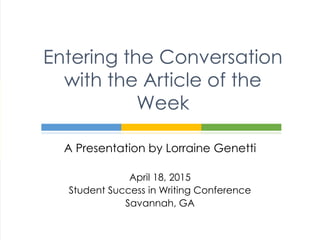
A Presentation by Lorraine Genetti
April 18, 2015
Student Success in Writing Conference
Savannah, GA
Entering the Conversation
with the Article of the
Week
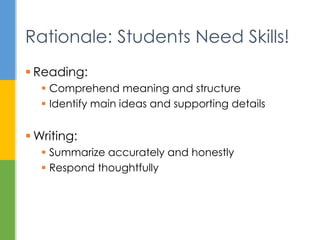
 Reading:
 Comprehend meaning and structure
 Identify main ideas and supporting details
 Writing:
 Summarize accurately and honestly
 Respond thoughtfully
Rationale: Students Need Skills!
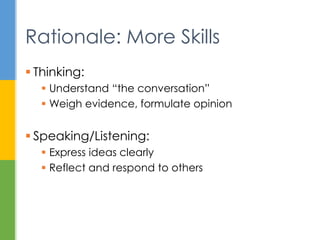
 Thinking:
 Understand “the conversation”
 Weigh evidence, formulate opinion
 Speaking/Listening:
 Express ideas clearly
 Reflect and respond to others
Rationale: More Skills
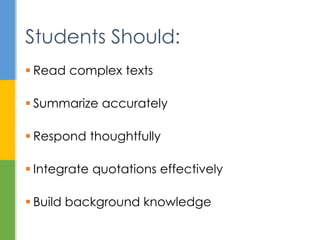
 Read complex texts
 Summarize accurately
 Respond thoughtfully
 Integrate quotations effectively
 Build background knowledge
Students Should:
 “Argument is the currency of academic
discourse, and learning to argue is a
necessary skill if students are to succeed in
their college careers.”
 First-year composition courses teach the
skills of argument
 Help raise public discourse from the
“abysmal” depths to which it has sunk
Duffy, John. “Virtuous Arguments.” Inside Higher Ed.16 March
2012. Web.
John Duffy: “Virtuous Arguments”
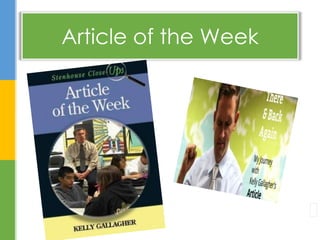
Article of the Week
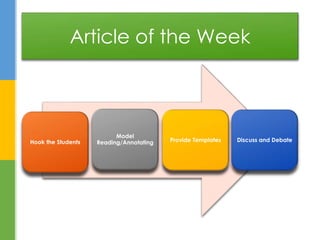
Hook the Students
Model
Reading/Annotating Provide Templates Discuss and Debate
Article of the Week
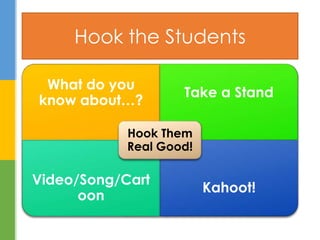
What do you
know about…?
Take a Stand
Video/Song/Cart
oon
Kahoot!
Hook Them
Real Good!
Hook the Students
 Ebola Quiz
 Account for teachers: getkahoot.com
Kahoot.it
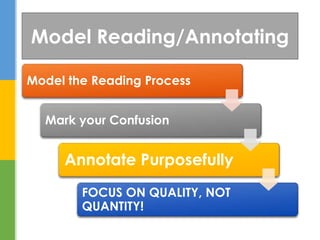
Model the Reading Process
Mark your Confusion
Annotate Purposefully
FOCUS ON QUALITY, NOT
QUANTITY!
Model Reading/Annotating
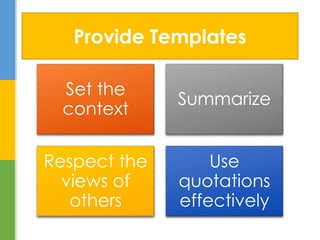
Set the
context
Summarize
Respect the
views of
others
Use
quotations
effectively
Provide Templates
 Students must be able to adequately and
honestly summarize the position of their
opponent before they undertake to put forth
their own views (Fleming 256).
 Templates provide guidance and structure to
keep students focused on what the article
actually says.
Fleming, David. “Rhetoric and Argumentation.” A Guide to
Composition Pedagogies. Ed. Gary Tate et al. New York: Oxford
UP, 2013. Print.
Locating Themselves in the
Conversation
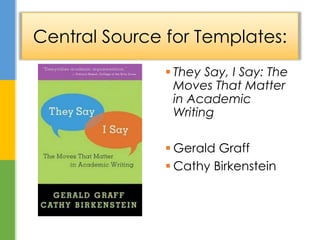
 They Say, I Say: The
Moves That Matter
in Academic
Writing
 Gerald Graff
 Cathy Birkenstein
Central Source for Templates:
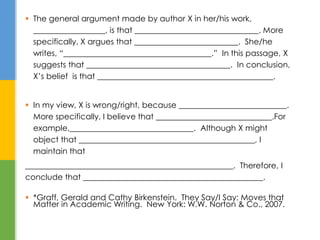
 The general argument made by author X in her/his work,
__________________, is that _______________________________. More
specifically, X argues that __________________________. She/he
writes, “_____________________________________.” In this passage, X
suggests that ____________________________________. In conclusion,
X’s belief is that ____________________________________________.
 In my view, X is wrong/right, because ___________________________.
More specifically, I believe that _____________________________.For
example,_______________________________. Although X might
object that ____________________________________________, I
maintain that
____________________________________________________. Therefore, I
conclude that _____________________________________________.
 *Graff, Gerald and Cathy Birkenstein. They Say/I Say: Moves that
Matter in Academic Writing. New York: W.W. Norton & Co., 2007.
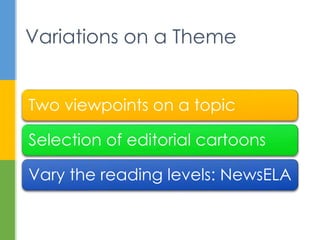
Two viewpoints on a topic
Selection of editorial cartoons
Vary the reading levels: NewsELA
Variations on a Theme
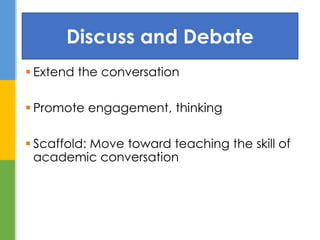
 Extend the conversation
 Promote engagement, thinking
 Scaffold: Move toward teaching the skill of
academic conversation
Discuss and Debate
 TeachingEnglishMatters.weebly.com
Collection of Resources for
News Articles, Templates, Ideas
 Duffy, John. “Virtuous Arguments.” Inside Higher
Ed. March 16, 2012. Web.
 Fleming, David. “Rhetoric and Argumentation.” A
Guide to Composition Pedagogies. Ed. Gary Tate
et al. New York: Oxford UP, 2013. Print.
 Gallagher, Kelly, and Richard L. Allington.
Readicide: How Schools Are Killing Reading and
What You Can Do About It. Portland, Me:
Stenhouse Publishers, 2009. Print.
 Graff, Gerald and Cathy Birkenstein. They Say/I
Say: Moves that Matter in Academic Writing. New
York: W.W. Norton & Co., 2007. Print.
 Stuart, Dave. "There and Back Again: My Journey
with Gallagher's Article of the Week Assignment."
Web log post. Teaching the Core. Dave Stuart
Consulting LLC, 27 Sept. 2014. Web. 2 Mar. 2015.
Resources

Entering the conversation

  • 1.
    A Presentation byLorraine Genetti April 18, 2015 Student Success in Writing Conference Savannah, GA Entering the Conversation with the Article of the Week
  • 2.
     Reading:  Comprehendmeaning and structure  Identify main ideas and supporting details  Writing:  Summarize accurately and honestly  Respond thoughtfully Rationale: Students Need Skills!
  • 3.
     Thinking:  Understand“the conversation”  Weigh evidence, formulate opinion  Speaking/Listening:  Express ideas clearly  Reflect and respond to others Rationale: More Skills
  • 4.
     Read complextexts  Summarize accurately  Respond thoughtfully  Integrate quotations effectively  Build background knowledge Students Should:
  • 5.
     “Argument isthe currency of academic discourse, and learning to argue is a necessary skill if students are to succeed in their college careers.”  First-year composition courses teach the skills of argument  Help raise public discourse from the “abysmal” depths to which it has sunk Duffy, John. “Virtuous Arguments.” Inside Higher Ed.16 March 2012. Web. John Duffy: “Virtuous Arguments”
  • 6.
  • 7.
    Hook the Students Model Reading/AnnotatingProvide Templates Discuss and Debate Article of the Week
  • 8.
    What do you knowabout…? Take a Stand Video/Song/Cart oon Kahoot! Hook Them Real Good! Hook the Students
  • 9.
     Ebola Quiz Account for teachers: getkahoot.com Kahoot.it
  • 10.
    Model the ReadingProcess Mark your Confusion Annotate Purposefully FOCUS ON QUALITY, NOT QUANTITY! Model Reading/Annotating
  • 11.
    Set the context Summarize Respect the viewsof others Use quotations effectively Provide Templates
  • 12.
     Students mustbe able to adequately and honestly summarize the position of their opponent before they undertake to put forth their own views (Fleming 256).  Templates provide guidance and structure to keep students focused on what the article actually says. Fleming, David. “Rhetoric and Argumentation.” A Guide to Composition Pedagogies. Ed. Gary Tate et al. New York: Oxford UP, 2013. Print. Locating Themselves in the Conversation
  • 13.
     They Say,I Say: The Moves That Matter in Academic Writing  Gerald Graff  Cathy Birkenstein Central Source for Templates:
  • 14.
     The generalargument made by author X in her/his work, __________________, is that _______________________________. More specifically, X argues that __________________________. She/he writes, “_____________________________________.” In this passage, X suggests that ____________________________________. In conclusion, X’s belief is that ____________________________________________.  In my view, X is wrong/right, because ___________________________. More specifically, I believe that _____________________________.For example,_______________________________. Although X might object that ____________________________________________, I maintain that ____________________________________________________. Therefore, I conclude that _____________________________________________.  *Graff, Gerald and Cathy Birkenstein. They Say/I Say: Moves that Matter in Academic Writing. New York: W.W. Norton & Co., 2007.
  • 15.
    Two viewpoints ona topic Selection of editorial cartoons Vary the reading levels: NewsELA Variations on a Theme
  • 16.
     Extend theconversation  Promote engagement, thinking  Scaffold: Move toward teaching the skill of academic conversation Discuss and Debate
  • 17.
     TeachingEnglishMatters.weebly.com Collection ofResources for News Articles, Templates, Ideas
  • 18.
     Duffy, John.“Virtuous Arguments.” Inside Higher Ed. March 16, 2012. Web.  Fleming, David. “Rhetoric and Argumentation.” A Guide to Composition Pedagogies. Ed. Gary Tate et al. New York: Oxford UP, 2013. Print.  Gallagher, Kelly, and Richard L. Allington. Readicide: How Schools Are Killing Reading and What You Can Do About It. Portland, Me: Stenhouse Publishers, 2009. Print.  Graff, Gerald and Cathy Birkenstein. They Say/I Say: Moves that Matter in Academic Writing. New York: W.W. Norton & Co., 2007. Print.  Stuart, Dave. "There and Back Again: My Journey with Gallagher's Article of the Week Assignment." Web log post. Teaching the Core. Dave Stuart Consulting LLC, 27 Sept. 2014. Web. 2 Mar. 2015. Resources