1
GAURA TEXTILE STUDIO
INTERNSHIP
REPORT
HAND BLOCK PRINTING
Harsha GOPLANI
4/16/2017
ACKNOWLEDGEMENT
The internship opportunity I had with GAURA TEXTILE STUDIO was a
great chance for learning and professional development. Therefore, I
consider myself as a very lucky individual as I was provided with an
opportunity to be a part of it. I am also grateful for having a chance to meet
so many wonderful people and professionals who led me though this
internship period.
Bearing in mind previous I am using this opportunity to express my
deepest gratitude and special thanks to the head of the organisations. who in
spite of being extraordinarily busy with her duties, took time out to hear,
guide and keep me on the correct path and allowing me to carry out my
project at her esteemed organization and extending during the training.
I express my deepest thanks to {GAURA TEXTILE STUDIO } and Dr.Renu
Jain and Dr. M.L.Nath{ Director of IEHE} for taking part in useful decision &
giving necessary advices and guidance and arranged all facilities to make life
easier. I choose this moment to acknowledge their contribution gratefully.
It is my radiant sentiment to place on record my best regards, deepest
sense of gratitude to Mrs. Deepa & Mr. Lalit {printing-GAURA TEXTILE
STUDIO for their careful and precious guidance which were extremely
valuable for my study both theoretically and practically.
I perceive as this opportunity as a big milestone in my career
development. I will strive to use gained skills and knowledge in the best
possible way, and I will continue to work on their improvement, in order to
attain desired career objectives. Hope to continue cooperation with all of you
in the future.Sincerely.
HARSHA GOPANI
CERTIFICATE
This is to certify that Ms. Harsha Goplani has
successfully completed her winter internship
on {hand block printing} under the guidance
of Miss Gaura Joshi the duration being 8
weeks from 15th dec.2016.
Signature of the HOD
INDEX
INTRODUCTION
ORGANISATION
ABOUT OWNER
OBJECTIVE
INTRODUCTION TO HAND BLOCK
HISTORY OF BLOCK
TYPES OF BLOCKS
PROCESS OF BLOCK PRINTING
ORGANISATION STRUCTURE
PRODUCTS DEVELOPED
PHOTOGRAPHS
INTRODUCTION
ORGANISATION:- Studio Gaura is a block printing
unit situated at new market, Bhopal. It has its own
printing unit having a single printing bed and a huge
collection of blocks created and designed and few of
them bought from Jaipur and Farookabad. The
colours used at this unit are pigment colours of high
quality. which only adds to quality of the garment.
The studio is owned by Miss Gaura Joshi.
OWNER:-.Gaura Joshi is a design graduate from
Indian Institute of Craft and Design, Jaipur
{Rajasthan}.IICD is one of the top institute in India
which specialises in craft and design.
Born and brought up in Bhopal, she completed her
schooling from Carmel convent school, Bhopal in the
year 2009 and then decided to pursue her passion in
designing. She chose textile designing and
completed her Bachelors in Designing in the year
2013. Soon after, she started her own design studio
in Bhopal. She specialises in hand block printing, tie
and dye. She also designs and creates handmade
blocks.
She has done various projects with organisation like
Weaver's Studio-Kolkata and Tantuk Weaves-
Dehradun. She has training to women in NGO duster
in Bhegpur- Uttrakhand to promote women
employment. She has been taking lectures at various
institutes in Bhopal which includes:- MLB College,
Institute for Excellence in Higher Education {IEHE},
Sant Hirdaram College, Dyalbagh Educational
Institute.
She has also been a part of the exam jury for
students of these institutes. She has been invited by
SAM Girls College and MLB College to judge their
fashion show and give expert talks on various
occasions.
Products of studio Gaura has been a part of various
competitions and have won first prize in IIM Indore
and AIMS Bhopal.
Studio Gaura not only creates exclusive and
exquisites products and designs but also is working
towards the cause of promoting and developing
craft sector. Gaura has been continuously been
working towards creating employment for women
by organising workshops for them.
It also encourages the students to learn and
undertake trainings in these sectors by providing
them short projects and internships at its own
printing unit.
BRIEF
OBJECTIVE:- To learn the technique of block
printing and developing the products using the
same for customers on the order basis as well as
learning the basic principles of designing and
applying them in the practical life.
INTRODUCTION TO HAND BLOCK:- Hand block
is the process of engraving the patterns on the
wooden block, dipped in natural and pigment
colours and traced on paper or fabric.
• Hand block is a tedious process as it is done
manually, either engraving or printing.
• Hand blocks are basically created at Pethapur-
Gujarat, Sanganer/ jaipur- Rajasthan, Farookabad-
Uttarpradesh and Bagh-Madhya pradesh.
• Blocks are made of wood and metal for
fineness in design.
TYPES OF BLOCKS: - Rekh, Datta, Gadh, Jaal,
Butti, Butta, Butti Jaal and Butta Jaal.
HISTORY OF BLOCKS:-
It originated in Rajasthan and was started by
Rajput community, Mughal's invaded in India and
forced Rajput's to fight with them to conquer
Rajasthan and both the communities fought
against each other and it resulted in the rivers of
blood but a group of Rajput community ran away
and denied to participate in war and hid. There
was no source of income for them to spend their
livelihood so they started practicing this art. It is
said that there was a leader of this group named
SANT NAAMDEV who had a dream, where god
explained him the process of hand block and he
explained the same to the other members and
tied and success.
The Mughal Raja came to know about the
practice of this intricate work and asked the
community to limit the printing only for them.
It involved the natural dyes, inspiration from
architecture and surroundings as they did not
worship human idols and believe in ALLAH.
The printing community was known as
CHEEPA as they printed and also because they
hid. this community hid nearby sanganer river
which had clear water which helped them to
bleach the fabric and thus the art was known as
sanganeri printing.
PROCESS OF PRINTING:-
Fabrics of same tints and shades are collected
and gathered for printing at a single day.
• To lay tray for printing binder is added and
pigment colours of high quality are combined
in addition of fixer. But while using khadi
colours and metallic colours the binder and
fixer differs accordingly.
• After mixing of colour with binder and fixer
and bringing it to centre with the help of
scrapper and that is than covered with several
layers of kambal jali , cotton fabric and net .
• Kambal jali is used for absorbing colour and
helping to apply colour evenly on the block.
Net is used for applying colour to the bold
block and fine blocks are used with cotton
fabric to apply colour to the block.
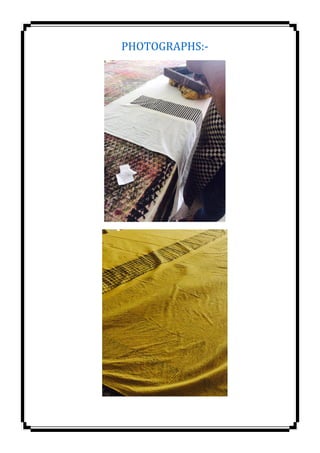
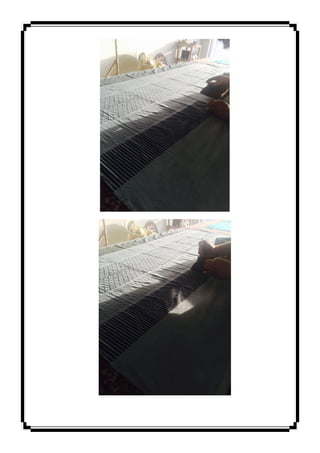
• After that fabric is laid straight on printing
table and is tucked with pins, colour tray is
laid on a piece of sponge to get the uniformity
is colour and printing and then block is
pressed against fabric to get the print.
• Printed fabric is than kept for drying and once
dried is ironed and packed for customer with
necessary details to be taken care.
ORGANISATION STRUCTURE:-
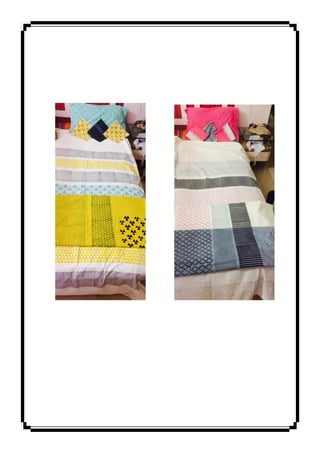
PRODUCTS DEVELOPED:-
1.Table cover
2.Silk fabric for shirt.
3.Bed linen consisting 1 single bed sheet, 1double
bed-sheet [Bombay dyeing].
4.6 pieces of cushion covers and 4-pillow covers.
5.Duvet covers 1 for single bed and 1 for double
bed.
Gaura Joshi
[head]
Deepa didi
[store
manager]
Intern
A
Intern
B
Lalit bhaiya
[ printing
expert]
Intern
C
PHOTOGRAPHS:-
GLOSSARY:-
1.REKH- OUTLINE.
2.DATTA-FILLER.
3.GADH- BACKGROUND.
4.JAAL- CONNECTING DESIGN.
5.BUTTI- SMALL MOTIF LESS THAN 3 INCHES.
6.BUTTA- BIGGER MOTIF MORE THAN 3 INCHES.
7.PANI JAAL- LIGHT CONNECTING DESIGN.
8.KHADI COLOR-SUCH COLOURS CAN BE USED ON
DARKER FABRIC.
9.BINDER-AGENT TO COMBINE/HOLD THE
COLOUR.
10. FIXER- AGENT TO FIX OR HOLD COLOUR ON
TO THE FABRIC.
BIBLIOGRAPHY:-
 Gaura textile studio.
 Block printing- Wikipedia.
 Study.com
 Strandofsilk.com
 utsavpedia.com
 Indianroots daily (blog)

Gaura internship documentation

  • 1.
    1 GAURA TEXTILE STUDIO INTERNSHIP REPORT HANDBLOCK PRINTING Harsha GOPLANI 4/16/2017
  • 2.
    ACKNOWLEDGEMENT The internship opportunityI had with GAURA TEXTILE STUDIO was a great chance for learning and professional development. Therefore, I consider myself as a very lucky individual as I was provided with an opportunity to be a part of it. I am also grateful for having a chance to meet so many wonderful people and professionals who led me though this internship period. Bearing in mind previous I am using this opportunity to express my deepest gratitude and special thanks to the head of the organisations. who in spite of being extraordinarily busy with her duties, took time out to hear, guide and keep me on the correct path and allowing me to carry out my project at her esteemed organization and extending during the training. I express my deepest thanks to {GAURA TEXTILE STUDIO } and Dr.Renu Jain and Dr. M.L.Nath{ Director of IEHE} for taking part in useful decision & giving necessary advices and guidance and arranged all facilities to make life easier. I choose this moment to acknowledge their contribution gratefully. It is my radiant sentiment to place on record my best regards, deepest sense of gratitude to Mrs. Deepa & Mr. Lalit {printing-GAURA TEXTILE STUDIO for their careful and precious guidance which were extremely valuable for my study both theoretically and practically. I perceive as this opportunity as a big milestone in my career development. I will strive to use gained skills and knowledge in the best possible way, and I will continue to work on their improvement, in order to attain desired career objectives. Hope to continue cooperation with all of you in the future.Sincerely. HARSHA GOPANI
  • 3.
    CERTIFICATE This is tocertify that Ms. Harsha Goplani has successfully completed her winter internship on {hand block printing} under the guidance of Miss Gaura Joshi the duration being 8 weeks from 15th dec.2016. Signature of the HOD
  • 4.
    INDEX INTRODUCTION ORGANISATION ABOUT OWNER OBJECTIVE INTRODUCTION TOHAND BLOCK HISTORY OF BLOCK TYPES OF BLOCKS PROCESS OF BLOCK PRINTING ORGANISATION STRUCTURE PRODUCTS DEVELOPED PHOTOGRAPHS
  • 5.
    INTRODUCTION ORGANISATION:- Studio Gaurais a block printing unit situated at new market, Bhopal. It has its own printing unit having a single printing bed and a huge collection of blocks created and designed and few of them bought from Jaipur and Farookabad. The colours used at this unit are pigment colours of high quality. which only adds to quality of the garment. The studio is owned by Miss Gaura Joshi. OWNER:-.Gaura Joshi is a design graduate from Indian Institute of Craft and Design, Jaipur {Rajasthan}.IICD is one of the top institute in India which specialises in craft and design. Born and brought up in Bhopal, she completed her schooling from Carmel convent school, Bhopal in the year 2009 and then decided to pursue her passion in designing. She chose textile designing and
  • 6.
    completed her Bachelorsin Designing in the year 2013. Soon after, she started her own design studio in Bhopal. She specialises in hand block printing, tie and dye. She also designs and creates handmade blocks. She has done various projects with organisation like Weaver's Studio-Kolkata and Tantuk Weaves- Dehradun. She has training to women in NGO duster in Bhegpur- Uttrakhand to promote women employment. She has been taking lectures at various institutes in Bhopal which includes:- MLB College, Institute for Excellence in Higher Education {IEHE}, Sant Hirdaram College, Dyalbagh Educational Institute. She has also been a part of the exam jury for students of these institutes. She has been invited by SAM Girls College and MLB College to judge their
  • 7.
    fashion show andgive expert talks on various occasions. Products of studio Gaura has been a part of various competitions and have won first prize in IIM Indore and AIMS Bhopal. Studio Gaura not only creates exclusive and exquisites products and designs but also is working towards the cause of promoting and developing craft sector. Gaura has been continuously been working towards creating employment for women by organising workshops for them. It also encourages the students to learn and undertake trainings in these sectors by providing them short projects and internships at its own printing unit.
  • 8.
    BRIEF OBJECTIVE:- To learnthe technique of block printing and developing the products using the same for customers on the order basis as well as learning the basic principles of designing and applying them in the practical life. INTRODUCTION TO HAND BLOCK:- Hand block is the process of engraving the patterns on the wooden block, dipped in natural and pigment colours and traced on paper or fabric. • Hand block is a tedious process as it is done manually, either engraving or printing. • Hand blocks are basically created at Pethapur- Gujarat, Sanganer/ jaipur- Rajasthan, Farookabad- Uttarpradesh and Bagh-Madhya pradesh. • Blocks are made of wood and metal for fineness in design.
  • 9.
    TYPES OF BLOCKS:- Rekh, Datta, Gadh, Jaal, Butti, Butta, Butti Jaal and Butta Jaal. HISTORY OF BLOCKS:- It originated in Rajasthan and was started by Rajput community, Mughal's invaded in India and forced Rajput's to fight with them to conquer Rajasthan and both the communities fought against each other and it resulted in the rivers of blood but a group of Rajput community ran away and denied to participate in war and hid. There was no source of income for them to spend their livelihood so they started practicing this art. It is said that there was a leader of this group named SANT NAAMDEV who had a dream, where god explained him the process of hand block and he explained the same to the other members and tied and success.
  • 10.
    The Mughal Rajacame to know about the practice of this intricate work and asked the community to limit the printing only for them. It involved the natural dyes, inspiration from architecture and surroundings as they did not worship human idols and believe in ALLAH. The printing community was known as CHEEPA as they printed and also because they hid. this community hid nearby sanganer river which had clear water which helped them to bleach the fabric and thus the art was known as sanganeri printing.
  • 11.
    PROCESS OF PRINTING:- Fabricsof same tints and shades are collected and gathered for printing at a single day. • To lay tray for printing binder is added and pigment colours of high quality are combined in addition of fixer. But while using khadi colours and metallic colours the binder and fixer differs accordingly. • After mixing of colour with binder and fixer and bringing it to centre with the help of scrapper and that is than covered with several layers of kambal jali , cotton fabric and net . • Kambal jali is used for absorbing colour and helping to apply colour evenly on the block. Net is used for applying colour to the bold
  • 12.
    block and fineblocks are used with cotton fabric to apply colour to the block. • After that fabric is laid straight on printing table and is tucked with pins, colour tray is laid on a piece of sponge to get the uniformity is colour and printing and then block is pressed against fabric to get the print. • Printed fabric is than kept for drying and once dried is ironed and packed for customer with necessary details to be taken care.
  • 13.
    ORGANISATION STRUCTURE:- PRODUCTS DEVELOPED:- 1.Tablecover 2.Silk fabric for shirt. 3.Bed linen consisting 1 single bed sheet, 1double bed-sheet [Bombay dyeing]. 4.6 pieces of cushion covers and 4-pillow covers. 5.Duvet covers 1 for single bed and 1 for double bed. Gaura Joshi [head] Deepa didi [store manager] Intern A Intern B Lalit bhaiya [ printing expert] Intern C
  • 14.
  • 17.
    GLOSSARY:- 1.REKH- OUTLINE. 2.DATTA-FILLER. 3.GADH- BACKGROUND. 4.JAAL-CONNECTING DESIGN. 5.BUTTI- SMALL MOTIF LESS THAN 3 INCHES. 6.BUTTA- BIGGER MOTIF MORE THAN 3 INCHES. 7.PANI JAAL- LIGHT CONNECTING DESIGN. 8.KHADI COLOR-SUCH COLOURS CAN BE USED ON DARKER FABRIC. 9.BINDER-AGENT TO COMBINE/HOLD THE COLOUR. 10. FIXER- AGENT TO FIX OR HOLD COLOUR ON TO THE FABRIC.
  • 18.
    BIBLIOGRAPHY:-  Gaura textilestudio.  Block printing- Wikipedia.  Study.com  Strandofsilk.com  utsavpedia.com  Indianroots daily (blog)