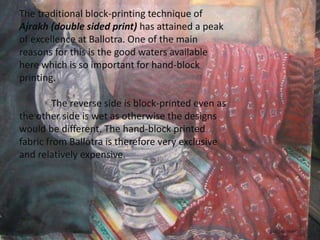
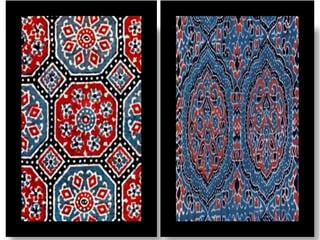
The traditional block-printing technique of
Ajrakh (double sided print) has attained a peak
of excellence at Ballotra. One of the main
reasons for this is the good waters available
here which is so important for hand-block
printing.
The reverse side is block-printed even as
the other side is wet as otherwise the designs
would be different. The hand-block printed
fabric from Ballotra is therefore very exclusive
and relatively expensive.
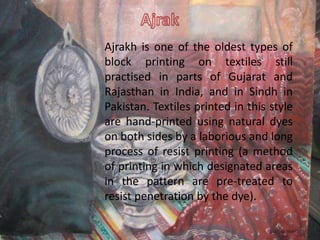
Ajrakh is one of the oldest types of
block printing on textiles still
practised in parts of Gujarat and
Rajasthan in India, and in Sindh in
Pakistan. Textiles printed in this style
are hand-printed using natural dyes
on both sides by a laborious and long
process of resist printing (a method
of printing in which designated areas
in the pattern are pre-treated to
resist penetration by the dye).
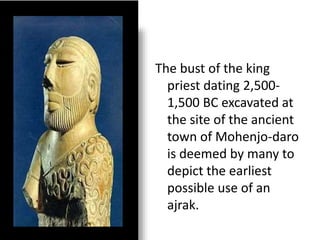
The bust of the king
priest dating 2,500-
1,500 BC excavated at
the site of the ancient
town of Mohenjo-daro
is deemed by many to
depict the earliest
possible use of an
ajrak.
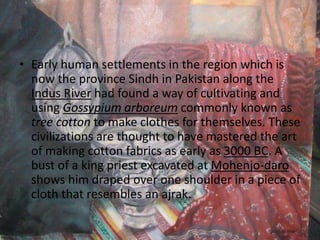
• Early human settlements in the region which is
now the province Sindh in Pakistan along the
Indus River had found a way of cultivating and
using Gossypium arboreum commonly known as
tree cotton to make clothes for themselves. These
civilizations are thought to have mastered the art
of making cotton fabrics as early as 3000 BC. A
bust of a king priest excavated at Mohenjo-daro
shows him draped over one shoulder in a piece of
cloth that resembles an ajrak.
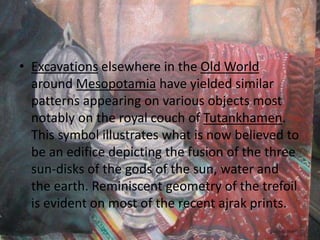
• Excavations elsewhere in the Old World
around Mesopotamia have yielded similar
patterns appearing on various objects most
notably on the royal couch of Tutankhamen.
This symbol illustrates what is now believed to
be an edifice depicting the fusion of the three
sun-disks of the gods of the sun, water and
the earth. Reminiscent geometry of the trefoil
is evident on most of the recent ajrak prints.
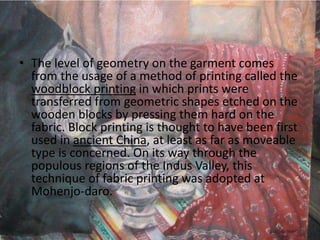
• The level of geometry on the garment comes
from the usage of a method of printing called the
woodblock printing in which prints were
transferred from geometric shapes etched on the
wooden blocks by pressing them hard on the
fabric. Block printing is thought to have been first
used in ancient China, at least as far as moveable
type is concerned. On its way through the
populous regions of the Indus Valley, this
technique of fabric printing was adopted at
Mohenjo-daro.
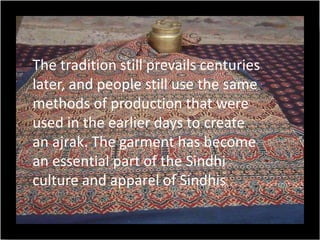
The tradition still prevails centuries
later, and people still use the same
methods of production that were
used in the earlier days to create
an ajrak. The garment has become
an essential part of the Sindhi
culture and apparel of Sindhis
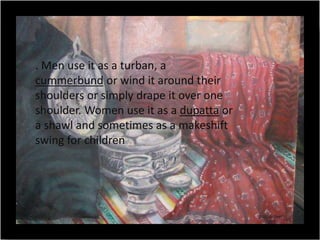
. Men use it as a turban, a
cummerbund or wind it around their
shoulders or simply drape it over one
shoulder. Women use it as a dupatta or
a shawl and sometimes as a makeshift
swing for children
• Traditional Ajrak Prints of Rajasthan
• Ajrak Process- The basic Difference is that the
white process is a very fine Dabu as
compared to the processes mentioned earlier
• 1. Desizing- It is done as explained in the Dabu
Process.
• 2. Myrobalan Process- Myrobalan is applied in
the same manner as explained in the Dabu
Process.
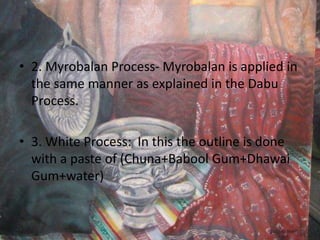
• 3. White Process: In this the outline is done
with a paste of (Chuna+Babool Gum+Dhawai
Gum+water)
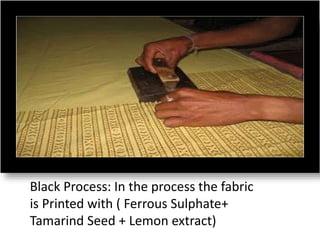
• Black Process: In the process the fabric
is Printed with ( Ferrous Sulphate+ Tamarind
Seed + Lemon extractBlack Process: In the
process the fabric is Printed with ( Ferrous
Sulphate+ Tamarind Seed + Lemon extract)
Black Process: In the process the fabric
is Printed with ( Ferrous Sulphate+
Tamarind Seed + Lemon extract)
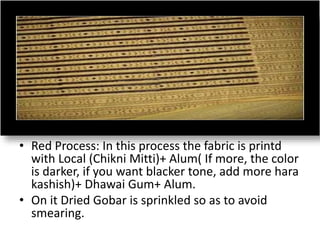
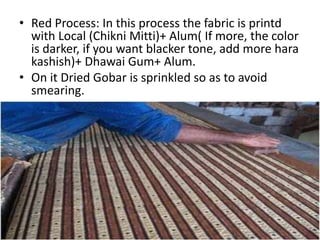
• Red Process: In this process the fabric is printd
with Local (Chikni Mitti)+ Alum( If more, the color
is darker, if you want blacker tone, add more hara
kashish)+ Dhawai Gum+ Alum.
• On it Dried Gobar is sprinkled so as to avoid
smearing.
• Red Process: In this process the fabric is printd
with Local (Chikni Mitti)+ Alum( If more, the color
is darker, if you want blacker tone, add more hara
kashish)+ Dhawai Gum+ Alum.
• On it Dried Gobar is sprinkled so as to avoid
smearing.
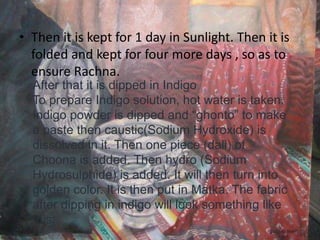
• Then it is kept for 1 day in Sunlight. Then it is
folded and kept for four more days , so as to
ensure Rachna.
After that it is dipped in Indigo
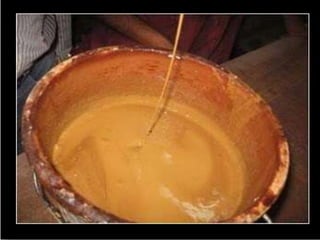
To prepare Indigo solution, hot water is taken.
Indigo powder is dipped and “ghonto” to make
a paste then caustic(Sodium Hydroxide) is
dissolved in it. Then one piece (dali) of
Choona is added. Then hydro (Sodium
Hydrosulphide) is added. It will then turn into
golden color. It is then put in Matka. The fabric
after dipping in indigo will look something like
this:
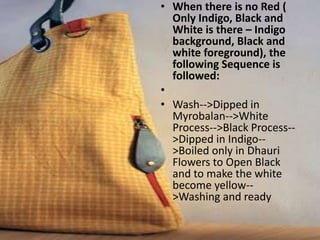
• When there is no Red (
Only Indigo, Black and
White is there – Indigo
background, Black and
white foreground), the
following Sequence is
followed:
•
• Wash-->Dipped in
Myrobalan-->White
Process-->Black Process--
>Dipped in Indigo--
>Boiled only in Dhauri
Flowers to Open Black
and to make the white
become yellow--
>Washing and ready
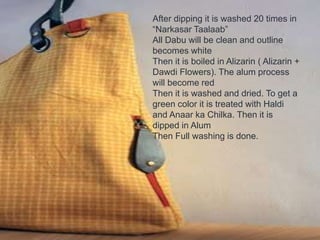
After dipping it is washed 20 times in
“Narkasar Taalaab”
All Dabu will be clean and outline
becomes white
Then it is boiled in Alizarin ( Alizarin +
Dawdi Flowers). The alum process
will become red
Then it is washed and dried. To get a
green color it is treated with Haldi
and Anaar ka Chilka. Then it is
dipped in Alum
Then Full washing is done.
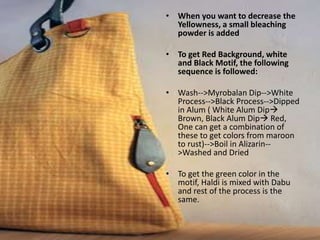
• When you want to decrease the
Yellowness, a small bleaching
powder is added
• To get Red Background, white
and Black Motif, the following
sequence is followed:
• Wash-->Myrobalan Dip-->White
Process-->Black Process-->Dipped
in Alum ( White Alum Dip
Brown, Black Alum Dip Red,
One can get a combination of
these to get colors from maroon
to rust)-->Boil in Alizarin--
>Washed and Dried
• To get the green color in the
motif, Haldi is mixed with Dabu
and rest of the process is the
same.
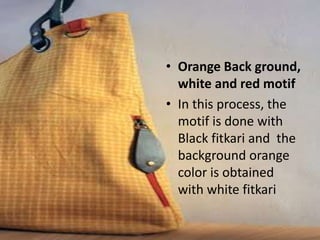
• Orange Back ground,
white and red motif
• In this process, the
motif is done with
Black fitkari and the
background orange
color is obtained
with white fitkari
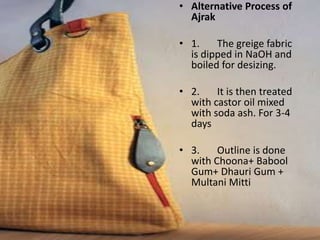
• Alternative Process of
Ajrak
• 1. The greige fabric
is dipped in NaOH and
boiled for desizing.
• 2. It is then treated
with castor oil mixed
with soda ash. For 3-4
days
• 3. Outline is done
with Choona+ Babool
Gum+ Dhauri Gum +
Multani Mitti
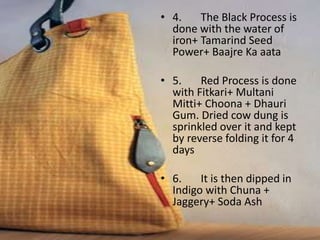
• 4. The Black Process is
done with the water of
iron+ Tamarind Seed
Power+ Baajre Ka aata
• 5. Red Process is done
with Fitkari+ Multani
Mitti+ Choona + Dhauri
Gum. Dried cow dung is
sprinkled over it and kept
by reverse folding it for 4
days
• 6. It is then dipped in
Indigo with Chuna +
Jaggery+ Soda Ash
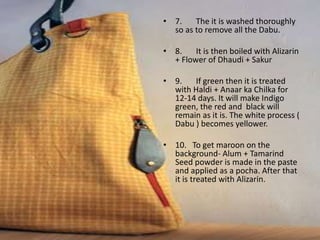
• 7. The it is washed thoroughly
so as to remove all the Dabu.
• 8. It is then boiled with Alizarin
+ Flower of Dhaudi + Sakur
• 9. If green then it is treated
with Haldi + Anaar ka Chilka for
12-14 days. It will make Indigo
green, the red and black will
remain as it is. The white process (
Dabu ) becomes yellower.
• 10. To get maroon on the
background- Alum + Tamarind
Seed powder is made in the paste
and applied as a pocha. After that
it is treated with Alizarin.
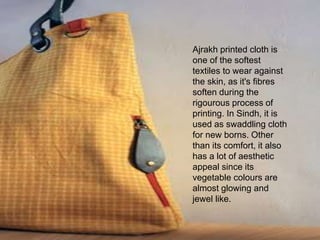
Ajrakh printed cloth is
one of the softest
textiles to wear against
the skin, as it's fibres
soften during the
rigourous process of
printing. In Sindh, it is
used as swaddling cloth
for new borns. Other
than its comfort, it also
has a lot of aesthetic
appeal since its
vegetable colours are
almost glowing and
jewel like.
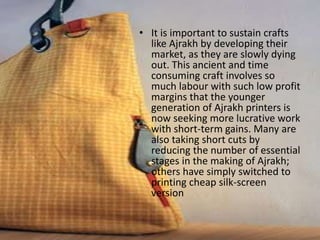
• It is important to sustain crafts
like Ajrakh by developing their
market, as they are slowly dying
out. This ancient and time
consuming craft involves so
much labour with such low profit
margins that the younger
generation of Ajrakh printers is
now seeking more lucrative work
with short-term gains. Many are
also taking short cuts by
reducing the number of essential
stages in the making of Ajrakh;
others have simply switched to
printing cheap silk-screen
version
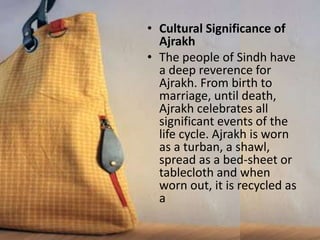
• Cultural Significance of
Ajrakh
• The people of Sindh have
a deep reverence for
Ajrakh. From birth to
marriage, until death,
Ajrakh celebrates all
significant events of the
life cycle. Ajrakh is worn
as a turban, a shawl,
spread as a bed-sheet or
tablecloth and when
worn out, it is recycled as
a
hammock for babies,
cover for a bullock cart
and most commonly
used as a backing to
patchwork quilts. It is
used and reused till
threadbare. It is worn
by the wealthy as well
as the poor — the
colours, patterns and
design-format remain
the same, only the
quality of the fabric is
different.
• Laborious Craft
• The process by which the
fabric is made is considered
intuitive to Ajrakh makers.
Ajrakh literally meant aaj ke
din rakh, or 'keep it for today'
because that is what the
process is. At every stage of
the tedious dying process, the
fabric should dry for three to
four days. Nature plays an
important role in the making
of Ajrakh. Craftsmen work in
total harmony with their
environment, where the sun,
river, animals, trees and mud
are all part of its making.
• First, cloth is torn into sheets
and taken to the river to be
washed. These are steamed in
copper vats for one night and a
day to open the pores of the
cloth and soften it. This process
is called khumbh in Sindh.
• Next, the fabric is soaked in a
mixture of camel dung, seed oil
and water. The dung enables
the cloth to become softer and
acts as a bleaching agent. This
stage is very crucial in
determining the quality of an
Ajrakh. The wet cloth is then
tied into an airtight bundle and
kept for five to 10 days,
depending upon the weather. A
distinct smell of mango pickle
emanating from the bundle
confirms that the fibres have
been well soaked with oil. This
is called the saaj.
• The cloth is then sun-dried and
soaked in oil that has been
curdled with carbonate of soda.
After a day, the cloth is washed
and re-soaked in a home-made
mixture of dried lemons,
molasses, castor oil and water,
amongst other things.
• Now, finally, the cloth is ready
for printing.
• Using the outline block, the
printer dips his block in kiryana
(a resist made with rice paste,
Acacia gum and lime) to print
on both sides of the cloth. The
printed pattern remains white.
The black areas are stamped on
the cloth with a filler-block.
• For the next stage, gum is
mixed with rice paste, alum,
molasses, fennel, Fuller’s earth
and other herbs to form the
mud resist-paste, called the
kharrh, which is printed on the
areas that are to be protected
against indigo dye, that is, the
areas meant to be white, black
and red.
• The cloth goes through the first
indigo dye. It is soaked in water
for at least an hour. To a
rhythmic count, craftsmen
swish and thrash the Ajrakhs in
water for an hour or more until
the gum and the excess dye
have been washed off and the
white areas become clear. This
stage is called vicharrh.
• In a large copper vat, the
Ajrakhs are dyed with madder
(Rubia Cordifolia).
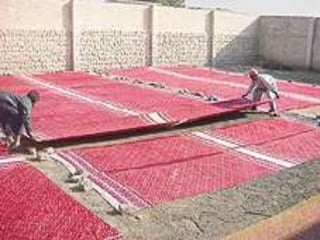
• On the riverbank or near a tank,
the red Ajrakhs are spread out to
partially dry in the sun. These are
wet again before they have
completely dried. This alternate
drying and drenching bleaches
the white areas and deepens
other colours.
• The mud resist mixture is again
printed to cover the red areas
and immediately sprinkled with
the sifted, dried cow dung to dry
the wet areas, called meena. The
thick, mud-encrusted cloth is
folded and slowly lowered into
the indigo vat for the second
time. The Ajrakhs are dried, rolled
into a bundle and then taken to
the river for the final wash. The
craftsmen fold the Ajrakhs while
still damp and the weight presses
them as they become dry.
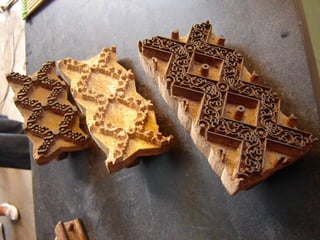
Ajrakh Blocks
• These are hand carved from
the wood of Acacia Arabica
trees. Several different
blocks are used to give the
characteristic repeated
patterning. Making the
blocks is a considerable
challenge since the pattern
has to synchronize perfectly
with the whole of the
Ajrakh as well as cover
various areas against dye.
Block makers (or poregars)
use the simplest of tools,
and carve each block that
can register an exact
inverted image on the other
side.
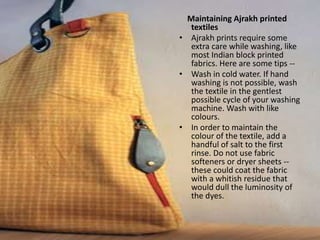
Maintaining Ajrakh printed
textiles
• Ajrakh prints require some
extra care while washing, like
most Indian block printed
fabrics. Here are some tips --
• Wash in cold water. If hand
washing is not possible, wash
the textile in the gentlest
possible cycle of your washing
machine. Wash with like
colours.
• In order to maintain the
colour of the textile, add a
handful of salt to the first
rinse. Do not use fabric
softeners or dryer sheets --
these could coat the fabric
with a whitish residue that
would dull the luminosity of
the dyes.
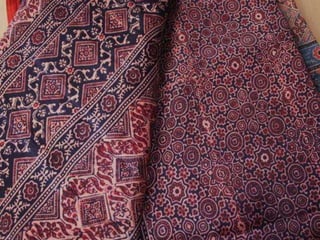
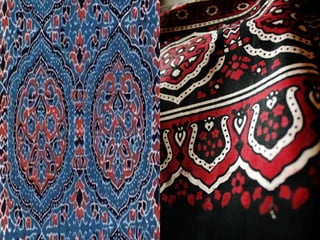
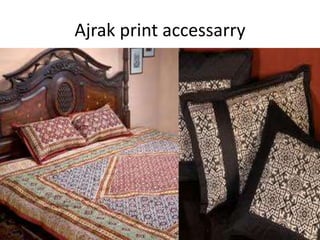
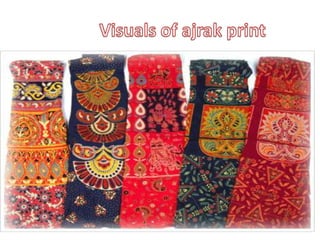
Ajrak print accessarry
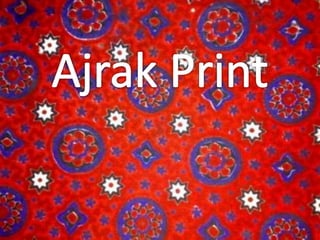
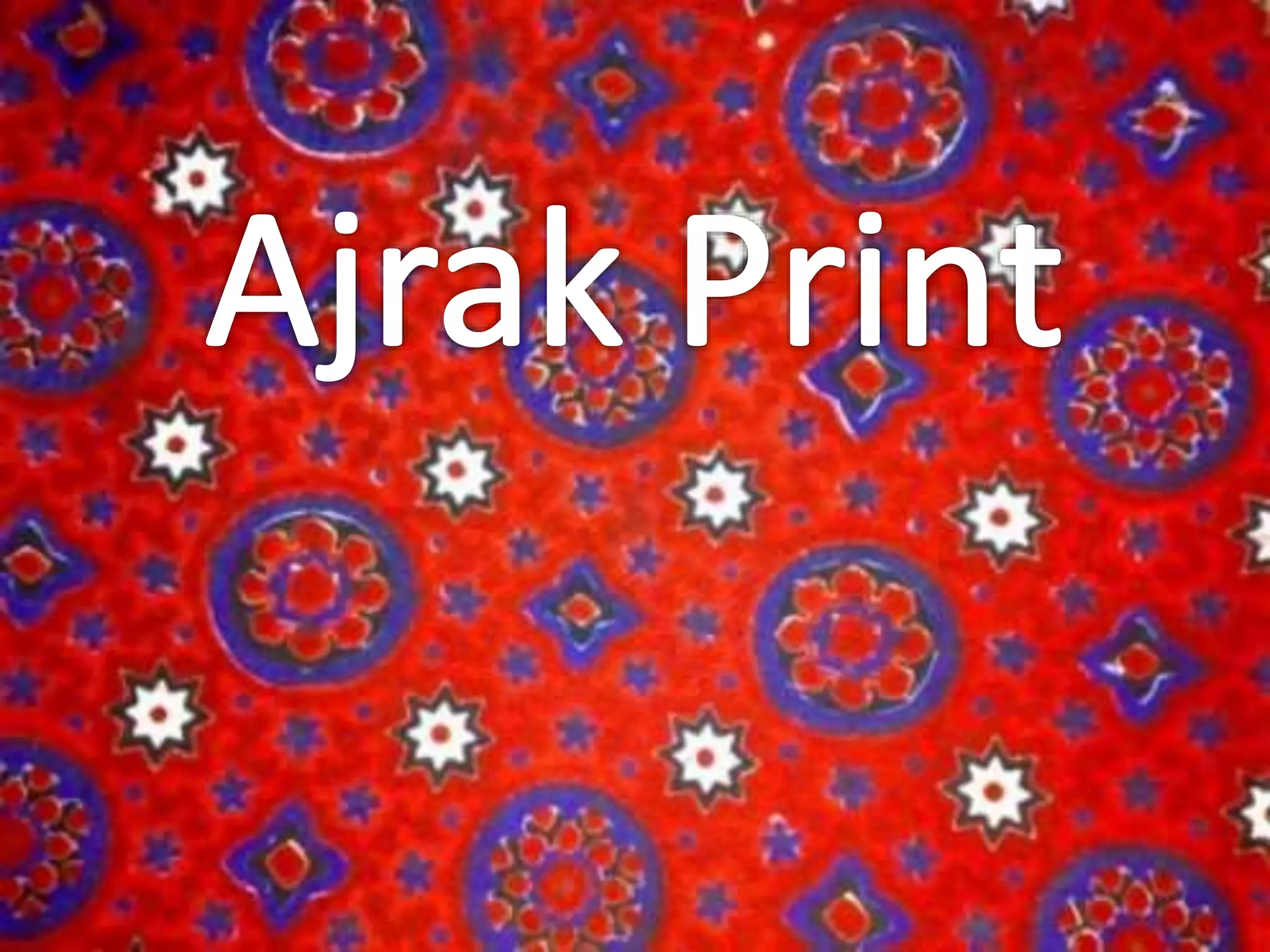
Ajrak print
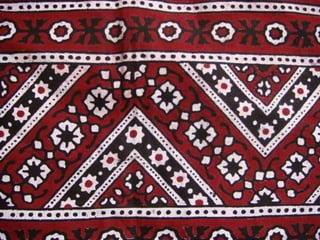
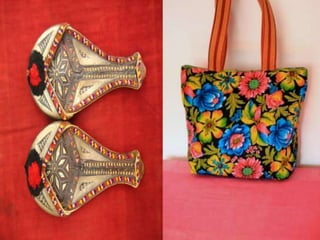
Ajrak print
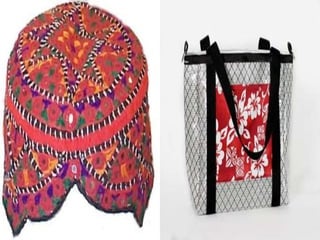
Ajrak print

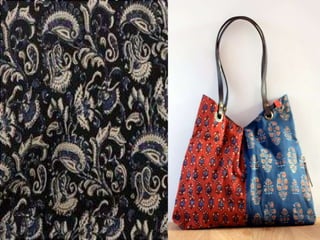
Ajrak print

  • 2.
    The traditional block-printingtechnique of Ajrakh (double sided print) has attained a peak of excellence at Ballotra. One of the main reasons for this is the good waters available here which is so important for hand-block printing. The reverse side is block-printed even as the other side is wet as otherwise the designs would be different. The hand-block printed fabric from Ballotra is therefore very exclusive and relatively expensive.
  • 3.
    Ajrakh is oneof the oldest types of block printing on textiles still practised in parts of Gujarat and Rajasthan in India, and in Sindh in Pakistan. Textiles printed in this style are hand-printed using natural dyes on both sides by a laborious and long process of resist printing (a method of printing in which designated areas in the pattern are pre-treated to resist penetration by the dye).
  • 5.
    The bust ofthe king priest dating 2,500- 1,500 BC excavated at the site of the ancient town of Mohenjo-daro is deemed by many to depict the earliest possible use of an ajrak.
  • 6.
    • Early humansettlements in the region which is now the province Sindh in Pakistan along the Indus River had found a way of cultivating and using Gossypium arboreum commonly known as tree cotton to make clothes for themselves. These civilizations are thought to have mastered the art of making cotton fabrics as early as 3000 BC. A bust of a king priest excavated at Mohenjo-daro shows him draped over one shoulder in a piece of cloth that resembles an ajrak.
  • 7.
    • Excavations elsewherein the Old World around Mesopotamia have yielded similar patterns appearing on various objects most notably on the royal couch of Tutankhamen. This symbol illustrates what is now believed to be an edifice depicting the fusion of the three sun-disks of the gods of the sun, water and the earth. Reminiscent geometry of the trefoil is evident on most of the recent ajrak prints.
  • 8.
    • The levelof geometry on the garment comes from the usage of a method of printing called the woodblock printing in which prints were transferred from geometric shapes etched on the wooden blocks by pressing them hard on the fabric. Block printing is thought to have been first used in ancient China, at least as far as moveable type is concerned. On its way through the populous regions of the Indus Valley, this technique of fabric printing was adopted at Mohenjo-daro.
  • 9.
    The tradition stillprevails centuries later, and people still use the same methods of production that were used in the earlier days to create an ajrak. The garment has become an essential part of the Sindhi culture and apparel of Sindhis
  • 10.
    . Men useit as a turban, a cummerbund or wind it around their shoulders or simply drape it over one shoulder. Women use it as a dupatta or a shawl and sometimes as a makeshift swing for children
  • 11.
    • Traditional AjrakPrints of Rajasthan • Ajrak Process- The basic Difference is that the white process is a very fine Dabu as compared to the processes mentioned earlier • 1. Desizing- It is done as explained in the Dabu Process.
  • 13.
    • 2. MyrobalanProcess- Myrobalan is applied in the same manner as explained in the Dabu Process. • 3. White Process: In this the outline is done with a paste of (Chuna+Babool Gum+Dhawai Gum+water)
  • 14.
    • Black Process:In the process the fabric is Printed with ( Ferrous Sulphate+ Tamarind Seed + Lemon extractBlack Process: In the process the fabric is Printed with ( Ferrous Sulphate+ Tamarind Seed + Lemon extract) Black Process: In the process the fabric is Printed with ( Ferrous Sulphate+ Tamarind Seed + Lemon extract)
  • 15.
    • Red Process:In this process the fabric is printd with Local (Chikni Mitti)+ Alum( If more, the color is darker, if you want blacker tone, add more hara kashish)+ Dhawai Gum+ Alum. • On it Dried Gobar is sprinkled so as to avoid smearing.
  • 16.
    • Red Process:In this process the fabric is printd with Local (Chikni Mitti)+ Alum( If more, the color is darker, if you want blacker tone, add more hara kashish)+ Dhawai Gum+ Alum. • On it Dried Gobar is sprinkled so as to avoid smearing.
  • 17.
    • Then itis kept for 1 day in Sunlight. Then it is folded and kept for four more days , so as to ensure Rachna. After that it is dipped in Indigo To prepare Indigo solution, hot water is taken. Indigo powder is dipped and “ghonto” to make a paste then caustic(Sodium Hydroxide) is dissolved in it. Then one piece (dali) of Choona is added. Then hydro (Sodium Hydrosulphide) is added. It will then turn into golden color. It is then put in Matka. The fabric after dipping in indigo will look something like this:
  • 18.
    • When thereis no Red ( Only Indigo, Black and White is there – Indigo background, Black and white foreground), the following Sequence is followed: • • Wash-->Dipped in Myrobalan-->White Process-->Black Process-- >Dipped in Indigo-- >Boiled only in Dhauri Flowers to Open Black and to make the white become yellow-- >Washing and ready
  • 19.
    After dipping itis washed 20 times in “Narkasar Taalaab” All Dabu will be clean and outline becomes white Then it is boiled in Alizarin ( Alizarin + Dawdi Flowers). The alum process will become red Then it is washed and dried. To get a green color it is treated with Haldi and Anaar ka Chilka. Then it is dipped in Alum Then Full washing is done.
  • 20.
    • When youwant to decrease the Yellowness, a small bleaching powder is added • To get Red Background, white and Black Motif, the following sequence is followed: • Wash-->Myrobalan Dip-->White Process-->Black Process-->Dipped in Alum ( White Alum Dip Brown, Black Alum Dip Red, One can get a combination of these to get colors from maroon to rust)-->Boil in Alizarin-- >Washed and Dried • To get the green color in the motif, Haldi is mixed with Dabu and rest of the process is the same.
  • 21.
    • Orange Background, white and red motif • In this process, the motif is done with Black fitkari and the background orange color is obtained with white fitkari
  • 22.
    • Alternative Processof Ajrak • 1. The greige fabric is dipped in NaOH and boiled for desizing. • 2. It is then treated with castor oil mixed with soda ash. For 3-4 days • 3. Outline is done with Choona+ Babool Gum+ Dhauri Gum + Multani Mitti
  • 23.
    • 4. TheBlack Process is done with the water of iron+ Tamarind Seed Power+ Baajre Ka aata • 5. Red Process is done with Fitkari+ Multani Mitti+ Choona + Dhauri Gum. Dried cow dung is sprinkled over it and kept by reverse folding it for 4 days • 6. It is then dipped in Indigo with Chuna + Jaggery+ Soda Ash
  • 24.
    • 7. Theit is washed thoroughly so as to remove all the Dabu. • 8. It is then boiled with Alizarin + Flower of Dhaudi + Sakur • 9. If green then it is treated with Haldi + Anaar ka Chilka for 12-14 days. It will make Indigo green, the red and black will remain as it is. The white process ( Dabu ) becomes yellower. • 10. To get maroon on the background- Alum + Tamarind Seed powder is made in the paste and applied as a pocha. After that it is treated with Alizarin.
  • 25.
    Ajrakh printed clothis one of the softest textiles to wear against the skin, as it's fibres soften during the rigourous process of printing. In Sindh, it is used as swaddling cloth for new borns. Other than its comfort, it also has a lot of aesthetic appeal since its vegetable colours are almost glowing and jewel like.
  • 26.
    • It isimportant to sustain crafts like Ajrakh by developing their market, as they are slowly dying out. This ancient and time consuming craft involves so much labour with such low profit margins that the younger generation of Ajrakh printers is now seeking more lucrative work with short-term gains. Many are also taking short cuts by reducing the number of essential stages in the making of Ajrakh; others have simply switched to printing cheap silk-screen version
  • 27.
    • Cultural Significanceof Ajrakh • The people of Sindh have a deep reverence for Ajrakh. From birth to marriage, until death, Ajrakh celebrates all significant events of the life cycle. Ajrakh is worn as a turban, a shawl, spread as a bed-sheet or tablecloth and when worn out, it is recycled as a
  • 28.
    hammock for babies, coverfor a bullock cart and most commonly used as a backing to patchwork quilts. It is used and reused till threadbare. It is worn by the wealthy as well as the poor — the colours, patterns and design-format remain the same, only the quality of the fabric is different.
  • 29.
    • Laborious Craft •The process by which the fabric is made is considered intuitive to Ajrakh makers. Ajrakh literally meant aaj ke din rakh, or 'keep it for today' because that is what the process is. At every stage of the tedious dying process, the fabric should dry for three to four days. Nature plays an important role in the making of Ajrakh. Craftsmen work in total harmony with their environment, where the sun, river, animals, trees and mud are all part of its making.
  • 30.
    • First, clothis torn into sheets and taken to the river to be washed. These are steamed in copper vats for one night and a day to open the pores of the cloth and soften it. This process is called khumbh in Sindh. • Next, the fabric is soaked in a mixture of camel dung, seed oil and water. The dung enables the cloth to become softer and acts as a bleaching agent. This stage is very crucial in determining the quality of an Ajrakh. The wet cloth is then tied into an airtight bundle and kept for five to 10 days, depending upon the weather. A distinct smell of mango pickle emanating from the bundle confirms that the fibres have been well soaked with oil. This is called the saaj.
  • 31.
    • The clothis then sun-dried and soaked in oil that has been curdled with carbonate of soda. After a day, the cloth is washed and re-soaked in a home-made mixture of dried lemons, molasses, castor oil and water, amongst other things. • Now, finally, the cloth is ready for printing. • Using the outline block, the printer dips his block in kiryana (a resist made with rice paste, Acacia gum and lime) to print on both sides of the cloth. The printed pattern remains white. The black areas are stamped on the cloth with a filler-block.
  • 32.
    • For thenext stage, gum is mixed with rice paste, alum, molasses, fennel, Fuller’s earth and other herbs to form the mud resist-paste, called the kharrh, which is printed on the areas that are to be protected against indigo dye, that is, the areas meant to be white, black and red. • The cloth goes through the first indigo dye. It is soaked in water for at least an hour. To a rhythmic count, craftsmen swish and thrash the Ajrakhs in water for an hour or more until the gum and the excess dye have been washed off and the white areas become clear. This stage is called vicharrh. • In a large copper vat, the Ajrakhs are dyed with madder (Rubia Cordifolia).
  • 33.
    • On theriverbank or near a tank, the red Ajrakhs are spread out to partially dry in the sun. These are wet again before they have completely dried. This alternate drying and drenching bleaches the white areas and deepens other colours. • The mud resist mixture is again printed to cover the red areas and immediately sprinkled with the sifted, dried cow dung to dry the wet areas, called meena. The thick, mud-encrusted cloth is folded and slowly lowered into the indigo vat for the second time. The Ajrakhs are dried, rolled into a bundle and then taken to the river for the final wash. The craftsmen fold the Ajrakhs while still damp and the weight presses them as they become dry.
  • 34.
    Ajrakh Blocks • Theseare hand carved from the wood of Acacia Arabica trees. Several different blocks are used to give the characteristic repeated patterning. Making the blocks is a considerable challenge since the pattern has to synchronize perfectly with the whole of the Ajrakh as well as cover various areas against dye. Block makers (or poregars) use the simplest of tools, and carve each block that can register an exact inverted image on the other side.
  • 36.
    Maintaining Ajrakh printed textiles •Ajrakh prints require some extra care while washing, like most Indian block printed fabrics. Here are some tips -- • Wash in cold water. If hand washing is not possible, wash the textile in the gentlest possible cycle of your washing machine. Wash with like colours. • In order to maintain the colour of the textile, add a handful of salt to the first rinse. Do not use fabric softeners or dryer sheets -- these could coat the fabric with a whitish residue that would dull the luminosity of the dyes.
  • 44.