Serco Internal
Mark Mamone, Global Chief Technology Officer, Serco Group plc.
Thursday 22 May 2014
Mobilising a Global Enterprise Architecture in a Digital World
Serco Public
About Serco
Our History
Expansion
1988 - 1998
Globalisation
1999 - Present
Foundation
1929 - 1964
Establishment
1965 - 1987
• Technical services • Facilities
management
• Systems
engineering
• Support services
• Outsourcing growth
• New market sectors
• New geographic
markets
• PFI and partnering
• More new markets
& countries
• Scale and pace
• Service integration
• New contracting
models
• Joint ventures and
strategic
partnership
Serco Public
About Serco
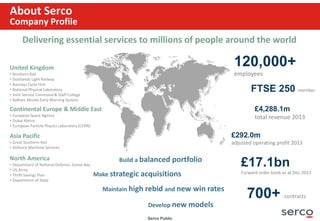
Company Profile
Delivering essential services to millions of people around the world
120,000+
employees
£4,288.1m
total revenue 2013
£292.0m
adjusted operating profit 2013
£17.1bn
Forward order book as at Dec 2013
FTSE 250 member
United Kingdom
• Northern Rail
• Docklands Light Railway
• Barclays Cycle Hire
• National Physical Laboratory
• Joint Service Command & Staff College
• Ballistic Missile Early Warning System
Continental Europe & Middle East
• European Space Agency
• Dubai Metro
• European Particle Physics Laboratory (CERN)
Asia Pacific
• Great Southern Rail
• Defence Maritime Services
North America
• Department of National Defence, Goose Bay
• US Army
• Thrift Savings Plan
• Department of State
Build a balanced portfolio
Maintain high rebid and new win rates
Make strategic acquisitions
700+ contracts
Develop new models
Serco Public
About Serco
Our business model and IT operating model
Value
creation
Customer
focus
Broad
business
Local
responsibility
global scale
Committed
people
IT Strategy
Policy &
Governance
IT delivery
‘efficient and
effective delivery’
Divisional
IT
‘change,
transition and
transformation’
Serco Public
Our Approach
Understanding
our business
Understanding
the driving
forces
Developing a
blueprint
leveraging
industry
frameworks
Assessment of
Enterprise
Architecture
tools available
Serco Public
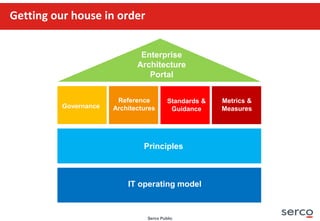
Getting our house in order
IT operating model
Principles
Governance
Reference
Architectures
Standards &
Guidance
Metrics &
Measures
Enterprise
Architecture
Portal
Serco Public
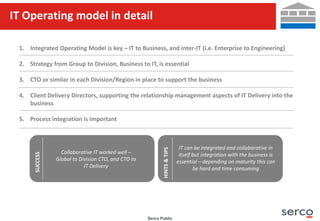
IT Operating model in detail
1. Integrated Operating Model is key – IT to Business, and inter-IT (i.e. Enterprise to Engineering)
2. Strategy from Group to Division, Business to IT, is essential
3. CTO or similar in each Division/Region in place to support the business
4. Client Delivery Directors, supporting the relationship management aspects of IT Delivery into the
business
5. Process integration is important
IT can be integrated and collaborative in
itself but integration with the business is
essential – depending on maturity this can
be hard and time consuming
Collaborative IT worked well –
Global to Division CTO, and CTO to
IT Delivery
SUCCESS
HINTS&TIPS
Serco Public
Principles
1. Establishing a set of Key Enterprise Principles is essential
2. Rationale and consequence are important to communicate the ‘why
bother’ factor
3. Embedding them in your EA processes is vital for them to be
understood, observed and followed
4. Publish them in a common and easily consumable way
5. Ensure that different perspectives of your stakeholders are reflected
Communicate – and communicate again
the relevance and importance
of principles
Allow domain specific
variations/exceptions BUT limit them
Global agreement and buy-in of the
principles from the outset
Enforcement through our EA
Governance Principles
SUCCESS
HINTS&TIPS
Serco Public
Governance
1. EA is referenced at the heart of our Business Lifecycle and Corporate Governance (SMS)
2. Accountability for compliance existed in local organisations through CTO’s
3. Integrated Operating Model meant that governance from strategy to engineering was applied
4. Formal rigour – chaired, minuted, measured and enforced using indicators and an audit process
Underestimated the amount of education
(training & communication required)
Consequence Management is imperative
Federated EA Model aligned to CTO
Accountability
Embedded within our Corporate
Governance
SUCCESS
HINTS&TIPS
Serco Public
Reference Architectures
1. Capability modelling – both business and technical is good
but needs context
2. Reference Architectures put capability (business and
technical) within a context
e.g. Markets > Business Units, Shared Services
3. Key tool for sales and delivery, and provides an anchor for
detailed Architectures, designs and standards
4. Common framework allows for local ownership but global
coordination
Tried to complete too many reference
architectures at once
Underestimated the effort required by the
CTO and Business SME’s to create them
Excellent communication tool
Supports federated and
collaborative development – whilst
promoting consistency
SUCCESS
HINTS&TIPS
Serco Public
Standards and Guidance
1. Definition of standards are essential in helping to realise economic
benefits
2. Enable you to leverage economies of scope and scale
3. Pragmatism is a must – Rule of “One” rarely works
4. Governance isn’t just about compliance – we used to good effect
to create standards and “buy-in”
5. Waiver process supports the formality of non-compliance
Global Standards are very hard (but not
impossible)
Standards aren’t always technologies – they
can be process, vendors, contracts etc.
Standards were accessible and
understood
Inclusive process of definition and
rationale
SUCCESS
HINTS&TIPS
Serco Public
Metrics and Measures
1. If you can’t measure it – you can’t manage it. Fact based decision making suited our organisation
and so Metrics & Measures were key
2. Use of Metrics & Measures to help with governance and standards
• Pipeline helps to ensure early engagement – identifying where it wasn’t happening
• Trends used to identify problem areas
3. Align your metrics to your process but not exclusively
Identifying the metrics and capturing the
data wasn’t – isn’t easy
EA Scorecard allowed us to
demonstrate EA was working
SUCCESS
HINTS&TIPS
Serco Public
Enterprise Architecture Portal
1. A method of communicating the framework and
its contents is essential – but can’t be used alone –
human communication is important too
2. Make it intuitive, user-centric and easy to consume
– you don’t get taught to use amazon.com
3. Recognise that your portal has different users and
hide complexity for those that want and need it –
the “Onion” method
4. Central custodian is important for data integrity
but process should underpin contributions to
avoid bottle necks
Adoption isn’t easy – you can lead a horse
to water but you can’t make it drink –
drive them to it with process and create
critical mass to provide encouragement
Evaluated our maturity and
focussed on it as a communication
tool initially.
Complexity came later
SUCCESS
HINTS&TIPS
Serco Public
What’s Next
Serco Public
Questions

Gartner EA Presentation v1

  • 1.
    Serco Internal Mark Mamone,Global Chief Technology Officer, Serco Group plc. Thursday 22 May 2014 Mobilising a Global Enterprise Architecture in a Digital World
  • 2.
    Serco Public About Serco OurHistory Expansion 1988 - 1998 Globalisation 1999 - Present Foundation 1929 - 1964 Establishment 1965 - 1987 • Technical services • Facilities management • Systems engineering • Support services • Outsourcing growth • New market sectors • New geographic markets • PFI and partnering • More new markets & countries • Scale and pace • Service integration • New contracting models • Joint ventures and strategic partnership
  • 3.
    Serco Public About Serco CompanyProfile Delivering essential services to millions of people around the world 120,000+ employees £4,288.1m total revenue 2013 £292.0m adjusted operating profit 2013 £17.1bn Forward order book as at Dec 2013 FTSE 250 member United Kingdom • Northern Rail • Docklands Light Railway • Barclays Cycle Hire • National Physical Laboratory • Joint Service Command & Staff College • Ballistic Missile Early Warning System Continental Europe & Middle East • European Space Agency • Dubai Metro • European Particle Physics Laboratory (CERN) Asia Pacific • Great Southern Rail • Defence Maritime Services North America • Department of National Defence, Goose Bay • US Army • Thrift Savings Plan • Department of State Build a balanced portfolio Maintain high rebid and new win rates Make strategic acquisitions 700+ contracts Develop new models
  • 4.
    Serco Public About Serco Ourbusiness model and IT operating model Value creation Customer focus Broad business Local responsibility global scale Committed people IT Strategy Policy & Governance IT delivery ‘efficient and effective delivery’ Divisional IT ‘change, transition and transformation’
  • 5.
    Serco Public Our Approach Understanding ourbusiness Understanding the driving forces Developing a blueprint leveraging industry frameworks Assessment of Enterprise Architecture tools available
  • 6.
    Serco Public Getting ourhouse in order IT operating model Principles Governance Reference Architectures Standards & Guidance Metrics & Measures Enterprise Architecture Portal
  • 7.
    Serco Public IT Operatingmodel in detail 1. Integrated Operating Model is key – IT to Business, and inter-IT (i.e. Enterprise to Engineering) 2. Strategy from Group to Division, Business to IT, is essential 3. CTO or similar in each Division/Region in place to support the business 4. Client Delivery Directors, supporting the relationship management aspects of IT Delivery into the business 5. Process integration is important IT can be integrated and collaborative in itself but integration with the business is essential – depending on maturity this can be hard and time consuming Collaborative IT worked well – Global to Division CTO, and CTO to IT Delivery SUCCESS HINTS&TIPS
  • 8.
    Serco Public Principles 1. Establishinga set of Key Enterprise Principles is essential 2. Rationale and consequence are important to communicate the ‘why bother’ factor 3. Embedding them in your EA processes is vital for them to be understood, observed and followed 4. Publish them in a common and easily consumable way 5. Ensure that different perspectives of your stakeholders are reflected Communicate – and communicate again the relevance and importance of principles Allow domain specific variations/exceptions BUT limit them Global agreement and buy-in of the principles from the outset Enforcement through our EA Governance Principles SUCCESS HINTS&TIPS
  • 9.
    Serco Public Governance 1. EAis referenced at the heart of our Business Lifecycle and Corporate Governance (SMS) 2. Accountability for compliance existed in local organisations through CTO’s 3. Integrated Operating Model meant that governance from strategy to engineering was applied 4. Formal rigour – chaired, minuted, measured and enforced using indicators and an audit process Underestimated the amount of education (training & communication required) Consequence Management is imperative Federated EA Model aligned to CTO Accountability Embedded within our Corporate Governance SUCCESS HINTS&TIPS
  • 10.
    Serco Public Reference Architectures 1.Capability modelling – both business and technical is good but needs context 2. Reference Architectures put capability (business and technical) within a context e.g. Markets > Business Units, Shared Services 3. Key tool for sales and delivery, and provides an anchor for detailed Architectures, designs and standards 4. Common framework allows for local ownership but global coordination Tried to complete too many reference architectures at once Underestimated the effort required by the CTO and Business SME’s to create them Excellent communication tool Supports federated and collaborative development – whilst promoting consistency SUCCESS HINTS&TIPS
  • 11.
    Serco Public Standards andGuidance 1. Definition of standards are essential in helping to realise economic benefits 2. Enable you to leverage economies of scope and scale 3. Pragmatism is a must – Rule of “One” rarely works 4. Governance isn’t just about compliance – we used to good effect to create standards and “buy-in” 5. Waiver process supports the formality of non-compliance Global Standards are very hard (but not impossible) Standards aren’t always technologies – they can be process, vendors, contracts etc. Standards were accessible and understood Inclusive process of definition and rationale SUCCESS HINTS&TIPS
  • 12.
    Serco Public Metrics andMeasures 1. If you can’t measure it – you can’t manage it. Fact based decision making suited our organisation and so Metrics & Measures were key 2. Use of Metrics & Measures to help with governance and standards • Pipeline helps to ensure early engagement – identifying where it wasn’t happening • Trends used to identify problem areas 3. Align your metrics to your process but not exclusively Identifying the metrics and capturing the data wasn’t – isn’t easy EA Scorecard allowed us to demonstrate EA was working SUCCESS HINTS&TIPS
  • 13.
    Serco Public Enterprise ArchitecturePortal 1. A method of communicating the framework and its contents is essential – but can’t be used alone – human communication is important too 2. Make it intuitive, user-centric and easy to consume – you don’t get taught to use amazon.com 3. Recognise that your portal has different users and hide complexity for those that want and need it – the “Onion” method 4. Central custodian is important for data integrity but process should underpin contributions to avoid bottle necks Adoption isn’t easy – you can lead a horse to water but you can’t make it drink – drive them to it with process and create critical mass to provide encouragement Evaluated our maturity and focussed on it as a communication tool initially. Complexity came later SUCCESS HINTS&TIPS
  • 14.
  • 15.