© Copyright 2013 Hewlett-Packard Development Company, L.P. The information contained herein is subject to change without notice.
Gamification
Understanding the possibilities for change
Charlie Bess, P.E.
Blog: Twitter: @cebess
© Copyright 2013 Hewlett-Packard Development Company, L.P. The information contained herein is subject to change without notice.2
Definition
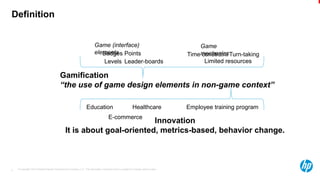
Gamification
“the use of game design elements in non-game context”
Education Employee training program
E-commerce
Healthcare
Badges
Levels
Points
Leader-boards
Game (interface)
elements Time constraint
Limited resources
Game
mechanicsTurn-taking
Innovation
It is about goal-oriented, metrics-based, behavior change.
© Copyright 2013 Hewlett-Packard Development Company, L.P. The information contained herein is subject to change without notice.3
A New World
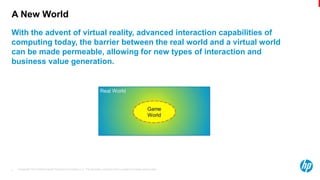
With the advent of virtual reality, advanced interaction capabilities of
computing today, the barrier between the real world and a virtual world
can be made permeable, allowing for new types of interaction and
business value generation.
© Copyright 2013 Hewlett-Packard Development Company, L.P. The information contained herein is subject to change without notice.4
Just using games in business
Gamification is not…
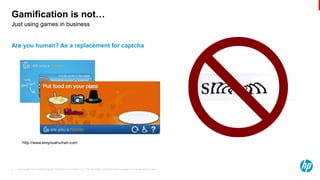
Are you human? As a replacement for captcha
http://www.areyouahuman.com
© Copyright 2013 Hewlett-Packard Development Company, L.P. The information contained herein is subject to change without notice.5
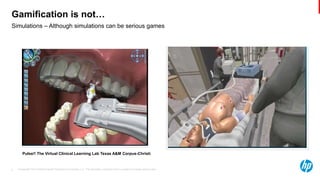
Simulations – Although simulations can be serious games
Gamification is not…
Pulse!! The Virtual Clinical Learning Lab Texas A&M Corpus-Christi
© Copyright 2013 Hewlett-Packard Development Company, L.P. The information contained herein is subject to change without notice.6
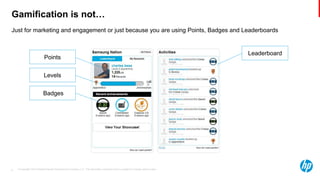
Just for marketing and engagement or just because you are using Points, Badges and Leaderboards
Gamification is not…
Leaderboard
Points
Levels
Badges
© Copyright 2013 Hewlett-Packard Development Company, L.P. The information contained herein is subject to change without notice.8
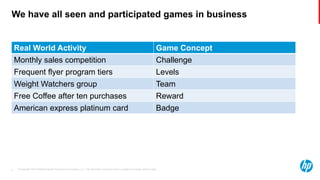
We have all seen and participated games in business
Real World Activity Game Concept
Monthly sales competition Challenge
Frequent flyer program tiers Levels
Weight Watchers group Team
Free Coffee after ten purchases Reward
American express platinum card Badge
© Copyright 2013 Hewlett-Packard Development Company, L.P. The information contained herein is subject to change without notice.9
Here is a challenge…
You know we’re talking about gamification – right?
Listen for the top 3 ideas that you’d like to take back to your workplace. Why did you find them
interesting?
I’ll be asking you to talk about these near the end.
© Copyright 2013 Hewlett-Packard Development Company, L.P. The information contained herein is subject to change without notice.10
Why now?
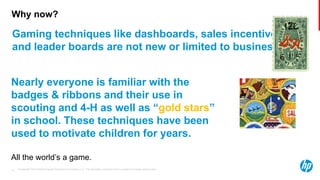
Gaming techniques like dashboards, sales incentives
and leader boards are not new or limited to business.
Nearly everyone is familiar with the
badges & ribbons and their use in
scouting and 4-H as well as “gold stars”
in school. These techniques have been
used to motivate children for years.
All the world’s a game.
© Copyright 2013 Hewlett-Packard Development Company, L.P. The information contained herein is subject to change without notice.11
Why now?
Business
• Ecosystem of partners and
services
• Reduction in product lifecycle
• Governance and compliance
• Green
• Innovation
Technology
• Mobile
• Cloud computing
• Analytics/big data
• Social
• Automation and Workflow
• Sensing & ubiquitous computing
Trends
© Copyright 2013 Hewlett-Packard Development Company, L.P. The information contained herein is subject to change without notice.12
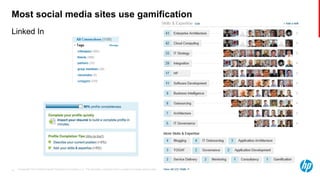
Most social media sites use gamification
Linked In
© Copyright 2013 Hewlett-Packard Development Company, L.P. The information contained herein is subject to change without notice.13
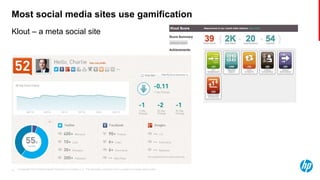
Most social media sites use gamification
Klout – a meta social site
© Copyright 2013 Hewlett-Packard Development Company, L.P. The information contained herein is subject to change without notice.14
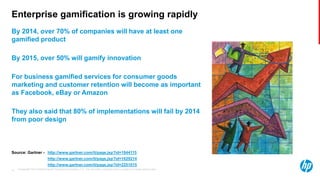
Enterprise gamification is growing rapidly
By 2014, over 70% of companies will have at least one
gamified product
By 2015, over 50% will gamify innovation
For business gamified services for consumer goods
marketing and customer retention will become as important
as Facebook, eBay or Amazon
They also said that 80% of implementations will fail by 2014
from poor design
Source: Gartner - http://www.gartner.com/it/page.jsp?id=1844115
http://www.gartner.com/it/page.jsp?id=1629214
http://www.gartner.com/it/page.jsp?id=2251015
© Copyright 2013 Hewlett-Packard Development Company, L.P. The information contained herein is subject to change without notice.15
It is applicable to all areas of services
Why should Gamification be of interest to you?
Exposed customers to additional capabilities (training):
• New hardware features
• Facilitate organizational change – Unified Communications
As a feature of a product:
• Improved project management or testing
Directly addresses business opportunities like:
• Customer retention
• Employee engagement
• Collaboration across business segments
• Business process adoption
• Delivery consistency
© Copyright 2013 Hewlett-Packard Development Company, L.P. The information contained herein is subject to change without notice.16
It can directly effect the bottom line
Gamification can benefit the enterprise
 Increase User engagement
 Motivate participation
 Influence behavior
 Drive adoption, learning
 Increase loyalty
 Improve quality of service
 Increase efficiency
 Reduce costs
Gamification Grows Up to Become a CEO's Best Friend - http://www.onforb.es/JcOFkH
© Copyright 2013 Hewlett-Packard Development Company, L.P. The information contained herein is subject to change without notice.17
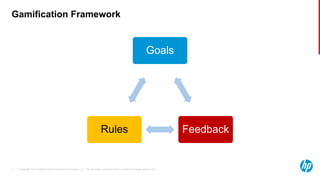
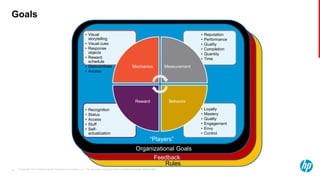
Gamification Framework
Goals
FeedbackRules
© Copyright 2013 Hewlett-Packard Development Company, L.P. The information contained herein is subject to change without notice.18
Rules
Feedback
Goals
Organizational Goals
“Players”
• Loyalty
• Mastery
• Quality
• Engagement
• Envy
• Control
• Recognition
• Status
• Access
• Stuff
• Self-
actualization
• Reputation
• Performance
• Quality
• Completion
• Quantity
• Time
• Visual
storytelling
• Visual cues
• Response
objects
• Reward
schedule
• Disincentives
• Access
Mechanics Measurement
BehaviorReward
© Copyright 2013 Hewlett-Packard Development Company, L.P. The information contained herein is subject to change without notice.19
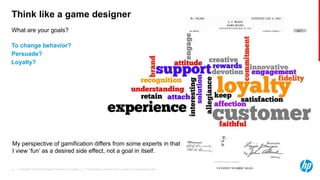
What are your goals?
Think like a game designer
To change behavior?
Persuade?
Loyalty?
My perspective of gamification differs from some experts in that
I view ‘fun’ as a desired side effect, not a goal in itself.
© Copyright 2013 Hewlett-Packard Development Company, L.P. The information contained herein is subject to change without notice.20
Who are the players?
Think like a game designer
The customers, employees, community, target population you are trying to affect…
• Players are the center of a game
• Players feel a sense of autonomy/control
• Players play
You needs to get your players playing and keep them playing.
How do you create an experience? Something that doesn’t get old…
© Copyright 2013 Hewlett-Packard Development Company, L.P. The information contained herein is subject to change without notice.21
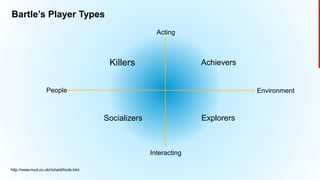
Bartle’s Player Types
Killers Achievers
ExplorersSocializers
People
Acting
Interacting
Environment
http://www.mud.co.uk/richard/hcds.htm
© Copyright 2013 Hewlett-Packard Development Company, L.P. The information contained herein is subject to change without notice.22
Game Balance
How many of you know about “flow”?
• Time passed without your awareness
• You think beyond the immediate task
Have any of you reached a state of flow in a gaming
environment?
What made you move into that state?
© Copyright 2013 Hewlett-Packard Development Company, L.P. The information contained herein is subject to change without notice.23
There are different kinds of fun
1. Easy Fun
• Exploration
• Fantasy
• Creativity
2. Hard fun
• Goals
• Obstacles
• Strategy
Nicole Lazzaro’s 4 Keys
POSTER -- http://xeodesign.com/4k2f/4k2f.jpg
WHITE PAPER -- http://www.xeodesign.com/xeodesign_whyweplaygames.pdf
3. Serious Fun
• Repetition
• Rhythm
• Collection
4. People fun
• Communicate
• Cooperate
• Compete
© Copyright 2013 Hewlett-Packard Development Company, L.P. The information contained herein is subject to change without notice.24
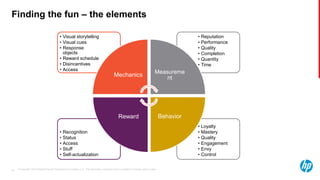
Finding the fun – the elements
• Loyalty
• Mastery
• Quality
• Engagement
• Envy
• Control
• Recognition
• Status
• Access
• Stuff
• Self-actualization
• Reputation
• Performance
• Quality
• Completion
• Quantity
• Time
• Visual storytelling
• Visual cues
• Response
objects
• Reward schedule
• Disincentives
• Access
Mechanics
Measureme
nt
BehaviorReward
© Copyright 2013 Hewlett-Packard Development Company, L.P. The information contained herein is subject to change without notice.25
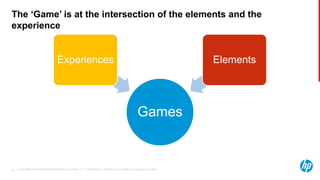
The ‘Game’ is at the intersection of the elements and the
experience
Games
Experiences Elements
© Copyright 2013 Hewlett-Packard Development Company, L.P. The information contained herein is subject to change without notice.26
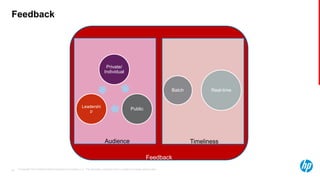
Feedback
Audience
Private/
Individual
Public
Leadershi
p
Batch Real-time
Timeliness
Feedback
© Copyright 2013 Hewlett-Packard Development Company, L.P. The information contained herein is subject to change without notice.27
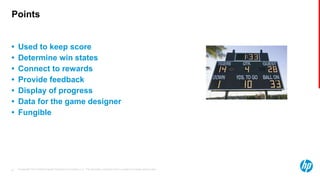
Points
• Used to keep score
• Determine win states
• Connect to rewards
• Provide feedback
• Display of progress
• Data for the game designer
• Fungible
© Copyright 2013 Hewlett-Packard Development Company, L.P. The information contained herein is subject to change without notice.28
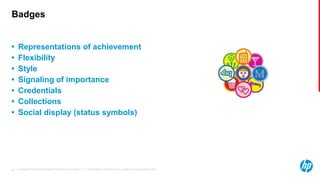
Badges
• Representations of achievement
• Flexibility
• Style
• Signaling of importance
• Credentials
• Collections
• Social display (status symbols)
© Copyright 2013 Hewlett-Packard Development Company, L.P. The information contained herein is subject to change without notice.29
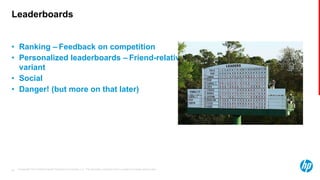
Leaderboards
• Ranking – Feedback on competition
• Personalized leaderboards – Friend-relative
variant
• Social
• Danger! (but more on that later)
© Copyright 2013 Hewlett-Packard Development Company, L.P. The information contained herein is subject to change without notice.30
Game Elements: foursquare.com
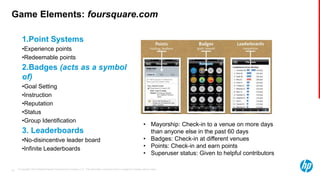
1.Point Systems
•Experience points
•Redeemable points
2.Badges (acts as a symbol
of)
•Goal Setting
•Instruction
•Reputation
•Status
•Group Identification
3. Leaderboards
•No-disincentive leader board
•Infinite Leaderboards
• Mayorship: Check-in to a venue on more days
than anyone else in the past 60 days

• Badges: Check-in at different venues
• Points: Check-in and earn points
• Superuser status: Given to helpful contributors
© Copyright 2013 Hewlett-Packard Development Company, L.P. The information contained herein is subject to change without notice.31
Pay attention to how these elements are perceived…
• The elements are not the game
• Not all rewards are fun
• Not all fun is rewarding
• It is not a cookie cutter, but you can learn from your mistakes
Beware of unintended consequences
© Copyright 2013 Hewlett-Packard Development Company, L.P. The information contained herein is subject to change without notice.32
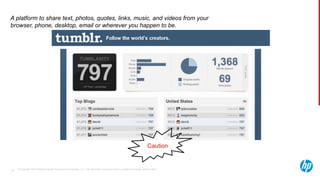
A platform to share text, photos, quotes, links, music, and videos from your
browser, phone, desktop, email or wherever you happen to be.
Caution
© Copyright 2013 Hewlett-Packard Development Company, L.P. The information contained herein is subject to change without notice.33
All games have rules
Rules
Rules provide :
• Structure and focus
o Have you ever heard someone say “that’s not fair”? It is because there are real or implied rules in play.
• Guidance
• A channel to move activities in desired ways
• Consistency (they can’t change, unless there is a reason for them to
change)
• A framework for self-discovery
• Understanding for the player of what’s important
Rules define how players go about achieving the goals; they are the challenge of the
game.
© Copyright 2013 Hewlett-Packard Development Company, L.P. The information contained herein is subject to change without notice.34
Why was that???
Have you ever seen a rules system that didn’t work?
© Copyright 2013 Hewlett-Packard Development Company, L.P. The information contained herein is subject to change without notice.35
Types
Rules
Decision points?
Structure vs. experimentation
Social vs. alone (extrinsic vs.
intrinsic)
Why
• Learning?
• Mastery?
• Experience?
• Persuade?
Remember it’s a game
Rules
© Copyright 2013 Hewlett-Packard Development Company, L.P. The information contained herein is subject to change without notice.36
Control is also a function of rules
Gaming the system
Looking for those unintended consequences
Cheating – it’s part of life
Gaming the system
© Copyright 2013 Hewlett-Packard Development Company, L.P. The information contained herein is subject to change without notice.
More Gamification Examples
© Copyright 2013 Hewlett-Packard Development Company, L.P. The information contained herein is subject to change without notice.38
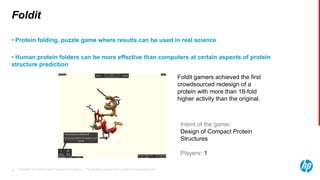
Intent of the game:
Design of Compact Protein
Structures
Players: 1
Foldit
• Protein folding, puzzle game where results can be used in real science
• Human protein folders can be more effective than computers at certain aspects of protein
structure prediction
Foldit gamers achieved the first
crowdsourced redesign of a
protein with more than 18-fold
higher activity than the original.
© Copyright 2013 Hewlett-Packard Development Company, L.P. The information contained herein is subject to change without notice.39
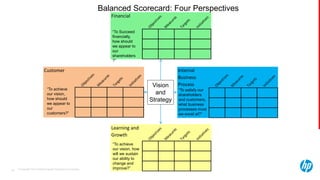
Financial
Objectives
M
easures
Targets
Initiatives
“To Succeed
financially,
how should
we appear to
our
shareholders
?”
Internal
Business
Process
Objectives
M
easures
Targets
Initiatives
“To satisfy our
shareholders
and customers,
what business
processes must
we excel at?”
Learning and
Growth
Objectives
M
easures
Targets
Initiatives
“To achieve
our vision, how
will we sustain
our ability to
change and
improve?”
Customer
Objectives
M
easures
Targets
Initiatives
“To achieve
our vision,
how should
we appear to
our
customers?”
Vision
and
Strategy
Balanced Scorecard: Four Perspectives
© Copyright 2013 Hewlett-Packard Development Company, L.P. The information contained herein is subject to change without notice.
Now What?
© Copyright 2013 Hewlett-Packard Development Company, L.P. The information contained herein is subject to change without notice.41
Be a game changer – ask questions
Starting a project
1. What are the goals?
2. Who are the players?
3. Understanding user motivation
4. Define the story
5. What will you measure?
6. What behaviors do you need to change?
7. What are the rewards?
8. How can you test the game?
© Copyright 2013 Hewlett-Packard Development Company, L.P. The information contained herein is subject to change without notice.42
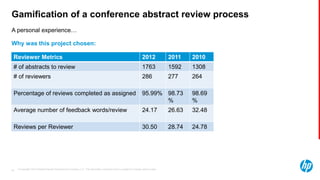
A personal experience…
Gamification of a conference abstract review process
Why was this project chosen:
Reviewer Metrics 2012 2011 2010
# of abstracts to review 1763 1592 1308
# of reviewers 286 277 264
Percentage of reviews completed as assigned 95.99% 98.73
%
98.69
%
Average number of feedback words/review 24.17 26.63 32.48
Reviews per Reviewer 30.50 28.74 24.78
© Copyright 2013 Hewlett-Packard Development Company, L.P. The information contained herein is subject to change without notice.43
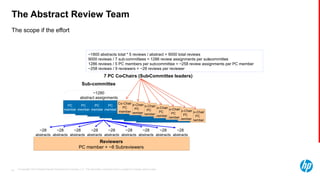
The scope if the effort
The Abstract Review Team
~1800 abstracts total * 5 reviews / abstract = 9000 total reviews
9000 reviews / 7 sub committees = 1286 review assignments per sub-committee
1286 reviews / 5 PC members per subcommittee = ~258 review assignments per PC member
~258 reviews / 9 reviewers = ~28 reviews per reviewer
7 PC Co-Chairs (Sub-Committee leaders)
Sub-committee
~1280
abstract assignments
abstracts
Reviewers
PC member + ~8 Subreviewers
Co-Chair
PC
member
PC
member
PC
member
PC
member
PC
member
PC
member
Co-Chair
PC
member
PC
member
PC
member
PC
member
PC
member
PC
member
Co-Chair
PC
member
PC
member
PC
member
PC
member
PC
member
PC
member
Co-Chair
PC
member
PC
member
PC
member
PC
member
PC
member
PC
member
Co-Chair
PC
member
PC
member
PC
member
PC
member
PC
member
PC
member
Co-Chair
PC
member
PC PC
member
PC
member
PC
member
PC
member
Co-Chair
PC
member
PC
member
PC
member
PC
member
PC
member
~28
abstracts
~28
abstracts
~28
abstracts
~28
abstracts
~28
abstracts
~28
abstracts
~28
abstracts
~28
abstracts
~28
abstracts
© Copyright 2013 Hewlett-Packard Development Company, L.P. The information contained herein is subject to change without notice.44
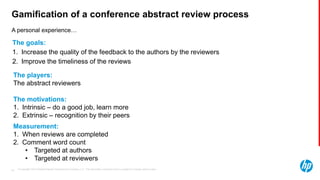
A personal experience…
Gamification of a conference abstract review process
The players:
The abstract reviewers
The motivations:
1. Intrinsic – do a good job, learn more
2. Extrinsic – recognition by their peers
The goals:
1. Increase the quality of the feedback to the authors by the reviewers
2. Improve the timeliness of the reviews
Measurement:
1. When reviews are completed
2. Comment word count
• Targeted at authors
• Targeted at reviewers
© Copyright 2013 Hewlett-Packard Development Company, L.P. The information contained herein is subject to change without notice.45
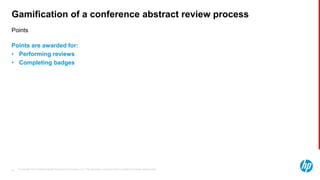
Points
Gamification of a conference abstract review process
Points are awarded for:
• Performing reviews
• Completing badges
© Copyright 2013 Hewlett-Packard Development Company, L.P. The information contained herein is subject to change without notice.46
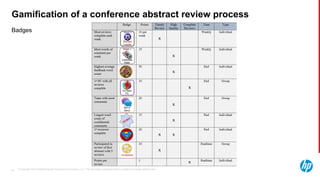
Badges
Gamification of a conference abstract review process
© Copyright 2013 Hewlett-Packard Development Company, L.P. The information contained herein is subject to change without notice.47
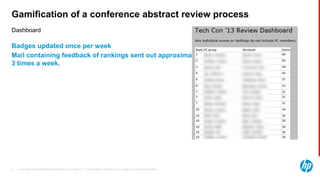
Dashboard
Gamification of a conference abstract review process
Badges updated once per week
Mail containing feedback of rankings sent out approximately
3 times a week.
© Copyright 2013 Hewlett-Packard Development Company, L.P. The information contained herein is subject to change without notice.48
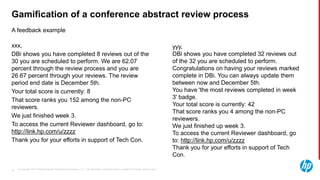
Gamification of a conference abstract review process
xxx,
DBi shows you have completed 8 reviews out of the
30 you are scheduled to perform. We are 62.07
percent through the review process and you are
26.67 percent through your reviews. The review
period end date is December 5th.
Your total score is currently: 8
That score ranks you 152 among the non-PC
reviewers.
We just finished week 3.
To access the current Reviewer dashboard, go to:
http://link.hp.com/u/zzzz
Thank you for your efforts in support of Tech Con.
A feedback example
yyy,
DBi shows you have completed 32 reviews out
of the 32 you are scheduled to perform.
Congratulations on having your reviews marked
complete in DBi. You can always update them
between now and December 5th.
You have 'the most reviews completed in week
3' badge.
Your total score is currently: 42
That score ranks you 4 among the non-PC
reviewers.
We just finished up week 3.
To access the current Reviewer dashboard, go
to: http://link.hp.com/u/zzzz
Thank you for your efforts in support of Tech
Con.
© Copyright 2013 Hewlett-Packard Development Company, L.P. The information contained herein is subject to change without notice.49
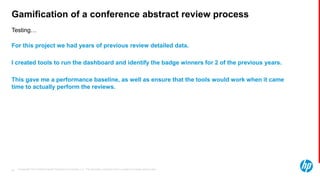
Testing…
Gamification of a conference abstract review process
For this project we had years of previous review detailed data.
I created tools to run the dashboard and identify the badge winners for 2 of the previous years.
This gave me a performance baseline, as well as ensure that the tools would work when it came
time to actually perform the reviews.
© Copyright 2013 Hewlett-Packard Development Company, L.P. The information contained herein is subject to change without notice.50
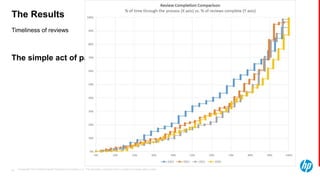
Timeliness of reviews
The Results
It may just be the Hawthorne effect:
The simple act of paying attention has a positive impact on productivity.
© Copyright 2013 Hewlett-Packard Development Company, L.P. The information contained herein is subject to change without notice.51
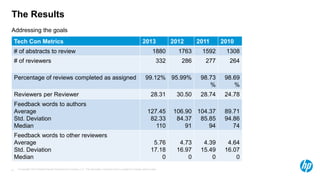
Addressing the goals
The Results
Tech Con Metrics 2013 2012 2011 2010
# of abstracts to review 1880 1763 1592 1308
# of reviewers 332 286 277 264
Percentage of reviews completed as assigned 99.12% 95.99% 98.73
%
98.69
%
Reviewers per Reviewer 28.31 30.50 28.74 24.78
Feedback words to authors
Average
Std. Deviation
Median
127.45
82.33
110
106.90
84.37
91
104.37
85.85
94
89.71
94.86
74
Feedback words to other reviewers
Average
Std. Deviation
Median
5.76
17.18
0
4.73
16.97
0
4.39
15.49
0
4.64
16.07
0
© Copyright 2013 Hewlett-Packard Development Company, L.P. The information contained herein is subject to change without notice.52
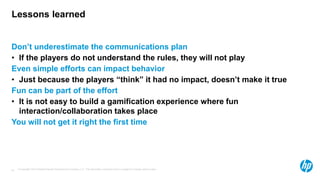
Lessons learned
Don’t underestimate the communications plan
• If the players do not understand the rules, they will not play
Even simple efforts can impact behavior
• Just because the players “think” it had no impact, doesn’t make it true
Fun can be part of the effort
• It is not easy to build a gamification experience where fun
interaction/collaboration takes place
You will not get it right the first time
© Copyright 2013 Hewlett-Packard Development Company, L.P. The information contained herein is subject to change without notice.53
I said I was going to ask you about this…
Challenge…
What were the top 3 tips that you’d like to take back to your workplace? Why?
© Copyright 2013 Hewlett-Packard Development Company, L.P. The information contained herein is subject to change without notice.
Discussion??
Charlie Bess, P.E.
e-mail: Charlie.bess@hp.com
Blog: http://www.hp.com/go/tnbt
Twitter: @cebess
© Copyright 2013 Hewlett-Packard Development Company, L.P. The information contained herein is subject to change without notice.55
References
Gamification 101: http://www.bunchball.com/sites/default/files/downloads/gamification101.pdf
Fun is the future: http://www.youtube.com/watch?v=6O1gNVeaE4g
Gartner Predicts Over 70% penetration of Gamification:
http://www.gartner.com/it/page.jsp?id=1844115
Gamification of the Enterprise: http://www.infoworld.com/d/applications/gamification-of-the-
enterprise-201959
Jane McGonigal, Reality is Broken: Why Games Make Us Better and How They Can Change the
World (New York: The Penguin Press, 2011),
Jane McGonigal video: Gaming Can Make a Better World”:
http://www.ted.com/talks/jane_mcgonigal_gaming_can_make_a_better_world.html
http://www.slideshare.net/ervler/gamification-how-effective-is-it
Chorewars: http://www.chorewars.com/help.php
Gamification course from Whorton on Coursera: https://class.coursera.org/gamification-2012-001/

Gamification presentation for ieee 2013 03

  • 1.
    © Copyright 2013Hewlett-Packard Development Company, L.P. The information contained herein is subject to change without notice. Gamification Understanding the possibilities for change Charlie Bess, P.E. Blog: Twitter: @cebess
  • 2.
    © Copyright 2013Hewlett-Packard Development Company, L.P. The information contained herein is subject to change without notice.2 Definition Gamification “the use of game design elements in non-game context” Education Employee training program E-commerce Healthcare Badges Levels Points Leader-boards Game (interface) elements Time constraint Limited resources Game mechanicsTurn-taking Innovation It is about goal-oriented, metrics-based, behavior change.
  • 3.
    © Copyright 2013Hewlett-Packard Development Company, L.P. The information contained herein is subject to change without notice.3 A New World With the advent of virtual reality, advanced interaction capabilities of computing today, the barrier between the real world and a virtual world can be made permeable, allowing for new types of interaction and business value generation.
  • 4.
    © Copyright 2013Hewlett-Packard Development Company, L.P. The information contained herein is subject to change without notice.4 Just using games in business Gamification is not… Are you human? As a replacement for captcha http://www.areyouahuman.com
  • 5.
    © Copyright 2013Hewlett-Packard Development Company, L.P. The information contained herein is subject to change without notice.5 Simulations – Although simulations can be serious games Gamification is not… Pulse!! The Virtual Clinical Learning Lab Texas A&M Corpus-Christi
  • 6.
    © Copyright 2013Hewlett-Packard Development Company, L.P. The information contained herein is subject to change without notice.6 Just for marketing and engagement or just because you are using Points, Badges and Leaderboards Gamification is not… Leaderboard Points Levels Badges
  • 7.
    © Copyright 2013Hewlett-Packard Development Company, L.P. The information contained herein is subject to change without notice.8 We have all seen and participated games in business Real World Activity Game Concept Monthly sales competition Challenge Frequent flyer program tiers Levels Weight Watchers group Team Free Coffee after ten purchases Reward American express platinum card Badge
  • 8.
    © Copyright 2013Hewlett-Packard Development Company, L.P. The information contained herein is subject to change without notice.9 Here is a challenge… You know we’re talking about gamification – right? Listen for the top 3 ideas that you’d like to take back to your workplace. Why did you find them interesting? I’ll be asking you to talk about these near the end.
  • 9.
    © Copyright 2013Hewlett-Packard Development Company, L.P. The information contained herein is subject to change without notice.10 Why now? Gaming techniques like dashboards, sales incentives and leader boards are not new or limited to business. Nearly everyone is familiar with the badges & ribbons and their use in scouting and 4-H as well as “gold stars” in school. These techniques have been used to motivate children for years. All the world’s a game.
  • 10.
    © Copyright 2013Hewlett-Packard Development Company, L.P. The information contained herein is subject to change without notice.11 Why now? Business • Ecosystem of partners and services • Reduction in product lifecycle • Governance and compliance • Green • Innovation Technology • Mobile • Cloud computing • Analytics/big data • Social • Automation and Workflow • Sensing & ubiquitous computing Trends
  • 11.
    © Copyright 2013Hewlett-Packard Development Company, L.P. The information contained herein is subject to change without notice.12 Most social media sites use gamification Linked In
  • 12.
    © Copyright 2013Hewlett-Packard Development Company, L.P. The information contained herein is subject to change without notice.13 Most social media sites use gamification Klout – a meta social site
  • 13.
    © Copyright 2013Hewlett-Packard Development Company, L.P. The information contained herein is subject to change without notice.14 Enterprise gamification is growing rapidly By 2014, over 70% of companies will have at least one gamified product By 2015, over 50% will gamify innovation For business gamified services for consumer goods marketing and customer retention will become as important as Facebook, eBay or Amazon They also said that 80% of implementations will fail by 2014 from poor design Source: Gartner - http://www.gartner.com/it/page.jsp?id=1844115 http://www.gartner.com/it/page.jsp?id=1629214 http://www.gartner.com/it/page.jsp?id=2251015
  • 14.
    © Copyright 2013Hewlett-Packard Development Company, L.P. The information contained herein is subject to change without notice.15 It is applicable to all areas of services Why should Gamification be of interest to you? Exposed customers to additional capabilities (training): • New hardware features • Facilitate organizational change – Unified Communications As a feature of a product: • Improved project management or testing Directly addresses business opportunities like: • Customer retention • Employee engagement • Collaboration across business segments • Business process adoption • Delivery consistency
  • 15.
    © Copyright 2013Hewlett-Packard Development Company, L.P. The information contained herein is subject to change without notice.16 It can directly effect the bottom line Gamification can benefit the enterprise  Increase User engagement  Motivate participation  Influence behavior  Drive adoption, learning  Increase loyalty  Improve quality of service  Increase efficiency  Reduce costs Gamification Grows Up to Become a CEO's Best Friend - http://www.onforb.es/JcOFkH
  • 16.
    © Copyright 2013Hewlett-Packard Development Company, L.P. The information contained herein is subject to change without notice.17 Gamification Framework Goals FeedbackRules
  • 17.
    © Copyright 2013Hewlett-Packard Development Company, L.P. The information contained herein is subject to change without notice.18 Rules Feedback Goals Organizational Goals “Players” • Loyalty • Mastery • Quality • Engagement • Envy • Control • Recognition • Status • Access • Stuff • Self- actualization • Reputation • Performance • Quality • Completion • Quantity • Time • Visual storytelling • Visual cues • Response objects • Reward schedule • Disincentives • Access Mechanics Measurement BehaviorReward
  • 18.
    © Copyright 2013Hewlett-Packard Development Company, L.P. The information contained herein is subject to change without notice.19 What are your goals? Think like a game designer To change behavior? Persuade? Loyalty? My perspective of gamification differs from some experts in that I view ‘fun’ as a desired side effect, not a goal in itself.
  • 19.
    © Copyright 2013Hewlett-Packard Development Company, L.P. The information contained herein is subject to change without notice.20 Who are the players? Think like a game designer The customers, employees, community, target population you are trying to affect… • Players are the center of a game • Players feel a sense of autonomy/control • Players play You needs to get your players playing and keep them playing. How do you create an experience? Something that doesn’t get old…
  • 20.
    © Copyright 2013Hewlett-Packard Development Company, L.P. The information contained herein is subject to change without notice.21 Bartle’s Player Types Killers Achievers ExplorersSocializers People Acting Interacting Environment http://www.mud.co.uk/richard/hcds.htm
  • 21.
    © Copyright 2013Hewlett-Packard Development Company, L.P. The information contained herein is subject to change without notice.22 Game Balance How many of you know about “flow”? • Time passed without your awareness • You think beyond the immediate task Have any of you reached a state of flow in a gaming environment? What made you move into that state?
  • 22.
    © Copyright 2013Hewlett-Packard Development Company, L.P. The information contained herein is subject to change without notice.23 There are different kinds of fun 1. Easy Fun • Exploration • Fantasy • Creativity 2. Hard fun • Goals • Obstacles • Strategy Nicole Lazzaro’s 4 Keys POSTER -- http://xeodesign.com/4k2f/4k2f.jpg WHITE PAPER -- http://www.xeodesign.com/xeodesign_whyweplaygames.pdf 3. Serious Fun • Repetition • Rhythm • Collection 4. People fun • Communicate • Cooperate • Compete
  • 23.
    © Copyright 2013Hewlett-Packard Development Company, L.P. The information contained herein is subject to change without notice.24 Finding the fun – the elements • Loyalty • Mastery • Quality • Engagement • Envy • Control • Recognition • Status • Access • Stuff • Self-actualization • Reputation • Performance • Quality • Completion • Quantity • Time • Visual storytelling • Visual cues • Response objects • Reward schedule • Disincentives • Access Mechanics Measureme nt BehaviorReward
  • 24.
    © Copyright 2013Hewlett-Packard Development Company, L.P. The information contained herein is subject to change without notice.25 The ‘Game’ is at the intersection of the elements and the experience Games Experiences Elements
  • 25.
    © Copyright 2013Hewlett-Packard Development Company, L.P. The information contained herein is subject to change without notice.26 Feedback Audience Private/ Individual Public Leadershi p Batch Real-time Timeliness Feedback
  • 26.
    © Copyright 2013Hewlett-Packard Development Company, L.P. The information contained herein is subject to change without notice.27 Points • Used to keep score • Determine win states • Connect to rewards • Provide feedback • Display of progress • Data for the game designer • Fungible
  • 27.
    © Copyright 2013Hewlett-Packard Development Company, L.P. The information contained herein is subject to change without notice.28 Badges • Representations of achievement • Flexibility • Style • Signaling of importance • Credentials • Collections • Social display (status symbols)
  • 28.
    © Copyright 2013Hewlett-Packard Development Company, L.P. The information contained herein is subject to change without notice.29 Leaderboards • Ranking – Feedback on competition • Personalized leaderboards – Friend-relative variant • Social • Danger! (but more on that later)
  • 29.
    © Copyright 2013Hewlett-Packard Development Company, L.P. The information contained herein is subject to change without notice.30 Game Elements: foursquare.com 1.Point Systems •Experience points •Redeemable points 2.Badges (acts as a symbol of) •Goal Setting •Instruction •Reputation •Status •Group Identification 3. Leaderboards •No-disincentive leader board •Infinite Leaderboards • Mayorship: Check-in to a venue on more days than anyone else in the past 60 days • Badges: Check-in at different venues • Points: Check-in and earn points • Superuser status: Given to helpful contributors
  • 30.
    © Copyright 2013Hewlett-Packard Development Company, L.P. The information contained herein is subject to change without notice.31 Pay attention to how these elements are perceived… • The elements are not the game • Not all rewards are fun • Not all fun is rewarding • It is not a cookie cutter, but you can learn from your mistakes Beware of unintended consequences
  • 31.
    © Copyright 2013Hewlett-Packard Development Company, L.P. The information contained herein is subject to change without notice.32 A platform to share text, photos, quotes, links, music, and videos from your browser, phone, desktop, email or wherever you happen to be. Caution
  • 32.
    © Copyright 2013Hewlett-Packard Development Company, L.P. The information contained herein is subject to change without notice.33 All games have rules Rules Rules provide : • Structure and focus o Have you ever heard someone say “that’s not fair”? It is because there are real or implied rules in play. • Guidance • A channel to move activities in desired ways • Consistency (they can’t change, unless there is a reason for them to change) • A framework for self-discovery • Understanding for the player of what’s important Rules define how players go about achieving the goals; they are the challenge of the game.
  • 33.
    © Copyright 2013Hewlett-Packard Development Company, L.P. The information contained herein is subject to change without notice.34 Why was that??? Have you ever seen a rules system that didn’t work?
  • 34.
    © Copyright 2013Hewlett-Packard Development Company, L.P. The information contained herein is subject to change without notice.35 Types Rules Decision points? Structure vs. experimentation Social vs. alone (extrinsic vs. intrinsic) Why • Learning? • Mastery? • Experience? • Persuade? Remember it’s a game Rules
  • 35.
    © Copyright 2013Hewlett-Packard Development Company, L.P. The information contained herein is subject to change without notice.36 Control is also a function of rules Gaming the system Looking for those unintended consequences Cheating – it’s part of life Gaming the system
  • 36.
    © Copyright 2013Hewlett-Packard Development Company, L.P. The information contained herein is subject to change without notice. More Gamification Examples
  • 37.
    © Copyright 2013Hewlett-Packard Development Company, L.P. The information contained herein is subject to change without notice.38 Intent of the game: Design of Compact Protein Structures Players: 1 Foldit • Protein folding, puzzle game where results can be used in real science • Human protein folders can be more effective than computers at certain aspects of protein structure prediction Foldit gamers achieved the first crowdsourced redesign of a protein with more than 18-fold higher activity than the original.
  • 38.
    © Copyright 2013Hewlett-Packard Development Company, L.P. The information contained herein is subject to change without notice.39 Financial Objectives M easures Targets Initiatives “To Succeed financially, how should we appear to our shareholders ?” Internal Business Process Objectives M easures Targets Initiatives “To satisfy our shareholders and customers, what business processes must we excel at?” Learning and Growth Objectives M easures Targets Initiatives “To achieve our vision, how will we sustain our ability to change and improve?” Customer Objectives M easures Targets Initiatives “To achieve our vision, how should we appear to our customers?” Vision and Strategy Balanced Scorecard: Four Perspectives
  • 39.
    © Copyright 2013Hewlett-Packard Development Company, L.P. The information contained herein is subject to change without notice. Now What?
  • 40.
    © Copyright 2013Hewlett-Packard Development Company, L.P. The information contained herein is subject to change without notice.41 Be a game changer – ask questions Starting a project 1. What are the goals? 2. Who are the players? 3. Understanding user motivation 4. Define the story 5. What will you measure? 6. What behaviors do you need to change? 7. What are the rewards? 8. How can you test the game?
  • 41.
    © Copyright 2013Hewlett-Packard Development Company, L.P. The information contained herein is subject to change without notice.42 A personal experience… Gamification of a conference abstract review process Why was this project chosen: Reviewer Metrics 2012 2011 2010 # of abstracts to review 1763 1592 1308 # of reviewers 286 277 264 Percentage of reviews completed as assigned 95.99% 98.73 % 98.69 % Average number of feedback words/review 24.17 26.63 32.48 Reviews per Reviewer 30.50 28.74 24.78
  • 42.
    © Copyright 2013Hewlett-Packard Development Company, L.P. The information contained herein is subject to change without notice.43 The scope if the effort The Abstract Review Team ~1800 abstracts total * 5 reviews / abstract = 9000 total reviews 9000 reviews / 7 sub committees = 1286 review assignments per sub-committee 1286 reviews / 5 PC members per subcommittee = ~258 review assignments per PC member ~258 reviews / 9 reviewers = ~28 reviews per reviewer 7 PC Co-Chairs (Sub-Committee leaders) Sub-committee ~1280 abstract assignments abstracts Reviewers PC member + ~8 Subreviewers Co-Chair PC member PC member PC member PC member PC member PC member Co-Chair PC member PC member PC member PC member PC member PC member Co-Chair PC member PC member PC member PC member PC member PC member Co-Chair PC member PC member PC member PC member PC member PC member Co-Chair PC member PC member PC member PC member PC member PC member Co-Chair PC member PC PC member PC member PC member PC member Co-Chair PC member PC member PC member PC member PC member ~28 abstracts ~28 abstracts ~28 abstracts ~28 abstracts ~28 abstracts ~28 abstracts ~28 abstracts ~28 abstracts ~28 abstracts
  • 43.
    © Copyright 2013Hewlett-Packard Development Company, L.P. The information contained herein is subject to change without notice.44 A personal experience… Gamification of a conference abstract review process The players: The abstract reviewers The motivations: 1. Intrinsic – do a good job, learn more 2. Extrinsic – recognition by their peers The goals: 1. Increase the quality of the feedback to the authors by the reviewers 2. Improve the timeliness of the reviews Measurement: 1. When reviews are completed 2. Comment word count • Targeted at authors • Targeted at reviewers
  • 44.
    © Copyright 2013Hewlett-Packard Development Company, L.P. The information contained herein is subject to change without notice.45 Points Gamification of a conference abstract review process Points are awarded for: • Performing reviews • Completing badges
  • 45.
    © Copyright 2013Hewlett-Packard Development Company, L.P. The information contained herein is subject to change without notice.46 Badges Gamification of a conference abstract review process
  • 46.
    © Copyright 2013Hewlett-Packard Development Company, L.P. The information contained herein is subject to change without notice.47 Dashboard Gamification of a conference abstract review process Badges updated once per week Mail containing feedback of rankings sent out approximately 3 times a week.
  • 47.
    © Copyright 2013Hewlett-Packard Development Company, L.P. The information contained herein is subject to change without notice.48 Gamification of a conference abstract review process xxx, DBi shows you have completed 8 reviews out of the 30 you are scheduled to perform. We are 62.07 percent through the review process and you are 26.67 percent through your reviews. The review period end date is December 5th. Your total score is currently: 8 That score ranks you 152 among the non-PC reviewers. We just finished week 3. To access the current Reviewer dashboard, go to: http://link.hp.com/u/zzzz Thank you for your efforts in support of Tech Con. A feedback example yyy, DBi shows you have completed 32 reviews out of the 32 you are scheduled to perform. Congratulations on having your reviews marked complete in DBi. You can always update them between now and December 5th. You have 'the most reviews completed in week 3' badge. Your total score is currently: 42 That score ranks you 4 among the non-PC reviewers. We just finished up week 3. To access the current Reviewer dashboard, go to: http://link.hp.com/u/zzzz Thank you for your efforts in support of Tech Con.
  • 48.
    © Copyright 2013Hewlett-Packard Development Company, L.P. The information contained herein is subject to change without notice.49 Testing… Gamification of a conference abstract review process For this project we had years of previous review detailed data. I created tools to run the dashboard and identify the badge winners for 2 of the previous years. This gave me a performance baseline, as well as ensure that the tools would work when it came time to actually perform the reviews.
  • 49.
    © Copyright 2013Hewlett-Packard Development Company, L.P. The information contained herein is subject to change without notice.50 Timeliness of reviews The Results It may just be the Hawthorne effect: The simple act of paying attention has a positive impact on productivity.
  • 50.
    © Copyright 2013Hewlett-Packard Development Company, L.P. The information contained herein is subject to change without notice.51 Addressing the goals The Results Tech Con Metrics 2013 2012 2011 2010 # of abstracts to review 1880 1763 1592 1308 # of reviewers 332 286 277 264 Percentage of reviews completed as assigned 99.12% 95.99% 98.73 % 98.69 % Reviewers per Reviewer 28.31 30.50 28.74 24.78 Feedback words to authors Average Std. Deviation Median 127.45 82.33 110 106.90 84.37 91 104.37 85.85 94 89.71 94.86 74 Feedback words to other reviewers Average Std. Deviation Median 5.76 17.18 0 4.73 16.97 0 4.39 15.49 0 4.64 16.07 0
  • 51.
    © Copyright 2013Hewlett-Packard Development Company, L.P. The information contained herein is subject to change without notice.52 Lessons learned Don’t underestimate the communications plan • If the players do not understand the rules, they will not play Even simple efforts can impact behavior • Just because the players “think” it had no impact, doesn’t make it true Fun can be part of the effort • It is not easy to build a gamification experience where fun interaction/collaboration takes place You will not get it right the first time
  • 52.
    © Copyright 2013Hewlett-Packard Development Company, L.P. The information contained herein is subject to change without notice.53 I said I was going to ask you about this… Challenge… What were the top 3 tips that you’d like to take back to your workplace? Why?
  • 53.
    © Copyright 2013Hewlett-Packard Development Company, L.P. The information contained herein is subject to change without notice. Discussion?? Charlie Bess, P.E. e-mail: Charlie.bess@hp.com Blog: http://www.hp.com/go/tnbt Twitter: @cebess
  • 54.
    © Copyright 2013Hewlett-Packard Development Company, L.P. The information contained herein is subject to change without notice.55 References Gamification 101: http://www.bunchball.com/sites/default/files/downloads/gamification101.pdf Fun is the future: http://www.youtube.com/watch?v=6O1gNVeaE4g Gartner Predicts Over 70% penetration of Gamification: http://www.gartner.com/it/page.jsp?id=1844115 Gamification of the Enterprise: http://www.infoworld.com/d/applications/gamification-of-the- enterprise-201959 Jane McGonigal, Reality is Broken: Why Games Make Us Better and How They Can Change the World (New York: The Penguin Press, 2011), Jane McGonigal video: Gaming Can Make a Better World”: http://www.ted.com/talks/jane_mcgonigal_gaming_can_make_a_better_world.html http://www.slideshare.net/ervler/gamification-how-effective-is-it Chorewars: http://www.chorewars.com/help.php Gamification course from Whorton on Coursera: https://class.coursera.org/gamification-2012-001/

Editor's Notes

  • #2 This will be an example-based attempt to expand your understanding about gamification. Hopefully it will be interactive and we’ll all learn something here. I put this set of slides together specifically for this group, so there will probably be some things where your experiences will change my understanding. At least I hope so, because if you don’t participate we’re going to be done in a hurry.
  • #4 Let’s start with the definition. <Read the top part of the slide> So the non-game context we’re talking about today is gamification in business. Having said that I am not an expert on game theory… but have many thoughts about the topic and that is why your input on further HP research is so needed. One way to think about the opporuntity is that in the past, the real world and the virtual world were kept separate -- the capabilities today allow for interaction between the real world and some level of virtual or reward based environment. That intermingling can change how organizations define objectives, progress and individuals behavior. It can also shift how a company like HP can think about our products and services.
  • #11 Business have been using gaming techniques since the first sales objectives were defined. 1930s when S&H Green Stamps was launched. S&H’s program allowed participating merchants to reward players with stamps when those players made specific purchases. Those stamps were then collected in a book. Once filled, those books could be redeemed for free stuff from a catalog or at an S&H Green Stamp store. An example of a loyalty program… In schools, we’ve all seen how rewards and behavior modification approaches have been used to encourage students to excel. Many organizations have knowledge management, case management, analytics, user interface techniques, mobility, social interaction… all of these can either use or be used in gamification efforts. Yet in some ways, these efforts only look at these project’s potential in isolation and not under a unifying framework like gamification.
  • #12 You might ask “Why now?” Business are turning into a frictionless, ecosystem of aggregated services and partners that are expected to work together and recoup expenses and produce value during an ever shortening lifecycle. The traditional approaches to change management and innovation have advanced to some degree, but there is a much greater demand for improvement than what the previous approaches can deliver. At the same time technology capabilities have shifted. It is possible to interact almost anywhere people are using the vast amounts of data and analytical capabilities that are becoming commonplace. We can reach out to people and encourage them, as well as enable them to influence their social networks to address change at many levels. Business processes can be automated, and focus more of people’s attention on those areas that need human creativity. All these capabilities have come together in ways that few organizations have capitalized on effectively. I always say that only when the business needs and the technology capabilities align can real innovation take place. At least as far as gamification is concerned, it is intersecting right now. One reason for the pressures to use gamification techniques is that although we have an abundance of Information Technology capabilities, the human attention span has remained relatively fixed. We can use gamification to both direct and focus attention in ways that people can relate to, and enjoy.
  • #14 Yes, one of my goals from doing this session is to increase my Klout score, so you’d better go to my blog and comment on my twitter posts. 
  • #16 In almost every case, when I’ve talked to people in the services space about gamification, after a brief explanation, the discussions went from “what is that?” to “I need that!” That’s because it is so universally applicable. It can be used to expose users to new capabilities, or train personnel on the best way to handle situations. In project management there are companies like RedCritter that have gamified the whole process of software development and delivery. I’ve already mentioned how sales activities across the globe have always been gamified to some extent. But even this area can be extended. So these techniques can be applied to every business and used as a mechanism to differentiate our products by making the client experience richer. Even within client organizations where we are deploying new capabilities like unified communications as part of a service relationship, gamification can be used to facilitate deployment and adoption. Some of the biggest problems that businesses face today can be effected directly - by gamification. Since it is goal oriented, social and metrics enabled.
  • #18 Three major components that I’d like to talk about in more detail…
  • #20 The whole purpose of a game is to have a goal and to strive for it, such as “save the princess”, often with sub-goals that provide small wins along the way, like “get to the next level”. Kevin Richardson designed Speed Camera Lottery (see Figure 2-1). The concept is simple: instead of just issuing outsized penalties to speeders, photograph every car that passes the checkpoint, and those observing the limit are entered into a prize drawing to win the fines of the speeders. The modified camera gave instant positive feedback in the form of a thumbs up.The effect was immediate—speed dropped at the checkpoint by an average of 20%, and consumers thought the idea was fantastic. This is a great example of game-thinking at work: turning a negative loop into a positive one for the greater good The Landlord’s Game - illustrate to them how under the present or prevailing system of land tenure, the landlord has an advantage over other enterprises and also how the single tax would discourage land speculation
  • #22 Explorers - An explorer, in brief, likes to go out into the world in order to bring things back to his community and proclaim, “I discovered this thing!” In a sense, the experience is the objective. One example of a game suited to the explorer player type was Super Mario Brothers on the Nintendo Entertainment System. A player had to play 100 games or more to find every hidden level behind every pipe and block, and bring that knowledge back to his peers for kudos. Achievers - People who like to achieve are an integral part of any competitive game. They drive a great deal of projects, services, and brands. The problem with designing exclusively for this player type is that it’s difficult to develop a system where everyone can win and achieve. And for achievers, losing at the game will likely cause them to lose interest in playing it. Socializers - This player type is made up of people who play games for the benefit of a social interaction. Games focused on socializers comprise some of the most enduring games throughout history—dominoes, bridge, mahjong, poker—the thread tying them together is that each is an extremely social experience. To be clear, it isn’t that socializers don’t care about the game or winning—they do. To them, the game is a backdrop for meaningful long-term social interactions. It’s the context and catalyst, not the end in itself. Killers- Also known as griefers, killers make up the smallest population of all of the player types. However, they are important to understand. They are similar to achievers in their desire to win; unlike achievers, however, winning isn’t enough. They must win and someone else must lose. Moreover, killers really want as many people as possible to see the kill, and for their victims to express admiration/respect
  • #27 Not just the players need to change, the leadership needs to change the way it makes decisions based on the new information available. There needs to be expectations, and if those are not met – make changes. Event driven…
  • #31 Experience Points: Of the five kinds of point systems, the most important are experience points (XP). Unlike airline miles, XP do not serve as any type of currency within the system. They are how you watch, rank, and guide your player. Everything a player does within the system will earn her XP—and, in general, XP never goes down and cannot be redeemed. By assigning XP to every activity in the system, the designer aligns his behavioral objectives with the player in a long-term way. In some systems, XP can expire—say monthly or annually—to create goal loops. This pattern can be observed in the requalification periods used in frequent-flyer programs—and expiry can serve the important purpose of “resetting” the game to level the playing field. Skill Points: By assigning skill points to an activity, we direct the player to complete some key alternate tasks and subgoals. Classic examples of skill points are found in Dungeons & Dragons and other similar games where you have skills, such as magic and power, and each has a different score. In the nongame context, you might assign a set of varied skill points on a photo-sharing website. For example, players may earn some points for the quality of their photos and other points for the quality of comments (although this is rare in gamification, depending on the circumstances, it might be worthwhile to keep them separate). Karma Points Karma points are a unique system that rarely appear in classic games. The sole purpose of karma is to give points away. That is, players gain no benefit from keeping their karma points, only from sharing them. Often, karma points are given as part of a regular grind, or check in behavior, for example: earn 3 karma points for every monthly check in. The main purpose of karma points in your design is to create a behavioral path for altruism and user reward. For example, if you want users to thank each other for a job well done in a challenge, instead of issuing virtual currency or gifts, you can let them give each other karma. This will preserve the altruistic feeling of the interaction while minimizing the tendency to game the system. Reputation Points Finally, reputation points make up the most complex point system. Any time a system requires trust between two or more parties that you can’t explicitly guarantee or manage, a reputation system is key. Its purpose is to act as a proxy for trust.
  • #33 As with meaning, there is also a danger in adding goals, rules, and feedback: They may encourage unintended behaviors like cheating, exploiting, or gaming your system. Consider the following story: In May 2009, tumblr introduced a new activity dashboard for users with an overall tumblr popularity score, »tumblarity«, hoping it would encourage people to engage more with the platform. And engage they did – although in an unintended fashion. Since the easiest way to raise tumblarity was to just post as much as possible, the community previously characterized by careful curation of web curiosities got drowned in dribble – or so the community felt, and reacted with a huge backlash. In January 2010, tumblr took tumblarity down and replaced it with a directory of tumblr users.
  • #34 Write it down Enable self-discovery Take advantage of mobile?
  • #37 Need more material
  • #48 Need to insert a picture
  • #55 Need to change the illustration