Gamification
Hands-On Workshop
An Coppens
Chief Game Changer
Gamification Nation
What games do you play?
Why do you enjoy them?
Think like a game designer:
Let’s design a gamification
campaign
The models
 6 D gamification design framework – Kevin Werbach
1. Design business objectives
2. Delineate target behaviour
3. Describe your players
4. Devise activity loops
5. Don’t forget the fun
6. Deploy the appropriate tools
The models
 Mapping the player’s journey to mastery – Gabe
Zicherman
1. Find the target audience wants/ needs emotional
triggers ->emotional profile
2. Design challenges based on these triggers -> emotional
trigger challenges
3. Design rewards based on wants/ needs -> reward
structure
4. Design communication for platforms where your target
group spends time -> communication plan
5. Invite players to participate -> implement communication
plan and player registration
What would the
business objectives
be for your project
Time for a bit of
behavioural and
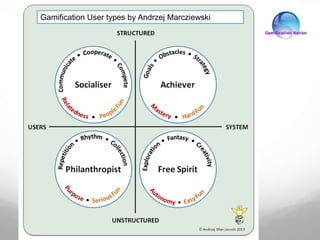
emotional profiling
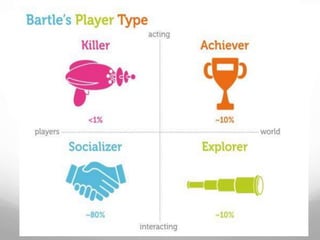
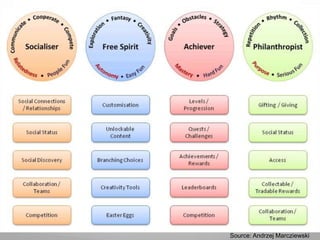
Gamification User types by Andrzej Marcziewski
Source: Andrzej Marcziewski
Motivation to tap
into
http://vimeo.com/88939322
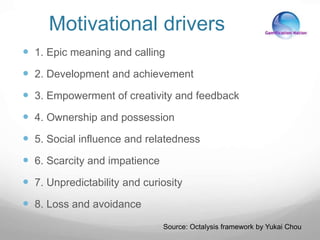
Motivational drivers
 1. Epic meaning and calling
 2. Development and achievement
 3. Empowerment of creativity and feedback
 4. Ownership and possession
 5. Social influence and relatedness
 6. Scarcity and impatience
 7. Unpredictability and curiosity
 8. Loss and avoidance
Source: Octalysis framework by Yukai Chou
Design the
experience –
the journey to
mastery
Fun
Deploy your first pilot
Test & measure, keep improving
Test pilot with different
audience segments
Men – Women – age groups – tech savvy – tech novices – etc.
Monitor – evaluate - Iterate
If in doubt,
who can help you out?
 Ask an expert
 Have an expert on board to facilitate the process
 Learn from colleagues
 Share experiences
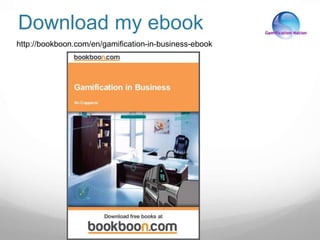
Download my ebook
http://bookboon.com/en/gamification-in-business-ebook
Useful resources
 www.gamification.co
 www.enterprise-gamification.com
 Octalysis: www.yukaichou.com
 Wiki on gamification: www.gamification.org
 Courses: Coursera, Udemy, iVersity
 My blog and online courses:
www.gamificationnation.com
Thank you for playing
Have fun designing your gamified HR processes
Keep in touch via @GamificationNat
www.gamificationnation.com

L&D Summit VI - An Coppens - Workshop Game Design for L&D success

Editor's Notes

  • #4 Group exercise (ideal if seated at tables) – each table discusses what they want to focus on and picks a process) Why is it important? Depending on numbers in the room we can have a pitch or work with each table picking one topic.
  • #5 6 D Design framework for Kevin Werbach – Gamification MOOC on Coursera
  • #6 5 steps to mastery – Gabe Zicherman
  • #7 Group exercise (ideal if seated at tables) – each table discusses what they want to focus on and picks a process) What are the business reasons for your gamification project, What are you fixing? How will you know when it is achieved? Compare notes with others in the room – sharing by table if feasible (runner with microphone?)
  • #8 Around the table – decide on the target audience and their various wants/ needs/ behaviours/ likes/ dislikes Think demographic, think education, think hobbies, think work conversations,
  • #12 Pick 5 Ideally intrinsically motivational actions they are willing to do Onboarding – Novice | Problem solving | Expert | Master | Visionary
  • #14 for novice, problem solver, expert, master, visionary Example of HR recruitment journey application – interview – follow-up – offer – negotiation - hired
  • #15 What would your target group consider to be fun? Know them, ask them, let them test it
  • #16 Be mindful of technology and your audience’s ability to use it Alpha, beta, go live
  • #19 Experts are very active online – twitter, LinkedIn groups, Facebook groups They are a friendly bunch Some of us also do it for a living Conferences like these are excellent to learn from other people’s experiences