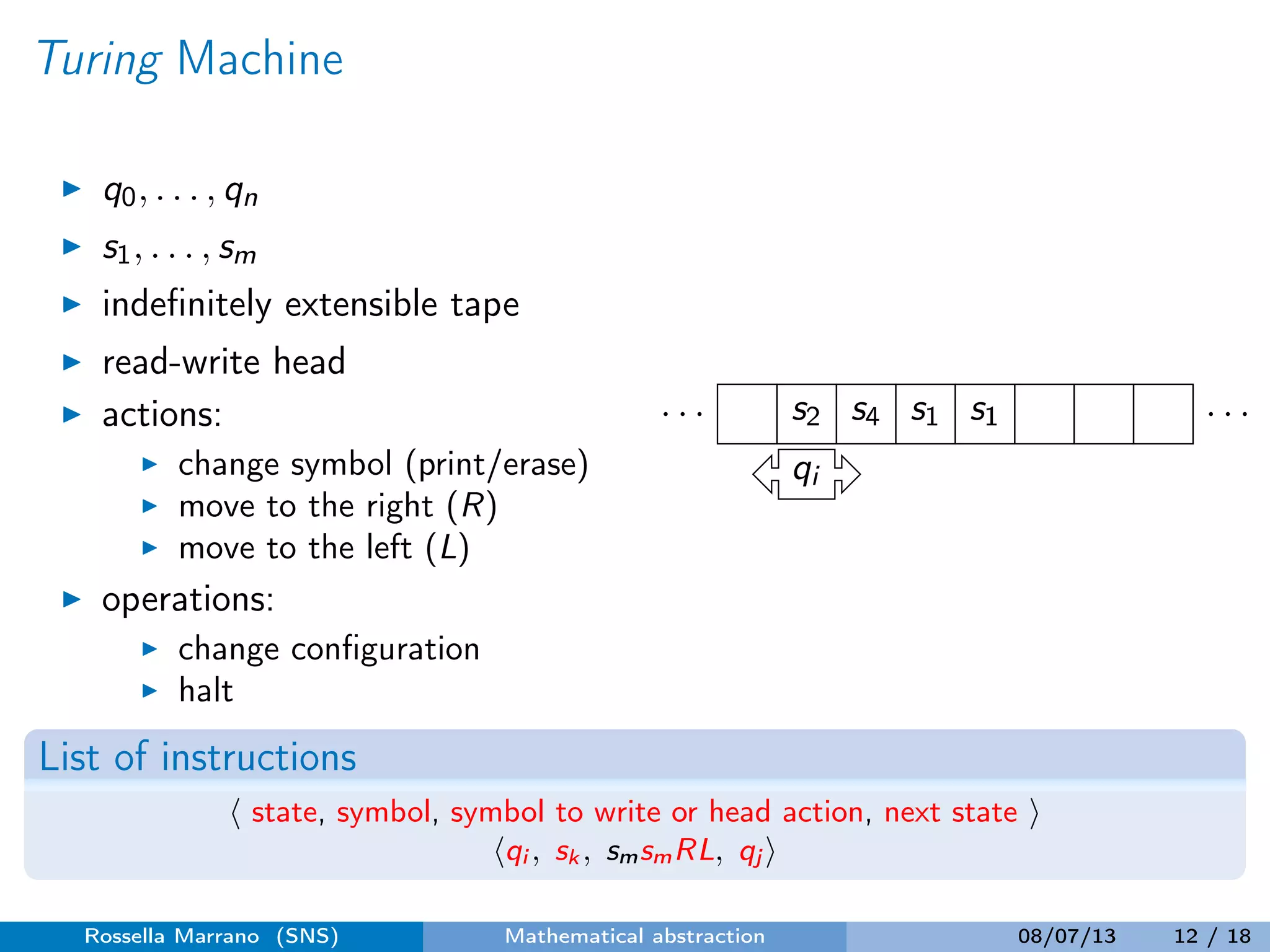
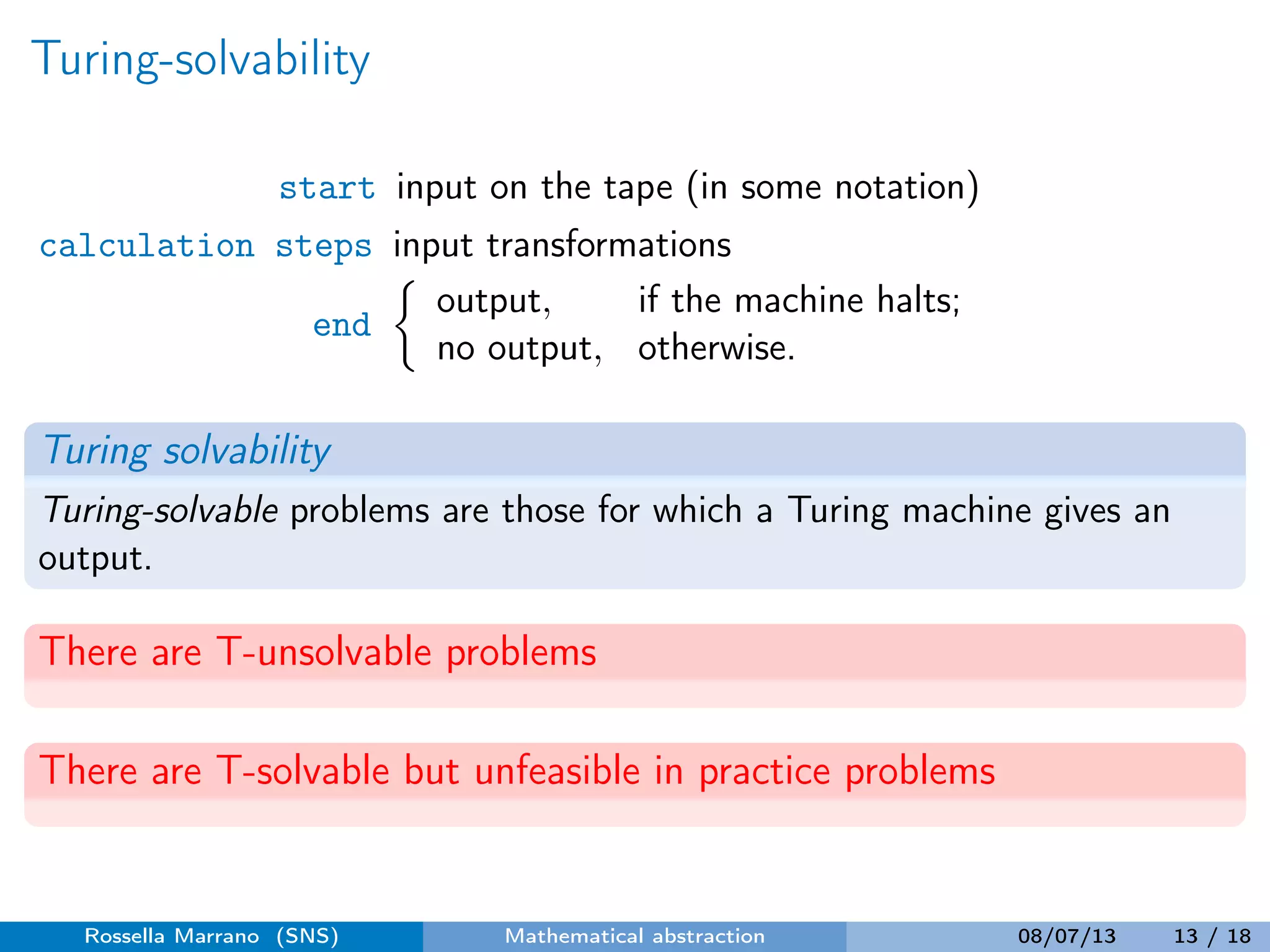
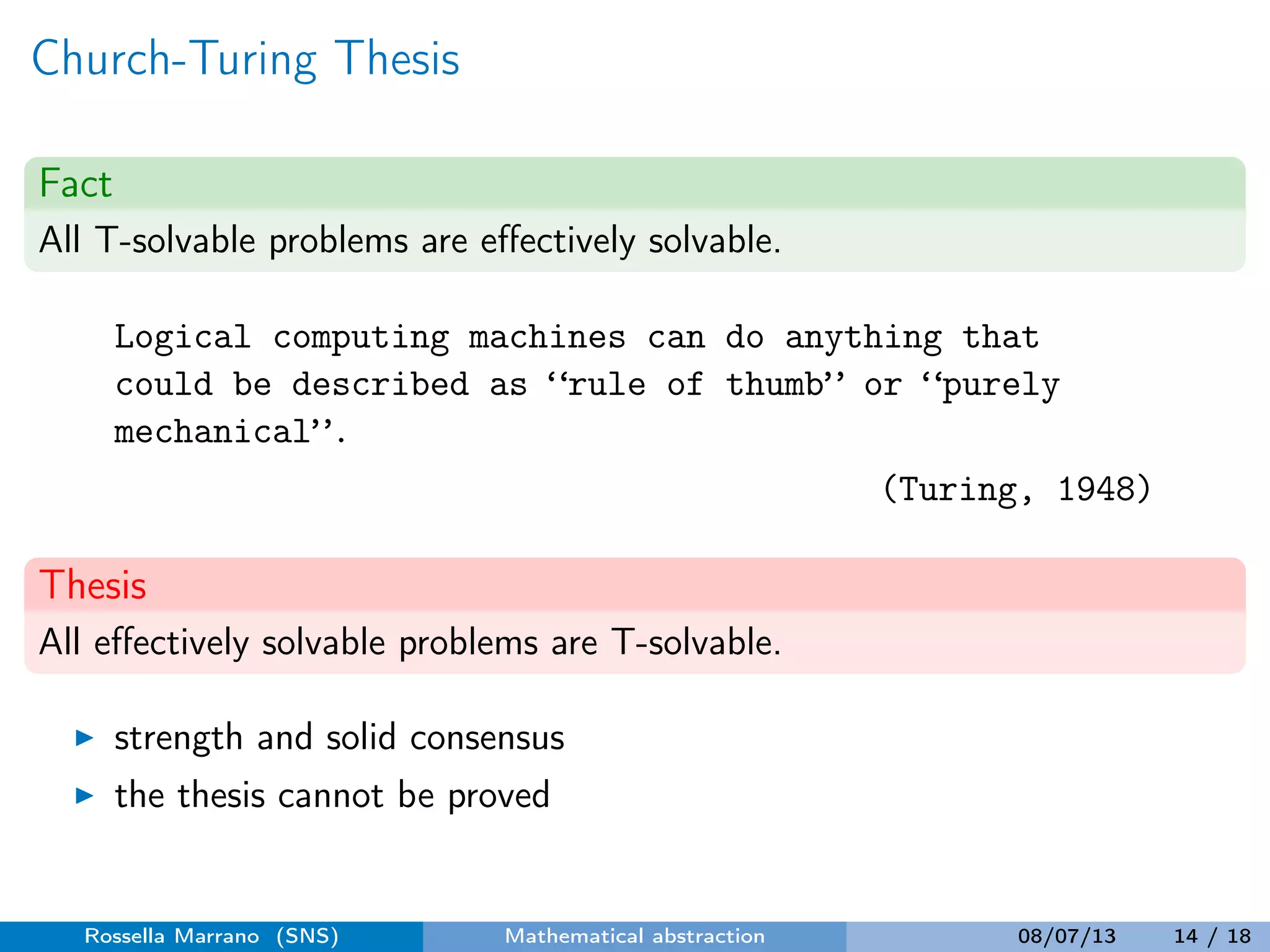
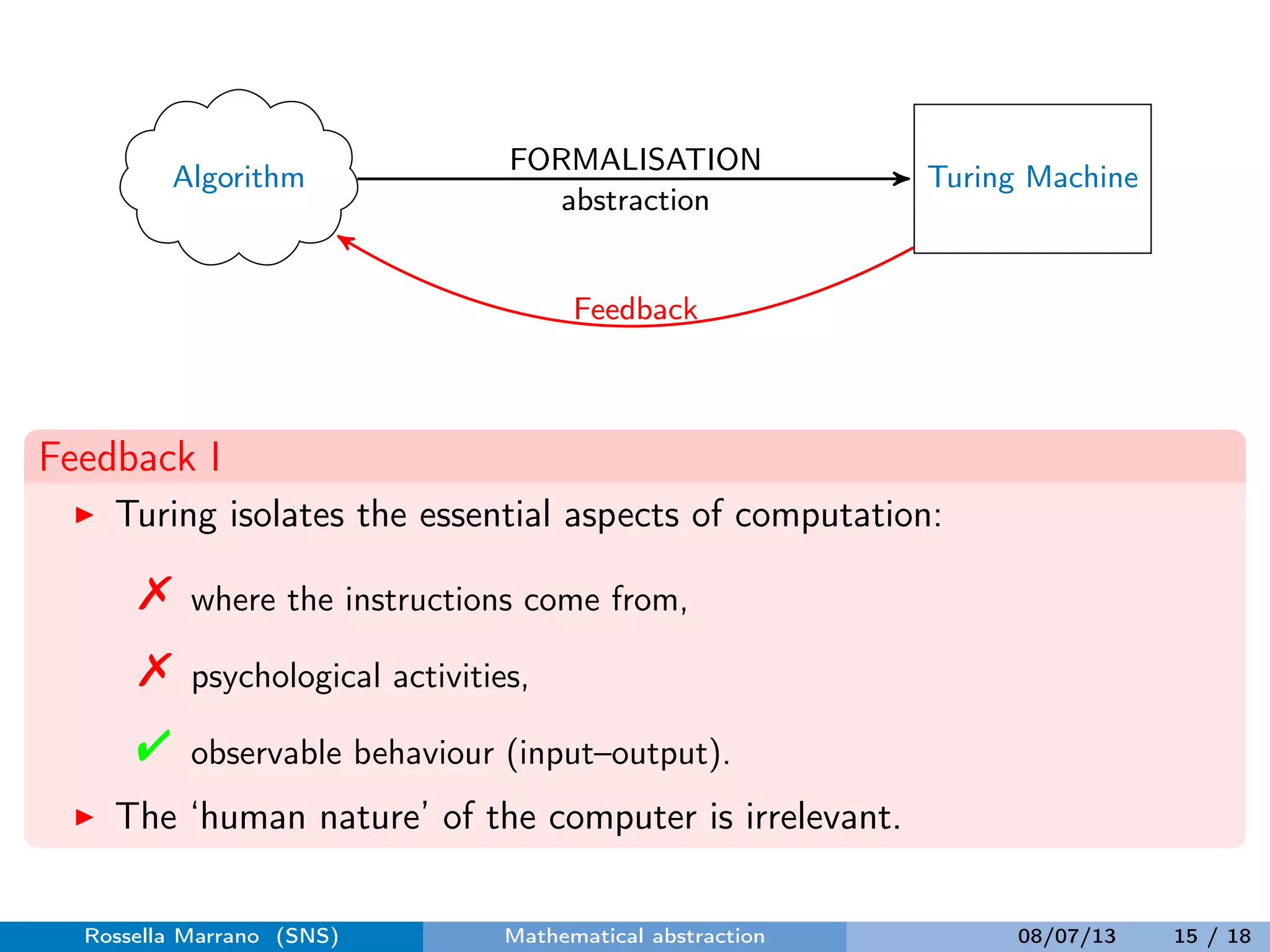
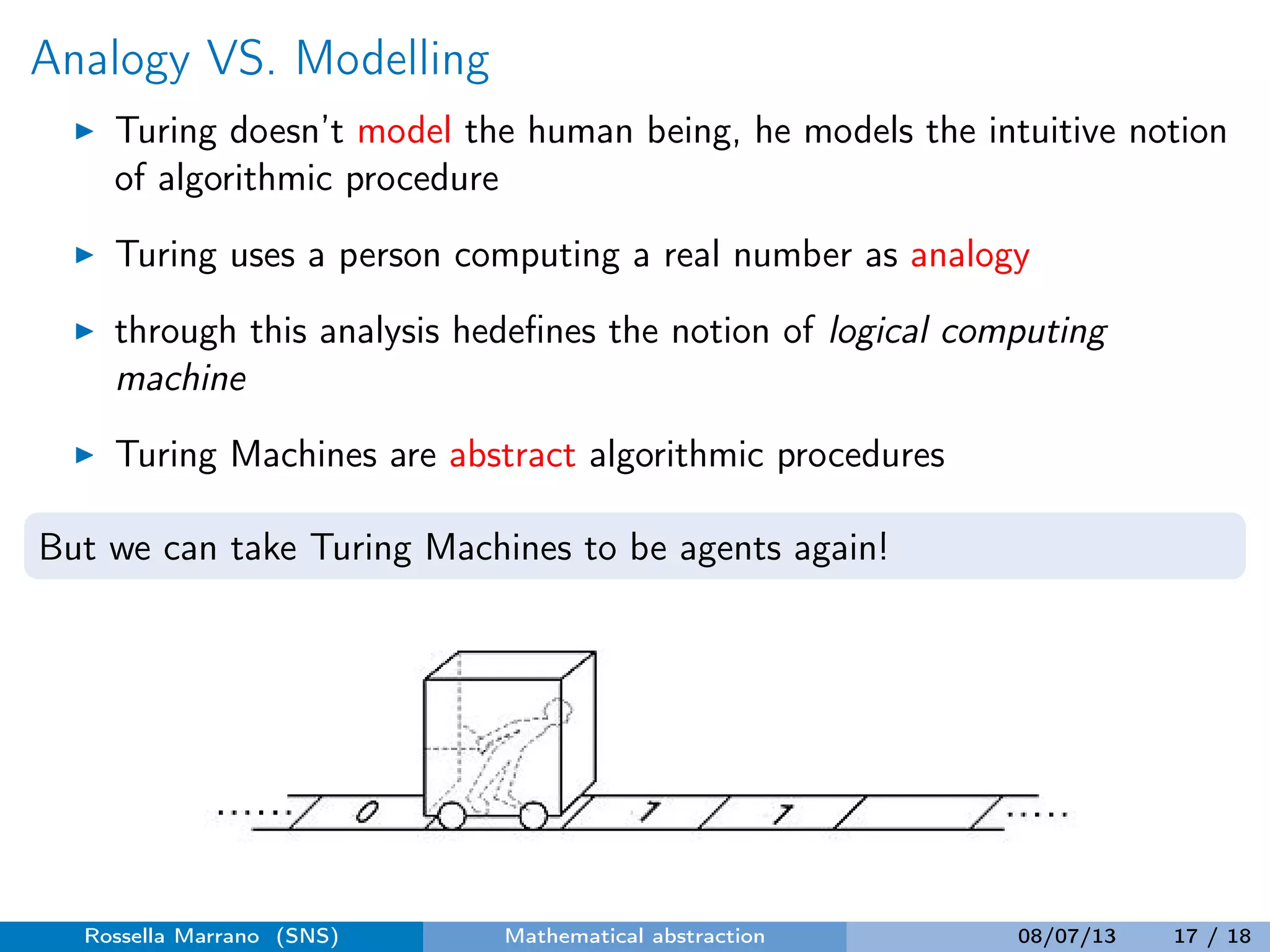
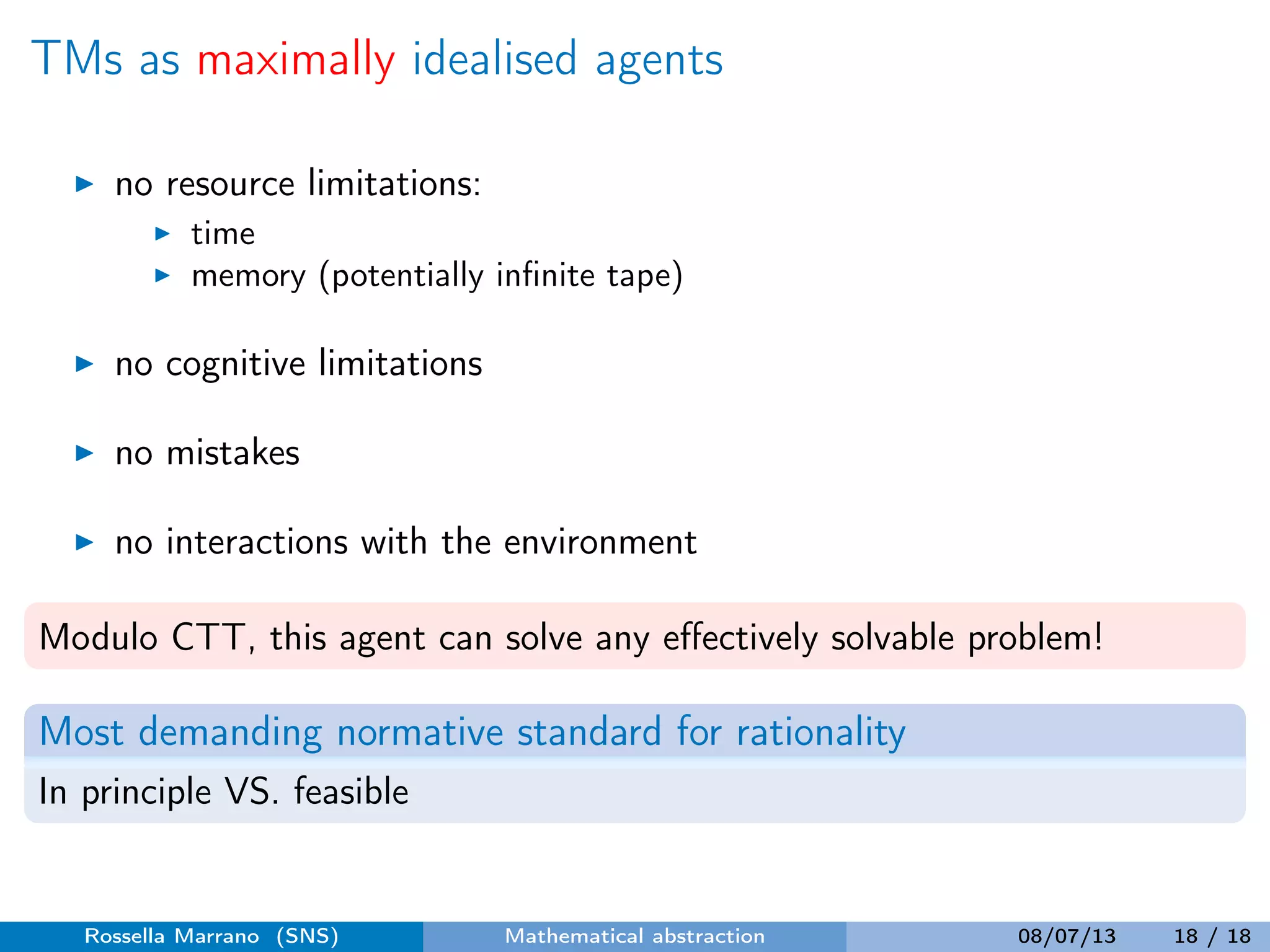
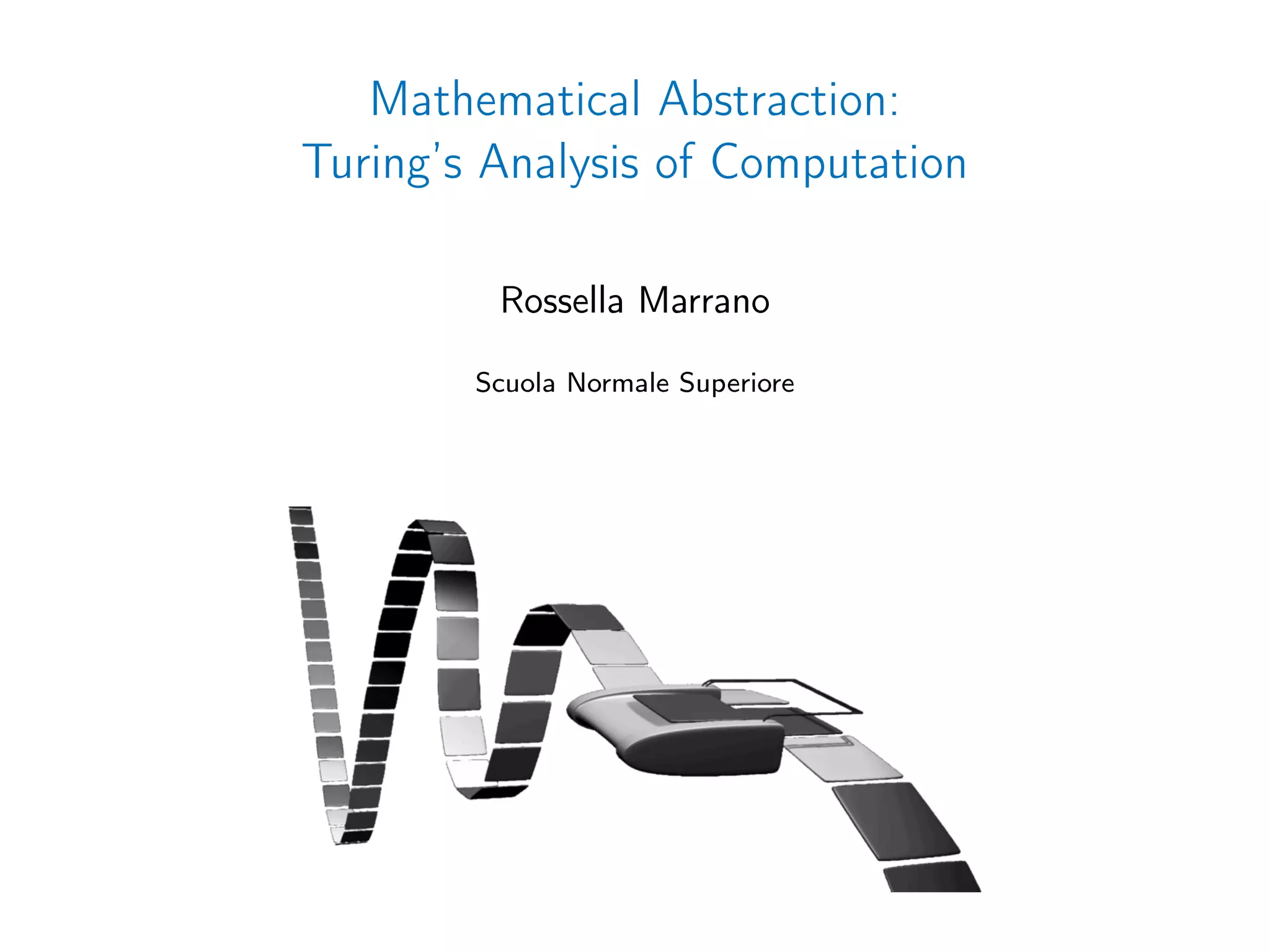
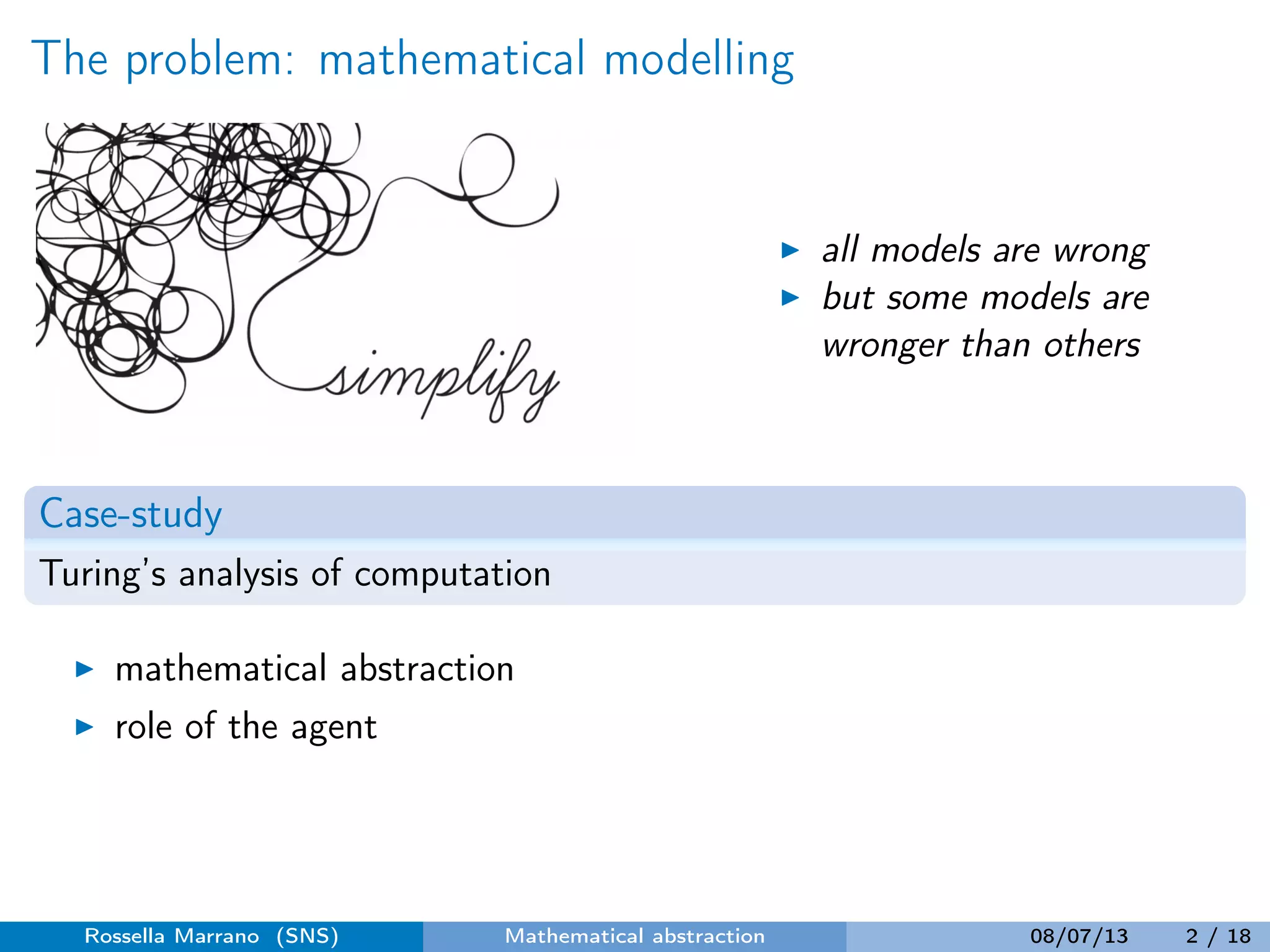
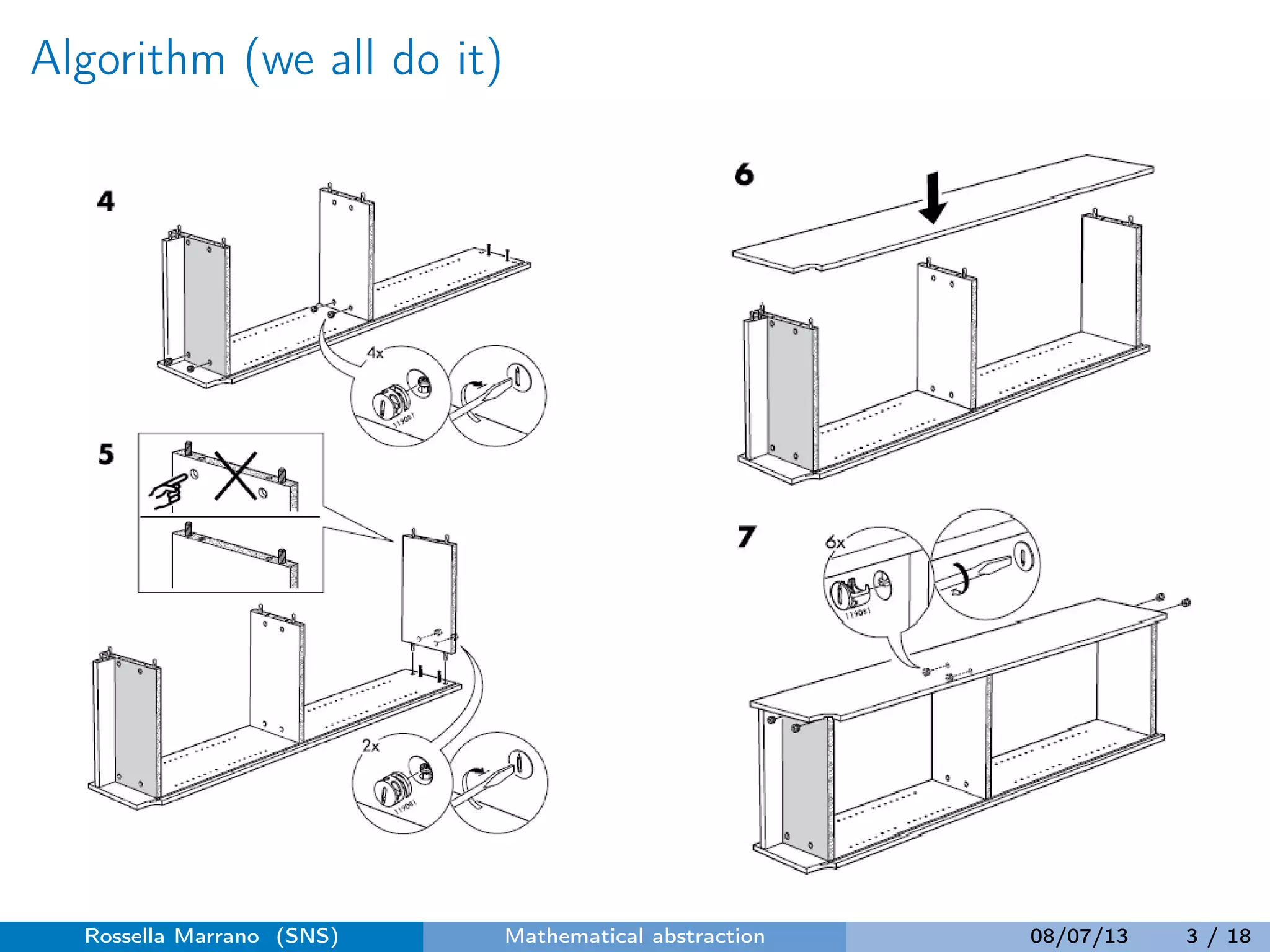
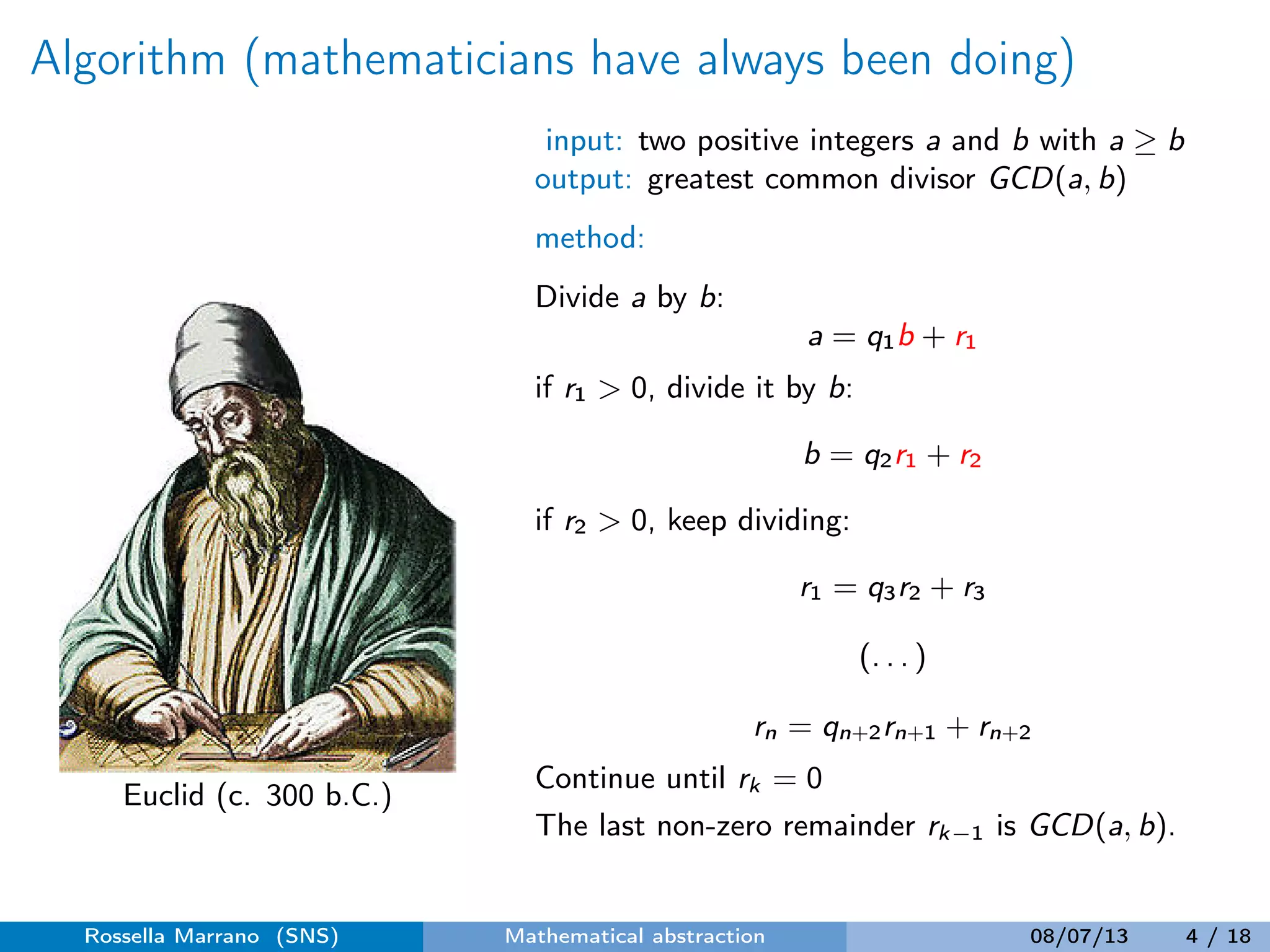
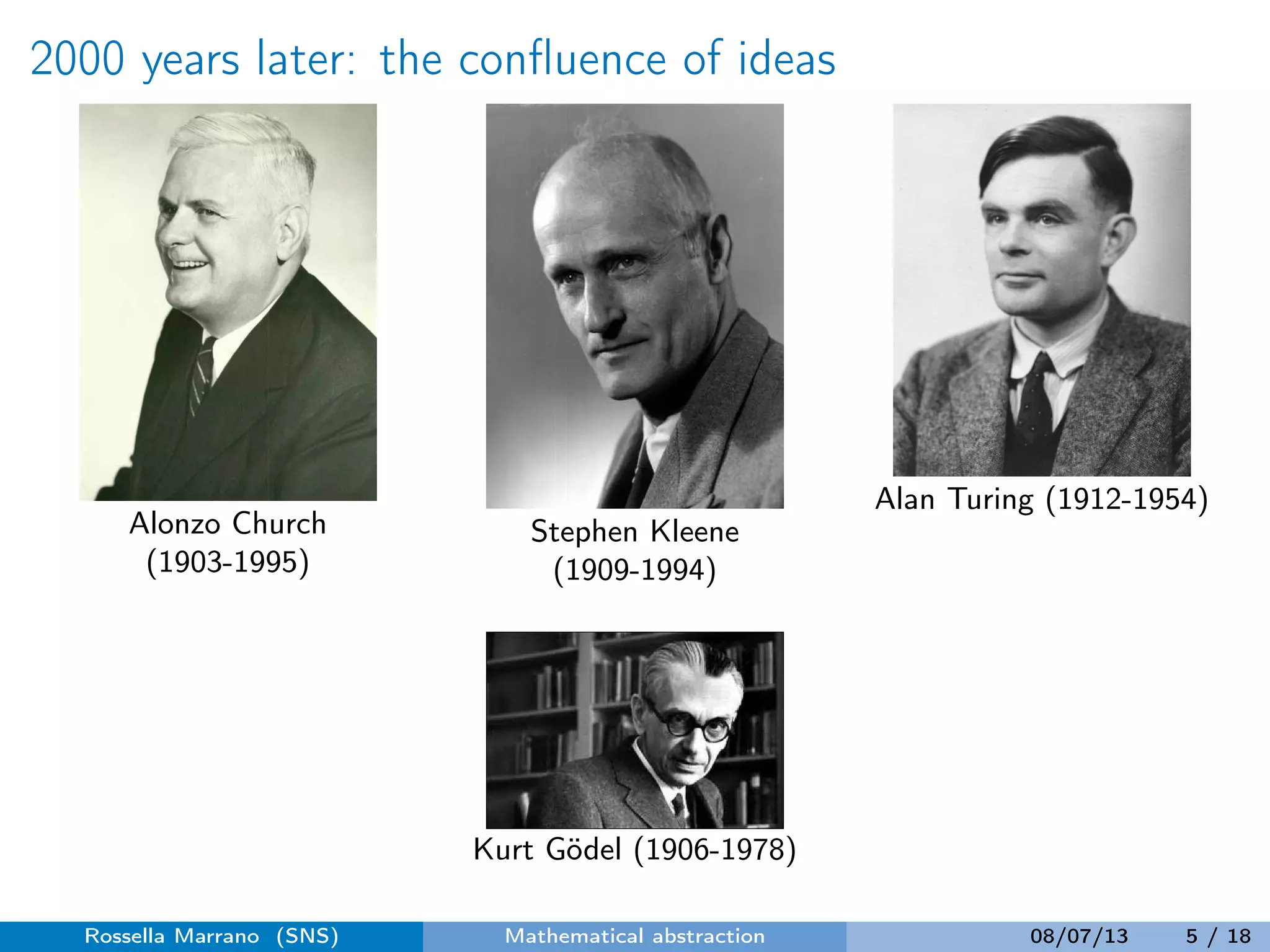
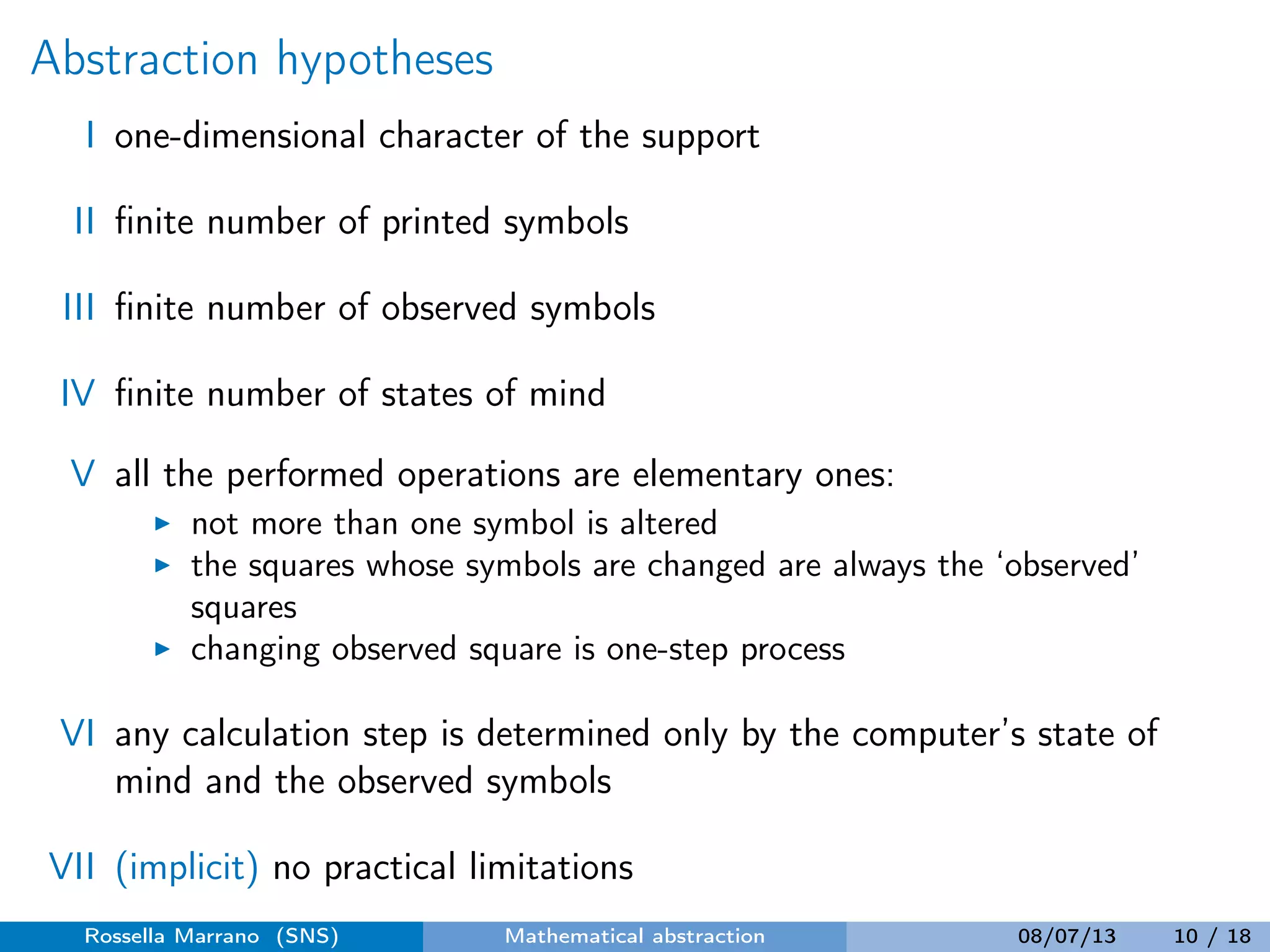
Turing developed the concept of the Turing machine through mathematical abstraction to formally define computation. He isolated the essential aspects of computation by abstracting away from implementation details like the physical system and psychological activities. This abstraction led to the definition of an algorithm as a set of well-defined instructions executable by an abstract computing agent. The Church-Turing thesis then asserts that all effectively calculable functions are computable by a Turing machine. Turing's abstraction approach provides a maximally idealized notion of a rational computational agent.
![Turing’s analysis
If one is given a puzzle to solve one will usually, if it
proves to be difficult, ask the owner whether it can be done.
Such a question should have a quite definite answer, yes or no,
at any rate provided the rules describing what you are allowed
to do are perfectly clear. Of course the owner of the puzzle
may not know the answer. One might equally ask, ‘How can one
tell whether a puzzle is solvable?’, but this cannot be
answered so straightforwardly. (Turing, 1954)
Turing’s problem
Investigate the class of problems that can be effectively solved.
On Computable Numbers, with an Application to the Entscheidungsproblem, Proc.
Lond. Math. Soc. (2) 42, 230–265, 1936.
Central idea
We may compare a man in the process of computing a real number
to a machine [...].
Rossella Marrano (SNS) Mathematical abstraction 08/07/13 6 / 18](https://image.slidesharecdn.com/handoutsemgamesdecisions-140425103337-phpapp02/75/Games_and_Decisions-6-2048.jpg)
![Computing is normally done by writing certain
symbols on paper. We may suppose this paper is
divided into squares like a child’s arithmetic book.
In elementary arithmetic the two-dimensional
character of the paper is sometimes used. But such a
use is always avoidable, and I think that it will be
agreed that the two-dimensional character of paper
is no essential of computation. I assume then that
the computation is carried out on one-dimensional
paper, i.e. on a tape divided into squares.
[...]
I shall also suppose that the number of symbols
which may be printed is finite.
Rossella Marrano (SNS) Mathematical abstraction 08/07/13 7 / 18](https://image.slidesharecdn.com/handoutsemgamesdecisions-140425103337-phpapp02/75/Games_and_Decisions-7-2048.jpg)
![[...] The behaviour of the computer at any moment is
determined by the symbols which he is observing, and
his ‘state of mind’ at that moment. We may suppose
that there is a bound B to the number of symbols or
squares which the computer can observe at one
moment. If he wishes to observe more, he must use
successive observations. We will also suppose that
the number of states of mind which need to be taken
into account is finite.
Rossella Marrano (SNS) Mathematical abstraction 08/07/13 8 / 18](https://image.slidesharecdn.com/handoutsemgamesdecisions-140425103337-phpapp02/75/Games_and_Decisions-8-2048.jpg)
![[...] Let us imagine the operations to be performed
by the computer to be split up into ‘simple
operations’ which are so elementary it is not easy
to imagine them further divided. Every such
operation consists of some change of the physical
system consisting of the computer and his tape. We
know the state of the system if we know the sequence
of symbols on the tape, which of these are observed
by the computer (possibly with a special order), and
the state of mind of the computer. We may suppose
that in a simple operation not more than one symbol
is altered. Any other changes can be split up into
changes of this kind.
Rossella Marrano (SNS) Mathematical abstraction 08/07/13 9 / 18](https://image.slidesharecdn.com/handoutsemgamesdecisions-140425103337-phpapp02/75/Games_and_Decisions-9-2048.jpg)
![We may now construct a machine to do the work of
this computer. To each state of mind of the computer
corresponds an ‘m-configuration’ of the machine. The
machine scans B squares corresponding to the B
squares observed by the computer.
[...]
The move which is done, and the succeeding
configuration, are determined by the scanned symbol
and the m-configuration.
Human computer
paper
mental states
observation
Machine
tape
m-configurations
scanning
Rossella Marrano (SNS) Mathematical abstraction 08/07/13 11 / 18](https://image.slidesharecdn.com/handoutsemgamesdecisions-140425103337-phpapp02/75/Games_and_Decisions-11-2048.jpg)