GAME SENSE
RITA PUPUKE-IBRAHIM 17873358
PDHPE
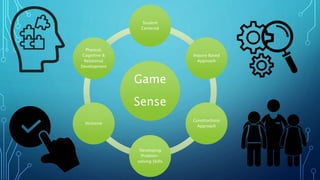
Game
Sense
Student
Centered
Inquiry Based
Approach
Constructivist
Approach
Developing
Problem-
solving Skills
Inclusive
Physical,
Cognitive &
Relational
Development
WHAT IS GAME SENSE?
• Games sense takes a constructivist approach to PDHPE
that helps develop skills and promotes learning through
games that have been modified to encourage problem
solving and decision-making (Australian Sports
Commission, 2018)
• Movement ability, athletic competency, spacial awareness
and perception, as well as tactical ability are promoted
when taking a games sense approach (Pill, 2016)
• Games sense is mainly student-centered where guided
discovery questions are asked by the teacher to ignite
engagement, they then work collaboratively through
problem-solving to alter the rules that will enhance and
challenge skills (Light, 2012).
TEACHING GAMES GAMES
SENSE
FOR UNDERSTANDING
• Student- teacher shared
dialogue
• Develop skills through
exploratory, engaging games
that have been modified.
• Focus on the games or
activities as a whole.
• Collective- thinking and
teacher questioning.
• (Bunker & Thorpe, 1982, &
Chandler, 1996)
• Students can exit and enter the
game as needed.
• Students aim to use enabling
skills are used to progress
through the game and develop
skills through various
modifications.
• The exploration of the learner is
the bases for the constructing
knowledge.
• Positive feedback and reflection.
• (Light, 2012 & Pill, 2016)
BENEFITS OF GAME SENSE
• Modification of games and activities is an imperative
component of game sense, which allows students and
teachers to collaborate control over extending and
simplifying to enhance the overall experience.
• Modification means that these games can be altered to
increase the participation of students by adding more
players to the game.
• Student empowerment and responsibility for their own
learning.
• Ownership over their own learning avoids the teachers
over-coaching and gives the students liability for their
own actions and behaviors.
• Engages affective, cognitive and psychomotor skills,
BENEFITS OF GAME SENSE
• Can be linked in with other KLA’s and teachable
moments across the curriculum.
• Promotes ‘Thinking Players’ (Australian Sports
Commission, 2018)
• Game sense allows the teachers to promote Positive
Behavior for Learning through classroom
management strategies due to the student-centred
and collaborative nature of the approach where
students must take on the responsibility for their
learning.
GAMES SENSE AND THE PDHPE SYLLABUS
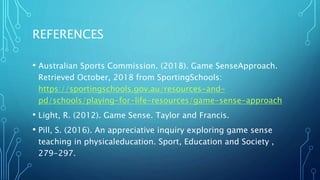
• Game Sense promotes five skills amongst the syllabus.
Interacting Working collaboratively to modify and
problem-solve
Problem-solving Guided Discovery Questions and Inquiries
Communicating Discussion and Reflection
Moving Encourages and develops the fundamental
movement skills
Decision- making The holistic focus on the games allows for
space perception and skill application.
REFERENCES
• Australian Sports Commission. (2018). Game SenseApproach.
Retrieved October, 2018 from SportingSchools:
https://sportingschools.gov.au/resources-and-
pd/schools/playing-for-life-resources/game-sense-approach
• Light, R. (2012). Game Sense. Taylor and Francis.
• Pill, S. (2016). An appreciative inquiry exploring game sense
teaching in physicaleducation. Sport, Education and Society ,
279-297.

Game Sense

  • 1.
  • 2.
  • 3.
    WHAT IS GAMESENSE? • Games sense takes a constructivist approach to PDHPE that helps develop skills and promotes learning through games that have been modified to encourage problem solving and decision-making (Australian Sports Commission, 2018) • Movement ability, athletic competency, spacial awareness and perception, as well as tactical ability are promoted when taking a games sense approach (Pill, 2016) • Games sense is mainly student-centered where guided discovery questions are asked by the teacher to ignite engagement, they then work collaboratively through problem-solving to alter the rules that will enhance and challenge skills (Light, 2012).
  • 4.
    TEACHING GAMES GAMES SENSE FORUNDERSTANDING • Student- teacher shared dialogue • Develop skills through exploratory, engaging games that have been modified. • Focus on the games or activities as a whole. • Collective- thinking and teacher questioning. • (Bunker & Thorpe, 1982, & Chandler, 1996) • Students can exit and enter the game as needed. • Students aim to use enabling skills are used to progress through the game and develop skills through various modifications. • The exploration of the learner is the bases for the constructing knowledge. • Positive feedback and reflection. • (Light, 2012 & Pill, 2016)
  • 5.
    BENEFITS OF GAMESENSE • Modification of games and activities is an imperative component of game sense, which allows students and teachers to collaborate control over extending and simplifying to enhance the overall experience. • Modification means that these games can be altered to increase the participation of students by adding more players to the game. • Student empowerment and responsibility for their own learning. • Ownership over their own learning avoids the teachers over-coaching and gives the students liability for their own actions and behaviors. • Engages affective, cognitive and psychomotor skills,
  • 6.
    BENEFITS OF GAMESENSE • Can be linked in with other KLA’s and teachable moments across the curriculum. • Promotes ‘Thinking Players’ (Australian Sports Commission, 2018) • Game sense allows the teachers to promote Positive Behavior for Learning through classroom management strategies due to the student-centred and collaborative nature of the approach where students must take on the responsibility for their learning.
  • 7.
    GAMES SENSE ANDTHE PDHPE SYLLABUS • Game Sense promotes five skills amongst the syllabus. Interacting Working collaboratively to modify and problem-solve Problem-solving Guided Discovery Questions and Inquiries Communicating Discussion and Reflection Moving Encourages and develops the fundamental movement skills Decision- making The holistic focus on the games allows for space perception and skill application.
  • 8.
    REFERENCES • Australian SportsCommission. (2018). Game SenseApproach. Retrieved October, 2018 from SportingSchools: https://sportingschools.gov.au/resources-and- pd/schools/playing-for-life-resources/game-sense-approach • Light, R. (2012). Game Sense. Taylor and Francis. • Pill, S. (2016). An appreciative inquiry exploring game sense teaching in physicaleducation. Sport, Education and Society , 279-297.