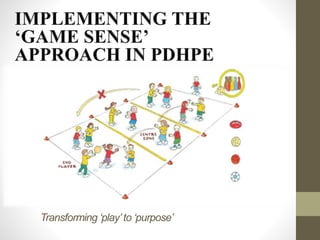
Transforming ‘play’to ‘purpose’
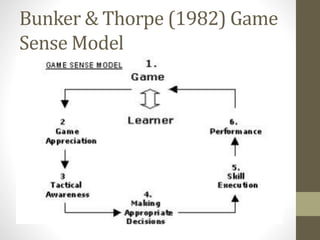
Bunker & Thorpe (1982) Game
Sense Model
What can we infer from the Game Sense
Model?
The basic approach of Game sense is to start with simple
games in which the stress on technique is reduced to allow
players to engage intellectually in the game (Light, 2012).
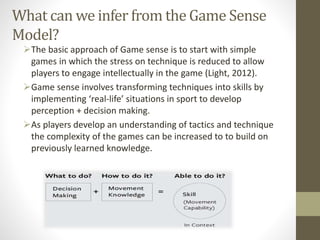
Game sense involves transforming techniques into skills by
implementing ‘real-life’ situations in sport to develop
perception + decision making.
As players develop an understanding of tactics and technique
the complexity of the games can be increased to to build on
previously learned knowledge.
Exampleof GameSense approachand the
Developmentof FundamentalMovement
Skills
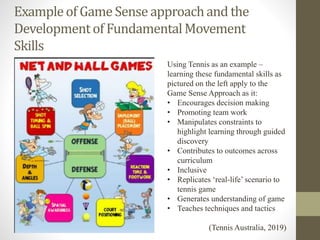
Using Tennis as an example –
learning these fundamental skills as
pictured on the left apply to the
Game Sense Approach as it:
• Encourages decision making
• Promoting team work
• Manipulates constraints to
highlight learning through guided
discovery
• Contributes to outcomes across
curriculum
• Inclusive
• Replicates ‘real-life’ scenario to
tennis game
• Generates understanding of game
• Teaches techniques and tactics
(Tennis Australia, 2019)
Game Sense & Inclusivity
For sport to engage all players and provide them all with positive experiences,
coaching must be inclusive. In saying so, research findings have highlighted:
 Physical education teachers have to deal with individual variation in skill,
attitude and motivation.
Hence, Game Sense is inclusive in two ways:
1.It is inclusive due to the ways in which it uses modified games designed to
suit the developmental, emotional and social needs for the players. For
example, modifications in changes to number of players per side, number
of balls, area of play, change of rules and equipment to cater to all learner
needs and abilities.
2.It is designed to improve all players’ skills and capacities.
(Light, 2013)
Traditional VS Game Sense
Traditional games/coaching
• Performance is main objective
• Focus on winning/losing
• Strict/non-flexible rules
• Instruction based
Game Sense
• Game is main objection of lesson
• Promotes empathy and team work
• Student centered learning
• Can be modified to meet different learner needs
• Promotes tactical development
• Promotes sense of belonging and self-worth
• Prevents expectation of performance and skill
Literature Evidence & Linking back
to Syllabus
A plethora of studies have highlighted that the Game Sense Approach
has shown:
To develop decision-making and problem-solving skills (Hopper et
al., 2009; Light 2013; Reid, 2014)
Increase teamwork, confidence and engagement (Light, 2013)
Development of knowledge of skills, tactics and strategies
(Townsend, 2007; Light, 2013; Reid, 2014)
Such findings are correlated to the objectives in the PDHPE Syllabus
that aims to develop students values and skills in problem-solving,
confidence, teamwork and acquisition of skills (NSW BOSTES, 2007).
Game Sense Pedagogy
1, Provides an appropriate physical learning environment
responds to a variety of learner abilities
2. Provides a platform to use questions for reflection
an important element when consolidating learning
3. Promotes collaboration
a central way way of learning according to social constructivist theorist of
learning (Vygotsky, 1978) ; Bruner, 1996)
4. Provides a supportive socio-moral environment
‘mistakes’ are seen as being essential for learning
Hence, Game Sense pedagogy aligns with quality teaching as a means of
providing quality learning and positive educational outcomes.
(Light, 2013)
References
Board of Studies, NSW. (2018). Personal development, health and physical education K-6
syllabus. Sydney: Author. Retrieved from NESA website:
https://educationstandards.nsw.edu.au/wps/portal/nesa/k-10/learning-areas/pdhpe/pdhpe-
k-10-2018
Light, R. (2013). Game Sense: pedagogy for performance, participation and enjoyment.
Chapter 4 (pp 37-47). (Online Library Book). Reid, P., & Harvey, S. (2014). We're
delivering Game Sense… aren't we?. Sports coaching review, 3(1), 80-92.
Werner, P., Thorpe, R., & Bunker, D. (1996). Teaching games for understanding: Evolution
of a model. Journal of Physical Education, Recreation & Dance, 67(1), 28-33.

Pdhpe presentation

  • 1.
  • 2.
    Bunker & Thorpe(1982) Game Sense Model
  • 3.
    What can weinfer from the Game Sense Model? The basic approach of Game sense is to start with simple games in which the stress on technique is reduced to allow players to engage intellectually in the game (Light, 2012). Game sense involves transforming techniques into skills by implementing ‘real-life’ situations in sport to develop perception + decision making. As players develop an understanding of tactics and technique the complexity of the games can be increased to to build on previously learned knowledge.
  • 4.
    Exampleof GameSense approachandthe Developmentof FundamentalMovement Skills Using Tennis as an example – learning these fundamental skills as pictured on the left apply to the Game Sense Approach as it: • Encourages decision making • Promoting team work • Manipulates constraints to highlight learning through guided discovery • Contributes to outcomes across curriculum • Inclusive • Replicates ‘real-life’ scenario to tennis game • Generates understanding of game • Teaches techniques and tactics (Tennis Australia, 2019)
  • 5.
    Game Sense &Inclusivity For sport to engage all players and provide them all with positive experiences, coaching must be inclusive. In saying so, research findings have highlighted:  Physical education teachers have to deal with individual variation in skill, attitude and motivation. Hence, Game Sense is inclusive in two ways: 1.It is inclusive due to the ways in which it uses modified games designed to suit the developmental, emotional and social needs for the players. For example, modifications in changes to number of players per side, number of balls, area of play, change of rules and equipment to cater to all learner needs and abilities. 2.It is designed to improve all players’ skills and capacities. (Light, 2013)
  • 6.
    Traditional VS GameSense Traditional games/coaching • Performance is main objective • Focus on winning/losing • Strict/non-flexible rules • Instruction based Game Sense • Game is main objection of lesson • Promotes empathy and team work • Student centered learning • Can be modified to meet different learner needs • Promotes tactical development • Promotes sense of belonging and self-worth • Prevents expectation of performance and skill
  • 7.
    Literature Evidence &Linking back to Syllabus A plethora of studies have highlighted that the Game Sense Approach has shown: To develop decision-making and problem-solving skills (Hopper et al., 2009; Light 2013; Reid, 2014) Increase teamwork, confidence and engagement (Light, 2013) Development of knowledge of skills, tactics and strategies (Townsend, 2007; Light, 2013; Reid, 2014) Such findings are correlated to the objectives in the PDHPE Syllabus that aims to develop students values and skills in problem-solving, confidence, teamwork and acquisition of skills (NSW BOSTES, 2007).
  • 8.
    Game Sense Pedagogy 1,Provides an appropriate physical learning environment responds to a variety of learner abilities 2. Provides a platform to use questions for reflection an important element when consolidating learning 3. Promotes collaboration a central way way of learning according to social constructivist theorist of learning (Vygotsky, 1978) ; Bruner, 1996) 4. Provides a supportive socio-moral environment ‘mistakes’ are seen as being essential for learning Hence, Game Sense pedagogy aligns with quality teaching as a means of providing quality learning and positive educational outcomes. (Light, 2013)
  • 9.
    References Board of Studies,NSW. (2018). Personal development, health and physical education K-6 syllabus. Sydney: Author. Retrieved from NESA website: https://educationstandards.nsw.edu.au/wps/portal/nesa/k-10/learning-areas/pdhpe/pdhpe- k-10-2018 Light, R. (2013). Game Sense: pedagogy for performance, participation and enjoyment. Chapter 4 (pp 37-47). (Online Library Book). Reid, P., & Harvey, S. (2014). We're delivering Game Sense… aren't we?. Sports coaching review, 3(1), 80-92. Werner, P., Thorpe, R., & Bunker, D. (1996). Teaching games for understanding: Evolution of a model. Journal of Physical Education, Recreation & Dance, 67(1), 28-33.