What is a game sense approach
in PE
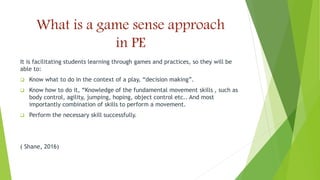
It is facilitating students learning through games and practices, so they will be
able to:
 Know what to do in the context of a play, “decision making”.
 Know how to do it, “Knowledge of the fundamental movement skills , such as
body control, agility, jumping, hoping, object control etc.. And most
importantly combination of skills to perform a movement.
 Perform the necessary skill successfully.
( Shane, 2016)
Why game
sense
approach
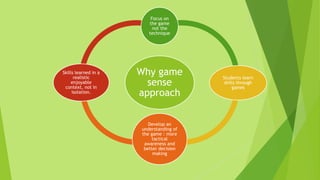
Focus on
the game
not the
technique
Students learn
skills through
games
Develop an
understanding of
the game : more
tactical
awareness and
better decision
making
Skills learned in a
realistic
enjoyable
context, not in
isolation.
Why we adopted a game sense approach
in our PE lessons
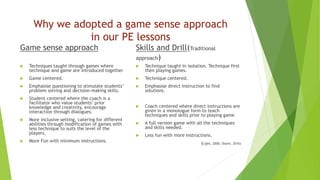
Game sense approach
 Techniques taught through games where
technique and game are introduced together
 Game centered.
 Emphasise questioning to stimulate students’
problem solving and decision-making skills.
 Student centered where the coach is a
facilitator who value students’ prior
knowledge and creativity, encourage
interaction through dialogues.
 More inclusive setting, catering for different
abilities through modification of games with
less technique to suits the level of the
players.
 More Fun with minimum instructions.
Skills and Drill(Traditional
approach)
 Technique taught in isolation. Technique first
then playing games.
 Technique centered.
 Emphasise direct instruction to find
solutions.
 Coach centered where direct instructions are
given in a monologue form to teach
techniques and skills prior to playing game
 A full version game with all the techniques
and skills needed.
 Less fun with more instructions.
(Light, 2006, Shane, 2016)
Rational
 The game sense approach develops students physical literacy by learning in,
about and through movement how to apply their skills across multiple
context, to foster the feeling of confidence, competence and enjoyment that
students need to lead a long, healthy and active life.
 GSA focus on personal and social skills such problem-solving, decision-making,
creative thinking and cooperation which are important skills for team work.
 GSA enhances critical and creative thinking through questioning, modifying
games and applying new ideas to find alternative solutions to problems. They
learn how to combine movement to generate new ones that leads to positive
outcomes.
GS a strength-based approach
It is a strength-based approach that values students skills and prior knowledge to build
on these skills. It focuses on achievement and strengths and explore the best of what is
working well. It construct a positive vision on what is working well to empower students
with self-confidence and self esteem .
References
 Light, R. (2006). Game Sense: Innovation or just good coaching? New Zealand
Physical Educator, 39(1), 8.
 NSW Education Standards Authority. (2018). Personal development, health and
physical education K-10 syllabus. Sydney: Author. Retrieved from NESA
website: http://educationstandards.nsw.edu.au/wps/portal/ nesa/k-
10/learning-areas/pdhpe/pdhpe-k-10-2018
 Pill, S. (2016). An appreciative inquiry exploring game sense teaching in
physical education. Sport, Education and Society, 21(2), 279-297.
 https://vuws.westernsydney.edu.au/bbcswebdav/pid-3912527-dt-content-rid-
28958810_1/courses/102072_2019_1h/Games%20Sense%20Supplemental%20Re
ading.pdf

Why game sense approach

  • 2.
    What is agame sense approach in PE It is facilitating students learning through games and practices, so they will be able to:  Know what to do in the context of a play, “decision making”.  Know how to do it, “Knowledge of the fundamental movement skills , such as body control, agility, jumping, hoping, object control etc.. And most importantly combination of skills to perform a movement.  Perform the necessary skill successfully. ( Shane, 2016)
  • 3.
    Why game sense approach Focus on thegame not the technique Students learn skills through games Develop an understanding of the game : more tactical awareness and better decision making Skills learned in a realistic enjoyable context, not in isolation.
  • 4.
    Why we adopteda game sense approach in our PE lessons Game sense approach  Techniques taught through games where technique and game are introduced together  Game centered.  Emphasise questioning to stimulate students’ problem solving and decision-making skills.  Student centered where the coach is a facilitator who value students’ prior knowledge and creativity, encourage interaction through dialogues.  More inclusive setting, catering for different abilities through modification of games with less technique to suits the level of the players.  More Fun with minimum instructions. Skills and Drill(Traditional approach)  Technique taught in isolation. Technique first then playing games.  Technique centered.  Emphasise direct instruction to find solutions.  Coach centered where direct instructions are given in a monologue form to teach techniques and skills prior to playing game  A full version game with all the techniques and skills needed.  Less fun with more instructions. (Light, 2006, Shane, 2016)
  • 5.
    Rational  The gamesense approach develops students physical literacy by learning in, about and through movement how to apply their skills across multiple context, to foster the feeling of confidence, competence and enjoyment that students need to lead a long, healthy and active life.  GSA focus on personal and social skills such problem-solving, decision-making, creative thinking and cooperation which are important skills for team work.  GSA enhances critical and creative thinking through questioning, modifying games and applying new ideas to find alternative solutions to problems. They learn how to combine movement to generate new ones that leads to positive outcomes.
  • 6.
    GS a strength-basedapproach It is a strength-based approach that values students skills and prior knowledge to build on these skills. It focuses on achievement and strengths and explore the best of what is working well. It construct a positive vision on what is working well to empower students with self-confidence and self esteem .
  • 7.
    References  Light, R.(2006). Game Sense: Innovation or just good coaching? New Zealand Physical Educator, 39(1), 8.  NSW Education Standards Authority. (2018). Personal development, health and physical education K-10 syllabus. Sydney: Author. Retrieved from NESA website: http://educationstandards.nsw.edu.au/wps/portal/ nesa/k- 10/learning-areas/pdhpe/pdhpe-k-10-2018  Pill, S. (2016). An appreciative inquiry exploring game sense teaching in physical education. Sport, Education and Society, 21(2), 279-297.  https://vuws.westernsydney.edu.au/bbcswebdav/pid-3912527-dt-content-rid- 28958810_1/courses/102072_2019_1h/Games%20Sense%20Supplemental%20Re ading.pdf