Game Mechanichamzah asyrani sulaiman
Search at the
internet
…timeless
principles and
practice of
mechanics
design….
CHAPTER 1
DESIGNING
GAME MECHANICS
DEFINE
“MECHANIC”
Game Mechanics are the basic
actions, processes, visuals, and
control mechanisms that are used to
“gamify” and activity
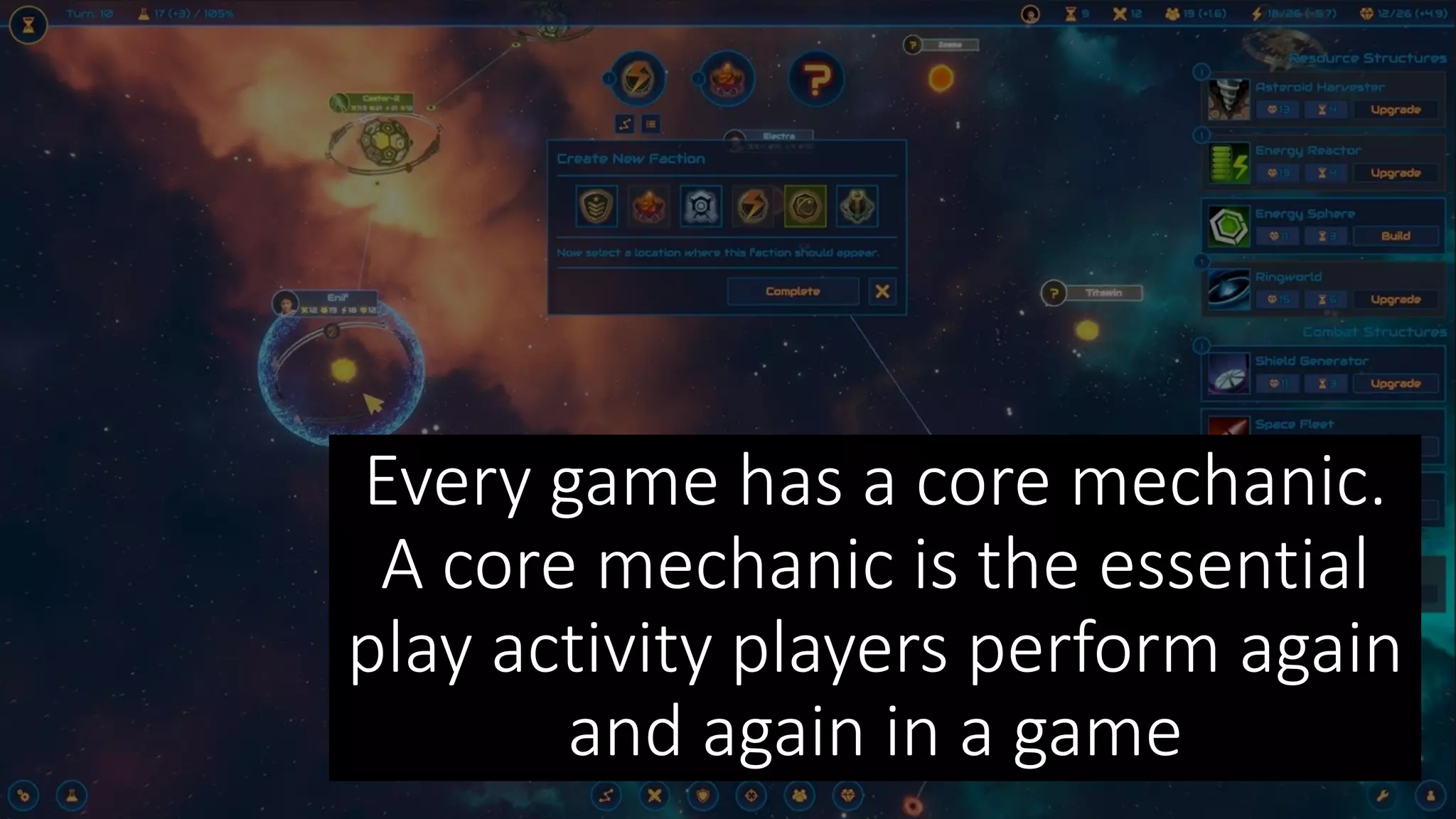
Every game has a core mechanic.
A core mechanic is the essential
play activity players perform again
and again in a game
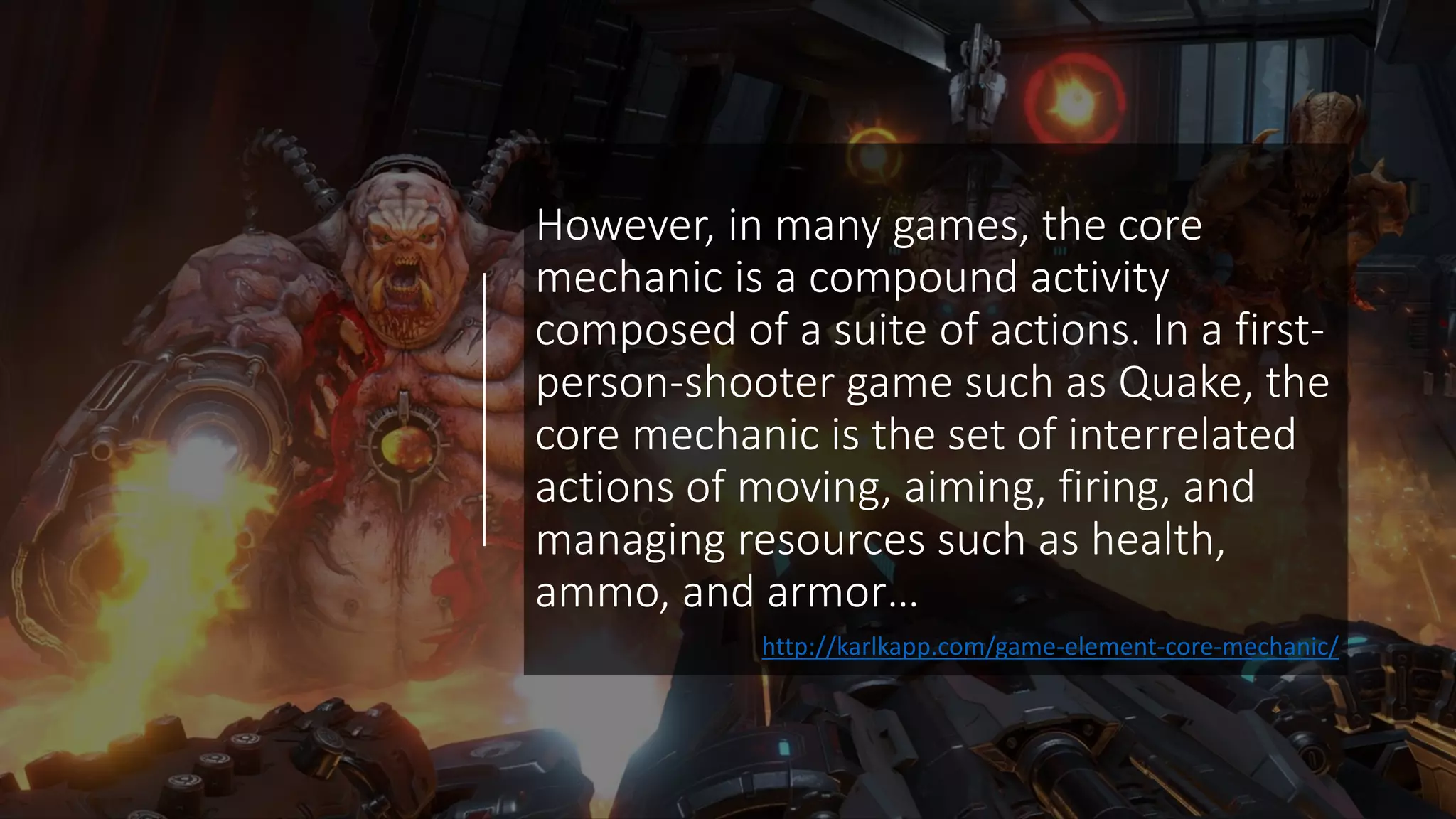
However, in many games, the core
mechanic is a compound activity
composed of a suite of actions. In a first-
person-shooter game such as Quake, the
core mechanic is the set of interrelated
actions of moving, aiming, firing, and
managing resources such as health,
ammo, and armor…
http://karlkapp.com/game-element-core-mechanic/
RULES DEFINE GAME
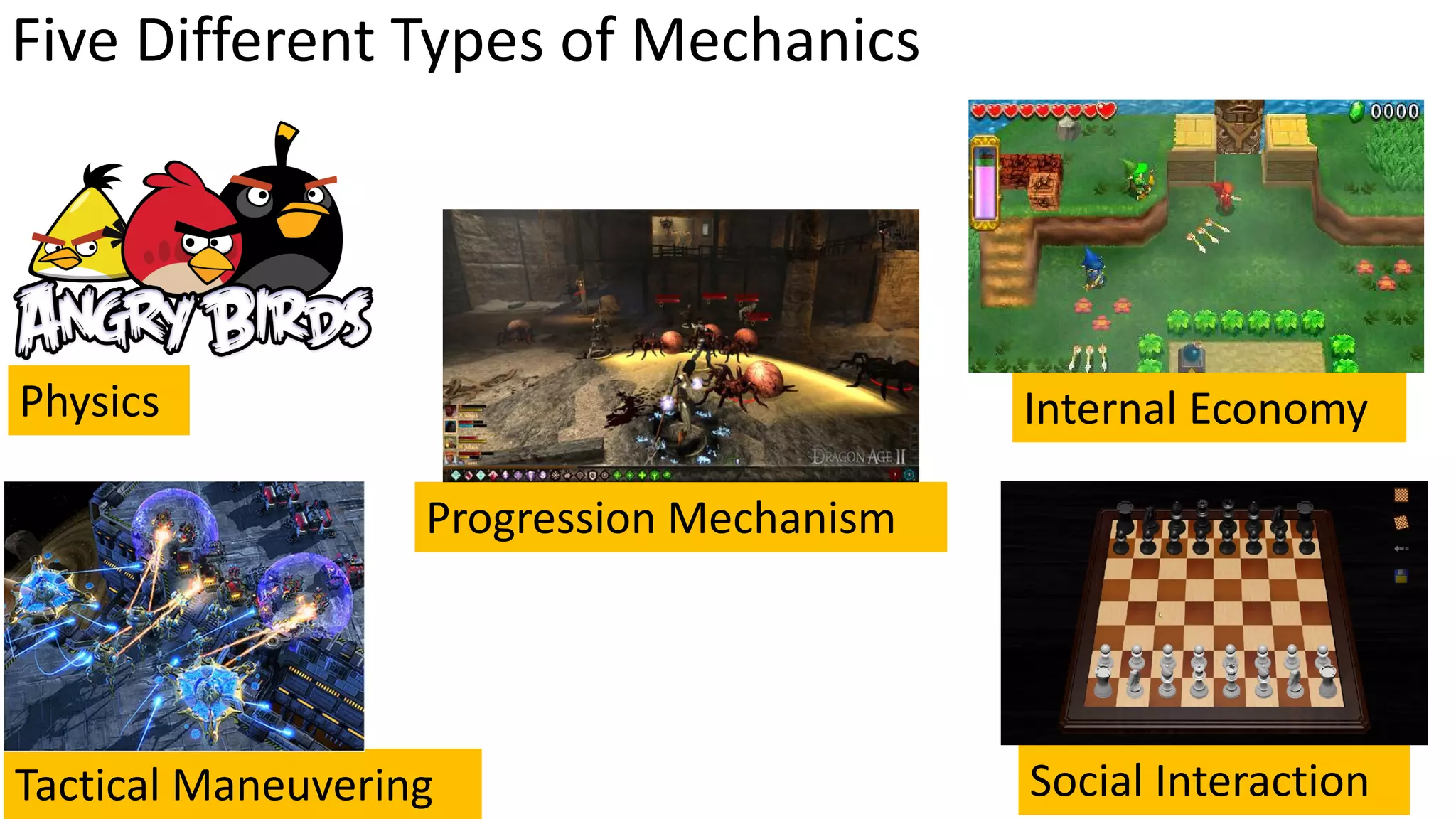
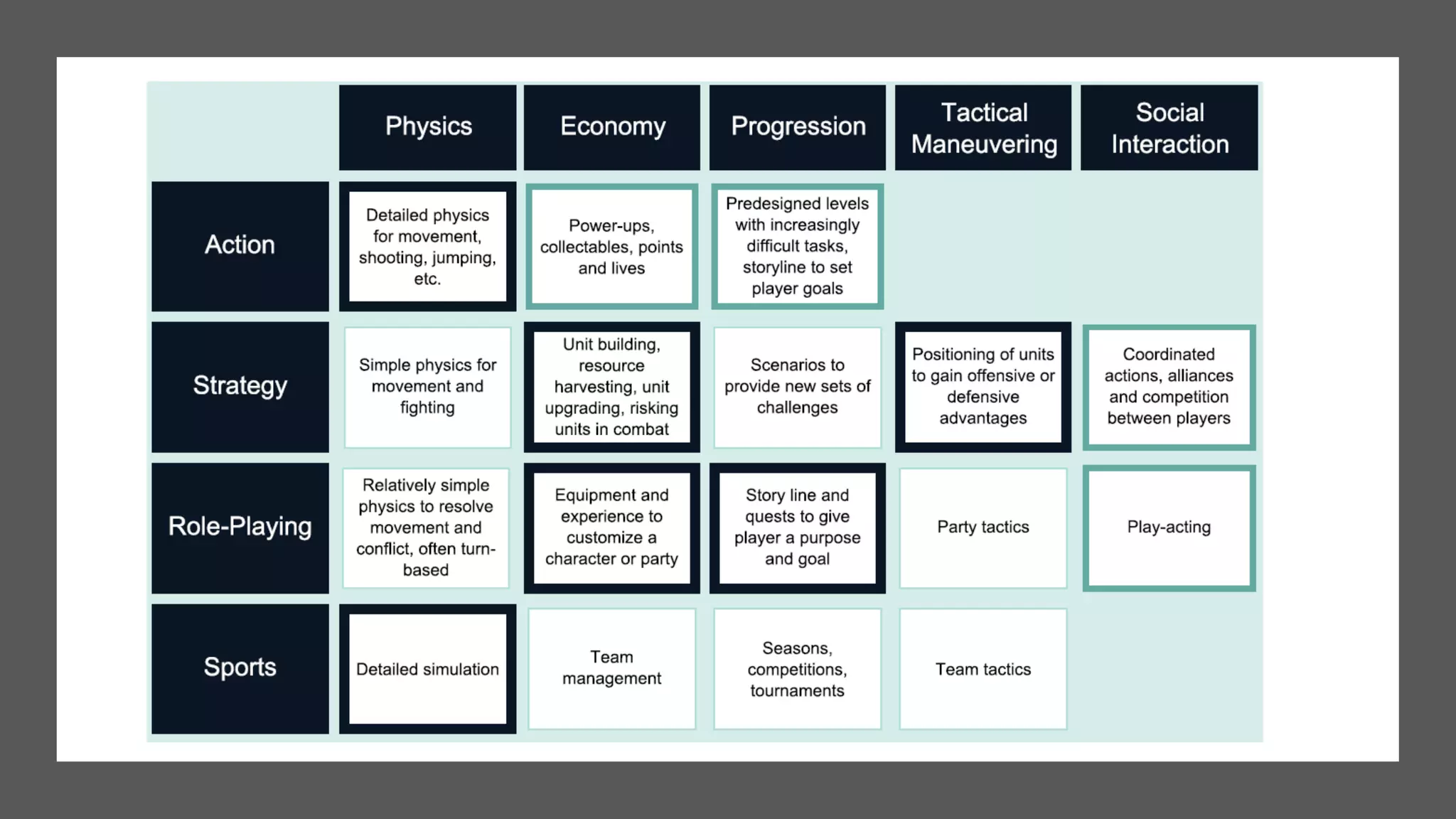
Five Different Types of Mechanics
Physics
Tactical Maneuvering
Internal Economy
Social Interaction
Progression Mechanism
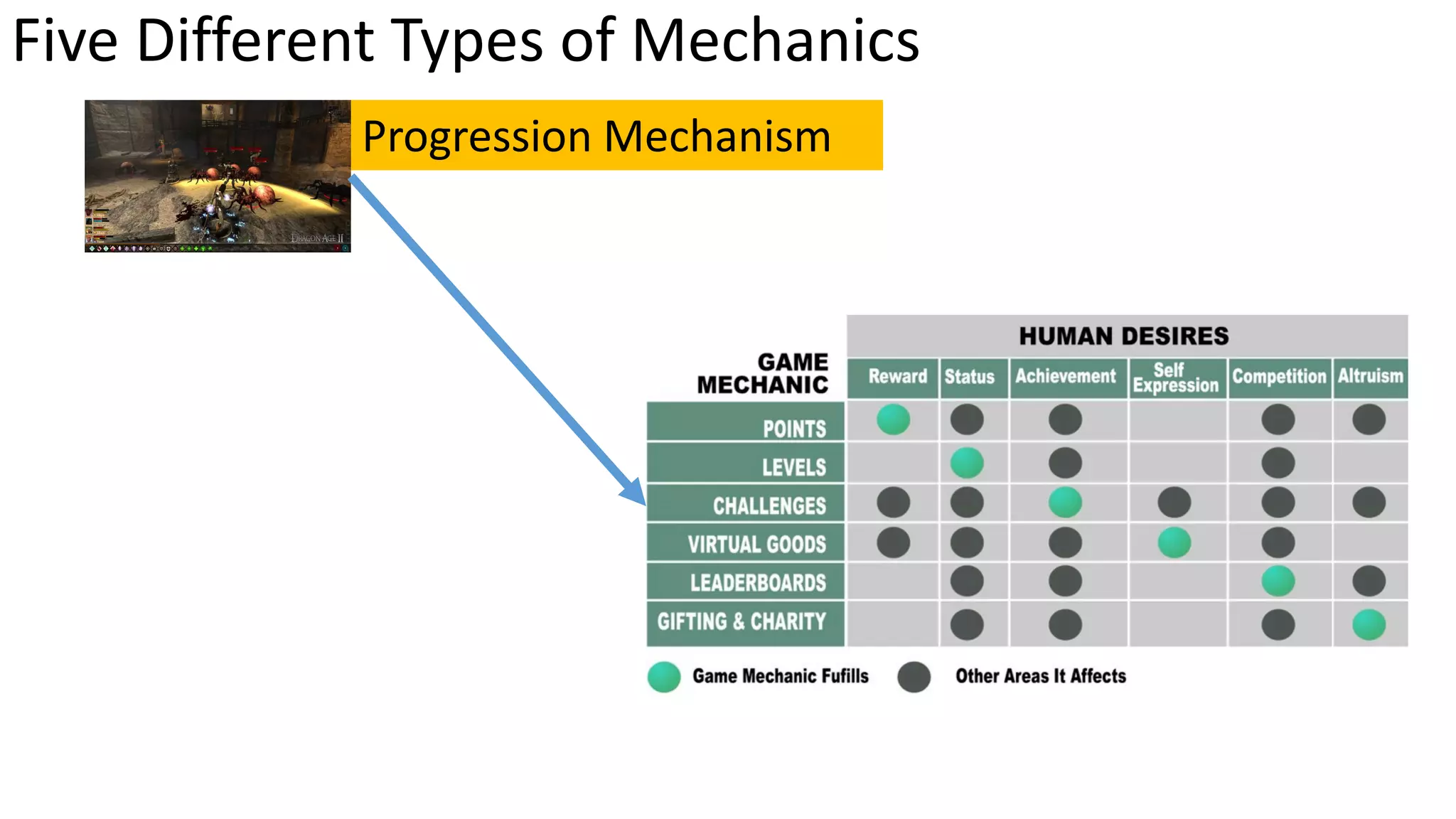
Five Different Types of Mechanics
Progression Mechanism
https://gamemechanicexplorer.com
Cool web for some fun…
DISCRETE MECHANICS
VS.
CONTINUOUS
MECHANICS
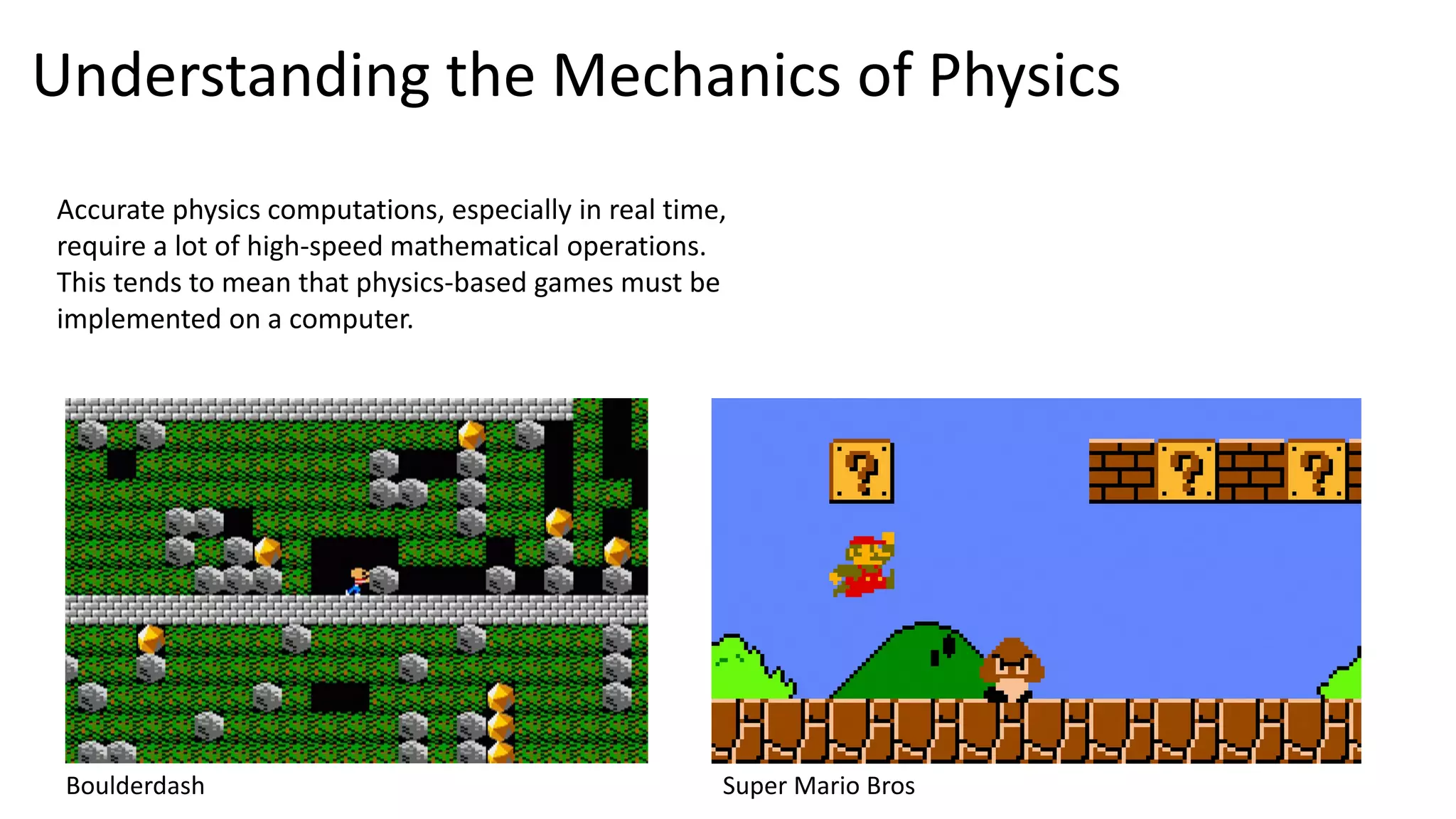
Understanding the Mechanics of Physics
Accurate physics computations, especially in real time,
require a lot of high-speed mathematical operations.
This tends to mean that physics-based games must be
implemented on a computer.
Boulderdash Super Mario Bros
In a real car, you’re not “catching mad air,” ever. But in GTA you can do it.
Your tires are super-grippy. You can take turns too fast. All that good stuff.
Physics in a game should boost the fun, not eliminate it! If making your
game more realistic (i.e. with more realistic physics) makes it less fun, then
it’s probably not the right design move.
https://www.gamedesigning.org/learn/game-physics/
Mixing Physical
Mechanics with
Strategic Gameplay
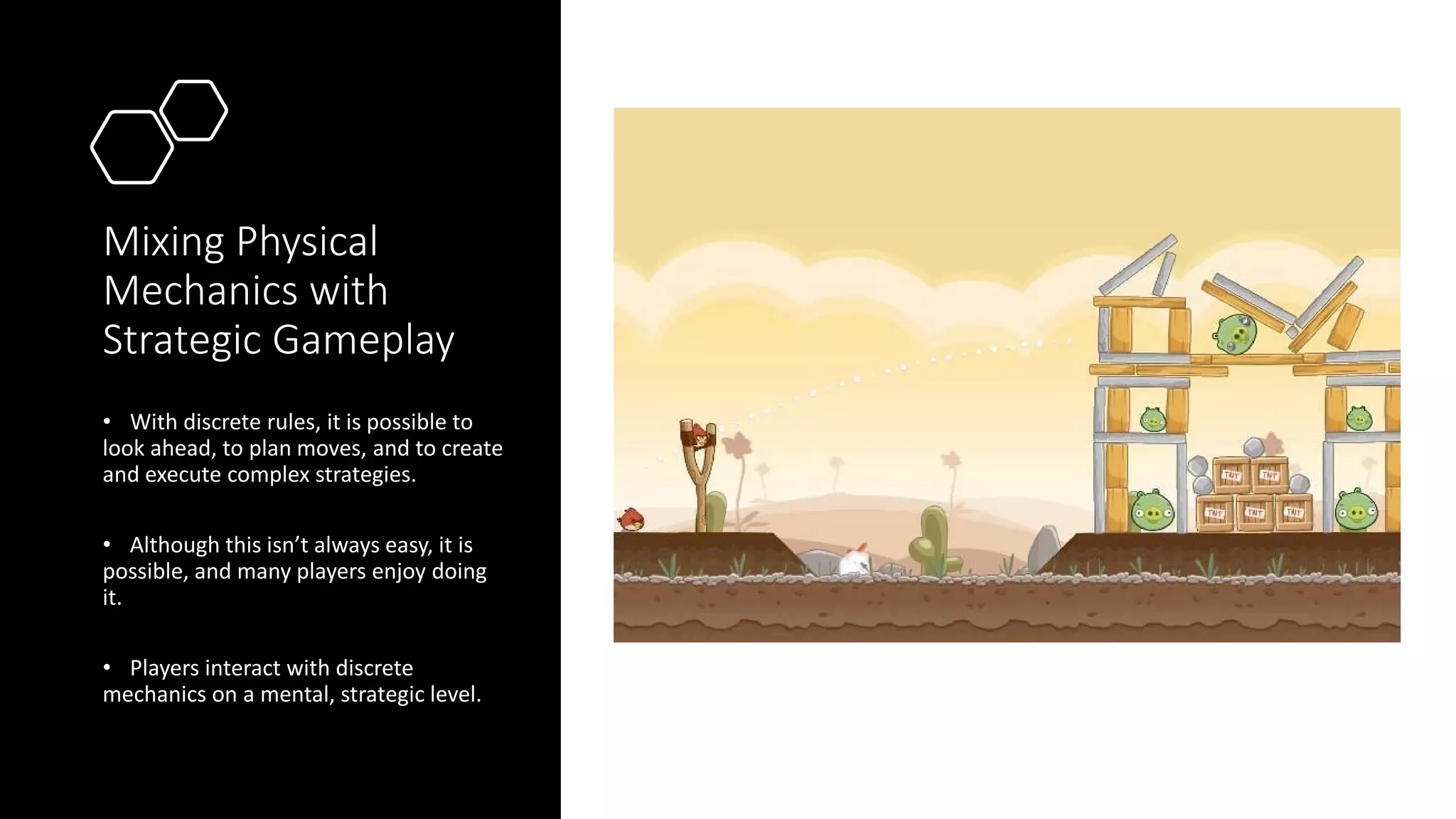
• With discrete rules, it is possible to
look ahead, to plan moves, and to create
and execute complex strategies.
• Although this isn’t always easy, it is
possible, and many players enjoy doing
it.
• Players interact with discrete
mechanics on a mental, strategic level.
Mixing Physical
Mechanics with
Strategic Gameplay
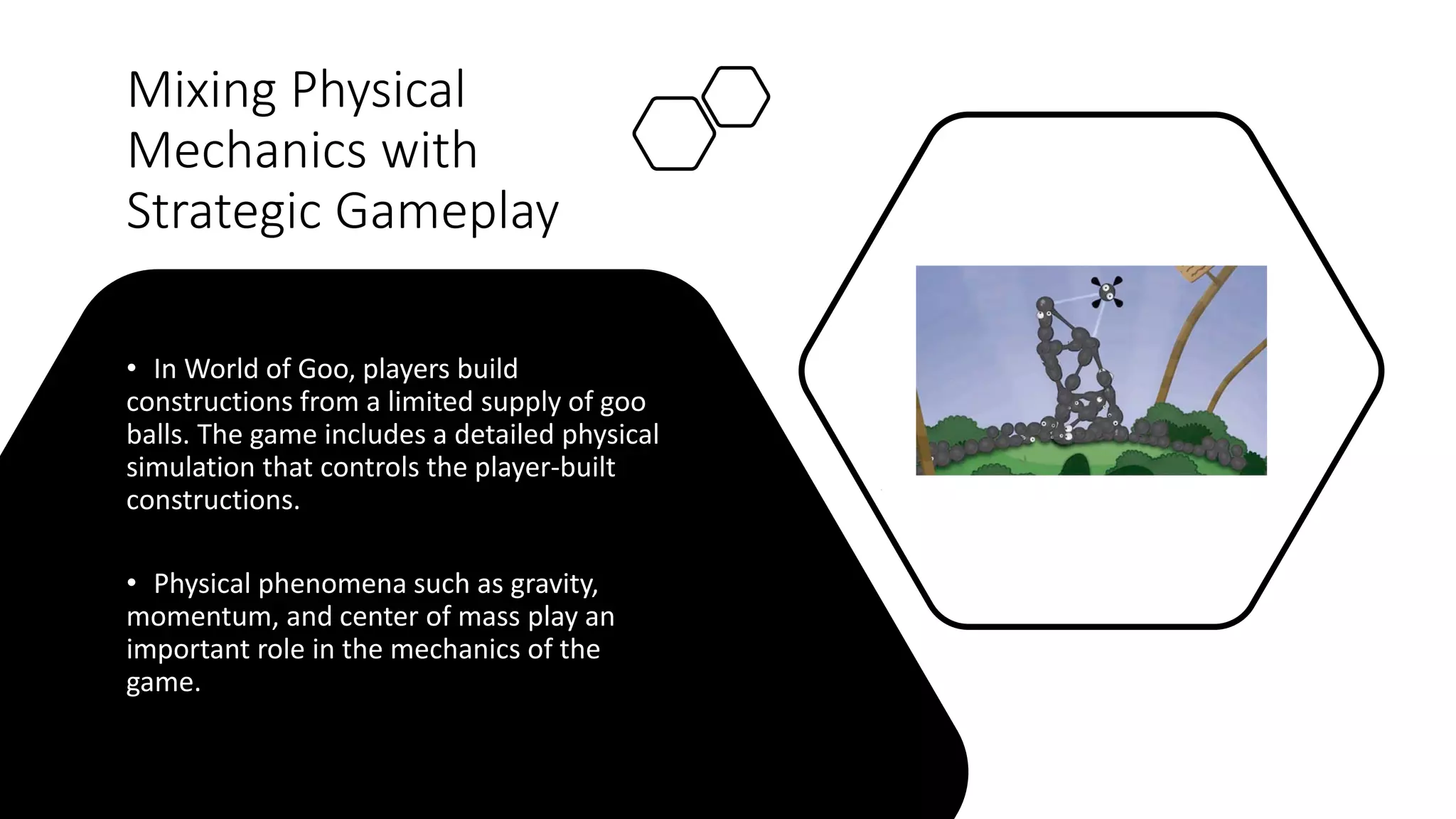
• In World of Goo, players build
constructions from a limited supply of goo
balls. The game includes a detailed physical
simulation that controls the player-built
constructions.
• Physical phenomena such as gravity,
momentum, and center of mass play an
important role in the mechanics of the
game.
Innovating with
Discrete Mechanics
• Discrete mechanics offer more opportunities for
innovation than many of the current forms of
continuous mechanics do.
• As games and genres change, designers’ definitions of
physical mechanics are all evolving into a handful of
directions that correspond closely with game genres.
• Most of the time there is little point in completely
changing the physics of a first-person shooter. In fact,
as games increasingly use physics engine middleware
to handle these mechanics, there is less room to
innovate in that area.
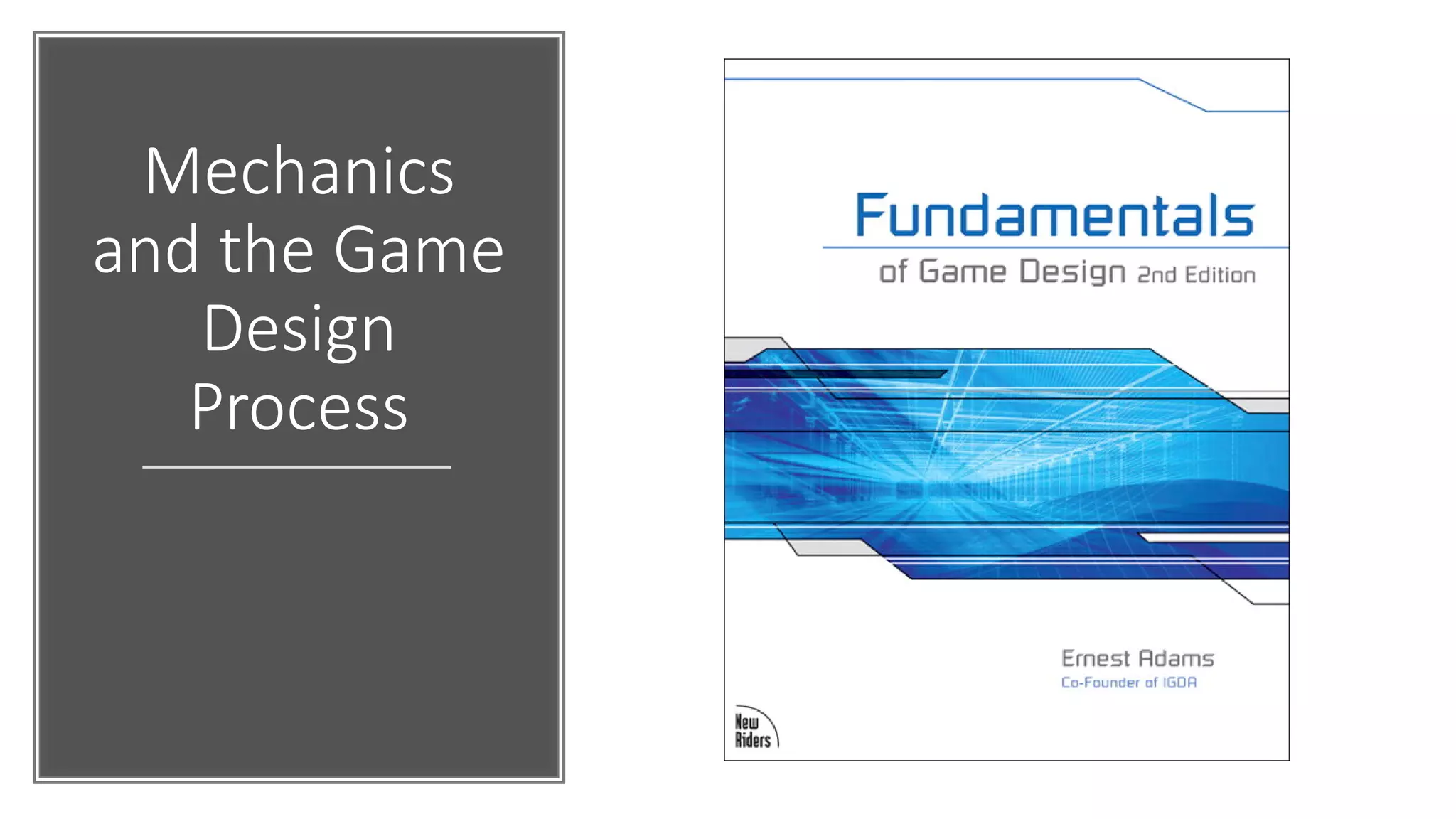
Mechanics
and the Game
Design
Process
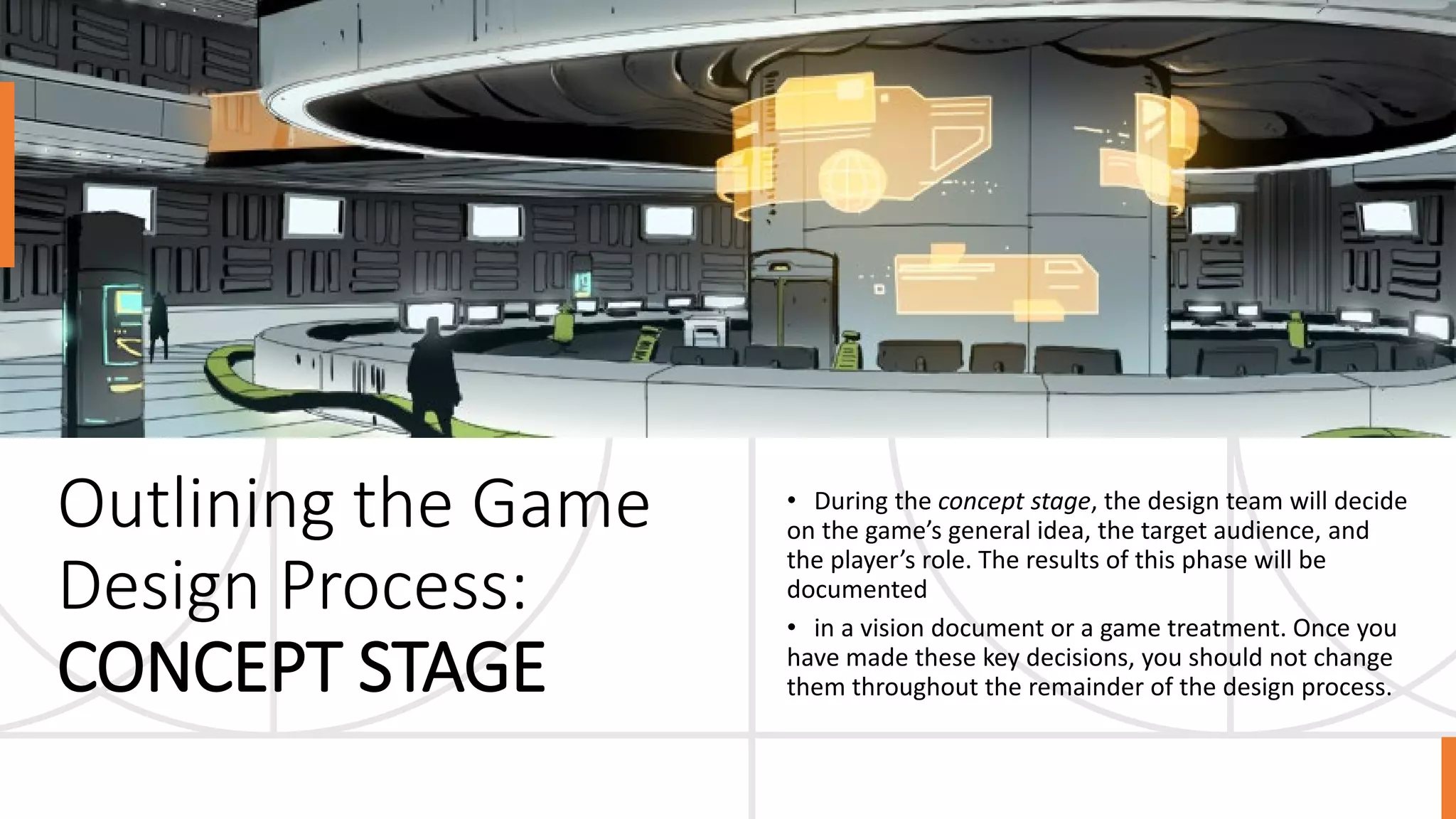
Outlining the Game
Design Process:
CONCEPT STAGE
• During the concept stage, the design team will decide
on the game’s general idea, the target audience, and
the player’s role. The results of this phase will be
documented
• in a vision document or a game treatment. Once you
have made these key decisions, you should not change
them throughout the remainder of the design process.
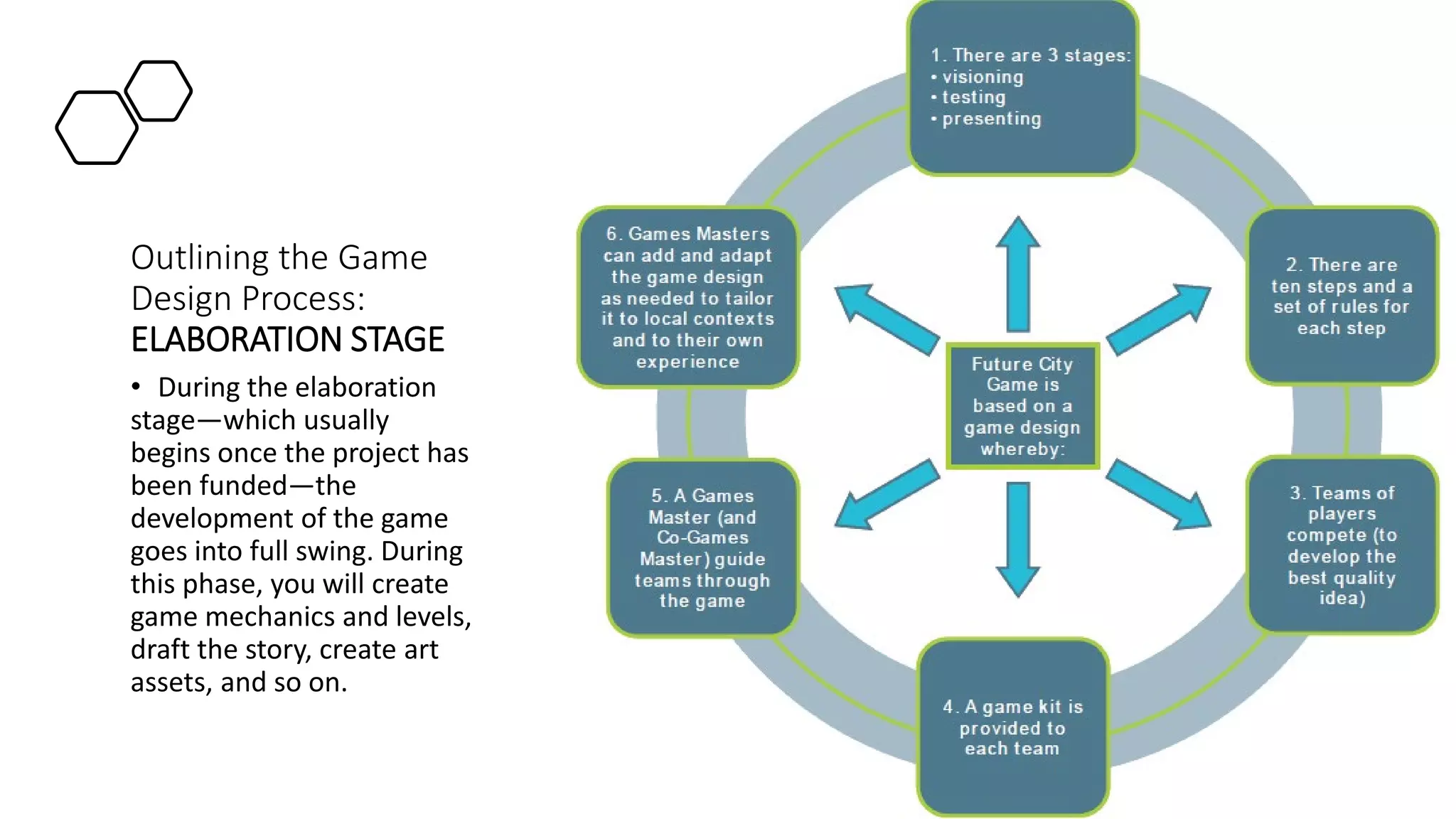
Outlining the Game
Design Process:
ELABORATION STAGE
• During the elaboration
stage—which usually
begins once the project has
been funded—the
development of the game
goes into full swing. During
this phase, you will create
game mechanics and levels,
draft the story, create art
assets, and so on.
Outlining the Game
Design Process:
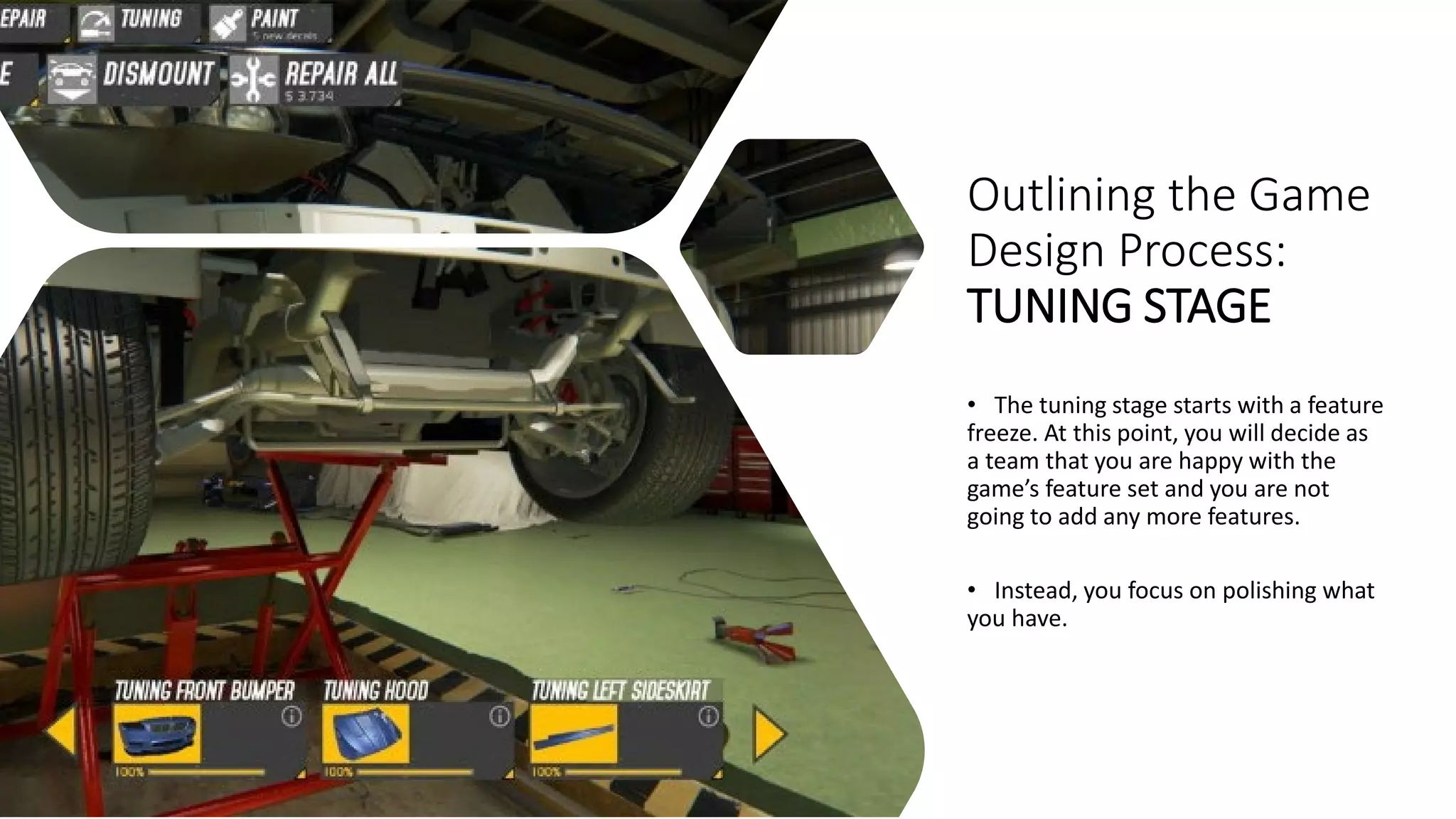
TUNING STAGE
• The tuning stage starts with a feature
freeze. At this point, you will decide as
a team that you are happy with the
game’s feature set and you are not
going to add any more features.
• Instead, you focus on polishing what
you have.
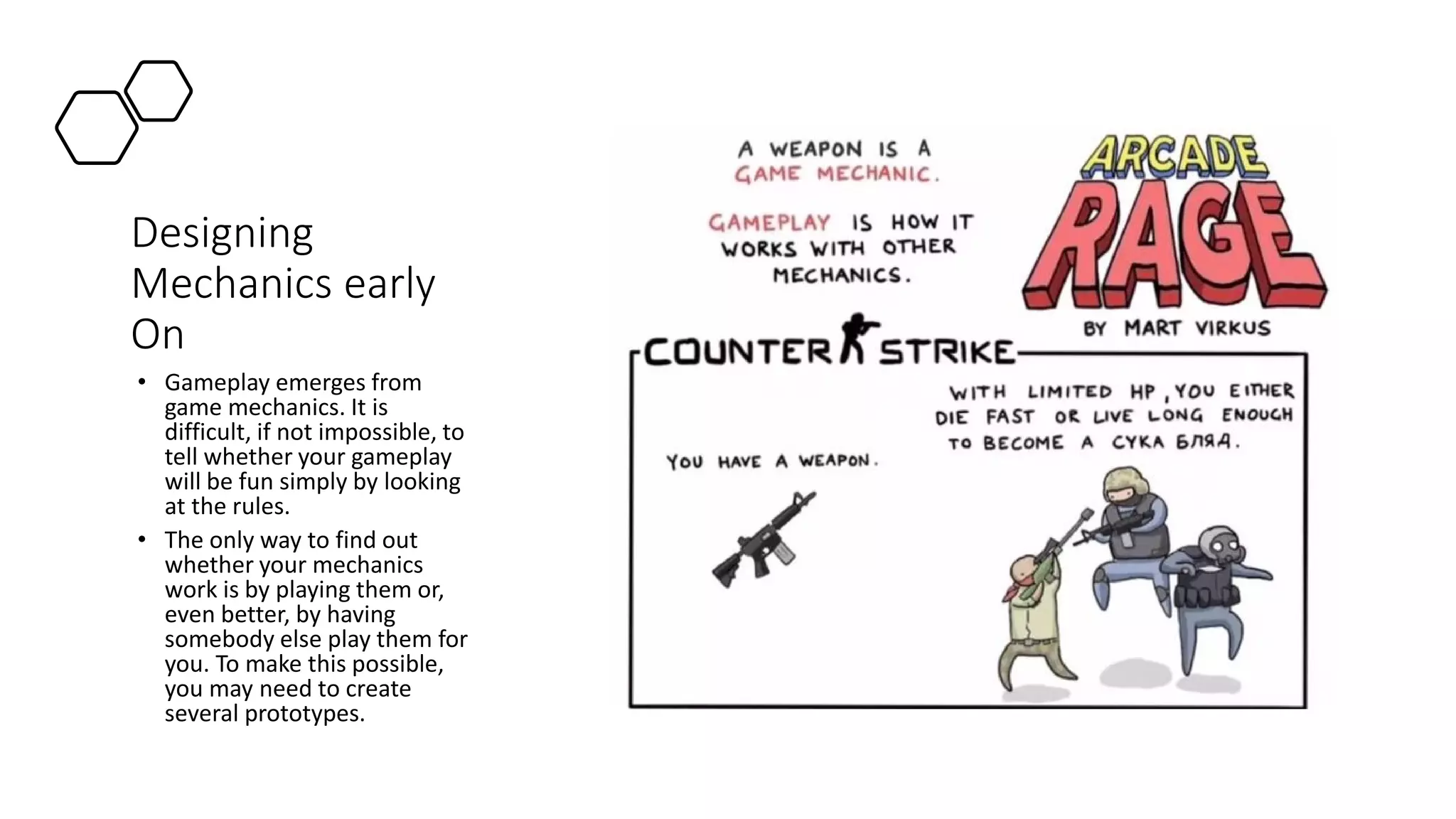
Designing
Mechanics early
On
• Gameplay emerges from
game mechanics. It is
difficult, if not impossible, to
tell whether your gameplay
will be fun simply by looking
at the rules.
• The only way to find out
whether your mechanics
work is by playing them or,
even better, by having
somebody else play them for
you. To make this possible,
you may need to create
several prototypes.
Prototyping
Techniques
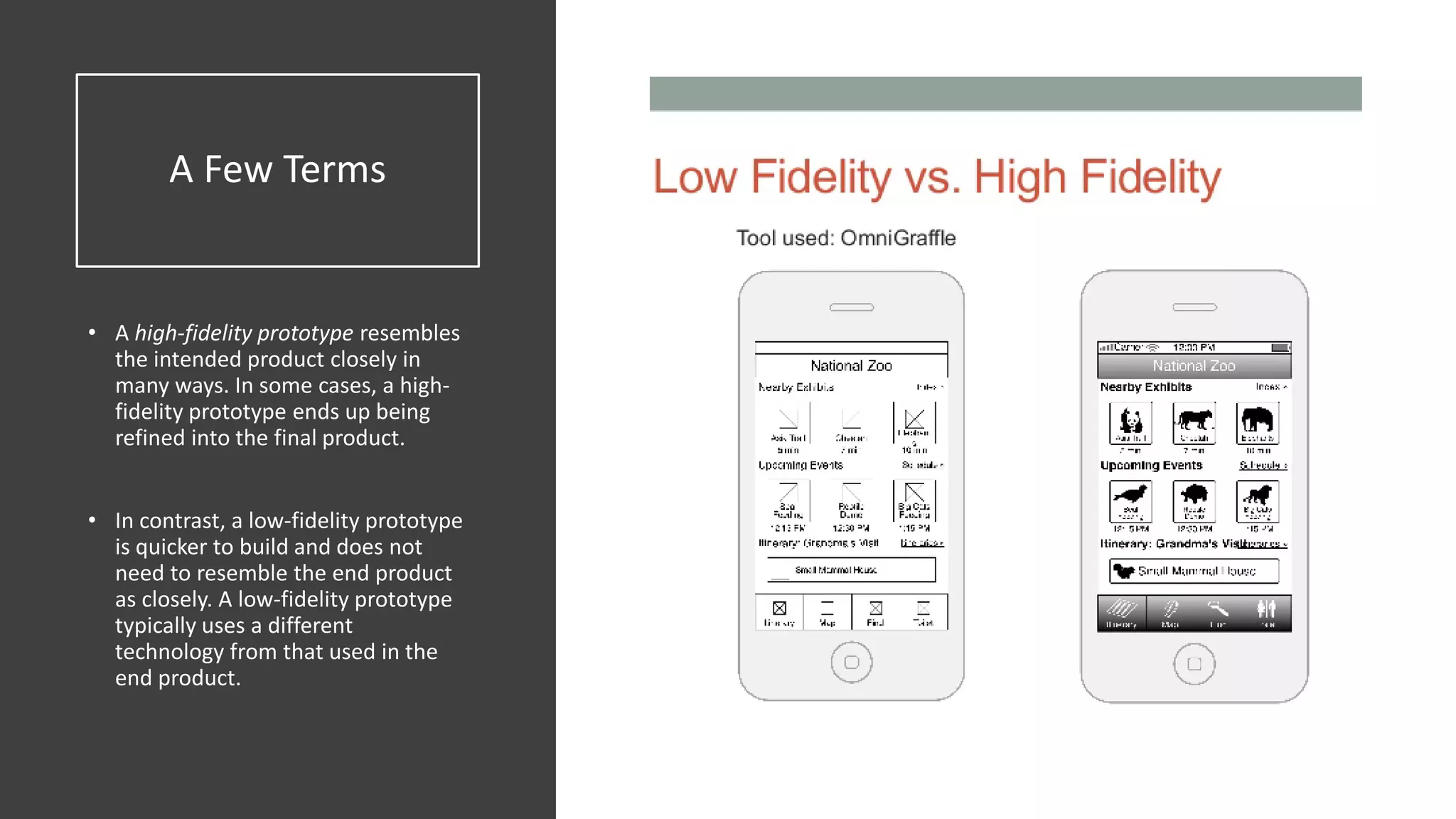
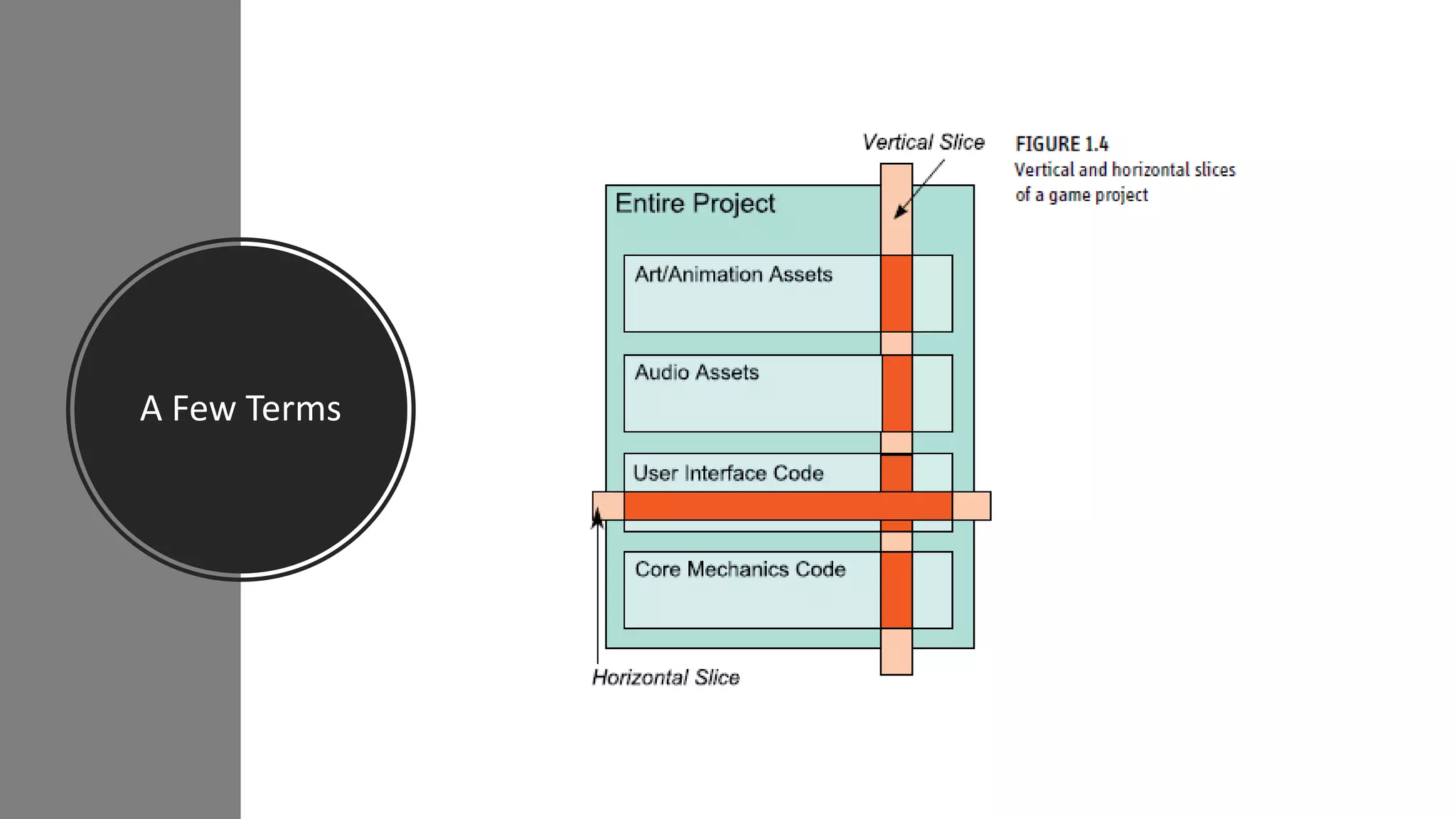
A Few Terms
• A high-fidelity prototype resembles
the intended product closely in
many ways. In some cases, a high-
fidelity prototype ends up being
refined into the final product.
• In contrast, a low-fidelity prototype
is quicker to build and does not
need to resemble the end product
as closely. A low-fidelity prototype
typically uses a different
technology from that used in the
end product.
A Few Terms
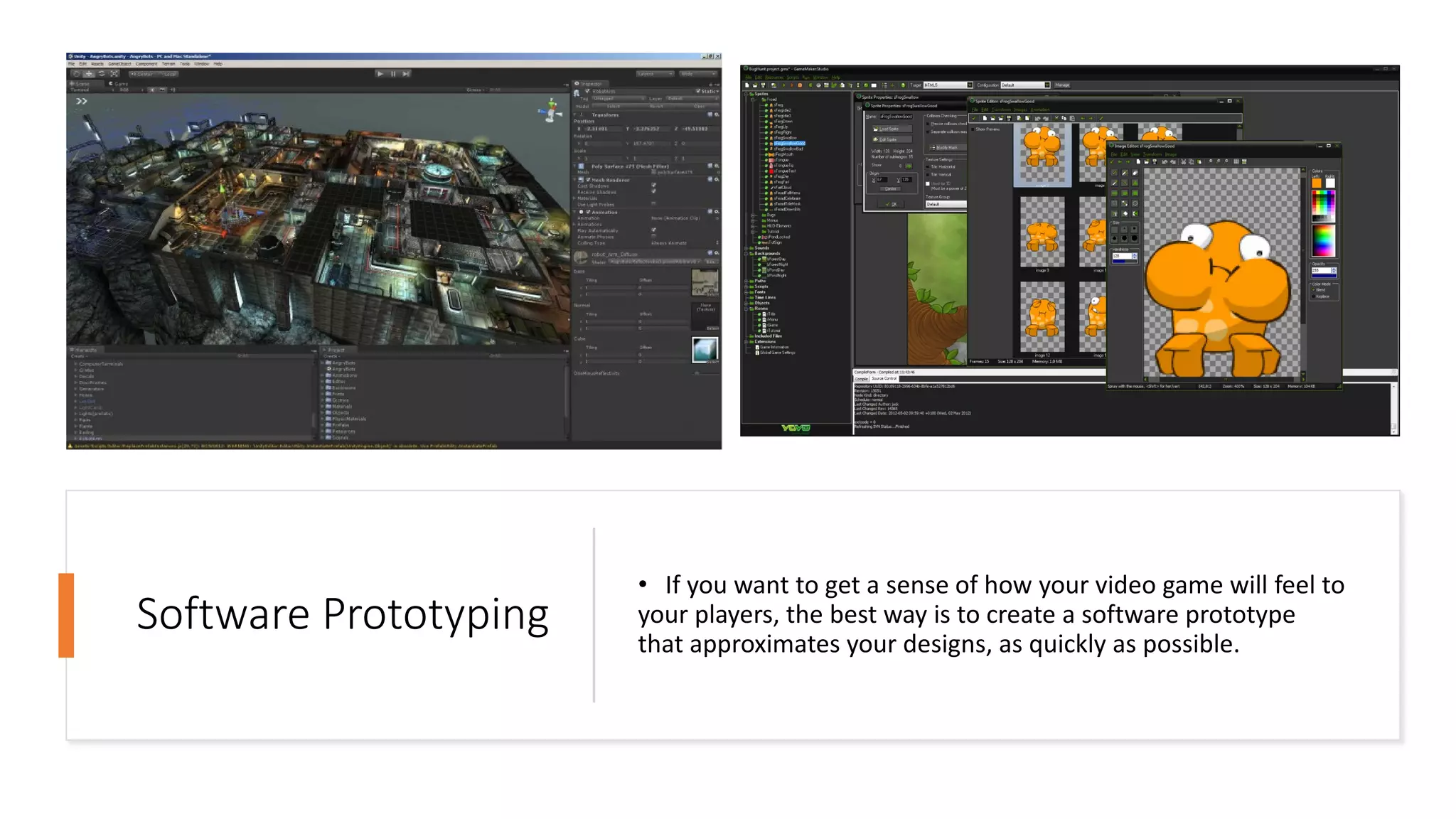
Software Prototyping
• If you want to get a sense of how your video game will feel to
your players, the best way is to create a software prototype
that approximates your designs, as quickly as possible.
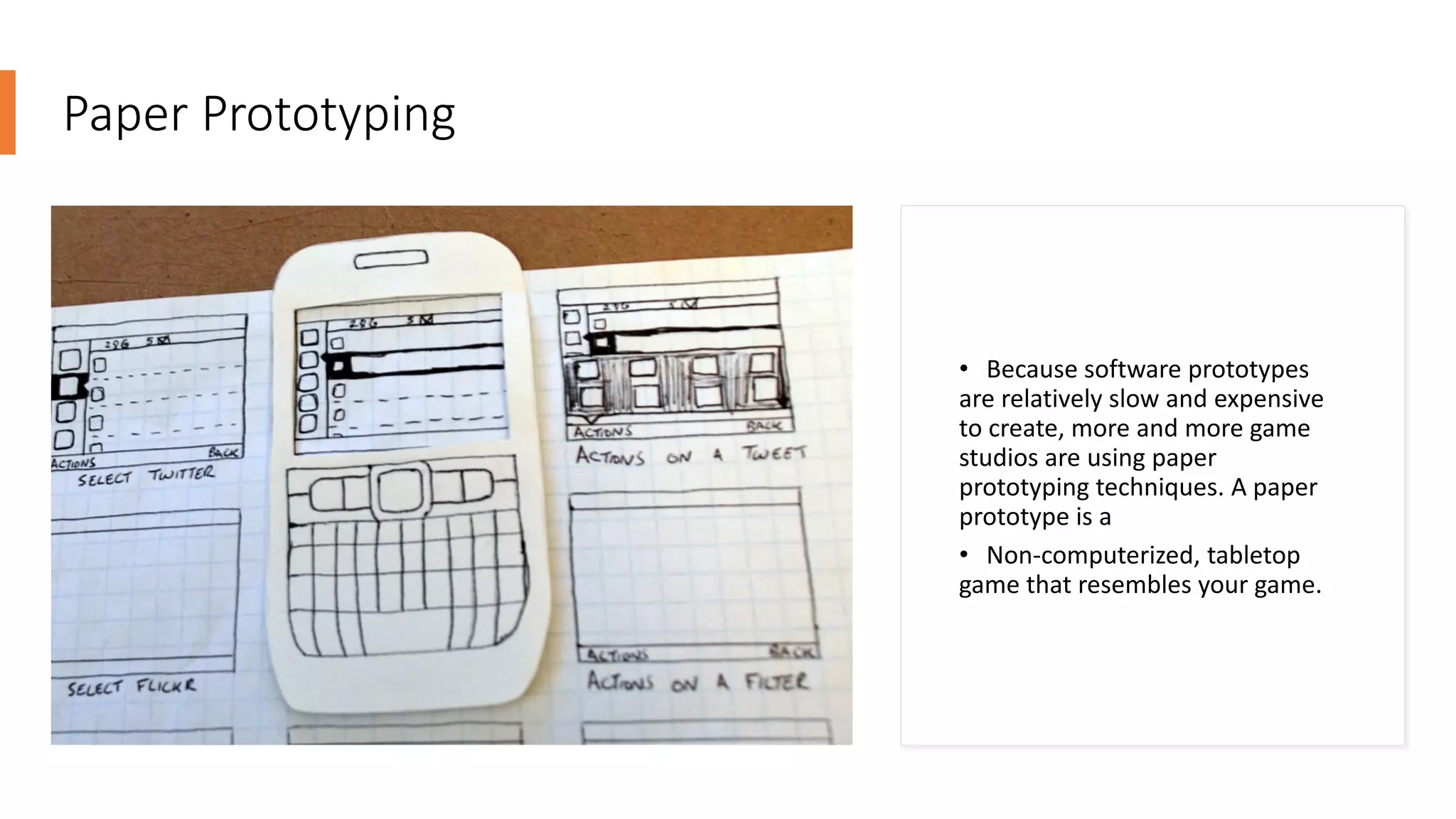
Paper Prototyping
• Because software prototypes
are relatively slow and expensive
to create, more and more game
studios are using paper
prototyping techniques. A paper
prototype is a
• Non-computerized, tabletop
game that resembles your game.
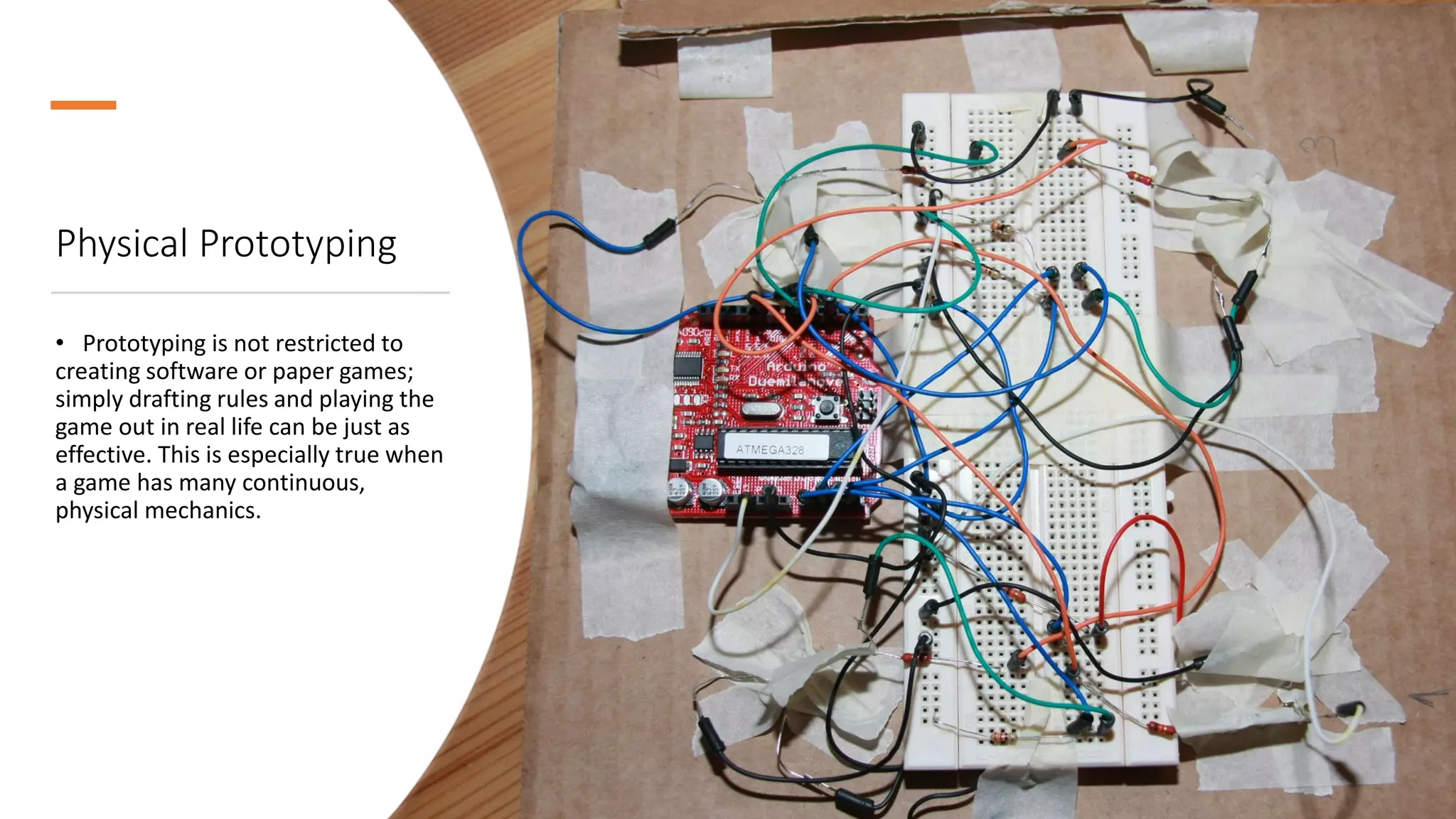
Physical Prototyping
• Prototyping is not restricted to
creating software or paper games;
simply drafting rules and playing the
game out in real life can be just as
effective. This is especially true when
a game has many continuous,
physical mechanics.
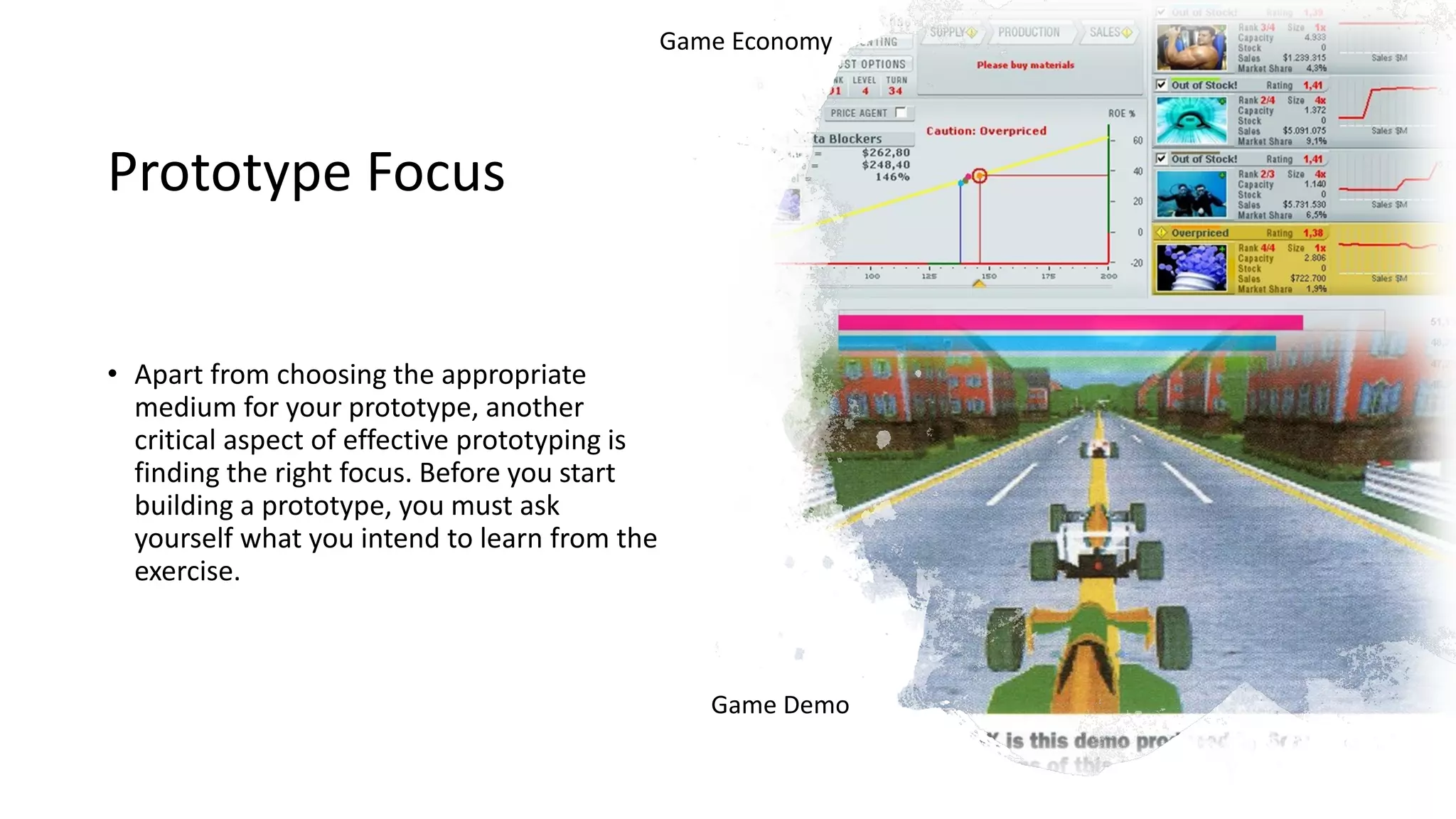
Prototype Focus
• Apart from choosing the appropriate
medium for your prototype, another
critical aspect of effective prototyping is
finding the right focus. Before you start
building a prototype, you must ask
yourself what you intend to learn from the
exercise.
Game Economy
Game Demo
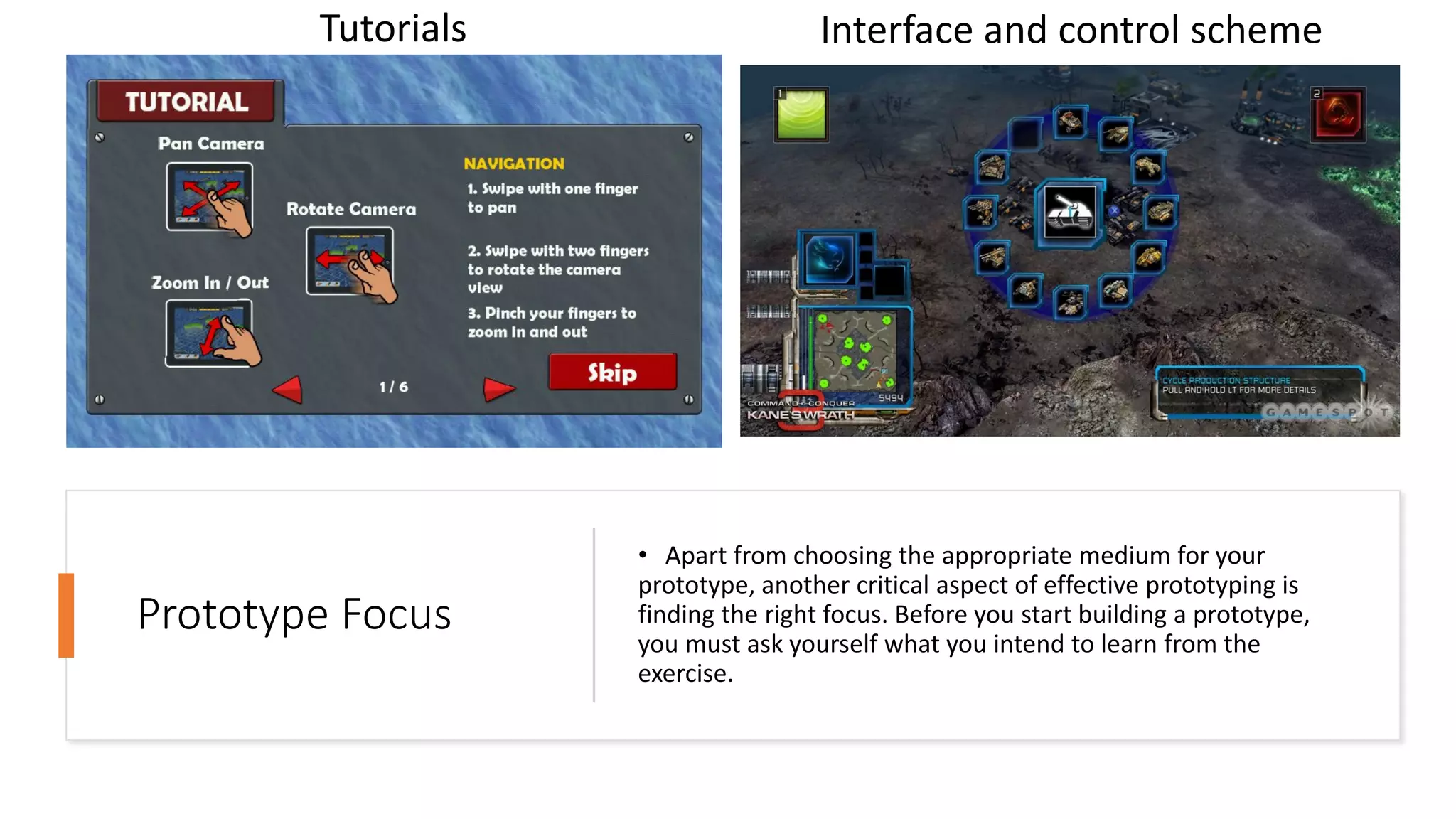
Prototype Focus
• Apart from choosing the appropriate medium for your
prototype, another critical aspect of effective prototyping is
finding the right focus. Before you start building a prototype,
you must ask yourself what you intend to learn from the
exercise.
Tutorials Interface and control scheme
Core Game
Mechanics –
Discrete
Mechanics
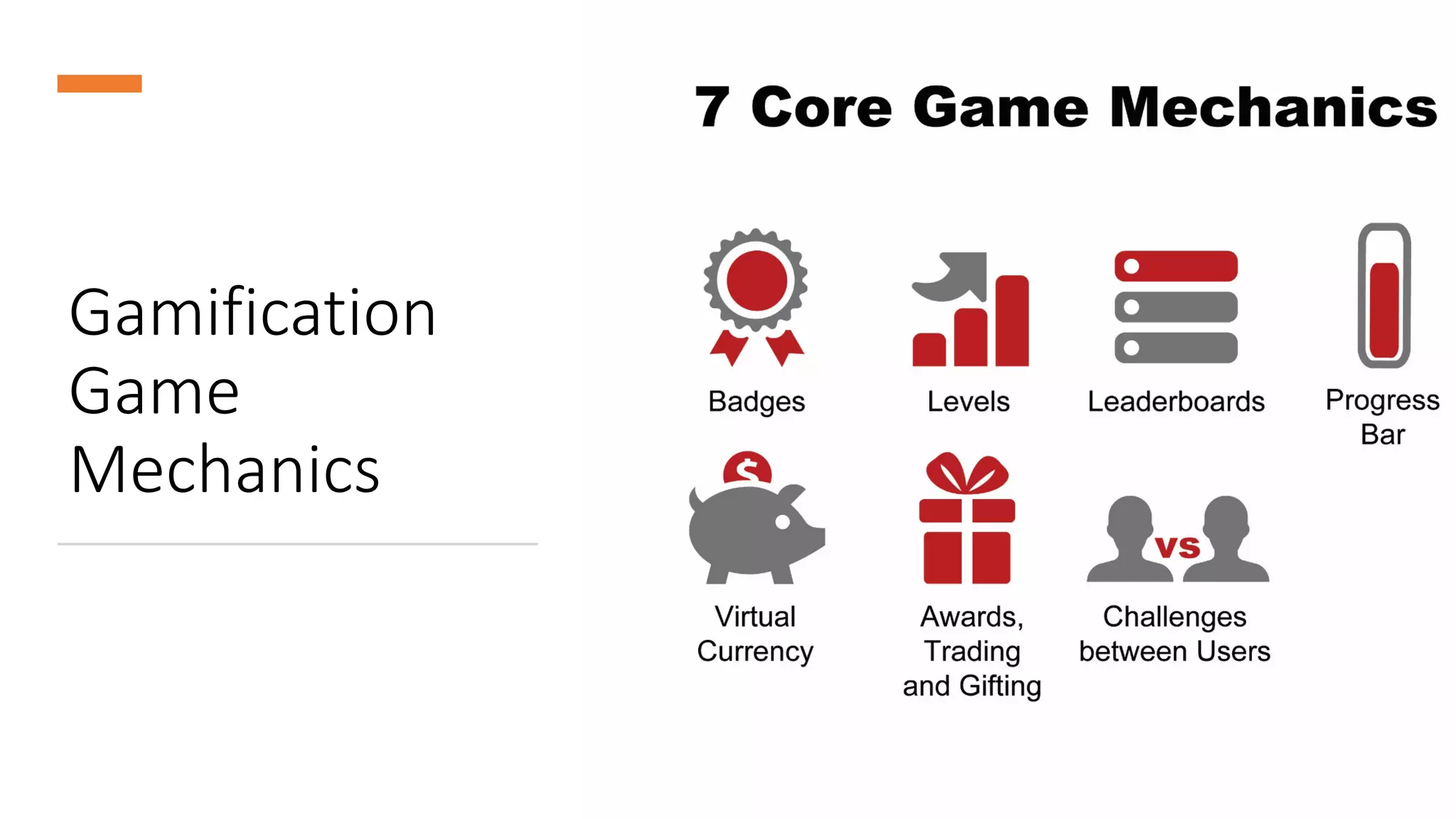
Gamification
Game
Mechanics
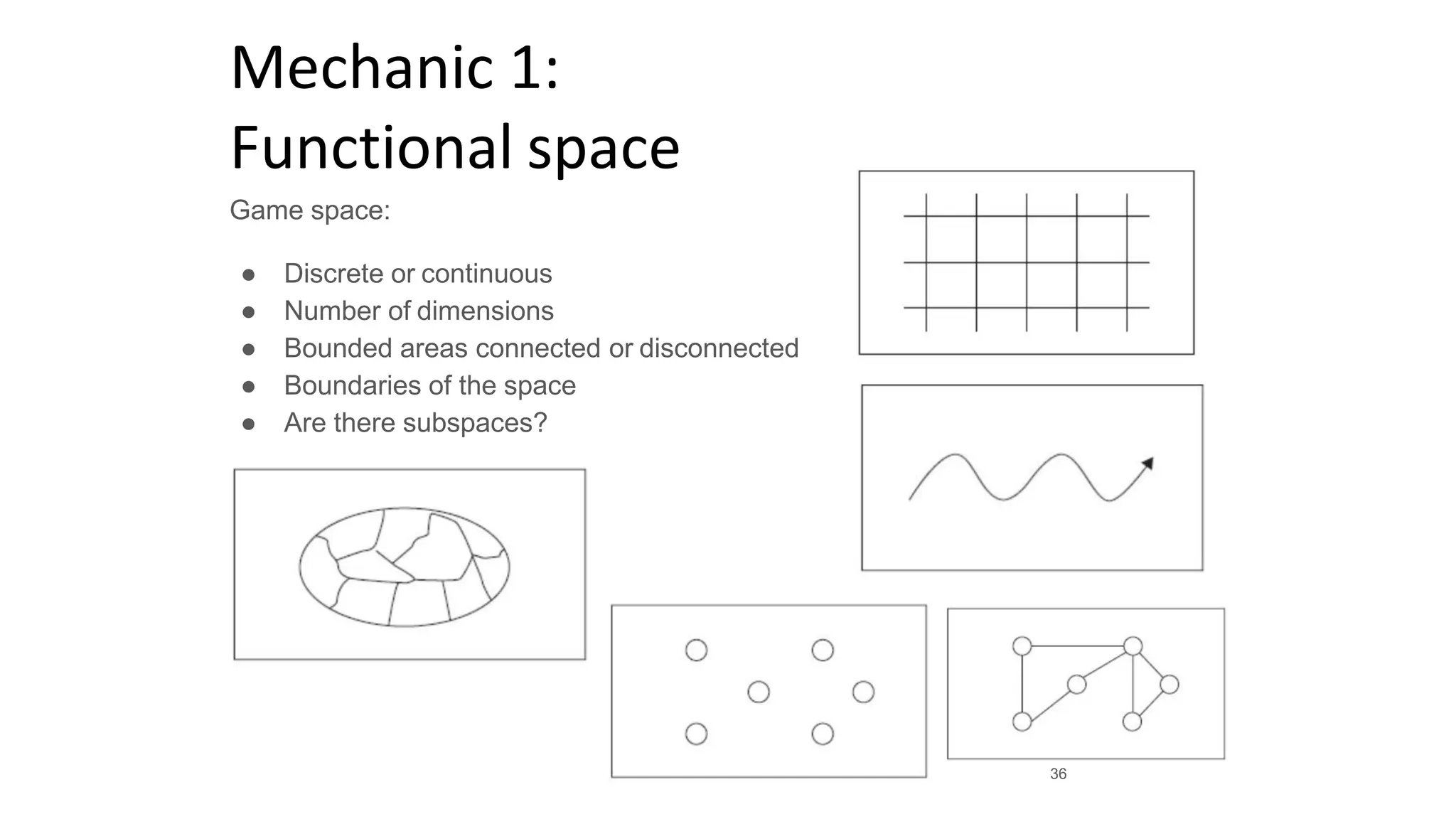
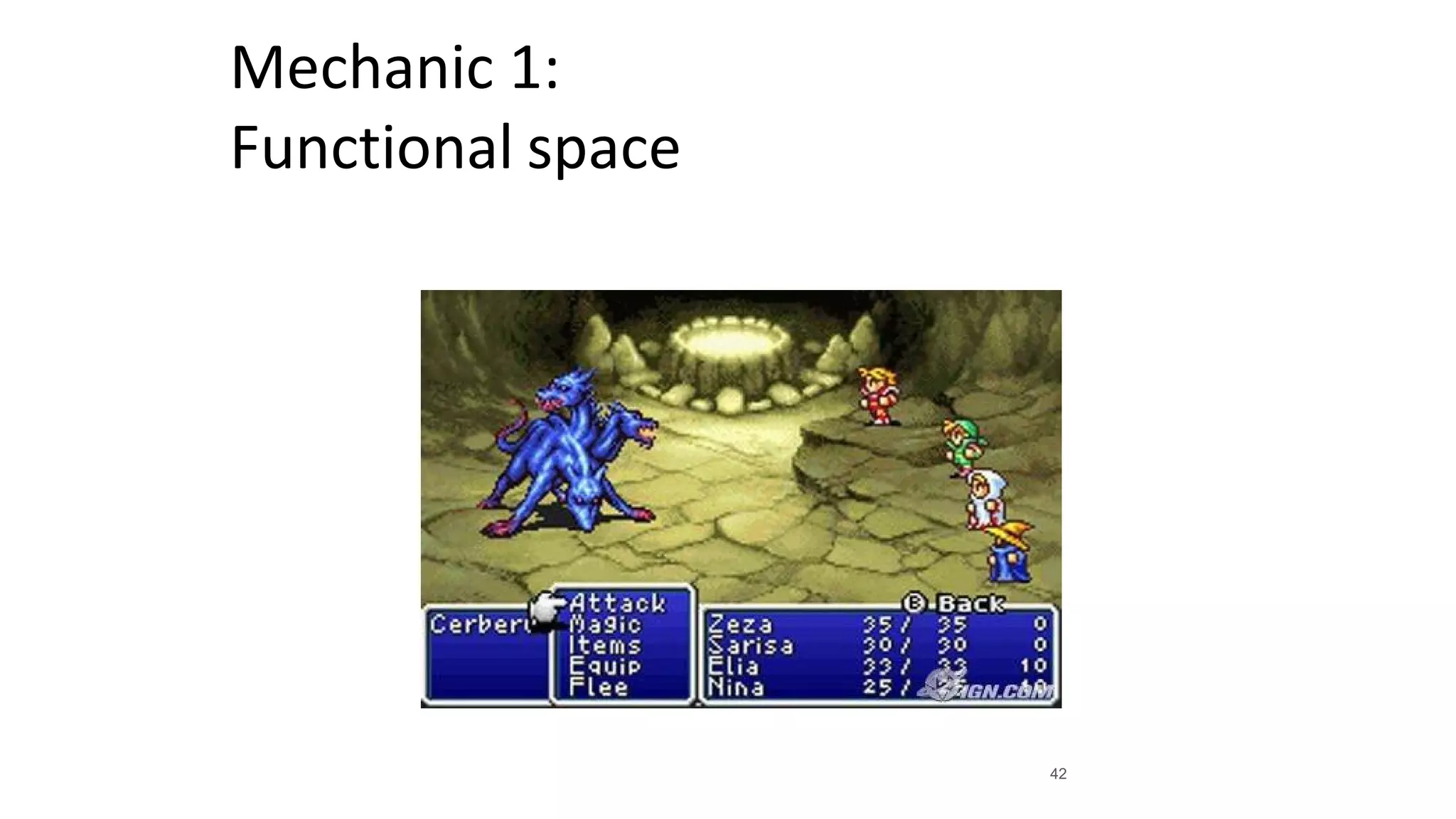
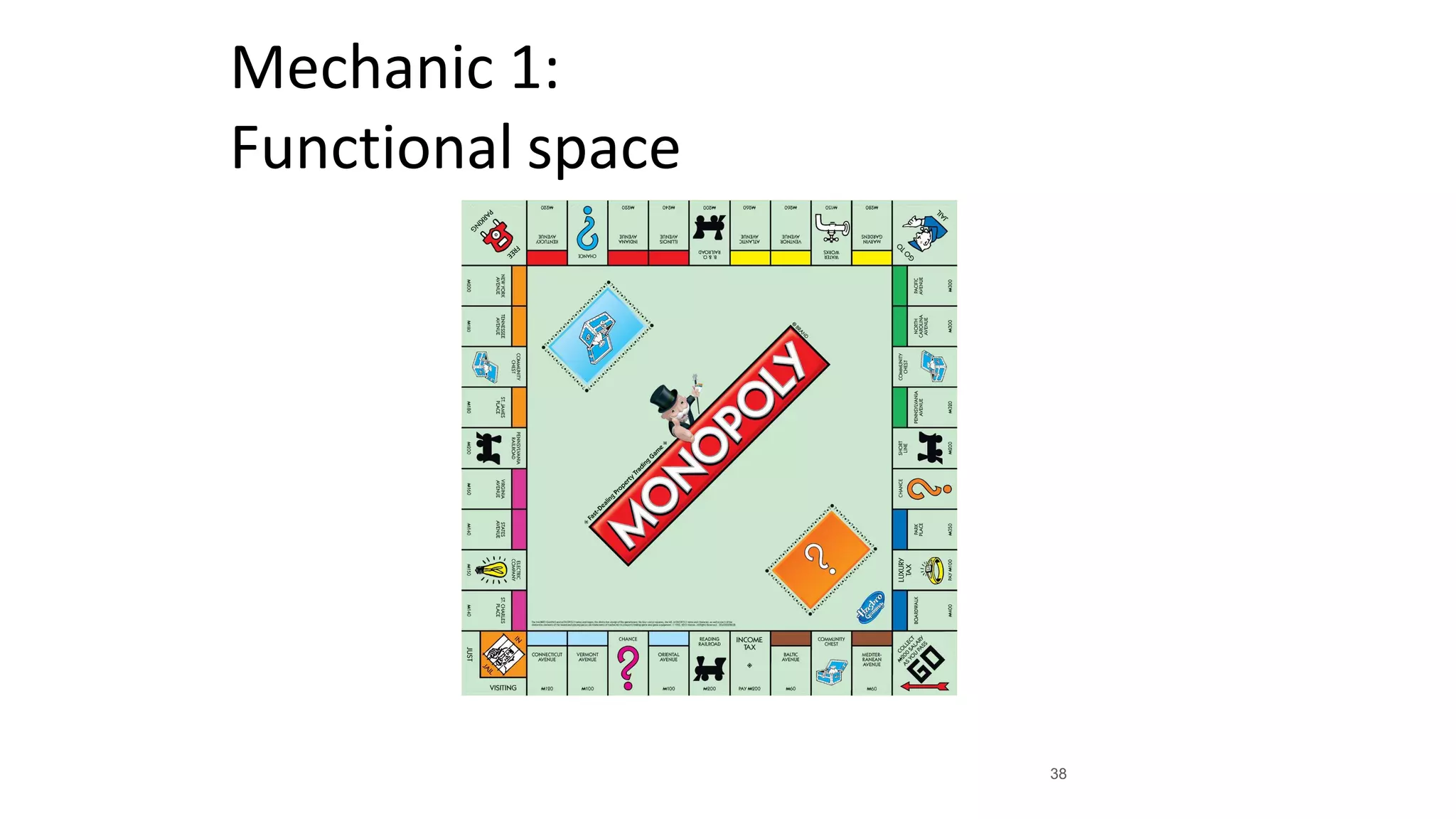
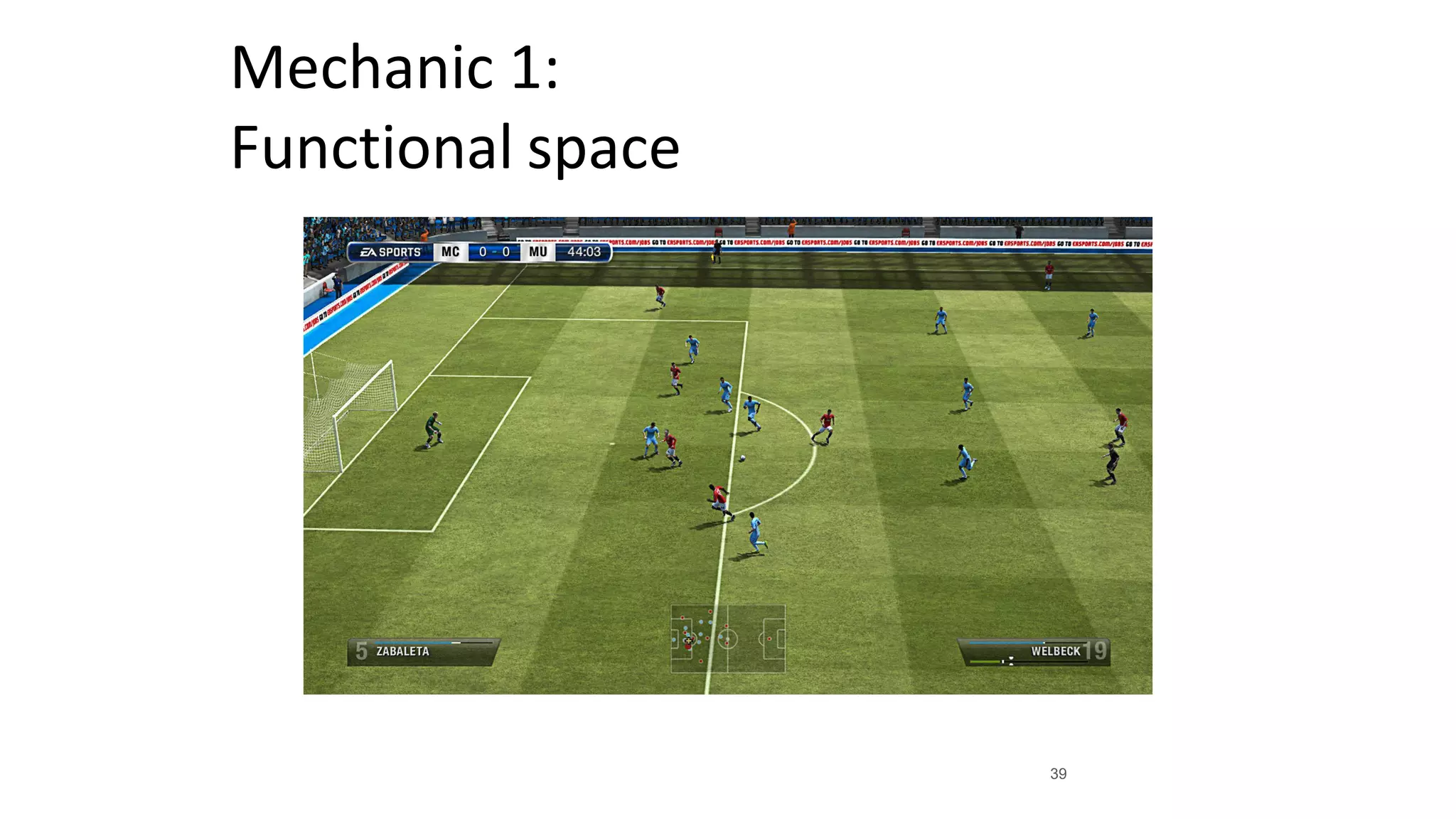
Mechanic 1:
Functional space
Game space:
● Discrete or continuous
● Number of dimensions
● Bounded areas connected or disconnected
● Boundaries of the space
● Are there subspaces?
36
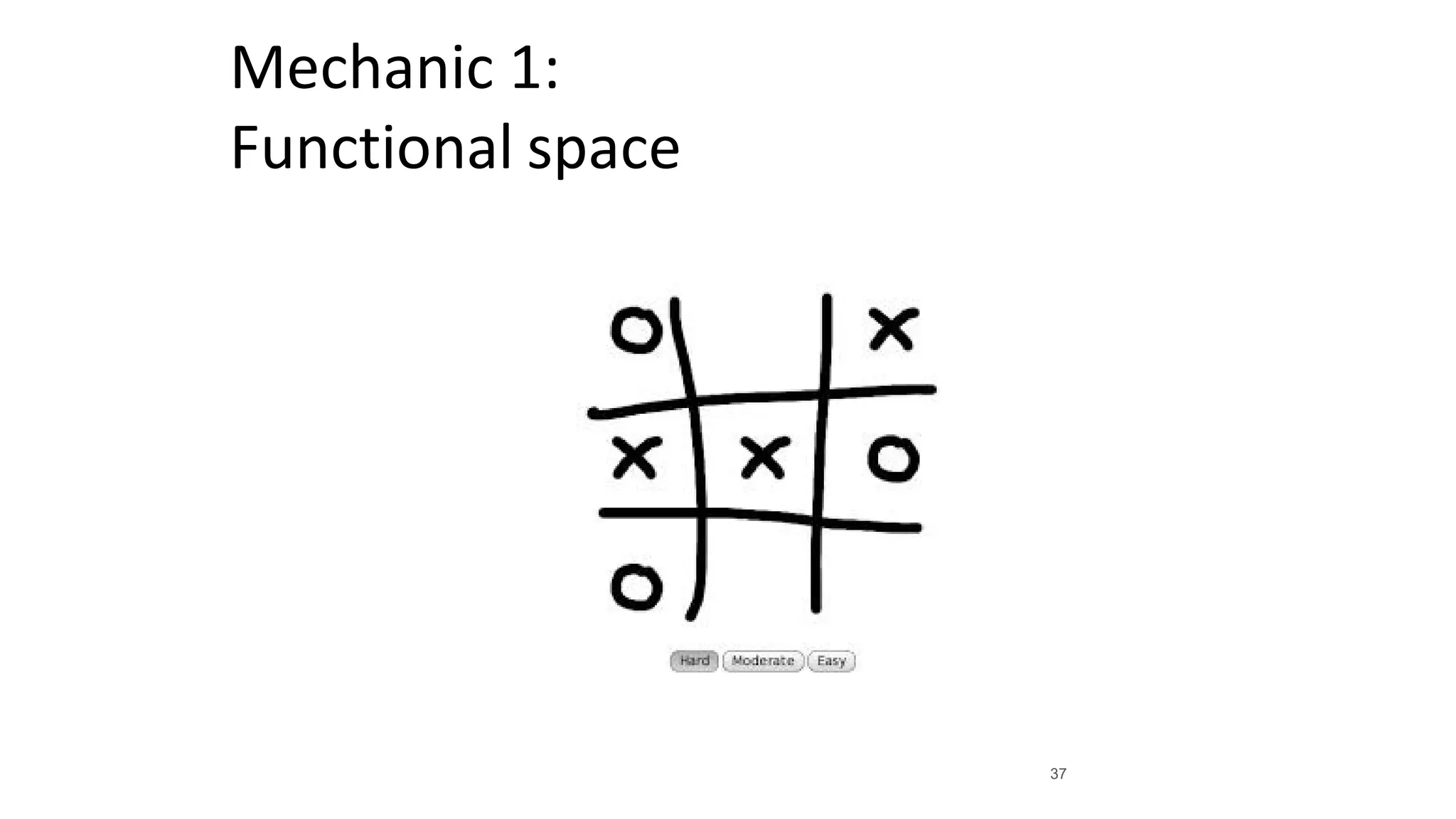
Mechanic 1:
Functional space
37
Mechanic 1:
Functional space
38
Mechanic 1:
Functional space
39
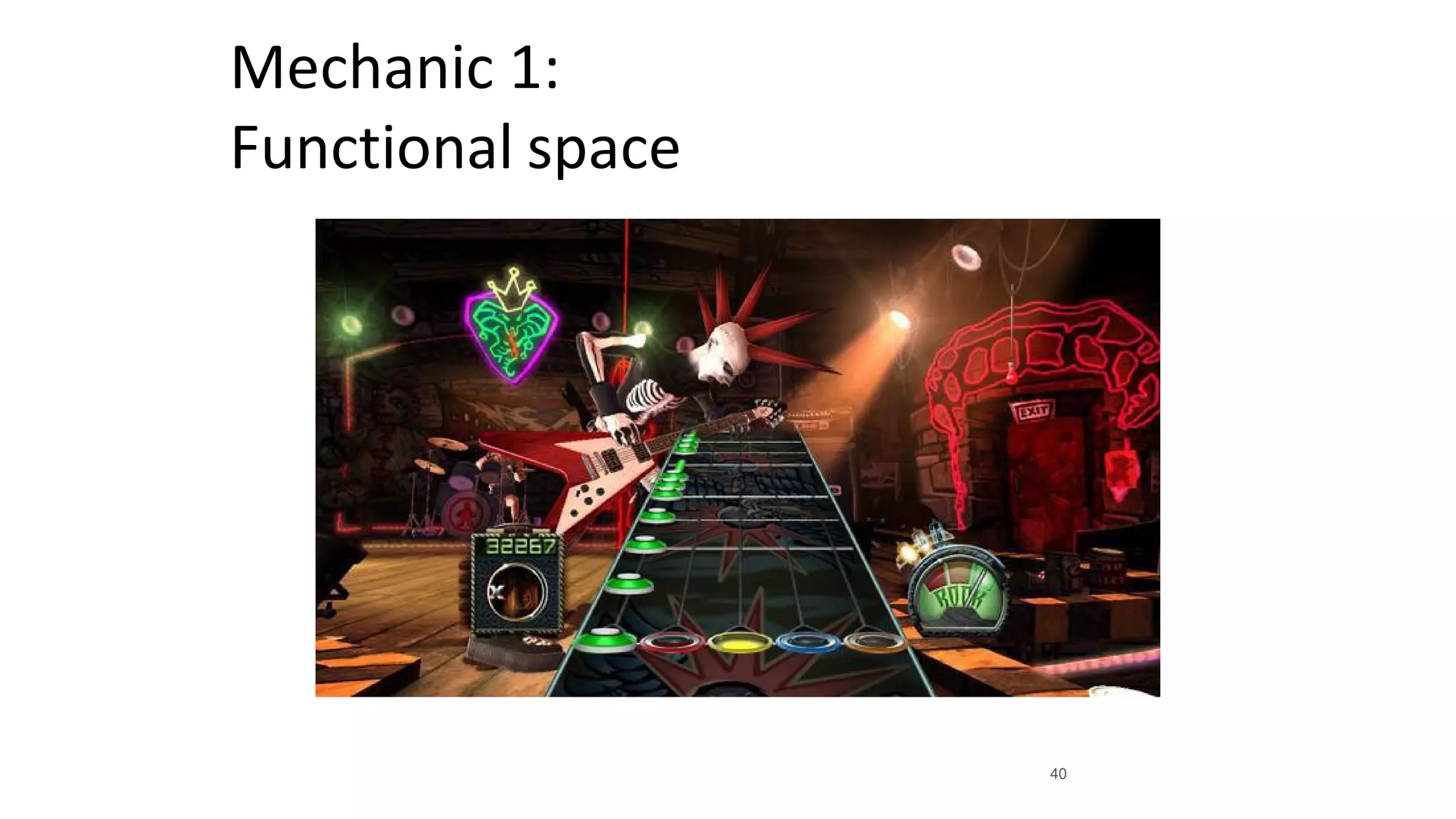
Mechanic 1:
Functional space
40
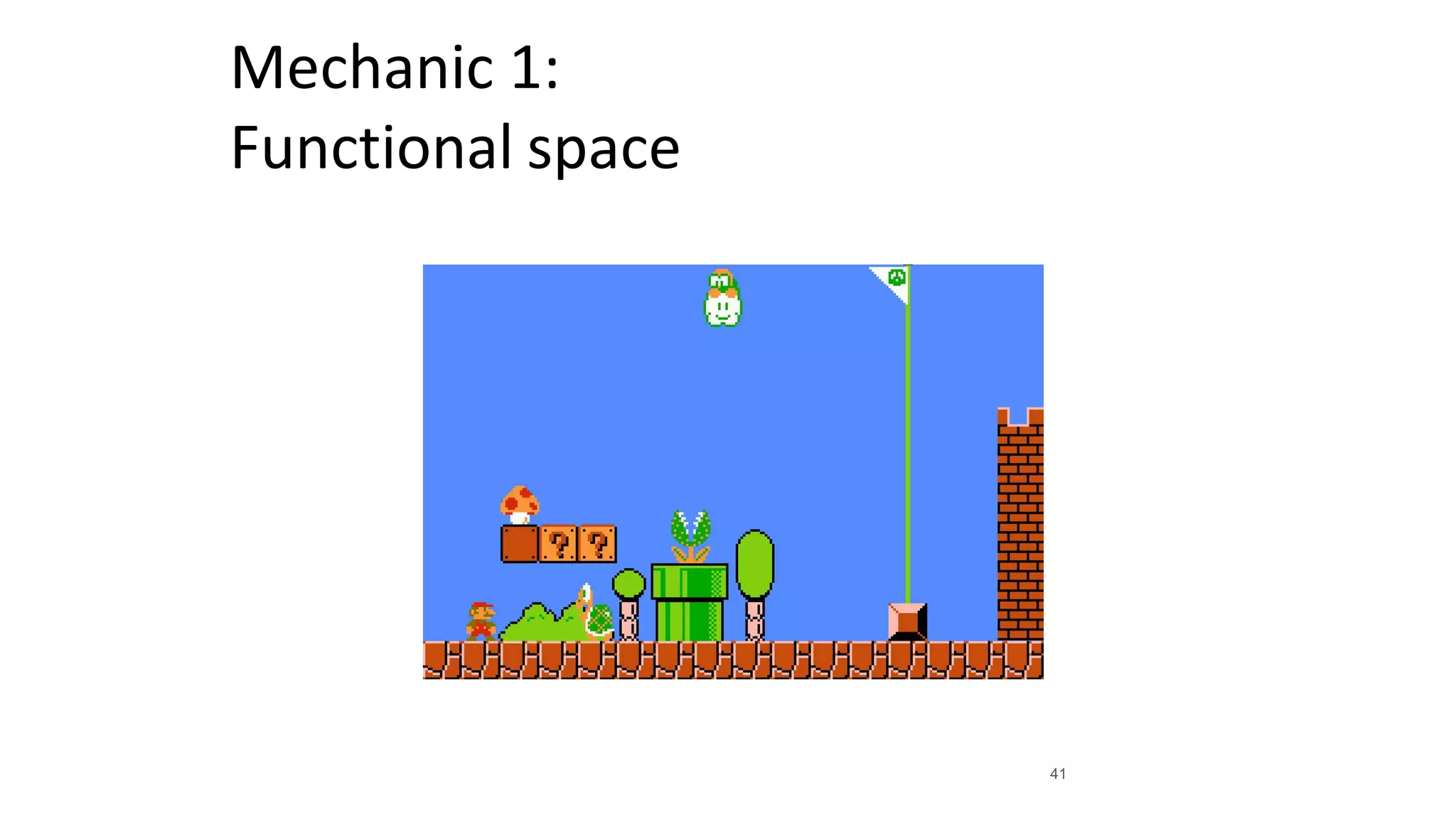
Mechanic 1:
Functional space
41
Mechanic 1:
Functional space
42
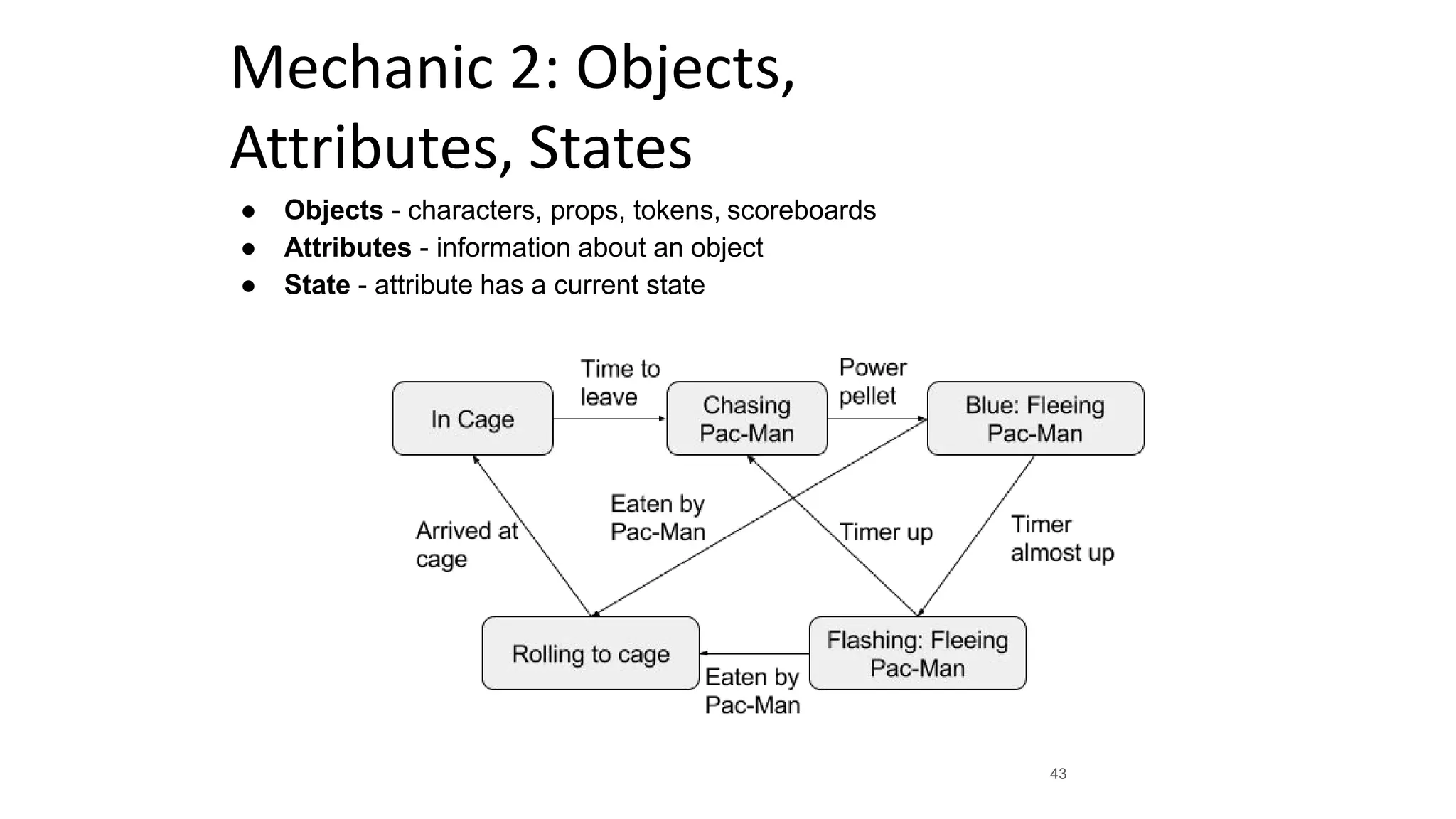
Mechanic 2: Objects,
Attributes, States
● Objects - characters, props, tokens, scoreboards
● Attributes - information about an object
● State - attribute has a current state
43
Mechanics 3:
Actions
● Operative actions - base actions player takes
● Resultant actions - meaningful in the larger picture of the game
Kingdom: New Lands 44
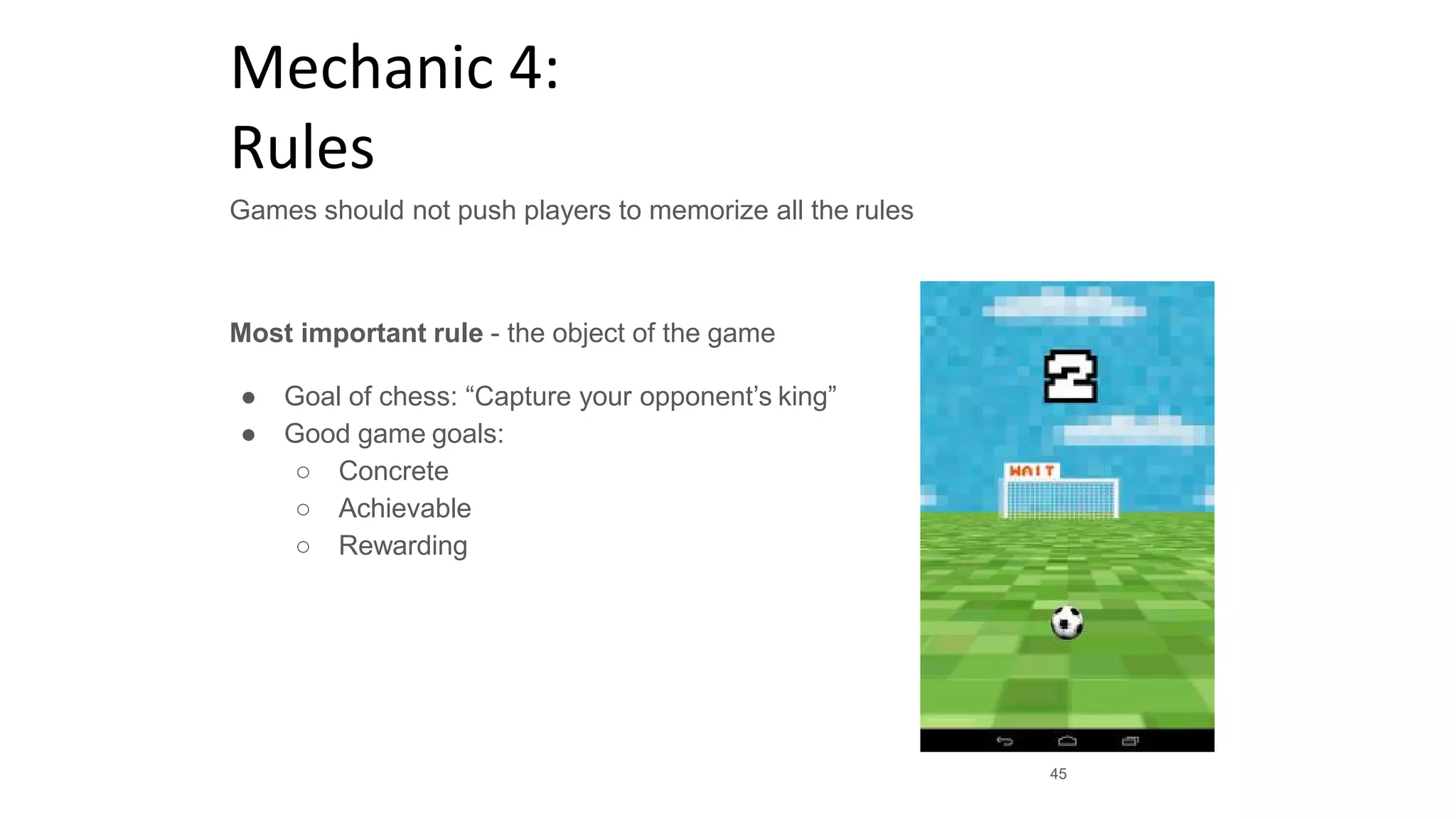
Mechanic 4:
Rules
Games should not push players to memorize all the rules
Most important rule - the object of the game
● Goal of chess: “Capture your opponent’s king”
● Good game goals:
○ Concrete
○ Achievable
○ Rewarding
45
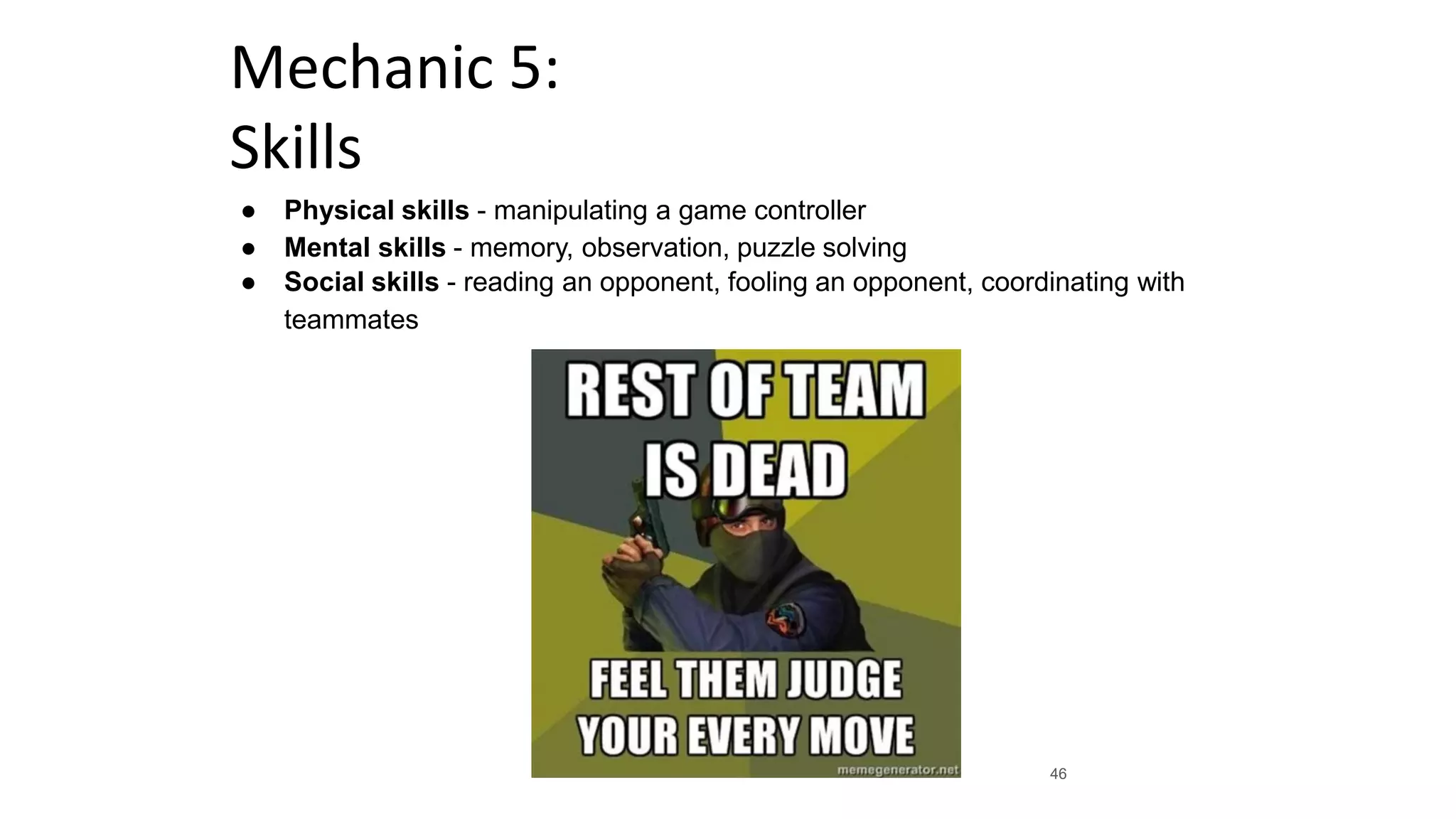
Mechanic 5:
Skills
● Physical skills - manipulating a game controller
● Mental skills - memory, observation, puzzle solving
● Social skills - reading an opponent, fooling an opponent, coordinating with
teammates
46
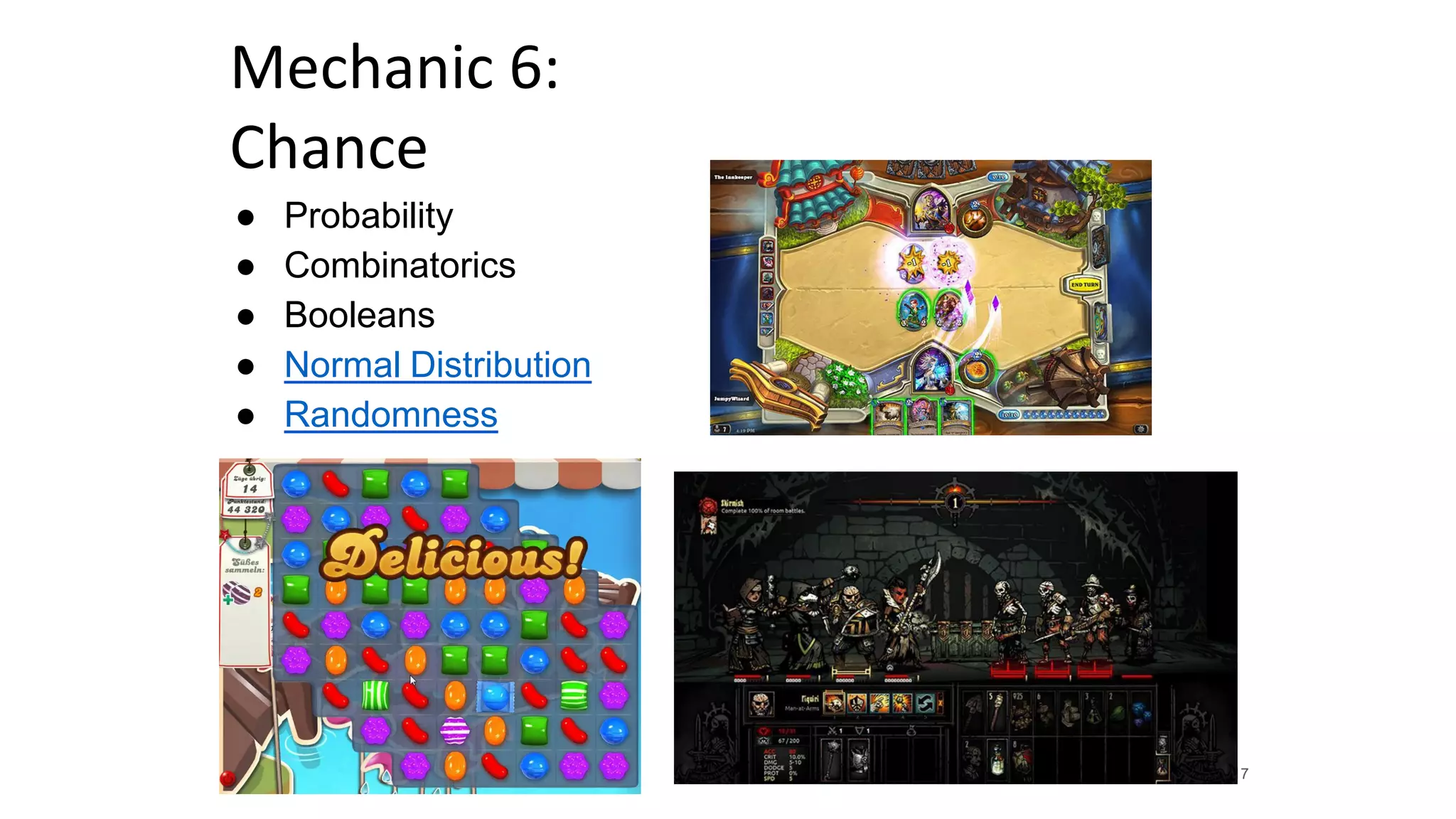
Mechanic 6:
Chance
● Probability
● Combinatorics
● Booleans
● Normal Distribution
● Randomness
17
Task – See Ulearn

01 - Introduction to Game Mechanics

  • 1.
  • 2.
  • 3.
  • 4.
  • 5.
  • 6.
    Game Mechanics arethe basic actions, processes, visuals, and control mechanisms that are used to “gamify” and activity
  • 7.
    Every game hasa core mechanic. A core mechanic is the essential play activity players perform again and again in a game
  • 8.
    However, in manygames, the core mechanic is a compound activity composed of a suite of actions. In a first- person-shooter game such as Quake, the core mechanic is the set of interrelated actions of moving, aiming, firing, and managing resources such as health, ammo, and armor… http://karlkapp.com/game-element-core-mechanic/
  • 9.
  • 10.
    Five Different Typesof Mechanics Physics Tactical Maneuvering Internal Economy Social Interaction Progression Mechanism
  • 11.
    Five Different Typesof Mechanics Progression Mechanism
  • 12.
  • 15.
  • 16.
    Understanding the Mechanicsof Physics Accurate physics computations, especially in real time, require a lot of high-speed mathematical operations. This tends to mean that physics-based games must be implemented on a computer. Boulderdash Super Mario Bros
  • 17.
    In a realcar, you’re not “catching mad air,” ever. But in GTA you can do it. Your tires are super-grippy. You can take turns too fast. All that good stuff. Physics in a game should boost the fun, not eliminate it! If making your game more realistic (i.e. with more realistic physics) makes it less fun, then it’s probably not the right design move. https://www.gamedesigning.org/learn/game-physics/
  • 18.
    Mixing Physical Mechanics with StrategicGameplay • With discrete rules, it is possible to look ahead, to plan moves, and to create and execute complex strategies. • Although this isn’t always easy, it is possible, and many players enjoy doing it. • Players interact with discrete mechanics on a mental, strategic level.
  • 19.
    Mixing Physical Mechanics with StrategicGameplay • In World of Goo, players build constructions from a limited supply of goo balls. The game includes a detailed physical simulation that controls the player-built constructions. • Physical phenomena such as gravity, momentum, and center of mass play an important role in the mechanics of the game.
  • 20.
    Innovating with Discrete Mechanics •Discrete mechanics offer more opportunities for innovation than many of the current forms of continuous mechanics do. • As games and genres change, designers’ definitions of physical mechanics are all evolving into a handful of directions that correspond closely with game genres. • Most of the time there is little point in completely changing the physics of a first-person shooter. In fact, as games increasingly use physics engine middleware to handle these mechanics, there is less room to innovate in that area.
  • 21.
  • 22.
    Outlining the Game DesignProcess: CONCEPT STAGE • During the concept stage, the design team will decide on the game’s general idea, the target audience, and the player’s role. The results of this phase will be documented • in a vision document or a game treatment. Once you have made these key decisions, you should not change them throughout the remainder of the design process.
  • 23.
    Outlining the Game DesignProcess: ELABORATION STAGE • During the elaboration stage—which usually begins once the project has been funded—the development of the game goes into full swing. During this phase, you will create game mechanics and levels, draft the story, create art assets, and so on.
  • 24.
    Outlining the Game DesignProcess: TUNING STAGE • The tuning stage starts with a feature freeze. At this point, you will decide as a team that you are happy with the game’s feature set and you are not going to add any more features. • Instead, you focus on polishing what you have.
  • 25.
    Designing Mechanics early On • Gameplayemerges from game mechanics. It is difficult, if not impossible, to tell whether your gameplay will be fun simply by looking at the rules. • The only way to find out whether your mechanics work is by playing them or, even better, by having somebody else play them for you. To make this possible, you may need to create several prototypes.
  • 26.
  • 27.
    A Few Terms •A high-fidelity prototype resembles the intended product closely in many ways. In some cases, a high- fidelity prototype ends up being refined into the final product. • In contrast, a low-fidelity prototype is quicker to build and does not need to resemble the end product as closely. A low-fidelity prototype typically uses a different technology from that used in the end product.
  • 28.
  • 29.
    Software Prototyping • Ifyou want to get a sense of how your video game will feel to your players, the best way is to create a software prototype that approximates your designs, as quickly as possible.
  • 30.
    Paper Prototyping • Becausesoftware prototypes are relatively slow and expensive to create, more and more game studios are using paper prototyping techniques. A paper prototype is a • Non-computerized, tabletop game that resembles your game.
  • 31.
    Physical Prototyping • Prototypingis not restricted to creating software or paper games; simply drafting rules and playing the game out in real life can be just as effective. This is especially true when a game has many continuous, physical mechanics.
  • 32.
    Prototype Focus • Apartfrom choosing the appropriate medium for your prototype, another critical aspect of effective prototyping is finding the right focus. Before you start building a prototype, you must ask yourself what you intend to learn from the exercise. Game Economy Game Demo
  • 33.
    Prototype Focus • Apartfrom choosing the appropriate medium for your prototype, another critical aspect of effective prototyping is finding the right focus. Before you start building a prototype, you must ask yourself what you intend to learn from the exercise. Tutorials Interface and control scheme
  • 34.
  • 35.
  • 36.
    Mechanic 1: Functional space Gamespace: ● Discrete or continuous ● Number of dimensions ● Bounded areas connected or disconnected ● Boundaries of the space ● Are there subspaces? 36
  • 37.
  • 38.
  • 39.
  • 40.
  • 41.
  • 42.
  • 43.
    Mechanic 2: Objects, Attributes,States ● Objects - characters, props, tokens, scoreboards ● Attributes - information about an object ● State - attribute has a current state 43
  • 44.
    Mechanics 3: Actions ● Operativeactions - base actions player takes ● Resultant actions - meaningful in the larger picture of the game Kingdom: New Lands 44
  • 45.
    Mechanic 4: Rules Games shouldnot push players to memorize all the rules Most important rule - the object of the game ● Goal of chess: “Capture your opponent’s king” ● Good game goals: ○ Concrete ○ Achievable ○ Rewarding 45
  • 46.
    Mechanic 5: Skills ● Physicalskills - manipulating a game controller ● Mental skills - memory, observation, puzzle solving ● Social skills - reading an opponent, fooling an opponent, coordinating with teammates 46
  • 47.
    Mechanic 6: Chance ● Probability ●Combinatorics ● Booleans ● Normal Distribution ● Randomness 17
  • 48.