Diagnostic Considerations 
Internet Gaming Addiction 
Leigh Holman, Ph.D., LPCS, RPTS, NCC, SCS 
Amhca Diplomate and CMHC 
President-Elect International Association of Addiction & Offender 
Counselors
Conflict Over what constitutes Problematic Online 
Gaming? 
 Video games as the starting point for examining the characteristics of a specific 
pathology (Charlton & Danforth, 2007; Griffiths, 2005; Griffiths & Meredith, 2009; 
Peters & Malesky, 2008). 
VS. 
 Internet is the main platform that unites different addictive activities, including online 
games (Van Rooij, Schoemakers, Vermulst, Van den Eijnden, & Van de Mheen, 2011; 
Young, 2009).
Griffiths, 2010) Video Game Addiction Theory 
Indicators of High Engagement (Charlton & Danforth, 2007, 
2008) 
1. Salience 
• Gaming becomes the most important activity in the person’s life and 
dominates his/her thinking, feelings (i.e. cravings), & behavior 
• Preoccupation & Cognitive Distortions 
• Deterioration of Socialized Behavior 
1. Mood Modification 
 Gamers report both an arousing ‘buzz or high” and 
 Distressing tranquilizing feeling of “escape or numbing” 
1. Tolerance 
• Increasing amounts of time are required to achieve the former 
effects
Griffiths, 2010) Video Game Addiction 
Theory 
Central Role in Addiction (Charlton & Danforth, 2007, 2008) 
4. Withdrawal Symptoms 
 Unpleasant feeling states or physical effects when not gaming or reduced 
time gaming 
 Shakes, moodiness, irritability 
5. Conflict 
• Interpersonal conflict with important relationships 
• Conflict with time spent on other activities (hobbies, work, school, social 
life) 
• Intra-psychic conflict – feelings of loss of control 
6. Relapse 
 Tendency for repeated reversions to earlier patterns of gaming after 
abstinence or control has been established
Other models 
Porter et al. (2010) 
Excessive use of one/more video games resulting in a preoccupation 
with and a loss of control over playing video games, and resulting 
negative psychosocial and/or physical consequences 
Integrated Models 
Problematic Online Game Use Model (Kim & Kim, 2010) 
5 dimensions: euphoria, health problems, conflict, failure of self-control, and 
preference of virtual relationship 
Demetrovics et al. (2012) Integrative Approach 
6 Dimensions: preoccupation, overuse, immersion, social isolation, interpersonal 
conflicts, and withdrawal
Issues with Research 
No consistency in literature on gaming addiction: 
Theory 
Conceptualization 
Screening and Assessment Measures 
Methodology 
Population 
Sampling
International Prevalence 
Rates
Prevalence 
Meta-analysis: About 3% of the general population meet addiction criteria 
Limited evidence suggests that most addicts (about 80%) stay addicts for at least 
2 years in the absence of treatment 
Prevalence rates vary according to: Type of digital technology activity 
How addiction is assessed (measurement) 
Demographic factors 
Cultural context (Far East Asian > Western) 
Country 
 Recruitment and sampling method psychiatric sample vs. community sample; 
 self-selection vs. random selection 
 Type of video game typically played 
 ↑among online video games, especially MMORPGs
DSM-5 
“Internet gaming has been reportedly defined as an “addiciton” by 
the Chinese government, and a treatment system has been set up. 
Reports of treatment of this condition have appeared in medical 
journals, mostly from Asian countries and some in the United 
States” (APA, p. 796). 
DSM-5 Workgroup: 
Reviewed more than 240 articles 
Some behavioral similarities were found between SUDs and Internet 
Gaming Disorder including: tolerance, withdrawal, repeated 
unsuccessful attempts to cut back or quit, and functional impairment 
Literature doesn’t use a standard definition 
Need epidemiologic studies to determine prevalence, clinical course, 
possible genetic influence, and potential biological factors base don 
fMRI data
DSM-5 
“a pattern of excessive and prolonged Internet gaming that 
results in a cluster of cognitive and behavioral symptoms, 
including progressive loss of control over gaming, tolerance, 
and withdrawal symptoms, analogous to the symptoms of 
substance use disorders. 
Typically play for 8-10 hours per day and at least 30 hours 
per week. 
Experience agitation and anger if they cannot play 
Neglect norlmal work/school/relationship obligations 
Separate from gambling disorder involving the Internet
DSM-5 
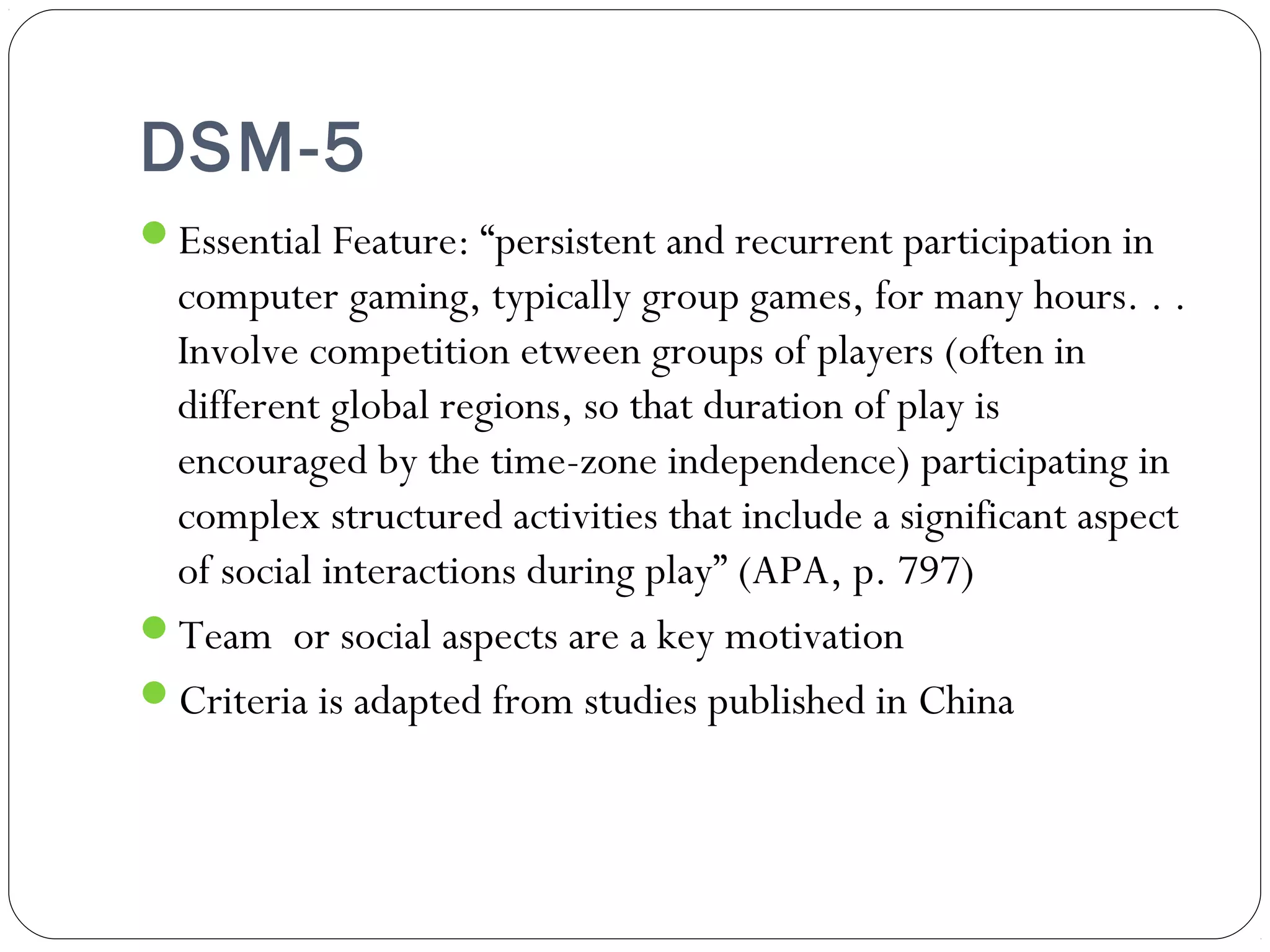
Essential Feature: “persistent and recurrent participation in 
computer gaming, typically group games, for many hours. . . 
Involve competition etween groups of players (often in 
different global regions, so that duration of play is 
encouraged by the time-zone independence) participating in 
complex structured activities that include a significant aspect 
of social interactions during play” (APA, p. 797) 
Team or social aspects are a key motivation 
Criteria is adapted from studies published in China
DSM 5 Section III: Internet Gaming 
Disorder 
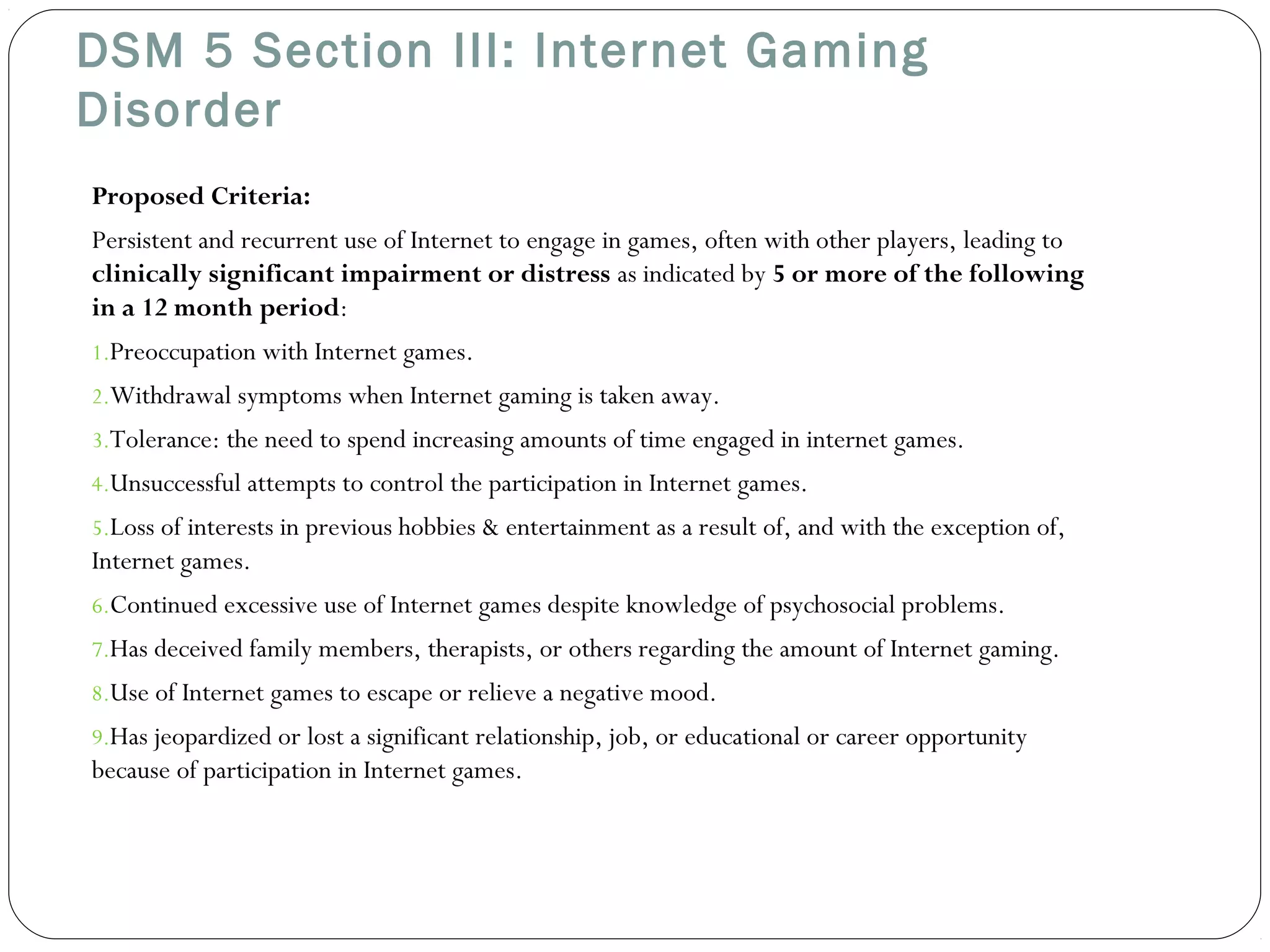
Proposed Criteria: 
Persistent and recurrent use of Internet to engage in games, often with other players, leading to 
clinically significant impairment or distress as indicated by 5 or more of the following 
in a 12 month period: 
1.Preoccupation with Internet games. 
2.Withdrawal symptoms when Internet gaming is taken away. 
3.Tolerance: the need to spend increasing amounts of time engaged in internet games. 
4.Unsuccessful attempts to control the participation in Internet games. 
5.Loss of interests in previous hobbies & entertainment as a result of, and with the exception of, 
Internet games. 
6.Continued excessive use of Internet games despite knowledge of psychosocial problems. 
7.Has deceived family members, therapists, or others regarding the amount of Internet gaming. 
8.Use of Internet games to escape or relieve a negative mood. 
9.Has jeopardized or lost a significant relationship, job, or educational or career opportunity 
because of participation in Internet games.
DSM 5 Section III: Internet Gaming 
Disorder 
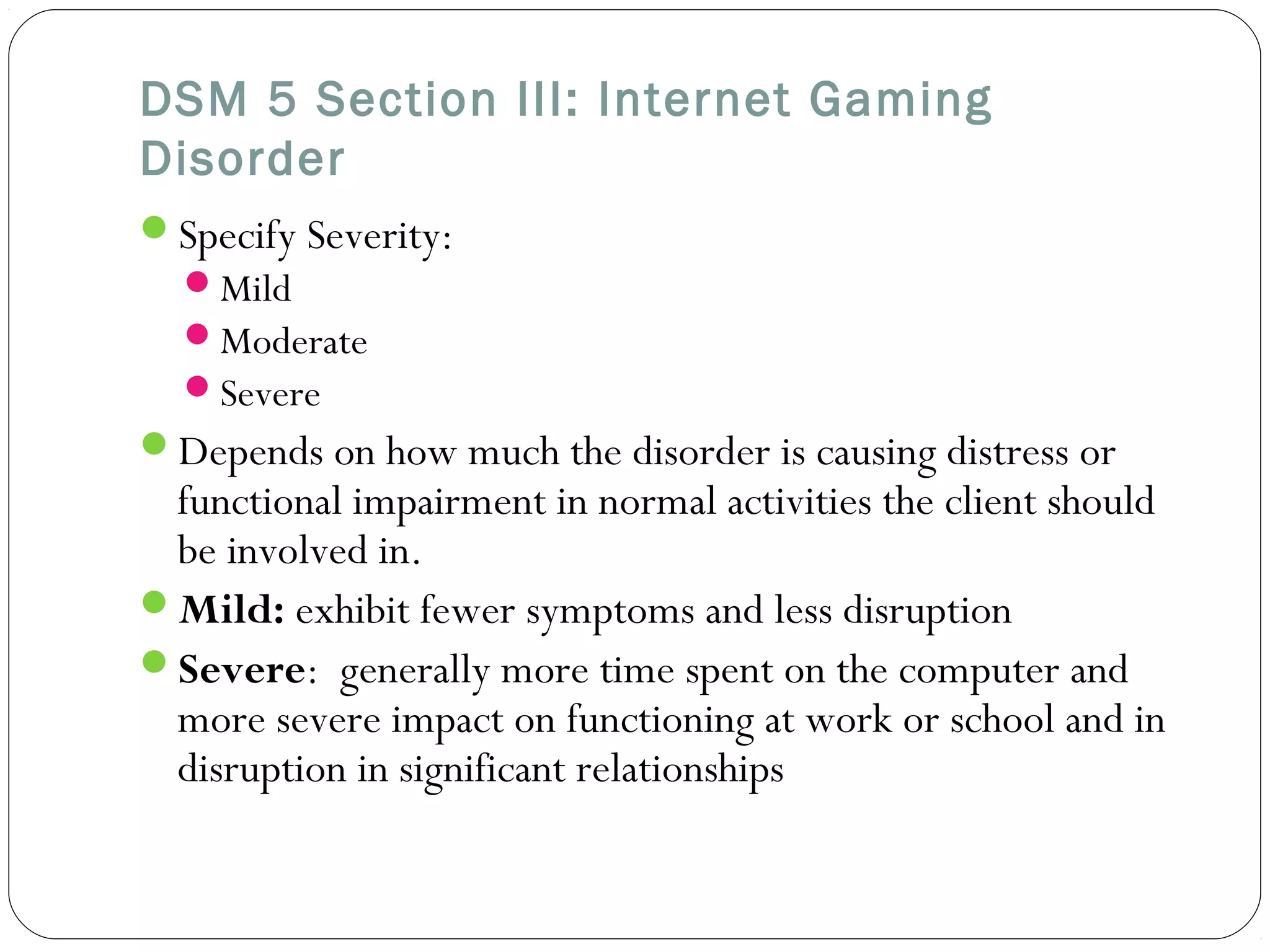
Specify Severity: 
Mild 
Moderate 
Severe 
Depends on how much the disorder is causing distress or 
functional impairment in normal activities the client should 
be involved in. 
Mild: exhibit fewer symptoms and less disruption 
Severe: generally more time spent on the computer and 
more severe impact on functioning at work or school and in 
disruption in significant relationships
Diagnostic Considerations 
The criteria in Section III should be used to determine if the 
client fits within these diagnostic criteria first. 
Since Section III diagnosis cannot be used as a diagnosis, 
consider using: Other Specified Obsessive Compulsive 
Disorder, Internet Gaming
Risk & Prognostic Factors 
Environmental: 
Computer availability 
Internet connection 
Speculation that helicopter parenting or very controlled home 
environments might generate higher risk situations 
Genetic & Physiological: 
Adolescent males at higher risk 
Asian environmental and/or genetic background is a risk factor 
suggested by literature, but clear evidence isn’t available
Differential Diagnosis 
Internet use that is excessive but doesn’t involve playing 
online games is not the same. 
Gambling using the Internet is not the same. 
Depression 
Social Phobia or other Anxiety 
Aspergers or Autism Spectrum Disorder
Comorbidity 
2x more likely to be diagnosed with ADD/ADHD than gamers who 
play recreationally (Batthyany, Muller, Benker, & Wolfling, 2009; 
Bioulac, Arfi, & Bouvard, 2008; Chan & Rabinowitz, 2006; Gentile et 
al., 2011; Han et al., 2009). 
Depression (Gentile et al., 2011; Peng & Liu, 2010). 
 MMORPG depressive symptoms (sadness, hopelessness, crying spells, 
insomnia, concentration problems) are related to habitual computer gaming 
at night b/t 10-6 (Lemola et al., 2011) 
Anxiety & Social Phobia – longitudinal data suggest pathological 
gamers exhibit higher levels of depression, anxiety & social phobia 
during follow-up than normal gamers (Gentile et al., 2011), but the 
relationship may be reciprocal.
Etiology 
Neurobiological Aspects: 
Cue induced gaming urge activates the same brain regions activated by 
gambling in pathological gamblers and substance use in substance 
addicts (Han et al., 2011; Ko et al., 2009). 
Working memory may be affected similarly as is in substance 
dependence (Kim et al., 2012). 
Need more studies
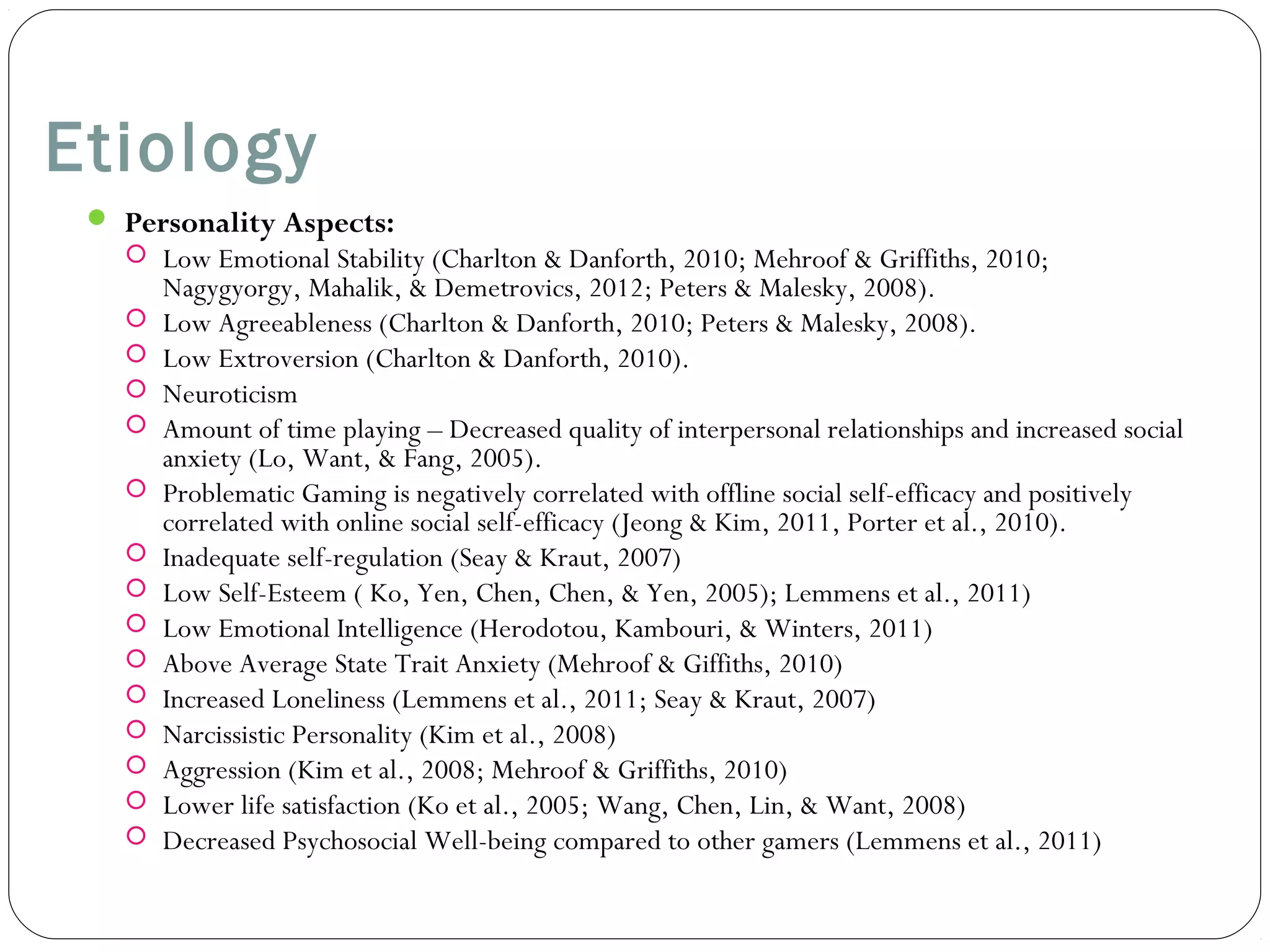
Etiology 
 Personality Aspects: 
 Low Emotional Stability (Charlton & Danforth, 2010; Mehroof & Griffiths, 2010; 
Nagygyorgy, Mahalik, & Demetrovics, 2012; Peters & Malesky, 2008). 
 Low Agreeableness (Charlton & Danforth, 2010; Peters & Malesky, 2008). 
 Low Extroversion (Charlton & Danforth, 2010). 
 Neuroticism 
 Amount of time playing – Decreased quality of interpersonal relationships and increased social 
anxiety (Lo, Want, & Fang, 2005). 
 Problematic Gaming is negatively correlated with offline social self-efficacy and positively 
correlated with online social self-efficacy (Jeong & Kim, 2011, Porter et al., 2010). 
 Inadequate self-regulation (Seay & Kraut, 2007) 
 Low Self-Esteem ( Ko, Yen, Chen, Chen, & Yen, 2005); Lemmens et al., 2011) 
 Low Emotional Intelligence (Herodotou, Kambouri, & Winters, 2011) 
 Above Average State Trait Anxiety (Mehroof & Giffiths, 2010) 
 Increased Loneliness (Lemmens et al., 2011; Seay & Kraut, 2007) 
 Narcissistic Personality (Kim et al., 2008) 
 Aggression (Kim et al., 2008; Mehroof & Griffiths, 2010) 
 Lower life satisfaction (Ko et al., 2005; Wang, Chen, Lin, & Want, 2008) 
 Decreased Psychosocial Well-being compared to other gamers (Lemmens et al., 2011)
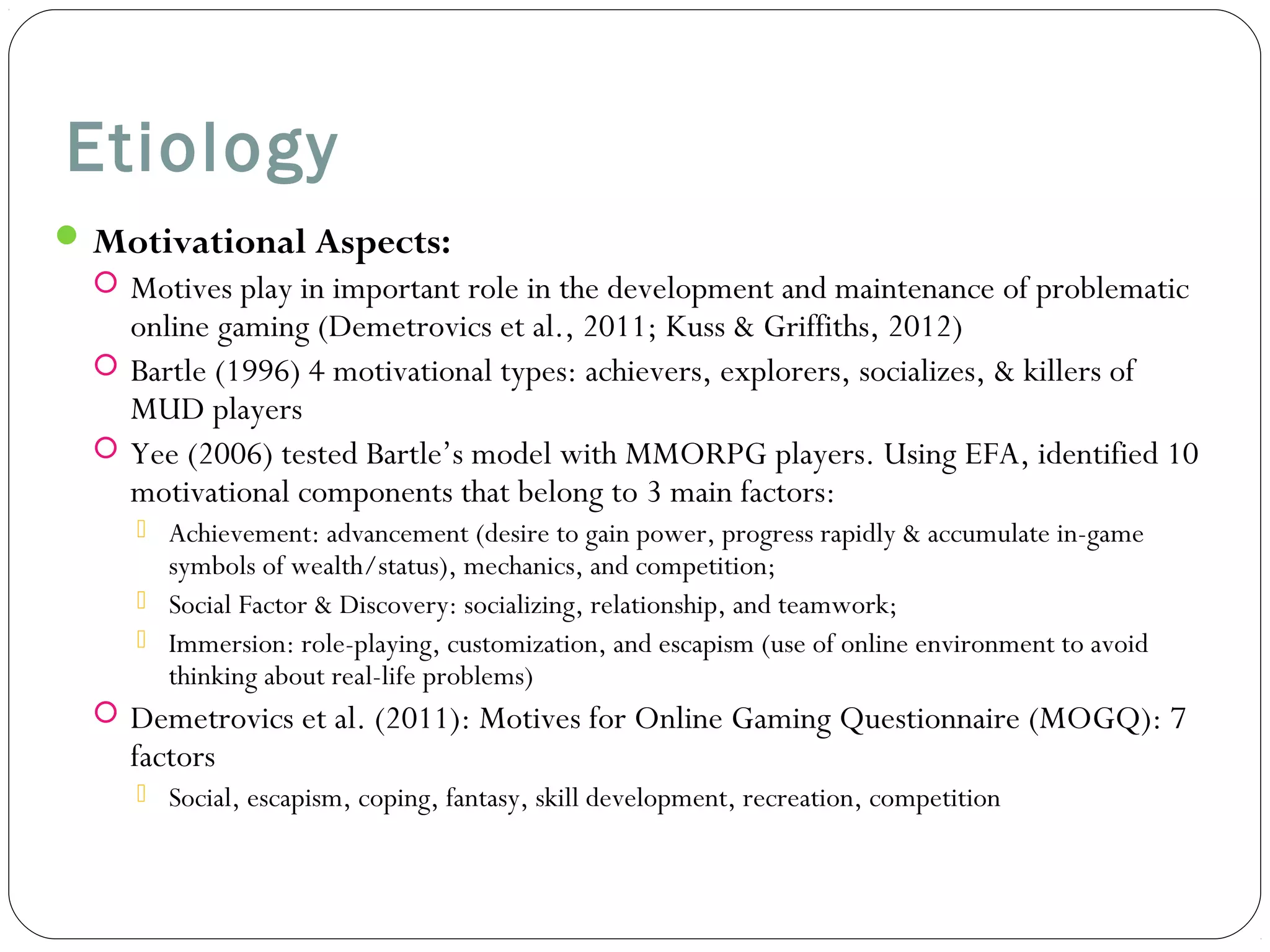
Etiology 
Motivational Aspects: 
 Motives play in important role in the development and maintenance of problematic 
online gaming (Demetrovics et al., 2011; Kuss & Griffiths, 2012) 
 Bartle (1996) 4 motivational types: achievers, explorers, socializes, & killers of 
MUD players 
 Yee (2006) tested Bartle’s model with MMORPG players. Using EFA, identified 10 
motivational components that belong to 3 main factors: 
 Achievement: advancement (desire to gain power, progress rapidly & accumulate in-game 
symbols of wealth/status), mechanics, and competition; 
 Social Factor & Discovery: socializing, relationship, and teamwork; 
 Immersion: role-playing, customization, and escapism (use of online environment to avoid 
thinking about real-life problems) 
 Demetrovics et al. (2011): Motives for Online Gaming Questionnaire (MOGQ): 7 
factors 
 Social, escapism, coping, fantasy, skill development, recreation, competition
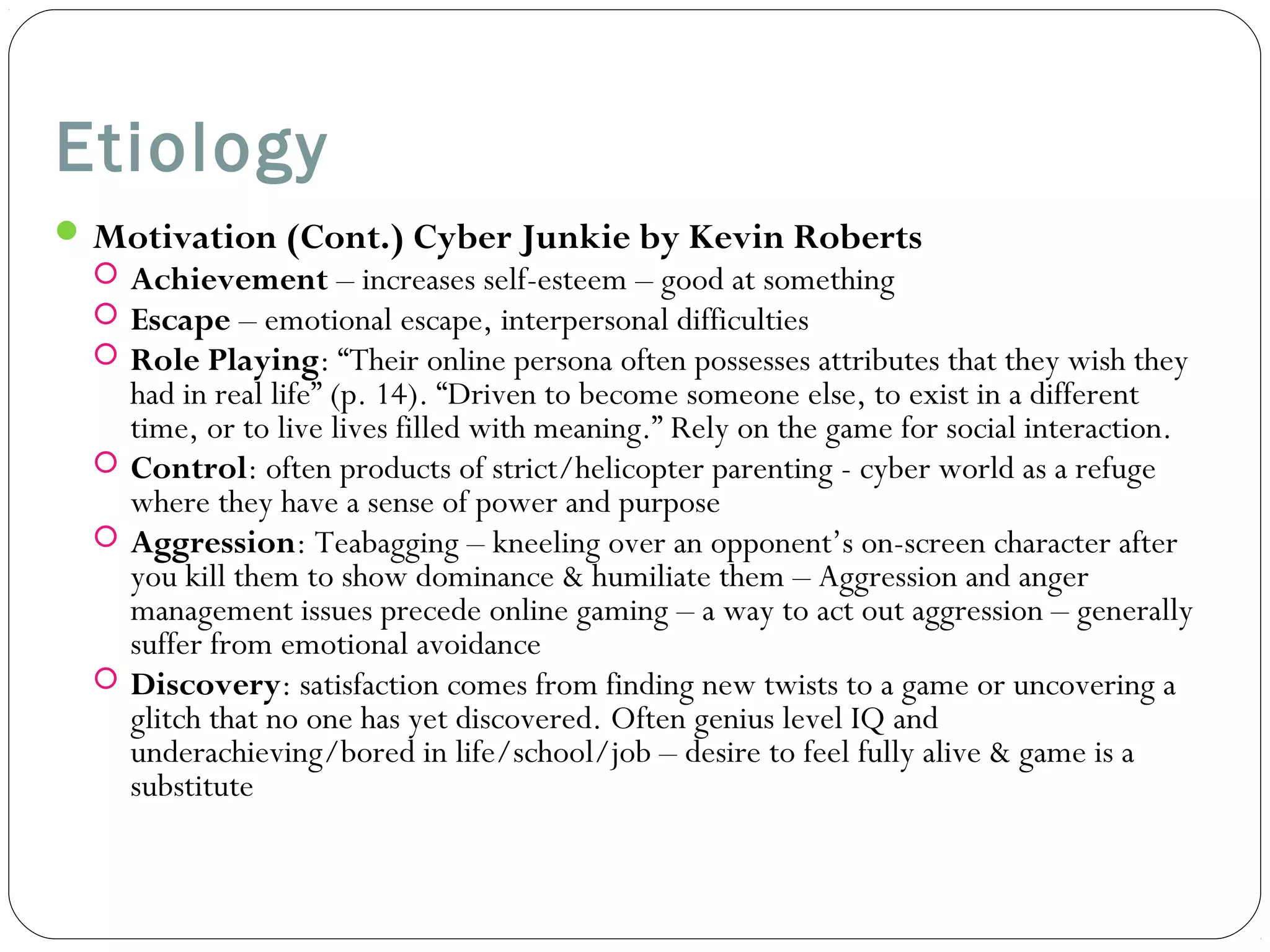
Etiology 
Motivation (Cont.) Cyber Junkie by Kevin Roberts 
 Achievement – increases self-esteem – good at something 
 Escape – emotional escape, interpersonal difficulties 
 Role Playing: “Their online persona often possesses attributes that they wish they 
had in real life” (p. 14). “Driven to become someone else, to exist in a different 
time, or to live lives filled with meaning.” Rely on the game for social interaction. 
 Control: often products of strict/helicopter parenting - cyber world as a refuge 
where they have a sense of power and purpose 
 Aggression: Teabagging – kneeling over an opponent’s on-screen character after 
you kill them to show dominance & humiliate them – Aggression and anger 
management issues precede online gaming – a way to act out aggression – generally 
suffer from emotional avoidance 
 Discovery: satisfaction comes from finding new twists to a game or uncovering a 
glitch that no one has yet discovered. Often genius level IQ and 
underachieving/bored in life/school/job – desire to feel fully alive & game is a 
substitute
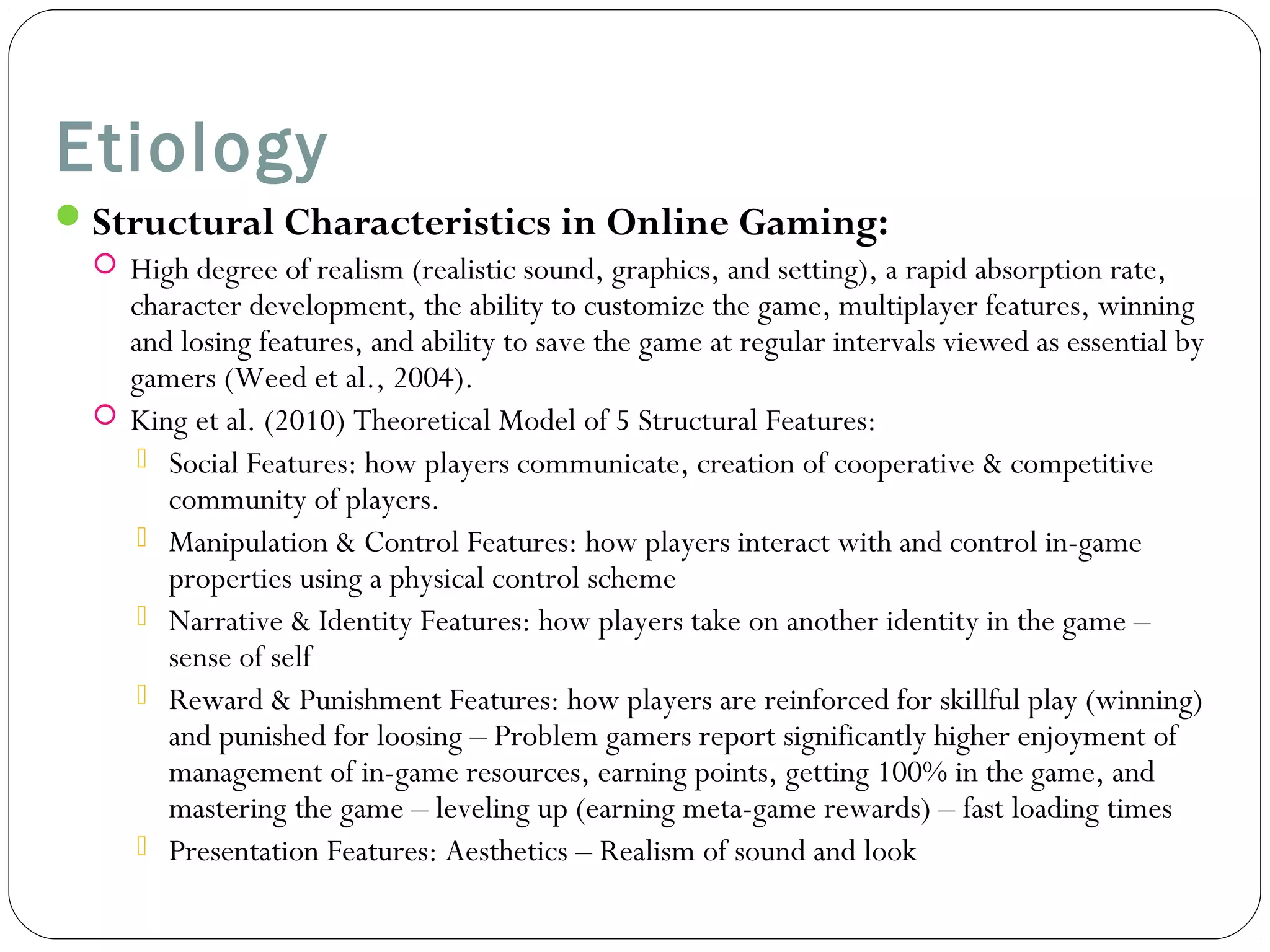
Etiology 
Structural Characteristics in Online Gaming: 
 High degree of realism (realistic sound, graphics, and setting), a rapid absorption rate, 
character development, the ability to customize the game, multiplayer features, winning 
and losing features, and ability to save the game at regular intervals viewed as essential by 
gamers (Weed et al., 2004). 
 King et al. (2010) Theoretical Model of 5 Structural Features: 
 Social Features: how players communicate, creation of cooperative & competitive 
community of players. 
 Manipulation & Control Features: how players interact with and control in-game 
properties using a physical control scheme 
 Narrative & Identity Features: how players take on another identity in the game – 
sense of self 
 Reward & Punishment Features: how players are reinforced for skillful play (winning) 
and punished for loosing – Problem gamers report significantly higher enjoyment of 
management of in-game resources, earning points, getting 100% in the game, and 
mastering the game – leveling up (earning meta-game rewards) – fast loading times 
 Presentation Features: Aesthetics – Realism of sound and look
Etiology 
Structure Continued: 
Instant but Intermittent Reinforcement (people keep responding in 
the absence of reinforcement hoping that another reward is just 
around the corner). 
Magnitude of the Reinforcement (high points score for doing 
something in-game – large rewards lead to fast responding and greater 
resistance to extinction 
Amount of Time 
Excessive game play is not a sufficient condition of addiction 
More time = higher risk

Diagnostic considerations internet gaming use disorder

  • 1.
    Diagnostic Considerations InternetGaming Addiction Leigh Holman, Ph.D., LPCS, RPTS, NCC, SCS Amhca Diplomate and CMHC President-Elect International Association of Addiction & Offender Counselors
  • 2.
    Conflict Over whatconstitutes Problematic Online Gaming?  Video games as the starting point for examining the characteristics of a specific pathology (Charlton & Danforth, 2007; Griffiths, 2005; Griffiths & Meredith, 2009; Peters & Malesky, 2008). VS.  Internet is the main platform that unites different addictive activities, including online games (Van Rooij, Schoemakers, Vermulst, Van den Eijnden, & Van de Mheen, 2011; Young, 2009).
  • 3.
    Griffiths, 2010) VideoGame Addiction Theory Indicators of High Engagement (Charlton & Danforth, 2007, 2008) 1. Salience • Gaming becomes the most important activity in the person’s life and dominates his/her thinking, feelings (i.e. cravings), & behavior • Preoccupation & Cognitive Distortions • Deterioration of Socialized Behavior 1. Mood Modification  Gamers report both an arousing ‘buzz or high” and  Distressing tranquilizing feeling of “escape or numbing” 1. Tolerance • Increasing amounts of time are required to achieve the former effects
  • 4.
    Griffiths, 2010) VideoGame Addiction Theory Central Role in Addiction (Charlton & Danforth, 2007, 2008) 4. Withdrawal Symptoms  Unpleasant feeling states or physical effects when not gaming or reduced time gaming  Shakes, moodiness, irritability 5. Conflict • Interpersonal conflict with important relationships • Conflict with time spent on other activities (hobbies, work, school, social life) • Intra-psychic conflict – feelings of loss of control 6. Relapse  Tendency for repeated reversions to earlier patterns of gaming after abstinence or control has been established
  • 5.
    Other models Porteret al. (2010) Excessive use of one/more video games resulting in a preoccupation with and a loss of control over playing video games, and resulting negative psychosocial and/or physical consequences Integrated Models Problematic Online Game Use Model (Kim & Kim, 2010) 5 dimensions: euphoria, health problems, conflict, failure of self-control, and preference of virtual relationship Demetrovics et al. (2012) Integrative Approach 6 Dimensions: preoccupation, overuse, immersion, social isolation, interpersonal conflicts, and withdrawal
  • 6.
    Issues with Research No consistency in literature on gaming addiction: Theory Conceptualization Screening and Assessment Measures Methodology Population Sampling
  • 7.
  • 8.
    Prevalence Meta-analysis: About3% of the general population meet addiction criteria Limited evidence suggests that most addicts (about 80%) stay addicts for at least 2 years in the absence of treatment Prevalence rates vary according to: Type of digital technology activity How addiction is assessed (measurement) Demographic factors Cultural context (Far East Asian > Western) Country  Recruitment and sampling method psychiatric sample vs. community sample;  self-selection vs. random selection  Type of video game typically played  ↑among online video games, especially MMORPGs
  • 9.
    DSM-5 “Internet gaminghas been reportedly defined as an “addiciton” by the Chinese government, and a treatment system has been set up. Reports of treatment of this condition have appeared in medical journals, mostly from Asian countries and some in the United States” (APA, p. 796). DSM-5 Workgroup: Reviewed more than 240 articles Some behavioral similarities were found between SUDs and Internet Gaming Disorder including: tolerance, withdrawal, repeated unsuccessful attempts to cut back or quit, and functional impairment Literature doesn’t use a standard definition Need epidemiologic studies to determine prevalence, clinical course, possible genetic influence, and potential biological factors base don fMRI data
  • 10.
    DSM-5 “a patternof excessive and prolonged Internet gaming that results in a cluster of cognitive and behavioral symptoms, including progressive loss of control over gaming, tolerance, and withdrawal symptoms, analogous to the symptoms of substance use disorders. Typically play for 8-10 hours per day and at least 30 hours per week. Experience agitation and anger if they cannot play Neglect norlmal work/school/relationship obligations Separate from gambling disorder involving the Internet
  • 11.
    DSM-5 Essential Feature:“persistent and recurrent participation in computer gaming, typically group games, for many hours. . . Involve competition etween groups of players (often in different global regions, so that duration of play is encouraged by the time-zone independence) participating in complex structured activities that include a significant aspect of social interactions during play” (APA, p. 797) Team or social aspects are a key motivation Criteria is adapted from studies published in China
  • 12.
    DSM 5 SectionIII: Internet Gaming Disorder Proposed Criteria: Persistent and recurrent use of Internet to engage in games, often with other players, leading to clinically significant impairment or distress as indicated by 5 or more of the following in a 12 month period: 1.Preoccupation with Internet games. 2.Withdrawal symptoms when Internet gaming is taken away. 3.Tolerance: the need to spend increasing amounts of time engaged in internet games. 4.Unsuccessful attempts to control the participation in Internet games. 5.Loss of interests in previous hobbies & entertainment as a result of, and with the exception of, Internet games. 6.Continued excessive use of Internet games despite knowledge of psychosocial problems. 7.Has deceived family members, therapists, or others regarding the amount of Internet gaming. 8.Use of Internet games to escape or relieve a negative mood. 9.Has jeopardized or lost a significant relationship, job, or educational or career opportunity because of participation in Internet games.
  • 13.
    DSM 5 SectionIII: Internet Gaming Disorder Specify Severity: Mild Moderate Severe Depends on how much the disorder is causing distress or functional impairment in normal activities the client should be involved in. Mild: exhibit fewer symptoms and less disruption Severe: generally more time spent on the computer and more severe impact on functioning at work or school and in disruption in significant relationships
  • 14.
    Diagnostic Considerations Thecriteria in Section III should be used to determine if the client fits within these diagnostic criteria first. Since Section III diagnosis cannot be used as a diagnosis, consider using: Other Specified Obsessive Compulsive Disorder, Internet Gaming
  • 15.
    Risk & PrognosticFactors Environmental: Computer availability Internet connection Speculation that helicopter parenting or very controlled home environments might generate higher risk situations Genetic & Physiological: Adolescent males at higher risk Asian environmental and/or genetic background is a risk factor suggested by literature, but clear evidence isn’t available
  • 16.
    Differential Diagnosis Internetuse that is excessive but doesn’t involve playing online games is not the same. Gambling using the Internet is not the same. Depression Social Phobia or other Anxiety Aspergers or Autism Spectrum Disorder
  • 17.
    Comorbidity 2x morelikely to be diagnosed with ADD/ADHD than gamers who play recreationally (Batthyany, Muller, Benker, & Wolfling, 2009; Bioulac, Arfi, & Bouvard, 2008; Chan & Rabinowitz, 2006; Gentile et al., 2011; Han et al., 2009). Depression (Gentile et al., 2011; Peng & Liu, 2010).  MMORPG depressive symptoms (sadness, hopelessness, crying spells, insomnia, concentration problems) are related to habitual computer gaming at night b/t 10-6 (Lemola et al., 2011) Anxiety & Social Phobia – longitudinal data suggest pathological gamers exhibit higher levels of depression, anxiety & social phobia during follow-up than normal gamers (Gentile et al., 2011), but the relationship may be reciprocal.
  • 18.
    Etiology Neurobiological Aspects: Cue induced gaming urge activates the same brain regions activated by gambling in pathological gamblers and substance use in substance addicts (Han et al., 2011; Ko et al., 2009). Working memory may be affected similarly as is in substance dependence (Kim et al., 2012). Need more studies
  • 19.
    Etiology  PersonalityAspects:  Low Emotional Stability (Charlton & Danforth, 2010; Mehroof & Griffiths, 2010; Nagygyorgy, Mahalik, & Demetrovics, 2012; Peters & Malesky, 2008).  Low Agreeableness (Charlton & Danforth, 2010; Peters & Malesky, 2008).  Low Extroversion (Charlton & Danforth, 2010).  Neuroticism  Amount of time playing – Decreased quality of interpersonal relationships and increased social anxiety (Lo, Want, & Fang, 2005).  Problematic Gaming is negatively correlated with offline social self-efficacy and positively correlated with online social self-efficacy (Jeong & Kim, 2011, Porter et al., 2010).  Inadequate self-regulation (Seay & Kraut, 2007)  Low Self-Esteem ( Ko, Yen, Chen, Chen, & Yen, 2005); Lemmens et al., 2011)  Low Emotional Intelligence (Herodotou, Kambouri, & Winters, 2011)  Above Average State Trait Anxiety (Mehroof & Giffiths, 2010)  Increased Loneliness (Lemmens et al., 2011; Seay & Kraut, 2007)  Narcissistic Personality (Kim et al., 2008)  Aggression (Kim et al., 2008; Mehroof & Griffiths, 2010)  Lower life satisfaction (Ko et al., 2005; Wang, Chen, Lin, & Want, 2008)  Decreased Psychosocial Well-being compared to other gamers (Lemmens et al., 2011)
  • 20.
    Etiology Motivational Aspects:  Motives play in important role in the development and maintenance of problematic online gaming (Demetrovics et al., 2011; Kuss & Griffiths, 2012)  Bartle (1996) 4 motivational types: achievers, explorers, socializes, & killers of MUD players  Yee (2006) tested Bartle’s model with MMORPG players. Using EFA, identified 10 motivational components that belong to 3 main factors:  Achievement: advancement (desire to gain power, progress rapidly & accumulate in-game symbols of wealth/status), mechanics, and competition;  Social Factor & Discovery: socializing, relationship, and teamwork;  Immersion: role-playing, customization, and escapism (use of online environment to avoid thinking about real-life problems)  Demetrovics et al. (2011): Motives for Online Gaming Questionnaire (MOGQ): 7 factors  Social, escapism, coping, fantasy, skill development, recreation, competition
  • 21.
    Etiology Motivation (Cont.)Cyber Junkie by Kevin Roberts  Achievement – increases self-esteem – good at something  Escape – emotional escape, interpersonal difficulties  Role Playing: “Their online persona often possesses attributes that they wish they had in real life” (p. 14). “Driven to become someone else, to exist in a different time, or to live lives filled with meaning.” Rely on the game for social interaction.  Control: often products of strict/helicopter parenting - cyber world as a refuge where they have a sense of power and purpose  Aggression: Teabagging – kneeling over an opponent’s on-screen character after you kill them to show dominance & humiliate them – Aggression and anger management issues precede online gaming – a way to act out aggression – generally suffer from emotional avoidance  Discovery: satisfaction comes from finding new twists to a game or uncovering a glitch that no one has yet discovered. Often genius level IQ and underachieving/bored in life/school/job – desire to feel fully alive & game is a substitute
  • 22.
    Etiology Structural Characteristicsin Online Gaming:  High degree of realism (realistic sound, graphics, and setting), a rapid absorption rate, character development, the ability to customize the game, multiplayer features, winning and losing features, and ability to save the game at regular intervals viewed as essential by gamers (Weed et al., 2004).  King et al. (2010) Theoretical Model of 5 Structural Features:  Social Features: how players communicate, creation of cooperative & competitive community of players.  Manipulation & Control Features: how players interact with and control in-game properties using a physical control scheme  Narrative & Identity Features: how players take on another identity in the game – sense of self  Reward & Punishment Features: how players are reinforced for skillful play (winning) and punished for loosing – Problem gamers report significantly higher enjoyment of management of in-game resources, earning points, getting 100% in the game, and mastering the game – leveling up (earning meta-game rewards) – fast loading times  Presentation Features: Aesthetics – Realism of sound and look
  • 23.
    Etiology Structure Continued: Instant but Intermittent Reinforcement (people keep responding in the absence of reinforcement hoping that another reward is just around the corner). Magnitude of the Reinforcement (high points score for doing something in-game – large rewards lead to fast responding and greater resistance to extinction Amount of Time Excessive game play is not a sufficient condition of addiction More time = higher risk

Editor's Notes

  • #13 Proposed Criteria: Persistent and recurrent use of Internet to engage in games, often with other players, leading to clinically significant impairment or distress as indicated by 5 or more of the following in a 12 month period: Preoccupation with Internet games. (The individual thinks about previous gaming activity or anticipates playing the next game; Internet gaming becomes the dominant activity in daily life.) Note: distinct from Internet gambling, which is included under gambling disorder. Withdrawal symptoms when Internet gaming is taken away. (These symptoms are typically described as irritability, anxiety, or sadness, but there are no physical signs of pharmacological withdrawal.) Tolerance: the need to spend increasing amounts of time engaged in internet games. Unsuccessful attempts to control the participation in Internet games. Loss of interests in previous hobbies & entertainment as a result of, and with the exception of, Internet games. Continued excessive use of Internet games despite knowledge of psychosocial problems. Has deceived family members, therapists, or others regarding the amount of Internet gaming. Use of Internet games to escape or relieve a negative mood. (e.g., feelings of helplessness, guilt, anxiety). Has jeopardized or lost a significant relationship, job, or educational or career opportunity because of participation in Internet games.