From Theory to Practice
How to use knowledge to support clients to make changes in their gambling
                        and decrease the risks.


                  Sylvie Smith, BA, ICADC
           Problem Gambling/Addictions Counsellor

Homewood Community Addiction Services (CADS)
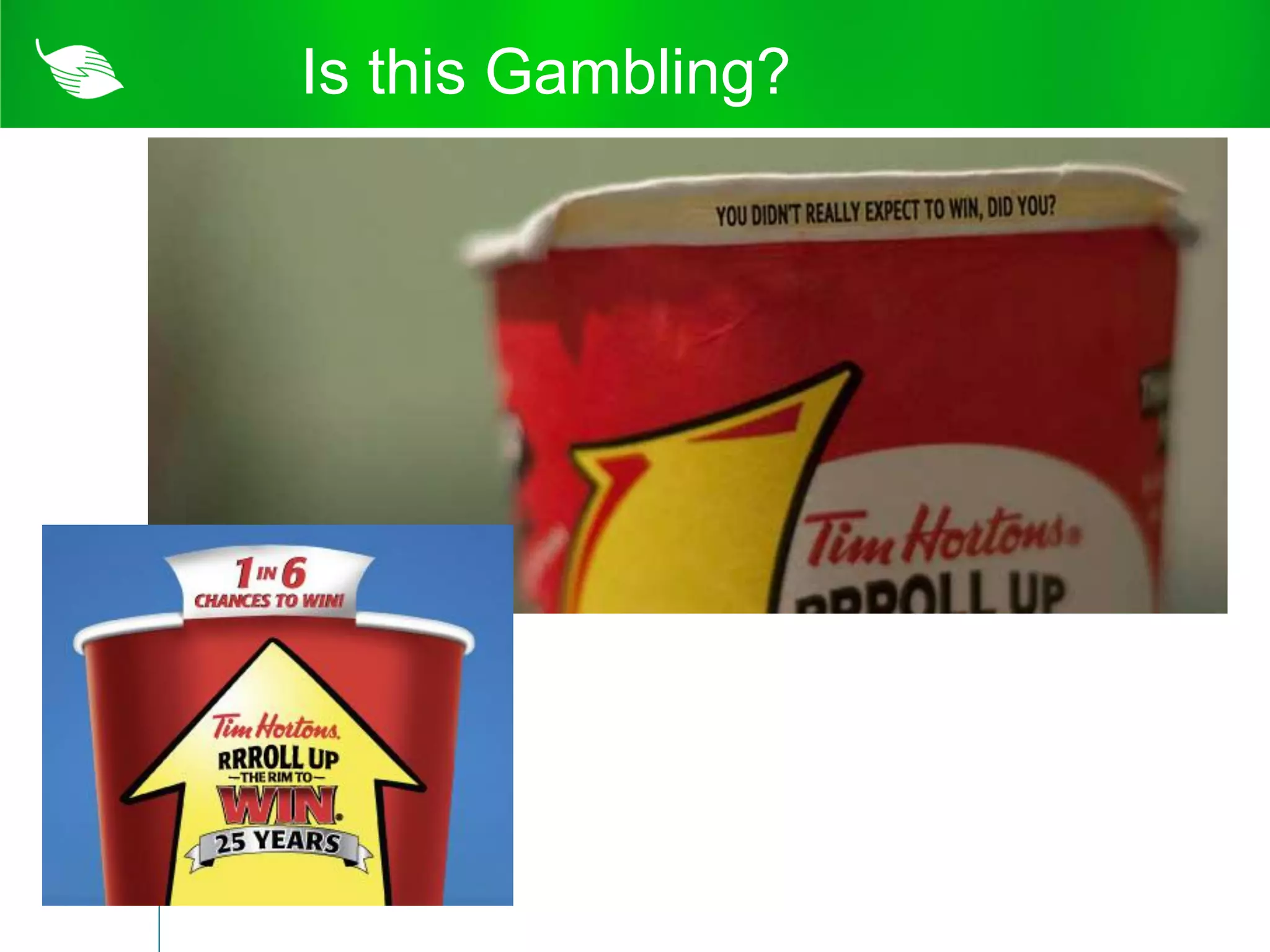
Is this Gambling?
What is Gambling?

• Wildman (1997) has suggested that the important
  thing to remember about gambling is that it is “a
  conscious, deliberate effort to stake valuables,
  usually but not always currency, on how some
  event happens to turn out.”

• “…risking something of value upon the outcome of
  a contest of chance or a future contingent event not
  under his control or influence, upon an agreement
  or understanding that he or someone else will
  receive something of value in the event of a certain
  outcome.“ Maine poker law: section 952(4)
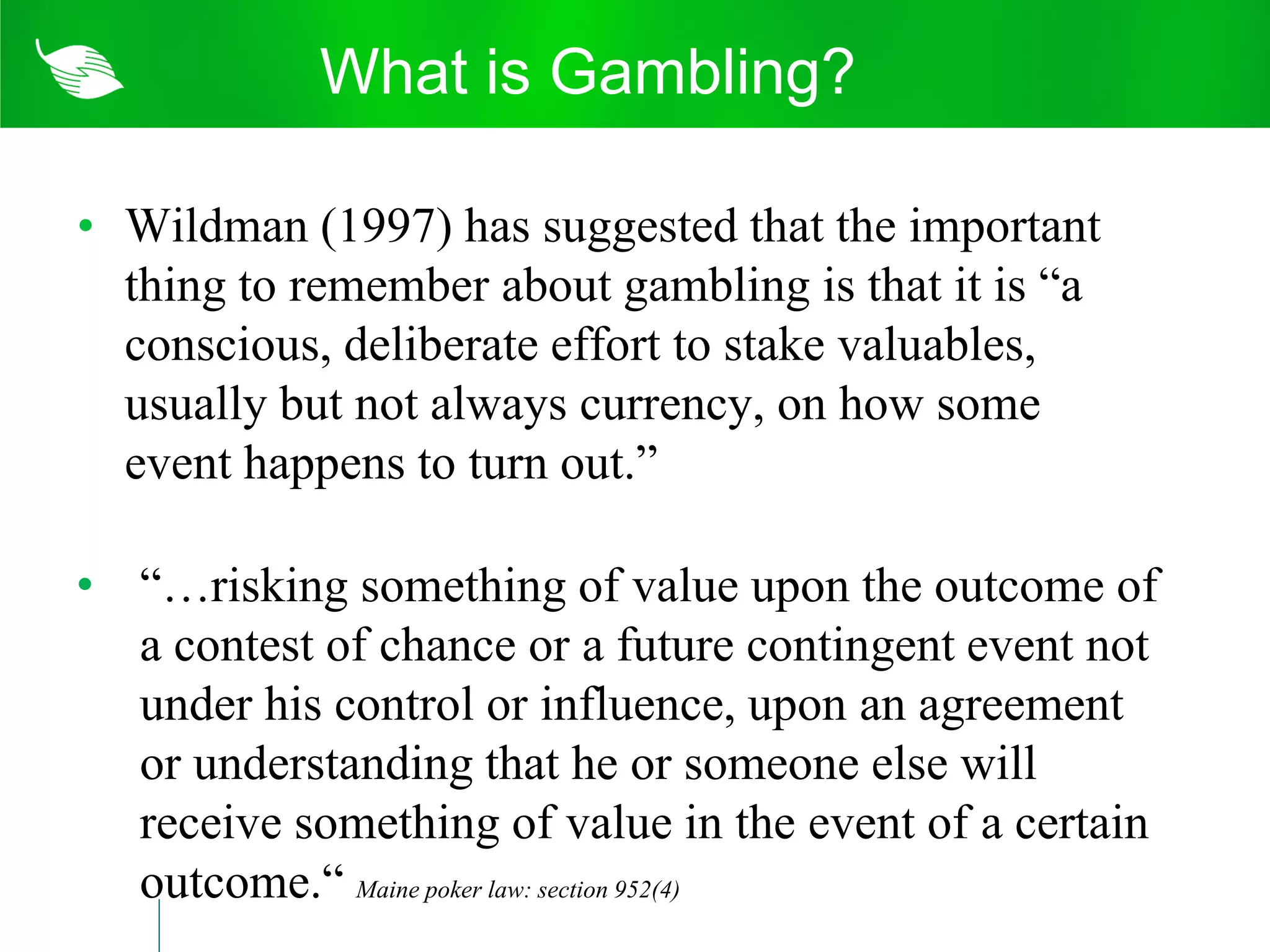
Interfering With Life…Maybe?
The Big Change


1. Long ago, most gambling had religious
   and ceremonial functions.
2. Later, gambling became a recreational
   activity played among individuals.
3. Most recently, gambling has become
   a business.


Taken from Stacked Deck, Williams R & Wood, R
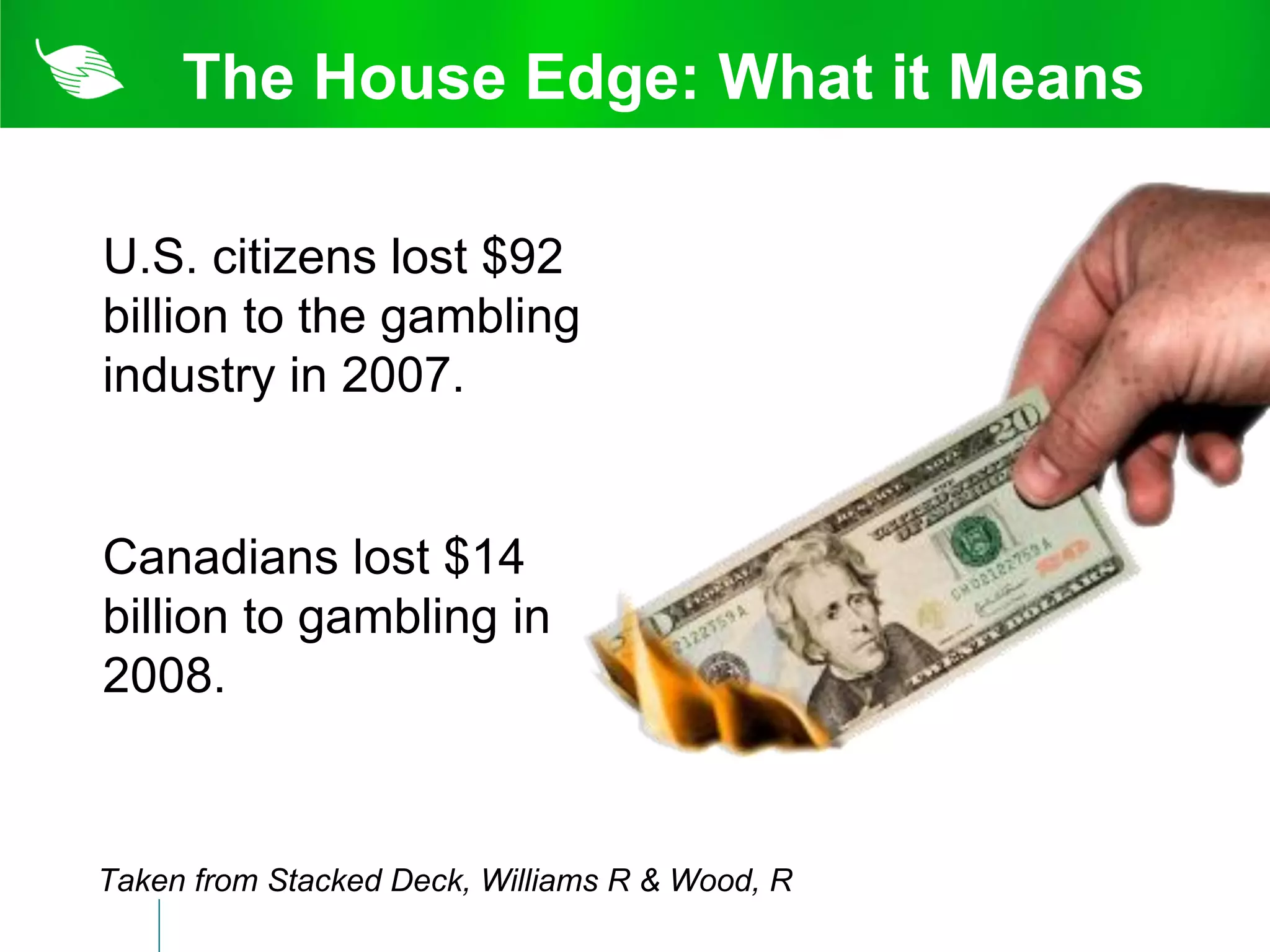
The House Edge: What it Means

• U.S. citizens lost $92
  billion to the gambling
  industry in 2007.


• Canadians lost $14
  billion to gambling in
  2008.


  Taken from Stacked Deck, Williams R & Wood, R
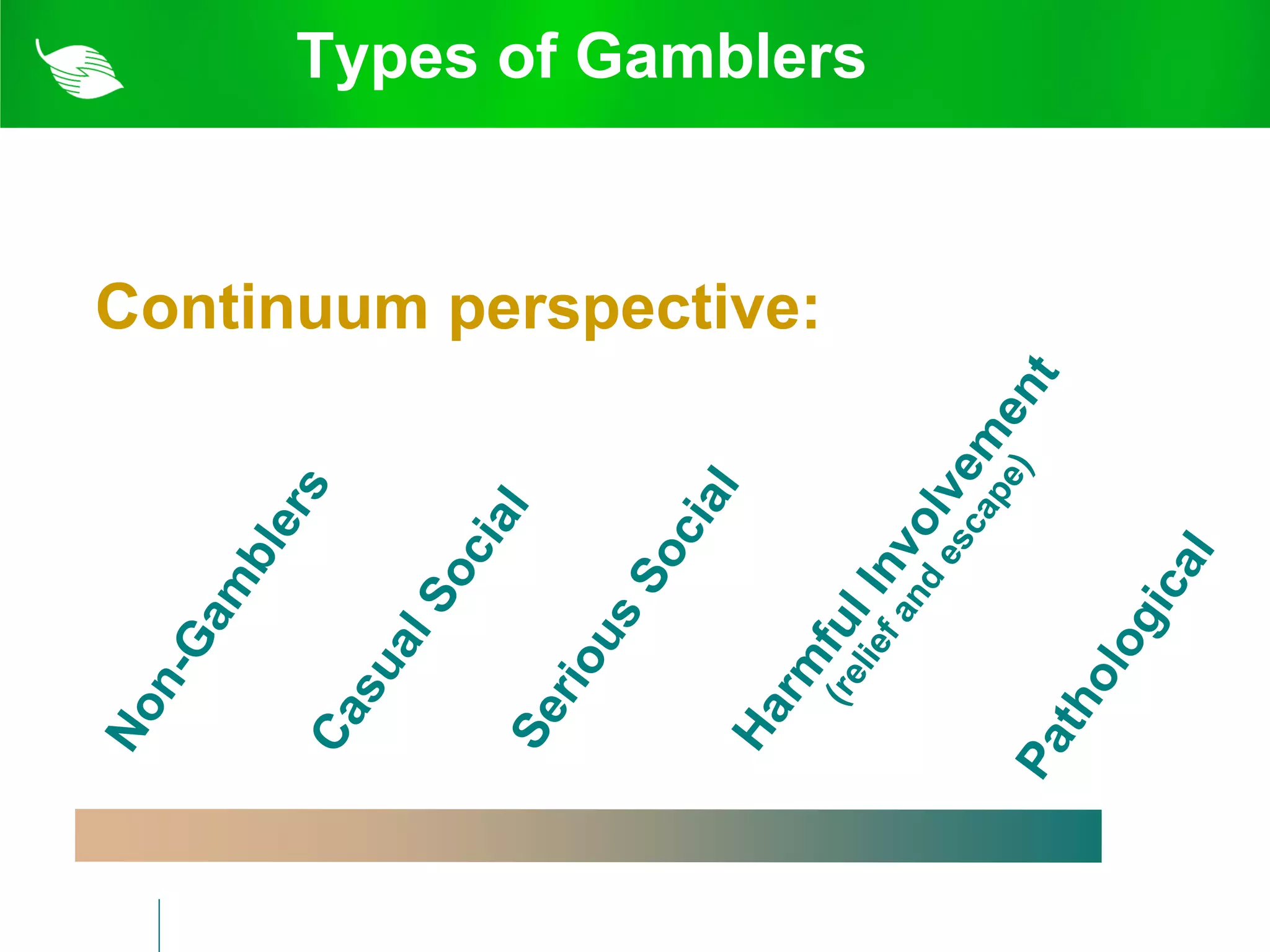
Types of Gamblers


Continuum perspective:
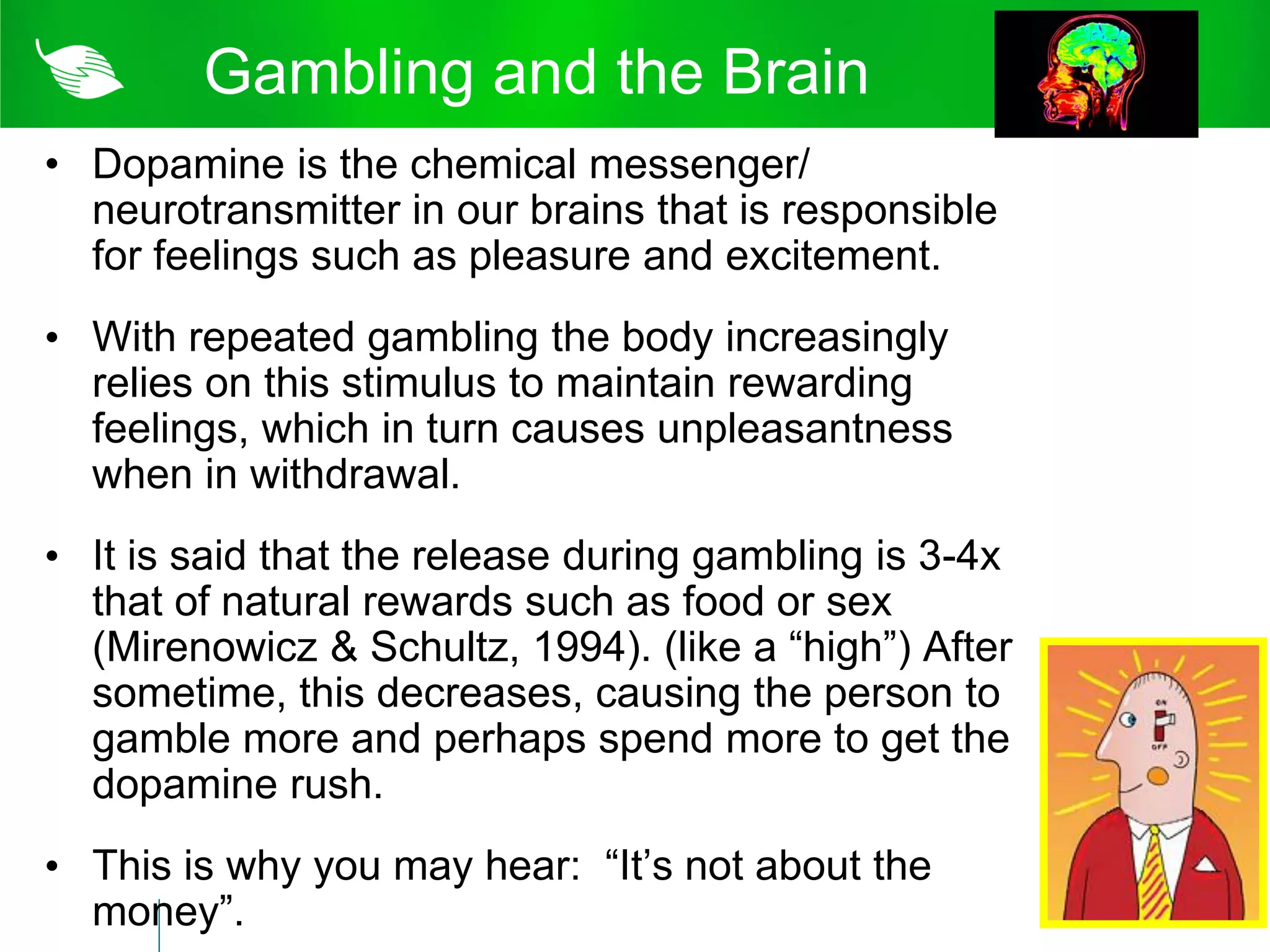
Gambling and the Brain
• Dopamine is the chemical messenger/
  neurotransmitter in our brains that is responsible
  for feelings such as pleasure and excitement.
• With repeated gambling the body increasingly
  relies on this stimulus to maintain rewarding
  feelings, which in turn causes unpleasantness
  when in withdrawal.
• It is said that the release during gambling is 3-4x
  that of natural rewards such as food or sex
  (Mirenowicz & Schultz, 1994). (like a “high”) After
  sometime, this decreases, causing the person to
  gamble more and perhaps spend more to get the
  dopamine rush.
• This is why you may hear: “It’s not about the
  money”.
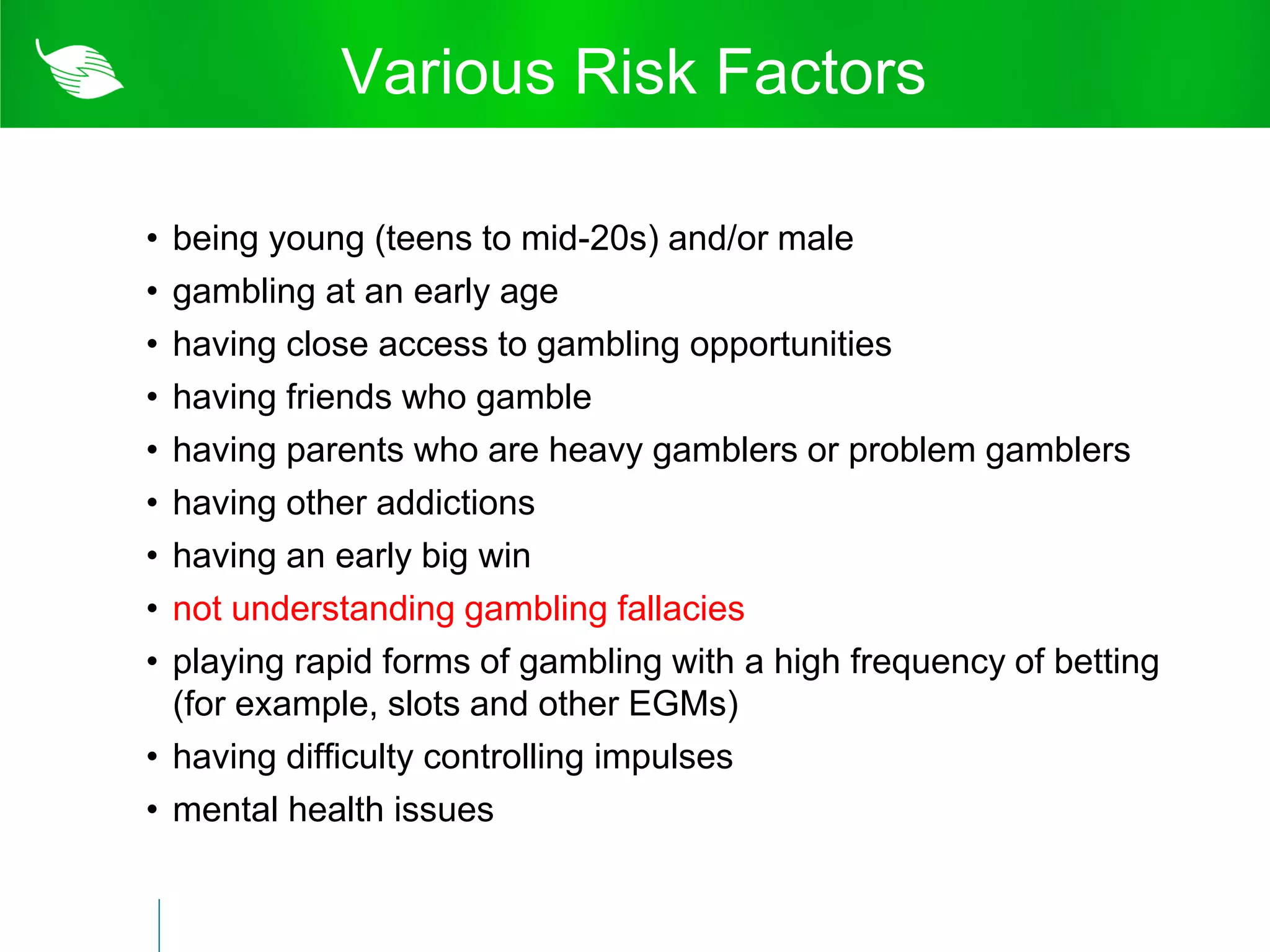
Various Risk Factors

• being young (teens to mid-20s) and/or male
• gambling at an early age
• having close access to gambling opportunities
• having friends who gamble
• having parents who are heavy gamblers or problem gamblers
• having other addictions
• having an early big win
• not understanding gambling fallacies
• playing rapid forms of gambling with a high frequency of betting
  (for example, slots and other EGMs)
• having difficulty controlling impulses
• mental health issues
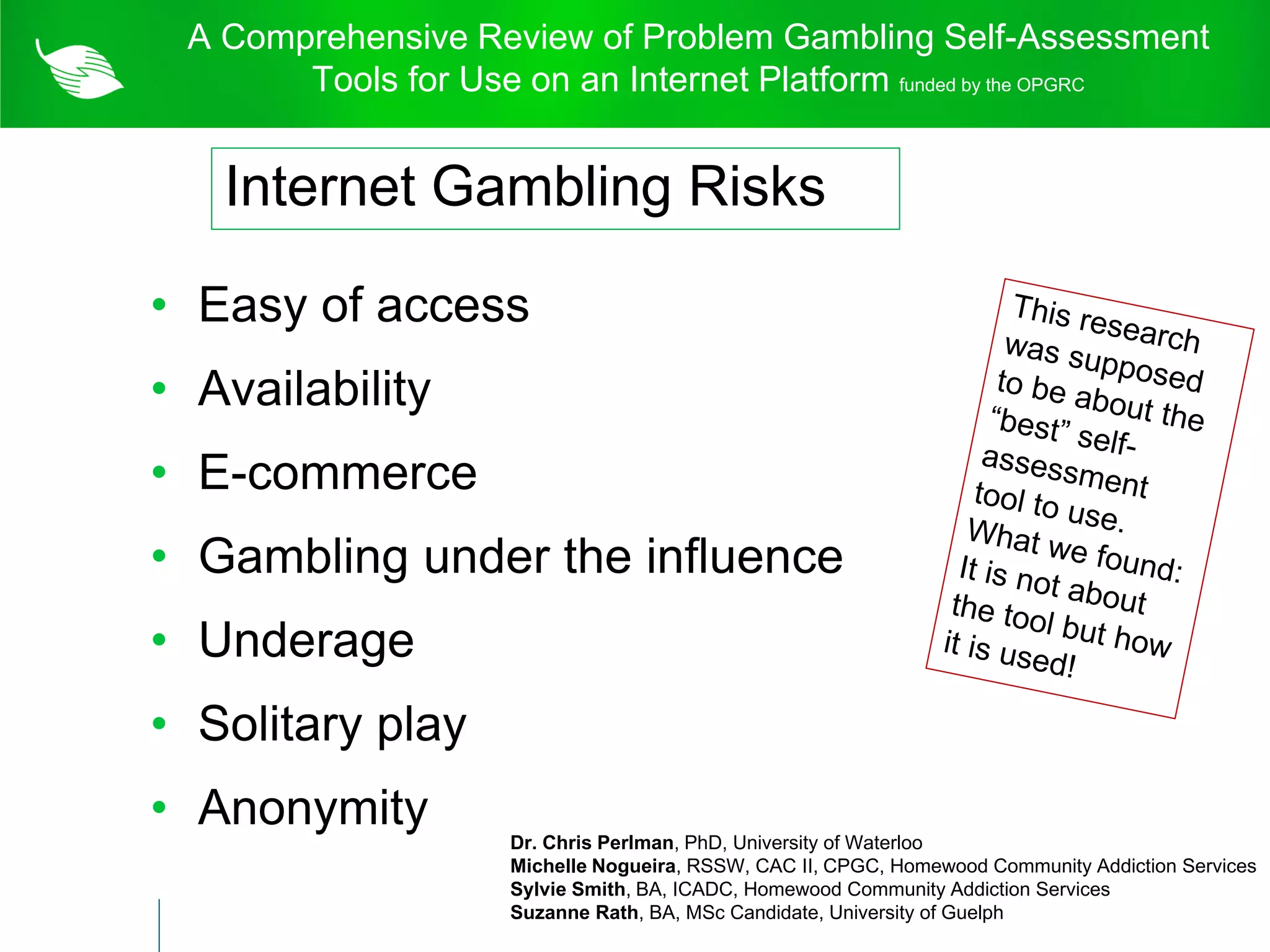
A Comprehensive Review of Problem Gambling Self-Assessment
          Tools for Use on an Internet Platform funded by the OPGRC


      Internet Gambling Risks

    • Easy of access
Internet Gambling Risks
   • Availability
   • E-commerce
   • Gambling under the influence
   • Underage
   • Solitary play
   • Anonymity
                       Dr. Chris Perlman, PhD, University of Waterloo
                       Michelle Nogueira, RSSW, CAC II, CPGC, Homewood Community Addiction Services
                       Sylvie Smith, BA, ICADC, Homewood Community Addiction Services
                       Suzanne Rath, BA, MSc Candidate, University of Guelph
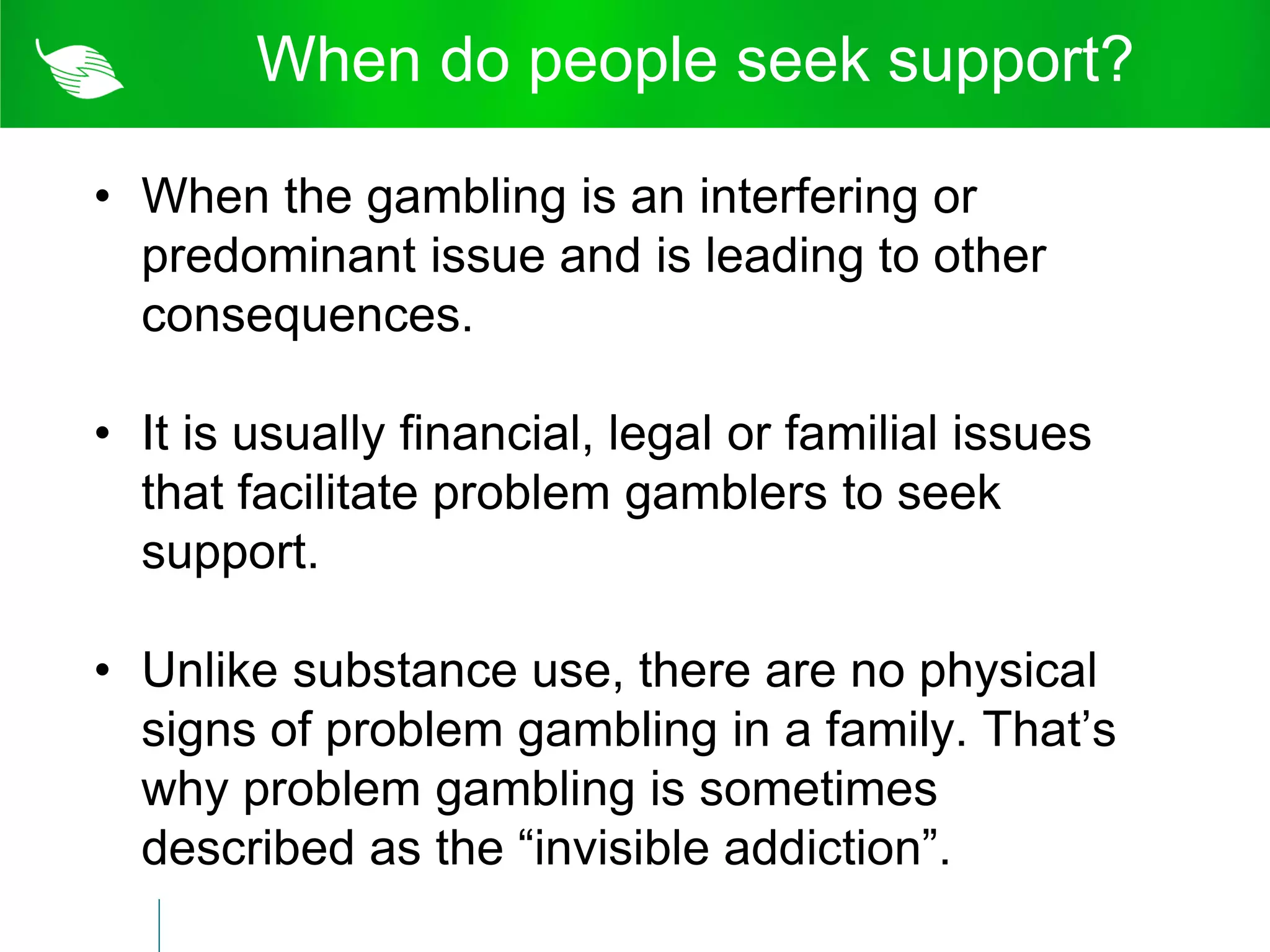
When do people seek support?

• When the gambling is an interfering or
  predominant issue and is leading to other
  consequences.

• It is usually financial, legal or familial issues
  that facilitate problem gamblers to seek
  support.

• Unlike substance use, there are no physical
  signs of problem gambling in a family. That’s
  why problem gambling is sometimes
  described as the “invisible addiction”.
Problem Gamblers and
   Harm Reduction
Harm Reduction and Gambling

• Individuals who gamble can be support using
  the Stages of Change

• Precontemplators seek support due to
  external consequences, such as court order,
  work place, family and/or bankruptcy

• Important to be non-judgemental and help
  individuals by educating them about gambling
  in a neutral manner.
Harm Reduction and Gambling

• Set limits with money

• Pay attention to physical needs

• Use only allocated money

• Set time limits for play

• If a problem is identified, Self-Exclusion can
  be a way to reduce harm.
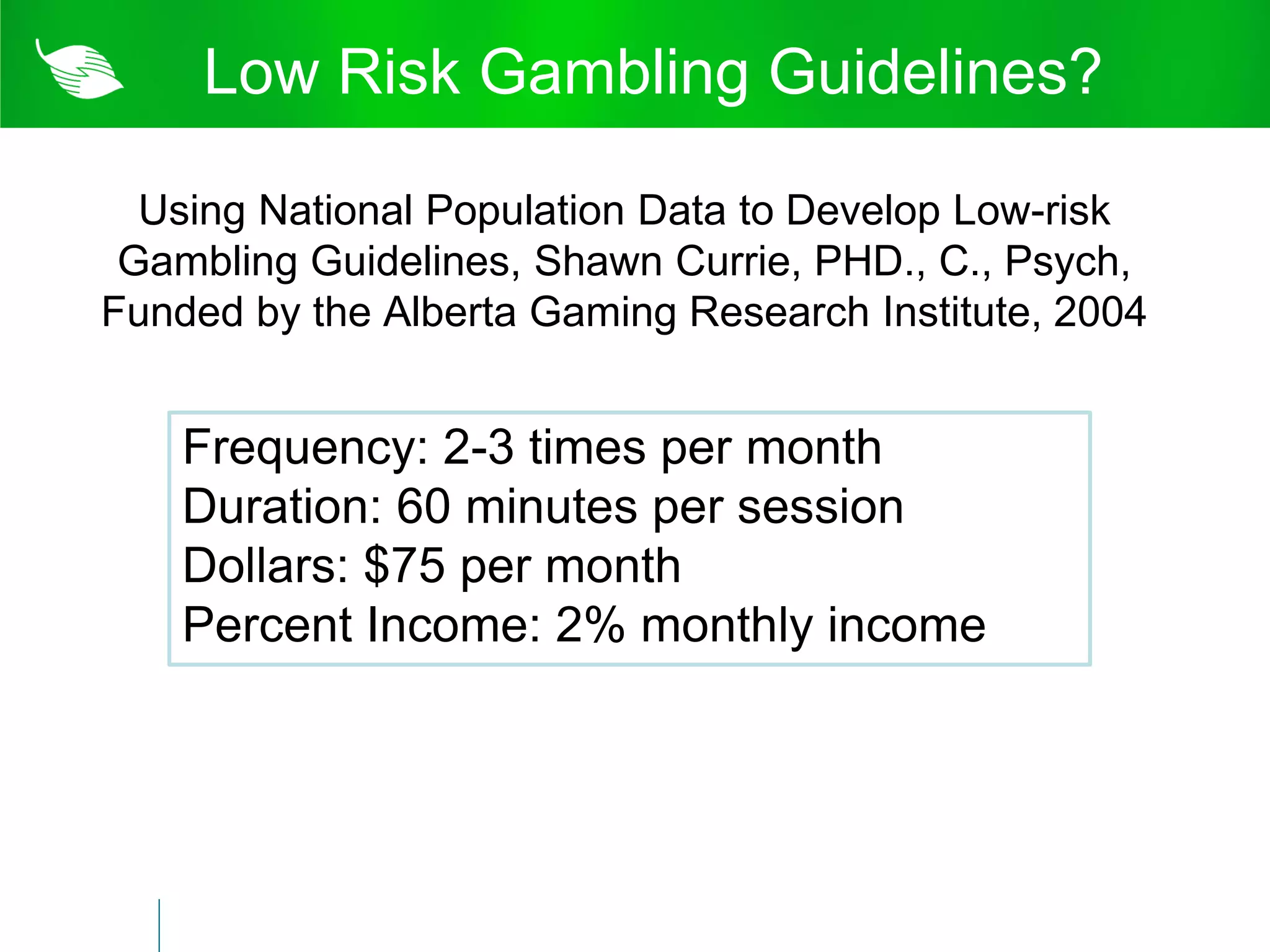
Low Risk Gambling Guidelines?

  Using National Population Data to Develop Low-risk
 Gambling Guidelines, Shawn Currie, PHD., C., Psych,
Funded by the Alberta Gaming Research Institute, 2004


    Frequency: 2-3 times per month
    Duration: 60 minutes per session
    Dollars: $75 per month
    Percent Income: 2% monthly income
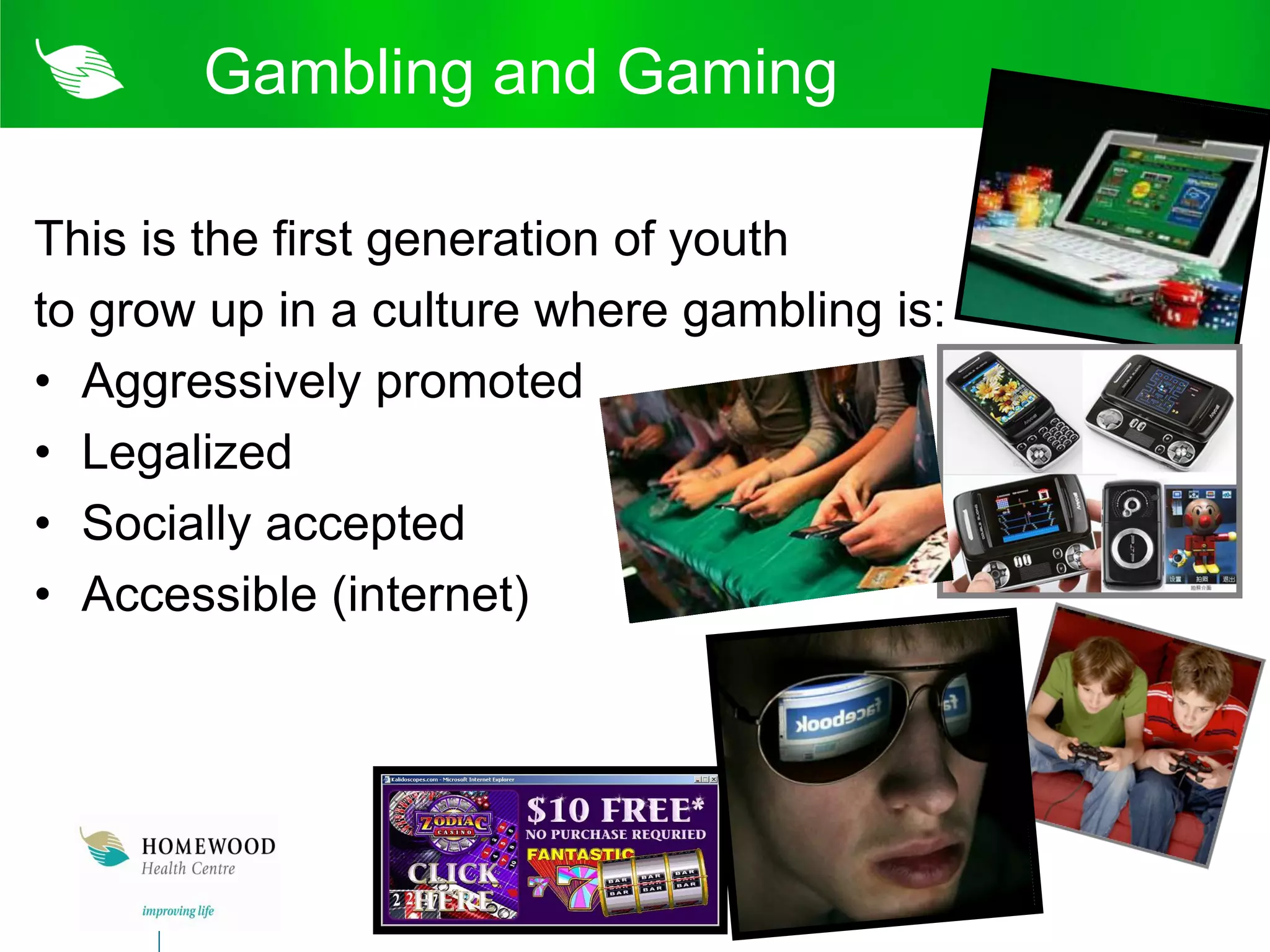
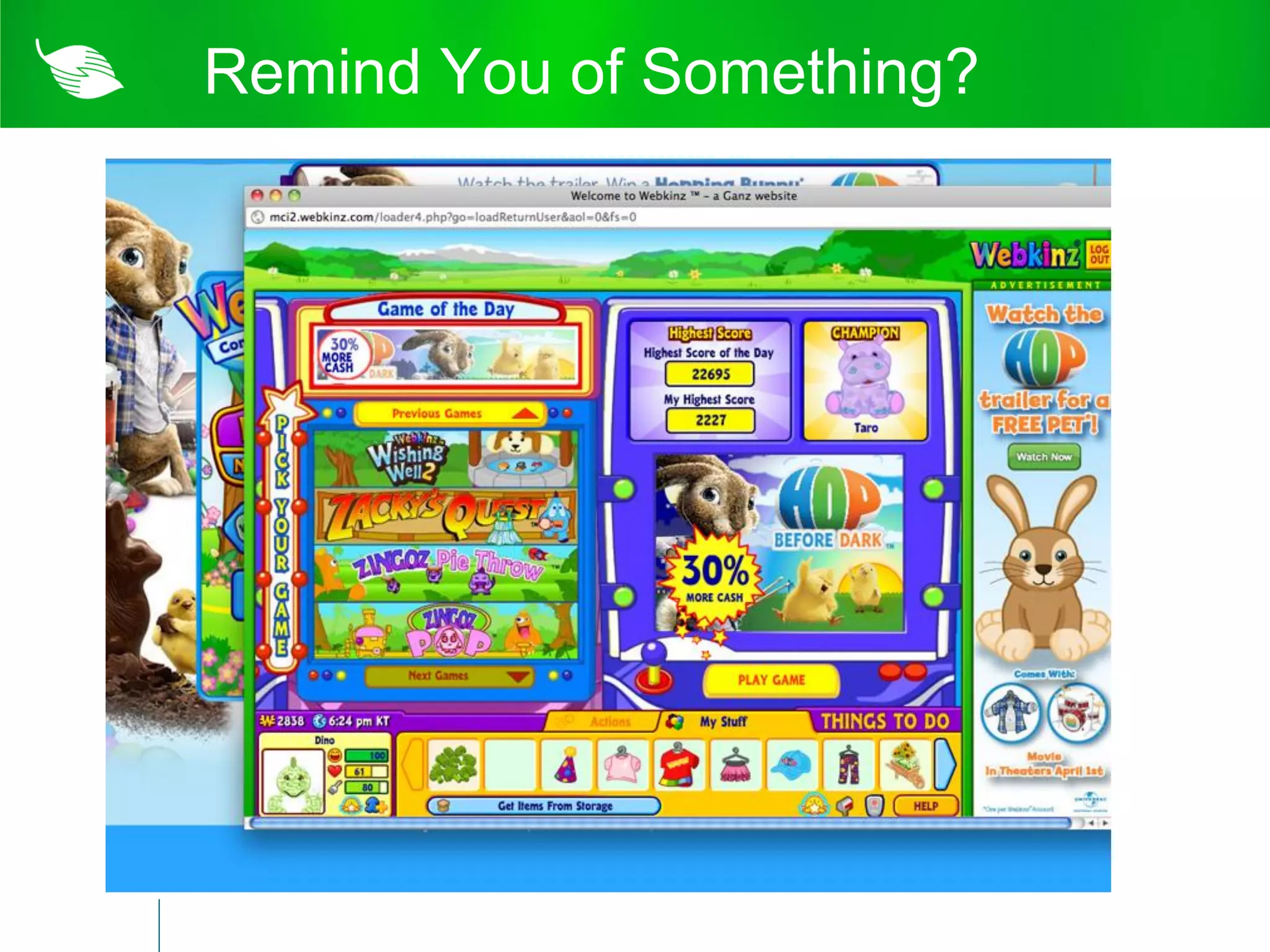
Gambling and Gaming

This is the first generation of youth
to grow up in a culture where gambling is:
• Aggressively promoted
• Legalized
• Socially accepted
• Accessible (internet)
Remind You of Something?
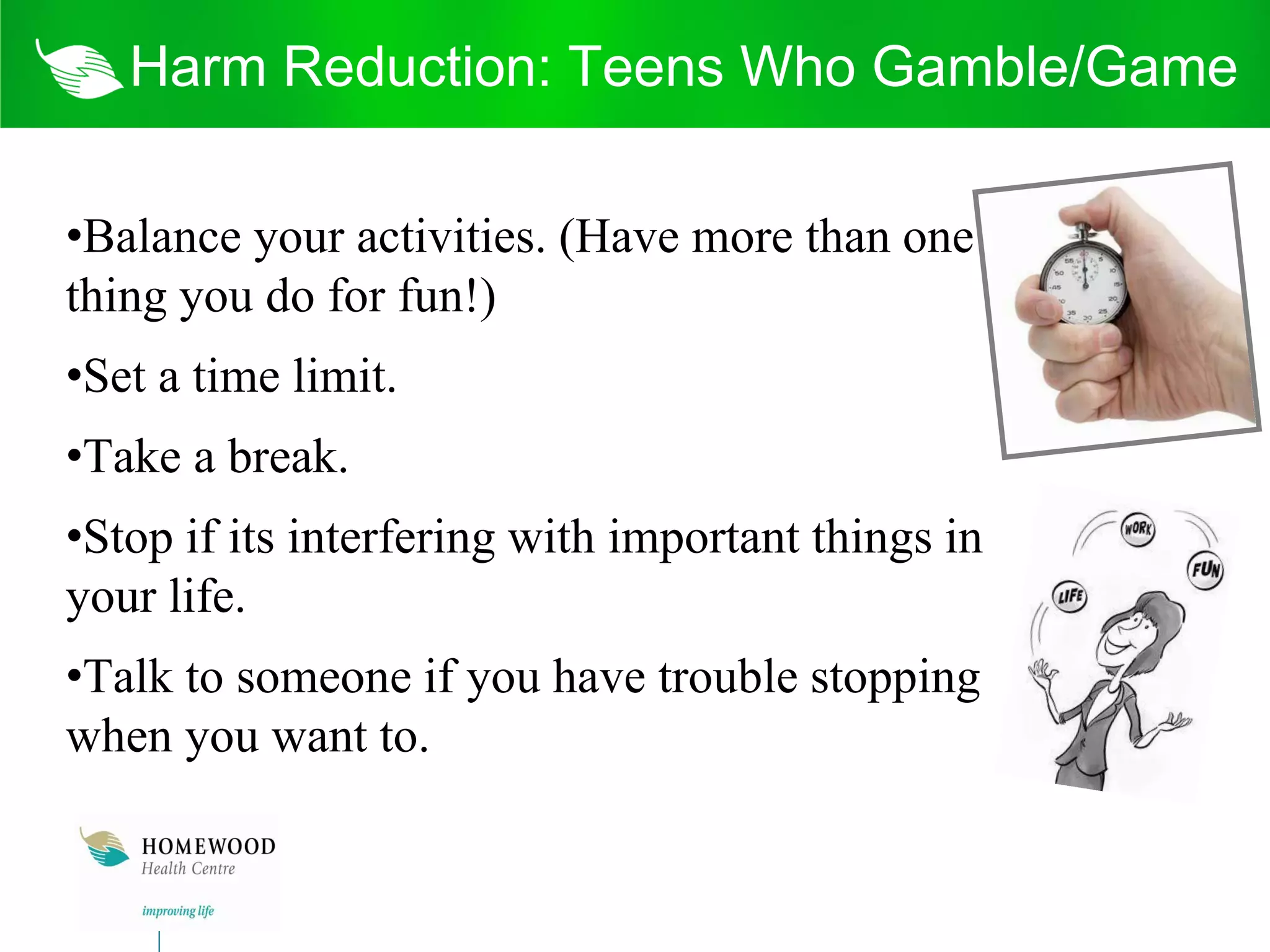
Harm Reduction: Teens Who Gamble/Game

•Balance your activities. (Have more than one
thing you do for fun!)
•Set a time limit.
•Take a break.
•Stop if its interfering with important things in
your life.
•Talk to someone if you have trouble stopping
when you want to.
If Abstinence is the Choice…


• Clients can remain abstinent from the
  game(s) they are seeking support with and
  set limits around other forms of gambling.
(CADS) Problem Gambling Services
       Assessment
       (family/friends as well as individuals
       who have issues with gambling)
       •   Individual Counselling
       •   Education
       •   Case Management
       •   Referrals to treatment or other community agencies
       •   Follow up/Aftercare

       Educational/Support Groups
       •   Nature Walk
       •   Horticulture Therapy sessions
       •   “Bored” Games
       •   Night of Inspiration
       •   Family and Friends Session
       •   Stressed Spelled Backwards is
           Desserts: Coping with the Holidays

COMING SOON…Concurrent Disorders and Gambling Group
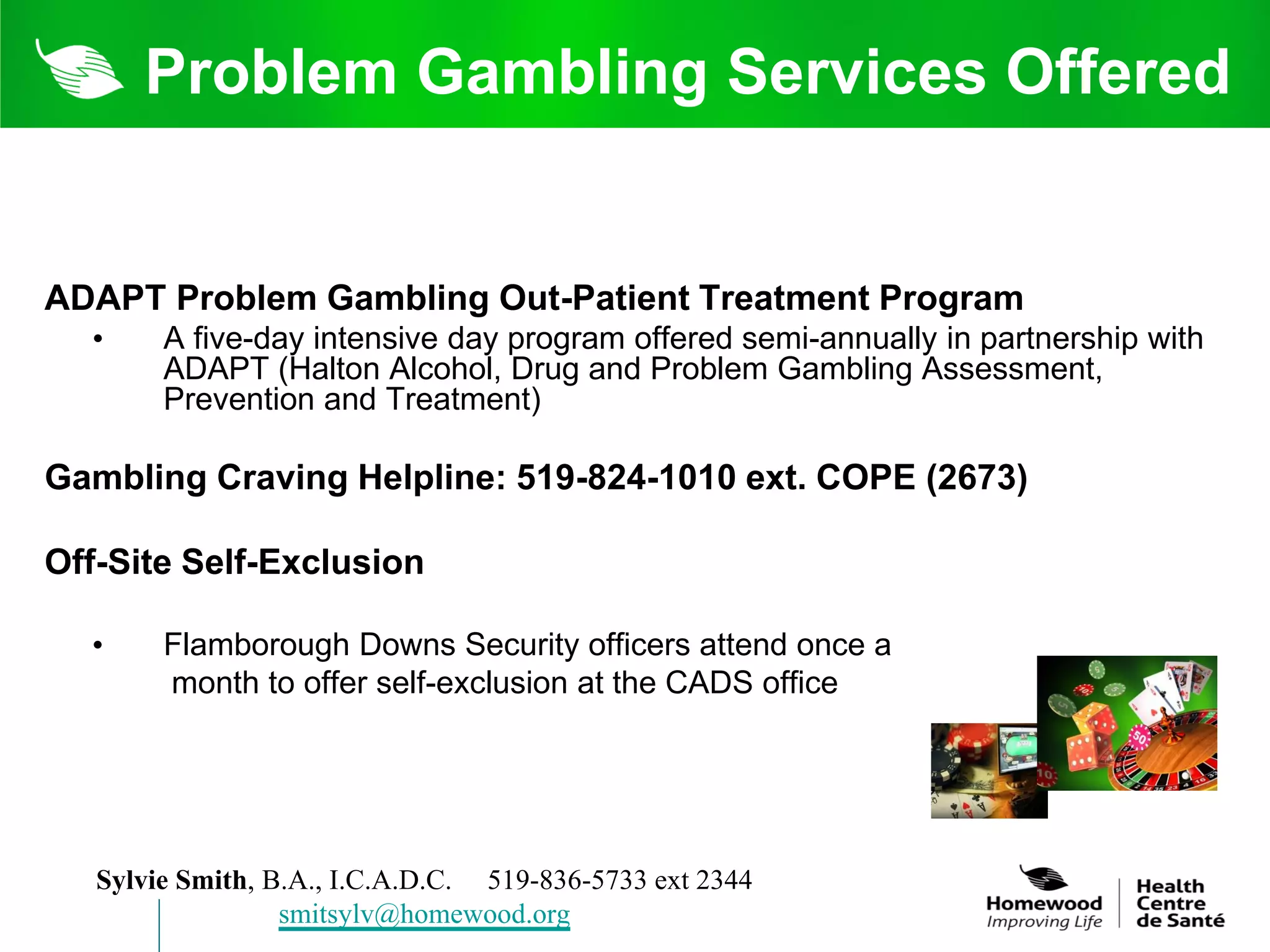
Problem Gambling Services Offered


ADAPT Problem Gambling Out-Patient Treatment Program
  •     A five-day intensive day program offered semi-annually in partnership with
        ADAPT (Halton Alcohol, Drug and Problem Gambling Assessment,
        Prevention and Treatment)

Gambling Craving Helpline: 519-824-1010 ext. COPE (2673)

Off-Site Self-Exclusion

  •     Flamborough Downs Security officers attend once a
        month to offer self-exclusion at the CADS office


   Sylvie Smith, B.A., I.C.A.D.C. 519-836-5733 ext 2344
                  smitsylv@homewood.org
Change is the essence of life.
Be willing to surrender what you are for
what you could become.

Harm reduction forum2013 sylvie smith

  • 1.
    From Theory toPractice How to use knowledge to support clients to make changes in their gambling and decrease the risks. Sylvie Smith, BA, ICADC Problem Gambling/Addictions Counsellor Homewood Community Addiction Services (CADS)
  • 2.
  • 3.
    What is Gambling? •Wildman (1997) has suggested that the important thing to remember about gambling is that it is “a conscious, deliberate effort to stake valuables, usually but not always currency, on how some event happens to turn out.” • “…risking something of value upon the outcome of a contest of chance or a future contingent event not under his control or influence, upon an agreement or understanding that he or someone else will receive something of value in the event of a certain outcome.“ Maine poker law: section 952(4)
  • 4.
  • 5.
    The Big Change 1.Long ago, most gambling had religious and ceremonial functions. 2. Later, gambling became a recreational activity played among individuals. 3. Most recently, gambling has become a business. Taken from Stacked Deck, Williams R & Wood, R
  • 6.
    The House Edge:What it Means • U.S. citizens lost $92 billion to the gambling industry in 2007. • Canadians lost $14 billion to gambling in 2008. Taken from Stacked Deck, Williams R & Wood, R
  • 7.
  • 8.
    Gambling and theBrain • Dopamine is the chemical messenger/ neurotransmitter in our brains that is responsible for feelings such as pleasure and excitement. • With repeated gambling the body increasingly relies on this stimulus to maintain rewarding feelings, which in turn causes unpleasantness when in withdrawal. • It is said that the release during gambling is 3-4x that of natural rewards such as food or sex (Mirenowicz & Schultz, 1994). (like a “high”) After sometime, this decreases, causing the person to gamble more and perhaps spend more to get the dopamine rush. • This is why you may hear: “It’s not about the money”.
  • 9.
    Various Risk Factors •being young (teens to mid-20s) and/or male • gambling at an early age • having close access to gambling opportunities • having friends who gamble • having parents who are heavy gamblers or problem gamblers • having other addictions • having an early big win • not understanding gambling fallacies • playing rapid forms of gambling with a high frequency of betting (for example, slots and other EGMs) • having difficulty controlling impulses • mental health issues
  • 10.
    A Comprehensive Reviewof Problem Gambling Self-Assessment Tools for Use on an Internet Platform funded by the OPGRC Internet Gambling Risks • Easy of access Internet Gambling Risks • Availability • E-commerce • Gambling under the influence • Underage • Solitary play • Anonymity Dr. Chris Perlman, PhD, University of Waterloo Michelle Nogueira, RSSW, CAC II, CPGC, Homewood Community Addiction Services Sylvie Smith, BA, ICADC, Homewood Community Addiction Services Suzanne Rath, BA, MSc Candidate, University of Guelph
  • 11.
    When do peopleseek support? • When the gambling is an interfering or predominant issue and is leading to other consequences. • It is usually financial, legal or familial issues that facilitate problem gamblers to seek support. • Unlike substance use, there are no physical signs of problem gambling in a family. That’s why problem gambling is sometimes described as the “invisible addiction”.
  • 12.
    Problem Gamblers and Harm Reduction
  • 13.
    Harm Reduction andGambling • Individuals who gamble can be support using the Stages of Change • Precontemplators seek support due to external consequences, such as court order, work place, family and/or bankruptcy • Important to be non-judgemental and help individuals by educating them about gambling in a neutral manner.
  • 14.
    Harm Reduction andGambling • Set limits with money • Pay attention to physical needs • Use only allocated money • Set time limits for play • If a problem is identified, Self-Exclusion can be a way to reduce harm.
  • 15.
    Low Risk GamblingGuidelines? Using National Population Data to Develop Low-risk Gambling Guidelines, Shawn Currie, PHD., C., Psych, Funded by the Alberta Gaming Research Institute, 2004 Frequency: 2-3 times per month Duration: 60 minutes per session Dollars: $75 per month Percent Income: 2% monthly income
  • 16.
    Gambling and Gaming Thisis the first generation of youth to grow up in a culture where gambling is: • Aggressively promoted • Legalized • Socially accepted • Accessible (internet)
  • 17.
    Remind You ofSomething?
  • 18.
    Harm Reduction: TeensWho Gamble/Game •Balance your activities. (Have more than one thing you do for fun!) •Set a time limit. •Take a break. •Stop if its interfering with important things in your life. •Talk to someone if you have trouble stopping when you want to.
  • 19.
    If Abstinence isthe Choice… • Clients can remain abstinent from the game(s) they are seeking support with and set limits around other forms of gambling.
  • 20.
    (CADS) Problem GamblingServices Assessment (family/friends as well as individuals who have issues with gambling) • Individual Counselling • Education • Case Management • Referrals to treatment or other community agencies • Follow up/Aftercare Educational/Support Groups • Nature Walk • Horticulture Therapy sessions • “Bored” Games • Night of Inspiration • Family and Friends Session • Stressed Spelled Backwards is Desserts: Coping with the Holidays COMING SOON…Concurrent Disorders and Gambling Group
  • 21.
    Problem Gambling ServicesOffered ADAPT Problem Gambling Out-Patient Treatment Program • A five-day intensive day program offered semi-annually in partnership with ADAPT (Halton Alcohol, Drug and Problem Gambling Assessment, Prevention and Treatment) Gambling Craving Helpline: 519-824-1010 ext. COPE (2673) Off-Site Self-Exclusion • Flamborough Downs Security officers attend once a month to offer self-exclusion at the CADS office Sylvie Smith, B.A., I.C.A.D.C. 519-836-5733 ext 2344 smitsylv@homewood.org
  • 22.
    Change is theessence of life. Be willing to surrender what you are for what you could become.