

What’s hidden in
those cards?
      Inside the World of
   Problem Gambling
           Julie Hynes, MA, CPS
           “Thinking Outside the Box”
                NCA 2012 Conference
Our Evening “Out of the Box” –
what it isn’t

 We aren’t going
 to talk about
 HOW to treat
 gamblers
Our Evening
“Out of the Box”
What it is:
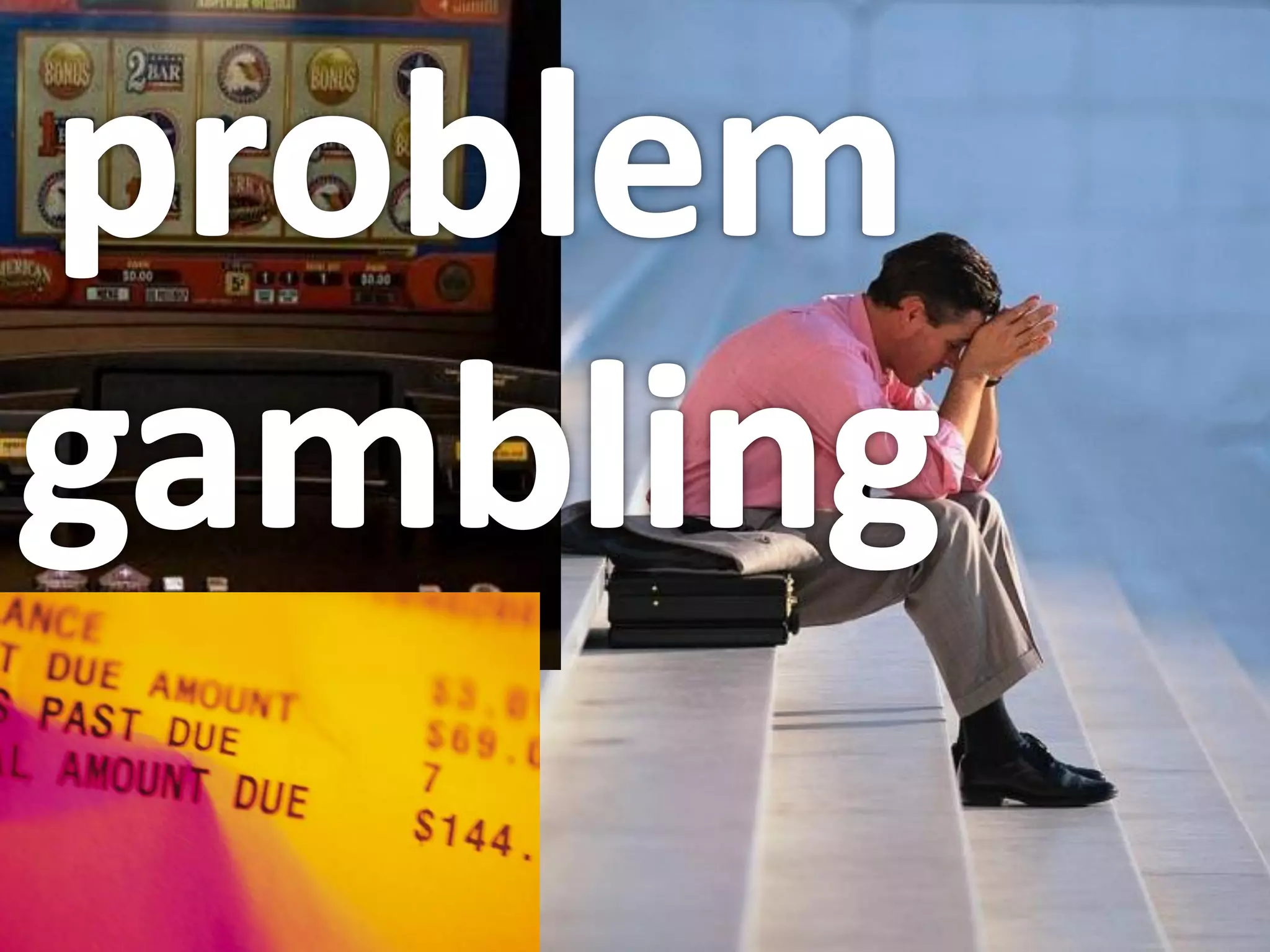
•   Why problem gambling
    deserves our attention
•   Addiction & mental
    health connections
•   ID & referral
•   Fun (Family Feud!)
$
 Opportunity
Gambling
     To risk money or
  something of value on
    the outcome of an
 unpredictable event.
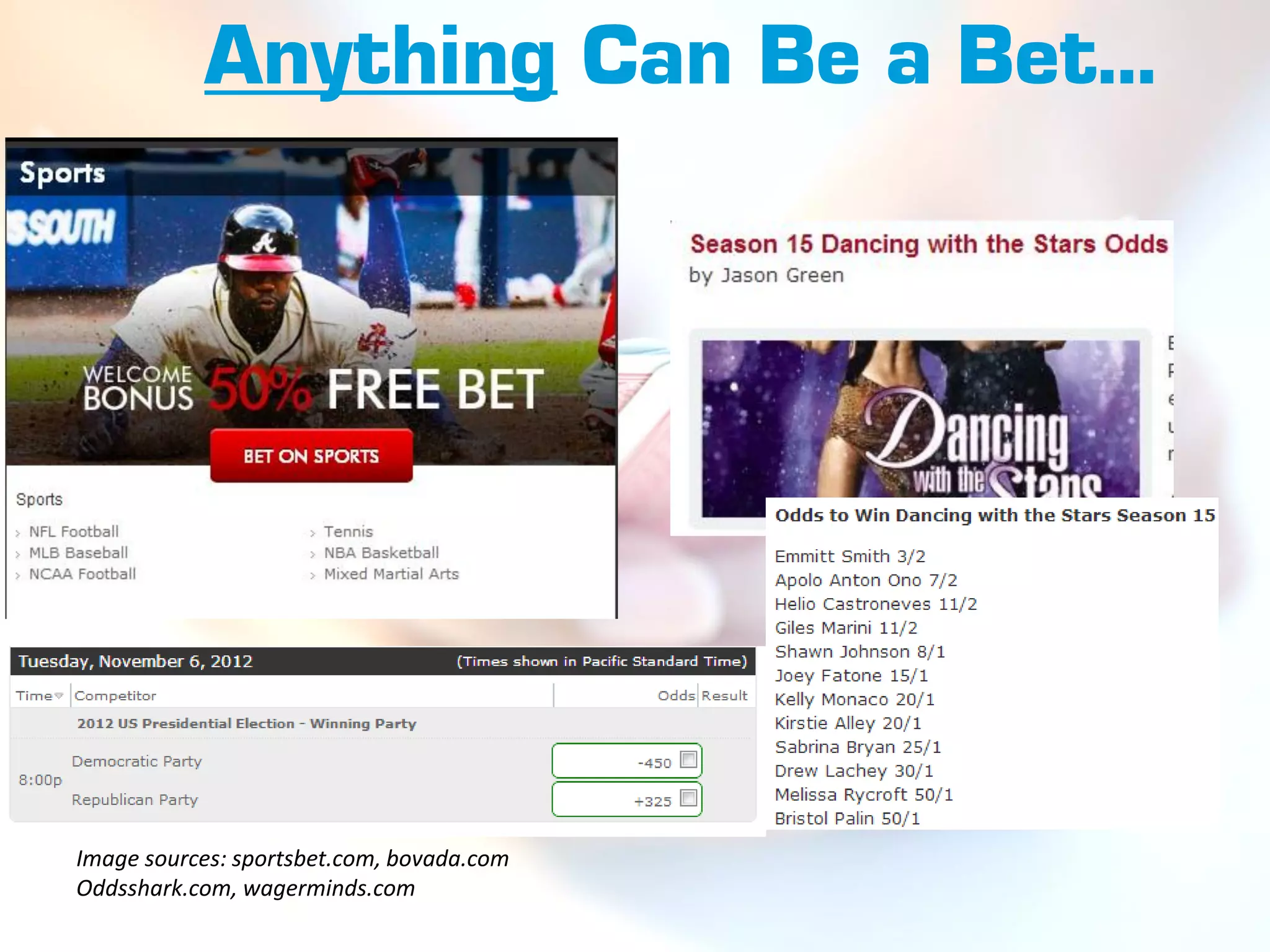
Anything Can Be a Bet…


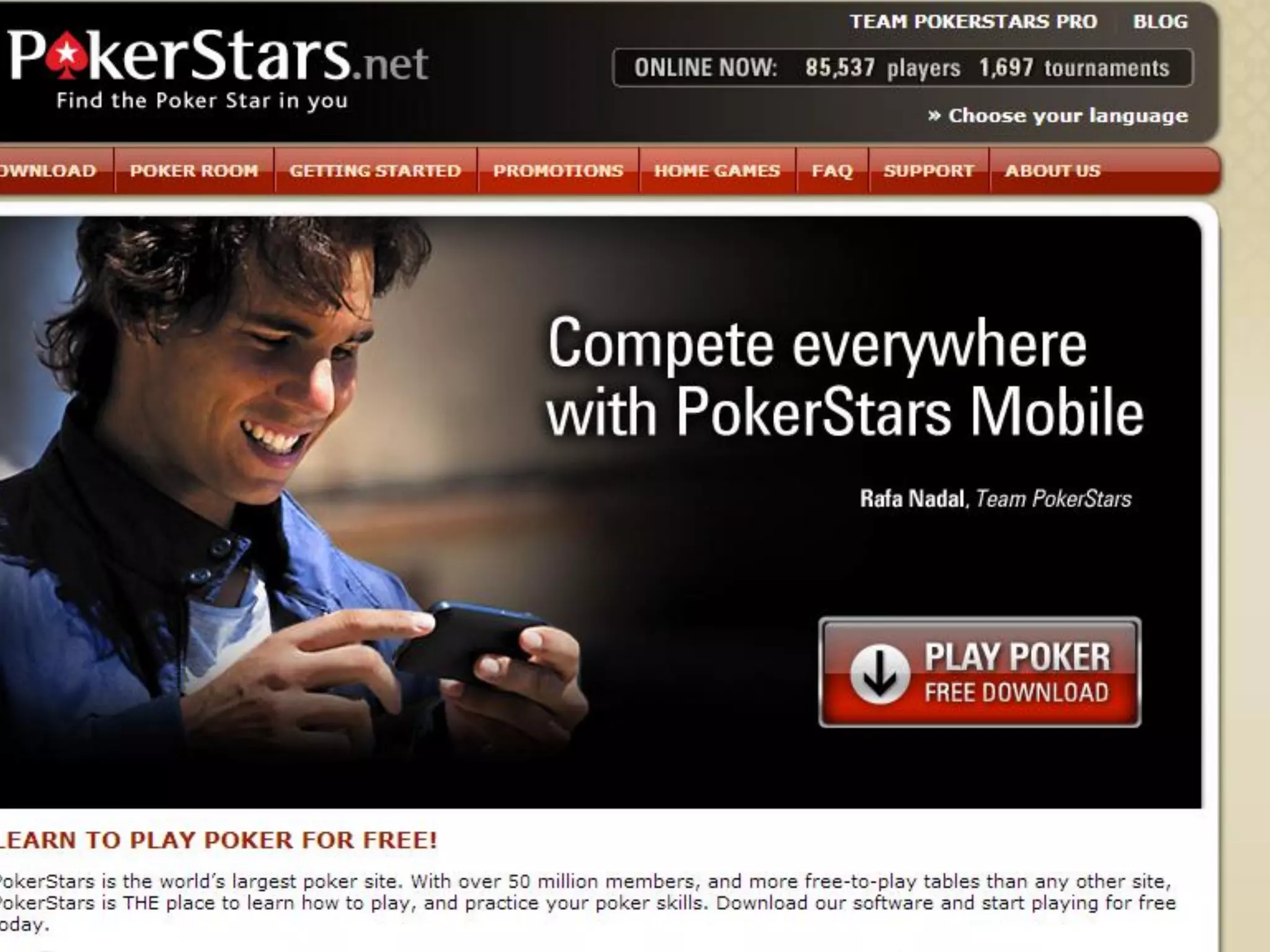
Image sources: sportsbet.com, bovada.com
Oddsshark.com, wagerminds.com
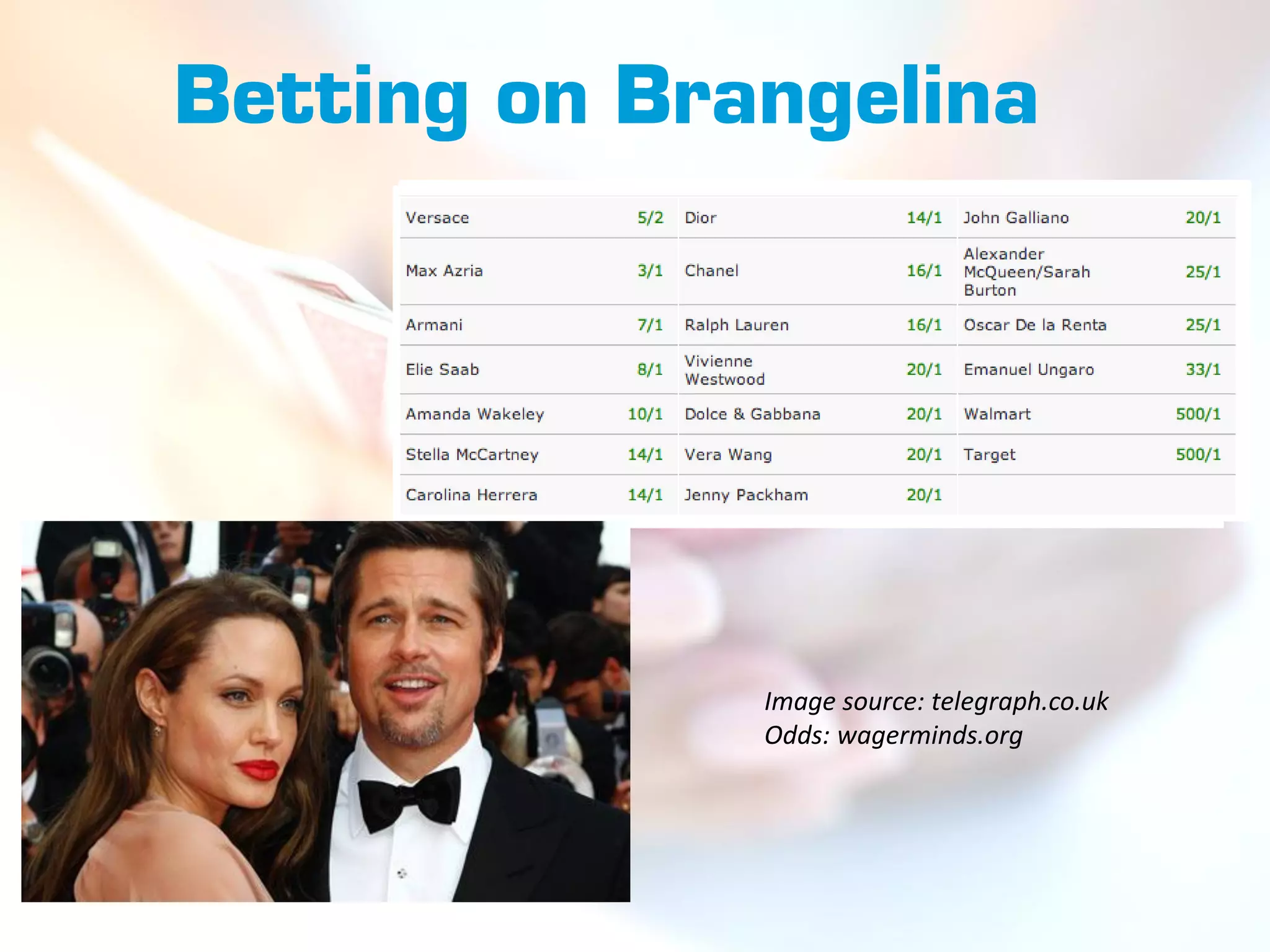
Betting on Brangelina


              Image source: telegraph.co.uk
              Odds: wagerminds.org
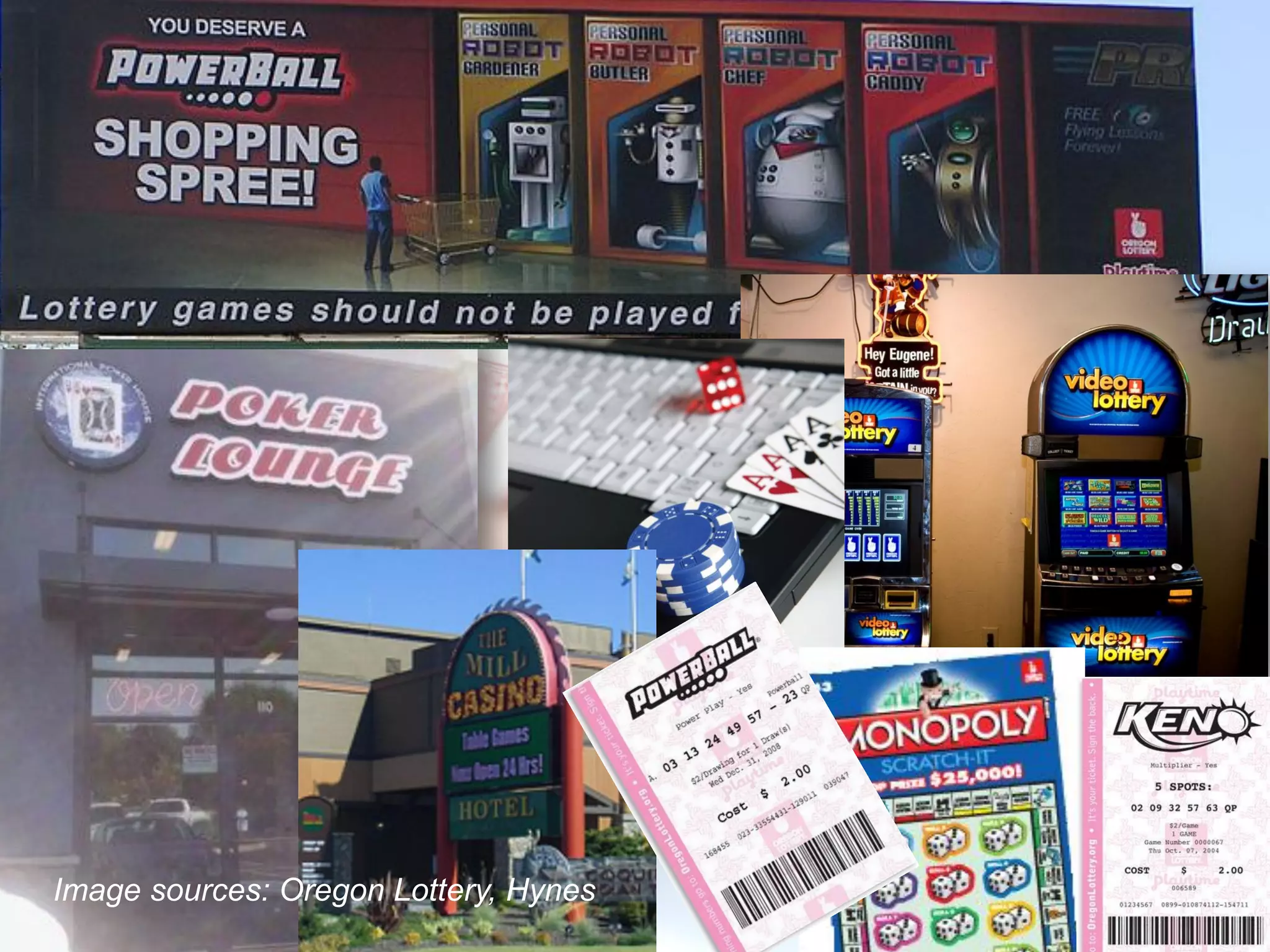
Image sources: Oregon Lottery, Hynes
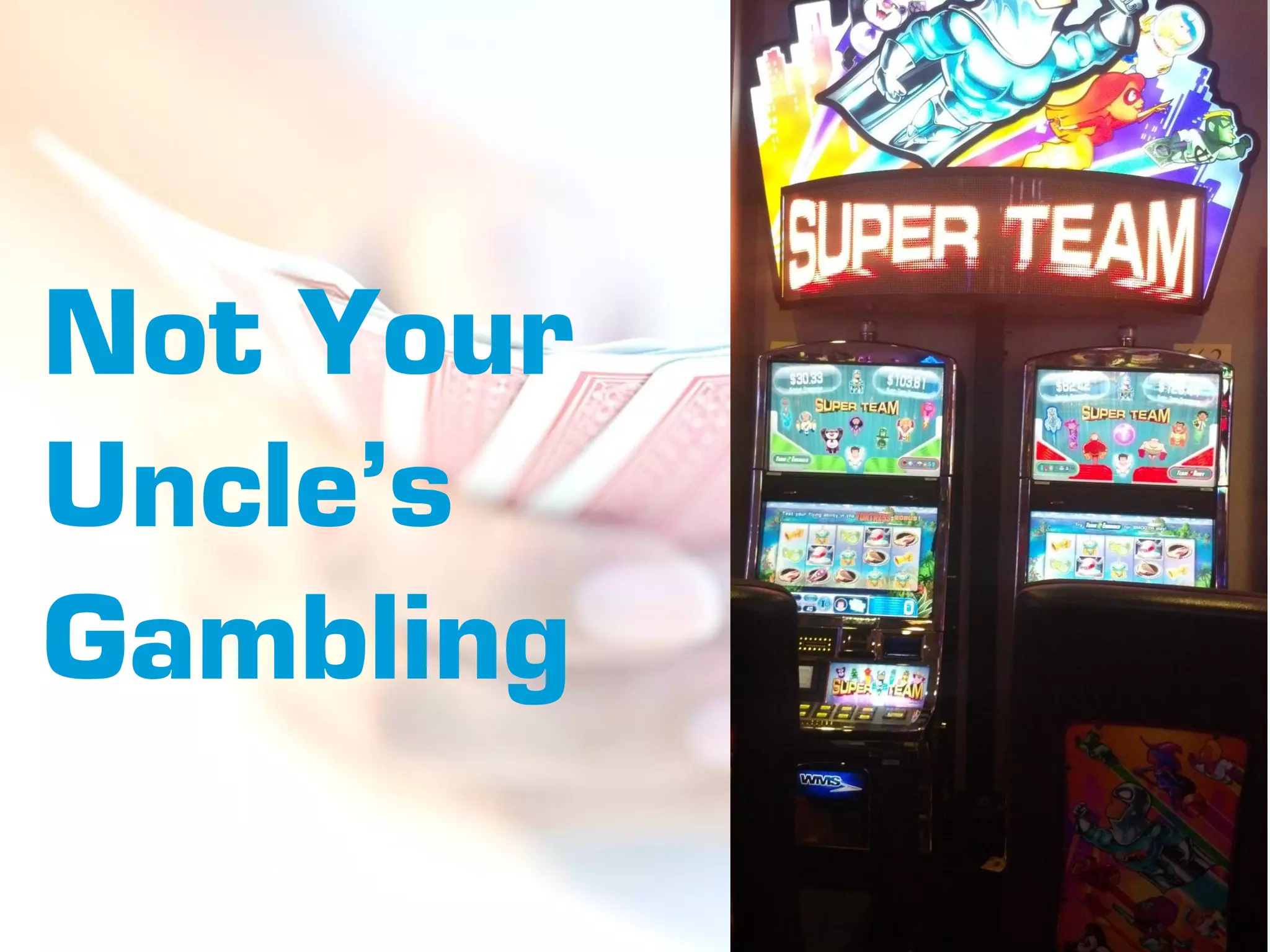
Not Your
Uncle’s
Gambling
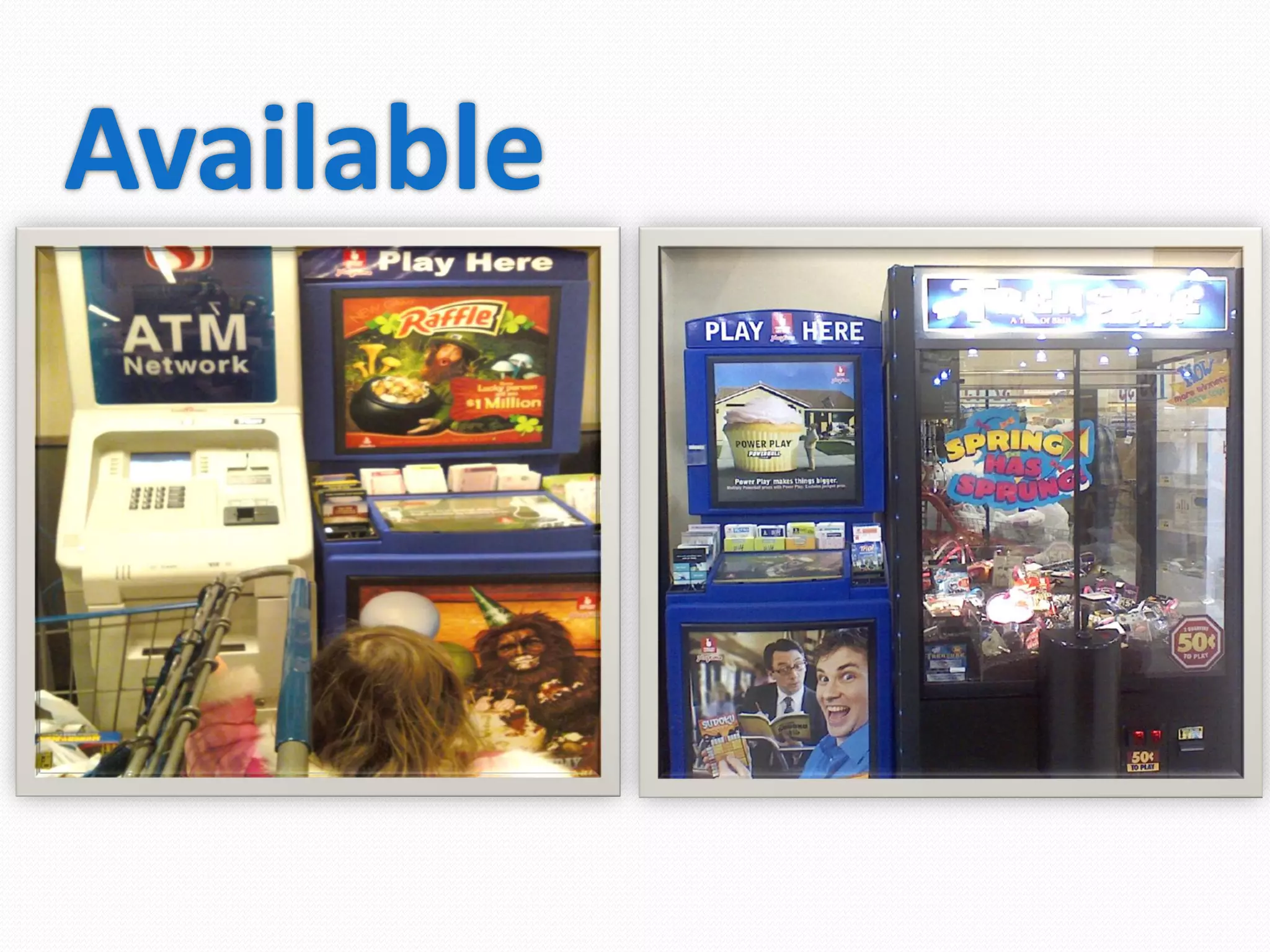
Available
It’s everywhere.
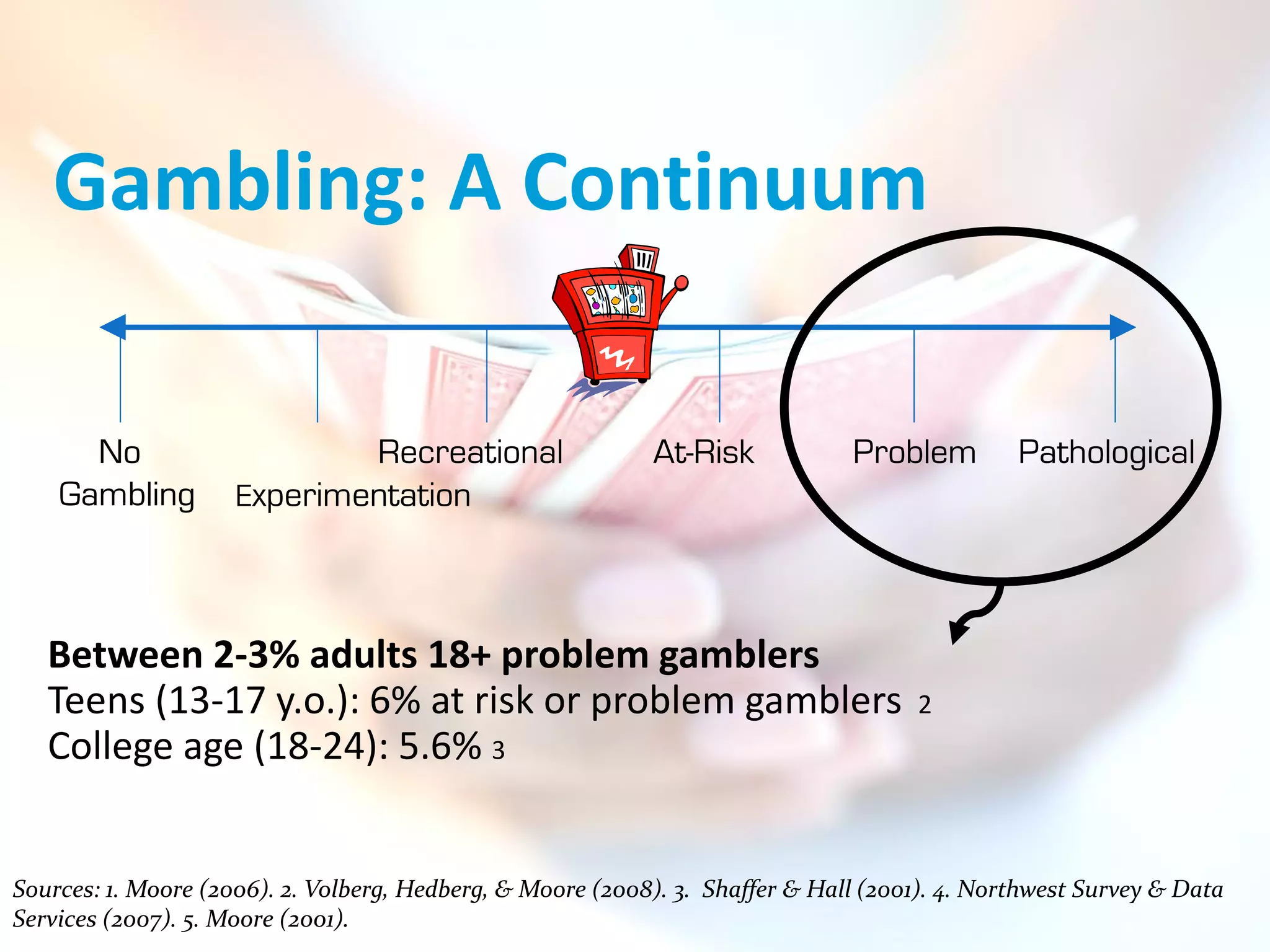
Gambling: A Continuum

      No                     Recreational                   At-Risk            Problem         Pathological
    Gambling         Experimentation


   Between 2-3% adults 18+ problem gamblers
   Teens (13-17 y.o.): 6% at risk or problem gamblers                                2
   College age (18-24): 5.6% 3


Sources: 1. Moore (2006). 2. Volberg, Hedberg, & Moore (2008). 3. Shaffer & Hall (2001). 4. Northwest Survey & Data
Services (2007). 5. Moore (2001).
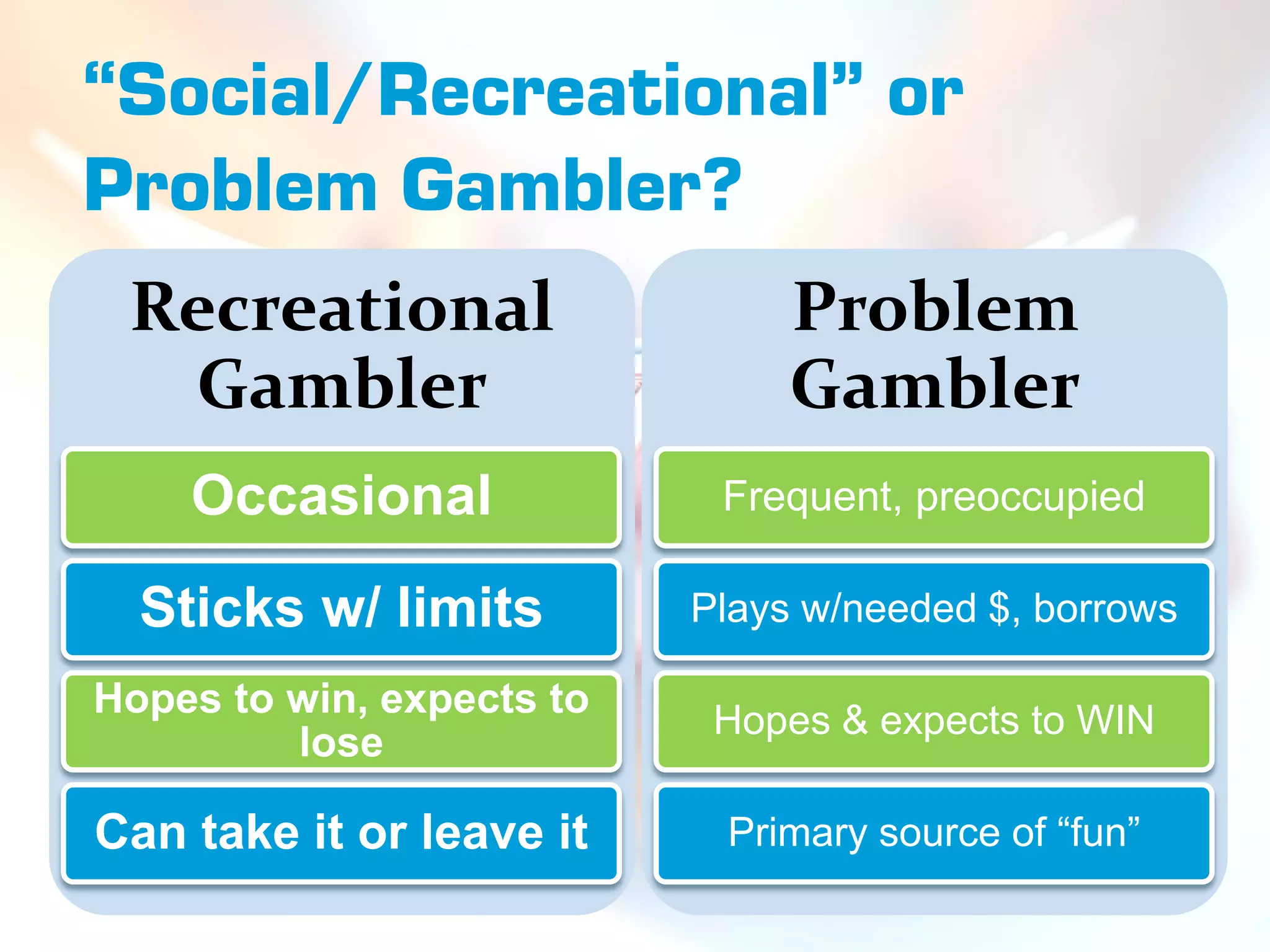
“Social/Recreational” or
Problem Gambler?
 Recreational                   Problem
  Gambler                       Gambler
    Occasional              Frequent, preoccupied

  Sticks w/ limits         Plays w/needed $, borrows

Hopes to win, expects to
                            Hopes & expects to WIN
         lose

Can take it or leave it     Primary source of “fun”
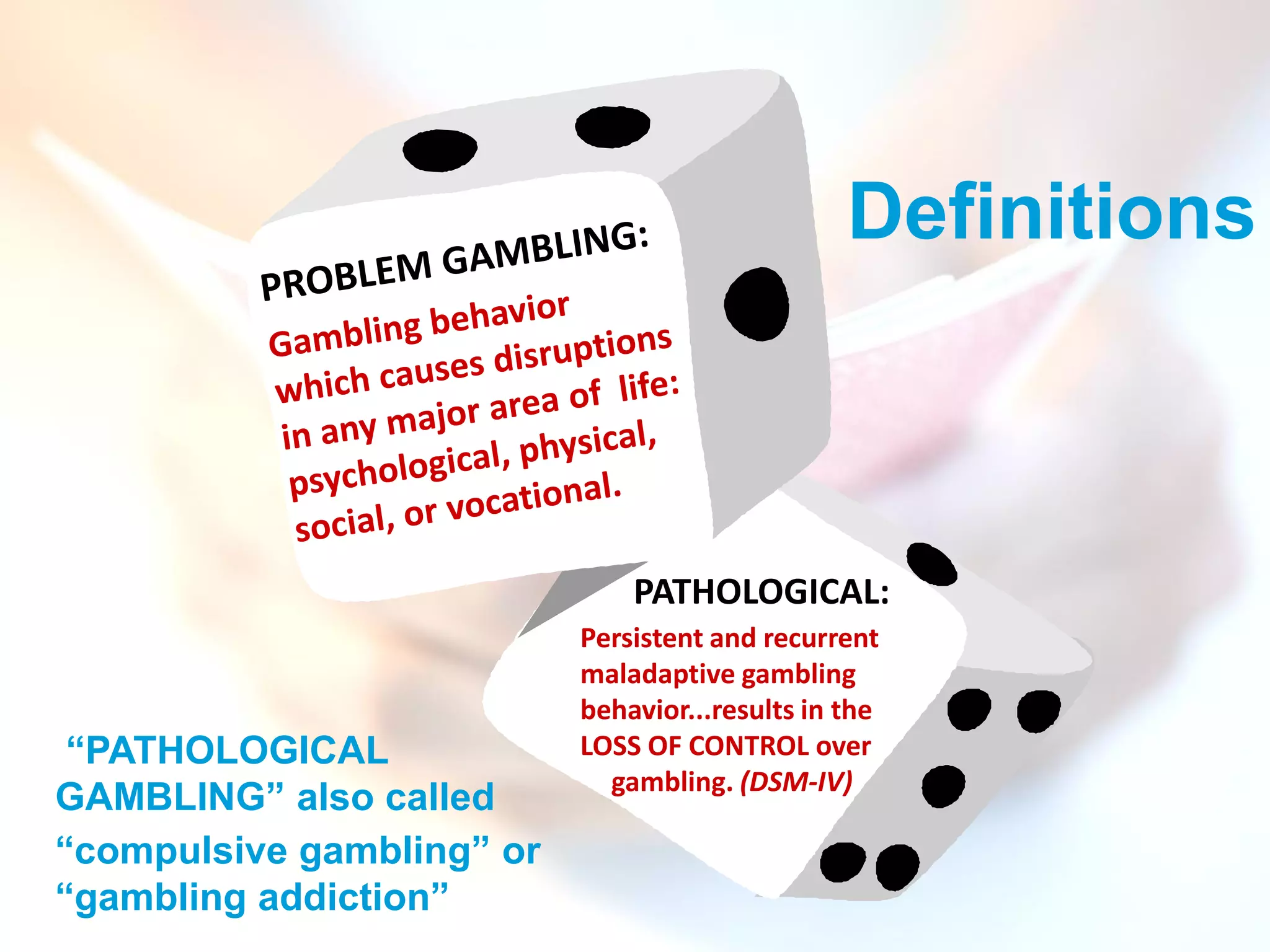
Definitions


                               PATHOLOGICAL:
                           Persistent and recurrent
                           maladaptive gambling
                           behavior...results in the
 “PATHOLOGICAL             LOSS OF CONTROL over
                             gambling. (DSM-IV)
GAMBLING” also called
“compulsive gambling” or
“gambling addiction”
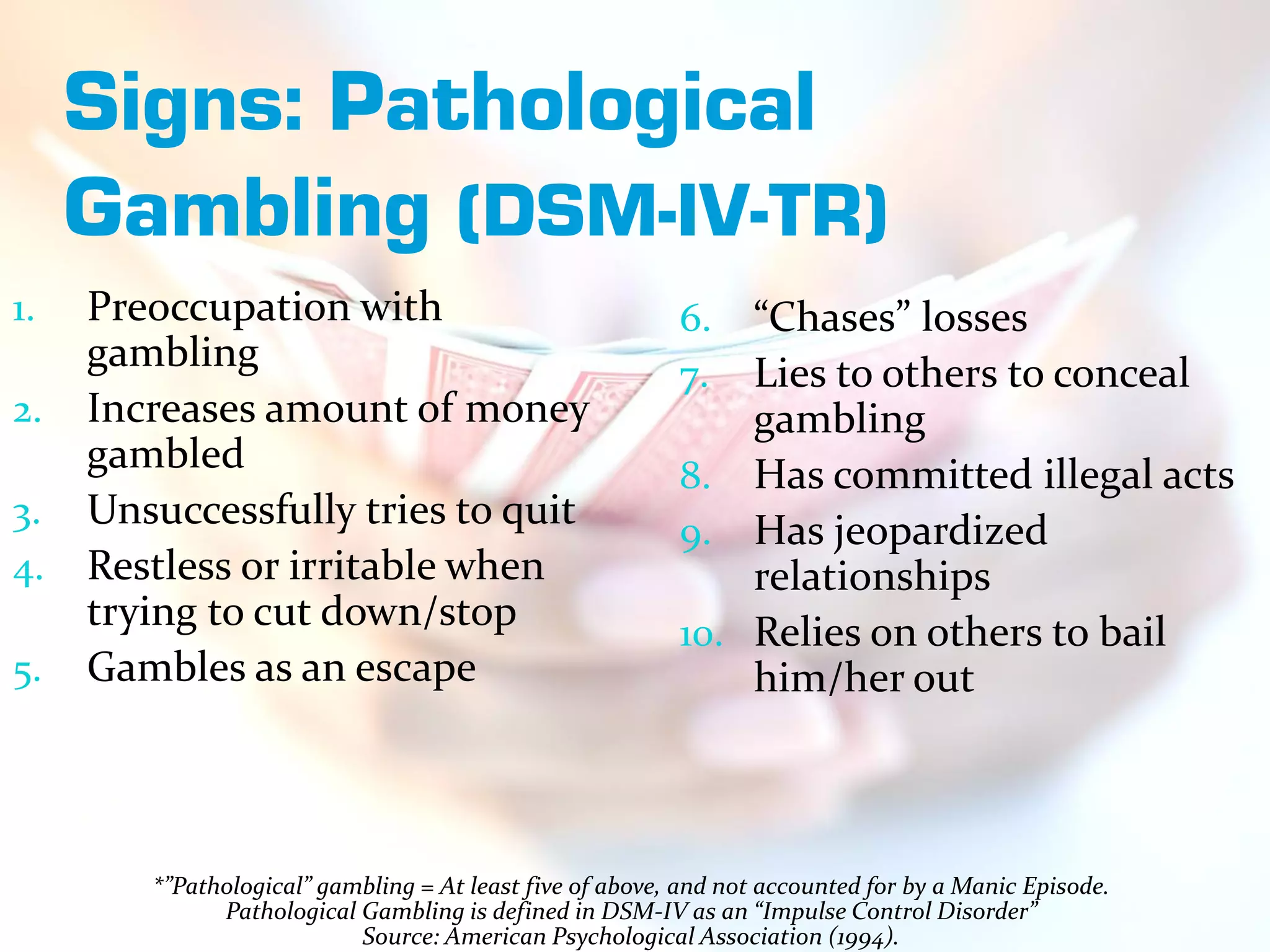
Signs: Pathological
     Gambling (DSM-IV-TR)
1.   Preoccupation with                                   6.  “Chases” losses
     gambling                                             7.  Lies to others to conceal
2.   Increases amount of money                                gambling
     gambled                                              8. Has committed illegal acts
3.   Unsuccessfully tries to quit                         9. Has jeopardized
4.   Restless or irritable when                               relationships
     trying to cut down/stop                              10. Relies on others to bail
5.   Gambles as an escape                                     him/her out


        *”Pathological” gambling = At least five of above, and not accounted for by a Manic Episode.
              Pathological Gambling is defined in DSM-IV as an “Impulse Control Disorder”
                           Source: American Psychological Association (1994).
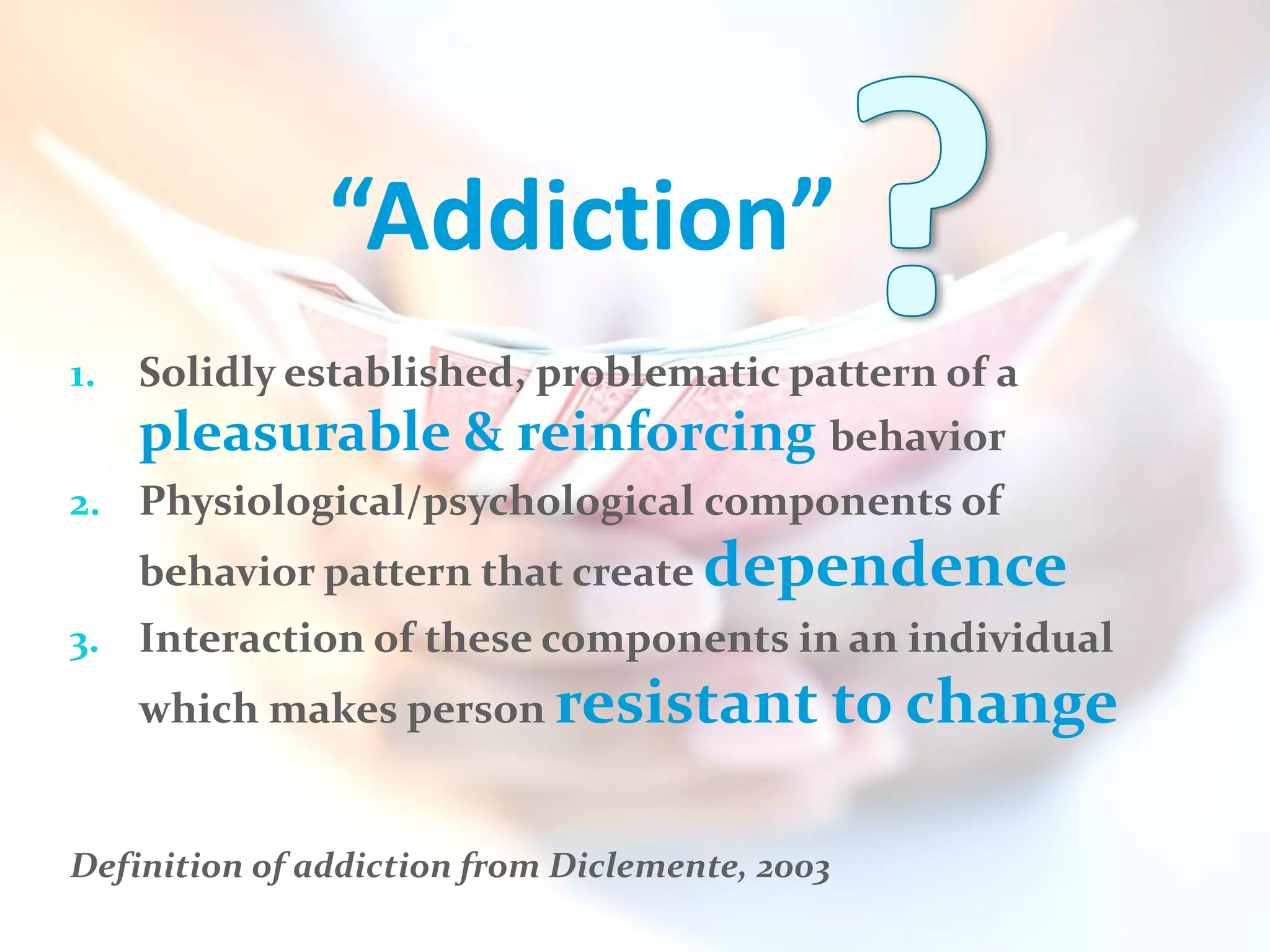
“Addiction”
1.   Solidly established, problematic pattern of a
     pleasurable & reinforcing behavior
2. Physiological/psychological components of
     behavior pattern that create dependence
3. Interaction of these components in an individual
     which makes person resistant to change


Definition of addiction from Diclemente, 2003
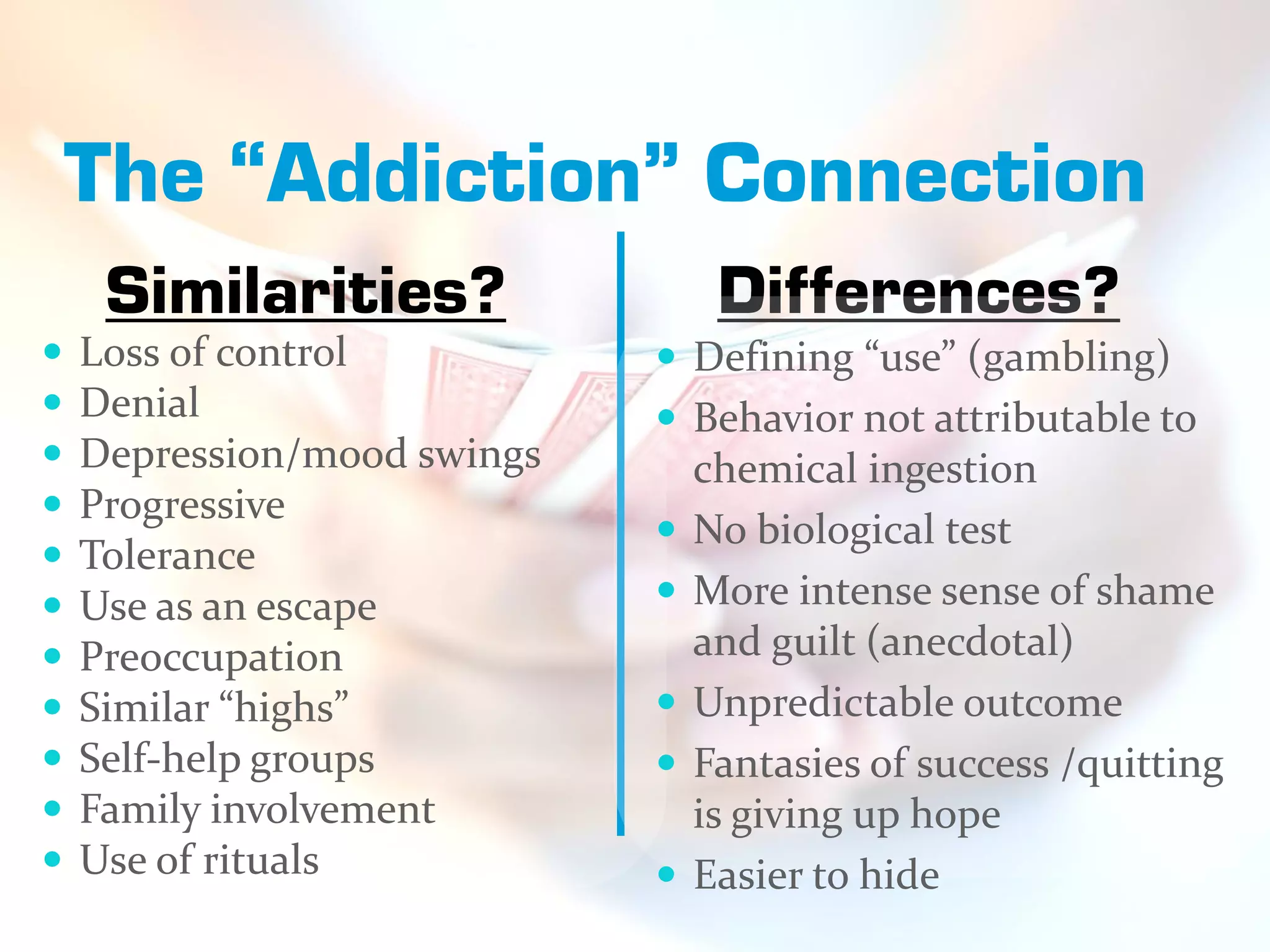
The “Addiction” Connection
     Similarities?                Differences?
   Loss of control           Defining “use” (gambling)
   Denial                    Behavior not attributable to
   Depression/mood swings       chemical ingestion
   Progressive
                                No biological test
   Tolerance
   Use as an escape            More intense sense of shame
   Preoccupation                and guilt (anecdotal)
   Similar “highs”             Unpredictable outcome
   Self-help groups            Fantasies of success /quitting
   Family involvement           is giving up hope
   Use of rituals              Easier to hide
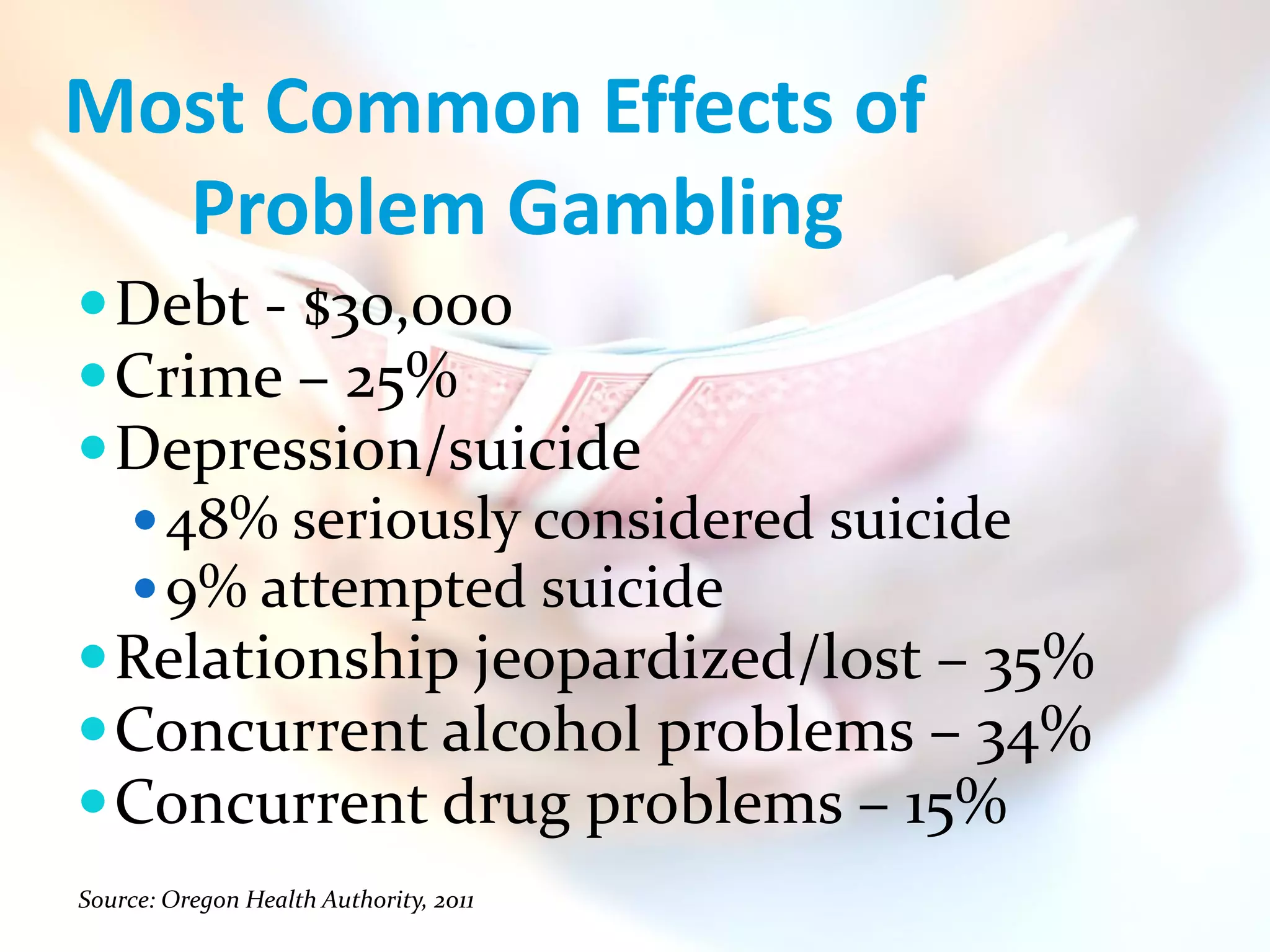
 Debt - $30,000
 Crime – 25%
 Depression/suicide
   48% seriously considered suicide
   9% attempted suicide
 Relationship jeopardized/lost – 35%
 Concurrent alcohol problems – 34%
 Concurrent drug problems – 15%
Source: Oregon Health Authority, 2011
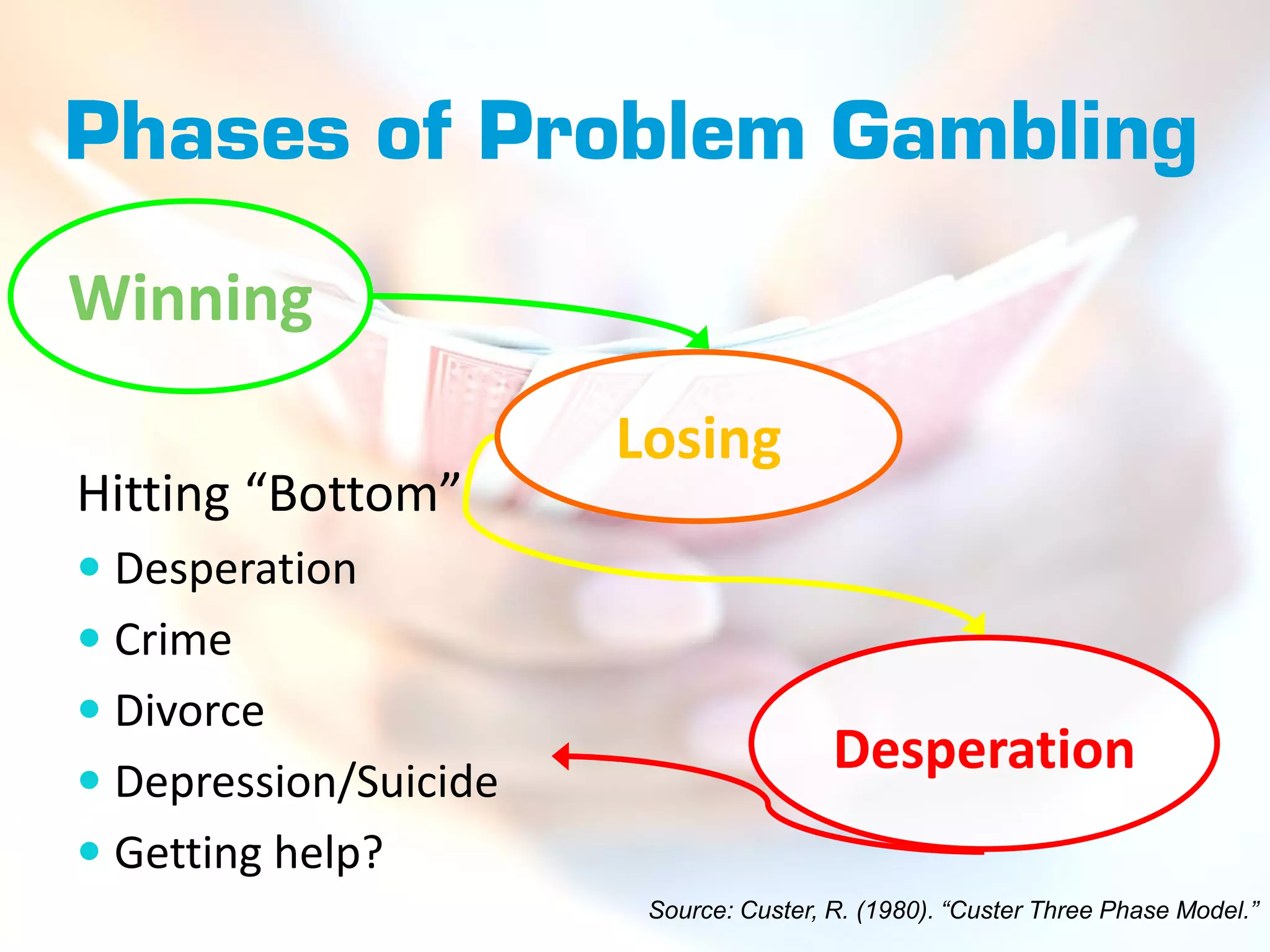
Phases of Problem Gambling
Winning
                       Losing
Hitting “Bottom”
 Desperation
 Crime
 Divorce
 Depression/Suicide
                                        Desperation
 Getting help?
                        Source: Custer, R. (1980). “Custer Three Phase Model.”
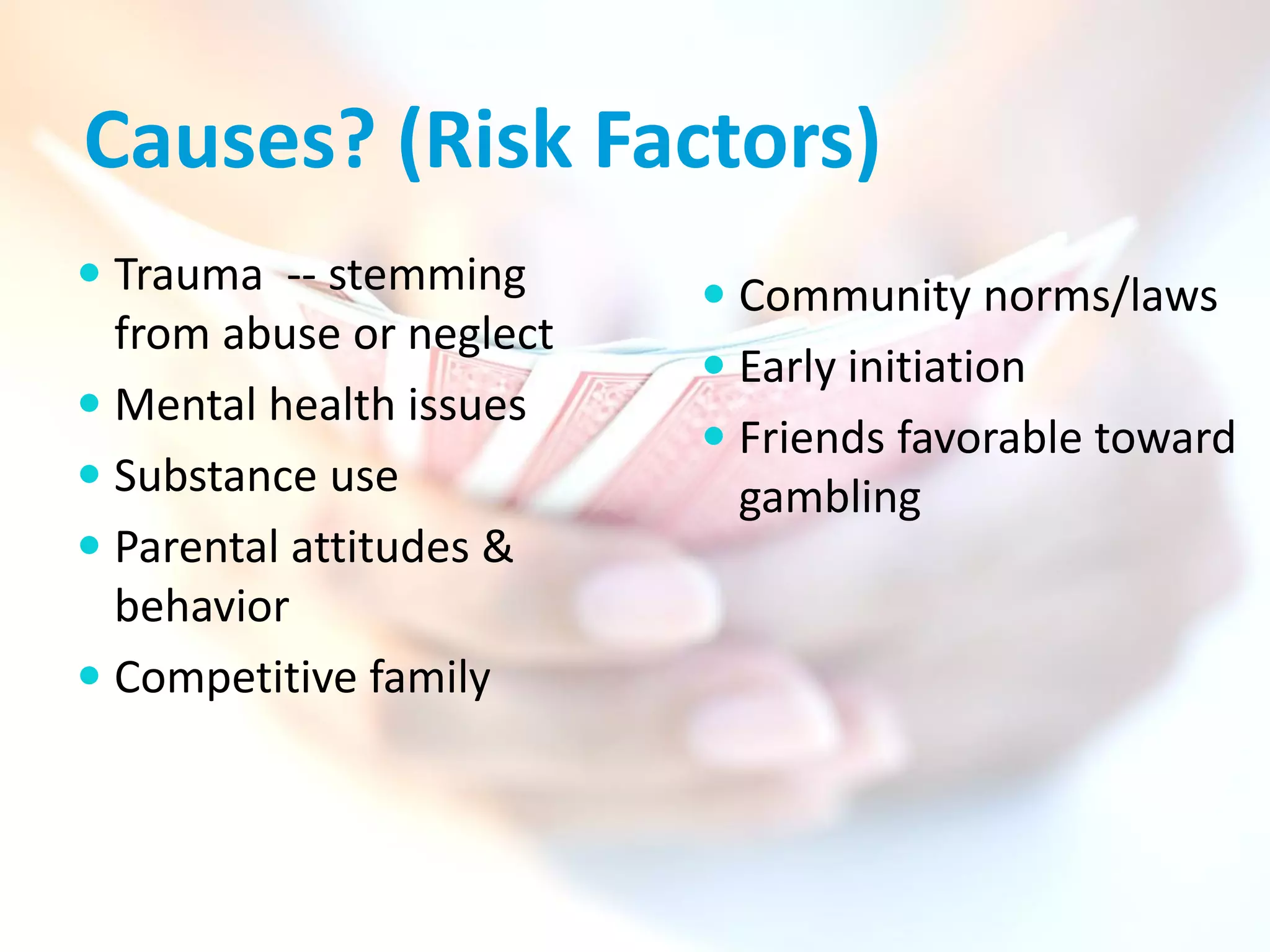
Causes? (Risk Factors)
 Trauma -- stemming       Community norms/laws
  from abuse or neglect
                           Early initiation
 Mental health issues
                           Friends favorable toward
 Substance use             gambling
 Parental attitudes &
  behavior
 Competitive family
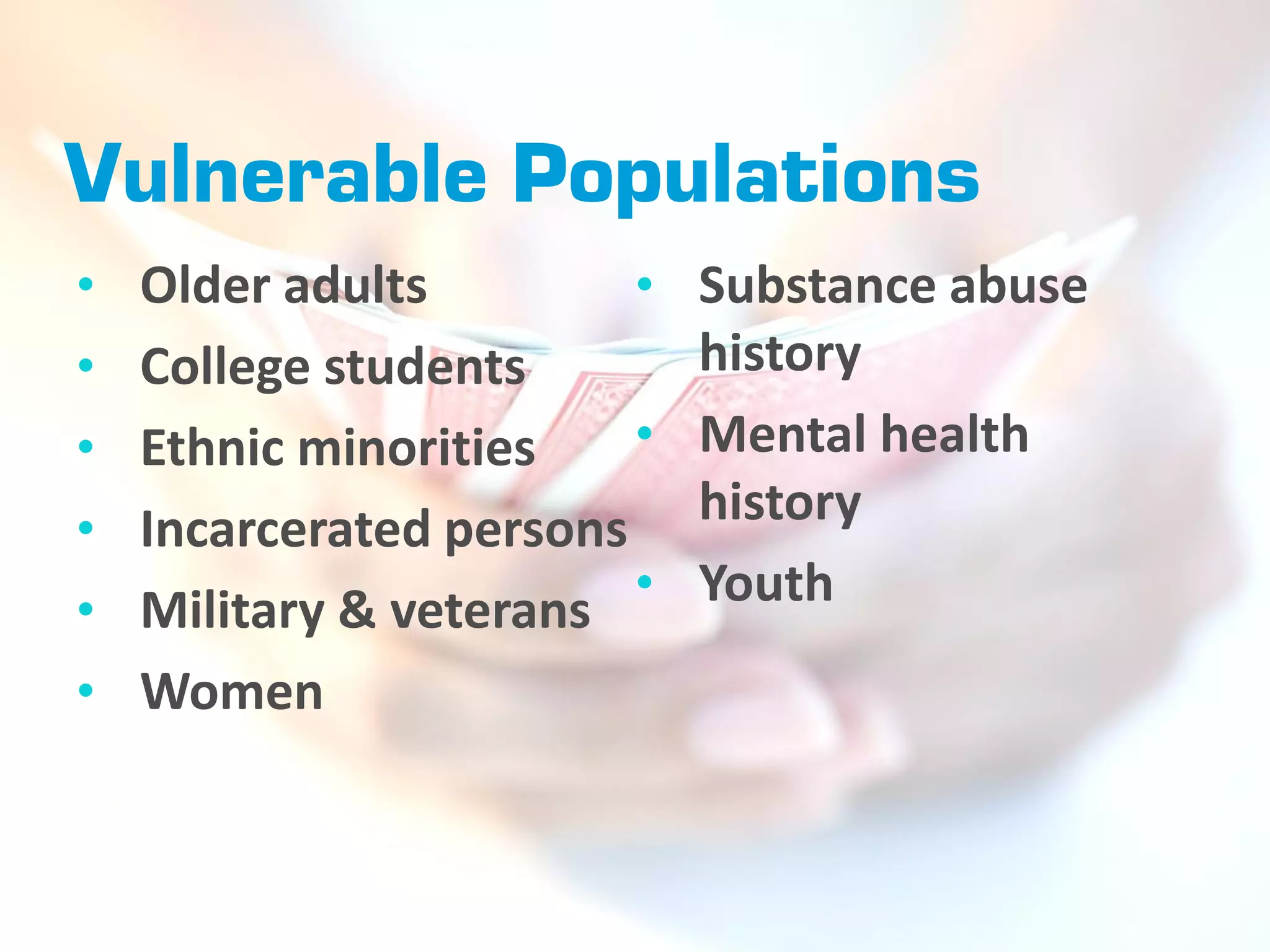
Vulnerable Populations
• Older adults          • Substance abuse
• College students         history
•   Ethnic minorities    • Mental health
•   Incarcerated persons   history
•   Military & veterans • Youth
•   Women
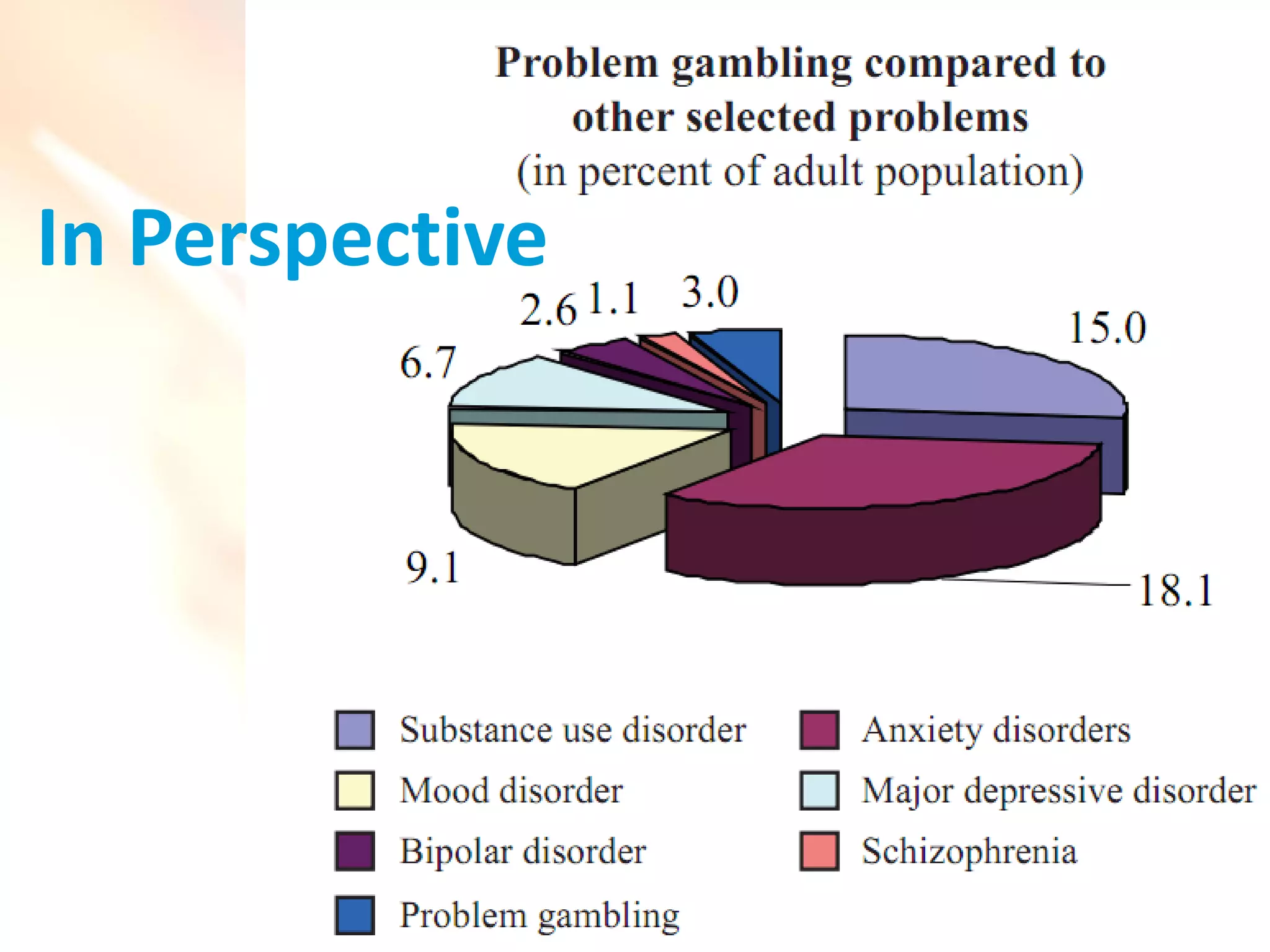
In Perspective
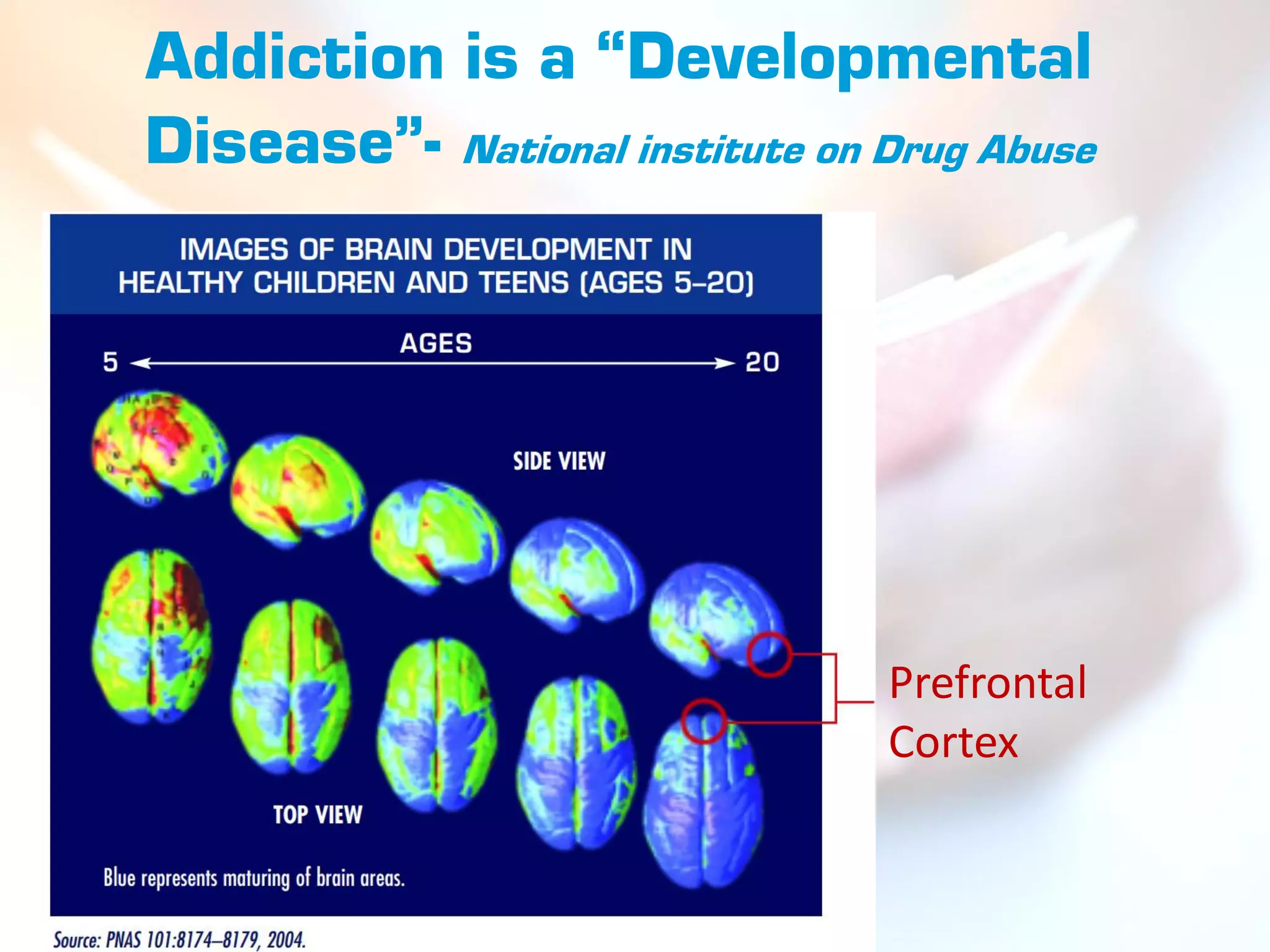
Addiction is a “Developmental
Disease”- National institute on Drug Abuse


                                Prefrontal
                                Cortex
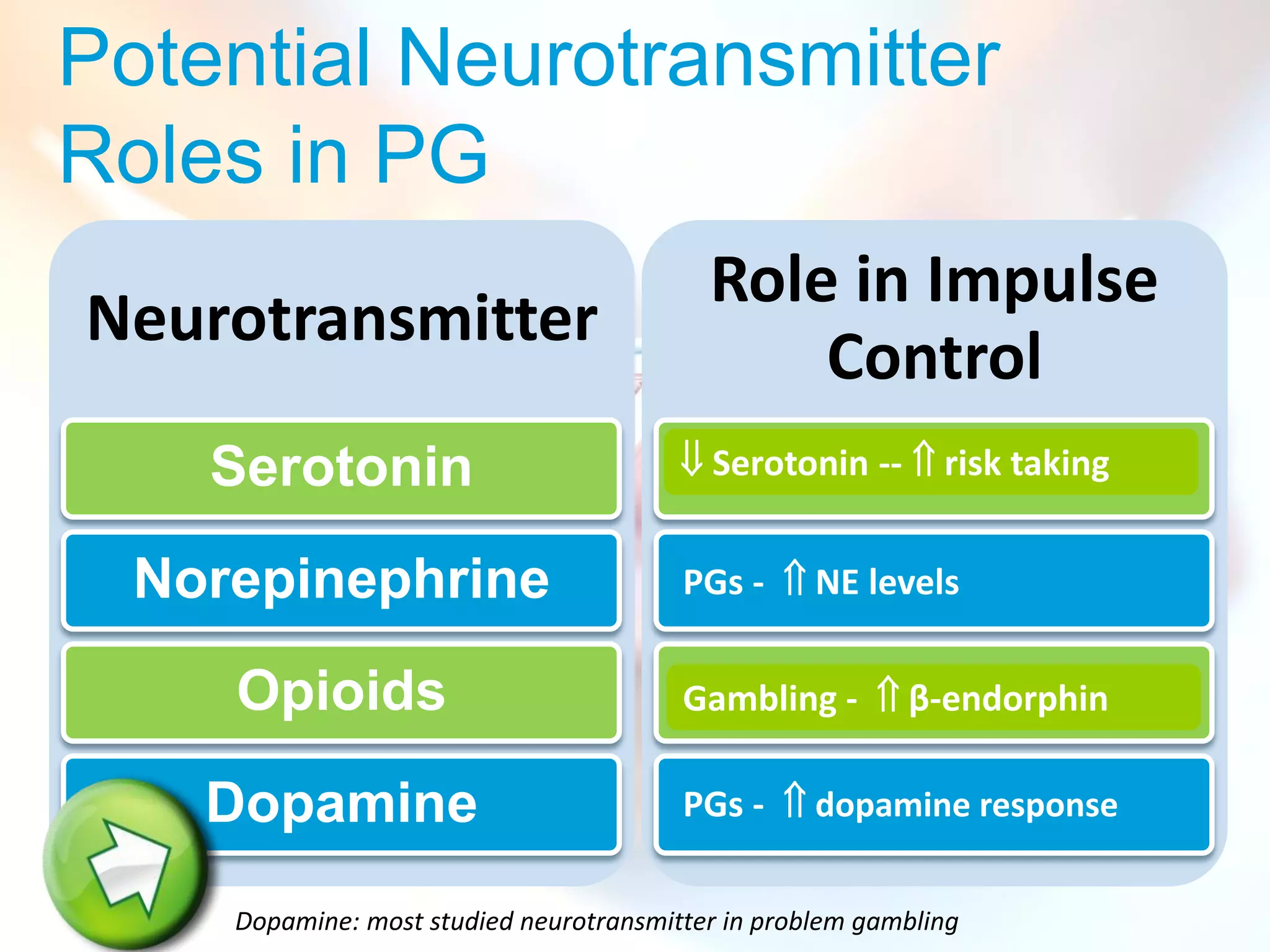
Potential Neurotransmitter
Roles in PG
                                           Role in Impulse
Neurotransmitter
                                               Control
    Serotonin                            Serotonin -- risk taking
                                        Behavior Initiation/Cessation

  Norepinephrine                         PGs -  NE levels
                                             Arousal, Excitement

     Opioids                             Gambling -  β-endorphin
                                              Pleasure, Urges

    Dopamine                             PGs -  dopamine response
                                           Reward, Reinforcement

     Dopamine: most studied neurotransmitter in problem gambling
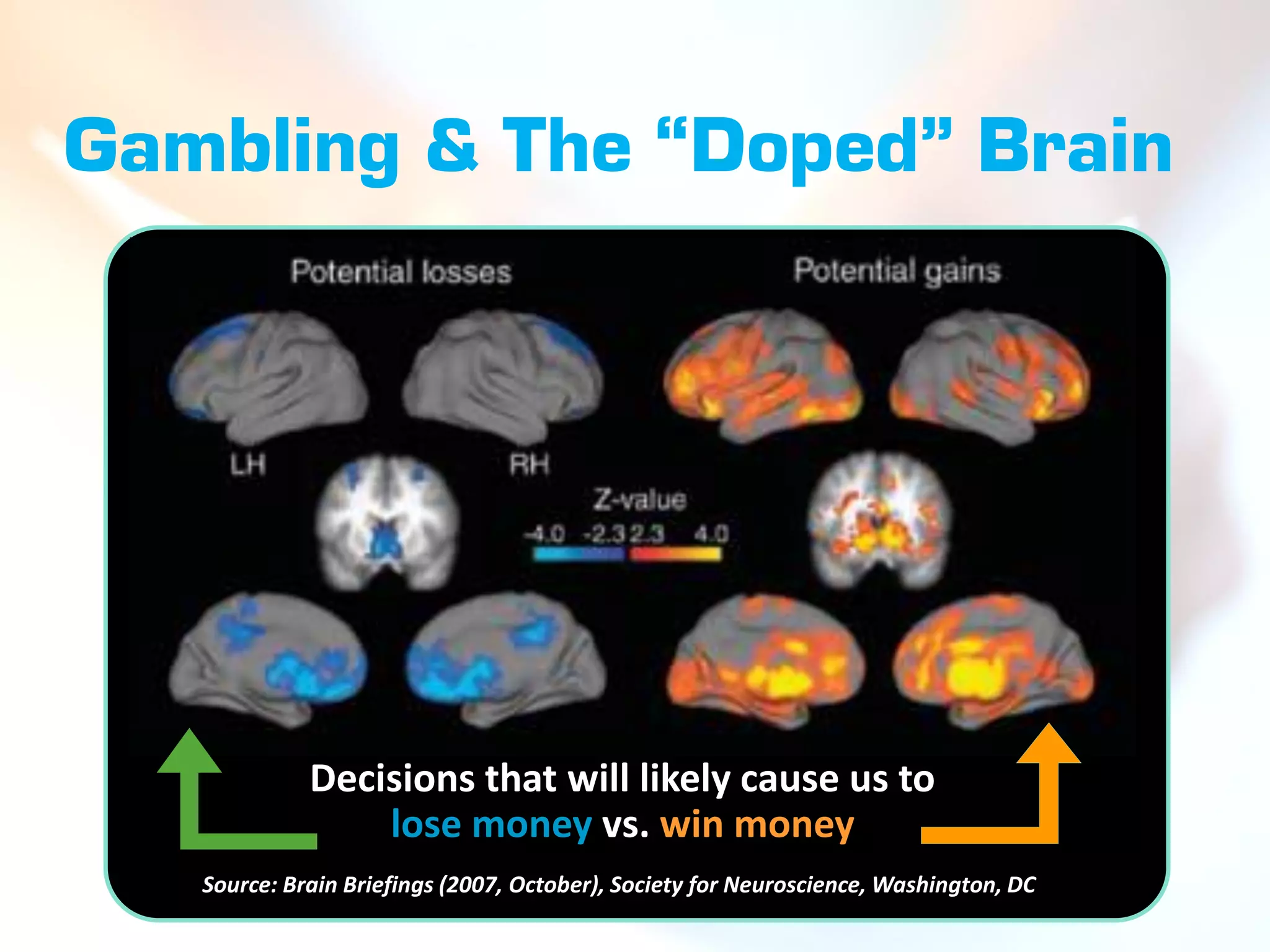
Gambling & The “Doped” Brain


             Decisions that will likely cause us to
                 lose money vs. win money
   Source: Brain Briefings (2007, October), Society for Neuroscience, Washington, DC
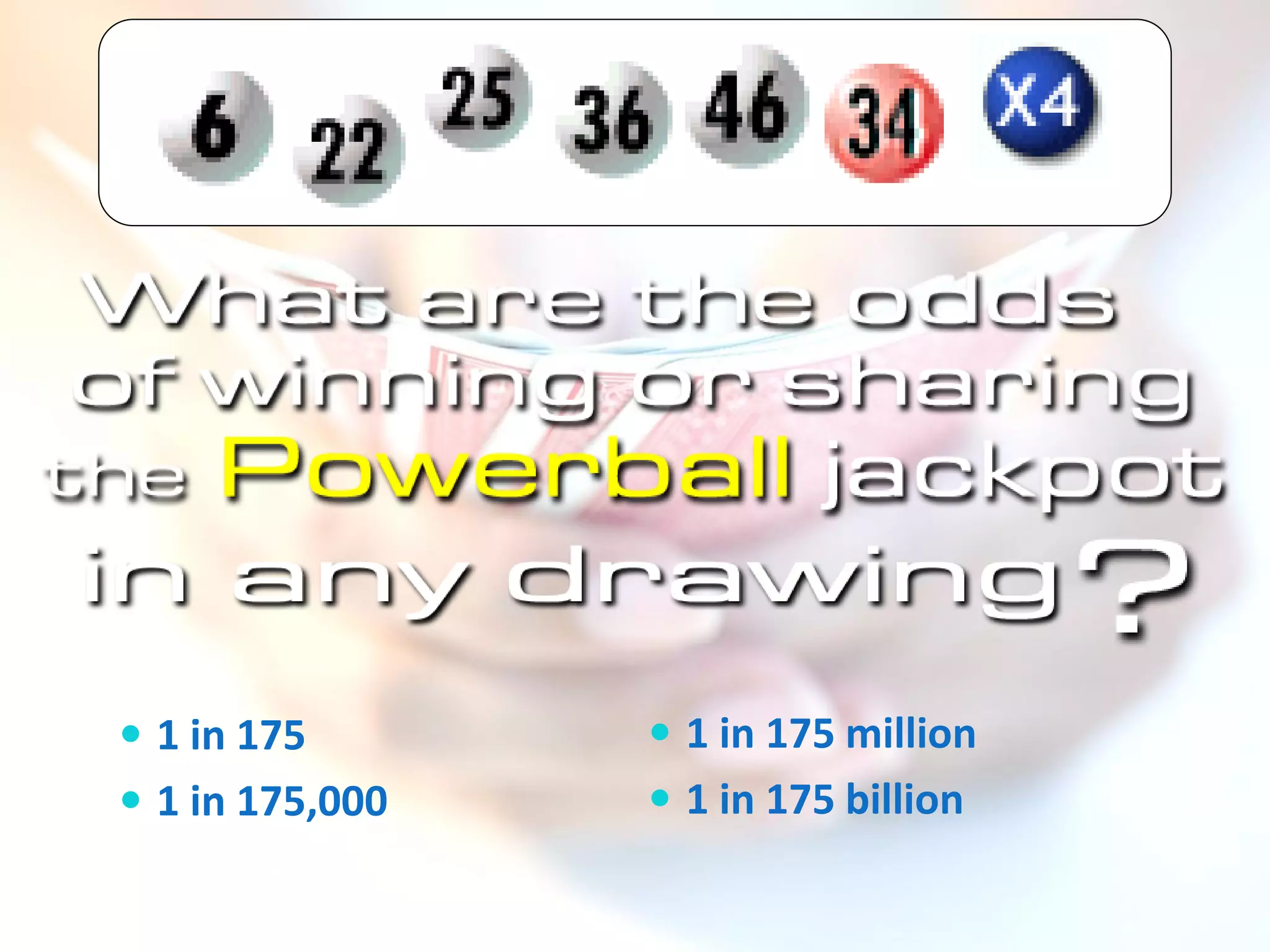
 1 in 175        1 in 175 million
 1 in 175,000    1 in 175 billion
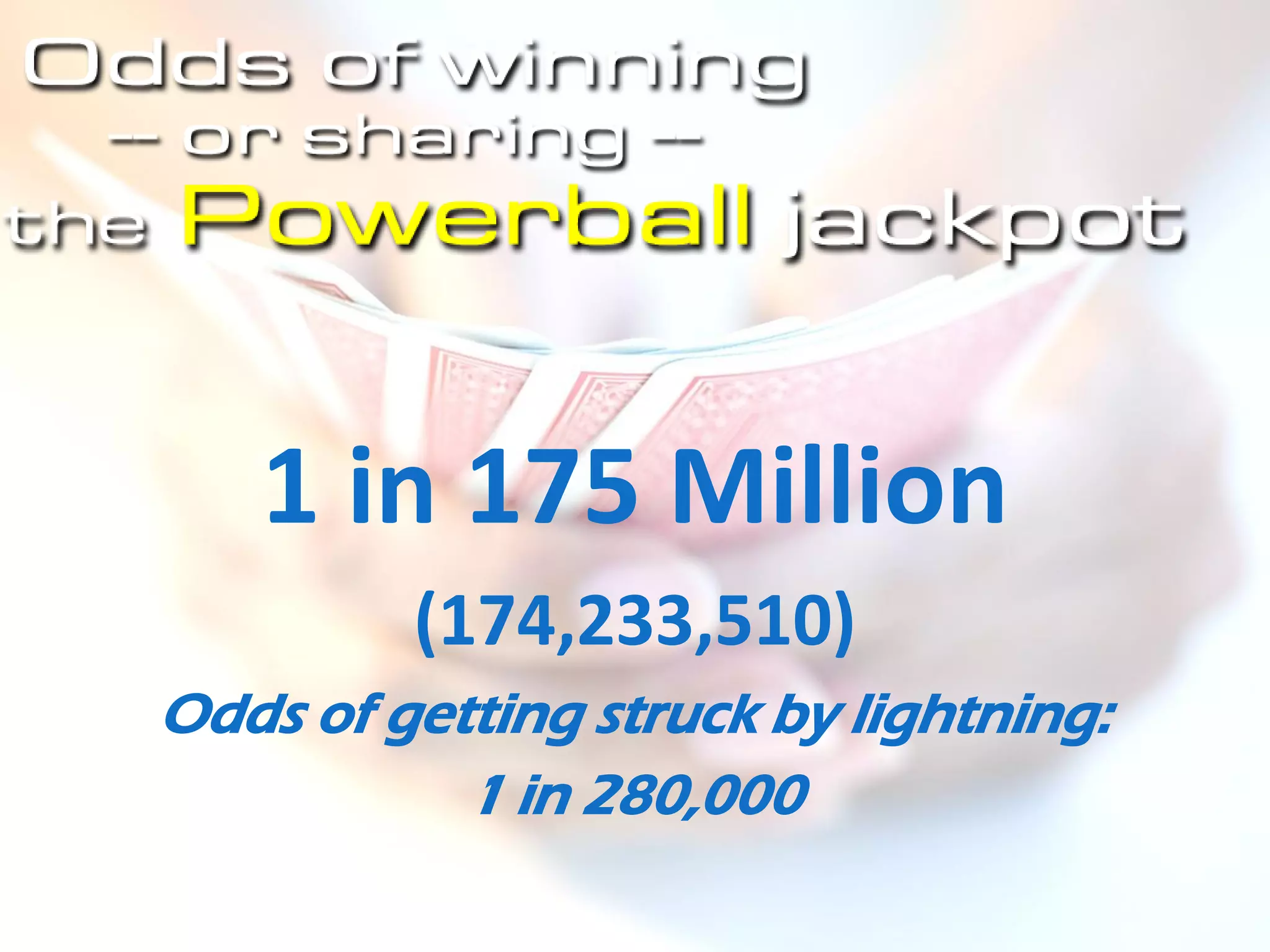
1 in 175 Million
         (174,233,510)
Odds of getting struck by lightning:
           1 in 280,000
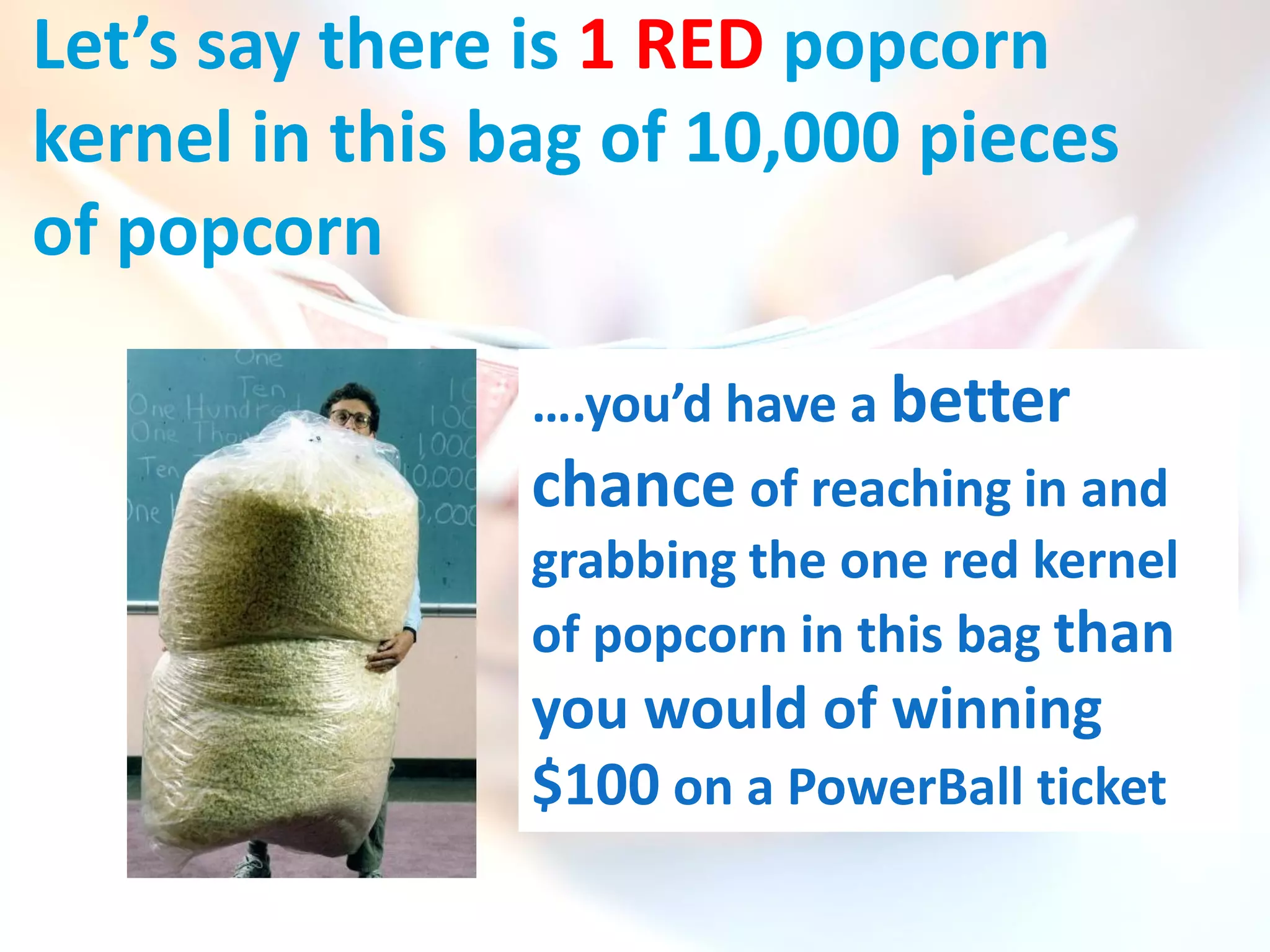
Let’s say there is 1 RED popcorn
kernel in this bag of 10,000 pieces
of popcorn

                ….you’d have a better
                chance of reaching in and
                grabbing the one red kernel
                of popcorn in this bag than
                you would of winning
                $100 on a PowerBall ticket
So…if your lucky numbers
have “almost” come up in the
last 5 drawings, are your
chances better, worse, or the
same?
How would you describe what
you see below?
 Magical
  Thinking
 Superstition
Personalization
Selective
 memory
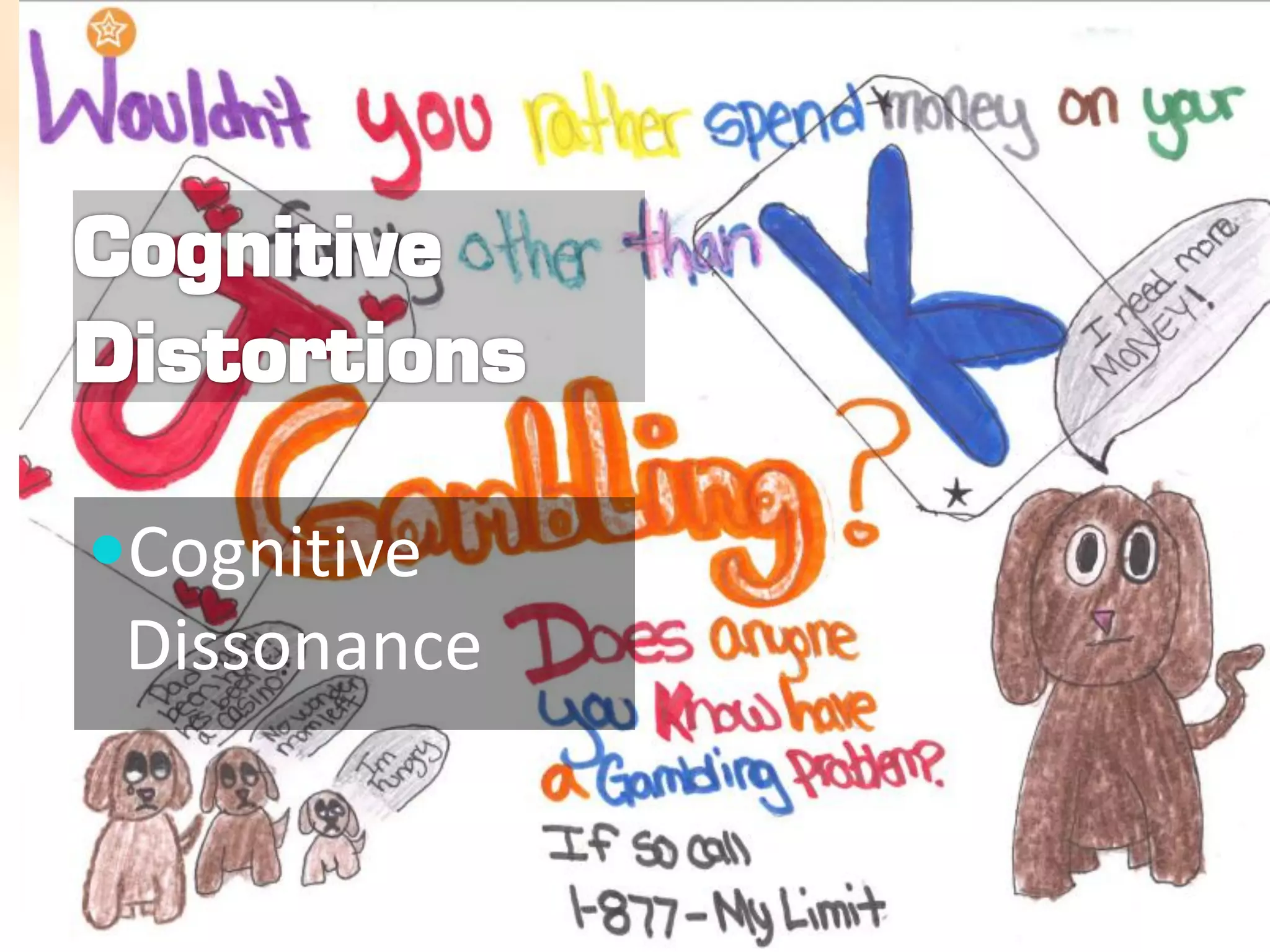
Cognitive
 Dissonance
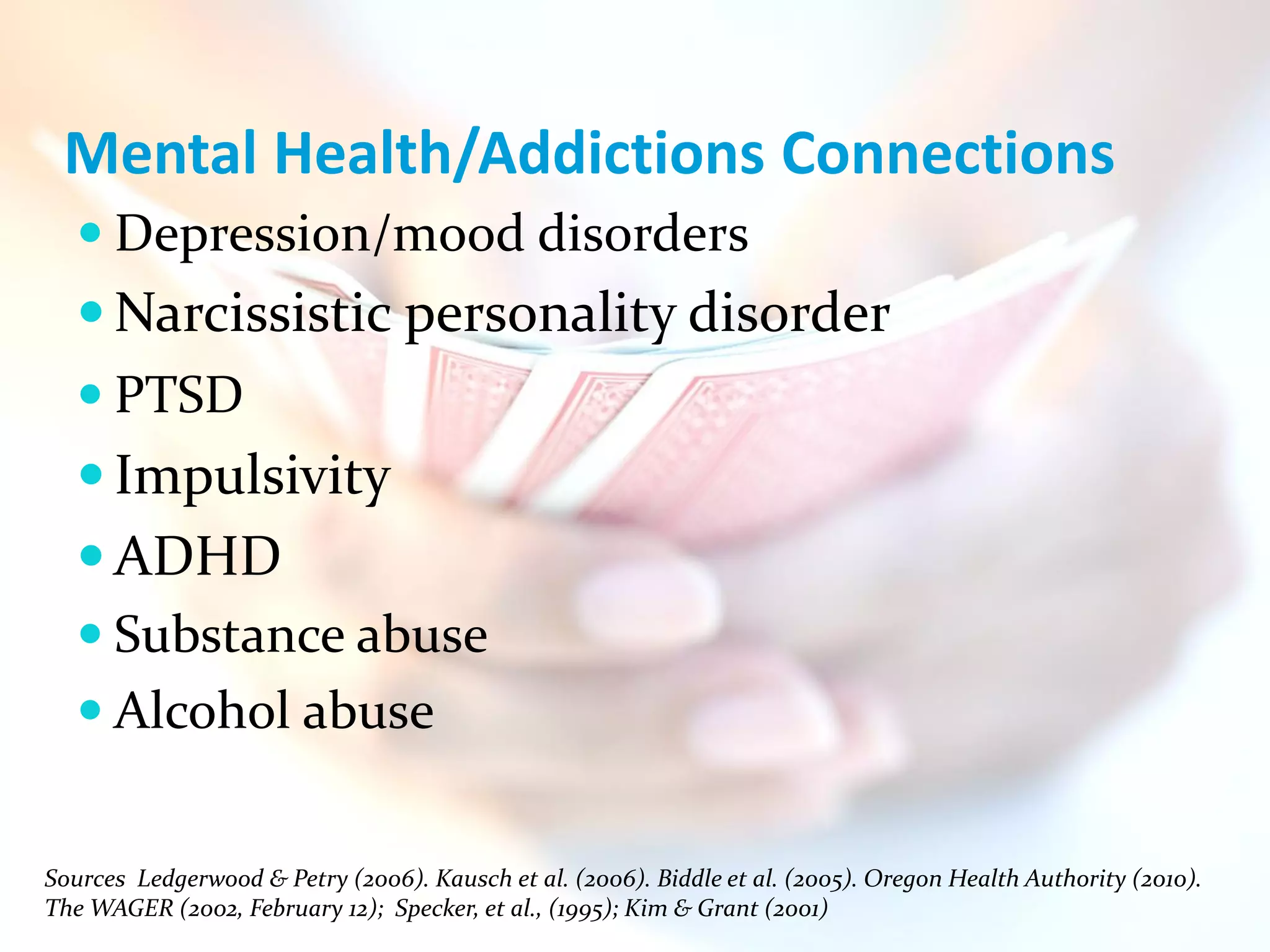
Mental Health/Addictions Connections
    Depression/mood disorders
    Narcissistic personality disorder
    PTSD
    Impulsivity
    ADHD
    Substance abuse
    Alcohol abuse


Sources Ledgerwood & Petry (2006). Kausch et al. (2006). Biddle et al. (2005). Oregon Health Authority (2010).
The WAGER (2002, February 12); Specker, et al., (1995); Kim & Grant (2001)
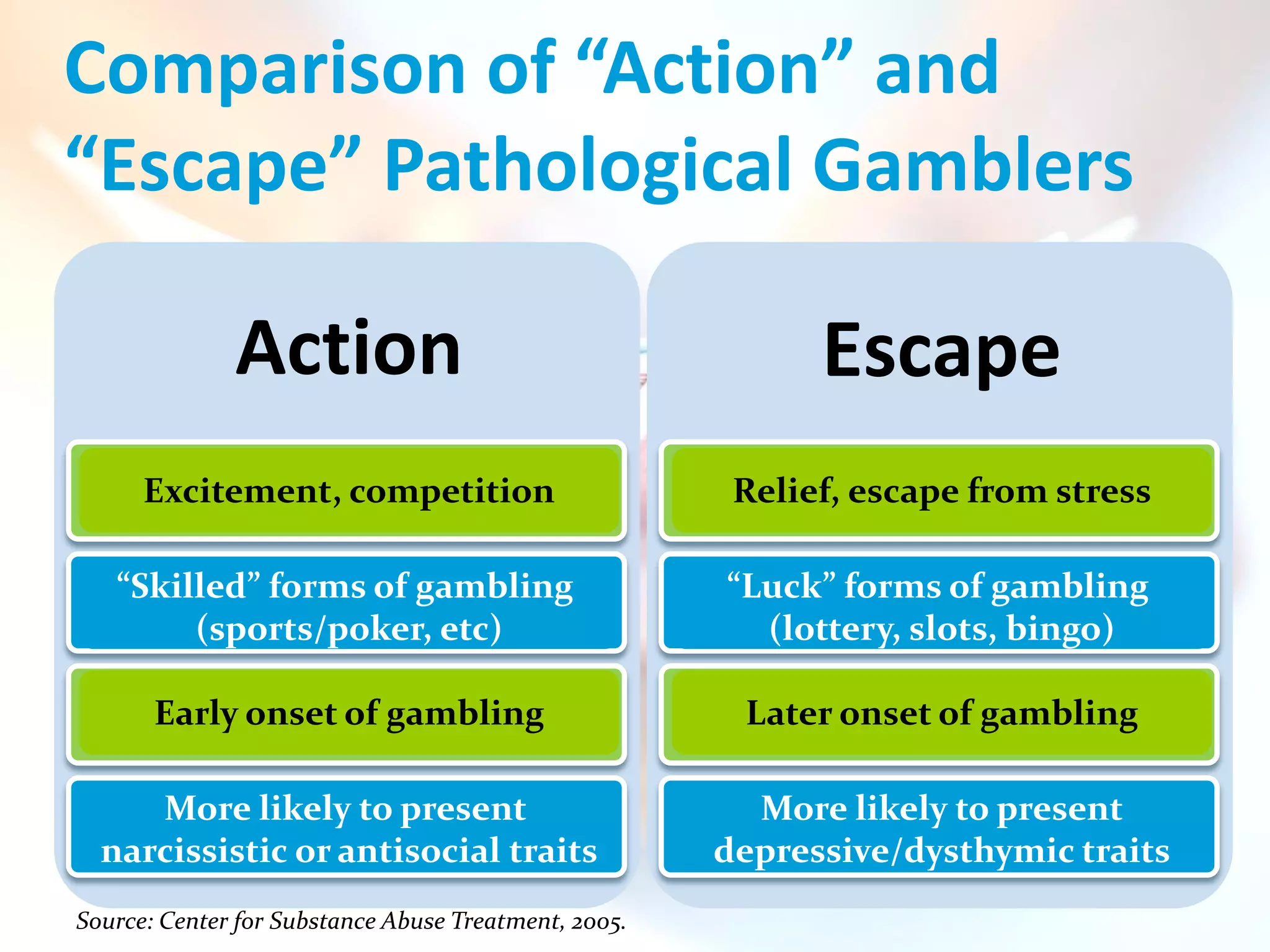
Comparison of “Action” and
“Escape” Pathological Gamblers

              Action                                        Escape
      Excitement, competition                          Relief, escape from stress

   “Skilled” forms of gambling                        “Luck” forms of gambling
        (sports/poker, etc)                             (lottery, slots, bingo)

       Early onset of gambling                         Later onset of gambling

     More likely to present                             More likely to present
  narcissistic or antisocial traits                   depressive/dysthymic traits
Source: Center for Substance Abuse Treatment, 2005.
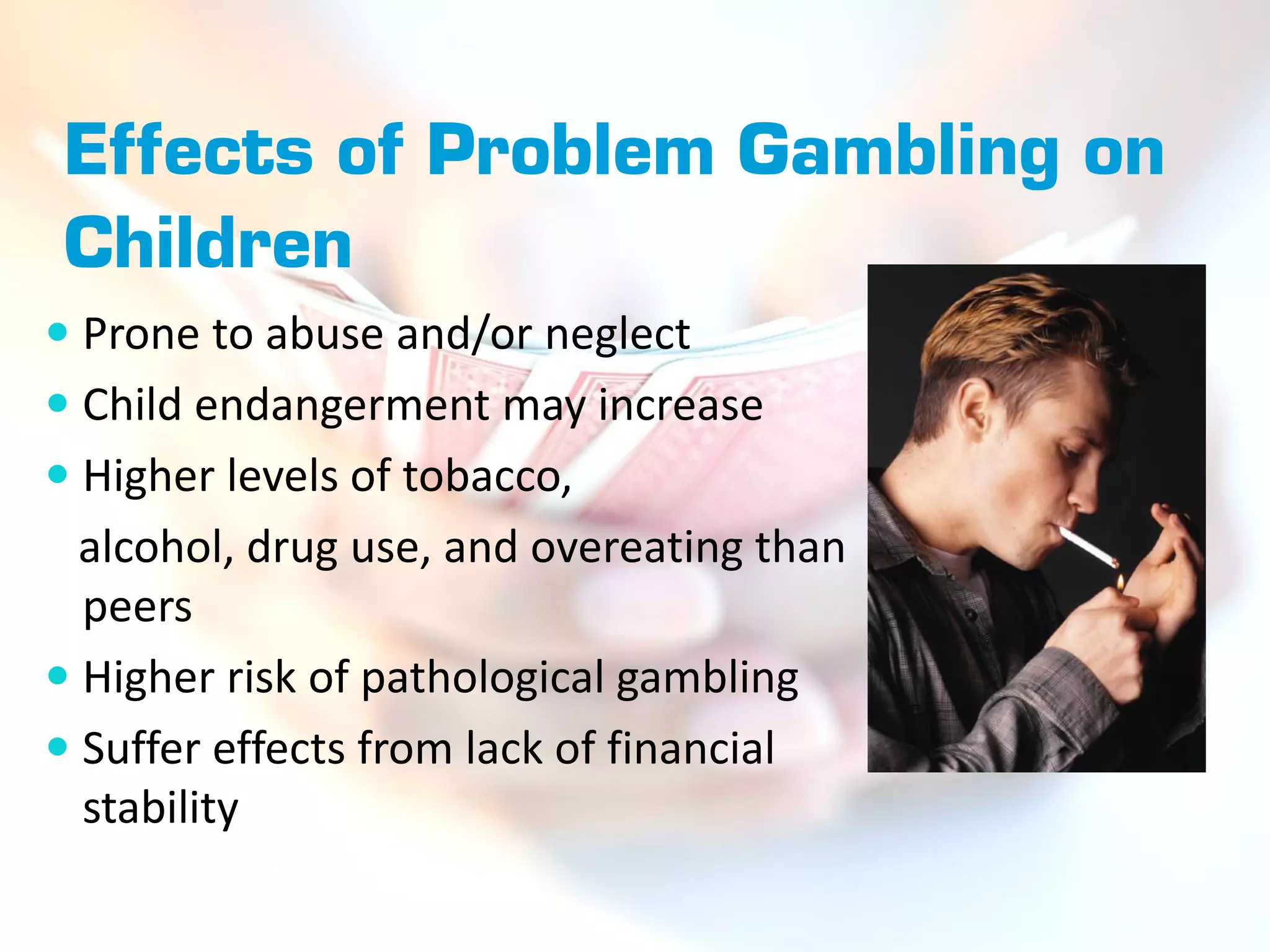
Effects of Problem Gambling on
Children
 Prone to abuse and/or neglect
 Child endangerment may increase
 Higher levels of tobacco,
  alcohol, drug use, and overeating than
  peers
 Higher risk of pathological gambling
 Suffer effects from lack of financial
  stability
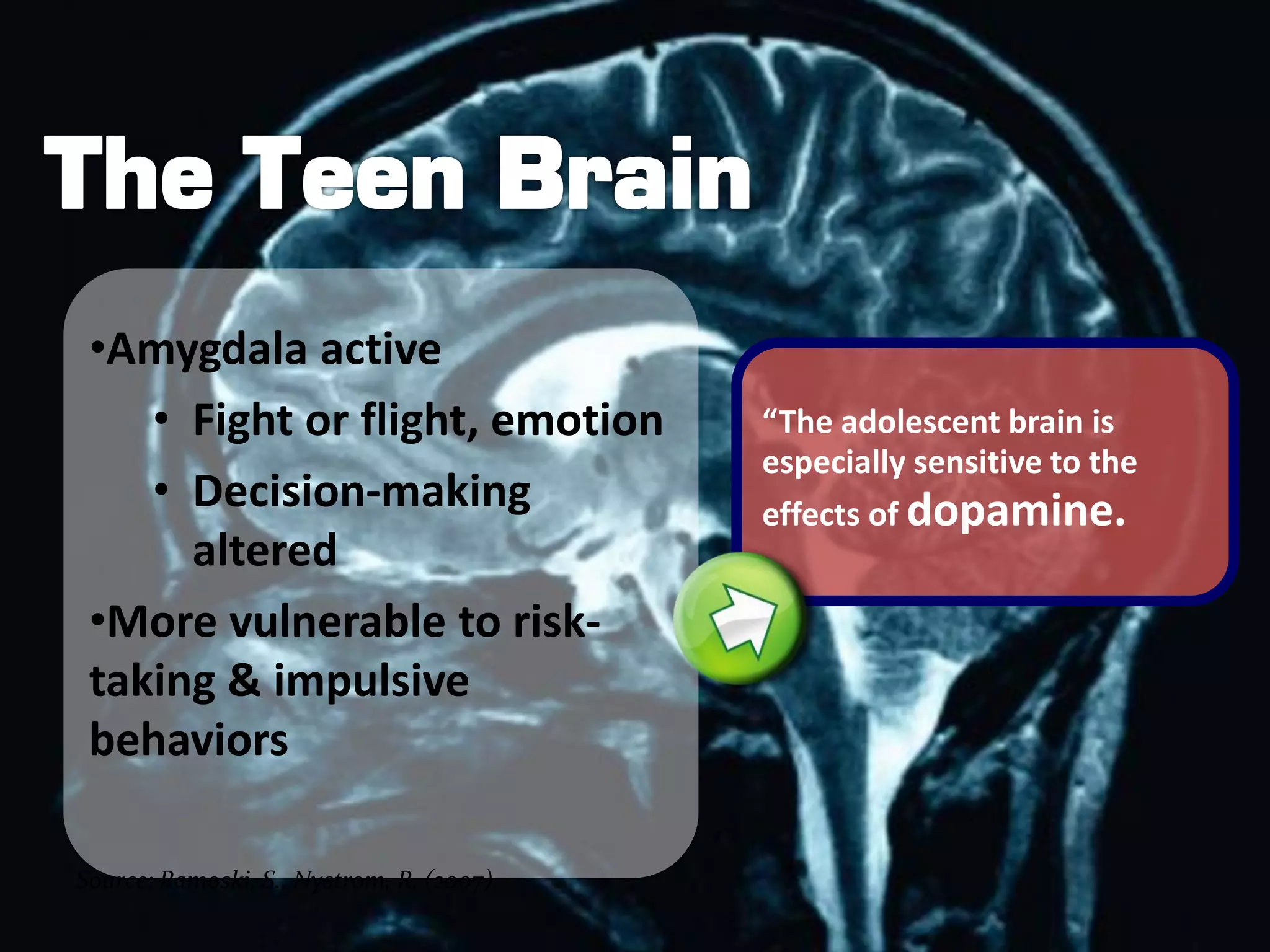
•Amygdala active
    • Fight or flight, emotion             “The adolescent brain is
                                           especially sensitive to the
    • Decision-making                      effects of dopamine.
      altered
 •More vulnerable to risk-
 taking & impulsive
 behaviors

Source: Ramoski, S., Nystrom, R. (2007).
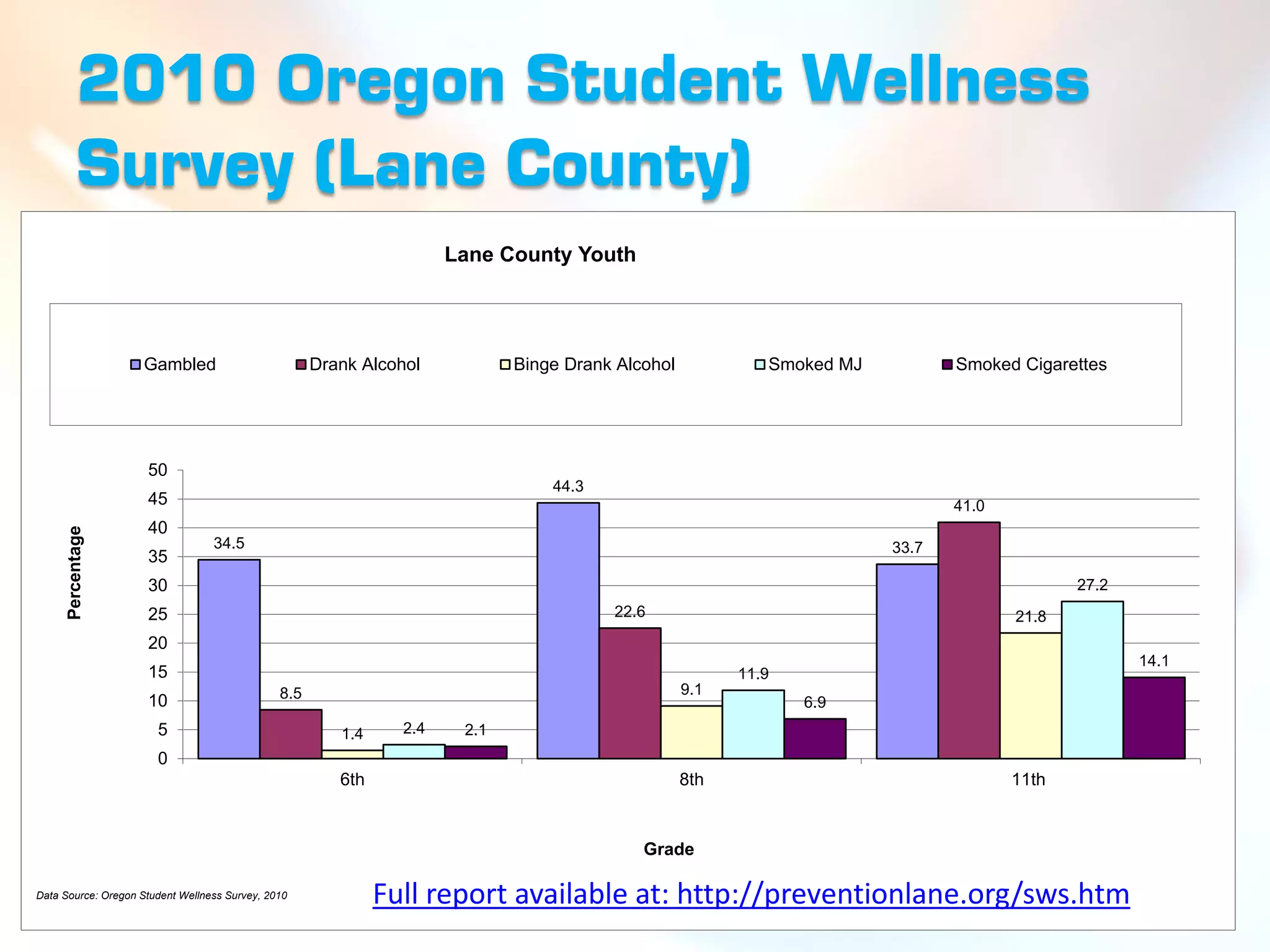
2010 Oregon Student Wellness
           Survey (Lane County)
                                                                      Lane County Youth


                     Gambled                         Drank Alcohol           Binge Drank Alcohol            Smoked MJ          Smoked Cigarettes


                     50
                                                                                 44.3
                     45                                                                                                        41.0
                     40
      Percentage


                                  34.5                                                                                  33.7
                     35
                     30                                                                                                                      27.2
                     25                                                                 22.6                                          21.8
                     20
                                                                                                                                                    14.1
                     15                                                                                  11.9
                                               8.5                                                 9.1
                     10                                                                                         6.9
                       5                                1.4     2.4    2.1
                       0
                                                        6th                                        8th                                11th


                                                                                            Grade

Data Source: Oregon Student Wellness Survey, 2010             Full report available at: http://preventionlane.org/sws.htm
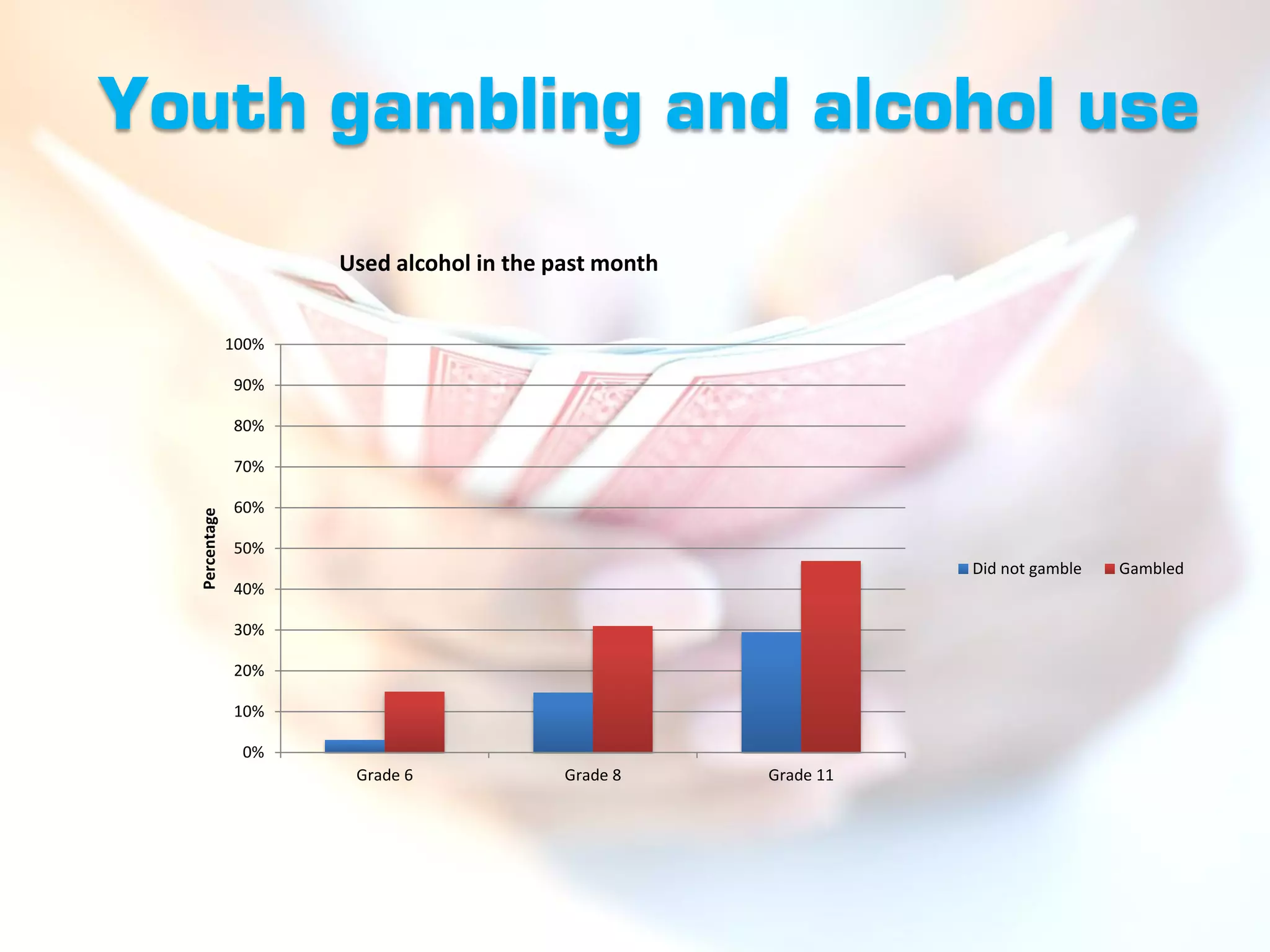
Youth gambling and alcohol use
                      Used alcohol in the past month


               100%

               90%

               80%

               70%

               60%
  Percentage


               50%
                                                                  Did not gamble   Gambled
               40%

               30%

               20%

               10%

                0%
                       Grade 6             Grade 8     Grade 11
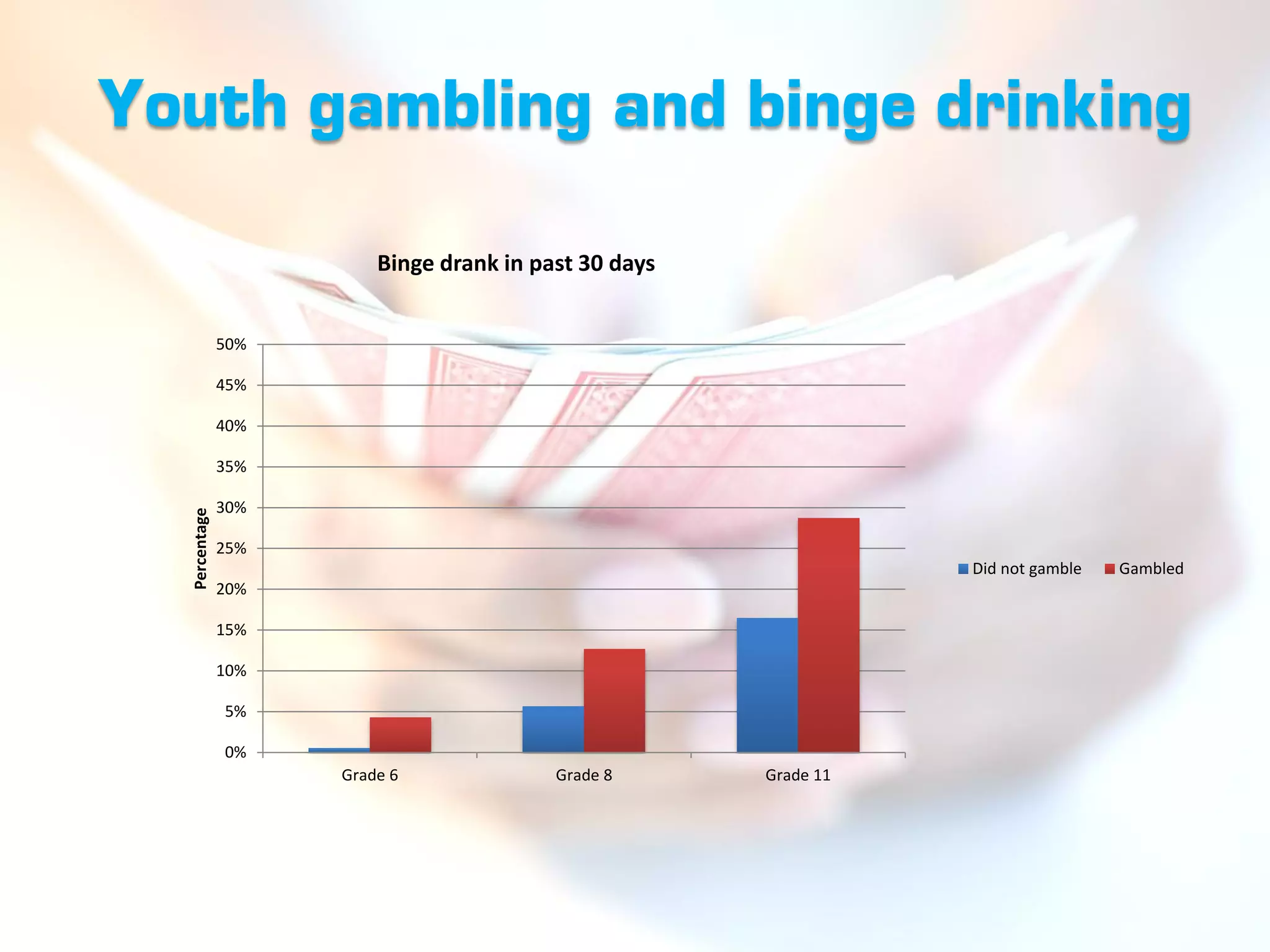
Youth gambling and binge drinking

                         Binge drank in past 30 days


               50%

               45%

               40%

               35%

               30%
  Percentage


               25%
                                                                  Did not gamble   Gambled
               20%

               15%

               10%

               5%

               0%
                     Grade 6              Grade 8      Grade 11
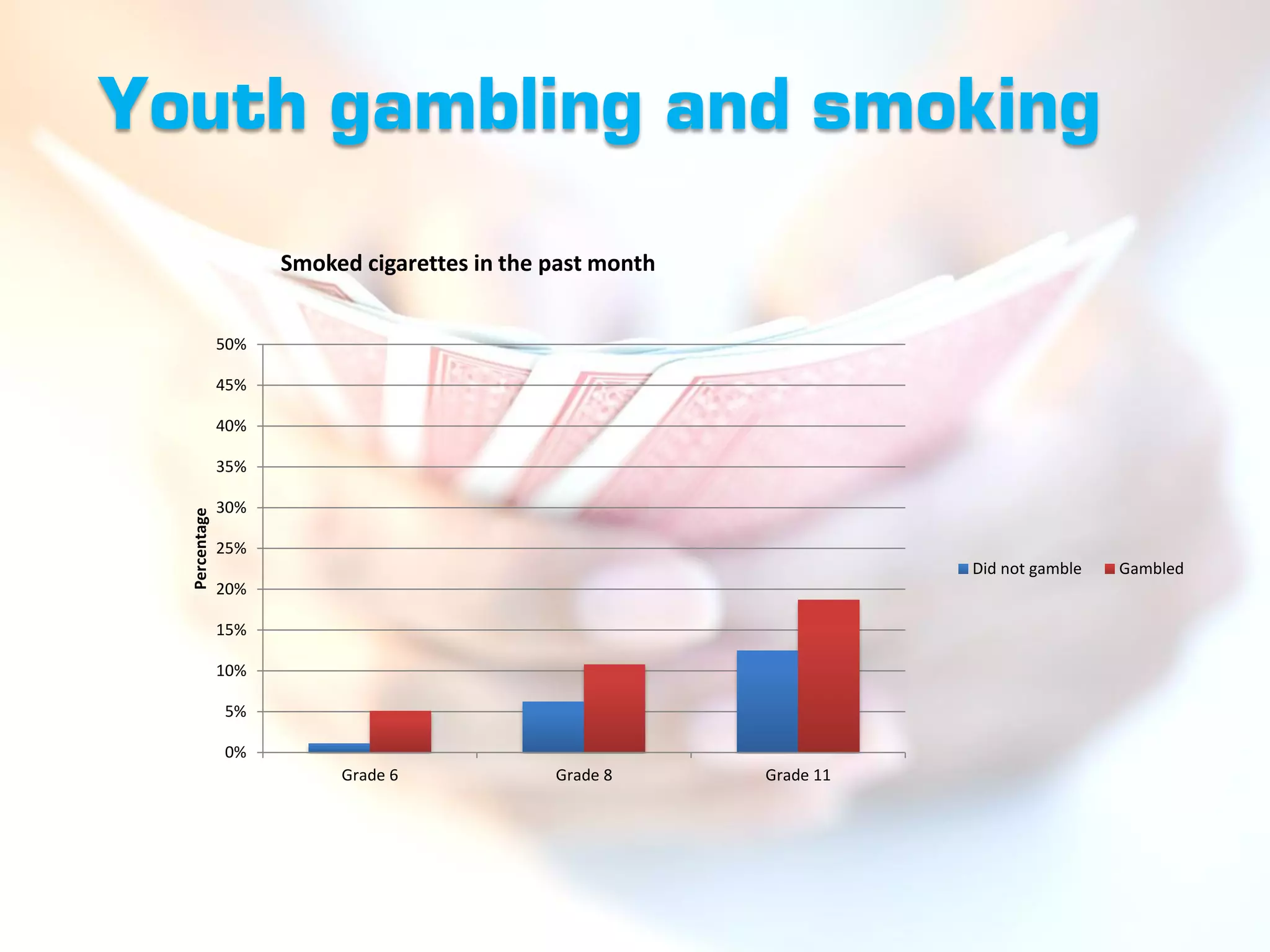
Youth gambling and smoking
                     Smoked cigarettes in the past month


               50%

               45%

               40%

               35%

               30%
  Percentage


               25%
                                                                      Did not gamble   Gambled
               20%

               15%

               10%

               5%

               0%
                          Grade 6             Grade 8      Grade 11
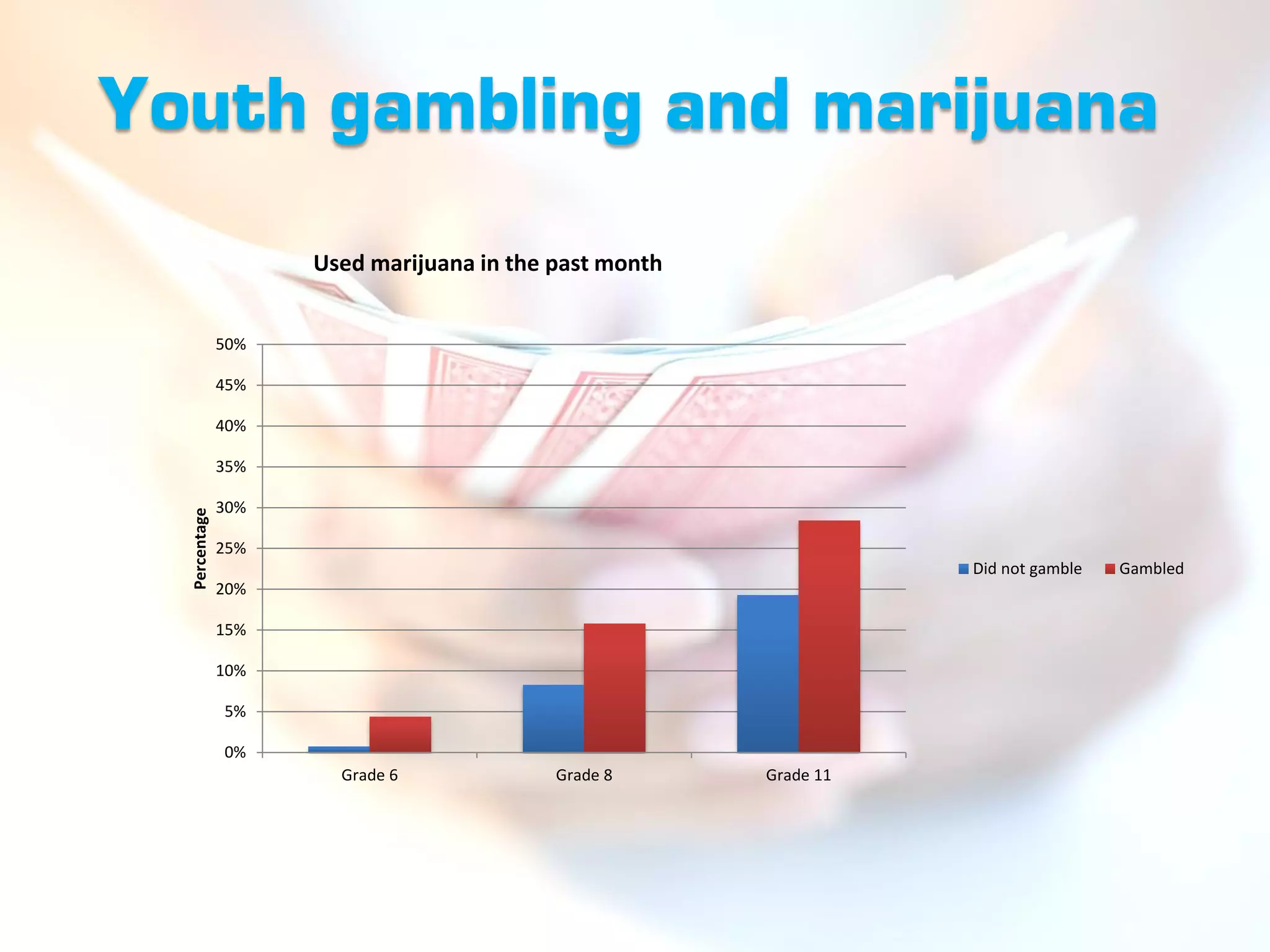
Youth gambling and marijuana
                     Used marijuana in the past month


               50%

               45%

               40%

               35%

               30%
  Percentage


               25%
                                                                   Did not gamble   Gambled
               20%

               15%

               10%

               5%

               0%
                       Grade 6             Grade 8      Grade 11
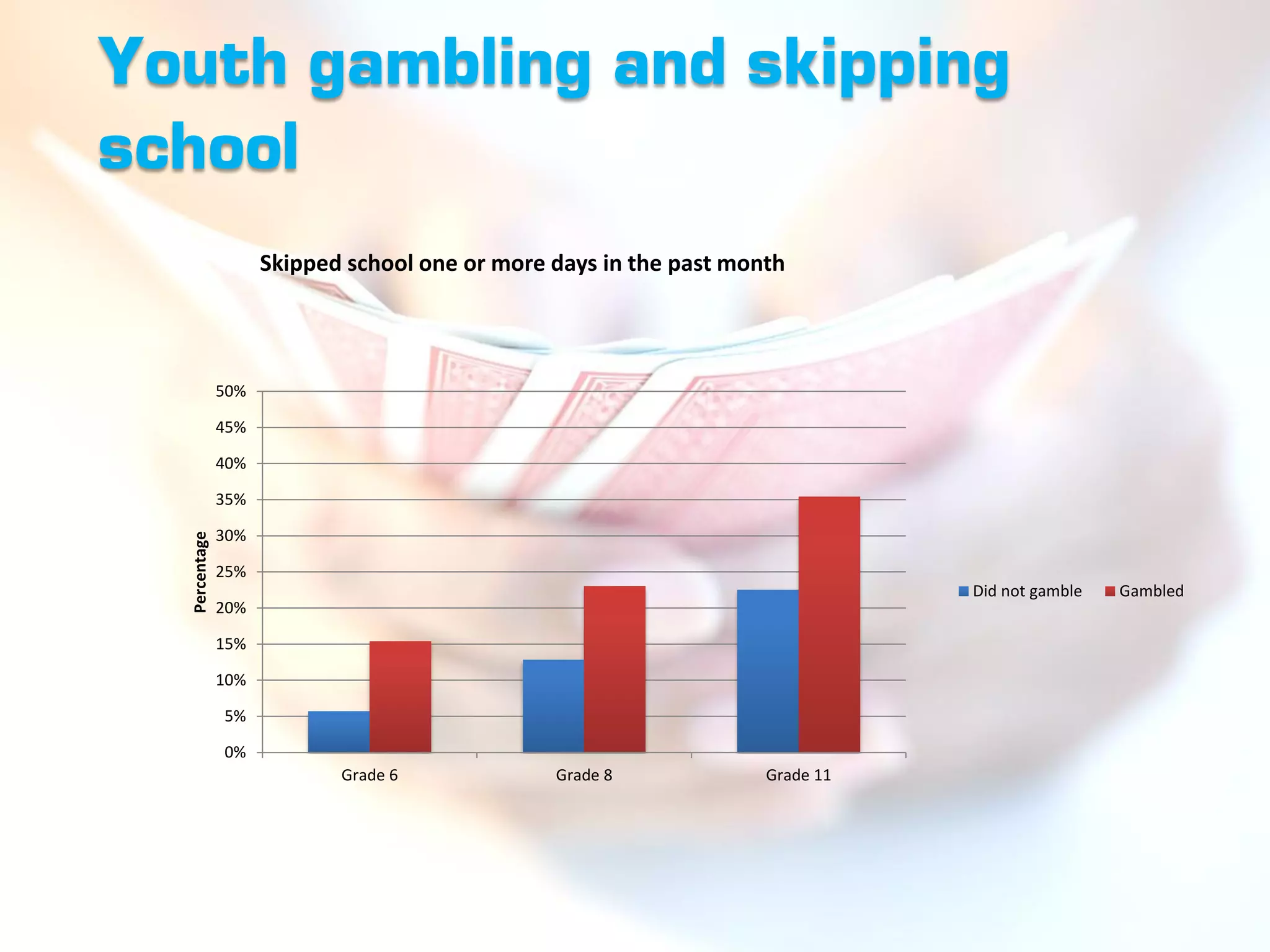
Youth gambling and skipping
school
                     Skipped school one or more days in the past month


               50%

               45%

               40%

               35%

               30%
  Percentage


               25%
                                                                               Did not gamble   Gambled
               20%

               15%

               10%

               5%

               0%
                            Grade 6             Grade 8             Grade 11
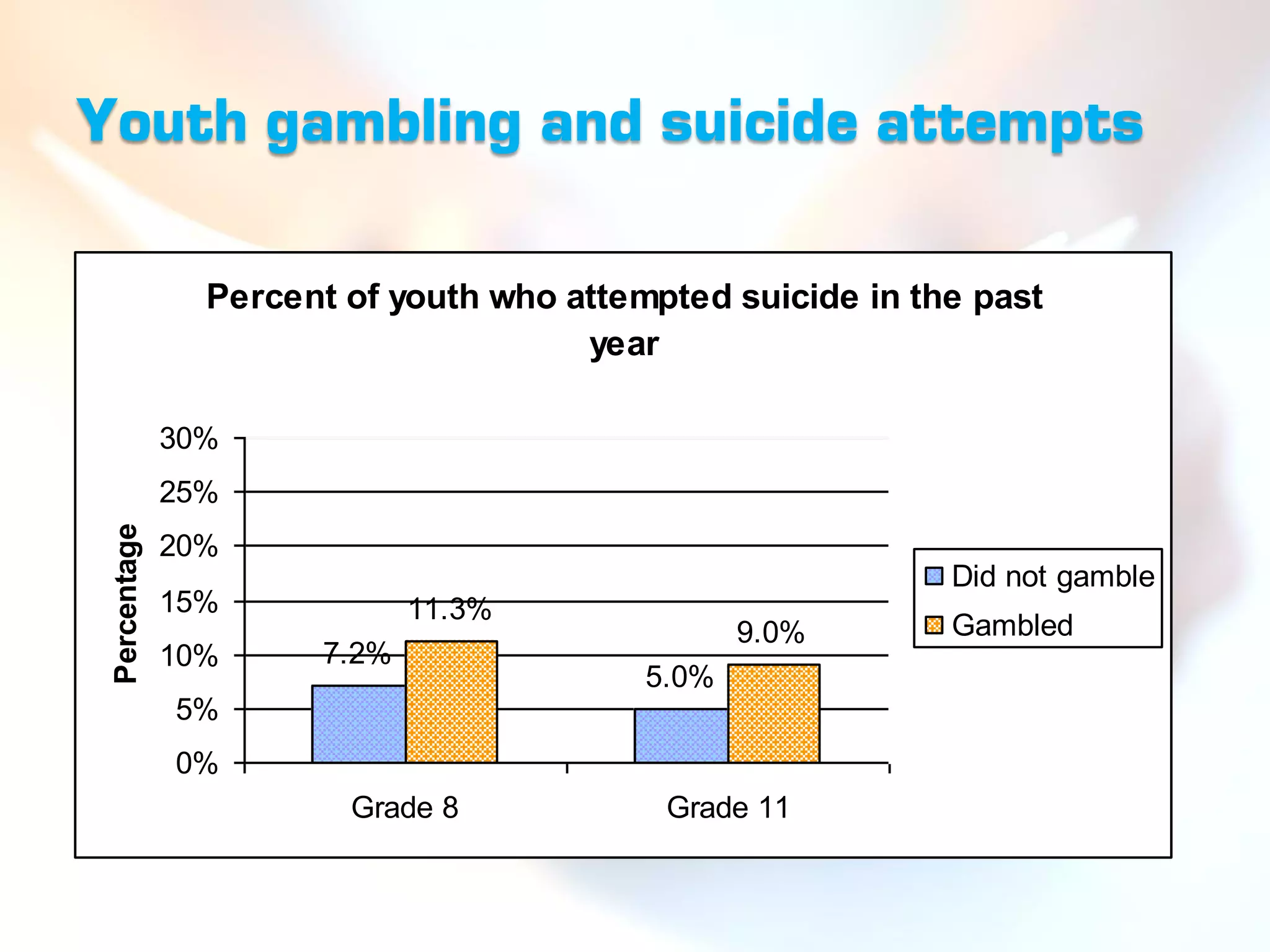
Youth gambling and suicide attempts

                Percent of youth who attempted suicide in the past
                                      year

              30%
              25%
 Percentage


              20%
                                                            Did not gamble
              15%            11.3%
                                                 9.0%       Gambled
              10%     7.2%
                                          5.0%
              5%
              0%
                        Grade 8            Grade 11
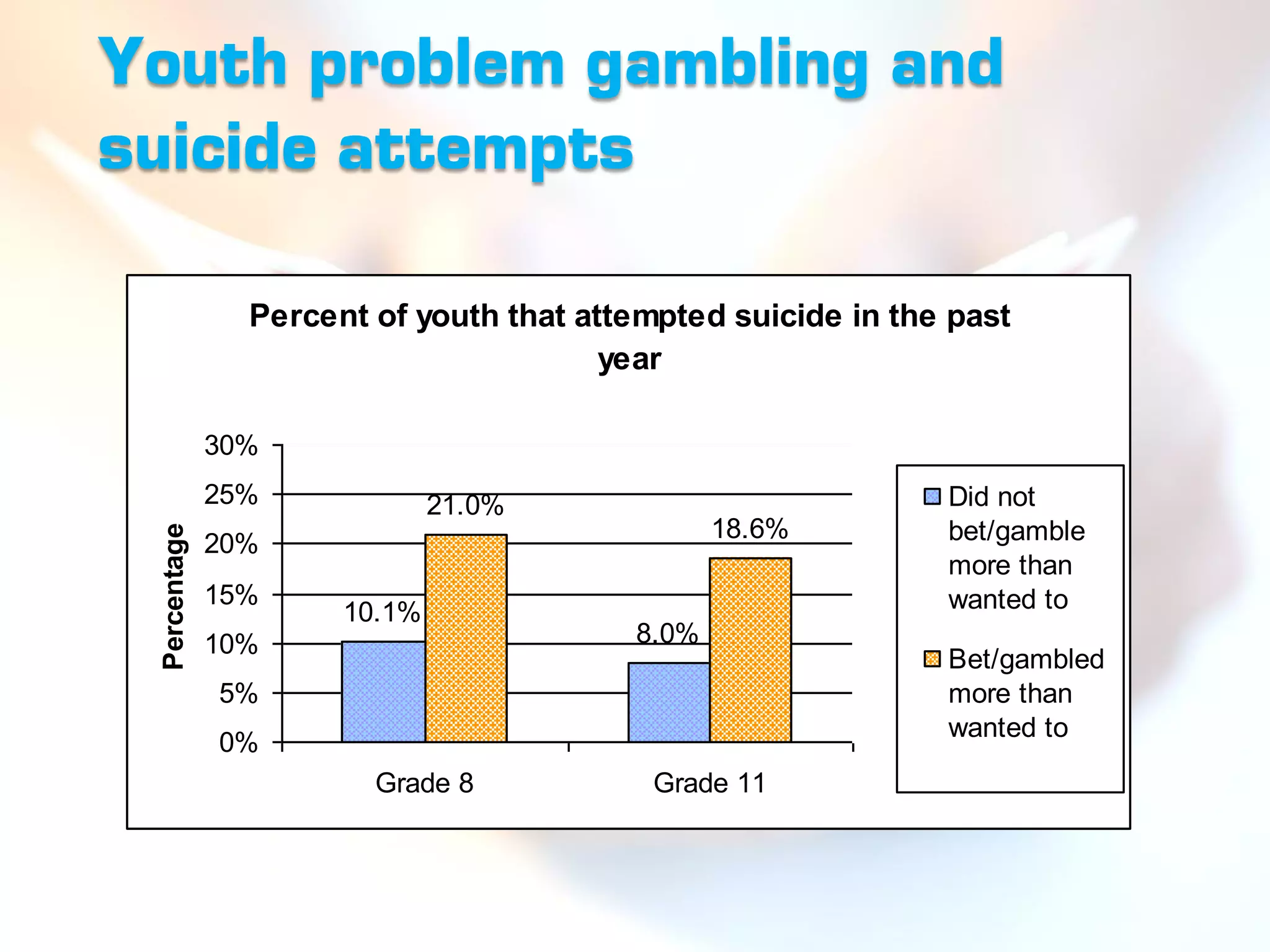
Youth problem gambling and
suicide attempts

                Percent of youth that attempted suicide in the past
                                        year

              30%
              25%             21.0%                           Did not
                                                18.6%         bet/gamble
 Percentage


              20%
                                                              more than
              15%                                             wanted to
                      10.1%
              10%                        8.0%
                                                              Bet/gambled
              5%                                              more than
                                                              wanted to
              0%
                        Grade 8            Grade 11
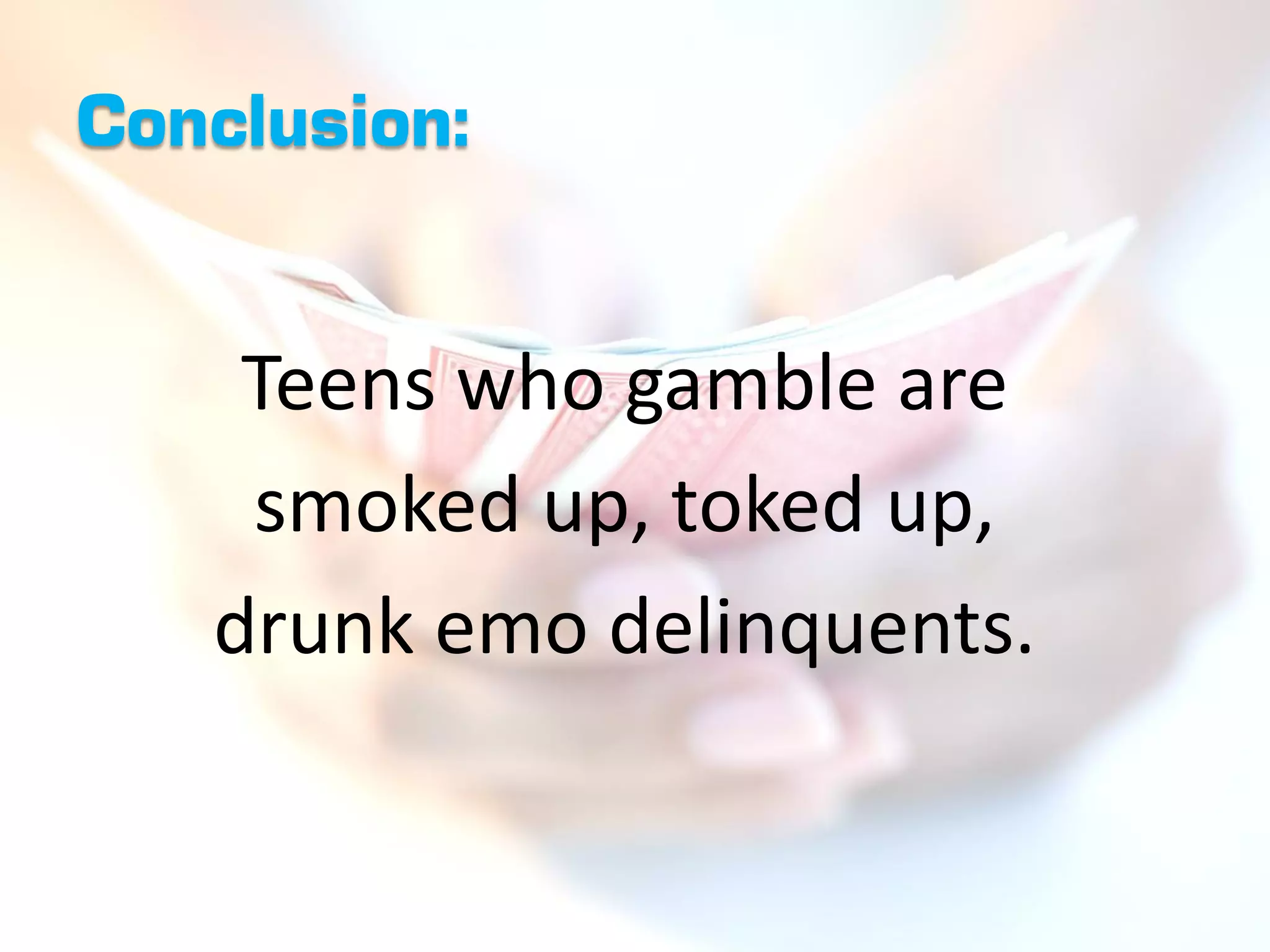
Conclusion:


    Teens who gamble are
    smoked up, toked up,
   drunk emo delinquents.
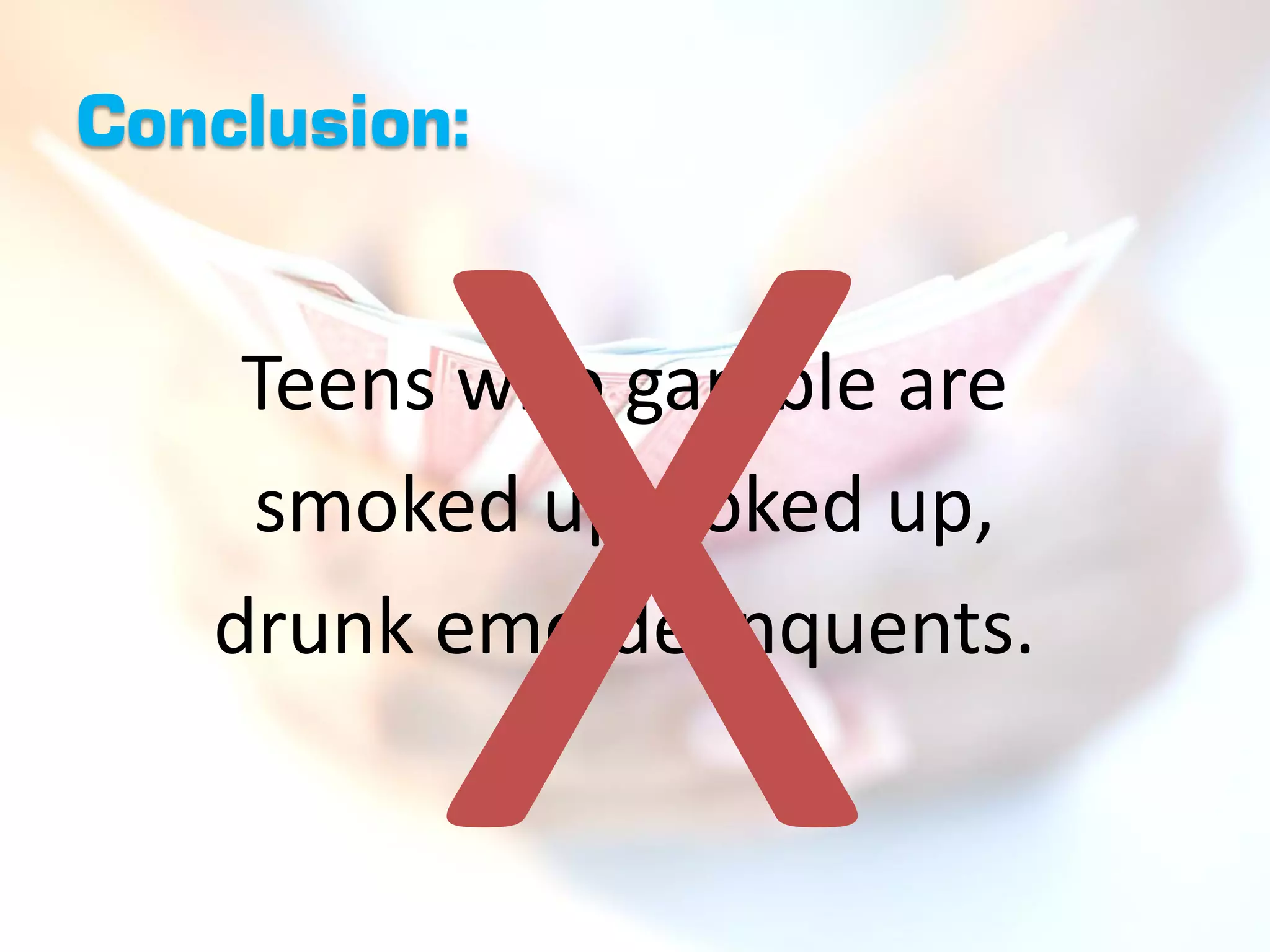
Conclusion:


    Teens who gamble are
    smoked up, toked up,
   drunk emo delinquents.
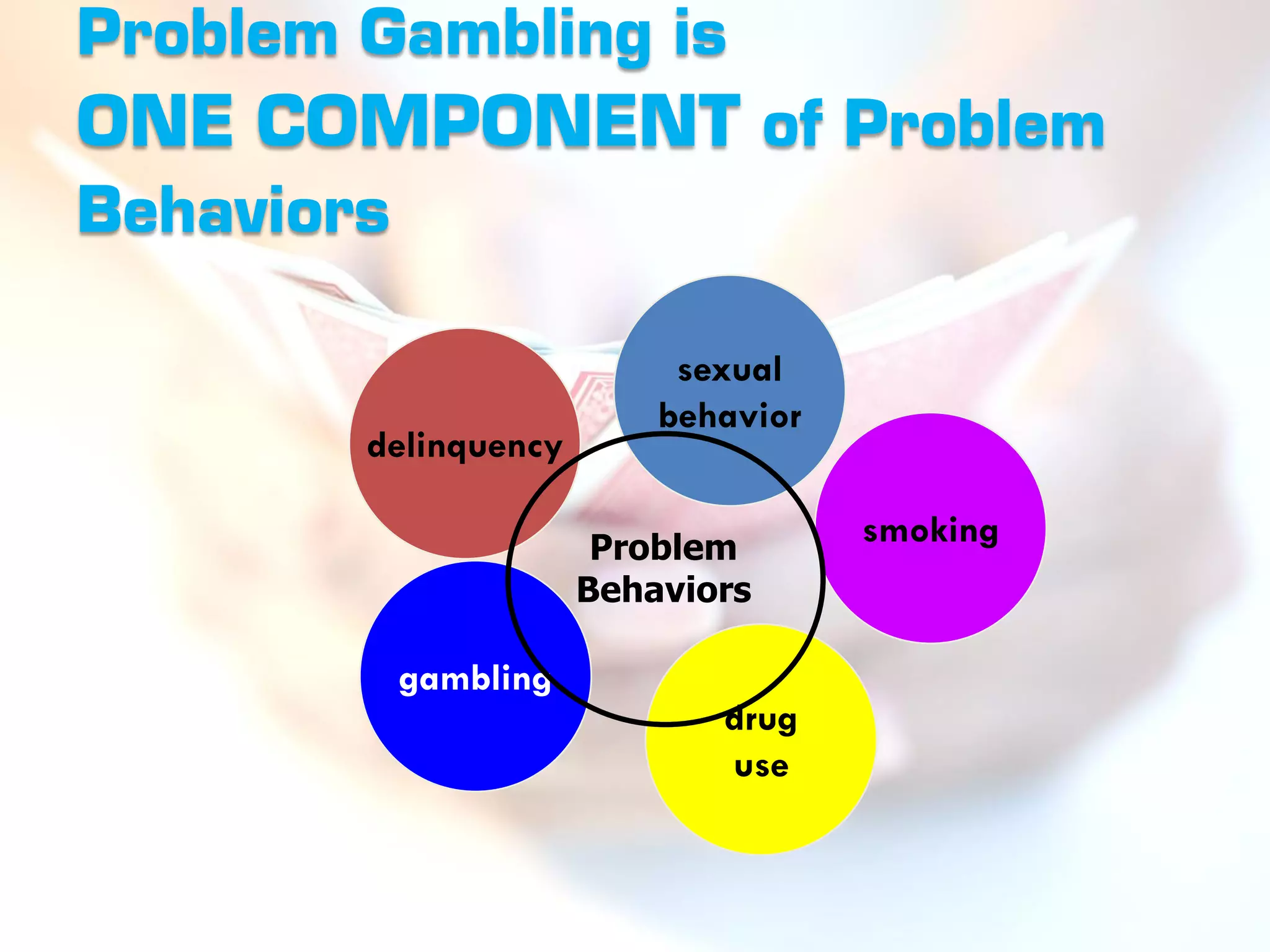
Problem Gambling is
ONE COMPONENT of Problem
Behaviors

                            sexual
                           behavior
        delinquency

                        Problem
                                      smoking
                       Behaviors

            gambling
                              drug
                              use
identification &
treatment
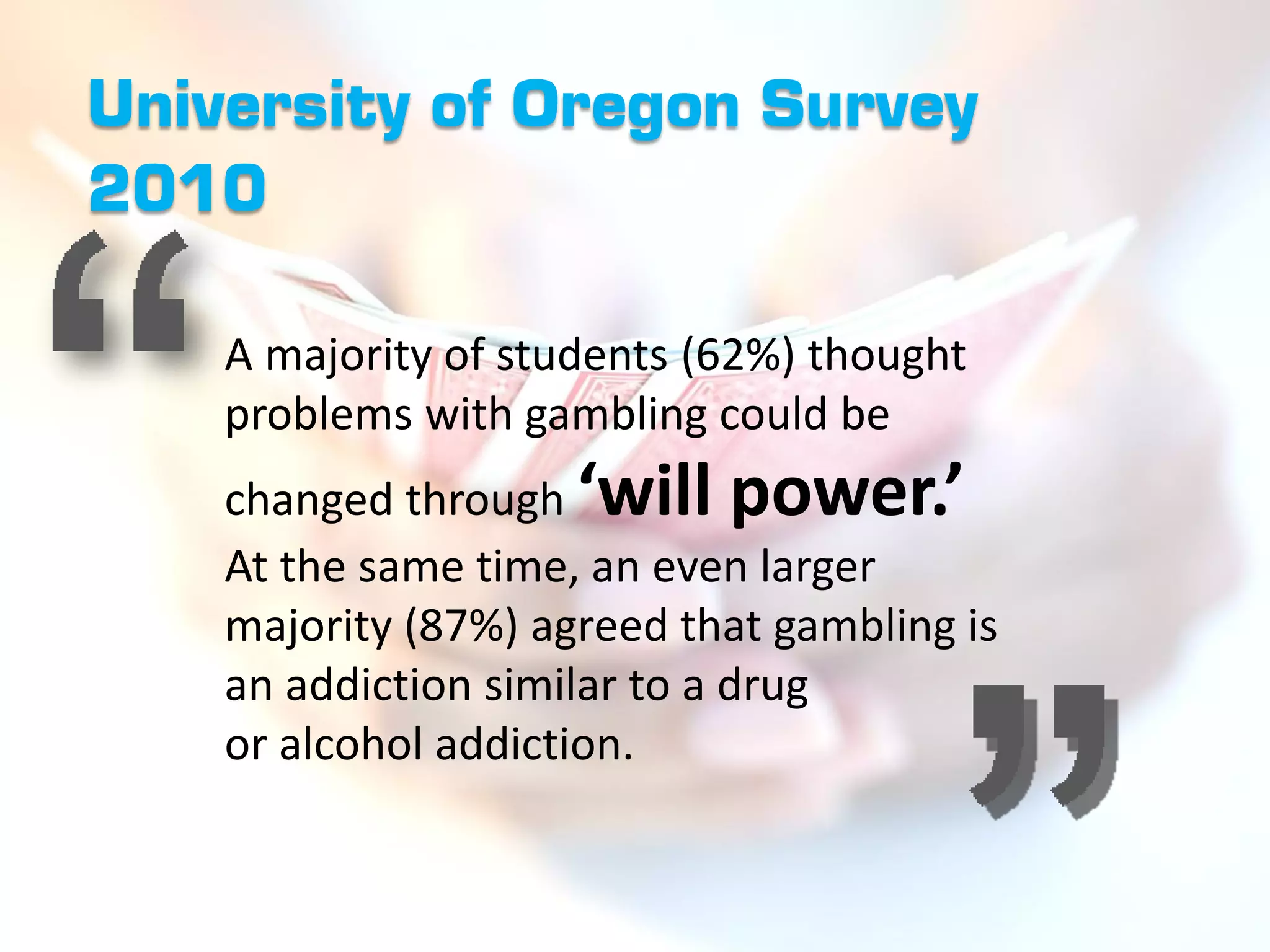
University of Oregon Survey
2010

    A majority of students (62%) thought
    problems with gambling could be
    changed through ‘will power.’
    At the same time, an even larger
    majority (87%) agreed that gambling is
    an addiction similar to a drug
    or alcohol addiction.
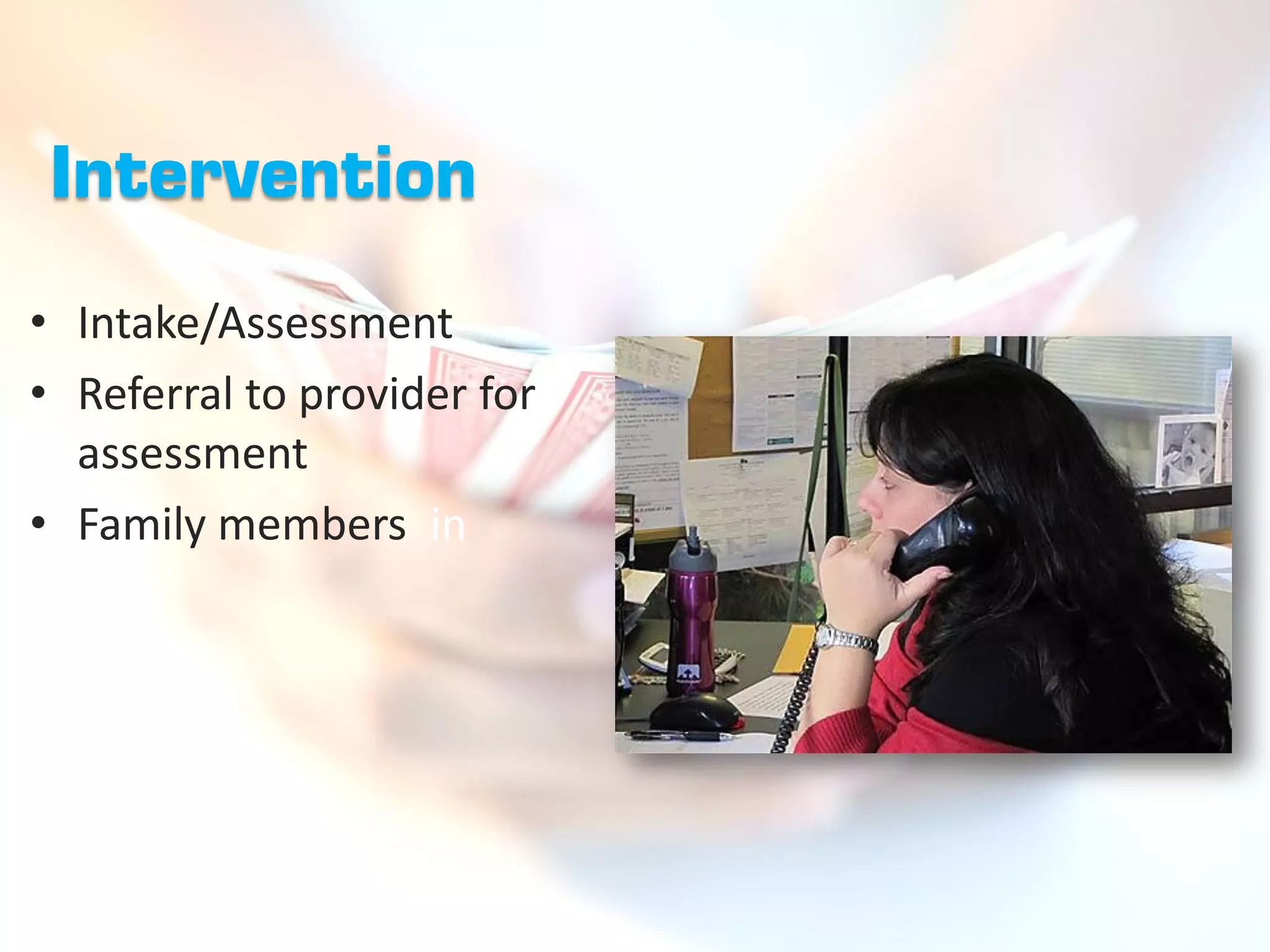
Intervention
• Intake/Assessment
• Referral to provider for
  assessment
• Family members in
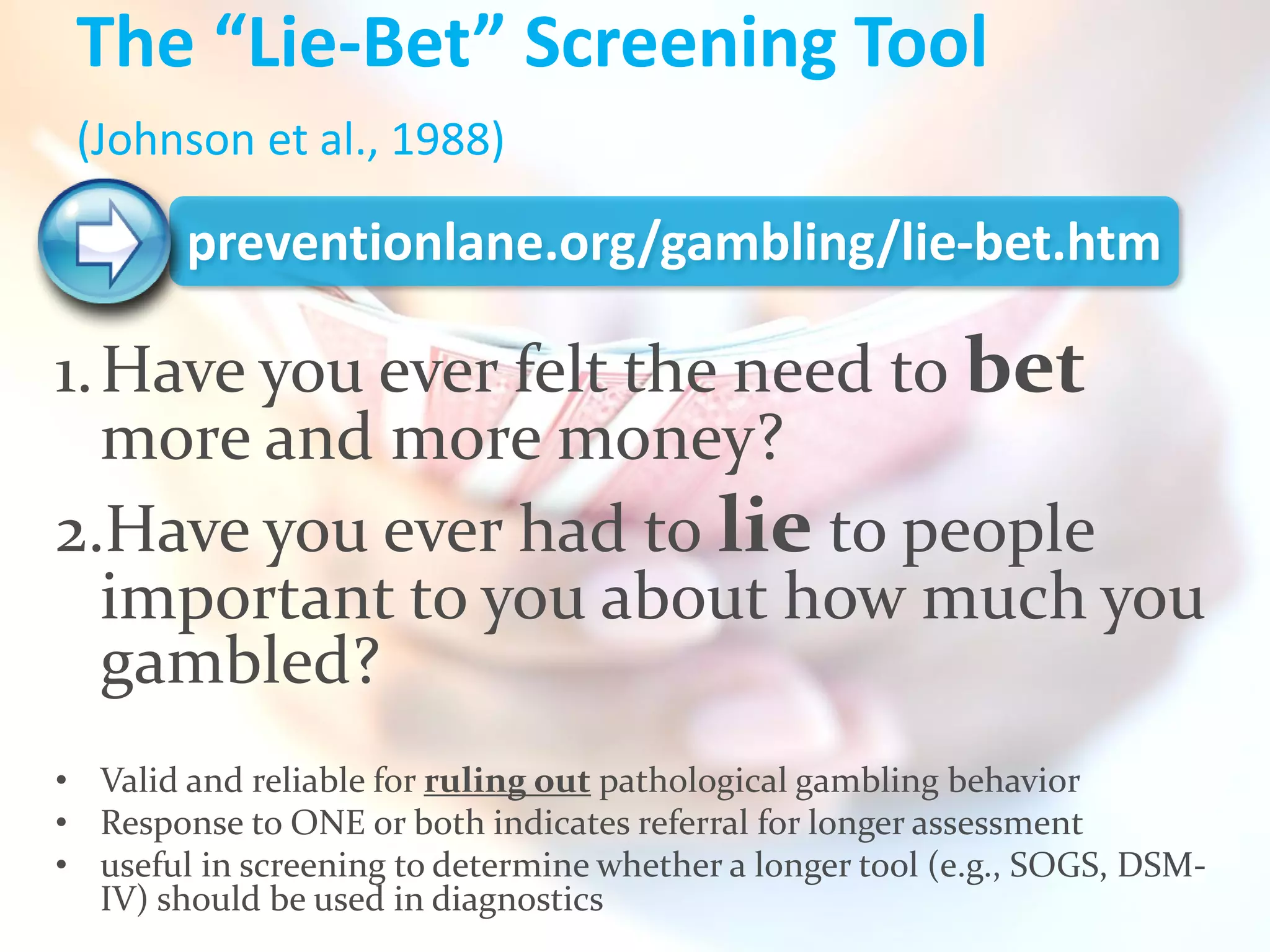
The “Lie-Bet” Screening Tool
 (Johnson et al., 1988)

        preventionlane.org/gambling/lie-bet.htm

1. Have you ever felt the need to bet
   more and more money?
2.Have you ever had to lie to people
   important to you about how much you
   gambled?
• Valid and reliable for ruling out pathological gambling behavior
• Response to ONE or both indicates referral for longer assessment
• useful in screening to determine whether a longer tool (e.g., SOGS, DSM-
  IV) should be used in diagnostics
Assessment Tools

• “Valid and Reliable”
  – DSM-IV 10
  – South Oaks Gambling Screen (SOGS)
  – SOGS-RA (Revised for Adolescents)


• Frequently Used
  – Gamblers Anonymous 20 Questions (GA-20)
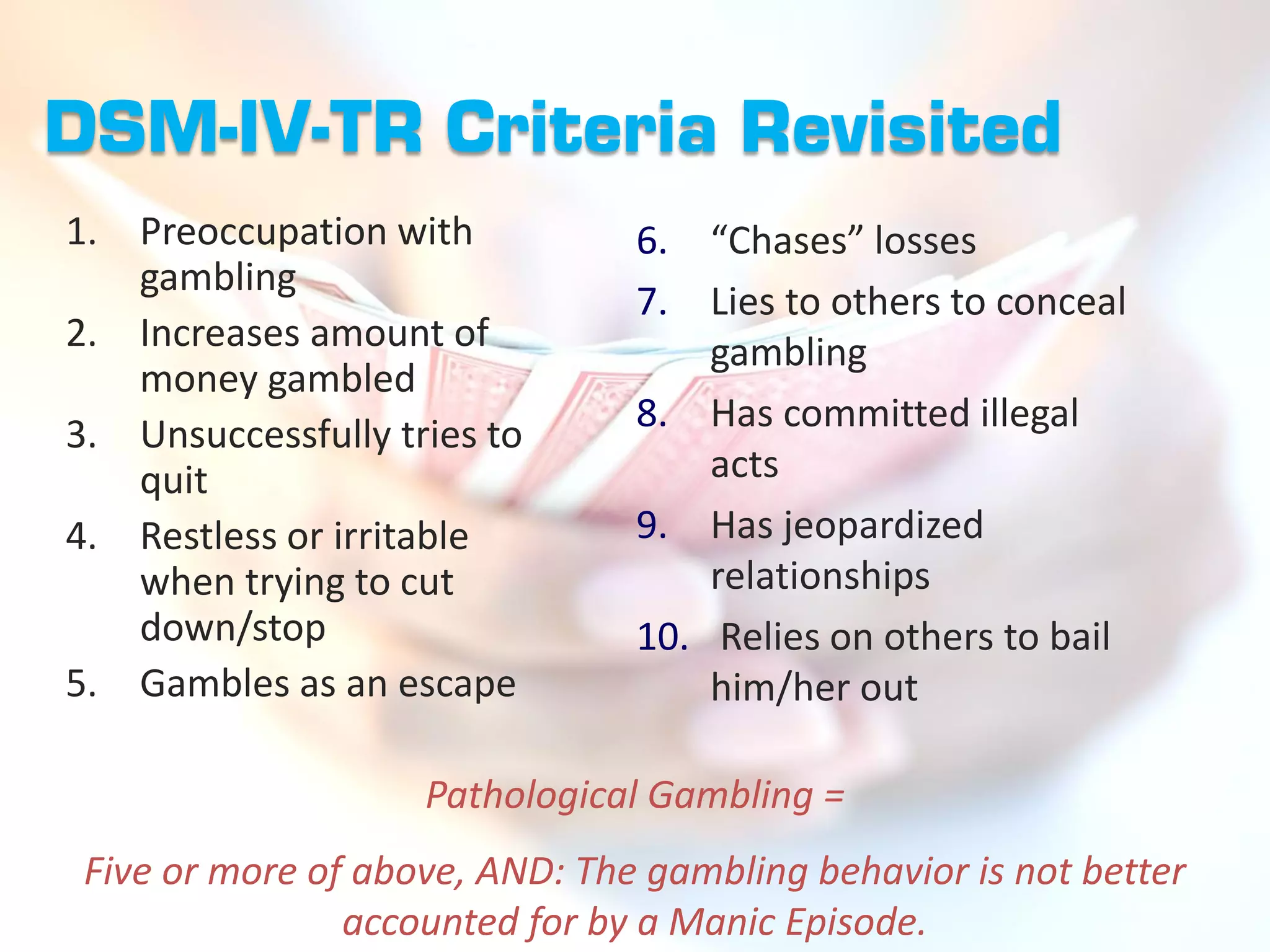
DSM-IV-TR Criteria Revisited
1. Preoccupation with           6. “Chases” losses
   gambling
                                7. Lies to others to conceal
2. Increases amount of              gambling
   money gambled
                                8. Has committed illegal
3. Unsuccessfully tries to
   quit                             acts
4. Restless or irritable        9. Has jeopardized
   when trying to cut               relationships
   down/stop                    10. Relies on others to bail
5. Gambles as an escape             him/her out

                    Pathological Gambling =
 Five or more of above, AND: The gambling behavior is not better
                accounted for by a Manic Episode.
Treatment

Nebraska DHHS Gamblers Assistance Program:
• http://dhhs.ne.gov/behavioral_health/Doc
  uments/GAP-FY12-13ProviderManual.pdf

Nebraska Council on Compulsive Gambling
• www.nebraskacouncil.com
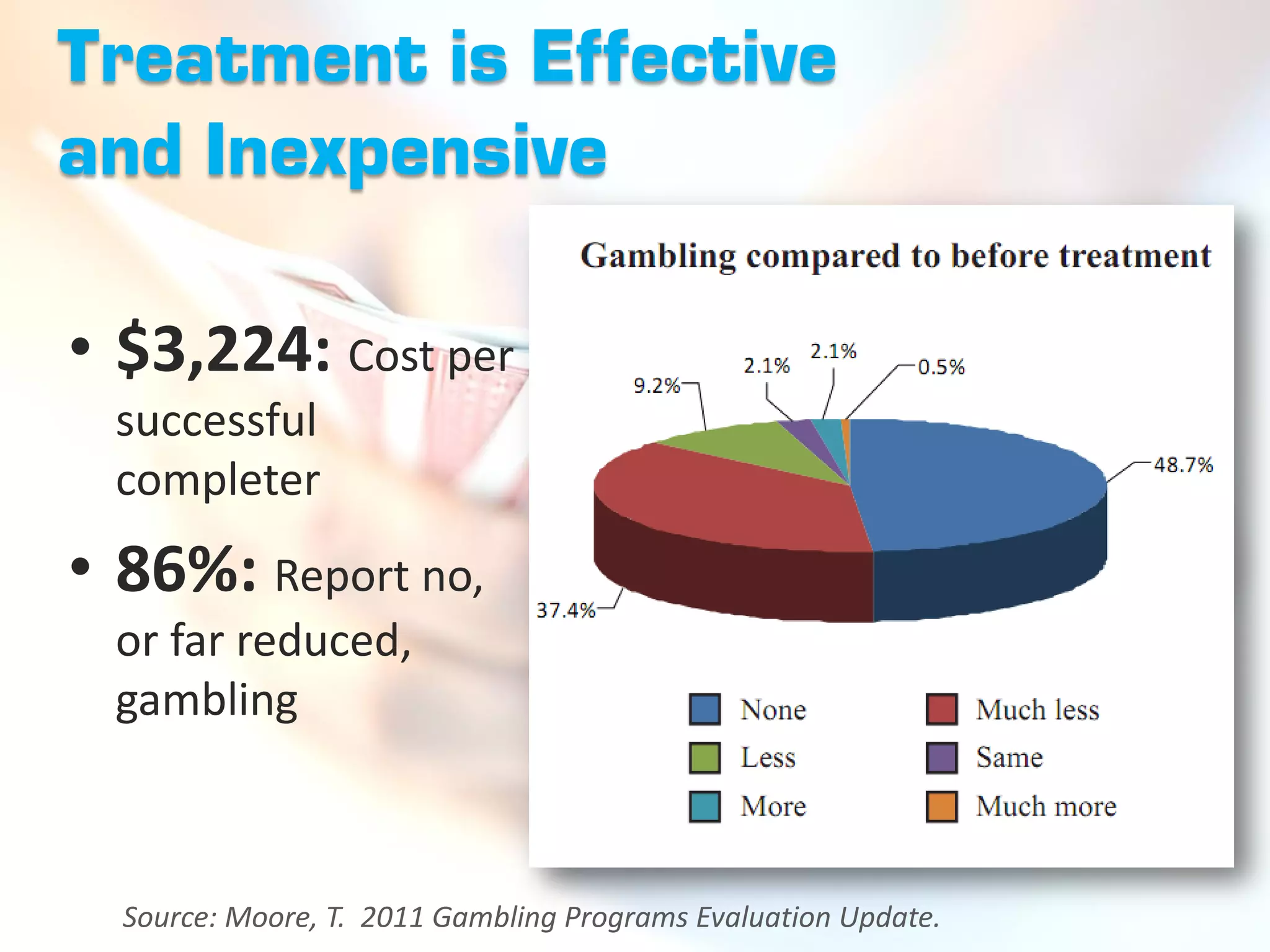
Treatment is Effective
and Inexpensive

• $3,224: Cost per
 successful
 completer
• 86%: Report no,
 or far reduced,
 gambling


  Source: Moore, T. 2011 Gambling Programs Evaluation Update.
Thank you! For more Info…
            Julie Hynes, MA, CPS

            Lane County Public Health Prevention
            Program
            541.682.3928 | julie.hynes@co.lane.or.us


            preventionlane.org
            problemgamblingprevention.org
References
American Psychiatric Association. (2000). Diagnostic and statistical manual of mental
disorders (4th ed., text revision). Washington, DC: Author.
Cross, Del Carmen Lorenzo, & Fuentes (1999). The extent and nature of gambling among college
student athletes. Ann Arbor, MI: University of Michigan Department of Athletics.
Department of Defense (2002). Survey of health related behaviors among military personnel
Washington, DC: Author. Report information available
http://www.tricare.mil/main/news/dodsurvey.htm
DiClemente, C. (2003). Addiction and change: How addictions develop and addicted people
recover. New York: Guilford Press.
ECONorthwest (2009). The contributions of Indian gaming to Oregon’s economy.
http://www.econw.com/reports/2009_ECONorthwest_Contributions-Indian-Gaming-Oregon-
Economy-2007.pdf
Engwall, Hunter & Steinberg (2004). Gambling and other risk behaviors on university campuses.
Journal of American College Health. 52 (6); 245-255.
Freimuth, M. (2008). Addicted? Recognizing Destructive Behavior Before It's Too Late
. Maryland: Rowman & Littlefield Publishers.
Kerber (2005). Problem and pathological gambling among college athletes. Annual of Clinical
Psychiatry. 17 (4); 243-7.
LaBrie, R., Shaffer, H., LaPlante, D., and Wechslet, H. (2003). Correlates of college student
gambling in United States. Journal of American College Health. 52 (2); 53-62.
Moore , T.L. (2002.) The etiology of pathological gambling. Salem, OR: Department of Human
Services. http://www.oregoncpg.com
References
Moore, TL. (2006). Oregon gambling prevalence replication study. Salem, OR:
Department of Human Services. http://www.oregoncpg.com
Moore (2001). Older adult gambling in Oregon. Salem, OR: Department of Human
Services. http://www.oregoncpg.com
Northwest Survey & Data Services (2007). Lane County Health & Human Services
college gambling survey. http://www.preventionlane.org/gambling/college.htm
Oregon Health Authority, Problem Gambling Services (2011). Oregon problem
gambling awareness community resource guide. Salem, OR: Author.
Oregon Lottery (2009). Oregon State Lottery Behavior and Attitude Tracking Study.
November 2008. InfoTek Research Group, Inc.
Oregon Lottery (2008). Overview through fiscal year 2009. Salem, OR: Author.
Ramoski, S., Nystrom, R. (2007). The changing adolescent brain. Northwest Public
Health. http://www.nwpublichealth.org/archives/s2007/adolescent-brain
Rockey, D.L., Beason, K.R., & Gilbert, J.D. (2002). Gambling by college athletes: An
association between problem gambling and athletes.
http://www.camh.net/egambling/archive/pdf/EJGI-issue7/EJGI-issue7-research-
rockey.pdf
Shaffer, H.J., Donato, Labrie, Kidman, & LaPlante. (2005). The epidemiology of
college alcohol and gambling policies. Harm Reduction Journal. 2 (1).
Shaffer, H.J. & Hall, M.N. (2001). Updating and refining meta-analytic prevalence
estimates of disordered gambling behavior in the United States and Canada. Canadian
Journal of Public Health, 92(3), 168-172.
Volberg, R.A., Hedberg, E.C., & Moore, T.L. (2008). Adolescent Gambling in Oregon.
Northhampton, MA: Gemini Research. http://gamblingaddiction.org

What's Hidden in those Cards? Inside the World of Problem Gambling

  • 1.
    What’s hidden in thosecards? Inside the World of Problem Gambling Julie Hynes, MA, CPS “Thinking Outside the Box” NCA 2012 Conference
  • 2.
    Our Evening “Outof the Box” – what it isn’t We aren’t going to talk about HOW to treat gamblers
  • 3.
    Our Evening “Out ofthe Box” What it is: • Why problem gambling deserves our attention • Addiction & mental health connections • ID & referral • Fun (Family Feud!)
  • 4.
  • 6.
    Gambling To risk money or something of value on the outcome of an unpredictable event.
  • 7.
    Anything Can Bea Bet… Image sources: sportsbet.com, bovada.com Oddsshark.com, wagerminds.com
  • 8.
    Betting on Brangelina Image source: telegraph.co.uk Odds: wagerminds.org
  • 9.
    Image sources: OregonLottery, Hynes
  • 10.
  • 12.
  • 16.
  • 22.
    Gambling: A Continuum No Recreational At-Risk Problem Pathological Gambling Experimentation Between 2-3% adults 18+ problem gamblers Teens (13-17 y.o.): 6% at risk or problem gamblers 2 College age (18-24): 5.6% 3 Sources: 1. Moore (2006). 2. Volberg, Hedberg, & Moore (2008). 3. Shaffer & Hall (2001). 4. Northwest Survey & Data Services (2007). 5. Moore (2001).
  • 23.
    “Social/Recreational” or Problem Gambler? Recreational Problem Gambler Gambler Occasional Frequent, preoccupied Sticks w/ limits Plays w/needed $, borrows Hopes to win, expects to Hopes & expects to WIN lose Can take it or leave it Primary source of “fun”
  • 24.
    Definitions PATHOLOGICAL: Persistent and recurrent maladaptive gambling behavior...results in the “PATHOLOGICAL LOSS OF CONTROL over gambling. (DSM-IV) GAMBLING” also called “compulsive gambling” or “gambling addiction”
  • 25.
    Signs: Pathological Gambling (DSM-IV-TR) 1. Preoccupation with 6. “Chases” losses gambling 7. Lies to others to conceal 2. Increases amount of money gambling gambled 8. Has committed illegal acts 3. Unsuccessfully tries to quit 9. Has jeopardized 4. Restless or irritable when relationships trying to cut down/stop 10. Relies on others to bail 5. Gambles as an escape him/her out *”Pathological” gambling = At least five of above, and not accounted for by a Manic Episode. Pathological Gambling is defined in DSM-IV as an “Impulse Control Disorder” Source: American Psychological Association (1994).
  • 26.
    “Addiction” 1. Solidly established, problematic pattern of a pleasurable & reinforcing behavior 2. Physiological/psychological components of behavior pattern that create dependence 3. Interaction of these components in an individual which makes person resistant to change Definition of addiction from Diclemente, 2003
  • 27.
    The “Addiction” Connection Similarities? Differences?  Loss of control  Defining “use” (gambling)  Denial  Behavior not attributable to  Depression/mood swings chemical ingestion  Progressive  No biological test  Tolerance  Use as an escape  More intense sense of shame  Preoccupation and guilt (anecdotal)  Similar “highs”  Unpredictable outcome  Self-help groups  Fantasies of success /quitting  Family involvement is giving up hope  Use of rituals  Easier to hide
  • 28.
     Debt -$30,000  Crime – 25%  Depression/suicide  48% seriously considered suicide  9% attempted suicide  Relationship jeopardized/lost – 35%  Concurrent alcohol problems – 34%  Concurrent drug problems – 15% Source: Oregon Health Authority, 2011
  • 30.
    Phases of ProblemGambling Winning Losing Hitting “Bottom”  Desperation  Crime  Divorce  Depression/Suicide Desperation  Getting help? Source: Custer, R. (1980). “Custer Three Phase Model.”
  • 31.
    Causes? (Risk Factors) Trauma -- stemming  Community norms/laws from abuse or neglect  Early initiation  Mental health issues  Friends favorable toward  Substance use gambling  Parental attitudes & behavior  Competitive family
  • 32.
    Vulnerable Populations • Olderadults • Substance abuse • College students history • Ethnic minorities • Mental health • Incarcerated persons history • Military & veterans • Youth • Women
  • 34.
  • 35.
    Addiction is a“Developmental Disease”- National institute on Drug Abuse Prefrontal Cortex
  • 36.
    Potential Neurotransmitter Roles inPG Role in Impulse Neurotransmitter Control Serotonin  Serotonin -- risk taking Behavior Initiation/Cessation Norepinephrine PGs -  NE levels Arousal, Excitement Opioids Gambling -  β-endorphin Pleasure, Urges Dopamine PGs -  dopamine response Reward, Reinforcement Dopamine: most studied neurotransmitter in problem gambling
  • 37.
    Gambling & The“Doped” Brain Decisions that will likely cause us to lose money vs. win money Source: Brain Briefings (2007, October), Society for Neuroscience, Washington, DC
  • 39.
     1 in175  1 in 175 million  1 in 175,000  1 in 175 billion
  • 40.
    1 in 175Million (174,233,510) Odds of getting struck by lightning: 1 in 280,000
  • 41.
    Let’s say thereis 1 RED popcorn kernel in this bag of 10,000 pieces of popcorn ….you’d have a better chance of reaching in and grabbing the one red kernel of popcorn in this bag than you would of winning $100 on a PowerBall ticket
  • 42.
    So…if your luckynumbers have “almost” come up in the last 5 drawings, are your chances better, worse, or the same?
  • 43.
    How would youdescribe what you see below?
  • 44.
     Magical Thinking  Superstition
  • 45.
  • 46.
  • 47.
  • 48.
    Mental Health/Addictions Connections  Depression/mood disorders  Narcissistic personality disorder  PTSD  Impulsivity  ADHD  Substance abuse  Alcohol abuse Sources Ledgerwood & Petry (2006). Kausch et al. (2006). Biddle et al. (2005). Oregon Health Authority (2010). The WAGER (2002, February 12); Specker, et al., (1995); Kim & Grant (2001)
  • 49.
    Comparison of “Action”and “Escape” Pathological Gamblers Action Escape Excitement, competition Relief, escape from stress “Skilled” forms of gambling “Luck” forms of gambling (sports/poker, etc) (lottery, slots, bingo) Early onset of gambling Later onset of gambling More likely to present More likely to present narcissistic or antisocial traits depressive/dysthymic traits Source: Center for Substance Abuse Treatment, 2005.
  • 51.
    Effects of ProblemGambling on Children  Prone to abuse and/or neglect  Child endangerment may increase  Higher levels of tobacco, alcohol, drug use, and overeating than peers  Higher risk of pathological gambling  Suffer effects from lack of financial stability
  • 52.
    •Amygdala active • Fight or flight, emotion “The adolescent brain is especially sensitive to the • Decision-making effects of dopamine. altered •More vulnerable to risk- taking & impulsive behaviors Source: Ramoski, S., Nystrom, R. (2007).
  • 53.
    2010 Oregon StudentWellness Survey (Lane County) Lane County Youth Gambled Drank Alcohol Binge Drank Alcohol Smoked MJ Smoked Cigarettes 50 44.3 45 41.0 40 Percentage 34.5 33.7 35 30 27.2 25 22.6 21.8 20 14.1 15 11.9 8.5 9.1 10 6.9 5 1.4 2.4 2.1 0 6th 8th 11th Grade Data Source: Oregon Student Wellness Survey, 2010 Full report available at: http://preventionlane.org/sws.htm
  • 54.
    Youth gambling andalcohol use Used alcohol in the past month 100% 90% 80% 70% 60% Percentage 50% Did not gamble Gambled 40% 30% 20% 10% 0% Grade 6 Grade 8 Grade 11
  • 55.
    Youth gambling andbinge drinking Binge drank in past 30 days 50% 45% 40% 35% 30% Percentage 25% Did not gamble Gambled 20% 15% 10% 5% 0% Grade 6 Grade 8 Grade 11
  • 56.
    Youth gambling andsmoking Smoked cigarettes in the past month 50% 45% 40% 35% 30% Percentage 25% Did not gamble Gambled 20% 15% 10% 5% 0% Grade 6 Grade 8 Grade 11
  • 57.
    Youth gambling andmarijuana Used marijuana in the past month 50% 45% 40% 35% 30% Percentage 25% Did not gamble Gambled 20% 15% 10% 5% 0% Grade 6 Grade 8 Grade 11
  • 58.
    Youth gambling andskipping school Skipped school one or more days in the past month 50% 45% 40% 35% 30% Percentage 25% Did not gamble Gambled 20% 15% 10% 5% 0% Grade 6 Grade 8 Grade 11
  • 59.
    Youth gambling andsuicide attempts Percent of youth who attempted suicide in the past year 30% 25% Percentage 20% Did not gamble 15% 11.3% 9.0% Gambled 10% 7.2% 5.0% 5% 0% Grade 8 Grade 11
  • 60.
    Youth problem gamblingand suicide attempts Percent of youth that attempted suicide in the past year 30% 25% 21.0% Did not 18.6% bet/gamble Percentage 20% more than 15% wanted to 10.1% 10% 8.0% Bet/gambled 5% more than wanted to 0% Grade 8 Grade 11
  • 61.
    Conclusion: Teens who gamble are smoked up, toked up, drunk emo delinquents.
  • 62.
    Conclusion: Teens who gamble are smoked up, toked up, drunk emo delinquents.
  • 63.
    Problem Gambling is ONECOMPONENT of Problem Behaviors sexual behavior delinquency Problem smoking Behaviors gambling drug use
  • 64.
  • 65.
    University of OregonSurvey 2010 A majority of students (62%) thought problems with gambling could be changed through ‘will power.’ At the same time, an even larger majority (87%) agreed that gambling is an addiction similar to a drug or alcohol addiction.
  • 66.
    Intervention • Intake/Assessment • Referralto provider for assessment • Family members in
  • 67.
    The “Lie-Bet” ScreeningTool (Johnson et al., 1988) preventionlane.org/gambling/lie-bet.htm 1. Have you ever felt the need to bet more and more money? 2.Have you ever had to lie to people important to you about how much you gambled? • Valid and reliable for ruling out pathological gambling behavior • Response to ONE or both indicates referral for longer assessment • useful in screening to determine whether a longer tool (e.g., SOGS, DSM- IV) should be used in diagnostics
  • 68.
    Assessment Tools • “Validand Reliable” – DSM-IV 10 – South Oaks Gambling Screen (SOGS) – SOGS-RA (Revised for Adolescents) • Frequently Used – Gamblers Anonymous 20 Questions (GA-20)
  • 69.
    DSM-IV-TR Criteria Revisited 1.Preoccupation with 6. “Chases” losses gambling 7. Lies to others to conceal 2. Increases amount of gambling money gambled 8. Has committed illegal 3. Unsuccessfully tries to quit acts 4. Restless or irritable 9. Has jeopardized when trying to cut relationships down/stop 10. Relies on others to bail 5. Gambles as an escape him/her out Pathological Gambling = Five or more of above, AND: The gambling behavior is not better accounted for by a Manic Episode.
  • 70.
    Treatment Nebraska DHHS GamblersAssistance Program: • http://dhhs.ne.gov/behavioral_health/Doc uments/GAP-FY12-13ProviderManual.pdf Nebraska Council on Compulsive Gambling • www.nebraskacouncil.com
  • 71.
    Treatment is Effective andInexpensive • $3,224: Cost per successful completer • 86%: Report no, or far reduced, gambling Source: Moore, T. 2011 Gambling Programs Evaluation Update.
  • 72.
    Thank you! Formore Info… Julie Hynes, MA, CPS Lane County Public Health Prevention Program 541.682.3928 | julie.hynes@co.lane.or.us preventionlane.org problemgamblingprevention.org
  • 73.
    References American Psychiatric Association.(2000). Diagnostic and statistical manual of mental disorders (4th ed., text revision). Washington, DC: Author. Cross, Del Carmen Lorenzo, & Fuentes (1999). The extent and nature of gambling among college student athletes. Ann Arbor, MI: University of Michigan Department of Athletics. Department of Defense (2002). Survey of health related behaviors among military personnel Washington, DC: Author. Report information available http://www.tricare.mil/main/news/dodsurvey.htm DiClemente, C. (2003). Addiction and change: How addictions develop and addicted people recover. New York: Guilford Press. ECONorthwest (2009). The contributions of Indian gaming to Oregon’s economy. http://www.econw.com/reports/2009_ECONorthwest_Contributions-Indian-Gaming-Oregon- Economy-2007.pdf Engwall, Hunter & Steinberg (2004). Gambling and other risk behaviors on university campuses. Journal of American College Health. 52 (6); 245-255. Freimuth, M. (2008). Addicted? Recognizing Destructive Behavior Before It's Too Late . Maryland: Rowman & Littlefield Publishers. Kerber (2005). Problem and pathological gambling among college athletes. Annual of Clinical Psychiatry. 17 (4); 243-7. LaBrie, R., Shaffer, H., LaPlante, D., and Wechslet, H. (2003). Correlates of college student gambling in United States. Journal of American College Health. 52 (2); 53-62. Moore , T.L. (2002.) The etiology of pathological gambling. Salem, OR: Department of Human Services. http://www.oregoncpg.com
  • 74.
    References Moore, TL. (2006).Oregon gambling prevalence replication study. Salem, OR: Department of Human Services. http://www.oregoncpg.com Moore (2001). Older adult gambling in Oregon. Salem, OR: Department of Human Services. http://www.oregoncpg.com Northwest Survey & Data Services (2007). Lane County Health & Human Services college gambling survey. http://www.preventionlane.org/gambling/college.htm Oregon Health Authority, Problem Gambling Services (2011). Oregon problem gambling awareness community resource guide. Salem, OR: Author. Oregon Lottery (2009). Oregon State Lottery Behavior and Attitude Tracking Study. November 2008. InfoTek Research Group, Inc. Oregon Lottery (2008). Overview through fiscal year 2009. Salem, OR: Author. Ramoski, S., Nystrom, R. (2007). The changing adolescent brain. Northwest Public Health. http://www.nwpublichealth.org/archives/s2007/adolescent-brain Rockey, D.L., Beason, K.R., & Gilbert, J.D. (2002). Gambling by college athletes: An association between problem gambling and athletes. http://www.camh.net/egambling/archive/pdf/EJGI-issue7/EJGI-issue7-research- rockey.pdf Shaffer, H.J., Donato, Labrie, Kidman, & LaPlante. (2005). The epidemiology of college alcohol and gambling policies. Harm Reduction Journal. 2 (1). Shaffer, H.J. & Hall, M.N. (2001). Updating and refining meta-analytic prevalence estimates of disordered gambling behavior in the United States and Canada. Canadian Journal of Public Health, 92(3), 168-172. Volberg, R.A., Hedberg, E.C., & Moore, T.L. (2008). Adolescent Gambling in Oregon. Northhampton, MA: Gemini Research. http://gamblingaddiction.org