UNIVERSIDAD DE GUADALAJARA
           Centro Universitario de Ciencias de la Salud


       GALLBLADDER &
  EXTRAHEPATIC BILIARY TREE
                                 Dr. Benjamín Robles Mariscal
                                Dr. Héctor Manuel Virgen Ayala
                                            Clínicas quirúrgicas

Brenda de la Torre Aguayo
209340718
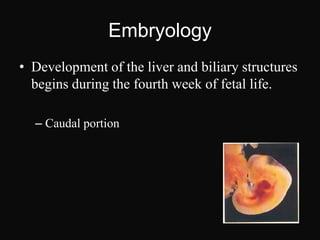
Embryology
• Development of the liver and biliary structures
  begins during the fourth week of fetal life.

  – Caudal portion
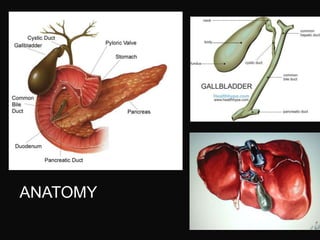
ANATOMY
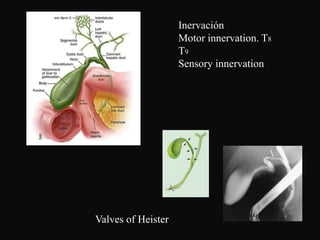
Inervación
                    Motor innervation. T8
                    T9
                    Sensory innervation


Valves of Heister
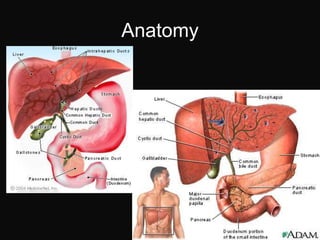
Anatomy
Physiology
• Bile…produce by the liver, transported to the
  gallbladder and released in response to
  humoral and neural control

• Hepatic production: 600 mL
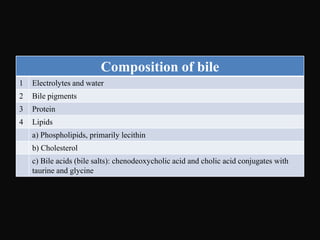
Composition of bile
1   Electrolytes and water
2   Bile pigments
3   Protein
4   Lipids
    a) Phospholipids, primarily lecithin
    b) Cholesterol
    c) Bile acids (bile salts): chenodeoxycholic acid and cholic acid conjugates with
    taurine and glycine
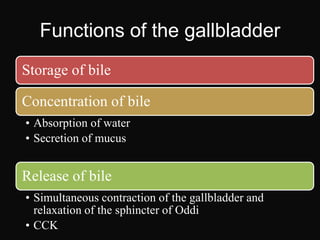
Functions of the gallbladder
Storage of bile

Concentration of bile
• Absorption of water
• Secretion of mucus


Release of bile
• Simultaneous contraction of the gallbladder and
  relaxation of the sphincter of Oddi
• CCK
RADIOLOGIC DIAGNOSIS OF
BILIARY TRACT DISEASE
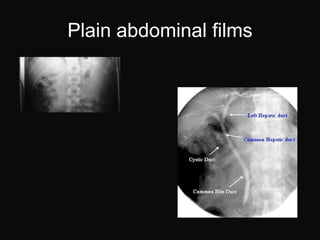
Plain abdominal films
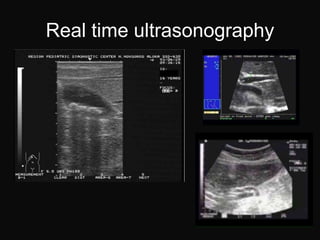
Real time ultrasonography
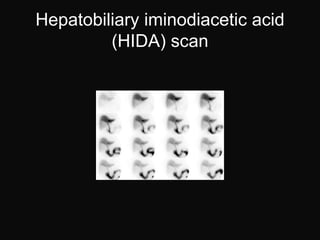
Hepatobiliary iminodiacetic acid
         (HIDA) scan
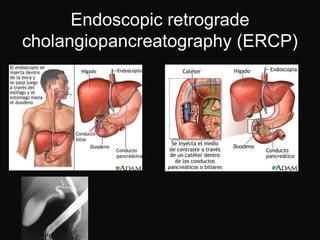
Endoscopic retrograde
cholangiopancreatography (ERCP)
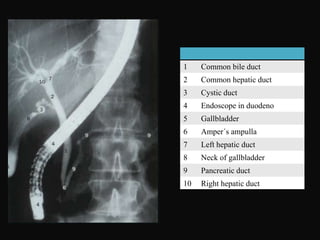
1    Common bile duct
2    Common hepatic duct
3    Cystic duct
4    Endoscope in duodeno
5    Gallbladder
6    Amper´s ampulla
7    Left hepatic duct
8    Neck of gallbladder
9    Pancreatic duct
10   Right hepatic duct
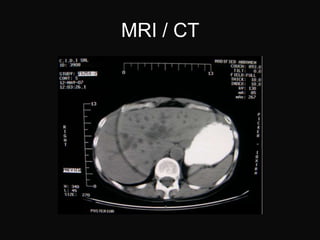
MRI / CT
GRACIAS
THANK YOU

Gallbladder & extrahepatic biliary tree