HOSSAM MOUSSA SAKR
Technique & normal
appearance of GIT US
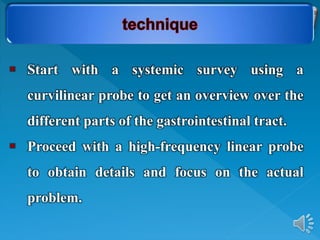
 Start with a systemic survey using a
curvilinear probe to get an overview over the
different parts of the gastrointestinal tract.
 Proceed with a high-frequency linear probe
to obtain details and focus on the actual
problem.
 It is possible to scan the distal esophagus & GEJ by
tilting the probe cranially in the epigastrium.
 The stomach is scanned in longitudinal and
transverse sections via a sub xiphoidal approach from
the cardia to the pylorus using the left lobe of the
liver as acoustic window
 The fundus of the stomach can be demonstrated in a
translienal view (through the spleen).
Abdominal esophagus in TS & LS views
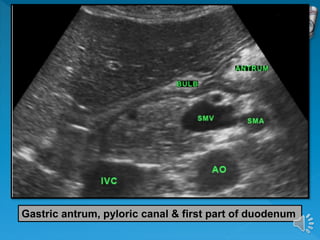
Gastric antrum, pyloric canal & first part of duodenum
 The muscular layer of the stomach, especially
that of the antrum, is more pronounced than
in other parts of the intestine.
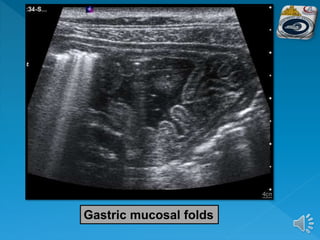
 In a non-distended condition the mucosal folds
of the gastric corpus and fundus are well
demonstrable
Gastric mucosal folds
 The duodenum is identified by its “C-shaped”
course around the pancreatic head.
 The first part of the duodenum is seen just
distal to the pylorus.
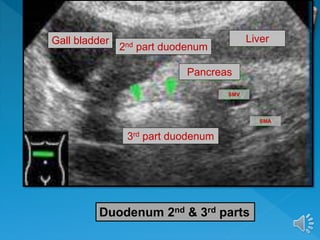
 The third part of the duodenum lies between
the aorta and the superior mesenteric vessels
Duodenum 2nd & 3rd parts
Gall bladder
2nd part duodenum
Liver
Pancreas
3rd part duodenum
SMV
SMA
 The jejunum is usually located in the left
upper and mid abdomen and the ileum in the
right mid and lower abdomen.
 The right iliac vessels are a landmark of the
ileocecal region
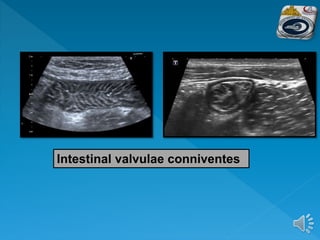
 The valvulae conniventes are typical of the
small intestine.
 They decrease in number and height from the
proximal jejunum to the distal ileum.
 They are best visible when bowel loops are
fluid filled
Intestinal valvulae conniventes
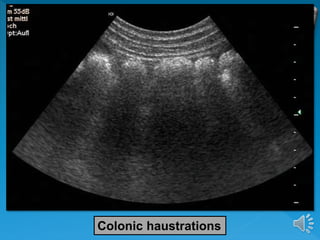
 The colon is characterized by its haustration
which using US is best visible at the ascending
and transverse colon.
 The left hemicolon is seen more often in a
contracted condition
Colonic haustrations
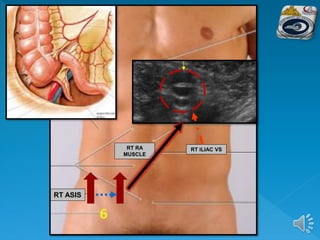
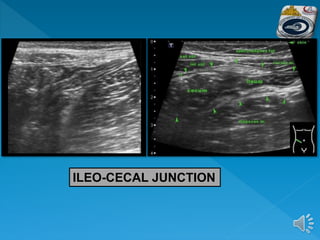
 Beginning at the right anterior superior iliac
spine and moving medially to the edge of the
rectus muscles in a sagittal plane, the right
common iliac vessels are identified.
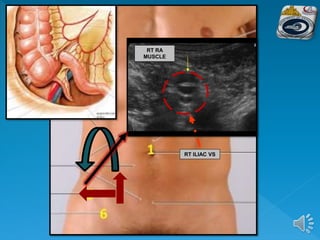
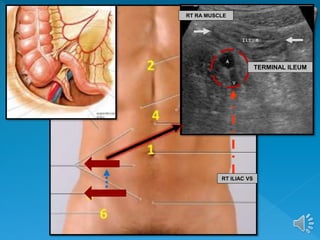
 Rotating anticlockwise to a transverse plane
and moving cranially, the first bowel loop
crossing from medial to lateral is identified as
the terminal ileum.
 This is followed to the ileocaecal valve and
caecum.
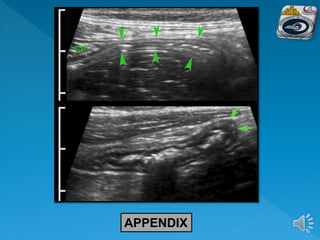
 The base of the appendix can be identified at
the deep margin of the caecum where the three
taenia coli meet
RT ASIS
RT RA
MUSCLE
RT ILIAC VS
RT RA
MUSCLE
RT ILIAC VS
RT RA MUSCLE
RT ILIAC VS
TERMINAL ILEUM
ILEO-CECAL JUNCTION
APPENDIX
Appendicular
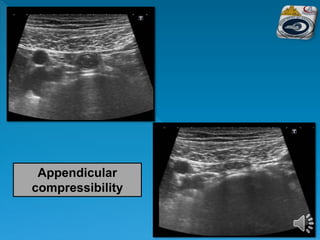
compressibility
 The ascending colon is followed up towards
the hepatic flexure.
 The rest of the colon can be followed via the
transverse segment distally towards the
rectum.
 Intercostal imaging may be required to
visualize the splenic flexure.
 Elevating the left arm and rotating to a partial
right decubitus position with straight left leg
can improve image acquisition
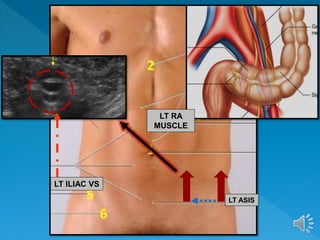
 Beginning at the left anterior superior iliac
crest and moving medially to the edge of the
rectus muscles in a sagittal plane, the left
common iliac vessels are identified.
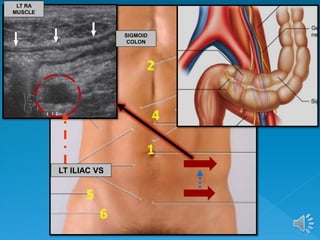
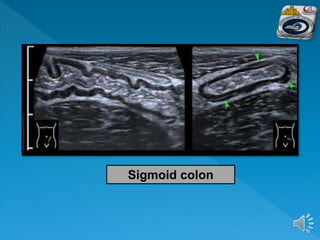
 Rotating clockwise to a transverse plane and
moving cranially, the first bowel loop crossing
from medial to lateral is identified as the
sigmoid colon.
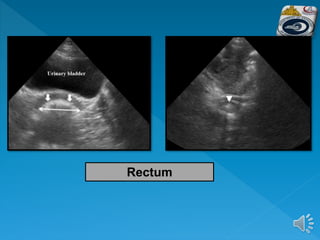
 The rectum is visualized through the filled
bladder
LT ASIS
LT ILIAC VS
LT RA
MUSCLE
LT RA
MUSCLE
LT ILIAC VS
LT RA
MUSCLE
LT ILIAC VS
SIGMOID
COLON
Sigmoid colon
Rectum
 The GEJ
 The Gastric antrum
 The Duodenum
 The Ileocecal region.
 The Ascending and Descending colon
 The Rectum
 The Lower sigmoid colon
 The Left colonic flexure
A. Bowel wall
B. Bowel lumen
C. Dynamic examination
D. Associated findings
1. Wall thickness
2. Echogenicity & Stratification
3. Vascularization
1. Luminal width
2. Contents within the lumen
1. Length of affected segment
2. Compressibility.
3. Peristalsis
1. Peritoneal fluid
2. Mesenteric lymph nodes
3. Others: e.g. liver, spleen, …..
 Wall thickness of the alimentary tract differs
from part to part and depends largely on the
state of distension or contraction.
 Under normal conditions stomach thickness
measures from mm, small bowel from
mm, and the colon from mm.
1. Inner hyperechoic layer: superficial mucosal
interface
2. Inner hypoechoic layer: mucosa
3. Middle hyperechoic layer: submucosa
4. Outer hypoechoic layer: muscularis propria
5. Outer hyperechoic layer: serosa and interface
to the serosa
1 2
3
5
4
1. superficial mucosal interface
2. Mucosa
3. Sub mucosa
4. Muscularis propria
5. serosa
 Small bowel diameter beyond 25 mm should
be regarded as abnormal particularly when
motility is reduced.
 Small bowel diameter less than 10 mm should
also be regarded as abnormal
 Normal colonic caliber ranges from cm,
with the largest diameter in the cecum
 The remainder of the colon is dilated when it is
greater than cm
 The cecum is considered dilated if larger than
cm in diameter
Git ultrasound part I technique & normal appearance

Git ultrasound part I technique & normal appearance

  • 3.
  • 4.
  • 6.
     Start witha systemic survey using a curvilinear probe to get an overview over the different parts of the gastrointestinal tract.  Proceed with a high-frequency linear probe to obtain details and focus on the actual problem.
  • 7.
     It ispossible to scan the distal esophagus & GEJ by tilting the probe cranially in the epigastrium.  The stomach is scanned in longitudinal and transverse sections via a sub xiphoidal approach from the cardia to the pylorus using the left lobe of the liver as acoustic window  The fundus of the stomach can be demonstrated in a translienal view (through the spleen).
  • 8.
  • 9.
    Gastric antrum, pyloriccanal & first part of duodenum
  • 10.
     The muscularlayer of the stomach, especially that of the antrum, is more pronounced than in other parts of the intestine.  In a non-distended condition the mucosal folds of the gastric corpus and fundus are well demonstrable
  • 11.
  • 12.
     The duodenumis identified by its “C-shaped” course around the pancreatic head.  The first part of the duodenum is seen just distal to the pylorus.  The third part of the duodenum lies between the aorta and the superior mesenteric vessels
  • 13.
    Duodenum 2nd &3rd parts Gall bladder 2nd part duodenum Liver Pancreas 3rd part duodenum SMV SMA
  • 14.
     The jejunumis usually located in the left upper and mid abdomen and the ileum in the right mid and lower abdomen.  The right iliac vessels are a landmark of the ileocecal region
  • 15.
     The valvulaeconniventes are typical of the small intestine.  They decrease in number and height from the proximal jejunum to the distal ileum.  They are best visible when bowel loops are fluid filled
  • 16.
  • 17.
     The colonis characterized by its haustration which using US is best visible at the ascending and transverse colon.  The left hemicolon is seen more often in a contracted condition
  • 18.
  • 19.
     Beginning atthe right anterior superior iliac spine and moving medially to the edge of the rectus muscles in a sagittal plane, the right common iliac vessels are identified.
  • 20.
     Rotating anticlockwiseto a transverse plane and moving cranially, the first bowel loop crossing from medial to lateral is identified as the terminal ileum.
  • 21.
     This isfollowed to the ileocaecal valve and caecum.  The base of the appendix can be identified at the deep margin of the caecum where the three taenia coli meet
  • 22.
  • 23.
  • 24.
    RT RA MUSCLE RTILIAC VS TERMINAL ILEUM
  • 25.
  • 26.
  • 27.
  • 28.
     The ascendingcolon is followed up towards the hepatic flexure.  The rest of the colon can be followed via the transverse segment distally towards the rectum.
  • 29.
     Intercostal imagingmay be required to visualize the splenic flexure.  Elevating the left arm and rotating to a partial right decubitus position with straight left leg can improve image acquisition
  • 30.
     Beginning atthe left anterior superior iliac crest and moving medially to the edge of the rectus muscles in a sagittal plane, the left common iliac vessels are identified.
  • 31.
     Rotating clockwiseto a transverse plane and moving cranially, the first bowel loop crossing from medial to lateral is identified as the sigmoid colon.  The rectum is visualized through the filled bladder
  • 32.
    LT ASIS LT ILIACVS LT RA MUSCLE
  • 33.
  • 34.
    LT RA MUSCLE LT ILIACVS SIGMOID COLON
  • 35.
  • 36.
  • 37.
     The GEJ The Gastric antrum  The Duodenum  The Ileocecal region.  The Ascending and Descending colon
  • 38.
     The Rectum The Lower sigmoid colon  The Left colonic flexure
  • 39.
    A. Bowel wall B.Bowel lumen C. Dynamic examination D. Associated findings
  • 40.
    1. Wall thickness 2.Echogenicity & Stratification 3. Vascularization
  • 41.
    1. Luminal width 2.Contents within the lumen
  • 42.
    1. Length ofaffected segment 2. Compressibility. 3. Peristalsis
  • 43.
    1. Peritoneal fluid 2.Mesenteric lymph nodes 3. Others: e.g. liver, spleen, …..
  • 44.
     Wall thicknessof the alimentary tract differs from part to part and depends largely on the state of distension or contraction.  Under normal conditions stomach thickness measures from mm, small bowel from mm, and the colon from mm.
  • 45.
    1. Inner hyperechoiclayer: superficial mucosal interface 2. Inner hypoechoic layer: mucosa 3. Middle hyperechoic layer: submucosa 4. Outer hypoechoic layer: muscularis propria 5. Outer hyperechoic layer: serosa and interface to the serosa
  • 46.
    1 2 3 5 4 1. superficialmucosal interface 2. Mucosa 3. Sub mucosa 4. Muscularis propria 5. serosa
  • 47.
     Small boweldiameter beyond 25 mm should be regarded as abnormal particularly when motility is reduced.  Small bowel diameter less than 10 mm should also be regarded as abnormal
  • 48.
     Normal coloniccaliber ranges from cm, with the largest diameter in the cecum  The remainder of the colon is dilated when it is greater than cm  The cecum is considered dilated if larger than cm in diameter

Editor's Notes

  • #6 Both curvilinear & high-resolution linear probes can be used & actually they are both used in the same examination
  • #15 as we will explain later
  • #16 valvulae conniventes are the mucosal fold of the small intestine
  • #37 The rectum is visualized through the UB, it can be filled with gases or empty
  • #40 After we identify the different parts of the GIT, what will we comment on ??
  • #41 After we identify the different parts of the GIT, what will we comment on ??
  • #42 After we identify the different parts of the GIT, what will we comment on ??
  • #43 After we identify the different parts of the GIT, what will we comment on ??
  • #44 After we identify the different parts of the GIT, what will we comment on ??
  • #50 By this we end this part about technique of examination & normal appearance & we will start to discuss the different pathological conditions affecting the GIT in the next talks ISA