

The Anatomy of Galaxies
• Galaxies come in three basic types:
spirals, ellipticals and irregulars.
Each of these three broad
morphologies of galaxy tells us a
little about what is going on inside
the galaxy itself. They are all
structured differently.
Spiral Galaxies
• The spiral arms of a galaxy contain
most of the interstellar medium –
dust and other material between
stars – within a galaxy. It is in the
spiral arms that new stars are
forming, hence their usually bright,
blueish or white colour. Spirals are
made of about 10-20% dust and gas.
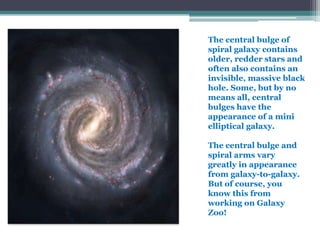
• This is the source material for the stars
that are forming within the spiral
arms. It is the dust that obscures
background light to create the dark
lanes you see in spiral galaxies. You
can the arms and the dust lanes very
well in this artistic impression of our
own galaxy, the Milky Way from Nick
Risinger / NASA.
The central bulge of
spiral galaxy contains
older, redder stars and
often also contains an
invisible, massive black
hole. Some, but by no
means all, central
bulges have the
appearance of a mini
elliptical galaxy.
The central bulge and
spiral arms vary
greatly in appearance
from galaxy-to-galaxy.
But of course, you
know this from
working on Galaxy
Zoo!
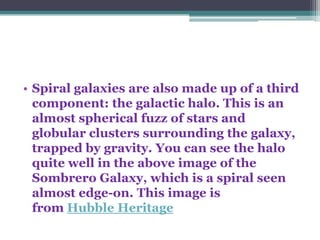
• Spiral galaxies are also made up of a third
component: the galactic halo. This is an
almost spherical fuzz of stars and
globular clusters surrounding the galaxy,
trapped by gravity. You can see the halo
quite well in the above image of the
Sombrero Galaxy, which is a spiral seen
almost edge-on. This image is
from Hubble Heritage
Ellipticals
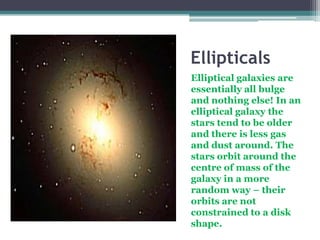
Elliptical galaxies are
essentially all bulge
and nothing else! In an
elliptical galaxy the
stars tend to be older
and there is less gas
and dust around. The
stars orbit around the
centre of mass of the
galaxy in a more
random way – their
orbits are not
constrained to a disk
shape.
• There is very little star
formation going on in
elliptical galaxies and so they
usually appear reddish in
colour: dominated by older,
cooler stars.
Irregulars
• There is obviously little to say about
the structure of irregular galaxies
because they are irregular. They
make up about a quarter of all
galaxies. It is thought that many
irregulars were once ellipticals or
spirals and have been distorted by
interactions or collisions with other
galaxies.
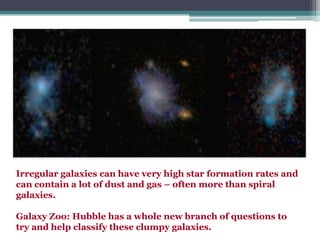
Irregular galaxies can have very high star formation rates and
can contain a lot of dust and gas – often more than spiral
galaxies.
Galaxy Zoo: Hubble has a whole new branch of questions to
try and help classify these clumpy galaxies.
Dwarf Galaxies
• You could add this fourth category
to the list of galaxy types. Dwarf
galaxies might appear to be just
smaller versions of the above types,
but they are the most common type
of galaxy. There are more dwarfs
than any of the others, if you just
count them up.
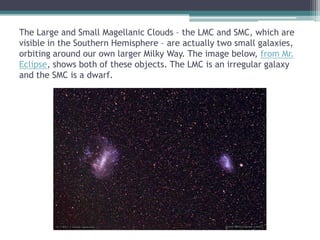
The Large and Small Magellanic Clouds – the LMC and SMC, which are
visible in the Southern Hemisphere – are actually two small galaxies,
orbiting around our own larger Milky Way. The image below, from Mr.
Eclipse, shows both of these objects. The LMC is an irregular galaxy
and the SMC is a dwarf.
the anatomy of galaxies

the anatomy of galaxies

  • 1.
  • 2.
    • Galaxies comein three basic types: spirals, ellipticals and irregulars. Each of these three broad morphologies of galaxy tells us a little about what is going on inside the galaxy itself. They are all structured differently.
  • 3.
    Spiral Galaxies • Thespiral arms of a galaxy contain most of the interstellar medium – dust and other material between stars – within a galaxy. It is in the spiral arms that new stars are forming, hence their usually bright, blueish or white colour. Spirals are made of about 10-20% dust and gas.
  • 4.
    • This isthe source material for the stars that are forming within the spiral arms. It is the dust that obscures background light to create the dark lanes you see in spiral galaxies. You can the arms and the dust lanes very well in this artistic impression of our own galaxy, the Milky Way from Nick Risinger / NASA.
  • 5.
    The central bulgeof spiral galaxy contains older, redder stars and often also contains an invisible, massive black hole. Some, but by no means all, central bulges have the appearance of a mini elliptical galaxy. The central bulge and spiral arms vary greatly in appearance from galaxy-to-galaxy. But of course, you know this from working on Galaxy Zoo!
  • 6.
    • Spiral galaxiesare also made up of a third component: the galactic halo. This is an almost spherical fuzz of stars and globular clusters surrounding the galaxy, trapped by gravity. You can see the halo quite well in the above image of the Sombrero Galaxy, which is a spiral seen almost edge-on. This image is from Hubble Heritage
  • 7.
    Ellipticals Elliptical galaxies are essentiallyall bulge and nothing else! In an elliptical galaxy the stars tend to be older and there is less gas and dust around. The stars orbit around the centre of mass of the galaxy in a more random way – their orbits are not constrained to a disk shape.
  • 8.
    • There isvery little star formation going on in elliptical galaxies and so they usually appear reddish in colour: dominated by older, cooler stars.
  • 9.
    Irregulars • There isobviously little to say about the structure of irregular galaxies because they are irregular. They make up about a quarter of all galaxies. It is thought that many irregulars were once ellipticals or spirals and have been distorted by interactions or collisions with other galaxies.
  • 10.
    Irregular galaxies canhave very high star formation rates and can contain a lot of dust and gas – often more than spiral galaxies. Galaxy Zoo: Hubble has a whole new branch of questions to try and help classify these clumpy galaxies.
  • 11.
    Dwarf Galaxies • Youcould add this fourth category to the list of galaxy types. Dwarf galaxies might appear to be just smaller versions of the above types, but they are the most common type of galaxy. There are more dwarfs than any of the others, if you just count them up.
  • 12.
    The Large andSmall Magellanic Clouds – the LMC and SMC, which are visible in the Southern Hemisphere – are actually two small galaxies, orbiting around our own larger Milky Way. The image below, from Mr. Eclipse, shows both of these objects. The LMC is an irregular galaxy and the SMC is a dwarf.