Incremental pattern matching in the 
VIATRA    d lt     f    ti       t
VIATRA model transformation system
Gábor Bergmann
András Ökrös
István Ráth (rath@mit.bme.hu)
Dániel Varró
Dániel Varró               Department of Measurement and 
                           Department of Measurement and
Gergely Varró              Information Systems
                         Budapest University of Technology and
                                  University of Technology and 
                         Economics
Overview
• Introduction

• Concepts

•P f
 Performance analysis
                l i

• Future work

• Summary
Introduction
Incremental model transformations
            model transformations
• Key usage scenarios for MT:
  ▫ Mapping between languages
  ▫ Intra‐domain model manipulation
       Model execution
       Validity checking (constraint evaluation)
       Validity checking (constraint evaluation)
• They work with evolving models.
  ▫ Users are constantly changing/modifying them.
  ▫ Users usually work with large models.
    Users usually work with large
• Problem: transformations are slow
  ▫ To execute… (large models)
  ▫ and to re‐execute again and again (always starting from scratch).
• Solution: incrementality
  ▫ Take the source model, and its mapped counterpart;
  ▫ Use the information about how the source model was changed;
  ▫ M
    Map and apply the changes (but ONLY the changes) to the target model.
           d     l h h         (b ONLY h h          )    h           d l
Towards incrementality
Towards incrementality
• How to achieve incrementality?
  How to achieve incrementality?
  ▫ Incremental updates: avoid re‐generation.
     Don t recreate what is already there.
     Don’t recreate what is already there
       Use reference (correspondence) models.
  ▫ Incremental execution: avoid re‐computation.
    Incremental execution: avoid re computation.
     Don’t recalculate what was already computed.
     How?
Incremental graph pattern matching
Incremental graph pattern matching
• Graph transformations require pattern matching
     p                     q     p             g
• Goal: retrieve the matching set quickly
• How?
  ▫ Store (cache) matchings
  ▫ Update them as the model changes
        Update precisely (incrementality)
        U d t      i l (i         t lit )
• Expected results: good, if…
  ▫   There is enough memory ( )
      There is enough memory (*)
  ▫   Queries are dominant
  ▫   Model changes are relatively sparse (**)
  ▫   e.g. synchronization, constraint evaluation, …
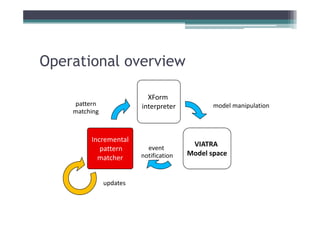
Operational overview

                           XForm 
    pattern              interpreter           model manipulation
    matching


         Incremental
                           event 
                                         VIATRA 
            pattern
                         notification   Model space
           matcher


               updates
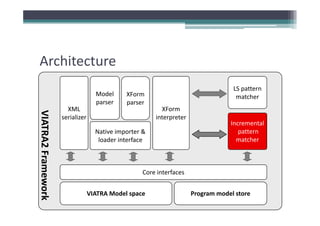
Architecture
                                                                                  LS pattern
                                                                                  LS tt
                                   Model     XForm                                 matcher
                                   parser    parser
                      XML                                XForm
VIATRA
V


                    serializer                         interpreter
                                                                                 Incremental
                                   Native importer &                                pattern
     A2 Framewo


                                    loader interface
                                    l d i t f                                      matcher


                                                  Core interfaces
              ork


                                 VIATRA Model space                  Program model store
Concepts
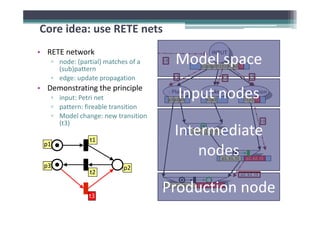
Core idea: use RETE nets
• RETE network                                                    INPUT
   ▫ node: (partial) matches of a
     node: (partial) matches of a 
     (sub)pattern
                                     t3      Model space
                                             Model space    p1 p2 p3 t1 t2 k1 k2 t3

   ▫ edge: update propagation                t3                             t3              t3

• Demonstrating the principle
  Demonstrating the principle
   ▫ input: Petri net                          Input nodes
                                          : Place
                                          p1 p2 p3
                                                       d        : Token
                                                                k1 k2
                                                                                       : Transition
                                                                                         t1 t2 t3
   ▫ pattern: fireable transition
   ▫ Model change: new transition 
                                                                                                    t3
     (t3)

                t1
                                             Intermediate 
                                                       p1, k1    p2, k2

 p1
                                                 nodes                    p1, k1, t1      p2, k2, t3
 p3
  3                        p2
                t2                                                                     p2, k2, t3


                t3
                                     Production node
                                     Production node
                                          p1, k1, t1, p3   p2, k2, t2, p3
RETE network construction
RETE network construction
• Key: pattern decomposition
    y p             p
  ▫ Pattern = set of constraints (defined over pattern variables)
  ▫ Types of constraints: type, topology (source/target), 
    hierarchy (containment), attribute value, generics 
    h       h (             )      b      l
    (instanceOf/supertypeOf), injectivity, [negative] pattern 
    calls, …
    calls, …
• Construction algorithm (roughly)
  ▫ 1. Decompose the pattern into elementary constraints (*)
  ▫ 2. Process the elementary constraints and connect them 
    with appropriate intermediate nodes (JOIN, MINUS‐JOIN, 
    UNION, …)
    UNION )
  ▫ 3. Create terminator production node
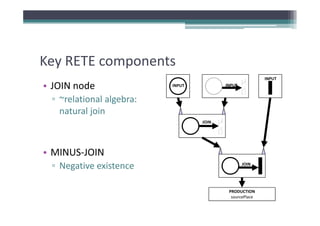
Key RETE components
Key RETE components
                                                          INPUT
• JOIN node
  JOIN node                INPUT          INPUT


 ▫ ~relational algebra: 
   natural join
   natural join
                                   JOIN


• MINUS‐JOIN
 ▫ Negative existence
   Negative existence                             JOIN


                                           PRODUCTION
                                            sourcePlace
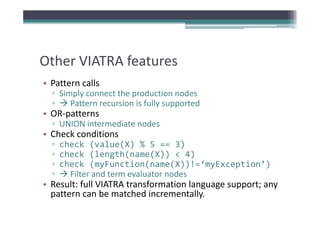
Other VIATRA features
Other VIATRA features
• Pattern calls
  ▫ Simply connect the production nodes
  ▫    Pattern recursion is fully supported
• OR patterns
  OR‐patterns
  ▫ UNION intermediate nodes
• Check conditions
  ▫ check (value(X) % 5 == 3)
  ▫ check (length(name(X)) < 4)
  ▫ check (myFunction(name(X))!=‘myException’)
    check (myFunction(name(X))!= myException )
  ▫   Filter and term evaluator nodes
• Result: full VIATRA transformation language support; any 
  pattern can be matched incrementally.
Updates
• Needed when the model space changes
  Needed when the model space changes
• VIATRA notification mechanism (EMF is also possible)
  ▫ Transparent: user modification, model imports, results of a
    Transparent: user modification, model imports, results of a 
    transformation, external modification, …  RETE is always 
    updated!
• Input nodes receive elementary modifications and 
  release an update token
  ▫ Represents a change in the partial matching (+/‐)
• Nodes process updates and propagate them if needed
  ▫ PRECISE update mechanism
Performance analysis
Performance analysis
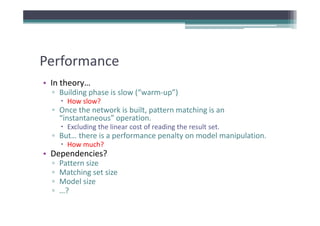
Performance
• In theory…
  ▫ Building phase is slow (“warm‐up”)
        How slow?
  ▫ Once the network is built, pattern matching is an 
                             ,p               g
    “instantaneous” operation.
        Excluding the linear cost of reading the result set.
  ▫ But… there is a performance penalty on model manipulation.
                    p           p     y              p
        How much?
• Dependencies?
  ▫   Pattern size
      Pattern size
  ▫   Matching set size
  ▫   Model size
  ▫   …?
       ?
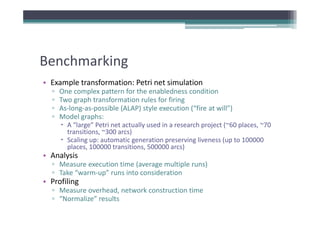
Benchmarking
• Example transformation: Petri net simulation
  ▫   One complex pattern for the enabledness condition
  ▫   Two graph transformation rules for firing
  ▫   As‐long‐as‐possible (ALAP) style execution (“fire at will”)
  ▫   Model graphs:
        A “large” Petri net actually used in a research project (~60 places, ~70 
        transitions, ~300 arcs)
        Scaling up: automatic generation preserving liveness ( t 100000
        S li           t    ti         ti          i li        (up to 100000 
        places, 100000 transitions, 500000 arcs)
• Analysis
  ▫ Measure execution time (average multiple runs)
    Measure execution time (average multiple runs)
  ▫ Take “warm‐up” runs into consideration
• Profiling
  ▫ Measure overhead network construction time
    Measure overhead, network construction time
  ▫ “Normalize” results
Profiling results
Profiling results
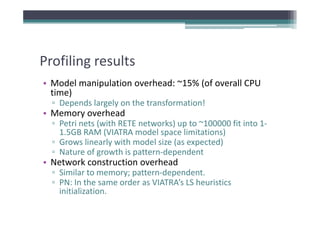
• Model manipulation overhead: ~15% (of overall CPU 
            p                       (
  time)
  ▫ Depends largely on the transformation!
• Memory overhead
  Memory overhead
  ▫ Petri nets (with RETE networks) up to ~100000 fit into 1‐
    1.5GB RAM (VIATRA model space limitations)
  ▫ Grows linearly with model size (as expected)
                                   (           )
  ▫ Nature of growth is pattern‐dependent
• Network construction overhead
  Network construction overhead
  ▫ Similar to memory; pattern‐dependent.
  ▫ PN: In the same order as VIATRA’s LS heuristics 
    initialization.
    initialization
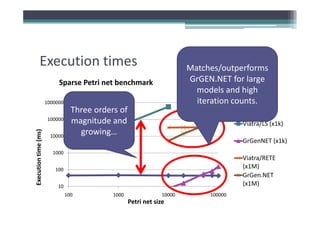
Execution times
          Execution times                                                Matches/outperforms 
                           Sparse Petri net benchmark                    GrGEN.NET for large 
                                                                           models and high 
                                                                               d l    d hi h
                      1000000                                              iteration counts.
                                                                                       Viatra/RETE 
                                  Three orders of                                      (x1k)
                                                                                       ( 1k)
                      100000      magnitude and                                        Viatra/LS (x1k)
                                    growing…
                ms)


                        10000
       on time (m


                                                                                       GrGenNET (x1k)
                                                                                       G G NET ( 1k)
                         1000
                                                                                       Viatra/RETE 
Executio


                          100
                                                                                       (x1M)
                                                                                       ( 1M)
                                                                                       GrGen.NET 
                           10                                                          (x1M)
                                100          1000                10000        100000
                                                    Petri net size
Benchmarking summary
Benchmarking summary
• Predictable near‐linear growth
  Predictable near linear growth
  ▫ As long as there is enough memory
  ▫ Certain problem classes: constant execution time ☺
    Certain problem classes: constant execution time ☺
  ▫ A ga
Improving performance
Improving performance
• Strategies
  ▫ Improve the construction algorithm
       Memory efficiency (node sharing)
       Memory efficiency (node sharing)
       Heuristics‐driven constraint enumeration (based on 
       p
       pattern [and model space] content)
               [            p ]          )
  ▫ Parallelism
       Update the RETE network in parallel with the 
       transformation
       Parallel network construction
  ▫?
Future work
Future work
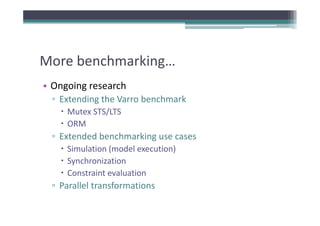
More benchmarking…
More benchmarking
• Ongoing research
  Ongoing research
 ▫ Extending the Varro benchmark
     Mutex STS/LTS
     ORM
 ▫ Extended benchmarking use cases
   Extended benchmarking use cases
     Simulation (model execution)
     Synchronization
      y
     Constraint evaluation
 ▫ Parallel transformations
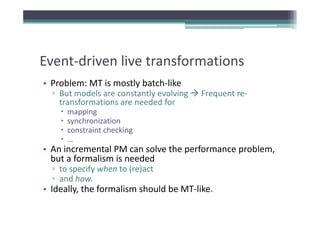
Event‐driven live transformations
Event‐driven live transformations
• Problem: MT is mostly batch‐like
                      y
  ▫ But models are constantly evolving    Frequent re‐
    transformations are needed for
      mapping
      synchronization
      constraint checking
      …
• An incremental PM can solve the performance problem, 
  but a formalism is needed
  ▫ to specify when to (re)act
  ▫ and how.
• Ideally the formalism should be MT‐like
  Ideally, the formalism should be MT like.
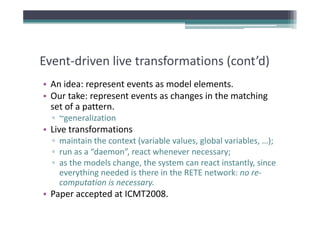
Event‐driven live transformations (cont d)
Event‐driven live transformations (cont’d)
• An idea: represent events as model elements.
              p
• Our take: represent events as changes in the matching 
  set of a pattern.
  ▫ ~generalization
• Live transformations
  ▫ maintain the context (variable values, global variables, …);
        i t i th    t t ( i bl       l      l b l i bl        )
  ▫ run as a “daemon”, react whenever necessary;
  ▫ as the models change the system can react instantly since
    as the models change, the system can react instantly, since 
    everything needed is there in the RETE network: no re‐
    computation is necessary.
• Paper accepted at ICMT2008.
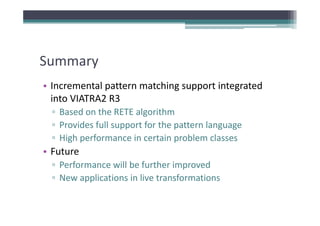
Summary
• Incremental pattern matching support integrated
  Incremental pattern matching support integrated 
  into VIATRA2 R3
  ▫ Based on the RETE algorithm
    Based on the RETE algorithm
  ▫ Provides full support for the pattern language
  ▫ High performance in certain problem classes
    High performance in certain problem classes
• Future
  ▫ Performance will be further improved
    Performance will be further improved
  ▫ New applications in live transformations

Incremental pattern matching in the VIATRA2 model transformation system

  • 1.
    Incremental pattern matching in the  VIATRA d lt f ti t VIATRA model transformation system Gábor Bergmann András Ökrös István Ráth (rath@mit.bme.hu) Dániel Varró Dániel Varró Department of Measurement and  Department of Measurement and Gergely Varró Information Systems Budapest University of Technology and University of Technology and  Economics
  • 2.
    Overview • Introduction • Concepts •Pf Performance analysis l i • Future work • Summary
  • 3.
  • 4.
    Incremental model transformations model transformations • Key usage scenarios for MT: ▫ Mapping between languages ▫ Intra‐domain model manipulation Model execution Validity checking (constraint evaluation) Validity checking (constraint evaluation) • They work with evolving models. ▫ Users are constantly changing/modifying them. ▫ Users usually work with large models. Users usually work with large • Problem: transformations are slow ▫ To execute… (large models) ▫ and to re‐execute again and again (always starting from scratch). • Solution: incrementality ▫ Take the source model, and its mapped counterpart; ▫ Use the information about how the source model was changed; ▫ M Map and apply the changes (but ONLY the changes) to the target model. d l h h (b ONLY h h ) h d l
  • 5.
    Towards incrementality Towards incrementality • Howto achieve incrementality? How to achieve incrementality? ▫ Incremental updates: avoid re‐generation. Don t recreate what is already there. Don’t recreate what is already there Use reference (correspondence) models. ▫ Incremental execution: avoid re‐computation. Incremental execution: avoid re computation. Don’t recalculate what was already computed. How?
  • 6.
    Incremental graph pattern matching Incremental graph patternmatching • Graph transformations require pattern matching p q p g • Goal: retrieve the matching set quickly • How? ▫ Store (cache) matchings ▫ Update them as the model changes Update precisely (incrementality) U d t i l (i t lit ) • Expected results: good, if… ▫ There is enough memory ( ) There is enough memory (*) ▫ Queries are dominant ▫ Model changes are relatively sparse (**) ▫ e.g. synchronization, constraint evaluation, …
  • 7.
    Operational overview XForm  pattern  interpreter model manipulation matching Incremental event  VIATRA  pattern notification Model space matcher updates
  • 8.
    Architecture LS pattern LS tt Model XForm matcher parser parser XML XForm VIATRA V serializer interpreter Incremental Native importer & pattern A2 Framewo loader interface l d i t f matcher Core interfaces ork VIATRA Model space Program model store
  • 9.
  • 10.
    Core idea: use RETE nets • RETE network INPUT ▫ node: (partial) matches of a node: (partial) matches of a  (sub)pattern t3 Model space Model space p1 p2 p3 t1 t2 k1 k2 t3 ▫ edge: update propagation t3 t3 t3 • Demonstrating the principle Demonstrating the principle ▫ input: Petri net Input nodes : Place p1 p2 p3 d : Token k1 k2 : Transition t1 t2 t3 ▫ pattern: fireable transition ▫ Model change: new transition  t3 (t3) t1 Intermediate  p1, k1 p2, k2 p1 nodes p1, k1, t1 p2, k2, t3 p3 3 p2 t2 p2, k2, t3 t3 Production node Production node p1, k1, t1, p3 p2, k2, t2, p3
  • 11.
    RETE network construction RETE network construction •Key: pattern decomposition y p p ▫ Pattern = set of constraints (defined over pattern variables) ▫ Types of constraints: type, topology (source/target),  hierarchy (containment), attribute value, generics  h h ( ) b l (instanceOf/supertypeOf), injectivity, [negative] pattern  calls, … calls, … • Construction algorithm (roughly) ▫ 1. Decompose the pattern into elementary constraints (*) ▫ 2. Process the elementary constraints and connect them  with appropriate intermediate nodes (JOIN, MINUS‐JOIN,  UNION, …) UNION ) ▫ 3. Create terminator production node
  • 12.
    Key RETE components Key RETE components INPUT • JOIN node JOIN node INPUT INPUT ▫ ~relational algebra:  natural join natural join JOIN • MINUS‐JOIN ▫ Negative existence Negative existence JOIN PRODUCTION sourcePlace
  • 13.
    Other VIATRA features Other VIATRA features •Pattern calls ▫ Simply connect the production nodes ▫ Pattern recursion is fully supported • OR patterns OR‐patterns ▫ UNION intermediate nodes • Check conditions ▫ check (value(X) % 5 == 3) ▫ check (length(name(X)) < 4) ▫ check (myFunction(name(X))!=‘myException’) check (myFunction(name(X))!= myException ) ▫ Filter and term evaluator nodes • Result: full VIATRA transformation language support; any  pattern can be matched incrementally.
  • 14.
    Updates • Needed whenthe model space changes Needed when the model space changes • VIATRA notification mechanism (EMF is also possible) ▫ Transparent: user modification, model imports, results of a Transparent: user modification, model imports, results of a  transformation, external modification, …  RETE is always  updated! • Input nodes receive elementary modifications and  release an update token ▫ Represents a change in the partial matching (+/‐) • Nodes process updates and propagate them if needed ▫ PRECISE update mechanism
  • 15.
  • 16.
    Performance • In theory… ▫ Building phase is slow (“warm‐up”) How slow? ▫ Once the network is built, pattern matching is an  ,p g “instantaneous” operation. Excluding the linear cost of reading the result set. ▫ But… there is a performance penalty on model manipulation. p p y p How much? • Dependencies? ▫ Pattern size Pattern size ▫ Matching set size ▫ Model size ▫ …? ?
  • 17.
    Benchmarking • Example transformation: Petri net simulation ▫ One complex pattern for the enabledness condition ▫ Two graph transformation rules for firing ▫ As‐long‐as‐possible (ALAP) style execution (“fire at will”) ▫ Model graphs: A “large” Petri net actually used in a research project (~60 places, ~70  transitions, ~300 arcs) Scaling up: automatic generation preserving liveness ( t 100000 S li t ti ti i li (up to 100000  places, 100000 transitions, 500000 arcs) • Analysis ▫ Measure execution time (average multiple runs) Measure execution time (average multiple runs) ▫ Take “warm‐up” runs into consideration • Profiling ▫ Measure overhead network construction time Measure overhead, network construction time ▫ “Normalize” results
  • 18.
    Profiling results Profiling results • Model manipulation overhead: ~15% (of overall CPU  p ( time) ▫ Depends largely on the transformation! • Memory overhead Memory overhead ▫ Petri nets (with RETE networks) up to ~100000 fit into 1‐ 1.5GB RAM (VIATRA model space limitations) ▫ Grows linearly with model size (as expected) ( ) ▫ Nature of growth is pattern‐dependent • Network construction overhead Network construction overhead ▫ Similar to memory; pattern‐dependent. ▫ PN: In the same order as VIATRA’s LS heuristics  initialization. initialization
  • 19.
    Execution times Execution times Matches/outperforms  Sparse Petri net benchmark GrGEN.NET for large  models and high  d l d hi h 1000000 iteration counts. Viatra/RETE  Three orders of  (x1k) ( 1k) 100000 magnitude and  Viatra/LS (x1k) growing… ms) 10000 on time (m GrGenNET (x1k) G G NET ( 1k) 1000 Viatra/RETE  Executio 100 (x1M) ( 1M) GrGen.NET  10 (x1M) 100 1000 10000 100000 Petri net size
  • 20.
    Benchmarking summary Benchmarking summary • Predictablenear‐linear growth Predictable near linear growth ▫ As long as there is enough memory ▫ Certain problem classes: constant execution time ☺ Certain problem classes: constant execution time ☺ ▫ A ga
  • 21.
    Improving performance Improving performance • Strategies ▫ Improve the construction algorithm Memory efficiency (node sharing) Memory efficiency (node sharing) Heuristics‐driven constraint enumeration (based on  p pattern [and model space] content) [ p ] ) ▫ Parallelism Update the RETE network in parallel with the  transformation Parallel network construction ▫?
  • 22.
  • 23.
    More benchmarking… More benchmarking • Ongoingresearch Ongoing research ▫ Extending the Varro benchmark Mutex STS/LTS ORM ▫ Extended benchmarking use cases Extended benchmarking use cases Simulation (model execution) Synchronization y Constraint evaluation ▫ Parallel transformations
  • 24.
    Event‐driven live transformations Event‐driven live transformations •Problem: MT is mostly batch‐like y ▫ But models are constantly evolving  Frequent re‐ transformations are needed for mapping synchronization constraint checking … • An incremental PM can solve the performance problem,  but a formalism is needed ▫ to specify when to (re)act ▫ and how. • Ideally the formalism should be MT‐like Ideally, the formalism should be MT like.
  • 25.
    Event‐driven live transformations (cont d) Event‐driven livetransformations (cont’d) • An idea: represent events as model elements. p • Our take: represent events as changes in the matching  set of a pattern. ▫ ~generalization • Live transformations ▫ maintain the context (variable values, global variables, …); i t i th t t ( i bl l l b l i bl ) ▫ run as a “daemon”, react whenever necessary; ▫ as the models change the system can react instantly since as the models change, the system can react instantly, since  everything needed is there in the RETE network: no re‐ computation is necessary. • Paper accepted at ICMT2008.
  • 26.
    Summary • Incremental patternmatching support integrated Incremental pattern matching support integrated  into VIATRA2 R3 ▫ Based on the RETE algorithm Based on the RETE algorithm ▫ Provides full support for the pattern language ▫ High performance in certain problem classes High performance in certain problem classes • Future ▫ Performance will be further improved Performance will be further improved ▫ New applications in live transformations