XCORE MEETS INCQUERY:
HOW THE NEW GENERATION
OF DSLS ARE MADE
Tamás Szabó (itemis AG), István Ráth (BUTE)
With contributions from:
Ed Merks
Gábor Bergmann, Ábel Hegedüs, Ákos Horváth,
András Ökrös, Zoltán Ujhelyi, Benedek Izsó

Budapest University of Technology and Economics
Fault Tolerant Systems Research Group

IncQueryLabs Ltd.

Itemis AG
Overview






Introduction
Live graph search for EMF
Query-based language engineering
Conclusion
EMF-INCQUERY:
LIVE GRAPH SEARCH FOR EMF
Queries in modeling tools
 Important!
o Model management
o Queries
o Views
o Transformations
Incremental queries
 Key observation: model queries are expensive
o Models are large (1-5-10+ M elements)
o Queries are complex (attribute value checks +
navigation/joins + iterations)
o Industrial example: well-formedness validation of a 4M
element AUTOSAR model takes 30+ minutes
• Despite being hand-coded in Java (no OCL, …)
 Usability issues
 Productivity issues

 How to address this?
o Lazy evaluation
o Incrementality: calculate once, update afterwards
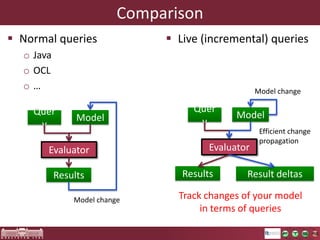
Comparison
 Normal queries

 Live (incremental) queries

o Java, OCL, …
Quer
y

Model

Evaluator
Results
Model change

(Re-)traversal necessary if
the model is changed

Model change

Quer
y

Model

Evaluator
Updated results

Efficient change
propagation

Result deltas

1. Always up-to-date results
without model traversal
2. Track changes of your model
in terms of queries
EMF-INCQUERY
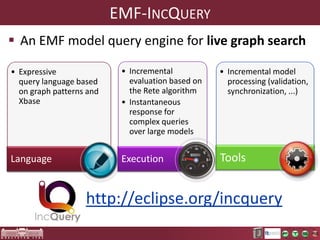
 An EMF model query engine for live graph search
• Expressive query
language based on
graph patterns and
Xbase

• Incremental
evaluation based on
the Rete algorithm
• Instantaneous
response for
complex queries
over large models

• Incremental model
processing (validation,
synchronization, ...)

Language

Execution

Tools

http://eclipse.org/incquery
Important use-case: Live abstractions

abstract

Complex model

Computed overlay
aka. “View”
Defined by a query
Items = SELECT …
Id

Label

Prop0

Prop1

0

N1

a

B

1

N2

c

D
Important use-case: Live abstractions
UI update
Model
Modification

abstract

Complex model

Computed overlay
aka. “View”

Change notification
Defined by a query
Items = SELECT …
Id

Prop0

Prop1

0

N1

a

B

1

Query result update

Label

N2

c

D

2

N3

e

F
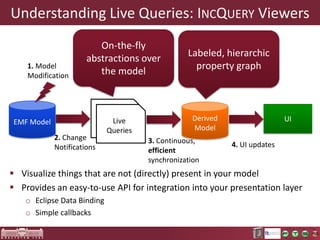
INCQUERY Viewers
1. Model
Modification

On-the-fly
abstractions over
the model

EMF Model
2. Change
Notifications

Live
Live
Queries
Queries

Labeled, hierarchic
property graph

Derived
Model
3. Continuous,
efficient
synchronization

UI
4. UI updates

 Visualize things that are not (directly) present in your model
 Provides an easy-to-use API for integration into your presentation layer
o Eclipse Data Binding
o Simple callbacks
DEMO INCQUERY Viewers
 Using pattern annotations for the specification of
on-thy-fly abstractions
 Using the INCQUERY Viewers Sandbox for
development and testing
 Visualizing large graphs with yFiles
 Using INCQUERY Viewers Extensions APIs in your
own apps
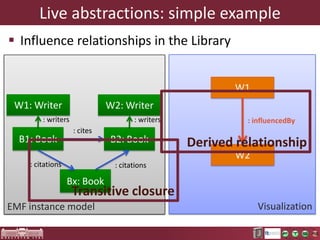
Live abstractions: simple example
 Influence relationships in the Library
W1
W1: Writer

W2: Writer

: writers

B1: Book

: writers
: cites

B2: Book

: influencedBy

Derived relationship
W2

: citations

: citations

Bx: Book

Transitive closure

EMF instance model

Visualization
QUERY-BASED LANGUAGE
ENGINEERING
Xcore
 Xcore
o Extended textual syntax for
Ecore-based
metamodeling, built on Xtext
o Fully fledged programming
language
o To specify structure +
behavior
(operations, datatype
conversion logic)
o http://wiki.eclipse.org/Xcore

Xbase
• Xtext-based programming
language
• Compiles to Java
• Java type system
• Supports advanced constructs
(closures, type inference,
operator overloading, …)
• http://wiki.eclipse.org/Xbase
Derived features in Ecore
 Getters (and setters) implemented with Java
 Frequently used to transparently integrate
complex queries into the language
o Can also be specified by means other than Java

 Nice proposition
o Transparent: integrate queries into the model – no
utility classes needed
o Extend the expressive power of metamodeling

 Many language engineers are reluctant to use
them – why?
The functionality challenge
 Typical modeling tool
architecture

View

o Model: EMF
o Controller: ~ EMF.Edit
o View: e.g. JFace Viewers

 Change notifications are
essential for this to work
 EMF has nice notifications
o Notifier - Adapter
o … except for derived
features

Controller
Change notifications

Model
The performance challenge
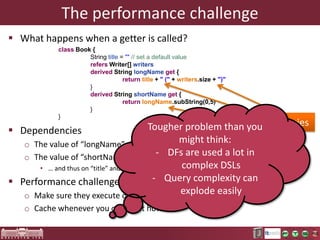
 What happens when a getter is called?
class Book {
String title = "" // set a default value
refers Writer[] writers
derived String longName get {
return title + " (" + writers.size + ")"
}
derived String shortName get {
return longName.subString(0,5)
}
}

dependencies
Tougher problem than you
 Dependencies
might think:
o The value of “longName” depends on “title” and “writers”
- DFs are used explicit
o The value of “shortName” depends on “longName” –a lot in dependency
complex
• … and thus on “title” and “writers” – implicit dependency DSLs
- Query complexity times
 Performance challenge: getters may be called manycan
explode easily
o Make sure they execute quickly – but how?
o Cache whenever you can – but how?
Solution: well-behaving derived features
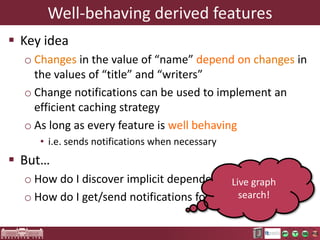
 Key idea
o Changes in the value of “name” depend on changes in
the values of “title” and “writers”
o Change notifications can be used to implement an
efficient caching strategy
o As long as every feature is behaving well
• i.e. sends notifications when necessary

 But…
o How do I discover implicit dependencies? graph
Live
search!
o How do I get/send notifications for derived features?
DEMO Query integration options for INCQUERY
 INCQUERY Java API
 Add-on APIs
o INCQUERY Validation
o INCQUERY Viewers
DEMO Query integration options for INCQUERY
 INCQUERY Java API
 Add-on APIs
o INCQUERY Validation
o INCQUERY Viewers

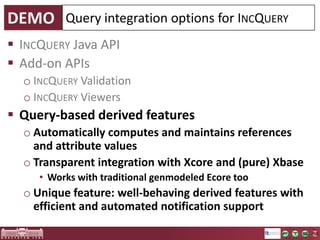
 Query-based derived features
o Automatically computes and maintains references
and attribute values
o Transparent integration with Xcore and (pure) Xbase
• Works with traditional genmodeled Ecore too

o Unique feature: well-behaving derived features with
efficient and automated notification support
Scalability? Yes!

Eclipse OCL, SPARQL
engines, Neo4j, …
Characteristic
difference, note
the log scales

• IncQuery can provide near zero response times for
complex queries over models up to 14M elements
•

Check http://incquery.net/publications/trainbenchmark for
more details
CONCLUSION
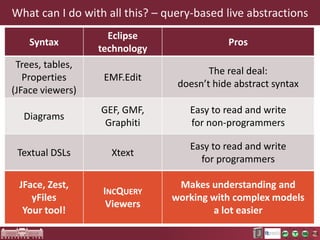
What can I do with all this? – query-based live abstractions
Eclipse
technology

Pros

Trees, tables,
Properties
(JFace viewers)

EMF.Edit

The real deal:
doesn’t hide abstract syntax

Diagrams

GEF, GMF,
Graphiti

Easy to read and write
for non-programmers

Textual DSLs

Xtext

Easy to read and write
for programmers

INCQUERY
Viewers

Makes understanding and
working with complex models
a lot easier

Syntax

JFace, Zest,
yFiles
Your tool!
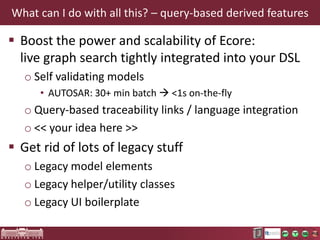
What can I do with all this? – query-based derived features

 Boost the power and scalability of Ecore:
live graph search tightly integrated into your DSL
o Self validating models
• 30+ min batch  <1s on-the-fly

o Query-based traceability links / language integration
o INCQUERY Viewers  “derived EObjects”
o << your idea here >>

 Get rid of lots of legacy stuff
o Legacy model elements
o Legacy helper/utility classes
o Legacy UI boilerplate
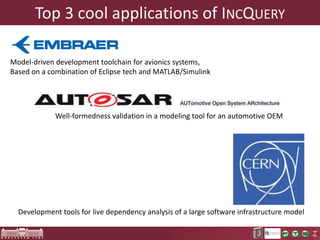
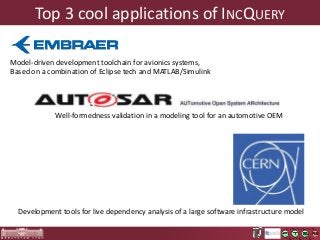
Top 3 cool applications of INCQUERY
Model-driven development toolchain for avionics systems,
Based on a combination of Eclipse tech and MATLAB/Simulink

Well-formedness validation in a modeling tool for an automotive OEM

Development tools for live dependency analysis of a large software infrastructure model
Three points to take home

1. Live abstractions are very powerful.
2. Use well-behaving derived features to boost your
DSL’s expressive power.
3. Xcore+INCQUERY is how the new generation of
DSLs are made 
Final points
 Find all details, examples, demos at
o http://eclipse.org/incquery
o http://incquery.net

 Check out the blog post
o http://incquery.net/blog/2013/10/xcore-meets-incqueryhow-new-generation-dsls-are-made-talk-eclipseconeurope-2013
o Demo projects
o Further reading (docs + the theory behind)

 Release 0.8 (including all these new features) is
scheduled shortly after the Xtext 2.5 release
 Your contributions (feedback, forum posts, ideas,
bugzillas, patches) are very welcome!

Xcore meets IncQuery: How the New Generation of DSLs are Made

  • 1.
    XCORE MEETS INCQUERY: HOWTHE NEW GENERATION OF DSLS ARE MADE Tamás Szabó (itemis AG), István Ráth (BUTE) With contributions from: Ed Merks Gábor Bergmann, Ábel Hegedüs, Ákos Horváth, András Ökrös, Zoltán Ujhelyi, Benedek Izsó Budapest University of Technology and Economics Fault Tolerant Systems Research Group IncQueryLabs Ltd. Itemis AG
  • 2.
    Overview     Introduction Live graph searchfor EMF Query-based language engineering Conclusion
  • 3.
  • 4.
    Queries in modelingtools  Important! o Model management o Queries o Views o Transformations
  • 5.
    Incremental queries  Keyobservation: model queries are expensive o Models are large (1-5-10+ M elements) o Queries are complex (attribute value checks + navigation/joins + iterations) o Industrial example: well-formedness validation of a 4M element AUTOSAR model takes 30+ minutes • Despite being hand-coded in Java (no OCL, …)  Usability issues  Productivity issues  How to address this? o Lazy evaluation o Incrementality: calculate once, update afterwards
  • 6.
    Comparison  Normal queries Live (incremental) queries o Java, OCL, … Quer y Model Evaluator Results Model change (Re-)traversal necessary if the model is changed Model change Quer y Model Evaluator Updated results Efficient change propagation Result deltas 1. Always up-to-date results without model traversal 2. Track changes of your model in terms of queries
  • 7.
    EMF-INCQUERY  An EMFmodel query engine for live graph search • Expressive query language based on graph patterns and Xbase • Incremental evaluation based on the Rete algorithm • Instantaneous response for complex queries over large models • Incremental model processing (validation, synchronization, ...) Language Execution Tools http://eclipse.org/incquery
  • 8.
    Important use-case: Liveabstractions abstract Complex model Computed overlay aka. “View” Defined by a query Items = SELECT … Id Label Prop0 Prop1 0 N1 a B 1 N2 c D
  • 9.
    Important use-case: Liveabstractions UI update Model Modification abstract Complex model Computed overlay aka. “View” Change notification Defined by a query Items = SELECT … Id Prop0 Prop1 0 N1 a B 1 Query result update Label N2 c D 2 N3 e F
  • 10.
    INCQUERY Viewers 1. Model Modification On-the-fly abstractionsover the model EMF Model 2. Change Notifications Live Live Queries Queries Labeled, hierarchic property graph Derived Model 3. Continuous, efficient synchronization UI 4. UI updates  Visualize things that are not (directly) present in your model  Provides an easy-to-use API for integration into your presentation layer o Eclipse Data Binding o Simple callbacks
  • 11.
    DEMO INCQUERY Viewers Using pattern annotations for the specification of on-thy-fly abstractions  Using the INCQUERY Viewers Sandbox for development and testing  Visualizing large graphs with yFiles  Using INCQUERY Viewers Extensions APIs in your own apps
  • 12.
    Live abstractions: simpleexample  Influence relationships in the Library W1 W1: Writer W2: Writer : writers B1: Book : writers : cites B2: Book : influencedBy Derived relationship W2 : citations : citations Bx: Book Transitive closure EMF instance model Visualization
  • 13.
  • 14.
    Xcore  Xcore o Extendedtextual syntax for Ecore-based metamodeling, built on Xtext o Fully fledged programming language o To specify structure + behavior (operations, datatype conversion logic) o http://wiki.eclipse.org/Xcore Xbase • Xtext-based programming language • Compiles to Java • Java type system • Supports advanced constructs (closures, type inference, operator overloading, …) • http://wiki.eclipse.org/Xbase
  • 15.
    Derived features inEcore  Getters (and setters) implemented with Java  Frequently used to transparently integrate complex queries into the language o Can also be specified by means other than Java  Nice proposition o Transparent: integrate queries into the model – no utility classes needed o Extend the expressive power of metamodeling  Many language engineers are reluctant to use them – why?
  • 16.
    The functionality challenge Typical modeling tool architecture View o Model: EMF o Controller: ~ EMF.Edit o View: e.g. JFace Viewers  Change notifications are essential for this to work  EMF has nice notifications o Notifier - Adapter o … except for derived features Controller Change notifications Model
  • 17.
    The performance challenge What happens when a getter is called? class Book { String title = "" // set a default value refers Writer[] writers derived String longName get { return title + " (" + writers.size + ")" } derived String shortName get { return longName.subString(0,5) } } dependencies Tougher problem than you  Dependencies might think: o The value of “longName” depends on “title” and “writers” - DFs are used explicit o The value of “shortName” depends on “longName” –a lot in dependency complex • … and thus on “title” and “writers” – implicit dependency DSLs - Query complexity times  Performance challenge: getters may be called manycan explode easily o Make sure they execute quickly – but how? o Cache whenever you can – but how?
  • 18.
    Solution: well-behaving derivedfeatures  Key idea o Changes in the value of “name” depend on changes in the values of “title” and “writers” o Change notifications can be used to implement an efficient caching strategy o As long as every feature is behaving well • i.e. sends notifications when necessary  But… o How do I discover implicit dependencies? graph Live search! o How do I get/send notifications for derived features?
  • 19.
    DEMO Query integrationoptions for INCQUERY  INCQUERY Java API  Add-on APIs o INCQUERY Validation o INCQUERY Viewers
  • 20.
    DEMO Query integrationoptions for INCQUERY  INCQUERY Java API  Add-on APIs o INCQUERY Validation o INCQUERY Viewers  Query-based derived features o Automatically computes and maintains references and attribute values o Transparent integration with Xcore and (pure) Xbase • Works with traditional genmodeled Ecore too o Unique feature: well-behaving derived features with efficient and automated notification support
  • 21.
    Scalability? Yes! Eclipse OCL,SPARQL engines, Neo4j, … Characteristic difference, note the log scales • IncQuery can provide near zero response times for complex queries over models up to 14M elements • Check http://incquery.net/publications/trainbenchmark for more details
  • 22.
  • 23.
    What can Ido with all this? – query-based live abstractions Eclipse technology Pros Trees, tables, Properties (JFace viewers) EMF.Edit The real deal: doesn’t hide abstract syntax Diagrams GEF, GMF, Graphiti Easy to read and write for non-programmers Textual DSLs Xtext Easy to read and write for programmers INCQUERY Viewers Makes understanding and working with complex models a lot easier Syntax JFace, Zest, yFiles Your tool!
  • 24.
    What can Ido with all this? – query-based derived features  Boost the power and scalability of Ecore: live graph search tightly integrated into your DSL o Self validating models • 30+ min batch  <1s on-the-fly o Query-based traceability links / language integration o INCQUERY Viewers  “derived EObjects” o << your idea here >>  Get rid of lots of legacy stuff o Legacy model elements o Legacy helper/utility classes o Legacy UI boilerplate
  • 25.
    Top 3 coolapplications of INCQUERY Model-driven development toolchain for avionics systems, Based on a combination of Eclipse tech and MATLAB/Simulink Well-formedness validation in a modeling tool for an automotive OEM Development tools for live dependency analysis of a large software infrastructure model
  • 26.
    Three points totake home 1. Live abstractions are very powerful. 2. Use well-behaving derived features to boost your DSL’s expressive power. 3. Xcore+INCQUERY is how the new generation of DSLs are made 
  • 27.
    Final points  Findall details, examples, demos at o http://eclipse.org/incquery o http://incquery.net  Check out the blog post o http://incquery.net/blog/2013/10/xcore-meets-incqueryhow-new-generation-dsls-are-made-talk-eclipseconeurope-2013 o Demo projects o Further reading (docs + the theory behind)  Release 0.8 (including all these new features) is scheduled shortly after the Xtext 2.5 release  Your contributions (feedback, forum posts, ideas, bugzillas, patches) are very welcome!

Editor's Notes

  • #22 Nemnagyméretűmódosítások