Persistent Homology
and
Nested Dissection
Don Sheehy
University of Connecticut
!
joint work with Michael Kerber and Primoz Skraba
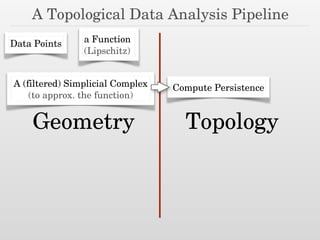
A Topological Data Analysis Pipeline
Data Points
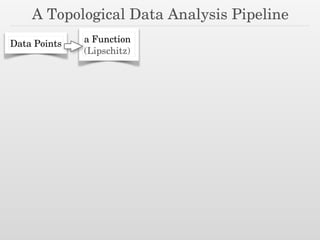
A Topological Data Analysis Pipeline
Data Points a Function
(Lipschitz)
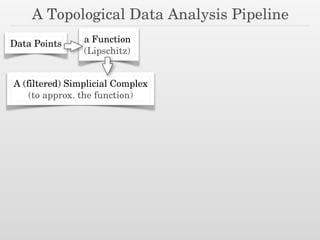
A Topological Data Analysis Pipeline
Data Points a Function
(Lipschitz)
A (filtered) Simplicial Complex
(to approx. the function)
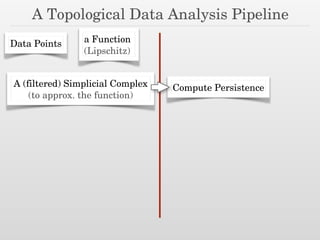
A Topological Data Analysis Pipeline
Data Points a Function
(Lipschitz)
A (filtered) Simplicial Complex
(to approx. the function)
Compute Persistence
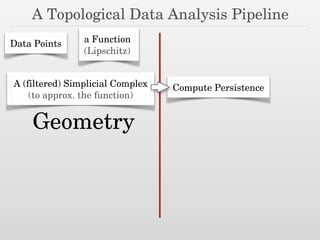
A Topological Data Analysis Pipeline
Data Points a Function
(Lipschitz)
A (filtered) Simplicial Complex
(to approx. the function)
Compute Persistence
Geometry
A Topological Data Analysis Pipeline
Data Points a Function
(Lipschitz)
A (filtered) Simplicial Complex
(to approx. the function)
Compute Persistence
Geometry Topology
A Topological Data Analysis Pipeline
Data Points a Function
(Lipschitz)
A (filtered) Simplicial Complex
(to approx. the function)
Compute Persistence
Geometry Topology
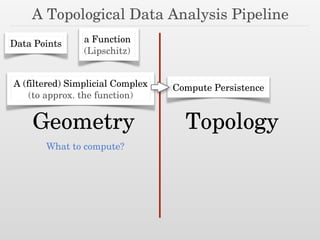
What to compute?
A Topological Data Analysis Pipeline
Data Points a Function
(Lipschitz)
A (filtered) Simplicial Complex
(to approx. the function)
Compute Persistence
Geometry Topology
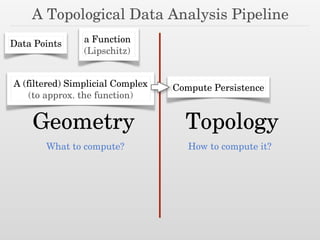
What to compute? How to compute it?
A Topological Data Analysis Pipeline
Data Points a Function
(Lipschitz)
A (filtered) Simplicial Complex
(to approx. the function)
Compute Persistence
Geometry Topology
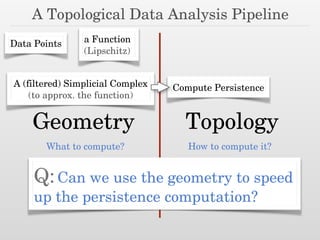
What to compute? How to compute it?
Q:Can we use the geometry to speed
up the persistence computation?
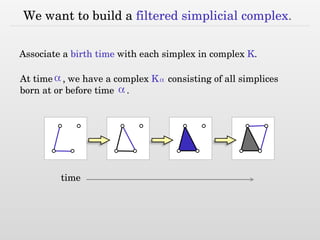
We want to build a filtered simplicial complex.
Associate a birth time with each simplex in complex K.
At timeα, we have a complex Kα consisting of all simplices
born at or before time α.
time
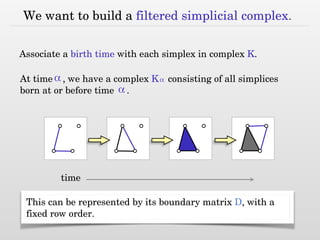
We want to build a filtered simplicial complex.
Associate a birth time with each simplex in complex K.
At timeα, we have a complex Kα consisting of all simplices
born at or before time α.
time
This can be represented by its boundary matrix D, with a
fixed row order.
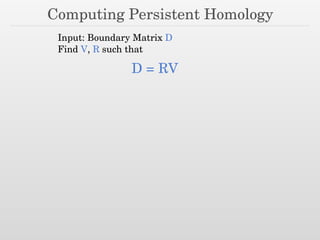
Computing Persistent Homology
Input: Boundary Matrix D
Find V, R such that
Computing Persistent Homology
Input: Boundary Matrix D
Find V, R such that
D = RV
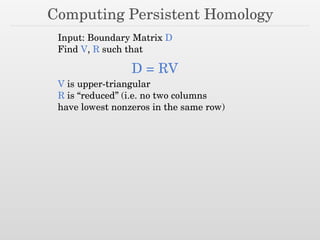
Computing Persistent Homology
Input: Boundary Matrix D
Find V, R such that
D = RV
V is upper-triangular
R is “reduced” (i.e. no two columns
have lowest nonzeros in the same row)
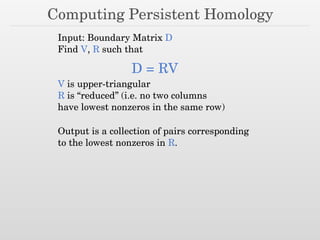
Computing Persistent Homology
Input: Boundary Matrix D
Find V, R such that
D = RV
V is upper-triangular
R is “reduced” (i.e. no two columns
have lowest nonzeros in the same row)
Output is a collection of pairs corresponding
to the lowest nonzeros in R.
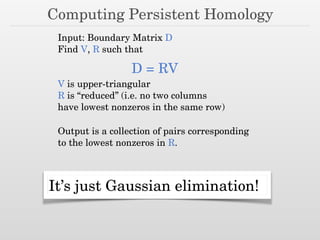
Computing Persistent Homology
Input: Boundary Matrix D
Find V, R such that
D = RV
V is upper-triangular
R is “reduced” (i.e. no two columns
have lowest nonzeros in the same row)
It’s just Gaussian elimination!
Output is a collection of pairs corresponding
to the lowest nonzeros in R.
The State of the Art
Asymptotics
The State of the Art
Asymptotics
“The Persistence Algorithm” [ELZ05] O(n3
)
The State of the Art
Asymptotics
“The Persistence Algorithm” [ELZ05]
via Matrix Multiplication [MMS11]
O(n3
)
O(n!
)
The State of the Art
Asymptotics
“The Persistence Algorithm” [ELZ05]
via Matrix Multiplication [MMS11]
Output-Sensitive [CK12] O(|D(1 ) |n2
)
O(n3
)
O(n!
)
The State of the Art
Asymptotics
Heuristics
“The Persistence Algorithm” [ELZ05]
via Matrix Multiplication [MMS11]
Output-Sensitive [CK12] O(|D(1 ) |n2
)
O(n3
)
O(n!
)
The State of the Art
Asymptotics
Heuristics
“The Persistence Algorithm” [ELZ05]
via Matrix Multiplication [MMS11]
Output-Sensitive [CK12]
Persistent Cohomology [MdSV-J11]
O(|D(1 ) |n2
)
O(n3
)
O(n!
)
The State of the Art
Asymptotics
Heuristics
“The Persistence Algorithm” [ELZ05]
via Matrix Multiplication [MMS11]
Output-Sensitive [CK12]
Persistent Cohomology [MdSV-J11]
Discrete Morse Reduction [MN13]
O(|D(1 ) |n2
)
O(n3
)
O(n!
)
The State of the Art
Asymptotics
Heuristics
“The Persistence Algorithm” [ELZ05]
via Matrix Multiplication [MMS11]
Output-Sensitive [CK12]
Persistent Cohomology [MdSV-J11]
Discrete Morse Reduction [MN13]
Clear and Compress [BKR13]
O(|D(1 ) |n2
)
O(n3
)
O(n!
)
Nested Dissection
Nested Dissection
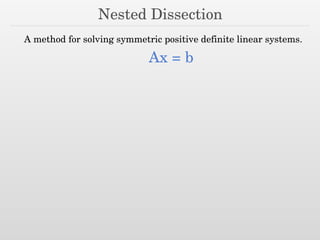
A method for solving symmetric positive definite linear systems.
Nested Dissection
A method for solving symmetric positive definite linear systems.
Ax = b
Nested Dissection
A method for solving symmetric positive definite linear systems.
Ax = b
If A is n x n, consider the n vertex graph with an edge (i,j) for each
nonzero entry A(i, j) of A.
Nested Dissection
A method for solving symmetric positive definite linear systems.
Ax = b
If A is n x n, consider the n vertex graph with an edge (i,j) for each
nonzero entry A(i, j) of A.
Nested Dissection
A method for solving symmetric positive definite linear systems.
Ax = b
If A is n x n, consider the n vertex graph with an edge (i,j) for each
nonzero entry A(i, j) of A.
Find a vertex separator S such that
Nested Dissection
A method for solving symmetric positive definite linear systems.
Ax = b
If A is n x n, consider the n vertex graph with an edge (i,j) for each
nonzero entry A(i, j) of A.
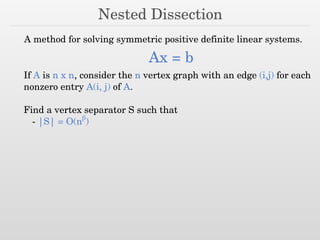
Find a vertex separator S such that
- |S| = O(nβ
)
Nested Dissection
A method for solving symmetric positive definite linear systems.
Ax = b
If A is n x n, consider the n vertex graph with an edge (i,j) for each
nonzero entry A(i, j) of A.
Find a vertex separator S such that
- |S| = O(nβ
)
- each connected piece has O(n) vertices.
Nested Dissection
A method for solving symmetric positive definite linear systems.
Ax = b
If A is n x n, consider the n vertex graph with an edge (i,j) for each
nonzero entry A(i, j) of A.
Find a vertex separator S such that
- |S| = O(nβ
)
- each connected piece has O(n) vertices.
The Punchline:
Nested Dissection
A method for solving symmetric positive definite linear systems.
Ax = b
If A is n x n, consider the n vertex graph with an edge (i,j) for each
nonzero entry A(i, j) of A.
Find a vertex separator S such that
- |S| = O(nβ
)
- each connected piece has O(n) vertices.
The Punchline:
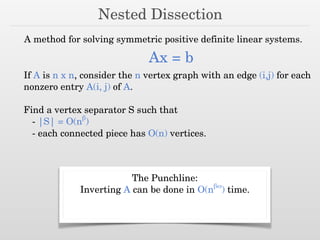
Inverting A can be done in O(nβω
) time.
Nested Dissection
A method for solving symmetric positive definite linear systems.
Ax = b
If A is n x n, consider the n vertex graph with an edge (i,j) for each
nonzero entry A(i, j) of A.
Find a vertex separator S such that
- |S| = O(nβ
)
- each connected piece has O(n) vertices.
The Punchline:
Inverting A can be done in O(nβω
) time.
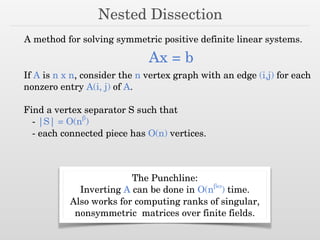
Also works for computing ranks of singular,
nonsymmetric matrices over finite fields.
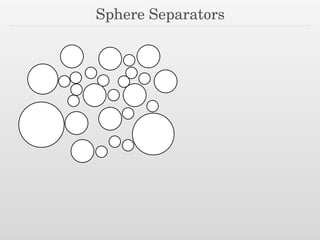
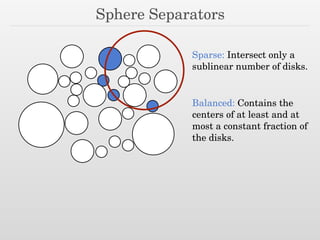
Sphere Separators
Sphere Separators
Sphere Separators
Sphere Separators
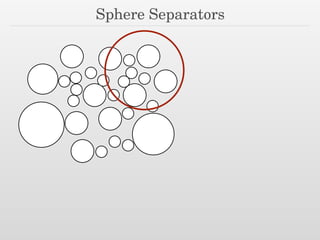
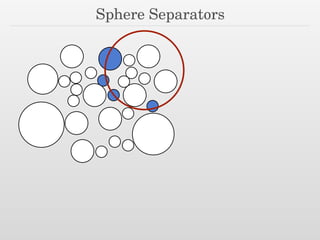
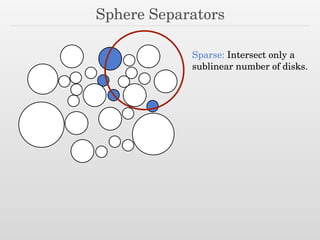
Sparse: Intersect only a
sublinear number of disks.
Sphere Separators
Sparse: Intersect only a
sublinear number of disks.
Balanced: Contains the
centers of at least and at
most a constant fraction of
the disks.
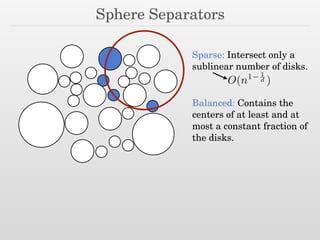
Sphere Separators
Sparse: Intersect only a
sublinear number of disks.
Balanced: Contains the
centers of at least and at
most a constant fraction of
the disks.
O(n1 1
d )
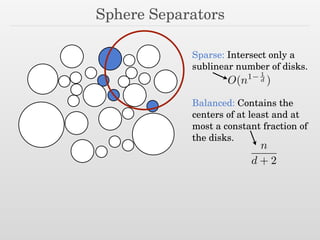
Sphere Separators
Sparse: Intersect only a
sublinear number of disks.
Balanced: Contains the
centers of at least and at
most a constant fraction of
the disks.
O(n1 1
d )
n
d + 2
Persistent Homology and Nested Dissection
A Conundrum:
Persistent Homology and Nested Dissection
A Conundrum:
Nested dissection gives an improvement by
choosing a good pivot order.
Persistent Homology and Nested Dissection
A Conundrum:
Nested dissection gives an improvement by
choosing a good pivot order.
Persistent homology restricts the pivot order.
Persistent Homology and Nested Dissection
A Conundrum:
Nested dissection gives an improvement by
choosing a good pivot order.
Persistent homology restricts the pivot order.
Persistent Homology and Nested Dissection
A Conundrum:
Nested dissection gives an improvement by
choosing a good pivot order.
Persistent homology restricts the pivot order.
The first trick:
Persistent Homology and Nested Dissection
A Conundrum:
Nested dissection gives an improvement by
choosing a good pivot order.
Persistent homology restricts the pivot order.
The first trick:
In the output-sensitive persistence algorithm of
Chen and Kerber, only ranks need to be computed.
Persistent Homology and Nested Dissection
A Conundrum:
Nested dissection gives an improvement by
choosing a good pivot order.
Persistent homology restricts the pivot order.
The first trick:
In the output-sensitive persistence algorithm of
Chen and Kerber, only ranks need to be computed.
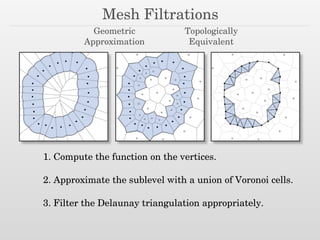
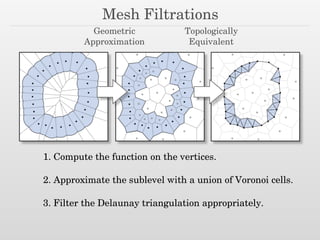
Mesh Filtrations
Geometric
Approximation
Topologically
Equivalent
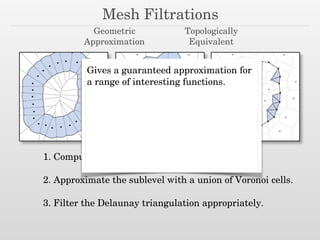
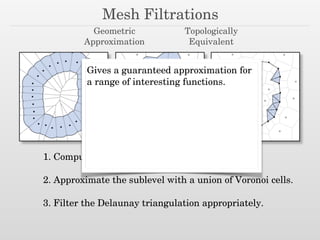
1. Compute the function on the vertices.
!
2. Approximate the sublevel with a union of Voronoi cells.
!
3. Filter the Delaunay triangulation appropriately.
Mesh Filtrations
Geometric
Approximation
Topologically
Equivalent
1. Compute the function on the vertices.
!
2. Approximate the sublevel with a union of Voronoi cells.
!
3. Filter the Delaunay triangulation appropriately.
Mesh Filtrations
Geometric
Approximation
Topologically
Equivalent
1. Compute the function on the vertices.
!
2. Approximate the sublevel with a union of Voronoi cells.
!
3. Filter the Delaunay triangulation appropriately.
Gives a guaranteed approximation for
a range of interesting functions.
Mesh Filtrations
Geometric
Approximation
Topologically
Equivalent
1. Compute the function on the vertices.
!
2. Approximate the sublevel with a union of Voronoi cells.
!
3. Filter the Delaunay triangulation appropriately.
Gives a guaranteed approximation for
a range of interesting functions.
Mesh Filtrations
Geometric
Approximation
Topologically
Equivalent
1. Compute the function on the vertices.
!
2. Approximate the sublevel with a union of Voronoi cells.
!
3. Filter the Delaunay triangulation appropriately.
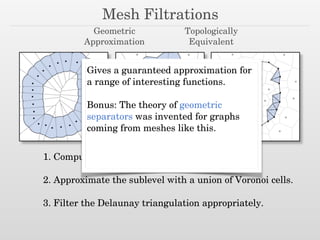
Gives a guaranteed approximation for
a range of interesting functions.
Bonus: The theory of geometric
separators was invented for graphs
coming from meshes like this.
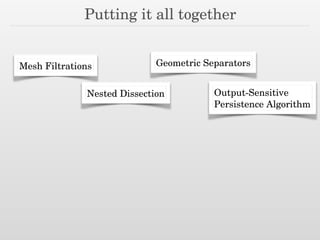
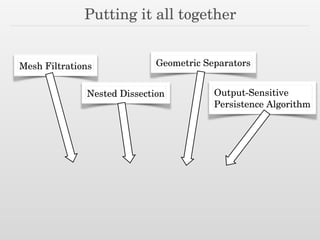
Putting it all together
Mesh Filtrations Geometric Separators
Nested Dissection Output-Sensitive
Persistence Algorithm
Putting it all together
Mesh Filtrations Geometric Separators
Nested Dissection Output-Sensitive
Persistence Algorithm
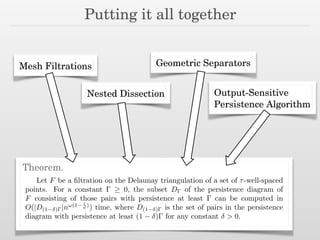
Theorem.
Let F be a filtration on the Delaunay triangulation of a set of ⌧-well-spaced
points. For a constant 0, the subset D of the persistence diagram of
F consisting of those pairs with persistence at least can be computed in
O(|D(1 ) |n!(1 1
d )
) time, where D(1 ) is the set of pairs in the persistence
diagram with persistence at least (1 ) for any constant > 0.
Putting it all together
Mesh Filtrations Geometric Separators
Nested Dissection Output-Sensitive
Persistence Algorithm
Summary
Summary
We can beat the matrix multiplication bound
for computing the persistent homology of a wide
class of functions defined on quality meshes.
Summary
We can beat the matrix multiplication bound
for computing the persistent homology of a wide
class of functions defined on quality meshes.
Summary
We can beat the matrix multiplication bound
for computing the persistent homology of a wide
class of functions defined on quality meshes.
The main technique is a combination of recent
advances in nested dissection, persistence
computation, and geometric separators.
Summary
We can beat the matrix multiplication bound
for computing the persistent homology of a wide
class of functions defined on quality meshes.
The main technique is a combination of recent
advances in nested dissection, persistence
computation, and geometric separators.
Thanks.
Persistent Homology and Nested Dissection

Persistent Homology and Nested Dissection

  • 1.
    Persistent Homology and Nested Dissection DonSheehy University of Connecticut ! joint work with Michael Kerber and Primoz Skraba
  • 2.
    A Topological DataAnalysis Pipeline
  • 3.
    A Topological DataAnalysis Pipeline Data Points
  • 4.
    A Topological DataAnalysis Pipeline Data Points a Function (Lipschitz)
  • 5.
    A Topological DataAnalysis Pipeline Data Points a Function (Lipschitz) A (filtered) Simplicial Complex (to approx. the function)
  • 6.
    A Topological DataAnalysis Pipeline Data Points a Function (Lipschitz) A (filtered) Simplicial Complex (to approx. the function) Compute Persistence
  • 7.
    A Topological DataAnalysis Pipeline Data Points a Function (Lipschitz) A (filtered) Simplicial Complex (to approx. the function) Compute Persistence Geometry
  • 8.
    A Topological DataAnalysis Pipeline Data Points a Function (Lipschitz) A (filtered) Simplicial Complex (to approx. the function) Compute Persistence Geometry Topology
  • 9.
    A Topological DataAnalysis Pipeline Data Points a Function (Lipschitz) A (filtered) Simplicial Complex (to approx. the function) Compute Persistence Geometry Topology What to compute?
  • 10.
    A Topological DataAnalysis Pipeline Data Points a Function (Lipschitz) A (filtered) Simplicial Complex (to approx. the function) Compute Persistence Geometry Topology What to compute? How to compute it?
  • 11.
    A Topological DataAnalysis Pipeline Data Points a Function (Lipschitz) A (filtered) Simplicial Complex (to approx. the function) Compute Persistence Geometry Topology What to compute? How to compute it? Q:Can we use the geometry to speed up the persistence computation?
  • 12.
    We want tobuild a filtered simplicial complex. Associate a birth time with each simplex in complex K. At timeα, we have a complex Kα consisting of all simplices born at or before time α. time
  • 13.
    We want tobuild a filtered simplicial complex. Associate a birth time with each simplex in complex K. At timeα, we have a complex Kα consisting of all simplices born at or before time α. time This can be represented by its boundary matrix D, with a fixed row order.
  • 14.
  • 15.
    Computing Persistent Homology Input:Boundary Matrix D Find V, R such that
  • 16.
    Computing Persistent Homology Input:Boundary Matrix D Find V, R such that D = RV
  • 17.
    Computing Persistent Homology Input:Boundary Matrix D Find V, R such that D = RV V is upper-triangular R is “reduced” (i.e. no two columns have lowest nonzeros in the same row)
  • 18.
    Computing Persistent Homology Input:Boundary Matrix D Find V, R such that D = RV V is upper-triangular R is “reduced” (i.e. no two columns have lowest nonzeros in the same row) Output is a collection of pairs corresponding to the lowest nonzeros in R.
  • 19.
    Computing Persistent Homology Input:Boundary Matrix D Find V, R such that D = RV V is upper-triangular R is “reduced” (i.e. no two columns have lowest nonzeros in the same row) It’s just Gaussian elimination! Output is a collection of pairs corresponding to the lowest nonzeros in R.
  • 20.
    The State ofthe Art Asymptotics
  • 21.
    The State ofthe Art Asymptotics “The Persistence Algorithm” [ELZ05] O(n3 )
  • 22.
    The State ofthe Art Asymptotics “The Persistence Algorithm” [ELZ05] via Matrix Multiplication [MMS11] O(n3 ) O(n! )
  • 23.
    The State ofthe Art Asymptotics “The Persistence Algorithm” [ELZ05] via Matrix Multiplication [MMS11] Output-Sensitive [CK12] O(|D(1 ) |n2 ) O(n3 ) O(n! )
  • 24.
    The State ofthe Art Asymptotics Heuristics “The Persistence Algorithm” [ELZ05] via Matrix Multiplication [MMS11] Output-Sensitive [CK12] O(|D(1 ) |n2 ) O(n3 ) O(n! )
  • 25.
    The State ofthe Art Asymptotics Heuristics “The Persistence Algorithm” [ELZ05] via Matrix Multiplication [MMS11] Output-Sensitive [CK12] Persistent Cohomology [MdSV-J11] O(|D(1 ) |n2 ) O(n3 ) O(n! )
  • 26.
    The State ofthe Art Asymptotics Heuristics “The Persistence Algorithm” [ELZ05] via Matrix Multiplication [MMS11] Output-Sensitive [CK12] Persistent Cohomology [MdSV-J11] Discrete Morse Reduction [MN13] O(|D(1 ) |n2 ) O(n3 ) O(n! )
  • 27.
    The State ofthe Art Asymptotics Heuristics “The Persistence Algorithm” [ELZ05] via Matrix Multiplication [MMS11] Output-Sensitive [CK12] Persistent Cohomology [MdSV-J11] Discrete Morse Reduction [MN13] Clear and Compress [BKR13] O(|D(1 ) |n2 ) O(n3 ) O(n! )
  • 28.
  • 29.
    Nested Dissection A methodfor solving symmetric positive definite linear systems.
  • 30.
    Nested Dissection A methodfor solving symmetric positive definite linear systems. Ax = b
  • 31.
    Nested Dissection A methodfor solving symmetric positive definite linear systems. Ax = b If A is n x n, consider the n vertex graph with an edge (i,j) for each nonzero entry A(i, j) of A.
  • 32.
    Nested Dissection A methodfor solving symmetric positive definite linear systems. Ax = b If A is n x n, consider the n vertex graph with an edge (i,j) for each nonzero entry A(i, j) of A.
  • 33.
    Nested Dissection A methodfor solving symmetric positive definite linear systems. Ax = b If A is n x n, consider the n vertex graph with an edge (i,j) for each nonzero entry A(i, j) of A. Find a vertex separator S such that
  • 34.
    Nested Dissection A methodfor solving symmetric positive definite linear systems. Ax = b If A is n x n, consider the n vertex graph with an edge (i,j) for each nonzero entry A(i, j) of A. Find a vertex separator S such that - |S| = O(nβ )
  • 35.
    Nested Dissection A methodfor solving symmetric positive definite linear systems. Ax = b If A is n x n, consider the n vertex graph with an edge (i,j) for each nonzero entry A(i, j) of A. Find a vertex separator S such that - |S| = O(nβ ) - each connected piece has O(n) vertices.
  • 36.
    Nested Dissection A methodfor solving symmetric positive definite linear systems. Ax = b If A is n x n, consider the n vertex graph with an edge (i,j) for each nonzero entry A(i, j) of A. Find a vertex separator S such that - |S| = O(nβ ) - each connected piece has O(n) vertices. The Punchline:
  • 37.
    Nested Dissection A methodfor solving symmetric positive definite linear systems. Ax = b If A is n x n, consider the n vertex graph with an edge (i,j) for each nonzero entry A(i, j) of A. Find a vertex separator S such that - |S| = O(nβ ) - each connected piece has O(n) vertices. The Punchline: Inverting A can be done in O(nβω ) time.
  • 38.
    Nested Dissection A methodfor solving symmetric positive definite linear systems. Ax = b If A is n x n, consider the n vertex graph with an edge (i,j) for each nonzero entry A(i, j) of A. Find a vertex separator S such that - |S| = O(nβ ) - each connected piece has O(n) vertices. The Punchline: Inverting A can be done in O(nβω ) time. Also works for computing ranks of singular, nonsymmetric matrices over finite fields.
  • 39.
  • 40.
  • 41.
  • 42.
    Sphere Separators Sparse: Intersectonly a sublinear number of disks.
  • 43.
    Sphere Separators Sparse: Intersectonly a sublinear number of disks. Balanced: Contains the centers of at least and at most a constant fraction of the disks.
  • 44.
    Sphere Separators Sparse: Intersectonly a sublinear number of disks. Balanced: Contains the centers of at least and at most a constant fraction of the disks. O(n1 1 d )
  • 45.
    Sphere Separators Sparse: Intersectonly a sublinear number of disks. Balanced: Contains the centers of at least and at most a constant fraction of the disks. O(n1 1 d ) n d + 2
  • 46.
    Persistent Homology andNested Dissection
  • 47.
    Persistent Homology andNested Dissection A Conundrum:
  • 48.
    Persistent Homology andNested Dissection A Conundrum: Nested dissection gives an improvement by choosing a good pivot order.
  • 49.
    Persistent Homology andNested Dissection A Conundrum: Nested dissection gives an improvement by choosing a good pivot order. Persistent homology restricts the pivot order.
  • 50.
    Persistent Homology andNested Dissection A Conundrum: Nested dissection gives an improvement by choosing a good pivot order. Persistent homology restricts the pivot order.
  • 51.
    Persistent Homology andNested Dissection A Conundrum: Nested dissection gives an improvement by choosing a good pivot order. Persistent homology restricts the pivot order. The first trick:
  • 52.
    Persistent Homology andNested Dissection A Conundrum: Nested dissection gives an improvement by choosing a good pivot order. Persistent homology restricts the pivot order. The first trick: In the output-sensitive persistence algorithm of Chen and Kerber, only ranks need to be computed.
  • 53.
    Persistent Homology andNested Dissection A Conundrum: Nested dissection gives an improvement by choosing a good pivot order. Persistent homology restricts the pivot order. The first trick: In the output-sensitive persistence algorithm of Chen and Kerber, only ranks need to be computed.
  • 54.
    Mesh Filtrations Geometric Approximation Topologically Equivalent 1. Computethe function on the vertices. ! 2. Approximate the sublevel with a union of Voronoi cells. ! 3. Filter the Delaunay triangulation appropriately.
  • 55.
    Mesh Filtrations Geometric Approximation Topologically Equivalent 1. Computethe function on the vertices. ! 2. Approximate the sublevel with a union of Voronoi cells. ! 3. Filter the Delaunay triangulation appropriately.
  • 56.
    Mesh Filtrations Geometric Approximation Topologically Equivalent 1. Computethe function on the vertices. ! 2. Approximate the sublevel with a union of Voronoi cells. ! 3. Filter the Delaunay triangulation appropriately. Gives a guaranteed approximation for a range of interesting functions.
  • 57.
    Mesh Filtrations Geometric Approximation Topologically Equivalent 1. Computethe function on the vertices. ! 2. Approximate the sublevel with a union of Voronoi cells. ! 3. Filter the Delaunay triangulation appropriately. Gives a guaranteed approximation for a range of interesting functions.
  • 58.
    Mesh Filtrations Geometric Approximation Topologically Equivalent 1. Computethe function on the vertices. ! 2. Approximate the sublevel with a union of Voronoi cells. ! 3. Filter the Delaunay triangulation appropriately. Gives a guaranteed approximation for a range of interesting functions. Bonus: The theory of geometric separators was invented for graphs coming from meshes like this.
  • 59.
  • 60.
    Putting it alltogether Mesh Filtrations Geometric Separators Nested Dissection Output-Sensitive Persistence Algorithm
  • 61.
    Putting it alltogether Mesh Filtrations Geometric Separators Nested Dissection Output-Sensitive Persistence Algorithm
  • 62.
    Theorem. Let F bea filtration on the Delaunay triangulation of a set of ⌧-well-spaced points. For a constant 0, the subset D of the persistence diagram of F consisting of those pairs with persistence at least can be computed in O(|D(1 ) |n!(1 1 d ) ) time, where D(1 ) is the set of pairs in the persistence diagram with persistence at least (1 ) for any constant > 0. Putting it all together Mesh Filtrations Geometric Separators Nested Dissection Output-Sensitive Persistence Algorithm
  • 63.
  • 64.
    Summary We can beatthe matrix multiplication bound for computing the persistent homology of a wide class of functions defined on quality meshes.
  • 65.
    Summary We can beatthe matrix multiplication bound for computing the persistent homology of a wide class of functions defined on quality meshes.
  • 66.
    Summary We can beatthe matrix multiplication bound for computing the persistent homology of a wide class of functions defined on quality meshes. The main technique is a combination of recent advances in nested dissection, persistence computation, and geometric separators.
  • 67.
    Summary We can beatthe matrix multiplication bound for computing the persistent homology of a wide class of functions defined on quality meshes. The main technique is a combination of recent advances in nested dissection, persistence computation, and geometric separators. Thanks.