A
Project report
On
EQUITY OPTION STRATEGIES
In partial fulfillment of the requirements of
Master of Management Studies
conducted by
University of Mumbai
through
Rizvi Institute of Management Studies & Research
under the guidance of
Prof. Vishal Singhi
Submitted by
ABBAS BADAMI
MMS
Batch: 2011 – 2013.
CERTIFICATE
This is to certify that Mr. Abbas Badami, a student of Rizvi Institute of Management
Studies and Research, of MMS III bearing Roll No. 7 and specializing in Finance has
successfully completed the project titled
“EQUITY OPTION STRATEGIES”
under the guidance of Prof. Vishal Singhi in partial fulfillment of the requirement of
Masters of Management Studies by University of Mumbai for the academic year 2011 –
2013.
_______________
Prof. Vishal Singhi
Project Guide
_______________ _______________
Prof. Umar Farooq Dr. Kalim Khan
Academic Co-ordinator Director
ACKNOWLEDGEMENT
I would like to express my sincere gratitude towards thanking the following people:
Prof. Vishal Singhi, Internal Mentor, for supporting & guiding me through my
summer internship project.
I thank Dr. Kalim Khan, Director, Rizvi Institute of Management studies &
Research, Mumbai, for providing me the opportunity to have such a good experience of
an internship project.
Finally, I am highly thankful to my parents, friends and my entire family, who
have supported me in this venture.
Abbas Badami
EXECUTIVE SUMMARY
India’s tryst with derivatives began in 2000 when both the NSE and the BSE
commenced trading in equity derivatives. In June 2000, index futures became the first
type of derivate instruments to be launched in the Indian markets, followed by index
options in June 2001, options in individual stocks in July 2001, and futures in single
stock derivatives in November 2001. Since then, equity derivatives have come a long
way. New products, an expanding list of eligible investors, rising volumes, and the best
risk management framework for exchange-traded derivatives have been the hallmark of
the journey of equity derivatives in India so far.
Derivatives may be traded for a variety of reasons. A derivative enables a trader
to hedge some preexisting risk by taking positions in derivatives markets that offset
potential losses in the underlying or spot market. In India, most derivatives users describe
themselves as hedgers (Fitch Ratings, 2004) and Indian laws generally require that
derivatives be used for hedging purposes only. Another motive for derivatives trading is
speculation (i.e. taking positions to profit from anticipated price movements). In practice,
it may be difficult to distinguish whether a particular trade was for hedging or
speculation, and active markets require the participation of both hedgers and speculators.
A third type of trader, called arbitrageurs, profit from discrepancies in the relationship of
spot and derivatives prices, and thereby help to keep markets efficient.
India’s experience with the equity derivatives market has been extremely positive.
The derivatives turnover on the NSE has surpassed the equity market turnover. The
turnover of derivatives on the NSE increased from 23,654 million in 2000–2001 to
292,482,211 million in 2010–2011, and reached 157,585,925 million in the first half of
2011–2012. The average daily turnover in these market segments on the NSE was
1,151,505 million in 2010–2011 compared to 723,921 in 2009–2010.
The objective of this project is to provide the reader with knowledge of the
various equity option strategies used today that are applicable in different market
situations.
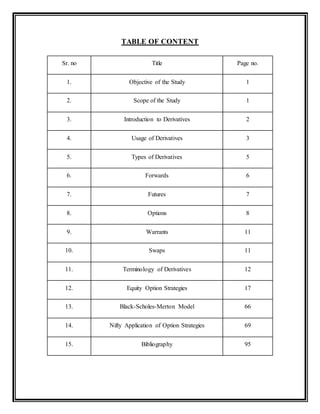
TABLE OF CONTENT
Sr. no Title Page no.
1. Objective of the Study 1
2. Scope of the Study 1
3. Introduction to Derivatives 2
4. Usage of Derivatives 3
5. Types of Derivatives 5
6. Forwards 6
7. Futures 7
8. Options 8
9. Warrants 11
10. Swaps 11
11. Terminology of Derivatives 12
12. Equity Option Strategies 17
13. Black-Scholes-Merton Model 66
14. Nifty Application of Option Strategies 69
15. Bibliography 95
Rizvi Institute of Management Studies and Research
Equity Option Strategies
Page | 1
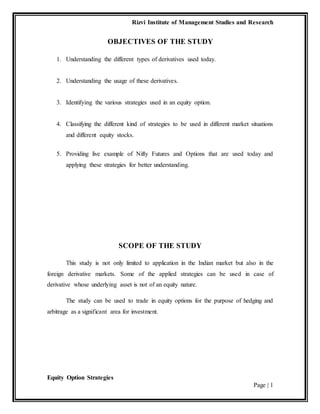
OBJECTIVES OF THE STUDY
1. Understanding the different types of derivatives used today.
2. Understanding the usage of these derivatives.
3. Identifying the various strategies used in an equity option.
4. Classifying the different kind of strategies to be used in different market situations
and different equity stocks.
5. Providing live example of Nifty Futures and Options that are used today and
applying these strategies for better understanding.
SCOPE OF THE STUDY
This study is not only limited to application in the Indian market but also in the
foreign derivative markets. Some of the applied strategies can be used in case of
derivative whose underlying asset is not of an equity nature.
The study can be used to trade in equity options for the purpose of hedging and
arbitrage as a significant area for investment.
Rizvi Institute of Management Studies and Research
Equity Option Strategies
Page | 2
Introduction to Derivatives
A derivative can be defined as a financial instrument whose value depends on (or
derivative from) the value of others, more basic, underlying variables. Very often the
variable underlying derivatives are the price of traded assets. A stock option, for example,
is a derivative whose value is dependent on the price of the stock. However, derivative
can be dependent on almost any variable, from the price of hogs to the amount of snow
falling at a certain ski resort.
A derivative instrument specifies conditions (especially the dates, resulting values
of the underlying variables, and notional amounts) under which payments, or payoffs, are
to be made between the parties. Derivatives are broadly categorized by the relationship
between the underlying asset and the derivative (such as forward, option, swap); the type
of underlying asset (such as equity derivatives, foreign exchange derivatives, interest rate
derivatives, commodity derivatives, or credit derivatives); the market in which they trade
(such as exchange-traded or over-the-counter); and their pay-off profile.
While trading in derivatives products has grown tremendously in recent times, the
earliest evidence of these types of instruments can be traced back to ancient Greece. Even
though derivatives have been in existence in some form or the other since ancient times,
the advent of modern day derivatives contracts is attributed to farmers’ need to protect
themselves against a decline in crop prices due to various economic and environmental
factors. Thus, derivatives contracts initially developed in commodities. The first “futures”
contracts can be traced to the Yodoya rice market in Osaka, Japan around 1650. The
farmers were afraid of rice prices falling in the future at the time of harvesting. To lock in
a price (that is, to sell the rice at a predetermined fixed price in the future), the farmers
entered into contracts with the buyers.
Rizvi Institute of Management Studies and Research
Equity Option Strategies
Page | 3
Usage of Derivatives
Hedging
Derivatives allow risk related to the price of the underlying asset to be transferred
from one party to another. For example, a wheat farmer and a miller could sign a futures
contract to exchange a specified amount of cash for a specified amount of wheat in the
future. Both parties have reduced a future risk: for the wheat farmer, the uncertainty of
the price, and for the miller, the availability of wheat. However, there is still the risk that
no wheat will be available because of events unspecified by the contract, such as the
weather, or that one party will renege on the contract. Although a third party, called a
clearing house, insures a futures contract, not all derivatives are insured against counter-
party risk.
From another perspective, the farmer and the miller both reduce a risk and acquire
a risk when they sign the futures contract: the farmer reduces the risk that the price of
wheat will fall below the price specified in the contract and acquires the risk that the price
of wheat will rise above the price specified in the contract (thereby losing additional
income that he could have earned). The miller, on the other hand, acquires the risk that
the price of wheat will fall below the price specified in the contract (thereby paying more
in the future than he otherwise would have) and reduces the risk that the price of wheat
will rise above the price specified in the contract. In this sense, one party is the insurer
(risk taker) for one type of risk, and the counter-party is the insurer (risk taker) for
another type of risk.
Hedging also occurs when an individual or institution buys an asset (such as a
commodity, a bond that has coupon payments, a stock that pays dividends, and so on) and
sells it using a futures contract. The individual or institution has access to the asset for a
specified amount of time, and can then sell it in the future at a specified price according
to the futures contract. Of course, this allows the individual or institution the benefit of
holding the asset, while reducing the risk that the future selling price will deviate
unexpectedly from the market's current assessment of the future value of the asset.
Rizvi Institute of Management Studies and Research
Equity Option Strategies
Page | 4
Derivatives can serve legitimate business purposes. For example, a corporation
borrows a large sum of money at a specific interest rate. The rate of interest on the loan
resets every six months. The corporation is concerned that the rate of interest may be
much higher in six months. The corporation could buy a forward rate agreement (FRA),
which is a contract to pay a fixed rate of interest six months after purchases on a notional
amount of money. If the interest rate after six months is above the contract rate, the seller
will pay the difference to the corporation, or FRA buyer. If the rate is lower, the
corporation will pay the difference to the seller. The purchase of the FRA serves to
reduce the uncertainty concerning the rate increase and stabilize earnings.
Speculation and arbitrage
Derivatives can be used to acquire risk, rather than to hedge against risk. Thus,
some individuals and institutions will enter into a derivative contract to speculate on the
value of the underlying asset, betting that the party seeking insurance will be wrong about
the future value of the underlying asset. Speculators look to buy an asset in the future at a
low price according to a derivative contract when the future market price is high, or to
sell an asset in the future at a high price according to a derivative contract when the
future market price is low.
Individuals and institutions may also look for arbitrage opportunities, as when the
current buying price of an asset falls below the price specified in a futures contract to sell
the asset.
Speculative trading in derivatives gained a great deal of notoriety in 1995 when
Nick Leeson, a trader at Barings Bank, made poor and unauthorized investments in
futures contracts. Through a combination of poor judgment, lack of oversight by the
bank's management and regulators, and unfortunate events like the Kobe earthquake,
Leeson incurred a US$1.3 billion loss that bankrupted the centuries-old institution.
Rizvi Institute of Management Studies and Research
Equity Option Strategies
Page | 5
Types of Derivatives
In broad terms, there are two groups of derivative contracts, which are distinguished by
the way they are traded in the market:
1. Over-the-counter (OTC) derivatives are contracts that are traded (and privately
negotiated) directly between two parties, without going through an exchange or
other intermediary. Products such as swaps, forward rate agreements, exotic
options - and other exotic derivatives - are almost always traded in this way. The
OTC derivative market is the largest market for derivatives, and is largely
unregulated with respect to disclosure of information between the parties, since
the OTC market is made up of banks and other highly sophisticated parties, such
as hedge funds. Reporting of OTC amounts are difficult because trades can occur
in private, without activity being visible on any exchange. According to the Bank
for International Settlements, the total outstanding notional amount is US$708
trillion (as of June 2011). Of this total notional amount, 67% are interest rate
contracts, 8% are credit default swaps (CDS), 9% are foreign exchange contracts,
2% are commodity contracts, 1% are equity contracts, and 12% are other.
Because OTC derivatives are not traded on an exchange, there is no central
counter-party. Therefore, they are subject to counter-party risk, like an ordinary
contract, since each counter-party relies on the other to perform.
2. Exchange-traded derivative contracts (ETD) are those derivatives instruments that
are traded via specialized derivatives exchanges or other exchanges. A derivatives
exchange is a market where individual’s trade standardized contracts that have
been defined by the exchange. A derivatives exchange acts as an intermediary to
all related transactions, and takes initial margin from both sides of the trade to act
as a guarantee. The world's largest derivatives exchanges (by number of
transactions) are the Korea Exchange (which lists KOSPI Index Futures &
Options), Eurex (which lists a wide range of European products such as interest
rate & index products), and CME Group (made up of the 2007 merger of the
Rizvi Institute of Management Studies and Research
Equity Option Strategies
Page | 6
Chicago Mercantile Exchange and the Chicago Board of Trade and the 2008
acquisition of the New York Mercantile Exchange). Some types of derivative
instruments also may trade on traditional exchanges. For instance, hybrid
instruments such as convertible bonds and/or convertible preferred may be listed
on stock or bond exchanges. Also, warrants (or "rights") may be listed on equity
exchanges.
Common derivative contract types
1. Forwards: A tailored contract between two parties, where payment takes place at
a specific time in the future at today's pre-determined price.
2. Futures: are contracts to buy or sell an asset on or before a future date at a price
specified today. A futures contract differs from a forward contract in that the
futures contract is a standardized contract written by a clearing house that
operates an exchange where the contract can be bought and sold; the forward
contract is a non-standardized contract written by the parties themselves.
3. Options: are contracts that give the owner the right, but not the obligation, to buy
(in the case of a call option) or sell (in the case of a put option) an asset. The price
at which the sale takes place is known as the strike price, and is specified at the
time the parties enter into the option. The option contract also specifies a maturity
date. If the owner of the contract exercises this right, the counter-party has the
obligation to carry out the transaction.
4. Warrants: Apart from the commonly used short-dated options which have a
maximum maturity period of 1 year, there exists certain long-dated options as
well, known as Warrant. These are generally traded over-the-counter.
5. Swaps: are contracts to exchange cash (flows) on or before a specified future date
based on the underlying value of currencies exchange rates, bonds/interest rates,
commodities exchange, stocks or other assets. Another term which is commonly
associated to Swap is Swaption which is basically an option on the forward Swap.
Rizvi Institute of Management Studies and Research
Equity Option Strategies
Page | 7
Forwards
A forward contract or simply a forward is a contract between two parties to buy or
sell an asset at a certain future date for a certain price that is pre-decided on the date of
the contract. The future date is referred to as expiry date and the pre-decided price is
referred to as Forward Price. It may be noted that Forwards are private contracts and their
terms are determined by the parties involved.
A forward is thus an agreement between two parties in which one party, the
buyer, enters into an agreement with the other party, the seller that he would buy from the
seller an underlying asset on the expiry date at the forward price. Therefore, it is a
commitment by both the parties to engage in a transaction at a later date with the price set
in advance. This is different from a spot market contract, which involves immediate
payment and immediate transfer of asset.
The party that agrees to buy the asset on a future date is referred to as a long
investor and is said to have a long position. Similarly the party that agrees to sell the asset
in a future date is referred to as a short investor and is said to have a short position. The
price agreed upon is called the delivery price or the Forward Price.
Forward contracts are traded only in Over the Counter (OTC) market and not in
stock exchanges. OTC market is a private market where individuals/institutions can trade
through negotiations on a one to one basis.
A drawback of forward contracts is that they are subject to default risk.
Regardless of whether the contract is for physical or cash settlement, there exists a
potential for one party to default, i.e. not honor the contract. It could be either the buyer
or the seller. This results in the other party suffering a loss. This risk of making losses
due to any of the two parties defaulting is known as counter party risk. The main reason
behind such risk is the absence of any mediator between the parties, who could have
undertaken the task of ensuring that both the parties fulfill their obligations arising out of
the contract. Default risk is also referred to as counter party risk or credit risk.
Rizvi Institute of Management Studies and Research
Equity Option Strategies
Page | 8
Futures
Like a forward contract, a futures contract is an agreement between two parties in
which the buyer agrees to buy an underlying asset from the seller, at a future date at a
price that is agreed upon today. However, unlike a forward contract, a futures contract is
not a private transaction but gets traded on a recognized stock exchange. In addition, a
futures contract is standardized by the exchange. All the terms, other than the price, are
set by the stock exchange (rather than by individual parties as in the case of a forward
contract).
Also, both buyer and seller of the futures contracts are protected against the
counter party risk by an entity called the Clearing Corporation. The Clearing Corporation
provides this guarantee to ensure that the buyer or the seller of a futures contract does not
suffer as a result of the counter party defaulting on its obligation. In case one of the
parties defaults, the Clearing Corporation steps in to fulfill the obligation of this party, so
that the other party does not suffer due to non-fulfillment of the contract. To be able to
guarantee the fulfillment of the obligations under the contract, the Clearing Corporation
holds an amount as a security from both the parties. This amount is called the Margin
money and can be in the form of cash or other financial assets. Also, since the futures
contracts are traded on the stock exchanges, the parties have the flexibility of closing out
the contract prior to the maturity by squaring off the transactions in the market.
The Pay-off of a futures contract on maturity depends on the spot price of the
underlying asset at the time of maturity and the price at which the contract was initially
traded. There are two positions that could be taken in a futures contract a Long position
(one who buys the asset at the futures price takes the long position) and Short position
(one who sells the asset at the futures price takes the short position).
Rizvi Institute of Management Studies and Research
Equity Option Strategies
Page | 9
Options
Like forwards and futures, options are derivative instruments that provide the
opportunity to buy or sell an underlying asset on a future date. An option is a derivative
contract between a buyer and a seller, where one party (say First Party) gives to the other
(say Second Party) the right, but not the obligation, to buy from (or sell to) the First Party
the underlying asset on or before a specific day at an agreed-upon price. In return for
granting the option, the party granting the option collects a payment from the other party.
This payment collected is called the “premium” or price of the option.
The right to buy or sell is held by the “option buyer” (also called the option
holder); the party granting the right is the “option seller” or “option writer”. Unlike
forwards and futures contracts, options require a cash payment (called the premium)
upfront from the option buyer to the option seller. This payment is called option premium
or option price. Options can be traded either on the stock exchange or in over the counter
(OTC) markets. Options traded on the exchanges are backed by the Clearing Corporation
thereby minimizing the risk arising due to default by the counter parties involved.
Options traded in the OTC market however are not backed by the Clearing Corporation.
In return for assuming the obligation, called writing the option, the originator of
the option collects a payment, the premium, from the buyer. The writer of an option must
make good on delivering (or receiving) the underlying asset or its cash equivalent, if the
option is exercised. An option can usually be sold by its original buyer to another party.
Many options are created in standardized form and traded on an anonymous options
exchange among the general public.
As with all securities, trading options entails the risk of the option's value
changing over time. However, unlike traditional securities, the return from holding an
option varies non-linearly with the value of the underlying and other factors. Therefore,
the risks associated with holding options are more complicated to understand and predict.
Rizvi Institute of Management Studies and Research
Equity Option Strategies
Page | 10
There are two types of options—call options and put options
Call option
A call option is an option granting the right to the buyer of the option to buy the
underlying asset on a specific day at an agreed upon price, but not the obligation to do so.
It is the seller who grants this right to the buyer of the option. It may be noted that the
person who has the right to buy the underlying asset is known as the “buyer of the call
option”. The price at which the buyer has the right to buy the asset is agreed upon at the
time of entering the contract. This price is known as the strike price of the contract (call
option strike price in this case). Since the buyer of the call option has the right (but no
obligation) to buy the underlying asset, he will exercise his right to buy the underlying
asset if and only if the price of the underlying asset in the market is more than the strike
price on or before the expiry date of the contract. The buyer of the call option does not
have an obligation to buy if he does not want to.
Put option
A put option is a contract granting the right to the buyer of the option to sell the
underlying asset on or before a specific day at an agreed upon price, but not the
obligation to do so. It is the seller who grants this right to the buyer of the option. The
person who has the right to sell the underlying asset is known as the “buyer of the put
option”. The price at which the buyer has the right to sell the asset is agreed upon at the
time of entering the contract. This price is known as the strike price of the contract (put
option strike price in this case). Since the buyer of the put option has the right (but not the
obligation) to sell the underlying asset, he will exercise his right to sell the underlying
asset if and only if the price of the underlying asset in the market is less than the strike
price on or before the expiry date of the contract. The buyer of the put option does not
have the obligation to sell if he does not want to.
Rizvi Institute of Management Studies and Research
Equity Option Strategies
Page | 11
Warrants
A warrant is a security that entitles the holder to buy the underlying stock of the
issuing company at a fixed exercise price until the expiry date.
Warrants and options are similar in that the two contractual financial instruments
allow the holder special rights to buy securities. Both are discretionary and have
expiration dates. The word warrant simply means to "endow with the right", which is
only slightly different from the meaning of option.
Warrants are frequently attached to bonds or preferred stock as a sweetener,
allowing the issuer to pay lower interest rates or dividends. They can be used to enhance
the yield of the bond, and make them more attractive to potential buyers. Warrants can
also be used in private equity deals. Frequently, these warrants are detachable, and can be
sold independently of the bond or stock.
Swaps
A swap is a derivative in which counterparties exchange cash flows of one party's
financial instrument for those of the other party's financial instrument. The benefits in
question depend on the type of financial instruments involved. The swap agreement
defines the dates when the cash flows are to be paid and the way they are calculated.
Usually at the time when the contract is initiated at least one of these series of cash flows
is determined by a random or uncertain variable such as an interest rate, foreign exchange
rate, equity price or commodity price.
The cash flows are calculated over a notional principal amount. Contrary to a
future, a forward or an option, the notional amount is usually not exchanged between
counterparties. Consequently, swaps can be in cash or collateral. Swaps can be used to
hedge certain risks such as interest rate risk, or to speculate on changes in the expected
direction of underlying prices.
Rizvi Institute of Management Studies and Research
Equity Option Strategies
Page | 12
Terminology of Derivatives
Spot price (ST)
Spot price of an underlying asset is the price that is quoted for immediate delivery of the
asset. Spot price is also referred to as cash price sometimes.
Forward price or futures price (F)
Forward price or futures price is the price that is agreed upon at the date of the contract
for the delivery of an asset at a specific future date. These prices are dependent on the
spot price, the prevailing interest rate and the expiry date of the contract.
Strike price (K)
The price at which the buyer of an option can buy the stock (in the case of a call option)
or sell the stock (in the case of a put option) on or before the expiry date of option
contracts is called strike price. It is the price at which the stock will be bought or sold
when the option is exercised. Strike price is used in the case of options only; it is not used
for futures or forwards.
Expiration date (T)
In the case of Futures, Forwards, Index and Stock Options, Expiration Date is the date on
which settlement takes place. It is also called the final settlement date.
Types of options
Options can be divided into two different categories depending upon the primary exercise
styles associated with options. These categories are:
European Options: European options are options that can be exercised only on the
expiration date.
American options: American options are options that can be exercised on any day on or
before the expiry date.
Rizvi Institute of Management Studies and Research
Equity Option Strategies
Page | 13
Contract size
As futures and options are standardized contracts traded on an exchange, they have a
fixed contract size. One contract of a derivatives instrument represents a certain number
of shares of the underlying asset.
Contract Value
Contract value is notional value of the transaction in case one contract is bought or sold.
It is the contract size multiplied but the price of the futures. Contract value is used to
calculate margins etc. for contracts.
Margins
In the spot market, the buyer of a stock has to pay the entire transaction amount (for
purchasing the stock) to the seller. In a derivatives contract, a person enters into a trade
today (buy or sell) but the settlement happens on a future date. Because of this, there is a
high possibility of default by any of the parties. Futures and option contracts are traded
through exchanges and the counter party risk is taken care of by the clearing corporation.
In order to prevent any of the parties from defaulting on his trade commitment, the
clearing corporation levies a margin on the buyer as well as seller of the futures and
option contracts. This margin is a percentage (approximately 20%) of the total contract
value. This margin is applicable to both, the buyer and the seller of a futures contract.
Moneyness of an Option
“Moneyness” of an option indicates whether an option is worth exercising or not i.e. if
the option is exercised by the buyer of the option whether he will receive money or not.
“Moneyness” of an option at any given time depends on where the spot price of the
underlying is at that point of time relative to the strike price. The premium paid is not
taken into consideration while calculating moneyness of an Option, since the premium
once paid is a sunk cost and the profitability from exercising the option does not depend
on the size of the premium. Therefore, the decision whether to exercise the option or not
is not affected by the size of the premium.
Rizvi Institute of Management Studies and Research
Equity Option Strategies
Page | 14
The following three terms are used to define the moneyness of an option:-
In-the-money option
An option is said to be in-the-money if on exercising the option, it would produce a cash
inflow for the buyer. Thus, Call Options are in-the-money when the value of spot price of
the underlying exceeds the strike price. On the other hand, Put Options are in-the- money
when the spot price of the underlying is lower than the strike price. Moneyness of an
option should not be confused with the profit and loss arising from holding an option
contract. It should be noted that while moneyness of an option does not depend on the
premium paid, profit/loss do. Thus a holder of an in-the-money option need not always
make profit as the profitability also depends on the premium paid.
Out-of-the-money option
An out-of-the-money option is an opposite of an in-the-money option. An option-holder
will not exercise the option when it is out-of-the-money. A Call option is out-of-the-
money when its strike price is greater than the spot price of the underlying and a Put
option is out-of-the money when the spot price of the underlying is greater than the
option’s strike price.
At-the-money option
An at-the-money-option is one in which the spot price of the underlying is equal to the
strike price. It is at the stage where with any movement in the spot price of the
underlying, the option will either become in-the-money or out-of-the-money.
Rizvi Institute of Management Studies and Research
Equity Option Strategies
Page | 15
Equity Option Strategies
Options strategies can favor movements in the underlying that are bullish, bearish
or neutral. In the case of neutral strategies, they can be further classified into those that
are bullish on volatility and those that are bearish on volatility. The option positions used
can be long and/or short positions in calls
Bullish strategies
Bullish options strategies are employed when the options trader expects the
underlying stock price to move upwards. It is necessary to assess how high the stock
price can go and the time frame in which the rally will occur in order to select the
optimum trading strategy. The most bullish of options trading strategies is the simple call
buying strategy used by most novice options traders.
Stocks seldom go up by leaps and bounds. Moderately bullish options traders
usually set a target price for the Bull Run and utilize bull spreads to reduce cost. (It does
not reduce risk because the options can still expire worthless). While maximum profit is
capped for these strategies, they usually cost less to employ for a given nominal amount
of exposure. The bull call spread and the bull put spread are common examples of
moderately bullish strategies.
Mildly bullish trading strategies are options strategies that make money as long as
the underlying stock price does not go down by the options expiration date. These
strategies may provide a small downside protection as well. Writing out-of-the-money
covered calls is a good example of such a strategy.
Bearish strategies
Bearish options strategies are employed when the options trader expects the
underlying stock price to move downwards. It is necessary to assess how low the stock
price can go and the time frame in which the decline will happen in order to select the
optimum trading strategy.
Rizvi Institute of Management Studies and Research
Equity Option Strategies
Page | 16
The most bearish of options trading strategies is the simple put buying strategy utilized
by most novice options traders. Stock prices only occasionally make steep downward
moves. Moderately bearish options traders usually set a target price for the expected
decline and utilize bear spreads to reduce cost. While maximum profit is capped for these
strategies, they usually cost less to employ. The bear call spread and the bear put spread
are common examples of moderately bearish strategies.
Mildly bearish trading strategies are options strategies that make money as long as
the underlying stock price does not go up by the options expiration date. These strategies
may provide a small upside protection as well. In general, bearish strategies yield less
profit with less risk of loss.
Neutral or non-directional strategies
Neutral strategies in options trading are employed when the options trader does
not know whether the underlying stock price will rise or fall. Also known as non-
directional strategies, they are so named because the potential to profit does not depend
on whether the underlying stock price will go upwards or downwards. Rather, the correct
neutral strategy to employ depends on the expected volatility of the underlying stock
price.
Bullish on volatility
Neutral trading strategies that are bullish on volatility profit when the underlying
stock price experiences big moves upwards or downwards. They include the long
straddle, long strangle, short condor and short butterfly.
Bearish on volatility
Neutral trading strategies that are bearish on volatility profit when the underlying
stock price experiences little or no movement. Such strategies include the short straddle,
short strangle, ratio spreads, long condor and long butterfly.
Rizvi Institute of Management Studies and Research
Equity Option Strategies
Page | 17
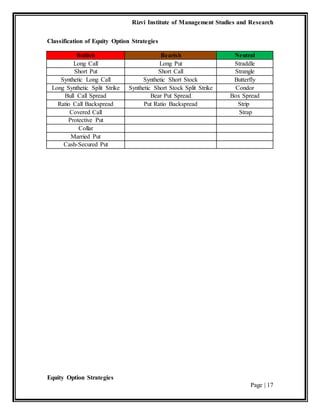
Classification of Equity Option Strategies
Bullish Bearish Neutral
Long Call Long Put Straddle
Short Put Short Call Strangle
Synthetic Long Call Synthetic Short Stock Butterfly
Long Synthetic Split Strike Synthetic Short Stock Split Strike Condor
Bull Call Spread Bear Put Spread Box Spread
Ratio Call Backspread Put Ratio Backspread Strip
Covered Call Strap
Protective Put
Collar
Married Put
Cash-Secured Put
Rizvi Institute of Management Studies and Research
Equity Option Strategies
Page | 18
Rizvi Institute of Management Studies and Research
Equity Option Strategies
Page | 19
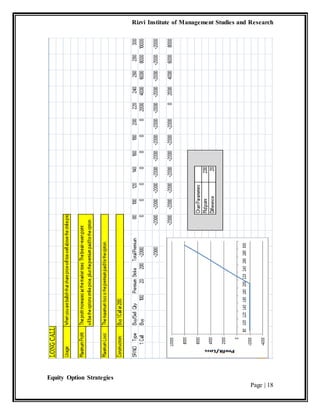
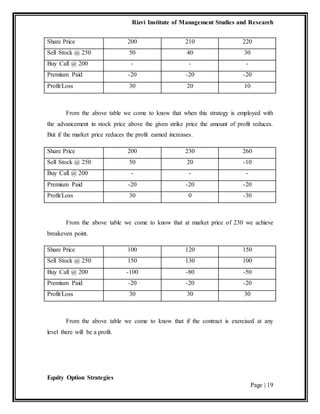
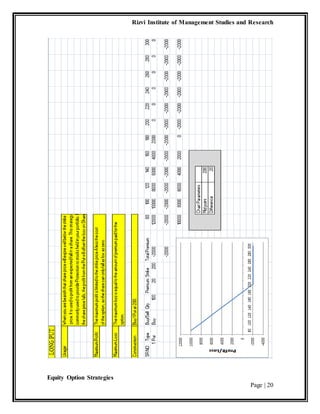
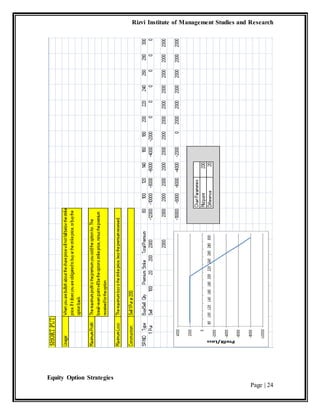
Share Price 200 210 220
Sell Stock @ 250 50 40 30
Buy Call @ 200 - - -
Premium Paid -20 -20 -20
Profit/Loss 30 20 10
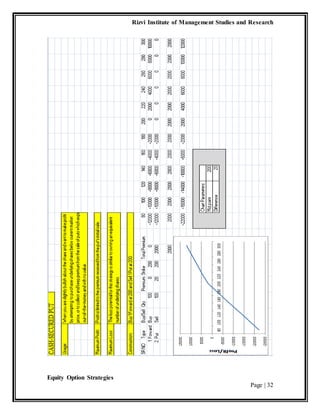
From the above table we come to know that when this strategy is employed with
the advancement in stock price above the given strike price the amount of profit reduces.
But if the market price reduces the profit earned increases.
Share Price 200 230 260
Sell Stock @ 250 50 20 -10
Buy Call @ 200 - - -
Premium Paid -20 -20 -20
Profit/Loss 30 0 -30
From the above table we come to know that at market price of 230 we achieve
breakeven point.
Share Price 100 120 150
Sell Stock @ 250 150 130 100
Buy Call @ 200 -100 -80 -50
Premium Paid -20 -20 -20
Profit/Loss 30 30 30
From the above table we come to know that if the contract is exercised at any
level there will be a profit.
Rizvi Institute of Management Studies and Research
Equity Option Strategies
Page | 20
Rizvi Institute of Management Studies and Research
Equity Option Strategies
Page | 21
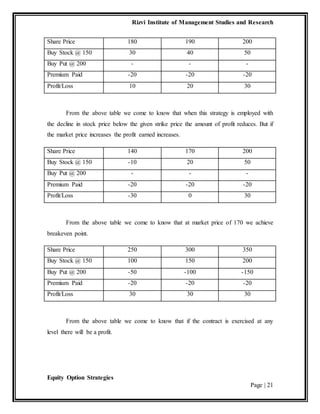
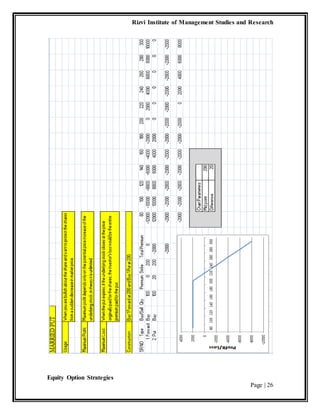
Share Price 180 190 200
Buy Stock @ 150 30 40 50
Buy Put @ 200 - - -
Premium Paid -20 -20 -20
Profit/Loss 10 20 30
From the above table we come to know that when this strategy is employed with
the decline in stock price below the given strike price the amount of profit reduces. But if
the market price increases the profit earned increases.
Share Price 140 170 200
Buy Stock @ 150 -10 20 50
Buy Put @ 200 - - -
Premium Paid -20 -20 -20
Profit/Loss -30 0 30
From the above table we come to know that at market price of 170 we achieve
breakeven point.
Share Price 250 300 350
Buy Stock @ 150 100 150 200
Buy Put @ 200 -50 -100 -150
Premium Paid -20 -20 -20
Profit/Loss 30 30 30
From the above table we come to know that if the contract is exercised at any
level there will be a profit.
Rizvi Institute of Management Studies and Research
Equity Option Strategies
Page | 22
Rizvi Institute of Management Studies and Research
Equity Option Strategies
Page | 23
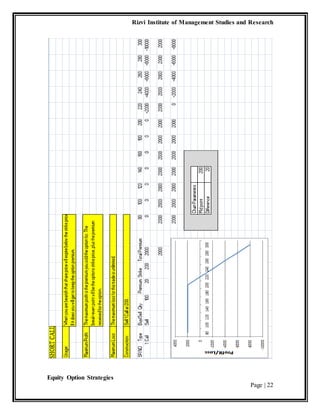
Share Price 150 170 200
Buy Stock @ 150 - 20 50
Sell Call @ 200 - - -
Premium Received 20 20 20
Profit/Loss 20 40 70
From the above table we come to know that when this strategy is employed with
the increase in stock price above the given strike price the amount of profit increases. But
if the market price reduces the profit earned reduces.
Share Price 100 130 160
Buy Stock @ 150 -50 -20 10
Sell Call @ 200 - - -
Premium Received 20 20 20
Profit/Loss -30 0 30
From the above table we come to know that at market price of 130 we achieve
breakeven point.
Share Price 250 300 350
Buy Stock @ 150 100 150 200
Sell Call @ 200 -50 -100 -150
Premium Received 20 20 20
Profit/Loss 70 70 70
From the above table we come to know that if the contract is exercised at any
level there will be a profit.
Rizvi Institute of Management Studies and Research
Equity Option Strategies
Page | 24
Rizvi Institute of Management Studies and Research
Equity Option Strategies
Page | 25
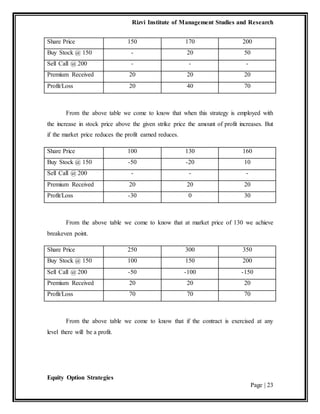
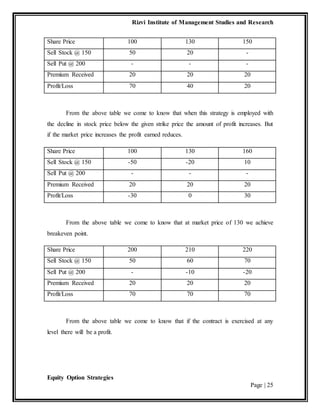
Share Price 100 130 150
Sell Stock @ 150 50 20 -
Sell Put @ 200 - - -
Premium Received 20 20 20
Profit/Loss 70 40 20
From the above table we come to know that when this strategy is employed with
the decline in stock price below the given strike price the amount of profit increases. But
if the market price increases the profit earned reduces.
Share Price 100 130 160
Sell Stock @ 150 -50 -20 10
Sell Put @ 200 - - -
Premium Received 20 20 20
Profit/Loss -30 0 30
From the above table we come to know that at market price of 130 we achieve
breakeven point.
Share Price 200 210 220
Sell Stock @ 150 50 60 70
Sell Put @ 200 - -10 -20
Premium Received 20 20 20
Profit/Loss 70 70 70
From the above table we come to know that if the contract is exercised at any
level there will be a profit.
Rizvi Institute of Management Studies and Research
Equity Option Strategies
Page | 26
Rizvi Institute of Management Studies and Research
Equity Option Strategies
Page | 27
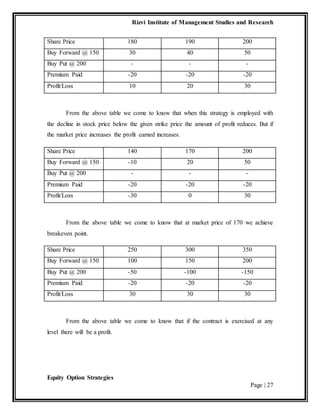
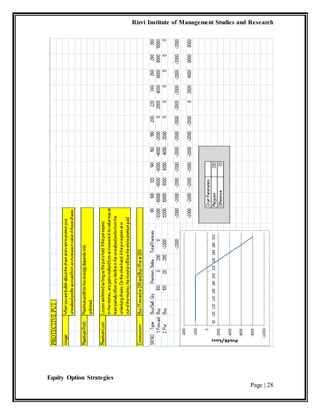
Share Price 180 190 200
Buy Forward @ 150 30 40 50
Buy Put @ 200 - - -
Premium Paid -20 -20 -20
Profit/Loss 10 20 30
From the above table we come to know that when this strategy is employed with
the decline in stock price below the given strike price the amount of profit reduces. But if
the market price increases the profit earned increases.
Share Price 140 170 200
Buy Forward @ 150 -10 20 50
Buy Put @ 200 - - -
Premium Paid -20 -20 -20
Profit/Loss -30 0 30
From the above table we come to know that at market price of 170 we achieve
breakeven point.
Share Price 250 300 350
Buy Forward @ 150 100 150 200
Buy Put @ 200 -50 -100 -150
Premium Paid -20 -20 -20
Profit/Loss 30 30 30
From the above table we come to know that if the contract is exercised at any
level there will be a profit.
Rizvi Institute of Management Studies and Research
Equity Option Strategies
Page | 28
Rizvi Institute of Management Studies and Research
Equity Option Strategies
Page | 29
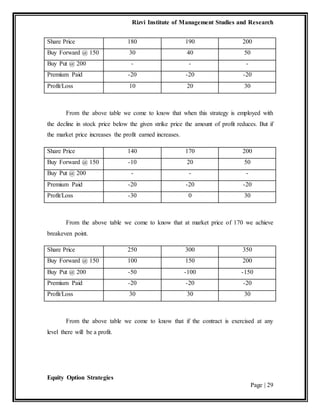
Share Price 180 190 200
Buy Forward @ 150 30 40 50
Buy Put @ 200 - - -
Premium Paid -20 -20 -20
Profit/Loss 10 20 30
From the above table we come to know that when this strategy is employed with
the decline in stock price below the given strike price the amount of profit reduces. But if
the market price increases the profit earned increases.
Share Price 140 170 200
Buy Forward @ 150 -10 20 50
Buy Put @ 200 - - -
Premium Paid -20 -20 -20
Profit/Loss -30 0 30
From the above table we come to know that at market price of 170 we achieve
breakeven point.
Share Price 250 300 350
Buy Forward @ 150 100 150 200
Buy Put @ 200 -50 -100 -150
Premium Paid -20 -20 -20
Profit/Loss 30 30 30
From the above table we come to know that if the contract is exercised at any
level there will be a profit.
Rizvi Institute of Management Studies and Research
Equity Option Strategies
Page | 30
Rizvi Institute of Management Studies and Research
Equity Option Strategies
Page | 31
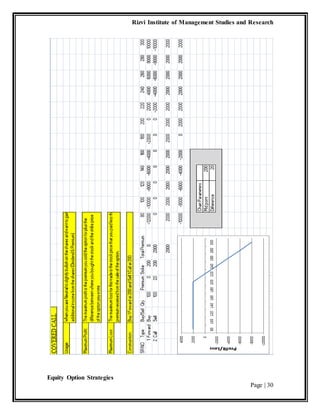
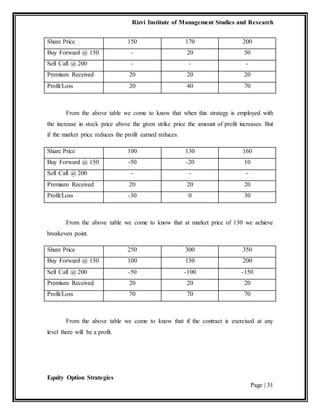
Share Price 150 170 200
Buy Forward @ 150 - 20 50
Sell Call @ 200 - - -
Premium Received 20 20 20
Profit/Loss 20 40 70
From the above table we come to know that when this strategy is employed with
the increase in stock price above the given strike price the amount of profit increases. But
if the market price reduces the profit earned reduces.
Share Price 100 130 160
Buy Forward @ 150 -50 -20 10
Sell Call @ 200 - - -
Premium Received 20 20 20
Profit/Loss -30 0 30
From the above table we come to know that at market price of 130 we achieve
breakeven point.
Share Price 250 300 350
Buy Forward @ 150 100 150 200
Sell Call @ 200 -50 -100 -150
Premium Received 20 20 20
Profit/Loss 70 70 70
From the above table we come to know that if the contract is exercised at any
level there will be a profit.
Rizvi Institute of Management Studies and Research
Equity Option Strategies
Page | 32
Rizvi Institute of Management Studies and Research
Equity Option Strategies
Page | 33
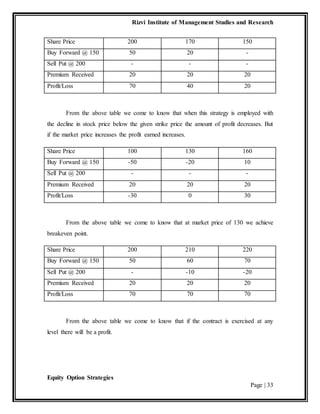
Share Price 200 170 150
Buy Forward @ 150 50 20 -
Sell Put @ 200 - - -
Premium Received 20 20 20
Profit/Loss 70 40 20
From the above table we come to know that when this strategy is employed with
the decline in stock price below the given strike price the amount of profit decreases. But
if the market price increases the profit earned increases.
Share Price 100 130 160
Buy Forward @ 150 -50 -20 10
Sell Put @ 200 - - -
Premium Received 20 20 20
Profit/Loss -30 0 30
From the above table we come to know that at market price of 130 we achieve
breakeven point.
Share Price 200 210 220
Buy Forward @ 150 50 60 70
Sell Put @ 200 - -10 -20
Premium Received 20 20 20
Profit/Loss 70 70 70
From the above table we come to know that if the contract is exercised at any
level there will be a profit.
Rizvi Institute of Management Studies and Research
Equity Option Strategies
Page | 34
Rizvi Institute of Management Studies and Research
Equity Option Strategies
Page | 35
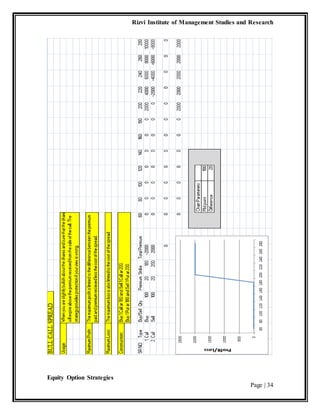
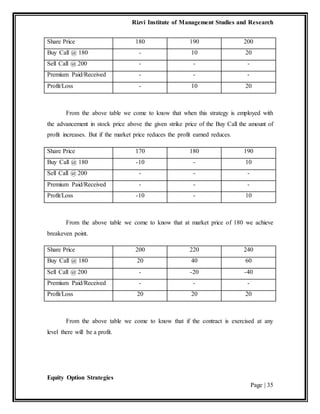
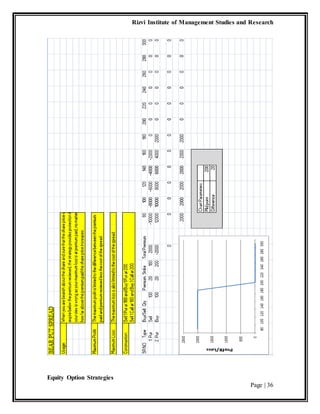
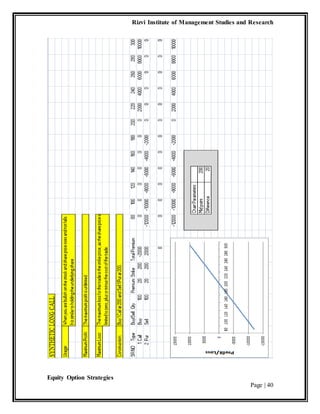
Share Price 180 190 200
Buy Call @ 180 - 10 20
Sell Call @ 200 - - -
Premium Paid/Received - - -
Profit/Loss - 10 20
From the above table we come to know that when this strategy is employed with
the advancement in stock price above the given strike price of the Buy Call the amount of
profit increases. But if the market price reduces the profit earned reduces.
Share Price 170 180 190
Buy Call @ 180 -10 - 10
Sell Call @ 200 - - -
Premium Paid/Received - - -
Profit/Loss -10 - 10
From the above table we come to know that at market price of 180 we achieve
breakeven point.
Share Price 200 220 240
Buy Call @ 180 20 40 60
Sell Call @ 200 - -20 -40
Premium Paid/Received - - -
Profit/Loss 20 20 20
From the above table we come to know that if the contract is exercised at any
level there will be a profit.
Rizvi Institute of Management Studies and Research
Equity Option Strategies
Page | 36
Rizvi Institute of Management Studies and Research
Equity Option Strategies
Page | 37
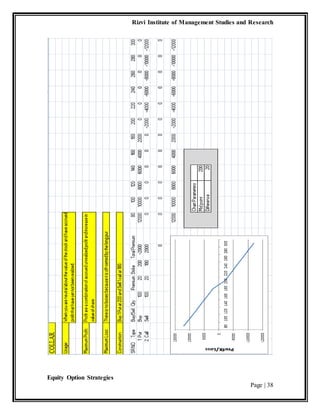
Share Price 180 190 200
Sell Put @ 180 - - -
Buy Put @ 200 20 10 -
Premium Paid/Received - - -
Profit/Loss 20 10 -
From the above table we come to know that when this strategy is employed with
the decline in stock price below the Buy Put strike price the amount of profit increases.
But if the market price increases the profit earned reduces.
Share Price 190 200 210
Sell Put @ 180 - - -
Buy Put @ 200 10 - -10
Premium Paid/Received - - -
Profit/Loss 10 - -10
From the above table we come to know that at market price of 200 we achieve
breakeven point.
Share Price 160 170 180
Sell Put @ 180 -20 -10 -
Buy Put @ 200 40 30 20
Premium Paid/Received - - -
Profit/Loss 20 20 20
From the above table we come to know that if the contract is exercised at any
level there will be a profit.
Rizvi Institute of Management Studies and Research
Equity Option Strategies
Page | 38
Rizvi Institute of Management Studies and Research
Equity Option Strategies
Page | 39
Share Price 170 180 190
Buy Put @ 180 30 20 10
Sell Call @ 200 - - -
Premium Paid/Received - - -
Profit/Loss 30 20 10
From the above table we come to know that when this strategy is employed with
the advancement in stock price above the amount of profit decreases. But if the market
price reduces the profit earned increases.
Share Price 180 190 200
Buy Put @ 180 20 10 -
Sell Call @ 200 - -10 -20
Premium Paid/Received - - -
Profit/Loss 20 - -20
From the above table we come to know that at market price of 190 we achieve
breakeven point.
Share Price 170 180 190
Buy Put @ 180 30 20 10
Sell Call @ 200 - - -
Premium Paid/Received - - -
Profit/Loss 30 20 10
From the above table we come to know that if the contract is exercised at any
level there will never be a constant amount of profit.
Rizvi Institute of Management Studies and Research
Equity Option Strategies
Page | 40
Rizvi Institute of Management Studies and Research
Equity Option Strategies
Page | 41
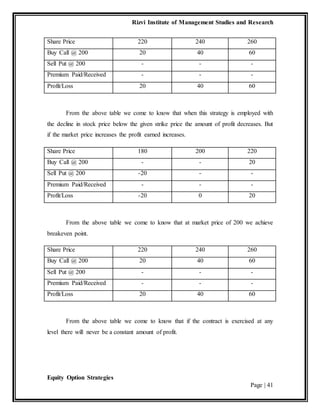
Share Price 220 240 260
Buy Call @ 200 20 40 60
Sell Put @ 200 - - -
Premium Paid/Received - - -
Profit/Loss 20 40 60
From the above table we come to know that when this strategy is employed with
the decline in stock price below the given strike price the amount of profit decreases. But
if the market price increases the profit earned increases.
Share Price 180 200 220
Buy Call @ 200 - - 20
Sell Put @ 200 -20 - -
Premium Paid/Received - - -
Profit/Loss -20 0 20
From the above table we come to know that at market price of 200 we achieve
breakeven point.
Share Price 220 240 260
Buy Call @ 200 20 40 60
Sell Put @ 200 - - -
Premium Paid/Received - - -
Profit/Loss 20 40 60
From the above table we come to know that if the contract is exercised at any
level there will never be a constant amount of profit.
Rizvi Institute of Management Studies and Research
Equity Option Strategies
Page | 42
Rizvi Institute of Management Studies and Research
Equity Option Strategies
Page | 43
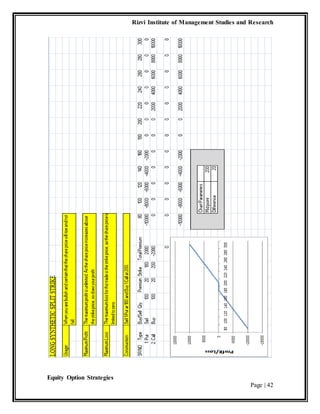
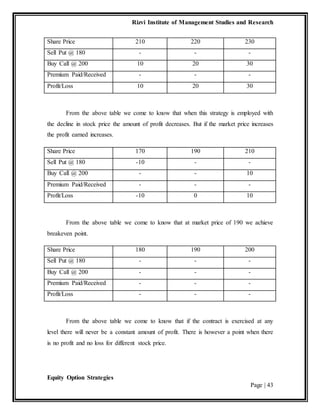
Share Price 210 220 230
Sell Put @ 180 - - -
Buy Call @ 200 10 20 30
Premium Paid/Received - - -
Profit/Loss 10 20 30
From the above table we come to know that when this strategy is employed with
the decline in stock price the amount of profit decreases. But if the market price increases
the profit earned increases.
Share Price 170 190 210
Sell Put @ 180 -10 - -
Buy Call @ 200 - - 10
Premium Paid/Received - - -
Profit/Loss -10 0 10
From the above table we come to know that at market price of 190 we achieve
breakeven point.
Share Price 180 190 200
Sell Put @ 180 - - -
Buy Call @ 200 - - -
Premium Paid/Received - - -
Profit/Loss - - -
From the above table we come to know that if the contract is exercised at any
level there will never be a constant amount of profit. There is however a point when there
is no profit and no loss for different stock price.
Rizvi Institute of Management Studies and Research
Equity Option Strategies
Page | 44
Rizvi Institute of Management Studies and Research
Equity Option Strategies
Page | 45
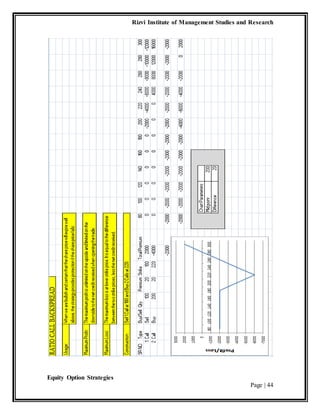
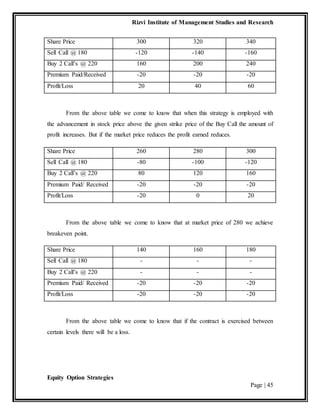
Share Price 300 320 340
Sell Call @ 180 -120 -140 -160
Buy 2 Call’s @ 220 160 200 240
Premium Paid/Received -20 -20 -20
Profit/Loss 20 40 60
From the above table we come to know that when this strategy is employed with
the advancement in stock price above the given strike price of the Buy Call the amount of
profit increases. But if the market price reduces the profit earned reduces.
Share Price 260 280 300
Sell Call @ 180 -80 -100 -120
Buy 2 Call’s @ 220 80 120 160
Premium Paid/ Received -20 -20 -20
Profit/Loss -20 0 20
From the above table we come to know that at market price of 280 we achieve
breakeven point.
Share Price 140 160 180
Sell Call @ 180 - - -
Buy 2 Call’s @ 220 - - -
Premium Paid/ Received -20 -20 -20
Profit/Loss -20 -20 -20
From the above table we come to know that if the contract is exercised between
certain levels there will be a loss.
Rizvi Institute of Management Studies and Research
Equity Option Strategies
Page | 46
Rizvi Institute of Management Studies and Research
Equity Option Strategies
Page | 47
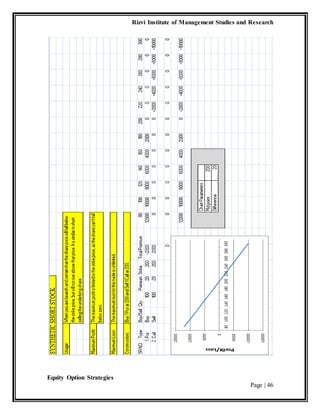
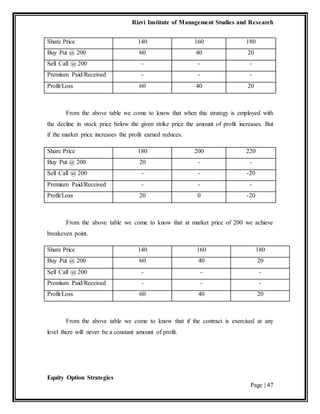
Share Price 140 160 180
Buy Put @ 200 60 40 20
Sell Call @ 200 - - -
Premium Paid/Received - - -
Profit/Loss 60 40 20
From the above table we come to know that when this strategy is employed with
the decline in stock price below the given strike price the amount of profit increases. But
if the market price increases the profit earned reduces.
Share Price 180 200 220
Buy Put @ 200 20 - -
Sell Call @ 200 - - -20
Premium Paid/Received - - -
Profit/Loss 20 0 -20
From the above table we come to know that at market price of 200 we achieve
breakeven point.
Share Price 140 160 180
Buy Put @ 200 60 40 20
Sell Call @ 200 - - -
Premium Paid/Received - - -
Profit/Loss 60 40 20
From the above table we come to know that if the contract is exercised at any
level there will never be a constant amount of profit.
Rizvi Institute of Management Studies and Research
Equity Option Strategies
Page | 48
Rizvi Institute of Management Studies and Research
Equity Option Strategies
Page | 49
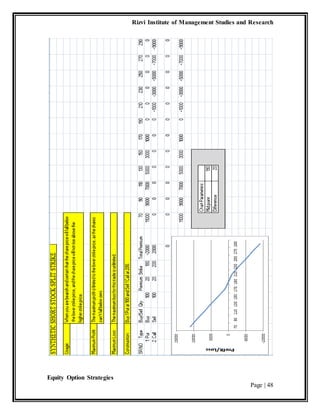
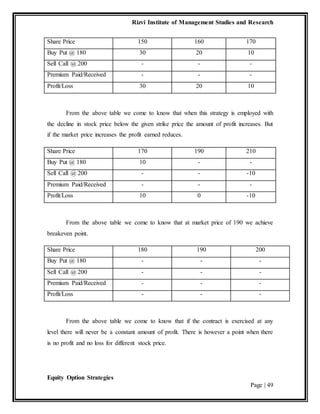
Share Price 150 160 170
Buy Put @ 180 30 20 10
Sell Call @ 200 - - -
Premium Paid/Received - - -
Profit/Loss 30 20 10
From the above table we come to know that when this strategy is employed with
the decline in stock price below the given strike price the amount of profit increases. But
if the market price increases the profit earned reduces.
Share Price 170 190 210
Buy Put @ 180 10 - -
Sell Call @ 200 - - -10
Premium Paid/Received - - -
Profit/Loss 10 0 -10
From the above table we come to know that at market price of 190 we achieve
breakeven point.
Share Price 180 190 200
Buy Put @ 180 - - -
Sell Call @ 200 - - -
Premium Paid/Received - - -
Profit/Loss - - -
From the above table we come to know that if the contract is exercised at any
level there will never be a constant amount of profit. There is however a point when there
is no profit and no loss for different stock price.
Rizvi Institute of Management Studies and Research
Equity Option Strategies
Page | 50
Rizvi Institute of Management Studies and Research
Equity Option Strategies
Page | 51
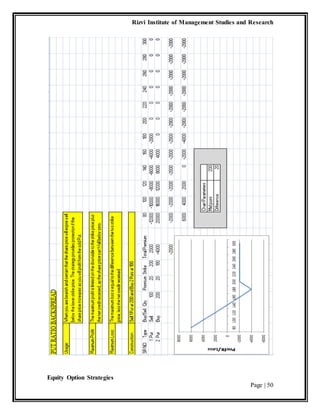
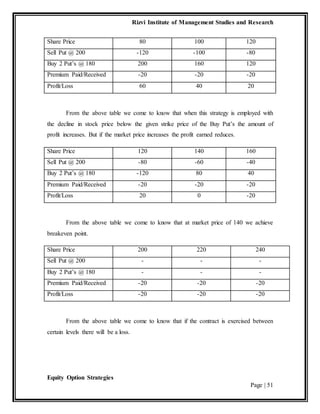
Share Price 80 100 120
Sell Put @ 200 -120 -100 -80
Buy 2 Put’s @ 180 200 160 120
Premium Paid/Received -20 -20 -20
Profit/Loss 60 40 20
From the above table we come to know that when this strategy is employed with
the decline in stock price below the given strike price of the Buy Put’s the amount of
profit increases. But if the market price increases the profit earned reduces.
Share Price 120 140 160
Sell Put @ 200 -80 -60 -40
Buy 2 Put’s @ 180 -120 80 40
Premium Paid/Received -20 -20 -20
Profit/Loss 20 0 -20
From the above table we come to know that at market price of 140 we achieve
breakeven point.
Share Price 200 220 240
Sell Put @ 200 - - -
Buy 2 Put’s @ 180 - - -
Premium Paid/Received -20 -20 -20
Profit/Loss -20 -20 -20
From the above table we come to know that if the contract is exercised between
certain levels there will be a loss.
Rizvi Institute of Management Studies and Research
Equity Option Strategies
Page | 52
Rizvi Institute of Management Studies and Research
Equity Option Strategies
Page | 53
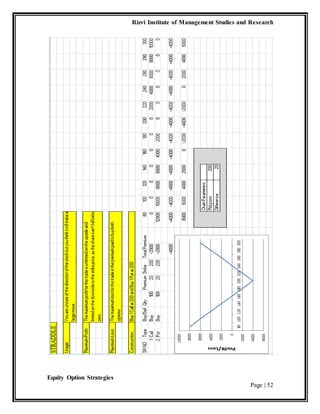
Share Price 260 280 300
Buy Call @ 200 60 80 100
Buy Put @ 200 - - -
Premium Paid -40 -40 -40
Profit/Loss 20 40 60
From the above table we come to know that when this strategy is employed with
the advancement in stock price above the given strike price the amount of profit
increases. But if the market price reduces the profit earned reduces. However below a
certain level (i.e. 160) if the market price falls there is more amount of profit earned for
more fall in price.
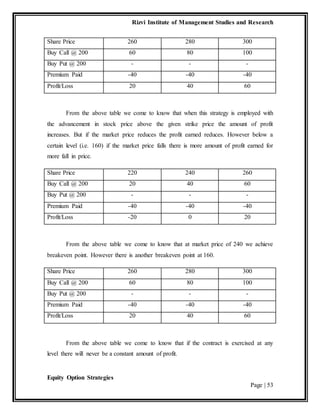
Share Price 220 240 260
Buy Call @ 200 20 40 60
Buy Put @ 200 - - -
Premium Paid -40 -40 -40
Profit/Loss -20 0 20
From the above table we come to know that at market price of 240 we achieve
breakeven point. However there is another breakeven point at 160.
Share Price 260 280 300
Buy Call @ 200 60 80 100
Buy Put @ 200 - - -
Premium Paid -40 -40 -40
Profit/Loss 20 40 60
From the above table we come to know that if the contract is exercised at any
level there will never be a constant amount of profit.
Rizvi Institute of Management Studies and Research
Equity Option Strategies
Page | 54
Rizvi Institute of Management Studies and Research
Equity Option Strategies
Page | 55
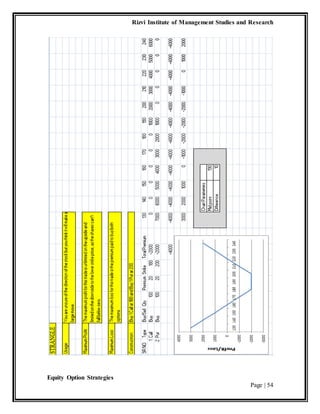
Share Price 240 260 280
Buy Call @ 180 60 80 100
Buy Put @ 200 - - -
Premium Paid -40 -40 -40
Profit/Loss 20 40 60
From the above table we come to know that when this strategy is employed with
the advancement in stock price above the given strike price the amount of profit
increases. But if the market price reduces the profit earned reduces. However below a
certain level (i.e. 160) if the market price falls there is more amount of profit earned for
more fall in price.
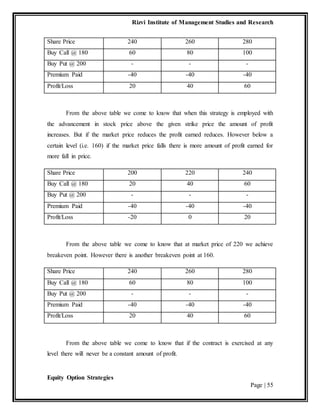
Share Price 200 220 240
Buy Call @ 180 20 40 60
Buy Put @ 200 - - -
Premium Paid -40 -40 -40
Profit/Loss -20 0 20
From the above table we come to know that at market price of 220 we achieve
breakeven point. However there is another breakeven point at 160.
Share Price 240 260 280
Buy Call @ 180 60 80 100
Buy Put @ 200 - - -
Premium Paid -40 -40 -40
Profit/Loss 20 40 60
From the above table we come to know that if the contract is exercised at any
level there will never be a constant amount of profit.
Rizvi Institute of Management Studies and Research
Equity Option Strategies
Page | 56
Rizvi Institute of Management Studies and Research
Equity Option Strategies
Page | 57
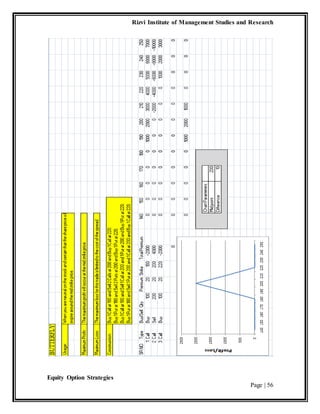
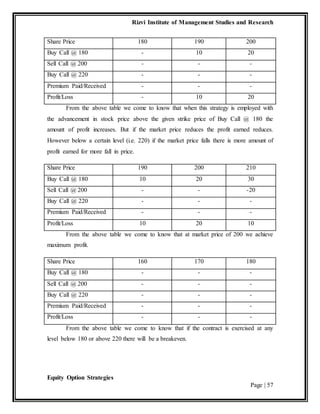
Share Price 180 190 200
Buy Call @ 180 - 10 20
Sell Call @ 200 - - -
Buy Call @ 220 - - -
Premium Paid/Received - - -
Profit/Loss - 10 20
From the above table we come to know that when this strategy is employed with
the advancement in stock price above the given strike price of Buy Call @ 180 the
amount of profit increases. But if the market price reduces the profit earned reduces.
However below a certain level (i.e. 220) if the market price falls there is more amount of
profit earned for more fall in price.
Share Price 190 200 210
Buy Call @ 180 10 20 30
Sell Call @ 200 - - -20
Buy Call @ 220 - - -
Premium Paid/Received - - -
Profit/Loss 10 20 10
From the above table we come to know that at market price of 200 we achieve
maximum profit.
Share Price 160 170 180
Buy Call @ 180 - - -
Sell Call @ 200 - - -
Buy Call @ 220 - - -
Premium Paid/Received - - -
Profit/Loss - - -
From the above table we come to know that if the contract is exercised at any
level below 180 or above 220 there will be a breakeven.
Rizvi Institute of Management Studies and Research
Equity Option Strategies
Page | 58
Rizvi Institute of Management Studies and Research
Equity Option Strategies
Page | 59
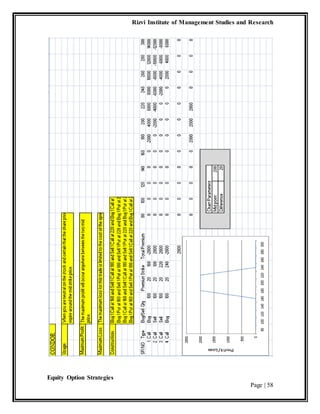
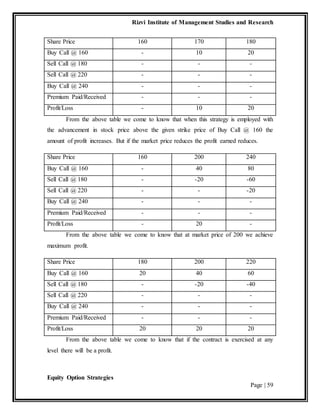
Share Price 160 170 180
Buy Call @ 160 - 10 20
Sell Call @ 180 - - -
Sell Call @ 220 - - -
Buy Call @ 240 - - -
Premium Paid/Received - - -
Profit/Loss - 10 20
From the above table we come to know that when this strategy is employed with
the advancement in stock price above the given strike price of Buy Call @ 160 the
amount of profit increases. But if the market price reduces the profit earned reduces.
Share Price 160 200 240
Buy Call @ 160 - 40 80
Sell Call @ 180 - -20 -60
Sell Call @ 220 - - -20
Buy Call @ 240 - - -
Premium Paid/Received - - -
Profit/Loss - 20 -
From the above table we come to know that at market price of 200 we achieve
maximum profit.
Share Price 180 200 220
Buy Call @ 160 20 40 60
Sell Call @ 180 - -20 -40
Sell Call @ 220 - - -
Buy Call @ 240 - - -
Premium Paid/Received - - -
Profit/Loss 20 20 20
From the above table we come to know that if the contract is exercised at any
level there will be a profit.
Rizvi Institute of Management Studies and Research
Equity Option Strategies
Page | 60
Rizvi Institute of Management Studies and Research
Equity Option Strategies
Page | 61
Share Price 200 220 240
Buy Call @ 200 - 20 40
Sell Call @ 200 - -20 -40
Sell Put @ 200 - - -
Buy Put @ 200 - - -
Premium Paid/Received - - -
Profit/Loss - - -
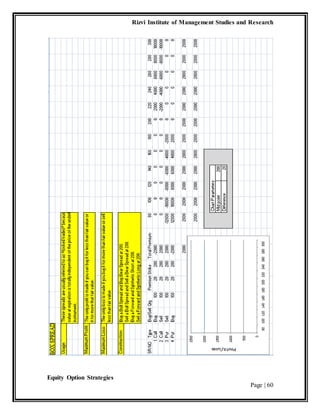
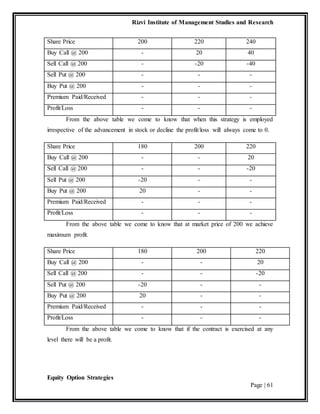
From the above table we come to know that when this strategy is employed
irrespective of the advancement in stock or decline the profit/loss will always come to 0.
Share Price 180 200 220
Buy Call @ 200 - - 20
Sell Call @ 200 - - -20
Sell Put @ 200 -20 - -
Buy Put @ 200 20 - -
Premium Paid/Received - - -
Profit/Loss - - -
From the above table we come to know that at market price of 200 we achieve
maximum profit.
Share Price 180 200 220
Buy Call @ 200 - - 20
Sell Call @ 200 - - -20
Sell Put @ 200 -20 - -
Buy Put @ 200 20 - -
Premium Paid/Received - - -
Profit/Loss - - -
From the above table we come to know that if the contract is exercised at any
level there will be a profit.
Rizvi Institute of Management Studies and Research
Equity Option Strategies
Page | 62
Rizvi Institute of Management Studies and Research
Equity Option Strategies
Page | 63
Share Price 260 280 300
Buy Call @ 200 60 80 100
Buy 2 Put’s @ 200 - - -
Premium Paid/Received -60 -60 -60
Profit/Loss - 20 40
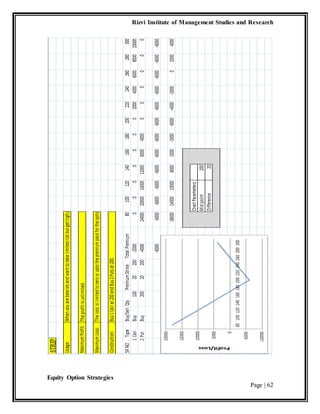
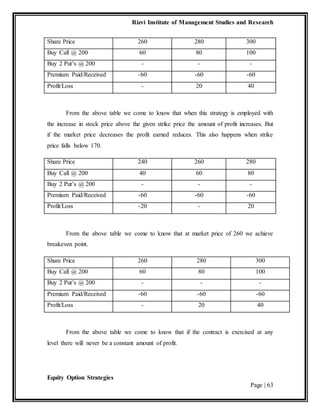
From the above table we come to know that when this strategy is employed with
the increase in stock price above the given strike price the amount of profit increases. But
if the market price decreases the profit earned reduces. This also happens when strike
price falls below 170.
Share Price 240 260 280
Buy Call @ 200 40 60 80
Buy 2 Put’s @ 200 - - -
Premium Paid/Received -60 -60 -60
Profit/Loss -20 - 20
From the above table we come to know that at market price of 260 we achieve
breakeven point.
Share Price 260 280 300
Buy Call @ 200 60 80 100
Buy 2 Put’s @ 200 - - -
Premium Paid/Received -60 -60 -60
Profit/Loss - 20 40
From the above table we come to know that if the contract is exercised at any
level there will never be a constant amount of profit.
Rizvi Institute of Management Studies and Research
Equity Option Strategies
Page | 64
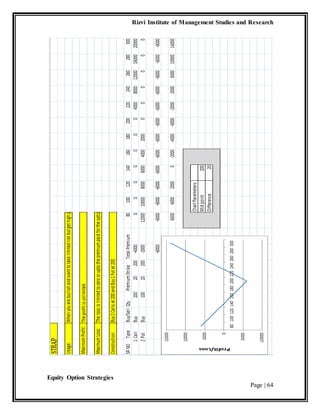
Rizvi Institute of Management Studies and Research
Equity Option Strategies
Page | 65
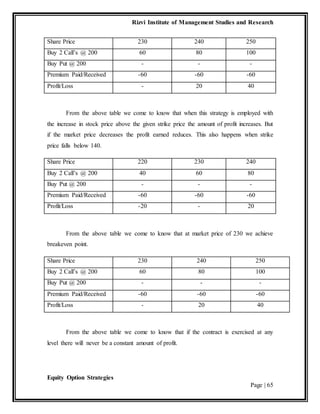
Share Price 230 240 250
Buy 2 Call’s @ 200 60 80 100
Buy Put @ 200 - - -
Premium Paid/Received -60 -60 -60
Profit/Loss - 20 40
From the above table we come to know that when this strategy is employed with
the increase in stock price above the given strike price the amount of profit increases. But
if the market price decreases the profit earned reduces. This also happens when strike
price falls below 140.
Share Price 220 230 240
Buy 2 Call’s @ 200 40 60 80
Buy Put @ 200 - - -
Premium Paid/Received -60 -60 -60
Profit/Loss -20 - 20
From the above table we come to know that at market price of 230 we achieve
breakeven point.
Share Price 230 240 250
Buy 2 Call’s @ 200 60 80 100
Buy Put @ 200 - - -
Premium Paid/Received -60 -60 -60
Profit/Loss - 20 40
From the above table we come to know that if the contract is exercised at any
level there will never be a constant amount of profit.
Rizvi Institute of Management Studies and Research
Equity Option Strategies
Page | 66
Black-Scholes-Merton Model
Black–Scholes-Merton is a mathematical model of a financial market containing
certain derivative investment instruments. From the model, one can deduce the Black–
Scholes formula, which gives the price of European-style options. The formula led to a
boom in options trading and legitimized scientifically the activities of the Chicago Board
Options Exchange and other options markets around the world. It is widely used by
options market participants. Many empirical tests have shown the Black–Scholes price is
“fairly close” to the observed prices, although there are well-known discrepancies such as
the “option smile”.
The model was first articulated by Fischer Black and Myron Scholes in their 1973
paper, “The Pricing of Options and Corporate Liabilities", published in the Journal of
Political Economy. They derived a partial differential equation, now called the Black–
Scholes equation, which governs the price of the option over time. The key idea behind
the derivation was to hedge perfectly the option by buying and selling the underlying
asset in just the right way and consequently "eliminate risk". This hedge is called delta
hedging and is the basis of more complicated hedging strategies such as those engaged in
by Wall Street investment banks. The hedge implies there is only one right price for the
option and it is given by the Black–Scholes formula.
Robert C. Merton was the first to publish a paper expanding the mathematical
understanding of the options pricing model and coined the term Black–Scholes options
pricing model. Merton and Scholes received the 1997 Nobel Prize in Economics (The
Sveriges Riksbank Prize in Economic Sciences in Memory of Alfred Nobel) for their
work. Though ineligible for the prize because of his death in 1995, Black was mentioned
as a contributor by the Swedish academy.
Rizvi Institute of Management Studies and Research
Equity Option Strategies
Page | 67
Assumptions
The Black–Scholes model of the market for a particular stock makes the following
explicit assumptions:
1. There is no arbitrage opportunity (i.e., there is no way to make a riskless profit).
2. It is possible to borrow and lend cash at a known constant risk-free interest rate.
3. It is possible to buy and sell any amount, even fractional; of stock (this includes
short selling).
4. The above transactions do not incur any fees or costs (i.e., frictionless market).
5. The stock price follows a geometric Brownian motion with constant drift and
volatility.
6. The underlying security does not pay a dividend.
From these assumptions, Black and Scholes showed that “it is possible to create a hedged
position, consisting of a long position in the stock and a short position in the option,
whose value will not depend on the price of the stock.”
Several of these assumptions of the original model have been removed in subsequent
extensions of the model. Modern versions account for changing interest rates (Merton,
1976), transaction costs and taxes (Ingersoll, 1976), and dividend payout.
Black–Scholes formula
Black–Scholes European call option pricing surface
The Black–Scholes formula calculates the price of European put and call options. This
price is consistent with the Black–Scholes equation as above; this follows since the
formula can be obtained by solving the equation for the corresponding terminal and
boundary conditions.
Rizvi Institute of Management Studies and Research
Equity Option Strategies
Page | 68
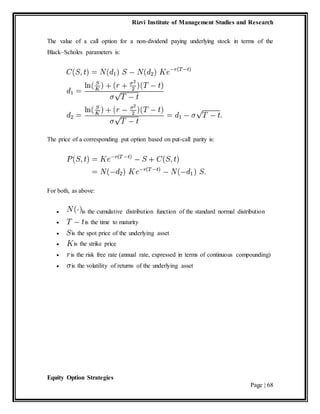
The value of a call option for a non-dividend paying underlying stock in terms of the
Black–Scholes parameters is:
The price of a corresponding put option based on put-call parity is:
For both, as above:
 is the cumulative distribution function of the standard normal distribution
 is the time to maturity
 is the spot price of the underlying asset
 is the strike price
 is the risk free rate (annual rate, expressed in terms of continuous compounding)
 is the volatility of returns of the underlying asset
Rizvi Institute of Management Studies and Research
Equity Option Strategies
Page | 69
Nifty Application of Option Strategies
In this project the application of these strategies have been undertaken using a 1
month futures and a snapshot of the Nifty call & put options chain to illustrate the
working of these startegies in different market situations.
Due to the underlying asset being an index for equity stocks a forward could not
be taken as it contains a combination of 50 stocks, so futures have been taken of the same
expiry date. The strategies that are applicable to equity stocks can also be applied to an
index.
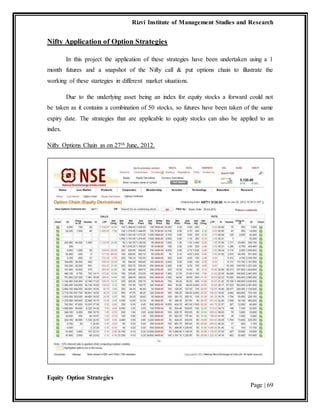
Nifty Options Chain as on 27th June, 2012.
Rizvi Institute of Management Studies and Research
Equity Option Strategies
Page | 70
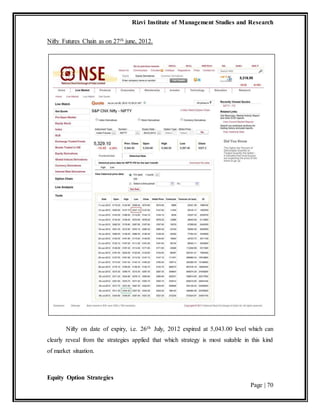
Nifty Futures Chain as on 27th june, 2012.
Nifty on date of expiry, i.e. 26th July, 2012 expired at 5,043.00 level which can
clearly reveal from the strategies applied that which strategy is most suitable in this kind
of market situation.
Rizvi Institute of Management Studies and Research
Equity Option Strategies
Page | 71
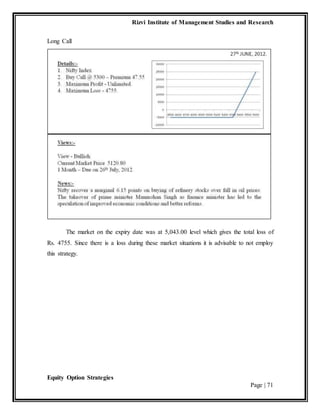
Long Call
The market on the expiry date was at 5,043.00 level which gives the total loss of
Rs. 4755. Since there is a loss during these market situations it is advisable to not employ
this strategy.
Rizvi Institute of Management Studies and Research
Equity Option Strategies
Page | 72
Long Put
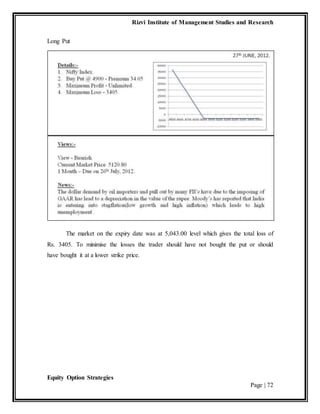
The market on the expiry date was at 5,043.00 level which gives the total loss of
Rs. 3405. To minimise the losses the trader should have not bought the put or should
have bought it at a lower strike price.
Rizvi Institute of Management Studies and Research
Equity Option Strategies
Page | 73
Short Call
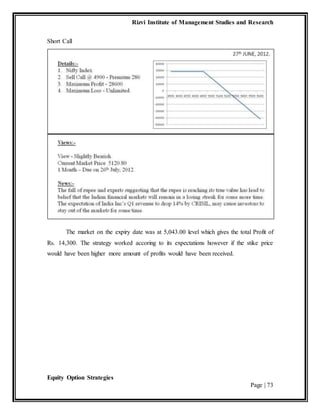
The market on the expiry date was at 5,043.00 level which gives the total Profit of
Rs. 14,300. The strategy worked accoring to its expectations however if the stike price
would have been higher more amount of profits would have been received.
Rizvi Institute of Management Studies and Research
Equity Option Strategies
Page | 74
Short Put
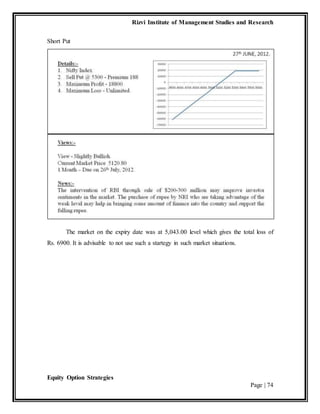
The market on the expiry date was at 5,043.00 level which gives the total loss of
Rs. 6900. It is advisable to not use such a startegy in such market situations.
Rizvi Institute of Management Studies and Research
Equity Option Strategies
Page | 75
Married Put
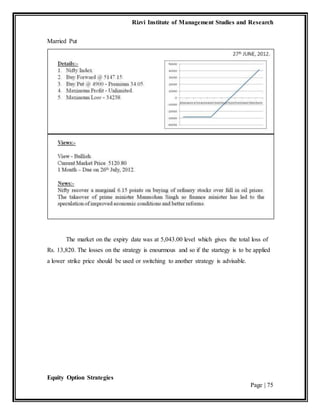
The market on the expiry date was at 5,043.00 level which gives the total loss of
Rs. 13,820. The losses on the strategy is enourmous and so if the startegy is to be applied
a lower strike price should be used or switching to another strategy is advisable.
Rizvi Institute of Management Studies and Research
Equity Option Strategies
Page | 76
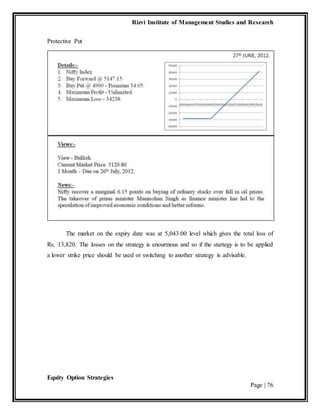
Protective Put
The market on the expiry date was at 5,043.00 level which gives the total loss of
Rs. 13,820. The losses on the strategy is enourmous and so if the startegy is to be applied
a lower strike price should be used or switching to another strategy is advisable.
Rizvi Institute of Management Studies and Research
Equity Option Strategies
Page | 77
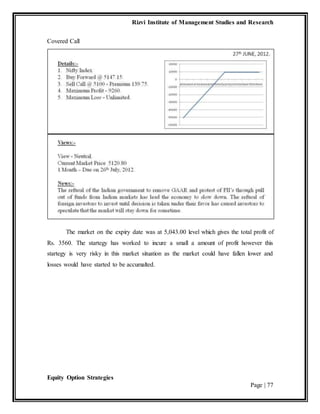
Covered Call
The market on the expiry date was at 5,043.00 level which gives the total profit of
Rs. 3560. The startegy has worked to incure a small a amount of profit however this
startegy is very risky in this market situation as the market could have fallen lower and
losses would have started to be accumalted.
Rizvi Institute of Management Studies and Research
Equity Option Strategies
Page | 78
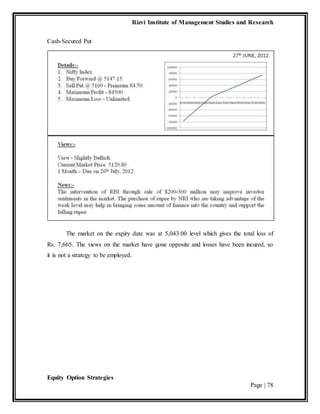
Cash-Secured Put
The market on the expiry date was at 5,043.00 level which gives the total loss of
Rs. 7,665. The views on the market have gone opposite and losses have been incured, so
it is not a strategy to be employed.
Rizvi Institute of Management Studies and Research
Equity Option Strategies
Page | 79
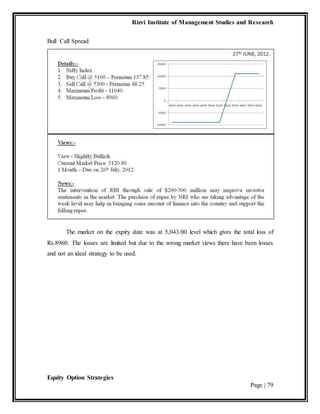
Bull Call Spread
The market on the expiry date was at 5,043.00 level which gives the total loss of
Rs.8960. The losses are limited but due to the wrong market views there have been losses
and not an ideal strategy to be used.
Rizvi Institute of Management Studies and Research
Equity Option Strategies
Page | 80
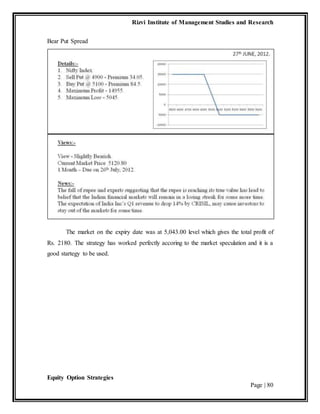
Bear Put Spread
The market on the expiry date was at 5,043.00 level which gives the total profit of
Rs. 2180. The strategy has worked perfectly accoring to the market speculation and it is a
good startegy to be used.
Rizvi Institute of Management Studies and Research
Equity Option Strategies
Page | 81
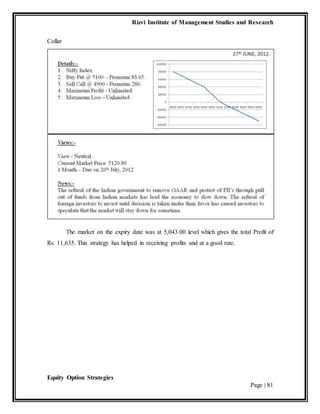
Collar
The market on the expiry date was at 5,043.00 level which gives the total Profit of
Rs. 11,635. This strategy has helped in receiving profits and at a good rate.
Rizvi Institute of Management Studies and Research
Equity Option Strategies
Page | 82
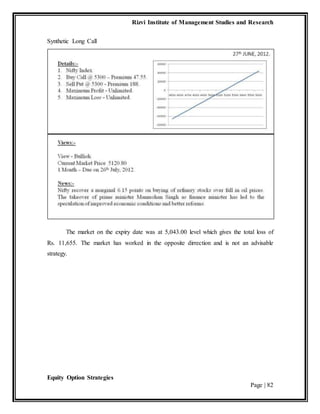
Synthetic Long Call
The market on the expiry date was at 5,043.00 level which gives the total loss of
Rs. 11,655. The market has worked in the opposite dirrection and is not an advisable
strategy.
Rizvi Institute of Management Studies and Research
Equity Option Strategies
Page | 83
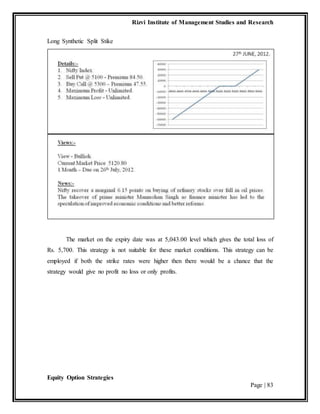
Long Synthetic Split Stike
The market on the expiry date was at 5,043.00 level which gives the total loss of
Rs. 5,700. This strategy is not suitable for these market conditions. This strategy can be
employed if both the strike rates were higher then there would be a chance that the
strategy would give no profit no loss or only profits.
Rizvi Institute of Management Studies and Research
Equity Option Strategies
Page | 84
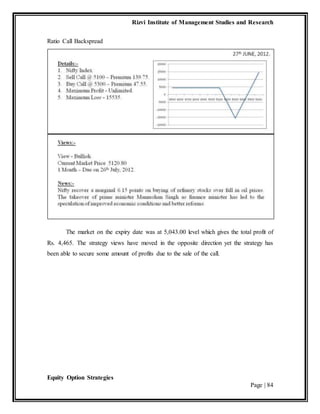
Ratio Call Backspread
The market on the expiry date was at 5,043.00 level which gives the total profit of
Rs. 4,465. The strategy views have moved in the opposite direction yet the strategy has
been able to secure some amount of profits due to the sale of the call.
Rizvi Institute of Management Studies and Research
Equity Option Strategies
Page | 85
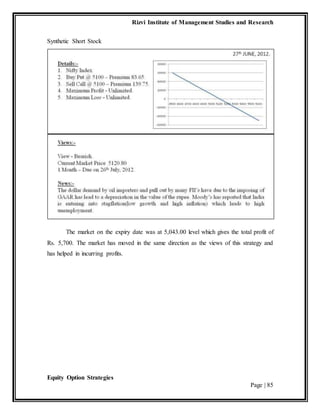
Synthetic Short Stock
The market on the expiry date was at 5,043.00 level which gives the total profit of
Rs. 5,700. The market has moved in the same direction as the views of this strategy and
has helped in incurring profits.
Rizvi Institute of Management Studies and Research
Equity Option Strategies
Page | 86
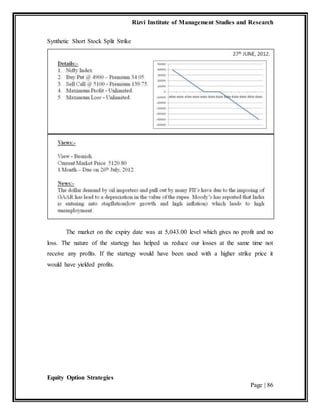
Synthetic Short Stock Split Strike
The market on the expiry date was at 5,043.00 level which gives no profit and no
loss. The nature of the startegy has helped us reduce our losses at the same time not
receive any profits. If the startegy would have been used with a higher strike price it
would have yielded profits.
Rizvi Institute of Management Studies and Research
Equity Option Strategies
Page | 87
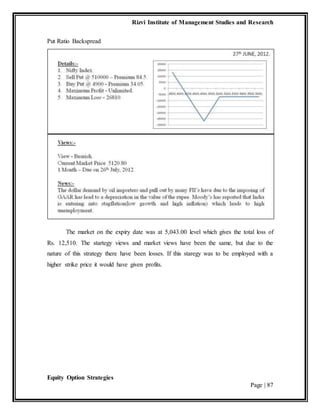
Put Ratio Backspread
The market on the expiry date was at 5,043.00 level which gives the total loss of
Rs. 12,510. The startegy views and market views have been the same, but due to the
nature of this strategy there have been losses. If this staregy was to be employed with a
higher strike price it would have given profits.
Rizvi Institute of Management Studies and Research
Equity Option Strategies
Page | 88
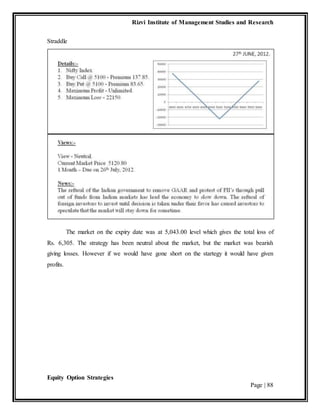
Straddle
The market on the expiry date was at 5,043.00 level which gives the total loss of
Rs. 6,305. The strategy has been neutral about the market, but the market was bearish
giving losses. However if we would have gone short on the startegy it would have given
profits.
Rizvi Institute of Management Studies and Research
Equity Option Strategies
Page | 89
Strangle
The market on the expiry date was at 5,043.00 level which gives the total loss of
Rs. 7,920. The strategy has been neutral about the market, but the market was bearish
giving losses. However if we would have gone short on the startegy it would have given
profits.
Rizvi Institute of Management Studies and Research
Equity Option Strategies
Page | 90
Butterfly
The market on the expiry date was at 5,043.00 level which gives the total Profit of
Rs. 10,040. The strategy views and market views were not similar yet it has yielded
profits making it one of the safe strategy to use.
Rizvi Institute of Management Studies and Research
Equity Option Strategies
Page | 91
Condor
The market on the expiry date was at 5,043.00 level which gives the total profit of
Rs. 6,760. The strategy views and market views were not similar yet it has yielded profits
making it one of the safe strategy to use. The premium received and paid has also off set
the losses making it a safe strategy. However if the premium paid were higher than those
received it would incur losses.
Rizvi Institute of Management Studies and Research
Equity Option Strategies
Page | 92
Box Spread
The market on the expiry date was at 5,043.00 level which gives the total profit of
Rs. 275. This strategy has been designed in such a way that whatever the market situtaion
there will always be profits. However the profits are limited so is the risk.
Rizvi Institute of Management Studies and Research
Equity Option Strategies
Page | 93
Strip
The market on the expiry date was at 5,043.00 level which gives the total loss of
Rs. 19,115. The strategy was slightly bearish as opposed to market that was bearish. If
the strategy was to be used with a higher strike price or would have gone short on the
strategy it would give profits.
Rizvi Institute of Management Studies and Research
Equity Option Strategies
Page | 94
Strap
The market on the expiry date was at 5,043.00 level which gives the total loss of
Rs. 30,235. The strategy views and market views have been completely opposite, so huge
loss has been incurred. If we would have gone short on the strategy it would have given
some profits.
Rizvi Institute of Management Studies and Research
Equity Option Strategies
Page | 95
Bibliography
1. Options, Futures and Other Derivatives - John C. Hull.
2. Equity Derivative: beginner’s Module - NCFM.
3. Equity Options Strategy Guide - The Options Industry Council.
4. Options Securities Guide - Australian Securities Exchange (ASX)

Equity options strategies

  • 1.
    A Project report On EQUITY OPTIONSTRATEGIES In partial fulfillment of the requirements of Master of Management Studies conducted by University of Mumbai through Rizvi Institute of Management Studies & Research under the guidance of Prof. Vishal Singhi Submitted by ABBAS BADAMI MMS Batch: 2011 – 2013.
  • 2.
    CERTIFICATE This is tocertify that Mr. Abbas Badami, a student of Rizvi Institute of Management Studies and Research, of MMS III bearing Roll No. 7 and specializing in Finance has successfully completed the project titled “EQUITY OPTION STRATEGIES” under the guidance of Prof. Vishal Singhi in partial fulfillment of the requirement of Masters of Management Studies by University of Mumbai for the academic year 2011 – 2013. _______________ Prof. Vishal Singhi Project Guide _______________ _______________ Prof. Umar Farooq Dr. Kalim Khan Academic Co-ordinator Director
  • 3.
    ACKNOWLEDGEMENT I would liketo express my sincere gratitude towards thanking the following people: Prof. Vishal Singhi, Internal Mentor, for supporting & guiding me through my summer internship project. I thank Dr. Kalim Khan, Director, Rizvi Institute of Management studies & Research, Mumbai, for providing me the opportunity to have such a good experience of an internship project. Finally, I am highly thankful to my parents, friends and my entire family, who have supported me in this venture. Abbas Badami
  • 4.
    EXECUTIVE SUMMARY India’s trystwith derivatives began in 2000 when both the NSE and the BSE commenced trading in equity derivatives. In June 2000, index futures became the first type of derivate instruments to be launched in the Indian markets, followed by index options in June 2001, options in individual stocks in July 2001, and futures in single stock derivatives in November 2001. Since then, equity derivatives have come a long way. New products, an expanding list of eligible investors, rising volumes, and the best risk management framework for exchange-traded derivatives have been the hallmark of the journey of equity derivatives in India so far. Derivatives may be traded for a variety of reasons. A derivative enables a trader to hedge some preexisting risk by taking positions in derivatives markets that offset potential losses in the underlying or spot market. In India, most derivatives users describe themselves as hedgers (Fitch Ratings, 2004) and Indian laws generally require that derivatives be used for hedging purposes only. Another motive for derivatives trading is speculation (i.e. taking positions to profit from anticipated price movements). In practice, it may be difficult to distinguish whether a particular trade was for hedging or speculation, and active markets require the participation of both hedgers and speculators. A third type of trader, called arbitrageurs, profit from discrepancies in the relationship of spot and derivatives prices, and thereby help to keep markets efficient. India’s experience with the equity derivatives market has been extremely positive. The derivatives turnover on the NSE has surpassed the equity market turnover. The turnover of derivatives on the NSE increased from 23,654 million in 2000–2001 to 292,482,211 million in 2010–2011, and reached 157,585,925 million in the first half of 2011–2012. The average daily turnover in these market segments on the NSE was 1,151,505 million in 2010–2011 compared to 723,921 in 2009–2010. The objective of this project is to provide the reader with knowledge of the various equity option strategies used today that are applicable in different market situations.
  • 5.
    TABLE OF CONTENT Sr.no Title Page no. 1. Objective of the Study 1 2. Scope of the Study 1 3. Introduction to Derivatives 2 4. Usage of Derivatives 3 5. Types of Derivatives 5 6. Forwards 6 7. Futures 7 8. Options 8 9. Warrants 11 10. Swaps 11 11. Terminology of Derivatives 12 12. Equity Option Strategies 17 13. Black-Scholes-Merton Model 66 14. Nifty Application of Option Strategies 69 15. Bibliography 95
  • 6.
    Rizvi Institute ofManagement Studies and Research Equity Option Strategies Page | 1 OBJECTIVES OF THE STUDY 1. Understanding the different types of derivatives used today. 2. Understanding the usage of these derivatives. 3. Identifying the various strategies used in an equity option. 4. Classifying the different kind of strategies to be used in different market situations and different equity stocks. 5. Providing live example of Nifty Futures and Options that are used today and applying these strategies for better understanding. SCOPE OF THE STUDY This study is not only limited to application in the Indian market but also in the foreign derivative markets. Some of the applied strategies can be used in case of derivative whose underlying asset is not of an equity nature. The study can be used to trade in equity options for the purpose of hedging and arbitrage as a significant area for investment.
  • 7.
    Rizvi Institute ofManagement Studies and Research Equity Option Strategies Page | 2 Introduction to Derivatives A derivative can be defined as a financial instrument whose value depends on (or derivative from) the value of others, more basic, underlying variables. Very often the variable underlying derivatives are the price of traded assets. A stock option, for example, is a derivative whose value is dependent on the price of the stock. However, derivative can be dependent on almost any variable, from the price of hogs to the amount of snow falling at a certain ski resort. A derivative instrument specifies conditions (especially the dates, resulting values of the underlying variables, and notional amounts) under which payments, or payoffs, are to be made between the parties. Derivatives are broadly categorized by the relationship between the underlying asset and the derivative (such as forward, option, swap); the type of underlying asset (such as equity derivatives, foreign exchange derivatives, interest rate derivatives, commodity derivatives, or credit derivatives); the market in which they trade (such as exchange-traded or over-the-counter); and their pay-off profile. While trading in derivatives products has grown tremendously in recent times, the earliest evidence of these types of instruments can be traced back to ancient Greece. Even though derivatives have been in existence in some form or the other since ancient times, the advent of modern day derivatives contracts is attributed to farmers’ need to protect themselves against a decline in crop prices due to various economic and environmental factors. Thus, derivatives contracts initially developed in commodities. The first “futures” contracts can be traced to the Yodoya rice market in Osaka, Japan around 1650. The farmers were afraid of rice prices falling in the future at the time of harvesting. To lock in a price (that is, to sell the rice at a predetermined fixed price in the future), the farmers entered into contracts with the buyers.
  • 8.
    Rizvi Institute ofManagement Studies and Research Equity Option Strategies Page | 3 Usage of Derivatives Hedging Derivatives allow risk related to the price of the underlying asset to be transferred from one party to another. For example, a wheat farmer and a miller could sign a futures contract to exchange a specified amount of cash for a specified amount of wheat in the future. Both parties have reduced a future risk: for the wheat farmer, the uncertainty of the price, and for the miller, the availability of wheat. However, there is still the risk that no wheat will be available because of events unspecified by the contract, such as the weather, or that one party will renege on the contract. Although a third party, called a clearing house, insures a futures contract, not all derivatives are insured against counter- party risk. From another perspective, the farmer and the miller both reduce a risk and acquire a risk when they sign the futures contract: the farmer reduces the risk that the price of wheat will fall below the price specified in the contract and acquires the risk that the price of wheat will rise above the price specified in the contract (thereby losing additional income that he could have earned). The miller, on the other hand, acquires the risk that the price of wheat will fall below the price specified in the contract (thereby paying more in the future than he otherwise would have) and reduces the risk that the price of wheat will rise above the price specified in the contract. In this sense, one party is the insurer (risk taker) for one type of risk, and the counter-party is the insurer (risk taker) for another type of risk. Hedging also occurs when an individual or institution buys an asset (such as a commodity, a bond that has coupon payments, a stock that pays dividends, and so on) and sells it using a futures contract. The individual or institution has access to the asset for a specified amount of time, and can then sell it in the future at a specified price according to the futures contract. Of course, this allows the individual or institution the benefit of holding the asset, while reducing the risk that the future selling price will deviate unexpectedly from the market's current assessment of the future value of the asset.
  • 9.
    Rizvi Institute ofManagement Studies and Research Equity Option Strategies Page | 4 Derivatives can serve legitimate business purposes. For example, a corporation borrows a large sum of money at a specific interest rate. The rate of interest on the loan resets every six months. The corporation is concerned that the rate of interest may be much higher in six months. The corporation could buy a forward rate agreement (FRA), which is a contract to pay a fixed rate of interest six months after purchases on a notional amount of money. If the interest rate after six months is above the contract rate, the seller will pay the difference to the corporation, or FRA buyer. If the rate is lower, the corporation will pay the difference to the seller. The purchase of the FRA serves to reduce the uncertainty concerning the rate increase and stabilize earnings. Speculation and arbitrage Derivatives can be used to acquire risk, rather than to hedge against risk. Thus, some individuals and institutions will enter into a derivative contract to speculate on the value of the underlying asset, betting that the party seeking insurance will be wrong about the future value of the underlying asset. Speculators look to buy an asset in the future at a low price according to a derivative contract when the future market price is high, or to sell an asset in the future at a high price according to a derivative contract when the future market price is low. Individuals and institutions may also look for arbitrage opportunities, as when the current buying price of an asset falls below the price specified in a futures contract to sell the asset. Speculative trading in derivatives gained a great deal of notoriety in 1995 when Nick Leeson, a trader at Barings Bank, made poor and unauthorized investments in futures contracts. Through a combination of poor judgment, lack of oversight by the bank's management and regulators, and unfortunate events like the Kobe earthquake, Leeson incurred a US$1.3 billion loss that bankrupted the centuries-old institution.
  • 10.
    Rizvi Institute ofManagement Studies and Research Equity Option Strategies Page | 5 Types of Derivatives In broad terms, there are two groups of derivative contracts, which are distinguished by the way they are traded in the market: 1. Over-the-counter (OTC) derivatives are contracts that are traded (and privately negotiated) directly between two parties, without going through an exchange or other intermediary. Products such as swaps, forward rate agreements, exotic options - and other exotic derivatives - are almost always traded in this way. The OTC derivative market is the largest market for derivatives, and is largely unregulated with respect to disclosure of information between the parties, since the OTC market is made up of banks and other highly sophisticated parties, such as hedge funds. Reporting of OTC amounts are difficult because trades can occur in private, without activity being visible on any exchange. According to the Bank for International Settlements, the total outstanding notional amount is US$708 trillion (as of June 2011). Of this total notional amount, 67% are interest rate contracts, 8% are credit default swaps (CDS), 9% are foreign exchange contracts, 2% are commodity contracts, 1% are equity contracts, and 12% are other. Because OTC derivatives are not traded on an exchange, there is no central counter-party. Therefore, they are subject to counter-party risk, like an ordinary contract, since each counter-party relies on the other to perform. 2. Exchange-traded derivative contracts (ETD) are those derivatives instruments that are traded via specialized derivatives exchanges or other exchanges. A derivatives exchange is a market where individual’s trade standardized contracts that have been defined by the exchange. A derivatives exchange acts as an intermediary to all related transactions, and takes initial margin from both sides of the trade to act as a guarantee. The world's largest derivatives exchanges (by number of transactions) are the Korea Exchange (which lists KOSPI Index Futures & Options), Eurex (which lists a wide range of European products such as interest rate & index products), and CME Group (made up of the 2007 merger of the
  • 11.
    Rizvi Institute ofManagement Studies and Research Equity Option Strategies Page | 6 Chicago Mercantile Exchange and the Chicago Board of Trade and the 2008 acquisition of the New York Mercantile Exchange). Some types of derivative instruments also may trade on traditional exchanges. For instance, hybrid instruments such as convertible bonds and/or convertible preferred may be listed on stock or bond exchanges. Also, warrants (or "rights") may be listed on equity exchanges. Common derivative contract types 1. Forwards: A tailored contract between two parties, where payment takes place at a specific time in the future at today's pre-determined price. 2. Futures: are contracts to buy or sell an asset on or before a future date at a price specified today. A futures contract differs from a forward contract in that the futures contract is a standardized contract written by a clearing house that operates an exchange where the contract can be bought and sold; the forward contract is a non-standardized contract written by the parties themselves. 3. Options: are contracts that give the owner the right, but not the obligation, to buy (in the case of a call option) or sell (in the case of a put option) an asset. The price at which the sale takes place is known as the strike price, and is specified at the time the parties enter into the option. The option contract also specifies a maturity date. If the owner of the contract exercises this right, the counter-party has the obligation to carry out the transaction. 4. Warrants: Apart from the commonly used short-dated options which have a maximum maturity period of 1 year, there exists certain long-dated options as well, known as Warrant. These are generally traded over-the-counter. 5. Swaps: are contracts to exchange cash (flows) on or before a specified future date based on the underlying value of currencies exchange rates, bonds/interest rates, commodities exchange, stocks or other assets. Another term which is commonly associated to Swap is Swaption which is basically an option on the forward Swap.
  • 12.
    Rizvi Institute ofManagement Studies and Research Equity Option Strategies Page | 7 Forwards A forward contract or simply a forward is a contract between two parties to buy or sell an asset at a certain future date for a certain price that is pre-decided on the date of the contract. The future date is referred to as expiry date and the pre-decided price is referred to as Forward Price. It may be noted that Forwards are private contracts and their terms are determined by the parties involved. A forward is thus an agreement between two parties in which one party, the buyer, enters into an agreement with the other party, the seller that he would buy from the seller an underlying asset on the expiry date at the forward price. Therefore, it is a commitment by both the parties to engage in a transaction at a later date with the price set in advance. This is different from a spot market contract, which involves immediate payment and immediate transfer of asset. The party that agrees to buy the asset on a future date is referred to as a long investor and is said to have a long position. Similarly the party that agrees to sell the asset in a future date is referred to as a short investor and is said to have a short position. The price agreed upon is called the delivery price or the Forward Price. Forward contracts are traded only in Over the Counter (OTC) market and not in stock exchanges. OTC market is a private market where individuals/institutions can trade through negotiations on a one to one basis. A drawback of forward contracts is that they are subject to default risk. Regardless of whether the contract is for physical or cash settlement, there exists a potential for one party to default, i.e. not honor the contract. It could be either the buyer or the seller. This results in the other party suffering a loss. This risk of making losses due to any of the two parties defaulting is known as counter party risk. The main reason behind such risk is the absence of any mediator between the parties, who could have undertaken the task of ensuring that both the parties fulfill their obligations arising out of the contract. Default risk is also referred to as counter party risk or credit risk.
  • 13.
    Rizvi Institute ofManagement Studies and Research Equity Option Strategies Page | 8 Futures Like a forward contract, a futures contract is an agreement between two parties in which the buyer agrees to buy an underlying asset from the seller, at a future date at a price that is agreed upon today. However, unlike a forward contract, a futures contract is not a private transaction but gets traded on a recognized stock exchange. In addition, a futures contract is standardized by the exchange. All the terms, other than the price, are set by the stock exchange (rather than by individual parties as in the case of a forward contract). Also, both buyer and seller of the futures contracts are protected against the counter party risk by an entity called the Clearing Corporation. The Clearing Corporation provides this guarantee to ensure that the buyer or the seller of a futures contract does not suffer as a result of the counter party defaulting on its obligation. In case one of the parties defaults, the Clearing Corporation steps in to fulfill the obligation of this party, so that the other party does not suffer due to non-fulfillment of the contract. To be able to guarantee the fulfillment of the obligations under the contract, the Clearing Corporation holds an amount as a security from both the parties. This amount is called the Margin money and can be in the form of cash or other financial assets. Also, since the futures contracts are traded on the stock exchanges, the parties have the flexibility of closing out the contract prior to the maturity by squaring off the transactions in the market. The Pay-off of a futures contract on maturity depends on the spot price of the underlying asset at the time of maturity and the price at which the contract was initially traded. There are two positions that could be taken in a futures contract a Long position (one who buys the asset at the futures price takes the long position) and Short position (one who sells the asset at the futures price takes the short position).
  • 14.
    Rizvi Institute ofManagement Studies and Research Equity Option Strategies Page | 9 Options Like forwards and futures, options are derivative instruments that provide the opportunity to buy or sell an underlying asset on a future date. An option is a derivative contract between a buyer and a seller, where one party (say First Party) gives to the other (say Second Party) the right, but not the obligation, to buy from (or sell to) the First Party the underlying asset on or before a specific day at an agreed-upon price. In return for granting the option, the party granting the option collects a payment from the other party. This payment collected is called the “premium” or price of the option. The right to buy or sell is held by the “option buyer” (also called the option holder); the party granting the right is the “option seller” or “option writer”. Unlike forwards and futures contracts, options require a cash payment (called the premium) upfront from the option buyer to the option seller. This payment is called option premium or option price. Options can be traded either on the stock exchange or in over the counter (OTC) markets. Options traded on the exchanges are backed by the Clearing Corporation thereby minimizing the risk arising due to default by the counter parties involved. Options traded in the OTC market however are not backed by the Clearing Corporation. In return for assuming the obligation, called writing the option, the originator of the option collects a payment, the premium, from the buyer. The writer of an option must make good on delivering (or receiving) the underlying asset or its cash equivalent, if the option is exercised. An option can usually be sold by its original buyer to another party. Many options are created in standardized form and traded on an anonymous options exchange among the general public. As with all securities, trading options entails the risk of the option's value changing over time. However, unlike traditional securities, the return from holding an option varies non-linearly with the value of the underlying and other factors. Therefore, the risks associated with holding options are more complicated to understand and predict.
  • 15.
    Rizvi Institute ofManagement Studies and Research Equity Option Strategies Page | 10 There are two types of options—call options and put options Call option A call option is an option granting the right to the buyer of the option to buy the underlying asset on a specific day at an agreed upon price, but not the obligation to do so. It is the seller who grants this right to the buyer of the option. It may be noted that the person who has the right to buy the underlying asset is known as the “buyer of the call option”. The price at which the buyer has the right to buy the asset is agreed upon at the time of entering the contract. This price is known as the strike price of the contract (call option strike price in this case). Since the buyer of the call option has the right (but no obligation) to buy the underlying asset, he will exercise his right to buy the underlying asset if and only if the price of the underlying asset in the market is more than the strike price on or before the expiry date of the contract. The buyer of the call option does not have an obligation to buy if he does not want to. Put option A put option is a contract granting the right to the buyer of the option to sell the underlying asset on or before a specific day at an agreed upon price, but not the obligation to do so. It is the seller who grants this right to the buyer of the option. The person who has the right to sell the underlying asset is known as the “buyer of the put option”. The price at which the buyer has the right to sell the asset is agreed upon at the time of entering the contract. This price is known as the strike price of the contract (put option strike price in this case). Since the buyer of the put option has the right (but not the obligation) to sell the underlying asset, he will exercise his right to sell the underlying asset if and only if the price of the underlying asset in the market is less than the strike price on or before the expiry date of the contract. The buyer of the put option does not have the obligation to sell if he does not want to.
  • 16.
    Rizvi Institute ofManagement Studies and Research Equity Option Strategies Page | 11 Warrants A warrant is a security that entitles the holder to buy the underlying stock of the issuing company at a fixed exercise price until the expiry date. Warrants and options are similar in that the two contractual financial instruments allow the holder special rights to buy securities. Both are discretionary and have expiration dates. The word warrant simply means to "endow with the right", which is only slightly different from the meaning of option. Warrants are frequently attached to bonds or preferred stock as a sweetener, allowing the issuer to pay lower interest rates or dividends. They can be used to enhance the yield of the bond, and make them more attractive to potential buyers. Warrants can also be used in private equity deals. Frequently, these warrants are detachable, and can be sold independently of the bond or stock. Swaps A swap is a derivative in which counterparties exchange cash flows of one party's financial instrument for those of the other party's financial instrument. The benefits in question depend on the type of financial instruments involved. The swap agreement defines the dates when the cash flows are to be paid and the way they are calculated. Usually at the time when the contract is initiated at least one of these series of cash flows is determined by a random or uncertain variable such as an interest rate, foreign exchange rate, equity price or commodity price. The cash flows are calculated over a notional principal amount. Contrary to a future, a forward or an option, the notional amount is usually not exchanged between counterparties. Consequently, swaps can be in cash or collateral. Swaps can be used to hedge certain risks such as interest rate risk, or to speculate on changes in the expected direction of underlying prices.
  • 17.
    Rizvi Institute ofManagement Studies and Research Equity Option Strategies Page | 12 Terminology of Derivatives Spot price (ST) Spot price of an underlying asset is the price that is quoted for immediate delivery of the asset. Spot price is also referred to as cash price sometimes. Forward price or futures price (F) Forward price or futures price is the price that is agreed upon at the date of the contract for the delivery of an asset at a specific future date. These prices are dependent on the spot price, the prevailing interest rate and the expiry date of the contract. Strike price (K) The price at which the buyer of an option can buy the stock (in the case of a call option) or sell the stock (in the case of a put option) on or before the expiry date of option contracts is called strike price. It is the price at which the stock will be bought or sold when the option is exercised. Strike price is used in the case of options only; it is not used for futures or forwards. Expiration date (T) In the case of Futures, Forwards, Index and Stock Options, Expiration Date is the date on which settlement takes place. It is also called the final settlement date. Types of options Options can be divided into two different categories depending upon the primary exercise styles associated with options. These categories are: European Options: European options are options that can be exercised only on the expiration date. American options: American options are options that can be exercised on any day on or before the expiry date.
  • 18.
    Rizvi Institute ofManagement Studies and Research Equity Option Strategies Page | 13 Contract size As futures and options are standardized contracts traded on an exchange, they have a fixed contract size. One contract of a derivatives instrument represents a certain number of shares of the underlying asset. Contract Value Contract value is notional value of the transaction in case one contract is bought or sold. It is the contract size multiplied but the price of the futures. Contract value is used to calculate margins etc. for contracts. Margins In the spot market, the buyer of a stock has to pay the entire transaction amount (for purchasing the stock) to the seller. In a derivatives contract, a person enters into a trade today (buy or sell) but the settlement happens on a future date. Because of this, there is a high possibility of default by any of the parties. Futures and option contracts are traded through exchanges and the counter party risk is taken care of by the clearing corporation. In order to prevent any of the parties from defaulting on his trade commitment, the clearing corporation levies a margin on the buyer as well as seller of the futures and option contracts. This margin is a percentage (approximately 20%) of the total contract value. This margin is applicable to both, the buyer and the seller of a futures contract. Moneyness of an Option “Moneyness” of an option indicates whether an option is worth exercising or not i.e. if the option is exercised by the buyer of the option whether he will receive money or not. “Moneyness” of an option at any given time depends on where the spot price of the underlying is at that point of time relative to the strike price. The premium paid is not taken into consideration while calculating moneyness of an Option, since the premium once paid is a sunk cost and the profitability from exercising the option does not depend on the size of the premium. Therefore, the decision whether to exercise the option or not is not affected by the size of the premium.
  • 19.
    Rizvi Institute ofManagement Studies and Research Equity Option Strategies Page | 14 The following three terms are used to define the moneyness of an option:- In-the-money option An option is said to be in-the-money if on exercising the option, it would produce a cash inflow for the buyer. Thus, Call Options are in-the-money when the value of spot price of the underlying exceeds the strike price. On the other hand, Put Options are in-the- money when the spot price of the underlying is lower than the strike price. Moneyness of an option should not be confused with the profit and loss arising from holding an option contract. It should be noted that while moneyness of an option does not depend on the premium paid, profit/loss do. Thus a holder of an in-the-money option need not always make profit as the profitability also depends on the premium paid. Out-of-the-money option An out-of-the-money option is an opposite of an in-the-money option. An option-holder will not exercise the option when it is out-of-the-money. A Call option is out-of-the- money when its strike price is greater than the spot price of the underlying and a Put option is out-of-the money when the spot price of the underlying is greater than the option’s strike price. At-the-money option An at-the-money-option is one in which the spot price of the underlying is equal to the strike price. It is at the stage where with any movement in the spot price of the underlying, the option will either become in-the-money or out-of-the-money.
  • 20.
    Rizvi Institute ofManagement Studies and Research Equity Option Strategies Page | 15 Equity Option Strategies Options strategies can favor movements in the underlying that are bullish, bearish or neutral. In the case of neutral strategies, they can be further classified into those that are bullish on volatility and those that are bearish on volatility. The option positions used can be long and/or short positions in calls Bullish strategies Bullish options strategies are employed when the options trader expects the underlying stock price to move upwards. It is necessary to assess how high the stock price can go and the time frame in which the rally will occur in order to select the optimum trading strategy. The most bullish of options trading strategies is the simple call buying strategy used by most novice options traders. Stocks seldom go up by leaps and bounds. Moderately bullish options traders usually set a target price for the Bull Run and utilize bull spreads to reduce cost. (It does not reduce risk because the options can still expire worthless). While maximum profit is capped for these strategies, they usually cost less to employ for a given nominal amount of exposure. The bull call spread and the bull put spread are common examples of moderately bullish strategies. Mildly bullish trading strategies are options strategies that make money as long as the underlying stock price does not go down by the options expiration date. These strategies may provide a small downside protection as well. Writing out-of-the-money covered calls is a good example of such a strategy. Bearish strategies Bearish options strategies are employed when the options trader expects the underlying stock price to move downwards. It is necessary to assess how low the stock price can go and the time frame in which the decline will happen in order to select the optimum trading strategy.
  • 21.
    Rizvi Institute ofManagement Studies and Research Equity Option Strategies Page | 16 The most bearish of options trading strategies is the simple put buying strategy utilized by most novice options traders. Stock prices only occasionally make steep downward moves. Moderately bearish options traders usually set a target price for the expected decline and utilize bear spreads to reduce cost. While maximum profit is capped for these strategies, they usually cost less to employ. The bear call spread and the bear put spread are common examples of moderately bearish strategies. Mildly bearish trading strategies are options strategies that make money as long as the underlying stock price does not go up by the options expiration date. These strategies may provide a small upside protection as well. In general, bearish strategies yield less profit with less risk of loss. Neutral or non-directional strategies Neutral strategies in options trading are employed when the options trader does not know whether the underlying stock price will rise or fall. Also known as non- directional strategies, they are so named because the potential to profit does not depend on whether the underlying stock price will go upwards or downwards. Rather, the correct neutral strategy to employ depends on the expected volatility of the underlying stock price. Bullish on volatility Neutral trading strategies that are bullish on volatility profit when the underlying stock price experiences big moves upwards or downwards. They include the long straddle, long strangle, short condor and short butterfly. Bearish on volatility Neutral trading strategies that are bearish on volatility profit when the underlying stock price experiences little or no movement. Such strategies include the short straddle, short strangle, ratio spreads, long condor and long butterfly.
  • 22.
    Rizvi Institute ofManagement Studies and Research Equity Option Strategies Page | 17 Classification of Equity Option Strategies Bullish Bearish Neutral Long Call Long Put Straddle Short Put Short Call Strangle Synthetic Long Call Synthetic Short Stock Butterfly Long Synthetic Split Strike Synthetic Short Stock Split Strike Condor Bull Call Spread Bear Put Spread Box Spread Ratio Call Backspread Put Ratio Backspread Strip Covered Call Strap Protective Put Collar Married Put Cash-Secured Put
  • 23.
    Rizvi Institute ofManagement Studies and Research Equity Option Strategies Page | 18
  • 24.
    Rizvi Institute ofManagement Studies and Research Equity Option Strategies Page | 19 Share Price 200 210 220 Sell Stock @ 250 50 40 30 Buy Call @ 200 - - - Premium Paid -20 -20 -20 Profit/Loss 30 20 10 From the above table we come to know that when this strategy is employed with the advancement in stock price above the given strike price the amount of profit reduces. But if the market price reduces the profit earned increases. Share Price 200 230 260 Sell Stock @ 250 50 20 -10 Buy Call @ 200 - - - Premium Paid -20 -20 -20 Profit/Loss 30 0 -30 From the above table we come to know that at market price of 230 we achieve breakeven point. Share Price 100 120 150 Sell Stock @ 250 150 130 100 Buy Call @ 200 -100 -80 -50 Premium Paid -20 -20 -20 Profit/Loss 30 30 30 From the above table we come to know that if the contract is exercised at any level there will be a profit.
  • 25.
    Rizvi Institute ofManagement Studies and Research Equity Option Strategies Page | 20
  • 26.
    Rizvi Institute ofManagement Studies and Research Equity Option Strategies Page | 21 Share Price 180 190 200 Buy Stock @ 150 30 40 50 Buy Put @ 200 - - - Premium Paid -20 -20 -20 Profit/Loss 10 20 30 From the above table we come to know that when this strategy is employed with the decline in stock price below the given strike price the amount of profit reduces. But if the market price increases the profit earned increases. Share Price 140 170 200 Buy Stock @ 150 -10 20 50 Buy Put @ 200 - - - Premium Paid -20 -20 -20 Profit/Loss -30 0 30 From the above table we come to know that at market price of 170 we achieve breakeven point. Share Price 250 300 350 Buy Stock @ 150 100 150 200 Buy Put @ 200 -50 -100 -150 Premium Paid -20 -20 -20 Profit/Loss 30 30 30 From the above table we come to know that if the contract is exercised at any level there will be a profit.
  • 27.
    Rizvi Institute ofManagement Studies and Research Equity Option Strategies Page | 22
  • 28.
    Rizvi Institute ofManagement Studies and Research Equity Option Strategies Page | 23 Share Price 150 170 200 Buy Stock @ 150 - 20 50 Sell Call @ 200 - - - Premium Received 20 20 20 Profit/Loss 20 40 70 From the above table we come to know that when this strategy is employed with the increase in stock price above the given strike price the amount of profit increases. But if the market price reduces the profit earned reduces. Share Price 100 130 160 Buy Stock @ 150 -50 -20 10 Sell Call @ 200 - - - Premium Received 20 20 20 Profit/Loss -30 0 30 From the above table we come to know that at market price of 130 we achieve breakeven point. Share Price 250 300 350 Buy Stock @ 150 100 150 200 Sell Call @ 200 -50 -100 -150 Premium Received 20 20 20 Profit/Loss 70 70 70 From the above table we come to know that if the contract is exercised at any level there will be a profit.
  • 29.
    Rizvi Institute ofManagement Studies and Research Equity Option Strategies Page | 24
  • 30.
    Rizvi Institute ofManagement Studies and Research Equity Option Strategies Page | 25 Share Price 100 130 150 Sell Stock @ 150 50 20 - Sell Put @ 200 - - - Premium Received 20 20 20 Profit/Loss 70 40 20 From the above table we come to know that when this strategy is employed with the decline in stock price below the given strike price the amount of profit increases. But if the market price increases the profit earned reduces. Share Price 100 130 160 Sell Stock @ 150 -50 -20 10 Sell Put @ 200 - - - Premium Received 20 20 20 Profit/Loss -30 0 30 From the above table we come to know that at market price of 130 we achieve breakeven point. Share Price 200 210 220 Sell Stock @ 150 50 60 70 Sell Put @ 200 - -10 -20 Premium Received 20 20 20 Profit/Loss 70 70 70 From the above table we come to know that if the contract is exercised at any level there will be a profit.
  • 31.
    Rizvi Institute ofManagement Studies and Research Equity Option Strategies Page | 26
  • 32.
    Rizvi Institute ofManagement Studies and Research Equity Option Strategies Page | 27 Share Price 180 190 200 Buy Forward @ 150 30 40 50 Buy Put @ 200 - - - Premium Paid -20 -20 -20 Profit/Loss 10 20 30 From the above table we come to know that when this strategy is employed with the decline in stock price below the given strike price the amount of profit reduces. But if the market price increases the profit earned increases. Share Price 140 170 200 Buy Forward @ 150 -10 20 50 Buy Put @ 200 - - - Premium Paid -20 -20 -20 Profit/Loss -30 0 30 From the above table we come to know that at market price of 170 we achieve breakeven point. Share Price 250 300 350 Buy Forward @ 150 100 150 200 Buy Put @ 200 -50 -100 -150 Premium Paid -20 -20 -20 Profit/Loss 30 30 30 From the above table we come to know that if the contract is exercised at any level there will be a profit.
  • 33.
    Rizvi Institute ofManagement Studies and Research Equity Option Strategies Page | 28
  • 34.
    Rizvi Institute ofManagement Studies and Research Equity Option Strategies Page | 29 Share Price 180 190 200 Buy Forward @ 150 30 40 50 Buy Put @ 200 - - - Premium Paid -20 -20 -20 Profit/Loss 10 20 30 From the above table we come to know that when this strategy is employed with the decline in stock price below the given strike price the amount of profit reduces. But if the market price increases the profit earned increases. Share Price 140 170 200 Buy Forward @ 150 -10 20 50 Buy Put @ 200 - - - Premium Paid -20 -20 -20 Profit/Loss -30 0 30 From the above table we come to know that at market price of 170 we achieve breakeven point. Share Price 250 300 350 Buy Forward @ 150 100 150 200 Buy Put @ 200 -50 -100 -150 Premium Paid -20 -20 -20 Profit/Loss 30 30 30 From the above table we come to know that if the contract is exercised at any level there will be a profit.
  • 35.
    Rizvi Institute ofManagement Studies and Research Equity Option Strategies Page | 30
  • 36.
    Rizvi Institute ofManagement Studies and Research Equity Option Strategies Page | 31 Share Price 150 170 200 Buy Forward @ 150 - 20 50 Sell Call @ 200 - - - Premium Received 20 20 20 Profit/Loss 20 40 70 From the above table we come to know that when this strategy is employed with the increase in stock price above the given strike price the amount of profit increases. But if the market price reduces the profit earned reduces. Share Price 100 130 160 Buy Forward @ 150 -50 -20 10 Sell Call @ 200 - - - Premium Received 20 20 20 Profit/Loss -30 0 30 From the above table we come to know that at market price of 130 we achieve breakeven point. Share Price 250 300 350 Buy Forward @ 150 100 150 200 Sell Call @ 200 -50 -100 -150 Premium Received 20 20 20 Profit/Loss 70 70 70 From the above table we come to know that if the contract is exercised at any level there will be a profit.
  • 37.
    Rizvi Institute ofManagement Studies and Research Equity Option Strategies Page | 32
  • 38.
    Rizvi Institute ofManagement Studies and Research Equity Option Strategies Page | 33 Share Price 200 170 150 Buy Forward @ 150 50 20 - Sell Put @ 200 - - - Premium Received 20 20 20 Profit/Loss 70 40 20 From the above table we come to know that when this strategy is employed with the decline in stock price below the given strike price the amount of profit decreases. But if the market price increases the profit earned increases. Share Price 100 130 160 Buy Forward @ 150 -50 -20 10 Sell Put @ 200 - - - Premium Received 20 20 20 Profit/Loss -30 0 30 From the above table we come to know that at market price of 130 we achieve breakeven point. Share Price 200 210 220 Buy Forward @ 150 50 60 70 Sell Put @ 200 - -10 -20 Premium Received 20 20 20 Profit/Loss 70 70 70 From the above table we come to know that if the contract is exercised at any level there will be a profit.
  • 39.
    Rizvi Institute ofManagement Studies and Research Equity Option Strategies Page | 34
  • 40.
    Rizvi Institute ofManagement Studies and Research Equity Option Strategies Page | 35 Share Price 180 190 200 Buy Call @ 180 - 10 20 Sell Call @ 200 - - - Premium Paid/Received - - - Profit/Loss - 10 20 From the above table we come to know that when this strategy is employed with the advancement in stock price above the given strike price of the Buy Call the amount of profit increases. But if the market price reduces the profit earned reduces. Share Price 170 180 190 Buy Call @ 180 -10 - 10 Sell Call @ 200 - - - Premium Paid/Received - - - Profit/Loss -10 - 10 From the above table we come to know that at market price of 180 we achieve breakeven point. Share Price 200 220 240 Buy Call @ 180 20 40 60 Sell Call @ 200 - -20 -40 Premium Paid/Received - - - Profit/Loss 20 20 20 From the above table we come to know that if the contract is exercised at any level there will be a profit.
  • 41.
    Rizvi Institute ofManagement Studies and Research Equity Option Strategies Page | 36
  • 42.
    Rizvi Institute ofManagement Studies and Research Equity Option Strategies Page | 37 Share Price 180 190 200 Sell Put @ 180 - - - Buy Put @ 200 20 10 - Premium Paid/Received - - - Profit/Loss 20 10 - From the above table we come to know that when this strategy is employed with the decline in stock price below the Buy Put strike price the amount of profit increases. But if the market price increases the profit earned reduces. Share Price 190 200 210 Sell Put @ 180 - - - Buy Put @ 200 10 - -10 Premium Paid/Received - - - Profit/Loss 10 - -10 From the above table we come to know that at market price of 200 we achieve breakeven point. Share Price 160 170 180 Sell Put @ 180 -20 -10 - Buy Put @ 200 40 30 20 Premium Paid/Received - - - Profit/Loss 20 20 20 From the above table we come to know that if the contract is exercised at any level there will be a profit.
  • 43.
    Rizvi Institute ofManagement Studies and Research Equity Option Strategies Page | 38
  • 44.
    Rizvi Institute ofManagement Studies and Research Equity Option Strategies Page | 39 Share Price 170 180 190 Buy Put @ 180 30 20 10 Sell Call @ 200 - - - Premium Paid/Received - - - Profit/Loss 30 20 10 From the above table we come to know that when this strategy is employed with the advancement in stock price above the amount of profit decreases. But if the market price reduces the profit earned increases. Share Price 180 190 200 Buy Put @ 180 20 10 - Sell Call @ 200 - -10 -20 Premium Paid/Received - - - Profit/Loss 20 - -20 From the above table we come to know that at market price of 190 we achieve breakeven point. Share Price 170 180 190 Buy Put @ 180 30 20 10 Sell Call @ 200 - - - Premium Paid/Received - - - Profit/Loss 30 20 10 From the above table we come to know that if the contract is exercised at any level there will never be a constant amount of profit.
  • 45.
    Rizvi Institute ofManagement Studies and Research Equity Option Strategies Page | 40
  • 46.
    Rizvi Institute ofManagement Studies and Research Equity Option Strategies Page | 41 Share Price 220 240 260 Buy Call @ 200 20 40 60 Sell Put @ 200 - - - Premium Paid/Received - - - Profit/Loss 20 40 60 From the above table we come to know that when this strategy is employed with the decline in stock price below the given strike price the amount of profit decreases. But if the market price increases the profit earned increases. Share Price 180 200 220 Buy Call @ 200 - - 20 Sell Put @ 200 -20 - - Premium Paid/Received - - - Profit/Loss -20 0 20 From the above table we come to know that at market price of 200 we achieve breakeven point. Share Price 220 240 260 Buy Call @ 200 20 40 60 Sell Put @ 200 - - - Premium Paid/Received - - - Profit/Loss 20 40 60 From the above table we come to know that if the contract is exercised at any level there will never be a constant amount of profit.
  • 47.
    Rizvi Institute ofManagement Studies and Research Equity Option Strategies Page | 42
  • 48.
    Rizvi Institute ofManagement Studies and Research Equity Option Strategies Page | 43 Share Price 210 220 230 Sell Put @ 180 - - - Buy Call @ 200 10 20 30 Premium Paid/Received - - - Profit/Loss 10 20 30 From the above table we come to know that when this strategy is employed with the decline in stock price the amount of profit decreases. But if the market price increases the profit earned increases. Share Price 170 190 210 Sell Put @ 180 -10 - - Buy Call @ 200 - - 10 Premium Paid/Received - - - Profit/Loss -10 0 10 From the above table we come to know that at market price of 190 we achieve breakeven point. Share Price 180 190 200 Sell Put @ 180 - - - Buy Call @ 200 - - - Premium Paid/Received - - - Profit/Loss - - - From the above table we come to know that if the contract is exercised at any level there will never be a constant amount of profit. There is however a point when there is no profit and no loss for different stock price.
  • 49.
    Rizvi Institute ofManagement Studies and Research Equity Option Strategies Page | 44
  • 50.
    Rizvi Institute ofManagement Studies and Research Equity Option Strategies Page | 45 Share Price 300 320 340 Sell Call @ 180 -120 -140 -160 Buy 2 Call’s @ 220 160 200 240 Premium Paid/Received -20 -20 -20 Profit/Loss 20 40 60 From the above table we come to know that when this strategy is employed with the advancement in stock price above the given strike price of the Buy Call the amount of profit increases. But if the market price reduces the profit earned reduces. Share Price 260 280 300 Sell Call @ 180 -80 -100 -120 Buy 2 Call’s @ 220 80 120 160 Premium Paid/ Received -20 -20 -20 Profit/Loss -20 0 20 From the above table we come to know that at market price of 280 we achieve breakeven point. Share Price 140 160 180 Sell Call @ 180 - - - Buy 2 Call’s @ 220 - - - Premium Paid/ Received -20 -20 -20 Profit/Loss -20 -20 -20 From the above table we come to know that if the contract is exercised between certain levels there will be a loss.
  • 51.
    Rizvi Institute ofManagement Studies and Research Equity Option Strategies Page | 46
  • 52.
    Rizvi Institute ofManagement Studies and Research Equity Option Strategies Page | 47 Share Price 140 160 180 Buy Put @ 200 60 40 20 Sell Call @ 200 - - - Premium Paid/Received - - - Profit/Loss 60 40 20 From the above table we come to know that when this strategy is employed with the decline in stock price below the given strike price the amount of profit increases. But if the market price increases the profit earned reduces. Share Price 180 200 220 Buy Put @ 200 20 - - Sell Call @ 200 - - -20 Premium Paid/Received - - - Profit/Loss 20 0 -20 From the above table we come to know that at market price of 200 we achieve breakeven point. Share Price 140 160 180 Buy Put @ 200 60 40 20 Sell Call @ 200 - - - Premium Paid/Received - - - Profit/Loss 60 40 20 From the above table we come to know that if the contract is exercised at any level there will never be a constant amount of profit.
  • 53.
    Rizvi Institute ofManagement Studies and Research Equity Option Strategies Page | 48
  • 54.
    Rizvi Institute ofManagement Studies and Research Equity Option Strategies Page | 49 Share Price 150 160 170 Buy Put @ 180 30 20 10 Sell Call @ 200 - - - Premium Paid/Received - - - Profit/Loss 30 20 10 From the above table we come to know that when this strategy is employed with the decline in stock price below the given strike price the amount of profit increases. But if the market price increases the profit earned reduces. Share Price 170 190 210 Buy Put @ 180 10 - - Sell Call @ 200 - - -10 Premium Paid/Received - - - Profit/Loss 10 0 -10 From the above table we come to know that at market price of 190 we achieve breakeven point. Share Price 180 190 200 Buy Put @ 180 - - - Sell Call @ 200 - - - Premium Paid/Received - - - Profit/Loss - - - From the above table we come to know that if the contract is exercised at any level there will never be a constant amount of profit. There is however a point when there is no profit and no loss for different stock price.
  • 55.
    Rizvi Institute ofManagement Studies and Research Equity Option Strategies Page | 50
  • 56.
    Rizvi Institute ofManagement Studies and Research Equity Option Strategies Page | 51 Share Price 80 100 120 Sell Put @ 200 -120 -100 -80 Buy 2 Put’s @ 180 200 160 120 Premium Paid/Received -20 -20 -20 Profit/Loss 60 40 20 From the above table we come to know that when this strategy is employed with the decline in stock price below the given strike price of the Buy Put’s the amount of profit increases. But if the market price increases the profit earned reduces. Share Price 120 140 160 Sell Put @ 200 -80 -60 -40 Buy 2 Put’s @ 180 -120 80 40 Premium Paid/Received -20 -20 -20 Profit/Loss 20 0 -20 From the above table we come to know that at market price of 140 we achieve breakeven point. Share Price 200 220 240 Sell Put @ 200 - - - Buy 2 Put’s @ 180 - - - Premium Paid/Received -20 -20 -20 Profit/Loss -20 -20 -20 From the above table we come to know that if the contract is exercised between certain levels there will be a loss.
  • 57.
    Rizvi Institute ofManagement Studies and Research Equity Option Strategies Page | 52
  • 58.
    Rizvi Institute ofManagement Studies and Research Equity Option Strategies Page | 53 Share Price 260 280 300 Buy Call @ 200 60 80 100 Buy Put @ 200 - - - Premium Paid -40 -40 -40 Profit/Loss 20 40 60 From the above table we come to know that when this strategy is employed with the advancement in stock price above the given strike price the amount of profit increases. But if the market price reduces the profit earned reduces. However below a certain level (i.e. 160) if the market price falls there is more amount of profit earned for more fall in price. Share Price 220 240 260 Buy Call @ 200 20 40 60 Buy Put @ 200 - - - Premium Paid -40 -40 -40 Profit/Loss -20 0 20 From the above table we come to know that at market price of 240 we achieve breakeven point. However there is another breakeven point at 160. Share Price 260 280 300 Buy Call @ 200 60 80 100 Buy Put @ 200 - - - Premium Paid -40 -40 -40 Profit/Loss 20 40 60 From the above table we come to know that if the contract is exercised at any level there will never be a constant amount of profit.
  • 59.
    Rizvi Institute ofManagement Studies and Research Equity Option Strategies Page | 54
  • 60.
    Rizvi Institute ofManagement Studies and Research Equity Option Strategies Page | 55 Share Price 240 260 280 Buy Call @ 180 60 80 100 Buy Put @ 200 - - - Premium Paid -40 -40 -40 Profit/Loss 20 40 60 From the above table we come to know that when this strategy is employed with the advancement in stock price above the given strike price the amount of profit increases. But if the market price reduces the profit earned reduces. However below a certain level (i.e. 160) if the market price falls there is more amount of profit earned for more fall in price. Share Price 200 220 240 Buy Call @ 180 20 40 60 Buy Put @ 200 - - - Premium Paid -40 -40 -40 Profit/Loss -20 0 20 From the above table we come to know that at market price of 220 we achieve breakeven point. However there is another breakeven point at 160. Share Price 240 260 280 Buy Call @ 180 60 80 100 Buy Put @ 200 - - - Premium Paid -40 -40 -40 Profit/Loss 20 40 60 From the above table we come to know that if the contract is exercised at any level there will never be a constant amount of profit.
  • 61.
    Rizvi Institute ofManagement Studies and Research Equity Option Strategies Page | 56
  • 62.
    Rizvi Institute ofManagement Studies and Research Equity Option Strategies Page | 57 Share Price 180 190 200 Buy Call @ 180 - 10 20 Sell Call @ 200 - - - Buy Call @ 220 - - - Premium Paid/Received - - - Profit/Loss - 10 20 From the above table we come to know that when this strategy is employed with the advancement in stock price above the given strike price of Buy Call @ 180 the amount of profit increases. But if the market price reduces the profit earned reduces. However below a certain level (i.e. 220) if the market price falls there is more amount of profit earned for more fall in price. Share Price 190 200 210 Buy Call @ 180 10 20 30 Sell Call @ 200 - - -20 Buy Call @ 220 - - - Premium Paid/Received - - - Profit/Loss 10 20 10 From the above table we come to know that at market price of 200 we achieve maximum profit. Share Price 160 170 180 Buy Call @ 180 - - - Sell Call @ 200 - - - Buy Call @ 220 - - - Premium Paid/Received - - - Profit/Loss - - - From the above table we come to know that if the contract is exercised at any level below 180 or above 220 there will be a breakeven.
  • 63.
    Rizvi Institute ofManagement Studies and Research Equity Option Strategies Page | 58
  • 64.
    Rizvi Institute ofManagement Studies and Research Equity Option Strategies Page | 59 Share Price 160 170 180 Buy Call @ 160 - 10 20 Sell Call @ 180 - - - Sell Call @ 220 - - - Buy Call @ 240 - - - Premium Paid/Received - - - Profit/Loss - 10 20 From the above table we come to know that when this strategy is employed with the advancement in stock price above the given strike price of Buy Call @ 160 the amount of profit increases. But if the market price reduces the profit earned reduces. Share Price 160 200 240 Buy Call @ 160 - 40 80 Sell Call @ 180 - -20 -60 Sell Call @ 220 - - -20 Buy Call @ 240 - - - Premium Paid/Received - - - Profit/Loss - 20 - From the above table we come to know that at market price of 200 we achieve maximum profit. Share Price 180 200 220 Buy Call @ 160 20 40 60 Sell Call @ 180 - -20 -40 Sell Call @ 220 - - - Buy Call @ 240 - - - Premium Paid/Received - - - Profit/Loss 20 20 20 From the above table we come to know that if the contract is exercised at any level there will be a profit.
  • 65.
    Rizvi Institute ofManagement Studies and Research Equity Option Strategies Page | 60
  • 66.
    Rizvi Institute ofManagement Studies and Research Equity Option Strategies Page | 61 Share Price 200 220 240 Buy Call @ 200 - 20 40 Sell Call @ 200 - -20 -40 Sell Put @ 200 - - - Buy Put @ 200 - - - Premium Paid/Received - - - Profit/Loss - - - From the above table we come to know that when this strategy is employed irrespective of the advancement in stock or decline the profit/loss will always come to 0. Share Price 180 200 220 Buy Call @ 200 - - 20 Sell Call @ 200 - - -20 Sell Put @ 200 -20 - - Buy Put @ 200 20 - - Premium Paid/Received - - - Profit/Loss - - - From the above table we come to know that at market price of 200 we achieve maximum profit. Share Price 180 200 220 Buy Call @ 200 - - 20 Sell Call @ 200 - - -20 Sell Put @ 200 -20 - - Buy Put @ 200 20 - - Premium Paid/Received - - - Profit/Loss - - - From the above table we come to know that if the contract is exercised at any level there will be a profit.
  • 67.
    Rizvi Institute ofManagement Studies and Research Equity Option Strategies Page | 62
  • 68.
    Rizvi Institute ofManagement Studies and Research Equity Option Strategies Page | 63 Share Price 260 280 300 Buy Call @ 200 60 80 100 Buy 2 Put’s @ 200 - - - Premium Paid/Received -60 -60 -60 Profit/Loss - 20 40 From the above table we come to know that when this strategy is employed with the increase in stock price above the given strike price the amount of profit increases. But if the market price decreases the profit earned reduces. This also happens when strike price falls below 170. Share Price 240 260 280 Buy Call @ 200 40 60 80 Buy 2 Put’s @ 200 - - - Premium Paid/Received -60 -60 -60 Profit/Loss -20 - 20 From the above table we come to know that at market price of 260 we achieve breakeven point. Share Price 260 280 300 Buy Call @ 200 60 80 100 Buy 2 Put’s @ 200 - - - Premium Paid/Received -60 -60 -60 Profit/Loss - 20 40 From the above table we come to know that if the contract is exercised at any level there will never be a constant amount of profit.
  • 69.
    Rizvi Institute ofManagement Studies and Research Equity Option Strategies Page | 64
  • 70.
    Rizvi Institute ofManagement Studies and Research Equity Option Strategies Page | 65 Share Price 230 240 250 Buy 2 Call’s @ 200 60 80 100 Buy Put @ 200 - - - Premium Paid/Received -60 -60 -60 Profit/Loss - 20 40 From the above table we come to know that when this strategy is employed with the increase in stock price above the given strike price the amount of profit increases. But if the market price decreases the profit earned reduces. This also happens when strike price falls below 140. Share Price 220 230 240 Buy 2 Call’s @ 200 40 60 80 Buy Put @ 200 - - - Premium Paid/Received -60 -60 -60 Profit/Loss -20 - 20 From the above table we come to know that at market price of 230 we achieve breakeven point. Share Price 230 240 250 Buy 2 Call’s @ 200 60 80 100 Buy Put @ 200 - - - Premium Paid/Received -60 -60 -60 Profit/Loss - 20 40 From the above table we come to know that if the contract is exercised at any level there will never be a constant amount of profit.
  • 71.
    Rizvi Institute ofManagement Studies and Research Equity Option Strategies Page | 66 Black-Scholes-Merton Model Black–Scholes-Merton is a mathematical model of a financial market containing certain derivative investment instruments. From the model, one can deduce the Black– Scholes formula, which gives the price of European-style options. The formula led to a boom in options trading and legitimized scientifically the activities of the Chicago Board Options Exchange and other options markets around the world. It is widely used by options market participants. Many empirical tests have shown the Black–Scholes price is “fairly close” to the observed prices, although there are well-known discrepancies such as the “option smile”. The model was first articulated by Fischer Black and Myron Scholes in their 1973 paper, “The Pricing of Options and Corporate Liabilities", published in the Journal of Political Economy. They derived a partial differential equation, now called the Black– Scholes equation, which governs the price of the option over time. The key idea behind the derivation was to hedge perfectly the option by buying and selling the underlying asset in just the right way and consequently "eliminate risk". This hedge is called delta hedging and is the basis of more complicated hedging strategies such as those engaged in by Wall Street investment banks. The hedge implies there is only one right price for the option and it is given by the Black–Scholes formula. Robert C. Merton was the first to publish a paper expanding the mathematical understanding of the options pricing model and coined the term Black–Scholes options pricing model. Merton and Scholes received the 1997 Nobel Prize in Economics (The Sveriges Riksbank Prize in Economic Sciences in Memory of Alfred Nobel) for their work. Though ineligible for the prize because of his death in 1995, Black was mentioned as a contributor by the Swedish academy.
  • 72.
    Rizvi Institute ofManagement Studies and Research Equity Option Strategies Page | 67 Assumptions The Black–Scholes model of the market for a particular stock makes the following explicit assumptions: 1. There is no arbitrage opportunity (i.e., there is no way to make a riskless profit). 2. It is possible to borrow and lend cash at a known constant risk-free interest rate. 3. It is possible to buy and sell any amount, even fractional; of stock (this includes short selling). 4. The above transactions do not incur any fees or costs (i.e., frictionless market). 5. The stock price follows a geometric Brownian motion with constant drift and volatility. 6. The underlying security does not pay a dividend. From these assumptions, Black and Scholes showed that “it is possible to create a hedged position, consisting of a long position in the stock and a short position in the option, whose value will not depend on the price of the stock.” Several of these assumptions of the original model have been removed in subsequent extensions of the model. Modern versions account for changing interest rates (Merton, 1976), transaction costs and taxes (Ingersoll, 1976), and dividend payout. Black–Scholes formula Black–Scholes European call option pricing surface The Black–Scholes formula calculates the price of European put and call options. This price is consistent with the Black–Scholes equation as above; this follows since the formula can be obtained by solving the equation for the corresponding terminal and boundary conditions.
  • 73.
    Rizvi Institute ofManagement Studies and Research Equity Option Strategies Page | 68 The value of a call option for a non-dividend paying underlying stock in terms of the Black–Scholes parameters is: The price of a corresponding put option based on put-call parity is: For both, as above:  is the cumulative distribution function of the standard normal distribution  is the time to maturity  is the spot price of the underlying asset  is the strike price  is the risk free rate (annual rate, expressed in terms of continuous compounding)  is the volatility of returns of the underlying asset
  • 74.
    Rizvi Institute ofManagement Studies and Research Equity Option Strategies Page | 69 Nifty Application of Option Strategies In this project the application of these strategies have been undertaken using a 1 month futures and a snapshot of the Nifty call & put options chain to illustrate the working of these startegies in different market situations. Due to the underlying asset being an index for equity stocks a forward could not be taken as it contains a combination of 50 stocks, so futures have been taken of the same expiry date. The strategies that are applicable to equity stocks can also be applied to an index. Nifty Options Chain as on 27th June, 2012.
  • 75.
    Rizvi Institute ofManagement Studies and Research Equity Option Strategies Page | 70 Nifty Futures Chain as on 27th june, 2012. Nifty on date of expiry, i.e. 26th July, 2012 expired at 5,043.00 level which can clearly reveal from the strategies applied that which strategy is most suitable in this kind of market situation.
  • 76.
    Rizvi Institute ofManagement Studies and Research Equity Option Strategies Page | 71 Long Call The market on the expiry date was at 5,043.00 level which gives the total loss of Rs. 4755. Since there is a loss during these market situations it is advisable to not employ this strategy.
  • 77.
    Rizvi Institute ofManagement Studies and Research Equity Option Strategies Page | 72 Long Put The market on the expiry date was at 5,043.00 level which gives the total loss of Rs. 3405. To minimise the losses the trader should have not bought the put or should have bought it at a lower strike price.
  • 78.
    Rizvi Institute ofManagement Studies and Research Equity Option Strategies Page | 73 Short Call The market on the expiry date was at 5,043.00 level which gives the total Profit of Rs. 14,300. The strategy worked accoring to its expectations however if the stike price would have been higher more amount of profits would have been received.
  • 79.
    Rizvi Institute ofManagement Studies and Research Equity Option Strategies Page | 74 Short Put The market on the expiry date was at 5,043.00 level which gives the total loss of Rs. 6900. It is advisable to not use such a startegy in such market situations.
  • 80.
    Rizvi Institute ofManagement Studies and Research Equity Option Strategies Page | 75 Married Put The market on the expiry date was at 5,043.00 level which gives the total loss of Rs. 13,820. The losses on the strategy is enourmous and so if the startegy is to be applied a lower strike price should be used or switching to another strategy is advisable.
  • 81.
    Rizvi Institute ofManagement Studies and Research Equity Option Strategies Page | 76 Protective Put The market on the expiry date was at 5,043.00 level which gives the total loss of Rs. 13,820. The losses on the strategy is enourmous and so if the startegy is to be applied a lower strike price should be used or switching to another strategy is advisable.
  • 82.
    Rizvi Institute ofManagement Studies and Research Equity Option Strategies Page | 77 Covered Call The market on the expiry date was at 5,043.00 level which gives the total profit of Rs. 3560. The startegy has worked to incure a small a amount of profit however this startegy is very risky in this market situation as the market could have fallen lower and losses would have started to be accumalted.
  • 83.
    Rizvi Institute ofManagement Studies and Research Equity Option Strategies Page | 78 Cash-Secured Put The market on the expiry date was at 5,043.00 level which gives the total loss of Rs. 7,665. The views on the market have gone opposite and losses have been incured, so it is not a strategy to be employed.
  • 84.
    Rizvi Institute ofManagement Studies and Research Equity Option Strategies Page | 79 Bull Call Spread The market on the expiry date was at 5,043.00 level which gives the total loss of Rs.8960. The losses are limited but due to the wrong market views there have been losses and not an ideal strategy to be used.
  • 85.
    Rizvi Institute ofManagement Studies and Research Equity Option Strategies Page | 80 Bear Put Spread The market on the expiry date was at 5,043.00 level which gives the total profit of Rs. 2180. The strategy has worked perfectly accoring to the market speculation and it is a good startegy to be used.
  • 86.
    Rizvi Institute ofManagement Studies and Research Equity Option Strategies Page | 81 Collar The market on the expiry date was at 5,043.00 level which gives the total Profit of Rs. 11,635. This strategy has helped in receiving profits and at a good rate.
  • 87.
    Rizvi Institute ofManagement Studies and Research Equity Option Strategies Page | 82 Synthetic Long Call The market on the expiry date was at 5,043.00 level which gives the total loss of Rs. 11,655. The market has worked in the opposite dirrection and is not an advisable strategy.
  • 88.
    Rizvi Institute ofManagement Studies and Research Equity Option Strategies Page | 83 Long Synthetic Split Stike The market on the expiry date was at 5,043.00 level which gives the total loss of Rs. 5,700. This strategy is not suitable for these market conditions. This strategy can be employed if both the strike rates were higher then there would be a chance that the strategy would give no profit no loss or only profits.
  • 89.
    Rizvi Institute ofManagement Studies and Research Equity Option Strategies Page | 84 Ratio Call Backspread The market on the expiry date was at 5,043.00 level which gives the total profit of Rs. 4,465. The strategy views have moved in the opposite direction yet the strategy has been able to secure some amount of profits due to the sale of the call.
  • 90.
    Rizvi Institute ofManagement Studies and Research Equity Option Strategies Page | 85 Synthetic Short Stock The market on the expiry date was at 5,043.00 level which gives the total profit of Rs. 5,700. The market has moved in the same direction as the views of this strategy and has helped in incurring profits.
  • 91.
    Rizvi Institute ofManagement Studies and Research Equity Option Strategies Page | 86 Synthetic Short Stock Split Strike The market on the expiry date was at 5,043.00 level which gives no profit and no loss. The nature of the startegy has helped us reduce our losses at the same time not receive any profits. If the startegy would have been used with a higher strike price it would have yielded profits.
  • 92.
    Rizvi Institute ofManagement Studies and Research Equity Option Strategies Page | 87 Put Ratio Backspread The market on the expiry date was at 5,043.00 level which gives the total loss of Rs. 12,510. The startegy views and market views have been the same, but due to the nature of this strategy there have been losses. If this staregy was to be employed with a higher strike price it would have given profits.
  • 93.
    Rizvi Institute ofManagement Studies and Research Equity Option Strategies Page | 88 Straddle The market on the expiry date was at 5,043.00 level which gives the total loss of Rs. 6,305. The strategy has been neutral about the market, but the market was bearish giving losses. However if we would have gone short on the startegy it would have given profits.
  • 94.
    Rizvi Institute ofManagement Studies and Research Equity Option Strategies Page | 89 Strangle The market on the expiry date was at 5,043.00 level which gives the total loss of Rs. 7,920. The strategy has been neutral about the market, but the market was bearish giving losses. However if we would have gone short on the startegy it would have given profits.
  • 95.
    Rizvi Institute ofManagement Studies and Research Equity Option Strategies Page | 90 Butterfly The market on the expiry date was at 5,043.00 level which gives the total Profit of Rs. 10,040. The strategy views and market views were not similar yet it has yielded profits making it one of the safe strategy to use.
  • 96.
    Rizvi Institute ofManagement Studies and Research Equity Option Strategies Page | 91 Condor The market on the expiry date was at 5,043.00 level which gives the total profit of Rs. 6,760. The strategy views and market views were not similar yet it has yielded profits making it one of the safe strategy to use. The premium received and paid has also off set the losses making it a safe strategy. However if the premium paid were higher than those received it would incur losses.
  • 97.
    Rizvi Institute ofManagement Studies and Research Equity Option Strategies Page | 92 Box Spread The market on the expiry date was at 5,043.00 level which gives the total profit of Rs. 275. This strategy has been designed in such a way that whatever the market situtaion there will always be profits. However the profits are limited so is the risk.
  • 98.
    Rizvi Institute ofManagement Studies and Research Equity Option Strategies Page | 93 Strip The market on the expiry date was at 5,043.00 level which gives the total loss of Rs. 19,115. The strategy was slightly bearish as opposed to market that was bearish. If the strategy was to be used with a higher strike price or would have gone short on the strategy it would give profits.
  • 99.
    Rizvi Institute ofManagement Studies and Research Equity Option Strategies Page | 94 Strap The market on the expiry date was at 5,043.00 level which gives the total loss of Rs. 30,235. The strategy views and market views have been completely opposite, so huge loss has been incurred. If we would have gone short on the strategy it would have given some profits.
  • 100.
    Rizvi Institute ofManagement Studies and Research Equity Option Strategies Page | 95 Bibliography 1. Options, Futures and Other Derivatives - John C. Hull. 2. Equity Derivative: beginner’s Module - NCFM. 3. Equity Options Strategy Guide - The Options Industry Council. 4. Options Securities Guide - Australian Securities Exchange (ASX)