Pablo Pazmiño, MD
Orthopaedic Surgery American Academy of Orthopaedic Surgeons Clinical Faculty Olympia Medical Center Cedars Sinai Medical Center Century City Doctors Hospital Education The University of California, Los Angeles The University of Michigan, Ann Arbor
Fusion is a surgical technique in which one or more of the vertebrae of the spine are united together (“fused”) so that motion no longer occurs between them. Think of fusion in terms of a mechanistic and a biologic approach
Union   Union means the bone is restored in terms of its mechanical stability - so this is a mechanistic definition.
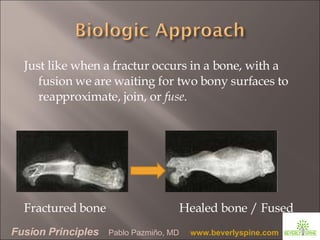
Just like when a fractur occurs in a bone, with a fusion we are waiting for two bony surfaces to reapproximate, join, or  fuse . Fractured bone Healed bone / Fused
You start with two bones, or vertebral bodies that need to span a gap where there was either a fracture or where you are waiting for fusion to occur Next you will see the cells start to reach across the gap in forming a soft “callus” or shell of bone. The two ends of the bone are now getting “sticky” This is around the  3 month  window and when most of my patients get back to sporting activities.
At the  3 month -6 month  window your bones are starting to reapproximate or get “sticky” This is similar to a Woven Bone phase Woven bone is soft , yet sturdy, similar to the bone on the skull of a newborn.  Strong enough to hold the contents inside but not as  strong as our final fusion bone.
As the shell of woven bone spans the gap, our fusion is slowly maturing. This is around the  6   month  mark and it is more than safe to begin activities. Final , robust, fusion occurs in  year  and you can see this area where there once was a gap is now the strongest part of the bone . This will take time to remodel to its normal shape.
We all need to deliver nutrients to the our soft tissues to give the cells in our body energy. The way we deliver these precious nutrients is through our blood delivering oxygen and vitamins to the areas that need it most. Look closely at the two fractured ends of the bone and you will see tiny blood vessels sprouting .
With time as the bony callus (around the two bony ends matures) you see under the microscope what really is maturing is the circulation and therefore the nutrients being delivered to the bone to allow the fusion to happen!!!
 
Here is a cross section of bone and the cells which actually make bone called osteoblasts.
36 year old female 76 year old female Note the  increased porosity
I like these slides because they highlight the fact that within the central cavity of each bone is a tiny blood vessel. This one vessel will feed the bone all the nutrients require to fuse. All our fusion will then depends on ensuring the circulation to this area
 
I often use a bone stimulator. We know that this stimulates the bony cells to align and cross the fracture gap. This helps to ensure healing and therefore fusion.
Limitation on range of motion/activities: This allows the two surfaces to remain close in proximity and therefore span the gap they need in order to fuse Health: Give your body the adequate nutrients it needs to recover (Calcium, diet, vitamins,etc.) Mobility: If loading on a particular bone increases, the bone will remodel itself over time to become stronger to resist that sort of loading. So it is important to get up and walk afterwards.
Wolff's law  is a theory developed by this German Anatomist/Surgeon (1835-1902) in the 19th century that states that bone in a healthy person or animal will adapt to the loads it is placed under . If loading on a particular bone increases, the bone will remodel itself over time to become stronger to resist that sort of loading .
Smoking : Nicotine specifically contracts the vessels which as you know are needed to deliver nutrients to allow the bones to heal/fuse. More than 4,000 chemicals make up cigarette smoke, and many of them can damage a person's health. But the bête noire of the lot is nicotine, a compound that is simultaneously pleasure-inducing, addictive, and—at high doses—poisonous.
Many studies have shown that fractures/wounds tend to take longer to heal if the injured person has been smoking. Cigarettes can also increase the risk of blood clotting, which may further reduce blood flow. Breakdown products of cigarette smoke include carbon monoxide, formaldehyde, nitrosamines and benzenes which can damage the cells that form the bone itself and can interrupt the healing process after a fracture or bone injury. Bones are nourished by blood much like the other organs and tissues in your body. Nutrients, minerals and oxygen are all supplied to the bones via the blood stream. Smoking elevates the levels of nicotine in your blood and this causes the blood vessels to constrict. Nicotine constricts blood vessels approximately 25% of their normal diameter. Because of the constriction of the vessels, decreased levels of nutrients are supplied to the bone, fracture /wound. It is thought that this is the reason for the effect on bone/wound healing.
 
Treatment of a fractured (broken) vertebra Correction of deformity (spinal curves or  scoliosis) Correction of instability, meaning an abnormal or excessive motion between two or more vertebrae. Correction of Spondylolisthesis Treatment of some cervical disc herniations. Elimination of pain from painful motion. Treatment of recurrent disc herniations.
Here is a very common example of when you would need a fusion which I see often in my practice. Many people have a condition that is called Spondylolisthesis.  This is an instability in their spine that causes severe back and leg pain.
Spondylolisthesis describes the displacement of a vertebral body in relation to the vertebrae below. It was first described in 1782 by a Belgian Obstetrician, Dr. Herbinaux.  He reported a bony prominence anterior to the sacrum that obstructed the vagina of a small number of patients
. The term “spondylolisthesis” was coined in 1854 from the Greek language “spondylo” for vertebrae and “olisthesis” for slip. The word for vertebrae in the Greek language is  Spondylo The word for slip is “ olisthesis ”
You can see here the problem you would have if one vertebral body is moving in relation to the body below it . The bone will literally pinch the nerve as it slides around.
Unfortunately this happens every time my patients bend forward or extend. They feel this as a sciatic pain in their legs or an aching back pain. As you can imagine this can potentially cause permanent nerve damage. If we remove the bone pinching the nerve the  pain will no longer be an issue, since there is nothing physically hurting the nerve .
Unfortunately this destabilizes the spine more so than it was before. We have devised a way to limit the motion of the two vertebral bodies and therefore remove the source of pain. We lock the vertebral bodies in relation to one another using screws, next we hold these screws together with small rods.  All performed in a minimally invasive manner.
 
 
Vitoss is a substance that can be placed at the time of surgery to help ensure solid fusion.  Look here at the histology which shows the pink bone maturing into green fused bone after Vitoss use.
 
Recently we have demonstrated that a genetically produced protein, recombinant human bone morphogenetic protein-2, or rhBMP-2, has the ability to stimulate a patient's own cells to make more bone.  This finding has been tremendously beneficial to patients undergoing spinal fusion.  In some cases it has eliminate the need for bone transplantation from the pelvis!!!!!
This is an exciting   and rapidly developing time in spine surgery. Our biomedical research, allows us to collaborate with bioengineers, molecular   biologists, physiologists, and drug and gene delivery specialists.
Thank you for your time. If you know someone who could benefit from a consultation for Spinal Fusion or would like more information on the Fusion process, please refer them to our website to arrange an appointment, or  you can reach us Toll free. www.beverlyspine.com  1-877-463-2251   1-8 SPINECAL-1

Fusion Principles by Pablo Pazmino MD

  • 1.
  • 2.
    Orthopaedic Surgery AmericanAcademy of Orthopaedic Surgeons Clinical Faculty Olympia Medical Center Cedars Sinai Medical Center Century City Doctors Hospital Education The University of California, Los Angeles The University of Michigan, Ann Arbor
  • 3.
    Fusion is asurgical technique in which one or more of the vertebrae of the spine are united together (“fused”) so that motion no longer occurs between them. Think of fusion in terms of a mechanistic and a biologic approach
  • 4.
    Union Union means the bone is restored in terms of its mechanical stability - so this is a mechanistic definition.
  • 5.
    Just like whena fractur occurs in a bone, with a fusion we are waiting for two bony surfaces to reapproximate, join, or fuse . Fractured bone Healed bone / Fused
  • 6.
    You start withtwo bones, or vertebral bodies that need to span a gap where there was either a fracture or where you are waiting for fusion to occur Next you will see the cells start to reach across the gap in forming a soft “callus” or shell of bone. The two ends of the bone are now getting “sticky” This is around the 3 month window and when most of my patients get back to sporting activities.
  • 7.
    At the 3 month -6 month window your bones are starting to reapproximate or get “sticky” This is similar to a Woven Bone phase Woven bone is soft , yet sturdy, similar to the bone on the skull of a newborn. Strong enough to hold the contents inside but not as strong as our final fusion bone.
  • 8.
    As the shellof woven bone spans the gap, our fusion is slowly maturing. This is around the 6 month mark and it is more than safe to begin activities. Final , robust, fusion occurs in year and you can see this area where there once was a gap is now the strongest part of the bone . This will take time to remodel to its normal shape.
  • 9.
    We all needto deliver nutrients to the our soft tissues to give the cells in our body energy. The way we deliver these precious nutrients is through our blood delivering oxygen and vitamins to the areas that need it most. Look closely at the two fractured ends of the bone and you will see tiny blood vessels sprouting .
  • 10.
    With time asthe bony callus (around the two bony ends matures) you see under the microscope what really is maturing is the circulation and therefore the nutrients being delivered to the bone to allow the fusion to happen!!!
  • 11.
  • 12.
    Here is across section of bone and the cells which actually make bone called osteoblasts.
  • 13.
    36 year oldfemale 76 year old female Note the increased porosity
  • 14.
    I like theseslides because they highlight the fact that within the central cavity of each bone is a tiny blood vessel. This one vessel will feed the bone all the nutrients require to fuse. All our fusion will then depends on ensuring the circulation to this area
  • 15.
  • 16.
    I often usea bone stimulator. We know that this stimulates the bony cells to align and cross the fracture gap. This helps to ensure healing and therefore fusion.
  • 17.
    Limitation on rangeof motion/activities: This allows the two surfaces to remain close in proximity and therefore span the gap they need in order to fuse Health: Give your body the adequate nutrients it needs to recover (Calcium, diet, vitamins,etc.) Mobility: If loading on a particular bone increases, the bone will remodel itself over time to become stronger to resist that sort of loading. So it is important to get up and walk afterwards.
  • 18.
    Wolff's law is a theory developed by this German Anatomist/Surgeon (1835-1902) in the 19th century that states that bone in a healthy person or animal will adapt to the loads it is placed under . If loading on a particular bone increases, the bone will remodel itself over time to become stronger to resist that sort of loading .
  • 19.
    Smoking : Nicotinespecifically contracts the vessels which as you know are needed to deliver nutrients to allow the bones to heal/fuse. More than 4,000 chemicals make up cigarette smoke, and many of them can damage a person's health. But the bête noire of the lot is nicotine, a compound that is simultaneously pleasure-inducing, addictive, and—at high doses—poisonous.
  • 20.
    Many studies haveshown that fractures/wounds tend to take longer to heal if the injured person has been smoking. Cigarettes can also increase the risk of blood clotting, which may further reduce blood flow. Breakdown products of cigarette smoke include carbon monoxide, formaldehyde, nitrosamines and benzenes which can damage the cells that form the bone itself and can interrupt the healing process after a fracture or bone injury. Bones are nourished by blood much like the other organs and tissues in your body. Nutrients, minerals and oxygen are all supplied to the bones via the blood stream. Smoking elevates the levels of nicotine in your blood and this causes the blood vessels to constrict. Nicotine constricts blood vessels approximately 25% of their normal diameter. Because of the constriction of the vessels, decreased levels of nutrients are supplied to the bone, fracture /wound. It is thought that this is the reason for the effect on bone/wound healing.
  • 21.
  • 22.
    Treatment of afractured (broken) vertebra Correction of deformity (spinal curves or scoliosis) Correction of instability, meaning an abnormal or excessive motion between two or more vertebrae. Correction of Spondylolisthesis Treatment of some cervical disc herniations. Elimination of pain from painful motion. Treatment of recurrent disc herniations.
  • 23.
    Here is avery common example of when you would need a fusion which I see often in my practice. Many people have a condition that is called Spondylolisthesis. This is an instability in their spine that causes severe back and leg pain.
  • 24.
    Spondylolisthesis describes thedisplacement of a vertebral body in relation to the vertebrae below. It was first described in 1782 by a Belgian Obstetrician, Dr. Herbinaux. He reported a bony prominence anterior to the sacrum that obstructed the vagina of a small number of patients
  • 25.
    . The term“spondylolisthesis” was coined in 1854 from the Greek language “spondylo” for vertebrae and “olisthesis” for slip. The word for vertebrae in the Greek language is Spondylo The word for slip is “ olisthesis ”
  • 26.
    You can seehere the problem you would have if one vertebral body is moving in relation to the body below it . The bone will literally pinch the nerve as it slides around.
  • 27.
    Unfortunately this happensevery time my patients bend forward or extend. They feel this as a sciatic pain in their legs or an aching back pain. As you can imagine this can potentially cause permanent nerve damage. If we remove the bone pinching the nerve the pain will no longer be an issue, since there is nothing physically hurting the nerve .
  • 28.
    Unfortunately this destabilizesthe spine more so than it was before. We have devised a way to limit the motion of the two vertebral bodies and therefore remove the source of pain. We lock the vertebral bodies in relation to one another using screws, next we hold these screws together with small rods. All performed in a minimally invasive manner.
  • 29.
  • 30.
  • 31.
    Vitoss is asubstance that can be placed at the time of surgery to help ensure solid fusion. Look here at the histology which shows the pink bone maturing into green fused bone after Vitoss use.
  • 32.
  • 33.
    Recently we havedemonstrated that a genetically produced protein, recombinant human bone morphogenetic protein-2, or rhBMP-2, has the ability to stimulate a patient's own cells to make more bone. This finding has been tremendously beneficial to patients undergoing spinal fusion. In some cases it has eliminate the need for bone transplantation from the pelvis!!!!!
  • 34.
    This is anexciting and rapidly developing time in spine surgery. Our biomedical research, allows us to collaborate with bioengineers, molecular biologists, physiologists, and drug and gene delivery specialists.
  • 35.
    Thank you foryour time. If you know someone who could benefit from a consultation for Spinal Fusion or would like more information on the Fusion process, please refer them to our website to arrange an appointment, or you can reach us Toll free. www.beverlyspine.com 1-877-463-2251 1-8 SPINECAL-1