Foundations of OD
1
Nature of Planned Change
 Change an inevitable feature of organizational life.
 OD is directed at bringing about planned change.
 Planned change to:
• Solve problems
• Learn from experience
• Reframe shared perceptions
• Adapt to external environmental changes
• Improve performance
• Influence future changes
2
Theories of Planned Change
 OD approaches rely on some theory about planned change.
 The theories describe the different stages through which
planned change may be effected in organizations.
 Then apply OD methods to help organization members
manage change.
 Three theories of changing:
• Lewin’s change model.
• The action research model.
• The positive model.
3
Theories of Planned Change
Lewin’s Change Model
 One of the earliest models by Kurt Lewin (1940s).
 Change as modification of those forces keeping a system’s
behavior stable.
 Two groups of forces:
• Those striving to maintain the status quo.
• Those pushing for change.
 “Quasi-stationary equilibrium.”
4
Theories of Planned Change
Lewin’s Change Model contd……
 This change process consists three steps:
• Unfreezing
• Moving
• Refreezing
 It is a general framework to understand the change process.
5
Theories of Planned Change
Lippitt, Watson, and Westley model
 Seven steps:
• Scouting
• Entry (Unfreezing)
• Diagnosis
• Planning
• Action (Moving)
• Stabilization and evaluation (Refreezing)
• Termination
6
Theories of Planned Change
Kotter’s Eight Stage
• Establishing a sense of urgency
• Creating the guiding coalition
• Developing a vision and strategy (Unfreezing)
• Communicating the change vision
• Empowering broad-based action
• Generating short-term wins (Moving)
• Consolidating gains and producing more change
• Anchoring new approaches in the culture (Refreezing)
7
Theories of Planned Change
8
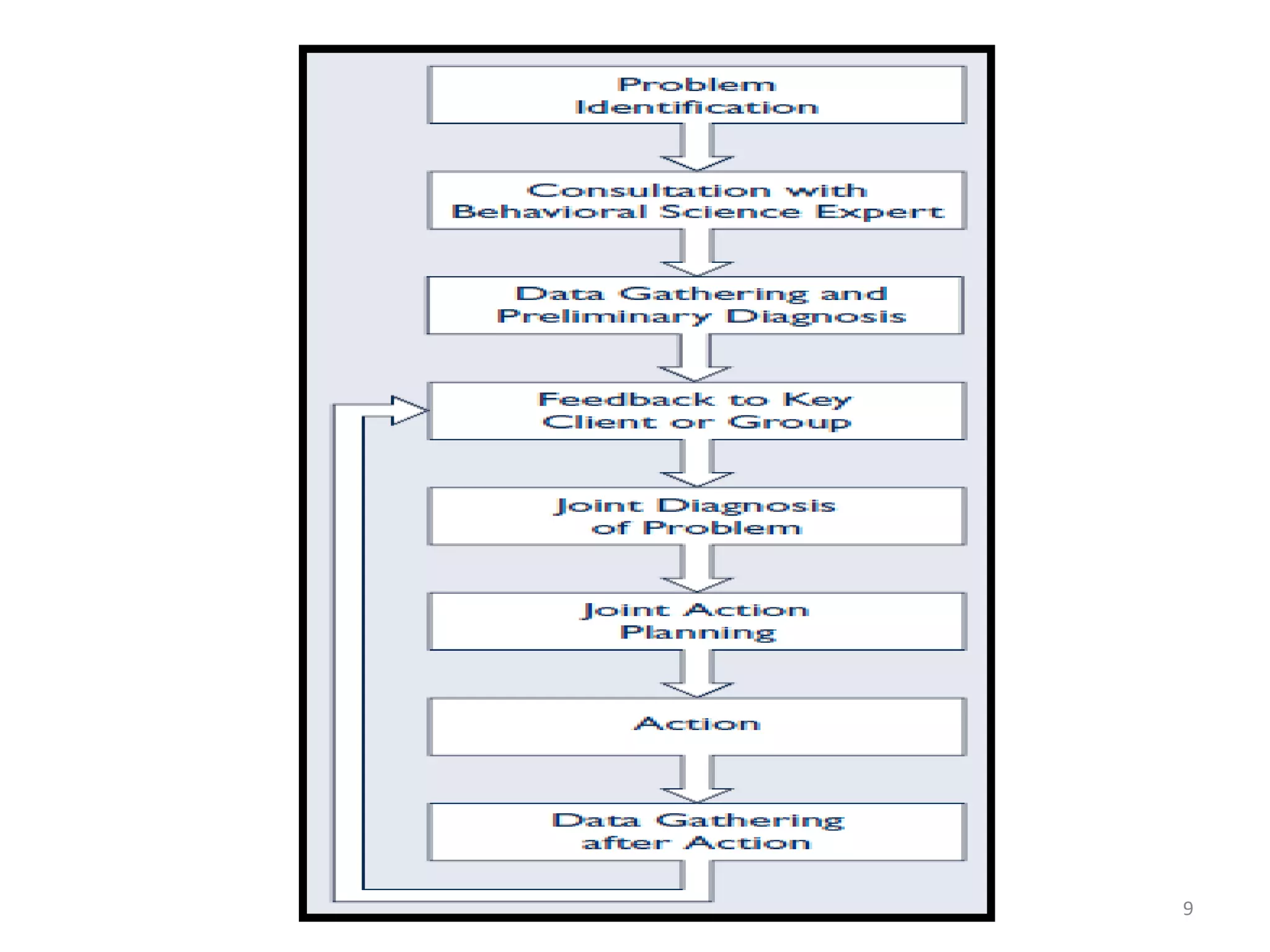
Action Research Model
 Planned change as a cyclical process.
 Considerable collaboration among organization members and
OD practitioners.
 Implementing planned change and developing more
knowledge.
 Most current approaches to planned change and is often
considered synonymous with OD.
9
Theories of Planned Change
The Positive Model
 The positive model focuses on what the organization is doing
right.
 Builds capabilities to achieve even better results.
 “Positive organizational scholarship,” which focuses on positive
dynamics in organizations that give rise to extraordinary
outcomes.
 Applied through a process called appreciative inquiry (AI).
 Appreciative Inquiry explicitly infuses a positive value
orientation into analyzing and changing organizations.
10
11
Systems Theory
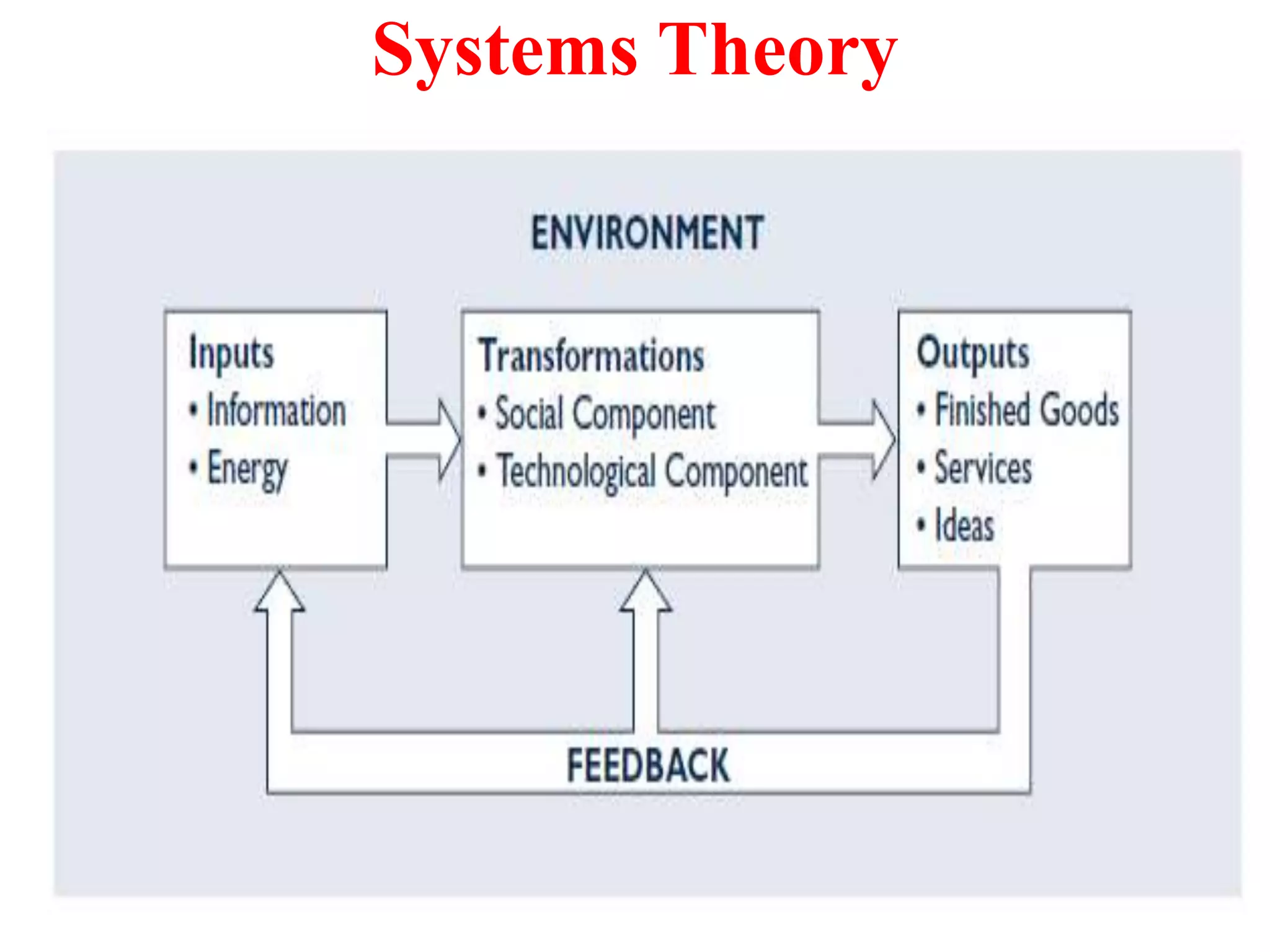
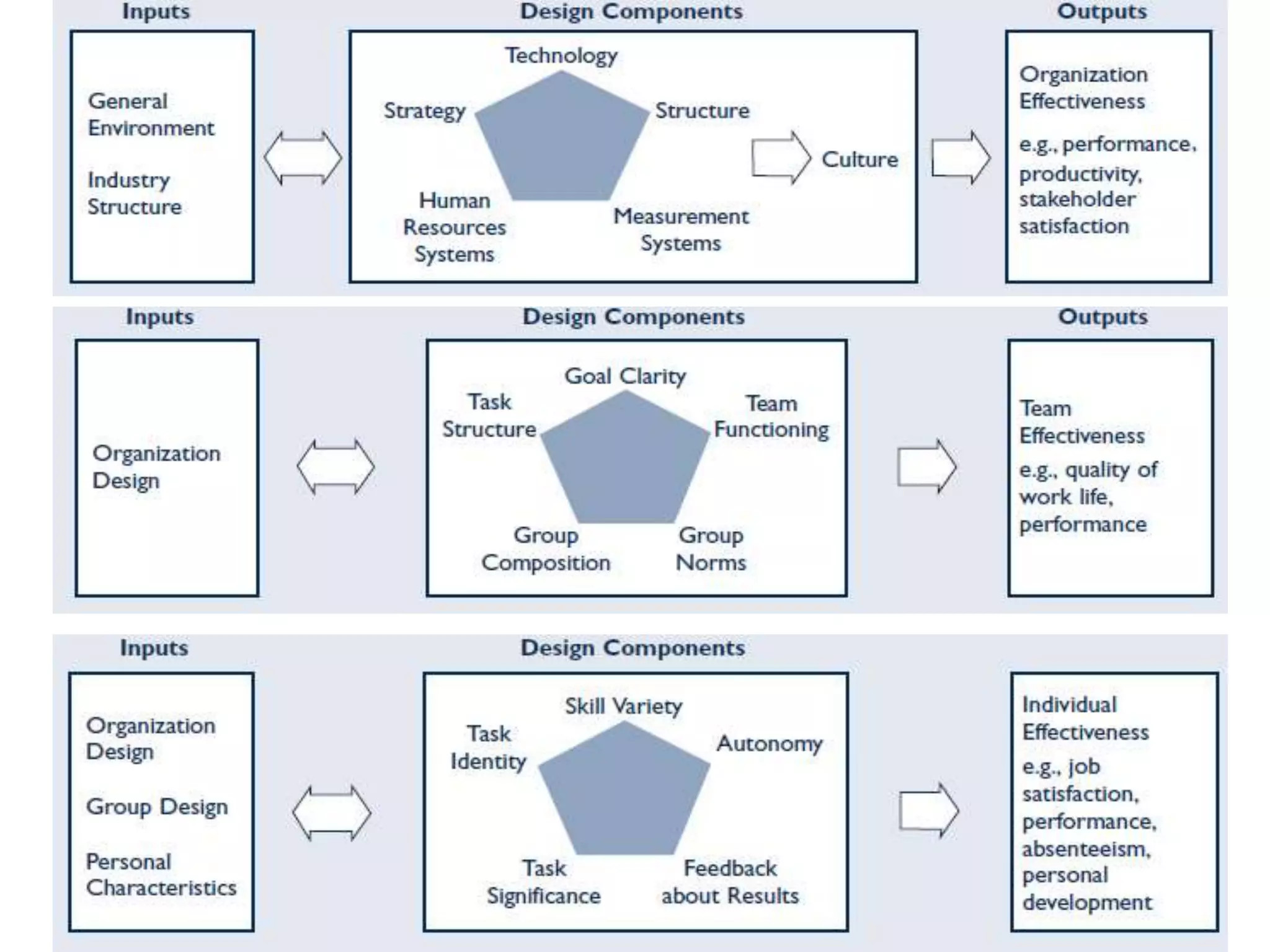
 Organizations as open systems.
 System denotes interdependency, interconnectedness, and
interrelatedness.
 All open systems are input- throughput- output mechanisms.
 Every system has a boundary, that separates it from its
environment.
 Open systems have purposes and goals.
 Feedback is important for the systems.
12
Systems Theory
13
14
Systems Theory
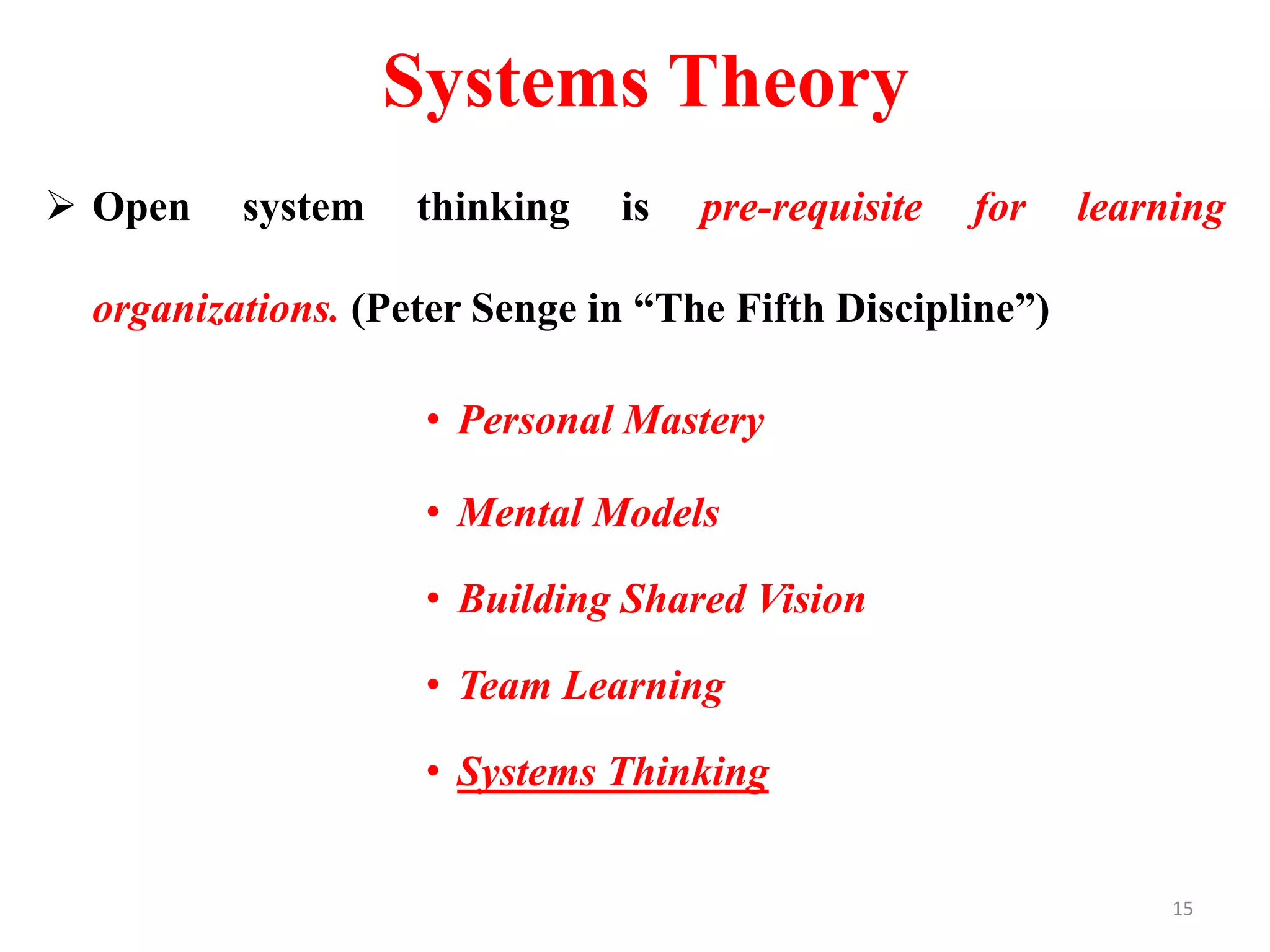
 Open system thinking is pre-requisite for learning
organizations. (Peter Senge in “The Fifth Discipline”)
• Personal Mastery
• Mental Models
• Building Shared Vision
• Team Learning
• Systems Thinking
15
Systems Theory
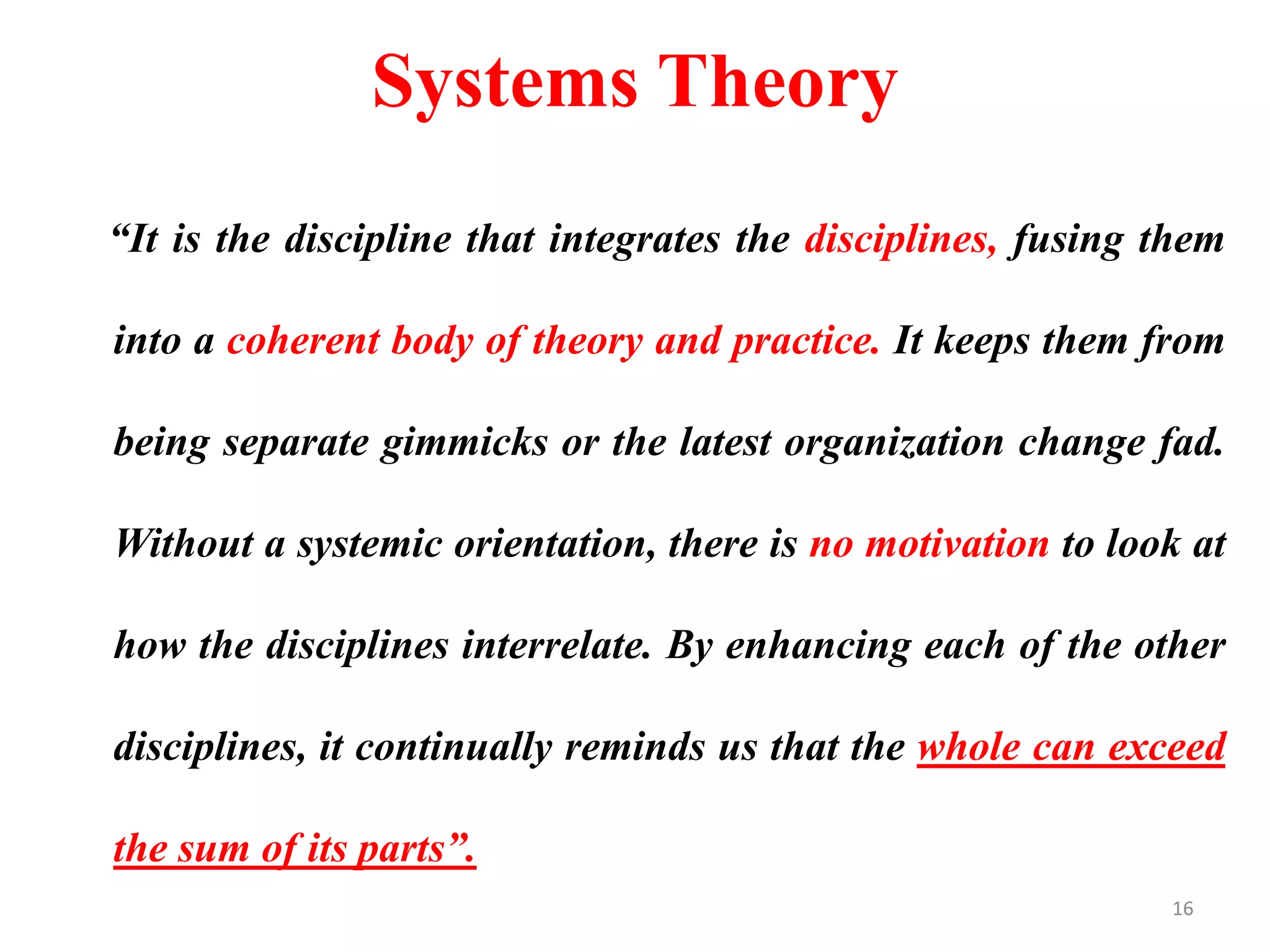
“It is the discipline that integrates the disciplines, fusing them
into a coherent body of theory and practice. It keeps them from
being separate gimmicks or the latest organization change fad.
Without a systemic orientation, there is no motivation to look at
how the disciplines interrelate. By enhancing each of the other
disciplines, it continually reminds us that the whole can exceed
the sum of its parts”.
16
Systems Theory
 System theory pervades OD from diagnosis to intervention
and evaluation.
 Nothing can be seen in isolation.
 If one wants to change a system, one changes the system, not
just its component parts.
 These approaches are valuable in OD.
17
Participation and Empowerment
 A powerful and useful model.
 Participation enhances empowerment, and empowerment in
turn enhances performance and individual well-being.
 OD interventions are methods of increasing participation.
 Participation/Empowerment works.
18
Teams and Teamwork
 Building blocks of organizations.
 Teams must manage their culture, processes, systems, and
relationships.
 Involved/Empowered individuals in teams.
 Self- directed teams, Quality circles, High performance
organizations.
 Teams create synergy.
19
Parallel Learning Structures
 To plan and guide change programs.
 Dale Zand (1974) “Collateral Organizations”- a supplemental
organization coexisting with the usual, formal organization.
 Learning how to change and then leading the change process.
 Structure Parallel Learning.
 They coordinate self directed teams in high performance
organizations.
20
Normative-Re-educative Strategy
Chin and Benne describe three strategies:
Empirical-Rational Strategies
Normative Re-educative Strategies
Power- Coercive Strategies
 Change in norms and values and sharing of information.
21
Action Research
 A data based, problem solving method.
 Replicates scientific method of inquiry.
 Involves three steps:
Data Collection
Feedback of data to client system members
Action Planning
 Action research is a method of learning and doing.
22

FUNDAMENTALS OF OD

  • 1.
  • 2.
    Nature of PlannedChange  Change an inevitable feature of organizational life.  OD is directed at bringing about planned change.  Planned change to: • Solve problems • Learn from experience • Reframe shared perceptions • Adapt to external environmental changes • Improve performance • Influence future changes 2
  • 3.
    Theories of PlannedChange  OD approaches rely on some theory about planned change.  The theories describe the different stages through which planned change may be effected in organizations.  Then apply OD methods to help organization members manage change.  Three theories of changing: • Lewin’s change model. • The action research model. • The positive model. 3
  • 4.
    Theories of PlannedChange Lewin’s Change Model  One of the earliest models by Kurt Lewin (1940s).  Change as modification of those forces keeping a system’s behavior stable.  Two groups of forces: • Those striving to maintain the status quo. • Those pushing for change.  “Quasi-stationary equilibrium.” 4
  • 5.
    Theories of PlannedChange Lewin’s Change Model contd……  This change process consists three steps: • Unfreezing • Moving • Refreezing  It is a general framework to understand the change process. 5
  • 6.
    Theories of PlannedChange Lippitt, Watson, and Westley model  Seven steps: • Scouting • Entry (Unfreezing) • Diagnosis • Planning • Action (Moving) • Stabilization and evaluation (Refreezing) • Termination 6
  • 7.
    Theories of PlannedChange Kotter’s Eight Stage • Establishing a sense of urgency • Creating the guiding coalition • Developing a vision and strategy (Unfreezing) • Communicating the change vision • Empowering broad-based action • Generating short-term wins (Moving) • Consolidating gains and producing more change • Anchoring new approaches in the culture (Refreezing) 7
  • 8.
    Theories of PlannedChange 8 Action Research Model  Planned change as a cyclical process.  Considerable collaboration among organization members and OD practitioners.  Implementing planned change and developing more knowledge.  Most current approaches to planned change and is often considered synonymous with OD.
  • 9.
  • 10.
    Theories of PlannedChange The Positive Model  The positive model focuses on what the organization is doing right.  Builds capabilities to achieve even better results.  “Positive organizational scholarship,” which focuses on positive dynamics in organizations that give rise to extraordinary outcomes.  Applied through a process called appreciative inquiry (AI).  Appreciative Inquiry explicitly infuses a positive value orientation into analyzing and changing organizations. 10
  • 11.
  • 12.
    Systems Theory  Organizationsas open systems.  System denotes interdependency, interconnectedness, and interrelatedness.  All open systems are input- throughput- output mechanisms.  Every system has a boundary, that separates it from its environment.  Open systems have purposes and goals.  Feedback is important for the systems. 12
  • 13.
  • 14.
  • 15.
    Systems Theory  Opensystem thinking is pre-requisite for learning organizations. (Peter Senge in “The Fifth Discipline”) • Personal Mastery • Mental Models • Building Shared Vision • Team Learning • Systems Thinking 15
  • 16.
    Systems Theory “It isthe discipline that integrates the disciplines, fusing them into a coherent body of theory and practice. It keeps them from being separate gimmicks or the latest organization change fad. Without a systemic orientation, there is no motivation to look at how the disciplines interrelate. By enhancing each of the other disciplines, it continually reminds us that the whole can exceed the sum of its parts”. 16
  • 17.
    Systems Theory  Systemtheory pervades OD from diagnosis to intervention and evaluation.  Nothing can be seen in isolation.  If one wants to change a system, one changes the system, not just its component parts.  These approaches are valuable in OD. 17
  • 18.
    Participation and Empowerment A powerful and useful model.  Participation enhances empowerment, and empowerment in turn enhances performance and individual well-being.  OD interventions are methods of increasing participation.  Participation/Empowerment works. 18
  • 19.
    Teams and Teamwork Building blocks of organizations.  Teams must manage their culture, processes, systems, and relationships.  Involved/Empowered individuals in teams.  Self- directed teams, Quality circles, High performance organizations.  Teams create synergy. 19
  • 20.
    Parallel Learning Structures To plan and guide change programs.  Dale Zand (1974) “Collateral Organizations”- a supplemental organization coexisting with the usual, formal organization.  Learning how to change and then leading the change process.  Structure Parallel Learning.  They coordinate self directed teams in high performance organizations. 20
  • 21.
    Normative-Re-educative Strategy Chin andBenne describe three strategies: Empirical-Rational Strategies Normative Re-educative Strategies Power- Coercive Strategies  Change in norms and values and sharing of information. 21
  • 22.
    Action Research  Adata based, problem solving method.  Replicates scientific method of inquiry.  Involves three steps: Data Collection Feedback of data to client system members Action Planning  Action research is a method of learning and doing. 22