Organisational Development &
Change
Module 2
Planned Change
• Organization Development (OD) aims to facilitate planned
change to enhance an organization's effectiveness and its
ability to adapt to future changes. This process is typically
initiated by managers, often with support from internal or
external OD practitioners.
• Planned change can address various organizational
challenges, such as solving problems, learning from
experiences, reframing perceptions, adapting to external
changes, and improving performance.
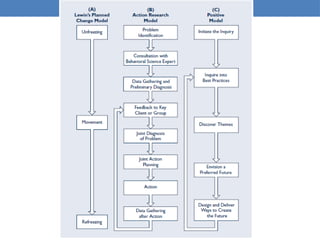
• Three significant change theories: Lewin’s Change Model,
the Action Research Model, and the Positive Model.
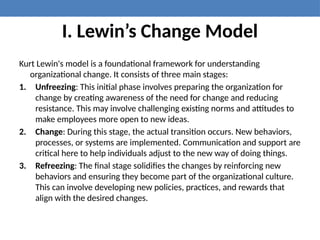
I. Lewin’s Change Model
Kurt Lewin's model is a foundational framework for understanding
organizational change. It consists of three main stages:
1. Unfreezing: This initial phase involves preparing the organization for
change by creating awareness of the need for change and reducing
resistance. This may involve challenging existing norms and attitudes to
make employees more open to new ideas.
2. Change: During this stage, the actual transition occurs. New behaviors,
processes, or systems are implemented. Communication and support are
critical here to help individuals adjust to the new way of doing things.
3. Refreezing: The final stage solidifies the changes by reinforcing new
behaviors and ensuring they become part of the organizational culture.
This can involve developing new policies, practices, and rewards that
align with the desired changes.
II. Action Research Model
• The Action Research Model emphasizes a systematic approach to
problem-solving through collaboration between OD practitioners and
organizational members. It typically follows these steps:
1. Identifying the Problem: The process begins with diagnosing the
current situation to understand the issues needing change.
2. Data Collection and Analysis: Relevant data is gathered through
various methods (e.g., interviews, surveys, observations) to analyze
the problem thoroughly.
3. Planning Action: Based on the analysis, strategies for change are
developed collaboratively.
4. Implementing Action: The planned interventions are executed.
5. Evaluating Action: The results of the implemented changes are
assessed to determine effectiveness.
III. Positive Model
The Positive Model focuses on building an organization's strengths and capabilities rather than merely
addressing weaknesses. Key elements include:
1. Initiate the Inquiry
Identify a relevant change topic through member involvement, focusing on positive aspects that
energize the organization.
2. Inquire into Best Practices
Gather information about the organization's strengths by conducting peer interviews to share
successful stories and experiences.
3. Discover the Themes
Analyze the collected stories to identify recurring themes that highlight the organization’s successful
elements and dynamics.
4. Envision a Preferred Future
Challenge the status quo and collaboratively create a compelling vision for the future, connecting best
practices to aspirational goals.
5. Design and Deliver Ways to Create the Future
Develop actionable plans to implement the vision, including assessing progress and making
adjustments to ensure sustained growth and alignment with desired outcomes.
Process of Organisational Development/
Planned Change
Process of Planned Change
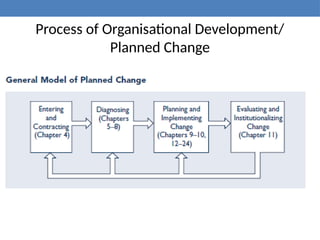
• The General Model of Planned Change outlines the core activities involved in initiating and
executing organizational change.
• STEP 1- Entering and Contracting: This is the initial stage of planned change, where OD
practitioners and organization members assess the need for change. Data is gathered to
understand organizational problems or identify positive opportunities. Based on this information,
discussions are held with managers and stakeholders to form a contract that defines the scope of
the change, outlines the resources required, and specifies the roles of all participants. However,
many organizations may not progress beyond this stage due to disagreements, lack of resources, or
the emergence of alternative solutions.
• STEP 2- Diagnosing: In this critical stage, the organization is thoroughly studied to identify the root
causes of problems or areas for improvement. Diagnosis involves selecting a model to understand
organizational dynamics and gathering relevant data through interviews, surveys, or observation.
This stage may focus on issues at the organizational, group, or individual levels. The data collected
is then analyzed and shared with managers and members, enabling informed discussions about
the next steps.
• STEP3- Planning and Implementing Change: Once the diagnosis is
complete, the OD practitioner and organization members jointly design
interventions aimed at achieving desired goals. The interventions may
address human processes, organizational structures, technology, or
strategic issues, depending on the specific diagnosis. The planning
process involves assessing the organization’s readiness for change,
understanding the culture and power dynamics, and ensuring the change
agents are equipped to lead the initiative. Implementation then focuses
on managing the transition, motivating stakeholders, and maintaining
momentum.
• STEP4- Evaluating and Institutionalizing Change: After the interventions
are implemented, their effectiveness is evaluated. Feedback is provided
to determine whether the changes should be continued, adjusted, or
abandoned. Successful changes are institutionalized through
reinforcement mechanisms such as feedback loops, reward systems, and
training programs to ensure the changes become a permanent part of
the organizational culture.
Who is organization development (OD)
practitioner ?
• An organization development (OD) practitioner refers to three main groups:
1. OD Professionals: These are internal or external consultants specializing in OD.
They focus on improving communication, employee involvement, and
organizational effectiveness. Over time, their role has expanded to include
strategic and structural aspects of organizations.
3. Specialists in Related Fields: Professionals in areas like reward systems,
organization design, and IT, who apply OD principles within their expertise. They
often collaborate with OD experts on large-scale projects, integrating OD into
their specific fields.
3. Managers and Administrators: Many managers have gained OD skills through
experience and formal training. They apply OD practices in their roles to lead
change within their teams, becoming essential change agents in their
organizations.
• These roles are increasingly overlapping, with cross-training blending OD with
other business functions.
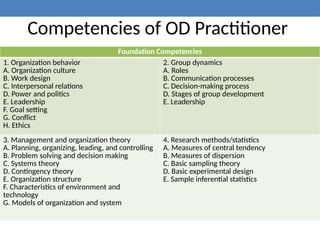
Competencies of OD Practitioner
Foundation Competencies
1. Organization behavior
A. Organization culture
B. Work design
C. Interpersonal relations
D. Power and politics
E. Leadership
F. Goal setting
G. Conflict
H. Ethics
2. Group dynamics
A. Roles
B. Communication processes
C. Decision-making process
D. Stages of group development
E. Leadership
3. Management and organization theory
A. Planning, organizing, leading, and controlling
B. Problem solving and decision making
C. Systems theory
D. Contingency theory
E. Organization structure
F. Characteristics of environment and
technology
G. Models of organization and system
4. Research methods/statistics
A. Measures of central tendency
B. Measures of dispersion
C. Basic sampling theory
D. Basic experimental design
E. Sample inferential statistics
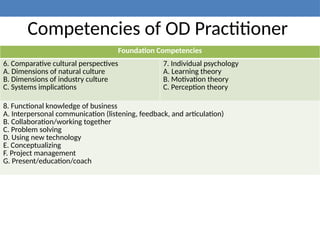
Competencies of OD Practitioner
Foundation Competencies
6. Comparative cultural perspectives
A. Dimensions of natural culture
B. Dimensions of industry culture
C. Systems implications
7. Individual psychology
A. Learning theory
B. Motivation theory
C. Perception theory
8. Functional knowledge of business
A. Interpersonal communication (listening, feedback, and articulation)
B. Collaboration/working together
C. Problem solving
D. Using new technology
E. Conceptualizing
F. Project management
G. Present/education/coach
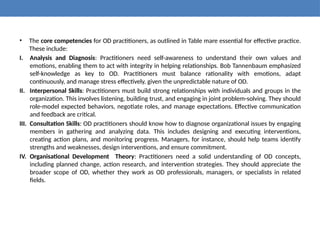
• The core competencies for OD practitioners, as outlined in Table mare essential for effective practice.
These include:
I. Analysis and Diagnosis: Practitioners need self-awareness to understand their own values and
emotions, enabling them to act with integrity in helping relationships. Bob Tannenbaum emphasized
self-knowledge as key to OD. Practitioners must balance rationality with emotions, adapt
continuously, and manage stress effectively, given the unpredictable nature of OD.
II. Interpersonal Skills: Practitioners must build strong relationships with individuals and groups in the
organization. This involves listening, building trust, and engaging in joint problem-solving. They should
role-model expected behaviors, negotiate roles, and manage expectations. Effective communication
and feedback are critical.
III. Consultation Skills: OD practitioners should know how to diagnose organizational issues by engaging
members in gathering and analyzing data. This includes designing and executing interventions,
creating action plans, and monitoring progress. Managers, for instance, should help teams identify
strengths and weaknesses, design interventions, and ensure commitment.
IV. Organisational Development Theory: Practitioners need a solid understanding of OD concepts,
including planned change, action research, and intervention strategies. They should appreciate the
broader scope of OD, whether they work as OD professionals, managers, or specialists in related
fields.
Competencies of OD Practitioner
Core Competencies
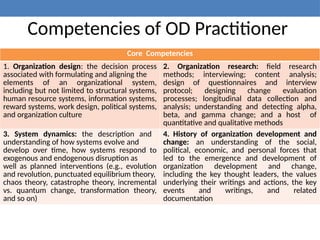
1. Organization design: the decision process
associated with formulating and aligning the
elements of an organizational system,
including but not limited to structural systems,
human resource systems, information systems,
reward systems, work design, political systems,
and organization culture
2. Organization research: field research
methods; interviewing; content analysis;
design of questionnaires and interview
protocol; designing change evaluation
processes; longitudinal data collection and
analysis; understanding and detecting alpha,
beta, and gamma change; and a host of
quantitative and qualitative methods
3. System dynamics: the description and
understanding of how systems evolve and
develop over time, how systems respond to
exogenous and endogenous disruption as
well as planned interventions (e.g., evolution
and revolution, punctuated equilibrium theory,
chaos theory, catastrophe theory, incremental
vs. quantum change, transformation theory,
and so on)
4. History of organization development and
change: an understanding of the social,
political, economic, and personal forces that
led to the emergence and development of
organization development and change,
including the key thought leaders, the values
underlying their writings and actions, the key
events and writings, and related
documentation
Competencies of OD Practitioner
Core Competencies
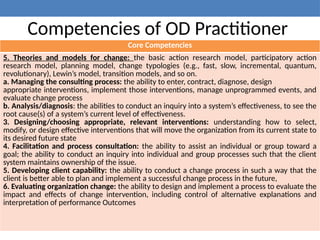
5. Theories and models for change: the basic action research model, participatory action
research model, planning model, change typologies (e.g., fast, slow, incremental, quantum,
revolutionary), Lewin’s model, transition models, and so on.
a. Managing the consulting process: the ability to enter, contract, diagnose, design
appropriate interventions, implement those interventions, manage unprogrammed events, and
evaluate change process
b. Analysis/diagnosis: the abilities to conduct an inquiry into a system’s effectiveness, to see the
root cause(s) of a system’s current level of effectiveness.
3. Designing/choosing appropriate, relevant interventions: understanding how to select,
modify, or design effective interventions that will move the organization from its current state to
its desired future state
4. Facilitation and process consultation: the ability to assist an individual or group toward a
goal; the ability to conduct an inquiry into individual and group processes such that the client
system maintains ownership of the issue.
5. Developing client capability: the ability to conduct a change process in such a way that the
client is better able to plan and implement a successful change process in the future,
6. Evaluating organization change: the ability to design and implement a process to evaluate the
impact and effects of change intervention, including control of alternative explanations and
interpretation of performance Outcomes
Internal VS External Consultants:
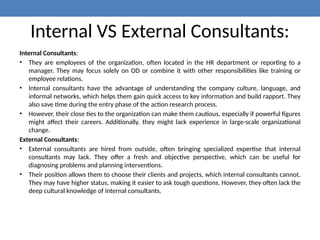
Internal Consultants:
• They are employees of the organization, often located in the HR department or reporting to a
manager. They may focus solely on OD or combine it with other responsibilities like training or
employee relations.
• Internal consultants have the advantage of understanding the company culture, language, and
informal networks, which helps them gain quick access to key information and build rapport. They
also save time during the entry phase of the action research process.
• However, their close ties to the organization can make them cautious, especially if powerful figures
might affect their careers. Additionally, they might lack experience in large-scale organizational
change.
External Consultants:
• External consultants are hired from outside, often bringing specialized expertise that internal
consultants may lack. They offer a fresh and objective perspective, which can be useful for
diagnosing problems and planning interventions.
• Their position allows them to choose their clients and projects, which internal consultants cannot.
They may have higher status, making it easier to ask tough questions. However, they often lack the
deep cultural knowledge of internal consultants.
Role of Organization Development
(OD) Professionals
Marginality in OD:
• OD professionals often occupy marginal roles, which means they
bridge different organizational groups with diverse goals and values.
• Individuals who thrive in marginal roles are open-minded, flexible,
and able to process complex information.
• They tend to excel in conflict-laden situations, helping to mediate
between opposing viewpoints.
• Research shows that external consultants tend to be more
comfortable in marginal roles than internal consultants, though
experienced internal consultants also adapt well.
Emotional Demands and Intelligence: OD
Practitioners
• OD work is emotionally demanding. Practitioners need high emotional
intelligence, which involves recognizing, understanding, and regulating
emotions in themselves and others. Emotional intelligence is critical for
managing resistance to change, fostering commitment, and addressing
ambiguity during organizational interventions. It enhances decision-
making and complements cognitive intelligence.
• Practitioners must be aware of their own emotional triggers to avoid
making decisions based on personal discomfort rather than organizational
effectiveness. For example, intervening prematurely in a conflict between
managers due to personal discomfort might harm the organization rather
than help resolve the conflict.
• Emotional intelligence can be developed through personal growth efforts
such as training or therapy, and it generally increases with age and
experience.
STEP 1-Entering into a Contract
• The process of entering into an Organization Development (OD) relationship starts
when an organization identifies a need to address specific issues and seeks help
from an OD practitioner, who can be either internal or external to the
organization. This stage involves several critical activities that set the foundation
for the OD process: clarifying the organizational issue, identifying the relevant
client, and selecting an appropriate OD practitioner.
1. Clarifying the Organizational Issue:
Organizations typically approach OD practitioners with a presenting problem,
which could range from high absenteeism to more generalized concerns like
preparing for organizational changes. At this point, the issue is often described
as a symptom of deeper, underlying causes. For example, high costs might be
seen as the problem, but it could result from issues like ineffective product
development or poor customer service. It is crucial to clarify the organizational
issue early on to ensure that subsequent diagnostic and intervention efforts are
focused correctly. Often, practitioners will collect preliminary data, such as
company records or interviews with key personnel, to better understand the
presenting problem and its context.
2. Determining the Relevant Client:
Identifying the relevant client involves pinpointing which members of the organization
can impact or are impacted by the issue at hand. These individuals must be involved in
the OD process to ensure commitment and support. The complexity of defining the
client varies. For straightforward issues confined to a specific unit, the relevant client
might just be that unit's manager and team members. However, for more complex,
cross-departmental issues, the relevant client may include multiple units, hierarchical
levels, or even external stakeholders like suppliers and customers. Involving the right
participants from the start is critical to the success of the OD process.
3. Selecting an OD Practitioner:
The choice of OD practitioner is pivotal and involves assessing their expertise,
experience, and interpersonal skills. While formal selection methods, like requesting
proposals from external practitioners, provide a structured approach, less formal
approaches, such as relying on recommendations and past client feedback, are also
common. The practitioner must not only have technical expertise but also the
interpersonal competence to build trust and navigate organizational politics. They
should approach the organization with openness, focusing on diagnosis rather than
imposing pre-designed solutions. Practitioners have a responsibility to ensure that their
skills match the organization’s needs and, if not, to help the organization find a better
fit.
Developing a Contract
Once the decision is made to enter into an OD relationship, the next step is
developing a contract, which is essential for defining the expectations, time,
and resources dedicated to the OD process. Key elements of the contracting
process include:
1. Mutual Expectations:
The contract should clarify what both the client and the practitioner expect
to gain from the OD process. This includes specifying desired outcomes, such
as improved job satisfaction or reduced costs. Clear expectations help avoid
misunderstandings and foster commitment from both parties.
2. Time and Resources:
The contract should outline the time commitment and resources that will be
dedicated to the OD process. Both parties must be transparent about what is
required for the process to succeed, including access to key personnel or
information and the involvement of relevant stakeholders.
3. Ground Rules:
Contracting also involves setting the ground rules for how the client and the
practitioner will work together. This includes issues like confidentiality, how
to handle sensitive information, and how decisions will be made throughout
the process.
STEP 2- Diagnosis
• Diagnosing organizations is a critical phase in the planned change model used in
organizational development (OD). It involves understanding how an organization is
currently functioning to identify areas that require improvement or enhancement.
Diagnosis follows the entry and contracting stage and precedes planning and
implementing change.
• The process is collaborative, involving both the OD practitioner and the
organization's members. This approach can uncover the root causes and lead to
the development of effective interventions. Diagnosis may focus on problem-
solving or improvement, depending on whether the issue is problem-oriented
(such as absenteeism) or development-oriented (such as enhancing employee
loyalty).
The Need for Diagnostic Models in
Organizational Development
Diagnostic models are essential in Organizational Development (OD) to effectively identify and
analyze organizational issues. These models help practitioners determine what information to
collect and where to focus their attention, ensuring a comprehensive understanding of the
organization's challenges.
Key Sources of Diagnostic Models
• Literature: Academic studies on leadership, motivation, group dynamics, and organizational
structure offer valuable frameworks for diagnosis.
• Practitioner Experience: Insights from real-world practice provide practical models for
diagnosing processes like communication, motivation, and conflict resolution.
Purpose of Diagnostic Models
• These models simplify complex organizational systems by highlighting critical areas like
decision-making, team dynamics, and conflict management. While useful, models can
introduce bias by focusing on specific aspects, so choosing the right one is crucial for an
accurate diagnosis.
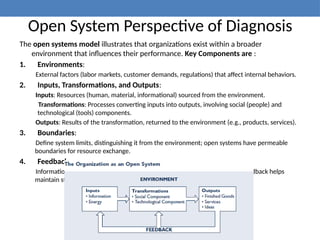
Open System Perspective of Diagnosis
The open systems model illustrates that organizations exist within a broader
environment that influences their performance. Key Components are :
1. Environments:
External factors (labor markets, customer demands, regulations) that affect internal behaviors.
2. Inputs, Transformations, and Outputs:
Inputs: Resources (human, material, informational) sourced from the environment.
Transformations: Processes converting inputs into outputs, involving social (people) and
technological (tools) components.
Outputs: Results of the transformation, returned to the environment (e.g., products, services).
3. Boundaries:
Define system limits, distinguishing it from the environment; open systems have permeable
boundaries for resource exchange.
4. Feedback:
Information on system performance used to guide future actions; effective feedback helps
maintain stability and adapt to changes.
Organisational Perspective of Diagnosis
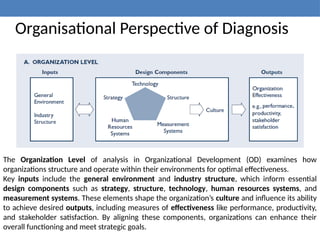
The Organization Level of analysis in Organizational Development (OD) examines how
organizations structure and operate within their environments for optimal effectiveness.
Key inputs include the general environment and industry structure, which inform essential
design components such as strategy, structure, technology, human resources systems, and
measurement systems. These elements shape the organization’s culture and influence its ability
to achieve desired outputs, including measures of effectiveness like performance, productivity,
and stakeholder satisfaction. By aligning these components, organizations can enhance their
overall functioning and meet strategic goals.
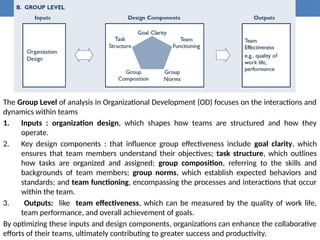
The Group Level of analysis in Organizational Development (OD) focuses on the interactions and
dynamics within teams
1. Inputs : organization design, which shapes how teams are structured and how they
operate.
2. Key design components : that influence group effectiveness include goal clarity, which
ensures that team members understand their objectives; task structure, which outlines
how tasks are organized and assigned; group composition, referring to the skills and
backgrounds of team members; group norms, which establish expected behaviors and
standards; and team functioning, encompassing the processes and interactions that occur
within the team.
3. Outputs: like team effectiveness, which can be measured by the quality of work life,
team performance, and overall achievement of goals.
By optimizing these inputs and design components, organizations can enhance the collaborative
efforts of their teams, ultimately contributing to greater success and productivity.
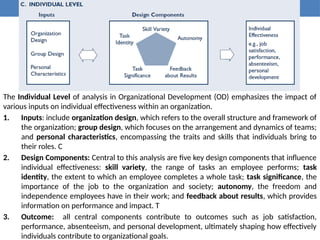
The Individual Level of analysis in Organizational Development (OD) emphasizes the impact of
various inputs on individual effectiveness within an organization.
1. Inputs: include organization design, which refers to the overall structure and framework of
the organization; group design, which focuses on the arrangement and dynamics of teams;
and personal characteristics, encompassing the traits and skills that individuals bring to
their roles. C
2. Design Components: Central to this analysis are five key design components that influence
individual effectiveness: skill variety, the range of tasks an employee performs; task
identity, the extent to which an employee completes a whole task; task significance, the
importance of the job to the organization and society; autonomy, the freedom and
independence employees have in their work; and feedback about results, which provides
information on performance and impact. T
3. Outcome: all central components contribute to outcomes such as job satisfaction,
performance, absenteeism, and personal development, ultimately shaping how effectively
individuals contribute to organizational goals.
Methods of Data Collection
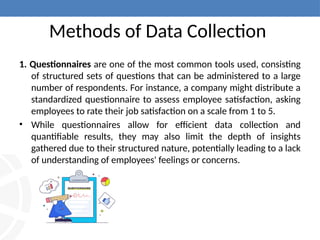
1. Questionnaires are one of the most common tools used, consisting
of structured sets of questions that can be administered to a large
number of respondents. For instance, a company might distribute a
standardized questionnaire to assess employee satisfaction, asking
employees to rate their job satisfaction on a scale from 1 to 5.
• While questionnaires allow for efficient data collection and
quantifiable results, they may also limit the depth of insights
gathered due to their structured nature, potentially leading to a lack
of understanding of employees' feelings or concerns.
2. Observations- In this practitioners directly examine behaviors and
interactions within the organization without interference. For
example, an OD consultant might observe team meetings to assess
communication styles and dynamics among team members. This
real-time data collection can reveal discrepancies between reported
practices and actual behaviors, offering insights into the
organization's culture. However, observation can be time-
consuming and is subject to observer bias, which may skew the
results.
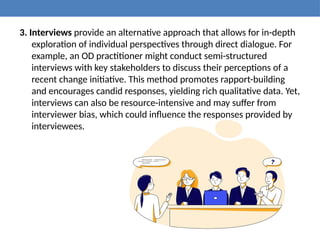
3. Interviews provide an alternative approach that allows for in-depth
exploration of individual perspectives through direct dialogue. For
example, an OD practitioner might conduct semi-structured
interviews with key stakeholders to discuss their perceptions of a
recent change initiative. This method promotes rapport-building
and encourages candid responses, yielding rich qualitative data. Yet,
interviews can also be resource-intensive and may suffer from
interviewer bias, which could influence the responses provided by
interviewees.
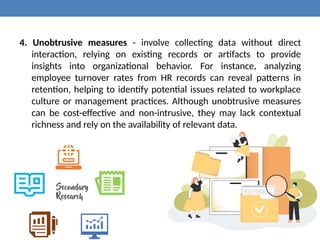
4. Unobtrusive measures - involve collecting data without direct
interaction, relying on existing records or artifacts to provide
insights into organizational behavior. For instance, analyzing
employee turnover rates from HR records can reveal patterns in
retention, helping to identify potential issues related to workplace
culture or management practices. Although unobtrusive measures
can be cost-effective and non-intrusive, they may lack contextual
richness and rely on the availability of relevant data.
Techniques of Data Analysis
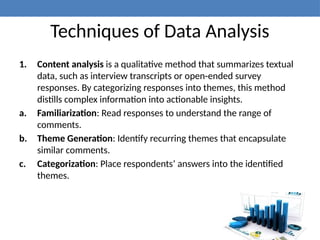
1. Content analysis is a qualitative method that summarizes textual
data, such as interview transcripts or open-ended survey
responses. By categorizing responses into themes, this method
distills complex information into actionable insights.
a. Familiarization: Read responses to understand the range of
comments.
b. Theme Generation: Identify recurring themes that encapsulate
similar comments.
c. Categorization: Place respondents’ answers into the identified
themes.
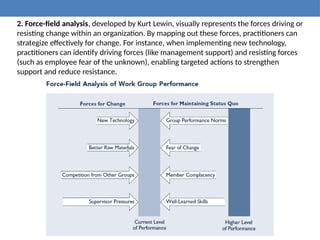
2. Force-field analysis, developed by Kurt Lewin, visually represents the forces driving or
resisting change within an organization. By mapping out these forces, practitioners can
strategize effectively for change. For instance, when implementing new technology,
practitioners can identify driving forces (like management support) and resisting forces
(such as employee fear of the unknown), enabling targeted actions to strengthen
support and reduce resistance.
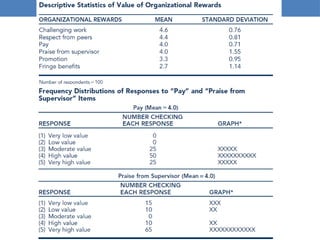
3. Quantitative Techniques
• Quantitative techniques provide systematic data analysis. Key methods
include:
• Means: The average of a dataset, indicating overall trends. For
example, calculating the mean employee satisfaction score helps
assess general morale within the organization.
• Standard Deviations: This statistic measures data variability around
the mean. A high standard deviation in satisfaction scores may indicate
diverse employee opinions, warranting further exploration.
• Frequency Distributions: This method summarizes how often each
response category occurs, often presented in tables or graphs. For
example, a frequency distribution of satisfaction ratings can reveal
trends and inform decision-making.
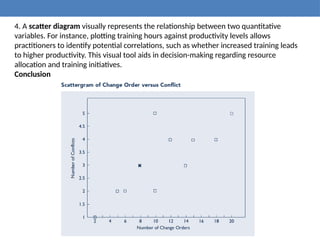
4. A scatter diagram visually represents the relationship between two quantitative
variables. For instance, plotting training hours against productivity levels allows
practitioners to identify potential correlations, such as whether increased training leads
to higher productivity. This visual tool aids in decision-making regarding resource
allocation and training initiatives.
Conclusion

Presentation on OrganizationalDevelopment.

  • 1.
  • 2.
    Planned Change • OrganizationDevelopment (OD) aims to facilitate planned change to enhance an organization's effectiveness and its ability to adapt to future changes. This process is typically initiated by managers, often with support from internal or external OD practitioners. • Planned change can address various organizational challenges, such as solving problems, learning from experiences, reframing perceptions, adapting to external changes, and improving performance. • Three significant change theories: Lewin’s Change Model, the Action Research Model, and the Positive Model.
  • 4.
    I. Lewin’s ChangeModel Kurt Lewin's model is a foundational framework for understanding organizational change. It consists of three main stages: 1. Unfreezing: This initial phase involves preparing the organization for change by creating awareness of the need for change and reducing resistance. This may involve challenging existing norms and attitudes to make employees more open to new ideas. 2. Change: During this stage, the actual transition occurs. New behaviors, processes, or systems are implemented. Communication and support are critical here to help individuals adjust to the new way of doing things. 3. Refreezing: The final stage solidifies the changes by reinforcing new behaviors and ensuring they become part of the organizational culture. This can involve developing new policies, practices, and rewards that align with the desired changes.
  • 5.
    II. Action ResearchModel • The Action Research Model emphasizes a systematic approach to problem-solving through collaboration between OD practitioners and organizational members. It typically follows these steps: 1. Identifying the Problem: The process begins with diagnosing the current situation to understand the issues needing change. 2. Data Collection and Analysis: Relevant data is gathered through various methods (e.g., interviews, surveys, observations) to analyze the problem thoroughly. 3. Planning Action: Based on the analysis, strategies for change are developed collaboratively. 4. Implementing Action: The planned interventions are executed. 5. Evaluating Action: The results of the implemented changes are assessed to determine effectiveness.
  • 6.
    III. Positive Model ThePositive Model focuses on building an organization's strengths and capabilities rather than merely addressing weaknesses. Key elements include: 1. Initiate the Inquiry Identify a relevant change topic through member involvement, focusing on positive aspects that energize the organization. 2. Inquire into Best Practices Gather information about the organization's strengths by conducting peer interviews to share successful stories and experiences. 3. Discover the Themes Analyze the collected stories to identify recurring themes that highlight the organization’s successful elements and dynamics. 4. Envision a Preferred Future Challenge the status quo and collaboratively create a compelling vision for the future, connecting best practices to aspirational goals. 5. Design and Deliver Ways to Create the Future Develop actionable plans to implement the vision, including assessing progress and making adjustments to ensure sustained growth and alignment with desired outcomes.
  • 7.
    Process of OrganisationalDevelopment/ Planned Change
  • 8.
    Process of PlannedChange • The General Model of Planned Change outlines the core activities involved in initiating and executing organizational change. • STEP 1- Entering and Contracting: This is the initial stage of planned change, where OD practitioners and organization members assess the need for change. Data is gathered to understand organizational problems or identify positive opportunities. Based on this information, discussions are held with managers and stakeholders to form a contract that defines the scope of the change, outlines the resources required, and specifies the roles of all participants. However, many organizations may not progress beyond this stage due to disagreements, lack of resources, or the emergence of alternative solutions. • STEP 2- Diagnosing: In this critical stage, the organization is thoroughly studied to identify the root causes of problems or areas for improvement. Diagnosis involves selecting a model to understand organizational dynamics and gathering relevant data through interviews, surveys, or observation. This stage may focus on issues at the organizational, group, or individual levels. The data collected is then analyzed and shared with managers and members, enabling informed discussions about the next steps.
  • 9.
    • STEP3- Planningand Implementing Change: Once the diagnosis is complete, the OD practitioner and organization members jointly design interventions aimed at achieving desired goals. The interventions may address human processes, organizational structures, technology, or strategic issues, depending on the specific diagnosis. The planning process involves assessing the organization’s readiness for change, understanding the culture and power dynamics, and ensuring the change agents are equipped to lead the initiative. Implementation then focuses on managing the transition, motivating stakeholders, and maintaining momentum. • STEP4- Evaluating and Institutionalizing Change: After the interventions are implemented, their effectiveness is evaluated. Feedback is provided to determine whether the changes should be continued, adjusted, or abandoned. Successful changes are institutionalized through reinforcement mechanisms such as feedback loops, reward systems, and training programs to ensure the changes become a permanent part of the organizational culture.
  • 10.
    Who is organizationdevelopment (OD) practitioner ? • An organization development (OD) practitioner refers to three main groups: 1. OD Professionals: These are internal or external consultants specializing in OD. They focus on improving communication, employee involvement, and organizational effectiveness. Over time, their role has expanded to include strategic and structural aspects of organizations. 3. Specialists in Related Fields: Professionals in areas like reward systems, organization design, and IT, who apply OD principles within their expertise. They often collaborate with OD experts on large-scale projects, integrating OD into their specific fields. 3. Managers and Administrators: Many managers have gained OD skills through experience and formal training. They apply OD practices in their roles to lead change within their teams, becoming essential change agents in their organizations. • These roles are increasingly overlapping, with cross-training blending OD with other business functions.
  • 11.
    Competencies of ODPractitioner Foundation Competencies 1. Organization behavior A. Organization culture B. Work design C. Interpersonal relations D. Power and politics E. Leadership F. Goal setting G. Conflict H. Ethics 2. Group dynamics A. Roles B. Communication processes C. Decision-making process D. Stages of group development E. Leadership 3. Management and organization theory A. Planning, organizing, leading, and controlling B. Problem solving and decision making C. Systems theory D. Contingency theory E. Organization structure F. Characteristics of environment and technology G. Models of organization and system 4. Research methods/statistics A. Measures of central tendency B. Measures of dispersion C. Basic sampling theory D. Basic experimental design E. Sample inferential statistics
  • 12.
    Competencies of ODPractitioner Foundation Competencies 6. Comparative cultural perspectives A. Dimensions of natural culture B. Dimensions of industry culture C. Systems implications 7. Individual psychology A. Learning theory B. Motivation theory C. Perception theory 8. Functional knowledge of business A. Interpersonal communication (listening, feedback, and articulation) B. Collaboration/working together C. Problem solving D. Using new technology E. Conceptualizing F. Project management G. Present/education/coach
  • 13.
    • The corecompetencies for OD practitioners, as outlined in Table mare essential for effective practice. These include: I. Analysis and Diagnosis: Practitioners need self-awareness to understand their own values and emotions, enabling them to act with integrity in helping relationships. Bob Tannenbaum emphasized self-knowledge as key to OD. Practitioners must balance rationality with emotions, adapt continuously, and manage stress effectively, given the unpredictable nature of OD. II. Interpersonal Skills: Practitioners must build strong relationships with individuals and groups in the organization. This involves listening, building trust, and engaging in joint problem-solving. They should role-model expected behaviors, negotiate roles, and manage expectations. Effective communication and feedback are critical. III. Consultation Skills: OD practitioners should know how to diagnose organizational issues by engaging members in gathering and analyzing data. This includes designing and executing interventions, creating action plans, and monitoring progress. Managers, for instance, should help teams identify strengths and weaknesses, design interventions, and ensure commitment. IV. Organisational Development Theory: Practitioners need a solid understanding of OD concepts, including planned change, action research, and intervention strategies. They should appreciate the broader scope of OD, whether they work as OD professionals, managers, or specialists in related fields.
  • 14.
    Competencies of ODPractitioner Core Competencies 1. Organization design: the decision process associated with formulating and aligning the elements of an organizational system, including but not limited to structural systems, human resource systems, information systems, reward systems, work design, political systems, and organization culture 2. Organization research: field research methods; interviewing; content analysis; design of questionnaires and interview protocol; designing change evaluation processes; longitudinal data collection and analysis; understanding and detecting alpha, beta, and gamma change; and a host of quantitative and qualitative methods 3. System dynamics: the description and understanding of how systems evolve and develop over time, how systems respond to exogenous and endogenous disruption as well as planned interventions (e.g., evolution and revolution, punctuated equilibrium theory, chaos theory, catastrophe theory, incremental vs. quantum change, transformation theory, and so on) 4. History of organization development and change: an understanding of the social, political, economic, and personal forces that led to the emergence and development of organization development and change, including the key thought leaders, the values underlying their writings and actions, the key events and writings, and related documentation
  • 15.
    Competencies of ODPractitioner Core Competencies 5. Theories and models for change: the basic action research model, participatory action research model, planning model, change typologies (e.g., fast, slow, incremental, quantum, revolutionary), Lewin’s model, transition models, and so on. a. Managing the consulting process: the ability to enter, contract, diagnose, design appropriate interventions, implement those interventions, manage unprogrammed events, and evaluate change process b. Analysis/diagnosis: the abilities to conduct an inquiry into a system’s effectiveness, to see the root cause(s) of a system’s current level of effectiveness. 3. Designing/choosing appropriate, relevant interventions: understanding how to select, modify, or design effective interventions that will move the organization from its current state to its desired future state 4. Facilitation and process consultation: the ability to assist an individual or group toward a goal; the ability to conduct an inquiry into individual and group processes such that the client system maintains ownership of the issue. 5. Developing client capability: the ability to conduct a change process in such a way that the client is better able to plan and implement a successful change process in the future, 6. Evaluating organization change: the ability to design and implement a process to evaluate the impact and effects of change intervention, including control of alternative explanations and interpretation of performance Outcomes
  • 16.
    Internal VS ExternalConsultants: Internal Consultants: • They are employees of the organization, often located in the HR department or reporting to a manager. They may focus solely on OD or combine it with other responsibilities like training or employee relations. • Internal consultants have the advantage of understanding the company culture, language, and informal networks, which helps them gain quick access to key information and build rapport. They also save time during the entry phase of the action research process. • However, their close ties to the organization can make them cautious, especially if powerful figures might affect their careers. Additionally, they might lack experience in large-scale organizational change. External Consultants: • External consultants are hired from outside, often bringing specialized expertise that internal consultants may lack. They offer a fresh and objective perspective, which can be useful for diagnosing problems and planning interventions. • Their position allows them to choose their clients and projects, which internal consultants cannot. They may have higher status, making it easier to ask tough questions. However, they often lack the deep cultural knowledge of internal consultants.
  • 17.
    Role of OrganizationDevelopment (OD) Professionals Marginality in OD: • OD professionals often occupy marginal roles, which means they bridge different organizational groups with diverse goals and values. • Individuals who thrive in marginal roles are open-minded, flexible, and able to process complex information. • They tend to excel in conflict-laden situations, helping to mediate between opposing viewpoints. • Research shows that external consultants tend to be more comfortable in marginal roles than internal consultants, though experienced internal consultants also adapt well.
  • 18.
    Emotional Demands andIntelligence: OD Practitioners • OD work is emotionally demanding. Practitioners need high emotional intelligence, which involves recognizing, understanding, and regulating emotions in themselves and others. Emotional intelligence is critical for managing resistance to change, fostering commitment, and addressing ambiguity during organizational interventions. It enhances decision- making and complements cognitive intelligence. • Practitioners must be aware of their own emotional triggers to avoid making decisions based on personal discomfort rather than organizational effectiveness. For example, intervening prematurely in a conflict between managers due to personal discomfort might harm the organization rather than help resolve the conflict. • Emotional intelligence can be developed through personal growth efforts such as training or therapy, and it generally increases with age and experience.
  • 19.
    STEP 1-Entering intoa Contract • The process of entering into an Organization Development (OD) relationship starts when an organization identifies a need to address specific issues and seeks help from an OD practitioner, who can be either internal or external to the organization. This stage involves several critical activities that set the foundation for the OD process: clarifying the organizational issue, identifying the relevant client, and selecting an appropriate OD practitioner. 1. Clarifying the Organizational Issue: Organizations typically approach OD practitioners with a presenting problem, which could range from high absenteeism to more generalized concerns like preparing for organizational changes. At this point, the issue is often described as a symptom of deeper, underlying causes. For example, high costs might be seen as the problem, but it could result from issues like ineffective product development or poor customer service. It is crucial to clarify the organizational issue early on to ensure that subsequent diagnostic and intervention efforts are focused correctly. Often, practitioners will collect preliminary data, such as company records or interviews with key personnel, to better understand the presenting problem and its context.
  • 20.
    2. Determining theRelevant Client: Identifying the relevant client involves pinpointing which members of the organization can impact or are impacted by the issue at hand. These individuals must be involved in the OD process to ensure commitment and support. The complexity of defining the client varies. For straightforward issues confined to a specific unit, the relevant client might just be that unit's manager and team members. However, for more complex, cross-departmental issues, the relevant client may include multiple units, hierarchical levels, or even external stakeholders like suppliers and customers. Involving the right participants from the start is critical to the success of the OD process. 3. Selecting an OD Practitioner: The choice of OD practitioner is pivotal and involves assessing their expertise, experience, and interpersonal skills. While formal selection methods, like requesting proposals from external practitioners, provide a structured approach, less formal approaches, such as relying on recommendations and past client feedback, are also common. The practitioner must not only have technical expertise but also the interpersonal competence to build trust and navigate organizational politics. They should approach the organization with openness, focusing on diagnosis rather than imposing pre-designed solutions. Practitioners have a responsibility to ensure that their skills match the organization’s needs and, if not, to help the organization find a better fit.
  • 21.
    Developing a Contract Oncethe decision is made to enter into an OD relationship, the next step is developing a contract, which is essential for defining the expectations, time, and resources dedicated to the OD process. Key elements of the contracting process include: 1. Mutual Expectations: The contract should clarify what both the client and the practitioner expect to gain from the OD process. This includes specifying desired outcomes, such as improved job satisfaction or reduced costs. Clear expectations help avoid misunderstandings and foster commitment from both parties. 2. Time and Resources: The contract should outline the time commitment and resources that will be dedicated to the OD process. Both parties must be transparent about what is required for the process to succeed, including access to key personnel or information and the involvement of relevant stakeholders. 3. Ground Rules: Contracting also involves setting the ground rules for how the client and the practitioner will work together. This includes issues like confidentiality, how to handle sensitive information, and how decisions will be made throughout the process.
  • 22.
    STEP 2- Diagnosis •Diagnosing organizations is a critical phase in the planned change model used in organizational development (OD). It involves understanding how an organization is currently functioning to identify areas that require improvement or enhancement. Diagnosis follows the entry and contracting stage and precedes planning and implementing change. • The process is collaborative, involving both the OD practitioner and the organization's members. This approach can uncover the root causes and lead to the development of effective interventions. Diagnosis may focus on problem- solving or improvement, depending on whether the issue is problem-oriented (such as absenteeism) or development-oriented (such as enhancing employee loyalty).
  • 23.
    The Need forDiagnostic Models in Organizational Development Diagnostic models are essential in Organizational Development (OD) to effectively identify and analyze organizational issues. These models help practitioners determine what information to collect and where to focus their attention, ensuring a comprehensive understanding of the organization's challenges. Key Sources of Diagnostic Models • Literature: Academic studies on leadership, motivation, group dynamics, and organizational structure offer valuable frameworks for diagnosis. • Practitioner Experience: Insights from real-world practice provide practical models for diagnosing processes like communication, motivation, and conflict resolution. Purpose of Diagnostic Models • These models simplify complex organizational systems by highlighting critical areas like decision-making, team dynamics, and conflict management. While useful, models can introduce bias by focusing on specific aspects, so choosing the right one is crucial for an accurate diagnosis.
  • 24.
    Open System Perspectiveof Diagnosis The open systems model illustrates that organizations exist within a broader environment that influences their performance. Key Components are : 1. Environments: External factors (labor markets, customer demands, regulations) that affect internal behaviors. 2. Inputs, Transformations, and Outputs: Inputs: Resources (human, material, informational) sourced from the environment. Transformations: Processes converting inputs into outputs, involving social (people) and technological (tools) components. Outputs: Results of the transformation, returned to the environment (e.g., products, services). 3. Boundaries: Define system limits, distinguishing it from the environment; open systems have permeable boundaries for resource exchange. 4. Feedback: Information on system performance used to guide future actions; effective feedback helps maintain stability and adapt to changes.
  • 25.
    Organisational Perspective ofDiagnosis The Organization Level of analysis in Organizational Development (OD) examines how organizations structure and operate within their environments for optimal effectiveness. Key inputs include the general environment and industry structure, which inform essential design components such as strategy, structure, technology, human resources systems, and measurement systems. These elements shape the organization’s culture and influence its ability to achieve desired outputs, including measures of effectiveness like performance, productivity, and stakeholder satisfaction. By aligning these components, organizations can enhance their overall functioning and meet strategic goals.
  • 26.
    The Group Levelof analysis in Organizational Development (OD) focuses on the interactions and dynamics within teams 1. Inputs : organization design, which shapes how teams are structured and how they operate. 2. Key design components : that influence group effectiveness include goal clarity, which ensures that team members understand their objectives; task structure, which outlines how tasks are organized and assigned; group composition, referring to the skills and backgrounds of team members; group norms, which establish expected behaviors and standards; and team functioning, encompassing the processes and interactions that occur within the team. 3. Outputs: like team effectiveness, which can be measured by the quality of work life, team performance, and overall achievement of goals. By optimizing these inputs and design components, organizations can enhance the collaborative efforts of their teams, ultimately contributing to greater success and productivity.
  • 27.
    The Individual Levelof analysis in Organizational Development (OD) emphasizes the impact of various inputs on individual effectiveness within an organization. 1. Inputs: include organization design, which refers to the overall structure and framework of the organization; group design, which focuses on the arrangement and dynamics of teams; and personal characteristics, encompassing the traits and skills that individuals bring to their roles. C 2. Design Components: Central to this analysis are five key design components that influence individual effectiveness: skill variety, the range of tasks an employee performs; task identity, the extent to which an employee completes a whole task; task significance, the importance of the job to the organization and society; autonomy, the freedom and independence employees have in their work; and feedback about results, which provides information on performance and impact. T 3. Outcome: all central components contribute to outcomes such as job satisfaction, performance, absenteeism, and personal development, ultimately shaping how effectively individuals contribute to organizational goals.
  • 28.
    Methods of DataCollection 1. Questionnaires are one of the most common tools used, consisting of structured sets of questions that can be administered to a large number of respondents. For instance, a company might distribute a standardized questionnaire to assess employee satisfaction, asking employees to rate their job satisfaction on a scale from 1 to 5. • While questionnaires allow for efficient data collection and quantifiable results, they may also limit the depth of insights gathered due to their structured nature, potentially leading to a lack of understanding of employees' feelings or concerns.
  • 29.
    2. Observations- Inthis practitioners directly examine behaviors and interactions within the organization without interference. For example, an OD consultant might observe team meetings to assess communication styles and dynamics among team members. This real-time data collection can reveal discrepancies between reported practices and actual behaviors, offering insights into the organization's culture. However, observation can be time- consuming and is subject to observer bias, which may skew the results.
  • 30.
    3. Interviews providean alternative approach that allows for in-depth exploration of individual perspectives through direct dialogue. For example, an OD practitioner might conduct semi-structured interviews with key stakeholders to discuss their perceptions of a recent change initiative. This method promotes rapport-building and encourages candid responses, yielding rich qualitative data. Yet, interviews can also be resource-intensive and may suffer from interviewer bias, which could influence the responses provided by interviewees.
  • 31.
    4. Unobtrusive measures- involve collecting data without direct interaction, relying on existing records or artifacts to provide insights into organizational behavior. For instance, analyzing employee turnover rates from HR records can reveal patterns in retention, helping to identify potential issues related to workplace culture or management practices. Although unobtrusive measures can be cost-effective and non-intrusive, they may lack contextual richness and rely on the availability of relevant data.
  • 32.
    Techniques of DataAnalysis 1. Content analysis is a qualitative method that summarizes textual data, such as interview transcripts or open-ended survey responses. By categorizing responses into themes, this method distills complex information into actionable insights. a. Familiarization: Read responses to understand the range of comments. b. Theme Generation: Identify recurring themes that encapsulate similar comments. c. Categorization: Place respondents’ answers into the identified themes.
  • 33.
    2. Force-field analysis,developed by Kurt Lewin, visually represents the forces driving or resisting change within an organization. By mapping out these forces, practitioners can strategize effectively for change. For instance, when implementing new technology, practitioners can identify driving forces (like management support) and resisting forces (such as employee fear of the unknown), enabling targeted actions to strengthen support and reduce resistance.
  • 34.
    3. Quantitative Techniques •Quantitative techniques provide systematic data analysis. Key methods include: • Means: The average of a dataset, indicating overall trends. For example, calculating the mean employee satisfaction score helps assess general morale within the organization. • Standard Deviations: This statistic measures data variability around the mean. A high standard deviation in satisfaction scores may indicate diverse employee opinions, warranting further exploration. • Frequency Distributions: This method summarizes how often each response category occurs, often presented in tables or graphs. For example, a frequency distribution of satisfaction ratings can reveal trends and inform decision-making.
  • 36.
    4. A scatterdiagram visually represents the relationship between two quantitative variables. For instance, plotting training hours against productivity levels allows practitioners to identify potential correlations, such as whether increased training leads to higher productivity. This visual tool aids in decision-making regarding resource allocation and training initiatives. Conclusion