pneumatics
Presented by :-
Vikash Kumar
introduction
The word Pneumatics is derived from a Greek word
Pneumatikos --- “pneuma”- means “wind”
“ tikos ” – means “ science ”
Pneumatics is the name given to the branch of science
which deals with the properties, motion and behavior of
air.
• Pneumatics deals the use of compressed air or gases . Most
commonly, compressed air is used to do mechanical work that is to
produce motion and generate forces. Pneumatic system have the task
of converting the energy stored in compressed air into motion.
• Cylinders are most commonly used in pneumatic system. They are
characterized by robust construction, large range of types, simple
installation and favorable performance. As a result of these benefits,
pneumatics is used in a wide range of application.
Detailed introduction
Pneumatic cylinders has a significant role as a
linear drive unit due to its :-
• Relatively low cost.
• Ease of installation.
• Simple and robust construction.
• Ready availability in various sizes and stroke lengths.
Diameter 25 to 320 mm.
Stroke length 01 to 2000 mm.
Available forces 02 to 45000 Newton.
Piston speed 0.1 to 1.5 m/s.
Pneumatic components can perform
• Linear motion
• Swivel motion
• Rotary motion
Are a of application
• Spray painting
• Crop spraying and operation of other agricultural
equipment
• Pneumatic robots
• Machine tool, work or tool feeding
• Bottling and filling machines
• Operation of heavy or hot doors
• Dental drills
• and so much more… new applications are developed
daily
Some industrial application employing
pneumatics are listed below :-
• General methods of
material handling –
1. Clamping
2. Shifting
3. Positioning
4. Orienting
• General Applications –
1. Packaging
2. Filling
3. Locking
4. Driving axes.
5. Door control
6. Transfer of material
7. Stacking of
components
8. stamping
Compressed air preparation Compressed air consumption
Advantages and distinguishing characteristic
of compressed air-
Availability
Transport
storage
Temperature
Explosion proof
Air is available practically everywhere in unlimited quantity
Air can be easily transported in pipelines, over large
distances.
Compressed air can be stored in a reservoir and removed as
required. In addition the reservoir can be transportable.
Compressed air is relatively insensitive to temperature.
Compressed air offers no risk of explosion or fire.
Cleanliness
Components
Speed
Overload safe
Unlubricated exhaust is clean.
The operating components are of simple construction and
therefore inexpensive.
Compressed air is very fast working medium.
Pneumatic tools and operating components can be loaded to
the point of stopping.
Pneumatics Symbols
- Supply units
Service equipment's
Combined symbols
Filter regulator and lubricator (FRL) Simplified diagram of service unit
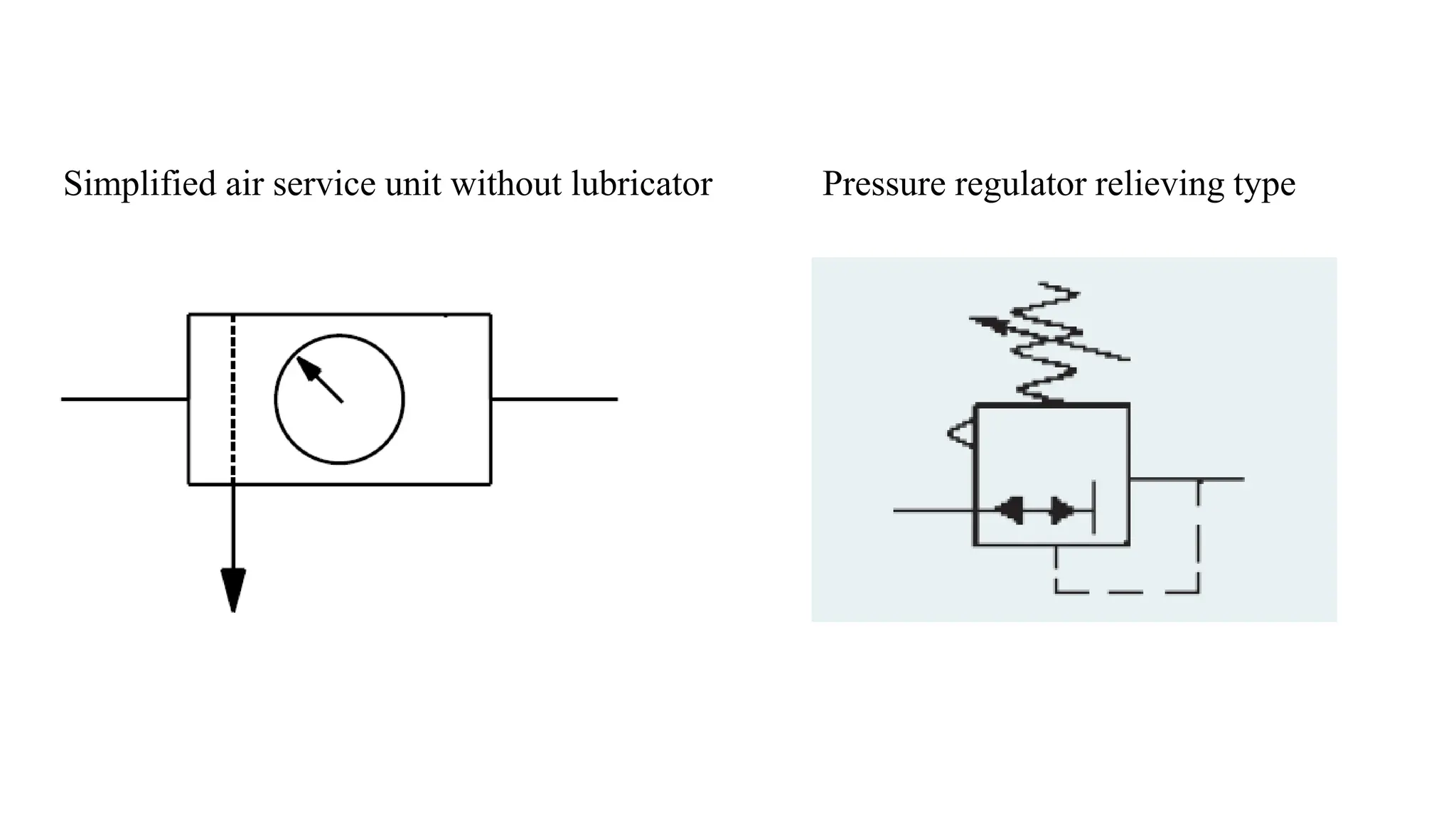
Simplified air service unit without lubricator Pressure regulator relieving type

pneumatics and control mechanical enggn

  • 1.
  • 2.
    introduction The word Pneumaticsis derived from a Greek word Pneumatikos --- “pneuma”- means “wind” “ tikos ” – means “ science ” Pneumatics is the name given to the branch of science which deals with the properties, motion and behavior of air.
  • 3.
    • Pneumatics dealsthe use of compressed air or gases . Most commonly, compressed air is used to do mechanical work that is to produce motion and generate forces. Pneumatic system have the task of converting the energy stored in compressed air into motion. • Cylinders are most commonly used in pneumatic system. They are characterized by robust construction, large range of types, simple installation and favorable performance. As a result of these benefits, pneumatics is used in a wide range of application. Detailed introduction
  • 4.
    Pneumatic cylinders hasa significant role as a linear drive unit due to its :- • Relatively low cost. • Ease of installation. • Simple and robust construction. • Ready availability in various sizes and stroke lengths. Diameter 25 to 320 mm. Stroke length 01 to 2000 mm. Available forces 02 to 45000 Newton. Piston speed 0.1 to 1.5 m/s.
  • 5.
    Pneumatic components canperform • Linear motion • Swivel motion • Rotary motion
  • 6.
    Are a ofapplication • Spray painting • Crop spraying and operation of other agricultural equipment • Pneumatic robots • Machine tool, work or tool feeding • Bottling and filling machines • Operation of heavy or hot doors • Dental drills • and so much more… new applications are developed daily
  • 7.
    Some industrial applicationemploying pneumatics are listed below :- • General methods of material handling – 1. Clamping 2. Shifting 3. Positioning 4. Orienting • General Applications – 1. Packaging 2. Filling 3. Locking 4. Driving axes. 5. Door control 6. Transfer of material 7. Stacking of components 8. stamping
  • 8.
    Compressed air preparationCompressed air consumption
  • 9.
    Advantages and distinguishingcharacteristic of compressed air- Availability Transport storage Temperature Explosion proof Air is available practically everywhere in unlimited quantity Air can be easily transported in pipelines, over large distances. Compressed air can be stored in a reservoir and removed as required. In addition the reservoir can be transportable. Compressed air is relatively insensitive to temperature. Compressed air offers no risk of explosion or fire.
  • 10.
    Cleanliness Components Speed Overload safe Unlubricated exhaustis clean. The operating components are of simple construction and therefore inexpensive. Compressed air is very fast working medium. Pneumatic tools and operating components can be loaded to the point of stopping.
  • 11.
    Pneumatics Symbols - Supplyunits Service equipment's
  • 12.
    Combined symbols Filter regulatorand lubricator (FRL) Simplified diagram of service unit
  • 13.
    Simplified air serviceunit without lubricator Pressure regulator relieving type