Chapter 2
Fundamental Concepts of
Managerial Economics
Review of Economic Terms
• Because of scarcity, an allocation decision must
be made. The allocation decision is comprised
of three separate choices:
 What and how many goods and services should be
produced?
 How should these goods and services be produced?
 For whom should these goods and services be
produced?
1. OPPORTUNITY COST CONCEPT
2. INCREMENTAL REASONING CONCEPT
3. DISCOUNTING CONCEPT
4. TIME PERSPECTIVE CONCEPT
5. CONTRIBUTION CONCEPT
6. EQUI MARGINAL CONCEPT
Fundamentals concepts of Managerial Economics
• Represents the benefits or profit foregone by pursuing one
course of action rather than another.
• The opportunity cost of the funds employed in the one’s own
business is the amount of interest which could have been
earned had these funds been invested in the next best
channel of investment.
• When a product X rather than a product Y is produced by
using a machine which can produce both, the opportunity
cost of producing X is the amount of Y sacrificed as a result.
• The opportunity cost of using an idle machine is zero, as its
use needs no sacrifice of opportunities.
• The opportunity cost of one’s labour in one’s own business is
the income one could have earned by accepting a job
outside.
• Implicit cost are considered by an economist not by an
accountant.
1.Opportunity Cost Concept
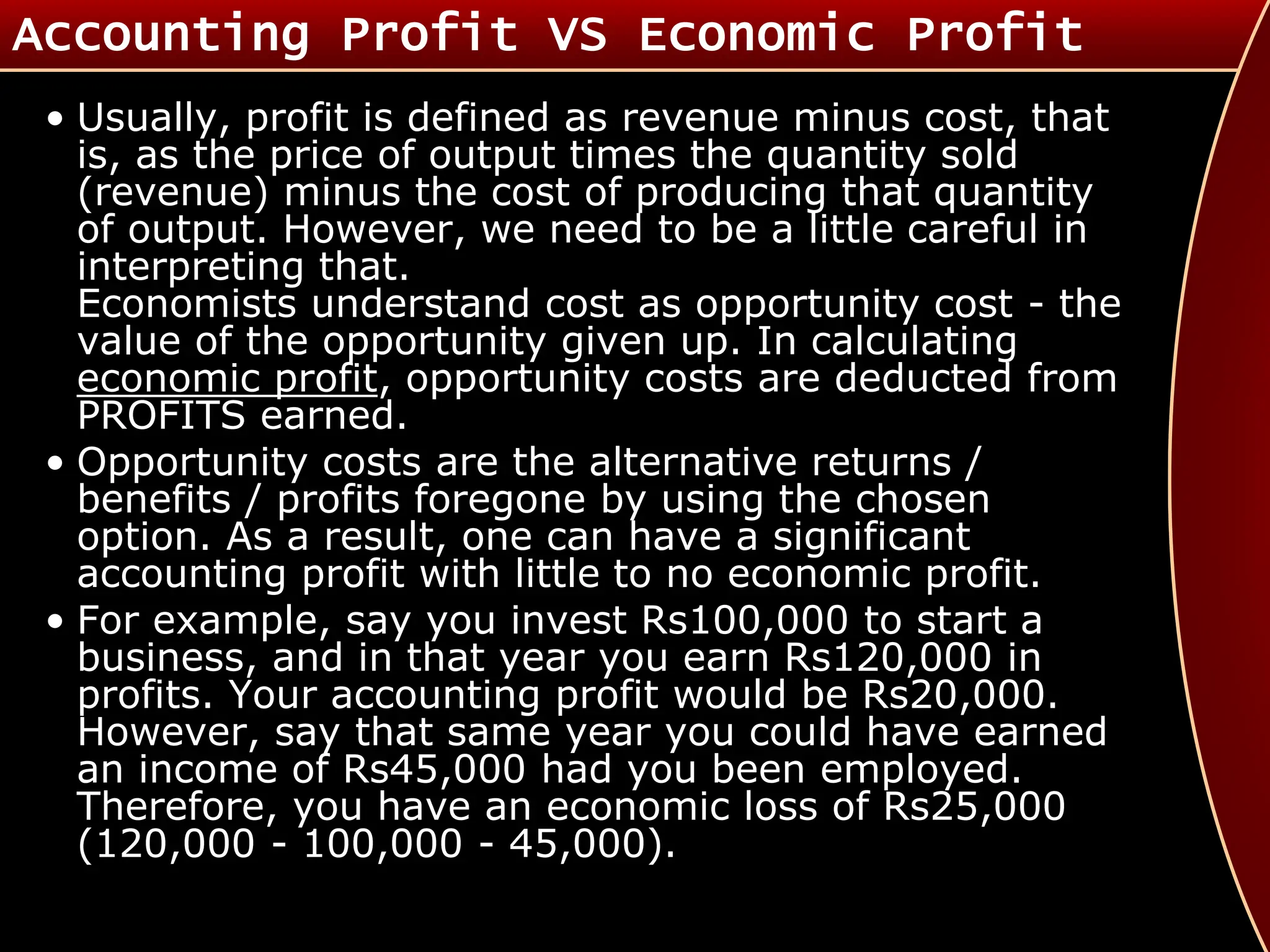
Accounting Profit VS Economic Profit
• Usually, profit is defined as revenue minus cost, that
is, as the price of output times the quantity sold
(revenue) minus the cost of producing that quantity
of output. However, we need to be a little careful in
interpreting that.
Economists understand cost as opportunity cost - the
value of the opportunity given up. In calculating
economic profit, opportunity costs are deducted from
PROFITS earned.
• Opportunity costs are the alternative returns /
benefits / profits foregone by using the chosen
option. As a result, one can have a significant
accounting profit with little to no economic profit.
• For example, say you invest Rs100,000 to start a
business, and in that year you earn Rs120,000 in
profits. Your accounting profit would be Rs20,000.
However, say that same year you could have earned
an income of Rs45,000 had you been employed.
Therefore, you have an economic loss of Rs25,000
(120,000 - 100,000 - 45,000).
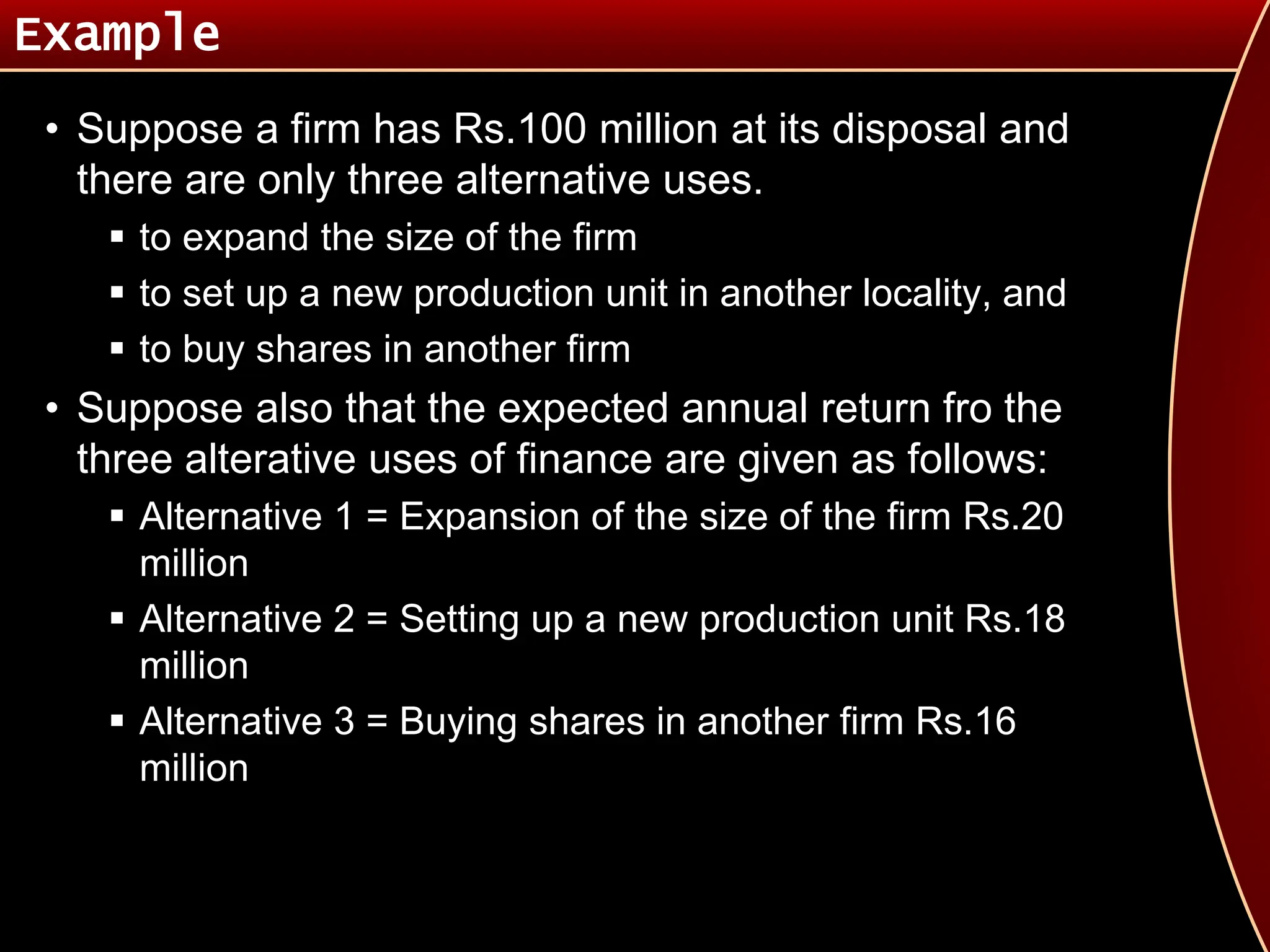
Example
• Suppose a firm has Rs.100 million at its disposal and
there are only three alternative uses.
 to expand the size of the firm
 to set up a new production unit in another locality, and
 to buy shares in another firm
• Suppose also that the expected annual return fro the
three alterative uses of finance are given as follows:
 Alternative 1 = Expansion of the size of the firm Rs.20
million
 Alternative 2 = Setting up a new production unit Rs.18
million
 Alternative 3 = Buying shares in another firm Rs.16
million
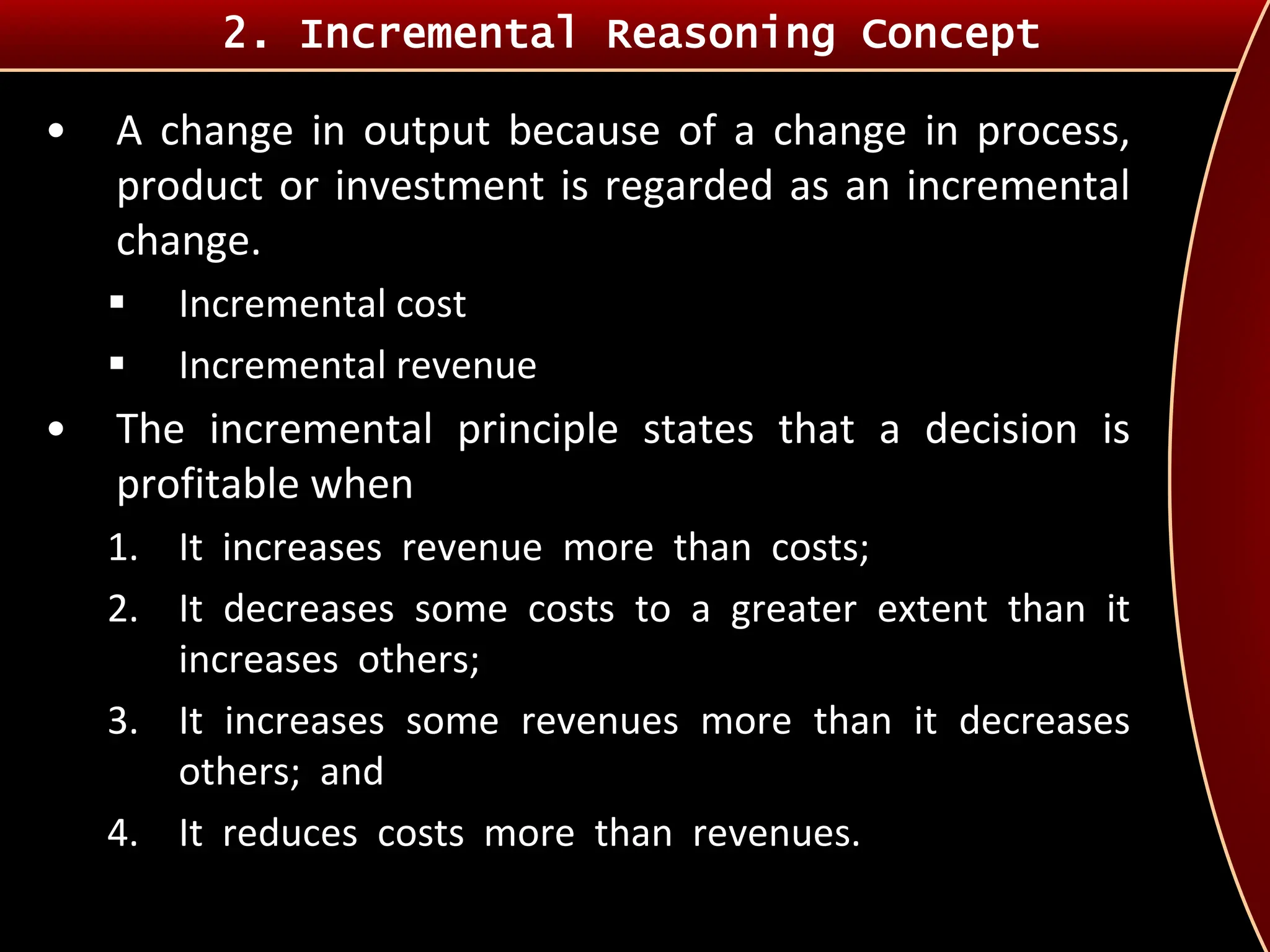
• A change in output because of a change in process,
product or investment is regarded as an incremental
change.
 Incremental cost
 Incremental revenue
• The incremental principle states that a decision is
profitable when
1. It increases revenue more than costs;
2. It decreases some costs to a greater extent than it
increases others;
3. It increases some revenues more than it decreases
others; and
4. It reduces costs more than revenues.
2. Incremental Reasoning Concept
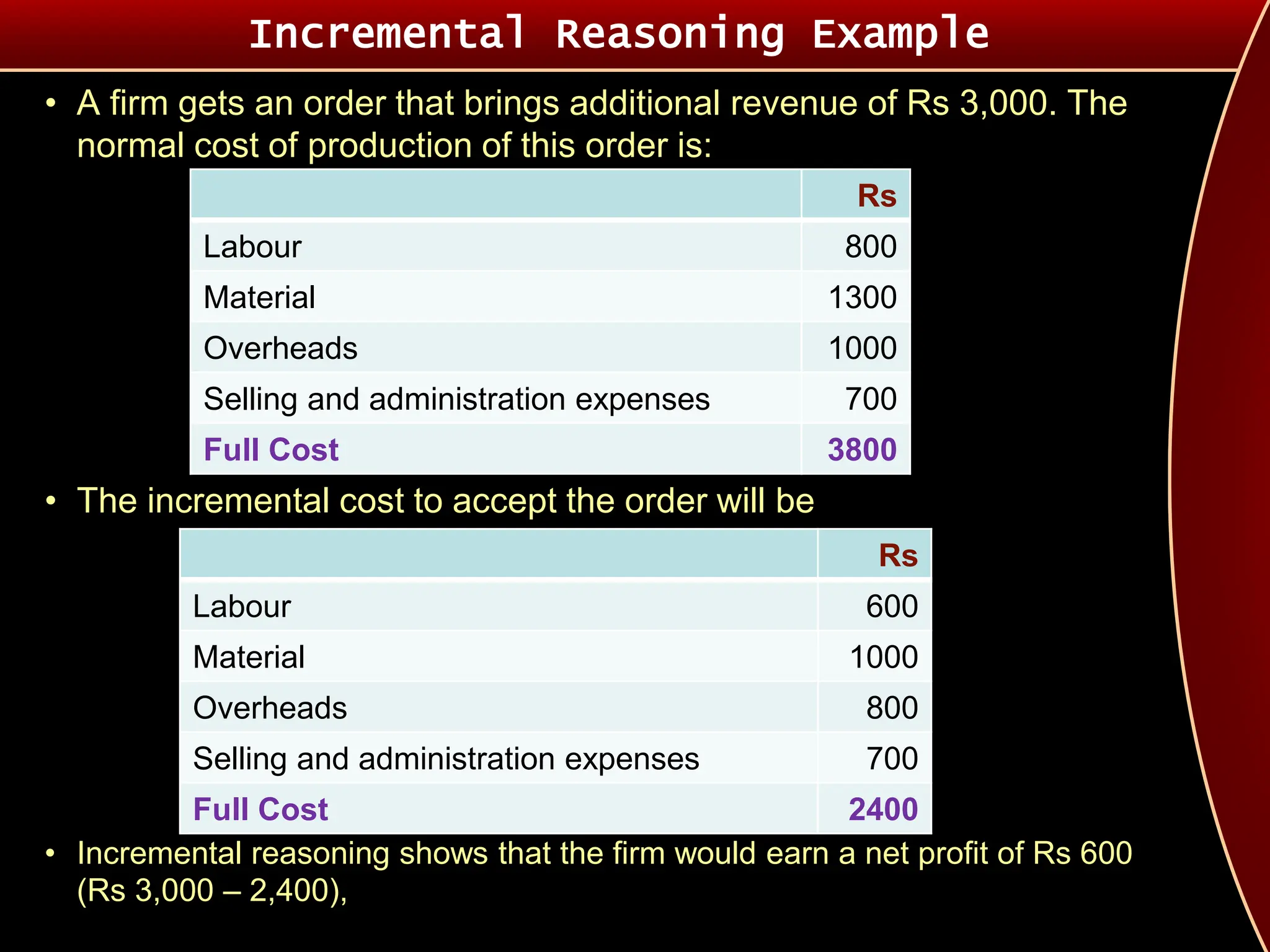
• A firm gets an order that brings additional revenue of Rs 3,000. The
normal cost of production of this order is:
• The incremental cost to accept the order will be
• Incremental reasoning shows that the firm would earn a net profit of Rs 600
(Rs 3,000 – 2,400),
Incremental Reasoning Example
Rs
Labour 800
Material 1300
Overheads 1000
Selling and administration expenses 700
Full Cost 3800
Rs
Labour 600
Material 1000
Overheads 800
Selling and administration expenses 700
Full Cost 2400
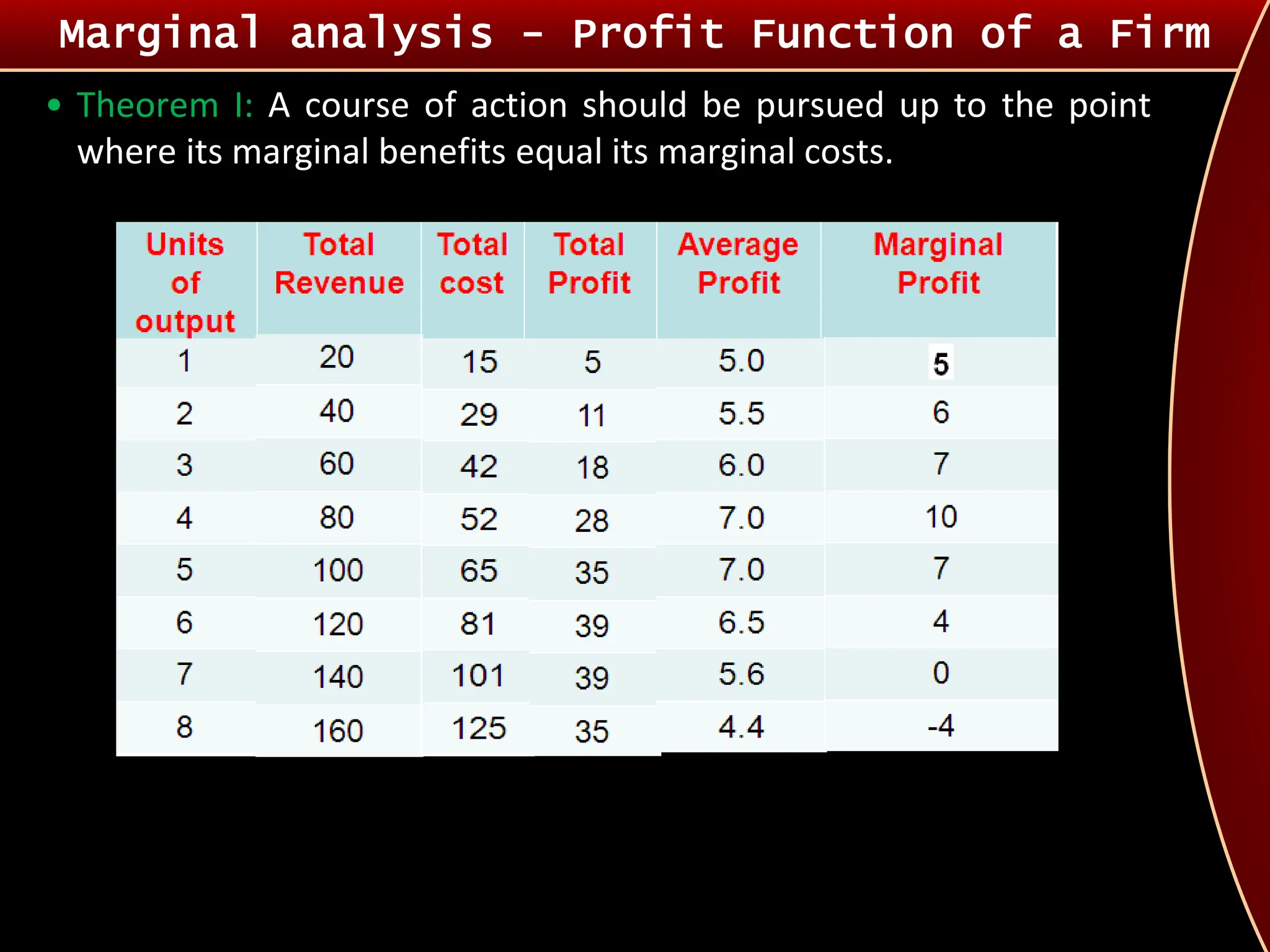
• Theorem I: A course of action should be pursued up to the point
where its marginal benefits equal its marginal costs.
Marginal analysis - Profit Function of a Firm
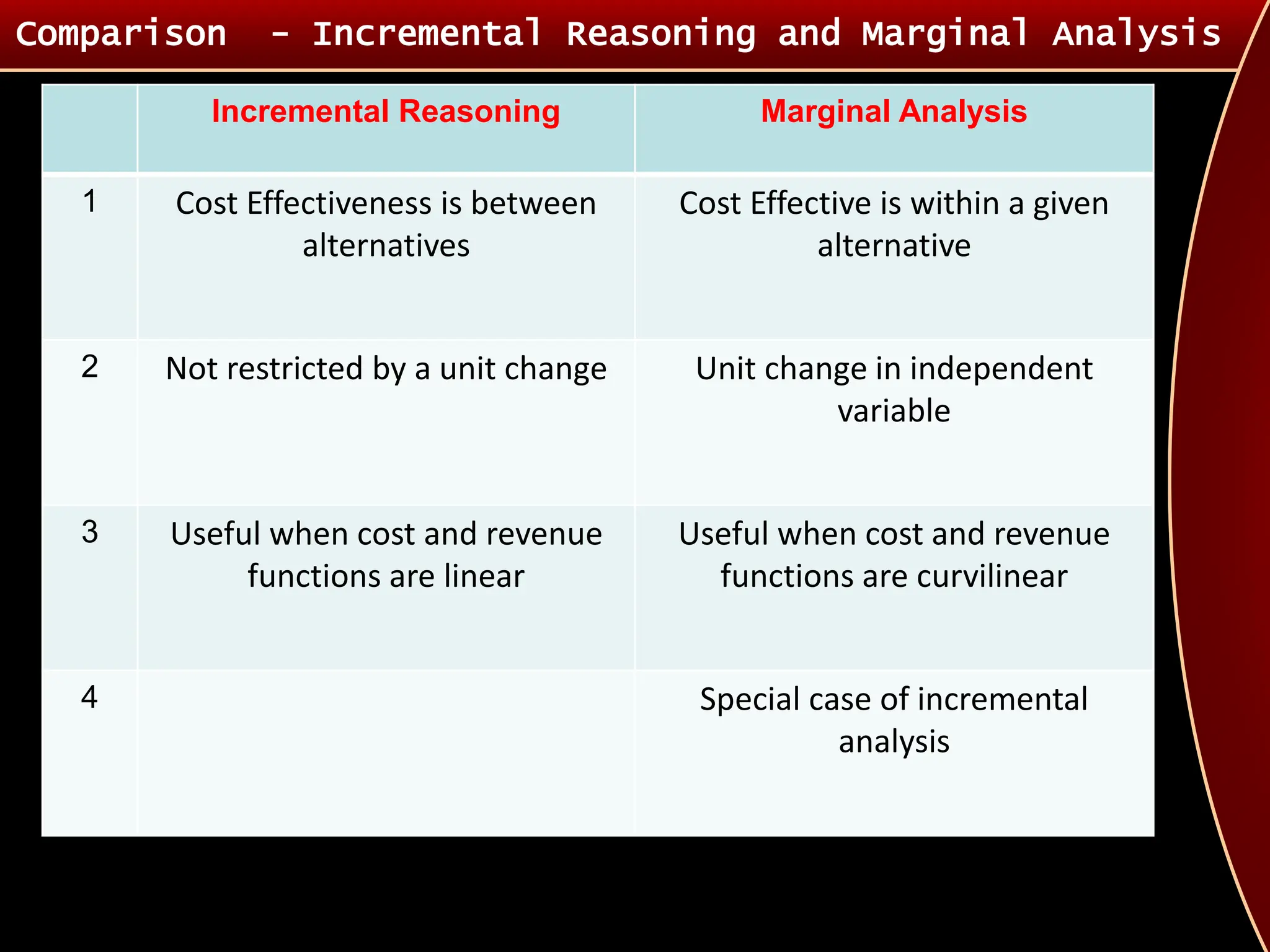
Comparison - Incremental Reasoning and Marginal Analysis
Incremental Reasoning Marginal Analysis
1 Cost Effectiveness is between
alternatives
Cost Effective is within a given
alternative
2 Not restricted by a unit change Unit change in independent
variable
3 Useful when cost and revenue
functions are linear
Useful when cost and revenue
functions are curvilinear
4 Special case of incremental
analysis
According to this principle, if a decision affects
costs and revenues in long-run, all those costs
and revenues must be discounted to present
values before valid comparison of alternatives is
possible. This is essential because a rupee worth
of money at a future date is not worth a rupee
today. Money actually has time value.
Discounting can be defined as a process used to
transform future money into an equivalent
number of present money.
There is a lot of risk and uncertainty about future.
The return in future is less attractive than the
same return today. The future must, therefore, be
discounted both for the elements of delay and risk
of future.
3. Discounting Principle Concept
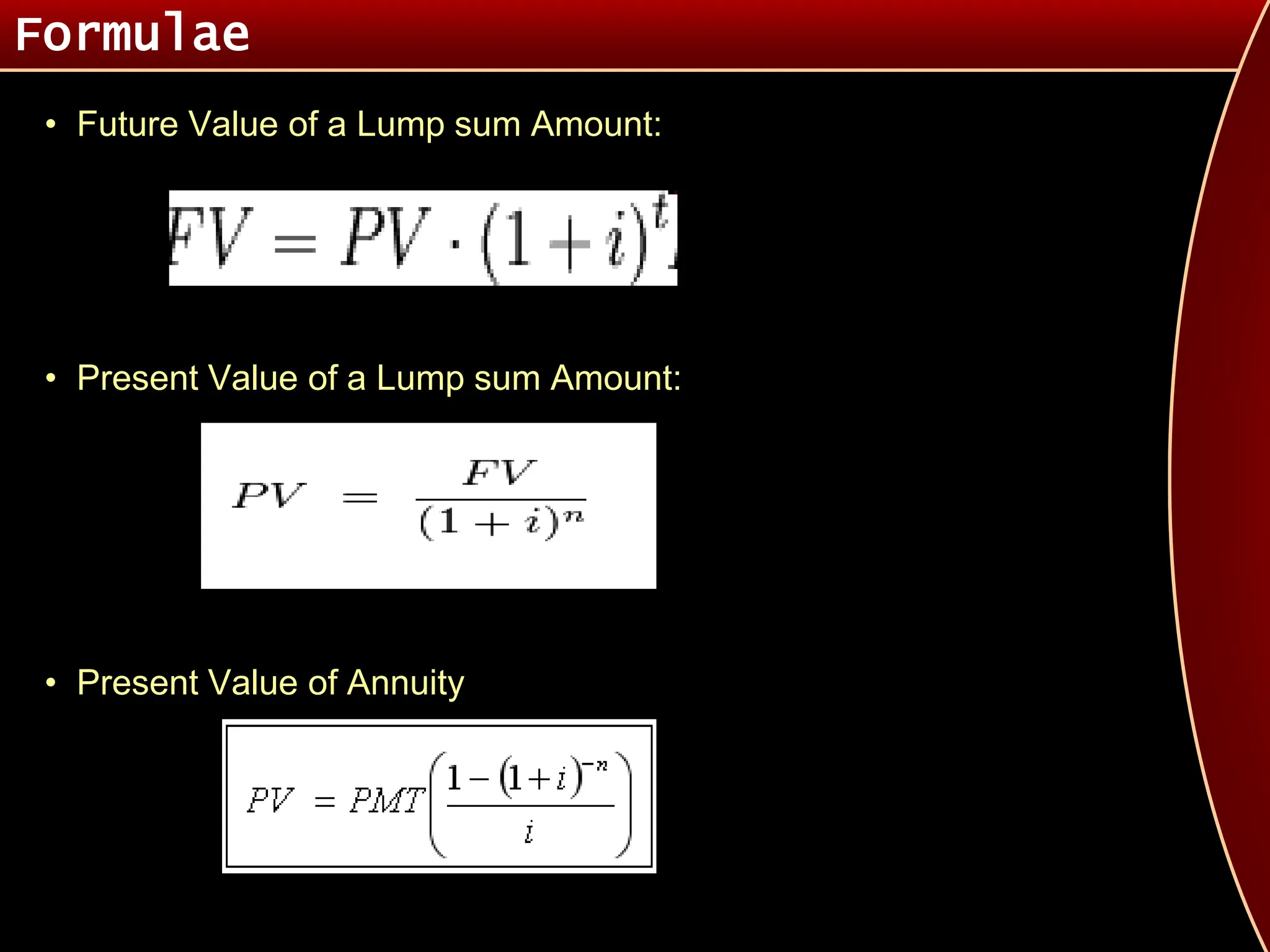
Formulae
• Future Value of a Lump sum Amount:
• Present Value of a Lump sum Amount:
• Present Value of Annuity
Discounting Principle
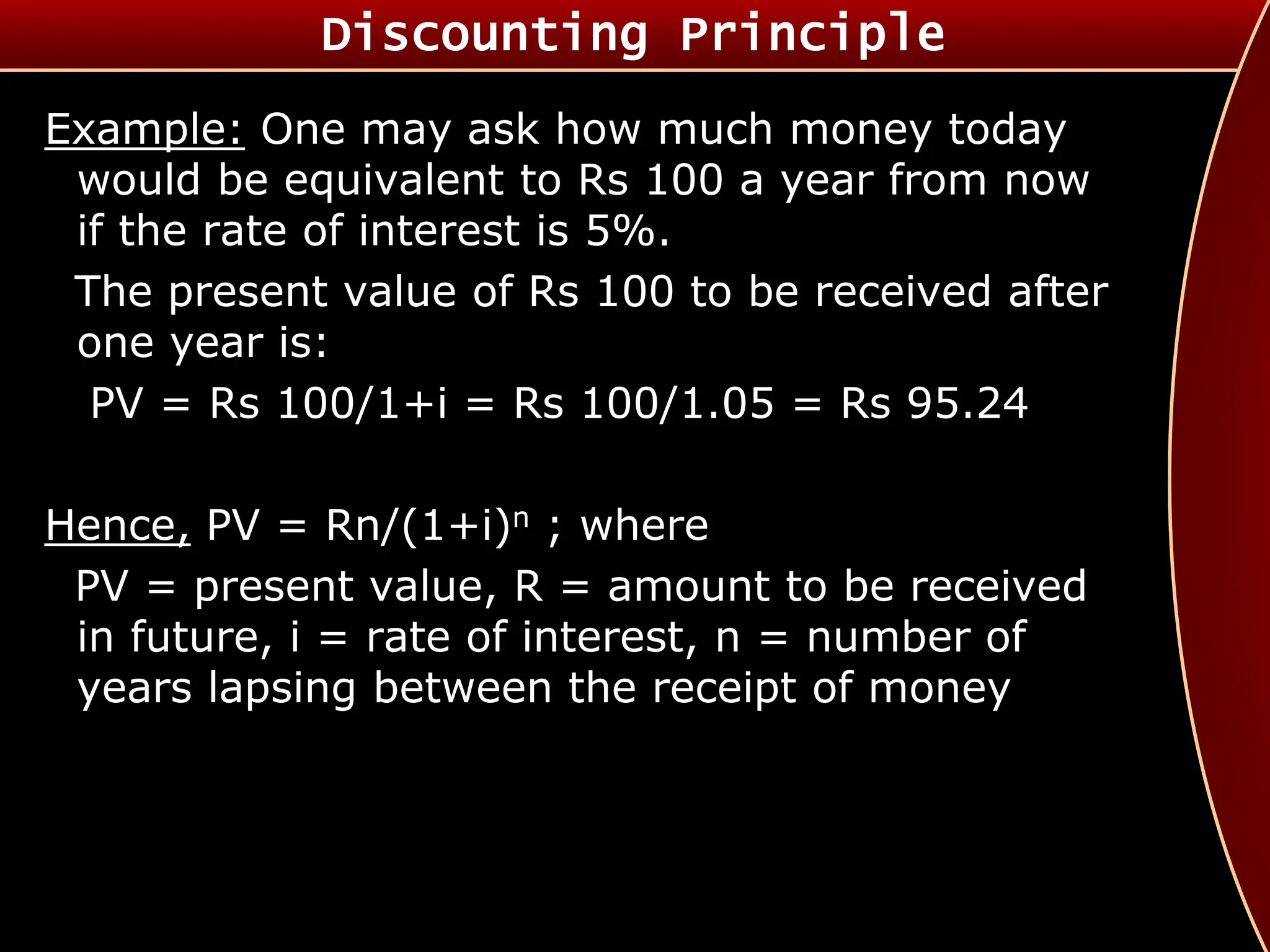
Example: One may ask how much money today
would be equivalent to Rs 100 a year from now
if the rate of interest is 5%.
The present value of Rs 100 to be received after
one year is:
PV = Rs 100/1+i = Rs 100/1.05 = Rs 95.24
Hence, PV = Rn/(1+i)n ; where
PV = present value, R = amount to be received
in future, i = rate of interest, n = number of
years lapsing between the receipt of money
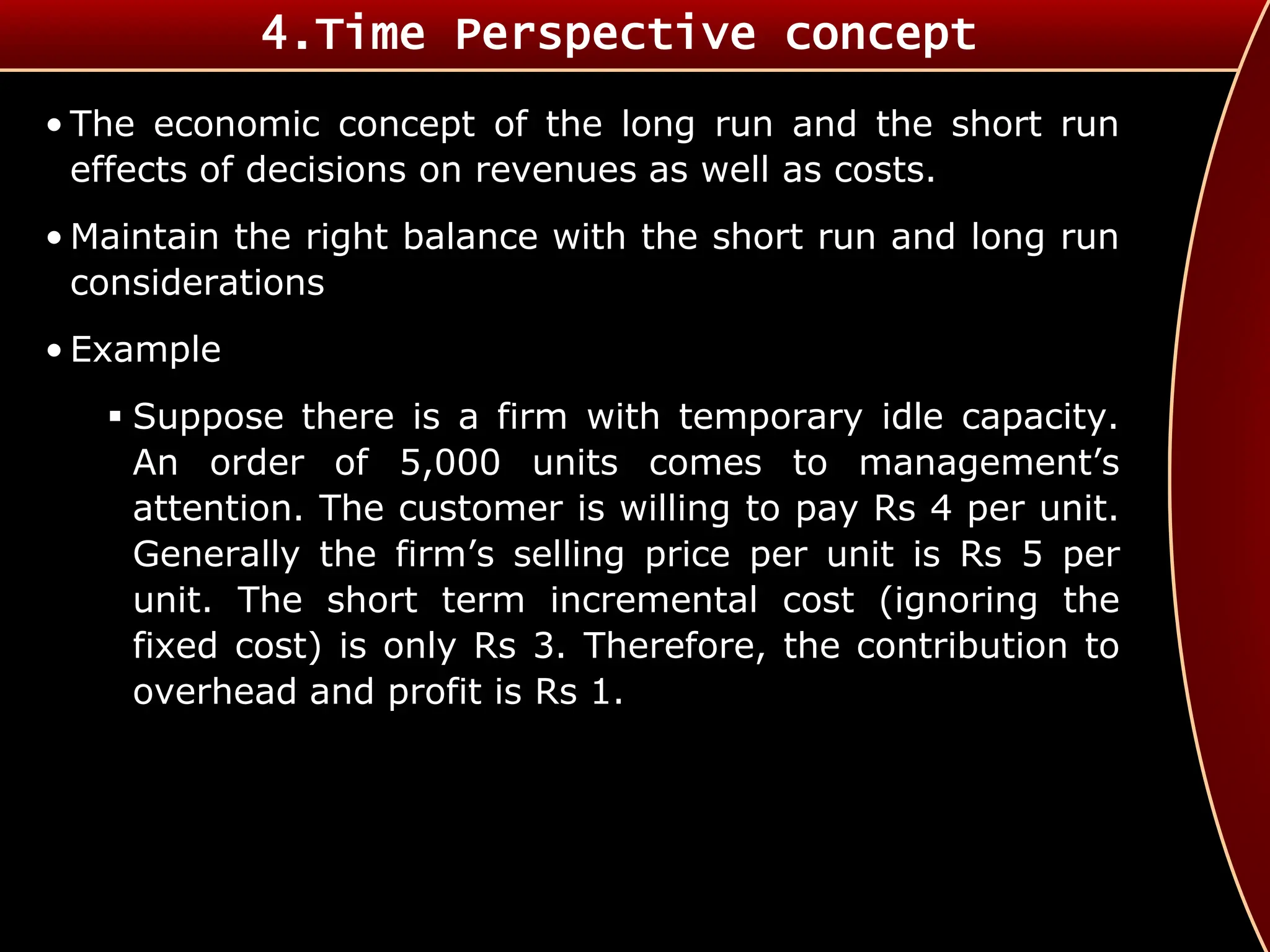
• The economic concept of the long run and the short run
effects of decisions on revenues as well as costs.
• Maintain the right balance with the short run and long run
considerations
• Example
 Suppose there is a firm with temporary idle capacity.
An order of 5,000 units comes to management’s
attention. The customer is willing to pay Rs 4 per unit.
Generally the firm’s selling price per unit is Rs 5 per
unit. The short term incremental cost (ignoring the
fixed cost) is only Rs 3. Therefore, the contribution to
overhead and profit is Rs 1.
4.Time Perspective concept
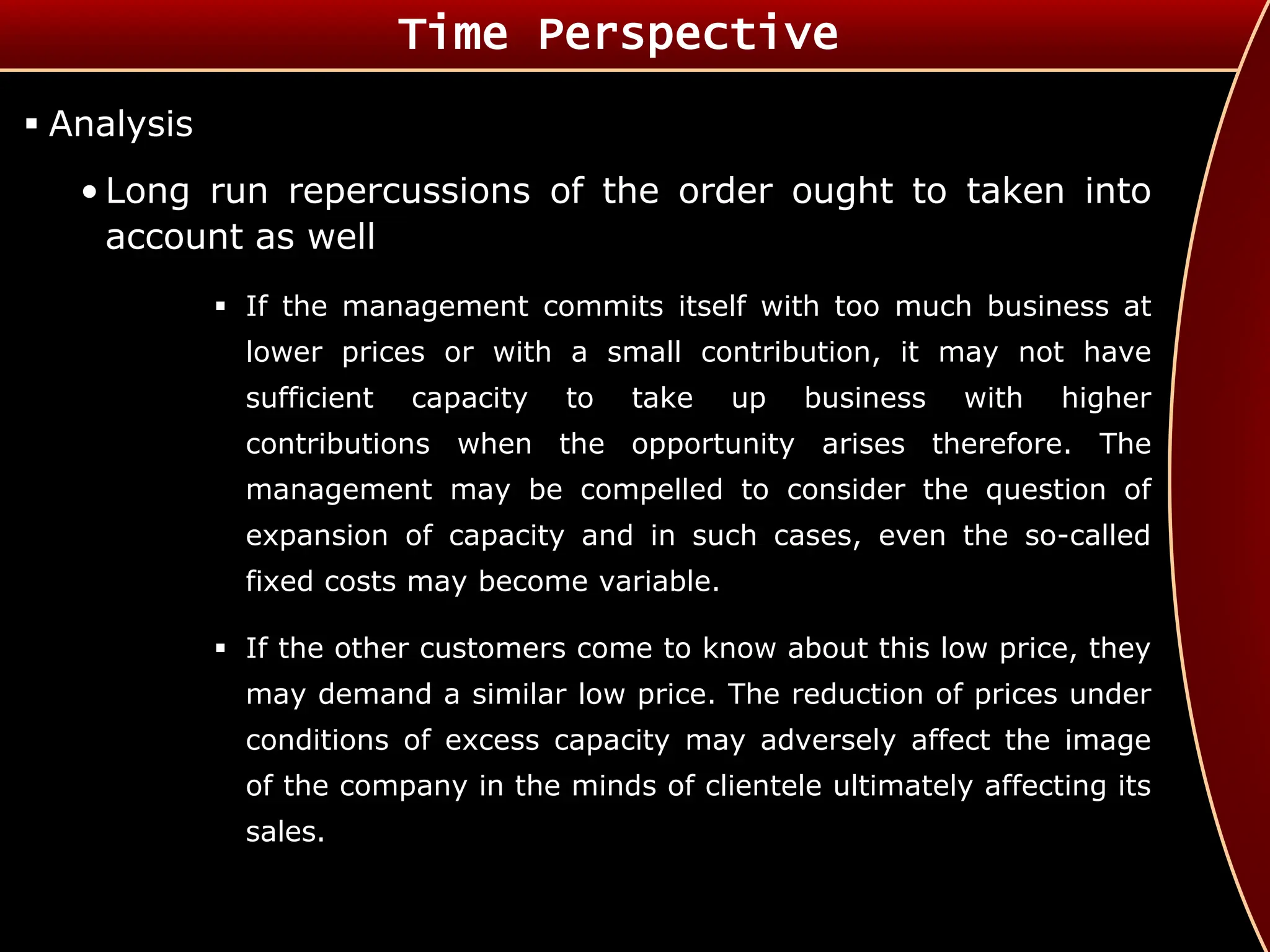
 Analysis
• Long run repercussions of the order ought to taken into
account as well
 If the management commits itself with too much business at
lower prices or with a small contribution, it may not have
sufficient capacity to take up business with higher
contributions when the opportunity arises therefore. The
management may be compelled to consider the question of
expansion of capacity and in such cases, even the so-called
fixed costs may become variable.
 If the other customers come to know about this low price, they
may demand a similar low price. The reduction of prices under
conditions of excess capacity may adversely affect the image
of the company in the minds of clientele ultimately affecting its
sales.
Time Perspective
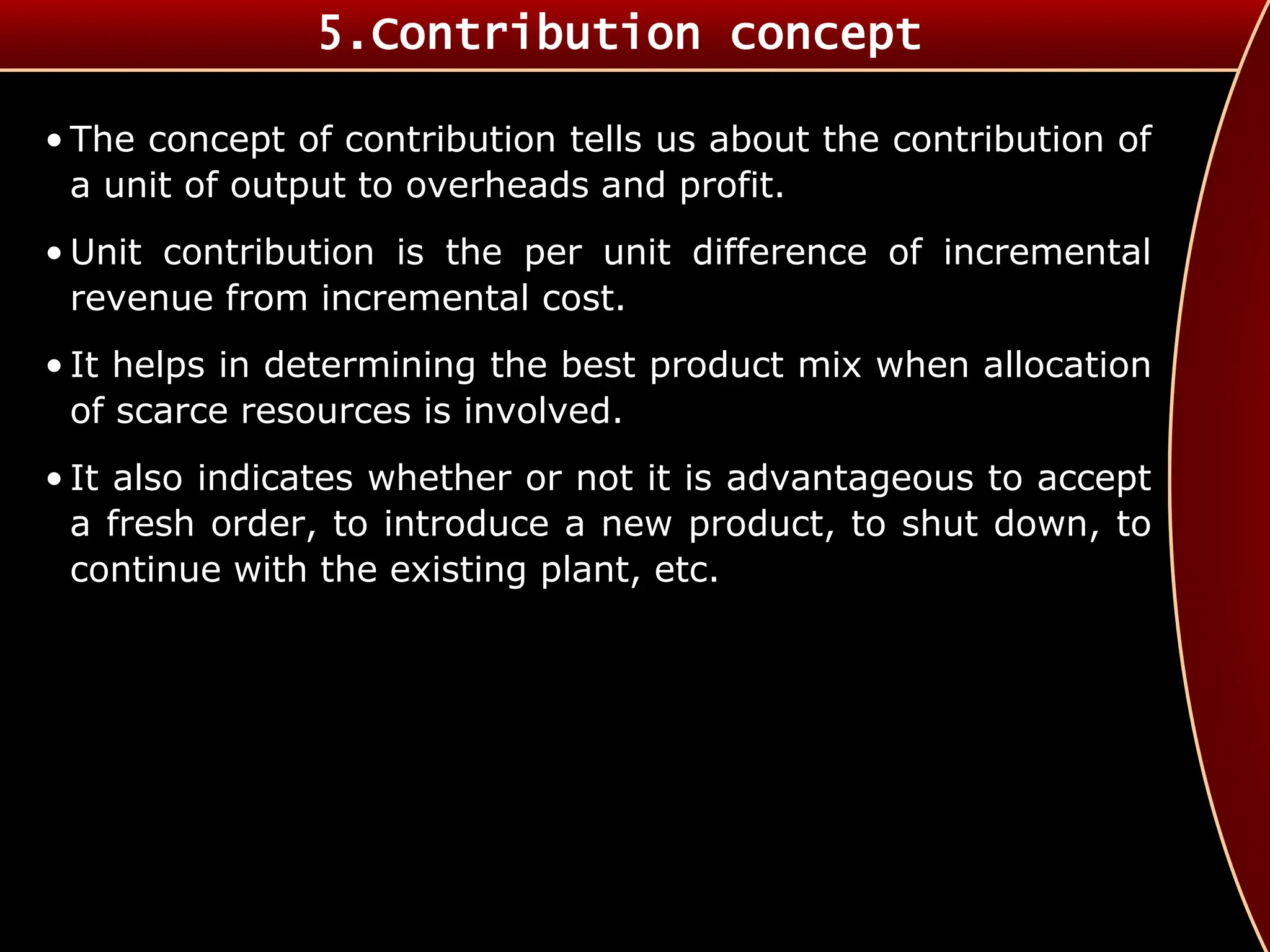
• The concept of contribution tells us about the contribution of
a unit of output to overheads and profit.
• Unit contribution is the per unit difference of incremental
revenue from incremental cost.
• It helps in determining the best product mix when allocation
of scarce resources is involved.
• It also indicates whether or not it is advantageous to accept
a fresh order, to introduce a new product, to shut down, to
continue with the existing plant, etc.
5.Contribution concept
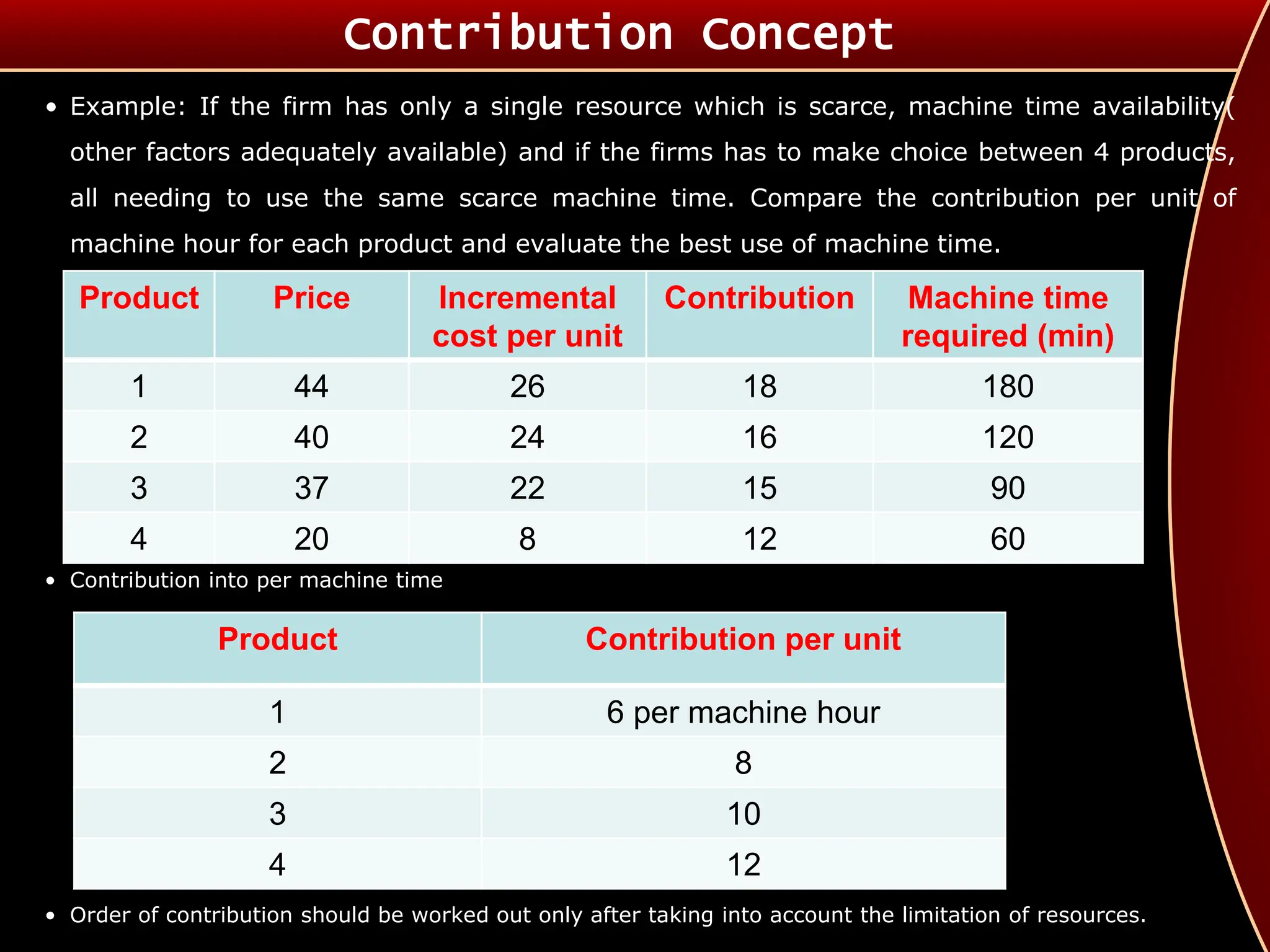
• Example: If the firm has only a single resource which is scarce, machine time availability(
other factors adequately available) and if the firms has to make choice between 4 products,
all needing to use the same scarce machine time. Compare the contribution per unit of
machine hour for each product and evaluate the best use of machine time.
• Contribution into per machine time
• Order of contribution should be worked out only after taking into account the limitation of resources.
Contribution Concept
Product Contribution per unit
1 6 per machine hour
2 8
3 10
4 12
Product Price Incremental
cost per unit
Contribution Machine time
required (min)
1 44 26 18 180
2 40 24 16 120
3 37 22 15 90
4 20 8 12 60
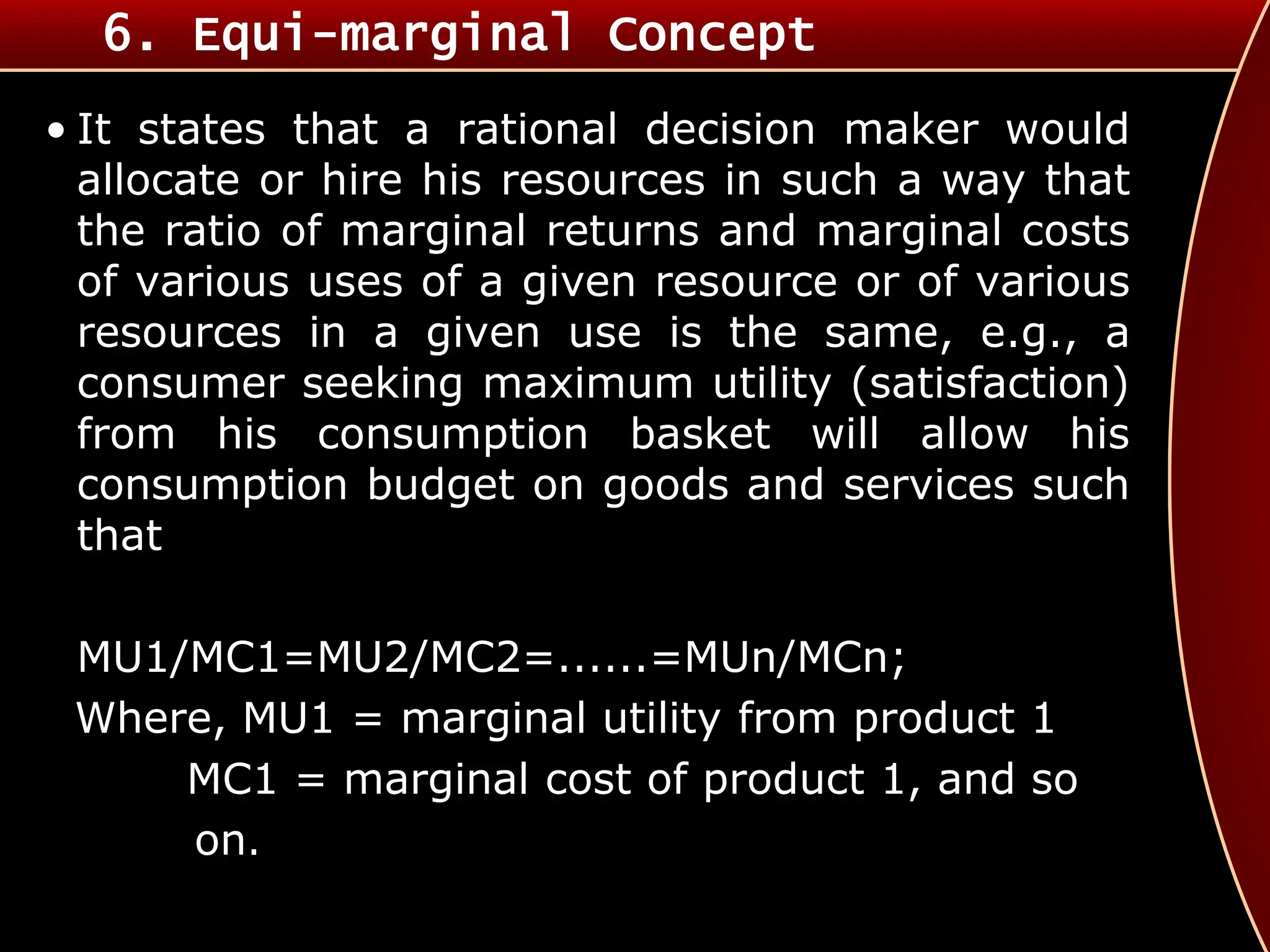
6. Equi-marginal Concept
• It states that a rational decision maker would
allocate or hire his resources in such a way that
the ratio of marginal returns and marginal costs
of various uses of a given resource or of various
resources in a given use is the same, e.g., a
consumer seeking maximum utility (satisfaction)
from his consumption basket will allow his
consumption budget on goods and services such
that
MU1/MC1=MU2/MC2=......=MUn/MCn;
Where, MU1 = marginal utility from product 1
MC1 = marginal cost of product 1, and so
on.

fundamental-concepts-of-managerial-economics.ppt

  • 1.
    Chapter 2 Fundamental Conceptsof Managerial Economics
  • 2.
    Review of EconomicTerms • Because of scarcity, an allocation decision must be made. The allocation decision is comprised of three separate choices:  What and how many goods and services should be produced?  How should these goods and services be produced?  For whom should these goods and services be produced?
  • 3.
    1. OPPORTUNITY COSTCONCEPT 2. INCREMENTAL REASONING CONCEPT 3. DISCOUNTING CONCEPT 4. TIME PERSPECTIVE CONCEPT 5. CONTRIBUTION CONCEPT 6. EQUI MARGINAL CONCEPT Fundamentals concepts of Managerial Economics
  • 4.
    • Represents thebenefits or profit foregone by pursuing one course of action rather than another. • The opportunity cost of the funds employed in the one’s own business is the amount of interest which could have been earned had these funds been invested in the next best channel of investment. • When a product X rather than a product Y is produced by using a machine which can produce both, the opportunity cost of producing X is the amount of Y sacrificed as a result. • The opportunity cost of using an idle machine is zero, as its use needs no sacrifice of opportunities. • The opportunity cost of one’s labour in one’s own business is the income one could have earned by accepting a job outside. • Implicit cost are considered by an economist not by an accountant. 1.Opportunity Cost Concept
  • 5.
    Accounting Profit VSEconomic Profit • Usually, profit is defined as revenue minus cost, that is, as the price of output times the quantity sold (revenue) minus the cost of producing that quantity of output. However, we need to be a little careful in interpreting that. Economists understand cost as opportunity cost - the value of the opportunity given up. In calculating economic profit, opportunity costs are deducted from PROFITS earned. • Opportunity costs are the alternative returns / benefits / profits foregone by using the chosen option. As a result, one can have a significant accounting profit with little to no economic profit. • For example, say you invest Rs100,000 to start a business, and in that year you earn Rs120,000 in profits. Your accounting profit would be Rs20,000. However, say that same year you could have earned an income of Rs45,000 had you been employed. Therefore, you have an economic loss of Rs25,000 (120,000 - 100,000 - 45,000).
  • 6.
    Example • Suppose afirm has Rs.100 million at its disposal and there are only three alternative uses.  to expand the size of the firm  to set up a new production unit in another locality, and  to buy shares in another firm • Suppose also that the expected annual return fro the three alterative uses of finance are given as follows:  Alternative 1 = Expansion of the size of the firm Rs.20 million  Alternative 2 = Setting up a new production unit Rs.18 million  Alternative 3 = Buying shares in another firm Rs.16 million
  • 7.
    • A changein output because of a change in process, product or investment is regarded as an incremental change.  Incremental cost  Incremental revenue • The incremental principle states that a decision is profitable when 1. It increases revenue more than costs; 2. It decreases some costs to a greater extent than it increases others; 3. It increases some revenues more than it decreases others; and 4. It reduces costs more than revenues. 2. Incremental Reasoning Concept
  • 8.
    • A firmgets an order that brings additional revenue of Rs 3,000. The normal cost of production of this order is: • The incremental cost to accept the order will be • Incremental reasoning shows that the firm would earn a net profit of Rs 600 (Rs 3,000 – 2,400), Incremental Reasoning Example Rs Labour 800 Material 1300 Overheads 1000 Selling and administration expenses 700 Full Cost 3800 Rs Labour 600 Material 1000 Overheads 800 Selling and administration expenses 700 Full Cost 2400
  • 9.
    • Theorem I:A course of action should be pursued up to the point where its marginal benefits equal its marginal costs. Marginal analysis - Profit Function of a Firm
  • 10.
    Comparison - IncrementalReasoning and Marginal Analysis Incremental Reasoning Marginal Analysis 1 Cost Effectiveness is between alternatives Cost Effective is within a given alternative 2 Not restricted by a unit change Unit change in independent variable 3 Useful when cost and revenue functions are linear Useful when cost and revenue functions are curvilinear 4 Special case of incremental analysis
  • 11.
    According to thisprinciple, if a decision affects costs and revenues in long-run, all those costs and revenues must be discounted to present values before valid comparison of alternatives is possible. This is essential because a rupee worth of money at a future date is not worth a rupee today. Money actually has time value. Discounting can be defined as a process used to transform future money into an equivalent number of present money. There is a lot of risk and uncertainty about future. The return in future is less attractive than the same return today. The future must, therefore, be discounted both for the elements of delay and risk of future. 3. Discounting Principle Concept
  • 12.
    Formulae • Future Valueof a Lump sum Amount: • Present Value of a Lump sum Amount: • Present Value of Annuity
  • 13.
    Discounting Principle Example: Onemay ask how much money today would be equivalent to Rs 100 a year from now if the rate of interest is 5%. The present value of Rs 100 to be received after one year is: PV = Rs 100/1+i = Rs 100/1.05 = Rs 95.24 Hence, PV = Rn/(1+i)n ; where PV = present value, R = amount to be received in future, i = rate of interest, n = number of years lapsing between the receipt of money
  • 14.
    • The economicconcept of the long run and the short run effects of decisions on revenues as well as costs. • Maintain the right balance with the short run and long run considerations • Example  Suppose there is a firm with temporary idle capacity. An order of 5,000 units comes to management’s attention. The customer is willing to pay Rs 4 per unit. Generally the firm’s selling price per unit is Rs 5 per unit. The short term incremental cost (ignoring the fixed cost) is only Rs 3. Therefore, the contribution to overhead and profit is Rs 1. 4.Time Perspective concept
  • 15.
     Analysis • Longrun repercussions of the order ought to taken into account as well  If the management commits itself with too much business at lower prices or with a small contribution, it may not have sufficient capacity to take up business with higher contributions when the opportunity arises therefore. The management may be compelled to consider the question of expansion of capacity and in such cases, even the so-called fixed costs may become variable.  If the other customers come to know about this low price, they may demand a similar low price. The reduction of prices under conditions of excess capacity may adversely affect the image of the company in the minds of clientele ultimately affecting its sales. Time Perspective
  • 16.
    • The conceptof contribution tells us about the contribution of a unit of output to overheads and profit. • Unit contribution is the per unit difference of incremental revenue from incremental cost. • It helps in determining the best product mix when allocation of scarce resources is involved. • It also indicates whether or not it is advantageous to accept a fresh order, to introduce a new product, to shut down, to continue with the existing plant, etc. 5.Contribution concept
  • 17.
    • Example: Ifthe firm has only a single resource which is scarce, machine time availability( other factors adequately available) and if the firms has to make choice between 4 products, all needing to use the same scarce machine time. Compare the contribution per unit of machine hour for each product and evaluate the best use of machine time. • Contribution into per machine time • Order of contribution should be worked out only after taking into account the limitation of resources. Contribution Concept Product Contribution per unit 1 6 per machine hour 2 8 3 10 4 12 Product Price Incremental cost per unit Contribution Machine time required (min) 1 44 26 18 180 2 40 24 16 120 3 37 22 15 90 4 20 8 12 60
  • 18.
    6. Equi-marginal Concept •It states that a rational decision maker would allocate or hire his resources in such a way that the ratio of marginal returns and marginal costs of various uses of a given resource or of various resources in a given use is the same, e.g., a consumer seeking maximum utility (satisfaction) from his consumption basket will allow his consumption budget on goods and services such that MU1/MC1=MU2/MC2=......=MUn/MCn; Where, MU1 = marginal utility from product 1 MC1 = marginal cost of product 1, and so on.