MANAGERIAL ECONOMICS
MODULE -1
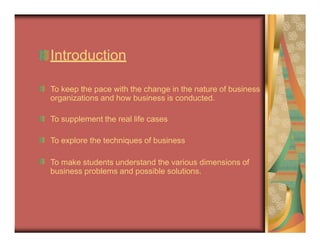
Introduction
To keep the pace with the change in the nature of business
organizations and how business is conducted.
To supplement the real life cases
To explore the techniques of business
To make students understand the various dimensions of
business problems and possible solutions.
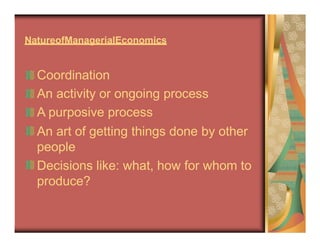
NatureofManagerialEconomics
Coordination
An activity or ongoing process
A purposive process
An art of getting things done by other
people
Decisions like: what, how for whom to
produce?
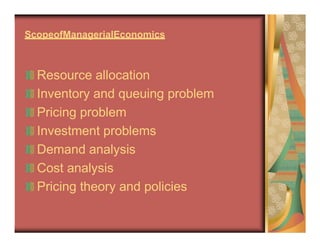
ScopeofManagerialEconomics
Resource allocation
Inventory and queuing problem
Pricing problem
Investment problems
Demand analysis
Cost analysis
Pricing theory and policies
Profit analysis with special reference to
break- even point
Capital budgeting for investment decisions
The business firm and objectives
Competition
Linked with microeconomic theory, macro
economic theory , operation research, theory
of decision making, statistics, management
theory & accounting
ManagerialEconomistsinDecisionmaking
Defining the problem
Determining the objective
Exploring the alternatives
Predicting the consequences
Making choice
Performing sensitivity analysis
Decision Making process
Micro & Macro Analysis
Partial and General Equilibrium Analysis
Static, Comparative Static and Dynamic Analysis
--allowing no change at a point of time (static)
-- allowing once for all change at a point of time
(comparative static)
--allowing successive changes over a period of
time (dynamic)
Positive and Normative analysis
MODULE -2
FUNDAMENTAL PRINCIPLES OF
MANAGERIAL ECONOMICS
Opportunity Cost (Opportunity Lost)
The next best alternative
Costs of sacrificed alternatives
Manager takes a decision by
choosing one course of action,
sacrificing the other alternatives
Holding Rs 1000 in hand……
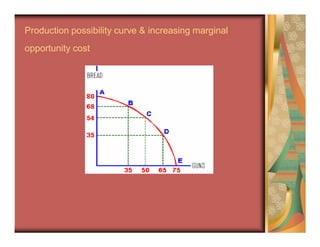
Production possibility curve & increasing marginal
opportunity cost
of a project. According to this theory, a project is sound if it
incremental principle, several guidelines should be maintained:
remains related to the other activities of the firm. Because of this,
either negatively or positively. It can increase the profits for the firm
considered.
represent an expenditure done by the firm in the past. These
denote all those expenditures that are done for the preliminary work
Incremental Principle
The incremental principle is used to measure the profit potential
increases total profit more than total cost.
--To have a proper estimation of profit potential by application of the
--Incidental Effects: Any kind of project taken by a company
the particular project influences all the other activities carried out,
or it may cause losses. These incidental effects must be
Sunk Costs: These costs should not be considered. Sunk costs
expenditures are not related with any particular project. These costs
related to the project, unrecoverable in any case.
extending from the relevant past* and foreseeable future taken
business decisions with long run implications.
Time Perspective
All business decision are taken with a certain time perspective.
The time perspective refers to the duration of time period
in view while taking a business decision.
period of past experience and trends which are relevant for
All business decisions do not have the same time perspective.
Eg: Manufacturing of Crackers
Eg: Management Institute.
production, in order to get the maximum total output, resources should be
productivity of each resource is the same in each unit of production.
"efficient allocation of resources." In the example, we have a tiny economy,
productivities on the two plots are equal, this tiny economy has an "efficient
the principles governing the efficient allocation of resources are the same.
two things equal "at the margin" -- in this case, to make the marginal
applications in economics. In more complicated cases, we will have to
resources between two fields that produce the same output. When the
services, it will be more complicated. But a version of the Equimarginal
Discounting & Equimarginal
Principles
When the same product or service is being produced in two or more units of
allocated among the units of production in such a way that the marginal
This example may also be a little clearer example of what we mean by
consisting of one farmer and two plots of land. When the marginal
allocation of resources." Of course, real economies are more complex, but
This rule has a name: it is the Equimarginal Principle. The idea is to make
productivity of labor equal on the two fields. As we will see, it has many
generalize the rule carefully. In this example, for instance, we are allocating
different areas of production are producing different kinds of goods and
Principle will still apply.
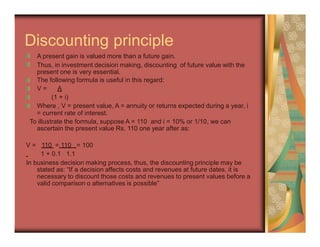
Discounting principle
A present gain is valued more than a future gain.
Thus, in investment decision making, discounting of future value with the
present one is very essential.
The following formula is useful in this regard:
V = A
(1 + i)
Where , V = present value, A = annuity or returns expected during a year, i
= current rate of interest.
To illustrate the formula, suppose A = 110 and i = 10% or 1/10, we can
ascertain the present value Rs. 110 one year after as:
V = 110 = 110 = 100
1 + 0.1 1.1
In business decision making process, thus, the discounting principle may be
stated as: “If a decision affects costs and revenues at future dates, it is
necessary to discount those costs and revenues to present values before a
valid comparison o alternatives is possible”

Manangerial Economics-Module -1-converted.pdf

  • 1.
  • 2.
    Introduction To keep thepace with the change in the nature of business organizations and how business is conducted. To supplement the real life cases To explore the techniques of business To make students understand the various dimensions of business problems and possible solutions.
  • 3.
    NatureofManagerialEconomics Coordination An activity orongoing process A purposive process An art of getting things done by other people Decisions like: what, how for whom to produce?
  • 4.
    ScopeofManagerialEconomics Resource allocation Inventory andqueuing problem Pricing problem Investment problems Demand analysis Cost analysis Pricing theory and policies
  • 5.
    Profit analysis withspecial reference to break- even point Capital budgeting for investment decisions The business firm and objectives Competition Linked with microeconomic theory, macro economic theory , operation research, theory of decision making, statistics, management theory & accounting
  • 6.
    ManagerialEconomistsinDecisionmaking Defining the problem Determiningthe objective Exploring the alternatives Predicting the consequences Making choice Performing sensitivity analysis
  • 7.
    Decision Making process Micro& Macro Analysis Partial and General Equilibrium Analysis Static, Comparative Static and Dynamic Analysis --allowing no change at a point of time (static) -- allowing once for all change at a point of time (comparative static) --allowing successive changes over a period of time (dynamic) Positive and Normative analysis
  • 8.
    MODULE -2 FUNDAMENTAL PRINCIPLESOF MANAGERIAL ECONOMICS Opportunity Cost (Opportunity Lost) The next best alternative Costs of sacrificed alternatives Manager takes a decision by choosing one course of action, sacrificing the other alternatives Holding Rs 1000 in hand……
  • 9.
    Production possibility curve& increasing marginal opportunity cost
  • 10.
    of a project.According to this theory, a project is sound if it incremental principle, several guidelines should be maintained: remains related to the other activities of the firm. Because of this, either negatively or positively. It can increase the profits for the firm considered. represent an expenditure done by the firm in the past. These denote all those expenditures that are done for the preliminary work Incremental Principle The incremental principle is used to measure the profit potential increases total profit more than total cost. --To have a proper estimation of profit potential by application of the --Incidental Effects: Any kind of project taken by a company the particular project influences all the other activities carried out, or it may cause losses. These incidental effects must be Sunk Costs: These costs should not be considered. Sunk costs expenditures are not related with any particular project. These costs related to the project, unrecoverable in any case.
  • 11.
    extending from therelevant past* and foreseeable future taken business decisions with long run implications. Time Perspective All business decision are taken with a certain time perspective. The time perspective refers to the duration of time period in view while taking a business decision. period of past experience and trends which are relevant for All business decisions do not have the same time perspective. Eg: Manufacturing of Crackers Eg: Management Institute.
  • 12.
    production, in orderto get the maximum total output, resources should be productivity of each resource is the same in each unit of production. "efficient allocation of resources." In the example, we have a tiny economy, productivities on the two plots are equal, this tiny economy has an "efficient the principles governing the efficient allocation of resources are the same. two things equal "at the margin" -- in this case, to make the marginal applications in economics. In more complicated cases, we will have to resources between two fields that produce the same output. When the services, it will be more complicated. But a version of the Equimarginal Discounting & Equimarginal Principles When the same product or service is being produced in two or more units of allocated among the units of production in such a way that the marginal This example may also be a little clearer example of what we mean by consisting of one farmer and two plots of land. When the marginal allocation of resources." Of course, real economies are more complex, but This rule has a name: it is the Equimarginal Principle. The idea is to make productivity of labor equal on the two fields. As we will see, it has many generalize the rule carefully. In this example, for instance, we are allocating different areas of production are producing different kinds of goods and Principle will still apply.
  • 13.
    Discounting principle A presentgain is valued more than a future gain. Thus, in investment decision making, discounting of future value with the present one is very essential. The following formula is useful in this regard: V = A (1 + i) Where , V = present value, A = annuity or returns expected during a year, i = current rate of interest. To illustrate the formula, suppose A = 110 and i = 10% or 1/10, we can ascertain the present value Rs. 110 one year after as: V = 110 = 110 = 100 1 + 0.1 1.1 In business decision making process, thus, the discounting principle may be stated as: “If a decision affects costs and revenues at future dates, it is necessary to discount those costs and revenues to present values before a valid comparison o alternatives is possible”