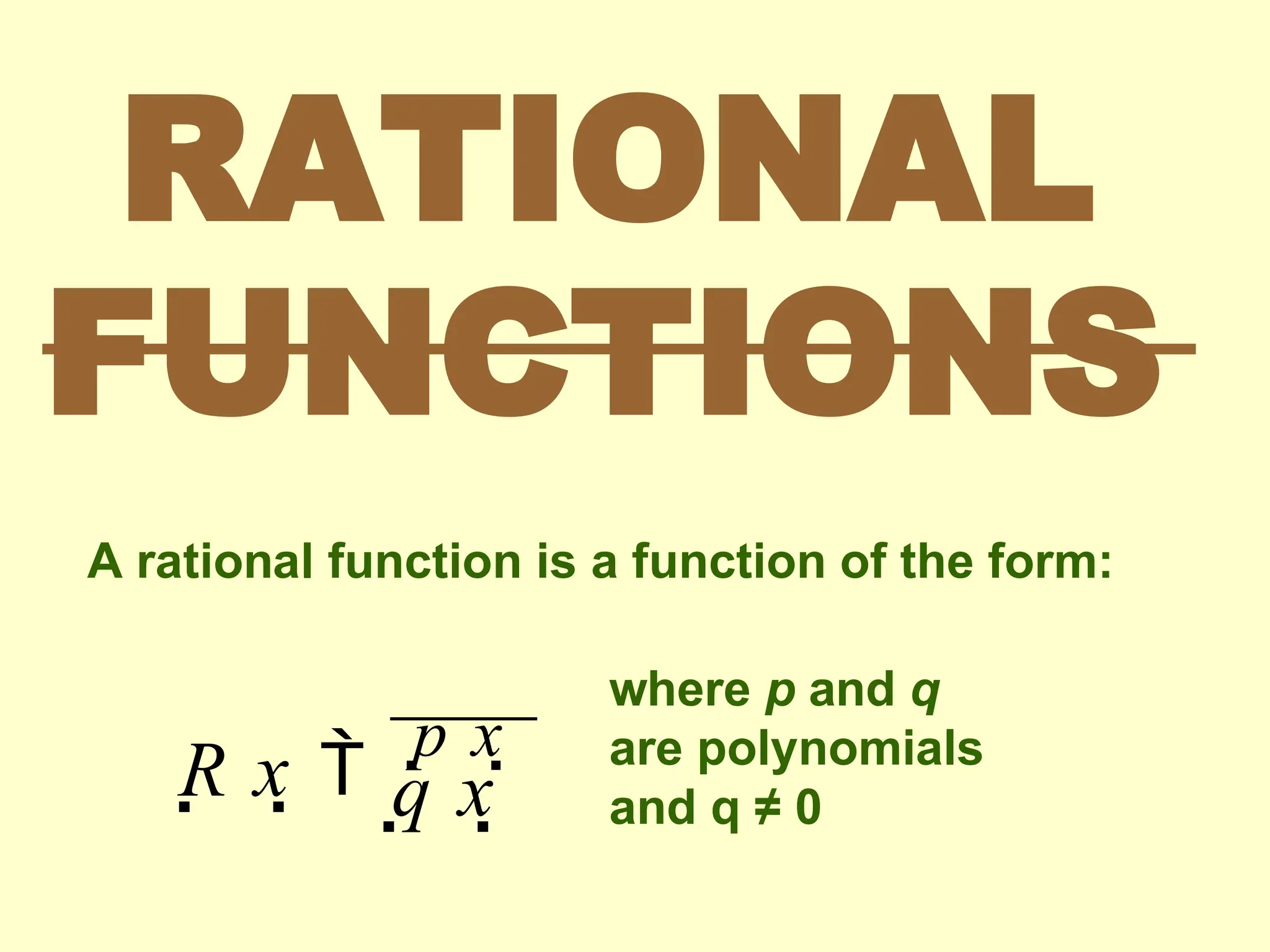
RATIONAL
FUNCTIONS
A rational function is a function of the form:
R x 
p x
q x
where p and q
are polynomials
and q ≠ 0
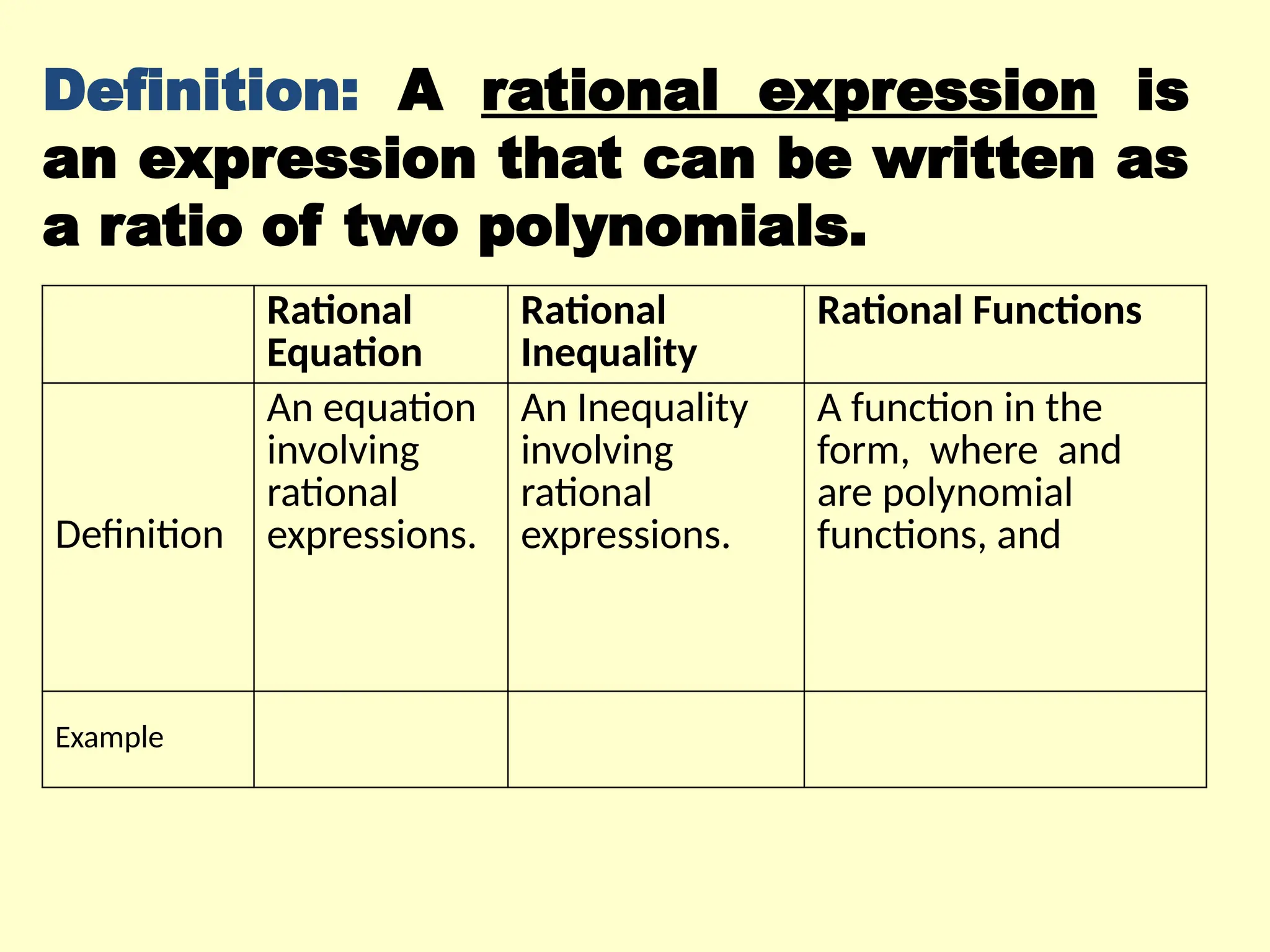
Definition: A rational expression is
an expression that can be written as
a ratio of two polynomials.
Rational
Equation
Rational
Inequality
Rational Functions
Definition
An equation
involving
rational
expressions.
An Inequality
involving
rational
expressions.
A function in the
form, where and
are polynomial
functions, and
Example
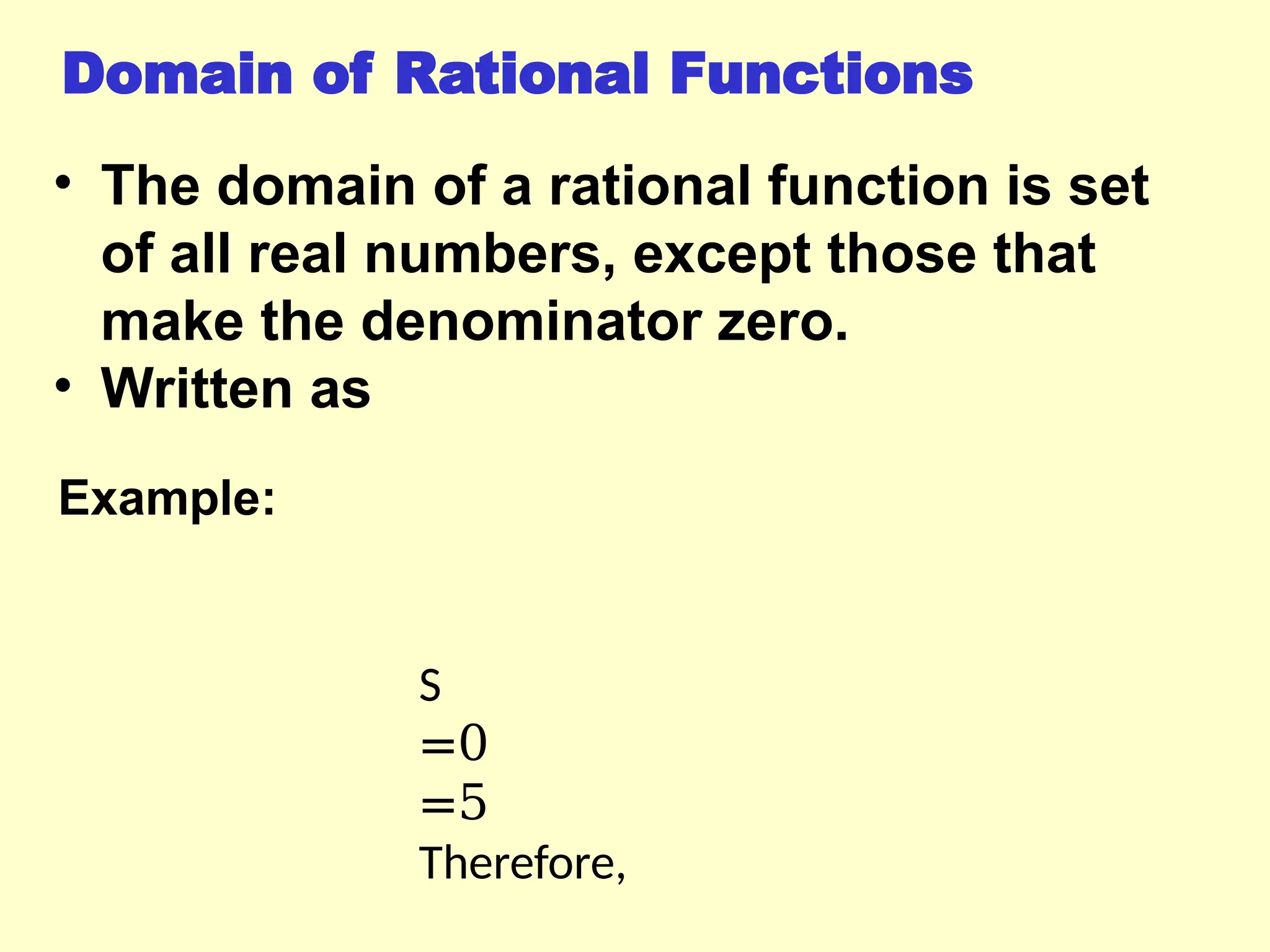
Domain of Rational Functions
• The domain of a rational function is set
of all real numbers, except those that
make the denominator zero.
• Written as
Example:
S
=0
=5
Therefore,
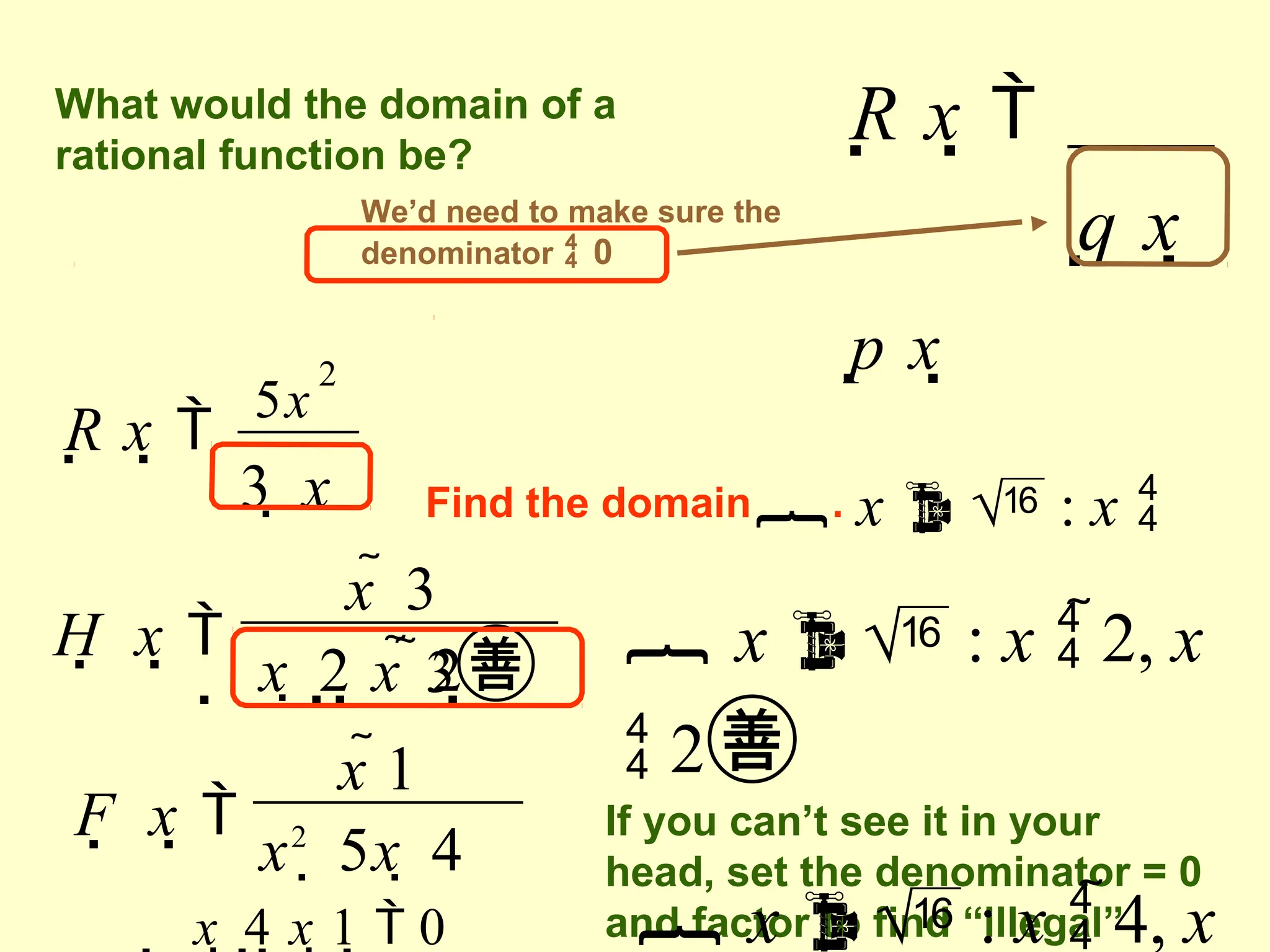
R x 
p x
q x
What would the domain of a
rational function be?
We’d need to make sure the
denominator  0
R x 
5x
3  x
2
Find the domain. x   : x 
3
H  x 
 x  2 x  2
x  3
 x  : x  2, x
 2
If you can’t see it in your
head, set the denominator = 0
and factor to find “illegal”
F  x 
x2
 5x  4
x 1
 x  4 x 1  0  x  : x  4, x
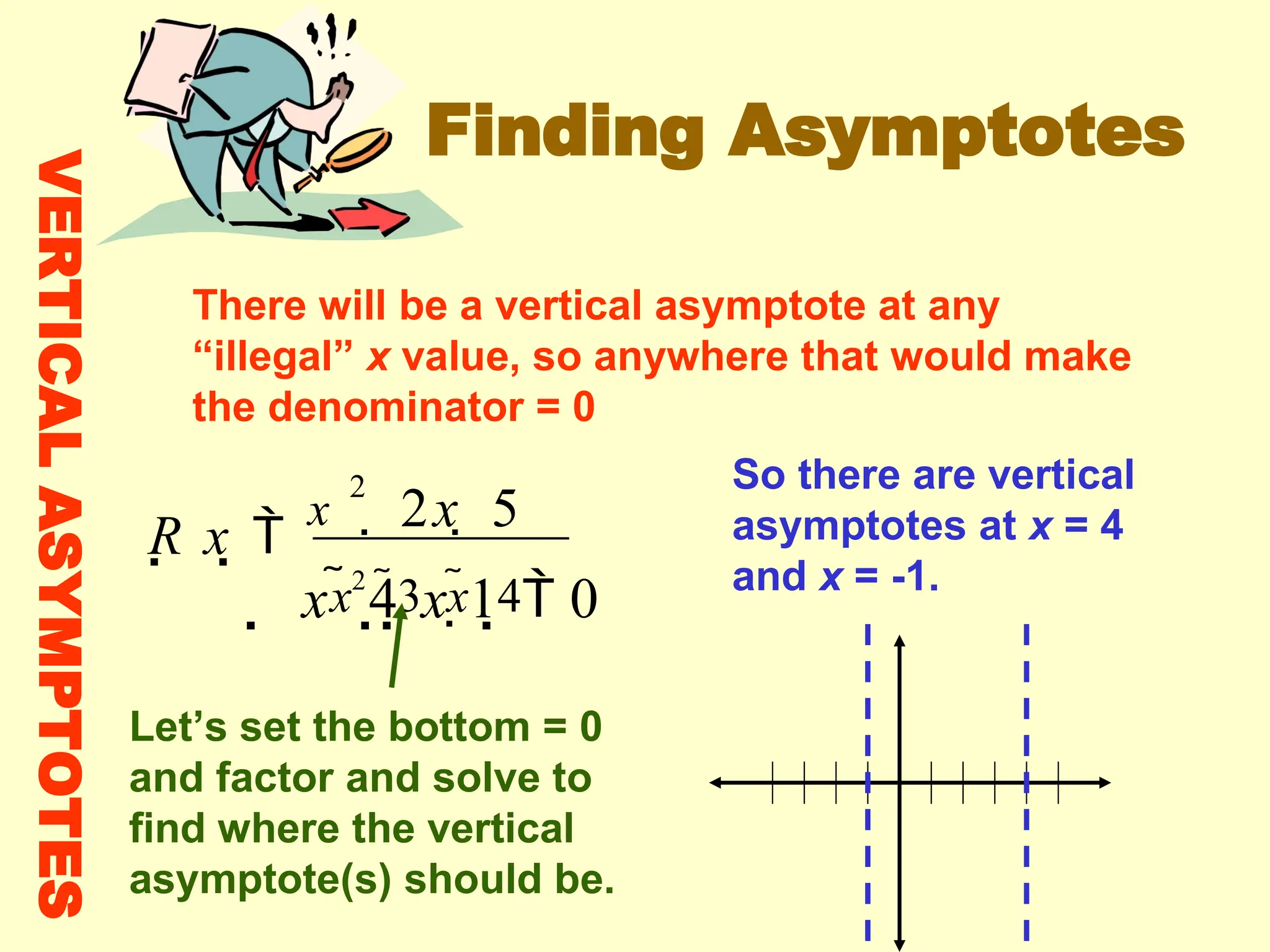
Finding Asymptotes
VERTICAL
ASYMPTOTES
There will be a vertical asymptote at any
“illegal” x value, so anywhere that would make
the denominator = 0
R x 
x
 xx2
43xx14 0
 2x  5
2
Let’s set the bottom = 0
and factor and solve to
find where the vertical
asymptote(s) should be.
So there are vertical
asymptotes at x = 4
and x = -1.
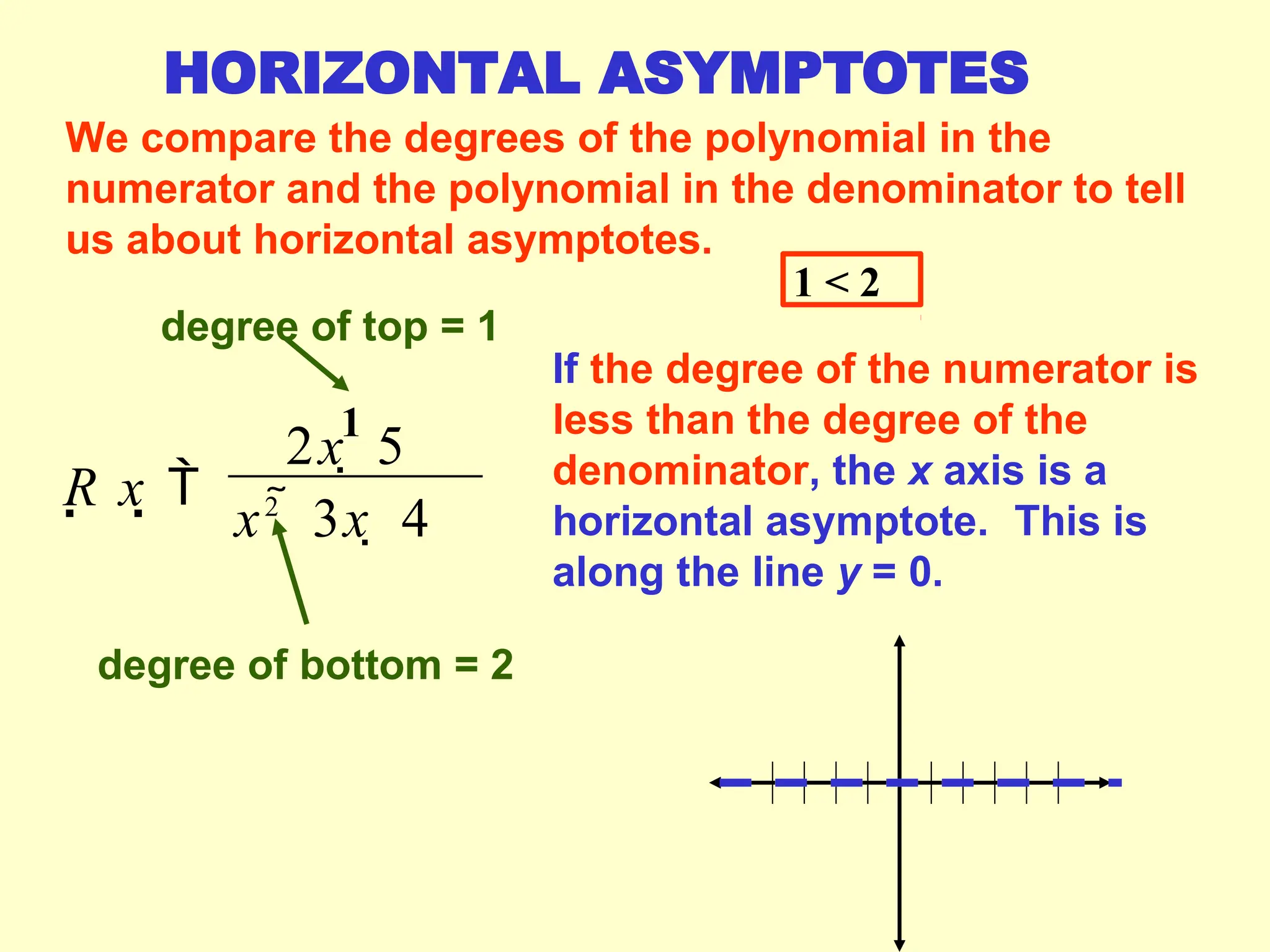
If the degree of the numerator is
less than the degree of the
denominator, (remember degree
is the highest power on any x
term) the x axis is a horizontal
asymptote.
If the degree of the numerator is
less than the degree of the
denominator, the x axis is a
horizontal asymptote. This is
along the line y = 0.
We compare the degrees of the polynomial in the
numerator and the polynomial in the denominator to tell
us about horizontal asymptotes.
R x 
x2
 3x  4
2x  5
degree of bottom = 2
HORIZONTAL ASYMPTOTES
degree of top = 1
1
1 < 2
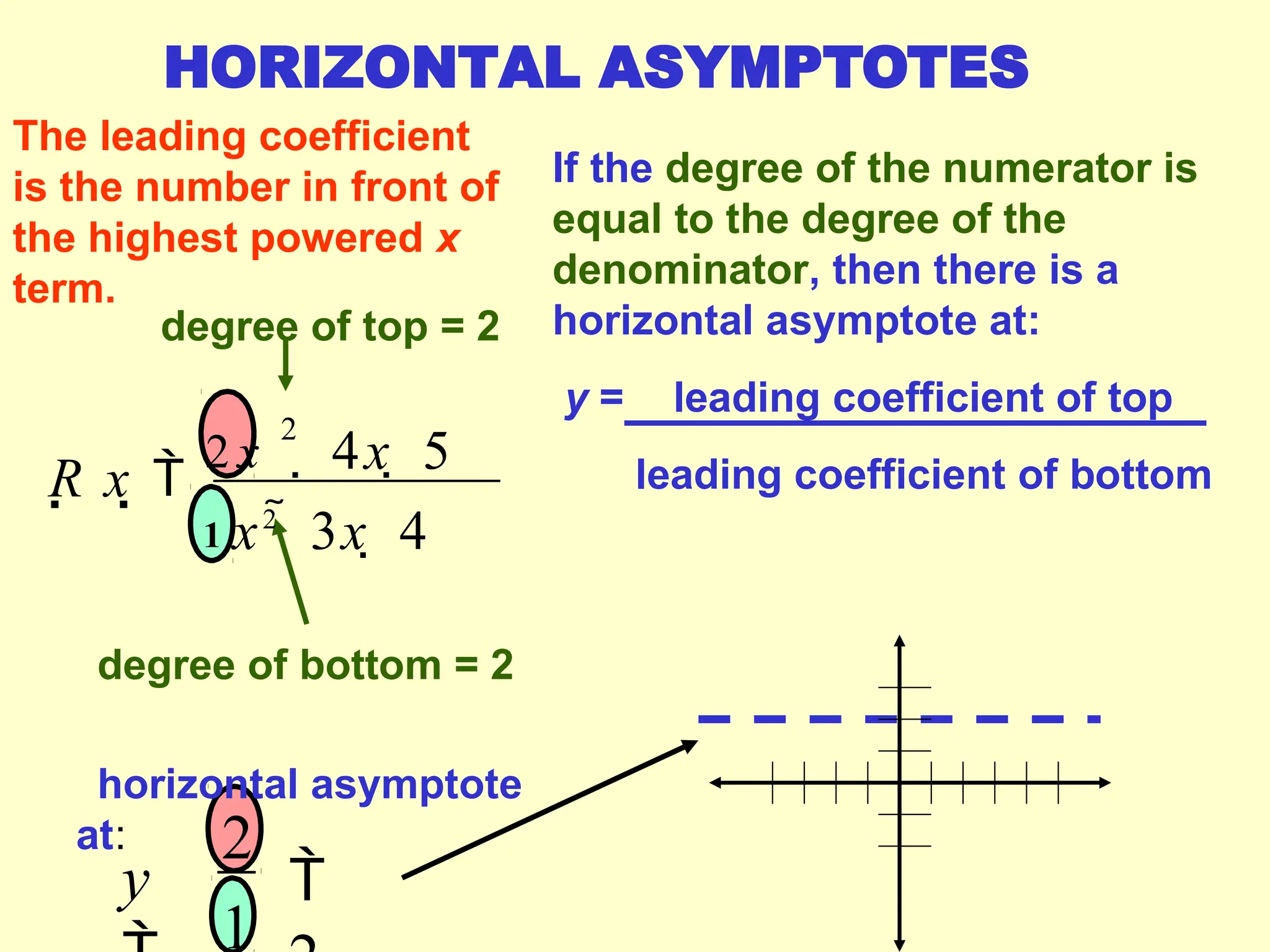
If the degree of the numerator is
equal to the degree of the
denominator, then there is a
horizontal asymptote at:
y = leading coefficient of top
leading coefficient of bottom
degree of bottom = 2
horizontal asymptote
at:
HORIZONTAL ASYMPTOTES
degree of top = 2
The leading coefficient
is the number in front of
the highest powered x
term.

1 x2
 3x  4
R x 
2 x  4x  5
2
1
2
y
R x 
x
x2
 3x  4
 3x  5 the quotient is the equation of
 2x
2
3
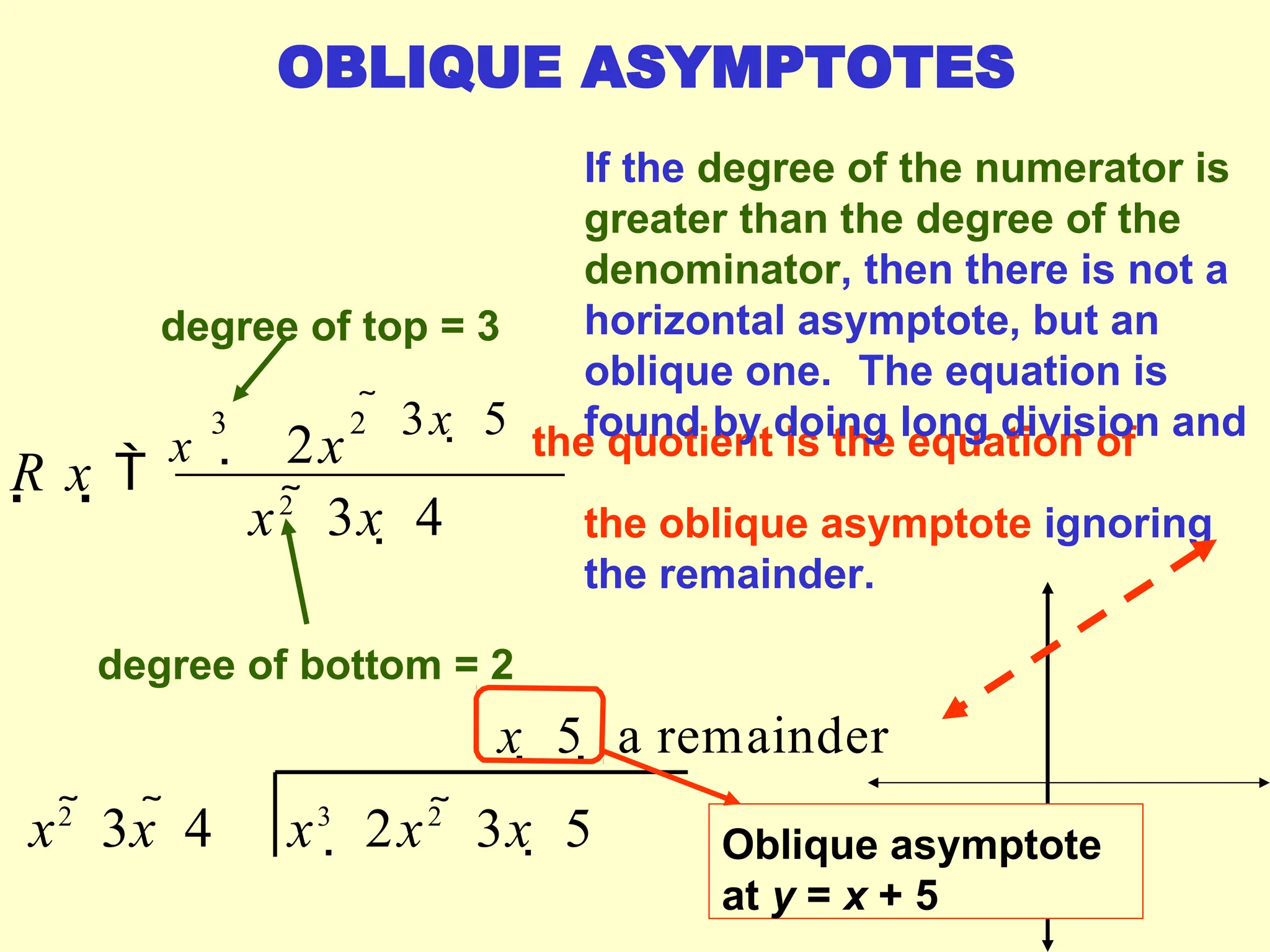
If the degree of the numerator is
greater than the degree of the
denominator, then there is not a
horizontal asymptote, but an
oblique one. The equation is
found by doing long division and
the oblique asymptote ignoring
the remainder.
degree of bottom = 2
x  5  a remainder
OBLIQUE ASYMPTOTES
degree of top = 3
x2
 3x  4 x3
 2x2
 3x  5 Oblique asymptote
at y = x + 5
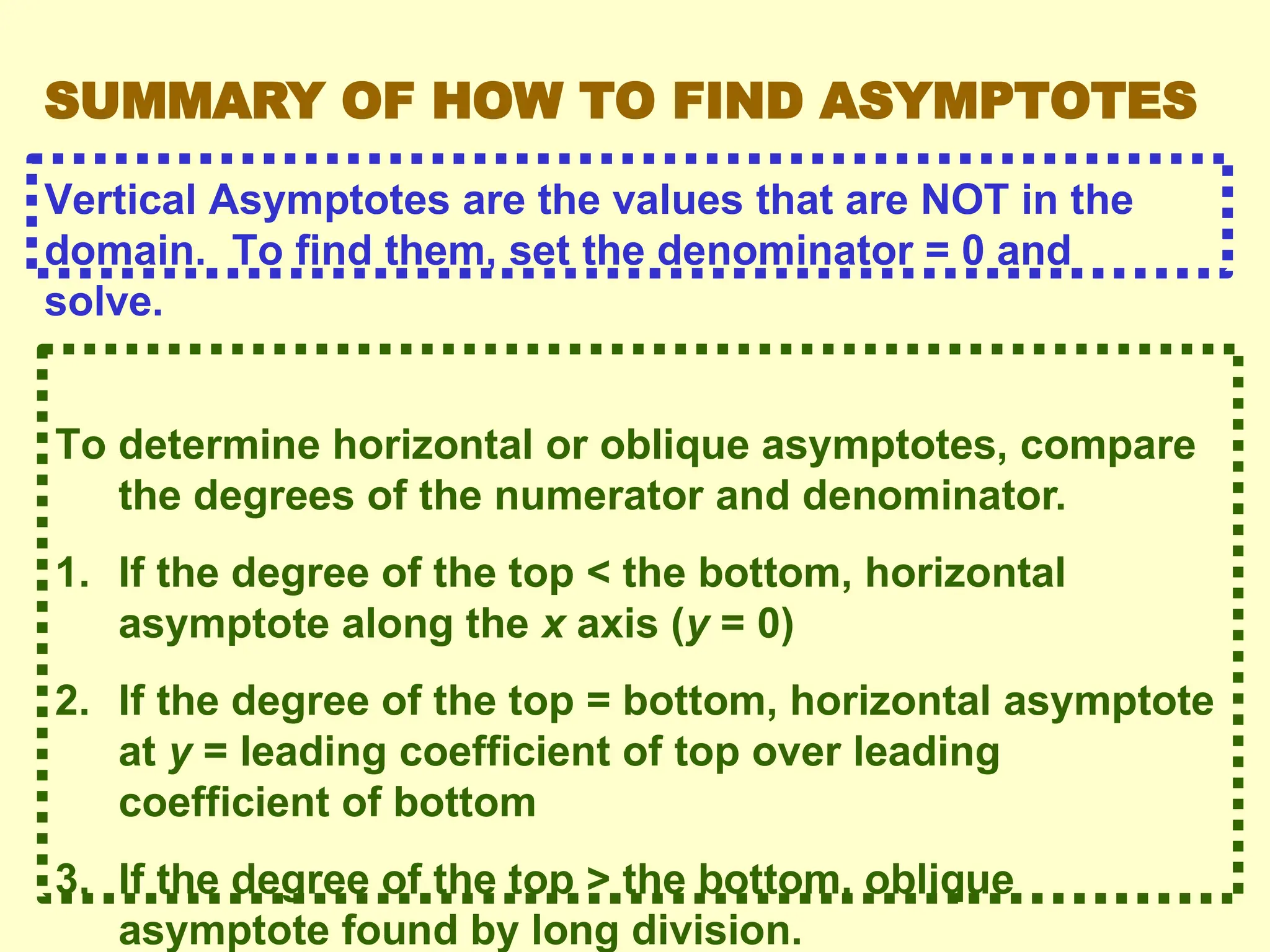
SUMMARY OF HOW TO FIND ASYMPTOTES
Vertical Asymptotes are the values that are NOT in the
domain. To find them, set the denominator = 0 and
solve.
To determine horizontal or oblique asymptotes, compare
the degrees of the numerator and denominator.
1. If the degree of the top < the bottom, horizontal
asymptote along the x axis (y = 0)
2. If the degree of the top = bottom, horizontal asymptote
at y = leading coefficient of top over leading
coefficient of bottom
3. If the degree of the top > the bottom, oblique
asymptote found by long division.

General Mathematics-RATIONAL FUNCTIONS.pptx

  • 1.
    RATIONAL FUNCTIONS A rational functionis a function of the form: R x  p x q x where p and q are polynomials and q ≠ 0
  • 2.
    Definition: A rationalexpression is an expression that can be written as a ratio of two polynomials. Rational Equation Rational Inequality Rational Functions Definition An equation involving rational expressions. An Inequality involving rational expressions. A function in the form, where and are polynomial functions, and Example
  • 3.
    Domain of RationalFunctions • The domain of a rational function is set of all real numbers, except those that make the denominator zero. • Written as Example: S =0 =5 Therefore,
  • 4.
    R x  px q x What would the domain of a rational function be? We’d need to make sure the denominator  0 R x  5x 3  x 2 Find the domain. x   : x  3 H  x   x  2 x  2 x  3  x  : x  2, x  2 If you can’t see it in your head, set the denominator = 0 and factor to find “illegal” F  x  x2  5x  4 x 1  x  4 x 1  0  x  : x  4, x
  • 5.
    Finding Asymptotes VERTICAL ASYMPTOTES There willbe a vertical asymptote at any “illegal” x value, so anywhere that would make the denominator = 0 R x  x  xx2 43xx14 0  2x  5 2 Let’s set the bottom = 0 and factor and solve to find where the vertical asymptote(s) should be. So there are vertical asymptotes at x = 4 and x = -1.
  • 6.
    If the degreeof the numerator is less than the degree of the denominator, (remember degree is the highest power on any x term) the x axis is a horizontal asymptote. If the degree of the numerator is less than the degree of the denominator, the x axis is a horizontal asymptote. This is along the line y = 0. We compare the degrees of the polynomial in the numerator and the polynomial in the denominator to tell us about horizontal asymptotes. R x  x2  3x  4 2x  5 degree of bottom = 2 HORIZONTAL ASYMPTOTES degree of top = 1 1 1 < 2
  • 7.
    If the degreeof the numerator is equal to the degree of the denominator, then there is a horizontal asymptote at: y = leading coefficient of top leading coefficient of bottom degree of bottom = 2 horizontal asymptote at: HORIZONTAL ASYMPTOTES degree of top = 2 The leading coefficient is the number in front of the highest powered x term.  1 x2  3x  4 R x  2 x  4x  5 2 1 2 y
  • 8.
    R x  x x2 3x  4  3x  5 the quotient is the equation of  2x 2 3 If the degree of the numerator is greater than the degree of the denominator, then there is not a horizontal asymptote, but an oblique one. The equation is found by doing long division and the oblique asymptote ignoring the remainder. degree of bottom = 2 x  5  a remainder OBLIQUE ASYMPTOTES degree of top = 3 x2  3x  4 x3  2x2  3x  5 Oblique asymptote at y = x + 5
  • 9.
    SUMMARY OF HOWTO FIND ASYMPTOTES Vertical Asymptotes are the values that are NOT in the domain. To find them, set the denominator = 0 and solve. To determine horizontal or oblique asymptotes, compare the degrees of the numerator and denominator. 1. If the degree of the top < the bottom, horizontal asymptote along the x axis (y = 0) 2. If the degree of the top = bottom, horizontal asymptote at y = leading coefficient of top over leading coefficient of bottom 3. If the degree of the top > the bottom, oblique asymptote found by long division.