Me
N
Me
N
N
N
8
Fulvalene, Rotaxane and Catenane Nanocompounds:
Temperature and Ultraviolet Radiation Effects on Plants and its
Bioremediation
Dr. Luis Alberto Lightbourn Rojas, PhD.
Instituto de Investigación Lightbourn Research A. C., Chihuahua, México
E-mail: drlightbourn@institutolightbourn.edu.mx
Phone: +52 (629) 101 0028
Effects of Climate Change On Plant Growth
Dr. Luis Alberto Lightbourn Rojas, PhD.
Instituto de Investigación Lightbourn Research A. C., Chihuahua, México
InstitutodeInvestigaciónLightbournResearchA.C.
The UV radiation can inhibit photosynthesis by altering gene expression and by
damaging the parts of the photosynthetic machinery (Smith et al., 2009). Sites
that are affected by this type of light are the light collector complex II (LHCII),
the PSII reaction center and PSI acceptor. However, most studies have
demonstrated that PSII is more sensitive to UV radiation as compared to PSI; this
is due to the chemical changes which produces the UV radiation on amino acids
with double bonds of the PSII proteins
Solar radiation (electromagnetic radiation) is one
of the most important factors in the growth and
development of plants, and is involved in many
important processes such as photosynthesis,
phototropism, photomorphogenesis, opening
stomata, temperature of plant and soil, etc.
Solar Radiation
Temperature
The increase in temperature causes a greater
fluidity in the membranes, causing problems in
cell functions, mainly in mitochondria and
chloroplasts . Therefore, the deleterious effects
that high temperatures cause on plants mainly
occur in photosynthetic functions and thylakoid
membranes.
UV Radiation
The plants exhibit different responses to
environmental stresses like UV radiation
exposure. The leaves commonly that
contain anthocyanins absorb more light in
the visible green and yellow region
spectrum regarding those leaves which do
not contain it; however, is unknown this
energy function (Hatier and Gould, 2009).
This energy could be used in repair
mechanisms or photosynthesis
optimization, whereby the plant can
continue to perform its metabolic activities with the least possible deficiency;
nevertheless, this mechanism may occur deficient with nutritional techniques.
Since the increase in certain nutrients appears not to be improved in plants that
are damaged by UV light, because it only considers some basic elements and
excluding that plants would use many more elements to carry out their functions
(Lightbourn et al., 2011; Singh et al., 2012).
On the other hand, there is an increase in the use of plastic greenhouses in
order to reduce the risk of pathogen attack, and also to reduce high UV radiation
levels, therefore preventing from reaching and damaging the plants. However,
when the light passes from one medium to another, it suffers inverted cycloid
deviations namely tautocrony producing dicroism and birefringence that affects
the polarity and intensity of the light beam incident and refracted which
consequently alters the photosynthetic phenomenon. This can be quantified as a
function of light energy, starting from the basic conceptions and traditional until
the logic formality given by the mathematical complex of variations calculation
Actually a new technology has developed in plant nutrition that consists on
clusters of selenium, nickel, titanium and polioxomolibdate. This is in fulvalenic
rotaxane-catenananic base, generating orthogonal sequence dendrimers that
are intra-tylacoidic nanosomes, which enables to optimize the photosynthetic
efficiency by capturing, storing and maintaining more available power provided
by the monochromatic beam of 563 nm. Therefore, induces the photosynthesis
optimization, serving as a light reserve at chloroplasts level. This helps to
maintain the plant metabolism, which results in phytotaxic stability, and
therefore, stability of production, irrespective of any adverse conditions such as
UV radiation stress (Lightbourn 2011b).
Lightbourn Technology
Furthermore, this technology contains zinc
as the principal element, which is required
for growth hormones synthesis (cytokinins
and auxins), besides participate in
chlorophyll production and possibly
prevent its destruction (Salisbury and Ross,
1994), thereby further reduce the damage
caused by high temperatures and UV
radiation.
The fulvalenic rotaxane-catenananic base are
molecules whose structure changes when exposed to
sunlight, and can remain stable in that form
indefinitely. Then, when a stimulus — a catalyst, a
small temperature change, a flash of light — it can
quickly snap back to its other form, releasing its
stored energy in a burst of heat. The fulvalenic
rotaxane-catenananic base are molecules whose
structure changes when exposed to sunlight, and can
remain stable in that form indefinitely.
Then, when a stimulus — a catalyst, a small temperature change, a flash of light
— it can quickly snap back to its other form, releasing its stored energy in a
burst of heat.
This compound is applied by foliar absorption and involves an innovation in
signaling and synchronization cell, because provide continuity in photosynthetic
energy uptake and transfer, due to that clusters absorb and store energy.
Furthermore, owing of these clusters not interrupt the metabolism on account
of darkness, there are no delays in the formation and maintenance of plant
tissue which means the total dejection of metabolic delays and consequences
translated into structural failures, metabolic, energetic and homeostatic that
directly affect the quantity and quality of biomass (Lightbourn, 2011b).
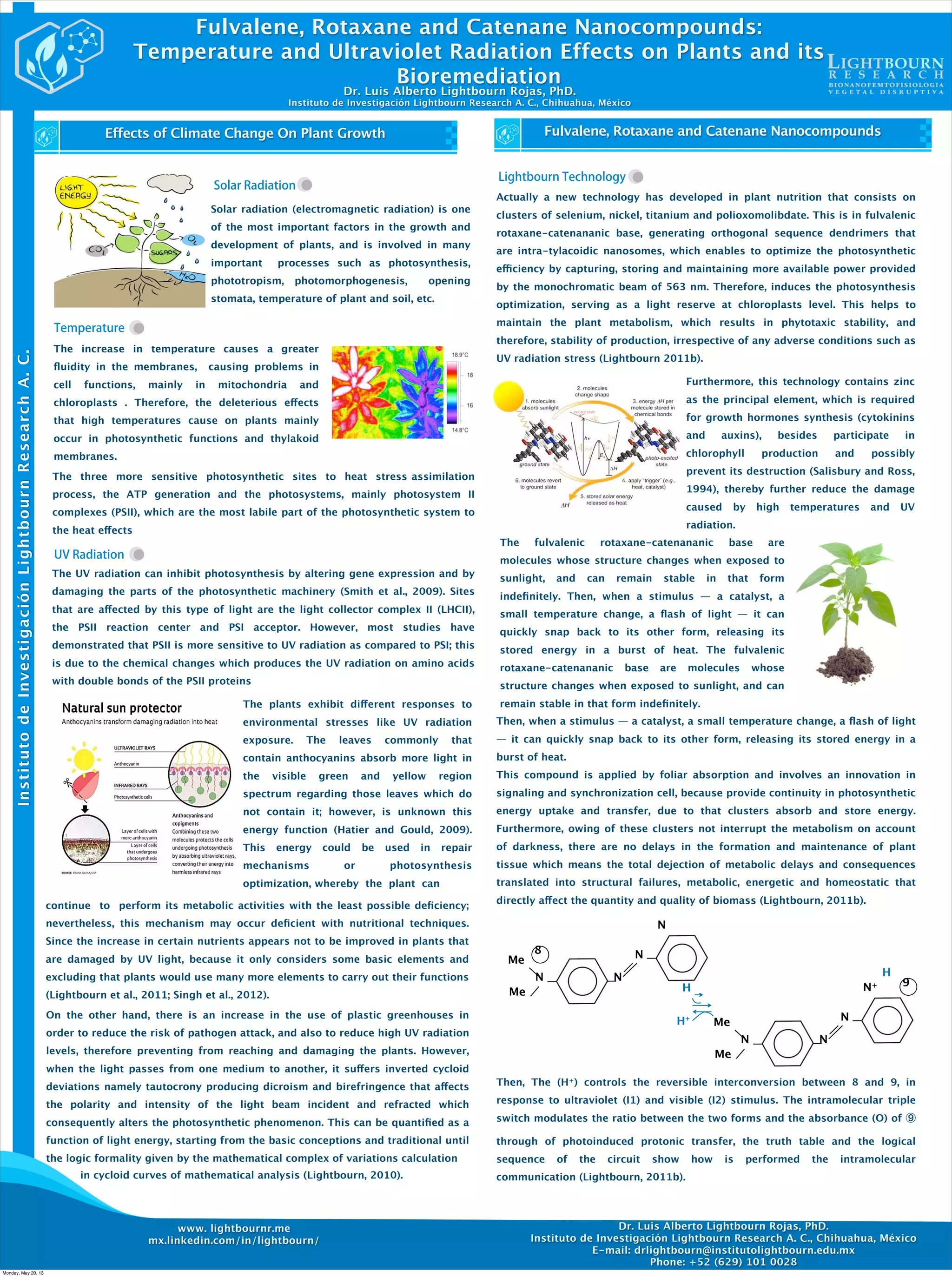
Then, The (H+) controls the reversible interconversion between 8 and 9, in
response to ultraviolet (I1) and visible (I2) stimulus. The intramolecular triple
switch modulates the ratio between the two forms and the absorbance (O) of ⑨
through of photoinduced protonic transfer, the truth table and the logical
sequence of the circuit show how is performed the intramolecular
communication (Lightbourn, 2011b).
H
H+
9
Me
N
Me
N
N
N+
H
The three more sensitive photosynthetic sites to heat stress assimilation
process, the ATP generation and the photosystems, mainly photosystem II
complexes (PSII), which are the most labile part of the photosynthetic system to
the heat effects
Fulvalene, Rotaxane and Catenane Nanocompounds
in cycloid curves of mathematical analysis (Lightbourn, 2010).
www. lightbournr.me
mx.linkedin.com/in/lightbourn/
Monday, May 20, 13

FULVALENE, ROTAXANE & CATENANE NANOCOMPOUNDS

  • 1.
    Me N Me N N N 8 Fulvalene, Rotaxane andCatenane Nanocompounds: Temperature and Ultraviolet Radiation Effects on Plants and its Bioremediation Dr. Luis Alberto Lightbourn Rojas, PhD. Instituto de Investigación Lightbourn Research A. C., Chihuahua, México E-mail: drlightbourn@institutolightbourn.edu.mx Phone: +52 (629) 101 0028 Effects of Climate Change On Plant Growth Dr. Luis Alberto Lightbourn Rojas, PhD. Instituto de Investigación Lightbourn Research A. C., Chihuahua, México InstitutodeInvestigaciónLightbournResearchA.C. The UV radiation can inhibit photosynthesis by altering gene expression and by damaging the parts of the photosynthetic machinery (Smith et al., 2009). Sites that are affected by this type of light are the light collector complex II (LHCII), the PSII reaction center and PSI acceptor. However, most studies have demonstrated that PSII is more sensitive to UV radiation as compared to PSI; this is due to the chemical changes which produces the UV radiation on amino acids with double bonds of the PSII proteins Solar radiation (electromagnetic radiation) is one of the most important factors in the growth and development of plants, and is involved in many important processes such as photosynthesis, phototropism, photomorphogenesis, opening stomata, temperature of plant and soil, etc. Solar Radiation Temperature The increase in temperature causes a greater fluidity in the membranes, causing problems in cell functions, mainly in mitochondria and chloroplasts . Therefore, the deleterious effects that high temperatures cause on plants mainly occur in photosynthetic functions and thylakoid membranes. UV Radiation The plants exhibit different responses to environmental stresses like UV radiation exposure. The leaves commonly that contain anthocyanins absorb more light in the visible green and yellow region spectrum regarding those leaves which do not contain it; however, is unknown this energy function (Hatier and Gould, 2009). This energy could be used in repair mechanisms or photosynthesis optimization, whereby the plant can continue to perform its metabolic activities with the least possible deficiency; nevertheless, this mechanism may occur deficient with nutritional techniques. Since the increase in certain nutrients appears not to be improved in plants that are damaged by UV light, because it only considers some basic elements and excluding that plants would use many more elements to carry out their functions (Lightbourn et al., 2011; Singh et al., 2012). On the other hand, there is an increase in the use of plastic greenhouses in order to reduce the risk of pathogen attack, and also to reduce high UV radiation levels, therefore preventing from reaching and damaging the plants. However, when the light passes from one medium to another, it suffers inverted cycloid deviations namely tautocrony producing dicroism and birefringence that affects the polarity and intensity of the light beam incident and refracted which consequently alters the photosynthetic phenomenon. This can be quantified as a function of light energy, starting from the basic conceptions and traditional until the logic formality given by the mathematical complex of variations calculation Actually a new technology has developed in plant nutrition that consists on clusters of selenium, nickel, titanium and polioxomolibdate. This is in fulvalenic rotaxane-catenananic base, generating orthogonal sequence dendrimers that are intra-tylacoidic nanosomes, which enables to optimize the photosynthetic efficiency by capturing, storing and maintaining more available power provided by the monochromatic beam of 563 nm. Therefore, induces the photosynthesis optimization, serving as a light reserve at chloroplasts level. This helps to maintain the plant metabolism, which results in phytotaxic stability, and therefore, stability of production, irrespective of any adverse conditions such as UV radiation stress (Lightbourn 2011b). Lightbourn Technology Furthermore, this technology contains zinc as the principal element, which is required for growth hormones synthesis (cytokinins and auxins), besides participate in chlorophyll production and possibly prevent its destruction (Salisbury and Ross, 1994), thereby further reduce the damage caused by high temperatures and UV radiation. The fulvalenic rotaxane-catenananic base are molecules whose structure changes when exposed to sunlight, and can remain stable in that form indefinitely. Then, when a stimulus — a catalyst, a small temperature change, a flash of light — it can quickly snap back to its other form, releasing its stored energy in a burst of heat. The fulvalenic rotaxane-catenananic base are molecules whose structure changes when exposed to sunlight, and can remain stable in that form indefinitely. Then, when a stimulus — a catalyst, a small temperature change, a flash of light — it can quickly snap back to its other form, releasing its stored energy in a burst of heat. This compound is applied by foliar absorption and involves an innovation in signaling and synchronization cell, because provide continuity in photosynthetic energy uptake and transfer, due to that clusters absorb and store energy. Furthermore, owing of these clusters not interrupt the metabolism on account of darkness, there are no delays in the formation and maintenance of plant tissue which means the total dejection of metabolic delays and consequences translated into structural failures, metabolic, energetic and homeostatic that directly affect the quantity and quality of biomass (Lightbourn, 2011b). Then, The (H+) controls the reversible interconversion between 8 and 9, in response to ultraviolet (I1) and visible (I2) stimulus. The intramolecular triple switch modulates the ratio between the two forms and the absorbance (O) of ⑨ through of photoinduced protonic transfer, the truth table and the logical sequence of the circuit show how is performed the intramolecular communication (Lightbourn, 2011b). H H+ 9 Me N Me N N N+ H The three more sensitive photosynthetic sites to heat stress assimilation process, the ATP generation and the photosystems, mainly photosystem II complexes (PSII), which are the most labile part of the photosynthetic system to the heat effects Fulvalene, Rotaxane and Catenane Nanocompounds in cycloid curves of mathematical analysis (Lightbourn, 2010). www. lightbournr.me mx.linkedin.com/in/lightbourn/ Monday, May 20, 13