

Fully Integrated Switch-Mode Single-Cell Li-Ion Charger With Full USB Source: Texas Instrument
Introduction Purpose An overview study on fully integrated switch mode single cell Li-Ion charger. Outline Features and application. Different Product family of the device. Serial interface description. Battery charging process, USB boot-up sequence. Operation modes and PWM controller. Content 16 pages
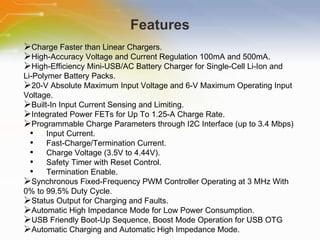
Features Charge Faster than Linear Chargers.  High-Accuracy Voltage and Current Regulation 100mA and 500mA.  High-Efficiency Mini-USB/AC Battery Charger for Single-Cell Li-Ion and  Li-Polymer Battery Packs.  20-V Absolute Maximum Input Voltage and 6-V Maximum Operating Input  Voltage.  Built-In Input Current Sensing and Limiting.  Integrated Power FETs for Up To 1.25-A Charge Rate.  Programmable Charge Parameters through I2C Interface (up to 3.4 Mbps) Input Current.  Fast-Charge/Termination Current. Charge Voltage (3.5V to 4.44V). Safety Timer with Reset Control. Termination Enable. Synchronous Fixed-Frequency PWM Controller Operating at 3 MHz With  0% to 99.5% Duty Cycle.  Status Output for Charging and Faults.  Automatic High Impedance Mode for Low Power Consumption.  USB Friendly Boot-Up Sequence, Boost Mode Operation for USB OTG Automatic Charging and Automatic High Impedance Mode.
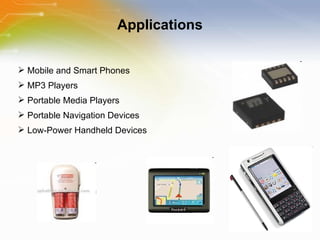
Applications Mobile and Smart Phones  MP3 Players  Portable Media Players Portable Navigation Devices Low-Power Handheld Devices
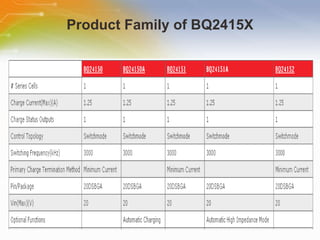
Product Family of BQ2415X
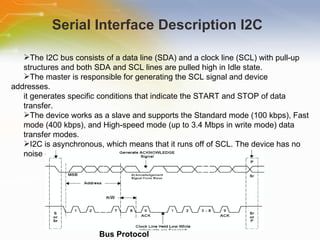
Serial Interface Description I2C The   I2C   bus   consists   of   a   data   line   (SDA)   and   a   clock   line   (SCL)   with   pull-up   structures   and   b oth   SDA   and   SCL   lines   are   pulled   high   in   Idle   state. The   master   is   responsible   for   generating   the   SCL   signal   and   device   addresses.   it   generates   specific   conditions   that   indicate   the   START   and   STOP   of   data   transfer. The   device   works   as   a   slave   and   supports   the   Standard   mode   (100   kbps),   Fast   mode   (400   kbps),   and   High-speed   mode   (up   to   3.4   Mbps   in   write   mode)   data   transfer   modes. I2C   is   asynchronous,   which   means   that   it   runs   off   of   SCL.   The   device   has   no   noise   or   glitch   filtering   on   SCL,   so   SCL   input   needs   to   be   clean. Bus Protocol
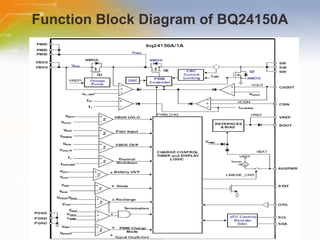
Function Block Diagram of BQ24150A
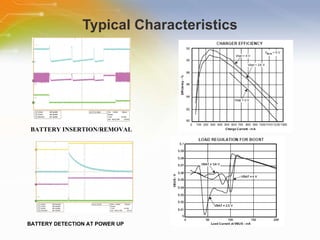
Typical Characteristics BATTERY INSERTION/REMOVAL BATTERY DETECTION AT POWER UP
Operation Modes The   BQ24150A/1A   usually   has   three   operation   modes: Charge   Mode: BQ24150A/1A   supports   a   precision   Li-ion   or   Li-polymer   charging   system   for   single-cell   applications. Boost   Mode: BQ24150A/1A   boosts   the   battery   voltage   to   VBUS   for   powering   attached   OTG   devices High   Impedance   Mode: BQ24150A/1A   stops   charging   or   boosting   and   operates   in   a   mode   with   low   current   from   VBUS   or   battery Through   the   proper   control,   BQ24150A/1A   can   achieve   the   smooth   transition   among   different   operation   modes.
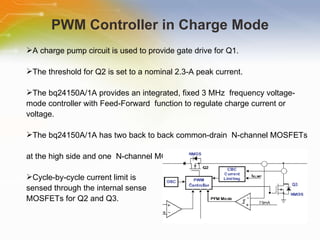
PWM Controller in Charge Mode A charge pump circuit is used to provide gate drive for Q1. The threshold for Q2 is set to a nominal 2.3-A peak current. The bq24150A/1A provides an integrated, fixed 3 MHz  frequency voltage- mode controller with Feed-Forward  function to regulate charge current or  voltage. The bq24150A/1A has two back to back common-drain  N-channel MOSFETs  at the high side and one  N-channel MOSFET at low side. Cycle-by-cycle current limit is  sensed through the internal sense MOSFETs for Q2 and Q3.
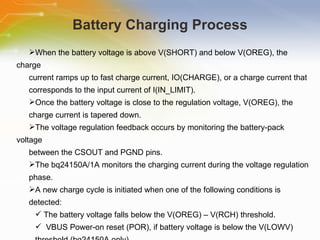
Battery Charging Process When the battery voltage is above V(SHORT) and below V(OREG), the charge  current ramps up to fast charge current, IO(CHARGE), or a charge current that  corresponds to the input current of I(IN_LIMIT). Once the battery voltage is close to the regulation voltage, V(OREG), the  charge current is tapered down. The voltage regulation feedback occurs by monitoring the battery-pack voltage  between the CSOUT and PGND pins. The bq24150A/1A monitors the charging current during the voltage regulation  phase. A new charge cycle is initiated when one of the following conditions is  detected: The battery voltage falls below the V(OREG) – V(RCH) threshold. VBUS Power-on reset (POR), if battery voltage is below the V(LOWV) threshold (bq24150A only). CE bit toggle or RESET bit is set (host controlled).
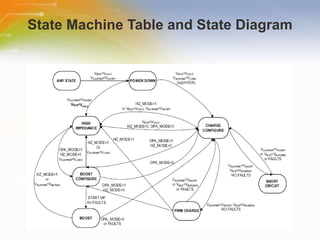
State Machine Table and State Diagram
USB Boot-Up Sequence During   normal   charging   process,   the   bq24150A/1A   is   normally   in   32-second   mode   with   host   control,   and   32-minute   mode   without   host   control   using   I2C   interface. At   power   on   reset   (POR)   of   VBUS,   if   the   battery   voltage   is   above   the   weak   battery   threshold,   V(LOWV),   bq24150A   operates   in   a   mode   dictated   by   the   I2C   control   registers. If   the   battery   voltage   is   below   V(LOWV)   and   the   host   control   through   I2C   interface   is   lost,   the   bq24150A   resets   all   I2C   registers   to   default   values. At   this   point   the   device   enable   the   charger   with   an   input   current   limit   dictated   by   the   OTG   pin   voltage   level   until   the   host   programs   the   I2C   registers. The   32-second   timer   can   be   reset   by   host   using   I2C   interface. At   the   beginning   of   charging   process,   the   bq24150A/1A   starts   a   32-minute   timer   (T32min)   that   can   be   stopped   by   any   write-action   performed   by   host   through   I2C   interface.
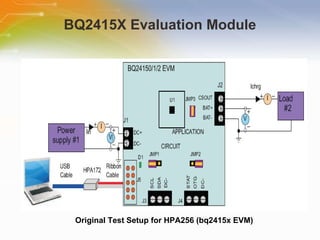
BQ2415X Evaluation Module Original Test Setup for HPA256 (bq2415x EVM)
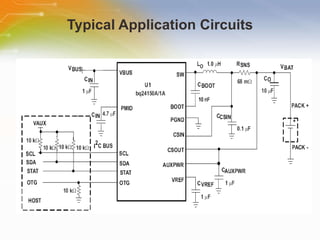
Typical Application Circuits
Additional Resource For ordering BQ2415X, please click the part list or Call our sales hotline For more product information go to http://focus.ti.com/docs/prod/folders/print/bq24151a.html Visit Element 14 to post your question   www.element-14.com For additional inquires contact our technical service hotline or even use our “Live Technical Chat” online facility Newark Farnell

Fully Integrated Switch-Mode Single-Cell Li-Ion Charger With Full USB

  • 1.
    Fully Integrated Switch-ModeSingle-Cell Li-Ion Charger With Full USB Source: Texas Instrument
  • 2.
    Introduction Purpose Anoverview study on fully integrated switch mode single cell Li-Ion charger. Outline Features and application. Different Product family of the device. Serial interface description. Battery charging process, USB boot-up sequence. Operation modes and PWM controller. Content 16 pages
  • 3.
    Features Charge Fasterthan Linear Chargers. High-Accuracy Voltage and Current Regulation 100mA and 500mA. High-Efficiency Mini-USB/AC Battery Charger for Single-Cell Li-Ion and Li-Polymer Battery Packs. 20-V Absolute Maximum Input Voltage and 6-V Maximum Operating Input Voltage. Built-In Input Current Sensing and Limiting. Integrated Power FETs for Up To 1.25-A Charge Rate. Programmable Charge Parameters through I2C Interface (up to 3.4 Mbps) Input Current. Fast-Charge/Termination Current. Charge Voltage (3.5V to 4.44V). Safety Timer with Reset Control. Termination Enable. Synchronous Fixed-Frequency PWM Controller Operating at 3 MHz With 0% to 99.5% Duty Cycle. Status Output for Charging and Faults. Automatic High Impedance Mode for Low Power Consumption. USB Friendly Boot-Up Sequence, Boost Mode Operation for USB OTG Automatic Charging and Automatic High Impedance Mode.
  • 4.
    Applications Mobile andSmart Phones MP3 Players Portable Media Players Portable Navigation Devices Low-Power Handheld Devices
  • 5.
  • 6.
    Serial Interface DescriptionI2C The I2C bus consists of a data line (SDA) and a clock line (SCL) with pull-up structures and b oth SDA and SCL lines are pulled high in Idle state. The master is responsible for generating the SCL signal and device addresses. it generates specific conditions that indicate the START and STOP of data transfer. The device works as a slave and supports the Standard mode (100 kbps), Fast mode (400 kbps), and High-speed mode (up to 3.4 Mbps in write mode) data transfer modes. I2C is asynchronous, which means that it runs off of SCL. The device has no noise or glitch filtering on SCL, so SCL input needs to be clean. Bus Protocol
  • 7.
  • 8.
    Typical Characteristics BATTERYINSERTION/REMOVAL BATTERY DETECTION AT POWER UP
  • 9.
    Operation Modes The BQ24150A/1A usually has three operation modes: Charge Mode: BQ24150A/1A supports a precision Li-ion or Li-polymer charging system for single-cell applications. Boost Mode: BQ24150A/1A boosts the battery voltage to VBUS for powering attached OTG devices High Impedance Mode: BQ24150A/1A stops charging or boosting and operates in a mode with low current from VBUS or battery Through the proper control, BQ24150A/1A can achieve the smooth transition among different operation modes.
  • 10.
    PWM Controller inCharge Mode A charge pump circuit is used to provide gate drive for Q1. The threshold for Q2 is set to a nominal 2.3-A peak current. The bq24150A/1A provides an integrated, fixed 3 MHz frequency voltage- mode controller with Feed-Forward function to regulate charge current or voltage. The bq24150A/1A has two back to back common-drain N-channel MOSFETs at the high side and one N-channel MOSFET at low side. Cycle-by-cycle current limit is sensed through the internal sense MOSFETs for Q2 and Q3.
  • 11.
    Battery Charging ProcessWhen the battery voltage is above V(SHORT) and below V(OREG), the charge current ramps up to fast charge current, IO(CHARGE), or a charge current that corresponds to the input current of I(IN_LIMIT). Once the battery voltage is close to the regulation voltage, V(OREG), the charge current is tapered down. The voltage regulation feedback occurs by monitoring the battery-pack voltage between the CSOUT and PGND pins. The bq24150A/1A monitors the charging current during the voltage regulation phase. A new charge cycle is initiated when one of the following conditions is detected: The battery voltage falls below the V(OREG) – V(RCH) threshold. VBUS Power-on reset (POR), if battery voltage is below the V(LOWV) threshold (bq24150A only). CE bit toggle or RESET bit is set (host controlled).
  • 12.
    State Machine Tableand State Diagram
  • 13.
    USB Boot-Up SequenceDuring normal charging process, the bq24150A/1A is normally in 32-second mode with host control, and 32-minute mode without host control using I2C interface. At power on reset (POR) of VBUS, if the battery voltage is above the weak battery threshold, V(LOWV), bq24150A operates in a mode dictated by the I2C control registers. If the battery voltage is below V(LOWV) and the host control through I2C interface is lost, the bq24150A resets all I2C registers to default values. At this point the device enable the charger with an input current limit dictated by the OTG pin voltage level until the host programs the I2C registers. The 32-second timer can be reset by host using I2C interface. At the beginning of charging process, the bq24150A/1A starts a 32-minute timer (T32min) that can be stopped by any write-action performed by host through I2C interface.
  • 14.
    BQ2415X Evaluation ModuleOriginal Test Setup for HPA256 (bq2415x EVM)
  • 15.
  • 16.
    Additional Resource Forordering BQ2415X, please click the part list or Call our sales hotline For more product information go to http://focus.ti.com/docs/prod/folders/print/bq24151a.html Visit Element 14 to post your question www.element-14.com For additional inquires contact our technical service hotline or even use our “Live Technical Chat” online facility Newark Farnell

Editor's Notes

  • #3 Welcome to the training module on the fully integrated switch mode single cell Li-Ion charger BQ2415X. This training module introduces the block diagram, start up sequence and applications for the device.
  • #4 The bq24150A/1A is a compact, flexible, high-efficiency, USB-friendly switch-mode charge management device for single-cell Li-ion and Li-polymer batteries used in a wide range of portable applications. The charge parameters can be programmed through an I2C interface. The bq2415X integrates a synchronous PWM controller, power MOSFETs, input current sensing, high-accuracy current and voltage regulation, and charge termination, into a small WCSP package.
  • #5 Single-cell Li-ion and Li-polymer batteries are used in a wide range of portable applications like mobile and smart phones, MP3 player, Handheld devices Etc..
  • #6 Here in this page Different families of BQ2415X device has been shown. BQ24150, BQ24150A, BQ24151, BQ24151A, BQ24152. BQ24151A has Automatic High Impedance Mode others do not have this feature.
  • #7 I2C is a 2-wire serial interface developed by Philips Semiconductor. The bus consists of a data line (SDA) and a clock line (SCL) with pull-up structures. The master generates further SCL cycles to either transmit data to the slave (R/W bit 1) or receive data from the slave (R/W bit 0). In either case, the receiver needs to acknowledge the data sent by the transmitter. So an acknowledge signal can either be generated by the master or by the slave, depending on which one is the receiver. The 9-bit valid data sequences consisting of 8-bit data and 1-bit acknowledge can continue as long as necessary.
  • #8 The bq24150A/1A is a highly integrated synchronous switch-mode charger with bi-directional operation to achieve boost function for USB OTG support, featuring integrated MOSFETs and small external components, targeted at extremely space-limited portable applications powered by 1-cell Li-Ion or Li-polymer battery pack. For a current limited power source, such as a USB host or hub, the high efficiency converter is critical in fully using the input power capacity and charging the battery. Due to the high efficiency in a wide range of the input voltage and battery voltage, the switching mode charger is a good choice for high speed charging with less power loss and better thermal management.
  • #9 This page gives you typical characteristics of the device: During the charging process, the bq24150A/1A monitors its junction temperature (TJ) and reduces the charge current once TJ increases to approximately 125°C. To support USB OTG device, bq24150A/1A provides VBUS (approximately 5.05 V) by boosting the battery voltage.
  • #10 The bq24150A/1A usually has three operation modes: charge mode, boost mode, and high impedance mode. In charge mode, the bq24150A/1A supports a precision Li-ion or Li-polymer charging system for single-cell applications. In boost mode, bq24150A/1A boosts the battery voltage to VBUS for powering attached OTG devices. In high impedance mode, the bq24150A/1A stops charging or boosting and operates in a mode with low current from VBUS or battery, to effectively reduce the power consumption when the portable device in standby mode. Through the proper control, bq24150A/1A can achieve the smooth transition among different operation modes.
  • #11 The bq2415x integrates a synchronous PWM controller, power MOSFETs, input current sensing, high-accuracy current and voltage regulation, and charge termination, into a small WCSP package. The charge parameters can be programmed through an I2C interface. Cycle-by-cycle current limit is sensed through the internal sense MOSFETs for Q2 and Q3. The threshold for Q2 is set to a nominal 2.3-A peak current. The low-side MOSFET (Q3) also has a current limit that decides if the PWM Controller will operate in synchronous or non-synchronous mode.
  • #12 At the beginning of precharge, while battery voltage is below the V(SHORT) threshold, the bq24150A/1A applies a short-circuit current, I(SHORT), to the battery. When the battery voltage is above V(SHORT) and below V(OREG), the charge current ramps up to fast charge current, IO(CHARGE), or a charge current that corresponds to the input current of I(IN_LIMIT). The slew rate for fast charge current is controlled to minimize the current and voltage over-shoot during transient. This device monitors the charging current during the voltage regulation phase. Once the termination threshold, ITERM, is detected and the battery voltage is above the recharge threshold, the device terminates charge.
  • #13 Again, there are three operation modes: charge mode, boost mode, and high impedance mode along with state transitions form High impedance, Boost configure, Boost, PWM charge, Charge configure, Short circuit.
  • #14 During normal charging process, the bq24150A/1A is normally in 32-second mode with host control, and 32-minute mode without host control using I2C interface. Boost mode enable control or input current limiting selection pin. When OTG is in active status, bq24150A/1A is forced to operate in boost mode. It has higher priority over I2C control and can be disabled through control register. The logic voltage level at OTG active status can also be controlled. At POR, the OTG pin is default to be used as the input current limiting selection pin. When OTG = High, Iin – limit = 500mA and when OTG = Low, Iin – limit = 100mA. If the battery voltage is below V(LOWV), but the host control using I2C interface is available (32 second mode), the device operates in a mode dictated by control registers.
  • #15 This slides shows the BQ2415x Evaluation module which has High Efficiency Fully Integrated NMOS Synchronous Buck Charger With 3MHz Frequency, Integrated Power FETs for Up To 1.25-A Charge Rate, Programmable Battery Voltage, Charge Current, and Input Current via I2C Interface. Its Input Operating Range is 4 to 6V and it has Boost Mode Operation for USB OTG.
  • #16 This is a typical application circuit for BQ2415X device used as pre-regulator application that operates as a DC/DC converter, with the termination disabled. the host charge controller controls switch Q to achieve pulse-charging function, and bq24150A/1A converts the input voltage to the lower output voltage (VOREG). The robust internal compensation design ensures the stable operation when the host-controlled switch Q is turned off.
  • #17 Thank you for taking the time to view this presentation on “ BQ2415X” . If you would like to learn more or go on to purchase some of these devices, you may either click on the part list link, or simply call our sales hotline. For more technical information you may either visit the Texas Instrument site, or if you would prefer to speak to someone live, please call our hotline number, or even use our ‘live chat’ online facility. You may visit Element 14 e-community to post your questions.