The document outlines a mini-project seminar on a finite state machine (FSM) based vending machine controller featuring automatic billing. It discusses the operation and implementation of the vending machine using Mealy and Moore models, detailing its design methodology, advantages, and disadvantages. Additionally, the document covers the history of vending machines and includes references for further reading.
Mini- Project Seminaron
Finite State Machine based Vending
Machine Controller with Auto-Billing
Features
By: Pratik Patil
Department of Electronics And Communication
(M. Tech VLSI and Embedded Systems)
2.
Contents
• Overview ofFinite State Machine
• MEALY & MOORE Machine Model
• Vending Machine their History
• Operation of the Proposed Vending Machine
• Implementation of Vending machine
• Design Methodology
• FSM diagram of Vending Machine
• Advantages & Disadvantages
• References
3.
Overview of FSM
•
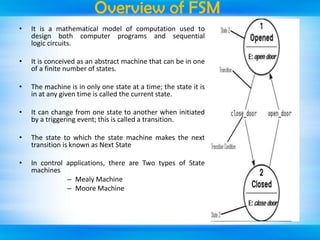
Itis a mathematical model of computation used to
design both computer programs and sequential
logic circuits.
•
It is conceived as an abstract machine that can be in one
of a finite number of states.
•
The machine is in only one state at a time; the state it is
in at any given time is called the current state.
•
It can change from one state to another when initiated
by a triggering event; this is called a transition.
•
The state to which the state machine makes the next
transition is known as Next State
•
In control applications, there are Two types of State
machines
– Mealy Machine
– Moore Machine
4.
Mealy and MooreMachine Model
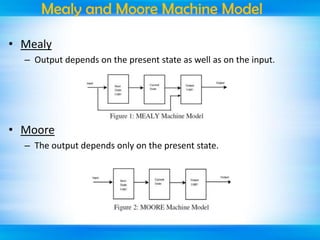
• Mealy
– Output depends on the present state as well as on the input.
• Moore
– The output depends only on the present state.
5.
Vending Machine andtheir History
Q. What is a Vending Machine?
Ans. A vending machine is a machine which
dispenses
items
such
as
snacks, beverages, lottery tickets, consumer
products to customers automatically, after the
customer inserts currency or credit into the
machine.
HISTORY:
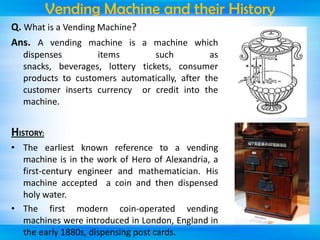
• The earliest known reference to a vending
machine is in the work of Hero of Alexandria, a
first-century engineer and mathematician. His
machine accepted a coin and then dispensed
holy water.
• The first modern coin-operated vending
machines were introduced in London, England in
the early 1880s, dispensing post cards.
6.
Operation of theProposed Vending Machine
• When the user puts in money, money counter tells the control
unit, the amount of money inserted in the Vending Machine.
• When the user presses the button to purchase the item that he
wants, the control unit turns on the motor and dispenses the
product if correct amount is inserted.
• If there is any change, machine will return it to the user.
• The machine will demand for servicing when the products are not
available inside the machine.
THIS MODEL HAS BEEN DEVELOPED USING MEALY MACHINE MODEL
7.
Implementation
•
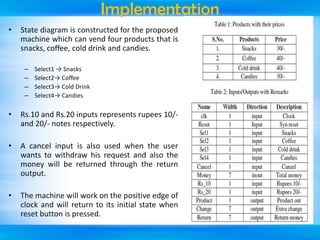
State diagram isconstructed for the proposed
machine which can vend four products that is
snacks, coffee, cold drink and candies.
–
–
–
–
Select1 → Snacks
Select2→ Coffee
Select3→ Cold Drink
Select4→ Candies
•
Rs.10 and Rs.20 inputs represents rupees 10/and 20/- notes respectively.
•
A cancel input is also used when the user
wants to withdraw his request and also the
money will be returned through the return
output.
•
The machine will work on the positive edge of
clock and will return to its initial state when
reset button is pressed.
8.
Design Methodology(Flowchart)
•
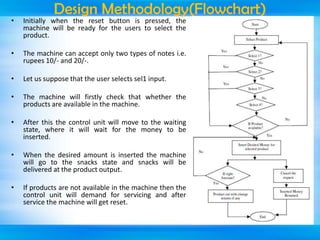
Initially whenthe reset button is pressed, the
machine will be ready for the users to select the
product.
•
The machine can accept only two types of notes i.e.
rupees 10/- and 20/-.
•
Let us suppose that the user selects sel1 input.
•
The machine will firstly check that whether the
products are available in the machine.
•
After this the control unit will move to the waiting
state, where it will wait for the money to be
inserted.
•
When the desired amount is inserted the machine
will go to the snacks state and snacks will be
delivered at the product output.
•
If products are not available in the machine then the
control unit will demand for servicing and after
service the machine will get reset.
9.
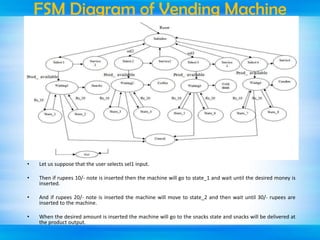
FSM Diagram ofVending Machine
•
Let us suppose that the user selects sel1 input.
•
Then if rupees 10/- note is inserted then the machine will go to state_1 and wait until the desired money is
inserted.
•
And if rupees 20/- note is inserted the machine will move to state_2 and then wait until 30/- rupees are
inserted to the machine.
•
When the desired amount is inserted the machine will go to the snacks state and snacks will be delivered at
the product output.
10.
Advantages & Disadvantages
•Advantages
– The vending machines are more accessible and practical than
the convention purchasing method.
– Finite State Machine (FSM) modeling reduces the hardware
– FSM model is easy to design.
– Due to their simplicity, FSMs are quick to design, quick to
implement and quick in execution.
• Disadvantages
– Vending Machines Costs more.
– The conditions for state transitions are fixed.
– All states, transitions and conditions need to be known up front
and be well defined which is not possible in cases.
11.
References
• International Journalof VLSI design & Communication Systems (VLSICS)
Vol.3, No.2, April 2012
• Introduction to Embedded Systems, Shibu K. V., Tata McGraw Hill
Education
• http://en.wikipedia.org/wiki/Finite-state_machine
• http://en.wikipedia.org/wiki/Vending_machine