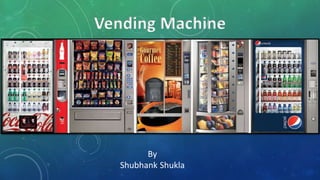
Vending Machine
By
Shubhank Shukla
CONTENTS
• Introduction
• History
• Modern Vending Machines
• Advantages
• Disadvantages
• Vending Machine Business
• Types of Vending Machines
• In India
• Applications of Vending Machines
• Bulk Candy and gumball vending
• Cigarette vending
• Full line vending
• Specialized vending
INTRODUCTION
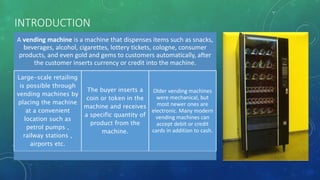
A vending machine is a machine that dispenses items such as snacks,
beverages, alcohol, cigarettes, lottery tickets, cologne, consumer
products, and even gold and gems to customers automatically, after
the customer inserts currency or credit into the machine.
Large-scale retailing
is possible through
vending machines by
placing the machine
at a convenient
location such as
petrol pumps ,
railway stations ,
airports etc.
The buyer inserts a
coin or token in the
machine and receives
a specific quantity of
product from the
machine.
Older vending machines
were mechanical, but
most newer ones are
electronic. Many modern
vending machines can
accept debit or credit
cards in addition to cash.
HISTORY
• The first vending machine was made in 1st Century by the Hero of
Alexandria (a first-century engineer and mathematician)
• His machine accepted a coin and then dispensed holy water
• Coin-operated machines that dispensed tobacco were being
operated as early as 1615 in the taverns of England, The machines
were portable and made of brass
• An English bookseller, Richard Carlile, devised a newspaper
dispensing machine for the dissemination of banned works in 1822.
• Simeon Denham was awarded British Patent no. 706 for his stamp
dispensing machine in 1867, the first fully automatic vending
machine.
MODERN VENDING MACHINES
• The first modern coin-operated vending machines were introduced in London in
the United Kingdom in the early 1880s, dispensing post cards
• Soon became a widespread feature at railway stations and post offices,
dispensing envelopes, postcards, and notepaper
• The first vending machine in the U.S. was built in 1888 by the Thomas Adams Gum
Company, selling gum on New York City train platforms
• The birth of slot machines and pinball is ultimately rooted in these early devices
ADVANTAGES
24 hr
service
Low cost
Economy
of labor
Quality
Waste
Reduction
ADVANTAGES
• Greater Distribution: Manufacturers and companies alike benefit by utilizing
Vending Machines as an efficient distribution channel for their products by
appropriately locating them in spaces liable to see high footfall from the target
customer
• Low Cost: At a fraction of the cost incurred, these machines provide companies with
the chance to penetrate new markets without the hassle of hiring too much labor.
These machines bring the company one step closer to the eventual consumer;
thereby, serving an intermediary role
• Enhanced Visibility: Companies willing to sell their products through Vending
Machines stand to gain from increased visibility in an already cluttered market.
Hence, the machines not only serve as a distribution unit but also serve as a display
unit; creating enhanced visibility and brand recognition
• Effective Advertisement Platform: In addition to just merely offering products for
sale, the machines also serve as an effective advertisement vehicle; thereby, aiding
companies to establish a more holistic interface with the consumers and ensure
higher brand recall in the long run
• 24 hour Service: Bereft of any human intervention whilst selling, the machines
negate the adverse implications of low productivity as a consequence of employee
leave, holiday or strikes. These machines function 24 hours a day, 365 days a year
serving customers
• Guaranteed Quality: Vending Machines store quality products in a quality, safe,
secure and hygienic environment. This also reduces the chances of adulteration and
duplication that can hurt the prospects and credibility of the company per se.
DISADVANTAGES
Less communication between seller and customer
Customer Resistance
Risk of failing machines
Coin fraud
VENDING MACHINE BUSINESS
Vending operations in the United States have evolved into a $36.6 billion industry
Canned cold drinks are the industry's top sellers, posting $15.7 billion in sales and accounting for 42.9% of
the industry's gross sales volume
Packaged candy and snacks ranked second, with 19.7% of the industry and $7.2 billion in sales
Vending accounts for a significant portion of the sales and profits of beverage bottlers and snack makers
Vending machines generated 14% of total foodservice sales in venues such as college campuses, factories,
businesses, hospitals, and schools.
Bottlers pay colleges, schools, and other institutions millions of dollars for exclusive rights to place vending
machines on campuses
Vended soft drink sales may represent only as much as 15% of a bottler's total yearly sales, but that same
volume could easily account for half of their annual profits
TYPES
These machines are available in various locations, including office buildings,
schools, train and bus stations, mall and shopping facilities. Other types of
vending machines include gumball machines or smaller vending machines that
only offer specific types of candies including chocolates, hard candies or candies
with a toy.
Some vending machines also offer freshly brewed coffee, hot chocolates or teas.
These vending machines allow users to choose specific types of coffees for a
given price and provides the cup, the coffee and milk or cream, if selected. Each
vending machine offers a full coffee menu. These vending machines are located in
offices, university and college environments and some shopping facilities.
A vending machine offering change in exchange for bills is also a useful vending
machine in certain environments. For example, this type of vending machine is
useful in places where change is required, such as parking garages or laundry
shops. A change-vending machine works by offering smaller bills and coins in
exchange for larger bills or credit cards.
TYPES
Vending machines filled with toiletry and medical supplies are located in public
bathrooms at the airport, bars, restaurants and clubs. These vending machines
provide supplies, such as tampons, face cloths, teeth floss, small toothbrushes,
toothpaste and condoms. Those located in airports may also have deodorant and
temporary body spray, so travelers can refresh themselves after a long flight.
Some vending machines offer products, such as office supplies. These types of
vending machines are useful in scholastic settings, airports, libraries and career
centers, where students may be looking for work. These vending machines provide
pens, paper, UBS flash drives, notepads, pencil sharpeners, small staplers and
mailing products, such as envelops and stamps.
Soft drinks Coins Snacks Tickets Coffee
IN INDIA
• Vending machines are not very common in India and are usually found only in
major cities or along some national highways
• Vending machines are used to sell snacks, beverages, public transit tickets,
jewelry , and change for currency notes.
The availability
of cheap labour
makes
operating stores
or kiosks
economical
Customers lack
of technical
knowledge and
feel uneasy
using vending
machines
A lack of
machines that
accept a wide
variety of
payment
methods
Vandalism,
rough use, and
poor
maintenance of
the machines
Reasons for Failure
APPLICATIONS
OF
VENDING MACHINES
BULK CANDY AND GUMBALL VENDING
Bulk candy
machines are
mechanical
machines that
vend a handful of
candy, a bouncy
ball, or perhaps a
capsule with a
small toy or
jewelry, for one or
two coins
The gross margins
in the bulk candy
business can be
quite high
The machines are
typically
inexpensive
compared to soft
drink or snack
machines, which
often require
power and
sometimes
refrigeration to
work
Many operators
donate a
percentage of the
profits to charity
so that locations
will allow them to
place the
machines for free.
CIGARETTE VENDING
Cigarettes were
commonly sold
in the United
States through
these machines,
but this is
increasingly rare
due to concerns
about underage
buyers
Sometimes a
pass has to be
inserted in the
machine to
prove one's age
before a
purchase can be
made
In the United
Kingdom,
legislation
banning them
outright came
into effect
Since 2007,
however, age
verification has
been mandatory
in Germany and
Italy - buyers
must be 18 or
over
FULL LINE VENDING
A full-line vending company may set up several types of vending
machines that sell a wide range of products
Products may include candy, cookies, chips, fresh fruit, milk, cold
food, coffee and other hot drinks, bottles, cans of soda, and even
frozen products like ice cream
These products can be sold from machines that include coffee,
snack, cold food, 20-oz. bottle machines, and glass-front bottle
machines
In the United States, almost all machines accept bills with more and
more machines accepting $5 bills
This is an advantage to the vendor because it virtually eliminates the
need for a bill changer
SPECIALIZED VENDING MACHINES
• Milk dispensers and egg vending machines networks spreading in European towns accelerated after
2000
• The basic food vending machines are usually owned by farmers selling their production directly to
consumers, providing fresh food to urban population at low prices and small operational costs
• Another type of vending machine is a Chargebox which is used for charging small mobile devices
such as mobile phones and ipods
• From 2000-2010, specialization of vending machines became more common. Vending extended
increasingly into non-traditional areas like electronics, or even artwork
• Liskom (Russia) and Xerox (Global) both have coin-operated or pay-per-copy vending machines
• In November 2013 online auto retailer, Carvana, opened the first car vending machine in the U.S.
located in Atlanta
THANK YOU

Vending machine

  • 1.
  • 2.
    CONTENTS • Introduction • History •Modern Vending Machines • Advantages • Disadvantages • Vending Machine Business • Types of Vending Machines • In India • Applications of Vending Machines • Bulk Candy and gumball vending • Cigarette vending • Full line vending • Specialized vending
  • 3.
    INTRODUCTION A vending machineis a machine that dispenses items such as snacks, beverages, alcohol, cigarettes, lottery tickets, cologne, consumer products, and even gold and gems to customers automatically, after the customer inserts currency or credit into the machine. Large-scale retailing is possible through vending machines by placing the machine at a convenient location such as petrol pumps , railway stations , airports etc. The buyer inserts a coin or token in the machine and receives a specific quantity of product from the machine. Older vending machines were mechanical, but most newer ones are electronic. Many modern vending machines can accept debit or credit cards in addition to cash.
  • 4.
    HISTORY • The firstvending machine was made in 1st Century by the Hero of Alexandria (a first-century engineer and mathematician) • His machine accepted a coin and then dispensed holy water • Coin-operated machines that dispensed tobacco were being operated as early as 1615 in the taverns of England, The machines were portable and made of brass • An English bookseller, Richard Carlile, devised a newspaper dispensing machine for the dissemination of banned works in 1822. • Simeon Denham was awarded British Patent no. 706 for his stamp dispensing machine in 1867, the first fully automatic vending machine.
  • 5.
    MODERN VENDING MACHINES •The first modern coin-operated vending machines were introduced in London in the United Kingdom in the early 1880s, dispensing post cards • Soon became a widespread feature at railway stations and post offices, dispensing envelopes, postcards, and notepaper • The first vending machine in the U.S. was built in 1888 by the Thomas Adams Gum Company, selling gum on New York City train platforms • The birth of slot machines and pinball is ultimately rooted in these early devices
  • 6.
    ADVANTAGES 24 hr service Low cost Economy oflabor Quality Waste Reduction
  • 7.
    ADVANTAGES • Greater Distribution:Manufacturers and companies alike benefit by utilizing Vending Machines as an efficient distribution channel for their products by appropriately locating them in spaces liable to see high footfall from the target customer • Low Cost: At a fraction of the cost incurred, these machines provide companies with the chance to penetrate new markets without the hassle of hiring too much labor. These machines bring the company one step closer to the eventual consumer; thereby, serving an intermediary role • Enhanced Visibility: Companies willing to sell their products through Vending Machines stand to gain from increased visibility in an already cluttered market. Hence, the machines not only serve as a distribution unit but also serve as a display unit; creating enhanced visibility and brand recognition
  • 8.
    • Effective AdvertisementPlatform: In addition to just merely offering products for sale, the machines also serve as an effective advertisement vehicle; thereby, aiding companies to establish a more holistic interface with the consumers and ensure higher brand recall in the long run • 24 hour Service: Bereft of any human intervention whilst selling, the machines negate the adverse implications of low productivity as a consequence of employee leave, holiday or strikes. These machines function 24 hours a day, 365 days a year serving customers • Guaranteed Quality: Vending Machines store quality products in a quality, safe, secure and hygienic environment. This also reduces the chances of adulteration and duplication that can hurt the prospects and credibility of the company per se.
  • 9.
    DISADVANTAGES Less communication betweenseller and customer Customer Resistance Risk of failing machines Coin fraud
  • 10.
    VENDING MACHINE BUSINESS Vendingoperations in the United States have evolved into a $36.6 billion industry Canned cold drinks are the industry's top sellers, posting $15.7 billion in sales and accounting for 42.9% of the industry's gross sales volume Packaged candy and snacks ranked second, with 19.7% of the industry and $7.2 billion in sales Vending accounts for a significant portion of the sales and profits of beverage bottlers and snack makers Vending machines generated 14% of total foodservice sales in venues such as college campuses, factories, businesses, hospitals, and schools. Bottlers pay colleges, schools, and other institutions millions of dollars for exclusive rights to place vending machines on campuses Vended soft drink sales may represent only as much as 15% of a bottler's total yearly sales, but that same volume could easily account for half of their annual profits
  • 11.
    TYPES These machines areavailable in various locations, including office buildings, schools, train and bus stations, mall and shopping facilities. Other types of vending machines include gumball machines or smaller vending machines that only offer specific types of candies including chocolates, hard candies or candies with a toy. Some vending machines also offer freshly brewed coffee, hot chocolates or teas. These vending machines allow users to choose specific types of coffees for a given price and provides the cup, the coffee and milk or cream, if selected. Each vending machine offers a full coffee menu. These vending machines are located in offices, university and college environments and some shopping facilities. A vending machine offering change in exchange for bills is also a useful vending machine in certain environments. For example, this type of vending machine is useful in places where change is required, such as parking garages or laundry shops. A change-vending machine works by offering smaller bills and coins in exchange for larger bills or credit cards.
  • 12.
    TYPES Vending machines filledwith toiletry and medical supplies are located in public bathrooms at the airport, bars, restaurants and clubs. These vending machines provide supplies, such as tampons, face cloths, teeth floss, small toothbrushes, toothpaste and condoms. Those located in airports may also have deodorant and temporary body spray, so travelers can refresh themselves after a long flight. Some vending machines offer products, such as office supplies. These types of vending machines are useful in scholastic settings, airports, libraries and career centers, where students may be looking for work. These vending machines provide pens, paper, UBS flash drives, notepads, pencil sharpeners, small staplers and mailing products, such as envelops and stamps.
  • 13.
    Soft drinks CoinsSnacks Tickets Coffee
  • 14.
    IN INDIA • Vendingmachines are not very common in India and are usually found only in major cities or along some national highways • Vending machines are used to sell snacks, beverages, public transit tickets, jewelry , and change for currency notes. The availability of cheap labour makes operating stores or kiosks economical Customers lack of technical knowledge and feel uneasy using vending machines A lack of machines that accept a wide variety of payment methods Vandalism, rough use, and poor maintenance of the machines Reasons for Failure
  • 15.
  • 16.
    BULK CANDY ANDGUMBALL VENDING Bulk candy machines are mechanical machines that vend a handful of candy, a bouncy ball, or perhaps a capsule with a small toy or jewelry, for one or two coins The gross margins in the bulk candy business can be quite high The machines are typically inexpensive compared to soft drink or snack machines, which often require power and sometimes refrigeration to work Many operators donate a percentage of the profits to charity so that locations will allow them to place the machines for free.
  • 17.
    CIGARETTE VENDING Cigarettes were commonlysold in the United States through these machines, but this is increasingly rare due to concerns about underage buyers Sometimes a pass has to be inserted in the machine to prove one's age before a purchase can be made In the United Kingdom, legislation banning them outright came into effect Since 2007, however, age verification has been mandatory in Germany and Italy - buyers must be 18 or over
  • 18.
    FULL LINE VENDING Afull-line vending company may set up several types of vending machines that sell a wide range of products Products may include candy, cookies, chips, fresh fruit, milk, cold food, coffee and other hot drinks, bottles, cans of soda, and even frozen products like ice cream These products can be sold from machines that include coffee, snack, cold food, 20-oz. bottle machines, and glass-front bottle machines In the United States, almost all machines accept bills with more and more machines accepting $5 bills This is an advantage to the vendor because it virtually eliminates the need for a bill changer
  • 19.
    SPECIALIZED VENDING MACHINES •Milk dispensers and egg vending machines networks spreading in European towns accelerated after 2000 • The basic food vending machines are usually owned by farmers selling their production directly to consumers, providing fresh food to urban population at low prices and small operational costs • Another type of vending machine is a Chargebox which is used for charging small mobile devices such as mobile phones and ipods • From 2000-2010, specialization of vending machines became more common. Vending extended increasingly into non-traditional areas like electronics, or even artwork • Liskom (Russia) and Xerox (Global) both have coin-operated or pay-per-copy vending machines • In November 2013 online auto retailer, Carvana, opened the first car vending machine in the U.S. located in Atlanta
  • 20.