Public Health 101 Series
Instructor name
Title
Organization
Introduction to Public
Health
Note: This slide set is in the public domain and may be customized as needed by
the user for informational or educational purposes. Permission from the Centers for
Disease Control and Prevention is not required, but citation of the source is
appreciated.
Introduction to Public Health
1. Public Health Definition and Key Terms
2. History of Public Health
3. A Public Health Approach
4. Core Functions and Essential Services of Public Health
5. Stakeholder Roles in Public Health
6. Determining and Influencing the Public’s Health
Course Topics
2
• describe the purpose of public health
• define key terms used in public health
• identify prominent events in the history of public health
• recognize the core public health functions and services
• describe the role of different stakeholders in the field of
public health
• list some determinants of health
• recognize how individual determinants of health affect
population health
After this course, you will be able to
Learning Objectives
3
Public Health Definition
and Key Terms
Topic 1
4
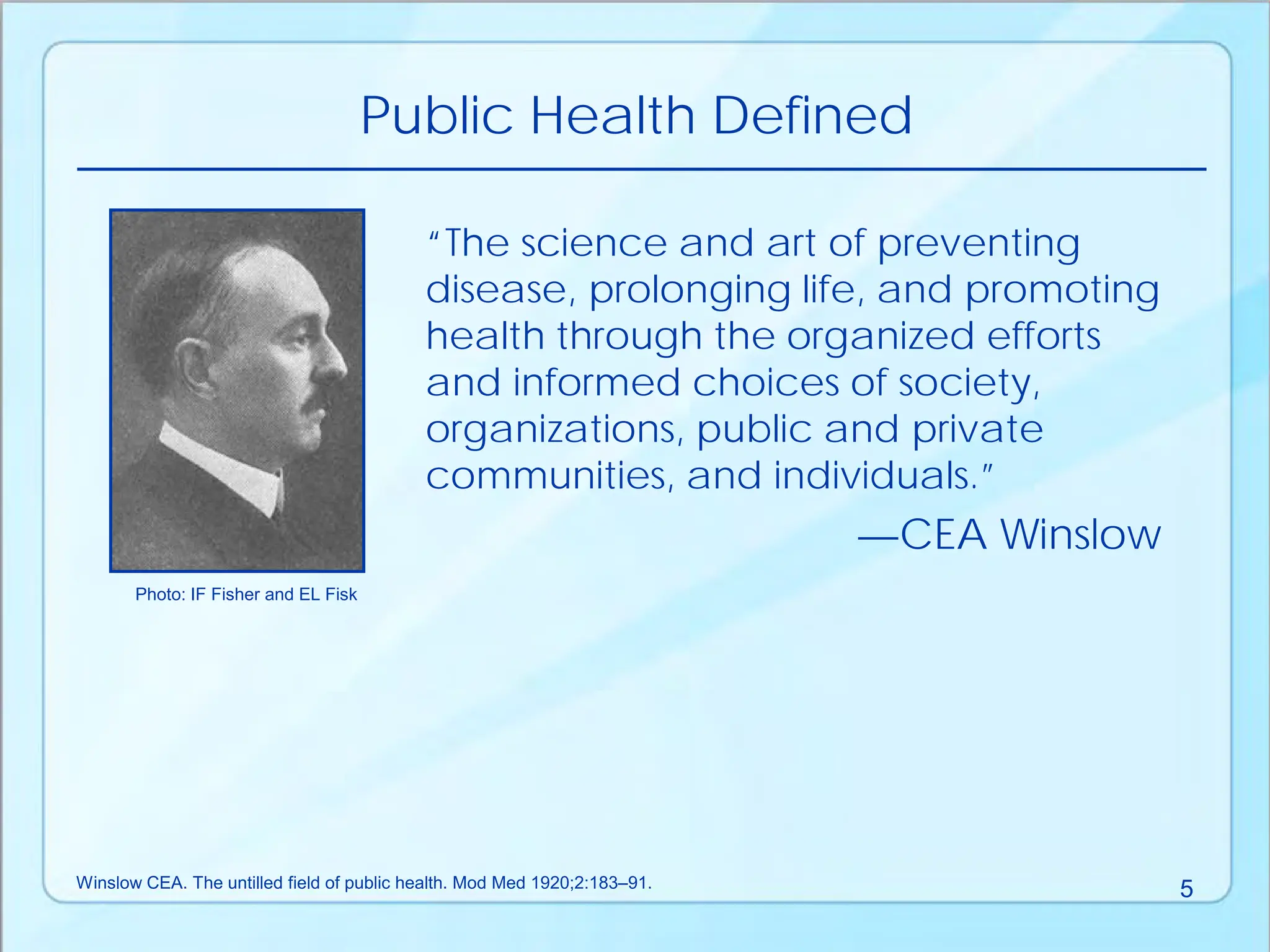
“The science and art of preventing
disease, prolonging life, and promoting
health through the organized efforts
and informed choices of society,
organizations, public and private
communities, and individuals.”
—CEA Winslow
Public Health Defined
Photo: IF Fisher and EL Fisk
Winslow CEA. The untilled field of public health. Mod Med 1920;2:183–91. 5
“Public health aims to
provide maximum benefit for
the largest number of
people.”
—World Health Organization
“Fulfilling society’s interest
in assuring conditions in
which people can be
healthy.”
—Institute of Medicine
The Mission of Public Health
6
Public Health Key Terms
determinant: factor that contributes to the generation of a trait.
epidemic or outbreak: occurrence in a community or region of cases
of an illness, specific health-related behavior, or other health-related
event clearly in excess of normal expectancy. Both terms are used
interchangeably; however, epidemic usually refers to a larger
geographic distribution of illness or health-related events.
health outcome: result of a medical condition that directly
affects the length or quality of a person’s life.
clinical care: prevention, treatment, and management of illness and
the preservation of mental and physical well-being through the services
offered by medical and allied health professions; also known as health
care.
Stedman TL, ed. Stedman’s medical dictionary. 28th ed. Baltimore, MD: Lippincott, Williams, and Wilkins; 2006.
Farlex, Inc. The free dictionary. Huntingdon Valley, PA: Farlex, Inc.; 2014. Available at: http://www.thefreedictionary.com/. 7
Public health aims to provide ___________________
with the right to be healthy and live in conditions
that support health.
groups of people
Fill in the blank with the correct answer.
A. groups of people B. individuals
Knowledge Check
8
A(n) ________________________ is a disease
occurrence among a population that is in
excess of what is expected for a given time
and place.
Fill in the blank with the correct answer.
D. prevention
A. pandemic B. intervention
C. epidemic or outbreak
epidemic or outbreak
Knowledge Check
9
The History of Public Health
Topic 2
10
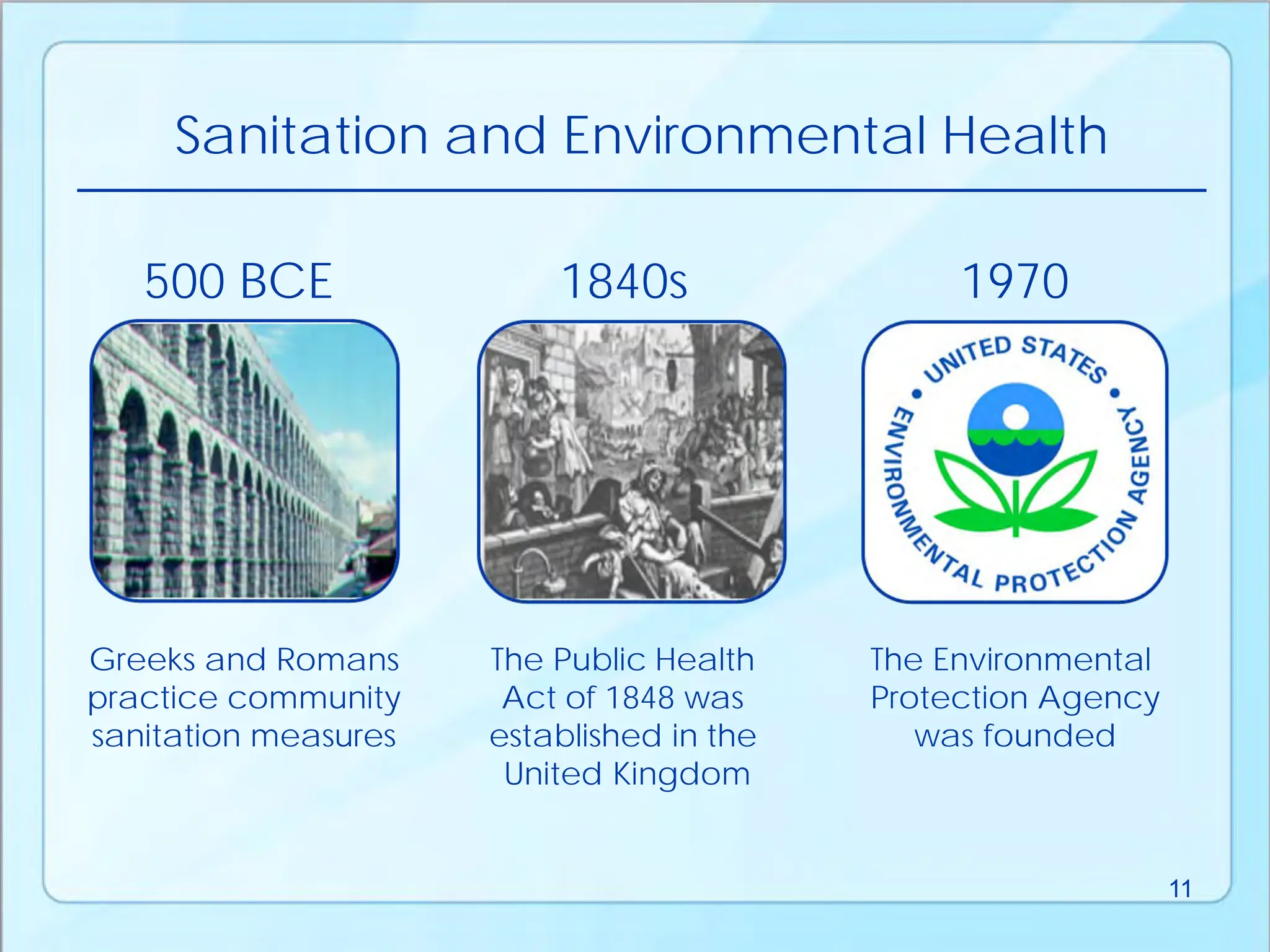
Sanitation and Environmental Health
500 BCE 1840s
The Environmental
Protection Agency
was founded
The Public Health
Act of 1848 was
established in the
United Kingdom
Greeks and Romans
practice community
sanitation measures
1970
11
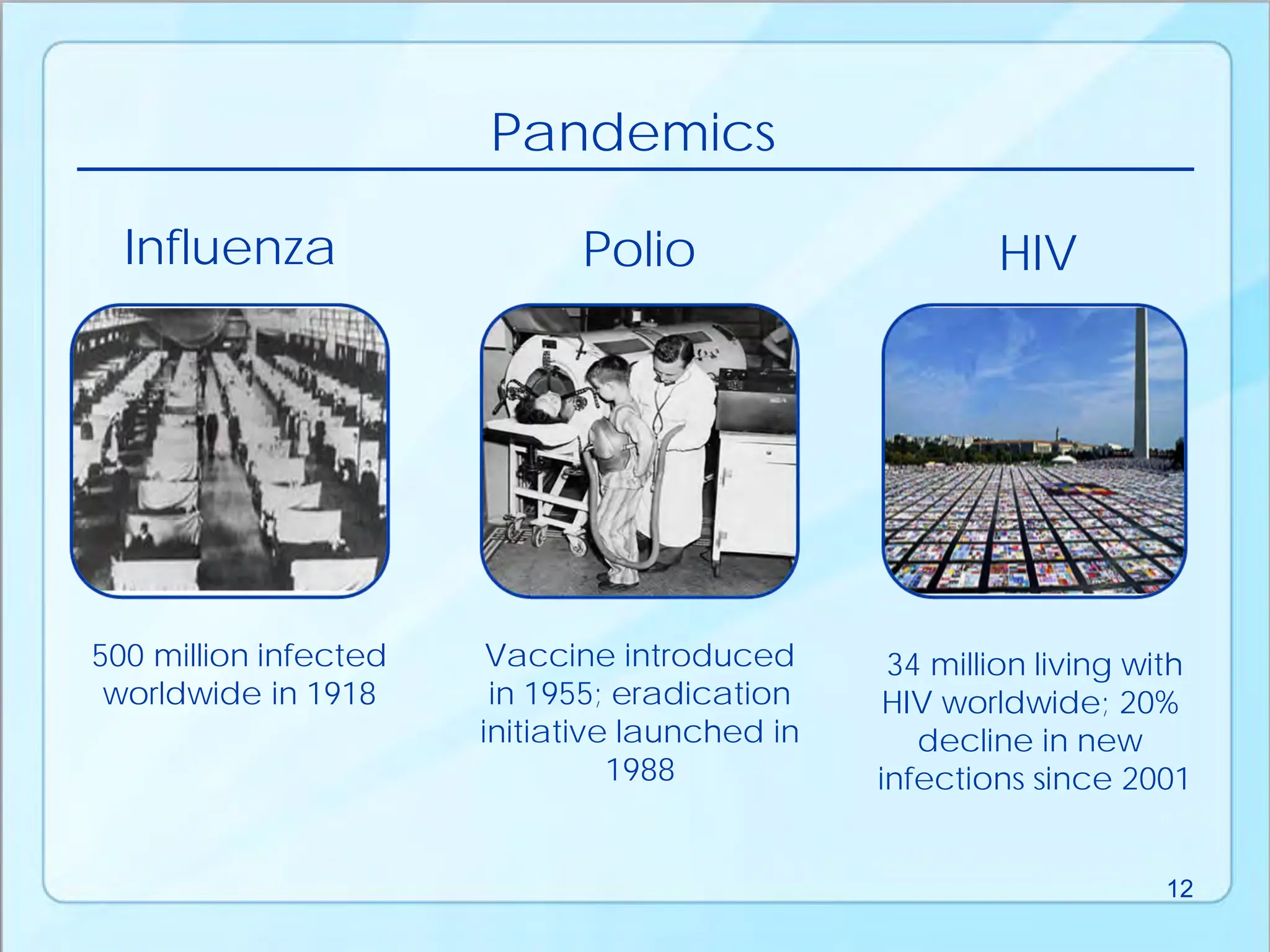
Pandemics
Influenza
500 million infected
worldwide in 1918
Polio
Vaccine introduced
in 1955; eradication
initiative launched in
1988
34 million living with
HIV worldwide; 20%
decline in new
infections since 2001
HIV
12
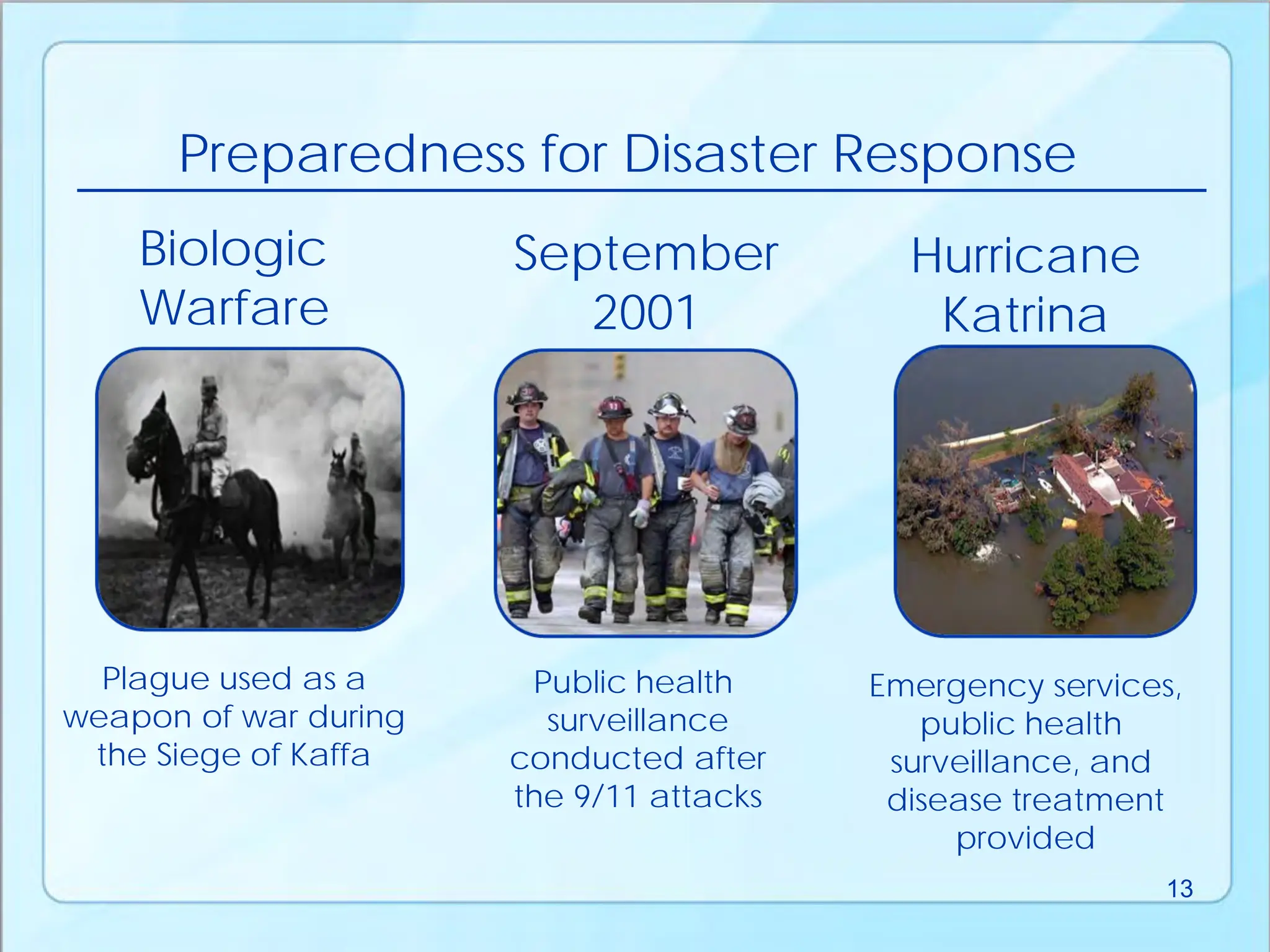
Preparedness for Disaster Response
Biologic
Warfare
Plague used as a
weapon of war during
the Siege of Kaffa
September
2001
Public health
surveillance
conducted after
the 9/11 attacks
Hurricane
Katrina
Emergency services,
public health
surveillance, and
disease treatment
provided
13
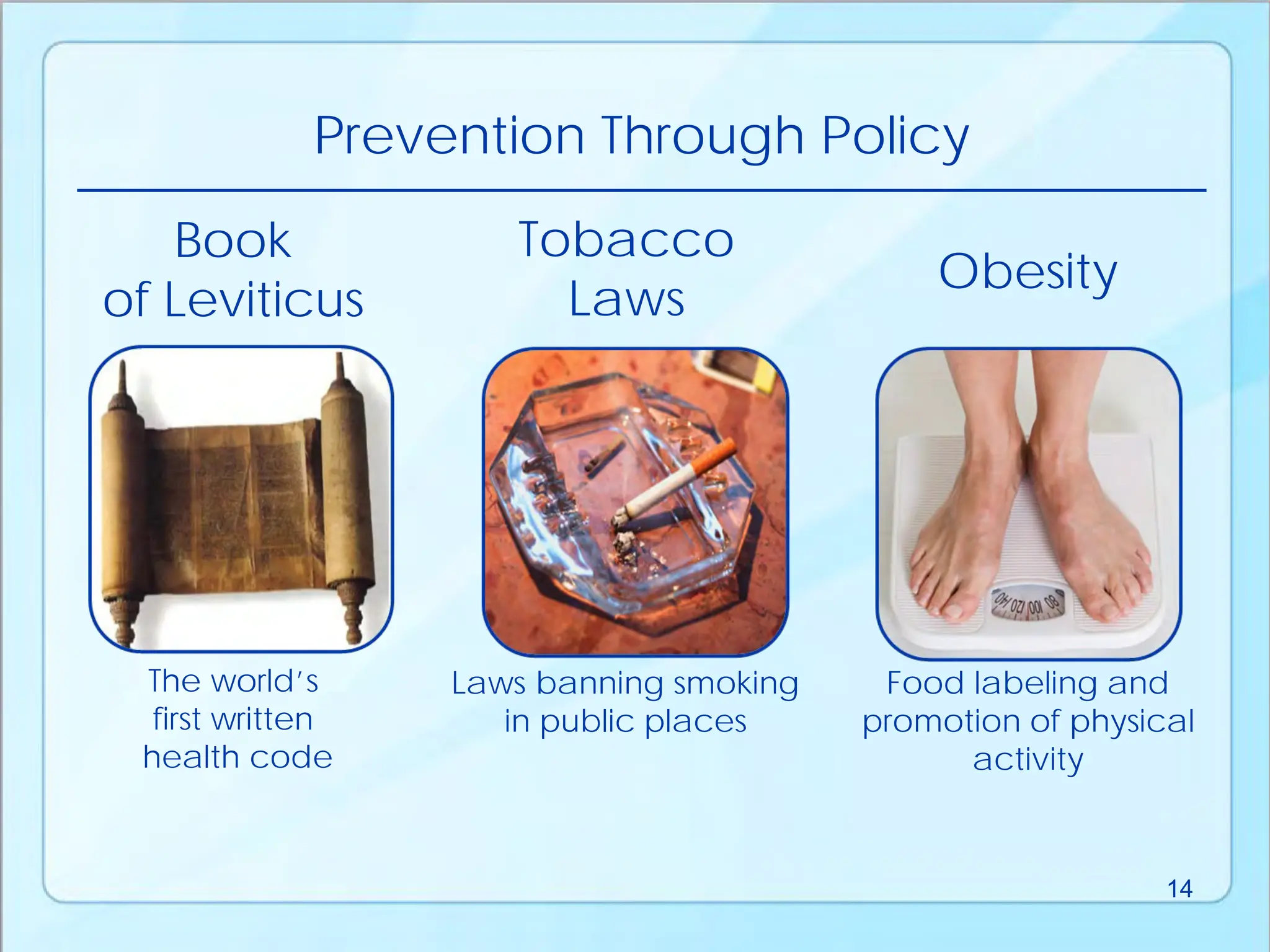
Prevention Through Policy
Book
of Leviticus
The world’s
first written
health code
Tobacco
Laws
Laws banning smoking
in public places
Obesity
Food labeling and
promotion of physical
activity
14
Which of the following events in public health history
have been pandemics? (Select all that apply)
D. Hurricane Katrina
B. Influenza
A. Siege of Kaffa
C. Polio
Knowledge Check
15
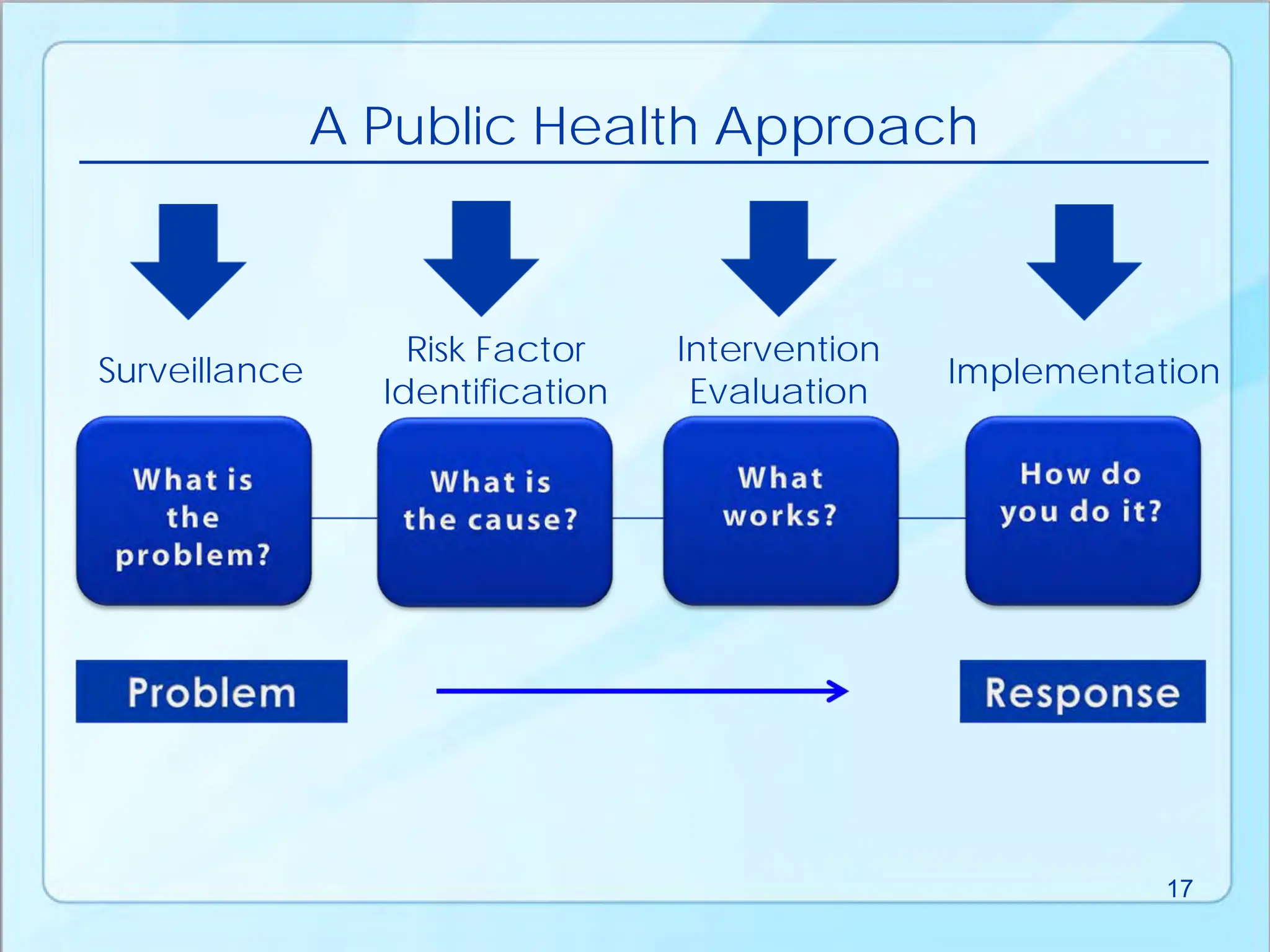
A Public Health Approach
Topic 3
16
A Public Health Approach
Surveillance
Risk Factor
Identification
Intervention
Evaluation
Implementation
17
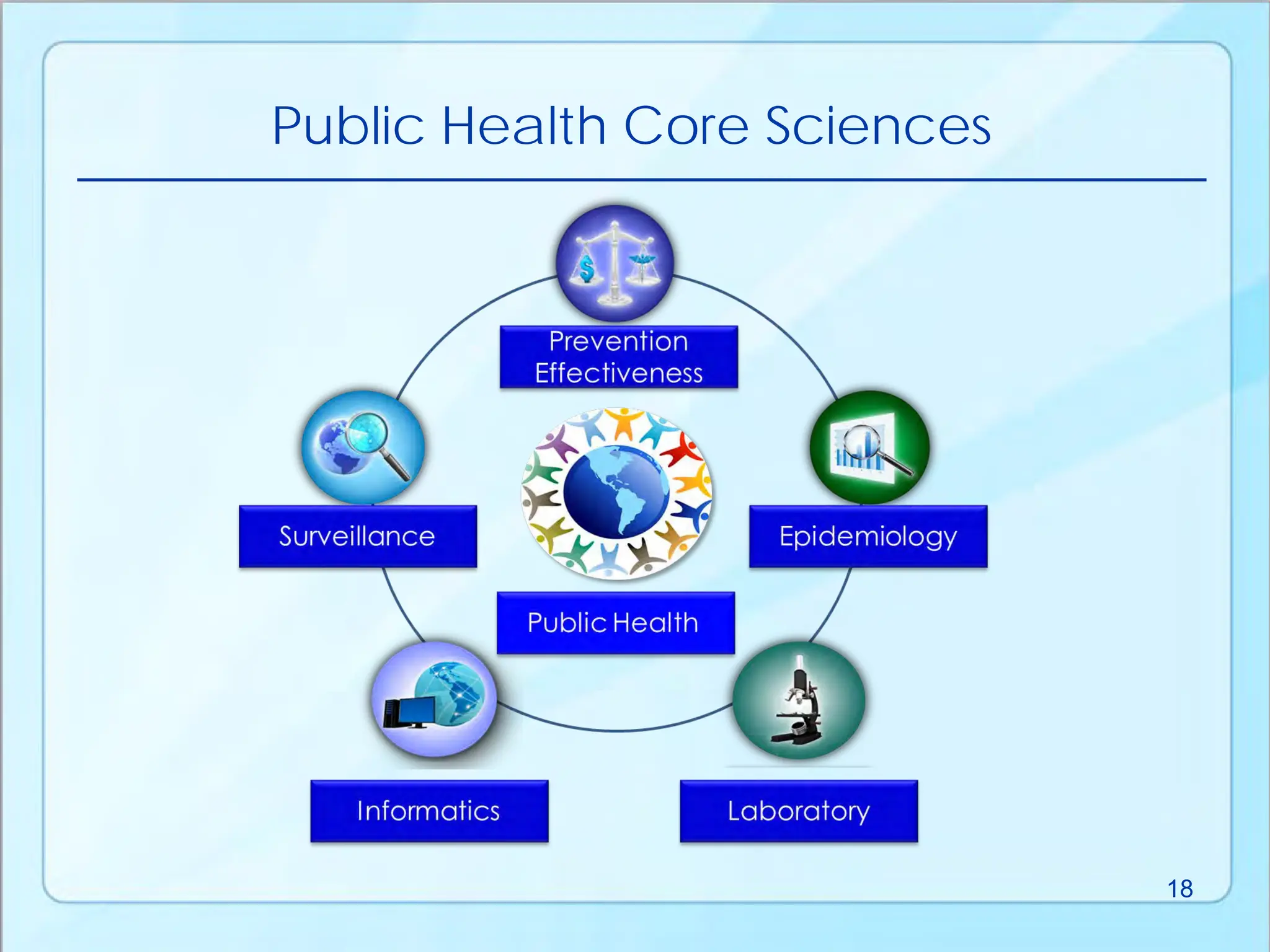
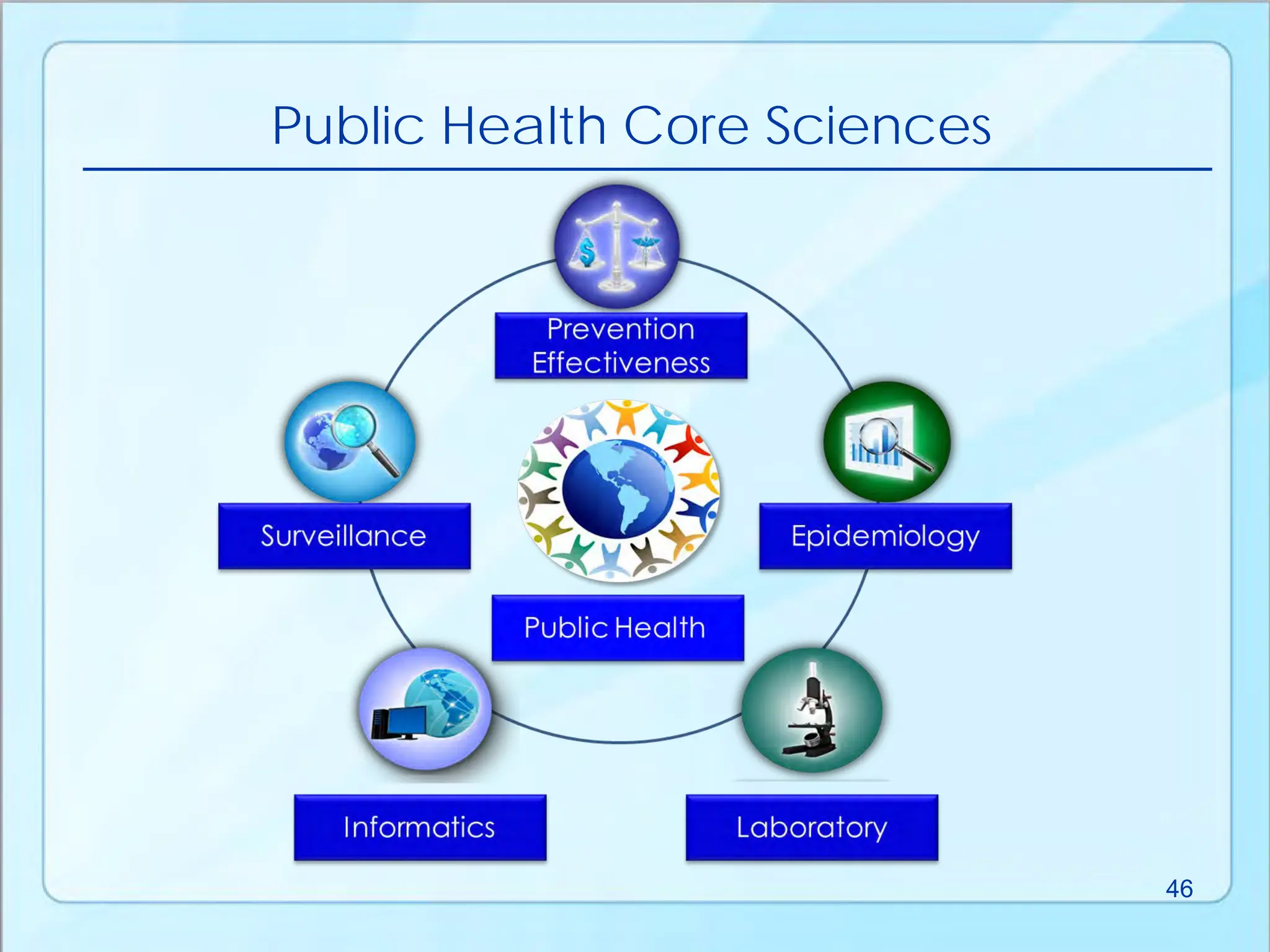
Public Health Core Sciences
18
Cholera — A Public Health Approach
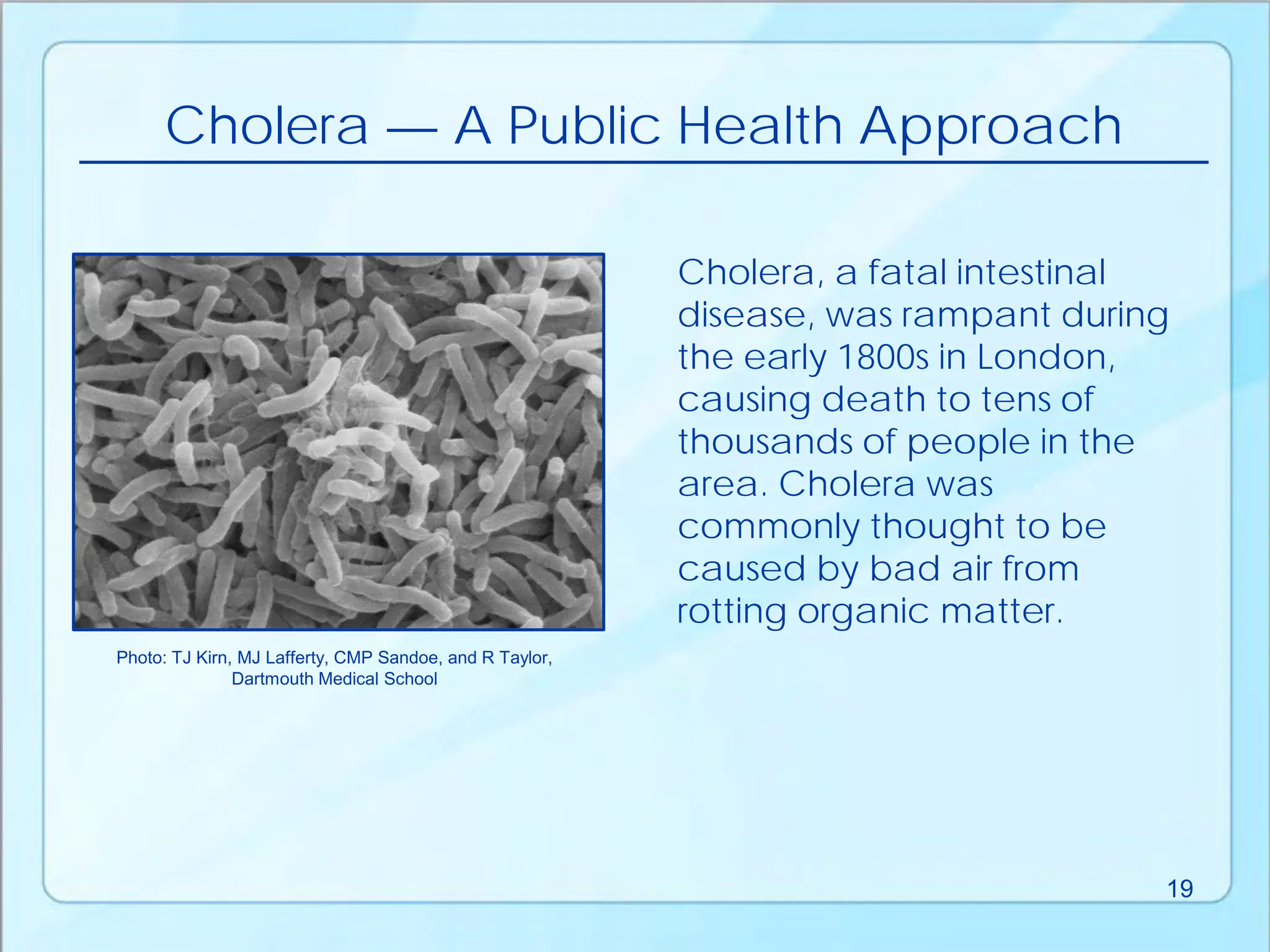
Cholera, a fatal intestinal
disease, was rampant during
the early 1800s in London,
causing death to tens of
thousands of people in the
area. Cholera was
commonly thought to be
caused by bad air from
rotting organic matter.
Photo: TJ Kirn, MJ Lafferty, CMP Sandoe, and R Taylor,
Dartmouth Medical School
19
John Snow, Physician
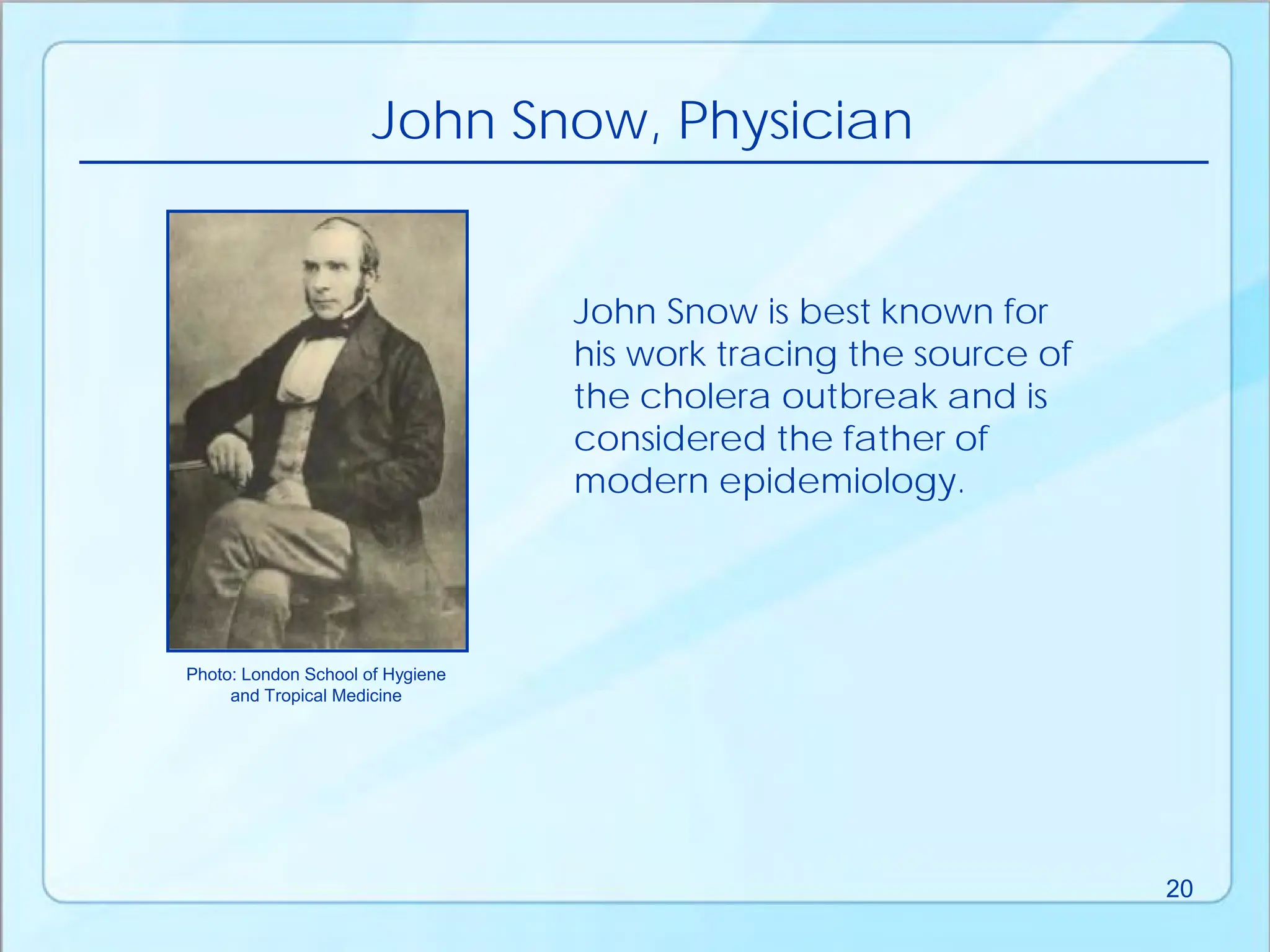
John Snow is best known for
his work tracing the source of
the cholera outbreak and is
considered the father of
modern epidemiology.
Photo: London School of Hygiene
and Tropical Medicine
20
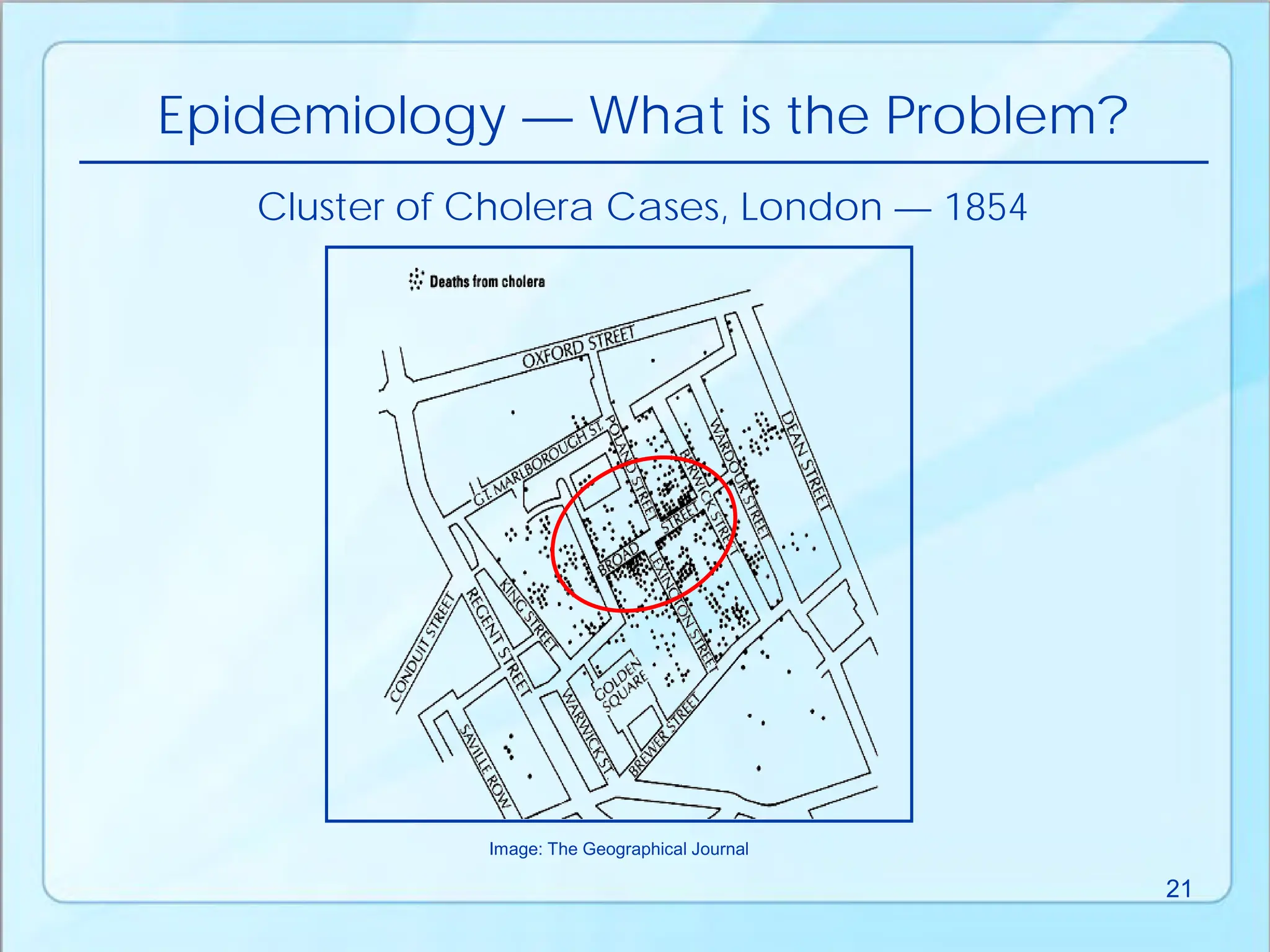
Epidemiology — What is the Problem?
Cluster of Cholera Cases, London — 1854
Image: The Geographical Journal
21
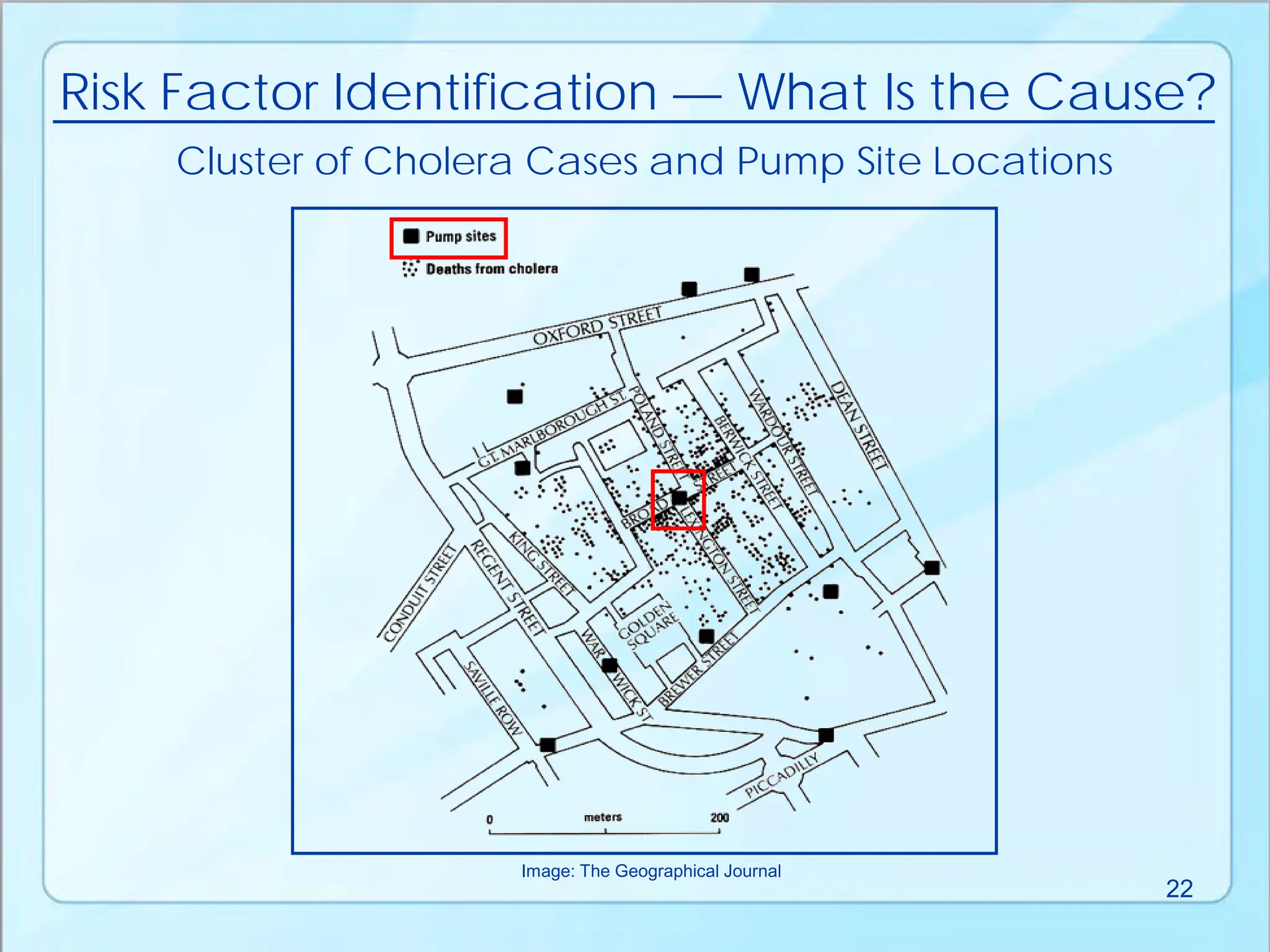
Cluster of Cholera Cases and Pump Site Locations
Risk Factor Identification — What Is the Cause?
Image: The Geographical Journal
22
• stop exposure to the contaminated water
supply on a larger scale, and
Intervention Evaluation — What Works?
• stop exposure to the entire supply of
contaminated water in the area
Through continuous research, Snow understood what
interventions were required to
23
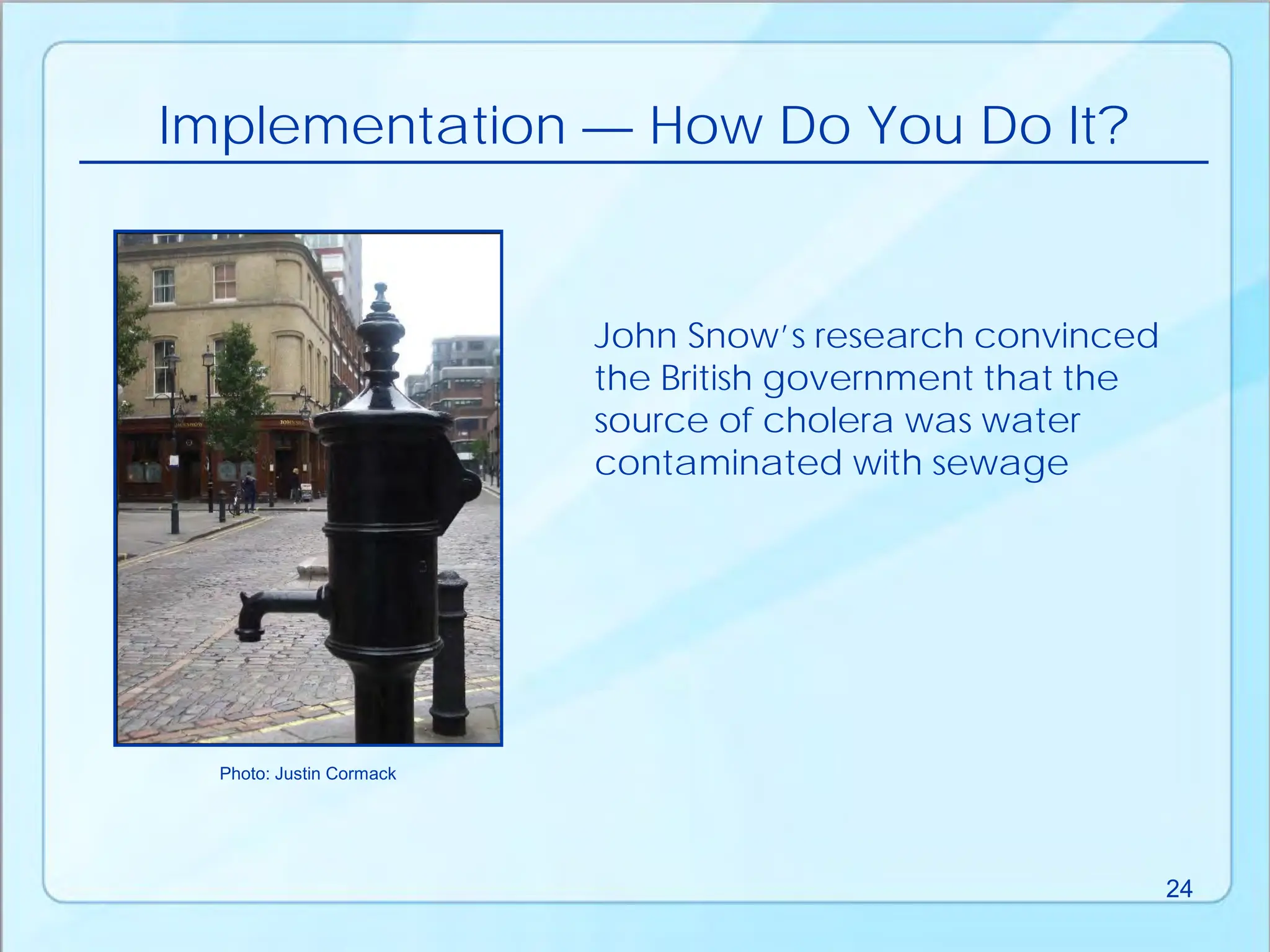
Implementation — How Do You Do It?
John Snow’s research convinced
the British government that the
source of cholera was water
contaminated with sewage
Photo: Justin Cormack
24
Fill in the blanks with the correct answers.
Each public health core science helps us to
___________ and _________ the public’s health by
providing public health practitioners with the
answers they need.
protect promote
Knowledge Check
25
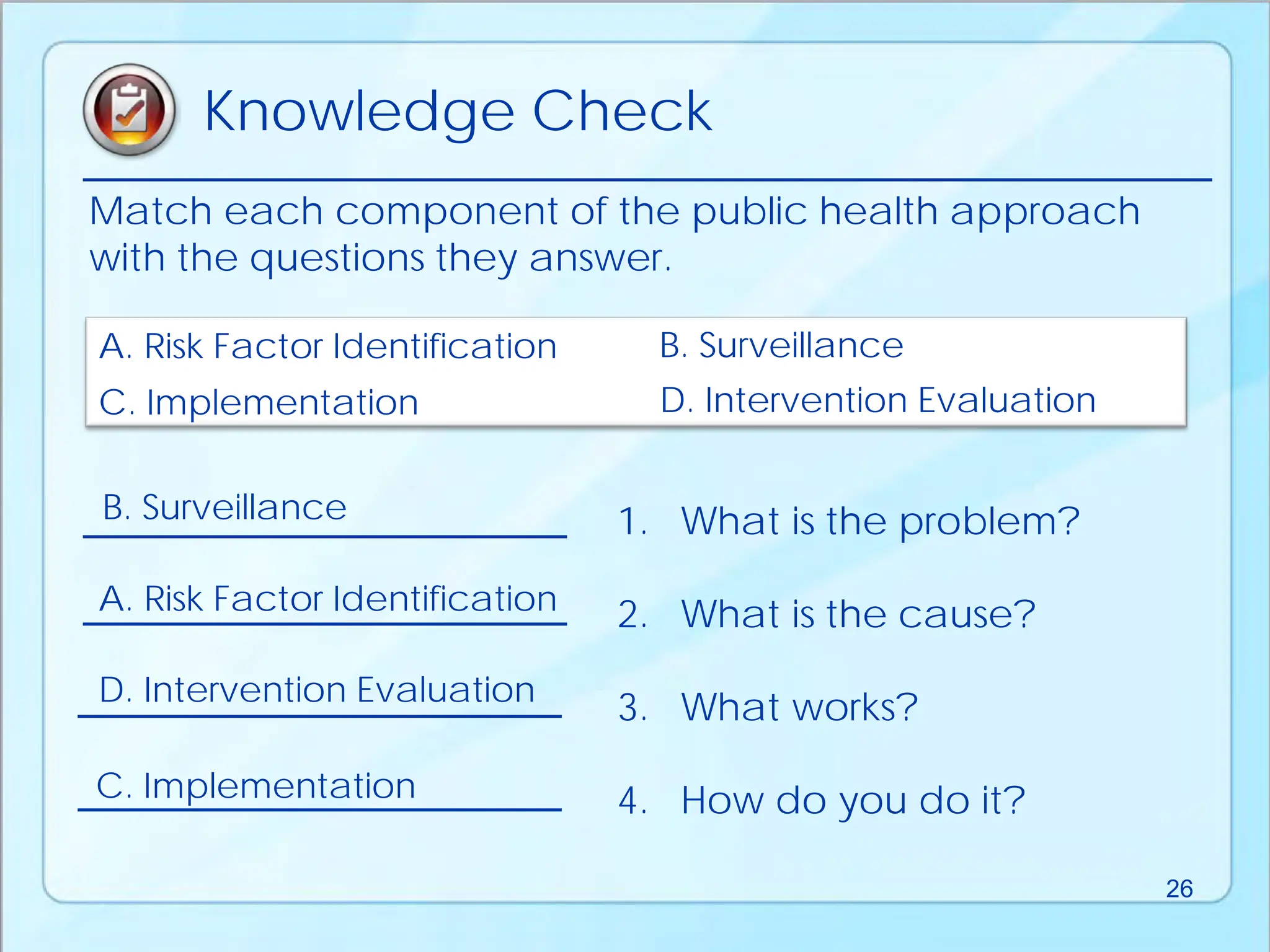
Match each component of the public health approach
with the questions they answer.
A. Risk Factor Identification B. Surveillance
C. Implementation D. Intervention Evaluation
1. What is the problem?
2. What is the cause?
3. What works?
4. How do you do it?
B. Surveillance
A. Risk Factor Identification
D. Intervention Evaluation
C. Implementation
Knowledge Check
26
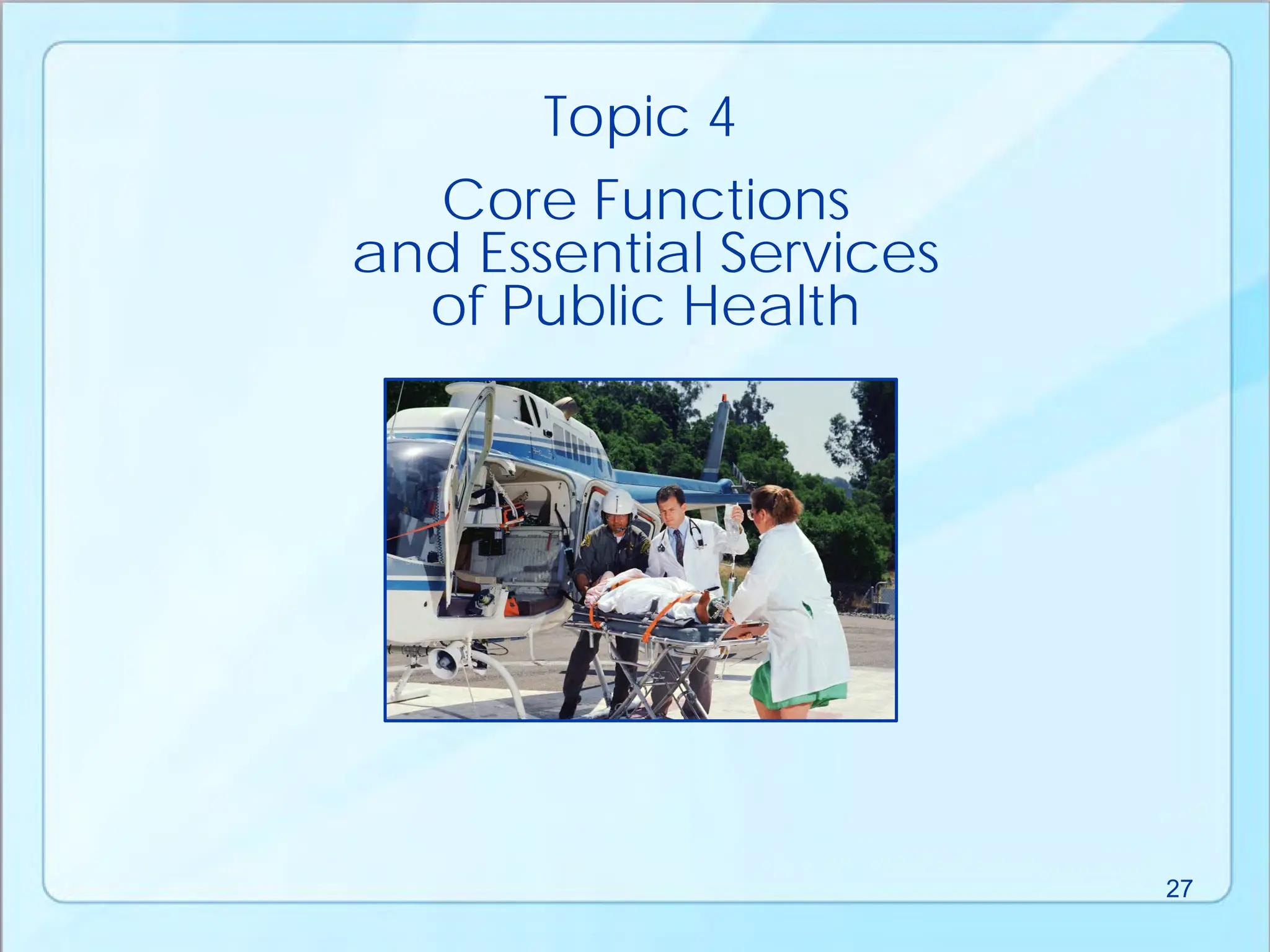
Core Functions
and Essential Services
of Public Health
Topic 4
27
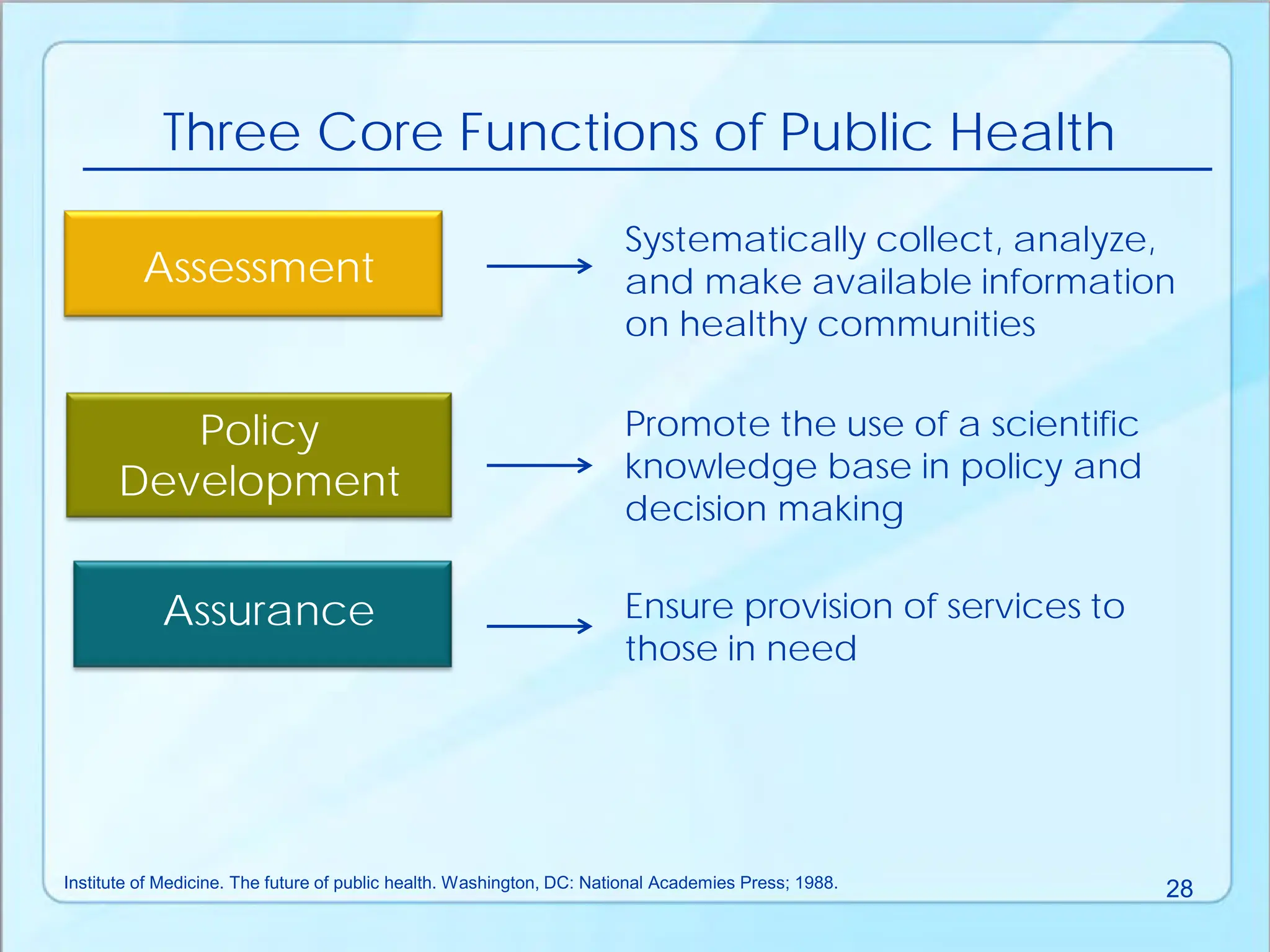
Three Core Functions of Public Health
Assessment
Assurance
Systematically collect, analyze,
and make available information
on healthy communities
Promote the use of a scientific
knowledge base in policy and
decision making
Ensure provision of services to
those in need
Institute of Medicine. The future of public health. Washington, DC: National Academies Press; 1988. 28
Policy
Development
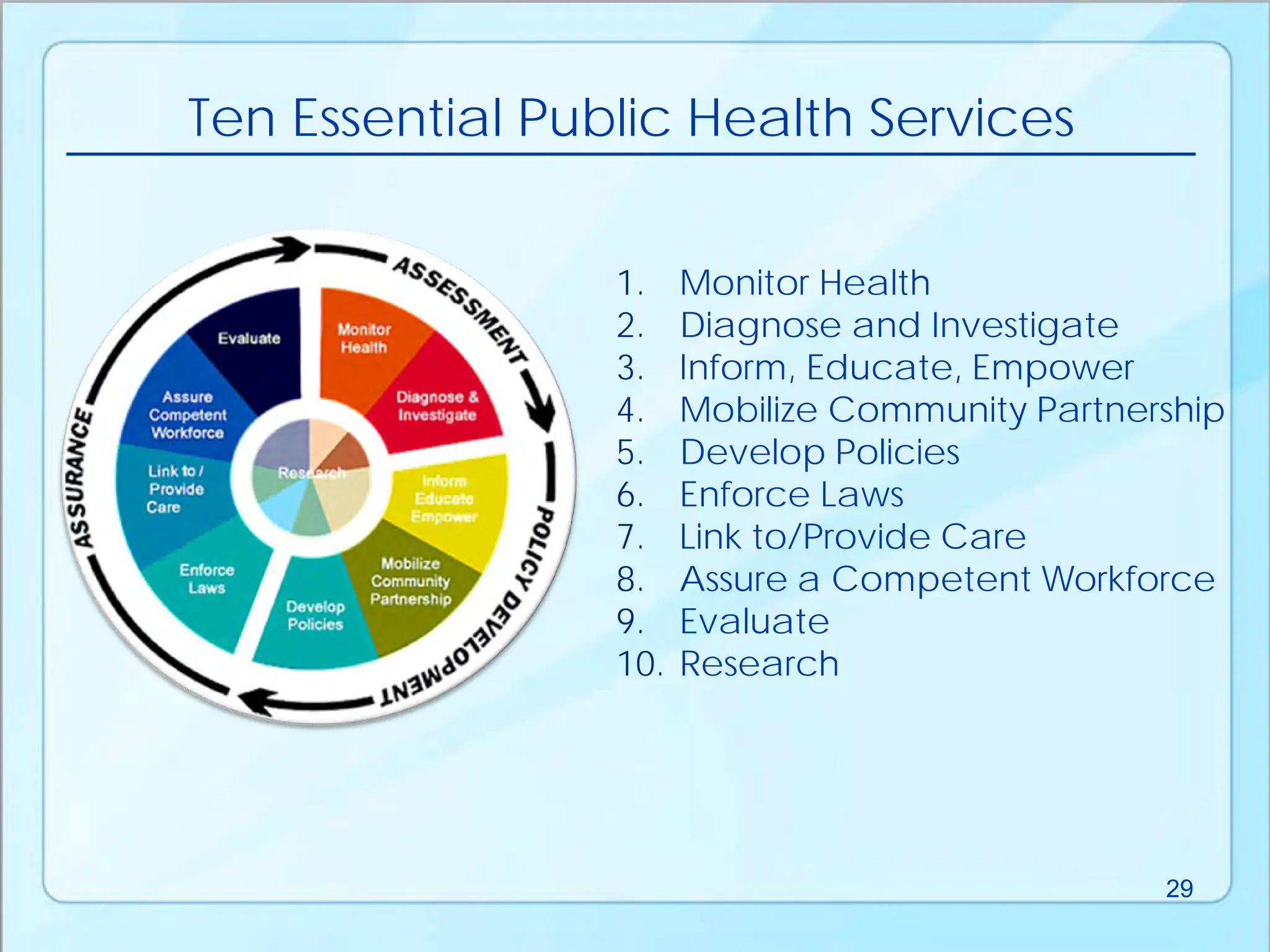
1. Monitor Health
2. Diagnose and Investigate
3. Inform, Educate, Empower
4. Mobilize Community Partnership
5. Develop Policies
6. Enforce Laws
7. Link to/Provide Care
8. Assure a Competent Workforce
9. Evaluate
10. Research
Ten Essential Public Health Services
29
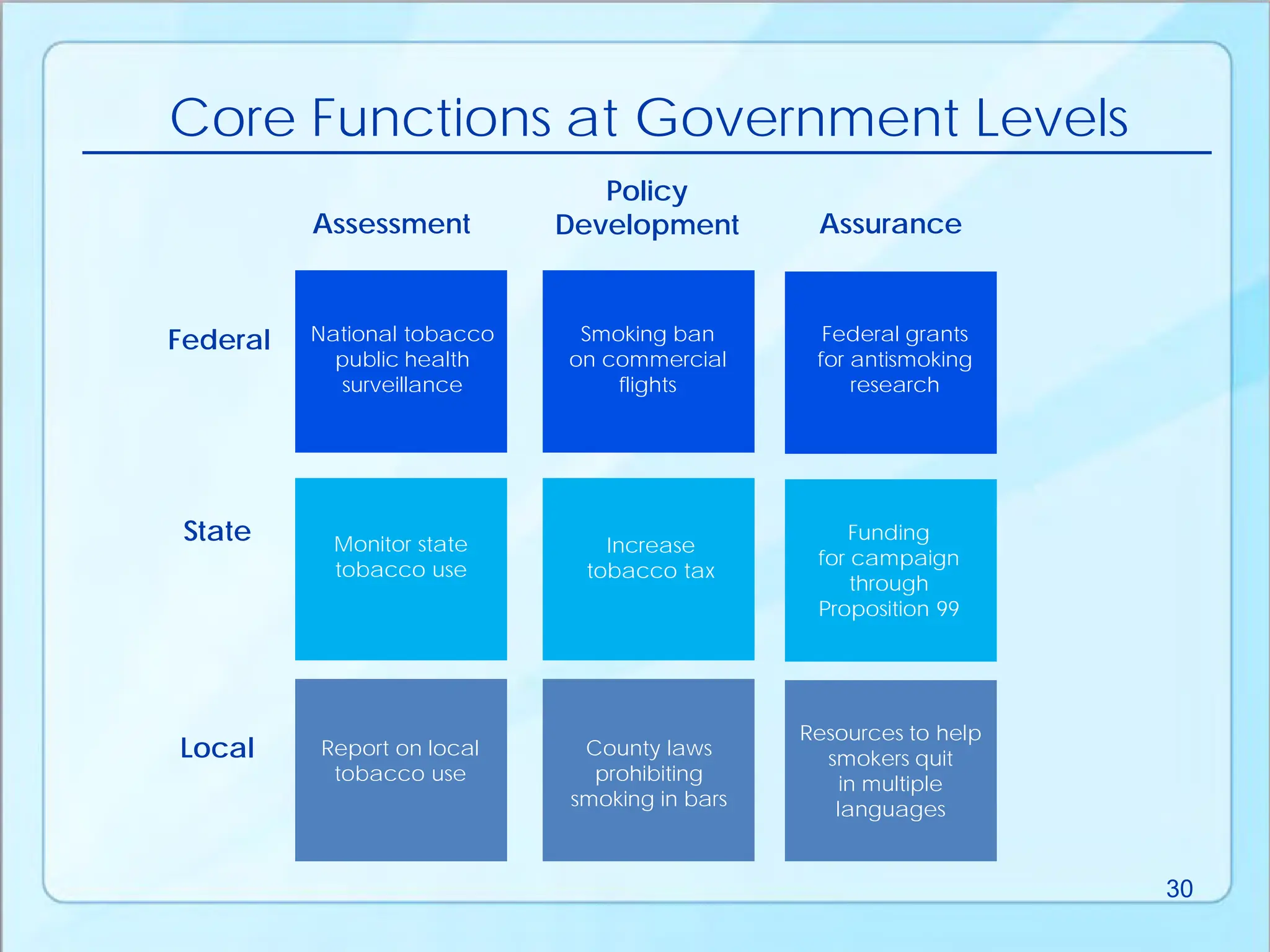
Core Functions at Government Levels
30
Assessment
Policy
Development Assurance
Federal
State
Local
National tobacco
public health
surveillance
Smoking ban
on commercial
flights
Federal grants
for antismoking
research
Monitor state
tobacco use
Increase
tobacco tax
Funding
for campaign
through
Proposition 99
Report on local
tobacco use
County laws
prohibiting
smoking in bars
Resources to help
smokers quit
in multiple
languages
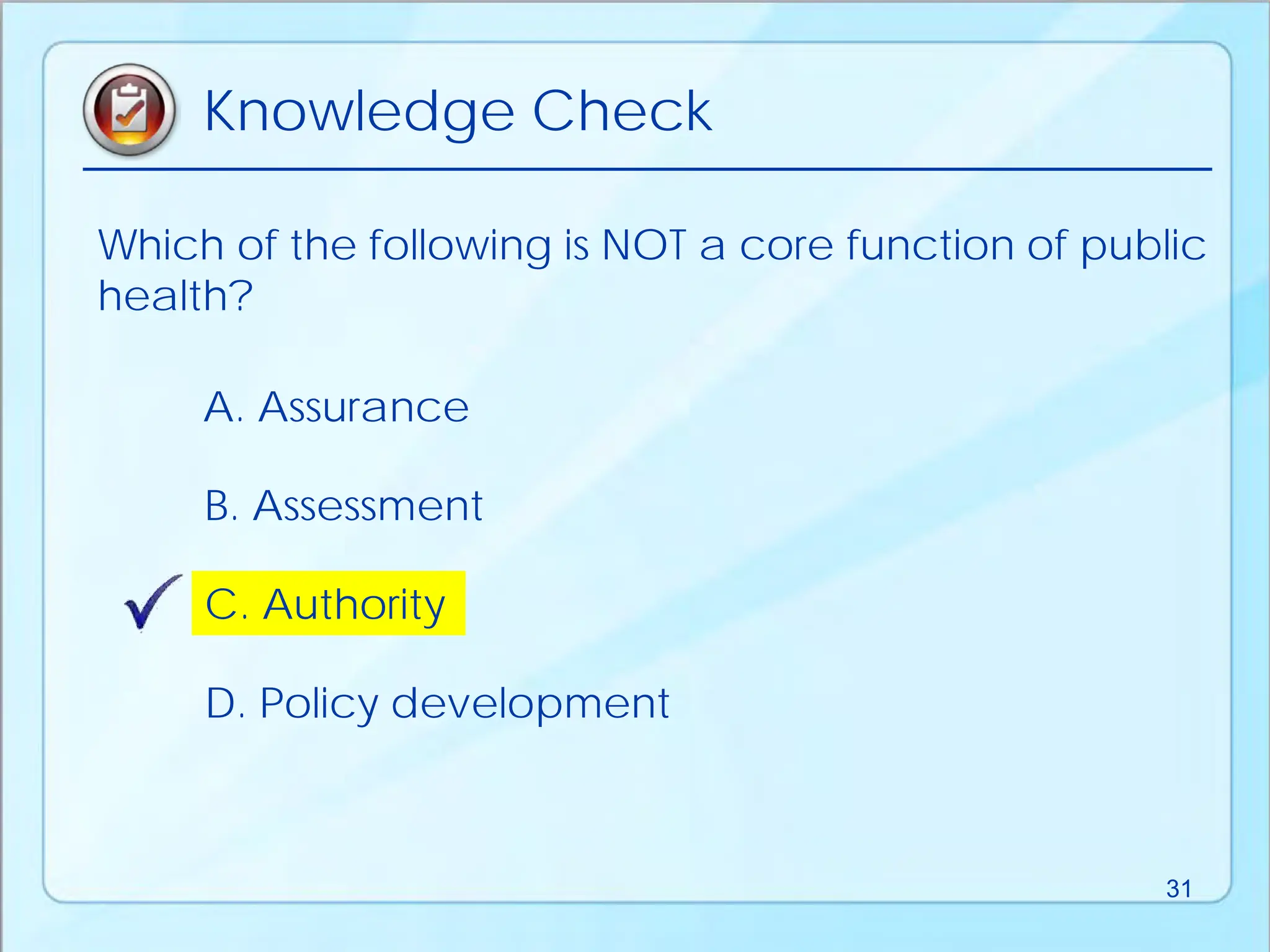
Which of the following is NOT a core function of public
health?
D. Policy development
B. Assessment
A. Assurance
C. Authority
Knowledge Check
31
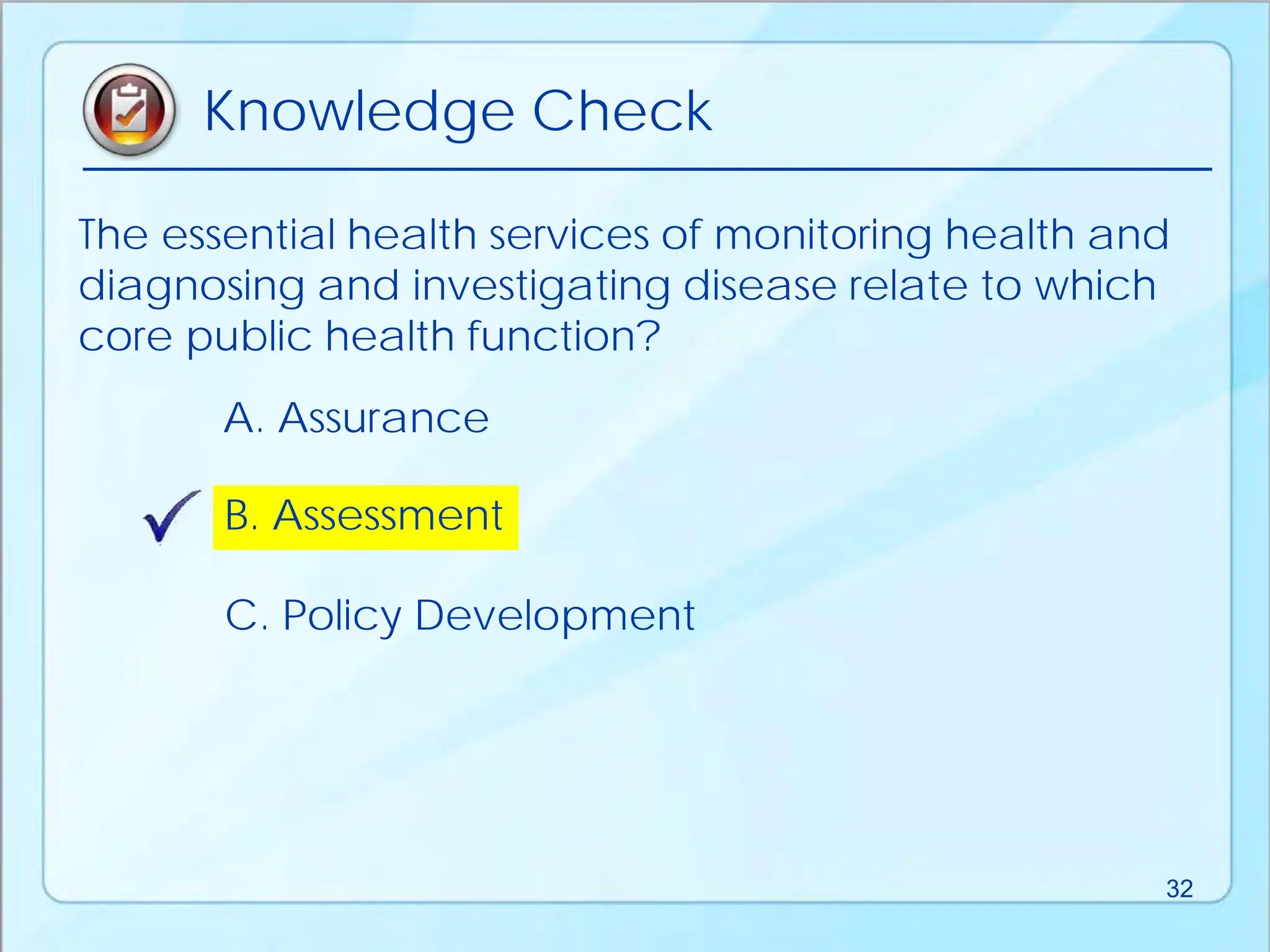
B. Assessment
A. Assurance
C. Policy Development
The essential health services of monitoring health and
diagnosing and investigating disease relate to which
core public health function?
Knowledge Check
32
Stakeholder Roles
in Public Health
Topic 5
33
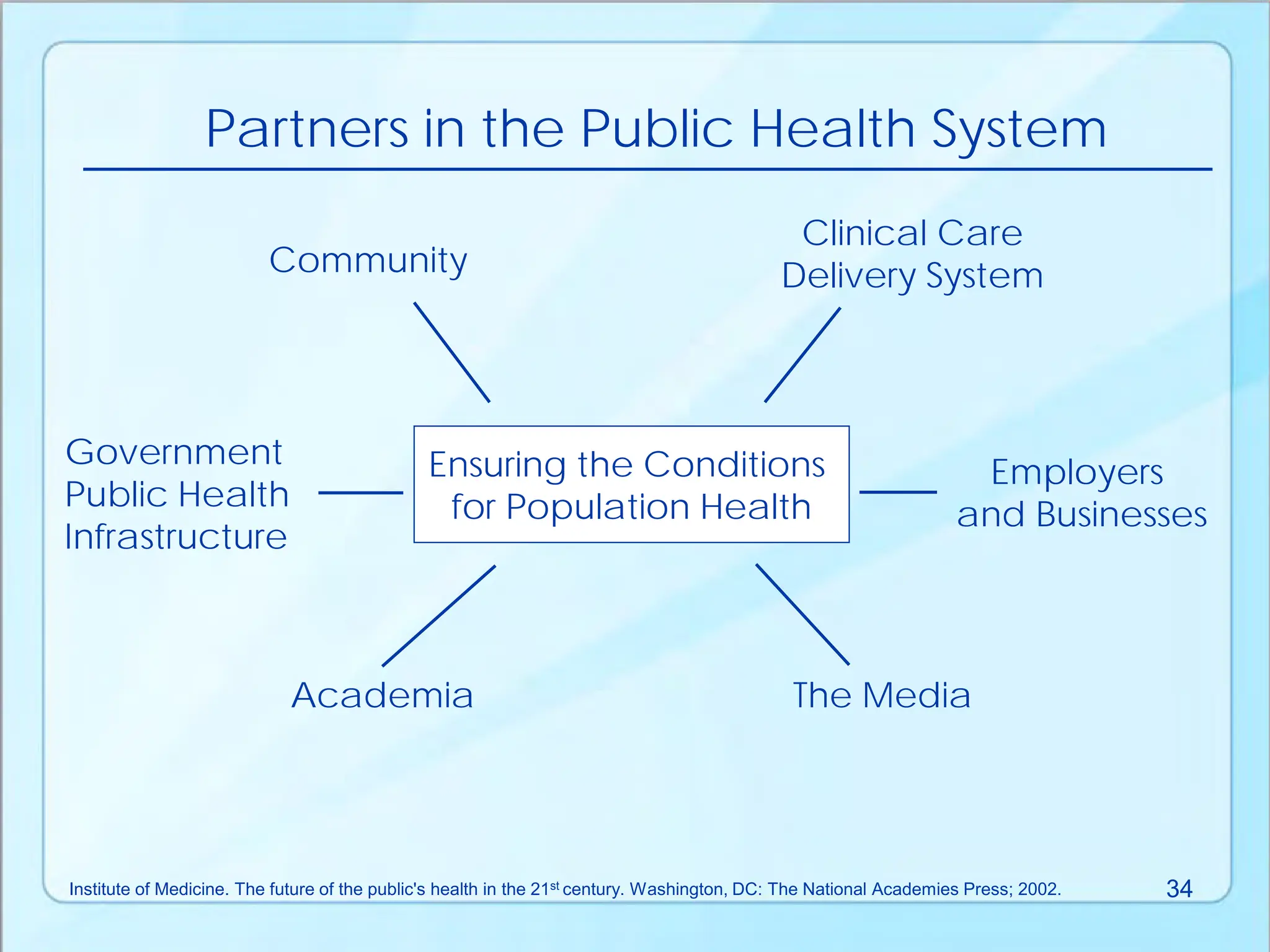
Partners in the Public Health System
Institute of Medicine. The future of the public's health in the 21st century. Washington, DC: The National Academies Press; 2002.
Ensuring the Conditions
for Population Health
Community
Clinical Care
Delivery System
Government
Public Health
Infrastructure
Employers
and Businesses
The Media
Academia
34
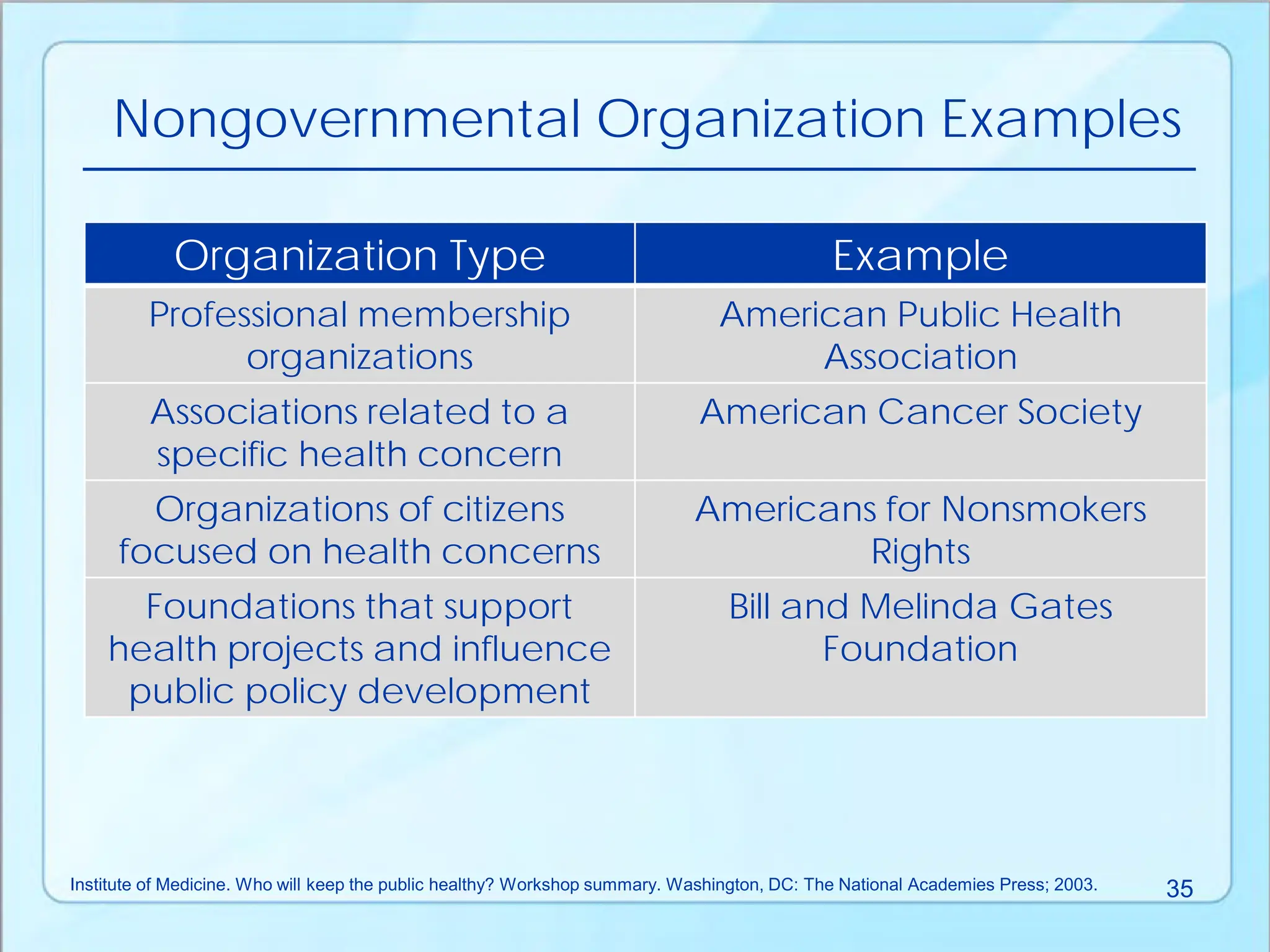
Nongovernmental Organization Examples
Institute of Medicine. Who will keep the public healthy? Workshop summary. Washington, DC: The National Academies Press; 2003. 35
Organization Type Example
Professional membership
organizations
American Public Health
Association
Associations related to a
specific health concern
American Cancer Society
Organizations of citizens
focused on health concerns
Americans for Nonsmokers
Rights
Foundations that support
health projects and influence
public policy development
Bill and Melinda Gates
Foundation
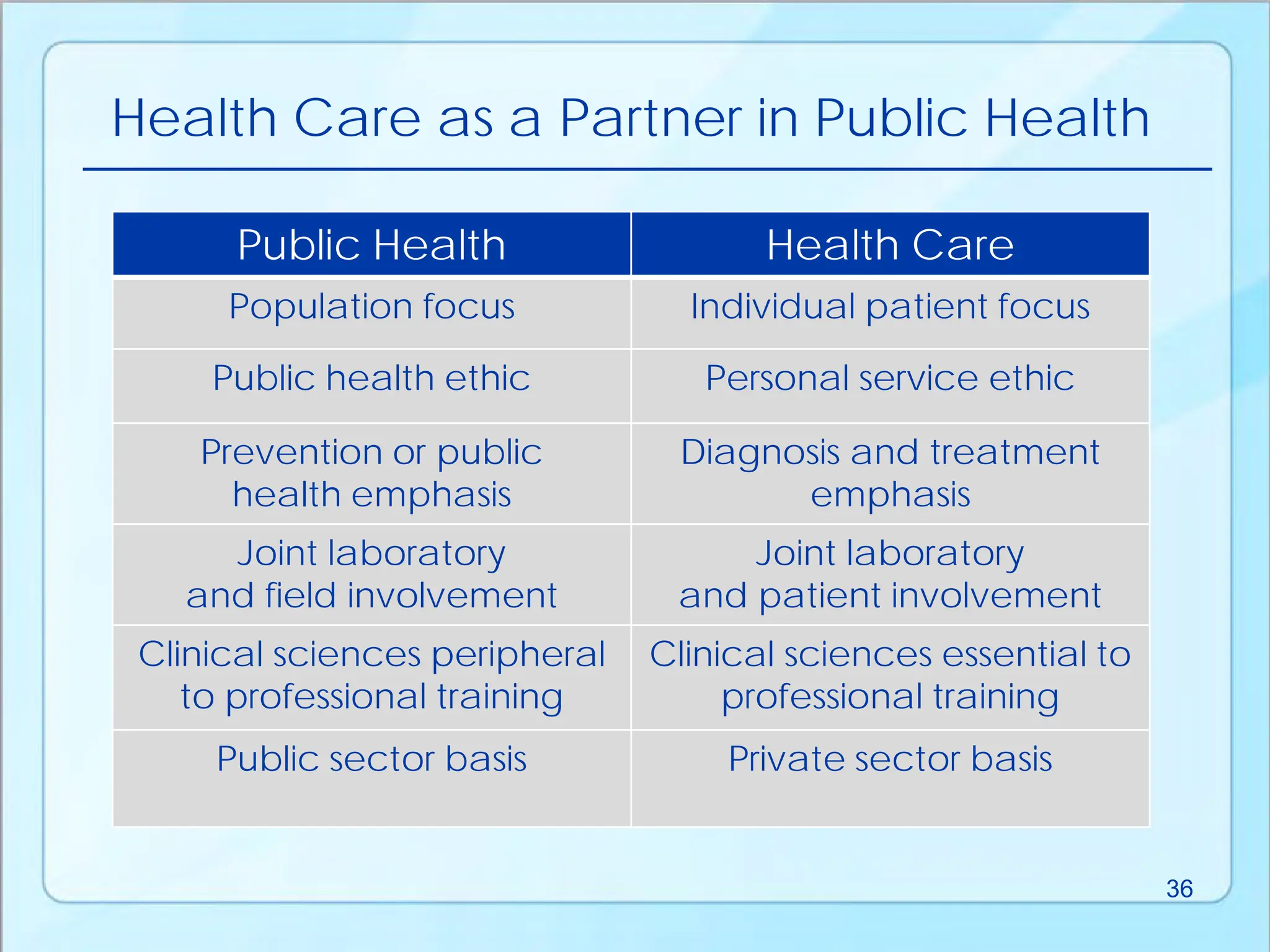
Health Care as a Partner in Public Health
36
Public Health Health Care
Population focus Individual patient focus
Public health ethic Personal service ethic
Prevention or public
health emphasis
Diagnosis and treatment
emphasis
Joint laboratory
and field involvement
Joint laboratory
and patient involvement
Clinical sciences peripheral
to professional training
Clinical sciences essential to
professional training
Public sector basis Private sector basis
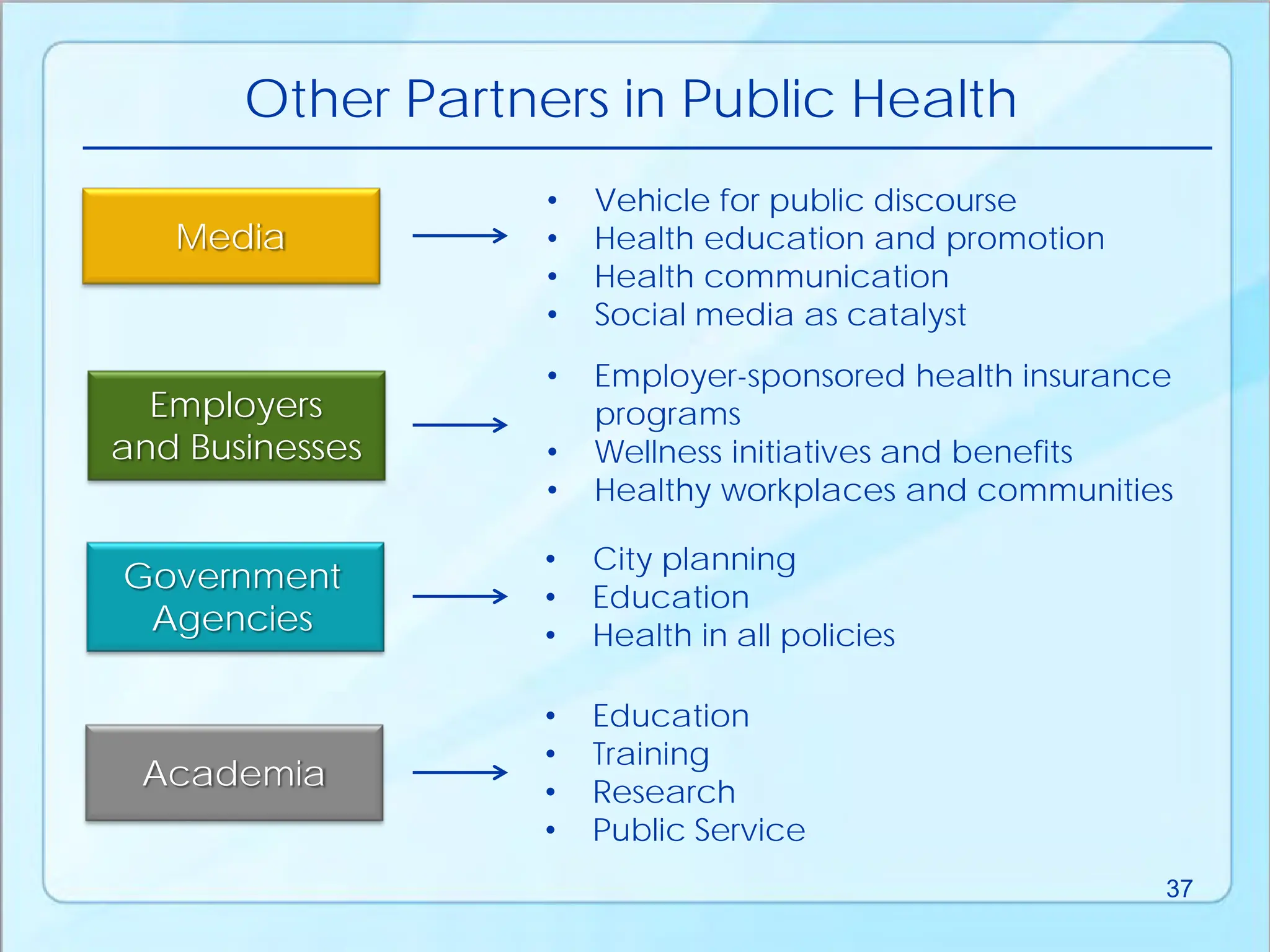
Other Partners in Public Health
Media
• Vehicle for public discourse
• Health education and promotion
• Health communication
• Social media as catalyst
Employers
and Businesses
• Employer-sponsored health insurance
programs
• Wellness initiatives and benefits
• Healthy workplaces and communities
Government
Agencies
• City planning
• Education
• Health in all policies
Academia
• Education
• Training
• Research
• Public Service
37
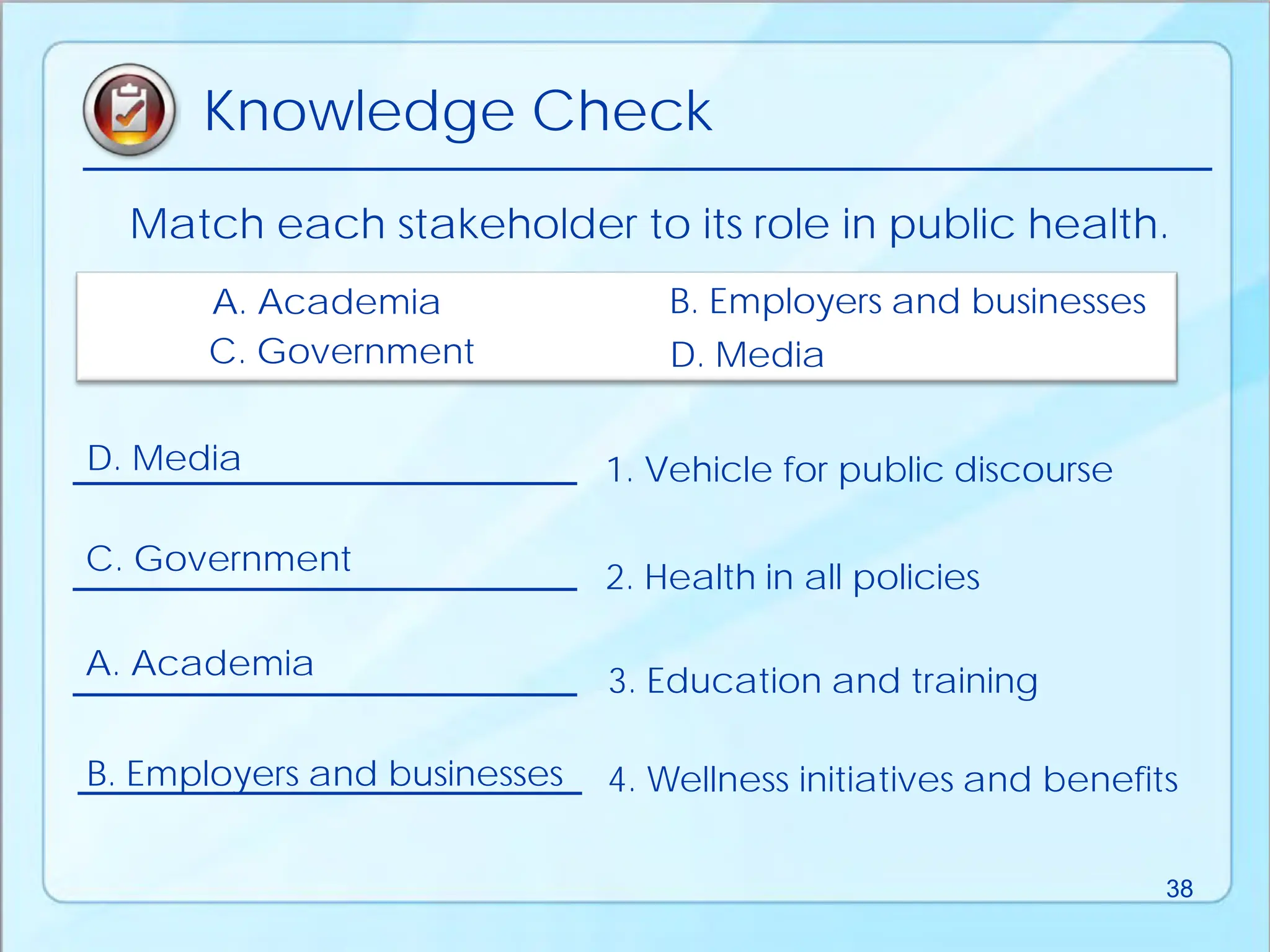
Match each stakeholder to its role in public health.
1. Vehicle for public discourse
4. Wellness initiatives and benefits
2. Health in all policies
3. Education and training
A. Academia B. Employers and businesses
C. Government D. Media
A. Academia
B. Employers and businesses
C. Government
D. Media
Knowledge Check
38
Determining and Influencing
the Public’s Health
Topic 6
39
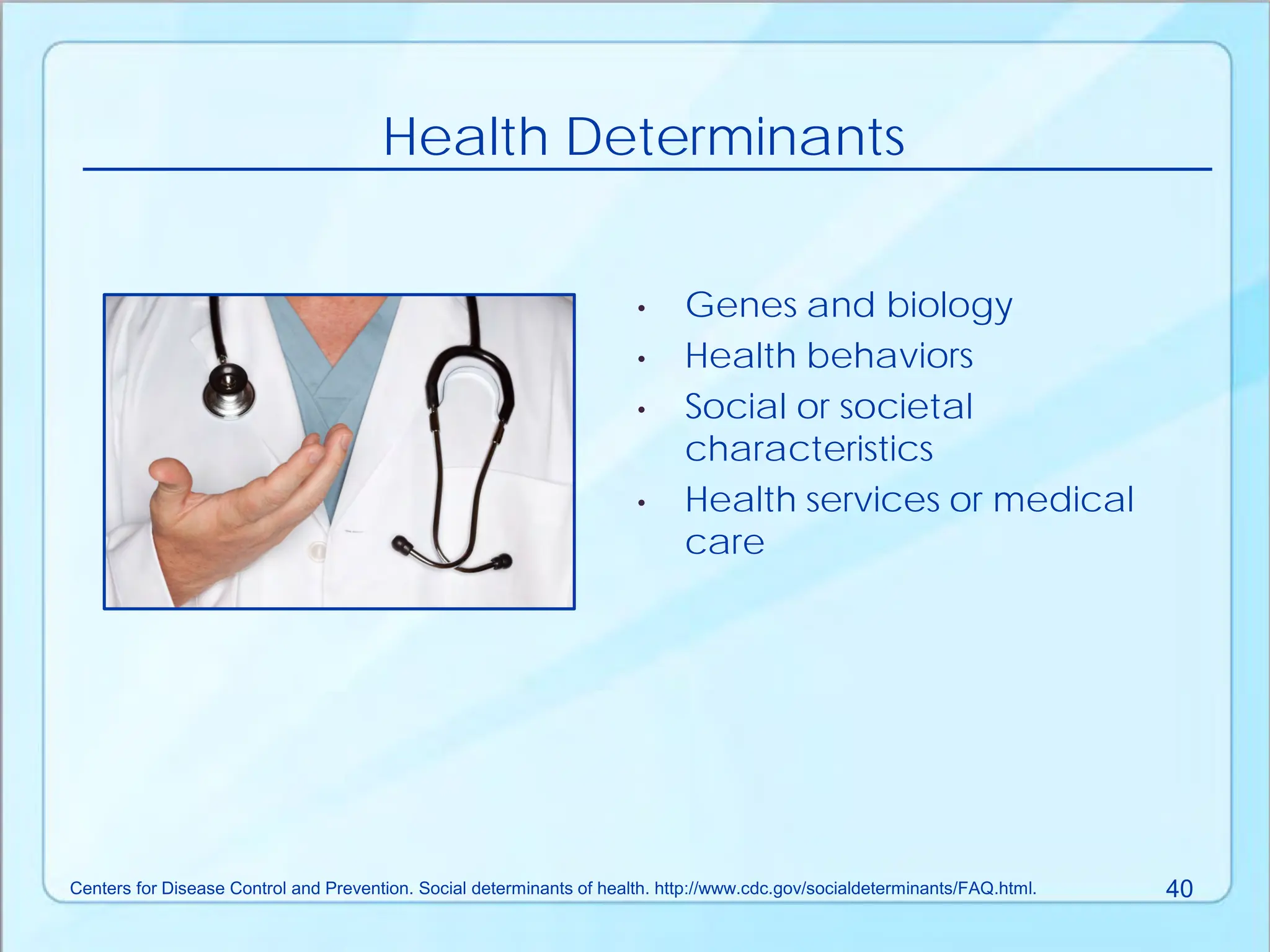
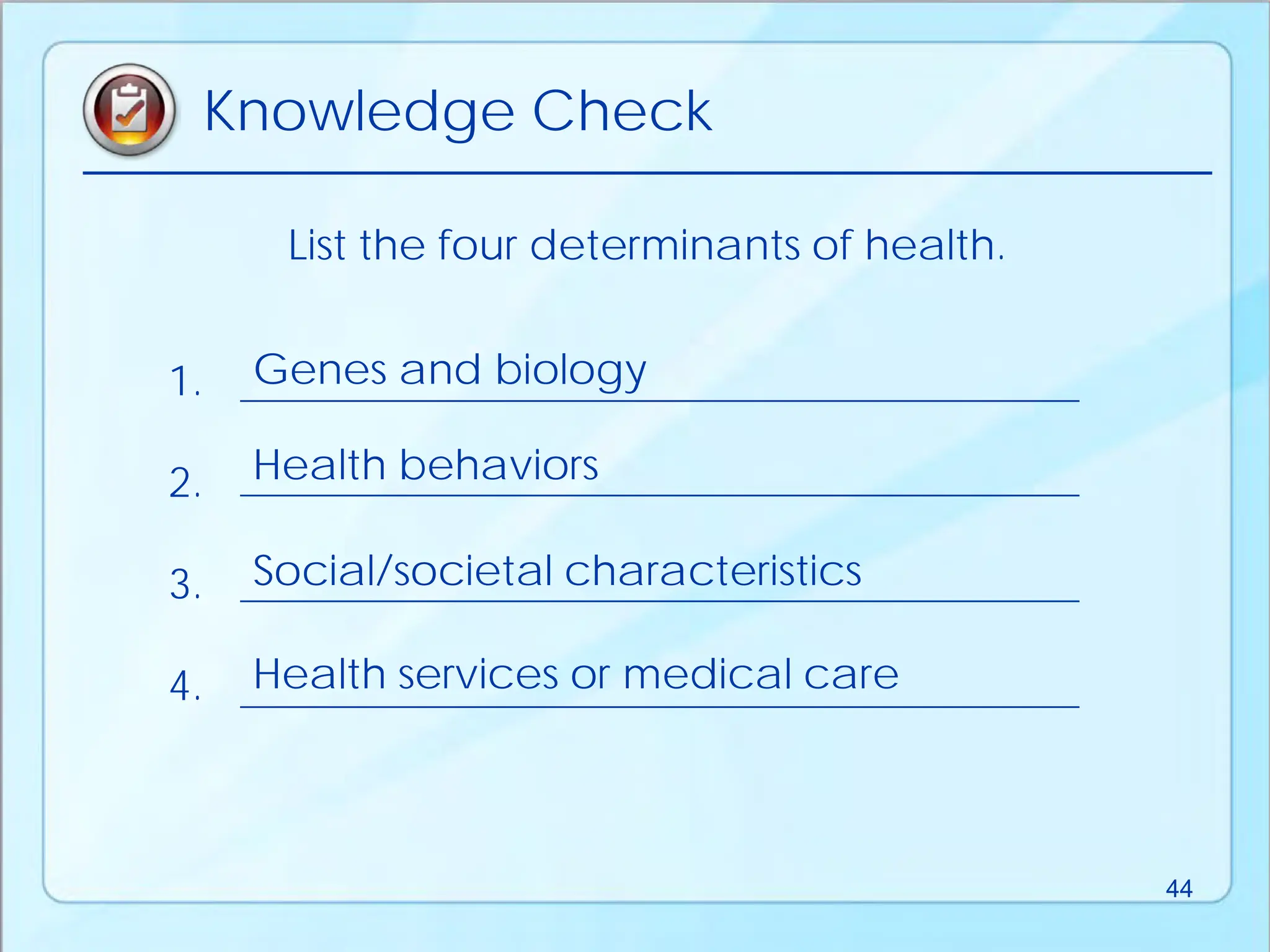
• Genes and biology
• Health behaviors
• Social or societal
characteristics
• Health services or medical
care
Health Determinants
Centers for Disease Control and Prevention. Social determinants of health. http://www.cdc.gov/socialdeterminants/FAQ.html. 40
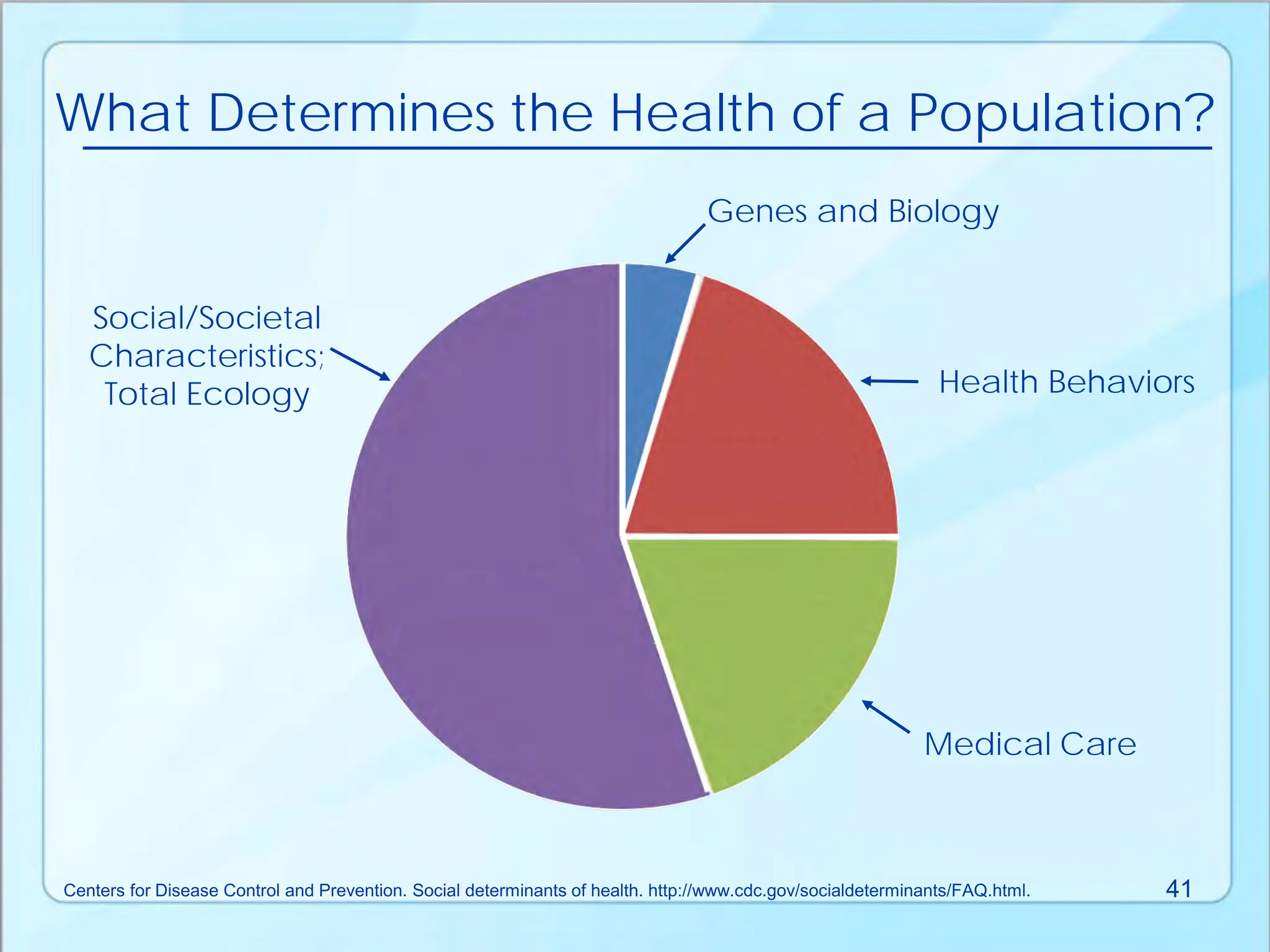
What Determines the Health of a Population?
Centers for Disease Control and Prevention. Social determinants of health. http://www.cdc.gov/socialdeterminants/FAQ.html.
Genes and Biology
Health Behaviors
Medical Care
Social/Societal
Characteristics;
Total Ecology
41
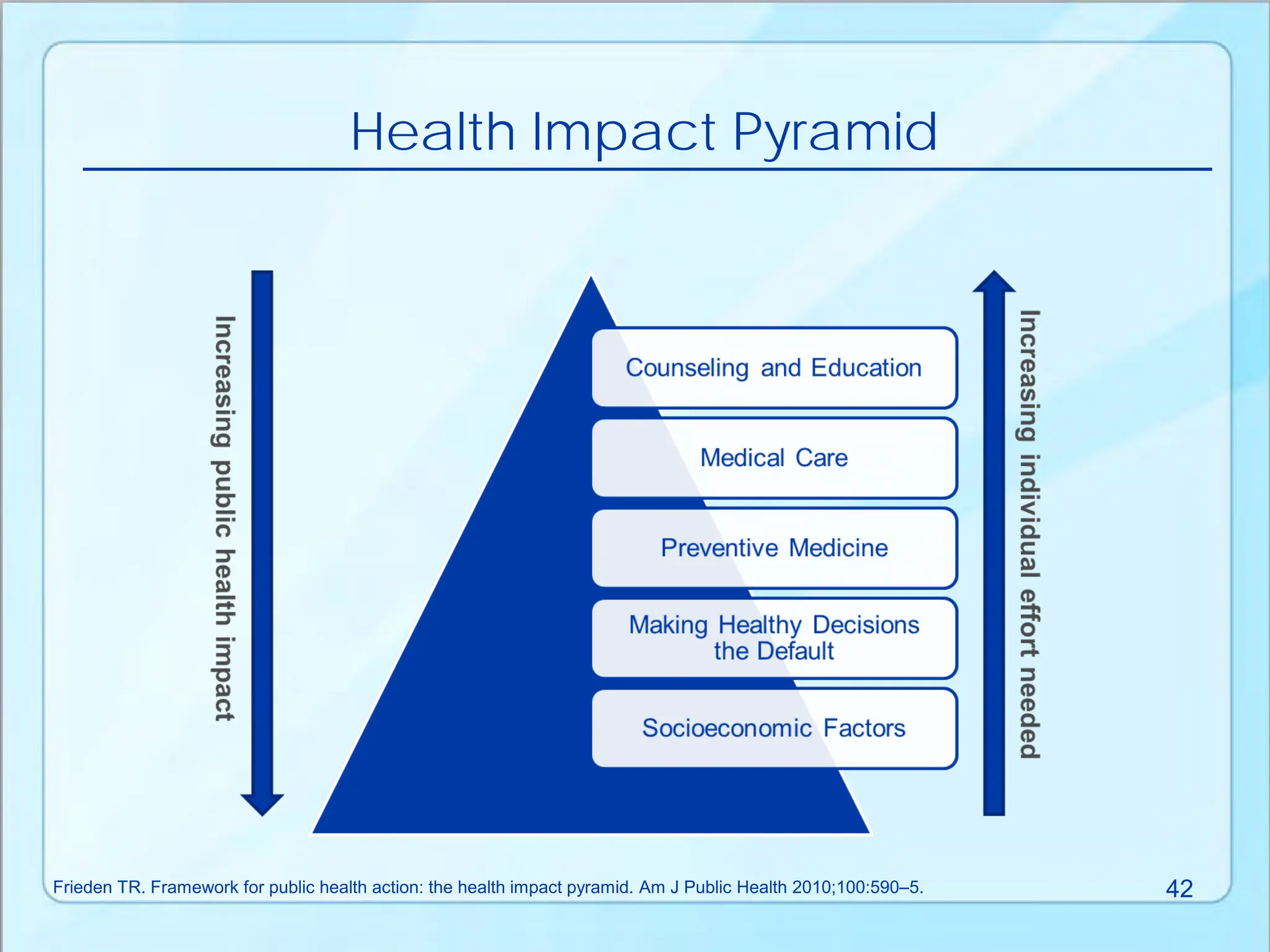
Health Impact Pyramid
Frieden TR. Framework for public health action: the health impact pyramid. Am J Public Health 2010;100:590–5. 42
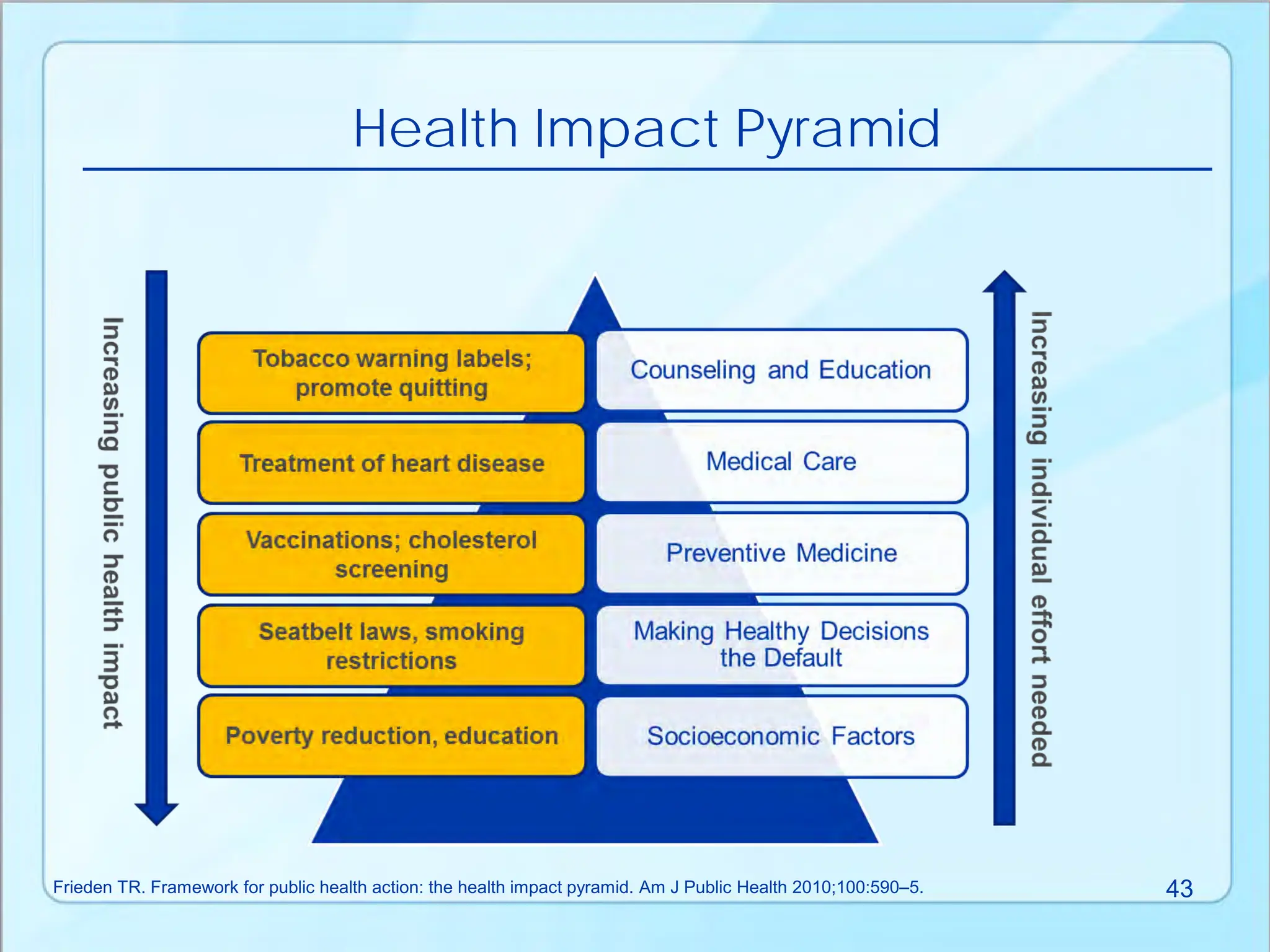
Health Impact Pyramid
Frieden TR. Framework for public health action: the health impact pyramid. Am J Public Health 2010;100:590–5. 43
List the four determinants of health.
Knowledge Check
1.
2.
3.
4.
Genes and biology
Health behaviors
Social/societal characteristics
Health services or medical care
44
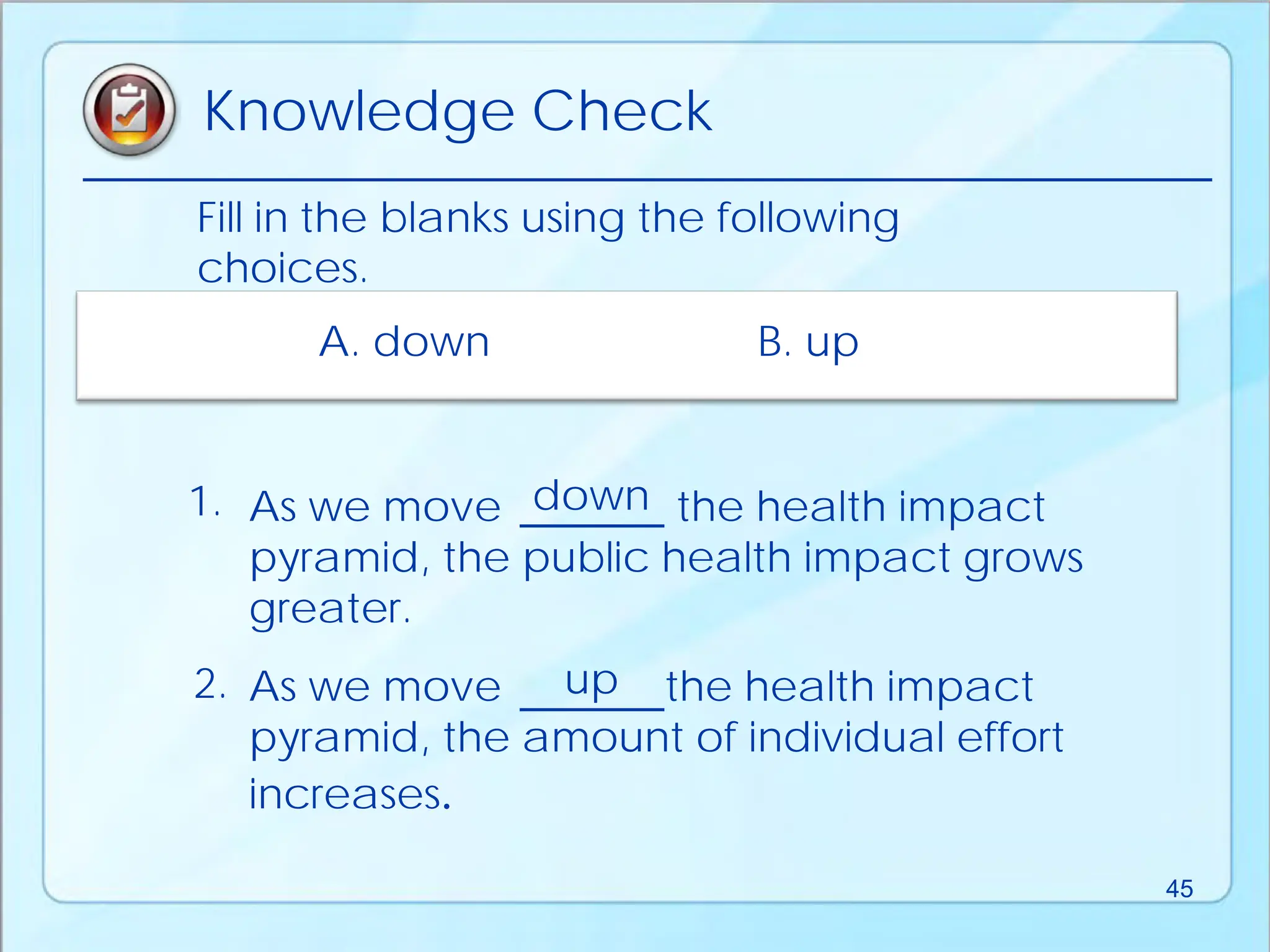
Fill in the blanks using the following
choices.
As we move the health impact
pyramid, the public health impact grows
greater.
As we move the health impact
pyramid, the amount of individual effort
increases.
A. down B. up
1.
2.
down
up
Knowledge Check
45
Public Health Core Sciences
46
• describe the purpose of public health
• define key terms used in public health
• identify prominent events in the history of public health
• recognize the core public health functions and services
• describe the role of different stakeholders in the field of
public health
• list some determinants of health
• recognize how individual determinants of health affect
population health
During this course, you learned to
Course Summary
47
QUESTIONS?
48
• American public health Association (APHA). The Prevention and public health Fund: a critical
investment in our nation’s physical and fiscal health. APHA Center for Health Policy Issue Brief.
Washington, DC: APHA; 2012. http://www.apha.org/NR/rdonlyres/8FA13774-AA47-43F2-838B-
1B0757D111C6/0/APHA_PrevFundBrief_June2012.pdf.
• California Department of public health. TabaccoFreeCA. http://www.Tobaccofreeca.org.
• Centers for Disease Control and Prevention. Key facts about seasonal flu vaccine.
http://www.cdc.gov/flu/protect/keyfacts.htm.
• Centers for Disease Control and Prevention. Overweight and obesity.
http://www.cdc.gov/obesity/index.html.
• Centers for Disease Control and Prevention. Social determinants of health.
http://www.cdc.gov/socialdeterminants/FAQ.html.
• Centers for Medicare and Medicaid Services. National health expenditure projections: 2008–
2018. http://www.cms.gov/Research-Statistics-Data-and-Systems/Statistics-Trends-and-
Reports/NationalHealthExpendData/downloads/proj2008.pdf.
• Dean H. Introduction to public health, epidemiology, and surveillance. Presented at the CDC
Science Ambassador Program, July 16, 2012.
• Frieden, TR. Framework for public health action: the health impact pyramid. Am J public health
2010;100:590–5.
• Kindig D, Stoddart G. What is population health? Am J public health. 2003;93:380–3.
• Institute of Medicine. For the public’s health: investing in a healthier future. Washington, DC:
National Academies Press; 2012.
• Institute of Medicine. Primary care and public health: exploring integration to improve
population health. Washington, DC: The National Academies Press; 2012.
Resources and Additional Reading
49
• Institute of Medicine. The future of public health. Washington, DC: The National Academies
Press; 1988.
• Institute of Medicine. The future of the public's health in the 21st century. Washington, DC: The
National Academies Press; 2002.
• Institute of Medicine. Who will keep the public healthy? Workshop summary. Washington, DC:
The National Academies Press; 2003.
• Pearl R. Tobacco smoking and longevity. Science 1938;87:216–7.
• Preamble to the Constitution of the World Health Organization as adopted by the International
Health Conference, New York, June19–July 22, 1946.
• Federal Communications Commission. Texting while driving. http://www.fcc.gov/guides/texting-
while-driving.
• UNAIDS. UNAIDS World AIDS Day Report, 2012.
http://www.unaids.org/en/media/unaids/contentassets/
documents/epidemiology/2012/gr2012/JC2434_WorldAIDSday_results_en.pdf.
• Skelton A. Introduction to public health science and practice.” Presented at the CDC Steven M.
Teutsch Prevention Effectiveness Fellowship Orientation, August 15, 2012.
• US Department of Health, Education, and Welfare. Smoking and health. Washington, DC: public
health Service; 1964. http://profiles.nlm.nih.gov/ps/access/NNBBMQ.pdf.
• Winslow CEA. The untilled field of public health. Mod Med 1920;2:183–91.
• World Health Organization (WHO). World report on violence and health. Geneva: WHO; 2002.
http://www.who.int/violence_injury_prevention/violence/world_report/en/.
Resources and Additional Reading
50
Links provided in this course to nonfederal organizations are provided solely as a
service to our users. These links do not constitute an endorsement of these
organizations nor their programs by the Centers for Disease Control and
Prevention (CDC) or the federal government, and none should be inferred. CDC
is not responsible for the content contained at these sites.
Use of trade names and commercial sources is for identification only and does
not imply endorsement by the Division of Scientific Education and Professional
Development, Center for Surveillance, Epidemiology, and Laboratory Services,
Centers for Disease Control and Prevention, the Public Health Service, or the U.S.
Department of Health and Human Services.
The findings and conclusions in this course are those of the authors and do not
necessarily represent the official position of the Centers for Disease Control and
Prevention.
Disclaimers
51
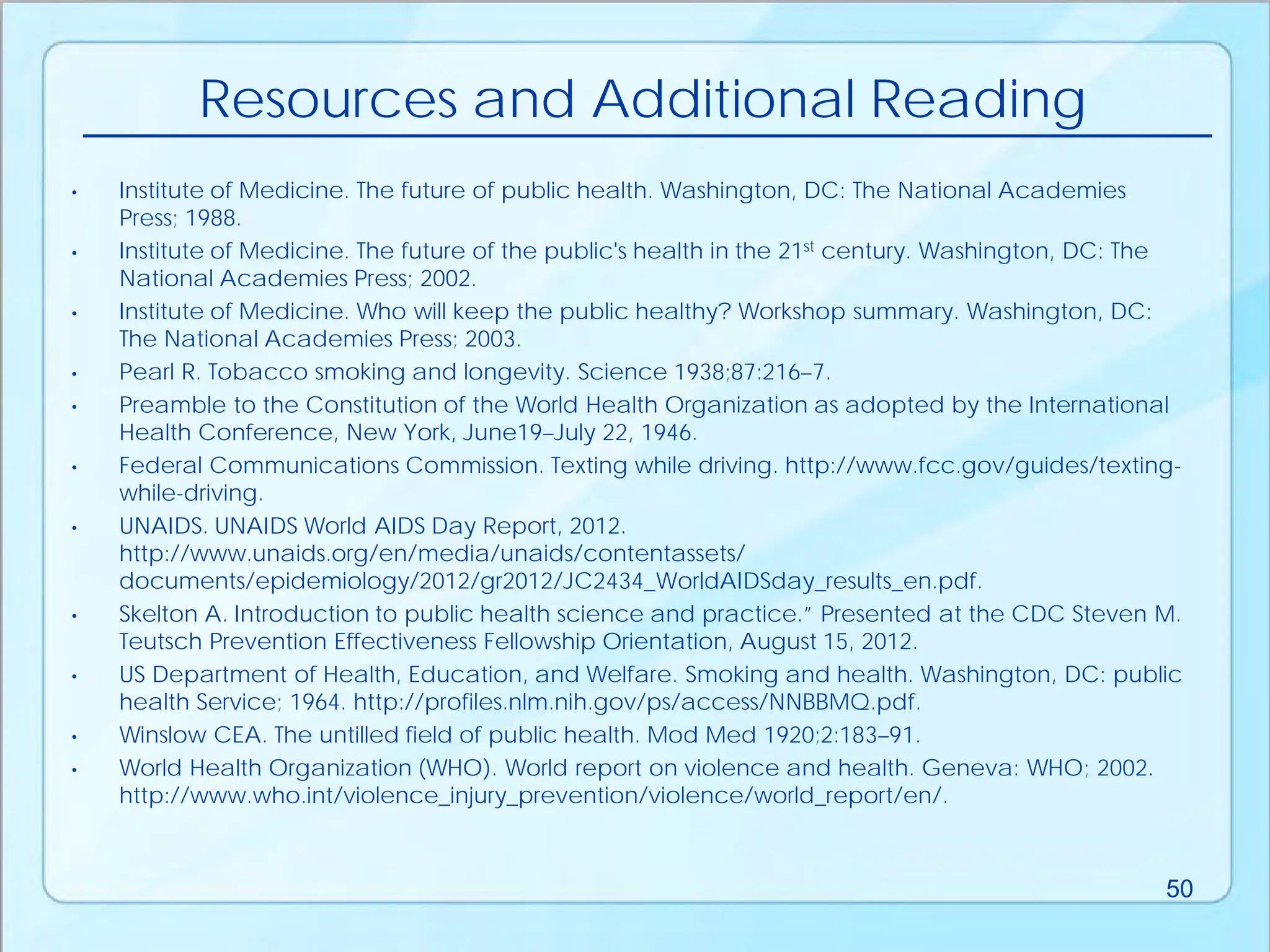
For more information, please contact the Centers for Disease Control and Prevention
1600 Clifton Road NE, Atlanta, GA 30333
Telephone: 1-800-CDC-INFO (232-4636)/TTY: 1-888-232-6348
Visit: http://www.cdc.gov | Contact CDC at: 1-800-CDC-INFO or http://www.cdc.gov/info
The findings and conclusions in this course are those of the authors and do not necessarily represent the official position of the
Centers for Disease Control and Prevention.
Center for Surveillance, Epidemiology, and Laboratory Services
Division of Scientific Education and Professional Development

introduction-to-public-health. department of PHpdf

  • 1.
    Public Health 101Series Instructor name Title Organization Introduction to Public Health Note: This slide set is in the public domain and may be customized as needed by the user for informational or educational purposes. Permission from the Centers for Disease Control and Prevention is not required, but citation of the source is appreciated.
  • 2.
    Introduction to PublicHealth 1. Public Health Definition and Key Terms 2. History of Public Health 3. A Public Health Approach 4. Core Functions and Essential Services of Public Health 5. Stakeholder Roles in Public Health 6. Determining and Influencing the Public’s Health Course Topics 2
  • 3.
    • describe thepurpose of public health • define key terms used in public health • identify prominent events in the history of public health • recognize the core public health functions and services • describe the role of different stakeholders in the field of public health • list some determinants of health • recognize how individual determinants of health affect population health After this course, you will be able to Learning Objectives 3
  • 4.
    Public Health Definition andKey Terms Topic 1 4
  • 5.
    “The science andart of preventing disease, prolonging life, and promoting health through the organized efforts and informed choices of society, organizations, public and private communities, and individuals.” —CEA Winslow Public Health Defined Photo: IF Fisher and EL Fisk Winslow CEA. The untilled field of public health. Mod Med 1920;2:183–91. 5
  • 6.
    “Public health aimsto provide maximum benefit for the largest number of people.” —World Health Organization “Fulfilling society’s interest in assuring conditions in which people can be healthy.” —Institute of Medicine The Mission of Public Health 6
  • 7.
    Public Health KeyTerms determinant: factor that contributes to the generation of a trait. epidemic or outbreak: occurrence in a community or region of cases of an illness, specific health-related behavior, or other health-related event clearly in excess of normal expectancy. Both terms are used interchangeably; however, epidemic usually refers to a larger geographic distribution of illness or health-related events. health outcome: result of a medical condition that directly affects the length or quality of a person’s life. clinical care: prevention, treatment, and management of illness and the preservation of mental and physical well-being through the services offered by medical and allied health professions; also known as health care. Stedman TL, ed. Stedman’s medical dictionary. 28th ed. Baltimore, MD: Lippincott, Williams, and Wilkins; 2006. Farlex, Inc. The free dictionary. Huntingdon Valley, PA: Farlex, Inc.; 2014. Available at: http://www.thefreedictionary.com/. 7
  • 8.
    Public health aimsto provide ___________________ with the right to be healthy and live in conditions that support health. groups of people Fill in the blank with the correct answer. A. groups of people B. individuals Knowledge Check 8
  • 9.
    A(n) ________________________ isa disease occurrence among a population that is in excess of what is expected for a given time and place. Fill in the blank with the correct answer. D. prevention A. pandemic B. intervention C. epidemic or outbreak epidemic or outbreak Knowledge Check 9
  • 10.
    The History ofPublic Health Topic 2 10
  • 11.
    Sanitation and EnvironmentalHealth 500 BCE 1840s The Environmental Protection Agency was founded The Public Health Act of 1848 was established in the United Kingdom Greeks and Romans practice community sanitation measures 1970 11
  • 12.
    Pandemics Influenza 500 million infected worldwidein 1918 Polio Vaccine introduced in 1955; eradication initiative launched in 1988 34 million living with HIV worldwide; 20% decline in new infections since 2001 HIV 12
  • 13.
    Preparedness for DisasterResponse Biologic Warfare Plague used as a weapon of war during the Siege of Kaffa September 2001 Public health surveillance conducted after the 9/11 attacks Hurricane Katrina Emergency services, public health surveillance, and disease treatment provided 13
  • 14.
    Prevention Through Policy Book ofLeviticus The world’s first written health code Tobacco Laws Laws banning smoking in public places Obesity Food labeling and promotion of physical activity 14
  • 15.
    Which of thefollowing events in public health history have been pandemics? (Select all that apply) D. Hurricane Katrina B. Influenza A. Siege of Kaffa C. Polio Knowledge Check 15
  • 16.
    A Public HealthApproach Topic 3 16
  • 17.
    A Public HealthApproach Surveillance Risk Factor Identification Intervention Evaluation Implementation 17
  • 18.
    Public Health CoreSciences 18
  • 19.
    Cholera — APublic Health Approach Cholera, a fatal intestinal disease, was rampant during the early 1800s in London, causing death to tens of thousands of people in the area. Cholera was commonly thought to be caused by bad air from rotting organic matter. Photo: TJ Kirn, MJ Lafferty, CMP Sandoe, and R Taylor, Dartmouth Medical School 19
  • 20.
    John Snow, Physician JohnSnow is best known for his work tracing the source of the cholera outbreak and is considered the father of modern epidemiology. Photo: London School of Hygiene and Tropical Medicine 20
  • 21.
    Epidemiology — Whatis the Problem? Cluster of Cholera Cases, London — 1854 Image: The Geographical Journal 21
  • 22.
    Cluster of CholeraCases and Pump Site Locations Risk Factor Identification — What Is the Cause? Image: The Geographical Journal 22
  • 23.
    • stop exposureto the contaminated water supply on a larger scale, and Intervention Evaluation — What Works? • stop exposure to the entire supply of contaminated water in the area Through continuous research, Snow understood what interventions were required to 23
  • 24.
    Implementation — HowDo You Do It? John Snow’s research convinced the British government that the source of cholera was water contaminated with sewage Photo: Justin Cormack 24
  • 25.
    Fill in theblanks with the correct answers. Each public health core science helps us to ___________ and _________ the public’s health by providing public health practitioners with the answers they need. protect promote Knowledge Check 25
  • 26.
    Match each componentof the public health approach with the questions they answer. A. Risk Factor Identification B. Surveillance C. Implementation D. Intervention Evaluation 1. What is the problem? 2. What is the cause? 3. What works? 4. How do you do it? B. Surveillance A. Risk Factor Identification D. Intervention Evaluation C. Implementation Knowledge Check 26
  • 27.
    Core Functions and EssentialServices of Public Health Topic 4 27
  • 28.
    Three Core Functionsof Public Health Assessment Assurance Systematically collect, analyze, and make available information on healthy communities Promote the use of a scientific knowledge base in policy and decision making Ensure provision of services to those in need Institute of Medicine. The future of public health. Washington, DC: National Academies Press; 1988. 28 Policy Development
  • 29.
    1. Monitor Health 2.Diagnose and Investigate 3. Inform, Educate, Empower 4. Mobilize Community Partnership 5. Develop Policies 6. Enforce Laws 7. Link to/Provide Care 8. Assure a Competent Workforce 9. Evaluate 10. Research Ten Essential Public Health Services 29
  • 30.
    Core Functions atGovernment Levels 30 Assessment Policy Development Assurance Federal State Local National tobacco public health surveillance Smoking ban on commercial flights Federal grants for antismoking research Monitor state tobacco use Increase tobacco tax Funding for campaign through Proposition 99 Report on local tobacco use County laws prohibiting smoking in bars Resources to help smokers quit in multiple languages
  • 31.
    Which of thefollowing is NOT a core function of public health? D. Policy development B. Assessment A. Assurance C. Authority Knowledge Check 31
  • 32.
    B. Assessment A. Assurance C.Policy Development The essential health services of monitoring health and diagnosing and investigating disease relate to which core public health function? Knowledge Check 32
  • 33.
    Stakeholder Roles in PublicHealth Topic 5 33
  • 34.
    Partners in thePublic Health System Institute of Medicine. The future of the public's health in the 21st century. Washington, DC: The National Academies Press; 2002. Ensuring the Conditions for Population Health Community Clinical Care Delivery System Government Public Health Infrastructure Employers and Businesses The Media Academia 34
  • 35.
    Nongovernmental Organization Examples Instituteof Medicine. Who will keep the public healthy? Workshop summary. Washington, DC: The National Academies Press; 2003. 35 Organization Type Example Professional membership organizations American Public Health Association Associations related to a specific health concern American Cancer Society Organizations of citizens focused on health concerns Americans for Nonsmokers Rights Foundations that support health projects and influence public policy development Bill and Melinda Gates Foundation
  • 36.
    Health Care asa Partner in Public Health 36 Public Health Health Care Population focus Individual patient focus Public health ethic Personal service ethic Prevention or public health emphasis Diagnosis and treatment emphasis Joint laboratory and field involvement Joint laboratory and patient involvement Clinical sciences peripheral to professional training Clinical sciences essential to professional training Public sector basis Private sector basis
  • 37.
    Other Partners inPublic Health Media • Vehicle for public discourse • Health education and promotion • Health communication • Social media as catalyst Employers and Businesses • Employer-sponsored health insurance programs • Wellness initiatives and benefits • Healthy workplaces and communities Government Agencies • City planning • Education • Health in all policies Academia • Education • Training • Research • Public Service 37
  • 38.
    Match each stakeholderto its role in public health. 1. Vehicle for public discourse 4. Wellness initiatives and benefits 2. Health in all policies 3. Education and training A. Academia B. Employers and businesses C. Government D. Media A. Academia B. Employers and businesses C. Government D. Media Knowledge Check 38
  • 39.
    Determining and Influencing thePublic’s Health Topic 6 39
  • 40.
    • Genes andbiology • Health behaviors • Social or societal characteristics • Health services or medical care Health Determinants Centers for Disease Control and Prevention. Social determinants of health. http://www.cdc.gov/socialdeterminants/FAQ.html. 40
  • 41.
    What Determines theHealth of a Population? Centers for Disease Control and Prevention. Social determinants of health. http://www.cdc.gov/socialdeterminants/FAQ.html. Genes and Biology Health Behaviors Medical Care Social/Societal Characteristics; Total Ecology 41
  • 42.
    Health Impact Pyramid FriedenTR. Framework for public health action: the health impact pyramid. Am J Public Health 2010;100:590–5. 42
  • 43.
    Health Impact Pyramid FriedenTR. Framework for public health action: the health impact pyramid. Am J Public Health 2010;100:590–5. 43
  • 44.
    List the fourdeterminants of health. Knowledge Check 1. 2. 3. 4. Genes and biology Health behaviors Social/societal characteristics Health services or medical care 44
  • 45.
    Fill in theblanks using the following choices. As we move the health impact pyramid, the public health impact grows greater. As we move the health impact pyramid, the amount of individual effort increases. A. down B. up 1. 2. down up Knowledge Check 45
  • 46.
    Public Health CoreSciences 46
  • 47.
    • describe thepurpose of public health • define key terms used in public health • identify prominent events in the history of public health • recognize the core public health functions and services • describe the role of different stakeholders in the field of public health • list some determinants of health • recognize how individual determinants of health affect population health During this course, you learned to Course Summary 47
  • 48.
  • 49.
    • American publichealth Association (APHA). The Prevention and public health Fund: a critical investment in our nation’s physical and fiscal health. APHA Center for Health Policy Issue Brief. Washington, DC: APHA; 2012. http://www.apha.org/NR/rdonlyres/8FA13774-AA47-43F2-838B- 1B0757D111C6/0/APHA_PrevFundBrief_June2012.pdf. • California Department of public health. TabaccoFreeCA. http://www.Tobaccofreeca.org. • Centers for Disease Control and Prevention. Key facts about seasonal flu vaccine. http://www.cdc.gov/flu/protect/keyfacts.htm. • Centers for Disease Control and Prevention. Overweight and obesity. http://www.cdc.gov/obesity/index.html. • Centers for Disease Control and Prevention. Social determinants of health. http://www.cdc.gov/socialdeterminants/FAQ.html. • Centers for Medicare and Medicaid Services. National health expenditure projections: 2008– 2018. http://www.cms.gov/Research-Statistics-Data-and-Systems/Statistics-Trends-and- Reports/NationalHealthExpendData/downloads/proj2008.pdf. • Dean H. Introduction to public health, epidemiology, and surveillance. Presented at the CDC Science Ambassador Program, July 16, 2012. • Frieden, TR. Framework for public health action: the health impact pyramid. Am J public health 2010;100:590–5. • Kindig D, Stoddart G. What is population health? Am J public health. 2003;93:380–3. • Institute of Medicine. For the public’s health: investing in a healthier future. Washington, DC: National Academies Press; 2012. • Institute of Medicine. Primary care and public health: exploring integration to improve population health. Washington, DC: The National Academies Press; 2012. Resources and Additional Reading 49
  • 50.
    • Institute ofMedicine. The future of public health. Washington, DC: The National Academies Press; 1988. • Institute of Medicine. The future of the public's health in the 21st century. Washington, DC: The National Academies Press; 2002. • Institute of Medicine. Who will keep the public healthy? Workshop summary. Washington, DC: The National Academies Press; 2003. • Pearl R. Tobacco smoking and longevity. Science 1938;87:216–7. • Preamble to the Constitution of the World Health Organization as adopted by the International Health Conference, New York, June19–July 22, 1946. • Federal Communications Commission. Texting while driving. http://www.fcc.gov/guides/texting- while-driving. • UNAIDS. UNAIDS World AIDS Day Report, 2012. http://www.unaids.org/en/media/unaids/contentassets/ documents/epidemiology/2012/gr2012/JC2434_WorldAIDSday_results_en.pdf. • Skelton A. Introduction to public health science and practice.” Presented at the CDC Steven M. Teutsch Prevention Effectiveness Fellowship Orientation, August 15, 2012. • US Department of Health, Education, and Welfare. Smoking and health. Washington, DC: public health Service; 1964. http://profiles.nlm.nih.gov/ps/access/NNBBMQ.pdf. • Winslow CEA. The untilled field of public health. Mod Med 1920;2:183–91. • World Health Organization (WHO). World report on violence and health. Geneva: WHO; 2002. http://www.who.int/violence_injury_prevention/violence/world_report/en/. Resources and Additional Reading 50
  • 51.
    Links provided inthis course to nonfederal organizations are provided solely as a service to our users. These links do not constitute an endorsement of these organizations nor their programs by the Centers for Disease Control and Prevention (CDC) or the federal government, and none should be inferred. CDC is not responsible for the content contained at these sites. Use of trade names and commercial sources is for identification only and does not imply endorsement by the Division of Scientific Education and Professional Development, Center for Surveillance, Epidemiology, and Laboratory Services, Centers for Disease Control and Prevention, the Public Health Service, or the U.S. Department of Health and Human Services. The findings and conclusions in this course are those of the authors and do not necessarily represent the official position of the Centers for Disease Control and Prevention. Disclaimers 51
  • 52.
    For more information,please contact the Centers for Disease Control and Prevention 1600 Clifton Road NE, Atlanta, GA 30333 Telephone: 1-800-CDC-INFO (232-4636)/TTY: 1-888-232-6348 Visit: http://www.cdc.gov | Contact CDC at: 1-800-CDC-INFO or http://www.cdc.gov/info The findings and conclusions in this course are those of the authors and do not necessarily represent the official position of the Centers for Disease Control and Prevention. Center for Surveillance, Epidemiology, and Laboratory Services Division of Scientific Education and Professional Development