
FRUIT AND VEGETABLE PROCESSING
Suman Shaw
Processing (canning, drying, freezing, and preparation of
juices, jams, and jellies) increases the shelf life of fruits and
vegetables. Processing steps include preparation of the raw
material (cleaning, trimming, and peeling followed by
cooking, canning, or freezing. Plant operation is often
seasonal
The fruit and vegetable industry typically generates large volumes of
effluents and solid waste. The effluents contain high organic loads,
cleansing and blanching agents, salt, and suspended solids such as fibers
and soil particles. They may also contain pesticide residues washed from
the raw materials. The main solid wastes are organic materials,
including discarded fruits and vegetables. Odor problems can occur with
poor management of solid wastes and effluents; when onions are
processed; and when ready-to-serve meals are prepared.
Waste Characteristics
Reductions in wastewater volumes of up to 95% have been reported through implementation
of good practices. Where possible, measures such as the following should be adopted:
 Procure clean raw fruit and vegetables, thus reducing the concentration of dirt and organics
(including pesticides) in the effluent.
 Use dry methods such as vibration or air jets to clean raw fruit and vegetables. Dry peeling
methods reduce the effluent volume (by up to 35%) and pollutant concentration (organic
load reduced by up to 25%).
 Separate and recirculate process wastewaters.
 Use countercurrent systems where washing is necessary.
 Use steam instead of hot water to reduce the quantity of wastewater going for treatment
(taking into consideration, however, the tradeoff with increased use of energy).
 Minimize the use of water for cleaning floors and machines.
 Remove solid wastes without the use of water.
 Reuse concentrated wastewaters and solid wastes for production of by-products.
Pollution Prevention and Control
Preliminary treatment of wastewaters should include screening (or sieving to
recover pulp) and grit removal, if necessary. This is followed by pH adjustment and
biological treatment of the organic load. The flows are frequently seasonal, and
robust treatment systems are preferred for onsite treatment. Pond systems are used
successfully to treat fruit and vegetable wastes, but odor nuisance, soil
deterioration, and groundwater pollution are to be avoided. The quality of the
effluent is normally suitable for discharge to municipal systems, although peak
hydraulic loads may cause a problem. Odor problems can be avoided by using gas
scrubbers or biofilters.
Treatment Technologies
RAJASTHAN
FRUITS
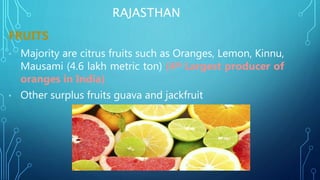
• Majority are citrus fruits such as Oranges, Lemon, Kinnu,
Mausami (4.6 lakh metric ton) (4th Largest producer of
oranges in India)
• Other surplus fruits guava and jackfruit
PROCESSING
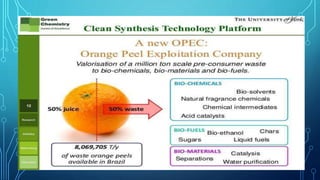
ORANGE AND OTHER CITRUS FRUITS
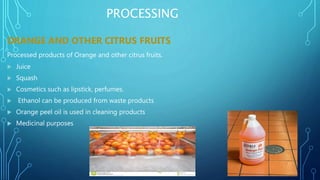
Processed products of Orange and other citrus fruits.
 Juice
 Squash
 Cosmetics such as lipstick, perfumes.
 Ethanol can be produced from waste products
 Orange peel oil is used in cleaning products
 Medicinal purposes
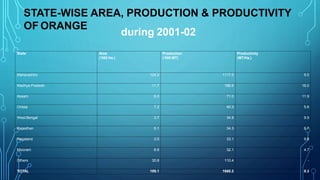
State Area
(‘000 Ha.)
Production
(‘000 MT)
Productivity
(MT/Ha.)
Maharashtra 124.2 1117.5 9.0
Madhya Pradesh 11.7 186.6 16.0
Assam 6.0 71.0 11.9
Orissa 7.2 40.3 5.6
West Bengal 3.7 34.9 9.5
Rajasthan 5.1 34.3 6.7
Nagaland 3.5 33.1 9.6
Mizoram 6.9 32.1 4.7
Others 30.8 110.4 -
TOTAL 199.1 1660.2 8.3
STATE-WISE AREA, PRODUCTION & PRODUCTIVITY
OF ORANGE
during 2001-02
CURRENT SCENARIO
 Majority small scale Industries
 Govt. subsidy upto 50% for large scale industries in Jhalawar district also known as “Nagpur of
Rajasthan”.
 Imparting water saving tech. knowledge taking help with Israel.
 Selling price is as low as 6 Rs/Kg, can be increased by setting up large scale processing industries.
 Only 2% citrus fruits produced are processed.
 Branding of oranges by the name “Raj santra“ done in past few years to increase people’s interest
such as in case of “Himachal apples”
VEGETABLES
RAJASTHA
N
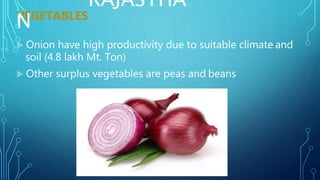
 Onion have high productivity due to suitable climate and
soil (4.8 lakh Mt. Ton)
 Other surplus vegetables are peas and beans
PROCESSIN
GONION
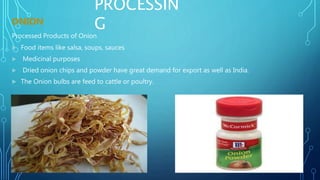
Processed Products of Onion
 Food items like salsa, soups, sauces
 Medicinal purposes
 Dried onion chips and powder have great demand for export as well as India.
 The Onion bulbs are feed to cattle or poultry.
CURRENT SCENARIO
 Ample processing industries present.
 Agro Food Parks developed at Kota, Jodhpur, Sriganganagar and Alwar.
 Although surplus commodity but supply is limited Haryana, Uttarakhand, Punjab and South India.
 Limited amount exported to Oman, Sri lanka, Malasia.
 Drying of onion and essence can be practiced at large so that wastage is less and it can be used
when the prices of onion is at its peak.
GUJARAT
FRUITS
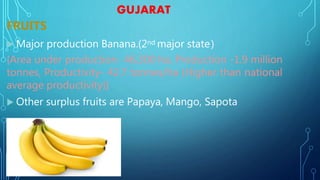
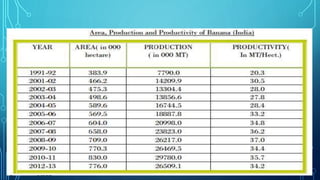
 Major production Banana.(2nd major state)
{Area under production- 46,300 ha, Production -1.9 million
tonnes, Productivity- 42.7 tonnes/ha (Higher than national
average productivity)}
 Other surplus fruits are Papaya, Mango, Sapota
PROCESSING
BANANA
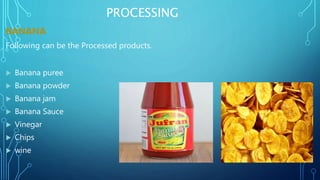
Following can be the Processed products.
 Banana puree
 Banana powder
 Banana jam
 Banana Sauce
 Vinegar
 Chips
 wine
CURRENT SCENARIO
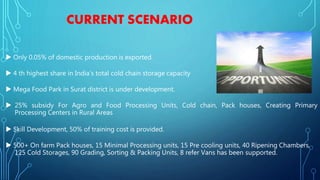
 Only 0.05% of domestic production is exported.
 4 th highest share in India's total cold chain storage capacity
 Mega Food Park in Surat district is under development.
 25% subsidy For Agro and Food Processing Units, Cold chain, Pack houses, Creating Primary
Processing Centers in Rural Areas
 Skill Development, 50% of training cost is provided.
 500+ On farm Pack houses, 15 Minimal Processing units, 15 Pre cooling units, 40 Ripening Chambers,
125 Cold Storages, 90 Grading, Sorting & Packing Units, 8 refer Vans has been supported.
GUJARAT
VEGETABLES
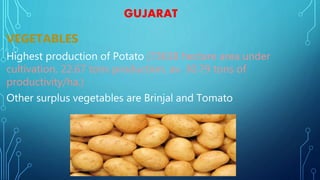
Highest production of Potato (73638 hectare area under
cultivation, 22.67 tons production, av. 30.79 tons of
productivity/ha.)
Other surplus vegetables are Brinjal and Tomato
PROCESSING
POTATO
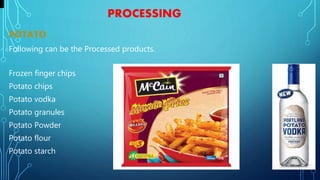
Following can be the Processed products.
Frozen finger chips
Potato chips
Potato vodka
Potato granules
Potato Powder
Potato flour
Potato starch
CURRENT SCENARIO
 Post harvest losses are 15-20%.
 Potato processing industry growing at 5-6%.
 MNC McCain Foods India & Himalaya International Ltd., Balaji Wafers Pvt. Ltd., ATOP Food Products, are
having their processing unit as well as contract farming of potato in large scale.
 During the year 2013-14, Gujarat having around 73638 hectare area under potato & having 22.67 tons
of production with av. 30.79 tons of productivity/ha.
 Cold storage facility of about 8 Lakh MT for potato storage.
 Export countries include Sri-Lanka, Oman, UAE, Bahrain.
Thank You

Fruit and vegetable processing

  • 1.
    FRUIT AND VEGETABLEPROCESSING Suman Shaw
  • 2.
    Processing (canning, drying,freezing, and preparation of juices, jams, and jellies) increases the shelf life of fruits and vegetables. Processing steps include preparation of the raw material (cleaning, trimming, and peeling followed by cooking, canning, or freezing. Plant operation is often seasonal
  • 3.
    The fruit andvegetable industry typically generates large volumes of effluents and solid waste. The effluents contain high organic loads, cleansing and blanching agents, salt, and suspended solids such as fibers and soil particles. They may also contain pesticide residues washed from the raw materials. The main solid wastes are organic materials, including discarded fruits and vegetables. Odor problems can occur with poor management of solid wastes and effluents; when onions are processed; and when ready-to-serve meals are prepared. Waste Characteristics
  • 4.
    Reductions in wastewatervolumes of up to 95% have been reported through implementation of good practices. Where possible, measures such as the following should be adopted:  Procure clean raw fruit and vegetables, thus reducing the concentration of dirt and organics (including pesticides) in the effluent.  Use dry methods such as vibration or air jets to clean raw fruit and vegetables. Dry peeling methods reduce the effluent volume (by up to 35%) and pollutant concentration (organic load reduced by up to 25%).  Separate and recirculate process wastewaters.  Use countercurrent systems where washing is necessary.  Use steam instead of hot water to reduce the quantity of wastewater going for treatment (taking into consideration, however, the tradeoff with increased use of energy).  Minimize the use of water for cleaning floors and machines.  Remove solid wastes without the use of water.  Reuse concentrated wastewaters and solid wastes for production of by-products. Pollution Prevention and Control
  • 5.
    Preliminary treatment ofwastewaters should include screening (or sieving to recover pulp) and grit removal, if necessary. This is followed by pH adjustment and biological treatment of the organic load. The flows are frequently seasonal, and robust treatment systems are preferred for onsite treatment. Pond systems are used successfully to treat fruit and vegetable wastes, but odor nuisance, soil deterioration, and groundwater pollution are to be avoided. The quality of the effluent is normally suitable for discharge to municipal systems, although peak hydraulic loads may cause a problem. Odor problems can be avoided by using gas scrubbers or biofilters. Treatment Technologies
  • 6.
    RAJASTHAN FRUITS • Majority arecitrus fruits such as Oranges, Lemon, Kinnu, Mausami (4.6 lakh metric ton) (4th Largest producer of oranges in India) • Other surplus fruits guava and jackfruit
  • 7.
    PROCESSING ORANGE AND OTHERCITRUS FRUITS Processed products of Orange and other citrus fruits.  Juice  Squash  Cosmetics such as lipstick, perfumes.  Ethanol can be produced from waste products  Orange peel oil is used in cleaning products  Medicinal purposes
  • 9.
    State Area (‘000 Ha.) Production (‘000MT) Productivity (MT/Ha.) Maharashtra 124.2 1117.5 9.0 Madhya Pradesh 11.7 186.6 16.0 Assam 6.0 71.0 11.9 Orissa 7.2 40.3 5.6 West Bengal 3.7 34.9 9.5 Rajasthan 5.1 34.3 6.7 Nagaland 3.5 33.1 9.6 Mizoram 6.9 32.1 4.7 Others 30.8 110.4 - TOTAL 199.1 1660.2 8.3 STATE-WISE AREA, PRODUCTION & PRODUCTIVITY OF ORANGE during 2001-02
  • 10.
    CURRENT SCENARIO  Majoritysmall scale Industries  Govt. subsidy upto 50% for large scale industries in Jhalawar district also known as “Nagpur of Rajasthan”.  Imparting water saving tech. knowledge taking help with Israel.  Selling price is as low as 6 Rs/Kg, can be increased by setting up large scale processing industries.  Only 2% citrus fruits produced are processed.  Branding of oranges by the name “Raj santra“ done in past few years to increase people’s interest such as in case of “Himachal apples”
  • 11.
    VEGETABLES RAJASTHA N  Onion havehigh productivity due to suitable climate and soil (4.8 lakh Mt. Ton)  Other surplus vegetables are peas and beans
  • 12.
    PROCESSIN GONION Processed Products ofOnion  Food items like salsa, soups, sauces  Medicinal purposes  Dried onion chips and powder have great demand for export as well as India.  The Onion bulbs are feed to cattle or poultry.
  • 13.
    CURRENT SCENARIO  Ampleprocessing industries present.  Agro Food Parks developed at Kota, Jodhpur, Sriganganagar and Alwar.  Although surplus commodity but supply is limited Haryana, Uttarakhand, Punjab and South India.  Limited amount exported to Oman, Sri lanka, Malasia.  Drying of onion and essence can be practiced at large so that wastage is less and it can be used when the prices of onion is at its peak.
  • 14.
    GUJARAT FRUITS  Major productionBanana.(2nd major state) {Area under production- 46,300 ha, Production -1.9 million tonnes, Productivity- 42.7 tonnes/ha (Higher than national average productivity)}  Other surplus fruits are Papaya, Mango, Sapota
  • 15.
    PROCESSING BANANA Following can bethe Processed products.  Banana puree  Banana powder  Banana jam  Banana Sauce  Vinegar  Chips  wine
  • 17.
    CURRENT SCENARIO  Only0.05% of domestic production is exported.  4 th highest share in India's total cold chain storage capacity  Mega Food Park in Surat district is under development.  25% subsidy For Agro and Food Processing Units, Cold chain, Pack houses, Creating Primary Processing Centers in Rural Areas  Skill Development, 50% of training cost is provided.  500+ On farm Pack houses, 15 Minimal Processing units, 15 Pre cooling units, 40 Ripening Chambers, 125 Cold Storages, 90 Grading, Sorting & Packing Units, 8 refer Vans has been supported.
  • 18.
    GUJARAT VEGETABLES Highest production ofPotato (73638 hectare area under cultivation, 22.67 tons production, av. 30.79 tons of productivity/ha.) Other surplus vegetables are Brinjal and Tomato
  • 19.
    PROCESSING POTATO Following can bethe Processed products. Frozen finger chips Potato chips Potato vodka Potato granules Potato Powder Potato flour Potato starch
  • 20.
    CURRENT SCENARIO  Postharvest losses are 15-20%.  Potato processing industry growing at 5-6%.  MNC McCain Foods India & Himalaya International Ltd., Balaji Wafers Pvt. Ltd., ATOP Food Products, are having their processing unit as well as contract farming of potato in large scale.  During the year 2013-14, Gujarat having around 73638 hectare area under potato & having 22.67 tons of production with av. 30.79 tons of productivity/ha.  Cold storage facility of about 8 Lakh MT for potato storage.  Export countries include Sri-Lanka, Oman, UAE, Bahrain.
  • 21.