From Microfilm to
Big Data: Can One
Brain Handle This Much
Change Without
Exploding?
John Mancini, @jmancini77
OR….
What is happening to
Content Management
and where will
it be in 2020?
About me
3
● President, AIIM
● Technology and Association
evangelist
● Author:
● 8 Things You Need to Know series
● Information Chaos vs. Information
Opportunity
● OccupyIT: A Technology Manifesto
● Content Management 2020
● Digital Landfill blog
● @jmancini77
AIIM Vision: Information at work that is simple, secure,
and available anywhere, anytime, and on any device.
AIIM mission: Improve organizational performance by
empowering a community of leaders committed to
information-driven innovation.
Click here –
http://www.AIIM.org/infochaos
Click here -
http://info.AIIM.org/cm2020
The forecast for 2020:
1. “ECM" as we know it will be gone, but
“content” will be more important than ever.
2. New best practices are desperately needed.
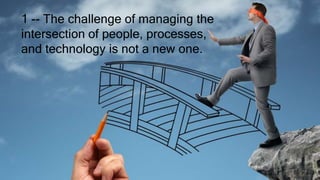
1 -- The challenge of managing the
intersection of people, processes,
and technology is not a new one.
Periods of Transition
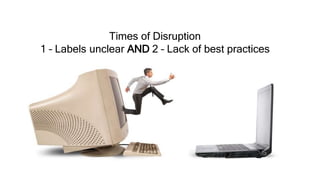
Times of Disruption
1 – Labels unclear AND 2 – Lack of best practices
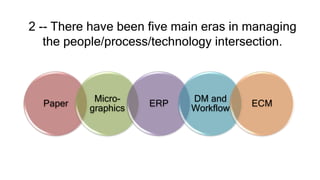
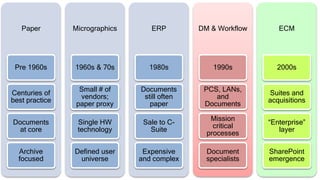
2 -- There have been five main eras in managing
the people/process/technology intersection.
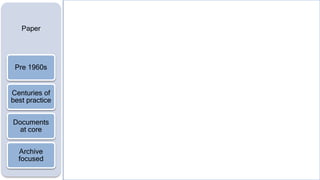
Paper
Micro-
graphics
ERP
DM and
Workflow
ECM
Paper
Pre 1960s
Centuries of
best practice
Documents
at core
Archive
focused
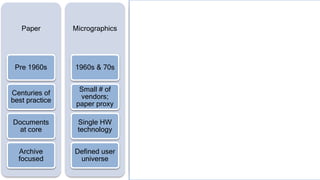
Micrographics
1960s & 70s
Small # of
vendors;
paper proxy
Single HW
technology
Defined user
universe
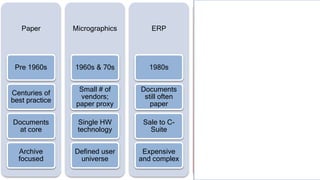
ERP
1980s
Documents
still often
paper
Sale to C-
Suite
Expensive
and complex
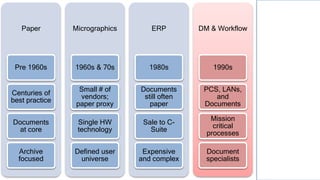
DM & Workflow
1990s
PCS, LANs,
and
Documents
Mission
critical
processes
Document
specialists
ECM
2000s
Suites and
acquisitions
“Enterprise”
layer
SharePoint
emergence
Paper
Pre 1960s
Centuries of
best practice
Documents
at core
Archive
focused
Micrographics
1960s & 70s
Small # of
vendors;
paper proxy
Single HW
technology
Defined user
universe
ERP
1980s
Documents
still often
paper
Sale to C-
Suite
Expensive
and complex
DM & Workflow
1990s
PCS, LANs,
and
Documents
Mission
critical
processes
Document
specialists
ECM
2000s
Suites and
acquisitions
“Enterprise”
layer
SharePoint
emergence
Paper
Pre 1960s
Centuries of
best practice
Documents
at core
Archive
focused
Micrographics
1960s & 70s
Small # of
vendors;
paper proxy
Single HW
technology
Defined user
universe
ERP
1980s
Documents
still often
paper
Sale to C-
Suite
Expensive
and complex
DM & Workflow
1990s
PCS, LANs,
and
Documents
Mission
critical
processes
Document
specialists
ECM
2000s
Suites and
acquisitions
“Enterprise”
layer
SharePoint
emergence
Paper
Pre 1960s
Centuries of
best practice
Documents
at core
Archive
focused
Micrographics
1960s & 70s
Small # of
vendors;
paper proxy
Single HW
technology
Defined user
universe
ERP
1980s
Documents
still often
paper
Sale to C-
Suite
Expensive
and complex
DM & Workflow
1990s
PCS, LANs,
and
Documents
Mission
critical
processes
Document
specialists
ECM
2000s
Suites and
acquisitions
“Enterprise”
layer
SharePoint
emergence
Paper
Pre 1960s
Centuries of
best practice
Documents
at core
Archive
focused
Micrographics
1960s & 70s
Small # of
vendors;
paper proxy
Single HW
technology
Defined user
universe
ERP
1980s
Documents
still often
paper
Sale to C-
Suite
Expensive
and complex
DM & Workflow
1990s
PCS, LANs,
and
Documents
Mission
critical
processes
Document
specialists
ECM
2000s
Suites and
acquisitions
“Enterprise”
layer
SharePoint
emergence
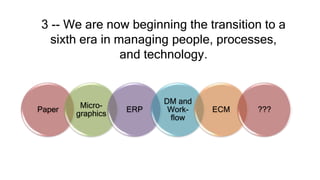
3 -- We are now beginning the transition to a
sixth era in managing people, processes,
and technology.
Paper
Micro-
graphics
ERP
DM and
Work-
flow
ECM ???
The Three Disrupters
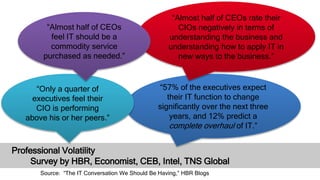
Professional Volatility
Survey by HBR, Economist, CEB, Intel, TNS Global
“57% of the executives expect
their IT function to change
significantly over the next three
years, and 12% predict a
complete overhaul of IT.”
“Almost half of CEOs rate their
CIOs negatively in terms of
understanding the business and
understanding how to apply IT in
new ways to the business.”
“Only a quarter of
executives feel their
CIO is performing
above his or her peers.”
“Almost half of CEOs
feel IT should be a
commodity service
purchased as needed.”
Source: “The IT Conversation We Should Be Having,” HBR Blogs
CONSUMERIZATION is transforming what users
expect from applications and how we deliver them.
We are now in the era of user-centric IT.
CLOUD AND MOBILE are creating an expectation of
anywhere, anytime access and transforming how we
engage with customers and employees.
THE INTERNET OF THINGS is generating massive
amounts of new data and information, creating
enormous new challenges and opportunities.
The Impact…
“Our processes are broken, we are buried in
information and it is killing our ability to satisfy our
customers.”
Process workers –
“Quit making us enter the same information in five
different spreadsheets.”
Knowledge workers –
“We’re drowning in information but thirsty for
knowledge.”
Security officers –
“Information is leaking out of the organization at every turn.”
Records managers and lawyers –
“The volume of information that is beyond our ability to
control is increasing business risk and exposure.”
IT people –
“We can’t keep up with the demands of the business
and they are working around us rather than with us.”
The C-Suite –
“We are spending so much effort just keeping the lights
on that I am afraid we will miss the next wave of
technology and be left behind.”
How do I turn Information Chaos into Information
Opportunity?
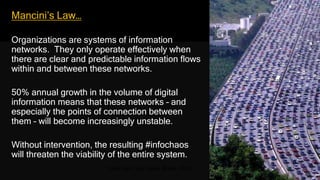
Mancini’s Law…
Organizations are systems of information
networks. They only operate effectively when
there are clear and predictable information flows
within and between these networks.
50% annual growth in the volume of digital
information means that these networks – and
especially the points of connection between
them – will become increasingly unstable.
Without intervention, the resulting #infochaos
will threaten the viability of the entire system.
Traffic jam, Sao Paolo, Brazil, 2009
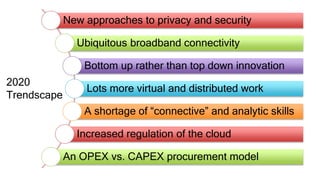
2020
Trendscape
New approaches to privacy and security
Ubiquitous broadband connectivity
Bottom up rather than top down innovation
Lots more virtual and distributed work
A shortage of “connective” and analytic skills
Increased regulation of the cloud
An OPEX vs. CAPEX procurement model
Challenge #1 – We haven’t achieved “ECM” and
customers increasingly don’t think of the problem
that way.
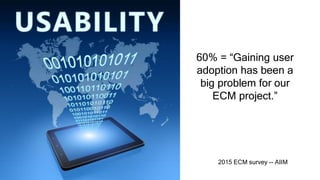
60% = “Gaining user
adoption has been a
big problem for our
ECM project.”
2015 ECM survey -- AIIM
“38% of organizations with
3000+ employees use 5 or
more ECM platforms.”
2015 ECM survey -- AIIM
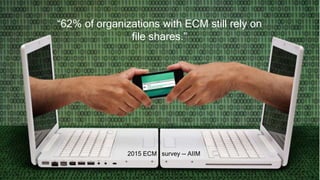
“62% of organizations with ECM still rely on
file shares.”
2015 ECM survey -- AIIM
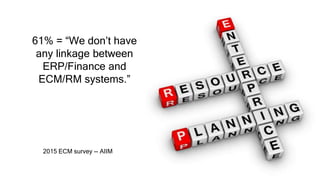
61% = “We don’t have
any linkage between
ERP/Finance and
ECM/RM systems.”
2015 ECM survey -- AIIM
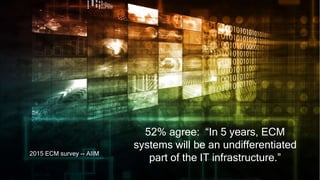
52% agree: “In 5 years, ECM
systems will be an undifferentiated
part of the IT infrastructure.”
2015 ECM survey -- AIIM
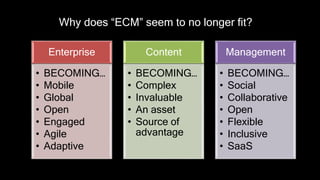
Enterprise
• BECOMING…
• Mobile
• Global
• Open
• Engaged
• Agile
• Adaptive
Content
• BECOMING…
• Complex
• Invaluable
• An asset
• Source of
advantage
Management
• BECOMING…
• Social
• Collaborative
• Open
• Flexible
• Inclusive
• SaaS
Why does “ECM” seem to no longer fit?
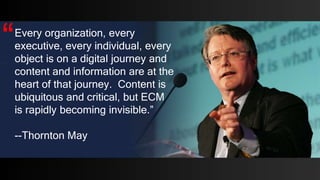
Every organization, every
executive, every individual, every
object is on a digital journey and
content and information are at the
heart of that journey. Content is
ubiquitous and critical, but ECM
is rapidly becoming invisible.”
--Thornton May
“
Challenge #2 – Whatever we call
it, organizations are desperate
for best practices amidst the
chaos of the emerging sixth era.
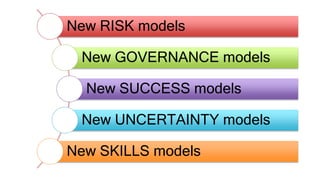
New RISK models
New GOVERNANCE models
New SUCCESS models
New UNCERTAINTY models
New SKILLS models
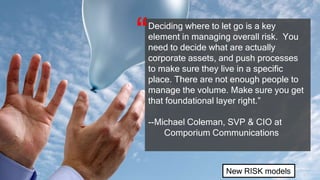
Deciding where to let go is a key
element in managing overall risk. You
need to decide what are actually
corporate assets, and push processes
to make sure they live in a specific
place. There are not enough people to
manage the volume. Make sure you get
that foundational layer right.”
--Michael Coleman, SVP & CIO at
Comporium Communications
“
New RISK models
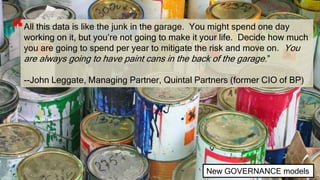
All this data is like the junk in the garage. You might spend one day
working on it, but you’re not going to make it your life. Decide how much
you are going to spend per year to mitigate the risk and move on. You
are always going to have paint cans in the back of the garage.”
--John Leggate, Managing Partner, Quintal Partners (former CIO of BP)
“
New GOVERNANCE models
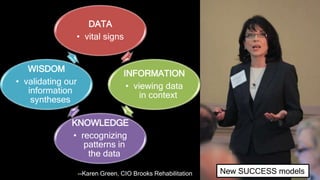
--Karen Green, CIO Brooks Rehabilitation New SUCCESS models
DATA
• vital signs
INFORMATION
• viewing data
in context
KNOWLEDGE
• recognizing
patterns in
the data
WISDOM
• validating our
information
syntheses
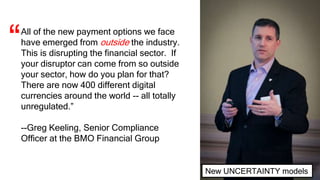
All of the new payment options we face
have emerged from outside the industry.
This is disrupting the financial sector. If
your disruptor can come from so outside
your sector, how do you plan for that?
There are now 400 different digital
currencies around the world -- all totally
unregulated.”
--Greg Keeling, Senior Compliance
Officer at the BMO Financial Group
“
New UNCERTAINTY models
New SKILLS models
The core problem we need to help our
organizations solve…
Where do I put my “stuff” so that it is…
Secure, shareable, and searchable so my
ORGANIZATION can accomplish its goals
and…
Works the way I work and is useful to ME in
getting my job done.
As we build out these best practices
for an uncertain era, the AIIM tribe of
information professionals will be
critical.
Join us on the journey.
Join us in New Orleans at #AIIM16.
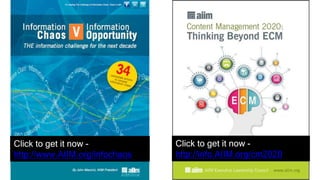
Click to get it now -
http://www.AIIM.org/infochaos
Click to get it now -
http://info.AIIM.org/cm2020

From Microfilm to Big Data - How Can One Brain Handle This Much Change Without Exploding?

  • 1.
    From Microfilm to BigData: Can One Brain Handle This Much Change Without Exploding? John Mancini, @jmancini77
  • 2.
    OR…. What is happeningto Content Management and where will it be in 2020?
  • 3.
    About me 3 ● President,AIIM ● Technology and Association evangelist ● Author: ● 8 Things You Need to Know series ● Information Chaos vs. Information Opportunity ● OccupyIT: A Technology Manifesto ● Content Management 2020 ● Digital Landfill blog ● @jmancini77
  • 4.
    AIIM Vision: Informationat work that is simple, secure, and available anywhere, anytime, and on any device.
  • 5.
    AIIM mission: Improveorganizational performance by empowering a community of leaders committed to information-driven innovation.
  • 6.
  • 7.
  • 8.
    The forecast for2020: 1. “ECM" as we know it will be gone, but “content” will be more important than ever. 2. New best practices are desperately needed.
  • 9.
    1 -- Thechallenge of managing the intersection of people, processes, and technology is not a new one.
  • 10.
    Periods of Transition Timesof Disruption 1 – Labels unclear AND 2 – Lack of best practices
  • 11.
    2 -- Therehave been five main eras in managing the people/process/technology intersection. Paper Micro- graphics ERP DM and Workflow ECM
  • 12.
    Paper Pre 1960s Centuries of bestpractice Documents at core Archive focused Micrographics 1960s & 70s Small # of vendors; paper proxy Single HW technology Defined user universe ERP 1980s Documents still often paper Sale to C- Suite Expensive and complex DM & Workflow 1990s PCS, LANs, and Documents Mission critical processes Document specialists ECM 2000s Suites and acquisitions “Enterprise” layer SharePoint emergence
  • 13.
    Paper Pre 1960s Centuries of bestpractice Documents at core Archive focused Micrographics 1960s & 70s Small # of vendors; paper proxy Single HW technology Defined user universe ERP 1980s Documents still often paper Sale to C- Suite Expensive and complex DM & Workflow 1990s PCS, LANs, and Documents Mission critical processes Document specialists ECM 2000s Suites and acquisitions “Enterprise” layer SharePoint emergence
  • 14.
    Paper Pre 1960s Centuries of bestpractice Documents at core Archive focused Micrographics 1960s & 70s Small # of vendors; paper proxy Single HW technology Defined user universe ERP 1980s Documents still often paper Sale to C- Suite Expensive and complex DM & Workflow 1990s PCS, LANs, and Documents Mission critical processes Document specialists ECM 2000s Suites and acquisitions “Enterprise” layer SharePoint emergence
  • 15.
    Paper Pre 1960s Centuries of bestpractice Documents at core Archive focused Micrographics 1960s & 70s Small # of vendors; paper proxy Single HW technology Defined user universe ERP 1980s Documents still often paper Sale to C- Suite Expensive and complex DM & Workflow 1990s PCS, LANs, and Documents Mission critical processes Document specialists ECM 2000s Suites and acquisitions “Enterprise” layer SharePoint emergence
  • 16.
    Paper Pre 1960s Centuries of bestpractice Documents at core Archive focused Micrographics 1960s & 70s Small # of vendors; paper proxy Single HW technology Defined user universe ERP 1980s Documents still often paper Sale to C- Suite Expensive and complex DM & Workflow 1990s PCS, LANs, and Documents Mission critical processes Document specialists ECM 2000s Suites and acquisitions “Enterprise” layer SharePoint emergence
  • 17.
    3 -- Weare now beginning the transition to a sixth era in managing people, processes, and technology. Paper Micro- graphics ERP DM and Work- flow ECM ???
  • 18.
  • 19.
    Professional Volatility Survey byHBR, Economist, CEB, Intel, TNS Global “57% of the executives expect their IT function to change significantly over the next three years, and 12% predict a complete overhaul of IT.” “Almost half of CEOs rate their CIOs negatively in terms of understanding the business and understanding how to apply IT in new ways to the business.” “Only a quarter of executives feel their CIO is performing above his or her peers.” “Almost half of CEOs feel IT should be a commodity service purchased as needed.” Source: “The IT Conversation We Should Be Having,” HBR Blogs
  • 20.
    CONSUMERIZATION is transformingwhat users expect from applications and how we deliver them. We are now in the era of user-centric IT.
  • 21.
    CLOUD AND MOBILEare creating an expectation of anywhere, anytime access and transforming how we engage with customers and employees.
  • 22.
    THE INTERNET OFTHINGS is generating massive amounts of new data and information, creating enormous new challenges and opportunities.
  • 23.
    The Impact… “Our processesare broken, we are buried in information and it is killing our ability to satisfy our customers.”
  • 24.
    Process workers – “Quitmaking us enter the same information in five different spreadsheets.”
  • 25.
    Knowledge workers – “We’redrowning in information but thirsty for knowledge.”
  • 26.
    Security officers – “Informationis leaking out of the organization at every turn.”
  • 27.
    Records managers andlawyers – “The volume of information that is beyond our ability to control is increasing business risk and exposure.”
  • 28.
    IT people – “Wecan’t keep up with the demands of the business and they are working around us rather than with us.”
  • 29.
    The C-Suite – “Weare spending so much effort just keeping the lights on that I am afraid we will miss the next wave of technology and be left behind.”
  • 30.
    How do Iturn Information Chaos into Information Opportunity?
  • 31.
    Mancini’s Law… Organizations aresystems of information networks. They only operate effectively when there are clear and predictable information flows within and between these networks. 50% annual growth in the volume of digital information means that these networks – and especially the points of connection between them – will become increasingly unstable. Without intervention, the resulting #infochaos will threaten the viability of the entire system. Traffic jam, Sao Paolo, Brazil, 2009
  • 32.
    2020 Trendscape New approaches toprivacy and security Ubiquitous broadband connectivity Bottom up rather than top down innovation Lots more virtual and distributed work A shortage of “connective” and analytic skills Increased regulation of the cloud An OPEX vs. CAPEX procurement model
  • 33.
    Challenge #1 –We haven’t achieved “ECM” and customers increasingly don’t think of the problem that way.
  • 34.
    60% = “Gaininguser adoption has been a big problem for our ECM project.” 2015 ECM survey -- AIIM
  • 35.
    “38% of organizationswith 3000+ employees use 5 or more ECM platforms.” 2015 ECM survey -- AIIM
  • 36.
    “62% of organizationswith ECM still rely on file shares.” 2015 ECM survey -- AIIM
  • 37.
    61% = “Wedon’t have any linkage between ERP/Finance and ECM/RM systems.” 2015 ECM survey -- AIIM
  • 38.
    52% agree: “In5 years, ECM systems will be an undifferentiated part of the IT infrastructure.” 2015 ECM survey -- AIIM
  • 39.
    Enterprise • BECOMING… • Mobile •Global • Open • Engaged • Agile • Adaptive Content • BECOMING… • Complex • Invaluable • An asset • Source of advantage Management • BECOMING… • Social • Collaborative • Open • Flexible • Inclusive • SaaS Why does “ECM” seem to no longer fit?
  • 40.
    Every organization, every executive,every individual, every object is on a digital journey and content and information are at the heart of that journey. Content is ubiquitous and critical, but ECM is rapidly becoming invisible.” --Thornton May “
  • 41.
    Challenge #2 –Whatever we call it, organizations are desperate for best practices amidst the chaos of the emerging sixth era.
  • 42.
    New RISK models NewGOVERNANCE models New SUCCESS models New UNCERTAINTY models New SKILLS models
  • 43.
    Deciding where tolet go is a key element in managing overall risk. You need to decide what are actually corporate assets, and push processes to make sure they live in a specific place. There are not enough people to manage the volume. Make sure you get that foundational layer right.” --Michael Coleman, SVP & CIO at Comporium Communications “ New RISK models
  • 44.
    All this datais like the junk in the garage. You might spend one day working on it, but you’re not going to make it your life. Decide how much you are going to spend per year to mitigate the risk and move on. You are always going to have paint cans in the back of the garage.” --John Leggate, Managing Partner, Quintal Partners (former CIO of BP) “ New GOVERNANCE models
  • 45.
    --Karen Green, CIOBrooks Rehabilitation New SUCCESS models DATA • vital signs INFORMATION • viewing data in context KNOWLEDGE • recognizing patterns in the data WISDOM • validating our information syntheses
  • 46.
    All of thenew payment options we face have emerged from outside the industry. This is disrupting the financial sector. If your disruptor can come from so outside your sector, how do you plan for that? There are now 400 different digital currencies around the world -- all totally unregulated.” --Greg Keeling, Senior Compliance Officer at the BMO Financial Group “ New UNCERTAINTY models
  • 47.
  • 48.
    The core problemwe need to help our organizations solve…
  • 49.
    Where do Iput my “stuff” so that it is… Secure, shareable, and searchable so my ORGANIZATION can accomplish its goals and… Works the way I work and is useful to ME in getting my job done.
  • 50.
    As we buildout these best practices for an uncertain era, the AIIM tribe of information professionals will be critical.
  • 51.
    Join us onthe journey. Join us in New Orleans at #AIIM16.
  • 52.
    Click to getit now - http://www.AIIM.org/infochaos Click to get it now - http://info.AIIM.org/cm2020

Editor's Notes

  • #10 The challenge of managing the intersection of people, processes, and information is not a new one. The business challenge of managing people, processes, and information does not change. However, the technologies and the timeframes that we use to manage this intersection DO, and we are currently in the middle of a phase of high disruption and uncertainty.
  • #11 How do we manage the intersection of people, processes, and information to: 1 -- Improve business processes to produce optimal business results; and 2 -- Document or record those results and the information associated with them. Organizations have dealt with the challenge associated with the intersection of people, processes, and information through a series of technology waves. In each wave or era, it took some time for norms and best practices and standards to emerge. Ultimately these norms did -- generating a period of widespread adoption of that particular technology -- only to be disrupted by the next wave of technology innovation. A couple of things are constants during periods of transition: 1 -- In between eras, the technologies that ultimately become dominant in the next era struggle for an identity and a label. Ultimately an “industry” of key players emerge, and once this happens, the chaos that was characteristic of the time between eras is forgotten. 2 -- In the early stages of each era, early adopters struggle with an absence of clear rules and best practices on how to best proceed. Again, these ultimately emerge, but not without a great deal of confusion during the interim.
  • #13 The Paper Era: For hundreds of years, the technology that fueled the intersection of people, processes and information was paper.
  • #14 The Micrographics Era: During the 1950s, paper began to be replaced -- especially for the task of documenting and recording -- by microfilm and the Micrographics Industry was born. But, paper still remained the primary technology governing the first part of the equation.
  • #15 The ERP Era: In the 1960s, 1970s and into 80s, the first great wave of enterprise IT spending replaced ledgers with data, automated a significant portion of our core back-end business processes, and gave birth to the ERP Industry. However, amidst this automation, paper still retained its dominant role as the vehicle by which most business was conducted -- it remained the primary means to convey information -- and was the primary way that business was documented on a daily basis.
  • #16 The Document Management and Workflow Era: In the 1980s and 1990s, we replaced some of this paper -- mostly the high-volume kind -- in selected, mission-critical processes (like new drug applications in pharmaceuticals or claims processing in insurance). We used closed local area networks to move these new electronic documents around among a limited number of specialized workers within the four walls of the enterprise. Document Management/Workflow emerged as the label we used to describe this era of people, processes and information.
  • #17 The ECM Era: The emergence of the internet and the maturation of core document management and imaging technologies ushered in the Enterprise Content Management Era in the early 2000s. Never a perfect industry label -- and probably more accurately a verb (something you do) than a noun (something you buy) -- “ECM” nonetheless served as a useful umbrella term for a decade. ECM described a cluster of capabilities and technologies that organizations used to capture, store, manage, deliver, and preserve the “content” (mostly images and documents) associated with processes that were 1) document intensive; and 2) mission-critical.
  • #19 Almost half of CEOs feel IT should be a commodity service purchased as needed. Only a quarter of executives feel their CIO is performing above his or her peers. Almost half of CEOs rate their CIOs negatively in terms of understanding the business and understanding apply IT in new ways to the business. 57% of executives expect their IT function to change significantly over the next three years, and 12% predict a complete overhaul of IT.
  • #21 Digital Disruption: Unleashing the Next Wave of Innovation, Forrester’s James McQuivey looks at the four major factors necessary for massive disruption: “A computer? Check. An Internet connection? Check. A programming language and SDK? Check. A friction-free platform for distributing and making money…? Check.”
  • #22 Joe McKendrick points out, “IT cost savings and speedier deployment are but a brief prelude to the main story. It’s only the first 10%. The remaining 90% is what happens to the business itself. It’s the transformation, enabling it to react to market opportunities, communicate and collaborate internally and externally, design and test new products, and become more agile. This ‘second chapter’ to cloud will produce far greater, but far more intangible, benefits.”
  • #24 The intersection of content and process over the past twenty years was best summarized by this continuum: Capture -> Manage -> Store -> Deliver -> Preserve. In this world, much of the following was true... The focus of IT was on cost reduction. Senior executives were largely oblivious to technology, and IT was a cost to be minimized. IT job security was found in system complexity. As mobile and social entered the world of systems of record, initially just their sheer existence was a source of competitive differentiation. System implementations were long and paid for by capital expenditures (CAPEX). Technical skills in and of themselves had value.
  • #33 IMPORTANT AND LIKELY New approaches to privacy and security Ubiquitous broadband connectivity Bottom up rather than top down innovation Lots more virtual and distributed work A shortage of “connective” and analytic skills An OPEX vs. CAPEX procurement model Increased regulation of the cloud by national governments.
  • #40 A new “umbrella” term is needed. ECM needs to become PART of the puzzle, rather than the puzzle itself. There will be many pieces to this puzzle in 2020 -- Content Management, Information Governance, Smart Process Applications, Collaboration and Social Technologies, Taxonomy and Metadata, Scanning and Capture, Content Analytics, Customer Engagement, and Search -- and the lines between “unstructured” and “structured” information will further blur. Organizations must combine analytics, collaboration, governance and processes to manage and leverage information assets more intelligently.
  • #43 Organizations are struggling with a lack of best practices and norms as they make the transition to the sixth era.
  • #44 A -- New Risk Models: How can organizations calibrate information-related risk at a time when nothing is stable and all the old assumptions no longer apply? One thing is clear: organizations have yet to work through the “control” equation for information assets in the sixth era. Some have decided, given the volume, velocity, and variety of information, that the path to risk minimization is to refocus around the core. Others fear that the very act of letting go will set in motion further balkanization of our core systems. Our old underlying assumptions about “control” (largely built upon managing devices) are no longer relevant, and new guiding practices have yet to emerge.
  • #45 A -- New Risk Models: How can organizations calibrate information-related risk at a time when nothing is stable and all the old assumptions no longer apply? One thing is clear: organizations have yet to work through the “control” equation for information assets in the sixth era. Some have decided, given the volume, velocity, and variety of information, that the path to risk minimization is to refocus around the core. Others fear that the very act of letting go will set in motion further balkanization of our core systems. Our old underlying assumptions about “control” (largely built upon managing devices) are no longer relevant, and new guiding practices have yet to emerge.
  • #46 B -- New Success Models: How can organizations move from information chaos to information opportunity? As we enter the sixth era, the demands put upon our information management systems are accelerating, and they are focused on more than cost control. “Information is at the heart of the transformation we are trying to make, and we need to constantly balance regulatory and compliance requirements with this transformation,” notes Karen Green. “As a health care provider, we are striving to make a D-I-K-W migration. We need to go from just collecting DATA (vital signs) to providing INFORMATION (viewing a serial set of vital signs/data in context) to KNOWLEDGE (recognizing patterns in the data) to WISDOM (validating the accuracy of our information syntheses).”
  • #47 C -- New Uncertainty Models: How can organizations better prepare for the future?
  • #48 C -- New Uncertainty Models: How can organizations better prepare for the future?
  • #52 Content management is increasingly everywhere, yet also increasingly invisible. As organizations deal with the two most profound challenges of the next five years -- security and analytics -- content management will become an increasingly important disciple. But it won’t be content management in the old sense of transactionally-centric ECM. And it won’t be as narrow as “information governance” or records management. And it won’t be as simplistic as just bringing Facebook-like social tools into the enterprise. As organizations think about the new intersection of people, process, and technology, and reassess this intersection in light of enormous security concerns and analytics-driven opportunity, how we deal with “content” -- in all of its forms and manifestation -- needs to be a core piece of the puzzle.