


From IoT Devices to Cloud
Computing Infrastructures
When (bi)millions small entities should work with a few giants
F. Desprez, INRIA
Entretiens Jacques Cartier - Montréal October 2017
Introduction
• Exponential improvement of
– Electronics (energy consumption, size, cost)
– Capacity of networks (WAN, wireless)
• Prediction between 28 and 50 billions of connected devices by 2020
(Ericsson, CISCO)
• Exponential growth of applications near users
– Smartphones, tablets, connected devices, sensors, …
• Large number of Cloud facilities to cope with generated data
– Many platforms and infrastructures available around the world
– Several offers for IaaS, PaaS, and SaaS platforms
– Public, private, community, and hybrid clouds
– Going toward distributed Clouds (FOG, Edge)
Entretiens Jacques Cartier - Oct. 2017F. Desprez - From IoT devices to Cloud Computing Infrastructures - 2
Entretiens Jacques Cartier -
Oct. 2017
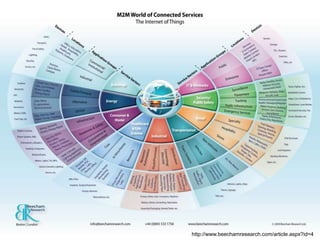
F. Desprez - From IoT devices to Cloud Computing Infrastructures - 3http://www.beechamresearch.com/article.aspx?id=4
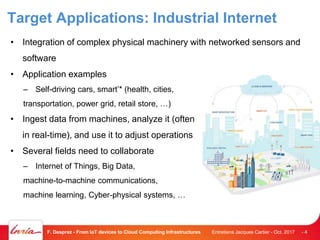
Target Applications: Industrial Internet
• Integration of complex physical machinery with networked sensors and
software
• Application examples
– Self-driving cars, smart’* (health, cities,
transportation, power grid, retail store, …)
• Ingest data from machines, analyze it (often
in real-time), and use it to adjust operations
• Several fields need to collaborate
– Internet of Things, Big Data,
machine-to-machine communications,
machine learning, Cyber-physical systems, …
Entretiens Jacques Cartier - Oct. 2017F. Desprez - From IoT devices to Cloud Computing Infrastructures - 4
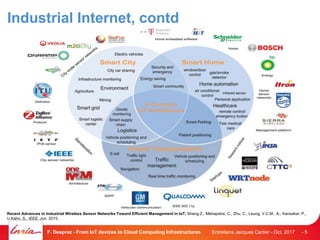
Industrial Internet, contd
Entretiens Jacques Cartier - Oct. 2017F. Desprez - From IoT devices to Cloud Computing Infrastructures - 5
Recent Advances in Industrial Wireless Sensor Networks Toward Efficient Management in IoT, Sheng.Z., Mahapatra, C., Zhu, C., Leung, V.C.M., A., Kansakar, P.,
U.Kahn, S., IEEE, Jun. 2015.
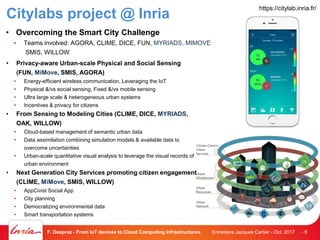
Citylabs project @ Inria
Entretiens Jacques Cartier - Oct. 2017F. Desprez - From IoT devices to Cloud Computing Infrastructures - 6
• Privacy-aware Urban-scale Physical and Social Sensing
(FUN, MiMove, SMIS, AGORA)
• Energy-efficient wireless communication, Leveraging the IoT
• Physical &/vs social sensing, Fixed &/vs mobile sensing
• Ultra large scale & heterogeneous urban systems
• Incentives & privacy for citizens
• From Sensing to Modeling Cities (CLIME, DICE, MYRIADS,
OAK, WILLOW)
• Cloud-based management of semantic urban data
• Data assimilation combining simulation models & available data to
overcome uncertainties
• Urban-scale quantitative visual analysis to leverage the visual records of
urban environment
• Next Generation City Services promoting citizen engagement
(CLIME, MiMove, SMIS, WILLOW)
• AppCivist Social App
• City planning
• Democratizing environmental data
• Smart transportation systems
• Overcoming the Smart City Challenge
• Teams involved: AGORA, CLIME, DICE, FUN, MYRIADS, MIMOVE
SMIS, WILLOW
https://citylab.inria.fr/
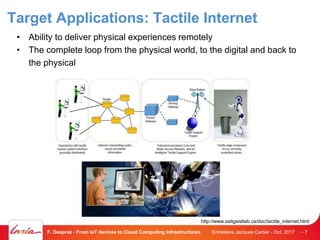
Target Applications: Tactile Internet
• Ability to deliver physical experiences remotely
• The complete loop from the physical world, to the digital and back to
the physical
Entretiens Jacques Cartier - Oct. 2017F. Desprez - From IoT devices to Cloud Computing Infrastructures - 7
http://www.zeitgeistlab.ca/doc/tactile_internet.html
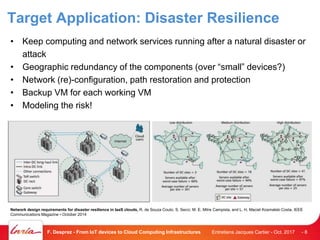
Target Application: Disaster Resilience
• Keep computing and network services running after a natural disaster or
attack
• Geographic redundancy of the components (over “small” devices?)
• Network (re)-configuration, path restoration and protection
• Backup VM for each working VM
• Modeling the risk!
Entretiens Jacques Cartier - Oct. 2017F. Desprez - From IoT devices to Cloud Computing Infrastructures - 8
Network design requirements for disaster resilience in IaaS clouds, R. de Souza Couto, S. Secci, M. E. Mitre Campista, and L. H. Maciel Kosmalski Costa, IEEE
Communications Magazine • October 2014
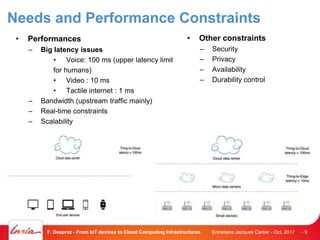
Needs and Performance Constraints
• Performances
– Big latency issues
• Voice: 100 ms (upper latency limit
for humans)
• Video : 10 ms
• Tactile internet : 1 ms
– Bandwidth (upstream traffic mainly)
– Real-time constraints
– Scalability
Entretiens Jacques Cartier - Oct. 2017F. Desprez - From IoT devices to Cloud Computing Infrastructures - 9
• Other constraints
– Security
– Privacy
– Availability
– Durability control
Entretiens Jacques Cartier -
Oct. 2017
F. Desprez - From IoT devices to Cloud Computing Infrastructures - 10
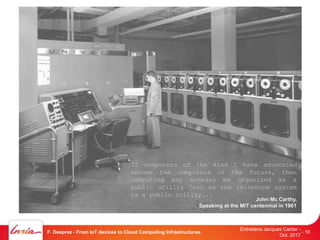
John Mc Carthy,
Speaking at the MIT centennial in 1961
If computers of the kind I have advocated
become the computers of the future, then
computing may someday be organized as a
public utility just as the telephone system
is a public utility...
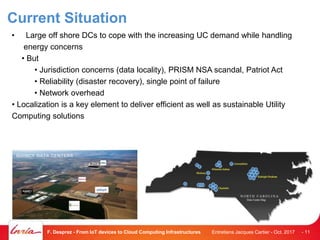
Current Situation
Entretiens Jacques Cartier - Oct. 2017F. Desprez - From IoT devices to Cloud Computing Infrastructures - 11
• Large off shore DCs to cope with the increasing UC demand while handling
energy concerns
• But
• Jurisdiction concerns (data locality), PRISM NSA scandal, Patriot Act
• Reliability (disaster recovery), single point of failure
• Network overhead
• Localization is a key element to deliver efficient as well as sustainable Utility
Computing solutions
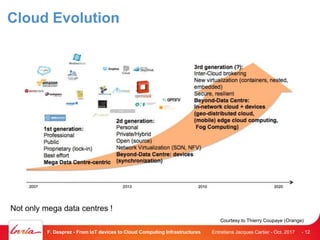
Cloud Evolution
Not only mega data centres !
Entretiens Jacques Cartier - Oct. 2017F. Desprez - From IoT devices to Cloud Computing Infrastructures - 12
Courtesy to Thierry Coupaye (Orange)
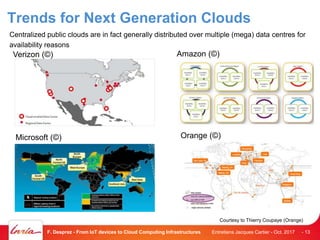
Trends for Next Generation Clouds
Centralized public clouds are in fact generally distributed over multiple (mega) data centres for
availability reasons
Entretiens Jacques Cartier - Oct. 2017F. Desprez - From IoT devices to Cloud Computing Infrastructures - 13
Verizon (©)
Orange (©)Microsoft (©)
Amazon (©)
Courtesy to Thierry Coupaye (Orange)
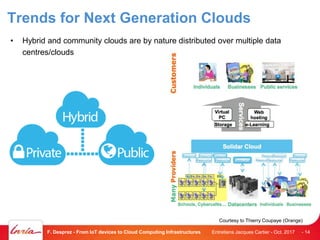
Trends for Next Generation Clouds
• Hybrid and community clouds are by nature distributed over multiple data
centres/clouds
Entretiens Jacques Cartier - Oct. 2017F. Desprez - From IoT devices to Cloud Computing Infrastructures - 14
Courtesy to Thierry Coupaye (Orange)
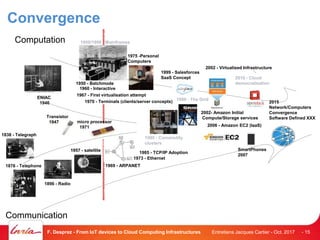
Convergence
Entretiens Jacques Cartier - Oct. 2017F. Desprez - From IoT devices to Cloud Computing Infrastructures - 15
ENIAC
1946
Transistor
1947
Computation
Communication
1999 - Salesforces
SaaS Concept
micro processor
1971
1838 - Telegraph
1876 - Telephone
1896 - Radio
1957 - satellite
1969 - ARPANET
1973 - Ethernet
1985 - TCP/IP Adoption
1975 -Personal
Computers
SmartPhones
2007
2002- Amazon Initial
Compute/Storage services
2006 - Amazon EC2 (IaaS)
2010 - Cloud
democratisation
2015
Network/Computers
Convergence
Software Defined XXX
1999 - The Grid
1995 - Commodity
clusters
2002 - Virtualised Infrastructure
1950/1990 - Mainframes
1950 - Batchmode
1960 - Interactive
1970 - Terminals (clients/server concepts)
1967 - First virtualisation attempt
Clouds, FOG, and Edge
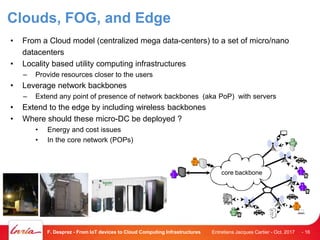
• From a Cloud model (centralized mega data-centers) to a set of micro/nano
datacenters
• Locality based utility computing infrastructures
– Provide resources closer to the users
• Leverage network backbones
– Extend any point of presence of network backbones (aka PoP) with servers
• Extend to the edge by including wireless backbones
• Where should these micro-DC be deployed ?
• Energy and cost issues
• In the core network (POPs)
Entretiens Jacques Cartier - Oct. 2017F. Desprez - From IoT devices to Cloud Computing Infrastructures - 16
P
a
ul
a
B
o
b
Al
ic
e
D
u
k
e
Ch
arle
s
P
a
m
B
o
b
core backbone
Clouds, FOG, and Edge
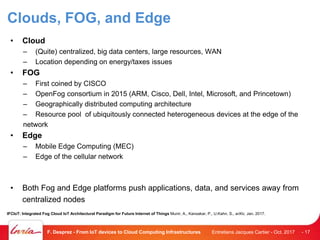
• Cloud
– (Quite) centralized, big data centers, large resources, WAN
– Location depending on energy/taxes issues
• FOG
– First coined by CISCO
– OpenFog consortium in 2015 (ARM, Cisco, Dell, Intel, Microsoft, and Princetown)
– Geographically distributed computing architecture
– Resource pool of ubiquitously connected heterogeneous devices at the edge of the
network
• Edge
– Mobile Edge Computing (MEC)
– Edge of the cellular network
• Both Fog and Edge platforms push applications, data, and services away from
centralized nodes
Entretiens Jacques Cartier - Oct. 2017F. Desprez - From IoT devices to Cloud Computing Infrastructures - 17
IFCIoT: Integrated Fog Cloud IoT Architectural Paradigm for Future Internet of Things Munir, A., Kansakar, P., U.Kahn, S., arXiv, Jan. 2017.
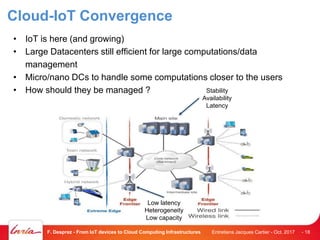
Cloud-IoT Convergence
• IoT is here (and growing)
• Large Datacenters still efficient for large computations/data
management
• Micro/nano DCs to handle some computations closer to the users
• How should they be managed ?
Entretiens Jacques Cartier - Oct. 2017F. Desprez - From IoT devices to Cloud Computing Infrastructures - 18
Stability
Availability
Latency
Low latency
Heterogeneity
Low capacity
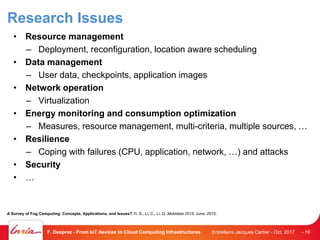
Research Issues
• Resource management
– Deployment, reconfiguration, location aware scheduling
• Data management
– User data, checkpoints, application images
• Network operation
– Virtualization
• Energy monitoring and consumption optimization
– Measures, resource management, multi-criteria, multiple sources, …
• Resilience
– Coping with failures (CPU, application, network, …) and attacks
• Security
• …
Entretiens Jacques Cartier - Oct. 2017F. Desprez - From IoT devices to Cloud Computing Infrastructures - 19
A Survey of Fog Computing: Concepts, Applications, and Issues? Yi, S., Li, C., Li, Q, Mobidata 2015, June. 2015.
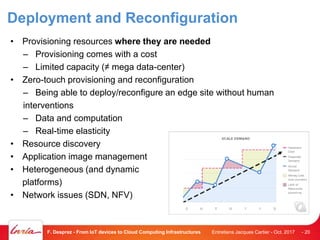
Deployment and Reconfiguration
• Provisioning resources where they are needed
– Provisioning comes with a cost
– Limited capacity (≠ mega data-center)
• Zero-touch provisioning and reconfiguration
– Being able to deploy/reconfigure an edge site without human
interventions
– Data and computation
– Real-time elasticity
• Resource discovery
• Application image management
• Heterogeneous (and dynamic
platforms)
• Network issues (SDN, NFV)
Entretiens Jacques Cartier - Oct. 2017F. Desprez - From IoT devices to Cloud Computing Infrastructures - 20
Locality Aware Resource Management
• Mechanisms to manage the life cycle of applications (VM, containers,
bare metal) and data (users, applications) taking locality into account
• Several objective functions (multi-criteria scheduling)
– Resource consumption
– Network cost
– Energy
– $
• Classical scheduling/mapping problems revisited
– Many papers using classical ILP solvers (scaling issues there !)
• Placement of application graphs over infrastructure graphs
– Static or dynamic
• What’s about dynamicity ?
– Clients moving from one place to an other
– Failures
Entretiens Jacques Cartier - Oct. 2017F. Desprez - From IoT devices to Cloud Computing Infrastructures - 21
Locality Aware Resource Management
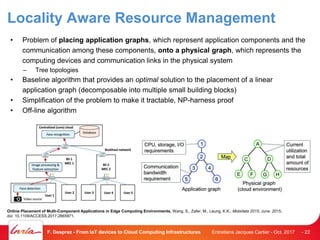
• Problem of placing application graphs, which represent application components and the
communication among these components, onto a physical graph, which represents the
computing devices and communication links in the physical system
– Tree topologies
• Baseline algorithm that provides an optimal solution to the placement of a linear
application graph (decomposable into multiple small building blocks)
• Simplification of the problem to make it tractable, NP-harness proof
• Off-line algorithm
Entretiens Jacques Cartier - Oct. 2017F. Desprez - From IoT devices to Cloud Computing Infrastructures - 22
Online Placement of Multi-Component Applications in Edge Computing Environments, Wang, S., Zafer, M., Leung, K.K., Mobidata 2015, June. 2015,
doi: 10.1109/ACCESS.2017.2665971.
Energy Monitoring and Consumption
Optimization
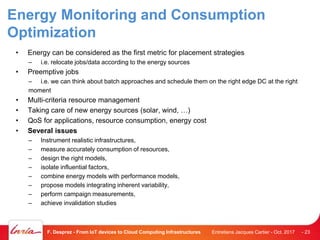
• Energy can be considered as the first metric for placement strategies
– i.e. relocate jobs/data according to the energy sources
• Preemptive jobs
– i.e. we can think about batch approaches and schedule them on the right edge DC at the right
moment
• Multi-criteria resource management
• Taking care of new energy sources (solar, wind, …)
• QoS for applications, resource consumption, energy cost
• Several issues
– Instrument realistic infrastructures,
– measure accurately consumption of resources,
– design the right models,
– isolate influential factors,
– combine energy models with performance models,
– propose models integrating inherent variability,
– perform campaign measurements,
– achieve invalidation studies
Entretiens Jacques Cartier - Oct. 2017F. Desprez - From IoT devices to Cloud Computing Infrastructures - 23
Renewable Energy and IoT
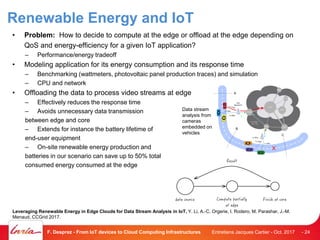
• Problem: How to decide to compute at the edge or offload at the edge depending on
QoS and energy-efficiency for a given IoT application?
– Performance/energy tradeoff
• Modeling application for its energy consumption and its response time
– Benchmarking (wattmeters, photovoltaic panel production traces) and simulation
– CPU and network
• Offloading the data to process video streams at edge
– Effectively reduces the response time
– Avoids unnecessary data transmission
between edge and core
– Extends for instance the battery lifetime of
end-user equipment
– On-site renewable energy production and
batteries in our scenario can save up to 50% total
consumed energy consumed at the edge
Entretiens Jacques Cartier - Oct. 2017F. Desprez - From IoT devices to Cloud Computing Infrastructures - 24
Leveraging Renewable Energy in Edge Clouds for Data Stream Analysis in IoT, Y. Li, A.-C. Orgerie, I. Rodero, M. Parashar, J.-M.
Menaud, CCGrid 2017.
Edge
Core
Edge1
data
aggregation
v-4 720p
v-5 480p
v-6 360p
Core
Edge
Core
Edge0
v-3 360p
v-2 360p
v-1 360p
r0: p=(a,b),
ac = n%
A
B
C
Data stream
analysis from
cameras
embedded on
vehicles
Resilience
• Several Cloud failures in the past
– Dropbox, Netflix, Amazon
– Huge costs involved
• Advantage of Edge computing platforms
– No single point of failure
• At the infrastructure level
– Replication of VMs and data on various geographic locations
– Proactive and reactive strategies taking into account network latency into
account
• At the middleware level
– Rescheduling of failed tasks
• At the application level
– Periodical checkpointing (taking into account locality)
Entretiens Jacques Cartier - Oct. 2017F. Desprez - From IoT devices to Cloud Computing Infrastructures - 25
A Survey of Fog Computing: Concepts, Applications, and Issues? Yi, S., Li, C., Li, Q, Mobidata 2015, June. 2015.
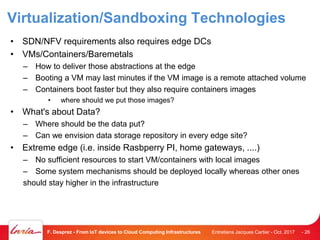
Virtualization/Sandboxing Technologies
• SDN/NFV requirements also requires edge DCs
• VMs/Containers/Baremetals
– How to deliver those abstractions at the edge
– Booting a VM may last minutes if the VM image is a remote attached volume
– Containers boot faster but they also require containers images
• where should we put those images?
• What's about Data?
– Where should be the data put?
– Can we envision data storage repository in every edge site?
• Extreme edge (i.e. inside Rasbperry PI, home gateways, ....)
– No sufficient resources to start VM/containers with local images
– Some system mechanisms should be deployed locally whereas other ones
should stay higher in the infrastructure
Entretiens Jacques Cartier - Oct. 2017F. Desprez - From IoT devices to Cloud Computing Infrastructures - 26
Other issues
• FOG networking
– Maintaining connectivity with heterogeneous (and dynamic) networks
– Use/adaptation of Software Defined Networking (SDN) and Network
Function Virtualization (NFV) features
– Quality of Service
• Interfacing and programming model
– Right now assembly code level (bunch of low level models for each kind of
platforms)
– Need of a unified model ?
• Accounting, billing and monitoring
• Privacy
• Simulation and experiments
– How to validate algorithms, protocols, and software stacks
Entretiens Jacques Cartier - Oct. 2017F. Desprez - From IoT devices to Cloud Computing Infrastructures - 27
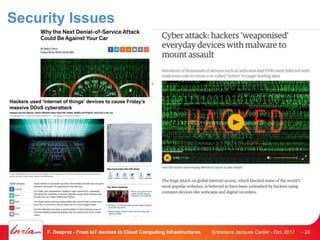
Security Issues
Entretiens Jacques Cartier - Oct. 2017F. Desprez - From IoT devices to Cloud Computing Infrastructures - 28
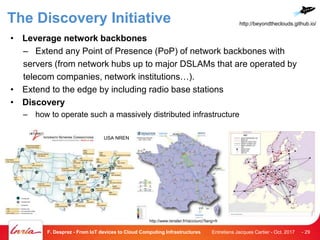
The Discovery Initiative
• Leverage network backbones
– Extend any Point of Presence (PoP) of network backbones with
servers (from network hubs up to major DSLAMs that are operated by
telecom companies, network institutions…).
• Extend to the edge by including radio base stations
• Discovery
– how to operate such a massively distributed infrastructure
Entretiens Jacques Cartier - Oct. 2017F. Desprez - From IoT devices to Cloud Computing Infrastructures - 29
USA NREN
http://www.renater.fr/raccourci?lang=fr
http://beyondtheclouds.github.io/
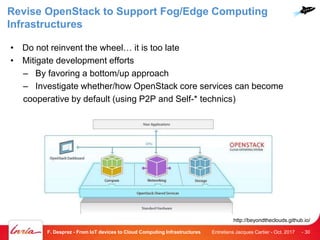
Revise OpenStack to Support Fog/Edge Computing
Infrastructures
• Do not reinvent the wheel… it is too late
• Mitigate development efforts
– By favoring a bottom/up approach
– Investigate whether/how OpenStack core services can become
cooperative by default (using P2P and Self-* technics)
Entretiens Jacques Cartier - Oct. 2017F. Desprez - From IoT devices to Cloud Computing Infrastructures - 30
http://beyondtheclouds.github.io/
Several research issues for Discovery
• Cost of the network(s) ?
• Partial view of the system ?
• Impact on others VMs ?
• Management of VM images ?
• How to take into account locality aspects?
• Which software abstractions to make the development easier and
more reliable (distributed event programming)? …
• OpenStack distribution and deployment
Entretiens Jacques Cartier - Oct. 2017F. Desprez - From IoT devices to Cloud Computing Infrastructures - 31
Beyond The Cloud, How Should Next Generation Utility Computing Infrastructures Be Designed? Lèbre, A., J. Pastor, J., Bertier, M., Desprez, F., Rouzaud-
Cornabas, J., Tedeschi, C., Anedda, P., Zanetti, G., Nou, R., Cortes, T., Riviere, E. and Ropars, T., INRIA Research Report 8348, Aug. 2013.
http://beyondtheclouds.github.io/
• Pro
• Locality (jurisdiction concerns, latency-aware apps, minimize network overhead)
• Reliability/redundancy (no critical point/location/center)
• The infrastructure is naturally distributed throughout multiple areas
• Lead time to delivery
• Leverage current PoPs and extend them according to UC demands
• Energy footprint (on-going investigations with RENATER)
• Bring back part of the revenue to NRENs/Telcos
• Cons
• Security concerns (in terms of who can access to the PoPs)
• Operate a fully IaaS in a unified but distributed manner at WAN level
• Not suited for all kinds of applications : Large tightly coupled HPC workloads 50 nodes/1000 cores,
200 nodes / 4000 cores (5 racks), so 1000 nodes in one PoP does not look realistic …
• Peering agreement / economic model between network operators
http://beyondtheclouds.github.io/
32Labex UCN@Sophia – F. Desprez Feb. 18, 2016
The DISCOVERY Initiative Pros and Cons
“Good experiments”
A good experiment should fulfill the following properties
– Reproducibility: must give the same result with the same input
– Extensibility: must target possible comparisons with other works
and extensions (more/other processors, larger data sets,
different architectures)
– Applicability: must define realistic parameters and must allow
for an easy calibration
– “Revisability”: when an implementation does not perform as
expected, must help to identify the reasons
Entretiens Jacques Cartier - Oct. 2017F. Desprez - From IoT devices to Cloud Computing Infrastructures - 33
SILECS: Super Infrastructure for Large-
scale Experimental Computer Science
• Having a large scale infrastructure to experiment IoT/Edge cloud
applications and software stacks
– Scaling factor
– Exascale platforms
– Virtualized, Programmable
– FOG and Mobile Edge Computing
• Features
– Manageability
• Agility (SDN, NFV)
• Self adaptability
• Global orchestration
– Complexity
• Resources
• Energy
– Data Flow Management
• Data deluge processing
Entretiens Jacques Cartier - Oct. 2017F. Desprez - From IoT devices to Cloud Computing Infrastructures - 34
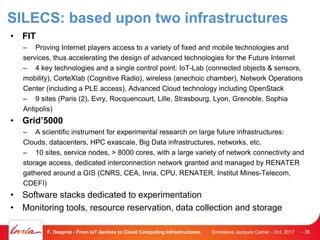
SILECS: based upon two infrastructures
• FIT
– Proving Internet players access to a variety of fixed and mobile technologies and
services, thus accelerating the design of advanced technologies for the Future Internet
– 4 key technologies and a single control point: IoT-Lab (connected objects & sensors,
mobility), CorteXlab (Cognitive Radio), wireless (anechoic chamber), Network Operations
Center (including a PLE access), Advanced Cloud technology including OpenStack
– 9 sites (Paris (2), Evry, Rocquencourt, Lille, Strasbourg, Lyon, Grenoble, Sophia
Antipolis)
• Grid’5000
– A scientific instrument for experimental research on large future infrastructures:
Clouds, datacenters, HPC exascale, Big Data infrastructures, networks, etc.
– 10 sites, service nodes, > 8000 cores, with a large variety of network connectivity and
storage access, dedicated interconnection network granted and managed by RENATER
gathered around a GIS (CNRS, CEA, Inria, CPU, RENATER, Institut Mines-Telecom,
CDEFI)
• Software stacks dedicated to experimentation
• Monitoring tools, resource reservation, data collection and storage
Entretiens Jacques Cartier - Oct. 2017F. Desprez - From IoT devices to Cloud Computing Infrastructures - 35
Grid’5000
Entretiens Jacques Cartier - Oct. 2017F. Desprez - From IoT devices to Cloud Computing Infrastructures - 36
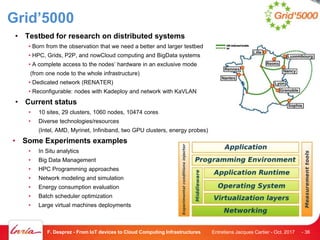
• Testbed for research on distributed systems
• Born from the observation that we need a better and larger testbed
• HPC, Grids, P2P, and nowCloud computing and BigData systems
• A complete access to the nodes’ hardware in an exclusive mode
(from one node to the whole infrastructure)
• Dedicated network (RENATER)
• Reconfigurable: nodes with Kadeploy and network with KaVLAN
• Current status
• 10 sites, 29 clusters, 1060 nodes, 10474 cores
• Diverse technologies/resources
(Intel, AMD, Myrinet, Infiniband, two GPU clusters, energy probes)
• Some Experiments examples
• In Situ analytics
• Big Data Management
• HPC Programming approaches
• Network modeling and simulation
• Energy consumption evaluation
• Batch scheduler optimization
• Large virtual machines deployments
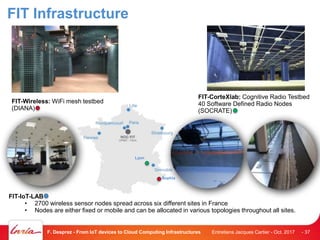
FIT Infrastructure
Entretiens Jacques Cartier - Oct. 2017F. Desprez - From IoT devices to Cloud Computing Infrastructures - 37
FIT-CorteXlab: Cognitive Radio Testbed
40 Software Defined Radio Nodes
(SOCRATE)
FIT-Wireless: WiFi mesh testbed
(DIANA)
FIT-IoT-LAB
• 2700 wireless sensor nodes spread across six different sites in France
• Nodes are either fixed or mobile and can be allocated in various topologies throughout all sites.
Sophia
Lyon
SILECS Design Objectives
• Deploy a large set of digital resources from sensors to data centers
– Open, remotely accessible, virtualized infrastructure
– Provide rich, diverse and advanced tools: test, measurement, benchmarking,
reproducibility, data repository, …
– Typically a « mid-scale » infrastructure
• Mobilize the scientific community in the domain of digital sciences
– Articulate the French and European efforts in this domain
– International attractivity and visibility (unique today at the international level)
• Several challenges
– Heterogeneity of the resulting infrastructures
– Different communities and different software stacks
– Keep reproducibility at its highest level
– Keep the infrastructure up-to-date
– Connect the infrastructure to other platforms in Europe and elsewhere
Entretiens Jacques Cartier - Oct. 2017F. Desprez - From IoT devices to Cloud Computing Infrastructures - 38
Entretiens Jacques Cartier - Oct. 2017F. Desprez - From IoT devices to Cloud Computing Infrastructures - 39
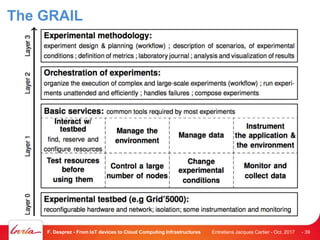
The GRAIL
SILECS
Entretiens Jacques Cartier - Oct. 2017F. Desprez - From IoT devices to Cloud Computing Infrastructures - 40
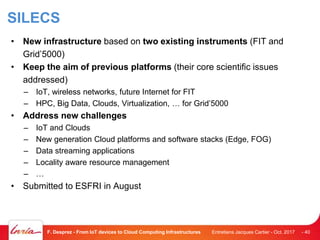
• New infrastructure based on two existing instruments (FIT and
Grid’5000)
• Keep the aim of previous platforms (their core scientific issues
addressed)
– IoT, wireless networks, future Internet for FIT
– HPC, Big Data, Clouds, Virtualization, … for Grid’5000
• Address new challenges
– IoT and Clouds
– New generation Cloud platforms and software stacks (Edge, FOG)
– Data streaming applications
– Locality aware resource management
– …
• Submitted to ESFRI in August
Conclusions
• Epic battle between centralization and distribution
– Batch processing, supercomputers, P2P, Grid, Cloud, Fog, and Edge
• Tons of new applications (with new related issues) coming
• Probably a mix of different approaches to get the best from every
infrastructure
– Regular DC, Edge, Extreme Edge
– Performance, Quality of Service, energy consumption
• Lots of research issues (both theoretical and software design issues)
• Distributed computing/network convergence
• We need new models to handle heterogeneity (CPU, networks,
storage) and dynamicity
• Scale issue
• How to perform significant experiments for these problems ?
• We live in an exciting time !
Entretiens Jacques Cartier - Oct. 2017F. Desprez - From IoT devices to Cloud Computing Infrastructures - 41
Thanks. Any questions ?
Thanks to Adrien Lebre (ASCOLA/STACK,
Inria, France), Anne-Cécile Orgerie (Myriads,
Inria, France), Thierry Coupaye (Orange,
France), Omer Rana (UK)

From IoT Devices to Cloud

  • 1.
    From IoT Devicesto Cloud Computing Infrastructures When (bi)millions small entities should work with a few giants F. Desprez, INRIA Entretiens Jacques Cartier - Montréal October 2017
  • 2.
    Introduction • Exponential improvementof – Electronics (energy consumption, size, cost) – Capacity of networks (WAN, wireless) • Prediction between 28 and 50 billions of connected devices by 2020 (Ericsson, CISCO) • Exponential growth of applications near users – Smartphones, tablets, connected devices, sensors, … • Large number of Cloud facilities to cope with generated data – Many platforms and infrastructures available around the world – Several offers for IaaS, PaaS, and SaaS platforms – Public, private, community, and hybrid clouds – Going toward distributed Clouds (FOG, Edge) Entretiens Jacques Cartier - Oct. 2017F. Desprez - From IoT devices to Cloud Computing Infrastructures - 2
  • 3.
    Entretiens Jacques Cartier- Oct. 2017 F. Desprez - From IoT devices to Cloud Computing Infrastructures - 3http://www.beechamresearch.com/article.aspx?id=4
  • 4.
    Target Applications: IndustrialInternet • Integration of complex physical machinery with networked sensors and software • Application examples – Self-driving cars, smart’* (health, cities, transportation, power grid, retail store, …) • Ingest data from machines, analyze it (often in real-time), and use it to adjust operations • Several fields need to collaborate – Internet of Things, Big Data, machine-to-machine communications, machine learning, Cyber-physical systems, … Entretiens Jacques Cartier - Oct. 2017F. Desprez - From IoT devices to Cloud Computing Infrastructures - 4
  • 5.
    Industrial Internet, contd EntretiensJacques Cartier - Oct. 2017F. Desprez - From IoT devices to Cloud Computing Infrastructures - 5 Recent Advances in Industrial Wireless Sensor Networks Toward Efficient Management in IoT, Sheng.Z., Mahapatra, C., Zhu, C., Leung, V.C.M., A., Kansakar, P., U.Kahn, S., IEEE, Jun. 2015.
  • 6.
    Citylabs project @Inria Entretiens Jacques Cartier - Oct. 2017F. Desprez - From IoT devices to Cloud Computing Infrastructures - 6 • Privacy-aware Urban-scale Physical and Social Sensing (FUN, MiMove, SMIS, AGORA) • Energy-efficient wireless communication, Leveraging the IoT • Physical &/vs social sensing, Fixed &/vs mobile sensing • Ultra large scale & heterogeneous urban systems • Incentives & privacy for citizens • From Sensing to Modeling Cities (CLIME, DICE, MYRIADS, OAK, WILLOW) • Cloud-based management of semantic urban data • Data assimilation combining simulation models & available data to overcome uncertainties • Urban-scale quantitative visual analysis to leverage the visual records of urban environment • Next Generation City Services promoting citizen engagement (CLIME, MiMove, SMIS, WILLOW) • AppCivist Social App • City planning • Democratizing environmental data • Smart transportation systems • Overcoming the Smart City Challenge • Teams involved: AGORA, CLIME, DICE, FUN, MYRIADS, MIMOVE SMIS, WILLOW https://citylab.inria.fr/
  • 7.
    Target Applications: TactileInternet • Ability to deliver physical experiences remotely • The complete loop from the physical world, to the digital and back to the physical Entretiens Jacques Cartier - Oct. 2017F. Desprez - From IoT devices to Cloud Computing Infrastructures - 7 http://www.zeitgeistlab.ca/doc/tactile_internet.html
  • 8.
    Target Application: DisasterResilience • Keep computing and network services running after a natural disaster or attack • Geographic redundancy of the components (over “small” devices?) • Network (re)-configuration, path restoration and protection • Backup VM for each working VM • Modeling the risk! Entretiens Jacques Cartier - Oct. 2017F. Desprez - From IoT devices to Cloud Computing Infrastructures - 8 Network design requirements for disaster resilience in IaaS clouds, R. de Souza Couto, S. Secci, M. E. Mitre Campista, and L. H. Maciel Kosmalski Costa, IEEE Communications Magazine • October 2014
  • 9.
    Needs and PerformanceConstraints • Performances – Big latency issues • Voice: 100 ms (upper latency limit for humans) • Video : 10 ms • Tactile internet : 1 ms – Bandwidth (upstream traffic mainly) – Real-time constraints – Scalability Entretiens Jacques Cartier - Oct. 2017F. Desprez - From IoT devices to Cloud Computing Infrastructures - 9 • Other constraints – Security – Privacy – Availability – Durability control
  • 10.
    Entretiens Jacques Cartier- Oct. 2017 F. Desprez - From IoT devices to Cloud Computing Infrastructures - 10 John Mc Carthy, Speaking at the MIT centennial in 1961 If computers of the kind I have advocated become the computers of the future, then computing may someday be organized as a public utility just as the telephone system is a public utility...
  • 11.
    Current Situation Entretiens JacquesCartier - Oct. 2017F. Desprez - From IoT devices to Cloud Computing Infrastructures - 11 • Large off shore DCs to cope with the increasing UC demand while handling energy concerns • But • Jurisdiction concerns (data locality), PRISM NSA scandal, Patriot Act • Reliability (disaster recovery), single point of failure • Network overhead • Localization is a key element to deliver efficient as well as sustainable Utility Computing solutions
  • 12.
    Cloud Evolution Not onlymega data centres ! Entretiens Jacques Cartier - Oct. 2017F. Desprez - From IoT devices to Cloud Computing Infrastructures - 12 Courtesy to Thierry Coupaye (Orange)
  • 13.
    Trends for NextGeneration Clouds Centralized public clouds are in fact generally distributed over multiple (mega) data centres for availability reasons Entretiens Jacques Cartier - Oct. 2017F. Desprez - From IoT devices to Cloud Computing Infrastructures - 13 Verizon (©) Orange (©)Microsoft (©) Amazon (©) Courtesy to Thierry Coupaye (Orange)
  • 14.
    Trends for NextGeneration Clouds • Hybrid and community clouds are by nature distributed over multiple data centres/clouds Entretiens Jacques Cartier - Oct. 2017F. Desprez - From IoT devices to Cloud Computing Infrastructures - 14 Courtesy to Thierry Coupaye (Orange)
  • 15.
    Convergence Entretiens Jacques Cartier- Oct. 2017F. Desprez - From IoT devices to Cloud Computing Infrastructures - 15 ENIAC 1946 Transistor 1947 Computation Communication 1999 - Salesforces SaaS Concept micro processor 1971 1838 - Telegraph 1876 - Telephone 1896 - Radio 1957 - satellite 1969 - ARPANET 1973 - Ethernet 1985 - TCP/IP Adoption 1975 -Personal Computers SmartPhones 2007 2002- Amazon Initial Compute/Storage services 2006 - Amazon EC2 (IaaS) 2010 - Cloud democratisation 2015 Network/Computers Convergence Software Defined XXX 1999 - The Grid 1995 - Commodity clusters 2002 - Virtualised Infrastructure 1950/1990 - Mainframes 1950 - Batchmode 1960 - Interactive 1970 - Terminals (clients/server concepts) 1967 - First virtualisation attempt
  • 16.
    Clouds, FOG, andEdge • From a Cloud model (centralized mega data-centers) to a set of micro/nano datacenters • Locality based utility computing infrastructures – Provide resources closer to the users • Leverage network backbones – Extend any point of presence of network backbones (aka PoP) with servers • Extend to the edge by including wireless backbones • Where should these micro-DC be deployed ? • Energy and cost issues • In the core network (POPs) Entretiens Jacques Cartier - Oct. 2017F. Desprez - From IoT devices to Cloud Computing Infrastructures - 16 P a ul a B o b Al ic e D u k e Ch arle s P a m B o b core backbone
  • 17.
    Clouds, FOG, andEdge • Cloud – (Quite) centralized, big data centers, large resources, WAN – Location depending on energy/taxes issues • FOG – First coined by CISCO – OpenFog consortium in 2015 (ARM, Cisco, Dell, Intel, Microsoft, and Princetown) – Geographically distributed computing architecture – Resource pool of ubiquitously connected heterogeneous devices at the edge of the network • Edge – Mobile Edge Computing (MEC) – Edge of the cellular network • Both Fog and Edge platforms push applications, data, and services away from centralized nodes Entretiens Jacques Cartier - Oct. 2017F. Desprez - From IoT devices to Cloud Computing Infrastructures - 17 IFCIoT: Integrated Fog Cloud IoT Architectural Paradigm for Future Internet of Things Munir, A., Kansakar, P., U.Kahn, S., arXiv, Jan. 2017.
  • 18.
    Cloud-IoT Convergence • IoTis here (and growing) • Large Datacenters still efficient for large computations/data management • Micro/nano DCs to handle some computations closer to the users • How should they be managed ? Entretiens Jacques Cartier - Oct. 2017F. Desprez - From IoT devices to Cloud Computing Infrastructures - 18 Stability Availability Latency Low latency Heterogeneity Low capacity
  • 19.
    Research Issues • Resourcemanagement – Deployment, reconfiguration, location aware scheduling • Data management – User data, checkpoints, application images • Network operation – Virtualization • Energy monitoring and consumption optimization – Measures, resource management, multi-criteria, multiple sources, … • Resilience – Coping with failures (CPU, application, network, …) and attacks • Security • … Entretiens Jacques Cartier - Oct. 2017F. Desprez - From IoT devices to Cloud Computing Infrastructures - 19 A Survey of Fog Computing: Concepts, Applications, and Issues? Yi, S., Li, C., Li, Q, Mobidata 2015, June. 2015.
  • 20.
    Deployment and Reconfiguration •Provisioning resources where they are needed – Provisioning comes with a cost – Limited capacity (≠ mega data-center) • Zero-touch provisioning and reconfiguration – Being able to deploy/reconfigure an edge site without human interventions – Data and computation – Real-time elasticity • Resource discovery • Application image management • Heterogeneous (and dynamic platforms) • Network issues (SDN, NFV) Entretiens Jacques Cartier - Oct. 2017F. Desprez - From IoT devices to Cloud Computing Infrastructures - 20
  • 21.
    Locality Aware ResourceManagement • Mechanisms to manage the life cycle of applications (VM, containers, bare metal) and data (users, applications) taking locality into account • Several objective functions (multi-criteria scheduling) – Resource consumption – Network cost – Energy – $ • Classical scheduling/mapping problems revisited – Many papers using classical ILP solvers (scaling issues there !) • Placement of application graphs over infrastructure graphs – Static or dynamic • What’s about dynamicity ? – Clients moving from one place to an other – Failures Entretiens Jacques Cartier - Oct. 2017F. Desprez - From IoT devices to Cloud Computing Infrastructures - 21
  • 22.
    Locality Aware ResourceManagement • Problem of placing application graphs, which represent application components and the communication among these components, onto a physical graph, which represents the computing devices and communication links in the physical system – Tree topologies • Baseline algorithm that provides an optimal solution to the placement of a linear application graph (decomposable into multiple small building blocks) • Simplification of the problem to make it tractable, NP-harness proof • Off-line algorithm Entretiens Jacques Cartier - Oct. 2017F. Desprez - From IoT devices to Cloud Computing Infrastructures - 22 Online Placement of Multi-Component Applications in Edge Computing Environments, Wang, S., Zafer, M., Leung, K.K., Mobidata 2015, June. 2015, doi: 10.1109/ACCESS.2017.2665971.
  • 23.
    Energy Monitoring andConsumption Optimization • Energy can be considered as the first metric for placement strategies – i.e. relocate jobs/data according to the energy sources • Preemptive jobs – i.e. we can think about batch approaches and schedule them on the right edge DC at the right moment • Multi-criteria resource management • Taking care of new energy sources (solar, wind, …) • QoS for applications, resource consumption, energy cost • Several issues – Instrument realistic infrastructures, – measure accurately consumption of resources, – design the right models, – isolate influential factors, – combine energy models with performance models, – propose models integrating inherent variability, – perform campaign measurements, – achieve invalidation studies Entretiens Jacques Cartier - Oct. 2017F. Desprez - From IoT devices to Cloud Computing Infrastructures - 23
  • 24.
    Renewable Energy andIoT • Problem: How to decide to compute at the edge or offload at the edge depending on QoS and energy-efficiency for a given IoT application? – Performance/energy tradeoff • Modeling application for its energy consumption and its response time – Benchmarking (wattmeters, photovoltaic panel production traces) and simulation – CPU and network • Offloading the data to process video streams at edge – Effectively reduces the response time – Avoids unnecessary data transmission between edge and core – Extends for instance the battery lifetime of end-user equipment – On-site renewable energy production and batteries in our scenario can save up to 50% total consumed energy consumed at the edge Entretiens Jacques Cartier - Oct. 2017F. Desprez - From IoT devices to Cloud Computing Infrastructures - 24 Leveraging Renewable Energy in Edge Clouds for Data Stream Analysis in IoT, Y. Li, A.-C. Orgerie, I. Rodero, M. Parashar, J.-M. Menaud, CCGrid 2017. Edge Core Edge1 data aggregation v-4 720p v-5 480p v-6 360p Core Edge Core Edge0 v-3 360p v-2 360p v-1 360p r0: p=(a,b), ac = n% A B C Data stream analysis from cameras embedded on vehicles
  • 25.
    Resilience • Several Cloudfailures in the past – Dropbox, Netflix, Amazon – Huge costs involved • Advantage of Edge computing platforms – No single point of failure • At the infrastructure level – Replication of VMs and data on various geographic locations – Proactive and reactive strategies taking into account network latency into account • At the middleware level – Rescheduling of failed tasks • At the application level – Periodical checkpointing (taking into account locality) Entretiens Jacques Cartier - Oct. 2017F. Desprez - From IoT devices to Cloud Computing Infrastructures - 25 A Survey of Fog Computing: Concepts, Applications, and Issues? Yi, S., Li, C., Li, Q, Mobidata 2015, June. 2015.
  • 26.
    Virtualization/Sandboxing Technologies • SDN/NFVrequirements also requires edge DCs • VMs/Containers/Baremetals – How to deliver those abstractions at the edge – Booting a VM may last minutes if the VM image is a remote attached volume – Containers boot faster but they also require containers images • where should we put those images? • What's about Data? – Where should be the data put? – Can we envision data storage repository in every edge site? • Extreme edge (i.e. inside Rasbperry PI, home gateways, ....) – No sufficient resources to start VM/containers with local images – Some system mechanisms should be deployed locally whereas other ones should stay higher in the infrastructure Entretiens Jacques Cartier - Oct. 2017F. Desprez - From IoT devices to Cloud Computing Infrastructures - 26
  • 27.
    Other issues • FOGnetworking – Maintaining connectivity with heterogeneous (and dynamic) networks – Use/adaptation of Software Defined Networking (SDN) and Network Function Virtualization (NFV) features – Quality of Service • Interfacing and programming model – Right now assembly code level (bunch of low level models for each kind of platforms) – Need of a unified model ? • Accounting, billing and monitoring • Privacy • Simulation and experiments – How to validate algorithms, protocols, and software stacks Entretiens Jacques Cartier - Oct. 2017F. Desprez - From IoT devices to Cloud Computing Infrastructures - 27
  • 28.
    Security Issues Entretiens JacquesCartier - Oct. 2017F. Desprez - From IoT devices to Cloud Computing Infrastructures - 28
  • 29.
    The Discovery Initiative •Leverage network backbones – Extend any Point of Presence (PoP) of network backbones with servers (from network hubs up to major DSLAMs that are operated by telecom companies, network institutions…). • Extend to the edge by including radio base stations • Discovery – how to operate such a massively distributed infrastructure Entretiens Jacques Cartier - Oct. 2017F. Desprez - From IoT devices to Cloud Computing Infrastructures - 29 USA NREN http://www.renater.fr/raccourci?lang=fr http://beyondtheclouds.github.io/
  • 30.
    Revise OpenStack toSupport Fog/Edge Computing Infrastructures • Do not reinvent the wheel… it is too late • Mitigate development efforts – By favoring a bottom/up approach – Investigate whether/how OpenStack core services can become cooperative by default (using P2P and Self-* technics) Entretiens Jacques Cartier - Oct. 2017F. Desprez - From IoT devices to Cloud Computing Infrastructures - 30 http://beyondtheclouds.github.io/
  • 31.
    Several research issuesfor Discovery • Cost of the network(s) ? • Partial view of the system ? • Impact on others VMs ? • Management of VM images ? • How to take into account locality aspects? • Which software abstractions to make the development easier and more reliable (distributed event programming)? … • OpenStack distribution and deployment Entretiens Jacques Cartier - Oct. 2017F. Desprez - From IoT devices to Cloud Computing Infrastructures - 31 Beyond The Cloud, How Should Next Generation Utility Computing Infrastructures Be Designed? Lèbre, A., J. Pastor, J., Bertier, M., Desprez, F., Rouzaud- Cornabas, J., Tedeschi, C., Anedda, P., Zanetti, G., Nou, R., Cortes, T., Riviere, E. and Ropars, T., INRIA Research Report 8348, Aug. 2013. http://beyondtheclouds.github.io/
  • 32.
    • Pro • Locality(jurisdiction concerns, latency-aware apps, minimize network overhead) • Reliability/redundancy (no critical point/location/center) • The infrastructure is naturally distributed throughout multiple areas • Lead time to delivery • Leverage current PoPs and extend them according to UC demands • Energy footprint (on-going investigations with RENATER) • Bring back part of the revenue to NRENs/Telcos • Cons • Security concerns (in terms of who can access to the PoPs) • Operate a fully IaaS in a unified but distributed manner at WAN level • Not suited for all kinds of applications : Large tightly coupled HPC workloads 50 nodes/1000 cores, 200 nodes / 4000 cores (5 racks), so 1000 nodes in one PoP does not look realistic … • Peering agreement / economic model between network operators http://beyondtheclouds.github.io/ 32Labex UCN@Sophia – F. Desprez Feb. 18, 2016 The DISCOVERY Initiative Pros and Cons
  • 33.
    “Good experiments” A goodexperiment should fulfill the following properties – Reproducibility: must give the same result with the same input – Extensibility: must target possible comparisons with other works and extensions (more/other processors, larger data sets, different architectures) – Applicability: must define realistic parameters and must allow for an easy calibration – “Revisability”: when an implementation does not perform as expected, must help to identify the reasons Entretiens Jacques Cartier - Oct. 2017F. Desprez - From IoT devices to Cloud Computing Infrastructures - 33
  • 34.
    SILECS: Super Infrastructurefor Large- scale Experimental Computer Science • Having a large scale infrastructure to experiment IoT/Edge cloud applications and software stacks – Scaling factor – Exascale platforms – Virtualized, Programmable – FOG and Mobile Edge Computing • Features – Manageability • Agility (SDN, NFV) • Self adaptability • Global orchestration – Complexity • Resources • Energy – Data Flow Management • Data deluge processing Entretiens Jacques Cartier - Oct. 2017F. Desprez - From IoT devices to Cloud Computing Infrastructures - 34
  • 35.
    SILECS: based upontwo infrastructures • FIT – Proving Internet players access to a variety of fixed and mobile technologies and services, thus accelerating the design of advanced technologies for the Future Internet – 4 key technologies and a single control point: IoT-Lab (connected objects & sensors, mobility), CorteXlab (Cognitive Radio), wireless (anechoic chamber), Network Operations Center (including a PLE access), Advanced Cloud technology including OpenStack – 9 sites (Paris (2), Evry, Rocquencourt, Lille, Strasbourg, Lyon, Grenoble, Sophia Antipolis) • Grid’5000 – A scientific instrument for experimental research on large future infrastructures: Clouds, datacenters, HPC exascale, Big Data infrastructures, networks, etc. – 10 sites, service nodes, > 8000 cores, with a large variety of network connectivity and storage access, dedicated interconnection network granted and managed by RENATER gathered around a GIS (CNRS, CEA, Inria, CPU, RENATER, Institut Mines-Telecom, CDEFI) • Software stacks dedicated to experimentation • Monitoring tools, resource reservation, data collection and storage Entretiens Jacques Cartier - Oct. 2017F. Desprez - From IoT devices to Cloud Computing Infrastructures - 35
  • 36.
    Grid’5000 Entretiens Jacques Cartier- Oct. 2017F. Desprez - From IoT devices to Cloud Computing Infrastructures - 36 • Testbed for research on distributed systems • Born from the observation that we need a better and larger testbed • HPC, Grids, P2P, and nowCloud computing and BigData systems • A complete access to the nodes’ hardware in an exclusive mode (from one node to the whole infrastructure) • Dedicated network (RENATER) • Reconfigurable: nodes with Kadeploy and network with KaVLAN • Current status • 10 sites, 29 clusters, 1060 nodes, 10474 cores • Diverse technologies/resources (Intel, AMD, Myrinet, Infiniband, two GPU clusters, energy probes) • Some Experiments examples • In Situ analytics • Big Data Management • HPC Programming approaches • Network modeling and simulation • Energy consumption evaluation • Batch scheduler optimization • Large virtual machines deployments
  • 37.
    FIT Infrastructure Entretiens JacquesCartier - Oct. 2017F. Desprez - From IoT devices to Cloud Computing Infrastructures - 37 FIT-CorteXlab: Cognitive Radio Testbed 40 Software Defined Radio Nodes (SOCRATE) FIT-Wireless: WiFi mesh testbed (DIANA) FIT-IoT-LAB • 2700 wireless sensor nodes spread across six different sites in France • Nodes are either fixed or mobile and can be allocated in various topologies throughout all sites. Sophia Lyon
  • 38.
    SILECS Design Objectives •Deploy a large set of digital resources from sensors to data centers – Open, remotely accessible, virtualized infrastructure – Provide rich, diverse and advanced tools: test, measurement, benchmarking, reproducibility, data repository, … – Typically a « mid-scale » infrastructure • Mobilize the scientific community in the domain of digital sciences – Articulate the French and European efforts in this domain – International attractivity and visibility (unique today at the international level) • Several challenges – Heterogeneity of the resulting infrastructures – Different communities and different software stacks – Keep reproducibility at its highest level – Keep the infrastructure up-to-date – Connect the infrastructure to other platforms in Europe and elsewhere Entretiens Jacques Cartier - Oct. 2017F. Desprez - From IoT devices to Cloud Computing Infrastructures - 38
  • 39.
    Entretiens Jacques Cartier- Oct. 2017F. Desprez - From IoT devices to Cloud Computing Infrastructures - 39 The GRAIL
  • 40.
    SILECS Entretiens Jacques Cartier- Oct. 2017F. Desprez - From IoT devices to Cloud Computing Infrastructures - 40 • New infrastructure based on two existing instruments (FIT and Grid’5000) • Keep the aim of previous platforms (their core scientific issues addressed) – IoT, wireless networks, future Internet for FIT – HPC, Big Data, Clouds, Virtualization, … for Grid’5000 • Address new challenges – IoT and Clouds – New generation Cloud platforms and software stacks (Edge, FOG) – Data streaming applications – Locality aware resource management – … • Submitted to ESFRI in August
  • 41.
    Conclusions • Epic battlebetween centralization and distribution – Batch processing, supercomputers, P2P, Grid, Cloud, Fog, and Edge • Tons of new applications (with new related issues) coming • Probably a mix of different approaches to get the best from every infrastructure – Regular DC, Edge, Extreme Edge – Performance, Quality of Service, energy consumption • Lots of research issues (both theoretical and software design issues) • Distributed computing/network convergence • We need new models to handle heterogeneity (CPU, networks, storage) and dynamicity • Scale issue • How to perform significant experiments for these problems ? • We live in an exciting time ! Entretiens Jacques Cartier - Oct. 2017F. Desprez - From IoT devices to Cloud Computing Infrastructures - 41
  • 42.
    Thanks. Any questions? Thanks to Adrien Lebre (ASCOLA/STACK, Inria, France), Anne-Cécile Orgerie (Myriads, Inria, France), Thierry Coupaye (Orange, France), Omer Rana (UK)