SILECS
Super Infrastructure for Large-scale Experimental Computer
Science
F. Desprez - Inria
F. Desprez - SILECS - Frederic.Desprez@inria.fr
INRIA, CNRS, RENATER, CEA, CPU, CDEFI, IMT, Sorbonne Université, Université Strasbourg, Université Lorraine, Université
Grenoble Alpes, Université Lille 1, Université Rennes 1, Université Toulouse, ENS Lyon, INSA Lyon
07/09/2018 http://www.silecs.net/
Introduction
• Exponential improvement of
– Electronics (energy consumption, size, cost)
• Capacity of networks (WAN, wireless, new technologies)
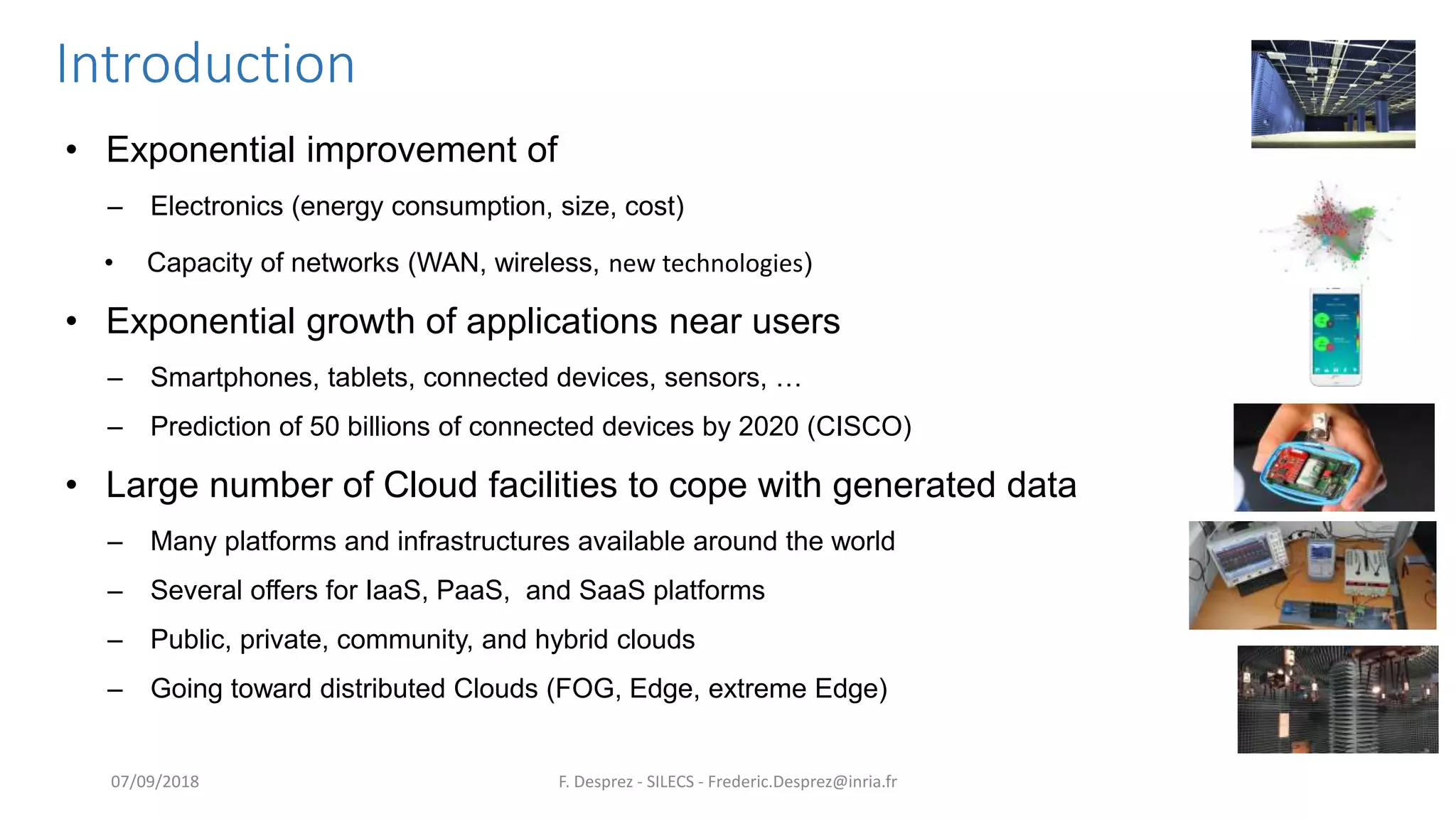
• Exponential growth of applications near users
– Smartphones, tablets, connected devices, sensors, …
– Prediction of 50 billions of connected devices by 2020 (CISCO)
• Large number of Cloud facilities to cope with generated data
– Many platforms and infrastructures available around the world
– Several offers for IaaS, PaaS, and SaaS platforms
– Public, private, community, and hybrid clouds
– Going toward distributed Clouds (FOG, Edge, extreme Edge)
F. Desprez - SILECS - Frederic.Desprez@inria.fr07/09/2018
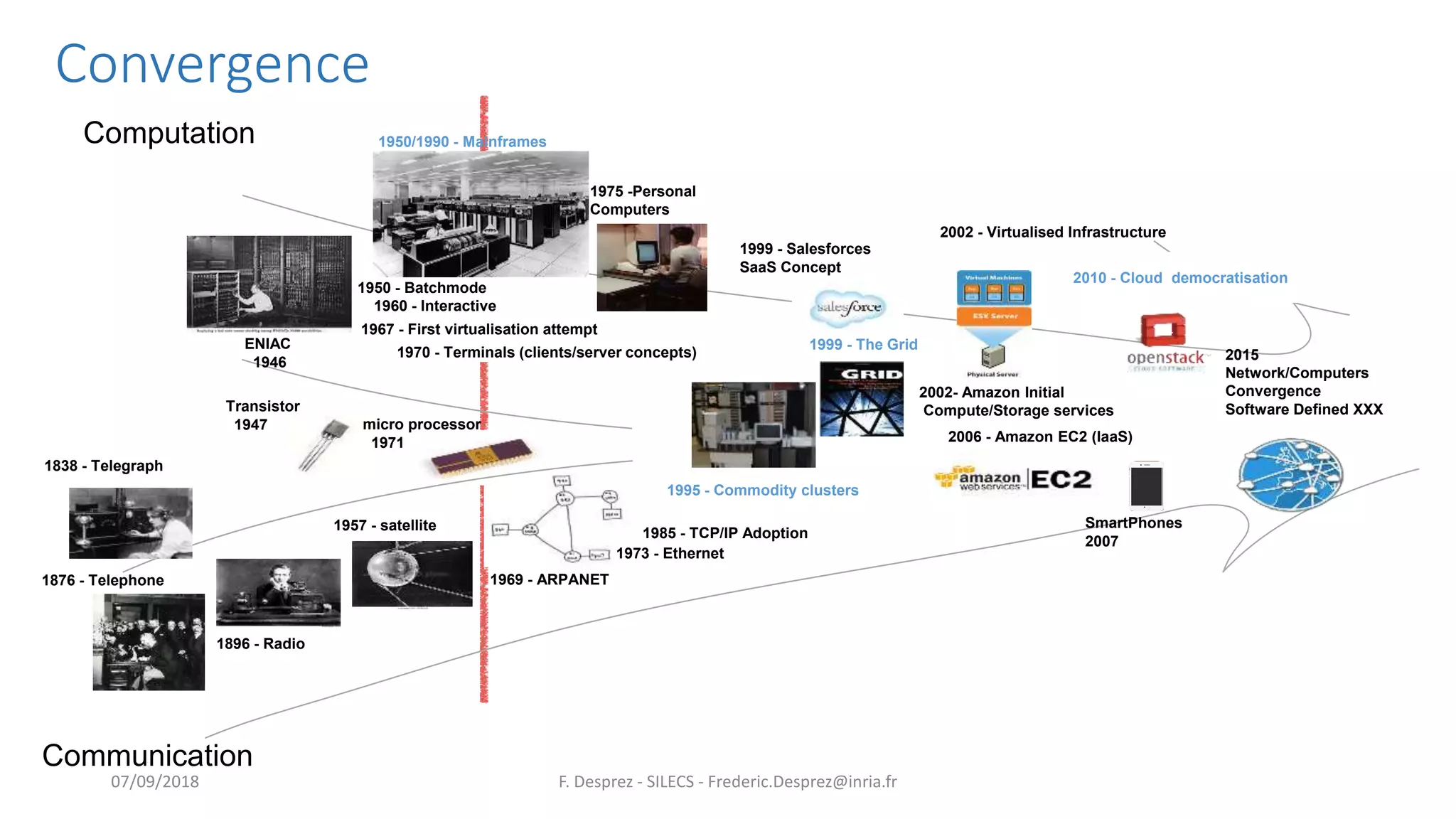
Convergence
F. Desprez - SILECS - Frederic.Desprez@inria.fr
ENIAC
1946
Transistor
1947
Computation
Communication
1999 - Salesforces
SaaS Concept
micro processor
1971
1838 - Telegraph
1876 - Telephone
1896 - Radio
1957 - satellite
1969 - ARPANET
1973 - Ethernet
1985 - TCP/IP Adoption
1975 -Personal
Computers
SmartPhones
2007
2002- Amazon Initial
Compute/Storage services
2006 - Amazon EC2 (IaaS)
2010 - Cloud democratisation
2015
Network/Computers
Convergence
Software Defined XXX
1999 - The Grid
1995 - Commodity clusters
2002 - Virtualised Infrastructure
1950/1990 - Mainframes
1950 - Batchmode
1960 - Interactive
1970 - Terminals (clients/server concepts)
1967 - First virtualisation attempt
07/09/2018
Good experiments
A good experiment should fulfill the following properties
– Reproducibility: must give the same result with the same input
– Extensibility: must target possible comparisons with other works and extensions
(more/other processors, larger data sets, different architectures)
– Applicability: must define realistic parameters and must allow for an easy calibration
– “Revisability”: when an implementation does not perform as expected, must help to
identify the reasons
F. Desprez - SILECS - Frederic.Desprez@inria.fr07/09/2018
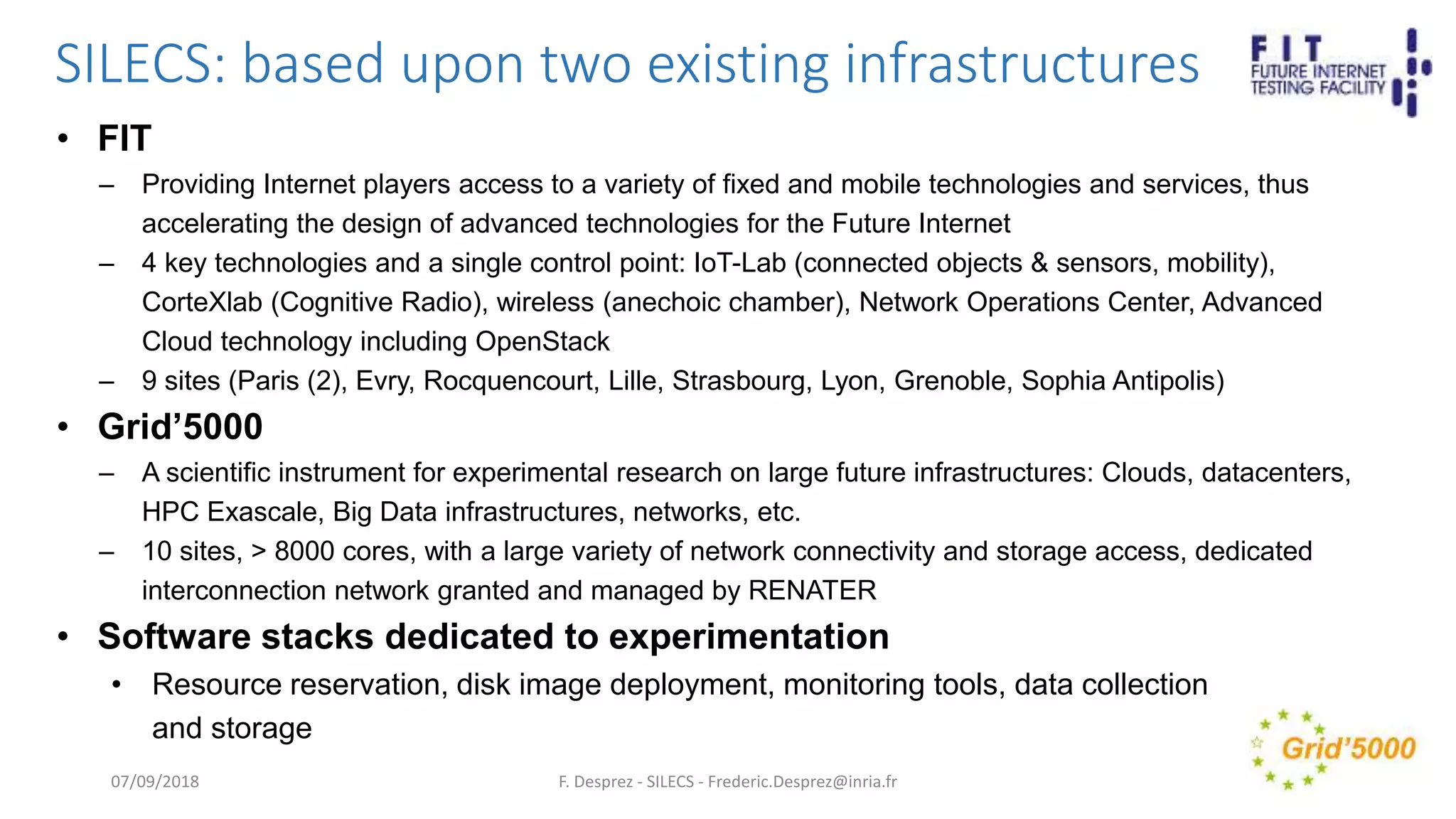
SILECS: based upon two existing infrastructures
• FIT
– Providing Internet players access to a variety of fixed and mobile technologies and services, thus
accelerating the design of advanced technologies for the Future Internet
– 4 key technologies and a single control point: IoT-Lab (connected objects & sensors, mobility),
CorteXlab (Cognitive Radio), wireless (anechoic chamber), Network Operations Center, Advanced
Cloud technology including OpenStack
– 9 sites (Paris (2), Evry, Rocquencourt, Lille, Strasbourg, Lyon, Grenoble, Sophia Antipolis)
• Grid’5000
– A scientific instrument for experimental research on large future infrastructures: Clouds, datacenters,
HPC Exascale, Big Data infrastructures, networks, etc.
– 10 sites, > 8000 cores, with a large variety of network connectivity and storage access, dedicated
interconnection network granted and managed by RENATER
• Software stacks dedicated to experimentation
• Resource reservation, disk image deployment, monitoring tools, data collection
and storage
F. Desprez - SILECS - Frederic.Desprez@inria.fr07/09/2018
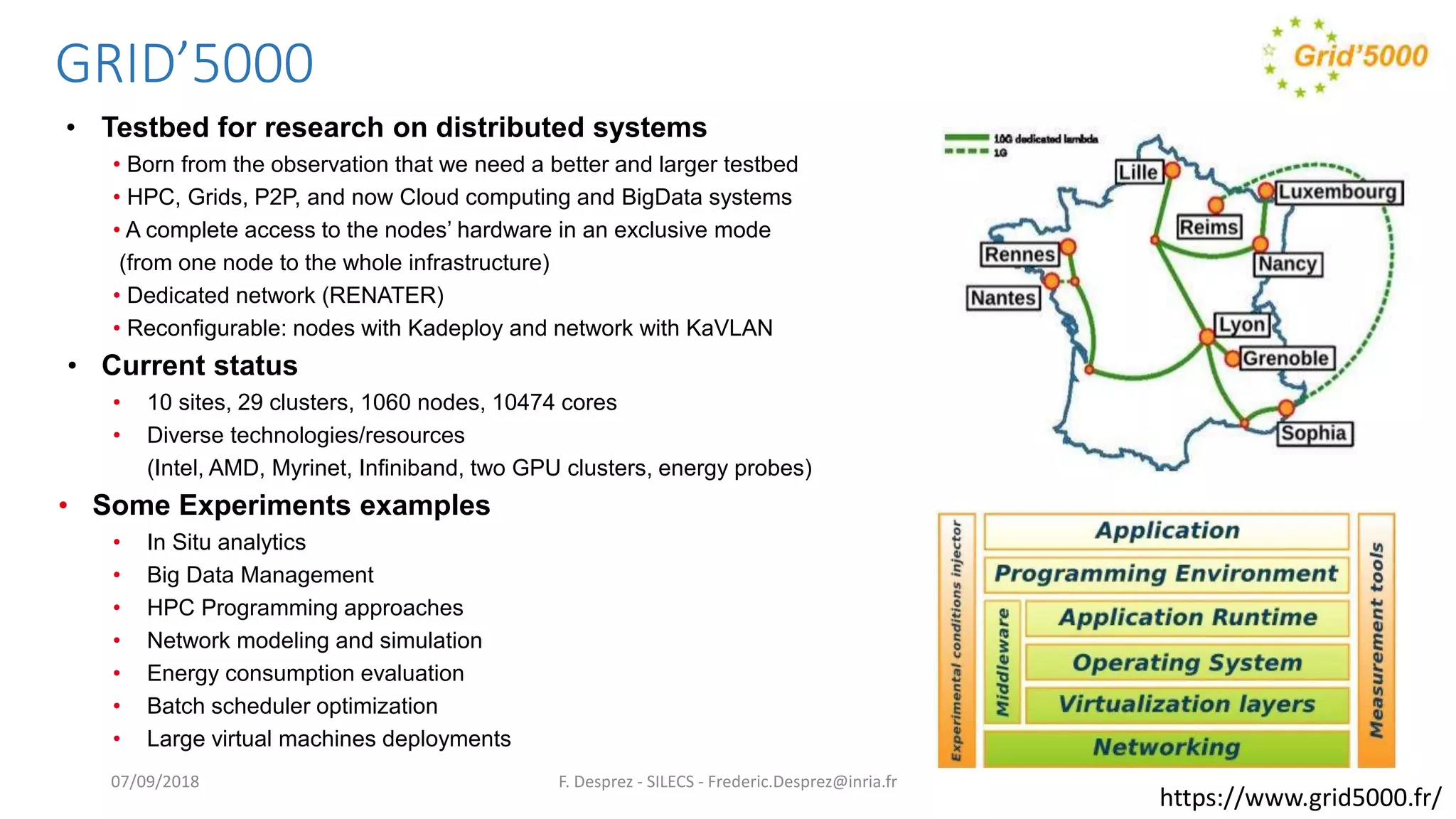
GRID’5000
• Testbed for research on distributed systems
• Born from the observation that we need a better and larger testbed
• HPC, Grids, P2P, and now Cloud computing and BigData systems
• A complete access to the nodes’ hardware in an exclusive mode
(from one node to the whole infrastructure)
• Dedicated network (RENATER)
• Reconfigurable: nodes with Kadeploy and network with KaVLAN
• Current status
• 10 sites, 29 clusters, 1060 nodes, 10474 cores
• Diverse technologies/resources
(Intel, AMD, Myrinet, Infiniband, two GPU clusters, energy probes)
• Some Experiments examples
• In Situ analytics
• Big Data Management
• HPC Programming approaches
• Network modeling and simulation
• Energy consumption evaluation
• Batch scheduler optimization
• Large virtual machines deployments
F. Desprez - SILECS - Frederic.Desprez@inria.fr07/09/2018
https://www.grid5000.fr/
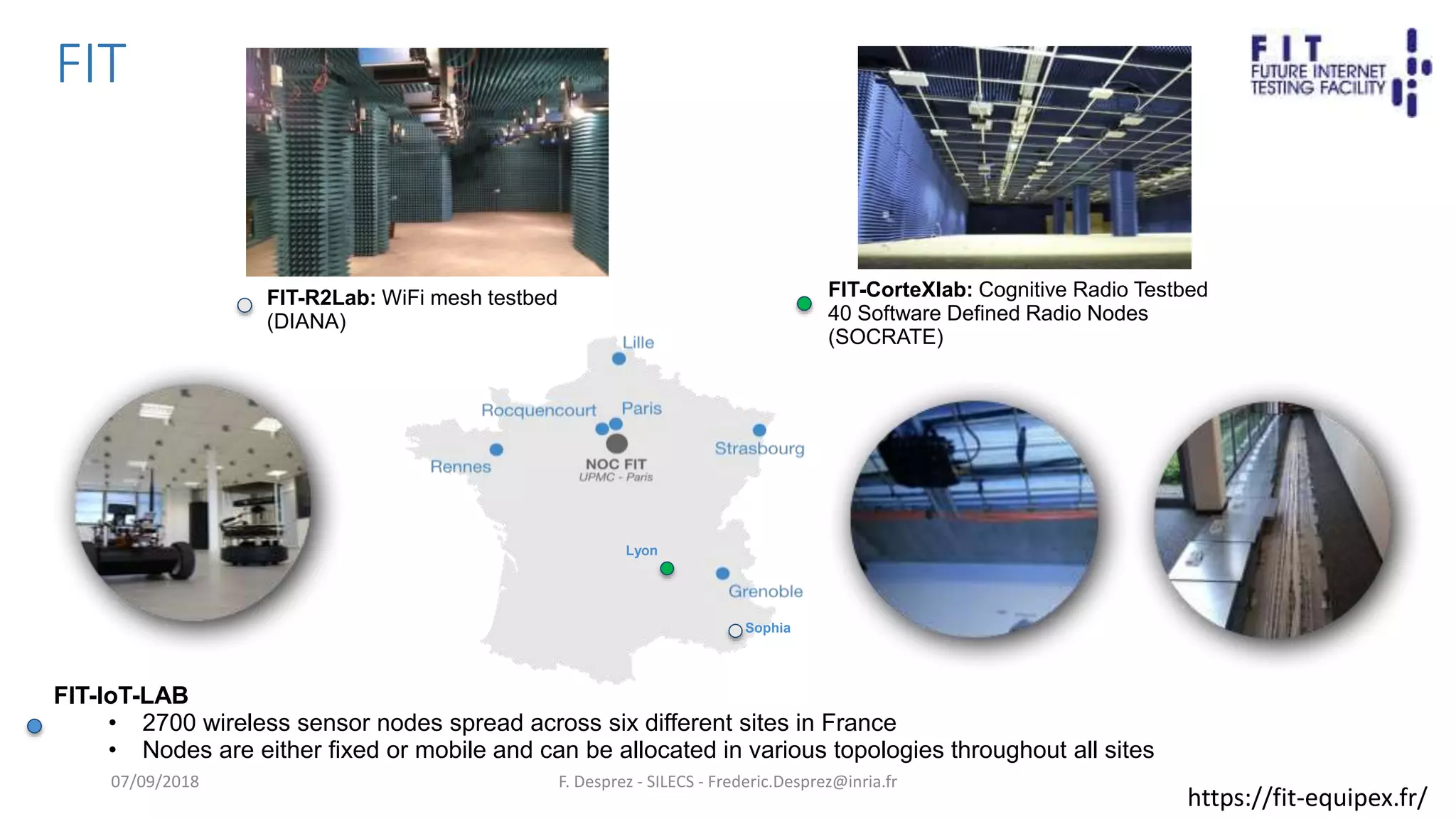
FIT
F. Desprez - SILECS - Frederic.Desprez@inria.fr
FIT-IoT-LAB
• 2700 wireless sensor nodes spread across six different sites in France
• Nodes are either fixed or mobile and can be allocated in various topologies throughout all sites
Sophia
Lyon
FIT-CorteXlab: Cognitive Radio Testbed
40 Software Defined Radio Nodes
(SOCRATE)
FIT-R2Lab: WiFi mesh testbed
(DIANA)
07/09/2018
https://fit-equipex.fr/
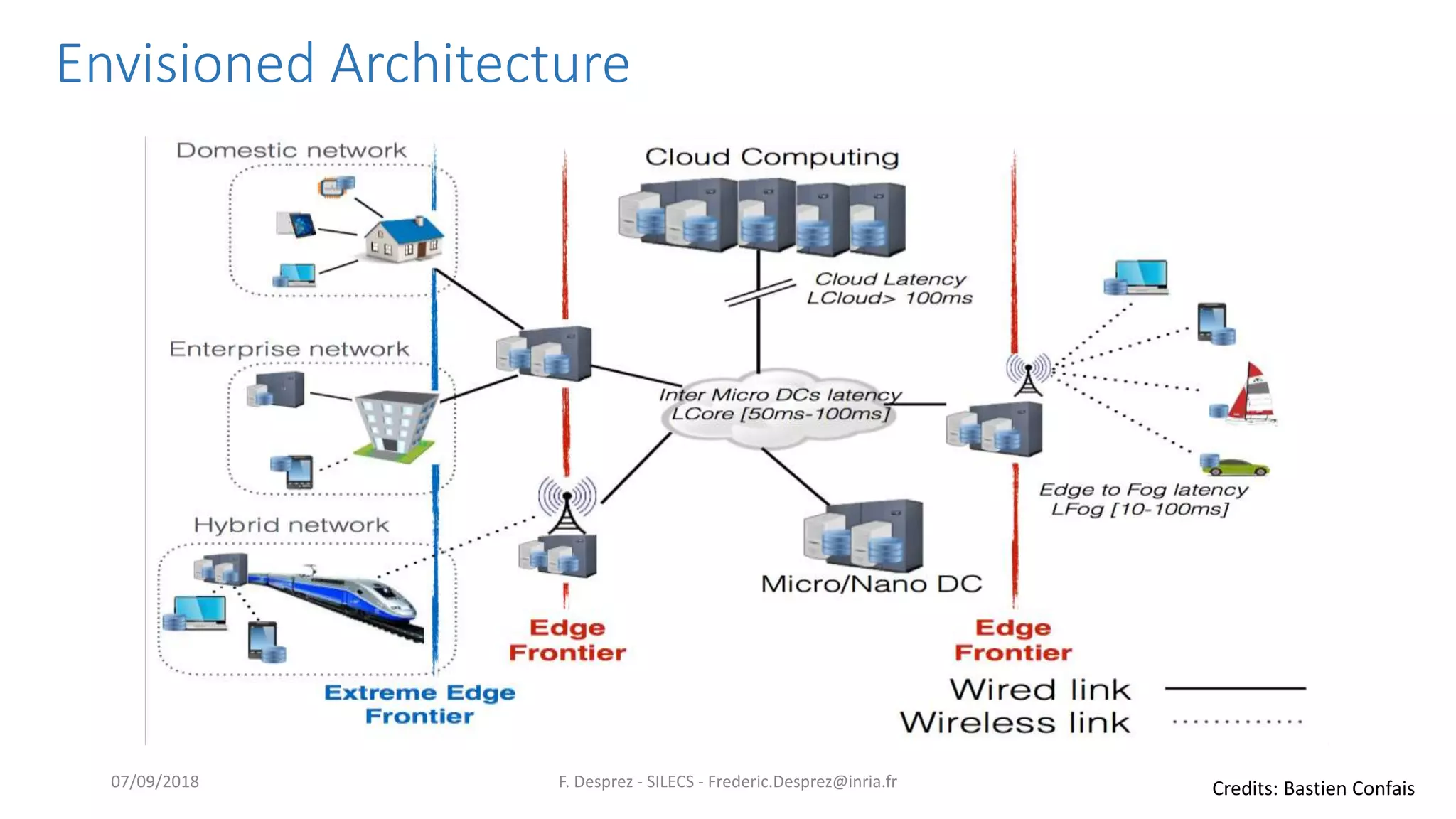
Envisioned Architecture
F. Desprez - SILECS - Frederic.Desprez@inria.fr Credits: Bastien Confais07/09/2018
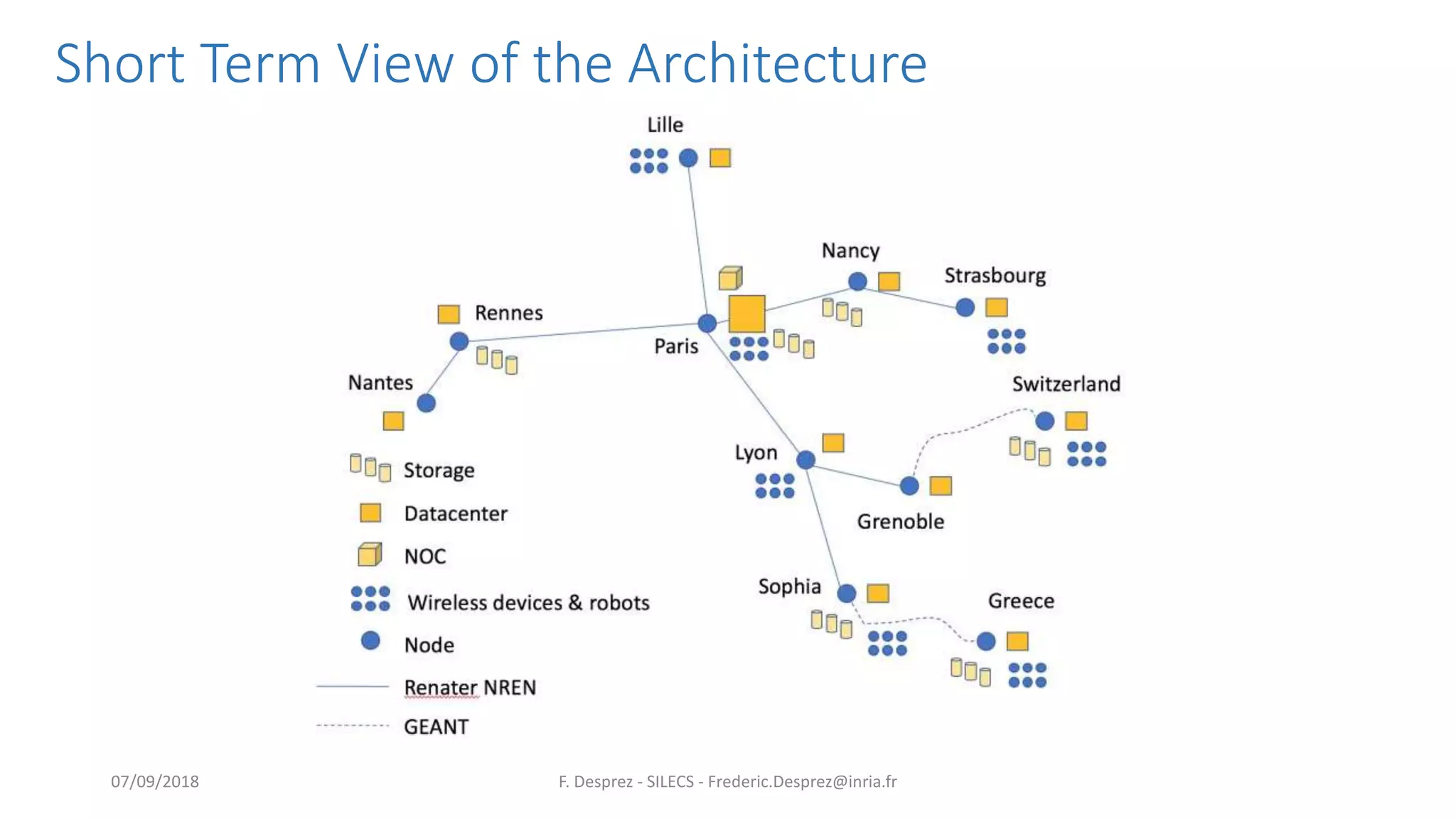
Short Term View of the Architecture
F. Desprez - SILECS - Frederic.Desprez@inria.fr07/09/2018
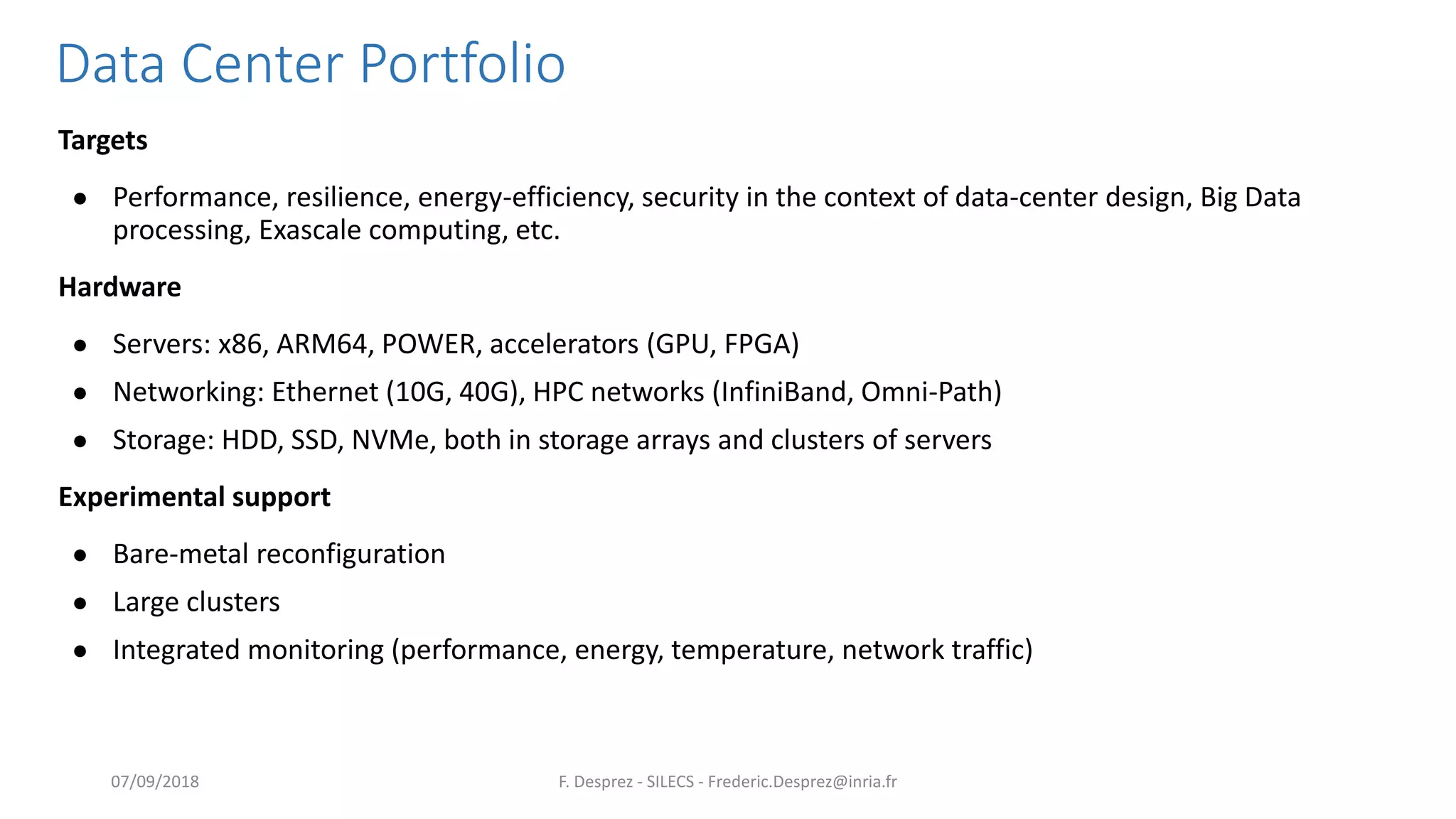
Data Center Portfolio
Targets
● Performance, resilience, energy-efficiency, security in the context of data-center design, Big Data
processing, Exascale computing, etc.
Hardware
● Servers: x86, ARM64, POWER, accelerators (GPU, FPGA)
● Networking: Ethernet (10G, 40G), HPC networks (InfiniBand, Omni-Path)
● Storage: HDD, SSD, NVMe, both in storage arrays and clusters of servers
Experimental support
● Bare-metal reconfiguration
● Large clusters
● Integrated monitoring (performance, energy, temperature, network traffic)
F. Desprez - SILECS - Frederic.Desprez@inria.fr07/09/2018
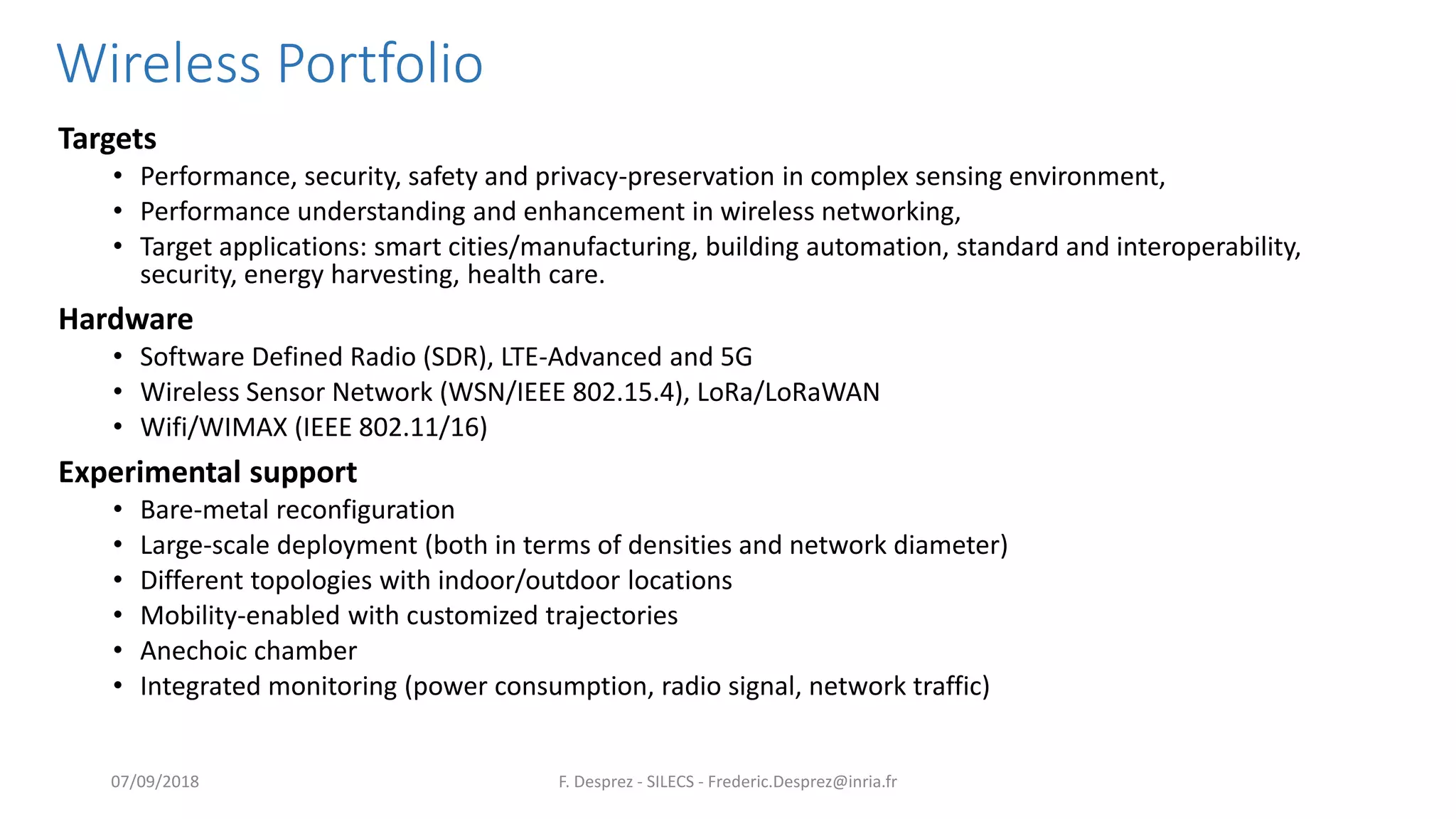
Wireless Portfolio
Targets
• Performance, security, safety and privacy-preservation in complex sensing environment,
• Performance understanding and enhancement in wireless networking,
• Target applications: smart cities/manufacturing, building automation, standard and interoperability,
security, energy harvesting, health care.
Hardware
• Software Defined Radio (SDR), LTE-Advanced and 5G
• Wireless Sensor Network (WSN/IEEE 802.15.4), LoRa/LoRaWAN
• Wifi/WIMAX (IEEE 802.11/16)
Experimental support
• Bare-metal reconfiguration
• Large-scale deployment (both in terms of densities and network diameter)
• Different topologies with indoor/outdoor locations
• Mobility-enabled with customized trajectories
• Anechoic chamber
• Integrated monitoring (power consumption, radio signal, network traffic)
F. Desprez - SILECS - Frederic.Desprez@inria.fr07/09/2018
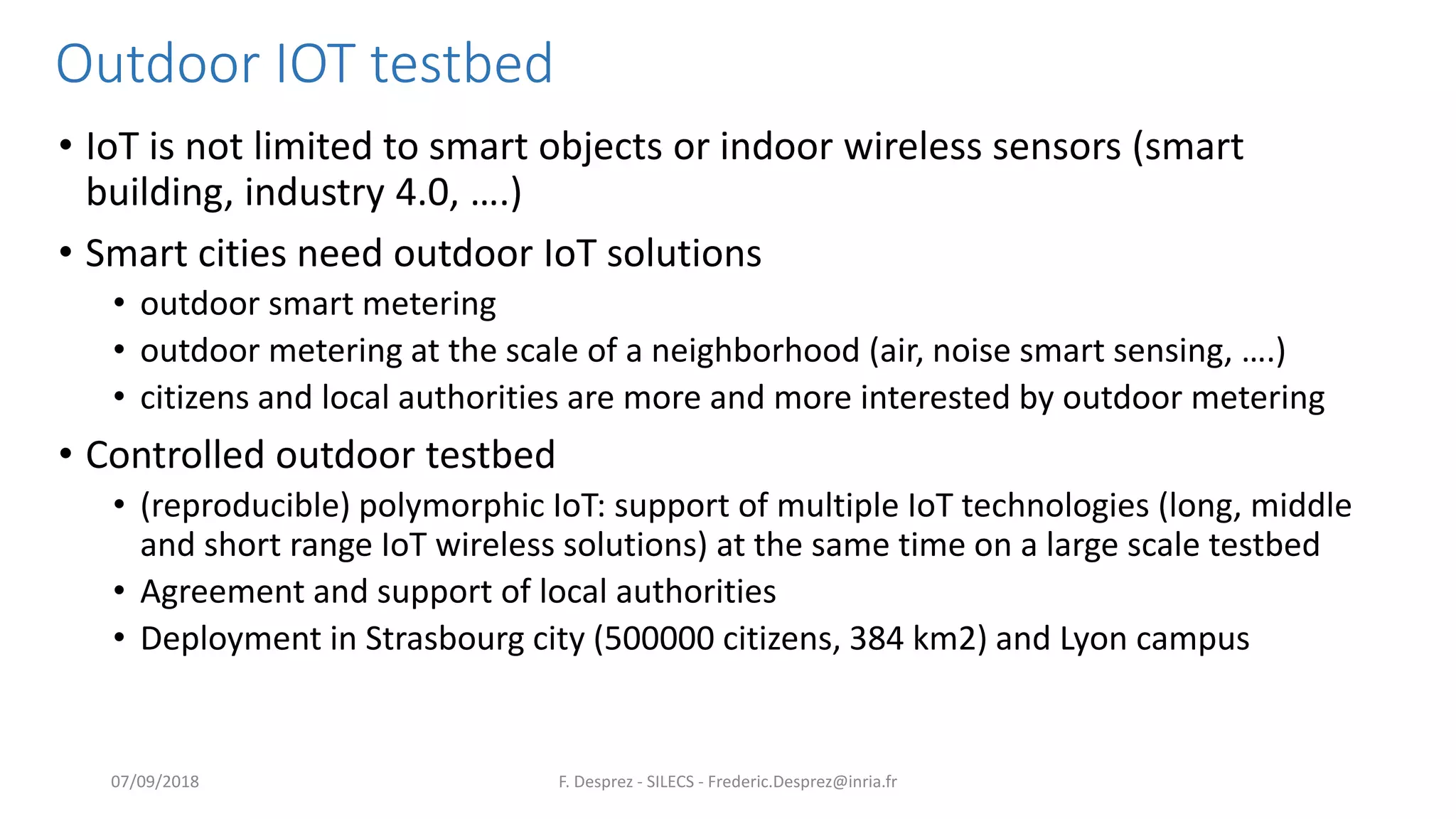
Outdoor IOT testbed
• IoT is not limited to smart objects or indoor wireless sensors (smart
building, industry 4.0, ….)
• Smart cities need outdoor IoT solutions
• outdoor smart metering
• outdoor metering at the scale of a neighborhood (air, noise smart sensing, ….)
• citizens and local authorities are more and more interested by outdoor metering
• Controlled outdoor testbed
• (reproducible) polymorphic IoT: support of multiple IoT technologies (long, middle
and short range IoT wireless solutions) at the same time on a large scale testbed
• Agreement and support of local authorities
• Deployment in Strasbourg city (500000 citizens, 384 km2) and Lyon campus
F. Desprez - SILECS - Frederic.Desprez@inria.fr07/09/2018
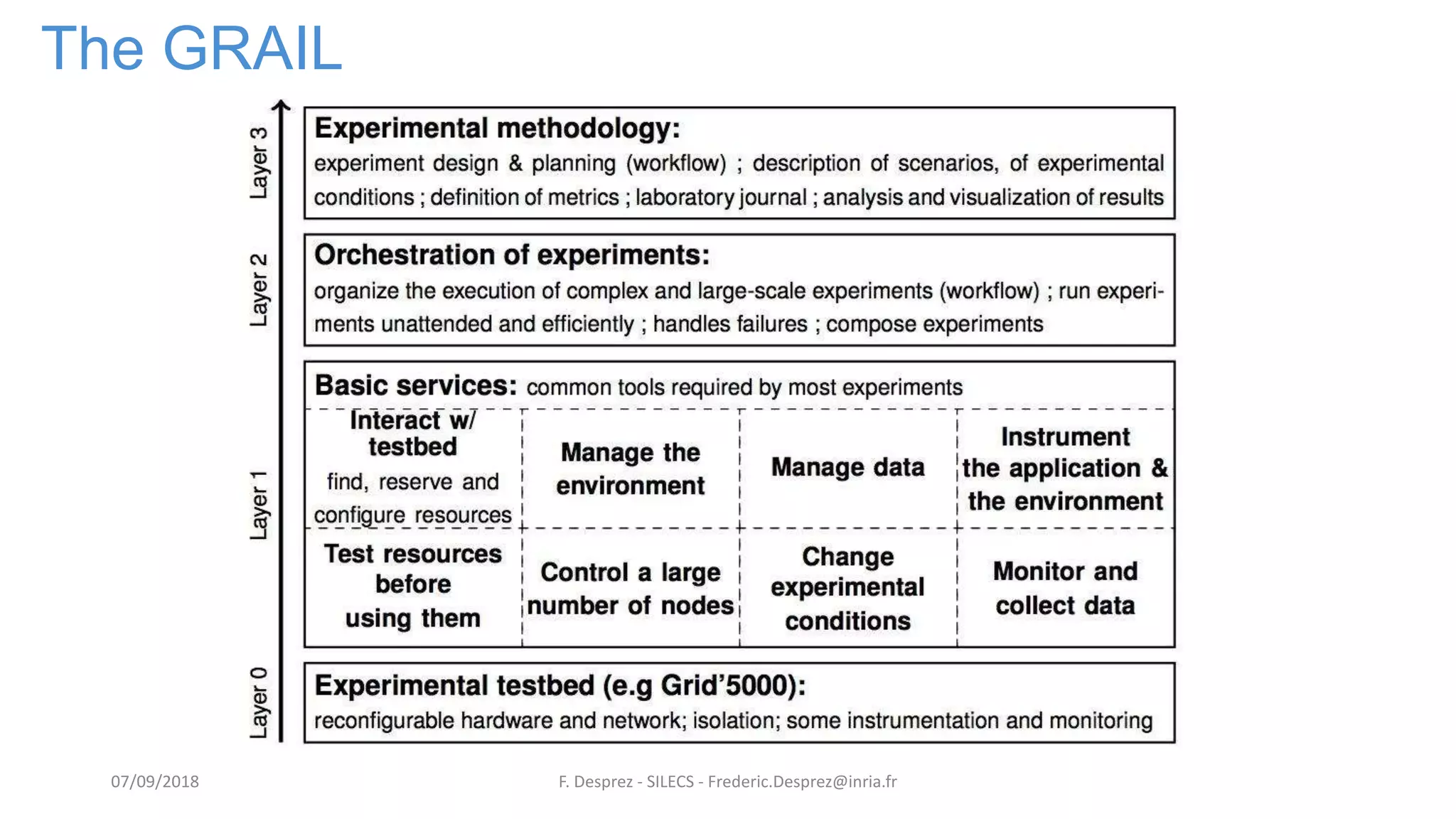
The GRAIL
F. Desprez - SILECS - Frederic.Desprez@inria.fr07/09/2018
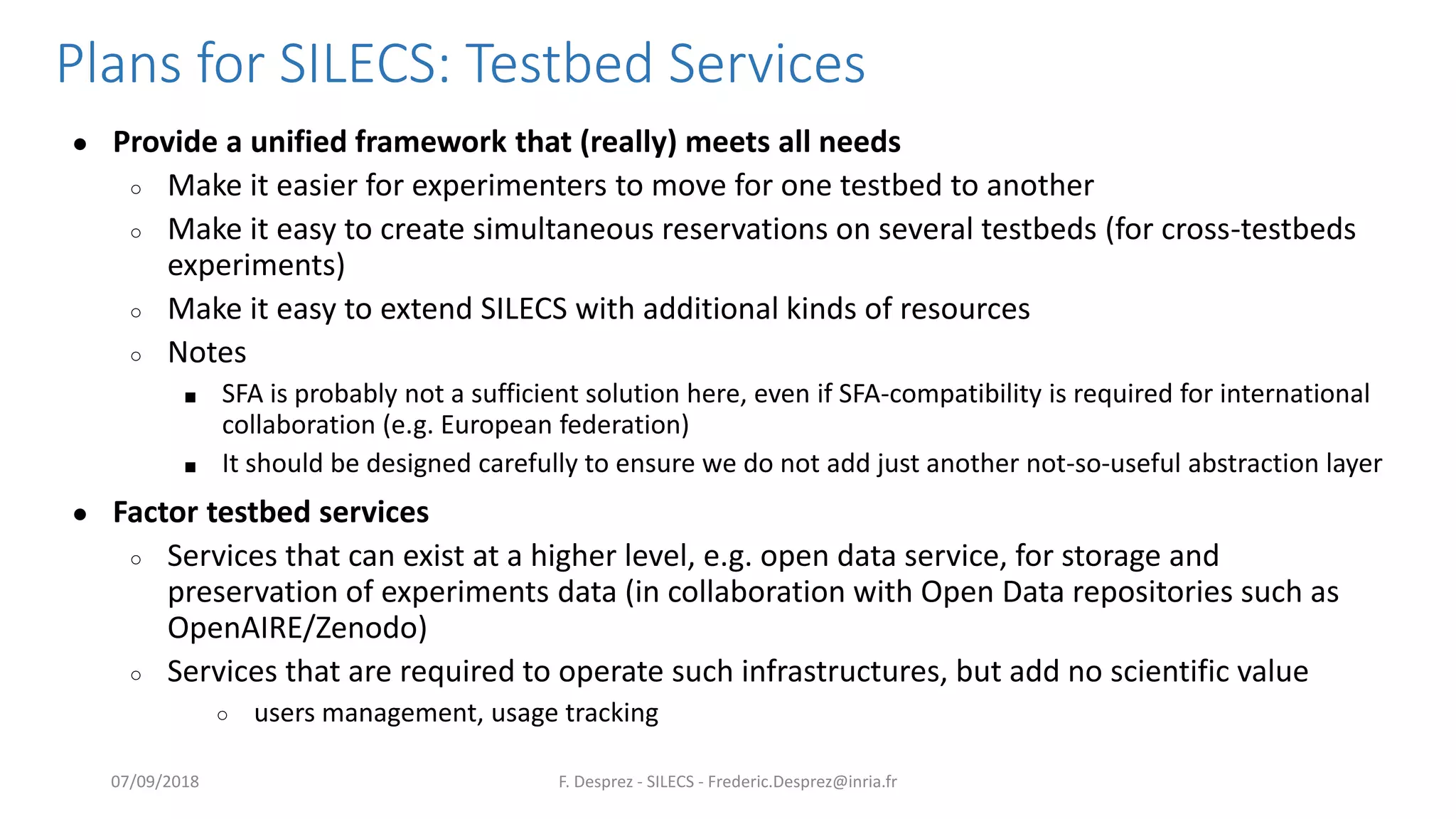
Plans for SILECS: Testbed Services
● Provide a unified framework that (really) meets all needs
○ Make it easier for experimenters to move for one testbed to another
○ Make it easy to create simultaneous reservations on several testbeds (for cross-testbeds
experiments)
○ Make it easy to extend SILECS with additional kinds of resources
○ Notes
■ SFA is probably not a sufficient solution here, even if SFA-compatibility is required for international
collaboration (e.g. European federation)
■ It should be designed carefully to ensure we do not add just another not-so-useful abstraction layer
● Factor testbed services
○ Services that can exist at a higher level, e.g. open data service, for storage and
preservation of experiments data (in collaboration with Open Data repositories such as
OpenAIRE/Zenodo)
○ Services that are required to operate such infrastructures, but add no scientific value
○ users management, usage tracking
F. Desprez - SILECS - Frederic.Desprez@inria.fr07/09/2018
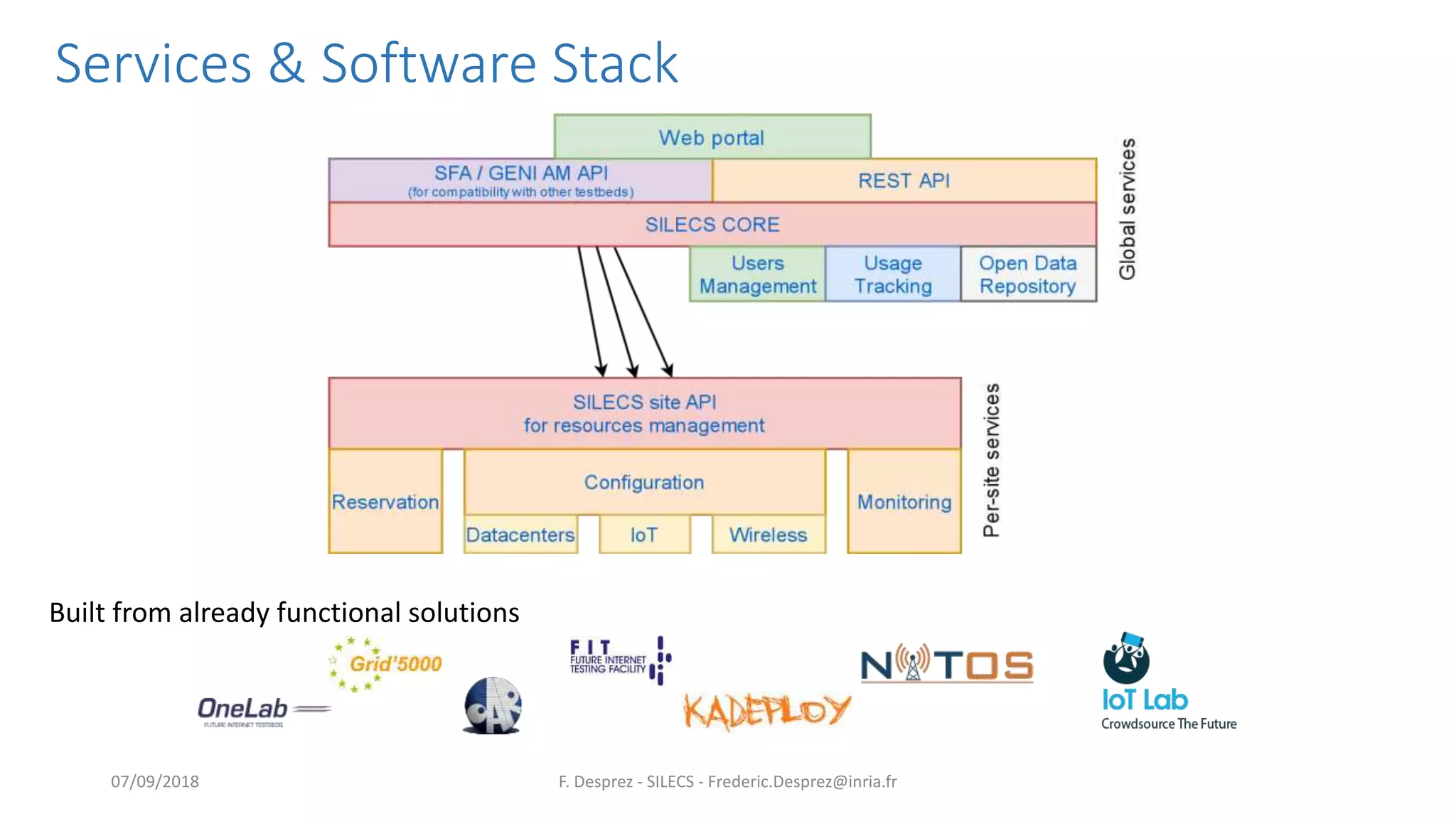
Services & Software Stack
F. Desprez - SILECS - Frederic.Desprez@inria.fr
Built from already functional solutions
07/09/2018
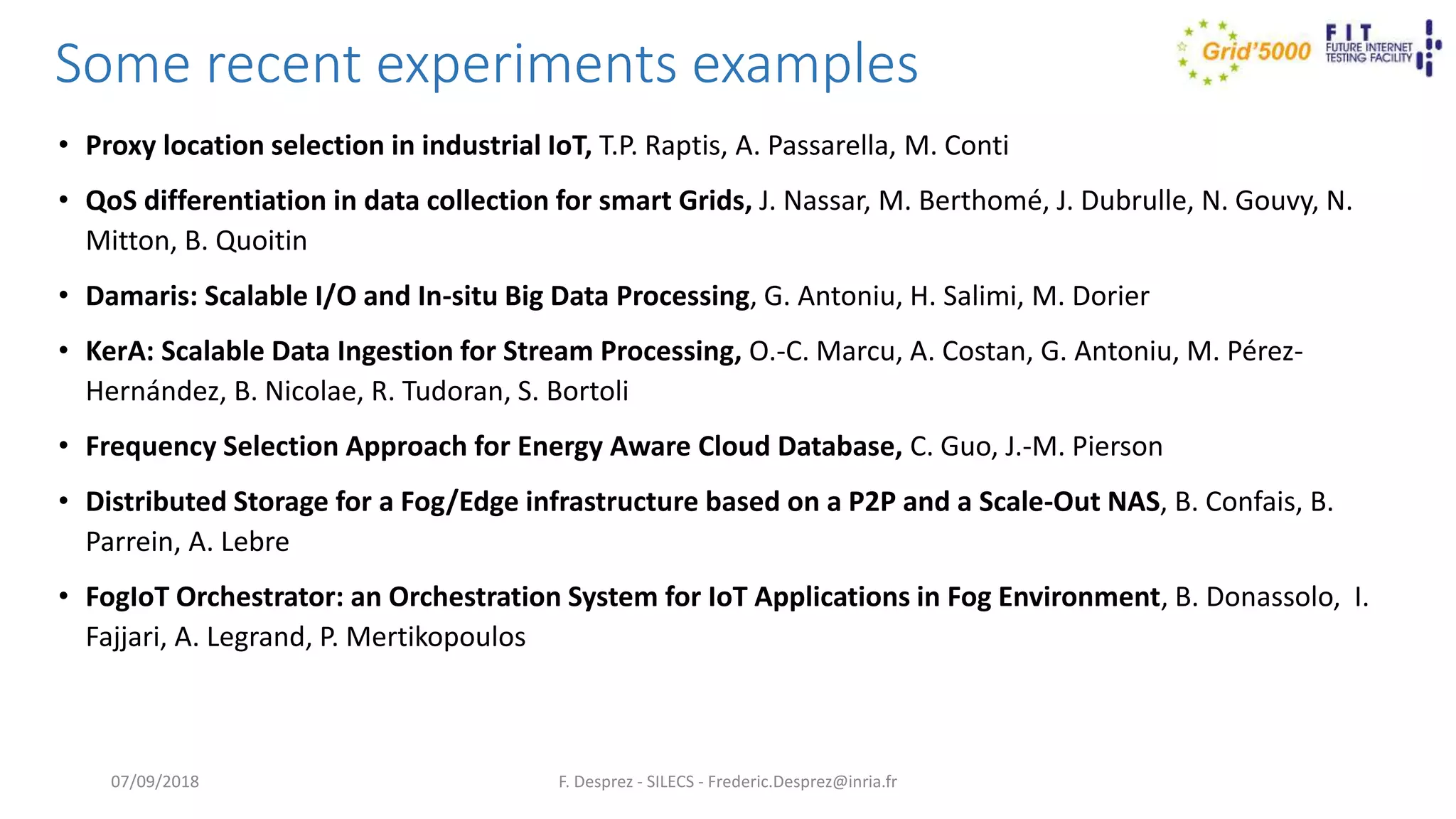
Some recent experiments examples
• Proxy location selection in industrial IoT, T.P. Raptis, A. Passarella, M. Conti
• QoS differentiation in data collection for smart Grids, J. Nassar, M. Berthomé, J. Dubrulle, N. Gouvy, N.
Mitton, B. Quoitin
• Damaris: Scalable I/O and In-situ Big Data Processing, G. Antoniu, H. Salimi, M. Dorier
• KerA: Scalable Data Ingestion for Stream Processing, O.-C. Marcu, A. Costan, G. Antoniu, M. Pérez-
Hernández, B. Nicolae, R. Tudoran, S. Bortoli
• Frequency Selection Approach for Energy Aware Cloud Database, C. Guo, J.-M. Pierson
• Distributed Storage for a Fog/Edge infrastructure based on a P2P and a Scale-Out NAS, B. Confais, B.
Parrein, A. Lebre
• FogIoT Orchestrator: an Orchestration System for IoT Applications in Fog Environment, B. Donassolo, I.
Fajjari, A. Legrand, P. Mertikopoulos
F. Desprez - SILECS - Frederic.Desprez@inria.fr07/09/2018
Proxy location selection in industrial IoT
• Distributed data collection with low latency in Industrial context
• Traditional approach
• Improving data routing by selecting quicker links
• Deploying enhanced edge-nodes for fog computing
• Solution
• Dynamically select sensor nodes to act as proxys and get the information closer to
consuming nodes.
• FIT IoT LAB as a validation testbed
• Access to 95 sensor nodes with IoT features remotely
• Customizable environment and tools (sniffer, consumption measure, etc)
• Repeat the experiments later and compare to alternate approaches with the same
environment
• The results show that latency is much reduced
• FIT IoT LAB helped validate the approach before real costly deployment
F. Desprez - SILECS - Frederic.Desprez@inria.fr
Performance Analysis of Latency-Aware Data Management in Industrial IoT Networks, T.P. Raptis, A. Passarella, M. Conti - MDPI Sensors, 2018,
18(8), 2611
07/09/2018
QoS differentiation in data collection for smart Grids
• Data collection with different QoS requirements for Smart Grid applications
• Traditional approach
• Use of standard RPL protocol which offers overall good performances but no QoS
differentiation based on application
• Solution
• Use a dynamic objective function
• FIT IoT LAB as a validation testbed
• Access to 67 sensor nodes with IoT features remotely
• Customizable environment and tools (data size and rate, consumption measure, clock, etc)
• Repeat the experiments and compare to alternate approaches with the same environment.
• The results show that based on the service requested, data from different
applications follow different paths, each meeting expected requirements.
• FIT IoT LAB helped validate the approach to go further with standardization
F. Desprez - SILECS - Frederic.Desprez@inria.fr
Multiple Instances QoS Routing In RPL: Application To Smart Grids – J. Nassar, M. Berthomé, J. Dubrulle, N. Gouvy, N. Mitton, B. Quoitin –
MDPI Sensors, July 2018
07/09/2018
Damaris
• Scalable, asynchronous data storage for large-scale simulations using the HDF5 format (HDF5 blog at
https://goo.gl/7A4cZh)
• Traditional approach
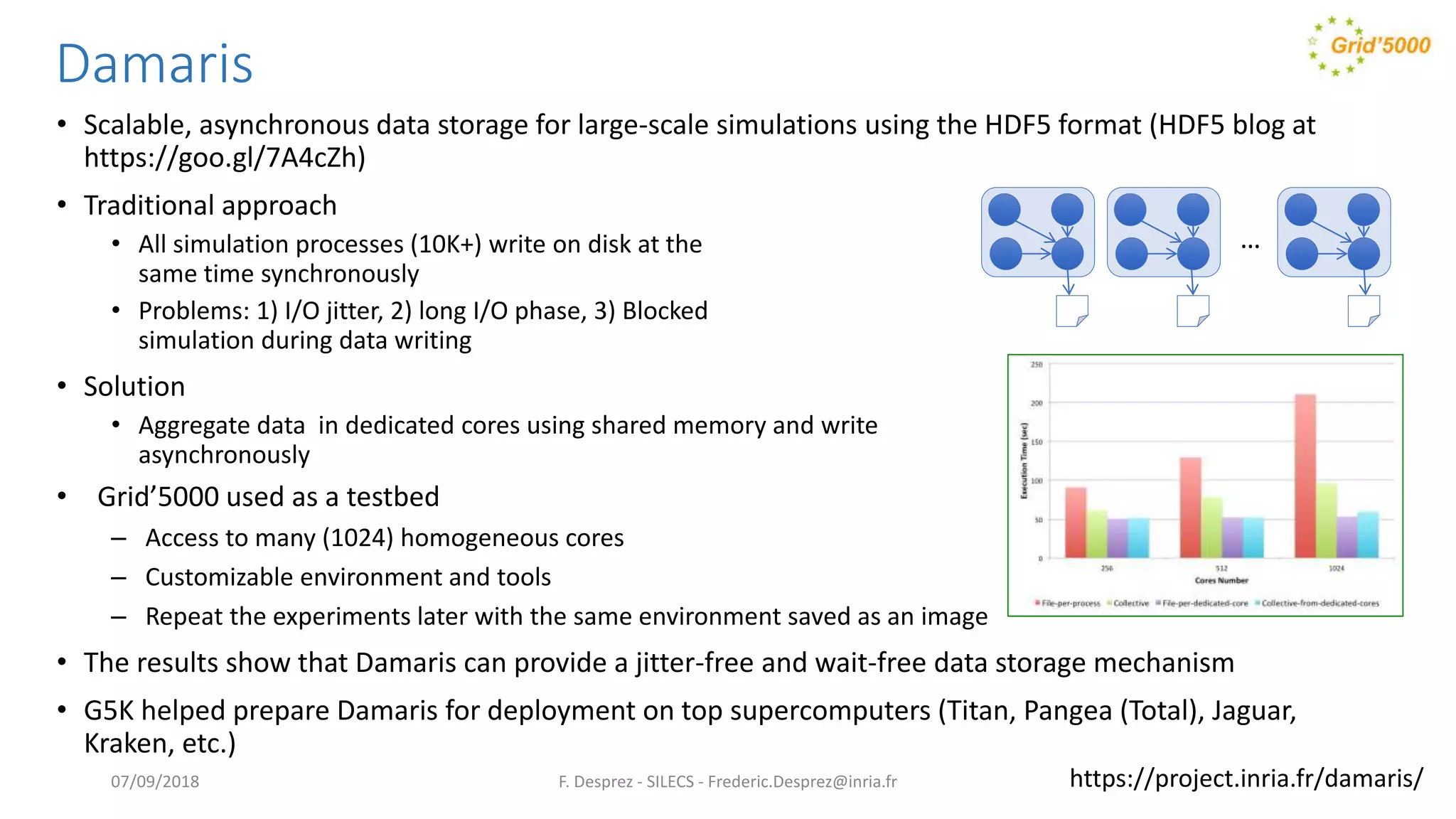
• All simulation processes (10K+) write on disk at the
same time synchronously
• Problems: 1) I/O jitter, 2) long I/O phase, 3) Blocked
simulation during data writing
• Solution
• Aggregate data in dedicated cores using shared memory and write
asynchronously
• Grid’5000 used as a testbed
– Access to many (1024) homogeneous cores
– Customizable environment and tools
– Repeat the experiments later with the same environment saved as an image
• The results show that Damaris can provide a jitter-free and wait-free data storage mechanism
• G5K helped prepare Damaris for deployment on top supercomputers (Titan, Pangea (Total), Jaguar,
Kraken, etc.)
F. Desprez - SILECS - Frederic.Desprez@inria.fr
…
https://project.inria.fr/damaris/07/09/2018
KerA: Scalable Data Ingestion for Stream Processing
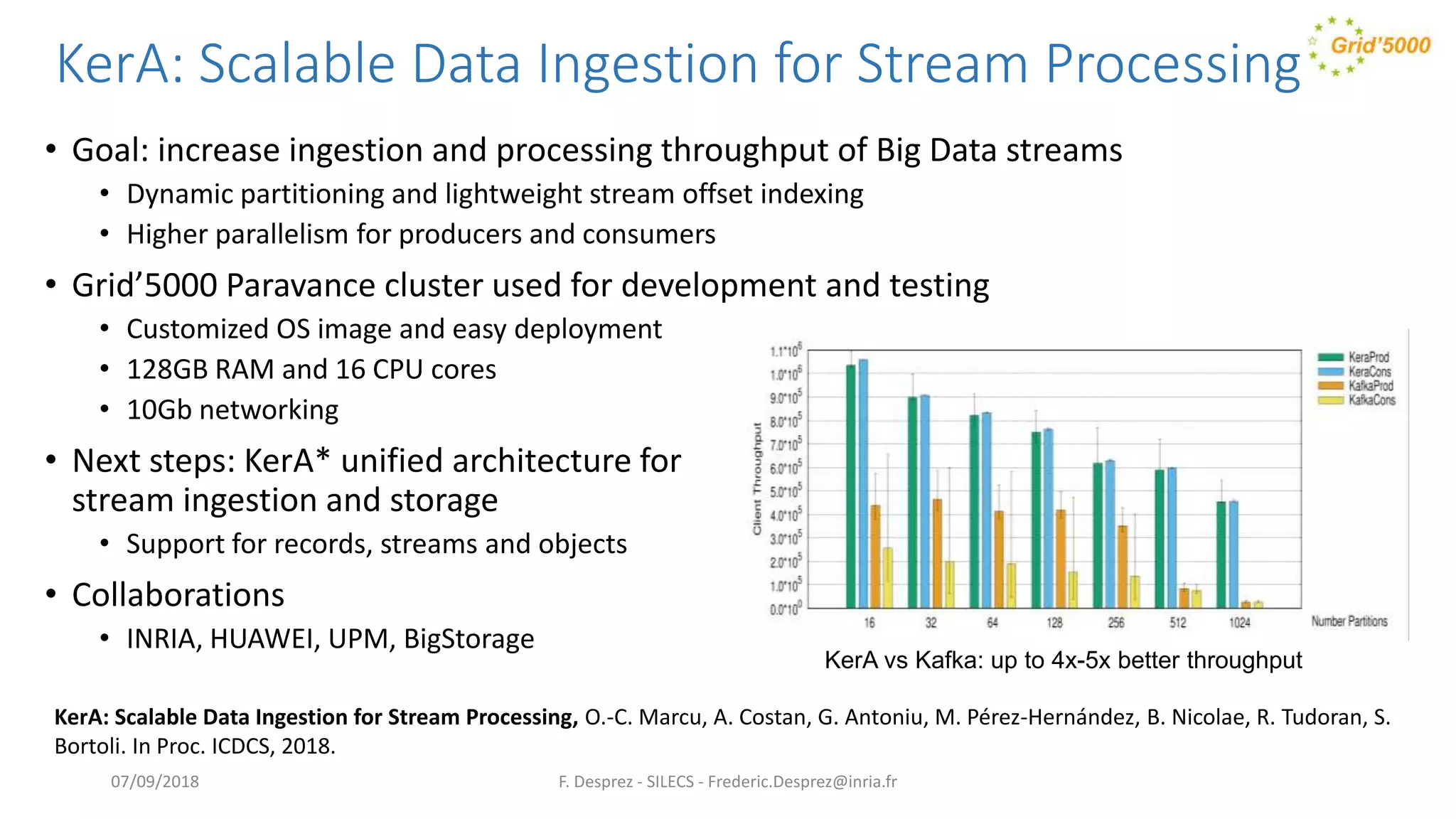
• Goal: increase ingestion and processing throughput of Big Data streams
• Dynamic partitioning and lightweight stream offset indexing
• Higher parallelism for producers and consumers
• Grid’5000 Paravance cluster used for development and testing
• Customized OS image and easy deployment
• 128GB RAM and 16 CPU cores
• 10Gb networking
• Next steps: KerA* unified architecture for
stream ingestion and storage
• Support for records, streams and objects
• Collaborations
• INRIA, HUAWEI, UPM, BigStorage
F. Desprez - SILECS - Frederic.Desprez@inria.fr
KerA: Scalable Data Ingestion for Stream Processing, O.-C. Marcu, A. Costan, G. Antoniu, M. Pérez-Hernández, B. Nicolae, R. Tudoran, S.
Bortoli. In Proc. ICDCS, 2018.
KerA vs Kafka: up to 4x-5x better throughput
07/09/2018
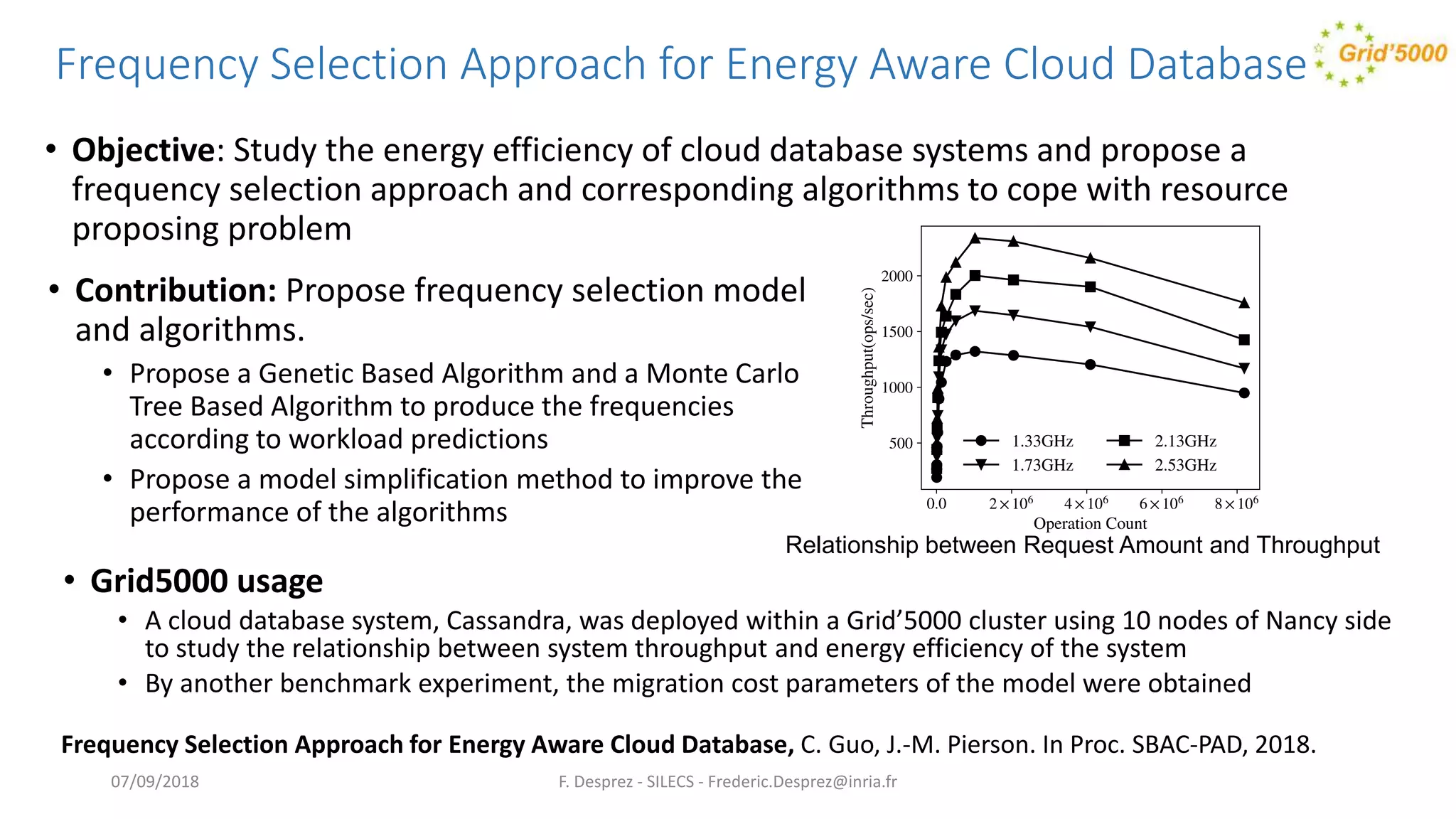
Frequency Selection Approach for Energy Aware Cloud Database
• Objective: Study the energy efficiency of cloud database systems and propose a
frequency selection approach and corresponding algorithms to cope with resource
proposing problem
F. Desprez - SILECS - Frederic.Desprez@inria.fr
Frequency Selection Approach for Energy Aware Cloud Database, C. Guo, J.-M. Pierson. In Proc. SBAC-PAD, 2018.
Relationship between Request Amount and Throughput
• Contribution: Propose frequency selection model
and algorithms.
• Propose a Genetic Based Algorithm and a Monte Carlo
Tree Based Algorithm to produce the frequencies
according to workload predictions
• Propose a model simplification method to improve the
performance of the algorithms
• Grid5000 usage
• A cloud database system, Cassandra, was deployed within a Grid’5000 cluster using 10 nodes of Nancy side
to study the relationship between system throughput and energy efficiency of the system
• By another benchmark experiment, the migration cost parameters of the model were obtained
07/09/2018
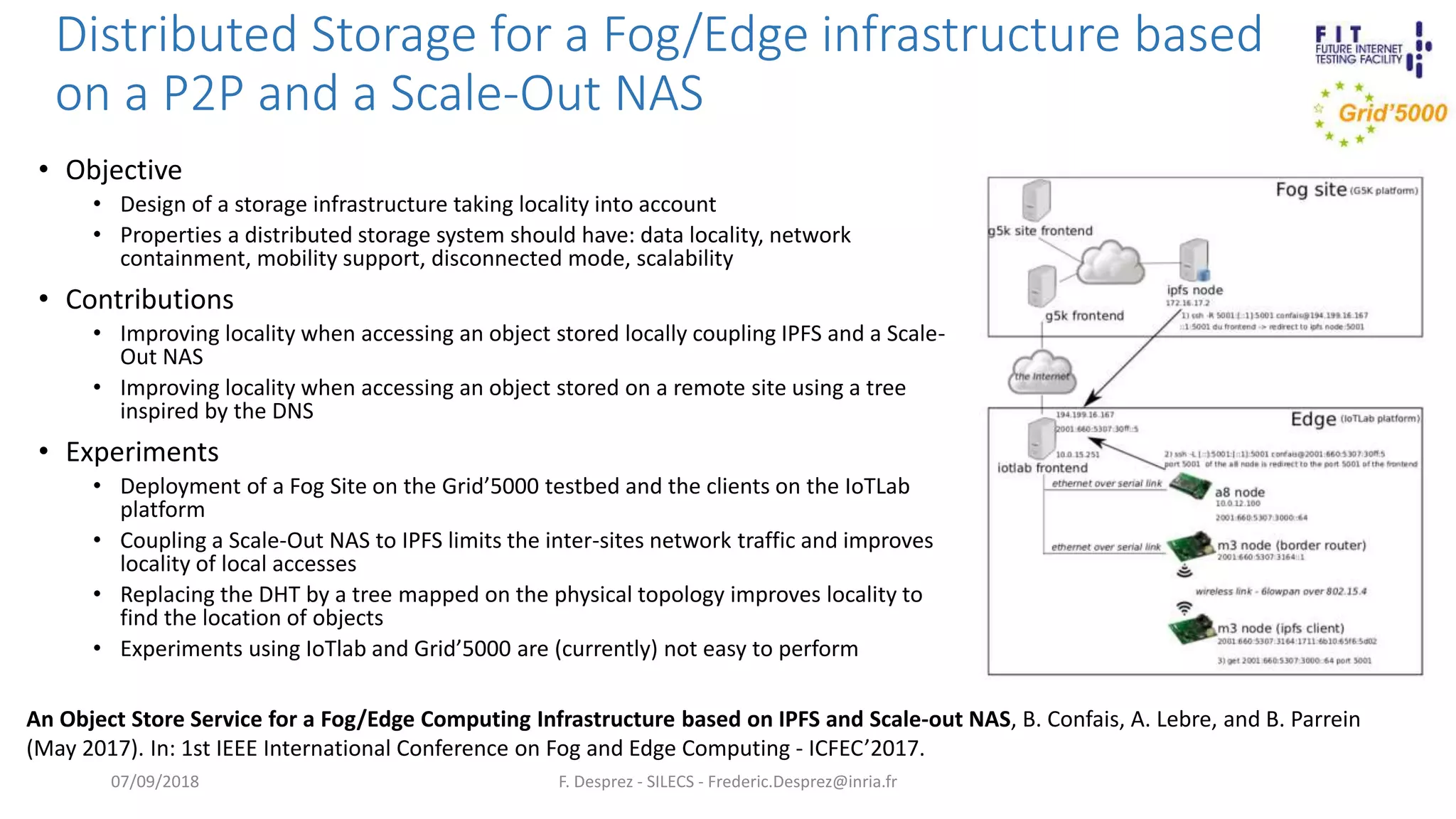
Distributed Storage for a Fog/Edge infrastructure based
on a P2P and a Scale-Out NAS
• Objective
• Design of a storage infrastructure taking locality into account
• Properties a distributed storage system should have: data locality, network
containment, mobility support, disconnected mode, scalability
• Contributions
• Improving locality when accessing an object stored locally coupling IPFS and a Scale-
Out NAS
• Improving locality when accessing an object stored on a remote site using a tree
inspired by the DNS
• Experiments
• Deployment of a Fog Site on the Grid’5000 testbed and the clients on the IoTLab
platform
• Coupling a Scale-Out NAS to IPFS limits the inter-sites network traffic and improves
locality of local accesses
• Replacing the DHT by a tree mapped on the physical topology improves locality to
find the location of objects
• Experiments using IoTlab and Grid’5000 are (currently) not easy to perform
F. Desprez - SILECS - Frederic.Desprez@inria.fr07/09/2018
An Object Store Service for a Fog/Edge Computing Infrastructure based on IPFS and Scale-out NAS, B. Confais, A. Lebre, and B. Parrein
(May 2017). In: 1st IEEE International Conference on Fog and Edge Computing - ICFEC’2017.
FogIoT Orchestrator: an Orchestration System for IoT
Applications in Fog Environment
F. Desprez - SILECS - Frederic.Desprez@inria.fr
• Objective
• Design a Optimized Fog Service Provisioning strategy (O-FSP) and
validate it on a real infrastructure
• Contributions
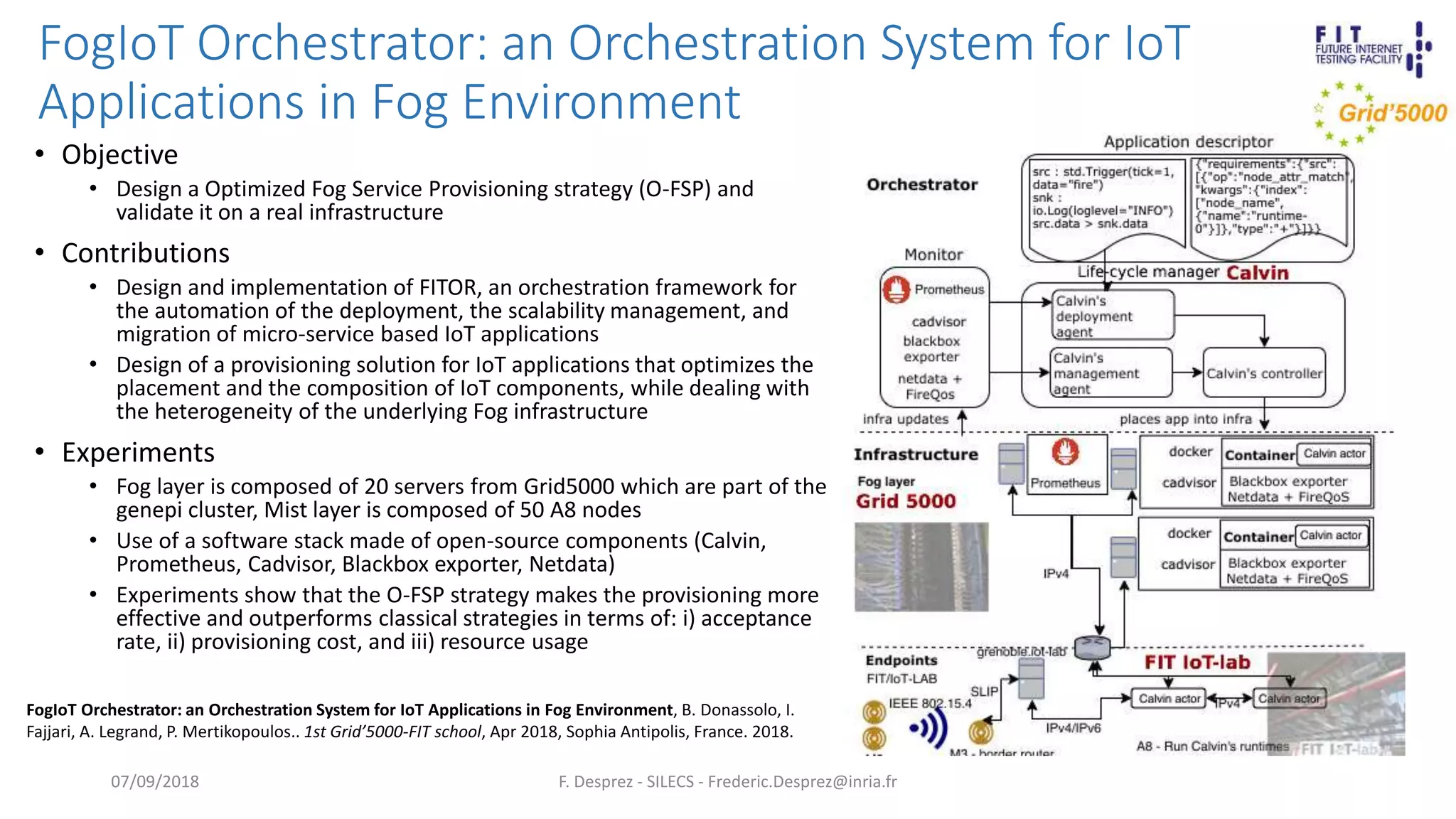
• Design and implementation of FITOR, an orchestration framework for
the automation of the deployment, the scalability management, and
migration of micro-service based IoT applications
• Design of a provisioning solution for IoT applications that optimizes the
placement and the composition of IoT components, while dealing with
the heterogeneity of the underlying Fog infrastructure
• Experiments
• Fog layer is composed of 20 servers from Grid5000 which are part of the
genepi cluster, Mist layer is composed of 50 A8 nodes
• Use of a software stack made of open-source components (Calvin,
Prometheus, Cadvisor, Blackbox exporter, Netdata)
• Experiments show that the O-FSP strategy makes the provisioning more
effective and outperforms classical strategies in terms of: i) acceptance
rate, ii) provisioning cost, and iii) resource usage
07/09/2018
FogIoT Orchestrator: an Orchestration System for IoT Applications in Fog Environment, B. Donassolo, I.
Fajjari, A. Legrand, P. Mertikopoulos.. 1st Grid’5000-FIT school, Apr 2018, Sophia Antipolis, France. 2018.
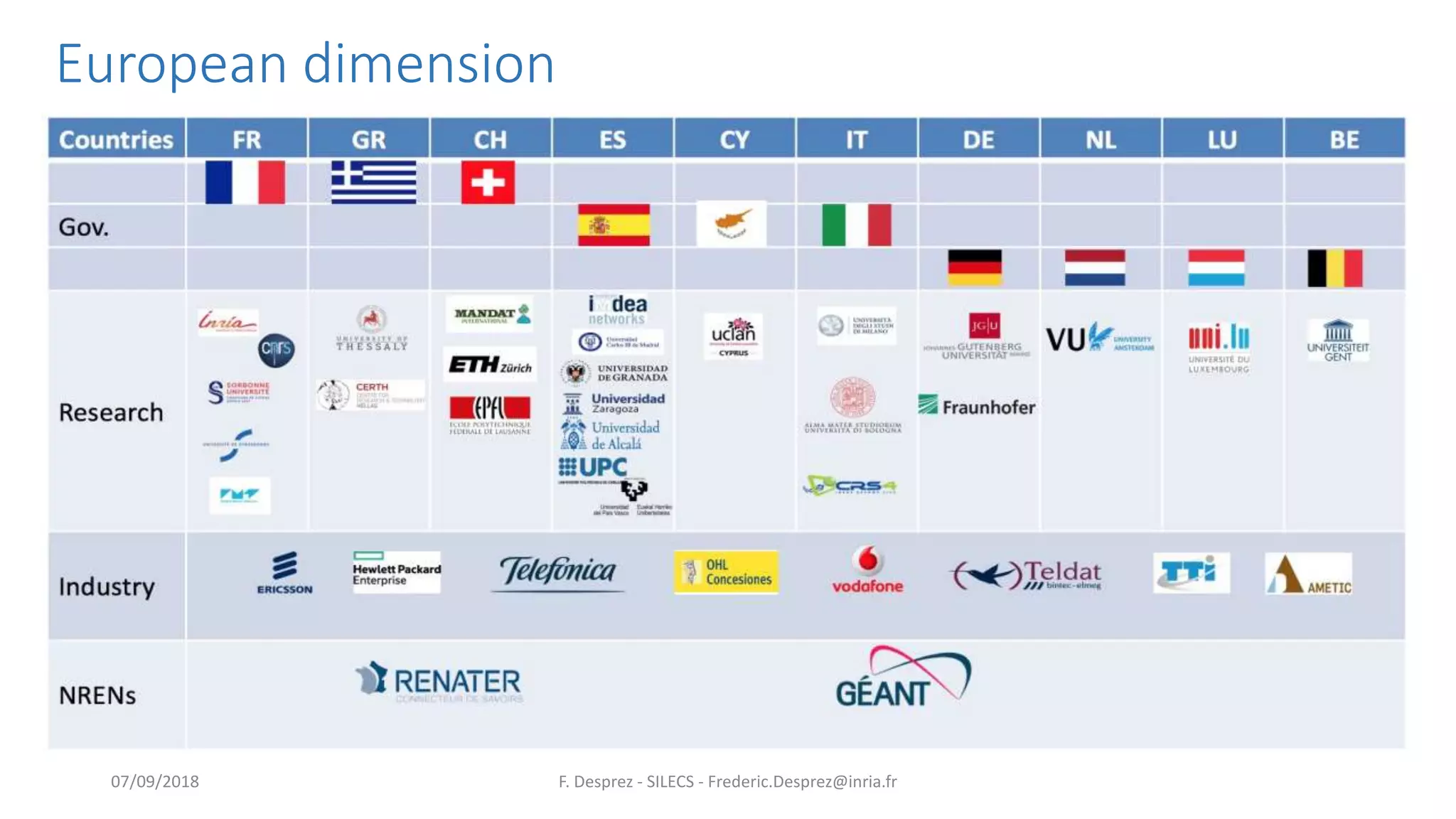
European dimension
F. Desprez - SILECS - Frederic.Desprez@inria.fr07/09/2018
Conclusions
• New infrastructure based on two existing instruments (FIT and Grid’5000)
• Design a software stack that will allow experiments mixing both kinds of resources
while keeping reproducibility level high
• Keep the aim of previous platforms (their core scientific issues addressed)
– Scalability issues, energy management, …
– IoT, wireless networks, future Internet for SILECS/FIT
– HPC, big data, clouds, virtualization, deep learning … for SILECS/Grid’5000
• Address new challenges
– IoT and Clouds
– New generation Cloud platforms and software stacks (Edge, FOG)
– Data streaming applications
– Locality aware resource management
– Big data management and analysis from sensors to the (distributed) cloud
– Mobility
– …
F. Desprez - SILECS - Frederic.Desprez@inria.fr07/09/2018
Thanks, any questions ?
F. Desprez - SILECS - Frederic.Desprez@inria.fr07/09/2018
http://www.silecs.net/
https://www.grid5000.fr/
https://fit-equipex.fr/

SILECS: Super Infrastructure for Large-scale Experimental Computer Science

  • 1.
    SILECS Super Infrastructure forLarge-scale Experimental Computer Science F. Desprez - Inria F. Desprez - SILECS - Frederic.Desprez@inria.fr INRIA, CNRS, RENATER, CEA, CPU, CDEFI, IMT, Sorbonne Université, Université Strasbourg, Université Lorraine, Université Grenoble Alpes, Université Lille 1, Université Rennes 1, Université Toulouse, ENS Lyon, INSA Lyon 07/09/2018 http://www.silecs.net/
  • 2.
    Introduction • Exponential improvementof – Electronics (energy consumption, size, cost) • Capacity of networks (WAN, wireless, new technologies) • Exponential growth of applications near users – Smartphones, tablets, connected devices, sensors, … – Prediction of 50 billions of connected devices by 2020 (CISCO) • Large number of Cloud facilities to cope with generated data – Many platforms and infrastructures available around the world – Several offers for IaaS, PaaS, and SaaS platforms – Public, private, community, and hybrid clouds – Going toward distributed Clouds (FOG, Edge, extreme Edge) F. Desprez - SILECS - Frederic.Desprez@inria.fr07/09/2018
  • 3.
    Convergence F. Desprez -SILECS - Frederic.Desprez@inria.fr ENIAC 1946 Transistor 1947 Computation Communication 1999 - Salesforces SaaS Concept micro processor 1971 1838 - Telegraph 1876 - Telephone 1896 - Radio 1957 - satellite 1969 - ARPANET 1973 - Ethernet 1985 - TCP/IP Adoption 1975 -Personal Computers SmartPhones 2007 2002- Amazon Initial Compute/Storage services 2006 - Amazon EC2 (IaaS) 2010 - Cloud democratisation 2015 Network/Computers Convergence Software Defined XXX 1999 - The Grid 1995 - Commodity clusters 2002 - Virtualised Infrastructure 1950/1990 - Mainframes 1950 - Batchmode 1960 - Interactive 1970 - Terminals (clients/server concepts) 1967 - First virtualisation attempt 07/09/2018
  • 4.
    Good experiments A goodexperiment should fulfill the following properties – Reproducibility: must give the same result with the same input – Extensibility: must target possible comparisons with other works and extensions (more/other processors, larger data sets, different architectures) – Applicability: must define realistic parameters and must allow for an easy calibration – “Revisability”: when an implementation does not perform as expected, must help to identify the reasons F. Desprez - SILECS - Frederic.Desprez@inria.fr07/09/2018
  • 5.
    SILECS: based upontwo existing infrastructures • FIT – Providing Internet players access to a variety of fixed and mobile technologies and services, thus accelerating the design of advanced technologies for the Future Internet – 4 key technologies and a single control point: IoT-Lab (connected objects & sensors, mobility), CorteXlab (Cognitive Radio), wireless (anechoic chamber), Network Operations Center, Advanced Cloud technology including OpenStack – 9 sites (Paris (2), Evry, Rocquencourt, Lille, Strasbourg, Lyon, Grenoble, Sophia Antipolis) • Grid’5000 – A scientific instrument for experimental research on large future infrastructures: Clouds, datacenters, HPC Exascale, Big Data infrastructures, networks, etc. – 10 sites, > 8000 cores, with a large variety of network connectivity and storage access, dedicated interconnection network granted and managed by RENATER • Software stacks dedicated to experimentation • Resource reservation, disk image deployment, monitoring tools, data collection and storage F. Desprez - SILECS - Frederic.Desprez@inria.fr07/09/2018
  • 6.
    GRID’5000 • Testbed forresearch on distributed systems • Born from the observation that we need a better and larger testbed • HPC, Grids, P2P, and now Cloud computing and BigData systems • A complete access to the nodes’ hardware in an exclusive mode (from one node to the whole infrastructure) • Dedicated network (RENATER) • Reconfigurable: nodes with Kadeploy and network with KaVLAN • Current status • 10 sites, 29 clusters, 1060 nodes, 10474 cores • Diverse technologies/resources (Intel, AMD, Myrinet, Infiniband, two GPU clusters, energy probes) • Some Experiments examples • In Situ analytics • Big Data Management • HPC Programming approaches • Network modeling and simulation • Energy consumption evaluation • Batch scheduler optimization • Large virtual machines deployments F. Desprez - SILECS - Frederic.Desprez@inria.fr07/09/2018 https://www.grid5000.fr/
  • 7.
    FIT F. Desprez -SILECS - Frederic.Desprez@inria.fr FIT-IoT-LAB • 2700 wireless sensor nodes spread across six different sites in France • Nodes are either fixed or mobile and can be allocated in various topologies throughout all sites Sophia Lyon FIT-CorteXlab: Cognitive Radio Testbed 40 Software Defined Radio Nodes (SOCRATE) FIT-R2Lab: WiFi mesh testbed (DIANA) 07/09/2018 https://fit-equipex.fr/
  • 8.
    Envisioned Architecture F. Desprez- SILECS - Frederic.Desprez@inria.fr Credits: Bastien Confais07/09/2018
  • 9.
    Short Term Viewof the Architecture F. Desprez - SILECS - Frederic.Desprez@inria.fr07/09/2018
  • 10.
    Data Center Portfolio Targets ●Performance, resilience, energy-efficiency, security in the context of data-center design, Big Data processing, Exascale computing, etc. Hardware ● Servers: x86, ARM64, POWER, accelerators (GPU, FPGA) ● Networking: Ethernet (10G, 40G), HPC networks (InfiniBand, Omni-Path) ● Storage: HDD, SSD, NVMe, both in storage arrays and clusters of servers Experimental support ● Bare-metal reconfiguration ● Large clusters ● Integrated monitoring (performance, energy, temperature, network traffic) F. Desprez - SILECS - Frederic.Desprez@inria.fr07/09/2018
  • 11.
    Wireless Portfolio Targets • Performance,security, safety and privacy-preservation in complex sensing environment, • Performance understanding and enhancement in wireless networking, • Target applications: smart cities/manufacturing, building automation, standard and interoperability, security, energy harvesting, health care. Hardware • Software Defined Radio (SDR), LTE-Advanced and 5G • Wireless Sensor Network (WSN/IEEE 802.15.4), LoRa/LoRaWAN • Wifi/WIMAX (IEEE 802.11/16) Experimental support • Bare-metal reconfiguration • Large-scale deployment (both in terms of densities and network diameter) • Different topologies with indoor/outdoor locations • Mobility-enabled with customized trajectories • Anechoic chamber • Integrated monitoring (power consumption, radio signal, network traffic) F. Desprez - SILECS - Frederic.Desprez@inria.fr07/09/2018
  • 12.
    Outdoor IOT testbed •IoT is not limited to smart objects or indoor wireless sensors (smart building, industry 4.0, ….) • Smart cities need outdoor IoT solutions • outdoor smart metering • outdoor metering at the scale of a neighborhood (air, noise smart sensing, ….) • citizens and local authorities are more and more interested by outdoor metering • Controlled outdoor testbed • (reproducible) polymorphic IoT: support of multiple IoT technologies (long, middle and short range IoT wireless solutions) at the same time on a large scale testbed • Agreement and support of local authorities • Deployment in Strasbourg city (500000 citizens, 384 km2) and Lyon campus F. Desprez - SILECS - Frederic.Desprez@inria.fr07/09/2018
  • 13.
    The GRAIL F. Desprez- SILECS - Frederic.Desprez@inria.fr07/09/2018
  • 14.
    Plans for SILECS:Testbed Services ● Provide a unified framework that (really) meets all needs ○ Make it easier for experimenters to move for one testbed to another ○ Make it easy to create simultaneous reservations on several testbeds (for cross-testbeds experiments) ○ Make it easy to extend SILECS with additional kinds of resources ○ Notes ■ SFA is probably not a sufficient solution here, even if SFA-compatibility is required for international collaboration (e.g. European federation) ■ It should be designed carefully to ensure we do not add just another not-so-useful abstraction layer ● Factor testbed services ○ Services that can exist at a higher level, e.g. open data service, for storage and preservation of experiments data (in collaboration with Open Data repositories such as OpenAIRE/Zenodo) ○ Services that are required to operate such infrastructures, but add no scientific value ○ users management, usage tracking F. Desprez - SILECS - Frederic.Desprez@inria.fr07/09/2018
  • 15.
    Services & SoftwareStack F. Desprez - SILECS - Frederic.Desprez@inria.fr Built from already functional solutions 07/09/2018
  • 16.
    Some recent experimentsexamples • Proxy location selection in industrial IoT, T.P. Raptis, A. Passarella, M. Conti • QoS differentiation in data collection for smart Grids, J. Nassar, M. Berthomé, J. Dubrulle, N. Gouvy, N. Mitton, B. Quoitin • Damaris: Scalable I/O and In-situ Big Data Processing, G. Antoniu, H. Salimi, M. Dorier • KerA: Scalable Data Ingestion for Stream Processing, O.-C. Marcu, A. Costan, G. Antoniu, M. Pérez- Hernández, B. Nicolae, R. Tudoran, S. Bortoli • Frequency Selection Approach for Energy Aware Cloud Database, C. Guo, J.-M. Pierson • Distributed Storage for a Fog/Edge infrastructure based on a P2P and a Scale-Out NAS, B. Confais, B. Parrein, A. Lebre • FogIoT Orchestrator: an Orchestration System for IoT Applications in Fog Environment, B. Donassolo, I. Fajjari, A. Legrand, P. Mertikopoulos F. Desprez - SILECS - Frederic.Desprez@inria.fr07/09/2018
  • 17.
    Proxy location selectionin industrial IoT • Distributed data collection with low latency in Industrial context • Traditional approach • Improving data routing by selecting quicker links • Deploying enhanced edge-nodes for fog computing • Solution • Dynamically select sensor nodes to act as proxys and get the information closer to consuming nodes. • FIT IoT LAB as a validation testbed • Access to 95 sensor nodes with IoT features remotely • Customizable environment and tools (sniffer, consumption measure, etc) • Repeat the experiments later and compare to alternate approaches with the same environment • The results show that latency is much reduced • FIT IoT LAB helped validate the approach before real costly deployment F. Desprez - SILECS - Frederic.Desprez@inria.fr Performance Analysis of Latency-Aware Data Management in Industrial IoT Networks, T.P. Raptis, A. Passarella, M. Conti - MDPI Sensors, 2018, 18(8), 2611 07/09/2018
  • 18.
    QoS differentiation indata collection for smart Grids • Data collection with different QoS requirements for Smart Grid applications • Traditional approach • Use of standard RPL protocol which offers overall good performances but no QoS differentiation based on application • Solution • Use a dynamic objective function • FIT IoT LAB as a validation testbed • Access to 67 sensor nodes with IoT features remotely • Customizable environment and tools (data size and rate, consumption measure, clock, etc) • Repeat the experiments and compare to alternate approaches with the same environment. • The results show that based on the service requested, data from different applications follow different paths, each meeting expected requirements. • FIT IoT LAB helped validate the approach to go further with standardization F. Desprez - SILECS - Frederic.Desprez@inria.fr Multiple Instances QoS Routing In RPL: Application To Smart Grids – J. Nassar, M. Berthomé, J. Dubrulle, N. Gouvy, N. Mitton, B. Quoitin – MDPI Sensors, July 2018 07/09/2018
  • 19.
    Damaris • Scalable, asynchronousdata storage for large-scale simulations using the HDF5 format (HDF5 blog at https://goo.gl/7A4cZh) • Traditional approach • All simulation processes (10K+) write on disk at the same time synchronously • Problems: 1) I/O jitter, 2) long I/O phase, 3) Blocked simulation during data writing • Solution • Aggregate data in dedicated cores using shared memory and write asynchronously • Grid’5000 used as a testbed – Access to many (1024) homogeneous cores – Customizable environment and tools – Repeat the experiments later with the same environment saved as an image • The results show that Damaris can provide a jitter-free and wait-free data storage mechanism • G5K helped prepare Damaris for deployment on top supercomputers (Titan, Pangea (Total), Jaguar, Kraken, etc.) F. Desprez - SILECS - Frederic.Desprez@inria.fr … https://project.inria.fr/damaris/07/09/2018
  • 20.
    KerA: Scalable DataIngestion for Stream Processing • Goal: increase ingestion and processing throughput of Big Data streams • Dynamic partitioning and lightweight stream offset indexing • Higher parallelism for producers and consumers • Grid’5000 Paravance cluster used for development and testing • Customized OS image and easy deployment • 128GB RAM and 16 CPU cores • 10Gb networking • Next steps: KerA* unified architecture for stream ingestion and storage • Support for records, streams and objects • Collaborations • INRIA, HUAWEI, UPM, BigStorage F. Desprez - SILECS - Frederic.Desprez@inria.fr KerA: Scalable Data Ingestion for Stream Processing, O.-C. Marcu, A. Costan, G. Antoniu, M. Pérez-Hernández, B. Nicolae, R. Tudoran, S. Bortoli. In Proc. ICDCS, 2018. KerA vs Kafka: up to 4x-5x better throughput 07/09/2018
  • 21.
    Frequency Selection Approachfor Energy Aware Cloud Database • Objective: Study the energy efficiency of cloud database systems and propose a frequency selection approach and corresponding algorithms to cope with resource proposing problem F. Desprez - SILECS - Frederic.Desprez@inria.fr Frequency Selection Approach for Energy Aware Cloud Database, C. Guo, J.-M. Pierson. In Proc. SBAC-PAD, 2018. Relationship between Request Amount and Throughput • Contribution: Propose frequency selection model and algorithms. • Propose a Genetic Based Algorithm and a Monte Carlo Tree Based Algorithm to produce the frequencies according to workload predictions • Propose a model simplification method to improve the performance of the algorithms • Grid5000 usage • A cloud database system, Cassandra, was deployed within a Grid’5000 cluster using 10 nodes of Nancy side to study the relationship between system throughput and energy efficiency of the system • By another benchmark experiment, the migration cost parameters of the model were obtained 07/09/2018
  • 22.
    Distributed Storage fora Fog/Edge infrastructure based on a P2P and a Scale-Out NAS • Objective • Design of a storage infrastructure taking locality into account • Properties a distributed storage system should have: data locality, network containment, mobility support, disconnected mode, scalability • Contributions • Improving locality when accessing an object stored locally coupling IPFS and a Scale- Out NAS • Improving locality when accessing an object stored on a remote site using a tree inspired by the DNS • Experiments • Deployment of a Fog Site on the Grid’5000 testbed and the clients on the IoTLab platform • Coupling a Scale-Out NAS to IPFS limits the inter-sites network traffic and improves locality of local accesses • Replacing the DHT by a tree mapped on the physical topology improves locality to find the location of objects • Experiments using IoTlab and Grid’5000 are (currently) not easy to perform F. Desprez - SILECS - Frederic.Desprez@inria.fr07/09/2018 An Object Store Service for a Fog/Edge Computing Infrastructure based on IPFS and Scale-out NAS, B. Confais, A. Lebre, and B. Parrein (May 2017). In: 1st IEEE International Conference on Fog and Edge Computing - ICFEC’2017.
  • 23.
    FogIoT Orchestrator: anOrchestration System for IoT Applications in Fog Environment F. Desprez - SILECS - Frederic.Desprez@inria.fr • Objective • Design a Optimized Fog Service Provisioning strategy (O-FSP) and validate it on a real infrastructure • Contributions • Design and implementation of FITOR, an orchestration framework for the automation of the deployment, the scalability management, and migration of micro-service based IoT applications • Design of a provisioning solution for IoT applications that optimizes the placement and the composition of IoT components, while dealing with the heterogeneity of the underlying Fog infrastructure • Experiments • Fog layer is composed of 20 servers from Grid5000 which are part of the genepi cluster, Mist layer is composed of 50 A8 nodes • Use of a software stack made of open-source components (Calvin, Prometheus, Cadvisor, Blackbox exporter, Netdata) • Experiments show that the O-FSP strategy makes the provisioning more effective and outperforms classical strategies in terms of: i) acceptance rate, ii) provisioning cost, and iii) resource usage 07/09/2018 FogIoT Orchestrator: an Orchestration System for IoT Applications in Fog Environment, B. Donassolo, I. Fajjari, A. Legrand, P. Mertikopoulos.. 1st Grid’5000-FIT school, Apr 2018, Sophia Antipolis, France. 2018.
  • 24.
    European dimension F. Desprez- SILECS - Frederic.Desprez@inria.fr07/09/2018
  • 25.
    Conclusions • New infrastructurebased on two existing instruments (FIT and Grid’5000) • Design a software stack that will allow experiments mixing both kinds of resources while keeping reproducibility level high • Keep the aim of previous platforms (their core scientific issues addressed) – Scalability issues, energy management, … – IoT, wireless networks, future Internet for SILECS/FIT – HPC, big data, clouds, virtualization, deep learning … for SILECS/Grid’5000 • Address new challenges – IoT and Clouds – New generation Cloud platforms and software stacks (Edge, FOG) – Data streaming applications – Locality aware resource management – Big data management and analysis from sensors to the (distributed) cloud – Mobility – … F. Desprez - SILECS - Frederic.Desprez@inria.fr07/09/2018
  • 26.
    Thanks, any questions? F. Desprez - SILECS - Frederic.Desprez@inria.fr07/09/2018 http://www.silecs.net/ https://www.grid5000.fr/ https://fit-equipex.fr/