Azure Brain: 4th paradigm, scientific
discovery & (really) big data (REC201)
Gabriel Antoniu
Senior Research Scientist, Inria
Head of the KerData Project-Team, Inria Rennes – Bretagne Atlantique
Radu Tudoran
PhD student, ENS Cachan – Brittany
KerData Project-Team, Inria Rennes – Bretagne Atlantique
Feb. 12, 2013
INRIA’s strategy in Cloud Computing
INRIA is among the leaders in Europe in the area of distributed computing and HPC
• Long history of researches around distributed systems, HPC, Grids
• Now several activities virtualized environments/cloud infrastructures
• Culture of multidisciplinary research
• Culture of exploration tools (owner of massively parallel machines since 1987, large scale
testbeds such as Grid’5000)
• Strong involvement in national, European and international collaborative projects
• Strong collaboration history with industry (Joint Microsoft Research – Inria Centre, IBM,
EDF, Bull, etc.)
- 2
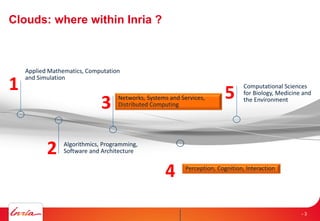
Clouds: where within Inria ?
1
2
Networks, Systems and Services,
Distributed Computing3
Perception, Cognition, Interaction
4
5
Applied Mathematics, Computation
and Simulation
Algorithmics, Programming,
Software and Architecture
Computational Sciences
for Biology, Medicine and
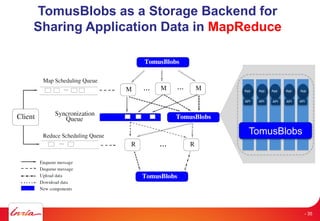
the Environment
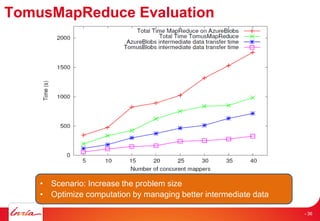
- 3
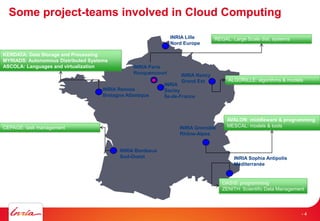
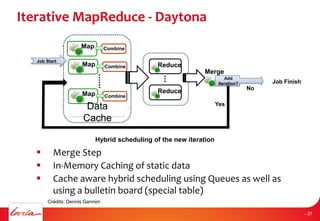
Some project-teams involved in Cloud Computing
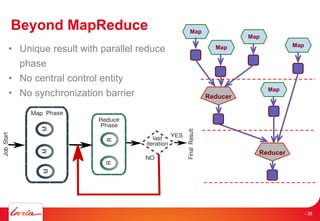
INRIA Nancy
Grand Est
INRIA Grenoble
Rhône-Alpes
INRIA Sophia Antipolis
Méditerranée
INRIA Rennes
Bretagne Atlantique
INRIA Bordeaux
Sud-Ouest
INRIA Lille
Nord Europe
INRIA
Saclay
Île-de-France
INRIA Paris
Rocquencourt
KERDATA: Data Storage and Processing
MYRIADS: Autonomous Distributed Systems
ASCOLA: Languages and virtualization
CEPAGE: task management
AVALON: middleware & programming
MESCAL: models & tools
REGAL: Large Scale dist. systems
ALGORILLE: algorithms & models
OASIS: programming
ZENITH: Scientific Data Management
- 4
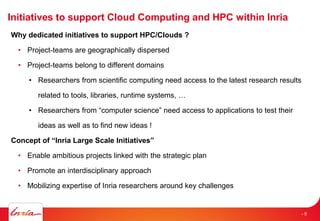
Initiatives to support Cloud Computing and HPC within Inria
Why dedicated initiatives to support HPC/Clouds ?
• Project-teams are geographically dispersed
• Project-teams belong to different domains
• Researchers from scientific computing need access to the latest research results
related to tools, libraries, runtime systems, …
• Researchers from “computer science” need access to applications to test their
ideas as well as to find new ideas !
Concept of “Inria Large Scale Initiatives”
• Enable ambitious projects linked with the strategic plan
• Promote an interdisciplinary approach
• Mobilizing expertise of Inria researchers around key challenges
- 5
CLOUD COMPUTING@
INRIA RENNES BRETAGNE ATLANTIQUE
- 6
Some Research Focus Areas
Software architecture and infrastructure for cloud computing
• Autonomic service management, resource management, SLA, sky
computing: Myriads
• Big Data storage and management, MapReduce: KerData
• Hybrid Cloud and P2P systems, privacy: ASAP
Advanced usage for specific application communities
• Bioinformatics: GENSCALE
• Cloud for medical imaging: EasyMed project (IRT B-Com): Visages
- 7
Some Research Focus Areas
Software architecture and infrastructure for cloud computing
• Autonomic service management, resource management, SLA, sky
computing: Myriads
• Big Data storage and management, MapReduce: KerData
• Hybrid Cloud and P2P systems, privacy: ASAP
Advanced usage for specific application communities
• Bioinformatics: GENSCALE
• Cloud for medical imaging: EasyMed project (IRT B-Com): Visages
- 8
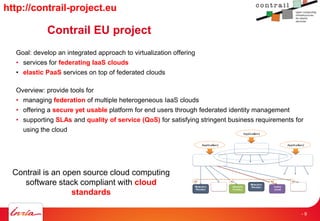
Contrail EU project
Goal: develop an integrated approach to virtualization offering
• services for federating IaaS clouds
• elastic PaaS services on top of federated clouds
Overview: provide tools for
• managing federation of multiple heterogeneous IaaS clouds
• offering a secure yet usable platform for end users through federated identity management
• supporting SLAs and quality of service (QoS) for satisfying stringent business requirements for
using the cloud
Resource
Provider
Federa&on)API)
+)Fed.)core)
Resource
Provider
Storage(
Provider( Public(
Cloud(
Storage(
Provider(Network(
Provider(
A) A)A) A)
Applica&on)
Applica&on)
Applica&on)
Federa&on)API)
+)Fed.)core)
Federa&on)API)
+)Fed.)core)
Contrail is an open source cloud computing
software stack compliant with cloud
standards
http://contrail-project.eu
- 9
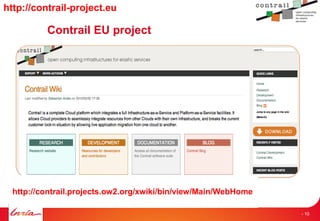
Contrail EU project
http://contrail-project.eu
http://contrail.projects.ow2.org/xwiki/bin/view/Main/WebHome
- 10
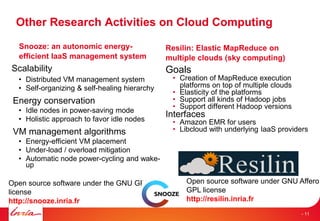
Open source software under the GNU GPLv2
license
http://snooze.inria.fr
Other Research Activities on Cloud Computing
Snooze: an autonomic energy-
efficient IaaS management system
Scalability
• Distributed VM management system
• Self-organizing & self-healing hierarchy
Energy conservation
• Idle nodes in power-saving mode
• Holistic approach to favor idle nodes
VM management algorithms
• Energy-efficient VM placement
• Under-load / overload mitigation
• Automatic node power-cycling and wake-
up
Resilin: Elastic MapReduce on
multiple clouds (sky computing)
Goals
• Creation of MapReduce execution
platforms on top of multiple clouds
• Elasticity of the platforms
• Support all kinds of Hadoop jobs
• Support different Hadoop versions
Interfaces
• Amazon EMR for users
• Libcloud with underlying IaaS providers
Open source software under GNU Affero
GPL license
http://resilin.inria.fr
- 11
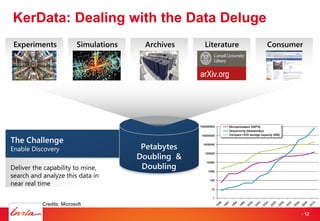
KerData: Dealing with the Data Deluge
Deliver the capability to mine,
search and analyze this data in
near real time
Science itself is evolving
Credits: Microsoft
12- 12
Last
few decades
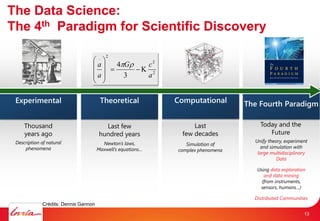
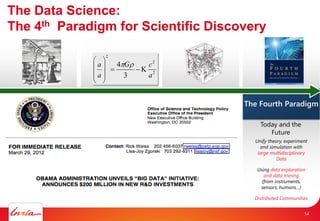
The Data Science:
The 4th Paradigm for Scientific Discovery
Thousand
years ago
Today and the
Future
Last few
hundred years
2
2
2.
3
4
a
cG
a
a










Simulation of
complex phenomena
Newton’s laws,
Maxwell’s equations…
Description of natural
phenomena
Unify theory, experiment
and simulation with
large multidisciplinary
Data
Using data exploration
and data mining
(from instruments,
sensors, humans…)
Distributed Communities
Crédits: Dennis Gannon
13
Last
few decades
The Data Science:
The 4th Paradigm for Scientific Discovery
Thousand
years ago
Today and the
Future
Last few
hundred years
2
2
2.
3
4
a
cG
a
a










Simulation of
complex phenomena
Newton’s laws,
Maxwell’s equations…
Description of natural
phenomena
Unify theory, experiment
and simulation with
large multidisciplinary
Data
Using data exploration
and data mining
(from instruments,
sensors, humans…)
Distributed Communities
14
Research Focus:
How to efficiently store, share and process data
for new-generation, data-intensive applications?
• Scientific challenges
• Massive data (1 object = 1 TB)
• Geographically distributed
• Fine-grain access (MB) for reading and writing
• High concurrency (10³ concurrent clients)
• Without locking
- Major goal: high-throughput under heavy concurrency
- Our contribution
Design and implementation of distributed algorithms
Validation with real apps on real platforms with real users
• Applications
• Massive data analysis: clouds (e.g. MapReduce)
• Post-Petascale HPC simulations: supercomputers
- 15
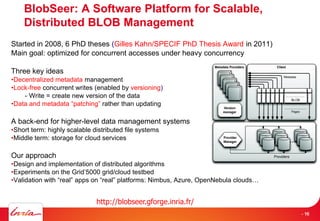
BlobSeer: A Software Platform for Scalable,
Distributed BLOB Management
Started in 2008, 6 PhD theses (Gilles Kahn/SPECIF PhD Thesis Award in 2011)
Main goal: optimized for concurrent accesses under heavy concurrency
Three key ideas
•Decentralized metadata management
•Lock-free concurrent writes (enabled by versioning)
- Write = create new version of the data
•Data and metadata “patching” rather than updating
A back-end for higher-level data management systems
•Short term: highly scalable distributed file systems
•Middle term: storage for cloud services
Our approach
•Design and implementation of distributed algorithms
•Experiments on the Grid’5000 grid/cloud testbed
•Validation with “real” apps on “real” platforms: Nimbus, Azure, OpenNebula clouds…
http://blobseer.gforge.inria.fr/
16- 16
Impact of BlobSeer: MapReduce
BlobSeer improves Hadoop
• Gain (execution time) : 35%
ANR MapReduce Project (2010-2014)
• Lead: G. Antoniu (KerData)
• Partners: INRIA (AVALON), Argonne National Lab, U. Illinois Urbana-Champaign, IBM,
JLPC, IBCP, MEDIT
• Strong collaboration with the Nimbus team from Argonne National Lab
- BlobSeer integrated with the Nimbus cloud toolkit
- BlobSeer used for efficient VM deployment and snapshotting
• Validation : Grid’5000 with Nimbus, FutureGrid (USA), Open Cirrus (USA)
http://mapreduce.inria.fr
- 17
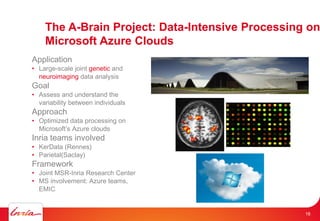
The A-Brain Project: Data-Intensive Processing on
Microsoft Azure Clouds
Application
• Large-scale joint genetic and
neuroimaging data analysis
Goal
• Assess and understand the
variability between individuals
Approach
• Optimized data processing on
Microsoft’s Azure clouds
Inria teams involved
• KerData (Rennes)
• Parietal(Saclay)
Framework
• Joint MSR-Inria Research Center
• MS involvement: Azure teams,
EMIC
18
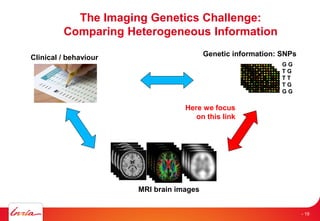
Genetic information: SNPs
G G
T G
T T
T G
G G
MRI brain images
Clinical / behaviour
The Imaging Genetics Challenge:
Comparing Heterogeneous Information
THere we focus
on this link
- 19
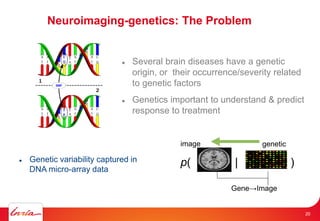
Neuroimaging-genetics: The Problem
 Several brain diseases have a genetic
origin, or their occurrence/severity related
to genetic factors
 Genetics important to understand & predict
response to treatment
 Genetic variability captured in
DNA micro-array data
p( )|
Gene→Image
geneticimage
20
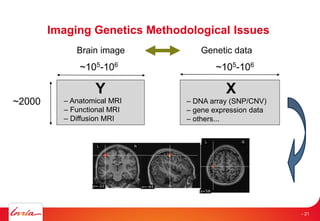
Imaging Genetics Methodological Issues
Genetic dataBrain image
Y
~105-106
~2000
X
~105-106
– Anatomical MRI
– Functional MRI
– Diffusion MRI
– DNA array (SNP/CNV)
– gene expression data
– others...
- 21
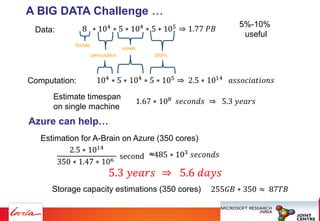
A BIG DATA Challenge …
Azure can help…
Data:
double
permutation
voxels
SNPs
5%-10%
useful
Computation:
Estimate timespan
on single machine
Estimation for A-Brain on Azure (350 cores)
Storage capacity estimations (350 cores)
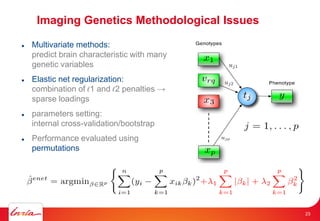
Imaging Genetics Methodological Issues
 Multivariate methods:
predict brain characteristic with many
genetic variables
 Elastic net regularization:
combination of ℓ1 and ℓ2 penalties →
sparse loadings
 parameters setting:
internal cross-validation/bootstrap
 Performance evaluated using
permutations
23
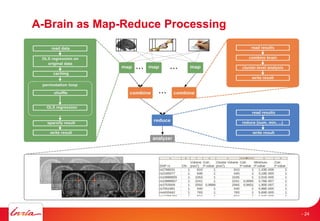
A-Brain as Map-Reduce Processing
- 24
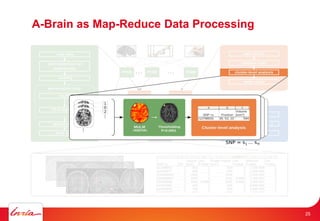
A-Brain as Map-Reduce Data Processing
25
Efficient Procedures for Statistics
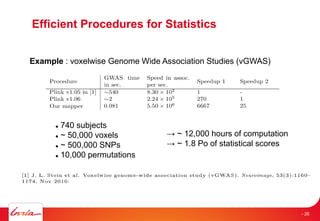
Example : voxelwise Genome Wide Association Studies (vGWAS)
 740 subjects
 ~ 50,000 voxels
 ~ 500,000 SNPs
 10,000 permutations
→ ~ 12,000 hours of computation
→ ~ 1.8 Po of statistical scores
- 26
Efficient Procedures for Statistics
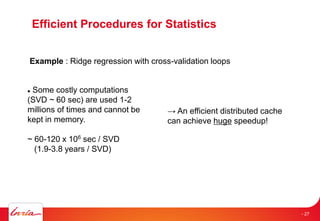
Example : Ridge regression with cross-validation loops
 Some costly computations
(SVD ~ 60 sec) are used 1-2
millions of times and cannot be
kept in memory.
~ 60-120 x 106 sec / SVD
(1.9-3.8 years / SVD)
→ An efficient distributed cache
can achieve huge speedup!
- 27
TomusBlobs approach
- 28
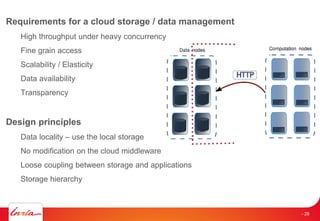
Requirements for a cloud storage / data management
High throughput under heavy concurrency
Fine grain access
Scalability / Elasticity
Data availability
Transparency
Design principles
Data locality – use the local storage
No modification on the cloud middleware
Loose coupling between storage and applications
Storage hierarchy
- 29
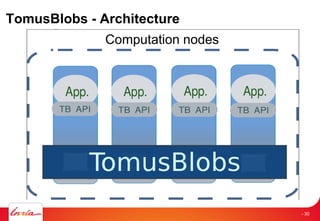
TomusBlobs - Architecture
- 30
Computation nodes
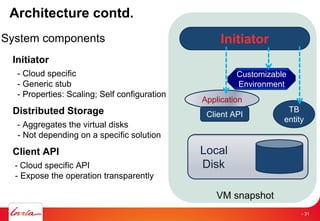
Architecture contd.
System components
Initiator
- Cloud specific
- Generic stub
- Properties: Scaling; Self configuration
Distributed Storage
- Aggregates the virtual disks
- Not depending on a specific solution
Client API
- Cloud specific API
- Expose the operation transparently
Initiator
Local
Disk
Application
Client API
TB
entity
VM snapshot
Customizable
Environment
- 31
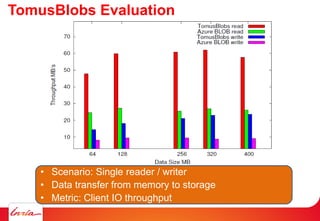
TomusBlobs Evaluation
• Scenario: Single reader / writer
• Data transfer from memory to storage
• Metric: Client IO throughput
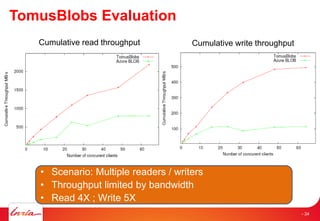
TomusBlobs Evaluation
Cumulative read throughput Cumulative write throughput
• Scenario: Multiple readers / writers
• Throughput limited by bandwidth
• Read 4X ; Write 5X
- 34
TomusBlobs as a Storage Backend for
Sharing Application Data in MapReduce
App
API
App App App App
API API API API
TomusBlobs
- 35
TomusMapReduce Evaluation
• Scenario: Increase the problem size
• Optimize computation by managing better intermediate data
- 36
Iterative MapReduce - Daytona
 Merge Step
 In-Memory Caching of static data
 Cache aware hybrid scheduling using Queues as well as
using a bulletin board (special table)
Reduce
Reduce
Merge
Add
Iteration?
No
Map Combine
Map Combine
Map Combine
Data
Cache
Yes
Hybrid scheduling of the new iteration
Job Start
Job Finish
Crédits: Dennis Gannon
- 37
Beyond MapReduce
• Unique result with parallel reduce
phase
• No central control entity
• No synchronization barrier
Map
Reducer
Map
Map
Map
Map
Reducer
- 38
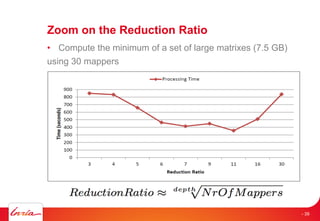
Zoom on the Reduction Ratio
• Compute the minimum of a set of large matrixes (7.5 GB)
using 30 mappers
- 39
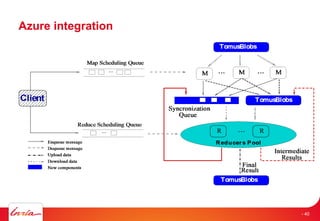
Azure integration
- 40
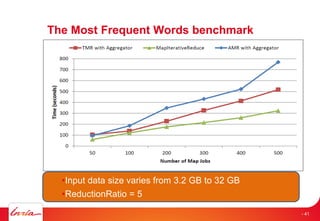
The Most Frequent Words benchmark
•Input data size varies from 3.2 GB to 32 GB
•ReductionRatio = 5
- 41
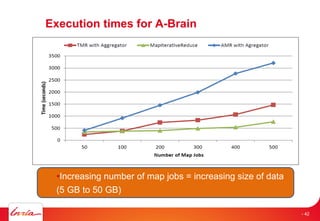
Execution times for A-Brain
•Increasing number of map jobs = increasing size of data
(5 GB to 50 GB)
- 42
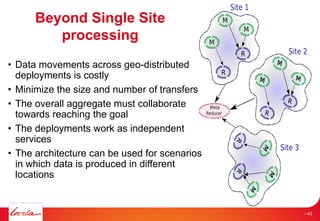
Beyond Single Site
processing
• Data movements across geo-distributed
deployments is costly
• Minimize the size and number of transfers
• The overall aggregate must collaborate
towards reaching the goal
• The deployments work as independent
services
• The architecture can be used for scenarios
in which data is produced in different
locations
- 43
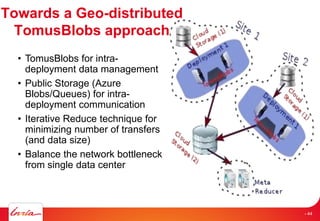
Towards a Geo-distributed
TomusBlobs approach
• TomusBlobs for intra-
deployment data management
• Public Storage (Azure
Blobs/Queues) for intra-
deployment communication
• Iterative Reduce technique for
minimizing number of transfers
(and data size)
• Balance the network bottleneck
from single data center
- 44
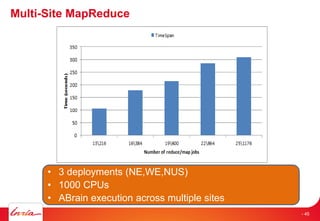
Multi-Site MapReduce
• 3 deployments (NE,WE,NUS)
• 1000 CPUs
• ABrain execution across multiple sites
- 45
Beyond MapReduce -
Workflow Processing
- 46
Data access patterns for workflows [1]
[1] Vairavanathan et al.
A Workflow-Aware Storage
System: An Opportunity Study
http://ece.ubc.ca/~matei/paper
s/ccgrid2012.pdf
Pipeline
Caching
Data informed workflow
Input
Output
Broadcast
Replication
Data size
Input
Output
Reduce/Gather
Co-placement of all data
Data informed workflow
Input
Output
Scatter
File size awareness
Data informed workflow
Input
Output
- 47
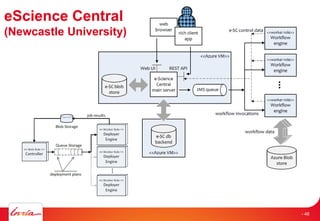
eScience Central
(Newcastle University)
- 48
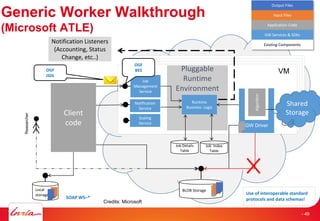
Generic Worker Walkthrough
(Microsoft ATLE)
Local
storage
Client
code
Researcher
Job
Management
Service
Algorithm
HD
GW Driver
Pluggable
Runtime
Environment
Runtime
Business Logic
Job Details
Table
Job Index
Table
Notification Listeners
(Accounting, Status
Change, etc..)
BLOB Storage
Notification
Service
Scaling
Service
OGF
BES VM
SOAP WS–*
Use of interoperable standard
protocols and data schemas!
OGF
JSDL
Application Code
GW Services & SDKs
Existing Components
Input Files
Output Files
Shared
Storage
- 49
Credits: Microsoft
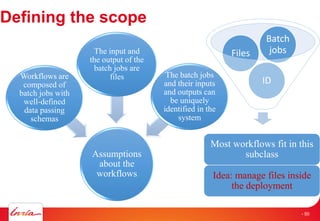
Defining the scope
ID
Files
Batch
jobs
Assumptions
about the
workflows
Workflows are
composed of
batch jobs with
well-defined
data passing
schemas
The input and
the output of the
batch jobs are
files The batch jobs
and their inputs
and outputs can
be uniquely
identified in the
system
Most workflows fit in this
subclass
Idea: manage files inside
the deployment
- 50
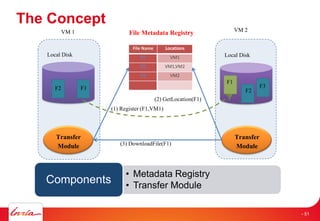
The Concept
File Name Locations
F1 VM1
F2 VM1,VM2
F3 VM2
VM 1 VM 2
Local Disk Local Disk
F1F2 F3
Transfer
Module
File Metadata Registry
(1) Register (F1,VM1)
(2) GetLocation(F1)
(3) DownloadFile(F1)
F1
F2
• Metadata Registry
• Transfer Module
Components
Transfer
Module
- 51
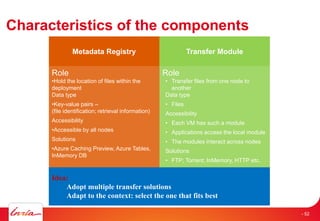
Characteristics of the components
Metadata Registry Transfer Module
Role
• Transfer files from one node to
another
Data type
• Files
Accessibility
• Each VM has such a module
• Applications access the local module
• The modules interact across nodes
Solutions
• FTP; Torrent; InMemory, HTTP etc.
Role
•Hold the location of files within the
deployment
Data type
•Key-value pairs –
(file identification; retrieval information)
Accessibility
•Accessible by all nodes
Solutions
•Azure Caching Preview, Azure Tables,
InMemory DB
Idea:
Adopt multiple transfer solutions
Adapt to the context: select the one that fits best
- 52
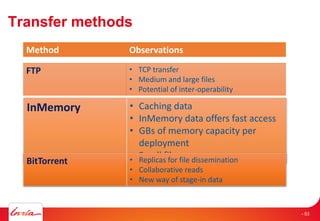
Transfer methods
Method Observations
InMemory • Caching data
• InMemory data offers fast access
• GBs of memory capacity per
deployment
• Small files
BitTorrent • Replicas for file dissemination
• Collaborative reads
• New way of stage-in data
FTP • TCP transfer
• Medium and large files
• Potential of inter-operability
- 53
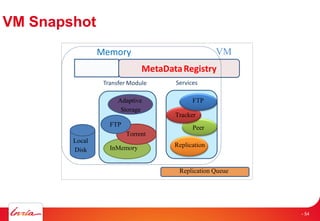
VM Snapshot
VMMemory
MetaDataRegistry
Adaptive
Storage
FTP
Torrent
InMemory
Transfer Module Services
Replication Queue
Replication
FTP
Tracker
Peer
Local
Disk
- 54
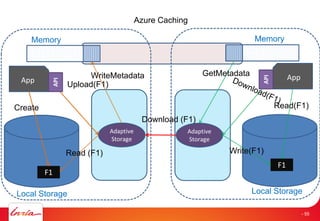
F1
Azure Caching
Adaptive
Storage
Adaptive
Storage
App App
F1
Create
Upload(F1)
GetMetadata
Read(F1)
Memory Memory
Local Storage Local Storage
Read (F1)
WriteMetadata
Write(F1)
Download (F1)
API
API
- 55
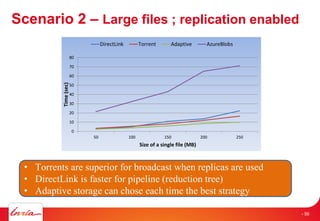
Scenario 2 – Large files ; replication enabled
0
10
20
30
40
50
60
70
80
50 100 150 200 250
Time(sec)
Size of a single file (MB)
DirectLink Torrent Adaptive AzureBlobs
• Torrents are superior for broadcast when replicas are used
• DirectLink is faster for pipeline (reduction tree)
• Adaptive storage can chose each time the best strategy
- 56
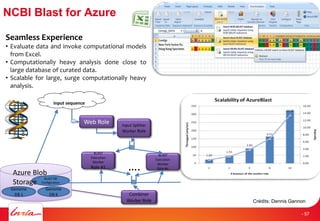
NCBI Blast for Azure
Seamless Experience
• Evaluate data and invoke computational models
from Excel.
• Computationally heavy analysis done close to
large database of curated data.
• Scalable for large, surge computationally heavy
analysis.
selects DBs and
input sequence
Web Role Input Splitter
Worker Role
BLAST
Execution
Worker
Role #n….
Combiner
Worker Role
Genome
DB 1
Genome
DB K
BLAST DB
Configuration
Azure Blob
Storage
BLAST
Execution
Worker
Role #1
Crédits: Dennis Gannon
- 57
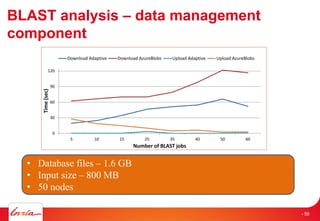
BLAST analysis – data management
component
0
30
60
90
120
5 10 15 25 35 40 50 60
Time(sec)
Number of BLAST jobs
Download Adaptive Download AzureBlobs Upload Adaptive Upload AzureBlobs
• Database files – 1.6 GB
• Input size – 800 MB
• 50 nodes
- 58
Scalable Storage on Clouds: Open Issues
Understanding price-performance trade-offs
• Consistency, availability, performance, cost, security,
quality of service, energy consumption
• Autonomy, adaptive consistency
• Dynamic elasticity
• Trade-offs exposed to the user
High performance variability
- Understand it, model it, cope with it
Deployment/application launching time is high
Latency of data accesses is still an issue
Data movements are expensive
Cope with tightly-coupled applications
Cope with various cloud programming models
Virtualization overhead
Benchmarking
Performance modeling
Self-optimization for cost reduction
- Elastic scale down
Security and privacy
- 59
Extreme scale does matter BUT not only
Other focus areas
– Affordability and usability of intermediate size systems
– Pervasiveness of usage across the entire industry, including Small and
Medium Enterprises (SMEs) and ISVs
– New HPC deployments (e.g. Big Data, HPC in Clouds)
– HPC and Cloud usage expansion, fostering the development of consultancy,
expertise and service business / end-user support
– Facilitating the creation of start-ups and the development of the SME sector
(hw/sw supply side)
– Education and training (inc. engineering skills for industry)
Cloud Computing@INRIA
Strategic Research Agenda
- 60
- 61
Azure Brain: 4th paradigm, scientific
discovery & (really) big data (REC201)
Gabriel Antoniu
Senior Research Scientist, Inria
Head of the KerData Project-Team, Inria Rennes – Bretagne Atlantique
Radu Tudoran
PhD student, ENS Cachan – Brittany
KerData Project-Team, Inria Rennes – Bretagne Atlantique
Contacts: Gabriel.Antoniu@inria.fr, Radu.Tudoran@inria.fr

Azure Brain: 4th paradigm, scientific discovery & (really) big data

  • 1.
    Azure Brain: 4thparadigm, scientific discovery & (really) big data (REC201) Gabriel Antoniu Senior Research Scientist, Inria Head of the KerData Project-Team, Inria Rennes – Bretagne Atlantique Radu Tudoran PhD student, ENS Cachan – Brittany KerData Project-Team, Inria Rennes – Bretagne Atlantique Feb. 12, 2013
  • 2.
    INRIA’s strategy inCloud Computing INRIA is among the leaders in Europe in the area of distributed computing and HPC • Long history of researches around distributed systems, HPC, Grids • Now several activities virtualized environments/cloud infrastructures • Culture of multidisciplinary research • Culture of exploration tools (owner of massively parallel machines since 1987, large scale testbeds such as Grid’5000) • Strong involvement in national, European and international collaborative projects • Strong collaboration history with industry (Joint Microsoft Research – Inria Centre, IBM, EDF, Bull, etc.) - 2
  • 3.
    Clouds: where withinInria ? 1 2 Networks, Systems and Services, Distributed Computing3 Perception, Cognition, Interaction 4 5 Applied Mathematics, Computation and Simulation Algorithmics, Programming, Software and Architecture Computational Sciences for Biology, Medicine and the Environment - 3
  • 4.
    Some project-teams involvedin Cloud Computing INRIA Nancy Grand Est INRIA Grenoble Rhône-Alpes INRIA Sophia Antipolis Méditerranée INRIA Rennes Bretagne Atlantique INRIA Bordeaux Sud-Ouest INRIA Lille Nord Europe INRIA Saclay Île-de-France INRIA Paris Rocquencourt KERDATA: Data Storage and Processing MYRIADS: Autonomous Distributed Systems ASCOLA: Languages and virtualization CEPAGE: task management AVALON: middleware & programming MESCAL: models & tools REGAL: Large Scale dist. systems ALGORILLE: algorithms & models OASIS: programming ZENITH: Scientific Data Management - 4
  • 5.
    Initiatives to supportCloud Computing and HPC within Inria Why dedicated initiatives to support HPC/Clouds ? • Project-teams are geographically dispersed • Project-teams belong to different domains • Researchers from scientific computing need access to the latest research results related to tools, libraries, runtime systems, … • Researchers from “computer science” need access to applications to test their ideas as well as to find new ideas ! Concept of “Inria Large Scale Initiatives” • Enable ambitious projects linked with the strategic plan • Promote an interdisciplinary approach • Mobilizing expertise of Inria researchers around key challenges - 5
  • 6.
    CLOUD COMPUTING@ INRIA RENNESBRETAGNE ATLANTIQUE - 6
  • 7.
    Some Research FocusAreas Software architecture and infrastructure for cloud computing • Autonomic service management, resource management, SLA, sky computing: Myriads • Big Data storage and management, MapReduce: KerData • Hybrid Cloud and P2P systems, privacy: ASAP Advanced usage for specific application communities • Bioinformatics: GENSCALE • Cloud for medical imaging: EasyMed project (IRT B-Com): Visages - 7
  • 8.
    Some Research FocusAreas Software architecture and infrastructure for cloud computing • Autonomic service management, resource management, SLA, sky computing: Myriads • Big Data storage and management, MapReduce: KerData • Hybrid Cloud and P2P systems, privacy: ASAP Advanced usage for specific application communities • Bioinformatics: GENSCALE • Cloud for medical imaging: EasyMed project (IRT B-Com): Visages - 8
  • 9.
    Contrail EU project Goal:develop an integrated approach to virtualization offering • services for federating IaaS clouds • elastic PaaS services on top of federated clouds Overview: provide tools for • managing federation of multiple heterogeneous IaaS clouds • offering a secure yet usable platform for end users through federated identity management • supporting SLAs and quality of service (QoS) for satisfying stringent business requirements for using the cloud Resource Provider Federa&on)API) +)Fed.)core) Resource Provider Storage( Provider( Public( Cloud( Storage( Provider(Network( Provider( A) A)A) A) Applica&on) Applica&on) Applica&on) Federa&on)API) +)Fed.)core) Federa&on)API) +)Fed.)core) Contrail is an open source cloud computing software stack compliant with cloud standards http://contrail-project.eu - 9
  • 10.
  • 11.
    Open source softwareunder the GNU GPLv2 license http://snooze.inria.fr Other Research Activities on Cloud Computing Snooze: an autonomic energy- efficient IaaS management system Scalability • Distributed VM management system • Self-organizing & self-healing hierarchy Energy conservation • Idle nodes in power-saving mode • Holistic approach to favor idle nodes VM management algorithms • Energy-efficient VM placement • Under-load / overload mitigation • Automatic node power-cycling and wake- up Resilin: Elastic MapReduce on multiple clouds (sky computing) Goals • Creation of MapReduce execution platforms on top of multiple clouds • Elasticity of the platforms • Support all kinds of Hadoop jobs • Support different Hadoop versions Interfaces • Amazon EMR for users • Libcloud with underlying IaaS providers Open source software under GNU Affero GPL license http://resilin.inria.fr - 11
  • 12.
    KerData: Dealing withthe Data Deluge Deliver the capability to mine, search and analyze this data in near real time Science itself is evolving Credits: Microsoft 12- 12
  • 13.
    Last few decades The DataScience: The 4th Paradigm for Scientific Discovery Thousand years ago Today and the Future Last few hundred years 2 2 2. 3 4 a cG a a           Simulation of complex phenomena Newton’s laws, Maxwell’s equations… Description of natural phenomena Unify theory, experiment and simulation with large multidisciplinary Data Using data exploration and data mining (from instruments, sensors, humans…) Distributed Communities Crédits: Dennis Gannon 13
  • 14.
    Last few decades The DataScience: The 4th Paradigm for Scientific Discovery Thousand years ago Today and the Future Last few hundred years 2 2 2. 3 4 a cG a a           Simulation of complex phenomena Newton’s laws, Maxwell’s equations… Description of natural phenomena Unify theory, experiment and simulation with large multidisciplinary Data Using data exploration and data mining (from instruments, sensors, humans…) Distributed Communities 14
  • 15.
    Research Focus: How toefficiently store, share and process data for new-generation, data-intensive applications? • Scientific challenges • Massive data (1 object = 1 TB) • Geographically distributed • Fine-grain access (MB) for reading and writing • High concurrency (10³ concurrent clients) • Without locking - Major goal: high-throughput under heavy concurrency - Our contribution Design and implementation of distributed algorithms Validation with real apps on real platforms with real users • Applications • Massive data analysis: clouds (e.g. MapReduce) • Post-Petascale HPC simulations: supercomputers - 15
  • 16.
    BlobSeer: A SoftwarePlatform for Scalable, Distributed BLOB Management Started in 2008, 6 PhD theses (Gilles Kahn/SPECIF PhD Thesis Award in 2011) Main goal: optimized for concurrent accesses under heavy concurrency Three key ideas •Decentralized metadata management •Lock-free concurrent writes (enabled by versioning) - Write = create new version of the data •Data and metadata “patching” rather than updating A back-end for higher-level data management systems •Short term: highly scalable distributed file systems •Middle term: storage for cloud services Our approach •Design and implementation of distributed algorithms •Experiments on the Grid’5000 grid/cloud testbed •Validation with “real” apps on “real” platforms: Nimbus, Azure, OpenNebula clouds… http://blobseer.gforge.inria.fr/ 16- 16
  • 17.
    Impact of BlobSeer:MapReduce BlobSeer improves Hadoop • Gain (execution time) : 35% ANR MapReduce Project (2010-2014) • Lead: G. Antoniu (KerData) • Partners: INRIA (AVALON), Argonne National Lab, U. Illinois Urbana-Champaign, IBM, JLPC, IBCP, MEDIT • Strong collaboration with the Nimbus team from Argonne National Lab - BlobSeer integrated with the Nimbus cloud toolkit - BlobSeer used for efficient VM deployment and snapshotting • Validation : Grid’5000 with Nimbus, FutureGrid (USA), Open Cirrus (USA) http://mapreduce.inria.fr - 17
  • 18.
    The A-Brain Project:Data-Intensive Processing on Microsoft Azure Clouds Application • Large-scale joint genetic and neuroimaging data analysis Goal • Assess and understand the variability between individuals Approach • Optimized data processing on Microsoft’s Azure clouds Inria teams involved • KerData (Rennes) • Parietal(Saclay) Framework • Joint MSR-Inria Research Center • MS involvement: Azure teams, EMIC 18
  • 19.
    Genetic information: SNPs GG T G T T T G G G MRI brain images Clinical / behaviour The Imaging Genetics Challenge: Comparing Heterogeneous Information THere we focus on this link - 19
  • 20.
    Neuroimaging-genetics: The Problem Several brain diseases have a genetic origin, or their occurrence/severity related to genetic factors  Genetics important to understand & predict response to treatment  Genetic variability captured in DNA micro-array data p( )| Gene→Image geneticimage 20
  • 21.
    Imaging Genetics MethodologicalIssues Genetic dataBrain image Y ~105-106 ~2000 X ~105-106 – Anatomical MRI – Functional MRI – Diffusion MRI – DNA array (SNP/CNV) – gene expression data – others... - 21
  • 22.
    A BIG DATAChallenge … Azure can help… Data: double permutation voxels SNPs 5%-10% useful Computation: Estimate timespan on single machine Estimation for A-Brain on Azure (350 cores) Storage capacity estimations (350 cores)
  • 23.
    Imaging Genetics MethodologicalIssues  Multivariate methods: predict brain characteristic with many genetic variables  Elastic net regularization: combination of ℓ1 and ℓ2 penalties → sparse loadings  parameters setting: internal cross-validation/bootstrap  Performance evaluated using permutations 23
  • 24.
    A-Brain as Map-ReduceProcessing - 24
  • 25.
    A-Brain as Map-ReduceData Processing 25
  • 26.
    Efficient Procedures forStatistics Example : voxelwise Genome Wide Association Studies (vGWAS)  740 subjects  ~ 50,000 voxels  ~ 500,000 SNPs  10,000 permutations → ~ 12,000 hours of computation → ~ 1.8 Po of statistical scores - 26
  • 27.
    Efficient Procedures forStatistics Example : Ridge regression with cross-validation loops  Some costly computations (SVD ~ 60 sec) are used 1-2 millions of times and cannot be kept in memory. ~ 60-120 x 106 sec / SVD (1.9-3.8 years / SVD) → An efficient distributed cache can achieve huge speedup! - 27
  • 28.
  • 29.
    Requirements for acloud storage / data management High throughput under heavy concurrency Fine grain access Scalability / Elasticity Data availability Transparency Design principles Data locality – use the local storage No modification on the cloud middleware Loose coupling between storage and applications Storage hierarchy - 29
  • 30.
    TomusBlobs - Architecture -30 Computation nodes
  • 31.
    Architecture contd. System components Initiator -Cloud specific - Generic stub - Properties: Scaling; Self configuration Distributed Storage - Aggregates the virtual disks - Not depending on a specific solution Client API - Cloud specific API - Expose the operation transparently Initiator Local Disk Application Client API TB entity VM snapshot Customizable Environment - 31
  • 32.
    TomusBlobs Evaluation • Scenario:Single reader / writer • Data transfer from memory to storage • Metric: Client IO throughput
  • 33.
    TomusBlobs Evaluation Cumulative readthroughput Cumulative write throughput • Scenario: Multiple readers / writers • Throughput limited by bandwidth • Read 4X ; Write 5X - 34
  • 34.
    TomusBlobs as aStorage Backend for Sharing Application Data in MapReduce App API App App App App API API API API TomusBlobs - 35
  • 35.
    TomusMapReduce Evaluation • Scenario:Increase the problem size • Optimize computation by managing better intermediate data - 36
  • 36.
    Iterative MapReduce -Daytona  Merge Step  In-Memory Caching of static data  Cache aware hybrid scheduling using Queues as well as using a bulletin board (special table) Reduce Reduce Merge Add Iteration? No Map Combine Map Combine Map Combine Data Cache Yes Hybrid scheduling of the new iteration Job Start Job Finish Crédits: Dennis Gannon - 37
  • 37.
    Beyond MapReduce • Uniqueresult with parallel reduce phase • No central control entity • No synchronization barrier Map Reducer Map Map Map Map Reducer - 38
  • 38.
    Zoom on theReduction Ratio • Compute the minimum of a set of large matrixes (7.5 GB) using 30 mappers - 39
  • 39.
  • 40.
    The Most FrequentWords benchmark •Input data size varies from 3.2 GB to 32 GB •ReductionRatio = 5 - 41
  • 41.
    Execution times forA-Brain •Increasing number of map jobs = increasing size of data (5 GB to 50 GB) - 42
  • 42.
    Beyond Single Site processing •Data movements across geo-distributed deployments is costly • Minimize the size and number of transfers • The overall aggregate must collaborate towards reaching the goal • The deployments work as independent services • The architecture can be used for scenarios in which data is produced in different locations - 43
  • 43.
    Towards a Geo-distributed TomusBlobsapproach • TomusBlobs for intra- deployment data management • Public Storage (Azure Blobs/Queues) for intra- deployment communication • Iterative Reduce technique for minimizing number of transfers (and data size) • Balance the network bottleneck from single data center - 44
  • 44.
    Multi-Site MapReduce • 3deployments (NE,WE,NUS) • 1000 CPUs • ABrain execution across multiple sites - 45
  • 45.
  • 46.
    Data access patternsfor workflows [1] [1] Vairavanathan et al. A Workflow-Aware Storage System: An Opportunity Study http://ece.ubc.ca/~matei/paper s/ccgrid2012.pdf Pipeline Caching Data informed workflow Input Output Broadcast Replication Data size Input Output Reduce/Gather Co-placement of all data Data informed workflow Input Output Scatter File size awareness Data informed workflow Input Output - 47
  • 47.
  • 48.
    Generic Worker Walkthrough (MicrosoftATLE) Local storage Client code Researcher Job Management Service Algorithm HD GW Driver Pluggable Runtime Environment Runtime Business Logic Job Details Table Job Index Table Notification Listeners (Accounting, Status Change, etc..) BLOB Storage Notification Service Scaling Service OGF BES VM SOAP WS–* Use of interoperable standard protocols and data schemas! OGF JSDL Application Code GW Services & SDKs Existing Components Input Files Output Files Shared Storage - 49 Credits: Microsoft
  • 49.
    Defining the scope ID Files Batch jobs Assumptions aboutthe workflows Workflows are composed of batch jobs with well-defined data passing schemas The input and the output of the batch jobs are files The batch jobs and their inputs and outputs can be uniquely identified in the system Most workflows fit in this subclass Idea: manage files inside the deployment - 50
  • 50.
    The Concept File NameLocations F1 VM1 F2 VM1,VM2 F3 VM2 VM 1 VM 2 Local Disk Local Disk F1F2 F3 Transfer Module File Metadata Registry (1) Register (F1,VM1) (2) GetLocation(F1) (3) DownloadFile(F1) F1 F2 • Metadata Registry • Transfer Module Components Transfer Module - 51
  • 51.
    Characteristics of thecomponents Metadata Registry Transfer Module Role • Transfer files from one node to another Data type • Files Accessibility • Each VM has such a module • Applications access the local module • The modules interact across nodes Solutions • FTP; Torrent; InMemory, HTTP etc. Role •Hold the location of files within the deployment Data type •Key-value pairs – (file identification; retrieval information) Accessibility •Accessible by all nodes Solutions •Azure Caching Preview, Azure Tables, InMemory DB Idea: Adopt multiple transfer solutions Adapt to the context: select the one that fits best - 52
  • 52.
    Transfer methods Method Observations InMemory• Caching data • InMemory data offers fast access • GBs of memory capacity per deployment • Small files BitTorrent • Replicas for file dissemination • Collaborative reads • New way of stage-in data FTP • TCP transfer • Medium and large files • Potential of inter-operability - 53
  • 53.
    VM Snapshot VMMemory MetaDataRegistry Adaptive Storage FTP Torrent InMemory Transfer ModuleServices Replication Queue Replication FTP Tracker Peer Local Disk - 54
  • 54.
    F1 Azure Caching Adaptive Storage Adaptive Storage App App F1 Create Upload(F1) GetMetadata Read(F1) MemoryMemory Local Storage Local Storage Read (F1) WriteMetadata Write(F1) Download (F1) API API - 55
  • 55.
    Scenario 2 –Large files ; replication enabled 0 10 20 30 40 50 60 70 80 50 100 150 200 250 Time(sec) Size of a single file (MB) DirectLink Torrent Adaptive AzureBlobs • Torrents are superior for broadcast when replicas are used • DirectLink is faster for pipeline (reduction tree) • Adaptive storage can chose each time the best strategy - 56
  • 56.
    NCBI Blast forAzure Seamless Experience • Evaluate data and invoke computational models from Excel. • Computationally heavy analysis done close to large database of curated data. • Scalable for large, surge computationally heavy analysis. selects DBs and input sequence Web Role Input Splitter Worker Role BLAST Execution Worker Role #n…. Combiner Worker Role Genome DB 1 Genome DB K BLAST DB Configuration Azure Blob Storage BLAST Execution Worker Role #1 Crédits: Dennis Gannon - 57
  • 57.
    BLAST analysis –data management component 0 30 60 90 120 5 10 15 25 35 40 50 60 Time(sec) Number of BLAST jobs Download Adaptive Download AzureBlobs Upload Adaptive Upload AzureBlobs • Database files – 1.6 GB • Input size – 800 MB • 50 nodes - 58
  • 58.
    Scalable Storage onClouds: Open Issues Understanding price-performance trade-offs • Consistency, availability, performance, cost, security, quality of service, energy consumption • Autonomy, adaptive consistency • Dynamic elasticity • Trade-offs exposed to the user High performance variability - Understand it, model it, cope with it Deployment/application launching time is high Latency of data accesses is still an issue Data movements are expensive Cope with tightly-coupled applications Cope with various cloud programming models Virtualization overhead Benchmarking Performance modeling Self-optimization for cost reduction - Elastic scale down Security and privacy - 59
  • 59.
    Extreme scale doesmatter BUT not only Other focus areas – Affordability and usability of intermediate size systems – Pervasiveness of usage across the entire industry, including Small and Medium Enterprises (SMEs) and ISVs – New HPC deployments (e.g. Big Data, HPC in Clouds) – HPC and Cloud usage expansion, fostering the development of consultancy, expertise and service business / end-user support – Facilitating the creation of start-ups and the development of the SME sector (hw/sw supply side) – Education and training (inc. engineering skills for industry) Cloud Computing@INRIA Strategic Research Agenda - 60
  • 60.
    - 61 Azure Brain:4th paradigm, scientific discovery & (really) big data (REC201) Gabriel Antoniu Senior Research Scientist, Inria Head of the KerData Project-Team, Inria Rennes – Bretagne Atlantique Radu Tudoran PhD student, ENS Cachan – Brittany KerData Project-Team, Inria Rennes – Bretagne Atlantique Contacts: Gabriel.Antoniu@inria.fr, Radu.Tudoran@inria.fr