GRID
COMPUTING
S U B M I T T E D T O : S U B M I T T E D B Y :
D R . M A N A V J E E T K A U R D E E P A N S H U
1 8 2 0 9 0 2 5
WHAT IS GRID COMPUTING?
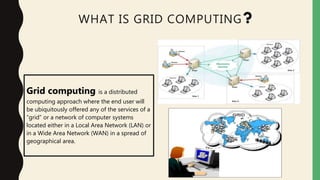
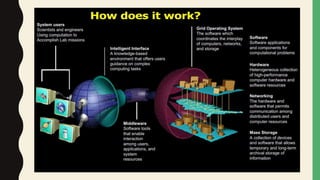
Grid computing is a distributed
computing approach where the end user will
be ubiquitously offered any of the services of a
“grid” or a network of computer systems
located either in a Local Area Network (LAN) or
in a Wide Area Network (WAN) in a spread of
geographical area.
ANALOGY WITH ELECTRICAL POWER
GRID
• Electrical power
grid
• users (or electrical
appliances) get access to
electricity through wall
sockets with no care or
consideration for where or
how the electricity is
actually generated.
• “The power grid” links
together power plants of
many different kinds
• The Grid
• users (or client applications) gain access
to computing resources (processors,
storage, data, applications, and so on)
as needed with little or no knowledge
of where
those resources are located or what the
underlying technologies, hardware,
operating system, and so on are.
• "the Grid" links together computing
resources (PCs, workstations, servers,
storage elements) and provides the
mechanism needed to access them.
DISTRIBUTED COMPUTING VS GRID
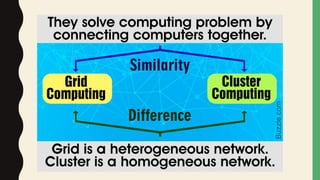
• Grid is an evolution of distributed computing
– Dynamic
– Geographically independent
– Built around standards
– Internet backbone
• Distributed computing is an ―older term
– Typically built around registered software and network
– Tightly couples systems/organization
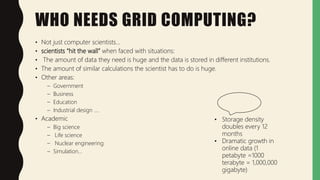
WHO NEEDS GRID COMPUTING?
• Not just computer scientists…
• scientists “hit the wall” when faced with situations:
• The amount of data they need is huge and the data is stored in different institutions.
• The amount of similar calculations the scientist has to do is huge.
• Other areas:
– Government
– Business
– Education
– Industrial design ….
• Academic
– Big science
– Life science
– Nuclear engineering
– Simulation…
• Storage density
doubles every 12
months
• Dramatic growth in
online data (1
petabyte =1000
terabyte = 1,000,000
gigabyte)
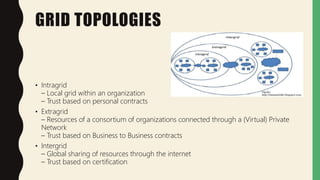
GRID TOPOLOGIES
• Intragrid
– Local grid within an organization
– Trust based on personal contracts
• Extragrid
– Resources of a consortium of organizations connected through a (Virtual) Private
Network
– Trust based on Business to Business contracts
• Intergrid
– Global sharing of resources through the internet
– Trust based on certification
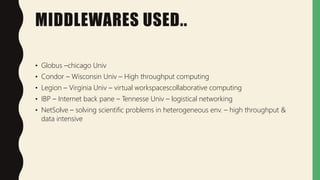
MIDDLEWARES USED..
• Globus –chicago Univ
• Condor – Wisconsin Univ – High throughput computing
• Legion – Virginia Univ – virtual workspacescollaborative computing
• IBP – Internet back pane – Tennesse Univ – logistical networking
• NetSolve – solving scientific problems in heterogeneous env. – high throughput &
data intensive
GRID IN INDIA -GARUDA
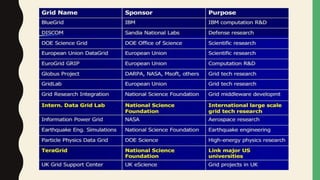
GARUDA is India's Grid Computing initiative connecting 17 cities across the
country.
•The 45 participating institutes in this nationwide project include all the IITs and C-
DAC centers and other major institutes in India.
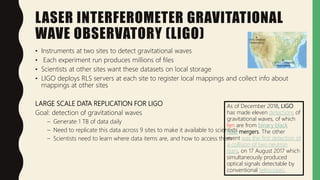
LASER INTERFEROMETER GRAVITATIONAL
WAVE OBSERVATORY (LIGO)
• Instruments at two sites to detect gravitational waves
• Each experiment run produces millions of files
• Scientists at other sites want these datasets on local storage
• LIGO deploys RLS servers at each site to register local mappings and collect info about
mappings at other sites
LARGE SCALE DATA REPLICATION FOR LIGO
Goal: detection of gravitational waves
– Generate 1 TB of data daily
– Need to replicate this data across 9 sites to make it available to scientists
– Scientists need to learn where data items are, and how to access them
As of December 2018, LIGO
has made eleven detections of
gravitational waves, of which
ten are from binary black
hole mergers. The other
event was the first detection of
a collision of two neutron
stars, on 17 August 2017 which
simultaneously produced
optical signals detectable by
conventional telescopes.
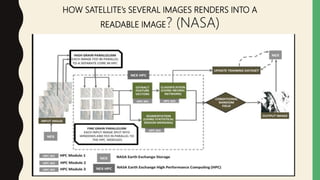
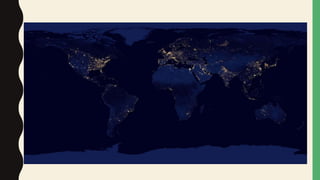
HOW SATELLITE’s SEVERAL IMAGES RENDERS INTO A
READABLE IMAGE? (NASA)
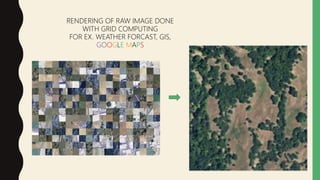
RENDERING OF RAW IMAGE DONE
WITH GRID COMPUTING
FOR EX. WEATHER FORCAST, GIS,
GOOGLE MAPS
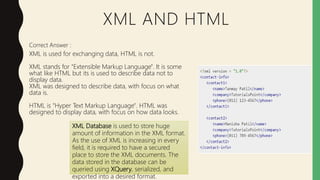
XML AND HTML
Correct Answer :
XML is used for exchanging data, HTML is not.
XML stands for "Extensible Markup Language". It is some
what like HTML but its is used to describe data not to
display data.
XML was designed to describe data, with focus on what
data is.
HTML is "Hyper Text Markup Language". HTML was
designed to display data, with focus on how data looks.
XML Database is used to store huge
amount of information in the XML format.
As the use of XML is increasing in every
field, it is required to have a secured
place to store the XML documents. The
data stored in the database can be
queried using XQuery, serialized, and
exported into a desired format.
BENEFITS OF GRID COMPUTING
• Grid computing solve Challenging problems such as earthquake simulation and
weather modeling. Grids computing is a way of using resources optimally inside an
organization.
• Grid architecture can also be used for load balancing and redundant network
connections. This Model use parallel processing software that divide a program among
the many thousand computers and Collect and combine the results into a single solution.
For the security reasons, grid computing is restricted within the same organization.
• Grid computing can be used in a large Networks where thousands of machines sit idle at
any given moment. Even when a user is reading, it constitutes idle time. These idle power
of computers can be used for large computational problems, these technique is running
in the background that is known as cycle-scavenging.
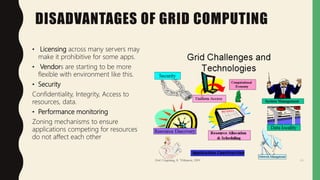
DISADVANTAGES OF GRID COMPUTING
• Licensing across many servers may
make it prohibitive for some apps.
• Vendors are starting to be more
flexible with environment like this.
• Security
Confidentiality, Integrity, Access to
resources, data.
• Performance monitoring
Zoning mechanisms to ensure
applications competing for resources
do not affect each other
REFERENCES
• http://www.jatit.org/distributed-computing/grid-vs-distributed.htm
• https://en.wikipedia.org/wiki/LIGO
• http://www.it.uom.gr/teaching/unc_charlottePPG/grid.htm
• https://www.youtube.com/watch?v=esVzoSqQ1Pc
• SATELLITE IMAGE PROCESSING ON A GRID BASED COMPUTING ENVIRONMENT
https://ijcsmc.com/docs/papers/March2014/V3I3201446.pdf
THANK YOU

Grid computing

  • 1.
    GRID COMPUTING S U BM I T T E D T O : S U B M I T T E D B Y : D R . M A N A V J E E T K A U R D E E P A N S H U 1 8 2 0 9 0 2 5
  • 2.
    WHAT IS GRIDCOMPUTING? Grid computing is a distributed computing approach where the end user will be ubiquitously offered any of the services of a “grid” or a network of computer systems located either in a Local Area Network (LAN) or in a Wide Area Network (WAN) in a spread of geographical area.
  • 3.
    ANALOGY WITH ELECTRICALPOWER GRID • Electrical power grid • users (or electrical appliances) get access to electricity through wall sockets with no care or consideration for where or how the electricity is actually generated. • “The power grid” links together power plants of many different kinds • The Grid • users (or client applications) gain access to computing resources (processors, storage, data, applications, and so on) as needed with little or no knowledge of where those resources are located or what the underlying technologies, hardware, operating system, and so on are. • "the Grid" links together computing resources (PCs, workstations, servers, storage elements) and provides the mechanism needed to access them.
  • 4.
    DISTRIBUTED COMPUTING VSGRID • Grid is an evolution of distributed computing – Dynamic – Geographically independent – Built around standards – Internet backbone • Distributed computing is an ―older term – Typically built around registered software and network – Tightly couples systems/organization
  • 5.
    WHO NEEDS GRIDCOMPUTING? • Not just computer scientists… • scientists “hit the wall” when faced with situations: • The amount of data they need is huge and the data is stored in different institutions. • The amount of similar calculations the scientist has to do is huge. • Other areas: – Government – Business – Education – Industrial design …. • Academic – Big science – Life science – Nuclear engineering – Simulation… • Storage density doubles every 12 months • Dramatic growth in online data (1 petabyte =1000 terabyte = 1,000,000 gigabyte)
  • 6.
    GRID TOPOLOGIES • Intragrid –Local grid within an organization – Trust based on personal contracts • Extragrid – Resources of a consortium of organizations connected through a (Virtual) Private Network – Trust based on Business to Business contracts • Intergrid – Global sharing of resources through the internet – Trust based on certification
  • 9.
    MIDDLEWARES USED.. • Globus–chicago Univ • Condor – Wisconsin Univ – High throughput computing • Legion – Virginia Univ – virtual workspacescollaborative computing • IBP – Internet back pane – Tennesse Univ – logistical networking • NetSolve – solving scientific problems in heterogeneous env. – high throughput & data intensive
  • 10.
    GRID IN INDIA-GARUDA GARUDA is India's Grid Computing initiative connecting 17 cities across the country. •The 45 participating institutes in this nationwide project include all the IITs and C- DAC centers and other major institutes in India.
  • 12.
    LASER INTERFEROMETER GRAVITATIONAL WAVEOBSERVATORY (LIGO) • Instruments at two sites to detect gravitational waves • Each experiment run produces millions of files • Scientists at other sites want these datasets on local storage • LIGO deploys RLS servers at each site to register local mappings and collect info about mappings at other sites LARGE SCALE DATA REPLICATION FOR LIGO Goal: detection of gravitational waves – Generate 1 TB of data daily – Need to replicate this data across 9 sites to make it available to scientists – Scientists need to learn where data items are, and how to access them As of December 2018, LIGO has made eleven detections of gravitational waves, of which ten are from binary black hole mergers. The other event was the first detection of a collision of two neutron stars, on 17 August 2017 which simultaneously produced optical signals detectable by conventional telescopes.
  • 13.
    HOW SATELLITE’s SEVERALIMAGES RENDERS INTO A READABLE IMAGE? (NASA)
  • 14.
    RENDERING OF RAWIMAGE DONE WITH GRID COMPUTING FOR EX. WEATHER FORCAST, GIS, GOOGLE MAPS
  • 17.
    XML AND HTML CorrectAnswer : XML is used for exchanging data, HTML is not. XML stands for "Extensible Markup Language". It is some what like HTML but its is used to describe data not to display data. XML was designed to describe data, with focus on what data is. HTML is "Hyper Text Markup Language". HTML was designed to display data, with focus on how data looks. XML Database is used to store huge amount of information in the XML format. As the use of XML is increasing in every field, it is required to have a secured place to store the XML documents. The data stored in the database can be queried using XQuery, serialized, and exported into a desired format.
  • 18.
    BENEFITS OF GRIDCOMPUTING • Grid computing solve Challenging problems such as earthquake simulation and weather modeling. Grids computing is a way of using resources optimally inside an organization. • Grid architecture can also be used for load balancing and redundant network connections. This Model use parallel processing software that divide a program among the many thousand computers and Collect and combine the results into a single solution. For the security reasons, grid computing is restricted within the same organization. • Grid computing can be used in a large Networks where thousands of machines sit idle at any given moment. Even when a user is reading, it constitutes idle time. These idle power of computers can be used for large computational problems, these technique is running in the background that is known as cycle-scavenging.
  • 19.
    DISADVANTAGES OF GRIDCOMPUTING • Licensing across many servers may make it prohibitive for some apps. • Vendors are starting to be more flexible with environment like this. • Security Confidentiality, Integrity, Access to resources, data. • Performance monitoring Zoning mechanisms to ensure applications competing for resources do not affect each other
  • 21.
    REFERENCES • http://www.jatit.org/distributed-computing/grid-vs-distributed.htm • https://en.wikipedia.org/wiki/LIGO •http://www.it.uom.gr/teaching/unc_charlottePPG/grid.htm • https://www.youtube.com/watch?v=esVzoSqQ1Pc • SATELLITE IMAGE PROCESSING ON A GRID BASED COMPUTING ENVIRONMENT https://ijcsmc.com/docs/papers/March2014/V3I3201446.pdf
  • 22.