













from
hand
to
mouth
Pavlo Baron
pavlo.baron@codecentric.de
              @pavlobaron
Forget backend
Or at least what
you call a backend
Your application server
will just slow down
your machines to
keep step with them
Or you will slow down
your incoming traffic
to give your application
server a chance to
breathe
User experience:
order food
at McDonalds, get
queued and receive
the ordered food
through mail 3
days later
User experience with some
psychology: order food at
McDonalds, get queued,
leave the restaurant
with color pictures of
your food and wait 3
days for its delivery
Every single data
abstraction layer only
helps ruin the
atmosphere through
heating
Hey, man,
you carry around a damn
USS Enterprise in your
pocket


         And you can run a
         damn Babylon 5 in
                  a cluster
And in the end, it's
always store/update/
delete/read/search/
process.

Isn't it?
So why drive a clown car
when you can have
a Ferrari
full of these?
Why not just live
from hand to mouth?
You haz this:

Your user. Totally drunk in
a football stadium. Just
wants to inform the world
that Ronaldo has scored a
goal. Shaking hand, lots of
typos and confusion.
You want this:

Let him protocol the fact at
any cost.

Look at it later, together
with further facts to make
a picture of the sports fact.
Concrete:

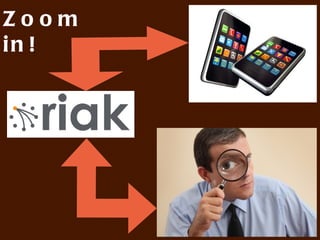
Mobile clients write from
everywhere, buffer,
read occasionally,
post-processing completely
behind the scenes, like
statistics etc.
Even more concrete:

Immediate, reliable, massive
writes. Analytics and
processing in a batch
afterwards. No need to
be exact to the second
and 100% data complete
More concrete:
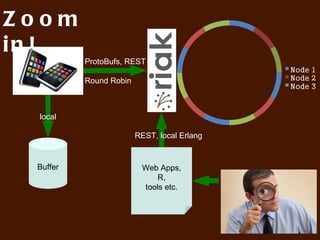
Very concrete:
           ProtoBufs, REST

           Round Robin


   local

                      REST, local Erlang client


  Buffer
                             Web Apps,
                                 R,
                             tools etc.
Infrastructure can be solved.

More challenging is how
to get structured records out
of a bunch of facts written by
shaking hands.

That's different story tho.
HTF does it work?
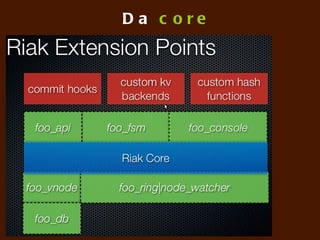
Da core
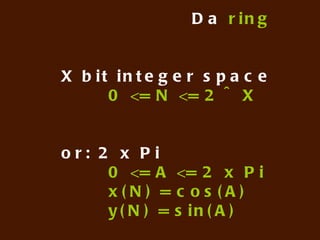
Da ring


X bit integer space
       0 <= N <= 2 ^ X


or: 2 x Pi
      0 <= A <= 2 x Pi
      x(N) = cos(A)
      y(N) = sin(A)
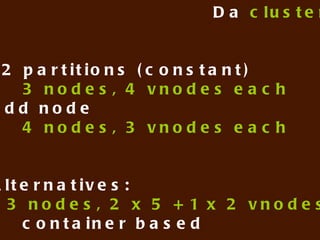
Da cluster


12 partitions (constant)
    3 nodes, 4 vnodes each
add node
    4 nodes, 3 vnodes each


Alternatives:
  3 nodes, 2 x 5 + 1 x 2 vnodes
    container based
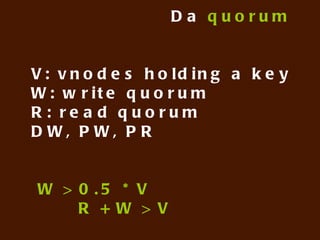
Da quorum


V: vnodes holding a key
W: write quorum
R: read quorum
DW, PW, PR


     W > 0.5 * V
     R+W>V
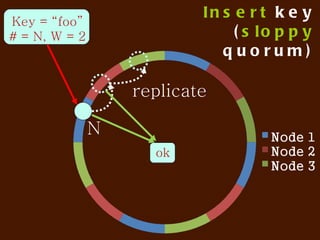
Insert key
Key = “foo”
# = N, W = 2               (sloppy quorum)


                   replicate

               N
                      ok
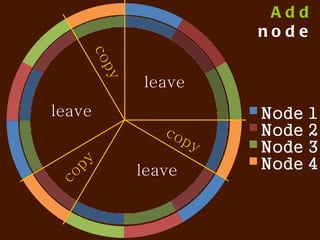
Add node


       co
        py
             leave
leave
                co
                  py
  y


             leave
   p
co
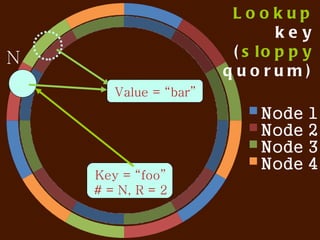
Lookup key
                         (sloppy
N                       quorum)

      Value = “bar”


    Key = “foo”
    # = N, R = 2
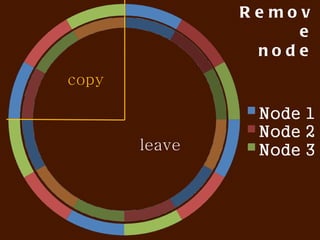
Remove
                 node

copy


       leave
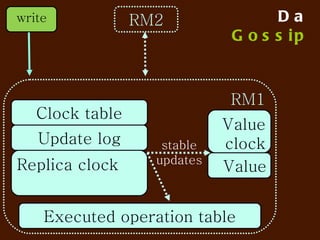
write          RM2          Da Gossip


                            RM1
  Clock table
                           Value
  Update log      stable   clock
Replica clock    updates
                           Value


  Executed operation table
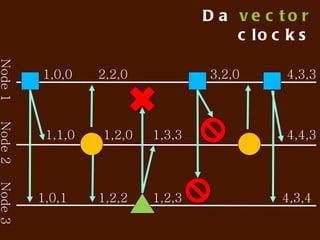
Da vector clocks
Node 1


         1,0,0    2,2,0           3,2,0   4,3,3
Node 2


          1,1,0   1,2,0   1,3,3           4,4,3
Node 3


         1,0,1    1,2,2   1,2,3           4,3,4
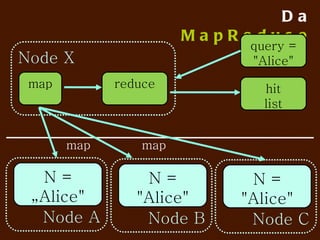
Da MapReduce
                          query =
Node X                    "Alice"
map         reduce         hit
                           list


      map      map

  N=            N=         N=
„Alice"       "Alice"    "Alice"
  Node A        Node B     Node C
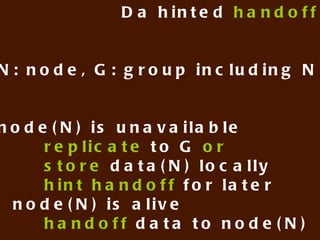
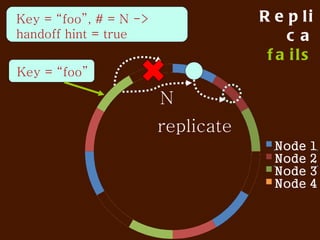
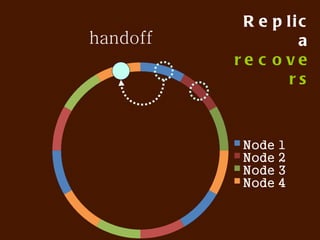
Da hinted handoff


N: node, G: group including N


node(N) is unavailable
     replicate to G or
     store data(N) locally
     hint handoff for later
  node(N) is alive
     handoff data to node(N)
Key = “foo”, # = N ->           Replica
handoff hint = true               fails

Key = “foo”

                        N
                    replicate
Replica
handoff   recovers
And that's by far not all:

You can search through
index with data locality.

You can tag objects and
query through 2i.

You can add hooks.
You don't even need to store
anything.

Just distribute your
calculation, search, batch
Have a look at tendita.com
So it's even comfy to load
your clown car
with these
Thank you
Most images originate from
            istockphoto.com

         except few ones taken
  from Wikipedia or Flickr (CC)
           and product pages/
publicly available presentations
   or generated through public
               online generators

From Hand To Mouth (@pavlobaron)

  • 1.
  • 2.
  • 3.
  • 4.
    Or at leastwhat you call a backend
  • 5.
    Your application server willjust slow down your machines to keep step with them
  • 6.
    Or you willslow down your incoming traffic to give your application server a chance to breathe
  • 7.
    User experience: order food atMcDonalds, get queued and receive the ordered food through mail 3 days later
  • 8.
    User experience withsome psychology: order food at McDonalds, get queued, leave the restaurant with color pictures of your food and wait 3 days for its delivery
  • 9.
    Every single data abstractionlayer only helps ruin the atmosphere through heating
  • 10.
    Hey, man, you carryaround a damn USS Enterprise in your pocket And you can run a damn Babylon 5 in a cluster
  • 11.
    And in theend, it's always store/update/ delete/read/search/ process. Isn't it?
  • 12.
    So why drivea clown car when you can have a Ferrari full of these?
  • 13.
    Why not justlive from hand to mouth?
  • 14.
    You haz this: Youruser. Totally drunk in a football stadium. Just wants to inform the world that Ronaldo has scored a goal. Shaking hand, lots of typos and confusion.
  • 15.
    You want this: Lethim protocol the fact at any cost. Look at it later, together with further facts to make a picture of the sports fact.
  • 16.
    Concrete: Mobile clients writefrom everywhere, buffer, read occasionally, post-processing completely behind the scenes, like statistics etc.
  • 17.
    Even more concrete: Immediate,reliable, massive writes. Analytics and processing in a batch afterwards. No need to be exact to the second and 100% data complete
  • 18.
  • 19.
    Very concrete: ProtoBufs, REST Round Robin local REST, local Erlang client Buffer Web Apps, R, tools etc.
  • 20.
    Infrastructure can besolved. More challenging is how to get structured records out of a bunch of facts written by shaking hands. That's different story tho.
  • 21.
  • 22.
  • 23.
    Da ring X bitinteger space 0 <= N <= 2 ^ X or: 2 x Pi 0 <= A <= 2 x Pi x(N) = cos(A) y(N) = sin(A)
  • 24.
    Da cluster 12 partitions(constant) 3 nodes, 4 vnodes each add node 4 nodes, 3 vnodes each Alternatives: 3 nodes, 2 x 5 + 1 x 2 vnodes container based
  • 25.
    Da quorum V: vnodesholding a key W: write quorum R: read quorum DW, PW, PR W > 0.5 * V R+W>V
  • 26.
    Insert key Key =“foo” # = N, W = 2 (sloppy quorum) replicate N ok
  • 27.
    Add node co py leave leave co py y leave p co
  • 28.
    Lookup key (sloppy N quorum) Value = “bar” Key = “foo” # = N, R = 2
  • 29.
    Remove node copy leave
  • 30.
    write RM2 Da Gossip RM1 Clock table Value Update log stable clock Replica clock updates Value Executed operation table
  • 31.
    Da vector clocks Node1 1,0,0 2,2,0 3,2,0 4,3,3 Node 2 1,1,0 1,2,0 1,3,3 4,4,3 Node 3 1,0,1 1,2,2 1,2,3 4,3,4
  • 32.
    Da MapReduce query = Node X "Alice" map reduce hit list map map N= N= N= „Alice" "Alice" "Alice" Node A Node B Node C
  • 33.
    Da hinted handoff N:node, G: group including N node(N) is unavailable replicate to G or store data(N) locally hint handoff for later node(N) is alive handoff data to node(N)
  • 34.
    Key = “foo”,# = N -> Replica handoff hint = true fails Key = “foo” N replicate
  • 35.
  • 36.
    And that's byfar not all: You can search through index with data locality. You can tag objects and query through 2i. You can add hooks.
  • 37.
    You don't evenneed to store anything. Just distribute your calculation, search, batch
  • 38.
    Have a lookat tendita.com
  • 39.
    So it's evencomfy to load your clown car with these
  • 40.
  • 41.
    Most images originatefrom istockphoto.com except few ones taken from Wikipedia or Flickr (CC) and product pages/ publicly available presentations or generated through public online generators