Cryptography for Smalltalkers Martin Kobetic Cincom Smalltalk Development ESUG 2004
Cryptographic Objectives confidentiality encryption integrity message authentication codes (MAC) authentication signatures
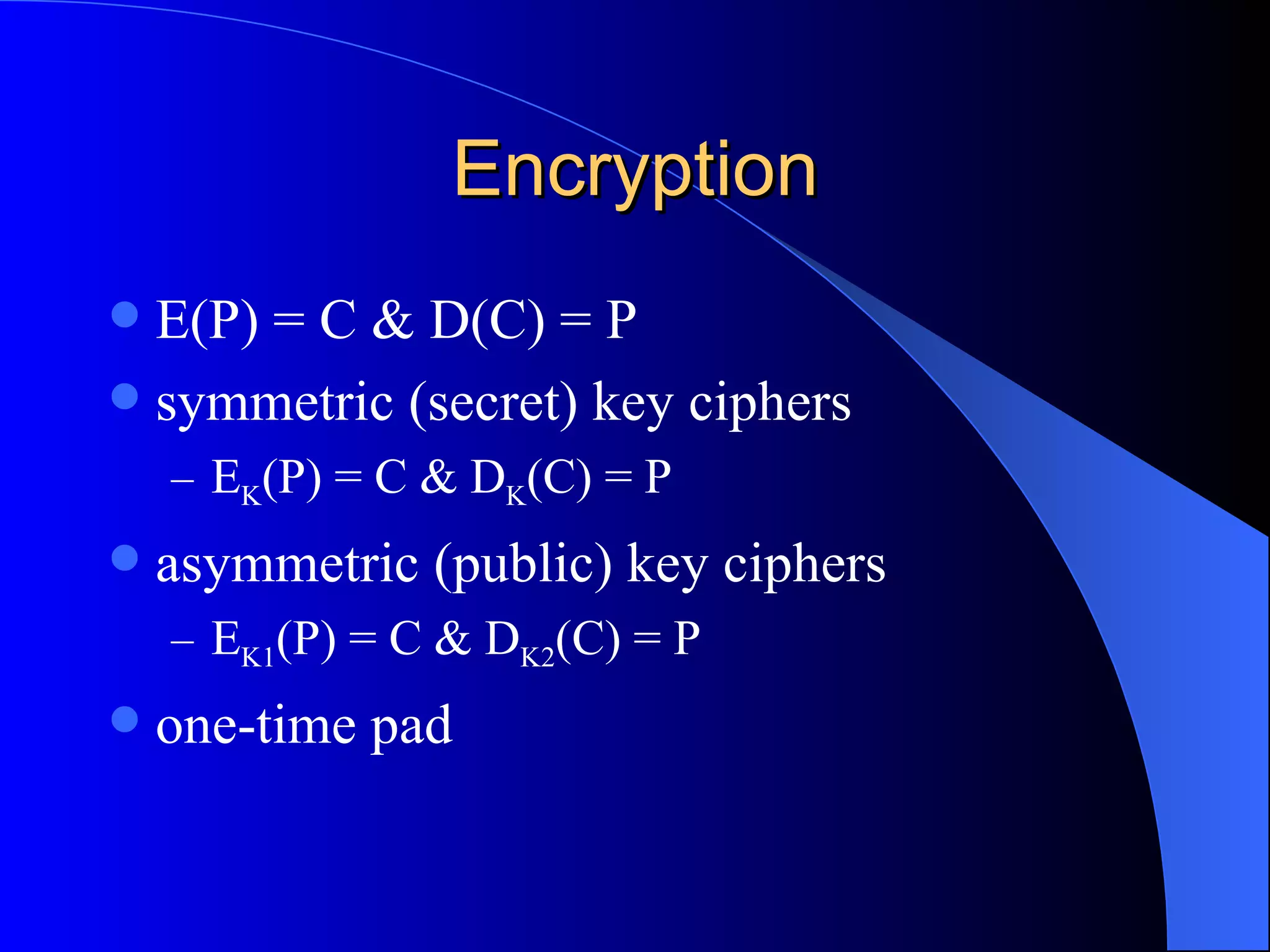
Encryption E(P) = C & D(C) = P symmetric (secret) key ciphers E K (P) = C & D K (C) = P  asymmetric (public) key ciphers E K1 (P) = C & D K2 (C) = P one-time pad
Secret Key Ciphers bulk data encryption built from simple, fast operations (xor, shift, x + y mod n, ...) two fundamental classes stream ciphers (RC4) block ciphers (DES/AES)
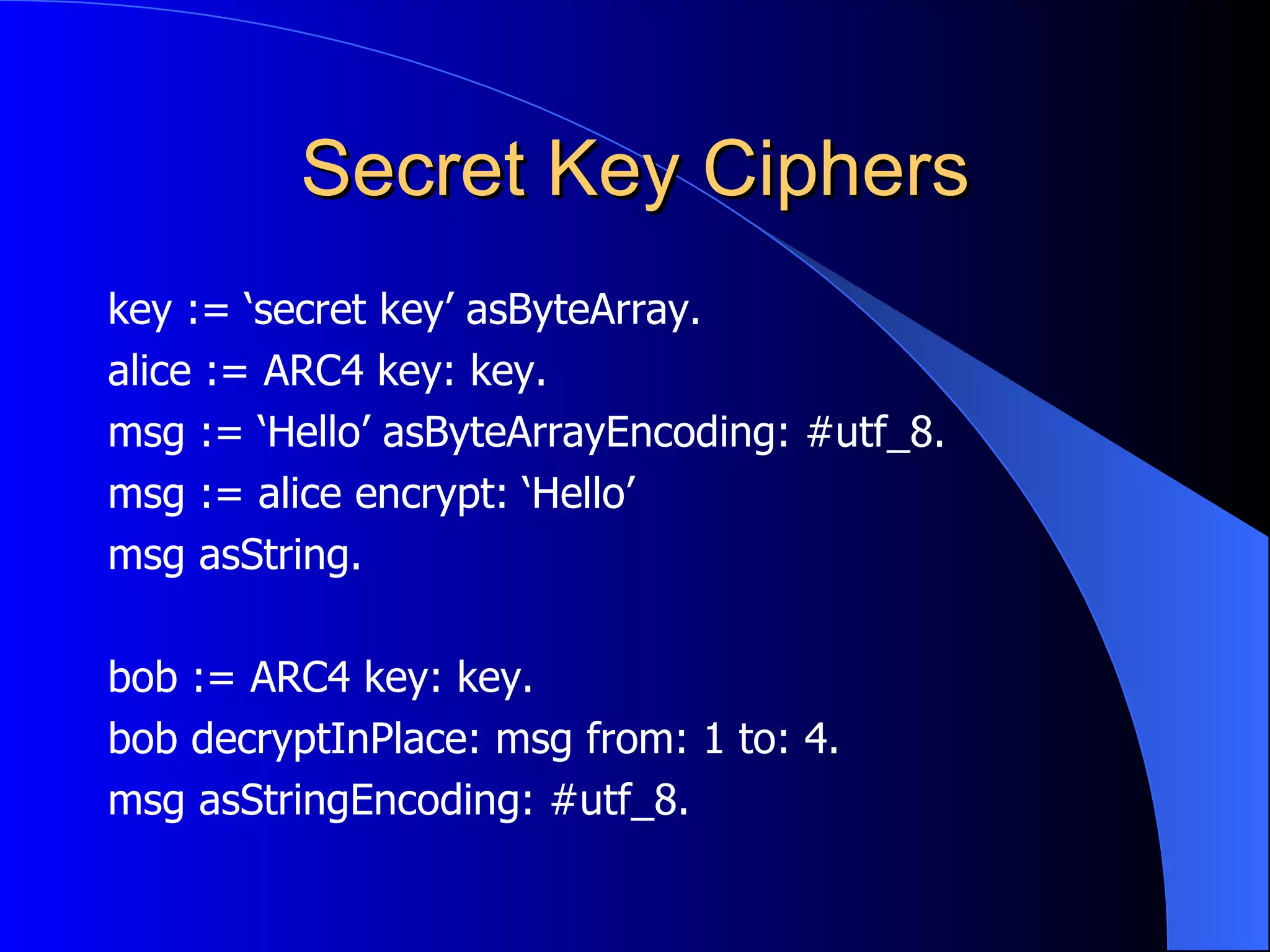
Secret Key Ciphers key := ‘secret key’ asByteArray. alice := ARC4 key: key. msg := ‘Hello’ asByteArrayEncoding: #utf_8. msg := alice encrypt: ‘Hello’ msg asString. bob := ARC4 key: key. bob decryptInPlace: msg from: 1 to: 4. msg asStringEncoding: #utf_8.
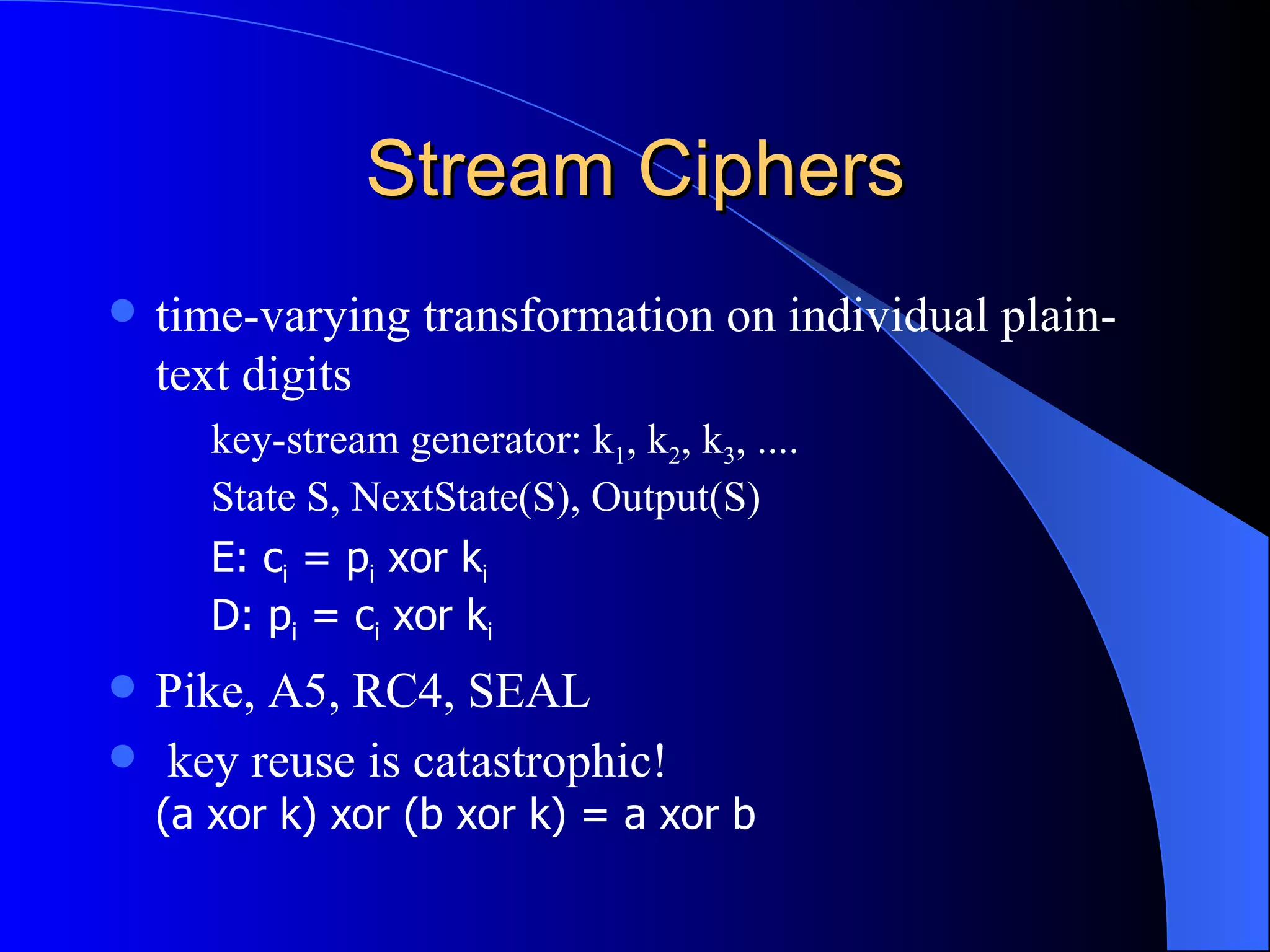
Stream Ciphers time-varying transformation on individual plain-text digits key-stream generator: k 1 , k 2 , k 3 , .... State S, NextState(S), Output(S) E: c i  = p i  xor k i D: p i  = c i  xor k i Pike, A5, RC4, SEAL key reuse is catastrophic! (a xor k) xor (b xor k) = a xor b
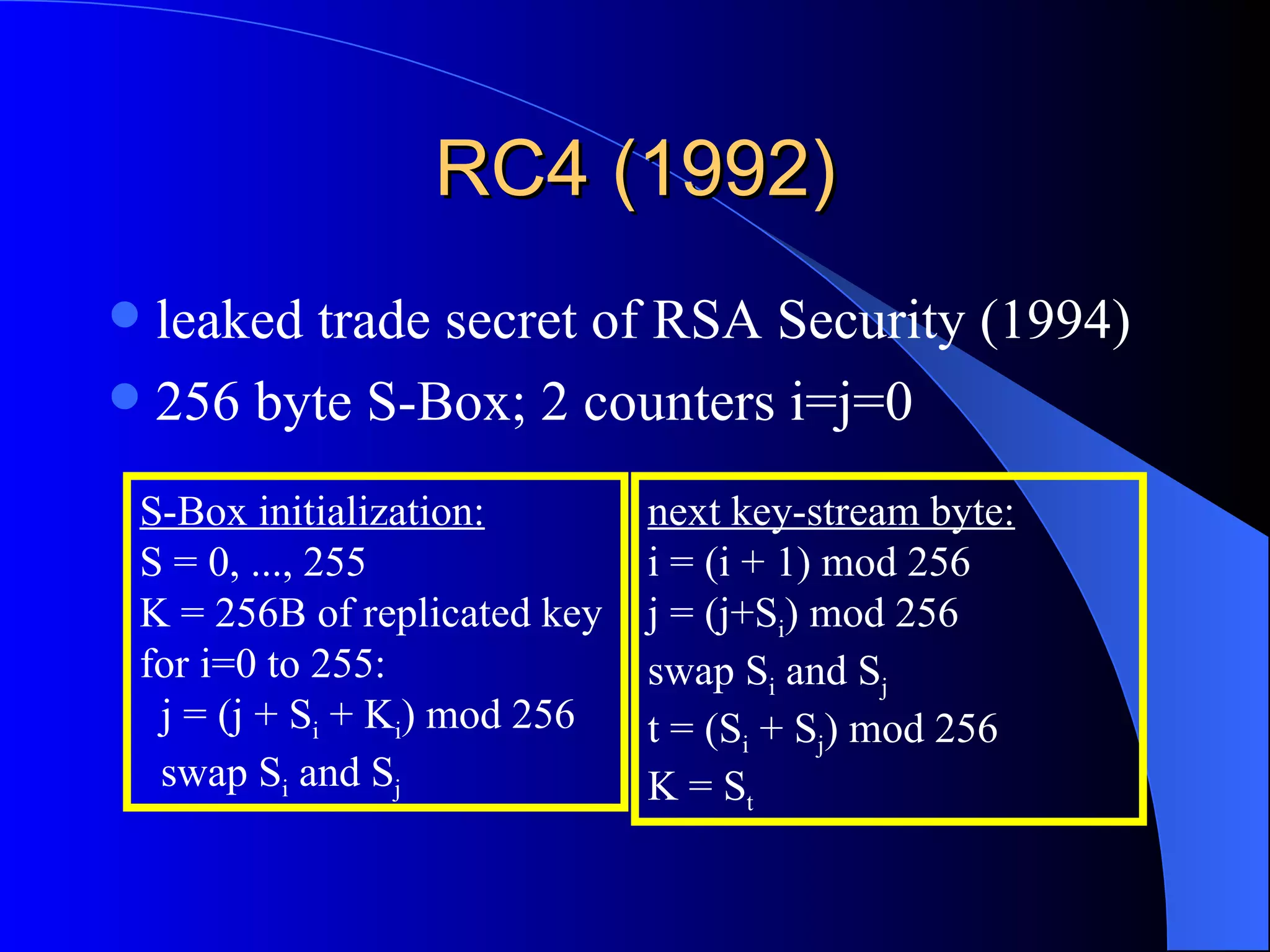
leaked trade secret of RSA Security (1994) 256 byte S-Box; 2 counters i=j=0 RC4 (1992) next key-stream byte: i = (i + 1) mod 256 j = (j+S i ) mod 256 swap S i  and S j t = (S i  + S j ) mod 256 K = S t S-Box initialization: S = 0, ..., 255 K = 256B of replicated key for i=0 to 255: j = (j + S i  + K i ) mod 256 swap S i  and S j
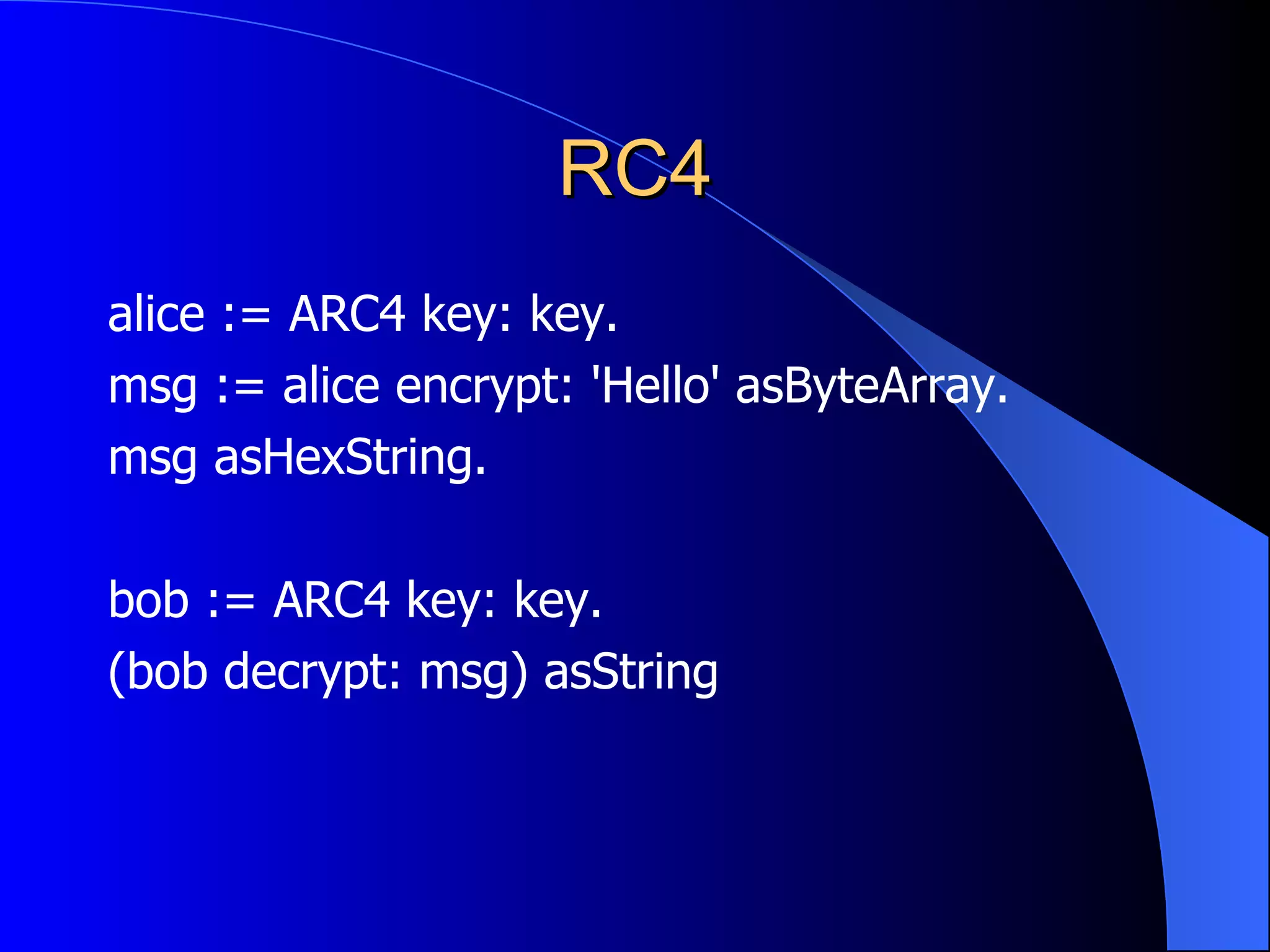
RC4 alice := ARC4 key: key. msg := alice encrypt: 'Hello' asByteArray. msg asHexString. bob := ARC4 key: key. (bob decrypt: msg) asString
Block Ciphers fixed transformation on blocks of plaintext (e.g 64, 128 bits) basic transformation applied in rounds DES, IDEA, CAST, Blowfish, RC2, RC5
DES (1977) csrc.nist.gov: FIPS PUB 46 (1977) FIPS PUB 46-3 (1999) triple DES still approved single DES legacy systems only 64 bit block size 56 bit key (64 bits with parity) 16 rounds using 48 bit subkeys
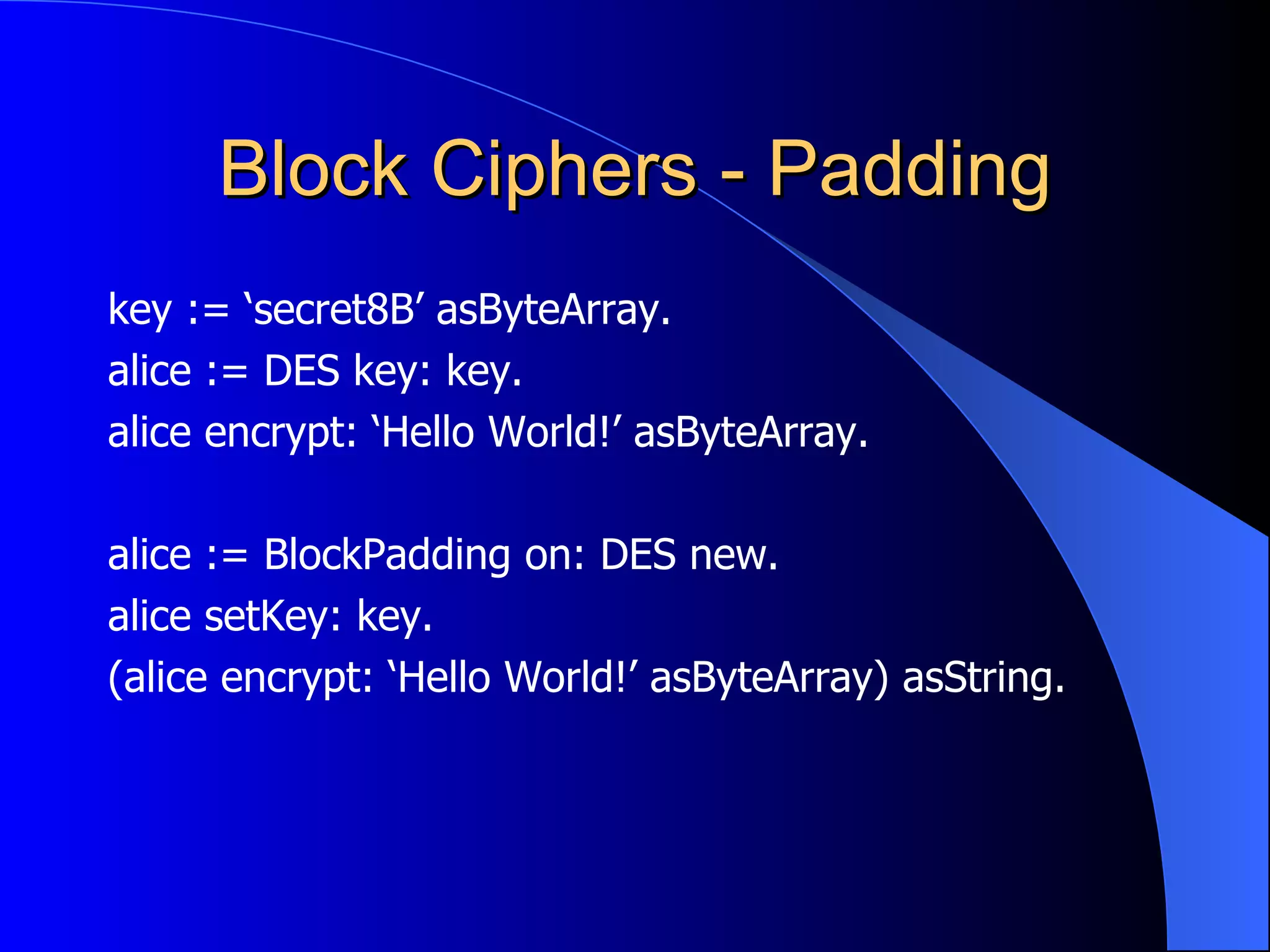
Block Ciphers - Padding key := ‘secret8B’ asByteArray. alice := DES key: key. alice encrypt: ‘Hello World!’ asByteArray. alice := BlockPadding on: DES new. alice setKey: key. (alice encrypt: ‘Hello World!’ asByteArray) asString.
Block Ciphers - Padding must be reversible pad with bits “100…0” pad with padding size (1-8) aka PKCS#5 padding ciphertext stealing different for different modes (ECB, CBC) some modes don’t need padding
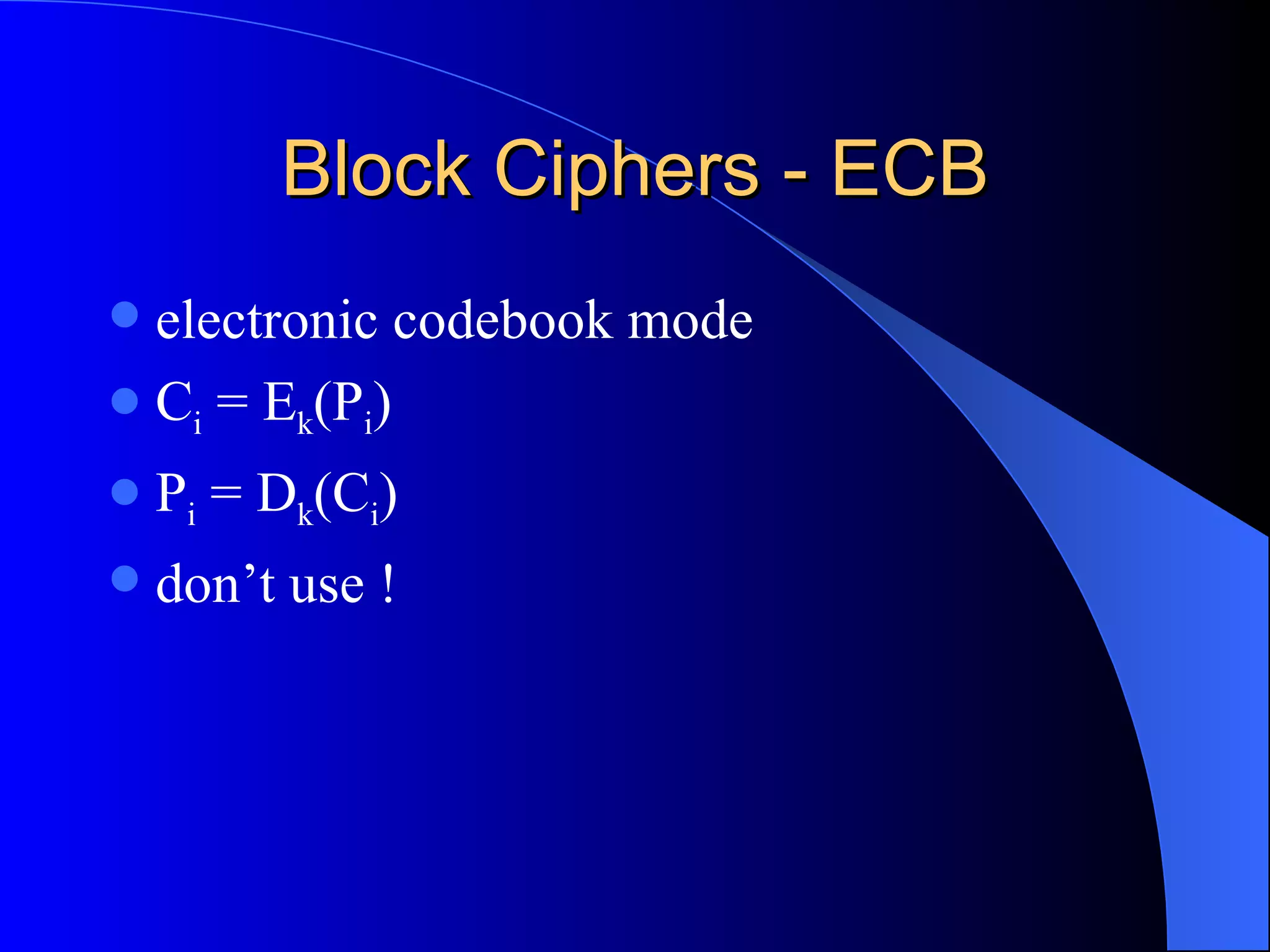
Block Ciphers - ECB electronic codebook mode C i  = E k (P i ) P i  = D k (C i ) don’t use !
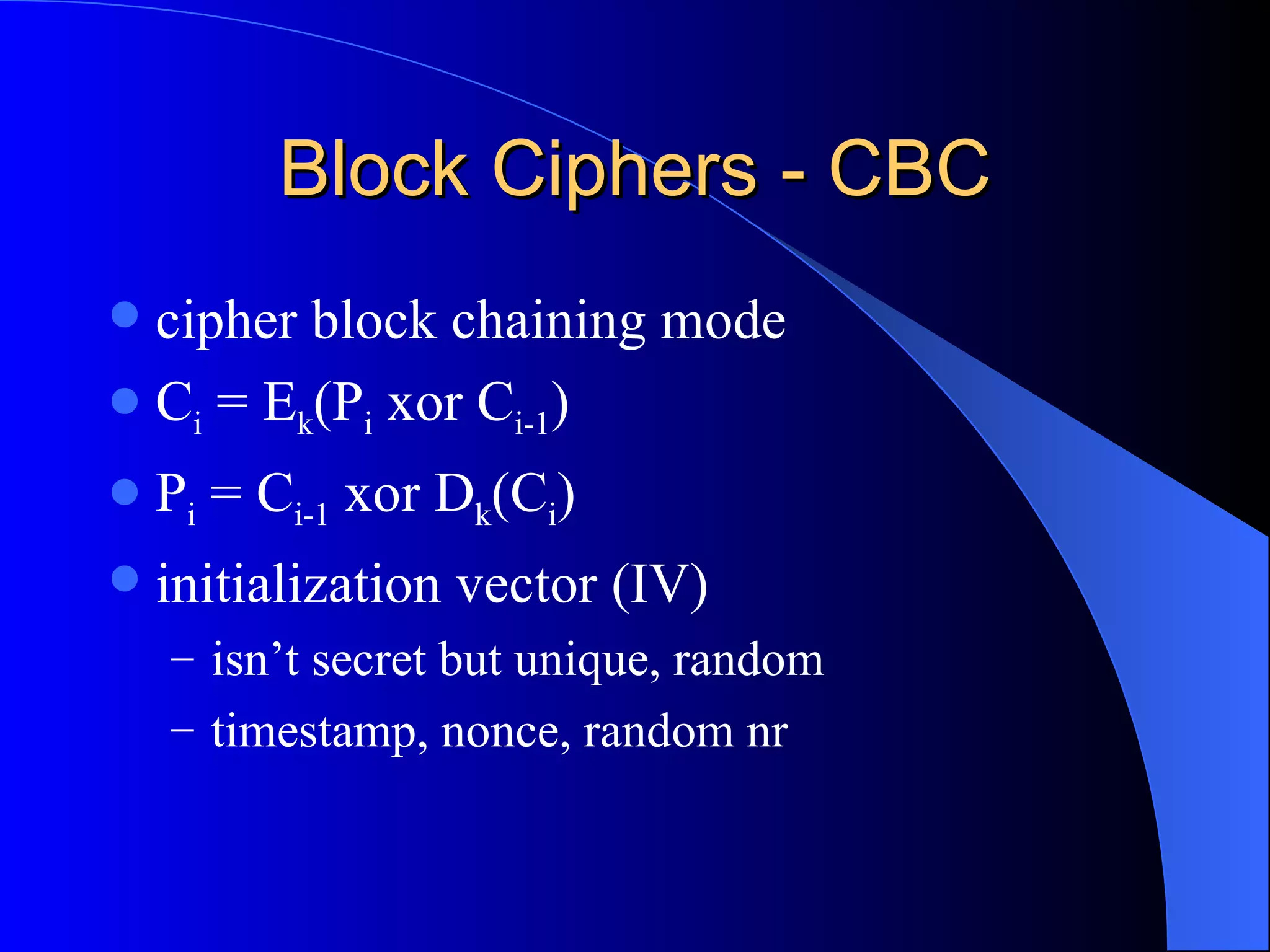
Block Ciphers - CBC cipher block chaining mode C i  = E k (P i  xor C i-1 ) P i  = C i-1  xor D k (C i ) initialization vector (IV) isn’t secret but unique, random timestamp, nonce, random nr
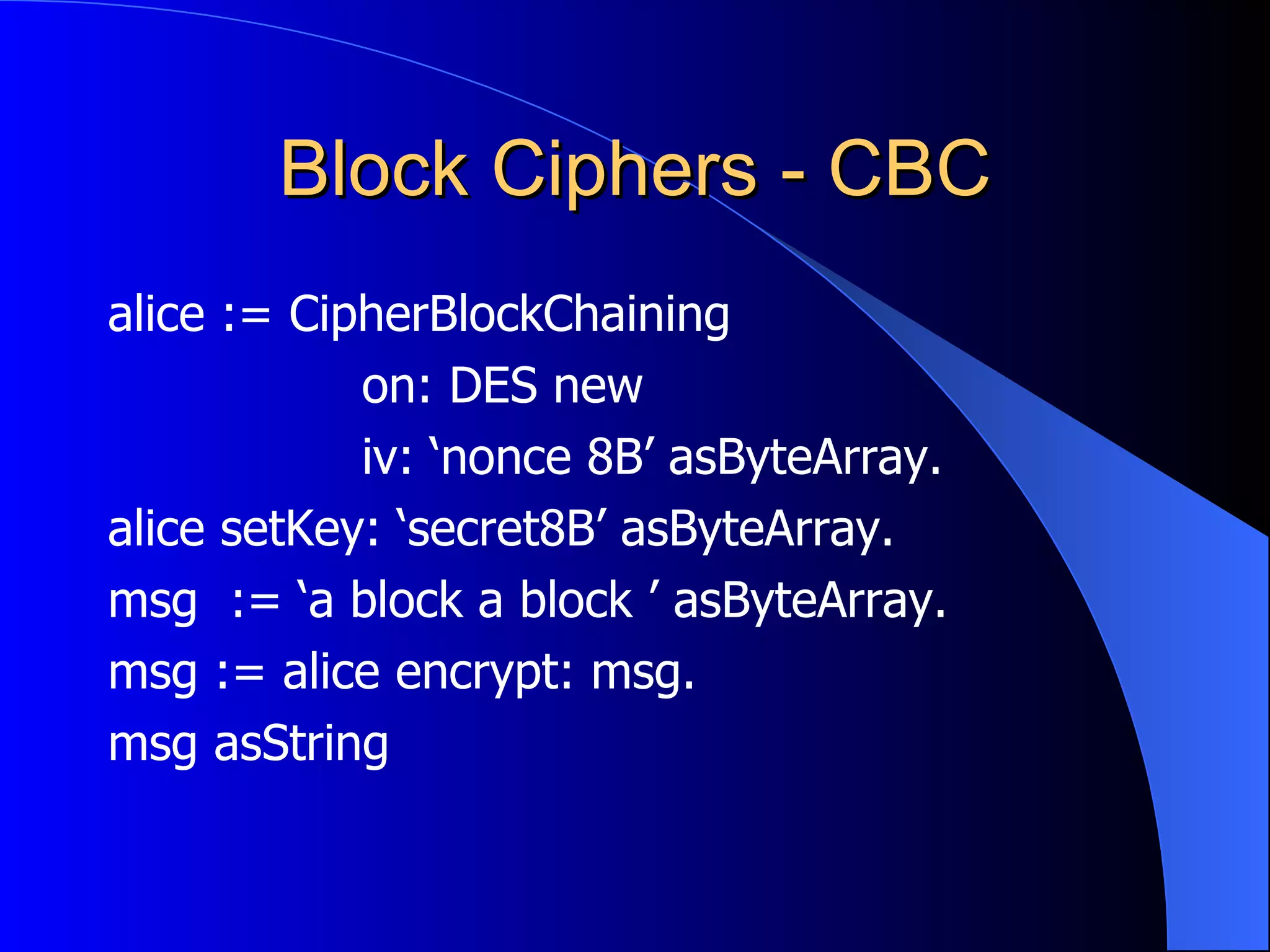
Block Ciphers - CBC alice := CipherBlockChaining on: DES new iv: ‘nonce 8B’ asByteArray. alice setKey: ‘secret8B’ asByteArray. msg  := ‘a block a block ’ asByteArray. msg := alice encrypt: msg. msg asString
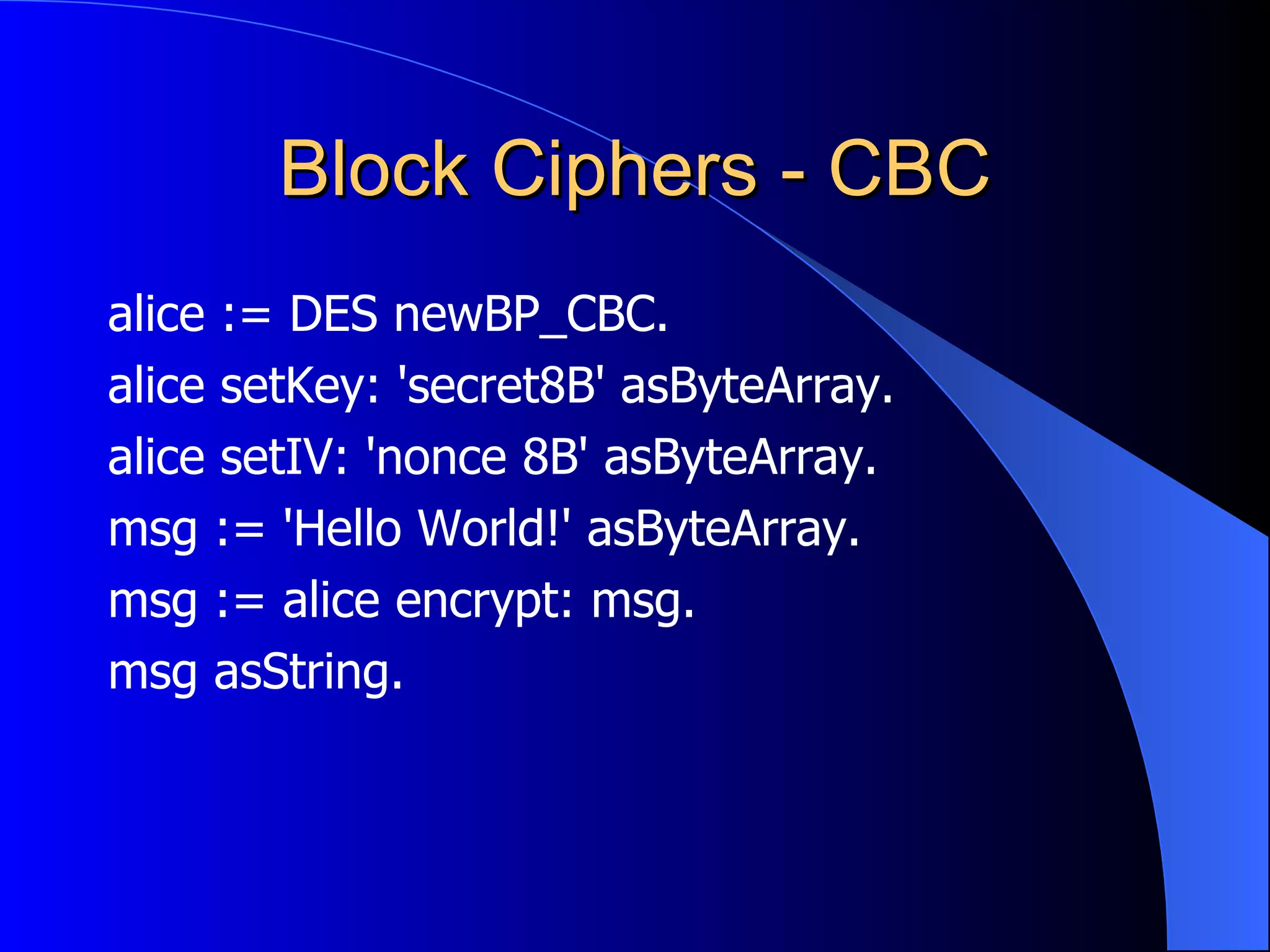
Block Ciphers - CBC alice := DES newBP_CBC. alice setKey: 'secret8B' asByteArray. alice setIV: 'nonce 8B' asByteArray. msg := 'Hello World!' asByteArray. msg := alice encrypt: msg. msg asString.
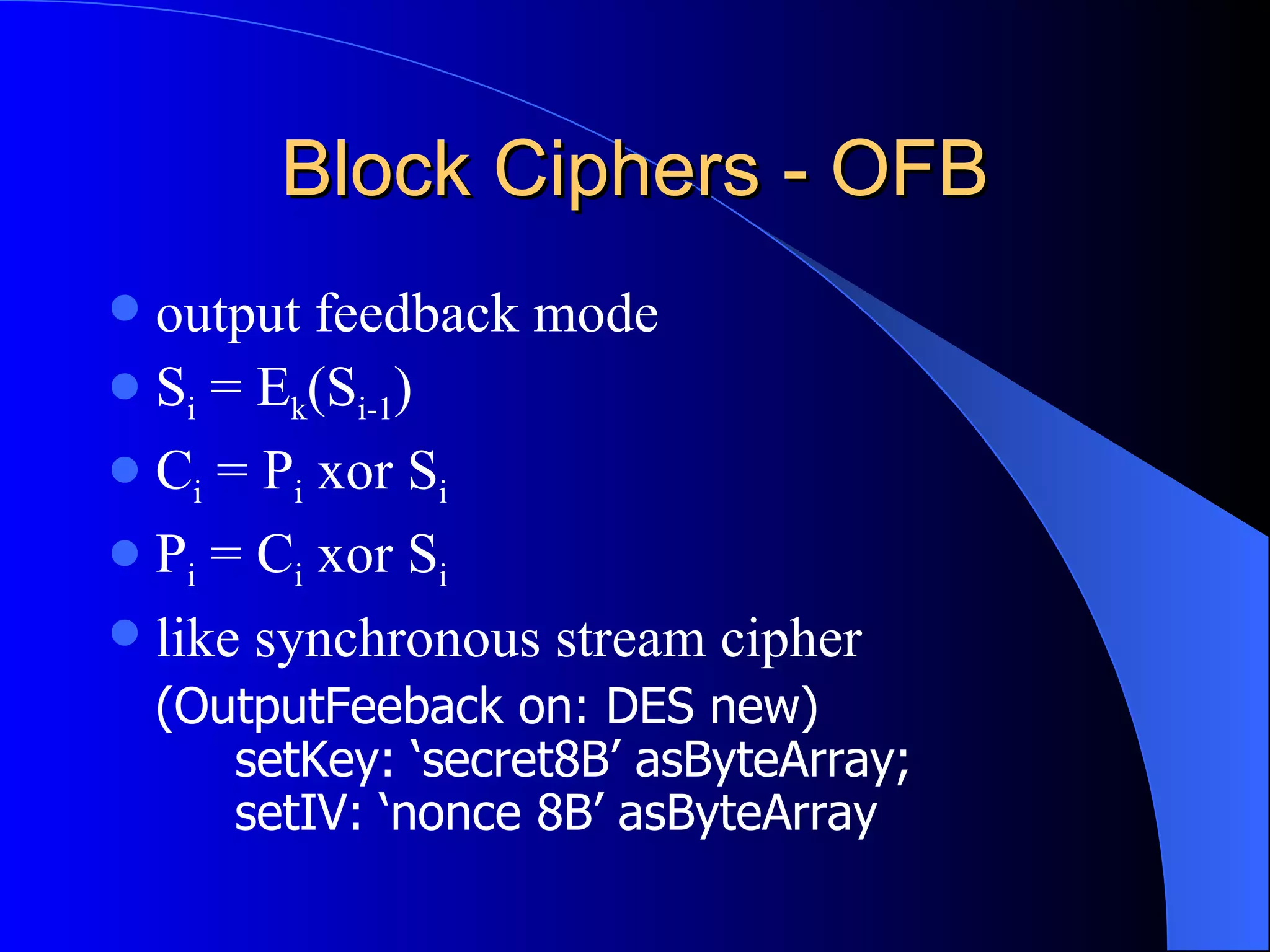
Block Ciphers - OFB output feedback mode S i  = E k (S i-1 ) C i  = P i  xor S i P i  = C i  xor S i like synchronous stream cipher (OutputFeeback on: DES new) setKey: ‘secret8B’ asByteArray; setIV: ‘nonce 8B’ asByteArray
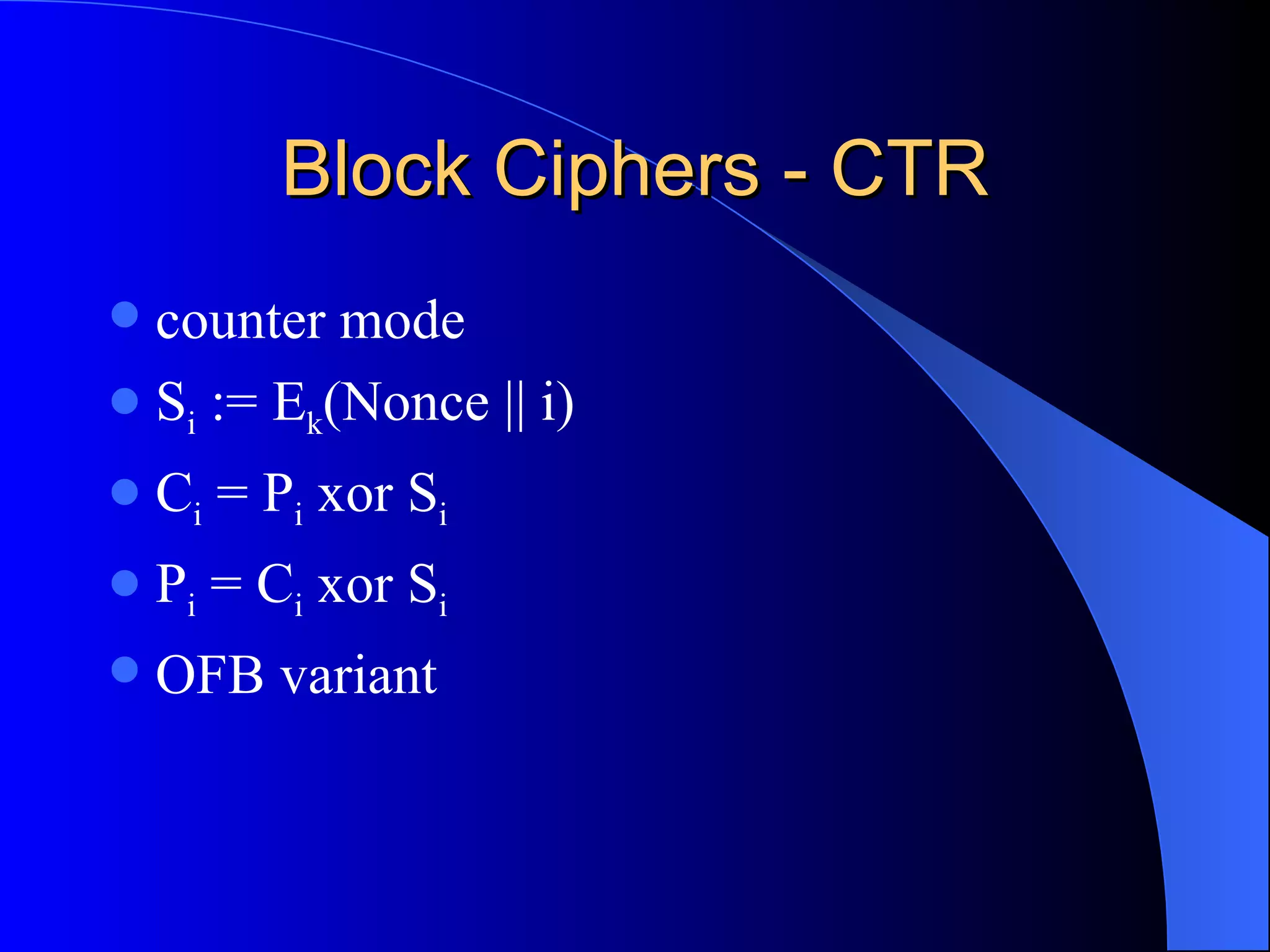
Block Ciphers - CTR counter mode S i  := E k (Nonce || i) C i  = P i  xor S i P i  = C i  xor S i OFB variant
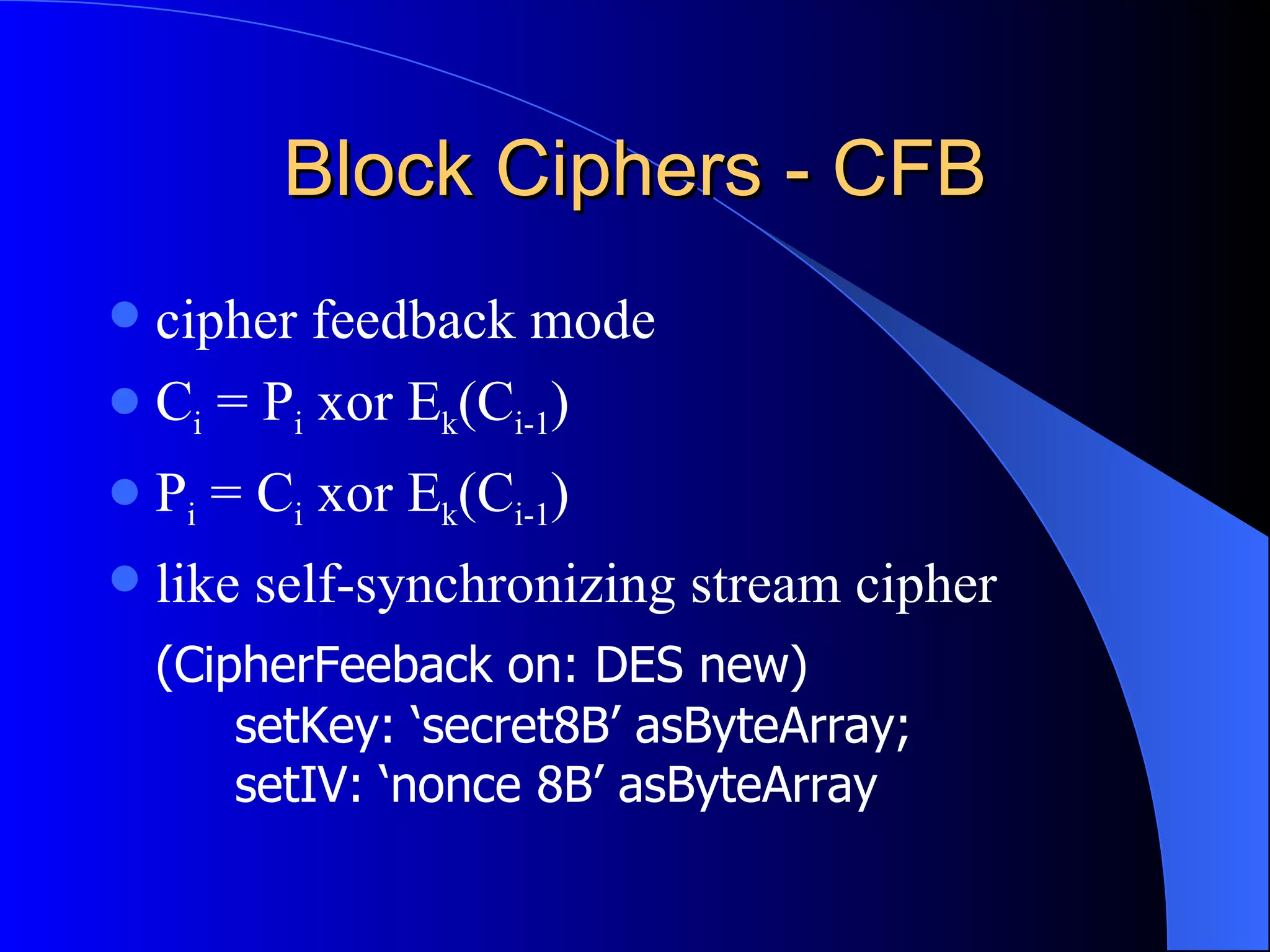
Block Ciphers - CFB cipher feedback mode C i  = P i  xor E k (C i-1 ) P i  = C i  xor E k (C i-1 ) like self-synchronizing stream cipher (CipherFeeback on: DES new) setKey: ‘secret8B’ asByteArray; setIV: ‘nonce 8B’ asByteArray
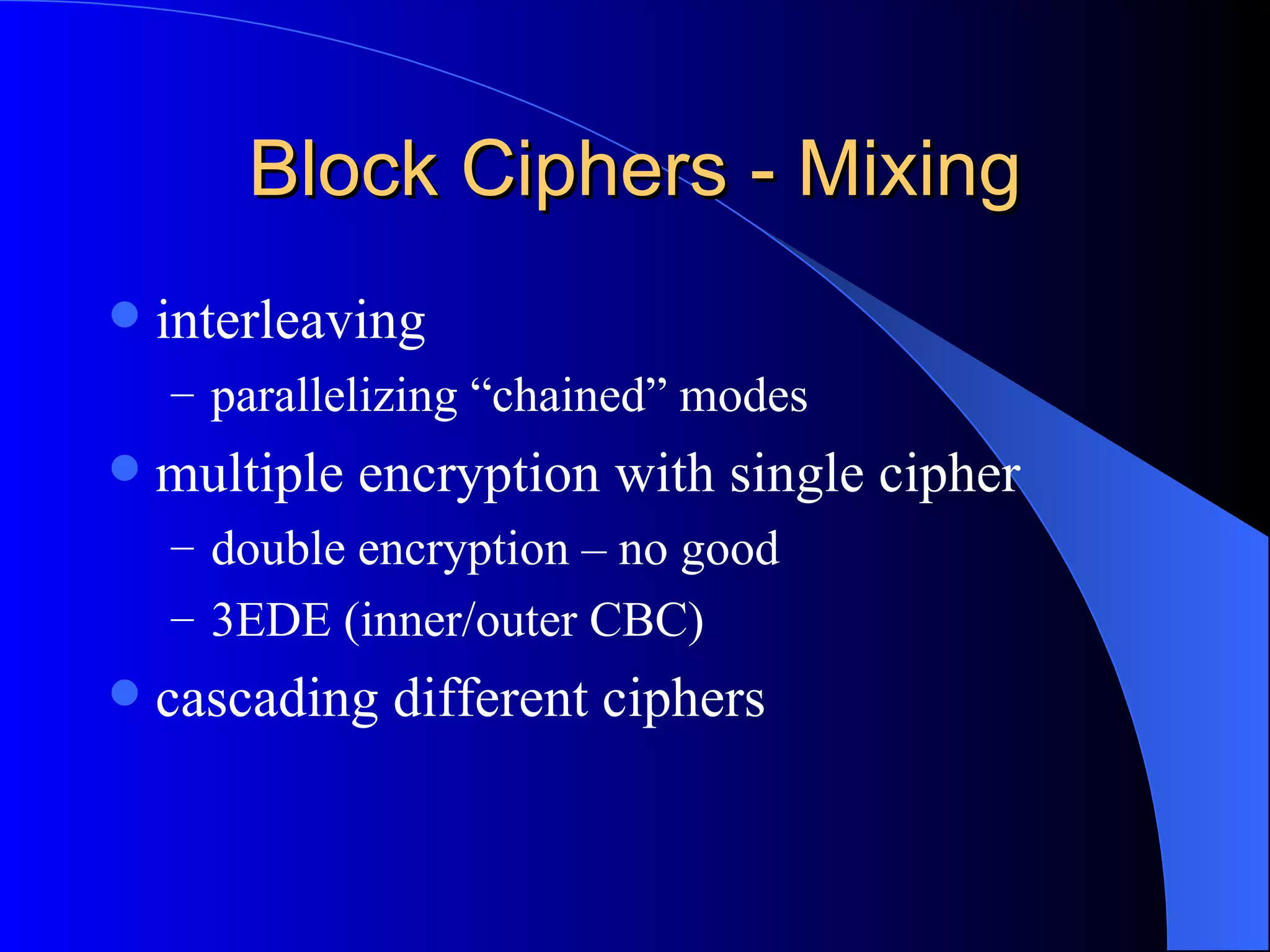
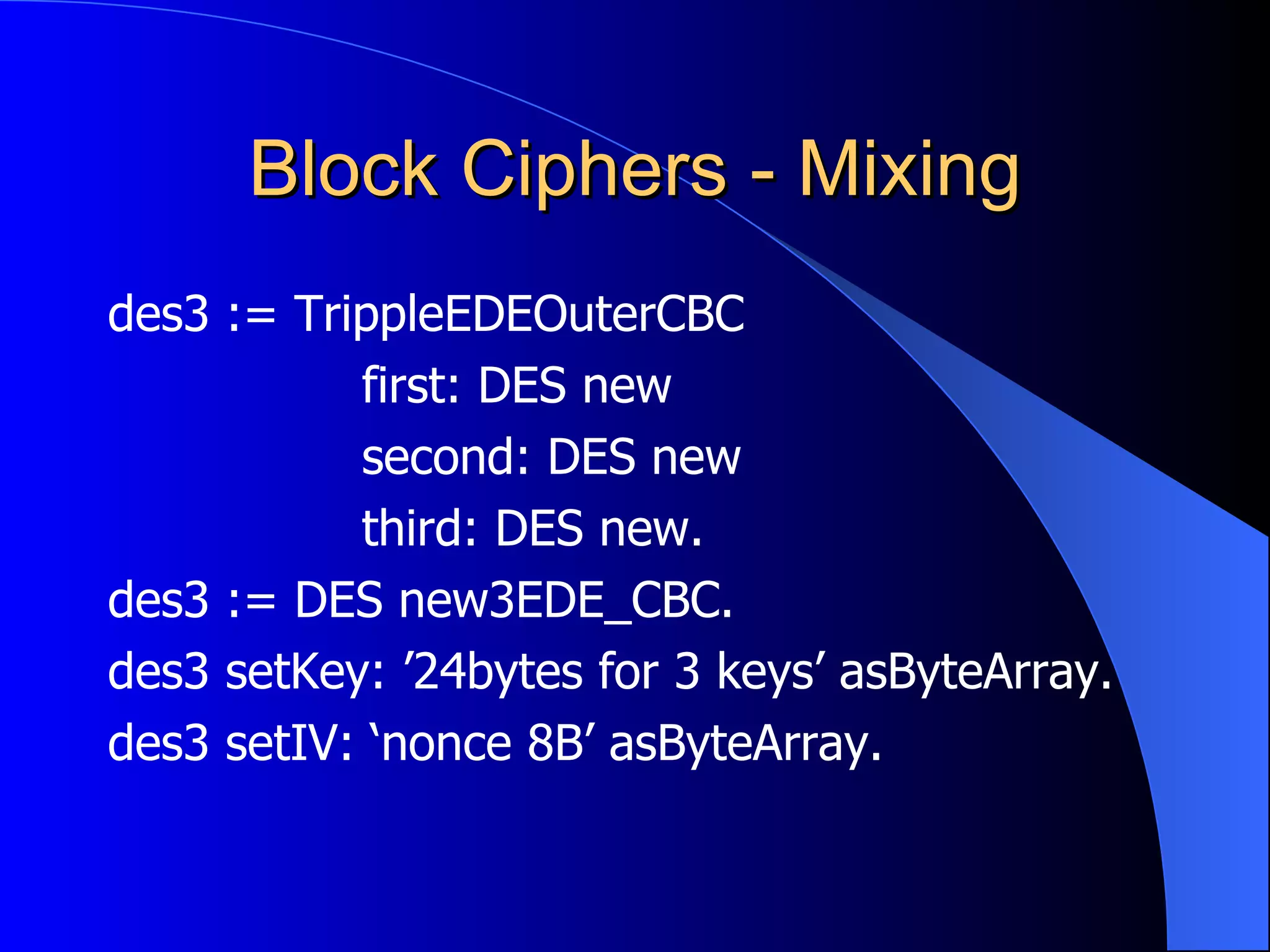
Block Ciphers - Mixing interleaving parallelizing “chained” modes multiple encryption with single cipher double encryption – no good 3EDE (inner/outer CBC) cascading different ciphers
Block Ciphers - Mixing des3 := TrippleEDEOuterCBC first: DES new second: DES new third: DES new. des3 := DES new3EDE_CBC. des3 setKey: ’24bytes for 3 keys’ asByteArray. des3 setIV: ‘nonce 8B’ asByteArray.
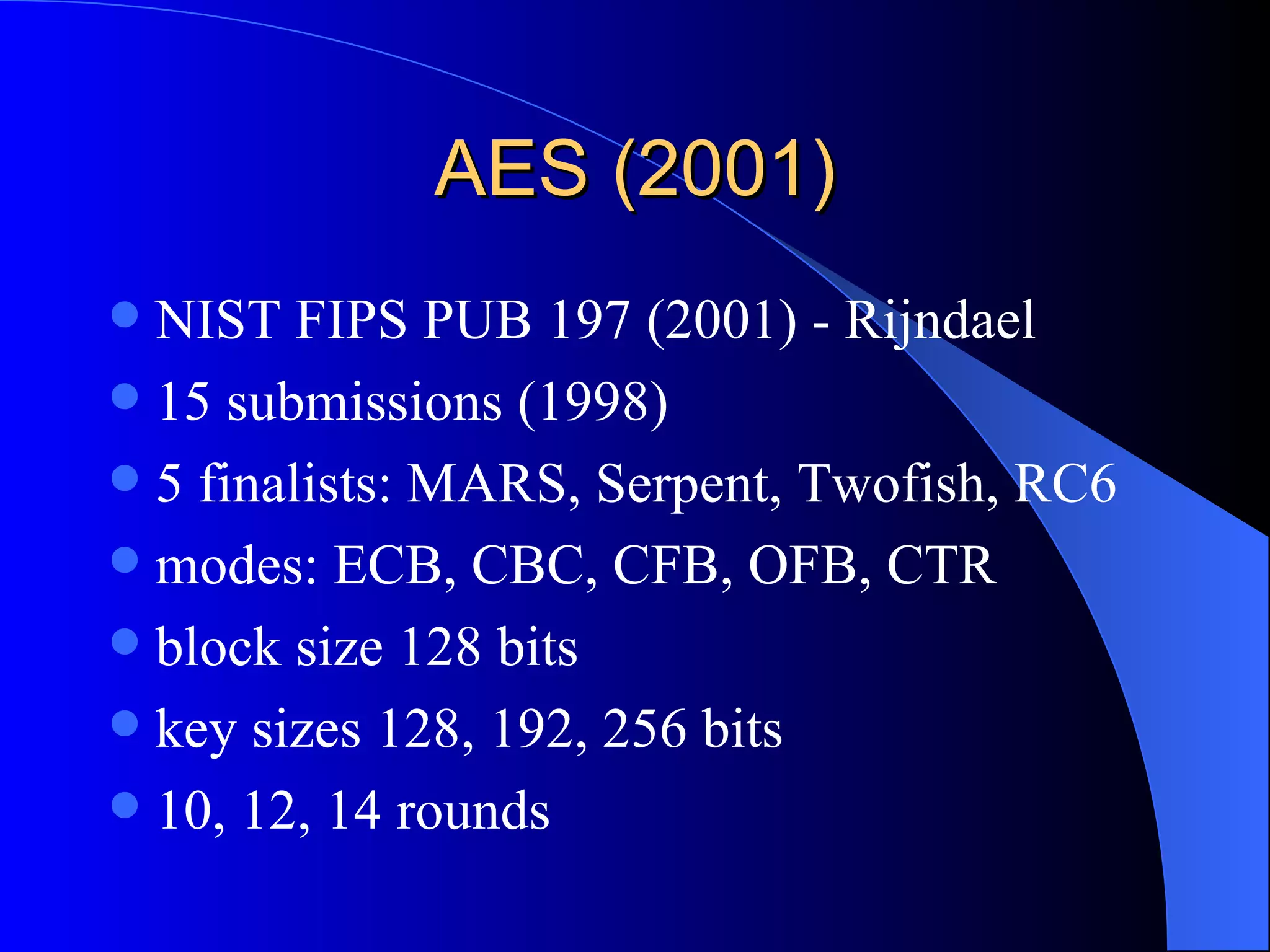
AES (2001) NIST FIPS PUB 197 (2001) - Rijndael 15 submissions (1998) 5 finalists: MARS, Serpent, Twofish, RC6 modes: ECB, CBC, CFB, OFB, CTR block size 128 bits key sizes 128, 192, 256 bits 10, 12, 14 rounds
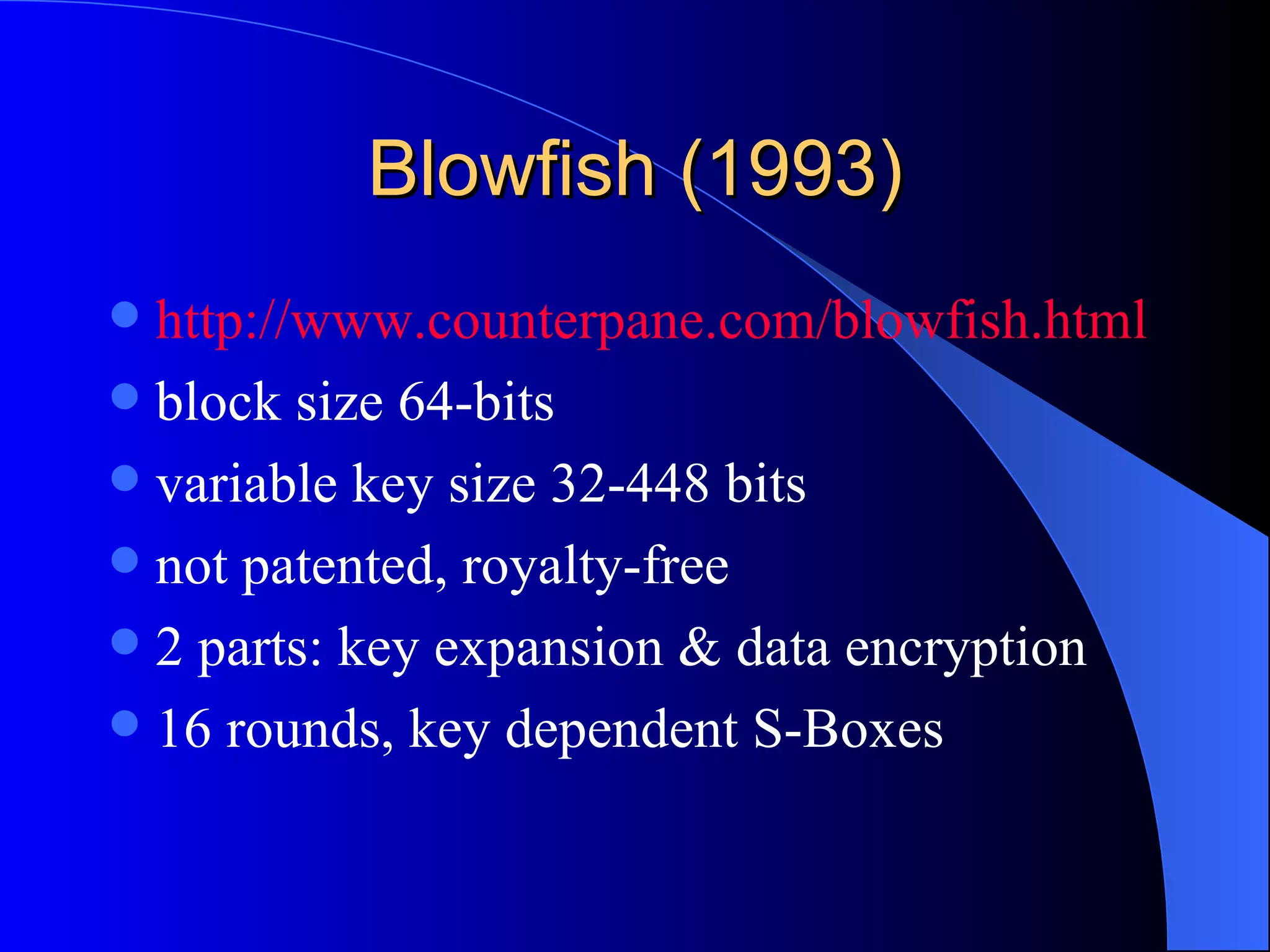
Blowfish (1993) http://www.counterpane.com/blowfish.html block size 64-bits variable key size 32-448 bits not patented, royalty-free 2 parts: key expansion & data encryption 16 rounds, key dependent S-Boxes
Books Anderson: Security Engineering Ferguson, Schneier: Practical Cryptography Kahn: The Codebreakers, … Menezes, van Oorschot, Vanstone: Handbook of Applied Cryptography  Schneier, B: Applied Cryptography

Cryptography for Smalltalkers - ESUG 2004

  • 1.
    Cryptography for SmalltalkersMartin Kobetic Cincom Smalltalk Development ESUG 2004
  • 2.
    Cryptographic Objectives confidentialityencryption integrity message authentication codes (MAC) authentication signatures
  • 3.
    Encryption E(P) =C & D(C) = P symmetric (secret) key ciphers E K (P) = C & D K (C) = P asymmetric (public) key ciphers E K1 (P) = C & D K2 (C) = P one-time pad
  • 4.
    Secret Key Ciphersbulk data encryption built from simple, fast operations (xor, shift, x + y mod n, ...) two fundamental classes stream ciphers (RC4) block ciphers (DES/AES)
  • 5.
    Secret Key Cipherskey := ‘secret key’ asByteArray. alice := ARC4 key: key. msg := ‘Hello’ asByteArrayEncoding: #utf_8. msg := alice encrypt: ‘Hello’ msg asString. bob := ARC4 key: key. bob decryptInPlace: msg from: 1 to: 4. msg asStringEncoding: #utf_8.
  • 6.
    Stream Ciphers time-varyingtransformation on individual plain-text digits key-stream generator: k 1 , k 2 , k 3 , .... State S, NextState(S), Output(S) E: c i = p i xor k i D: p i = c i xor k i Pike, A5, RC4, SEAL key reuse is catastrophic! (a xor k) xor (b xor k) = a xor b
  • 7.
    leaked trade secretof RSA Security (1994) 256 byte S-Box; 2 counters i=j=0 RC4 (1992) next key-stream byte: i = (i + 1) mod 256 j = (j+S i ) mod 256 swap S i and S j t = (S i + S j ) mod 256 K = S t S-Box initialization: S = 0, ..., 255 K = 256B of replicated key for i=0 to 255: j = (j + S i + K i ) mod 256 swap S i and S j
  • 8.
    RC4 alice :=ARC4 key: key. msg := alice encrypt: 'Hello' asByteArray. msg asHexString. bob := ARC4 key: key. (bob decrypt: msg) asString
  • 9.
    Block Ciphers fixedtransformation on blocks of plaintext (e.g 64, 128 bits) basic transformation applied in rounds DES, IDEA, CAST, Blowfish, RC2, RC5
  • 10.
    DES (1977) csrc.nist.gov:FIPS PUB 46 (1977) FIPS PUB 46-3 (1999) triple DES still approved single DES legacy systems only 64 bit block size 56 bit key (64 bits with parity) 16 rounds using 48 bit subkeys
  • 11.
    Block Ciphers -Padding key := ‘secret8B’ asByteArray. alice := DES key: key. alice encrypt: ‘Hello World!’ asByteArray. alice := BlockPadding on: DES new. alice setKey: key. (alice encrypt: ‘Hello World!’ asByteArray) asString.
  • 12.
    Block Ciphers -Padding must be reversible pad with bits “100…0” pad with padding size (1-8) aka PKCS#5 padding ciphertext stealing different for different modes (ECB, CBC) some modes don’t need padding
  • 13.
    Block Ciphers -ECB electronic codebook mode C i = E k (P i ) P i = D k (C i ) don’t use !
  • 14.
    Block Ciphers -CBC cipher block chaining mode C i = E k (P i xor C i-1 ) P i = C i-1 xor D k (C i ) initialization vector (IV) isn’t secret but unique, random timestamp, nonce, random nr
  • 15.
    Block Ciphers -CBC alice := CipherBlockChaining on: DES new iv: ‘nonce 8B’ asByteArray. alice setKey: ‘secret8B’ asByteArray. msg := ‘a block a block ’ asByteArray. msg := alice encrypt: msg. msg asString
  • 16.
    Block Ciphers -CBC alice := DES newBP_CBC. alice setKey: 'secret8B' asByteArray. alice setIV: 'nonce 8B' asByteArray. msg := 'Hello World!' asByteArray. msg := alice encrypt: msg. msg asString.
  • 17.
    Block Ciphers -OFB output feedback mode S i = E k (S i-1 ) C i = P i xor S i P i = C i xor S i like synchronous stream cipher (OutputFeeback on: DES new) setKey: ‘secret8B’ asByteArray; setIV: ‘nonce 8B’ asByteArray
  • 18.
    Block Ciphers -CTR counter mode S i := E k (Nonce || i) C i = P i xor S i P i = C i xor S i OFB variant
  • 19.
    Block Ciphers -CFB cipher feedback mode C i = P i xor E k (C i-1 ) P i = C i xor E k (C i-1 ) like self-synchronizing stream cipher (CipherFeeback on: DES new) setKey: ‘secret8B’ asByteArray; setIV: ‘nonce 8B’ asByteArray
  • 20.
    Block Ciphers -Mixing interleaving parallelizing “chained” modes multiple encryption with single cipher double encryption – no good 3EDE (inner/outer CBC) cascading different ciphers
  • 21.
    Block Ciphers -Mixing des3 := TrippleEDEOuterCBC first: DES new second: DES new third: DES new. des3 := DES new3EDE_CBC. des3 setKey: ’24bytes for 3 keys’ asByteArray. des3 setIV: ‘nonce 8B’ asByteArray.
  • 22.
    AES (2001) NISTFIPS PUB 197 (2001) - Rijndael 15 submissions (1998) 5 finalists: MARS, Serpent, Twofish, RC6 modes: ECB, CBC, CFB, OFB, CTR block size 128 bits key sizes 128, 192, 256 bits 10, 12, 14 rounds
  • 23.
    Blowfish (1993) http://www.counterpane.com/blowfish.htmlblock size 64-bits variable key size 32-448 bits not patented, royalty-free 2 parts: key expansion & data encryption 16 rounds, key dependent S-Boxes
  • 24.
    Books Anderson: SecurityEngineering Ferguson, Schneier: Practical Cryptography Kahn: The Codebreakers, … Menezes, van Oorschot, Vanstone: Handbook of Applied Cryptography Schneier, B: Applied Cryptography

Editor's Notes

  • #3 confidentiality - prevent eavesdropping (passive attack) integrity - prevent undetected modification (active attack) authentication - proof of origin (active attack) non-repudiation - undeniable proof of origin SSL provides authentication but doesn’t provide non-repudiation SMIME does both (theoretically) point-to-point vs end-to-end
  • #5 Hardware implementations
  • #7 Key stream reuse disastrous (P1 xor K) xor (P2 xor K) = P1 xor (K xor K) xor P2 = P1 xor P2 xoring 2 ciphertexts yields 2 xored plaintexts, easy to break
  • #8 ARC4 – “Alleged” RC4
  • #11 DEA (ANSI), DEA-1 (ISO) Lucifer descendant (IBM), NSA evaluated reviewed every 5 years 1983 – recertified, 1987 – recertified “last time” after public outcry 1993 – recertified, still no alternatives 1999 – reaffirmed 3DES, AES not finished yet
  • #14 POSITIVES parallelizable NEGATIVES preserves plaintext patterns easily manipulated
  • #18 N-bit OFB: smaller than block processing No need to pad. Doesn’t need decryption operation.
  • #19 Nonce: usually message number combined with additional data to guarantee uniqueness N-bit CTR: smaller than block processing No need to pad. Doesn’t need decryption operation.
  • #20 N-bit CFB: smaller than block processing No need to pad. Doesn’t need decryption operation.
  • #21 double encryption – meet in the middle attach 2^n+1 instead of 2^2n triple encryption – 2key or 3key cascading – beware of algorithm interactions
  • #23 Finalists Rijndael – Joan Daemen, Vincent Rijmen (Netherlands) Serpent – Ross Anderson (Cambridge, UK) Twofish – Bruce Schneier (Counterpane Inc) MARS – Don Coppersmith (IBM) RC6 – Ron Rivest (RSA Labs)