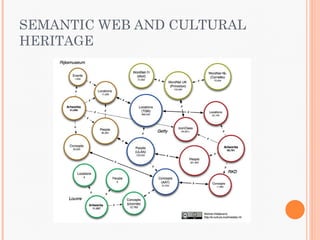
SEMANTIC WEB AND CULTURAL
HERITAGE
WHAT IS THE SEMANTIC WEB?
 The Semantic Web is a web of methods and
  technologies that allow machines to read and
  understand the meaning of information on the
  internet
 SEMANTICS= MEANING

 Intended as a real Web, where data is connected
  through meaning, in accessible ways in a limited
  location
 Conceived by Tim Berners-Lee as a continuation
  of the the current Internet.
 Monitored and promoted by the W3 consortium
WHAT IS THE SEMANTIC WEB?
 The Semantic Web will organize information in
  conceptual spaces according to its meaning; the
  current web suffers in searching information
  (with keyword-based searching), extracting
  relevant data across documents and outdated
  information.
 Semantic Web seeks to have an automated
  design to support maintenance.
 In order for it to work, there needs to be
  integration, standardization, and adaptation by
  the users.
RDF – RESOURCE DESCRIPTION
FRAMEWORK
 RDF allows for a common framework where data
  from various sources can merge. It takes two
  URIs and shows the relationship between them.
 Showing relationships is key: For example, in a
  regular search if you enter the keyword "Harry
  Potter" it has no way of knowing whether "Harry
  Potter" is the creator, character, related term etc.
  in relation to the results.
 Using RDF, the relations are coded in the results
  giving them meaning.
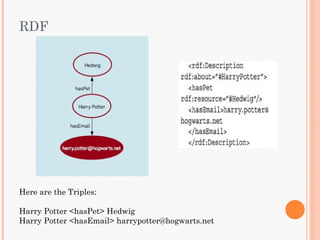
 It is based on the concept of triples- subject,
  predicate, object
RDF


Here are the Triples:

Harry Potter <hasPet> Hedwig
Harry Potter <hasEmail> harrypotter@hogwarts.net
SIMPLE KNOWLEDGE
ORGANIZATION SYSTEM (SKOS)

 SKOS is a standard set of languages and
  elements that are used as framework for
  thesauri, taxonomies, folksonomies, and subject-
  heading systems.
 Built upon RDF and RDFS

 Can be used with OWL

 Aims to be a more simple and intuitive set of
  standards
 Maintained by World Wide Web Consortium
  (WSC)
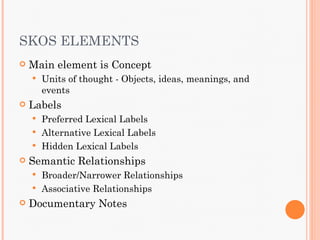
SKOS ELEMENTS
   Main element is Concept
       Units of thought - Objects, ideas, meanings, and
        events
   Labels
     Preferred Lexical Labels
     Alternative Lexical Labels
     Hidden Lexical Labels
   Semantic Relationships
     Broader/Narrower Relationships
     Associative Relationships
   Documentary Notes
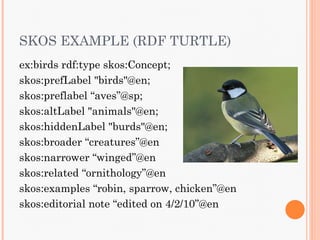
SKOS EXAMPLE (RDF TURTLE)
ex:birds rdf:type skos:Concept;
skos:prefLabel "birds"@en;
skos:preflabel “aves”@sp;
skos:altLabel "animals"@en;
skos:hiddenLabel "burds"@en;
skos:broader “creatures”@en
skos:narrower “winged”@en
skos:related “ornithology”@en
skos:examples “robin, sparrow, chicken”@en
skos:editorial note “edited on 4/2/10”@en
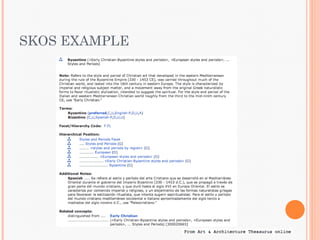
SKOS EXAMPLE
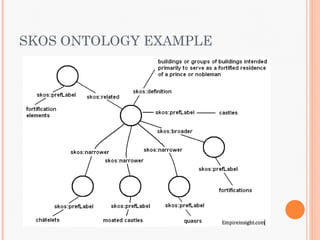
SKOS ONTOLOGY EXAMPLE
WEB ONTOLOGY LANGUAGE: OWL

 Semantic web requires more
  expressiveness than what RDF can offer;
  OWL is a richer vocabulary description
  language.
 Allows for greater machine
  interoperability of information on the
  web.
 OWL is being positioned to be the
  standardized language for the Semantic
  Web, as identified by W3C.
 Web Ontology Language is used to
  process the content of information instead
  of just presenting it on a web page.
WEB ONTOLOGY LANGUAGE: OWL

 OWL describes the meaning of terminology used
  in a document; it adds onto the vocabulary
  existing in the RDF Schema (which describes
  properties and classes of RDF resources).
 For example, RDF cannot describe relations
  between classes or cardinality constraints like
  OWL (like Hogwarts students have at most, one
  pet) can.
 OWL needs to have a well-defined syntax,
  expressive power, and efficient reasoning
  capabilities.
OWL


Description of the
class of student
wizards


Horrocks, I. (2008). Ontologies and the semantic web. Communications of the ACM. vol.51,
no.12 p.58-67. Retrieved from Academic Search Premier
ONTOLOGY
 An ontology like OWL gives a shared
  understanding of a domain, which is needed in
  overcoming differences in terminologies.
 It will improve accuracy of searches and
  interpret retrieved information from a search.
 The development of Semantic Web would be
  gradual; in addition, there must be compatibility
  between agents that use OWL and those that use
  RDF (at least partly): information that is written
  at a higher level (OWL) must be interpreted by
  agents that can also recognize RDF-written
  information.
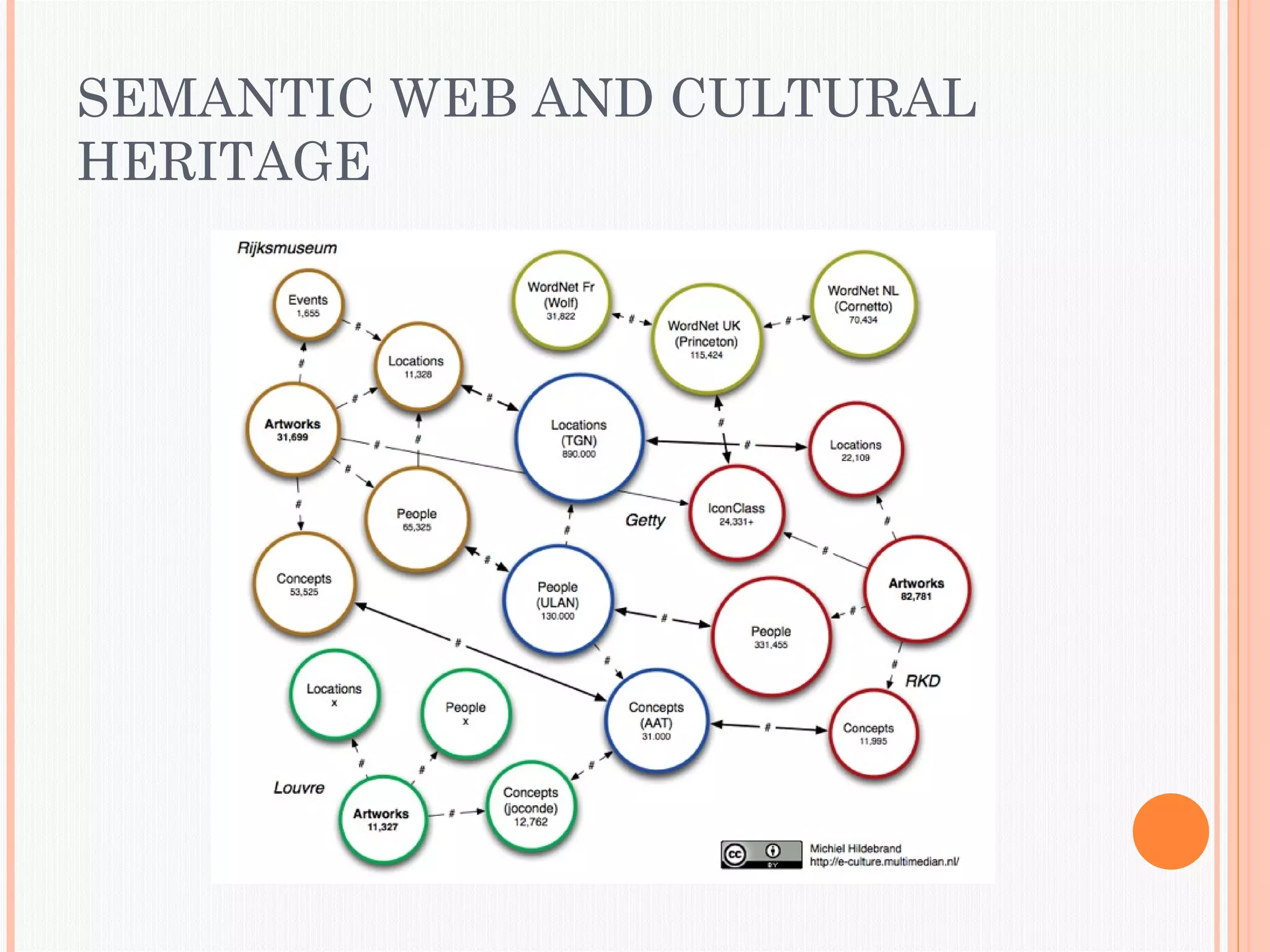
A NOTE ON METADATA
   Cultural heritage collections are indexed with
    metadata obtained from thesauri like Iconclass and
    Getty’s Vocabularies (Art and Architecture
    Thesaurus, Union List of Artist Names, Thesaurus of
    Geographic Names, and Cultural Objects Name
    Authority). Additionally, SKOS helps to enable
    production of controlled vocabularies for the semantic
    web.
   These vocabularies are not unified (although overlap
    does exist), so browsing many collections in an
    interoperable way becomes difficult.
   Metadata and vocabularies must be depicted in RDF
    and/or OWL.
   Forming semantic links between different resources is
    ontology mapping.
USE OF THESAURI/VOCABULARIES


   Many of these collections and projects use the same
    thesauri – Getty Vocabularies and Iconclass. Give
    authoritative information and strengthen access to
    databases.
   Getty Vocabularies consist of the Art and Architecture
    Thesaurus (AAT), Thesaurus of Geographic Names
    (TGN), The Cultural Objects Name Authority (CONA),
    and The Union List of Artist Names (ULAN). These give
    structured vocabulary for names, descriptions, titles
    biographies, and various information on art, architecture,
    important places, works of art and artists, respectively.
   Iconclass describes and classifies information on subjects
    (icons) that are depicted in works of art. A hierarchically
    ordered collection/classification system.
CULTURAL HERITAGE


 Cultural heritage is the legacy of culture
  inherited from previous generations of a
  particular group or society
 Tangible
       Artifacts, monuments, graves, and buildings.
   Intangible
       Language, rituals, traditions, stories, and oral
        histories.
BENEFITS

 Preservation
 Access

 Further exploration

 Ability to create relationships within and across
  collections
     Patrons can conduct meaningful searches
     Possible to build collections containing items from
      different institutions
BENEFITS
   How exactly does the Semantic Web create a
    “meaningful” search? For example, semantic
    links can be created that allow the user to:
     Find a painting of an historic event, find information
      on that event along with other artwork depicting it,
      locate it on a map and see where nearby events
      occurred and how they are represented in artwork.
     Look up at artist, see where this artist lived and
      worked, and see works by other artists that lived
      nearby at the time, or apprentices of that artist.
     Find additional written reports on events, historical
      figures or iconography shown in a cultural heritage
      collection.
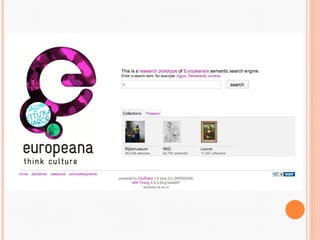
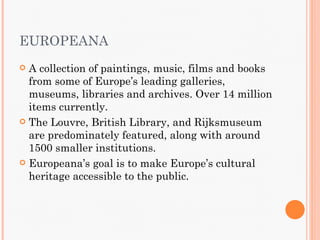
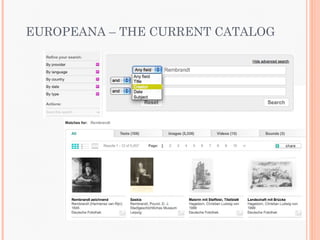
EUROPEANA
 A collection of paintings, music, films and books
  from some of Europe’s leading galleries,
  museums, libraries and archives. Over 14 million
  items currently.
 The Louvre, British Library, and Rijksmuseum
  are predominately featured, along with around
  1500 smaller institutions.
 Europeana’s goal is to make Europe’s cultural
  heritage accessible to the public.
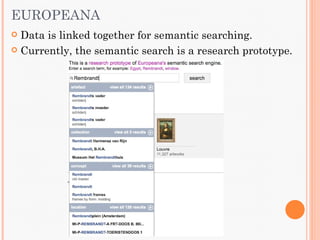
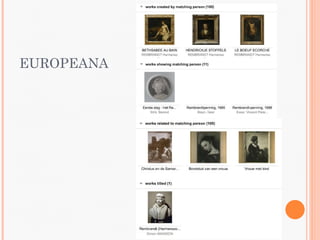
EUROPEANA
 Data is linked together for semantic searching.
 Currently, the semantic search is a research prototype.
EUROPEANA
EUROPEANA – THE CURRENT CATALOG
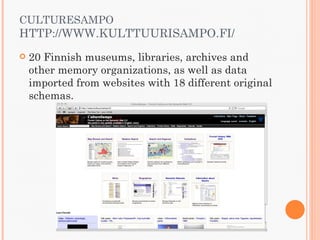
CULTURESAMPO
HTTP://WWW.KULTTUURISAMPO.FI/
   20 Finnish museums, libraries, archives and
    other memory organizations, as well as data
    imported from websites with 18 different original
    schemas.
CULTURESAMPO- CONT.
Features Summary         o Various   Entry
                         Points
 Map Search (historic   o Autocompletion
    and current)
 Faceted results        o Visualizations
 Timeline               o Cross language
 Person relations       searches
 Semantic Wikipedia     o Timeline
 Biographies
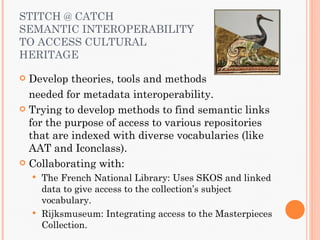
STITCH @ CATCH
SEMANTIC INTEROPERABILITY
TO ACCESS CULTURAL
HERITAGE

 Develop theories, tools and methods
  needed for metadata interoperability.
 Trying to develop methods to find semantic links
  for the purpose of access to various repositories
  that are indexed with diverse vocabularies (like
  AAT and Iconclass).
 Collaborating with:
     The French National Library: Uses SKOS and linked
      data to give access to the collection’s subject
      vocabulary.
     Rijksmuseum: Integrating access to the Masterpieces
      Collection.
MULTIMEDIAN N9C E-CULTURE
PROJECT
 The objective of this project is to give multimedia
  access to cultural heritage collections.
 E-culture “demonstrators” will be developed to
  give semantic information access and multimedia
  visualization between collections in the
  Netherlands. A cultural search engine will be
  produced.
 Uses Getty’s Thesauri, Rijksmuseum
  concepts/locations/people and SCVN (Dutch
  ethnology) and searches across Rijksmuseum,
  Archive.com, Museum Volkenkunde, and
  Tropenmuseum.
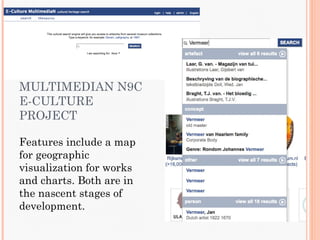
MULTIMEDIAN N9C
E-CULTURE
PROJECT

Features include a map
for geographic
visualization for works
and charts. Both are in
the nascent stages of
development.
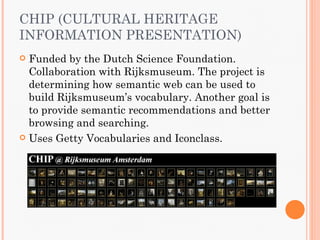
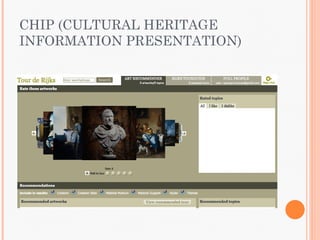
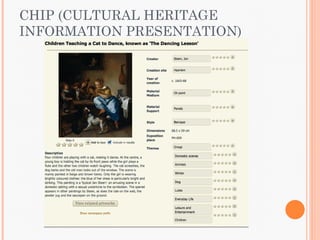
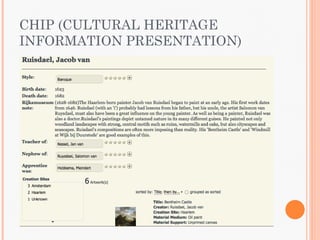
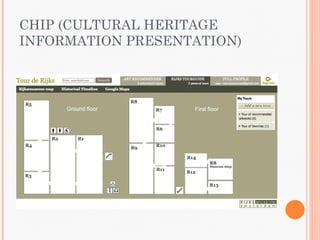
CHIP (CULTURAL HERITAGE
INFORMATION PRESENTATION)
 Funded by the Dutch Science Foundation.
  Collaboration with Rijksmuseum. The project is
  determining how semantic web can be used to
  build Rijksmuseum’s vocabulary. Another goal is
  to provide semantic recommendations and better
  browsing and searching.
 Uses Getty Vocabularies and Iconclass.
CHIP (CULTURAL HERITAGE
INFORMATION PRESENTATION)
   3 tools have been developed within the semantic
    web model
     Artwork Recommender: Semantically-powered tool,
      rates artwork for a user’s profile
     Tour Wizard: Personal virtual tour for the user.
     Mobile Tour: Mapping a virtual tour within the
      physical space of the museum. Guide users through
      collections via mobile devices.
   Create a user profile, can label topics you do not
    like or like, view information on artists and
    artworks.
CHIP (CULTURAL HERITAGE
INFORMATION PRESENTATION)
CHIP (CULTURAL HERITAGE
INFORMATION PRESENTATION)
CHIP (CULTURAL HERITAGE
INFORMATION PRESENTATION)
CHIP (CULTURAL HERITAGE
INFORMATION PRESENTATION)
CULTURAL HERITAGE OF
CANTABRIA


W3C Case Study
by the Fundación Marcelino Botín

 11 types of cultural heritage items from 300
  sources about Cantabria, Spain.
 Using semantic technologies remedies the spread
  of data in various forms, and digitization
  processes.
 Increases access to all citizens by creating a
  repository for cultural heritage
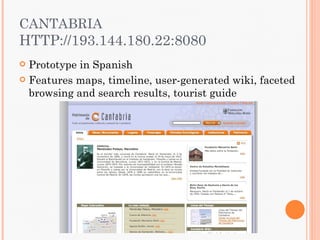
CANTABRIA
HTTP://193.144.180.22:8080
 Prototype in Spanish
 Features maps, timeline, user-generated wiki, faceted
  browsing and search results, tourist guide
CHALLENGES WITH CANTABRIA


 Problems are not technology related, but rather
  political
 Search results and data were skewed towards
  certain areas or people within Cantabria
CHALLENGES AND THE FUTURE OF
CULTURAL HERITAGE COLLECTIONS


 Large variety of objects- who has ownership?
 Who can give metadata, label authority files?

 Currently, only prototypes are available for
  searching cultural heritage collections
  semantically. Will people come around to the idea
  of Semantic Web?
QUESTIONS
 Is the Semantic Web a realistic goal?
 How will it be implemented?

 What challenges do you foresee?

 Is cultural heritage a realistic area to show
  semantically? What about other areas- travel,
  health, business, social media
BIBLIOGRAPHY
   Angjeli, A., Isaac, A., Cloarec, T., Martin, F., Meij, L., Matthezing, H., & Schloback, S. (2009).
             Semantic Web and Vocabulary Interoperability: an Experiment with Illumination
    Collections. International Cataloguing and Bibliographic Control, 38(2), 25-9. Retrieved         from
    Library Lit & Inf Full Text database
   Antoniou, G. & van Harmelen, F. (2004). A semantic web primer. Cambridge, Massachusetts: The
             MIT Press.
   Brynko, B. (2010) The power of the semantic web. Information Today. no5 p. 10.
   CHIP @ Rijksmuseum Amsterdam. (2008). CHIP (Cultural Heritage Information Presentation)
             Homepage. Retrieved from http://chip-project.org/
   Concordia, C., Gradmann, S., & Siebinga, S. (2010). Not just another portal, not just
    another digital library: A portrait of Europeana as an application program interface.            IFLA
    Journal, 36(1), 61-9. doi: 10.1177/0340035209360764
   CultureSampo (2010). Finnish culture on the semantic web 2.0. Retrieved from http://
    www.kulttuurisampo.fi/?lang=en
   Doszkocs, T. (2010 July/August). Semantic search engines mean well. Online Magazine vol34 no 4.
             p.36-42.
   Dunsire, Gordon. (2008). Said the spider to the fly: identity and authority and the
    semantic web. (based on keynote at CIG conference 2008, Glasgow) Manchester: CILIP
    Cataloguing and Indexing Group.
   Europeana Foundation. (2010). Europeana. Retrieved from http://www.europeana.eu/portal/
             index.html
   Fundacion Marcelino Botin (2009). Patrimonio de Cantabria: todo el patrimonio cultural y natural
    de Cantabria. Retrieved from http://193.144.180.22:8080/web/guest/                  home
   Getty’s Research Institute. (2010). Getty Vocabularies. Retrieved from http://www.getty.edu/
             research/tools/vocabularies/index.html
BIBLIOGRAPHY
   Herman, I. (2010, June 22). Introduction to semantic web technologies. Retrieved from
            http://www.w3.org/2010/Talks/0622-SemTech-IH/Tutorial.pdf
   Hernandez, Francisca. (2007, May). Case study: An ontology of Cantabria’s Cultural
            Heritage. Retrieved from http://www.w3.org/2001/sw/sweo/public/UseCases/
                         FoundationBotin/
   Horrocks, I. (2008). Ontologies and the semantic web. Communications of the ACM. vol.51
            no.12 p.58-67 Retrieved from Academic Search Premier
   Iconclass. (2010). Retrieved from http://www.iconclass.nl/
   McGuinness, D. L. & van Harmelen, F. (Eds.). (2009). OWL web ontology language
            overview. Retrieved from http://www.w3.org/TR/2004/REC-owl-features-20040210/
   Miles, A. & Bechhofer,S. (2009). SKOS Simple Knowledge Organization Reference.
            Retrieved from http://www.w3.org/TR/skos-reference/
   MultimediaN N9C E-culture Project. (2008). MultimediaN N9C Eculture project homepage.
            Retrieved from http://e-culture.multimedian.nl/
   Rapoza, J. (2004, June 4). Spinning the semantic web. Eweek Labs. www.eweek.com
   Schreiber, G., Amin, A., Aroyo, L., Van Assem, M., de Boer, V., et al. (2008). Semantic
            annotation and search for cultural heritage collecitons: The MultimediaN E-
            Culture demonstrator. Web semantics: Science, Services, and Agents on the World
            Wide Web 6. Elsevier. p.243-249. doi:10.1016/j.websem.2008.08.001
   Solanki, M. Semantic web in cultural heritage and archaeology [SlideShare slides].
            Retrieved from http://www.slideshare.net/nimonika/semantic-web-in-cultural-
                         heritage-and-archaeology
   STITCH @ CATCH. (2005). Semantic interoperability to access cultural heritage. Retrieved
            from http://www.cs.vu.nl/STITCH/index.html
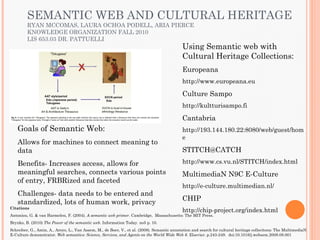
SEMANTIC WEB AND CULTURAL HERITAGE
         RYAN MCCOMAS, LAURA OCHOA PODELL, ARIA PIERCE
         KNOWLEDGE ORGANIZATION FALL 2010
         LIS 653.03 DR. PATTUELLI
                                                                                             Using Semantic web with
                                                                                             Cultural Heritage Collections:
                                                                                             Europeana
                                                                                             http://www.europeana.eu

                                                                                             Culture Sampo
                                                                                             http://kultturisampo.fi

                                                                                             Cantabria
    Goals of Semantic Web:                                                                   http://193.144.180.22:8080/web/guest/hom
                                                                                             e
    Allows for machines to connect meaning to
    data                                                                                     STITCH@CATCH
    Benefits- Increases access, allows for                                                   http://www.cs.vu.nl/STITCH/index.html
    meaningful searches, connects various points                                             MultimediaN N9C E-Culture
    of entry, FRBRized and faceted
                                                                                             http://e-culture.multimedian.nl/
    Challenges- data needs to be entered and
                                                                                             CHIP
    standardized, lots of human work, privacy
Citations
                                                                                             http://chip-project.org/index.html
Antoniou, G. & van Harmelen, F. (2004). A semantic web primer. Cambridge, Massachusetts: The MIT Press.
Brynko, B. (2010) The Power of the semantic web. Information Today. no5 p. 10.
Schreiber, G., Amin, A., Aroyo, L., Van Assem, M., de Boer, V., et al. (2008). Semantic annotation and search for cultural heritage collecitons: The MultimediaN
E-Culture demonstrator. Web semantics: Science, Services, and Agents on the World Wide Web 6. Elsevier. p.243-249.  doi:10.1016/j.websem.2008.08.001
Semantic Web and Cultural Heritage Collections

  • 1.
    SEMANTIC WEB ANDCULTURAL HERITAGE
  • 2.
    WHAT IS THESEMANTIC WEB?  The Semantic Web is a web of methods and technologies that allow machines to read and understand the meaning of information on the internet  SEMANTICS= MEANING  Intended as a real Web, where data is connected through meaning, in accessible ways in a limited location  Conceived by Tim Berners-Lee as a continuation of the the current Internet.  Monitored and promoted by the W3 consortium
  • 3.
    WHAT IS THESEMANTIC WEB?  The Semantic Web will organize information in conceptual spaces according to its meaning; the current web suffers in searching information (with keyword-based searching), extracting relevant data across documents and outdated information.  Semantic Web seeks to have an automated design to support maintenance.  In order for it to work, there needs to be integration, standardization, and adaptation by the users.
  • 4.
    RDF – RESOURCEDESCRIPTION FRAMEWORK  RDF allows for a common framework where data from various sources can merge. It takes two URIs and shows the relationship between them.  Showing relationships is key: For example, in a regular search if you enter the keyword "Harry Potter" it has no way of knowing whether "Harry Potter" is the creator, character, related term etc. in relation to the results.  Using RDF, the relations are coded in the results giving them meaning.  It is based on the concept of triples- subject, predicate, object
  • 5.
    RDF Here are theTriples: Harry Potter <hasPet> Hedwig Harry Potter <hasEmail> harrypotter@hogwarts.net
  • 6.
    SIMPLE KNOWLEDGE ORGANIZATION SYSTEM(SKOS)  SKOS is a standard set of languages and elements that are used as framework for thesauri, taxonomies, folksonomies, and subject- heading systems.  Built upon RDF and RDFS  Can be used with OWL  Aims to be a more simple and intuitive set of standards  Maintained by World Wide Web Consortium (WSC)
  • 7.
    SKOS ELEMENTS  Main element is Concept  Units of thought - Objects, ideas, meanings, and events  Labels  Preferred Lexical Labels  Alternative Lexical Labels  Hidden Lexical Labels  Semantic Relationships  Broader/Narrower Relationships  Associative Relationships  Documentary Notes
  • 8.
    SKOS EXAMPLE (RDFTURTLE) ex:birds rdf:type skos:Concept; skos:prefLabel "birds"@en; skos:preflabel “aves”@sp; skos:altLabel "animals"@en; skos:hiddenLabel "burds"@en; skos:broader “creatures”@en skos:narrower “winged”@en skos:related “ornithology”@en skos:examples “robin, sparrow, chicken”@en skos:editorial note “edited on 4/2/10”@en
  • 9.
  • 10.
  • 11.
    WEB ONTOLOGY LANGUAGE:OWL  Semantic web requires more expressiveness than what RDF can offer; OWL is a richer vocabulary description language.  Allows for greater machine interoperability of information on the web.  OWL is being positioned to be the standardized language for the Semantic Web, as identified by W3C.  Web Ontology Language is used to process the content of information instead of just presenting it on a web page.
  • 12.
    WEB ONTOLOGY LANGUAGE:OWL  OWL describes the meaning of terminology used in a document; it adds onto the vocabulary existing in the RDF Schema (which describes properties and classes of RDF resources).  For example, RDF cannot describe relations between classes or cardinality constraints like OWL (like Hogwarts students have at most, one pet) can.  OWL needs to have a well-defined syntax, expressive power, and efficient reasoning capabilities.
  • 13.
    OWL Description of the classof student wizards Horrocks, I. (2008). Ontologies and the semantic web. Communications of the ACM. vol.51, no.12 p.58-67. Retrieved from Academic Search Premier
  • 14.
    ONTOLOGY  An ontologylike OWL gives a shared understanding of a domain, which is needed in overcoming differences in terminologies.  It will improve accuracy of searches and interpret retrieved information from a search.  The development of Semantic Web would be gradual; in addition, there must be compatibility between agents that use OWL and those that use RDF (at least partly): information that is written at a higher level (OWL) must be interpreted by agents that can also recognize RDF-written information.
  • 15.
    A NOTE ONMETADATA  Cultural heritage collections are indexed with metadata obtained from thesauri like Iconclass and Getty’s Vocabularies (Art and Architecture Thesaurus, Union List of Artist Names, Thesaurus of Geographic Names, and Cultural Objects Name Authority). Additionally, SKOS helps to enable production of controlled vocabularies for the semantic web.  These vocabularies are not unified (although overlap does exist), so browsing many collections in an interoperable way becomes difficult.  Metadata and vocabularies must be depicted in RDF and/or OWL.  Forming semantic links between different resources is ontology mapping.
  • 16.
    USE OF THESAURI/VOCABULARIES  Many of these collections and projects use the same thesauri – Getty Vocabularies and Iconclass. Give authoritative information and strengthen access to databases.  Getty Vocabularies consist of the Art and Architecture Thesaurus (AAT), Thesaurus of Geographic Names (TGN), The Cultural Objects Name Authority (CONA), and The Union List of Artist Names (ULAN). These give structured vocabulary for names, descriptions, titles biographies, and various information on art, architecture, important places, works of art and artists, respectively.  Iconclass describes and classifies information on subjects (icons) that are depicted in works of art. A hierarchically ordered collection/classification system.
  • 17.
    CULTURAL HERITAGE  Culturalheritage is the legacy of culture inherited from previous generations of a particular group or society  Tangible  Artifacts, monuments, graves, and buildings.  Intangible  Language, rituals, traditions, stories, and oral histories.
  • 18.
    BENEFITS  Preservation  Access Further exploration  Ability to create relationships within and across collections  Patrons can conduct meaningful searches  Possible to build collections containing items from different institutions
  • 19.
    BENEFITS  How exactly does the Semantic Web create a “meaningful” search? For example, semantic links can be created that allow the user to:  Find a painting of an historic event, find information on that event along with other artwork depicting it, locate it on a map and see where nearby events occurred and how they are represented in artwork.  Look up at artist, see where this artist lived and worked, and see works by other artists that lived nearby at the time, or apprentices of that artist.  Find additional written reports on events, historical figures or iconography shown in a cultural heritage collection.
  • 21.
    EUROPEANA  A collectionof paintings, music, films and books from some of Europe’s leading galleries, museums, libraries and archives. Over 14 million items currently.  The Louvre, British Library, and Rijksmuseum are predominately featured, along with around 1500 smaller institutions.  Europeana’s goal is to make Europe’s cultural heritage accessible to the public.
  • 22.
    EUROPEANA  Data islinked together for semantic searching.  Currently, the semantic search is a research prototype.
  • 23.
  • 24.
    EUROPEANA – THECURRENT CATALOG
  • 25.
    CULTURESAMPO HTTP://WWW.KULTTUURISAMPO.FI/  20 Finnish museums, libraries, archives and other memory organizations, as well as data imported from websites with 18 different original schemas.
  • 26.
    CULTURESAMPO- CONT. Features Summary o Various Entry Points  Map Search (historic o Autocompletion and current)  Faceted results o Visualizations  Timeline o Cross language  Person relations searches  Semantic Wikipedia o Timeline  Biographies
  • 27.
    STITCH @ CATCH SEMANTICINTEROPERABILITY TO ACCESS CULTURAL HERITAGE  Develop theories, tools and methods needed for metadata interoperability.  Trying to develop methods to find semantic links for the purpose of access to various repositories that are indexed with diverse vocabularies (like AAT and Iconclass).  Collaborating with:  The French National Library: Uses SKOS and linked data to give access to the collection’s subject vocabulary.  Rijksmuseum: Integrating access to the Masterpieces Collection.
  • 28.
    MULTIMEDIAN N9C E-CULTURE PROJECT The objective of this project is to give multimedia access to cultural heritage collections.  E-culture “demonstrators” will be developed to give semantic information access and multimedia visualization between collections in the Netherlands. A cultural search engine will be produced.  Uses Getty’s Thesauri, Rijksmuseum concepts/locations/people and SCVN (Dutch ethnology) and searches across Rijksmuseum, Archive.com, Museum Volkenkunde, and Tropenmuseum.
  • 29.
    MULTIMEDIAN N9C E-CULTURE PROJECT Features includea map for geographic visualization for works and charts. Both are in the nascent stages of development.
  • 30.
    CHIP (CULTURAL HERITAGE INFORMATIONPRESENTATION)  Funded by the Dutch Science Foundation. Collaboration with Rijksmuseum. The project is determining how semantic web can be used to build Rijksmuseum’s vocabulary. Another goal is to provide semantic recommendations and better browsing and searching.  Uses Getty Vocabularies and Iconclass.
  • 31.
    CHIP (CULTURAL HERITAGE INFORMATIONPRESENTATION)  3 tools have been developed within the semantic web model  Artwork Recommender: Semantically-powered tool, rates artwork for a user’s profile  Tour Wizard: Personal virtual tour for the user.  Mobile Tour: Mapping a virtual tour within the physical space of the museum. Guide users through collections via mobile devices.  Create a user profile, can label topics you do not like or like, view information on artists and artworks.
  • 32.
  • 33.
  • 34.
  • 35.
  • 36.
    CULTURAL HERITAGE OF CANTABRIA W3CCase Study by the Fundación Marcelino Botín  11 types of cultural heritage items from 300 sources about Cantabria, Spain.  Using semantic technologies remedies the spread of data in various forms, and digitization processes.  Increases access to all citizens by creating a repository for cultural heritage
  • 37.
    CANTABRIA HTTP://193.144.180.22:8080  Prototype inSpanish  Features maps, timeline, user-generated wiki, faceted browsing and search results, tourist guide
  • 38.
    CHALLENGES WITH CANTABRIA Problems are not technology related, but rather political  Search results and data were skewed towards certain areas or people within Cantabria
  • 39.
    CHALLENGES AND THEFUTURE OF CULTURAL HERITAGE COLLECTIONS  Large variety of objects- who has ownership?  Who can give metadata, label authority files?  Currently, only prototypes are available for searching cultural heritage collections semantically. Will people come around to the idea of Semantic Web?
  • 40.
    QUESTIONS  Is theSemantic Web a realistic goal?  How will it be implemented?  What challenges do you foresee?  Is cultural heritage a realistic area to show semantically? What about other areas- travel, health, business, social media
  • 41.
    BIBLIOGRAPHY  Angjeli, A., Isaac, A., Cloarec, T., Martin, F., Meij, L., Matthezing, H., & Schloback, S. (2009). Semantic Web and Vocabulary Interoperability: an Experiment with Illumination Collections. International Cataloguing and Bibliographic Control, 38(2), 25-9. Retrieved from Library Lit & Inf Full Text database  Antoniou, G. & van Harmelen, F. (2004). A semantic web primer. Cambridge, Massachusetts: The MIT Press.  Brynko, B. (2010) The power of the semantic web. Information Today. no5 p. 10.  CHIP @ Rijksmuseum Amsterdam. (2008). CHIP (Cultural Heritage Information Presentation) Homepage. Retrieved from http://chip-project.org/  Concordia, C., Gradmann, S., & Siebinga, S. (2010). Not just another portal, not just another digital library: A portrait of Europeana as an application program interface. IFLA Journal, 36(1), 61-9. doi: 10.1177/0340035209360764  CultureSampo (2010). Finnish culture on the semantic web 2.0. Retrieved from http:// www.kulttuurisampo.fi/?lang=en  Doszkocs, T. (2010 July/August). Semantic search engines mean well. Online Magazine vol34 no 4. p.36-42.  Dunsire, Gordon. (2008). Said the spider to the fly: identity and authority and the semantic web. (based on keynote at CIG conference 2008, Glasgow) Manchester: CILIP Cataloguing and Indexing Group.  Europeana Foundation. (2010). Europeana. Retrieved from http://www.europeana.eu/portal/ index.html  Fundacion Marcelino Botin (2009). Patrimonio de Cantabria: todo el patrimonio cultural y natural de Cantabria. Retrieved from http://193.144.180.22:8080/web/guest/ home  Getty’s Research Institute. (2010). Getty Vocabularies. Retrieved from http://www.getty.edu/ research/tools/vocabularies/index.html
  • 42.
    BIBLIOGRAPHY  Herman, I. (2010, June 22). Introduction to semantic web technologies. Retrieved from http://www.w3.org/2010/Talks/0622-SemTech-IH/Tutorial.pdf  Hernandez, Francisca. (2007, May). Case study: An ontology of Cantabria’s Cultural Heritage. Retrieved from http://www.w3.org/2001/sw/sweo/public/UseCases/ FoundationBotin/  Horrocks, I. (2008). Ontologies and the semantic web. Communications of the ACM. vol.51 no.12 p.58-67 Retrieved from Academic Search Premier  Iconclass. (2010). Retrieved from http://www.iconclass.nl/  McGuinness, D. L. & van Harmelen, F. (Eds.). (2009). OWL web ontology language overview. Retrieved from http://www.w3.org/TR/2004/REC-owl-features-20040210/  Miles, A. & Bechhofer,S. (2009). SKOS Simple Knowledge Organization Reference. Retrieved from http://www.w3.org/TR/skos-reference/  MultimediaN N9C E-culture Project. (2008). MultimediaN N9C Eculture project homepage. Retrieved from http://e-culture.multimedian.nl/  Rapoza, J. (2004, June 4). Spinning the semantic web. Eweek Labs. www.eweek.com  Schreiber, G., Amin, A., Aroyo, L., Van Assem, M., de Boer, V., et al. (2008). Semantic annotation and search for cultural heritage collecitons: The MultimediaN E- Culture demonstrator. Web semantics: Science, Services, and Agents on the World Wide Web 6. Elsevier. p.243-249. doi:10.1016/j.websem.2008.08.001  Solanki, M. Semantic web in cultural heritage and archaeology [SlideShare slides]. Retrieved from http://www.slideshare.net/nimonika/semantic-web-in-cultural- heritage-and-archaeology  STITCH @ CATCH. (2005). Semantic interoperability to access cultural heritage. Retrieved from http://www.cs.vu.nl/STITCH/index.html
  • 43.
    SEMANTIC WEB ANDCULTURAL HERITAGE RYAN MCCOMAS, LAURA OCHOA PODELL, ARIA PIERCE KNOWLEDGE ORGANIZATION FALL 2010 LIS 653.03 DR. PATTUELLI Using Semantic web with Cultural Heritage Collections: Europeana http://www.europeana.eu Culture Sampo http://kultturisampo.fi Cantabria Goals of Semantic Web: http://193.144.180.22:8080/web/guest/hom e Allows for machines to connect meaning to data STITCH@CATCH Benefits- Increases access, allows for http://www.cs.vu.nl/STITCH/index.html meaningful searches, connects various points MultimediaN N9C E-Culture of entry, FRBRized and faceted http://e-culture.multimedian.nl/ Challenges- data needs to be entered and CHIP standardized, lots of human work, privacy Citations http://chip-project.org/index.html Antoniou, G. & van Harmelen, F. (2004). A semantic web primer. Cambridge, Massachusetts: The MIT Press. Brynko, B. (2010) The Power of the semantic web. Information Today. no5 p. 10. Schreiber, G., Amin, A., Aroyo, L., Van Assem, M., de Boer, V., et al. (2008). Semantic annotation and search for cultural heritage collecitons: The MultimediaN E-Culture demonstrator. Web semantics: Science, Services, and Agents on the World Wide Web 6. Elsevier. p.243-249.  doi:10.1016/j.websem.2008.08.001