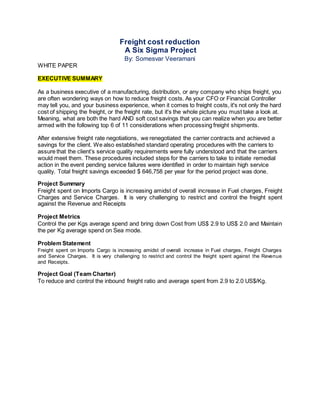
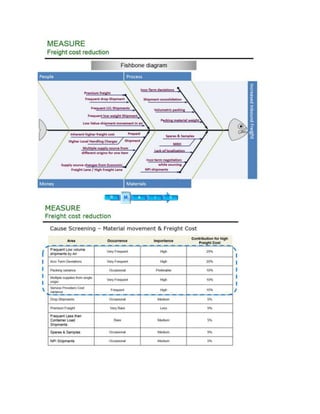
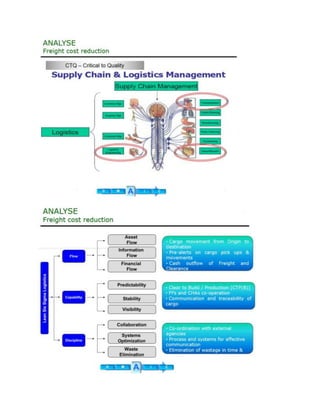
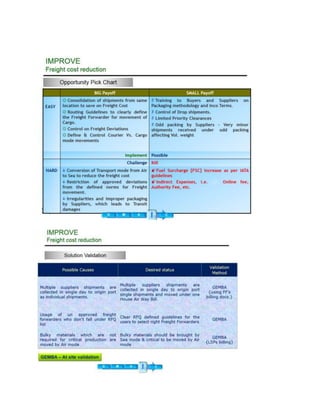
Freight cost reduction
A Six Sigma Project OF
By: Somesvar Veeramani
WHITE PAPER
EXECUTIVE SUMMARY
As a business executive of a manufacturing, distribution, or any company who ships freight, you
are often wondering ways on how to reduce freight costs. As your CFO or Financial Controller
may tell you, and your business experience, when it comes to freight costs, it's not only the hard
cost of shipping the freight, or the freight rate, but it's the whole picture you must take a look at.
Meaning, what are both the hard AND soft cost savings that you can realize when you are better
armed with the following top 6 of 11 considerations when processing freight shipments.
After extensive freight rate negotiations, we renegotiated the carrier contracts and achieved a
savings for the client. We also established standard operating procedures with the carriers to
assure that the client’s service quality requirements were fully understood and that the carriers
would meet them. These procedures included steps for the carriers to take to initiate remedial
action in the event pending service failures were identified in order to maintain high service
quality. Total freight savings exceeded $ 646,758 per year for the period project was done.
Project Summary
Freight spent on Imports Cargo is increasing amidst of overall increase in Fuel charges, Freight
Charges and Service Charges. It is very challenging to restrict and control the freight spent
against the Revenue and Receipts
Project Metrics
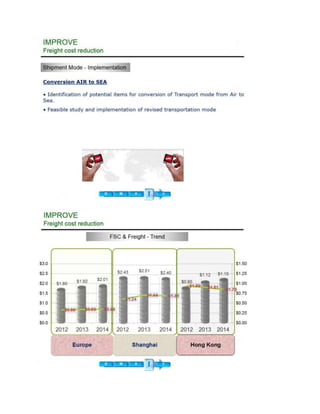
Control the per Kgs average spend and bring down Cost from US$ 2.9 to US$ 2.0 and Maintain
the per Kg average spend on Sea mode.
Problem Statement
Freight spent on Imports Cargo is increasing amidst of overall increase in Fuel charges, Freight Charges
and Service Charges. It is very challenging to restrict and control the freight spent against the Revenue
and Receipts.
Project Goal (Team Charter)
To reduce and control the inbound freight ratio and average spent from 2.9 to 2.0 US$/Kg.
Acknowledgements
This project was the result of the joint efforts put up by the team comprising the following:
 Neelavannan Natarajan - Logistics
 Ramesh Kumar Sampath - Logistics
 Balaji Ganesan - Logistics
 Puvannan Nandakumar - Purchase
 Ganesh Ramaiah - Purchase
 Radha Rajendran - Logistics
We acknowledge them individually for their contribution in making this project a great success.

Freight cost reduction

  • 1.
    Freight cost reduction ASix Sigma Project OF By: Somesvar Veeramani WHITE PAPER EXECUTIVE SUMMARY As a business executive of a manufacturing, distribution, or any company who ships freight, you are often wondering ways on how to reduce freight costs. As your CFO or Financial Controller may tell you, and your business experience, when it comes to freight costs, it's not only the hard cost of shipping the freight, or the freight rate, but it's the whole picture you must take a look at. Meaning, what are both the hard AND soft cost savings that you can realize when you are better armed with the following top 6 of 11 considerations when processing freight shipments. After extensive freight rate negotiations, we renegotiated the carrier contracts and achieved a savings for the client. We also established standard operating procedures with the carriers to assure that the client’s service quality requirements were fully understood and that the carriers would meet them. These procedures included steps for the carriers to take to initiate remedial action in the event pending service failures were identified in order to maintain high service quality. Total freight savings exceeded $ 646,758 per year for the period project was done. Project Summary Freight spent on Imports Cargo is increasing amidst of overall increase in Fuel charges, Freight Charges and Service Charges. It is very challenging to restrict and control the freight spent against the Revenue and Receipts Project Metrics Control the per Kgs average spend and bring down Cost from US$ 2.9 to US$ 2.0 and Maintain the per Kg average spend on Sea mode. Problem Statement Freight spent on Imports Cargo is increasing amidst of overall increase in Fuel charges, Freight Charges and Service Charges. It is very challenging to restrict and control the freight spent against the Revenue and Receipts. Project Goal (Team Charter) To reduce and control the inbound freight ratio and average spent from 2.9 to 2.0 US$/Kg.
  • 16.
    Acknowledgements This project wasthe result of the joint efforts put up by the team comprising the following:  Neelavannan Natarajan - Logistics  Ramesh Kumar Sampath - Logistics  Balaji Ganesan - Logistics  Puvannan Nandakumar - Purchase  Ganesh Ramaiah - Purchase  Radha Rajendran - Logistics We acknowledge them individually for their contribution in making this project a great success.