ASPEE COLLEGE OF HORTICULTURE
NAVSARI AGRICULTURAL UNIVERSITY
NAVSARI - 396 450
Course Title : Processing of Horticultural Produce
Course No. : PHM-507
Submitted To :-
Dr. A.K.Senapati
Assistant Professor
Department of Post Harvest Management
ACH, NAU, Navsari
Submitted By :-
Zala Harshvardhan Takhatsinh
1st Sem. M.Sc. (Horticulture)
Department of Post Harvest Management
ACH, NAU, Navsari
7/6/2023 1
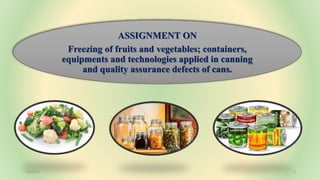
ASSIGNMENT ON
Freezing of fruits and vegetables; containers,
equipments and technologies applied in canning
and quality assurance defects of cans.
7/6/2023 2
CONTENTS
7/6/2023 3
Freezing of fruits and vegetables
• What is freezing ?
• Freezing is generally referred to as a unit operation in which the
temperature of food is reduced below freezing point and a proportion
of water undergoes a change in state to form ice-crystals.
7/6/2023 4
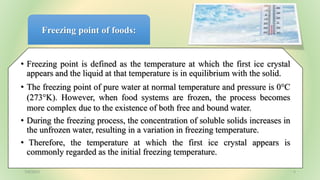
Freezing point of foods:
• Freezing point is defined as the temperature at which the first ice crystal
appears and the liquid at that temperature is in equilibrium with the solid.
• The freezing point of pure water at normal temperature and pressure is 0°C
(273°K). However, when food systems are frozen, the process becomes
more complex due to the existence of both free and bound water.
• During the freezing process, the concentration of soluble solids increases in
the unfrozen water, resulting in a variation in freezing temperature.
• Therefore, the temperature at which the first ice crystal appears is
commonly regarded as the initial freezing temperature.
7/6/2023 5
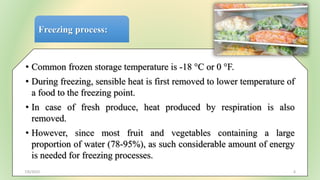
Freezing process:
• Common frozen storage temperature is -18 °C or 0 °F.
• During freezing, sensible heat is first removed to lower temperature of
a food to the freezing point.
• In case of fresh produce, heat produced by respiration is also
removed.
• However, since most fruit and vegetables containing a large
proportion of water (78-95%), as such considerable amount of energy
is needed for freezing processes.
7/6/2023 6
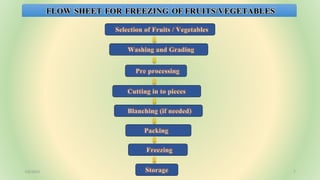
Selection of Fruits / Vegetables
Washing and Grading
Pre processing
Cutting in to pieces
Blanching (if needed)
Freezing
Storage
Packing
FLOW SHEET FOR FREEZING OF FRUITS/VEGETABLES
7/6/2023 7
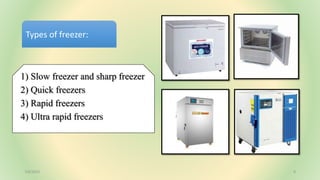
Types of freezer:
1) Slow freezer and sharp freezer
2) Quick freezers
3) Rapid freezers
4) Ultra rapid freezers
7/6/2023 8
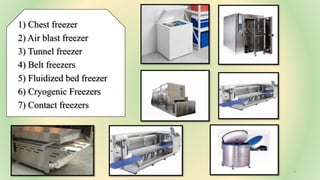
1) Chest freezer
2) Air blast freezer
3) Tunnel freezer
4) Belt freezers
5) Fluidized bed freezer
6) Cryogenic Freezers
7) Contact freezers
7/6/2023 9
Containers, Equipments And Technologies
applied in Canning
7/6/2023 10
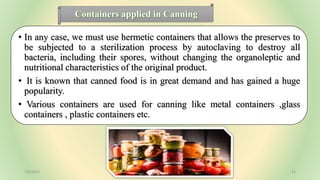
Containers applied in Canning
• In any case, we must use hermetic containers that allows the preserves to
be subjected to a sterilization process by autoclaving to destroy all
bacteria, including their spores, without changing the organoleptic and
nutritional characteristics of the original product.
• It is known that canned food is in great demand and has gained a huge
popularity.
• Various containers are used for canning like metal containers ,glass
containers , plastic containers etc.
7/6/2023 11
Glass containers:
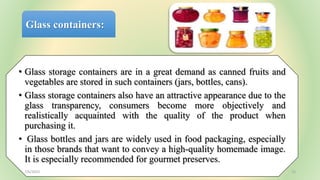
• Glass storage containers are in a great demand as canned fruits and
vegetables are stored in such containers (jars, bottles, cans).
• Glass storage containers also have an attractive appearance due to the
glass transparency, consumers become more objectively and
realistically acquainted with the quality of the product when
purchasing it.
• Glass bottles and jars are widely used in food packaging, especially
in those brands that want to convey a high-quality homemade image.
It is especially recommended for gourmet preserves.
7/6/2023 12
Types of glass containers:
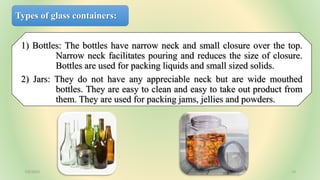
1) Bottles: The bottles have narrow neck and small closure over the top.
Narrow neck facilitates pouring and reduces the size of closure.
Bottles are used for packing liquids and small sized solids.
2) Jars: They do not have any appreciable neck but are wide mouthed
bottles. They are easy to clean and easy to take out product from
them. They are used for packing jams, jellies and powders.
7/6/2023 13
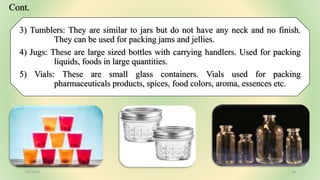
3) Tumblers: They are similar to jars but do not have any neck and no finish.
They can be used for packing jams and jellies.
4) Jugs: These are large sized bottles with carrying handlers. Used for packing
liquids, foods in large quantities.
5) Vials: These are small glass containers. Vials used for packing
pharmaceuticals products, spices, food colors, aroma, essences etc.
7/6/2023 14
Cont.
Advantage:
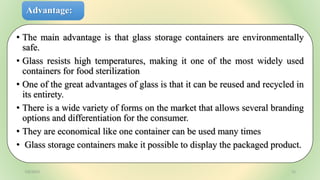
• The main advantage is that glass storage containers are environmentally
safe.
• Glass resists high temperatures, making it one of the most widely used
containers for food sterilization
• One of the great advantages of glass is that it can be reused and recycled in
its entirety.
• There is a wide variety of forms on the market that allows several branding
options and differentiation for the consumer.
• They are economical like one container can be used many times
• Glass storage containers make it possible to display the packaged product.
7/6/2023 15
Disadvantages:
• It is one of the most expensive materials. furthermore, as it is a heavy
product, its distribution becomes more expensive.
• It must be handled with care, as there is a risk of breakage.
• Printing is difficult or impossible, therefore promotional messages must
be made on labels.
• The material is transparent and allows light to pass through, which may
affect the preservation of some food products.
• In case of the glass container, not recycling correctly can be a problem
because nature will take years to decompose it.
7/6/2023 16
Metal Cans:
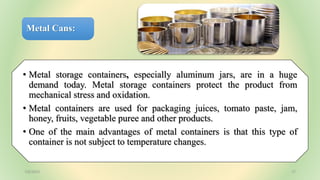
• Metal storage containers, especially aluminum jars, are in a huge
demand today. Metal storage containers protect the product from
mechanical stress and oxidation.
• Metal containers are used for packaging juices, tomato paste, jam,
honey, fruits, vegetable puree and other products.
• One of the main advantages of metal containers is that this type of
container is not subject to temperature changes.
7/6/2023 17
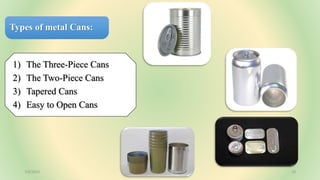
Types of metal Cans:
1) The Three-Piece Cans
2) The Two-Piece Cans
3) Tapered Cans
4) Easy to Open Cans
7/6/2023 18
Advantage:
• Canned foods are sealed and they are excellent to protect food against
ultraviolet light or oxygen.
• Currently, canned food has evolved and guarantees that food won’t be in
direct contact with the metal due to the coating of varnish with alimentary
grade that isolates the food. Furthermore, cans do not modify the taste,
quality and consistency of the food.
• They allow many screen printing options.
• The cans are 100% recyclable, so they help preserve the environment.
• High thermal conductivity, lightness, longevity, universality and long
storage period
7/6/2023 19
Disadvantages:
• Depending on the material, they can be susceptible to corrosion,
such as oxidation.
• The material is not transparent, so the consumer cannot appreciate
its content before purchasing the product, which sometimes can be
disadvantageous.
• Especially acidic food canned in aluminum containers may
experience flavor alteration, in which case the stored product may
acquire a characteristic metallic taste.
7/6/2023 20
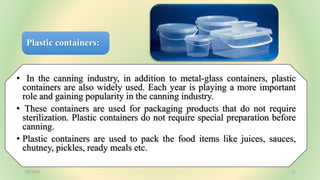
Plastic containers:
• In the canning industry, in addition to metal-glass containers, plastic
containers are also widely used. Each year is playing a more important
role and gaining popularity in the canning industry.
• These containers are used for packaging products that do not require
sterilization. Plastic containers do not require special preparation before
canning.
• Plastic containers are used to pack the food items like juices, sauces,
chutney, pickles, ready meals etc.
7/6/2023 21
Advantages:
• Helps to protect and preserve goods
• Reduced transportation weight
• Performance and energy
• Cheaper than glass
• Highly durable
• Lightness
• There are no design restrictions and limits.
• Easy utilization.
7/6/2023 22
Disadvantages:
• Poor longevity as plastic degrades over time
• Absorbs flavors and smells easily
• Large environmental and health impact
• Sometimes it melts when we fill hot products in it.
7/6/2023 23
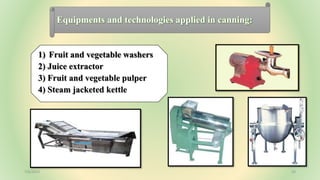
Equipments and technologies applied in canning:
1) Fruit and vegetable washers
2) Juice extractor
3) Fruit and vegetable pulper
4) Steam jacketed kettle
7/6/2023 24
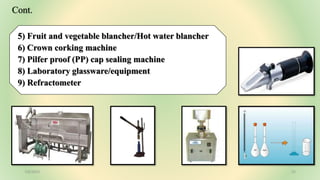
5) Fruit and vegetable blancher/Hot water blancher
6) Crown corking machine
7) Pilfer proof (PP) cap sealing machine
8) Laboratory glassware/equipment
9) Refractometer
7/6/2023 25
Cont.
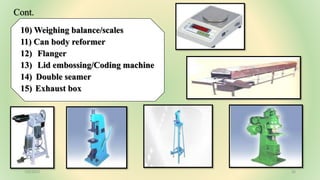
10) Weighing balance/scales
11) Can body reformer
12) Flanger
13) Lid embossing/Coding machine
14) Double seamer
15) Exhaust box
7/6/2023 26
Cont.
1. Flipper: A can with a mild positive pressure having both ends flat. One end of
this can will become convex when the side of the can is struck sharply or when the
temperature of the contents is increased.
2. Springer: It is the can with both ends bulged, but one or both ends will stay
concave. If swollen end of can is pushed in, an opposite flat end will pop out.
7/6/2023 27
Identification of spoilage on the basis of external appearance of cans:
Quality assurance defects of cans
3. Soft swell: It refers to a can with both ends bulged, but the gas pressure is low
enough to permit the ends to be dented by manual pressure.
4. Hard swell: The can with hard swell has both ends bulged. It contains such a
high gas pressure that neither end could be dented by hand. Often, the high gas
pressure distorts the ends or side seam of the cans and finally the can bursts from
side seam or through the seal at ends. The decomposed food in the can has an
offensive and sour odour and the product is generally discoloured. It is not fit for
consumption and may contain toxins produced by Clostridium botulinum.
7/6/2023 28
Cont.
5. Breather: A breather is a can with a minute leakage that permits air to
move in or out but does not necessarily allow micro-organisms to enter. In
these cans, the pressure inside the can is equal to that of the atmosphere. The
food remains fit for consumption.
6. Leaker: A very small leakage in the can may be due to faulty seam, or pin
hole as a result of corrosion inside the can or rusting of can from outside.
7. Flat sour: It may be caused by under-sterilization. The product has a sour
odour and its acidity is much greater than that of the normal product.
8. Bursting of can: Bursting of cans is due to excess of pressure caused by
the gases inside, produced by decomposition of food by micro-organisms, or
by hydrogen gas formed by chemical action of acids of the food on the
tinplate. The canned product becomes a total loss.
7/6/2023 29
Cont.
II. Identification of spoilage on the basis of appearance of glass containers:
• The glass containers like bottle, jar, etc. of food under gas pressure may have its
closure bulged or popped off or may show leakage of food through the broken
seal.
• The microbial growth can also be seen through the glass container in the form of
gas bubbles, cloudiness and films of growth.
7/6/2023 30
Causes of spoilage of canned/bottled products:
1. Chemical spoilage: Hydrogen swell is the important type of chemical
spoilage of canned food.
• Interaction between steel base of can and contents of the food leading to
chemical spoilage and may also cause following defects:
 discoloration of the food
 discoloration inside the can
 production of off flavour in the food
 cloudiness of liquors or syrups or brines
 corrosion or perforation of the metal and loss of nutritive quality.
7/6/2023 31
2. Biological spoilage: Biological spoilage in the canned food is caused by
either survival of organisms after heat treatment or entry of micro-organisms
through leakage of the container after heat processing.
A) Spoilage by mesophilic organisms: This type of spoilage is caused by
spore forming bacteria of genera Bacillus and Clostridium growing in the food
as a result of under processing. Besides, spoilage of lightly heated food like
acidic foods can also be caused by non-spore forming bacteria.
The mesophilic organisms responsible for spoilage are putrefactive anaerobes,
butyric anaerobes, flat sour and lactobacilli ,yeast etc.
7/6/2023 32
B) Spoilage by thermophilic organisms: Major cause of spoilage of heat
processed foods by thermophilic spore is due to under processing as their
spores are more heat resistant than those of mesophilic bacteria.
• Spoilage by thermophiles includes flat sour, TA spoilage and sulphide
spoilage.
i) Flat sour spoilage
ii) TA spoilage
iii) Sulphide spoilage
7/6/2023 33
C) Microbial spoilage on the basis of acidity:
• The low acid food with pH above 5.3 is subject to flat sour spoilage and
putrefaction.
• Medium acid foods with pH between 5.3 and 4.5 are likely to undergo TA
spoilage.
• Acid food with pH between 4.5 and 3.7 are spoiled by special flat sour
bacterium or by saccharolytic anaerobe.
• However, high acid food with a pH below 3.7 generally does not undergo
spoilage by bacteria, but in the cans it may result in hydrogen swell.
7/6/2023 34
7/6/2023 35

Freezing and Canning

  • 1.
    ASPEE COLLEGE OFHORTICULTURE NAVSARI AGRICULTURAL UNIVERSITY NAVSARI - 396 450 Course Title : Processing of Horticultural Produce Course No. : PHM-507 Submitted To :- Dr. A.K.Senapati Assistant Professor Department of Post Harvest Management ACH, NAU, Navsari Submitted By :- Zala Harshvardhan Takhatsinh 1st Sem. M.Sc. (Horticulture) Department of Post Harvest Management ACH, NAU, Navsari 7/6/2023 1
  • 2.
    ASSIGNMENT ON Freezing offruits and vegetables; containers, equipments and technologies applied in canning and quality assurance defects of cans. 7/6/2023 2
  • 3.
  • 4.
    Freezing of fruitsand vegetables • What is freezing ? • Freezing is generally referred to as a unit operation in which the temperature of food is reduced below freezing point and a proportion of water undergoes a change in state to form ice-crystals. 7/6/2023 4
  • 5.
    Freezing point offoods: • Freezing point is defined as the temperature at which the first ice crystal appears and the liquid at that temperature is in equilibrium with the solid. • The freezing point of pure water at normal temperature and pressure is 0°C (273°K). However, when food systems are frozen, the process becomes more complex due to the existence of both free and bound water. • During the freezing process, the concentration of soluble solids increases in the unfrozen water, resulting in a variation in freezing temperature. • Therefore, the temperature at which the first ice crystal appears is commonly regarded as the initial freezing temperature. 7/6/2023 5
  • 6.
    Freezing process: • Commonfrozen storage temperature is -18 °C or 0 °F. • During freezing, sensible heat is first removed to lower temperature of a food to the freezing point. • In case of fresh produce, heat produced by respiration is also removed. • However, since most fruit and vegetables containing a large proportion of water (78-95%), as such considerable amount of energy is needed for freezing processes. 7/6/2023 6
  • 7.
    Selection of Fruits/ Vegetables Washing and Grading Pre processing Cutting in to pieces Blanching (if needed) Freezing Storage Packing FLOW SHEET FOR FREEZING OF FRUITS/VEGETABLES 7/6/2023 7
  • 8.
    Types of freezer: 1)Slow freezer and sharp freezer 2) Quick freezers 3) Rapid freezers 4) Ultra rapid freezers 7/6/2023 8
  • 9.
    1) Chest freezer 2)Air blast freezer 3) Tunnel freezer 4) Belt freezers 5) Fluidized bed freezer 6) Cryogenic Freezers 7) Contact freezers 7/6/2023 9
  • 10.
    Containers, Equipments AndTechnologies applied in Canning 7/6/2023 10
  • 11.
    Containers applied inCanning • In any case, we must use hermetic containers that allows the preserves to be subjected to a sterilization process by autoclaving to destroy all bacteria, including their spores, without changing the organoleptic and nutritional characteristics of the original product. • It is known that canned food is in great demand and has gained a huge popularity. • Various containers are used for canning like metal containers ,glass containers , plastic containers etc. 7/6/2023 11
  • 12.
    Glass containers: • Glassstorage containers are in a great demand as canned fruits and vegetables are stored in such containers (jars, bottles, cans). • Glass storage containers also have an attractive appearance due to the glass transparency, consumers become more objectively and realistically acquainted with the quality of the product when purchasing it. • Glass bottles and jars are widely used in food packaging, especially in those brands that want to convey a high-quality homemade image. It is especially recommended for gourmet preserves. 7/6/2023 12
  • 13.
    Types of glasscontainers: 1) Bottles: The bottles have narrow neck and small closure over the top. Narrow neck facilitates pouring and reduces the size of closure. Bottles are used for packing liquids and small sized solids. 2) Jars: They do not have any appreciable neck but are wide mouthed bottles. They are easy to clean and easy to take out product from them. They are used for packing jams, jellies and powders. 7/6/2023 13
  • 14.
    3) Tumblers: Theyare similar to jars but do not have any neck and no finish. They can be used for packing jams and jellies. 4) Jugs: These are large sized bottles with carrying handlers. Used for packing liquids, foods in large quantities. 5) Vials: These are small glass containers. Vials used for packing pharmaceuticals products, spices, food colors, aroma, essences etc. 7/6/2023 14 Cont.
  • 15.
    Advantage: • The mainadvantage is that glass storage containers are environmentally safe. • Glass resists high temperatures, making it one of the most widely used containers for food sterilization • One of the great advantages of glass is that it can be reused and recycled in its entirety. • There is a wide variety of forms on the market that allows several branding options and differentiation for the consumer. • They are economical like one container can be used many times • Glass storage containers make it possible to display the packaged product. 7/6/2023 15
  • 16.
    Disadvantages: • It isone of the most expensive materials. furthermore, as it is a heavy product, its distribution becomes more expensive. • It must be handled with care, as there is a risk of breakage. • Printing is difficult or impossible, therefore promotional messages must be made on labels. • The material is transparent and allows light to pass through, which may affect the preservation of some food products. • In case of the glass container, not recycling correctly can be a problem because nature will take years to decompose it. 7/6/2023 16
  • 17.
    Metal Cans: • Metalstorage containers, especially aluminum jars, are in a huge demand today. Metal storage containers protect the product from mechanical stress and oxidation. • Metal containers are used for packaging juices, tomato paste, jam, honey, fruits, vegetable puree and other products. • One of the main advantages of metal containers is that this type of container is not subject to temperature changes. 7/6/2023 17
  • 18.
    Types of metalCans: 1) The Three-Piece Cans 2) The Two-Piece Cans 3) Tapered Cans 4) Easy to Open Cans 7/6/2023 18
  • 19.
    Advantage: • Canned foodsare sealed and they are excellent to protect food against ultraviolet light or oxygen. • Currently, canned food has evolved and guarantees that food won’t be in direct contact with the metal due to the coating of varnish with alimentary grade that isolates the food. Furthermore, cans do not modify the taste, quality and consistency of the food. • They allow many screen printing options. • The cans are 100% recyclable, so they help preserve the environment. • High thermal conductivity, lightness, longevity, universality and long storage period 7/6/2023 19
  • 20.
    Disadvantages: • Depending onthe material, they can be susceptible to corrosion, such as oxidation. • The material is not transparent, so the consumer cannot appreciate its content before purchasing the product, which sometimes can be disadvantageous. • Especially acidic food canned in aluminum containers may experience flavor alteration, in which case the stored product may acquire a characteristic metallic taste. 7/6/2023 20
  • 21.
    Plastic containers: • Inthe canning industry, in addition to metal-glass containers, plastic containers are also widely used. Each year is playing a more important role and gaining popularity in the canning industry. • These containers are used for packaging products that do not require sterilization. Plastic containers do not require special preparation before canning. • Plastic containers are used to pack the food items like juices, sauces, chutney, pickles, ready meals etc. 7/6/2023 21
  • 22.
    Advantages: • Helps toprotect and preserve goods • Reduced transportation weight • Performance and energy • Cheaper than glass • Highly durable • Lightness • There are no design restrictions and limits. • Easy utilization. 7/6/2023 22
  • 23.
    Disadvantages: • Poor longevityas plastic degrades over time • Absorbs flavors and smells easily • Large environmental and health impact • Sometimes it melts when we fill hot products in it. 7/6/2023 23
  • 24.
    Equipments and technologiesapplied in canning: 1) Fruit and vegetable washers 2) Juice extractor 3) Fruit and vegetable pulper 4) Steam jacketed kettle 7/6/2023 24
  • 25.
    5) Fruit andvegetable blancher/Hot water blancher 6) Crown corking machine 7) Pilfer proof (PP) cap sealing machine 8) Laboratory glassware/equipment 9) Refractometer 7/6/2023 25 Cont.
  • 26.
    10) Weighing balance/scales 11)Can body reformer 12) Flanger 13) Lid embossing/Coding machine 14) Double seamer 15) Exhaust box 7/6/2023 26 Cont.
  • 27.
    1. Flipper: Acan with a mild positive pressure having both ends flat. One end of this can will become convex when the side of the can is struck sharply or when the temperature of the contents is increased. 2. Springer: It is the can with both ends bulged, but one or both ends will stay concave. If swollen end of can is pushed in, an opposite flat end will pop out. 7/6/2023 27 Identification of spoilage on the basis of external appearance of cans: Quality assurance defects of cans
  • 28.
    3. Soft swell:It refers to a can with both ends bulged, but the gas pressure is low enough to permit the ends to be dented by manual pressure. 4. Hard swell: The can with hard swell has both ends bulged. It contains such a high gas pressure that neither end could be dented by hand. Often, the high gas pressure distorts the ends or side seam of the cans and finally the can bursts from side seam or through the seal at ends. The decomposed food in the can has an offensive and sour odour and the product is generally discoloured. It is not fit for consumption and may contain toxins produced by Clostridium botulinum. 7/6/2023 28 Cont.
  • 29.
    5. Breather: Abreather is a can with a minute leakage that permits air to move in or out but does not necessarily allow micro-organisms to enter. In these cans, the pressure inside the can is equal to that of the atmosphere. The food remains fit for consumption. 6. Leaker: A very small leakage in the can may be due to faulty seam, or pin hole as a result of corrosion inside the can or rusting of can from outside. 7. Flat sour: It may be caused by under-sterilization. The product has a sour odour and its acidity is much greater than that of the normal product. 8. Bursting of can: Bursting of cans is due to excess of pressure caused by the gases inside, produced by decomposition of food by micro-organisms, or by hydrogen gas formed by chemical action of acids of the food on the tinplate. The canned product becomes a total loss. 7/6/2023 29 Cont.
  • 30.
    II. Identification ofspoilage on the basis of appearance of glass containers: • The glass containers like bottle, jar, etc. of food under gas pressure may have its closure bulged or popped off or may show leakage of food through the broken seal. • The microbial growth can also be seen through the glass container in the form of gas bubbles, cloudiness and films of growth. 7/6/2023 30
  • 31.
    Causes of spoilageof canned/bottled products: 1. Chemical spoilage: Hydrogen swell is the important type of chemical spoilage of canned food. • Interaction between steel base of can and contents of the food leading to chemical spoilage and may also cause following defects:  discoloration of the food  discoloration inside the can  production of off flavour in the food  cloudiness of liquors or syrups or brines  corrosion or perforation of the metal and loss of nutritive quality. 7/6/2023 31
  • 32.
    2. Biological spoilage:Biological spoilage in the canned food is caused by either survival of organisms after heat treatment or entry of micro-organisms through leakage of the container after heat processing. A) Spoilage by mesophilic organisms: This type of spoilage is caused by spore forming bacteria of genera Bacillus and Clostridium growing in the food as a result of under processing. Besides, spoilage of lightly heated food like acidic foods can also be caused by non-spore forming bacteria. The mesophilic organisms responsible for spoilage are putrefactive anaerobes, butyric anaerobes, flat sour and lactobacilli ,yeast etc. 7/6/2023 32
  • 33.
    B) Spoilage bythermophilic organisms: Major cause of spoilage of heat processed foods by thermophilic spore is due to under processing as their spores are more heat resistant than those of mesophilic bacteria. • Spoilage by thermophiles includes flat sour, TA spoilage and sulphide spoilage. i) Flat sour spoilage ii) TA spoilage iii) Sulphide spoilage 7/6/2023 33
  • 34.
    C) Microbial spoilageon the basis of acidity: • The low acid food with pH above 5.3 is subject to flat sour spoilage and putrefaction. • Medium acid foods with pH between 5.3 and 4.5 are likely to undergo TA spoilage. • Acid food with pH between 4.5 and 3.7 are spoiled by special flat sour bacterium or by saccharolytic anaerobe. • However, high acid food with a pH below 3.7 generally does not undergo spoilage by bacteria, but in the cans it may result in hydrogen swell. 7/6/2023 34
  • 35.