INTRODUCTION TO THE
PHILOSOPHY OF THE
HUMAN PERSON
M R . E R R O L T. L A R I Z A
S u b j e c t Te a c h e r
WELCOME
TO THE INTRODUCTION TO THE PHILOSOPHY OF THE
HUMAN PERSON
•We are all together in this journey.
•To really understand this particular
subject, we always have to go back to
human experience.
How do you understand the
statement of Socrates when he
said that “the unexamined life is
not worth living.”?
• This is what doing philosophy is all about.
• We do not simply accept what has been handed on to us.
We ask questions why things, practices, tradition, beliefs,
presumptions, and even our prejudices are this way.
• We are invited to develop the Art of Questioning
introduced by Socrates which is called Elenchus.
• It is a continuous process of questioning and answering
until we arrive at the truth.
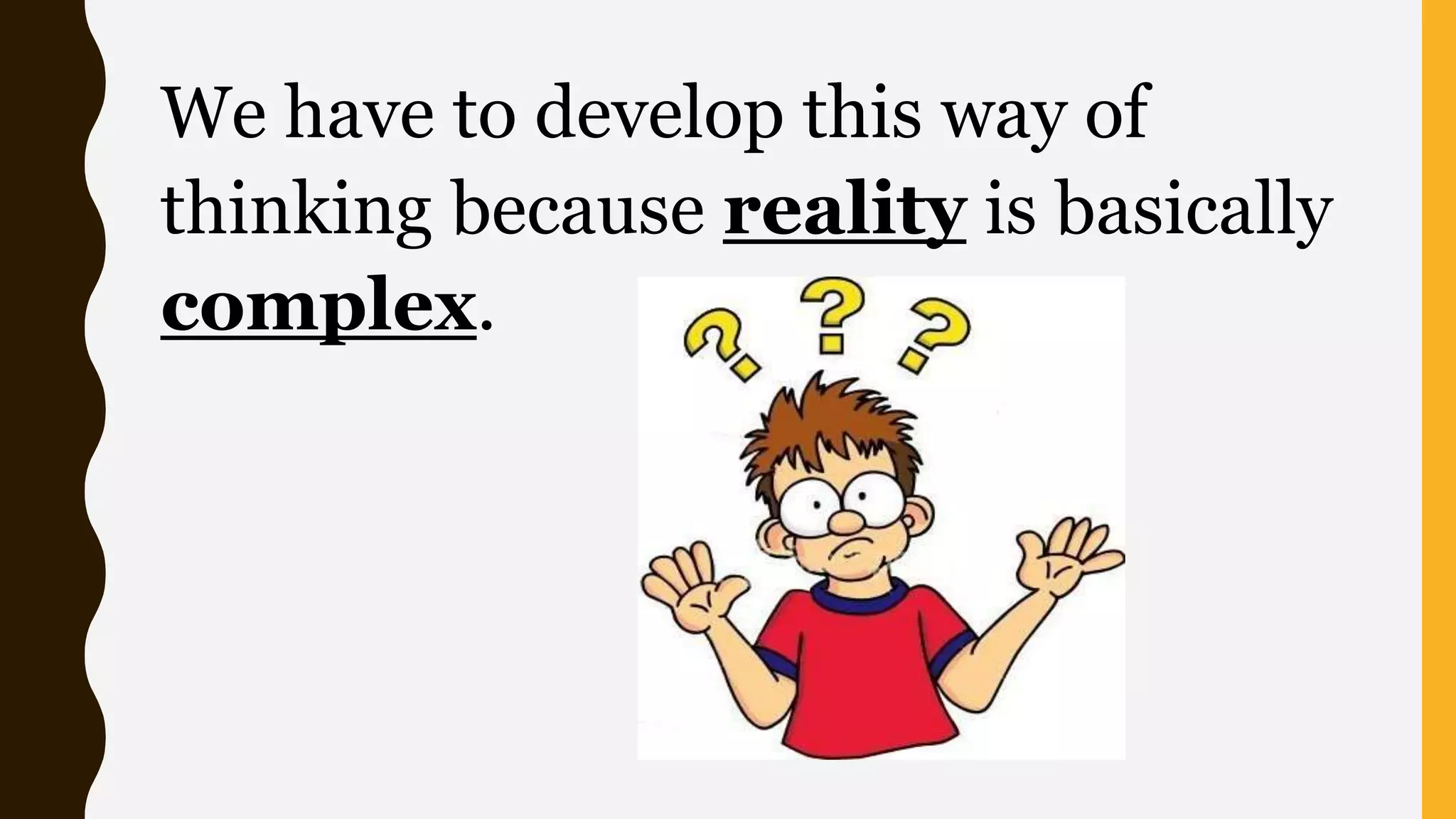
We have to develop this way of
thinking because reality is basically
complex.
Philosophy is not blind obedience.
•True learning is a dialogical process.
•It requires the attitude of open mindedness
and humility of heart.
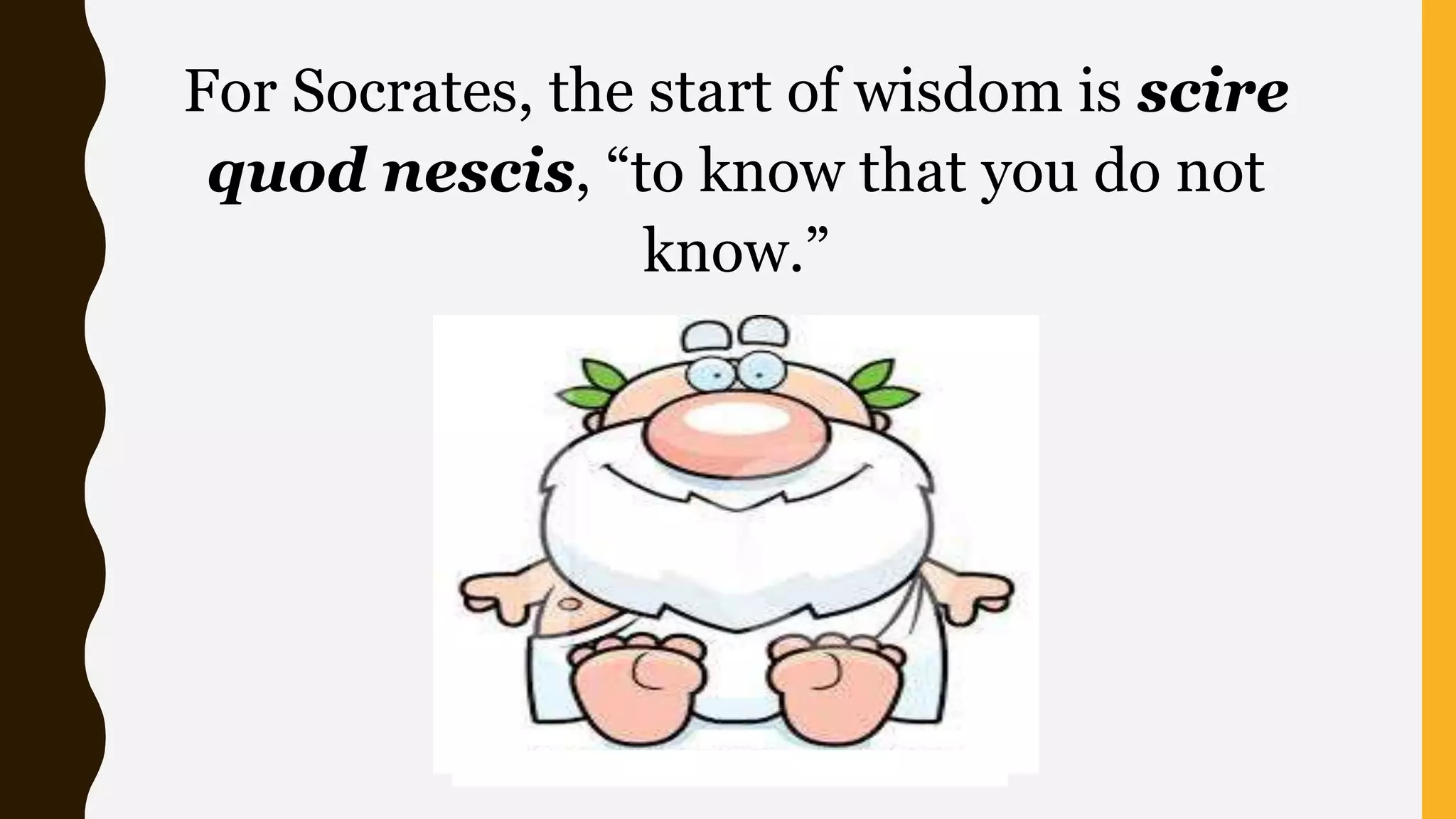
For Socrates, the start of wisdom is scire
quod nescis, “to know that you do not
know.”
LESSON 1
(DOING PHILOSOPHY)
SESSION 1
WHAT PHILOSOPHY IS
AND WHAT
PHILOSOPHY IS NOT?
MOTIVATIONAL VIDEO
ACTIVITY
Teacher: “Juan, what would you like to be when
you grow up?”
John: “Maam I want to be happy”
Teacher: “Juan you did not understand my
question.”
John: “Maam, you do not understand what is
life all about.”
GUIDE QUESTIONS:
1. Do you think that John answered his teacher’s question
correctly?
2. What do you think was John’s interpretation of his
teacher’s questions?
3. Based on his responses, what kind of student do you
imagine John to be?
4. If you were John’s teacher how would you respond to
him?
5. How is Philosophy related to this situation?
WHAT COMES TO YOUR
MINDS WHEN YOU
ENCOUNTER THE WORD
PHILOSOPHY?
GLOSSARY OF TERMS:
PHILOSOPHY
–Greek words: Philos (love) and Sophia
(Wisdom)
–Refer to “love of wisdom”
–A science or discipline which uses human
reason to investigate the ultimate causes,
reasons, and principles which govern all
things.
PHILOSOPHY COULD BE UNDERSTOOD
AS:
1.Philosophy as a path towards the
attainment of knowledge.
2.Philosophy as a path towards the
attainment of wisdom
1. PHILOSOPHY AS A PATH TOWARDS
THE ATTAINMENT OF KNOWLEDGE.
•Knowledge is a familiarity, awareness, or
understanding of someone or something,
such as facts, information, descriptions, or
skills, which is acquired through
experience or education by perceiving,
discovering, or learning.
PHILOSOPHY AS A PATH TOWARDS THE
ATTAINMENT OF KNOWLEDGE.
• Knowledge can refer to a theoretical or practical
understanding of a subject. It can be implicit (as
with practical skill or expertise) or explicit (as with
the theoretical understanding of a subject); it can be
more or less formal or systematic. In philosophy, the
study of knowledge is called epistemology; the
philosopher Plato famously defined knowledge as
"justified true belief",
PHILOSOPHY AS A PATH TOWARDS THE
ATTAINMENT OF KNOWLEDGE.
•Knowledge acquisition involves complex
cognitive processes: perception,
communication, and reasoning; while
knowledge is also said to be related to
the capacity of acknowledgement in
human beings.
2. PHILOSOPHY AS A PATH TOWARDS
THE ATTAINMENT OF WISDOM
•Descartes - “Through wisdom, we hear
not only prudence in business, but a
perfect knowledge of all things that man
can know, both the conduct of his life by
preserving his health and the invention of
all arts. ”
PHILOSOPHY AS A PATH TOWARDS THE
ATTAINMENT OF WISDOM
•Aristotle - “The wise man has the
knowledge of all things,
insofar as possible”
PHILOSOPHY AS A PATH TOWARDS THE
ATTAINMENT OF WISDOM
•Gide - “I do not think that the last word of
wisdom is to surrender to nature, and give
free rein to the instincts, but I think that
before seeking to reduce and tame, it is
important to understand – because many
of the disharmony that we suffer are only
apparent and due only to errors of
interpretation. ”
PHILOSOPHY AS A PATH TOWARDS THE
ATTAINMENT OF WISDOM
•Heraclitus - “Wisdom is one thing.
It is to know the thought by
which all things are led by all
things”
PHILOSOPHY AS A PATH TOWARDS THE
ATTAINMENT OF WISDOM
Summary
• Wisdom is knowledge of how to live
live well, and the disposition to act
appropriately on that knowledge.
What is the difference
between knowledge and
wisdom?
ANALOGY:
•Knowledge is knowing that tomato is
a fruit
•Wisdom is knowing not to put it in a
fruit salad
•Philosophy is asking if ketchup is a
fruit shake.
ACTIVITY
Relate the statements to your present
condition as SHS Learners preparing
for college:
1.“The unexamined life is not worth
living”
2.“He who has a way to live for can
bear with almost any how”.
END OF THE SESSION
SESSION 2
PHILOSOPHY AS A
CONCEPT AND AS A
PROCESS
PHILOSOPHY AS A CONCEPT
•Philosophy is a system of beliefs
about reality. It is one's integrated
view of the world. It includes an
understanding of the nature of
existence, man, and his role in the
world.
PHILOSOPHY AS A CONCEPT
It is a necessary product of man’s rational
mind.
I believe that the world is spherical.
I believe that the stars are millions of light
years away from the earth.
Based on mathematical judgment 1+1=2.
PHILOSOPHY AS A PROCESS
•Philosophy is employed as a
method of inquiry. It is an
engagement in the search
the meaning of life, its value
and relevance.
PHILOSOPHY AS A PROCESS
It is a process for finding significance in
existence.
1. The real essence of living is finding my
purpose.
2. Why is man subject to suffering?
3. As a person, how do I become active
member of the community?
4. What happens next?
ACTIVITY
Cite the difference between philosophy as concept
and philosophy as process.
PHILOSOPHY AS CONCEPT PHILOSOPHY AS PROCESS
1. 1.
2. 2.
Give the analogy of riding a
bicycle.
“Riding a bicycle is not about
knowing its parts but it is in
riding the bicycle itself.”
END OF SESSION 2
SESSION 3
Philosophy differs in
different eras in world
history
What wisdom can you get
from everyday objects like
Pencil/Eraser, Broom Stick,
Shoes?
DIFFERENT VIEWS OF PHILOSOPHERS
ABOUT THE NATURE AND MEANING OF
PHILOSOPHY:
Ancient Greeks:
• to have a good life/Origin
of the Universe
DIFFERENT VIEWS OF PHILOSOPHERS
ABOUT THE NATURE AND MEANING OF
PHILOSOPHY:
Heraclitus – logos. Everything changes.
Democritus – atoms.
Diogenes – you should not talk about
virtue but show it.
Socrates – Socratic Method.
DIFFERENT VIEWS OF PHILOSOPHERS
ABOUT THE NATURE AND MEANING OF
PHILOSOPHY:
Plato – Theory of forms
Aristotle – senses and
perception.
DIFFERENT VIEWS OF PHILOSOPHERS
ABOUT THE NATURE AND MEANING OF
PHILOSOPHY:
Medieval: to defend God
Agustine/Aquinas –
application of philosophy to
define and explain religious
concepts.
DIFFERENT VIEWS OF PHILOSOPHERS ABOUT
THE NATURE AND MEANING OF PHILOSOPHY:
WESTERN PHILOSOPHY
HISTORICAL
PERIOD
SCHOOL OF
THOUGHT
MAIN
FEATURES/BELIEFS
NOTABLE
PHILOSOPHERS
Renaissance )14th-
17th Centuries
Humanism
Emphasis on the
human person;
use of philosophy
to understand
society, nature,
and humanity
Petrarch
Desiderius
Erasmus
Niccolo
Machiavelli
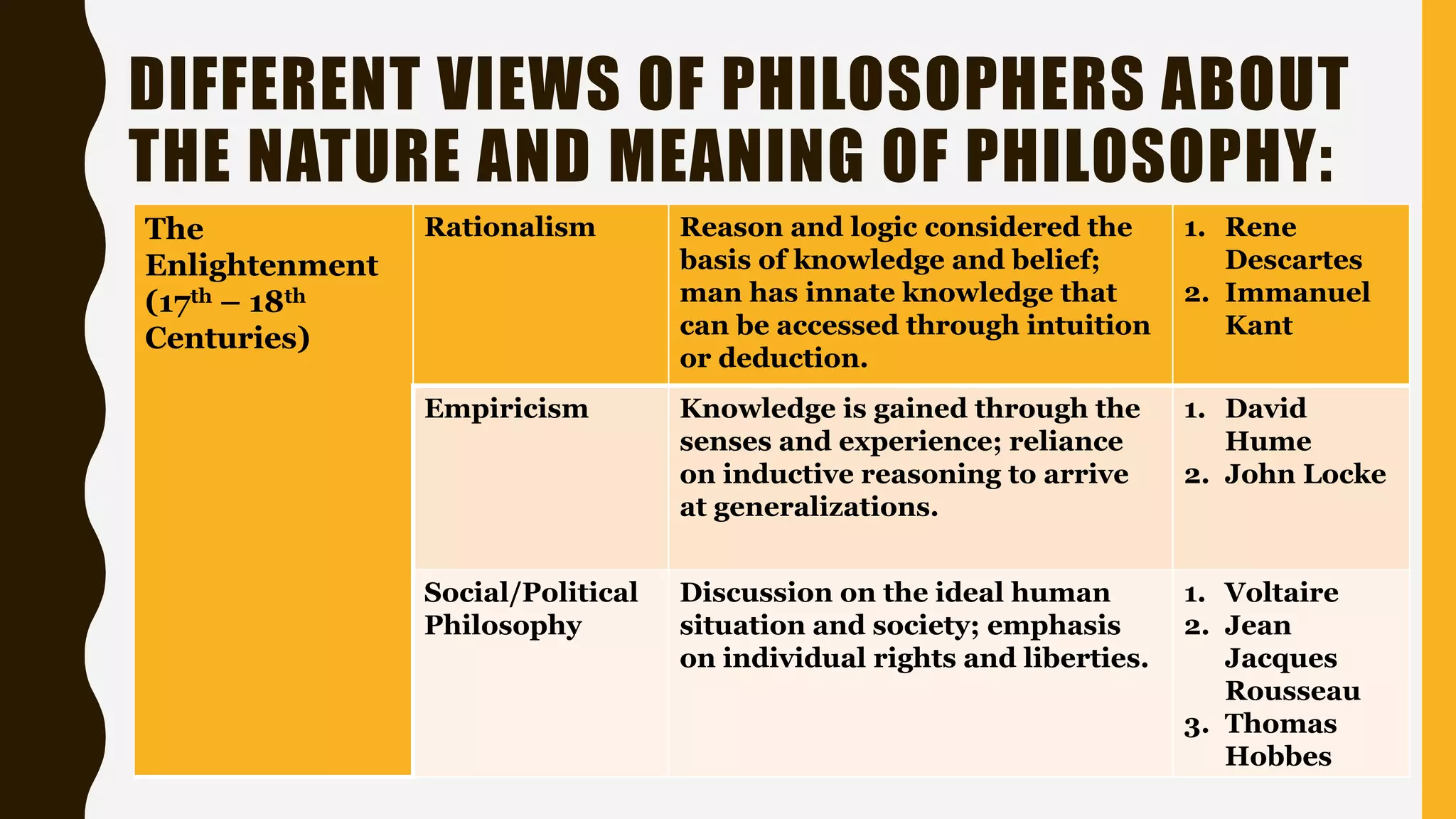
DIFFERENT VIEWS OF PHILOSOPHERS ABOUT
THE NATURE AND MEANING OF PHILOSOPHY:
The
Enlightenment
(17th – 18th
Centuries)
Rationalism Reason and logic considered the
basis of knowledge and belief;
man has innate knowledge that
can be accessed through intuition
or deduction.
1. Rene
Descartes
2. Immanuel
Kant
Empiricism Knowledge is gained through the
senses and experience; reliance
on inductive reasoning to arrive
at generalizations.
1. David
Hume
2. John Locke
Social/Political
Philosophy
Discussion on the ideal human
situation and society; emphasis
on individual rights and liberties.
1. Voltaire
2. Jean
Jacques
Rousseau
3. Thomas
Hobbes
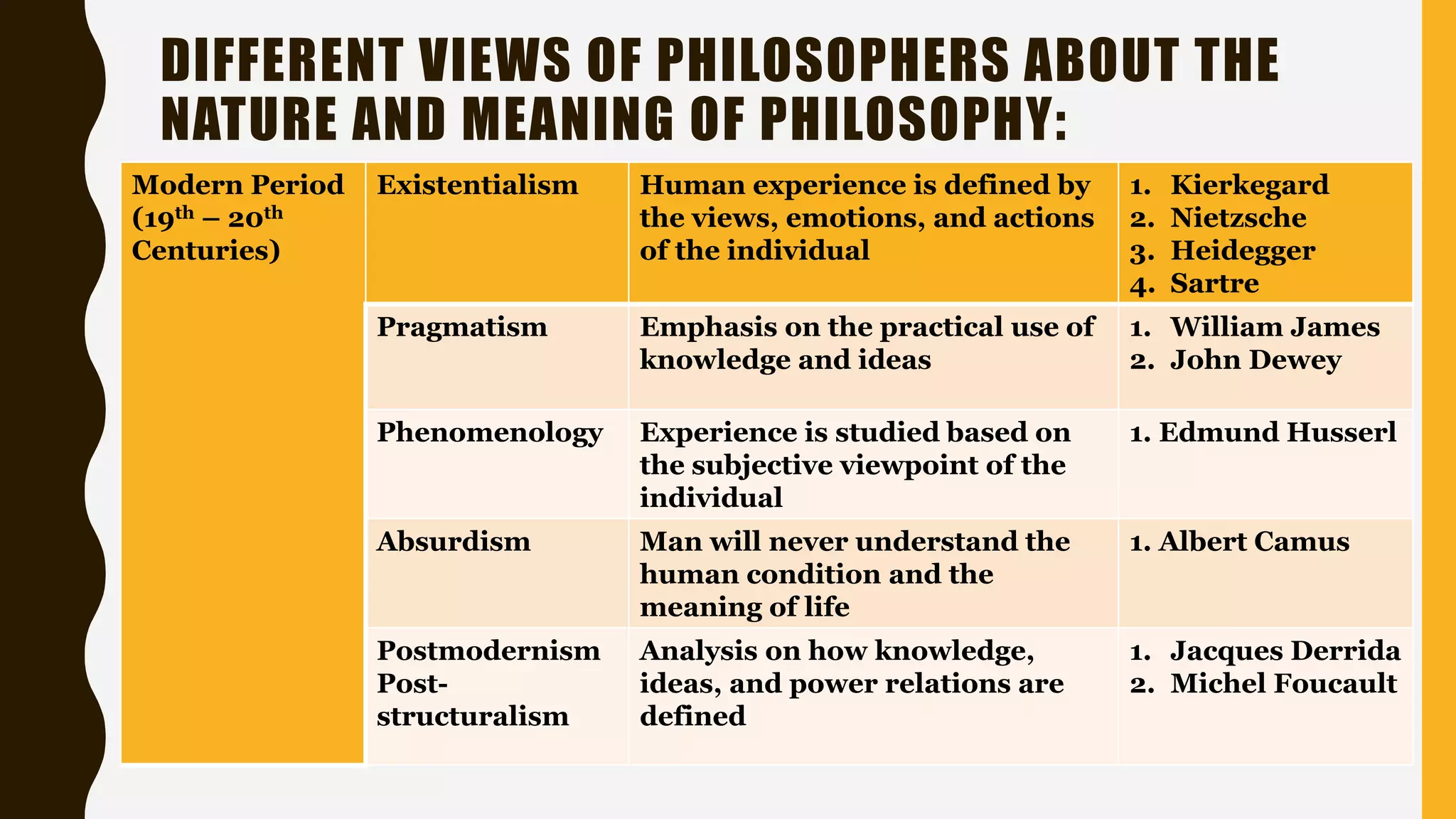
DIFFERENT VIEWS OF PHILOSOPHERS ABOUT THE
NATURE AND MEANING OF PHILOSOPHY:
Modern Period
(19th – 20th
Centuries)
Existentialism Human experience is defined by
the views, emotions, and actions
of the individual
1. Kierkegard
2. Nietzsche
3. Heidegger
4. Sartre
Pragmatism Emphasis on the practical use of
knowledge and ideas
1. William James
2. John Dewey
Phenomenology Experience is studied based on
the subjective viewpoint of the
individual
1. Edmund Husserl
Absurdism Man will never understand the
human condition and the
meaning of life
1. Albert Camus
Postmodernism
Post-
structuralism
Analysis on how knowledge,
ideas, and power relations are
defined
1. Jacques Derrida
2. Michel Foucault
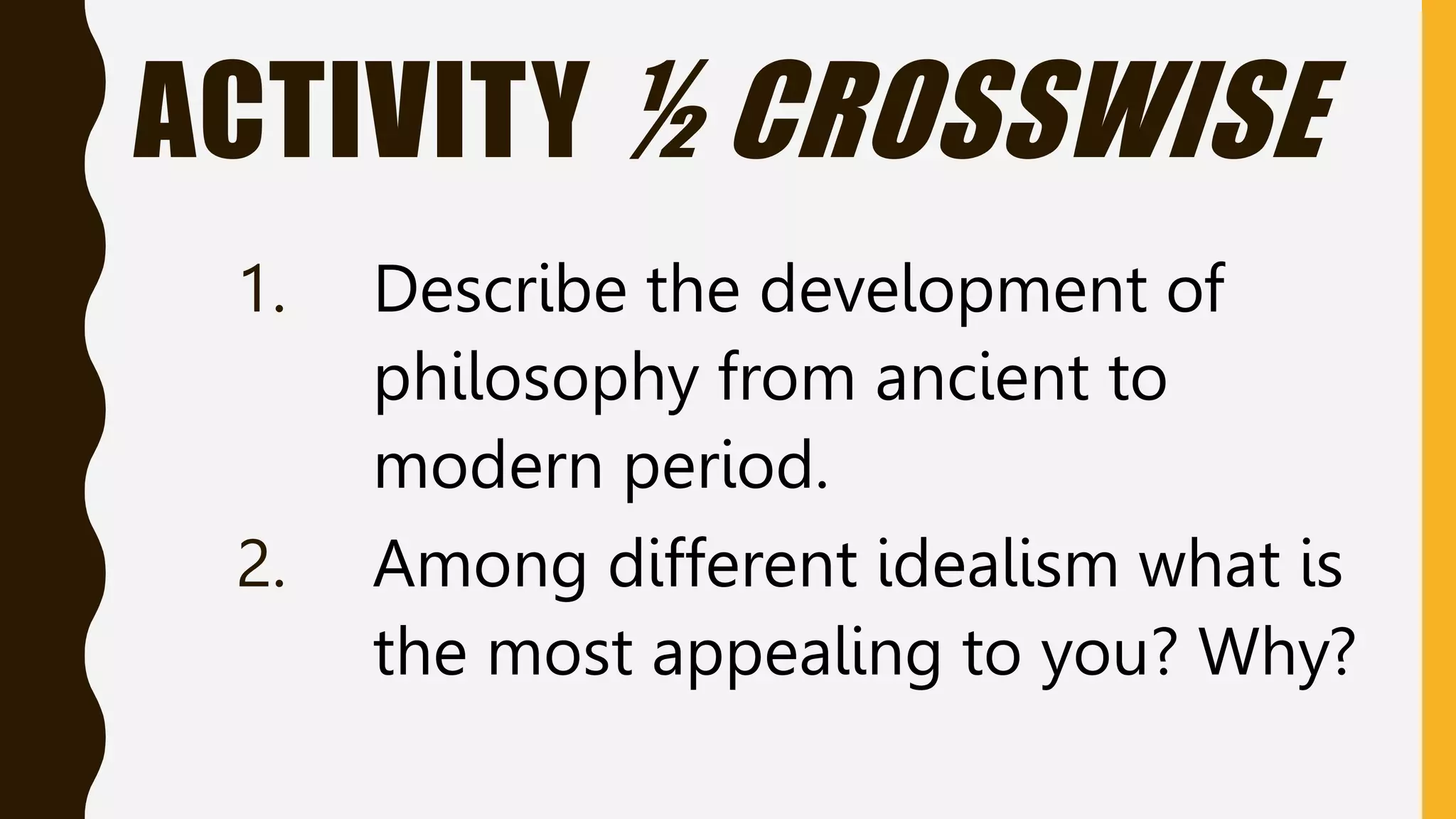
ACTIVITY ½ CROSSWISE
1. Describe the development of
philosophy from ancient to
modern period.
2. Among different idealism what is
the most appealing to you? Why?
Eastern Philosophy
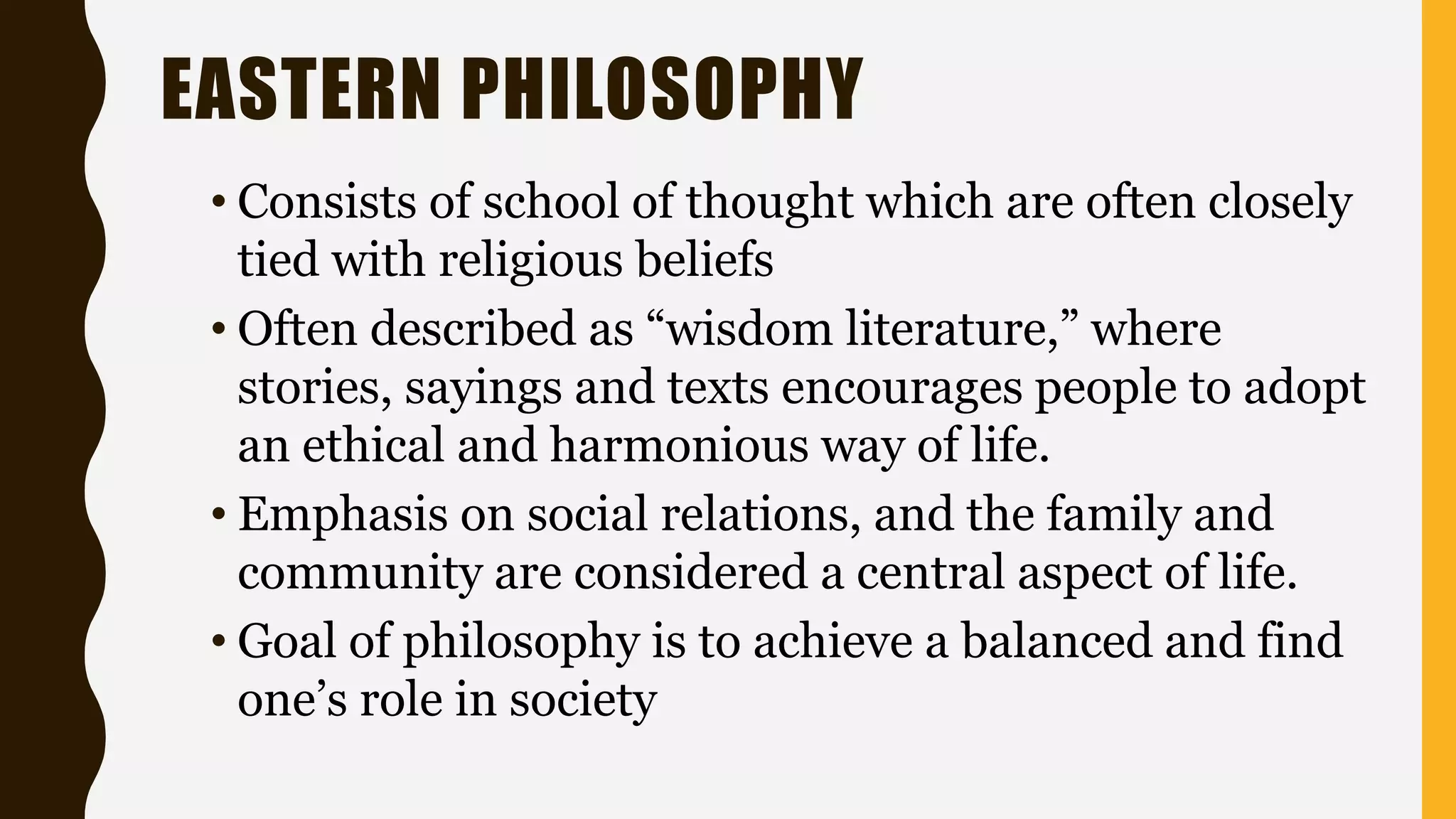
EASTERN PHILOSOPHY
• Consists of school of thought which are often closely
tied with religious beliefs
• Often described as “wisdom literature,” where
stories, sayings and texts encourages people to adopt
an ethical and harmonious way of life.
• Emphasis on social relations, and the family and
community are considered a central aspect of life.
• Goal of philosophy is to achieve a balanced and find
one’s role in society
EASTERN PHILOSOPHY
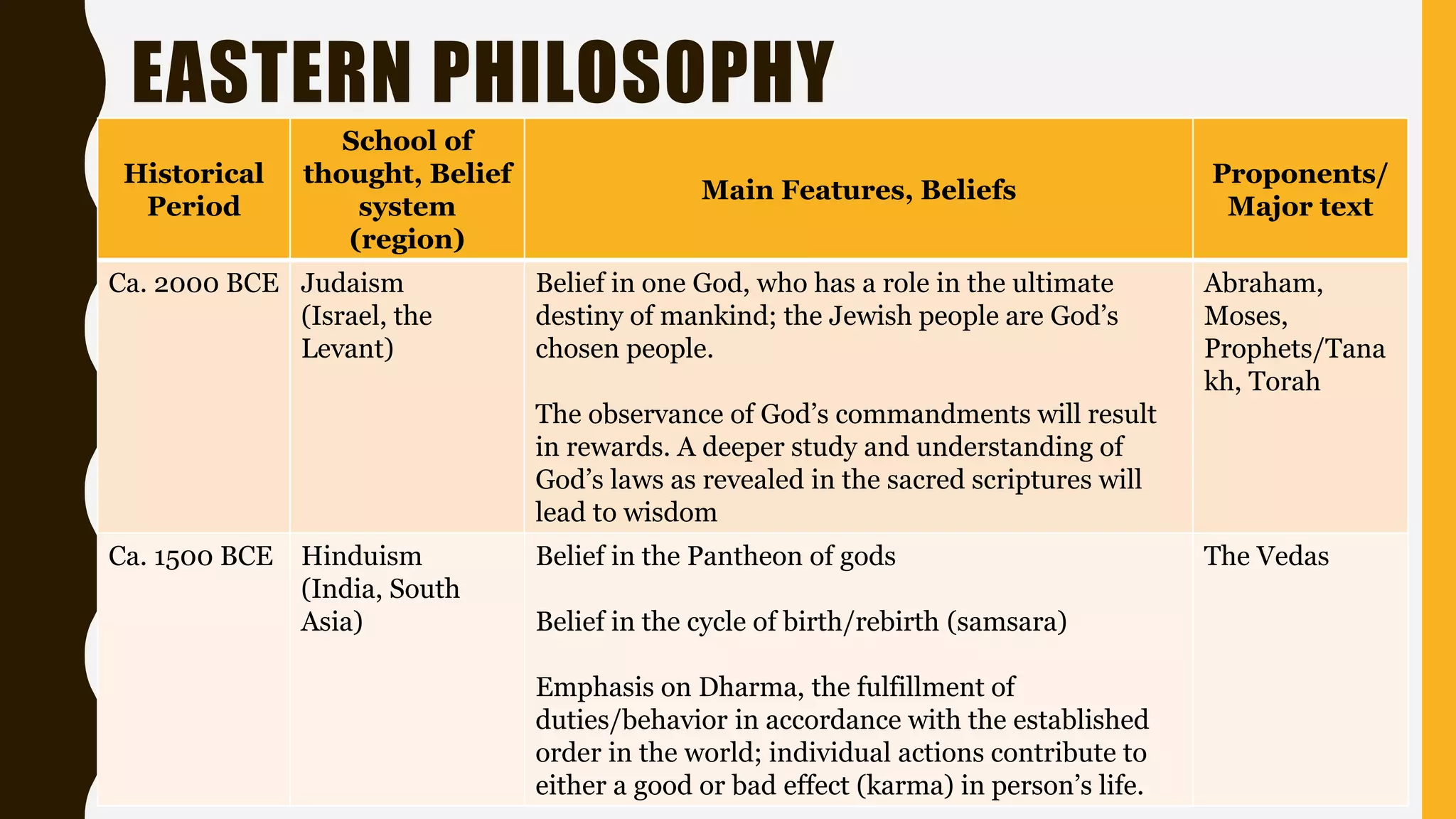
Historical
Period
School of
thought, Belief
system
(region)
Main Features, Beliefs
Proponents/
Major text
Ca. 2000 BCE Judaism
(Israel, the
Levant)
Belief in one God, who has a role in the ultimate
destiny of mankind; the Jewish people are God’s
chosen people.
The observance of God’s commandments will result
in rewards. A deeper study and understanding of
God’s laws as revealed in the sacred scriptures will
lead to wisdom
Abraham,
Moses,
Prophets/Tana
kh, Torah
Ca. 1500 BCE Hinduism
(India, South
Asia)
Belief in the Pantheon of gods
Belief in the cycle of birth/rebirth (samsara)
Emphasis on Dharma, the fulfillment of
duties/behavior in accordance with the established
order in the world; individual actions contribute to
either a good or bad effect (karma) in person’s life.
The Vedas
EASTERN PHILOSOPHY
Ca. 400
BCE
Buddhism
(South Asia,
East Asia,
Southeast
Asia)
Shares a number of main beliefs (samsara,
dharma, moksha) with Hinduism.
The Four Noble Truths describe the worldly
existence as imperfect and influenced by earthly
desires and suffering, (dukkha); to rid oneself of
desire and achieve liberation from suffering, one
must follow the Eight-Fold Path.
Divided into two major branches: Theravada and
Mahayana Buddhism
Siddharta
Gautama
(Buddha)
Tripitaka
Ca. 400
BCE
Confucianism
(East Asia)
The contemplation of the order of things can
lead to self-transformation. Self-transformation
can lead to the betterment of the family and
society
Human relations are based on mutual
obligations; individuals should perform their
intended roles and contribute to social order.
Confucius
The Five
Classics
EASTERN PHILOSOPHY
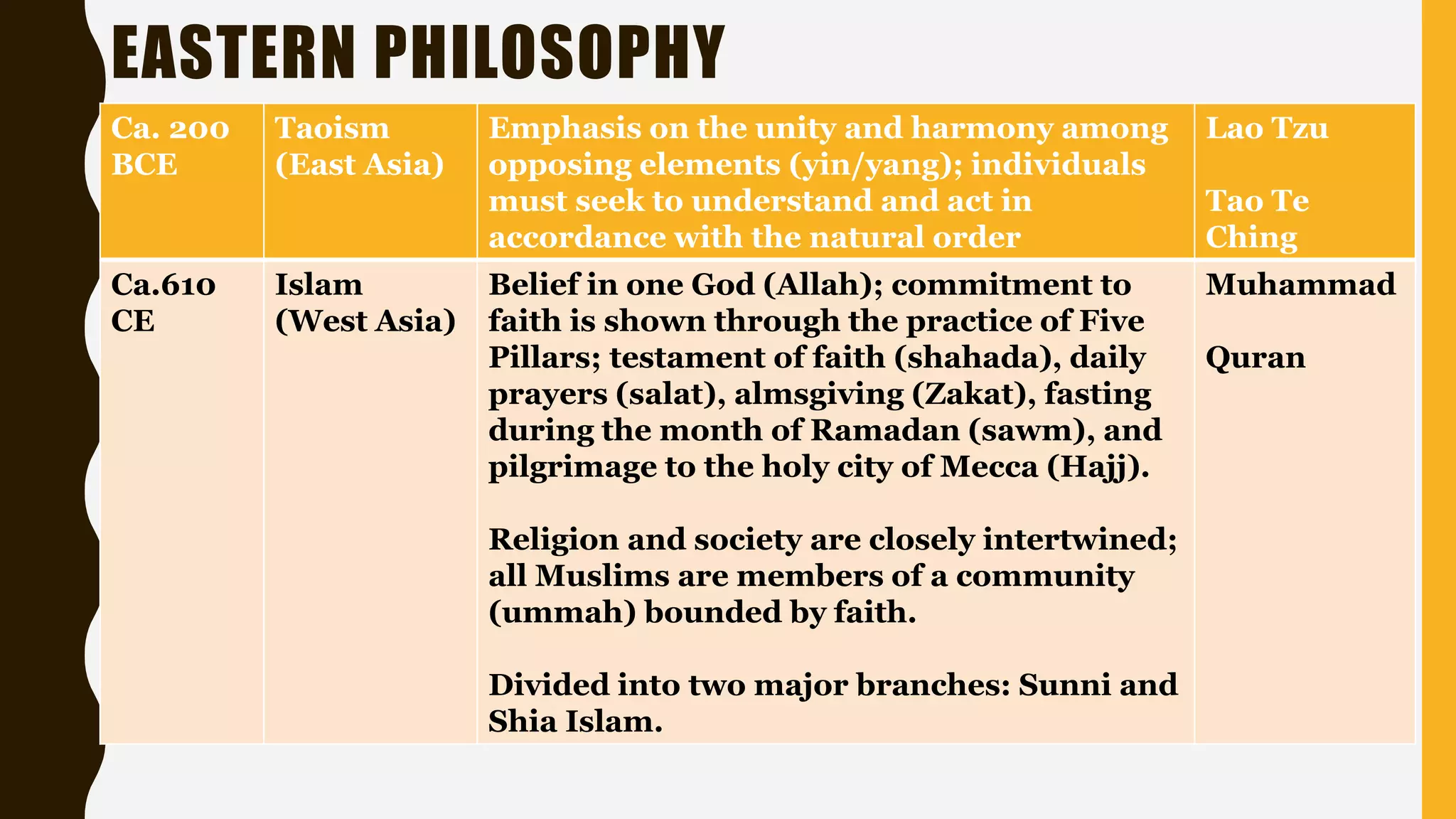
Ca. 200
BCE
Taoism
(East Asia)
Emphasis on the unity and harmony among
opposing elements (yin/yang); individuals
must seek to understand and act in
accordance with the natural order
Lao Tzu
Tao Te
Ching
Ca.610
CE
Islam
(West Asia)
Belief in one God (Allah); commitment to
faith is shown through the practice of Five
Pillars; testament of faith (shahada), daily
prayers (salat), almsgiving (Zakat), fasting
during the month of Ramadan (sawm), and
pilgrimage to the holy city of Mecca (Hajj).
Religion and society are closely intertwined;
all Muslims are members of a community
(ummah) bounded by faith.
Divided into two major branches: Sunni and
Shia Islam.
Muhammad
Quran
ACTIVITY
Compare and contrast aspects of Western and Eastern philosophy
using the Venn diagram. Discuss your work in your group.
WESTERN PHILOSOPHY EASTERN PHILOSOPHY
GUIDE QUESTION:
Which aspect or
characteristics distinguish
Eastern Philosophy from
Western Philosophy?
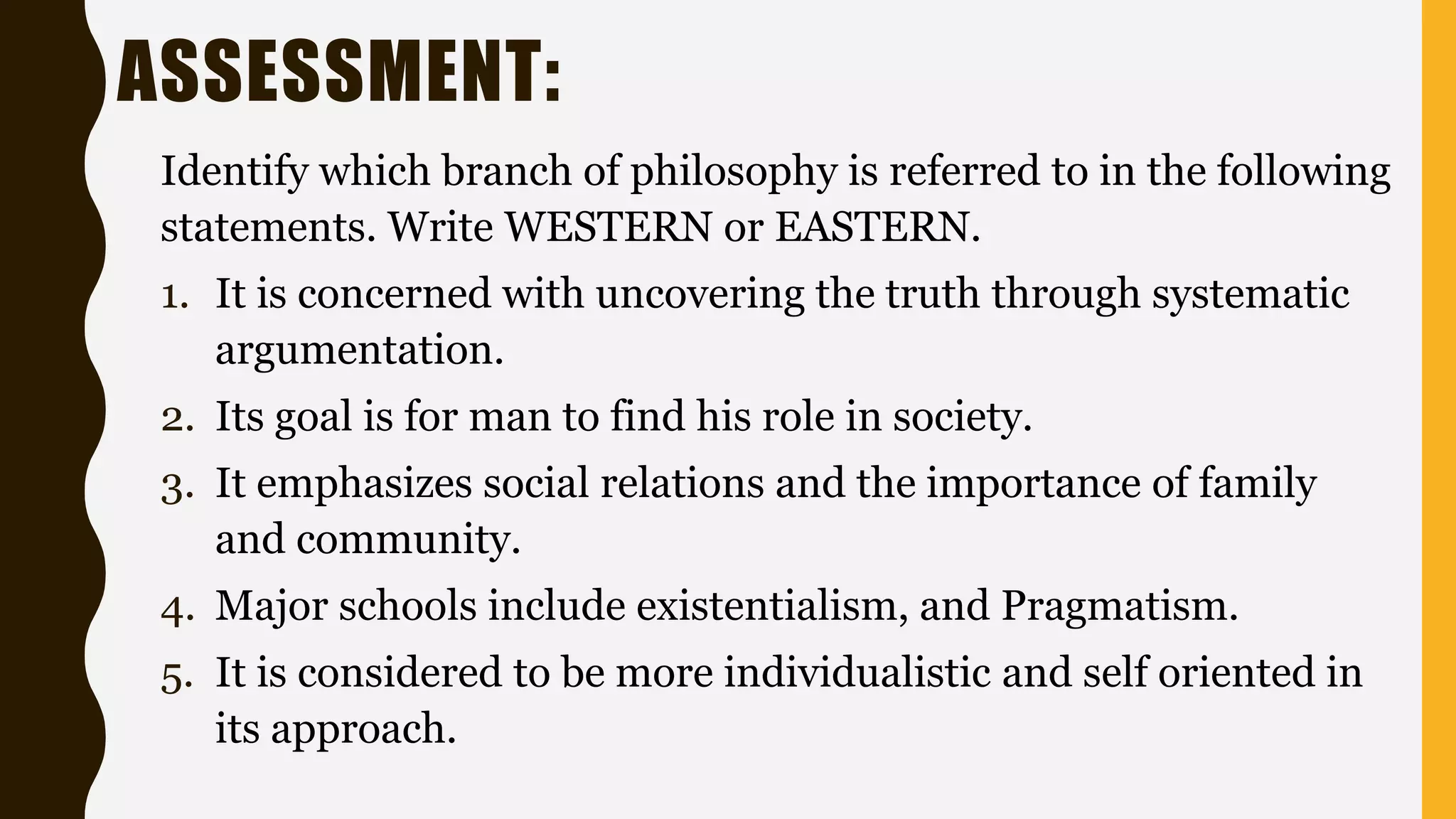
ASSESSMENT:
Identify which branch of philosophy is referred to in the following
statements. Write WESTERN or EASTERN.
1. It is concerned with uncovering the truth through systematic
argumentation.
2. Its goal is for man to find his role in society.
3. It emphasizes social relations and the importance of family
and community.
4. Major schools include existentialism, and Pragmatism.
5. It is considered to be more individualistic and self oriented in
its approach.
END OF THE SESSION
SESSION 4
HOW DO WE
CHARACTERIZE THE
STUDY OF
PHILOSOPHY?
ONE WAY OF LOOKING AT PHILOSOPHY
IS TO:
1.A way of analyzing frameworks.
Framework is defined as a way of
thinking about the world and is
composed of the views and beliefs of
a person.
ONE WAY OF LOOKING AT PHILOSOPHY
IS TO:
In analyzing frameworks we deal with
two types of questions:
1.Internal questions
Deals with our own correctness and values
Can be addressed using our own personal
frameworks.
ONE WAY OF LOOKING AT PHILOSOPHY
IS TO:
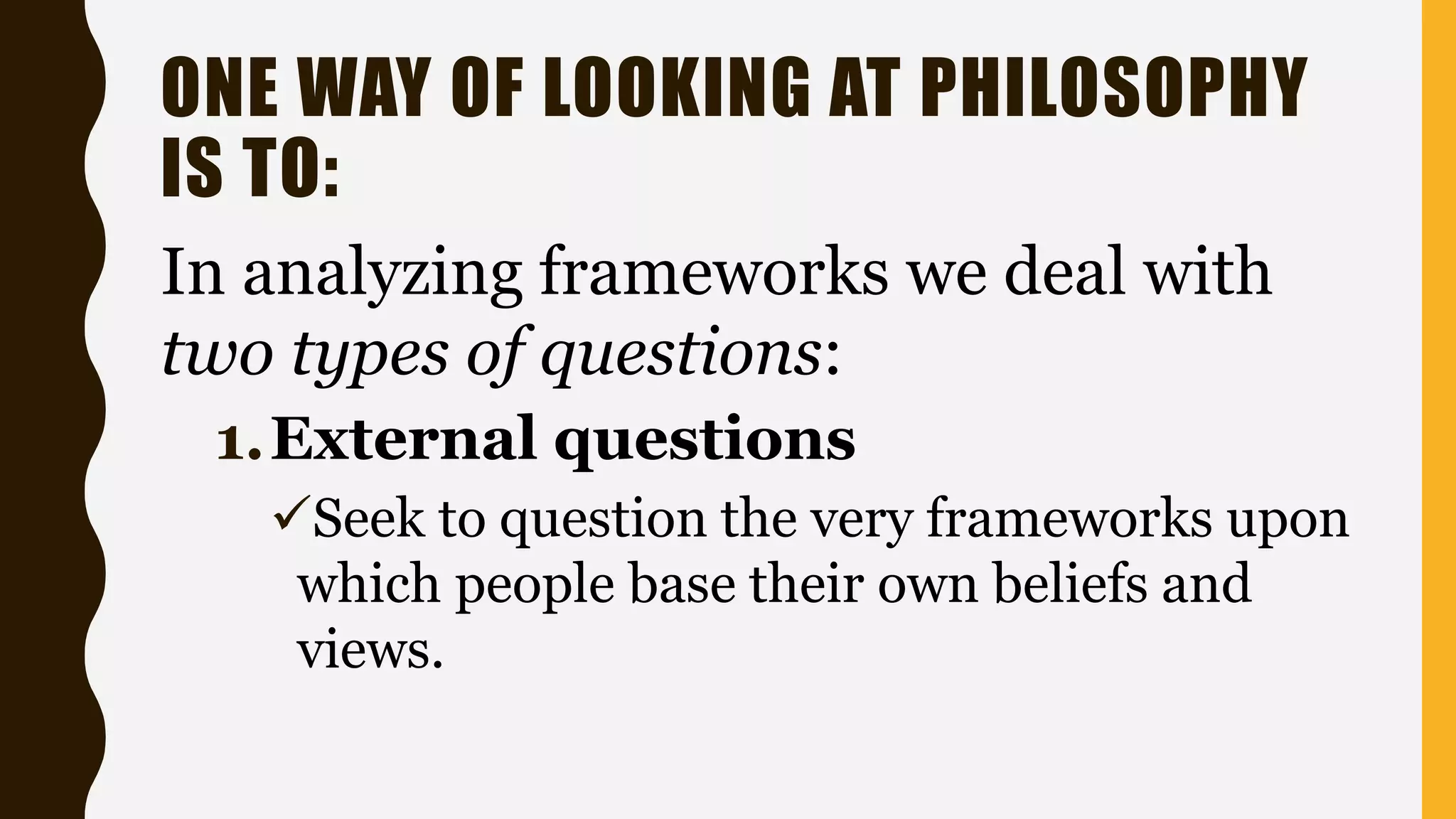
In analyzing frameworks we deal with
two types of questions:
1.External questions
Seek to question the very frameworks upon
which people base their own beliefs and
views.
ONE WAY OF LOOKING AT PHILOSOPHY
IS TO:
2. An examination of particular area of
knowledge
It goes hand-in-hand with other disciplines
in examining their fundamental purposes
and evaluating the changes they experience.
ONE WAY OF LOOKING AT PHILOSOPHY
IS TO:
3. A distinct area of knowledge with its own goals,
concerns, and ways of doing.
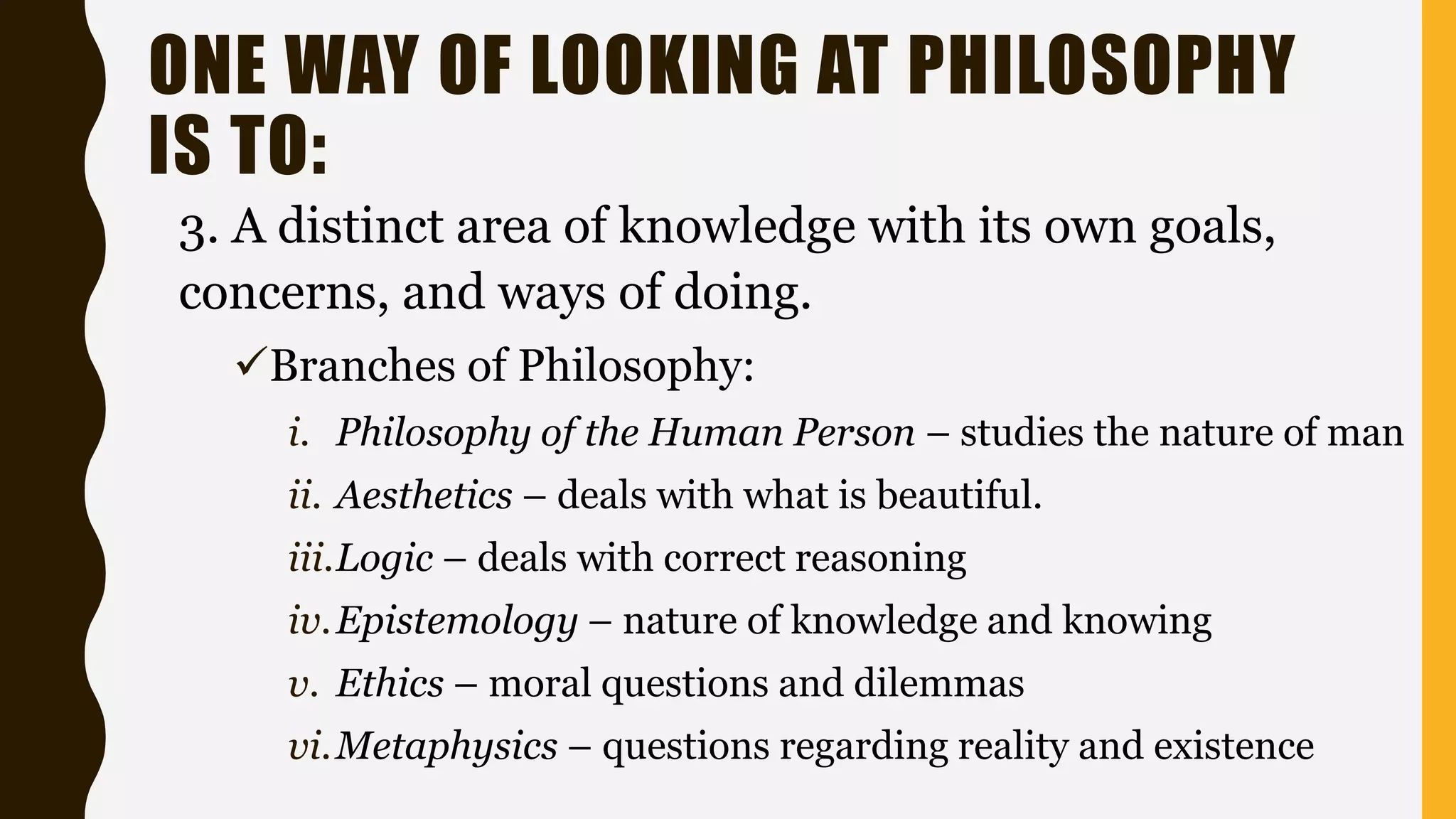
Branches of Philosophy:
i. Philosophy of the Human Person – studies the nature of man
ii. Aesthetics – deals with what is beautiful.
iii.Logic – deals with correct reasoning
iv.Epistemology – nature of knowledge and knowing
v. Ethics – moral questions and dilemmas
vi.Metaphysics – questions regarding reality and existence
TWO IMPORTANT FACTS ABOUT
PHILOSOPHIZING:
1.Philosophy is a reflective
and meditative activity
2.A method of mental exercise
WHY IS THERE A NEED FOR MAN TO
PHILOSOPHIZE?
A.SENSE OF WONDER
B.DOUBT
C.EXPERIENCE
D.LOVE OF WISDOM
“To love wisdom is to have
an insatiable desire for
Truth”
ACTIVITY
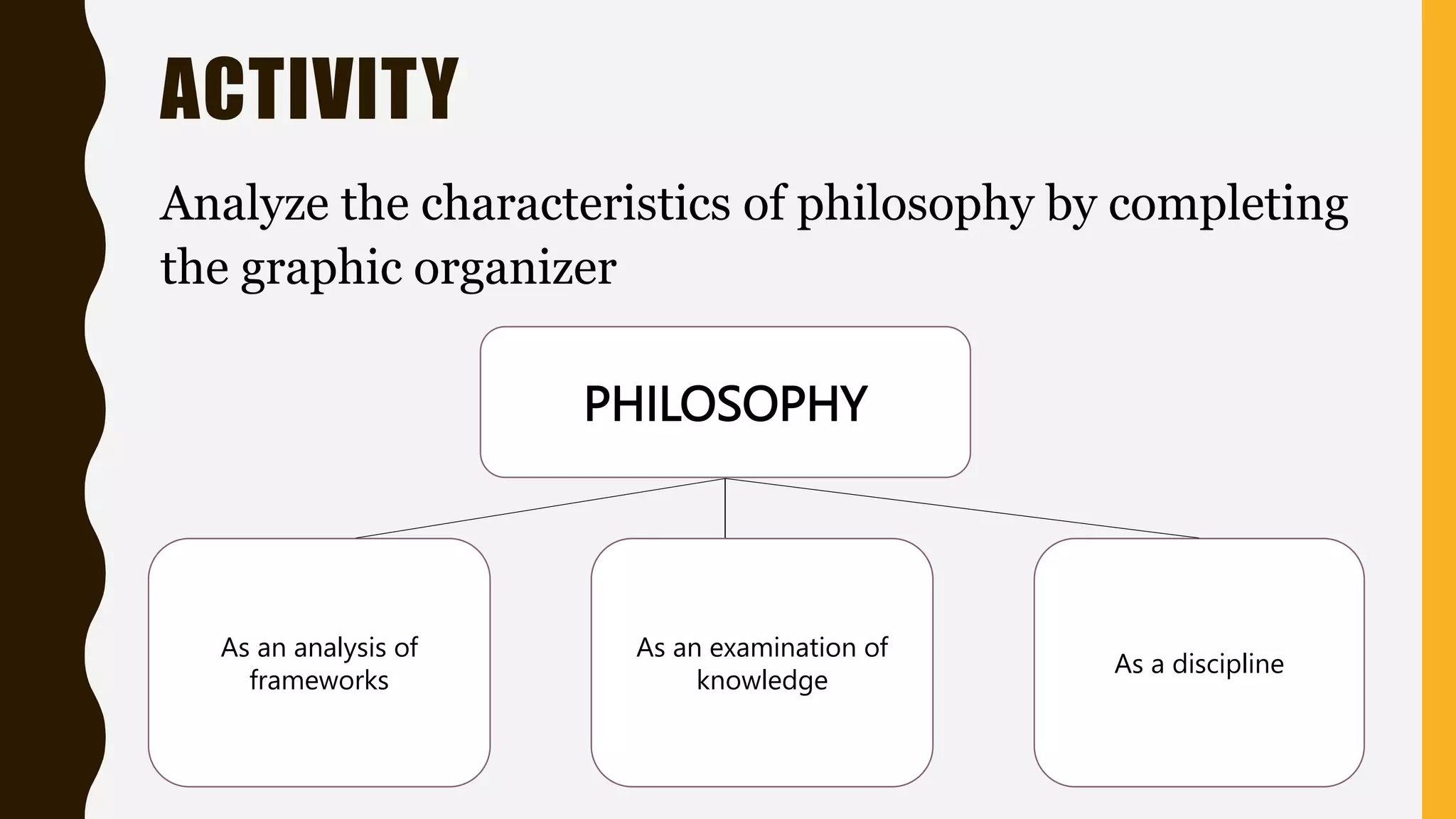
Analyze the characteristics of philosophy by completing
the graphic organizer
PHILOSOPHY
As an analysis of
frameworks
As an examination of
knowledge
As a discipline
REFLECTION:
Based on the characteristics of
philosophy, would it be possible for
any person to engage in
philosophical discussion? Why or
why not?
END OF THE LESSON

1 DOING PHILOSOPHY.pptx

  • 1.
    INTRODUCTION TO THE PHILOSOPHYOF THE HUMAN PERSON M R . E R R O L T. L A R I Z A S u b j e c t Te a c h e r
  • 2.
    WELCOME TO THE INTRODUCTIONTO THE PHILOSOPHY OF THE HUMAN PERSON •We are all together in this journey. •To really understand this particular subject, we always have to go back to human experience.
  • 3.
    How do youunderstand the statement of Socrates when he said that “the unexamined life is not worth living.”?
  • 4.
    • This iswhat doing philosophy is all about. • We do not simply accept what has been handed on to us. We ask questions why things, practices, tradition, beliefs, presumptions, and even our prejudices are this way. • We are invited to develop the Art of Questioning introduced by Socrates which is called Elenchus. • It is a continuous process of questioning and answering until we arrive at the truth.
  • 5.
    We have todevelop this way of thinking because reality is basically complex.
  • 6.
    Philosophy is notblind obedience.
  • 7.
    •True learning isa dialogical process. •It requires the attitude of open mindedness and humility of heart.
  • 8.
    For Socrates, thestart of wisdom is scire quod nescis, “to know that you do not know.”
  • 9.
  • 10.
    SESSION 1 WHAT PHILOSOPHYIS AND WHAT PHILOSOPHY IS NOT?
  • 11.
  • 12.
    ACTIVITY Teacher: “Juan, whatwould you like to be when you grow up?” John: “Maam I want to be happy” Teacher: “Juan you did not understand my question.” John: “Maam, you do not understand what is life all about.”
  • 13.
    GUIDE QUESTIONS: 1. Doyou think that John answered his teacher’s question correctly? 2. What do you think was John’s interpretation of his teacher’s questions? 3. Based on his responses, what kind of student do you imagine John to be? 4. If you were John’s teacher how would you respond to him? 5. How is Philosophy related to this situation?
  • 14.
    WHAT COMES TOYOUR MINDS WHEN YOU ENCOUNTER THE WORD PHILOSOPHY?
  • 15.
    GLOSSARY OF TERMS: PHILOSOPHY –Greekwords: Philos (love) and Sophia (Wisdom) –Refer to “love of wisdom” –A science or discipline which uses human reason to investigate the ultimate causes, reasons, and principles which govern all things.
  • 16.
    PHILOSOPHY COULD BEUNDERSTOOD AS: 1.Philosophy as a path towards the attainment of knowledge. 2.Philosophy as a path towards the attainment of wisdom
  • 17.
    1. PHILOSOPHY ASA PATH TOWARDS THE ATTAINMENT OF KNOWLEDGE. •Knowledge is a familiarity, awareness, or understanding of someone or something, such as facts, information, descriptions, or skills, which is acquired through experience or education by perceiving, discovering, or learning.
  • 18.
    PHILOSOPHY AS APATH TOWARDS THE ATTAINMENT OF KNOWLEDGE. • Knowledge can refer to a theoretical or practical understanding of a subject. It can be implicit (as with practical skill or expertise) or explicit (as with the theoretical understanding of a subject); it can be more or less formal or systematic. In philosophy, the study of knowledge is called epistemology; the philosopher Plato famously defined knowledge as "justified true belief",
  • 19.
    PHILOSOPHY AS APATH TOWARDS THE ATTAINMENT OF KNOWLEDGE. •Knowledge acquisition involves complex cognitive processes: perception, communication, and reasoning; while knowledge is also said to be related to the capacity of acknowledgement in human beings.
  • 20.
    2. PHILOSOPHY ASA PATH TOWARDS THE ATTAINMENT OF WISDOM •Descartes - “Through wisdom, we hear not only prudence in business, but a perfect knowledge of all things that man can know, both the conduct of his life by preserving his health and the invention of all arts. ”
  • 21.
    PHILOSOPHY AS APATH TOWARDS THE ATTAINMENT OF WISDOM •Aristotle - “The wise man has the knowledge of all things, insofar as possible”
  • 22.
    PHILOSOPHY AS APATH TOWARDS THE ATTAINMENT OF WISDOM •Gide - “I do not think that the last word of wisdom is to surrender to nature, and give free rein to the instincts, but I think that before seeking to reduce and tame, it is important to understand – because many of the disharmony that we suffer are only apparent and due only to errors of interpretation. ”
  • 23.
    PHILOSOPHY AS APATH TOWARDS THE ATTAINMENT OF WISDOM •Heraclitus - “Wisdom is one thing. It is to know the thought by which all things are led by all things”
  • 24.
    PHILOSOPHY AS APATH TOWARDS THE ATTAINMENT OF WISDOM Summary • Wisdom is knowledge of how to live live well, and the disposition to act appropriately on that knowledge.
  • 25.
    What is thedifference between knowledge and wisdom?
  • 26.
    ANALOGY: •Knowledge is knowingthat tomato is a fruit •Wisdom is knowing not to put it in a fruit salad •Philosophy is asking if ketchup is a fruit shake.
  • 27.
    ACTIVITY Relate the statementsto your present condition as SHS Learners preparing for college: 1.“The unexamined life is not worth living” 2.“He who has a way to live for can bear with almost any how”.
  • 28.
    END OF THESESSION
  • 29.
    SESSION 2 PHILOSOPHY ASA CONCEPT AND AS A PROCESS
  • 30.
    PHILOSOPHY AS ACONCEPT •Philosophy is a system of beliefs about reality. It is one's integrated view of the world. It includes an understanding of the nature of existence, man, and his role in the world.
  • 31.
    PHILOSOPHY AS ACONCEPT It is a necessary product of man’s rational mind. I believe that the world is spherical. I believe that the stars are millions of light years away from the earth. Based on mathematical judgment 1+1=2.
  • 32.
    PHILOSOPHY AS APROCESS •Philosophy is employed as a method of inquiry. It is an engagement in the search the meaning of life, its value and relevance.
  • 33.
    PHILOSOPHY AS APROCESS It is a process for finding significance in existence. 1. The real essence of living is finding my purpose. 2. Why is man subject to suffering? 3. As a person, how do I become active member of the community? 4. What happens next?
  • 34.
    ACTIVITY Cite the differencebetween philosophy as concept and philosophy as process. PHILOSOPHY AS CONCEPT PHILOSOPHY AS PROCESS 1. 1. 2. 2.
  • 35.
    Give the analogyof riding a bicycle. “Riding a bicycle is not about knowing its parts but it is in riding the bicycle itself.”
  • 36.
  • 37.
    SESSION 3 Philosophy differsin different eras in world history
  • 38.
    What wisdom canyou get from everyday objects like Pencil/Eraser, Broom Stick, Shoes?
  • 43.
    DIFFERENT VIEWS OFPHILOSOPHERS ABOUT THE NATURE AND MEANING OF PHILOSOPHY: Ancient Greeks: • to have a good life/Origin of the Universe
  • 44.
    DIFFERENT VIEWS OFPHILOSOPHERS ABOUT THE NATURE AND MEANING OF PHILOSOPHY: Heraclitus – logos. Everything changes. Democritus – atoms. Diogenes – you should not talk about virtue but show it. Socrates – Socratic Method.
  • 45.
    DIFFERENT VIEWS OFPHILOSOPHERS ABOUT THE NATURE AND MEANING OF PHILOSOPHY: Plato – Theory of forms Aristotle – senses and perception.
  • 46.
    DIFFERENT VIEWS OFPHILOSOPHERS ABOUT THE NATURE AND MEANING OF PHILOSOPHY: Medieval: to defend God Agustine/Aquinas – application of philosophy to define and explain religious concepts.
  • 47.
    DIFFERENT VIEWS OFPHILOSOPHERS ABOUT THE NATURE AND MEANING OF PHILOSOPHY: WESTERN PHILOSOPHY HISTORICAL PERIOD SCHOOL OF THOUGHT MAIN FEATURES/BELIEFS NOTABLE PHILOSOPHERS Renaissance )14th- 17th Centuries Humanism Emphasis on the human person; use of philosophy to understand society, nature, and humanity Petrarch Desiderius Erasmus Niccolo Machiavelli
  • 48.
    DIFFERENT VIEWS OFPHILOSOPHERS ABOUT THE NATURE AND MEANING OF PHILOSOPHY: The Enlightenment (17th – 18th Centuries) Rationalism Reason and logic considered the basis of knowledge and belief; man has innate knowledge that can be accessed through intuition or deduction. 1. Rene Descartes 2. Immanuel Kant Empiricism Knowledge is gained through the senses and experience; reliance on inductive reasoning to arrive at generalizations. 1. David Hume 2. John Locke Social/Political Philosophy Discussion on the ideal human situation and society; emphasis on individual rights and liberties. 1. Voltaire 2. Jean Jacques Rousseau 3. Thomas Hobbes
  • 49.
    DIFFERENT VIEWS OFPHILOSOPHERS ABOUT THE NATURE AND MEANING OF PHILOSOPHY: Modern Period (19th – 20th Centuries) Existentialism Human experience is defined by the views, emotions, and actions of the individual 1. Kierkegard 2. Nietzsche 3. Heidegger 4. Sartre Pragmatism Emphasis on the practical use of knowledge and ideas 1. William James 2. John Dewey Phenomenology Experience is studied based on the subjective viewpoint of the individual 1. Edmund Husserl Absurdism Man will never understand the human condition and the meaning of life 1. Albert Camus Postmodernism Post- structuralism Analysis on how knowledge, ideas, and power relations are defined 1. Jacques Derrida 2. Michel Foucault
  • 50.
    ACTIVITY ½ CROSSWISE 1.Describe the development of philosophy from ancient to modern period. 2. Among different idealism what is the most appealing to you? Why?
  • 51.
  • 52.
    EASTERN PHILOSOPHY • Consistsof school of thought which are often closely tied with religious beliefs • Often described as “wisdom literature,” where stories, sayings and texts encourages people to adopt an ethical and harmonious way of life. • Emphasis on social relations, and the family and community are considered a central aspect of life. • Goal of philosophy is to achieve a balanced and find one’s role in society
  • 53.
    EASTERN PHILOSOPHY Historical Period School of thought,Belief system (region) Main Features, Beliefs Proponents/ Major text Ca. 2000 BCE Judaism (Israel, the Levant) Belief in one God, who has a role in the ultimate destiny of mankind; the Jewish people are God’s chosen people. The observance of God’s commandments will result in rewards. A deeper study and understanding of God’s laws as revealed in the sacred scriptures will lead to wisdom Abraham, Moses, Prophets/Tana kh, Torah Ca. 1500 BCE Hinduism (India, South Asia) Belief in the Pantheon of gods Belief in the cycle of birth/rebirth (samsara) Emphasis on Dharma, the fulfillment of duties/behavior in accordance with the established order in the world; individual actions contribute to either a good or bad effect (karma) in person’s life. The Vedas
  • 54.
    EASTERN PHILOSOPHY Ca. 400 BCE Buddhism (SouthAsia, East Asia, Southeast Asia) Shares a number of main beliefs (samsara, dharma, moksha) with Hinduism. The Four Noble Truths describe the worldly existence as imperfect and influenced by earthly desires and suffering, (dukkha); to rid oneself of desire and achieve liberation from suffering, one must follow the Eight-Fold Path. Divided into two major branches: Theravada and Mahayana Buddhism Siddharta Gautama (Buddha) Tripitaka Ca. 400 BCE Confucianism (East Asia) The contemplation of the order of things can lead to self-transformation. Self-transformation can lead to the betterment of the family and society Human relations are based on mutual obligations; individuals should perform their intended roles and contribute to social order. Confucius The Five Classics
  • 55.
    EASTERN PHILOSOPHY Ca. 200 BCE Taoism (EastAsia) Emphasis on the unity and harmony among opposing elements (yin/yang); individuals must seek to understand and act in accordance with the natural order Lao Tzu Tao Te Ching Ca.610 CE Islam (West Asia) Belief in one God (Allah); commitment to faith is shown through the practice of Five Pillars; testament of faith (shahada), daily prayers (salat), almsgiving (Zakat), fasting during the month of Ramadan (sawm), and pilgrimage to the holy city of Mecca (Hajj). Religion and society are closely intertwined; all Muslims are members of a community (ummah) bounded by faith. Divided into two major branches: Sunni and Shia Islam. Muhammad Quran
  • 56.
    ACTIVITY Compare and contrastaspects of Western and Eastern philosophy using the Venn diagram. Discuss your work in your group. WESTERN PHILOSOPHY EASTERN PHILOSOPHY
  • 57.
    GUIDE QUESTION: Which aspector characteristics distinguish Eastern Philosophy from Western Philosophy?
  • 58.
    ASSESSMENT: Identify which branchof philosophy is referred to in the following statements. Write WESTERN or EASTERN. 1. It is concerned with uncovering the truth through systematic argumentation. 2. Its goal is for man to find his role in society. 3. It emphasizes social relations and the importance of family and community. 4. Major schools include existentialism, and Pragmatism. 5. It is considered to be more individualistic and self oriented in its approach.
  • 59.
    END OF THESESSION
  • 60.
    SESSION 4 HOW DOWE CHARACTERIZE THE STUDY OF PHILOSOPHY?
  • 61.
    ONE WAY OFLOOKING AT PHILOSOPHY IS TO: 1.A way of analyzing frameworks. Framework is defined as a way of thinking about the world and is composed of the views and beliefs of a person.
  • 62.
    ONE WAY OFLOOKING AT PHILOSOPHY IS TO: In analyzing frameworks we deal with two types of questions: 1.Internal questions Deals with our own correctness and values Can be addressed using our own personal frameworks.
  • 63.
    ONE WAY OFLOOKING AT PHILOSOPHY IS TO: In analyzing frameworks we deal with two types of questions: 1.External questions Seek to question the very frameworks upon which people base their own beliefs and views.
  • 64.
    ONE WAY OFLOOKING AT PHILOSOPHY IS TO: 2. An examination of particular area of knowledge It goes hand-in-hand with other disciplines in examining their fundamental purposes and evaluating the changes they experience.
  • 65.
    ONE WAY OFLOOKING AT PHILOSOPHY IS TO: 3. A distinct area of knowledge with its own goals, concerns, and ways of doing. Branches of Philosophy: i. Philosophy of the Human Person – studies the nature of man ii. Aesthetics – deals with what is beautiful. iii.Logic – deals with correct reasoning iv.Epistemology – nature of knowledge and knowing v. Ethics – moral questions and dilemmas vi.Metaphysics – questions regarding reality and existence
  • 66.
    TWO IMPORTANT FACTSABOUT PHILOSOPHIZING: 1.Philosophy is a reflective and meditative activity 2.A method of mental exercise
  • 67.
    WHY IS THEREA NEED FOR MAN TO PHILOSOPHIZE? A.SENSE OF WONDER B.DOUBT C.EXPERIENCE D.LOVE OF WISDOM
  • 68.
    “To love wisdomis to have an insatiable desire for Truth”
  • 69.
    ACTIVITY Analyze the characteristicsof philosophy by completing the graphic organizer PHILOSOPHY As an analysis of frameworks As an examination of knowledge As a discipline
  • 70.
    REFLECTION: Based on thecharacteristics of philosophy, would it be possible for any person to engage in philosophical discussion? Why or why not?
  • 71.
    END OF THELESSON

Editor's Notes

  • #4 TO become fully human is to use our highly developed faculty of thought to raise our existence above that of mere beasts. Living a life where your live under rules of others without examining what you actually want out of it. Examining our lives gives us a sense of meaning, clarity, peace, freedom…
  • #5 Why do we need to develop this kind of thinking?
  • #8 Dialogical = building understanding/deepening insight through questioning and dialogue
  • #9 To know, you need to strip off all your biases. You need to acknowledge that you are ignorant You cannot fill a cup unless its empty Scire Te Ipsum = Know Yourself.
  • #14 Philosophy is not about the fulfillment of our Goals It is not about accomplishing our dreams. It is not about being successful But philosophy is realizing our very existence…it is about understanding the meaning of our existence. The moment you understand what life is, that is everything.
  • #19 Theoretical – relating to the general principles Implicit – understood though not clearly stated Explicit – very clear
  • #20 Cognitive – involves thinking/mental
  • #21 Prudence – careful good judgement
  • #22 You are a master of yourself
  • #23 Wisdom is understanding the meaning of life.
  • #24 When you are able acquire wisdom it will guide towards the attainment of your goal.
  • #30 Concept – something conceived in the mind; an idea Process – it must not remain as an idea but must have result; there should be a change that will happen.