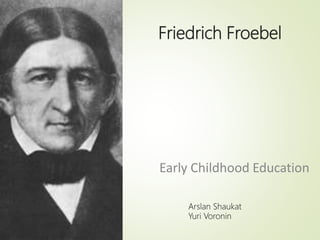
Friedrich Froebel
Early Childhood Education
Arslan Shaukat
Yuri Voronin
Introductio
n
Born on April 21, 1782 in Weinmar, Germany.
Studied Mathematics and Languages.
Taught at progressive model school in Frankfurt that was advocated
by the Swiss Educator Johann Heinrich Pestalozzi.
Attended University of Gӧttingen
Opened his own school at Griesheim in Thuringia in 1816.
Contributions and Ideas
DEVELOPED THE
KINDERGARTEN SYSTEM
THAT FOCUSED ON
PLAY WITH USE OF PLAY
MATERIALS AND
ACTIVITIES.
HE BELIEVED HIGHLY IN
‘UNITY.’
PUBLISHED A
COLLECTION OF
MOTHER-PLAY AND
NURSERY SCHOOL
SONGS. 1843
THE EDUCATION OF
MAN (1826)-
Kindergarten
First
Kindergarten
opened on
June 28, 1840.
The Kindergarten
name, indicates a
garden for
children and a
garden of
children.
Three parts of
Kindergarten-Toys for play
-Games and
dancing for healthy
activity
-Growing and
observing plants in
a garden to
stimulate
awareness of
natural world.
System of
categories and
series of gifts.
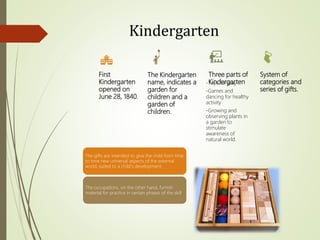
The gifts are intended to give the child from time
to time new universal aspects of the external
world, suited to a child's development.
The occupations, on the other hand, furnish
material for practice in certain phases of the skill
Effects on Education
He developed the idea of early education for kids in the course of 20 years
between 1830 till 1852.
Occupations-games and free self-activity, creativity, social participation, motor
expression.
Theory that self-activity and play are essential factors in child education.
In 1851 Prussia(Germany) Kindergarten was banned because of anti-liberal
views of government.
Quotes
“Play is the highest expression of
human development in childhood for
it alone is the free expression of what
is in a child's soul.”
“Play is the highest level of child
development . It gives joy, freedom,
contentment, inner and outer rest,
peace with the world The plays of
childhood are the germinal leaves of
all later life.”
“Children are like tiny flowers; they are
varied and need care, but each is
beautiful alone and glorious when
seen in the community of peers.”
Kindergarten idea spreads
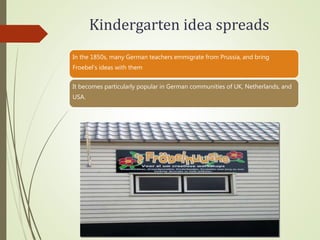
In the 1850s, many German teachers emmigrate from Prussia, and bring
Froebel's ideas with them
It becomes particularly popular in German communities of UK, Netherlands, and
USA.
Elizabeth Peabody & Milton Bradley
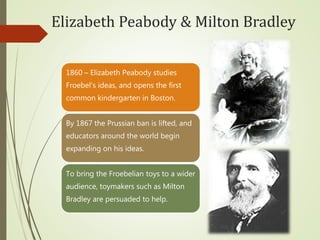
1860 – Elizabeth Peabody studies
Froebel's ideas, and opens the first
common kindergarten in Boston.
By 1867 the Prussian ban is lifted, and
educators around the world begin
expanding on his ideas.
To bring the Froebelian toys to a wider
audience, toymakers such as Milton
Bradley are persuaded to help.
The pushback
However, many were concerned about the prescribed nature of play in
Froebel's system, and call for more creativity in childrens' education
This happens to align with the manufacturers' desire to expand the line
of the “gifts”
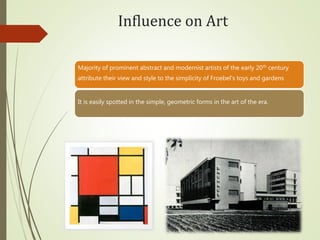
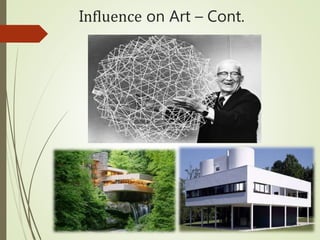
Influence on Art
Majority of prominent abstract and modernist artists of the early 20th
century
attribute their view and style to the simplicity of Froebel's toys and gardens
It is easily spotted in the simple, geometric forms in the art of the era.
Influence on Art – Cont.
...What happened?
The structured and planned nature of play was criticised as “stifling creativity in
children”
There are concerns about child safety around gardening and other similar tools
Debate over the results of replacing learning from the environment by the “gifts”
As a result, most kindergartens today have instead evolved to become daycare –
with the exception of select schools in Germany, Japan, Korea, and USA
Thank you for your
Attention
We are happy to answer your
questions.

Friedrich froebl

  • 1.
    Friedrich Froebel Early ChildhoodEducation Arslan Shaukat Yuri Voronin
  • 2.
    Introductio n Born on April21, 1782 in Weinmar, Germany. Studied Mathematics and Languages. Taught at progressive model school in Frankfurt that was advocated by the Swiss Educator Johann Heinrich Pestalozzi. Attended University of Gӧttingen Opened his own school at Griesheim in Thuringia in 1816.
  • 3.
    Contributions and Ideas DEVELOPEDTHE KINDERGARTEN SYSTEM THAT FOCUSED ON PLAY WITH USE OF PLAY MATERIALS AND ACTIVITIES. HE BELIEVED HIGHLY IN ‘UNITY.’ PUBLISHED A COLLECTION OF MOTHER-PLAY AND NURSERY SCHOOL SONGS. 1843 THE EDUCATION OF MAN (1826)-
  • 4.
    Kindergarten First Kindergarten opened on June 28,1840. The Kindergarten name, indicates a garden for children and a garden of children. Three parts of Kindergarten-Toys for play -Games and dancing for healthy activity -Growing and observing plants in a garden to stimulate awareness of natural world. System of categories and series of gifts. The gifts are intended to give the child from time to time new universal aspects of the external world, suited to a child's development. The occupations, on the other hand, furnish material for practice in certain phases of the skill
  • 5.
    Effects on Education Hedeveloped the idea of early education for kids in the course of 20 years between 1830 till 1852. Occupations-games and free self-activity, creativity, social participation, motor expression. Theory that self-activity and play are essential factors in child education. In 1851 Prussia(Germany) Kindergarten was banned because of anti-liberal views of government.
  • 6.
    Quotes “Play is thehighest expression of human development in childhood for it alone is the free expression of what is in a child's soul.” “Play is the highest level of child development . It gives joy, freedom, contentment, inner and outer rest, peace with the world The plays of childhood are the germinal leaves of all later life.” “Children are like tiny flowers; they are varied and need care, but each is beautiful alone and glorious when seen in the community of peers.”
  • 7.
    Kindergarten idea spreads Inthe 1850s, many German teachers emmigrate from Prussia, and bring Froebel's ideas with them It becomes particularly popular in German communities of UK, Netherlands, and USA.
  • 8.
    Elizabeth Peabody &Milton Bradley 1860 – Elizabeth Peabody studies Froebel's ideas, and opens the first common kindergarten in Boston. By 1867 the Prussian ban is lifted, and educators around the world begin expanding on his ideas. To bring the Froebelian toys to a wider audience, toymakers such as Milton Bradley are persuaded to help.
  • 9.
    The pushback However, manywere concerned about the prescribed nature of play in Froebel's system, and call for more creativity in childrens' education This happens to align with the manufacturers' desire to expand the line of the “gifts”
  • 10.
    Influence on Art Majorityof prominent abstract and modernist artists of the early 20th century attribute their view and style to the simplicity of Froebel's toys and gardens It is easily spotted in the simple, geometric forms in the art of the era.
  • 11.
  • 12.
    ...What happened? The structuredand planned nature of play was criticised as “stifling creativity in children” There are concerns about child safety around gardening and other similar tools Debate over the results of replacing learning from the environment by the “gifts” As a result, most kindergartens today have instead evolved to become daycare – with the exception of select schools in Germany, Japan, Korea, and USA
  • 13.
    Thank you foryour Attention We are happy to answer your questions.