1
FRAUD IS AN ACT WHICH
INTENDED TO CAUSE WRONGFUL
GAIN TO A PERSON AND A WRONGFUL
LOSS TO ANOTHER. THIS IS A
DILEBERATE ACT OF OMMISSION OR
COMMISSION
1
Due to the inherent nature of banking
operations, banks are always susceptible to
fraud both internal and external. It is therefore
important that all those who work in Summit
Bank Limited (SMBL) are aware of the risk
and means of enforcing the rules against
fraud, dacoits, theft and other illegal acts
involving dishonesty or damage to Bank's
assets.
1
Duties and Responsibilities
Employees, Supervisors, Branch Managers,
Group & Department Heads at all levels are
responsible for setting the appropriate tone of
intolerance for fraudulent act by complying
with all laws, rules, regulations, policies and
procedures. The above noted staff required
to be aware of the types of the fraud that
could occur within their area of responsibility
1
Following 5 key elements are attributed
as the basis for effective antifraud
program for prevention and timely
detection of fraud.
a) Control environment.
b) Risk Assessment.
c) Control activities.
d) Information and communication
e) Ongoing monitoring
7
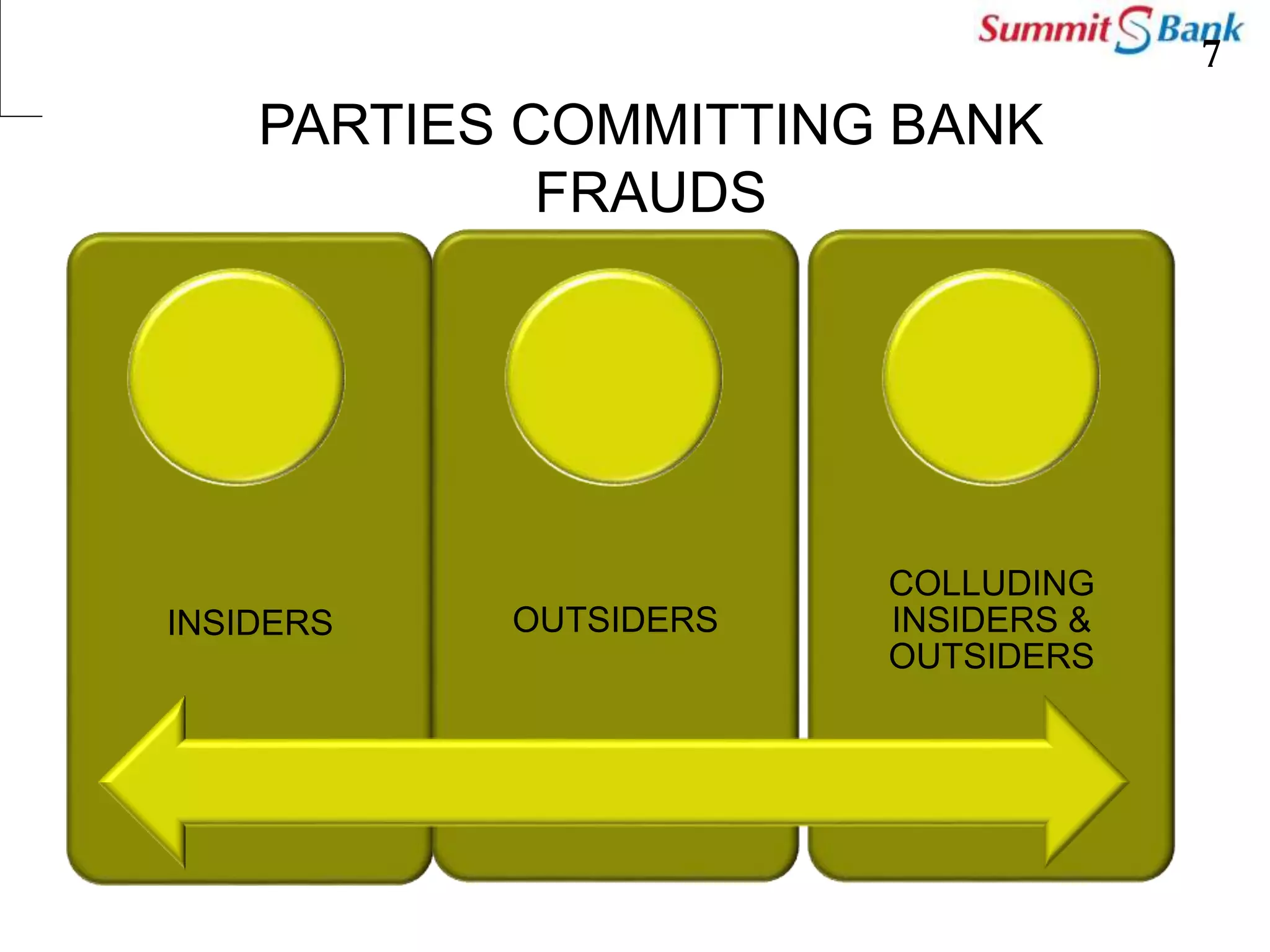
INSIDERS OUTSIDERS
COLLUDING
INSIDERS &
OUTSIDERS
PARTIES COMMITTING BANK
FRAUDS
10
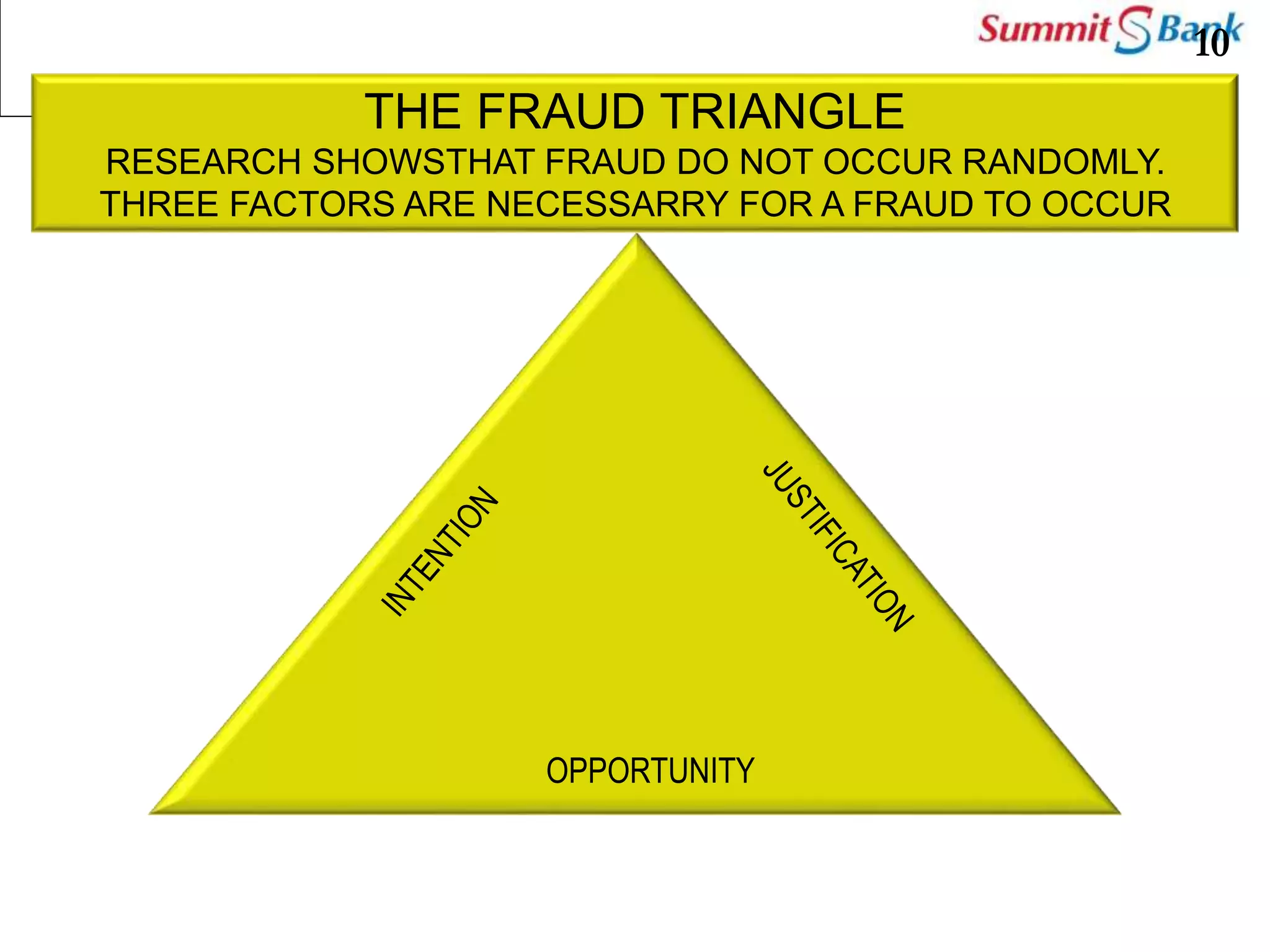
OPPORTUNITY
THE FRAUD TRIANGLE
RESEARCH SHOWSTHAT FRAUD DO NOT OCCUR RANDOMLY.
THREE FACTORS ARE NECESSARRY FOR A FRAUD TO OCCUR
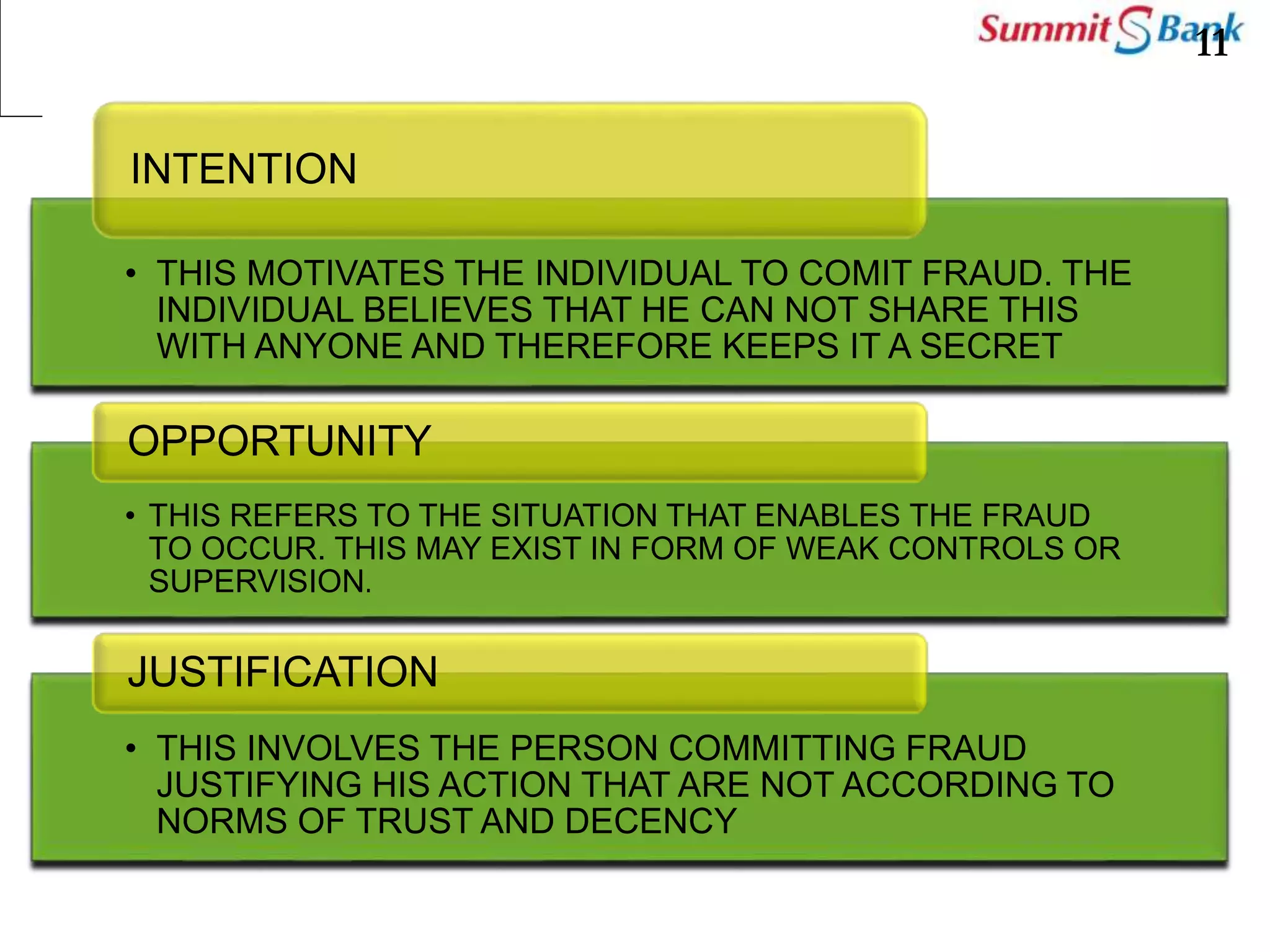
• THIS MOTIVATES THE INDIVIDUAL TO COMIT FRAUD. THE
INDIVIDUAL BELIEVES THAT HE CAN NOT SHARE THIS
WITH ANYONE AND THEREFORE KEEPS IT A SECRET
INTENTION
• THIS REFERS TO THE SITUATION THAT ENABLES THE FRAUD
TO OCCUR. THIS MAY EXIST IN FORM OF WEAK CONTROLS OR
SUPERVISION.
OPPORTUNITY
• THIS INVOLVES THE PERSON COMMITTING FRAUD
JUSTIFYING HIS ACTION THAT ARE NOT ACCORDING TO
NORMS OF TRUST AND DECENCY
JUSTIFICATION
11
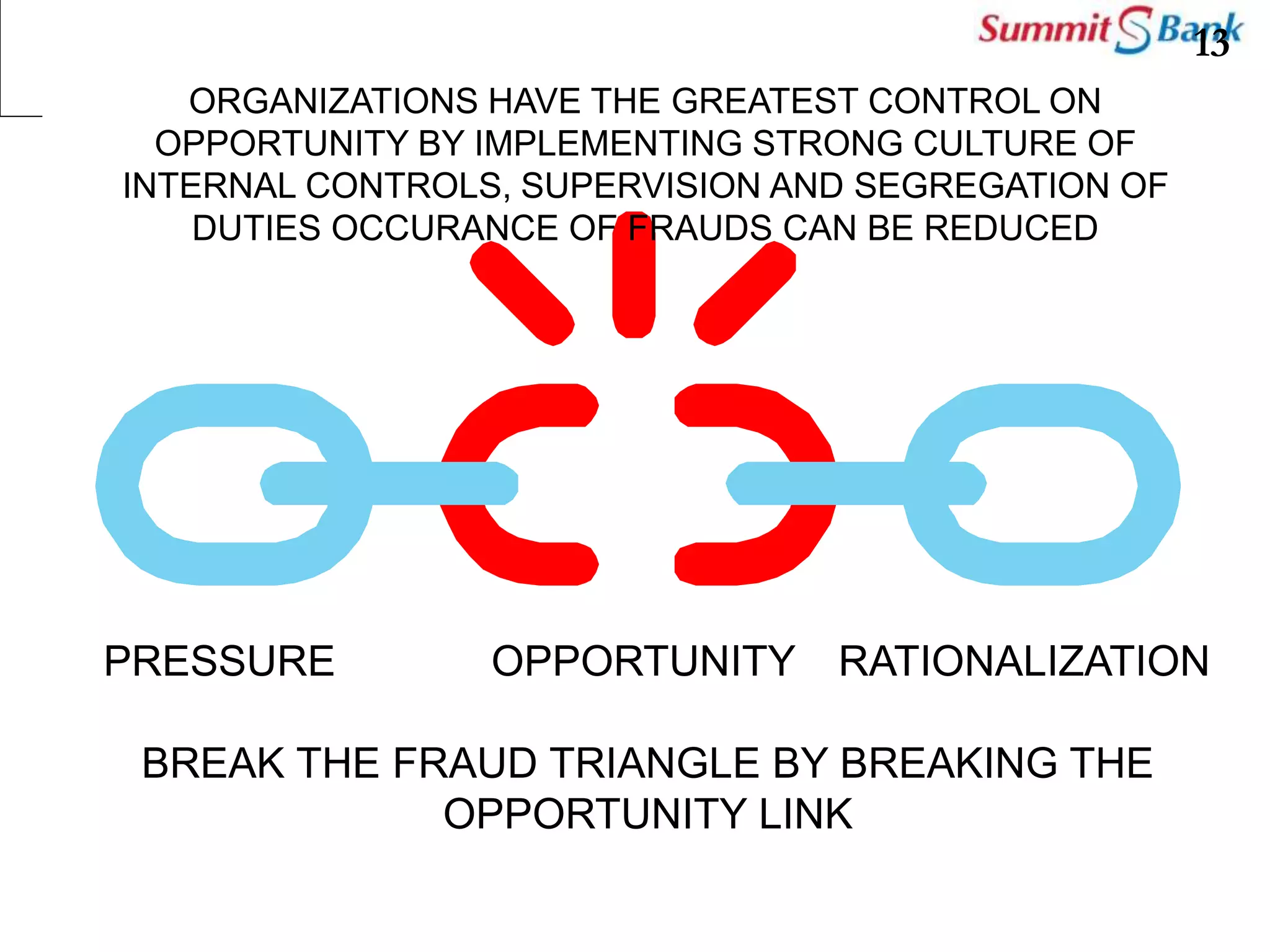
BREAK THE FRAUD TRIANGLE BY BREAKING THE
OPPORTUNITY LINK
PRESSURE OPPORTUNITY RATIONALIZATION
ORGANIZATIONS HAVE THE GREATEST CONTROL ON
OPPORTUNITY BY IMPLEMENTING STRONG CULTURE OF
INTERNAL CONTROLS, SUPERVISION AND SEGREGATION OF
DUTIES OCCURANCE OF FRAUDS CAN BE REDUCED
13
1
Impact of fraud on Banks
Financial Loss
Brand Image & Reputation
Customer confidence
Regulator confidence
Shareholder confidence
It is difficult for marketing people to get
business
Effect bank rating category
COMMON RECURRING FRAUDS
• Fake/ forged instruments
• Sharing of Passwords
• Fake/ forged inward remittances
• Tampering of AOFs and SS Cards
• Fake/ forged share applications
• Temporary Use of customers' Deposits for own
purposes
• Illegitimate ATM withdrawals
• Manipulation of Pledged Stock
COMMON RECURRING FRAUDS
• Illegitimate Foreign Remittances
• Unauthorized Issuance of ATM Cards
• Illegitimate On-Line Transactions
• Unauthorized issuance of Cheque Book
• Illegitimate Transactions in Customers'
Accounts
• Unauthorized Issuance of ATM Cards
• Benami Transaction
COMMON RECURRING FRAUDS
• Unauthorized Retention of Cheque Leaves of
Closed Account
• Illegitimate Transactions in Fake Accounts
• Unauthorized use of customers' overdraft
facilities by Staff
• Illegitimate Transactions in Staff Accounts
• Misappropriation of Cash in hand
COMMON RECURRING FRAUDS
Online Banking Fraud Schemes
• Most online banking fraud schemes involve two
steps.
• First, the criminal obtains the customer's
account access data, i.e. logon name and
password.
• Second, the criminal uses this information to
transfer money to other accounts and
withdrawals the funds. For the first step,
criminals have employed different schemes in
the past:
8
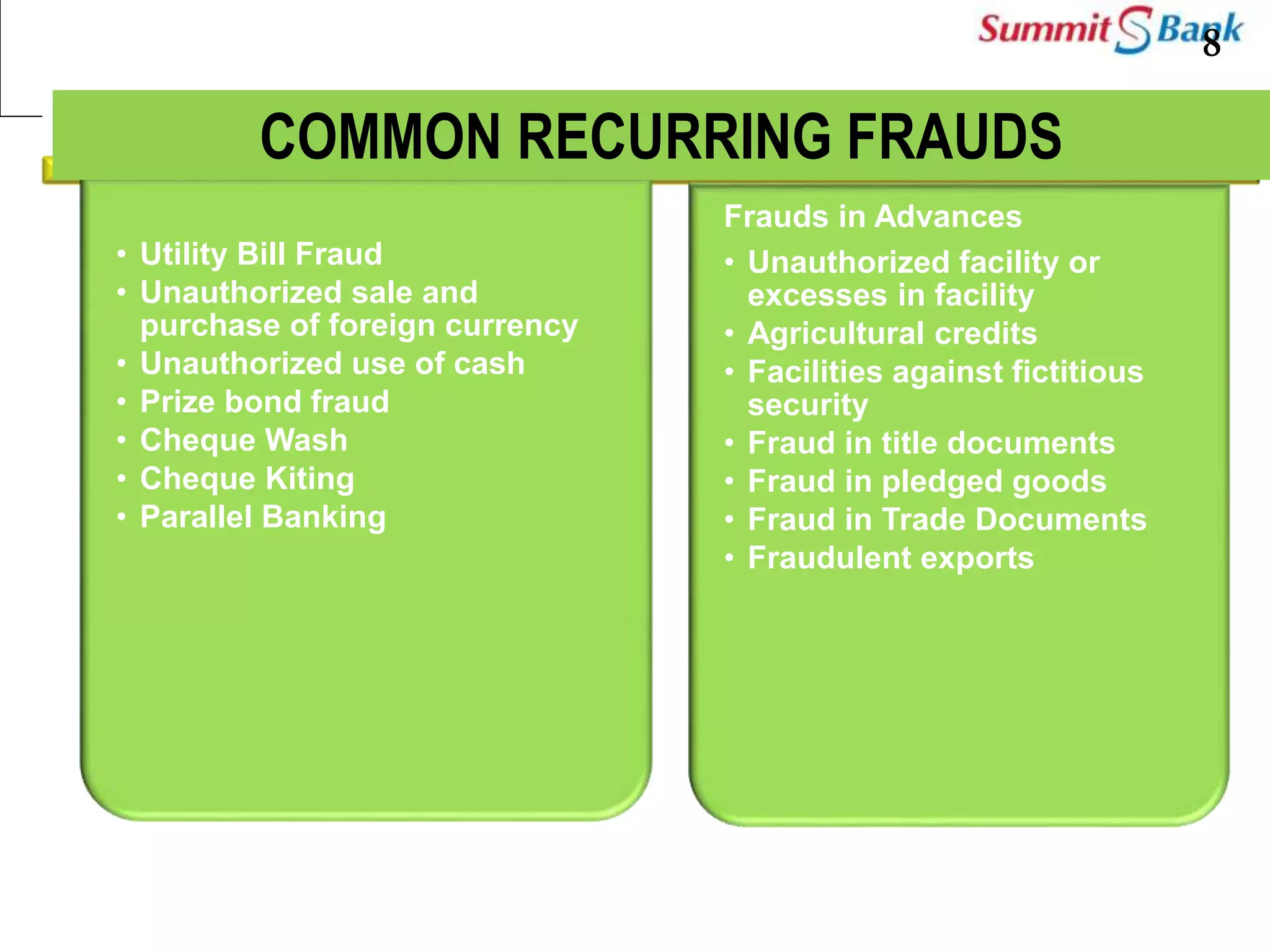
• Utility Bill Fraud
• Unauthorized sale and
purchase of foreign currency
• Unauthorized use of cash
• Prize bond fraud
• Cheque Wash
• Cheque Kiting
• Parallel Banking
Frauds in Advances
• Unauthorized facility or
excesses in facility
• Agricultural credits
• Facilities against fictitious
security
• Fraud in title documents
• Fraud in pledged goods
• Fraud in Trade Documents
• Fraudulent exports
COMMON RECURRING FRAUDS
8
Fictitious Accounts
Encashment /Collection of
Counterfeit/Forged Instruments
Fraudulent Operation in Photo
Account
Window Dressing
Misuse of Inactive Account
Cash Shortage
Consumer Products Related
Frauds
Issuance of Remittance in
Absence of Funds
Bogus Statement of Account
Misappropriation in Bank
Income
COMMON RECURRING FRAUDS
8
Un-Authorized Lien
Removal from Deposits
Misappropriation of
Withholding Tax
Personal Usage of Un-
Rented Lockers
Bogus Agricultural
Finances
Shortage/Unauthorize
d Lifting of Pledged
Stocks
Theft /Removal of
Contents of Lockers
COMMON RECURRING FRAUDS
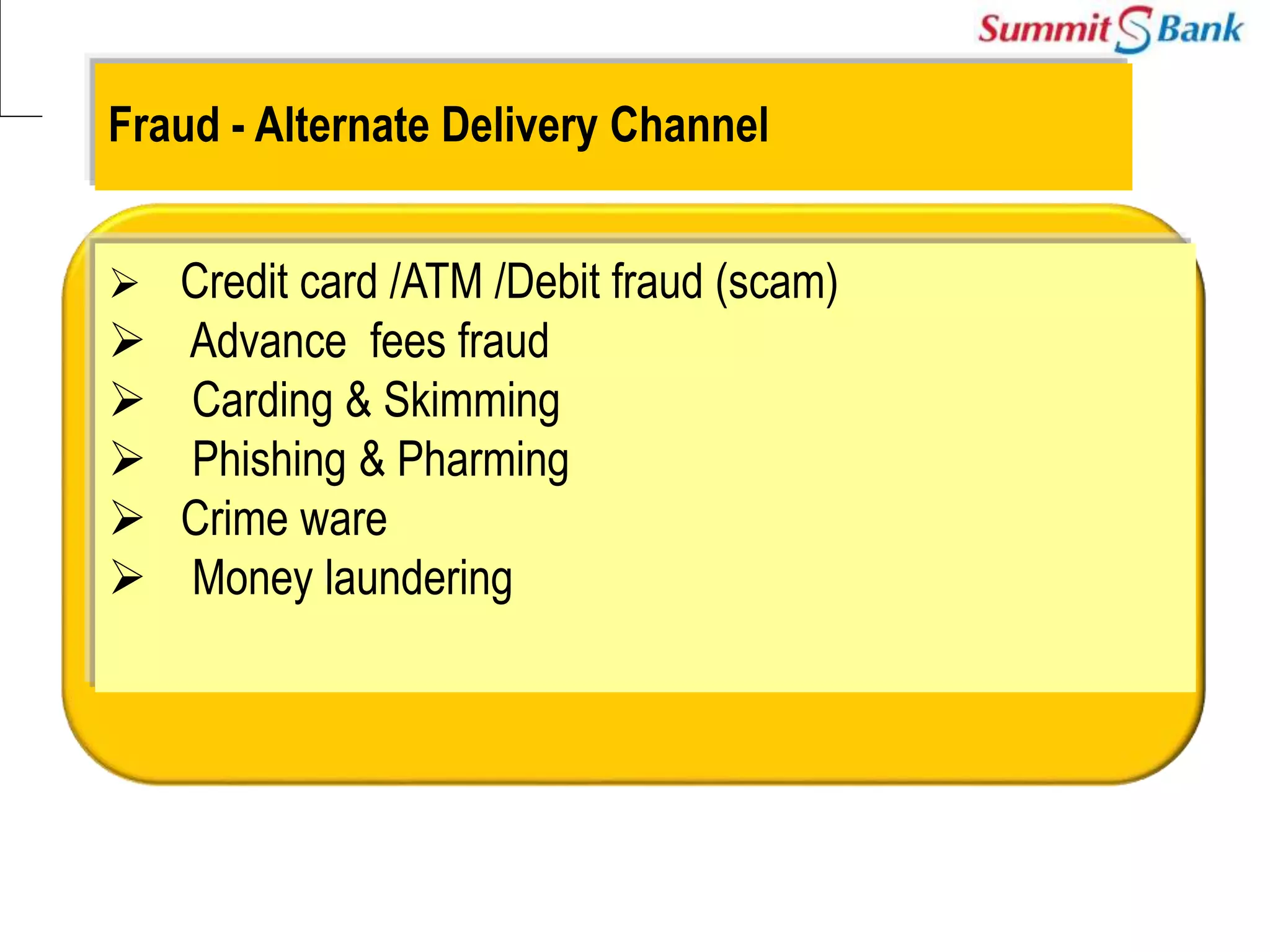
Fraud - Alternate Delivery Channel
 Credit card /ATM /Debit fraud (scam)
 Advance fees fraud
 Carding & Skimming
 Phishing & Pharming
 Crime ware
 Money laundering
Signature Verification and Fraud
Detection
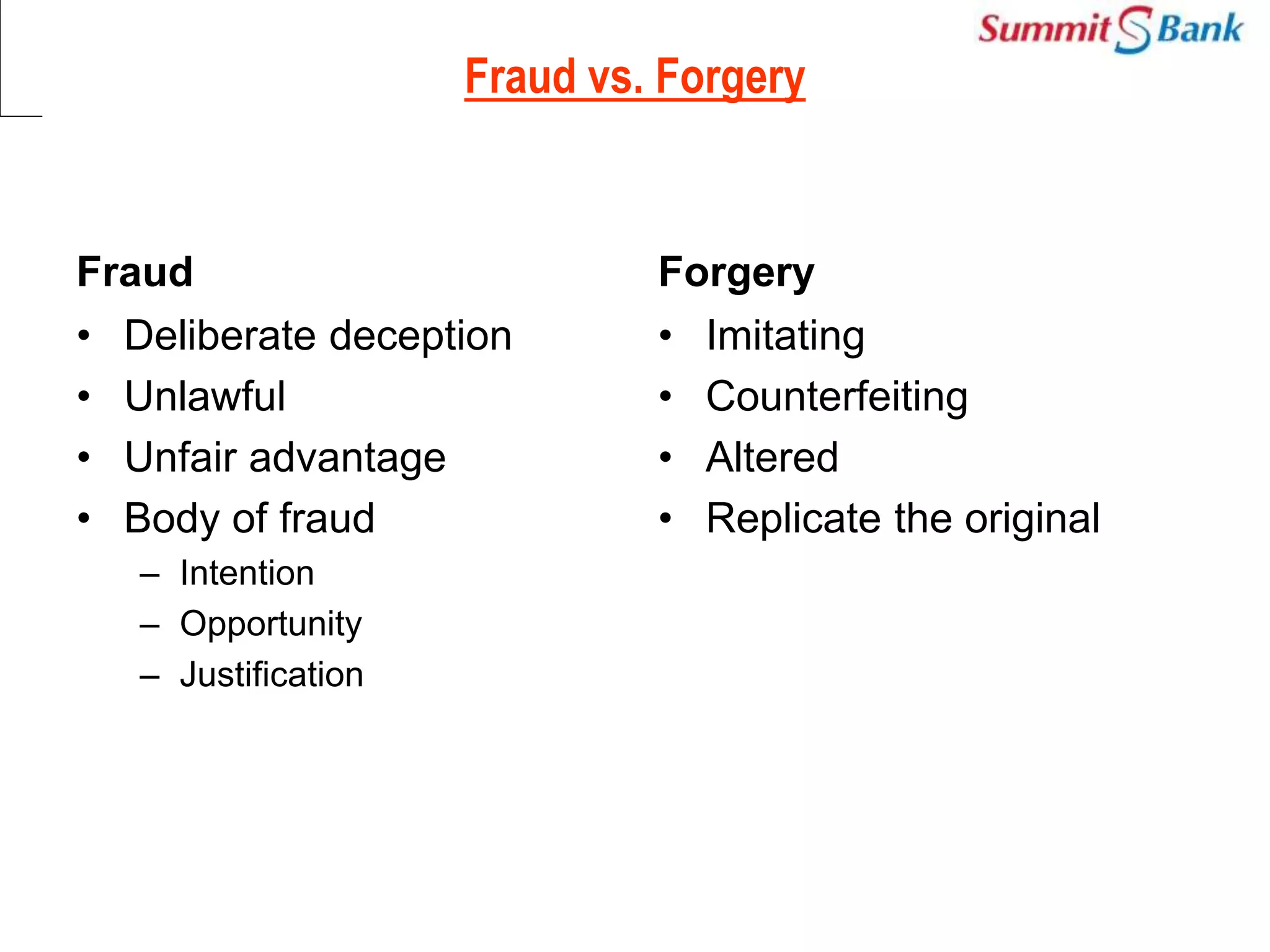
Fraud vs. Forgery
Fraud Forgery
• Deliberate deception
• Unlawful
• Unfair advantage
• Body of fraud
– Intention
– Opportunity
– Justification
• Imitating
• Counterfeiting
• Altered
• Replicate the original
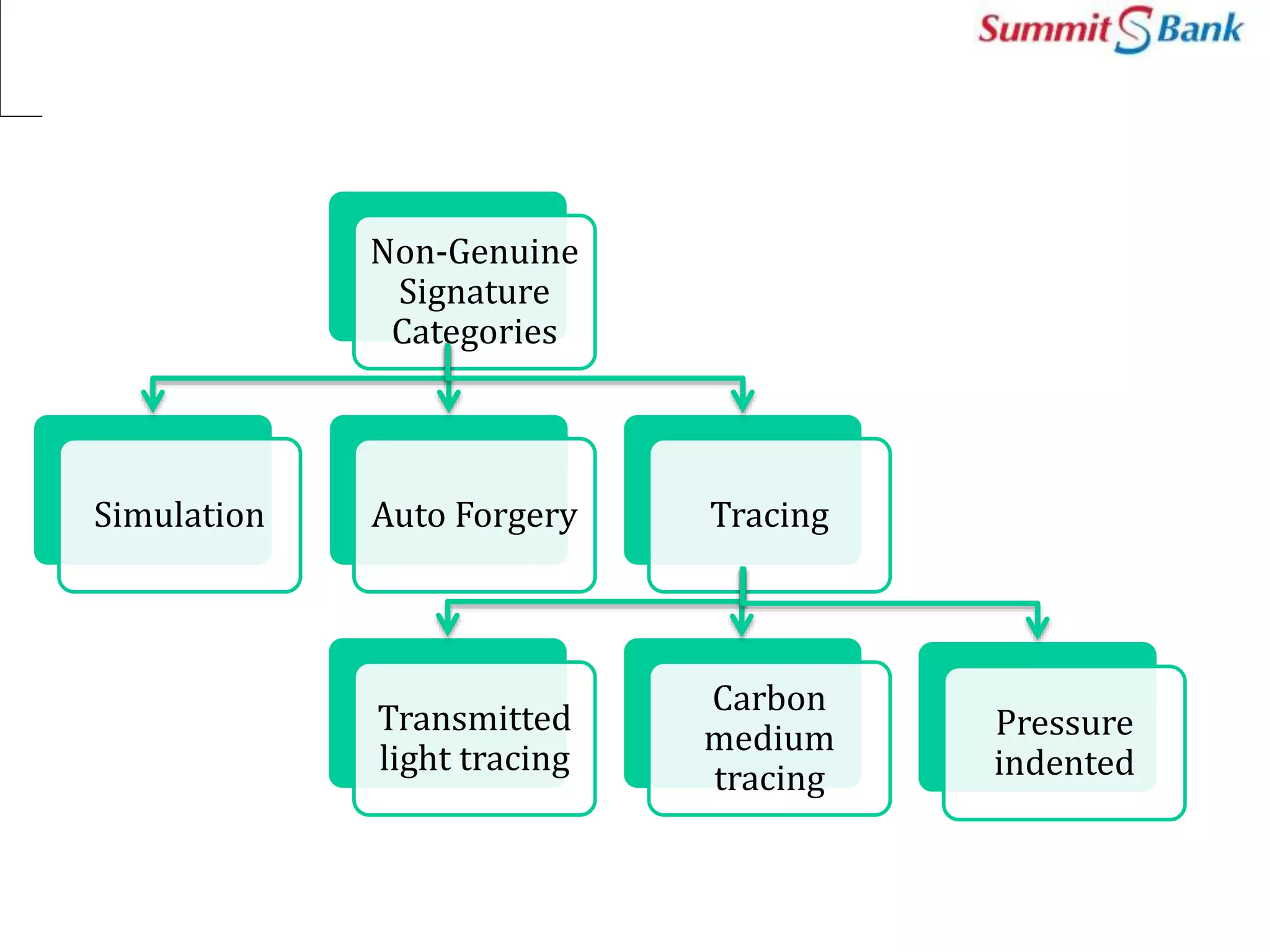
Pressure
indented
Carbon
medium
tracing
Tracing
Transmitted
light tracing
Simulation Auto Forgery
Non-Genuine
Signature
Categories
Simulation/Free hand
forgery
•Genuine signature as model
•Artistic reproduction of the original
•Skill and adequate amount of practice
•The original signature is memorized and
practiced
•Less tremor/not shaky
JUDGEMENT
•Speed
•The more rapidly the pen moves the
more difficult it becomes to replicate the
genuine
•Concentrate on the minute details
•Forger focus on large characters
•Divergence in smaller and less prominent
letters
•Some of the forger’s own handwriting
characters may appear
Transmitted Light
Tracing
Carbon
medium
Tracing
Pressure indented
Tracing
•Paper to receive the
spurious signature is
placed over the
document bearing
genuine signature
•Use of carbon as a
medium
•Ghost image of the
signature
•Use of thick ink pen
to over write the
ghost image
•Similar to carbon tracing
•No use of carbon medium
•Pressure leaves indented signature on the receiving
document
TRACING
Striking features
Simulation/Free Hand Auto-forgery
• Significant
characters/letters similar
• Miss the interior sub titles
or small characters
• Similarity to genuine
– Large prominent characters
• Significant
characters/letters
different
• Once making a significant
alteration comes back to
his normal style
• Similarity to genuine
– Small/ intricate details
Key points to check true signature
• Blunt starts and stops
• Pen lifts and hesitation
• Tremor
• Speed and pressure
• Patches
• Slant of the writing
• Connecting points of different words
• Y & g loops
SMBL CHEQUE INK SECURITY
UV Inks
Magnetic Ink
Penetrating/ Bleed Through Ink
SMBL PRINTING SECURITY
Litho/ Offset Printing
Letter Press Printing
Rainbow Printing
Thread color under UV lamp
27
Fraud Red Flags
 Each one of you, whether you are a branch manager,
internal auditor, investigator or have other operating
responsibility, must do your part in recognizing and
preventing Economic Crimes.
 Red Flags are warning signs and should alert you to
be on guard.
 They do not always point to criminal activity but
deserve your attention.
 60% - 70% of the bank’s Fraud / losses are a result of
employee related frauds. Watch for these warning
signs. They may give you advance notice of an
employee theft.
28
Fraud Red Flags- personal
 Life Style
 A discrepancy between earnings and lifestyle should
cause concern.
 Any sudden / dramatic improvement in lifestyle should be
questioned. Be ware of changing story on an employee’s
improved wealth – rich aunty, lottery, inheritance willed by an
unknown uncle??
 Significant Changes in employee habits, behavior must be
watched. E.g.. An employee with previous poor dress sense
suddenly up with fashions and changed personality.
29
Fraud Red Flags- personal
 Minimal Absenteeism.
Staff who do not take time off or vacation may be avoiding
risk that their replacement will discover their illegal activity.
An employee who is never sick and never takes annual
leave must be watched.
 Rotation policy.
Reluctance of staff to be transferred in spite of protracted
stay at one branch.
 Unusual / Inconsistent behavior
Anything out of the ordinary deserves further inquiry.
30
Fraud Red Flags-
 Remote Locations.
Fraud is more likely to occur at remote locations where
supervision and controls are least effective.
 Checks and Balances.
Beware of situations / transactions that are not properly
authorized, approved or recorded. Documents are missing.
Significant accounts not reconciled on timely basis.
 Passwords/ Keys etc.
Never compromise or allow others access to your personal
passwords, or keys of strong-room, safe vault etc.
31
Fraud Red Flags-
 Individuals familiar with operations and in a position of trust
are more likely to commit frauds.
 Dominant top managers may abuse their authority in the
commission of crimes.
 Employees given too much trust may abuse their authority.
 Transactions involving friends and relatives should be
scrutinized.
 ineffective monitoring, ineffective rotation etc. hinder early
detection of frauds..
Know
your
SOPs/
Regulator
Guideline
s
Know
your
people
.Internal
/&
external
Know your
risk
indicators
Investigate
what does
not make
sense
The use of
computer assisted
audit techniques
(CAAT) can
significantly
enhance the
effectiveness of
monitoring
activities
GOLDEN RULES FOR MITIGATING FRAUD RISK

Preventing Bank's Fraud and Forgery

  • 2.
    1 FRAUD IS ANACT WHICH INTENDED TO CAUSE WRONGFUL GAIN TO A PERSON AND A WRONGFUL LOSS TO ANOTHER. THIS IS A DILEBERATE ACT OF OMMISSION OR COMMISSION
  • 3.
    1 Due to theinherent nature of banking operations, banks are always susceptible to fraud both internal and external. It is therefore important that all those who work in Summit Bank Limited (SMBL) are aware of the risk and means of enforcing the rules against fraud, dacoits, theft and other illegal acts involving dishonesty or damage to Bank's assets.
  • 4.
    1 Duties and Responsibilities Employees,Supervisors, Branch Managers, Group & Department Heads at all levels are responsible for setting the appropriate tone of intolerance for fraudulent act by complying with all laws, rules, regulations, policies and procedures. The above noted staff required to be aware of the types of the fraud that could occur within their area of responsibility
  • 5.
    1 Following 5 keyelements are attributed as the basis for effective antifraud program for prevention and timely detection of fraud. a) Control environment. b) Risk Assessment. c) Control activities. d) Information and communication e) Ongoing monitoring
  • 6.
  • 7.
    10 OPPORTUNITY THE FRAUD TRIANGLE RESEARCHSHOWSTHAT FRAUD DO NOT OCCUR RANDOMLY. THREE FACTORS ARE NECESSARRY FOR A FRAUD TO OCCUR
  • 8.
    • THIS MOTIVATESTHE INDIVIDUAL TO COMIT FRAUD. THE INDIVIDUAL BELIEVES THAT HE CAN NOT SHARE THIS WITH ANYONE AND THEREFORE KEEPS IT A SECRET INTENTION • THIS REFERS TO THE SITUATION THAT ENABLES THE FRAUD TO OCCUR. THIS MAY EXIST IN FORM OF WEAK CONTROLS OR SUPERVISION. OPPORTUNITY • THIS INVOLVES THE PERSON COMMITTING FRAUD JUSTIFYING HIS ACTION THAT ARE NOT ACCORDING TO NORMS OF TRUST AND DECENCY JUSTIFICATION 11
  • 9.
    BREAK THE FRAUDTRIANGLE BY BREAKING THE OPPORTUNITY LINK PRESSURE OPPORTUNITY RATIONALIZATION ORGANIZATIONS HAVE THE GREATEST CONTROL ON OPPORTUNITY BY IMPLEMENTING STRONG CULTURE OF INTERNAL CONTROLS, SUPERVISION AND SEGREGATION OF DUTIES OCCURANCE OF FRAUDS CAN BE REDUCED 13
  • 10.
    1 Impact of fraudon Banks Financial Loss Brand Image & Reputation Customer confidence Regulator confidence Shareholder confidence It is difficult for marketing people to get business Effect bank rating category
  • 11.
    COMMON RECURRING FRAUDS •Fake/ forged instruments • Sharing of Passwords • Fake/ forged inward remittances • Tampering of AOFs and SS Cards • Fake/ forged share applications • Temporary Use of customers' Deposits for own purposes • Illegitimate ATM withdrawals • Manipulation of Pledged Stock
  • 12.
    COMMON RECURRING FRAUDS •Illegitimate Foreign Remittances • Unauthorized Issuance of ATM Cards • Illegitimate On-Line Transactions • Unauthorized issuance of Cheque Book • Illegitimate Transactions in Customers' Accounts • Unauthorized Issuance of ATM Cards • Benami Transaction
  • 13.
    COMMON RECURRING FRAUDS •Unauthorized Retention of Cheque Leaves of Closed Account • Illegitimate Transactions in Fake Accounts • Unauthorized use of customers' overdraft facilities by Staff • Illegitimate Transactions in Staff Accounts • Misappropriation of Cash in hand
  • 14.
    COMMON RECURRING FRAUDS OnlineBanking Fraud Schemes • Most online banking fraud schemes involve two steps. • First, the criminal obtains the customer's account access data, i.e. logon name and password. • Second, the criminal uses this information to transfer money to other accounts and withdrawals the funds. For the first step, criminals have employed different schemes in the past:
  • 15.
    8 • Utility BillFraud • Unauthorized sale and purchase of foreign currency • Unauthorized use of cash • Prize bond fraud • Cheque Wash • Cheque Kiting • Parallel Banking Frauds in Advances • Unauthorized facility or excesses in facility • Agricultural credits • Facilities against fictitious security • Fraud in title documents • Fraud in pledged goods • Fraud in Trade Documents • Fraudulent exports COMMON RECURRING FRAUDS
  • 16.
    8 Fictitious Accounts Encashment /Collectionof Counterfeit/Forged Instruments Fraudulent Operation in Photo Account Window Dressing Misuse of Inactive Account Cash Shortage Consumer Products Related Frauds Issuance of Remittance in Absence of Funds Bogus Statement of Account Misappropriation in Bank Income COMMON RECURRING FRAUDS
  • 17.
    8 Un-Authorized Lien Removal fromDeposits Misappropriation of Withholding Tax Personal Usage of Un- Rented Lockers Bogus Agricultural Finances Shortage/Unauthorize d Lifting of Pledged Stocks Theft /Removal of Contents of Lockers COMMON RECURRING FRAUDS
  • 18.
    Fraud - AlternateDelivery Channel  Credit card /ATM /Debit fraud (scam)  Advance fees fraud  Carding & Skimming  Phishing & Pharming  Crime ware  Money laundering
  • 19.
  • 20.
    Fraud vs. Forgery FraudForgery • Deliberate deception • Unlawful • Unfair advantage • Body of fraud – Intention – Opportunity – Justification • Imitating • Counterfeiting • Altered • Replicate the original
  • 21.
  • 22.
    Simulation/Free hand forgery •Genuine signatureas model •Artistic reproduction of the original •Skill and adequate amount of practice •The original signature is memorized and practiced •Less tremor/not shaky JUDGEMENT •Speed •The more rapidly the pen moves the more difficult it becomes to replicate the genuine •Concentrate on the minute details •Forger focus on large characters •Divergence in smaller and less prominent letters •Some of the forger’s own handwriting characters may appear
  • 23.
    Transmitted Light Tracing Carbon medium Tracing Pressure indented Tracing •Paperto receive the spurious signature is placed over the document bearing genuine signature •Use of carbon as a medium •Ghost image of the signature •Use of thick ink pen to over write the ghost image •Similar to carbon tracing •No use of carbon medium •Pressure leaves indented signature on the receiving document TRACING
  • 24.
    Striking features Simulation/Free HandAuto-forgery • Significant characters/letters similar • Miss the interior sub titles or small characters • Similarity to genuine – Large prominent characters • Significant characters/letters different • Once making a significant alteration comes back to his normal style • Similarity to genuine – Small/ intricate details
  • 25.
    Key points tocheck true signature • Blunt starts and stops • Pen lifts and hesitation • Tremor • Speed and pressure • Patches • Slant of the writing • Connecting points of different words • Y & g loops
  • 26.
    SMBL CHEQUE INKSECURITY UV Inks Magnetic Ink Penetrating/ Bleed Through Ink SMBL PRINTING SECURITY Litho/ Offset Printing Letter Press Printing Rainbow Printing Thread color under UV lamp
  • 27.
    27 Fraud Red Flags Each one of you, whether you are a branch manager, internal auditor, investigator or have other operating responsibility, must do your part in recognizing and preventing Economic Crimes.  Red Flags are warning signs and should alert you to be on guard.  They do not always point to criminal activity but deserve your attention.  60% - 70% of the bank’s Fraud / losses are a result of employee related frauds. Watch for these warning signs. They may give you advance notice of an employee theft.
  • 28.
    28 Fraud Red Flags-personal  Life Style  A discrepancy between earnings and lifestyle should cause concern.  Any sudden / dramatic improvement in lifestyle should be questioned. Be ware of changing story on an employee’s improved wealth – rich aunty, lottery, inheritance willed by an unknown uncle??  Significant Changes in employee habits, behavior must be watched. E.g.. An employee with previous poor dress sense suddenly up with fashions and changed personality.
  • 29.
    29 Fraud Red Flags-personal  Minimal Absenteeism. Staff who do not take time off or vacation may be avoiding risk that their replacement will discover their illegal activity. An employee who is never sick and never takes annual leave must be watched.  Rotation policy. Reluctance of staff to be transferred in spite of protracted stay at one branch.  Unusual / Inconsistent behavior Anything out of the ordinary deserves further inquiry.
  • 30.
    30 Fraud Red Flags- Remote Locations. Fraud is more likely to occur at remote locations where supervision and controls are least effective.  Checks and Balances. Beware of situations / transactions that are not properly authorized, approved or recorded. Documents are missing. Significant accounts not reconciled on timely basis.  Passwords/ Keys etc. Never compromise or allow others access to your personal passwords, or keys of strong-room, safe vault etc.
  • 31.
    31 Fraud Red Flags- Individuals familiar with operations and in a position of trust are more likely to commit frauds.  Dominant top managers may abuse their authority in the commission of crimes.  Employees given too much trust may abuse their authority.  Transactions involving friends and relatives should be scrutinized.  ineffective monitoring, ineffective rotation etc. hinder early detection of frauds..
  • 32.
    Know your SOPs/ Regulator Guideline s Know your people .Internal /& external Know your risk indicators Investigate what does notmake sense The use of computer assisted audit techniques (CAAT) can significantly enhance the effectiveness of monitoring activities GOLDEN RULES FOR MITIGATING FRAUD RISK

Editor's Notes

  • #3 Fraud damage bank reputation Financial loss Market loss
  • #11 Fraud damage bank reputation Financial loss Market loss