Fraud Risk
Assessment
Charanjeet Singh, CFE, CISM
Content of this presentation is personal views of the
speaker and does not represent views of the Employer,
including current and past or any of the associations.
Content
What is FRA
Why it is important
When it can be/should be done
How it can be done effectively
Challenges
Q&A
What is FRA?
• It’s a fraud prevention tool, may also become
detection tool in some cases
• Is useful for identifying opportunities which can be
exploited by fraudsters
• Can be done at organisation level or at process/
product level
• Key objective is the identification of fraud risk and
check whether existing control design and
implementation is effective
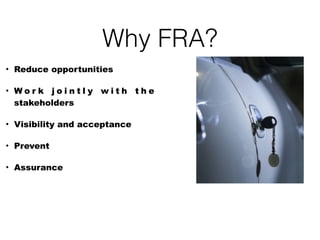
Why FRA?
• Reduce opportunities
• W o r k j o i n t l y w i t h t h e
stakeholders
• Visibility and acceptance
• Prevent
• Assurance
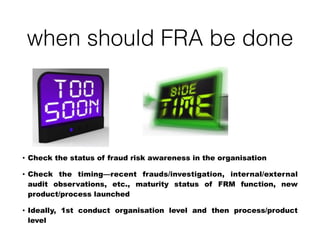
when should FRA be done
• Check the status of fraud risk awareness in the organisation
• Check the timing—recent frauds/investigation, internal/external
audit observations, etc., maturity status of FRM function, new
product/process launched
• Ideally, 1st conduct organisation level and then process/product
level
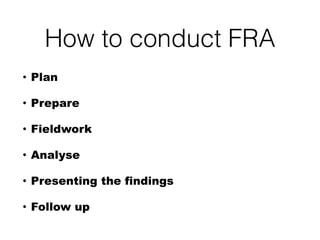
How to conduct FRA
• Plan
• Prepare
• Fieldwork
• Analyse
• Presenting the findings
• Follow up
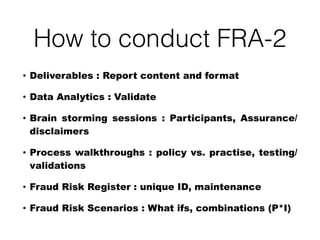
How to conduct FRA-2
• Deliverables : Report content and format
• Data Analytics : Validate
• Brain storming sessions : Participants, Assurance/
disclaimers
• Process walkthroughs : policy vs. practise, testing/
validations
• Fraud Risk Register : unique ID, maintenance
• Fraud Risk Scenarios : What ifs, combinations (P*I)
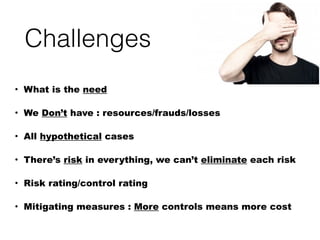
Challenges
• What is the need
• We Don’t have : resources/frauds/losses
• All hypothetical cases
• There’s risk in everything, we can’t eliminate each risk
• Risk rating/control rating
• Mitigating measures : More controls means more cost
If you want to go far, engage in team
work
Q&A
images courtesy of: http://www.freedigitalphotos.net
Content of this presentation is personal views of the
speaker and does not represent views of the Employer,
including current and past or any of the associations.

Fraud Risk Assessment

  • 1.
    Fraud Risk Assessment Charanjeet Singh,CFE, CISM Content of this presentation is personal views of the speaker and does not represent views of the Employer, including current and past or any of the associations.
  • 2.
    Content What is FRA Whyit is important When it can be/should be done How it can be done effectively Challenges Q&A
  • 3.
    What is FRA? •It’s a fraud prevention tool, may also become detection tool in some cases • Is useful for identifying opportunities which can be exploited by fraudsters • Can be done at organisation level or at process/ product level • Key objective is the identification of fraud risk and check whether existing control design and implementation is effective
  • 4.
    Why FRA? • Reduceopportunities • W o r k j o i n t l y w i t h t h e stakeholders • Visibility and acceptance • Prevent • Assurance
  • 5.
    when should FRAbe done • Check the status of fraud risk awareness in the organisation • Check the timing—recent frauds/investigation, internal/external audit observations, etc., maturity status of FRM function, new product/process launched • Ideally, 1st conduct organisation level and then process/product level
  • 6.
    How to conductFRA • Plan • Prepare • Fieldwork • Analyse • Presenting the findings • Follow up
  • 7.
    How to conductFRA-2 • Deliverables : Report content and format • Data Analytics : Validate • Brain storming sessions : Participants, Assurance/ disclaimers • Process walkthroughs : policy vs. practise, testing/ validations • Fraud Risk Register : unique ID, maintenance • Fraud Risk Scenarios : What ifs, combinations (P*I)
  • 8.
    Challenges • What isthe need • We Don’t have : resources/frauds/losses • All hypothetical cases • There’s risk in everything, we can’t eliminate each risk • Risk rating/control rating • Mitigating measures : More controls means more cost
  • 9.
    If you wantto go far, engage in team work Q&A images courtesy of: http://www.freedigitalphotos.net Content of this presentation is personal views of the speaker and does not represent views of the Employer, including current and past or any of the associations.