NARCOTICS
(ADMINISTRATION AND
STORAGE)
ELIZABETH S. BAUTISTA R.N.
DEFINITION
NARCOTICS – an addictive drug that reduces
pain, alters mood and behavior and usually
induces sleep or stupor.
NARCOTICS (SAUH ) – any narcotic drug such
as morphine, that blunts or distorts the
senses and induces sleep.
PROCEDURE
 Prior to the administration of narcotic
medication, obtain a baseline assessment of
the following :
a. Pain score
b. Vital signs including respiratory rate
c. Sedation scale
d. Mental Status
SEDATION SCALE
AWAKE (4) – Awake, alert
MINIMAL (3) – Ptosis, slight slurrging of speech
MODERATE (2) – Spontaneous eye closure,
delayed response to verbal commands,
appropriate response to verbal and tactile
stimulation
DEEP (1) – responds only to repeated or painful
stimulation
UNRESPONSIVE (0)-no response to painful
stimulation.
REPORT : < OR EQUALTO SCORE OF 2
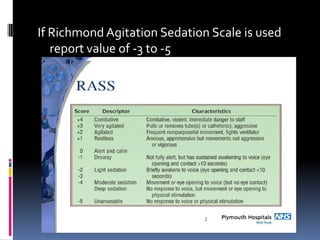
If Richmond Agitation Sedation Scale is used
report value of -3 to -5
SAFETY OF NARCOTICS
ADMINISTRATION
 Maintain patent IV access for patients receiving
continuous narcotics infusion for 6 hours after
narcotic is discontinued.
 In cases of overdose, all data will be preserved for
further investigation.
 In an event of suspected narcotic overdose :
a. Send remaining infusion to the pharmacy
b. Inspect infusion site, infusion pump and tubing for
irregularities
c. Document all pertinent information in the patients
medication record.
REPORTABLE CONDITIONS
 Pain level of 5 out of 10 or greater
 Level of pain relief unacceptable to the
patient
 Sedation score less than or equal to 2 unless
CMO
 Respiratory rate of less than or equal to 8 or
shallow breathing unless patient is intubated
or CMO
 Mental status change unless intubated or
CMO
 Itching, nausea/ vomiting, constipation and
urinary retention.
POLICY ( SAUH )
 Narcotic cabinet keys are kept with the
medication nurse at all times
 Narcotic storage is kept under locked all the
time
 Medication nurse in charge in each shifts
counts the narcotics, verifies the narcotic
count at the end of the shift with the
incoming nurse and document in the narcotic
logbook.
 Document the used and unused narcotics in
the narcotic logbook.
 Pink form to be filled up by the patient/
relative, administering nurse and prescribing
doctor.
 Empty ampoule to be returned to the
pharmacy with the filled up pink form
STORAGE
DRUG STORAGE ROOMS MUST FEATURE :
 Adequate lighting
 Temperature of 25 C or below
 Adequate shelving
 Two RUM containers (Return of Unwanted
Medicine )
 Soap dispenser and paper towel holder
STORAGE AND DISTRIBUTION OF
NARCOTICS
 The Narcotic cupboard is to be separated and/or
locked independent of other cupboards.
 The cupboard is to contain only narcotic and
controlled drugs.
 The Pharmacist supplies the unit with the
medications and records the additions and/or
deletions on the narcotic record in red ink along
with their signature and signature of the
registered or licensed nurse accepting delivery.
Borrowing Narcotics from
other units
 Borrow narcotics only outside of Pharmacy’s
normal working hours. Document time,
borrowing unit, dose and number of remaining
doses on the lending unit’s Narcotic
Administration Record. Both the lending unit’s
nurse and borrowing unit’s nurse signs for the
transaction.
 Record addition on borrowing unit’s Narcotic
Administration Record.Two registered or
licensed nurses from the borrowing unit sign for
the transaction.
 Record administration of narcotic.
Counting Narcotics
 Count narcotics at the change of each shift according to unit specific
policy.
 Two registered or licensed nurses will count the narcotics using the
NarcoticAdministration Record.
 Note: If the unit is staffed by only one RN, the nurse counts alone
and completes the count and another staff member (physician etc)
verifies.
 Send completed NarcoticAdministration Records to Pharmacy daily.
 Enter shift counts in red on the Narcotics and Controlled Drugs Record
indicating:
 -date
 -time
 -“shift count”
 -actual balance (never carry false balances forward) signature of two nurses
 performing the count.
Missing Doses
 Rule out all sources of discrepancy.
 Inform your Nursing Supervisor.
 Indicate the missing dose on the Narcotic
Administration Record.
 Complete a Nursing/Pharmacy Communication
sheet indicating a dose is missing.
 The Nursing Supervisor will ensure all recorded
information is correct, sign the
Nursing/Pharmacy Communication Sheet, and
forward it to Pharmacy.
Key Control
 The Charge Nurse or Medication Nurse of each
unit carry the narcotic key(s) at all times.
 If your unit has more than one key per lock,
count the keys at end of shift and record the
number on the Narcotic Administration Record.
 If a narcotic key is taken home:
 The Nursing Supervisor/Charge Nurse
telephones the individual.
 The employee personally returns the key to the
hospital.
 When the key is returned, complete a narcotic count.
 Have the lock changed if the keys are not returned
promptly.
 If a narcotic key is taken home and the registered or
licensed nurse cannot be contacted or if a narcotic key is
lost:
1.The Nursing Supervisor/Charge Nurse contacts Maintenance
to change the lock at the earliest opportunity.
2.In all instances, when a narcotic key is taken home or lost,
the Nursing Supervisor/Charge Nurse completes a
Pharmacy/Nursing Medication Communication Sheet and
forwards it to the Pharmacy Department indicating
whether or not the lock was changed
Expired narcotics
Expiration dates shall be checked on a routine
schedule, and at a minimum on a monthly
basis per hospital policy. It is recommended
that controlled substances be replaced
one(1) month prior to their expiration date.
Controlled substances that have expired shall
not be carried administered to patients at any
time.
STAFF MUST ENSURE
 Drug storage is kept locked
 All drugs and medicine containers are labeled
with date, expiry date etc
 Floors, walls, sinks, benches are free of
anything that may likely to contaminate
drugs
 Floors are free of stock or other obstructions
Documentation
1.The registered nurse/Physician completes the Narcotic Administration
Record for each dose administered.This includes:
 time of administration
 patient’s last name and first initial
 dosage of narcotic administered
 physician’s last name and first initial
 the number of units of narcotics remaining
 amount of narcotic wasted, if applicable
 signature of the registered nurse/Physician administering the
medication
 signature of registered nurse/Physician observing wastage of remaining
narcotic
2. Make all entries in ink.
3. If a revision or correction is necessary, draw a single line through the
original entry, write “error,” initial and make a second entry if necessary.
Narcotics

Narcotics

  • 1.
  • 2.
    DEFINITION NARCOTICS – anaddictive drug that reduces pain, alters mood and behavior and usually induces sleep or stupor. NARCOTICS (SAUH ) – any narcotic drug such as morphine, that blunts or distorts the senses and induces sleep.
  • 3.
    PROCEDURE  Prior tothe administration of narcotic medication, obtain a baseline assessment of the following : a. Pain score b. Vital signs including respiratory rate c. Sedation scale d. Mental Status
  • 4.
    SEDATION SCALE AWAKE (4)– Awake, alert MINIMAL (3) – Ptosis, slight slurrging of speech MODERATE (2) – Spontaneous eye closure, delayed response to verbal commands, appropriate response to verbal and tactile stimulation DEEP (1) – responds only to repeated or painful stimulation UNRESPONSIVE (0)-no response to painful stimulation. REPORT : < OR EQUALTO SCORE OF 2
  • 5.
    If Richmond AgitationSedation Scale is used report value of -3 to -5
  • 6.
    SAFETY OF NARCOTICS ADMINISTRATION Maintain patent IV access for patients receiving continuous narcotics infusion for 6 hours after narcotic is discontinued.  In cases of overdose, all data will be preserved for further investigation.  In an event of suspected narcotic overdose : a. Send remaining infusion to the pharmacy b. Inspect infusion site, infusion pump and tubing for irregularities c. Document all pertinent information in the patients medication record.
  • 7.
    REPORTABLE CONDITIONS  Painlevel of 5 out of 10 or greater  Level of pain relief unacceptable to the patient  Sedation score less than or equal to 2 unless CMO
  • 8.
     Respiratory rateof less than or equal to 8 or shallow breathing unless patient is intubated or CMO  Mental status change unless intubated or CMO  Itching, nausea/ vomiting, constipation and urinary retention.
  • 9.
    POLICY ( SAUH)  Narcotic cabinet keys are kept with the medication nurse at all times  Narcotic storage is kept under locked all the time  Medication nurse in charge in each shifts counts the narcotics, verifies the narcotic count at the end of the shift with the incoming nurse and document in the narcotic logbook.
  • 10.
     Document theused and unused narcotics in the narcotic logbook.  Pink form to be filled up by the patient/ relative, administering nurse and prescribing doctor.  Empty ampoule to be returned to the pharmacy with the filled up pink form
  • 11.
    STORAGE DRUG STORAGE ROOMSMUST FEATURE :  Adequate lighting  Temperature of 25 C or below  Adequate shelving  Two RUM containers (Return of Unwanted Medicine )  Soap dispenser and paper towel holder
  • 12.
    STORAGE AND DISTRIBUTIONOF NARCOTICS  The Narcotic cupboard is to be separated and/or locked independent of other cupboards.  The cupboard is to contain only narcotic and controlled drugs.  The Pharmacist supplies the unit with the medications and records the additions and/or deletions on the narcotic record in red ink along with their signature and signature of the registered or licensed nurse accepting delivery.
  • 13.
    Borrowing Narcotics from otherunits  Borrow narcotics only outside of Pharmacy’s normal working hours. Document time, borrowing unit, dose and number of remaining doses on the lending unit’s Narcotic Administration Record. Both the lending unit’s nurse and borrowing unit’s nurse signs for the transaction.  Record addition on borrowing unit’s Narcotic Administration Record.Two registered or licensed nurses from the borrowing unit sign for the transaction.  Record administration of narcotic.
  • 14.
    Counting Narcotics  Countnarcotics at the change of each shift according to unit specific policy.  Two registered or licensed nurses will count the narcotics using the NarcoticAdministration Record.  Note: If the unit is staffed by only one RN, the nurse counts alone and completes the count and another staff member (physician etc) verifies.  Send completed NarcoticAdministration Records to Pharmacy daily.  Enter shift counts in red on the Narcotics and Controlled Drugs Record indicating:  -date  -time  -“shift count”  -actual balance (never carry false balances forward) signature of two nurses  performing the count.
  • 15.
    Missing Doses  Ruleout all sources of discrepancy.  Inform your Nursing Supervisor.  Indicate the missing dose on the Narcotic Administration Record.  Complete a Nursing/Pharmacy Communication sheet indicating a dose is missing.  The Nursing Supervisor will ensure all recorded information is correct, sign the Nursing/Pharmacy Communication Sheet, and forward it to Pharmacy.
  • 16.
    Key Control  TheCharge Nurse or Medication Nurse of each unit carry the narcotic key(s) at all times.  If your unit has more than one key per lock, count the keys at end of shift and record the number on the Narcotic Administration Record.  If a narcotic key is taken home:  The Nursing Supervisor/Charge Nurse telephones the individual.  The employee personally returns the key to the hospital.
  • 17.
     When thekey is returned, complete a narcotic count.  Have the lock changed if the keys are not returned promptly.  If a narcotic key is taken home and the registered or licensed nurse cannot be contacted or if a narcotic key is lost: 1.The Nursing Supervisor/Charge Nurse contacts Maintenance to change the lock at the earliest opportunity. 2.In all instances, when a narcotic key is taken home or lost, the Nursing Supervisor/Charge Nurse completes a Pharmacy/Nursing Medication Communication Sheet and forwards it to the Pharmacy Department indicating whether or not the lock was changed
  • 18.
    Expired narcotics Expiration datesshall be checked on a routine schedule, and at a minimum on a monthly basis per hospital policy. It is recommended that controlled substances be replaced one(1) month prior to their expiration date. Controlled substances that have expired shall not be carried administered to patients at any time.
  • 19.
    STAFF MUST ENSURE Drug storage is kept locked  All drugs and medicine containers are labeled with date, expiry date etc  Floors, walls, sinks, benches are free of anything that may likely to contaminate drugs  Floors are free of stock or other obstructions
  • 20.
    Documentation 1.The registered nurse/Physiciancompletes the Narcotic Administration Record for each dose administered.This includes:  time of administration  patient’s last name and first initial  dosage of narcotic administered  physician’s last name and first initial  the number of units of narcotics remaining  amount of narcotic wasted, if applicable  signature of the registered nurse/Physician administering the medication  signature of registered nurse/Physician observing wastage of remaining narcotic 2. Make all entries in ink. 3. If a revision or correction is necessary, draw a single line through the original entry, write “error,” initial and make a second entry if necessary.