1 2 3
Basic Math Review
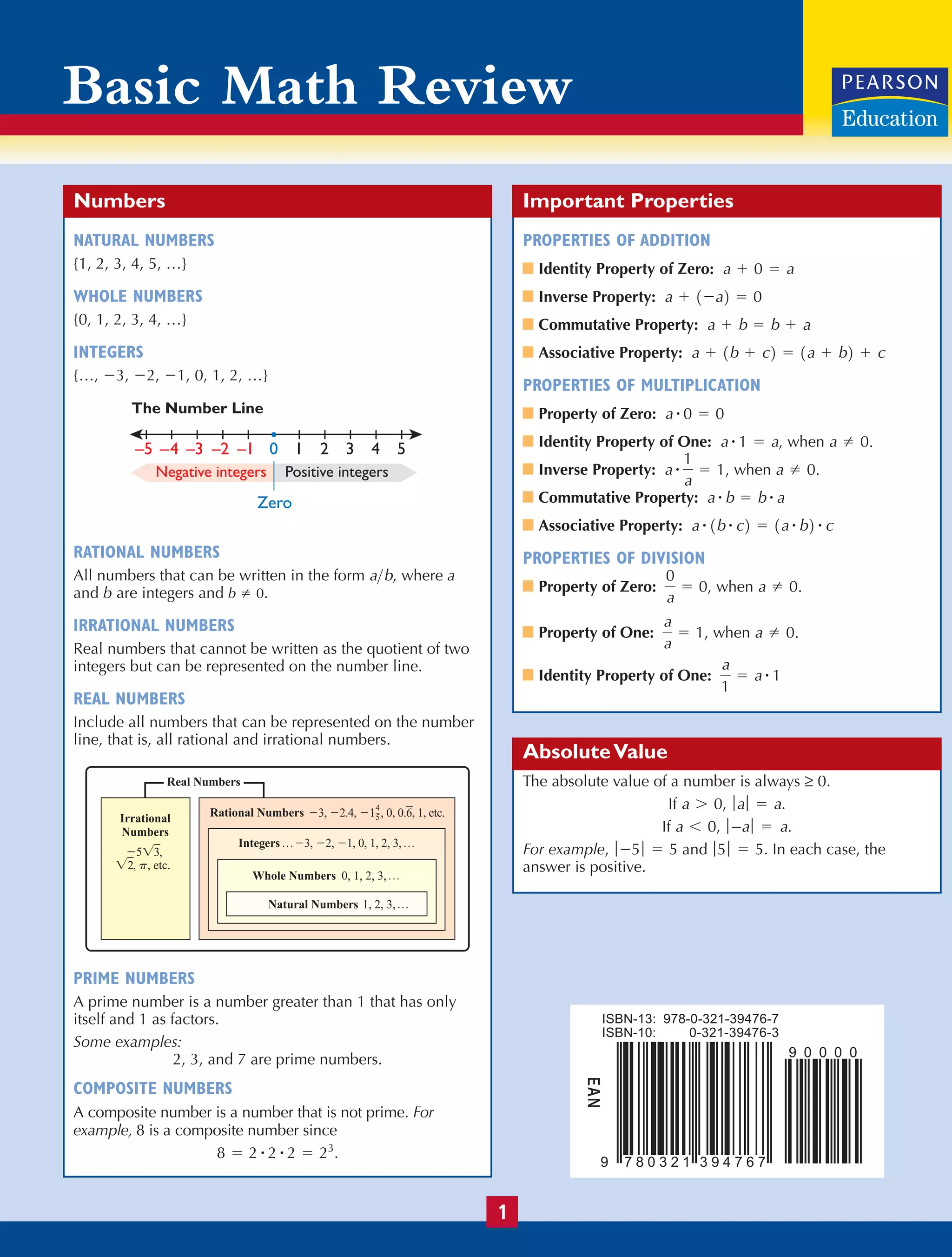
Numbers
NATURAL NUMBERS
{1, 2, 3, 4, 5, …}
WHOLE NUMBERS
{0, 1, 2, 3, 4, …}
INTEGERS
{…, Ϫ3, Ϫ2, Ϫ1, 0, 1, 2, …}
RATIONAL NUMBERS
All numbers that can be written in the form , where a
and b are integers and .
IRRATIONAL NUMBERS
Real numbers that cannot be written as the quotient of two
integers but can be represented on the number line.
REAL NUMBERS
Include all numbers that can be represented on the number
line, that is, all rational and irrational numbers.
PRIME NUMBERS
A prime number is a number greater than 1 that has only
itself and 1 as factors.
Some examples:
2, 3, and 7 are prime numbers.
COMPOSITE NUMBERS
A composite number is a number that is not prime. For
example, 8 is a composite number since
.8 = 2 # 2 # 2 = 23
Rational Numbers
Real Numbers
23, 22.4, 21 , 0, 0.6, 1, etc.24_
5
25VN
Irrational
Numbers
p 23, 22, 21, 0, 1, 2, 3, pIntegers
0, 1, 2, 3, pWhole Numbers
Natural Numbers 1, 2, 3, p
3,
2, p, etc.VN
b Z 0
a>b
–5–5 –4–4 –3–3
Negative integersNegative integers Positive integers
The Number Line
Zero
–2–2 –1–1 0 1 2 3 4 5
ISBN-13:
ISBN-10:
978-0-321-39476-7
0-321-39476-3
9 7 8 0 3 2 1 3 9 4 7 6 7
9 0 0 0 0
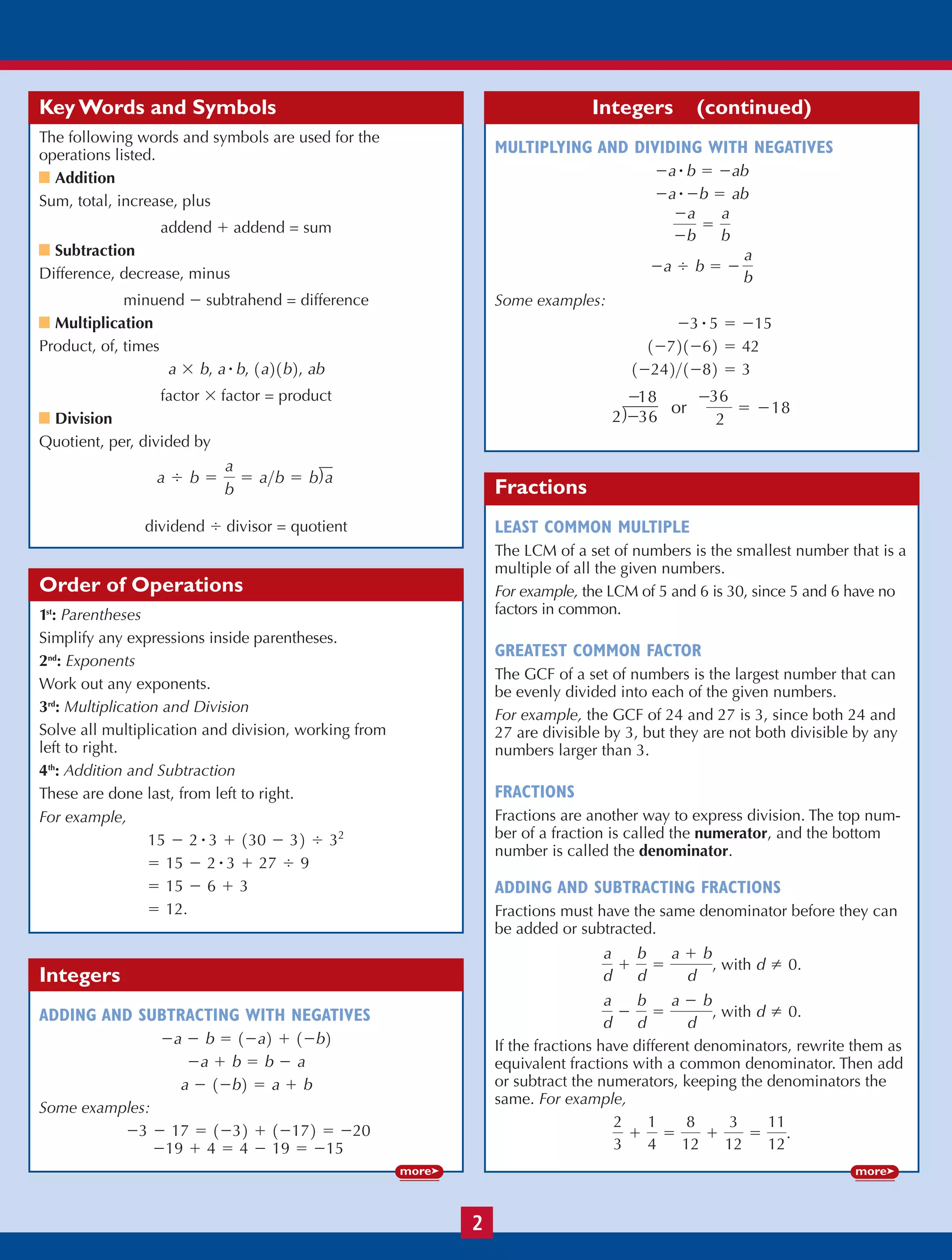
Integers (continued)
MULTIPLYING AND DIVIDING WITH NEGATIVES
Some examples:
Fractions
LEAST COMMON MULTIPLE
The LCM of a set of numbers is the smallest number that is a
multiple of all the given numbers.
For example, the LCM of 5 and 6 is 30, since 5 and 6 have no
factors in common.
GREATEST COMMON FACTOR
The GCF of a set of numbers is the largest number that can
be evenly divided into each of the given numbers.
For example, the GCF of 24 and 27 is 3, since both 24 and
27 are divisible by 3, but they are not both divisible by any
numbers larger than 3.
FRACTIONS
Fractions are another way to express division. The top num-
ber of a fraction is called the numerator, and the bottom
number is called the denominator.
ADDING AND SUBTRACTING FRACTIONS
Fractions must have the same denominator before they can
be added or subtracted.
, with .
, with .
If the fractions have different denominators, rewrite them as
equivalent fractions with a common denominator. Then add
or subtract the numerators, keeping the denominators the
same. For example,
.
2
3
+
1
4
=
8
12
+
3
12
=
11
12
d Z 0
a
d
-
b
d
=
a - b
d
d Z 0
a
d
+
b
d
=
a + b
d
or
36
2
ϭ Ϫ18
Ϫ2ͤ 36
18Ϫ Ϫ
1-242>1-82 = 3
1-721-62 = 42
-3 # 5 = -15
-a , b = -
a
b
-a
-b
=
a
b
-a # -b = ab
-a # b = -ab
Important Properties
PROPERTIES OF ADDITION
Identity Property of Zero:
Inverse Property:
Commutative Property:
Associative Property:
PROPERTIES OF MULTIPLICATION
Property of Zero:
Identity Property of One: , when .
Inverse Property: , when .
Commutative Property:
Associative Property:
PROPERTIES OF DIVISION
Property of Zero: , when .
Property of One: , when .
Identity Property of One:
AbsoluteValue
The absolute value of a number is always ≥ 0.
If , .
If , .
For example, and . In each case, the
answer is positive.
ƒ5ƒ = 5ƒ -5ƒ = 5
ƒ aƒ = aa 6 0
ƒaƒ = aa 7 0
a
1
= a # 1
a Z 0
a
a
= 1
a Z 0
0
a
= 0
a # 1b # c2 = 1a # b2 # c
a # b = b # a
a Z 0a # 1
a
= 1
a Z 0a # 1 = a
a # 0 = 0
a + 1b + c2 = 1a + b2 + c
a + b = b + a
a + 1-a2 = 0
a + 0 = a
Key Words and Symbols
The following words and symbols are used for the
operations listed.
Addition
Sum, total, increase, plus
addend ϩ addend = sum
Subtraction
Difference, decrease, minus
minuend Ϫ subtrahend = difference
Multiplication
Product, of, times
factor ϫ factor = product
Division
Quotient, per, divided by
dividend Ϭ divisor = quotient
Order of Operations
1st
: Parentheses
Simplify any expressions inside parentheses.
2nd
: Exponents
Work out any exponents.
3rd
: Multiplication and Division
Solve all multiplication and division, working from
left to right.
4th
: Addition and Subtraction
These are done last, from left to right.
For example,
.
Integers
ADDING AND SUBTRACTING WITH NEGATIVES
Some examples:
-19 + 4 = 4 - 19 = -15
-3 - 17 = 1-32 + 1-172 = -20
a - 1-b2 = a + b
-a + b = b - a
-a - b = 1-a2 + 1-b2
= 12
= 15 - 6 + 3
= 15 - 2 # 3 + 27 , 9
15 - 2 # 3 + 130 - 32 , 32
a Ϭ b ϭ
a
b
ϭ a>b ϭ bͤa
a * b, a # b, 1a21b2, ab
more➤
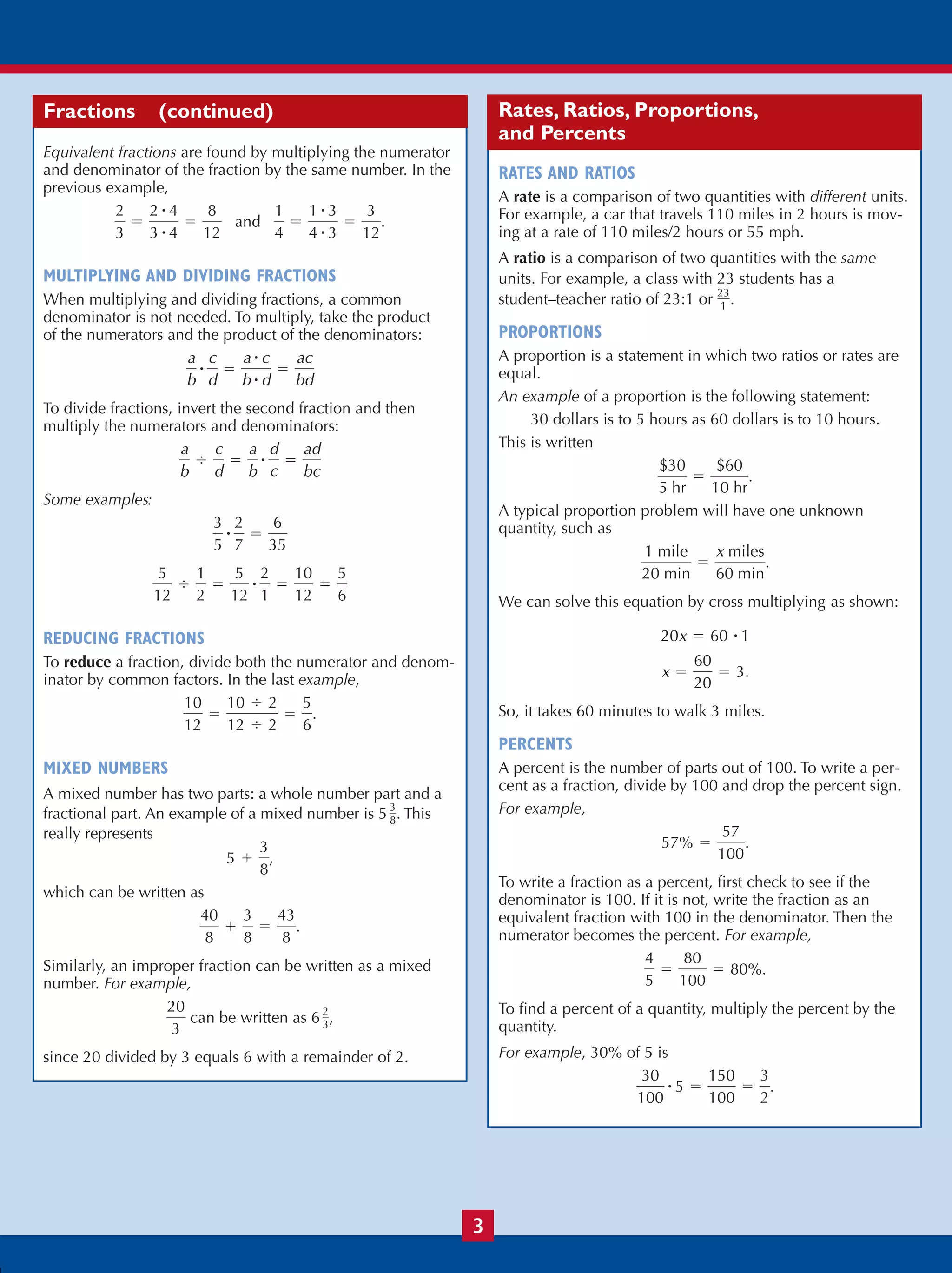
Rates, Ratios, Proportions,
and Percents
RATES AND RATIOS
A rate is a comparison of two quantities with different units.
For example, a car that travels 110 miles in 2 hours is mov-
ing at a rate of 110 miles/2 hours or 55 mph.
A ratio is a comparison of two quantities with the same
units. For example, a class with 23 students has a
student–teacher ratio of 23:1 or .
PROPORTIONS
A proportion is a statement in which two ratios or rates are
equal.
An example of a proportion is the following statement:
30 dollars is to 5 hours as 60 dollars is to 10 hours.
This is written
.
A typical proportion problem will have one unknown
quantity, such as
.
We can solve this equation by cross multiplying as shown:
.
So, it takes 60 minutes to walk 3 miles.
PERCENTS
A percent is the number of parts out of 100. To write a per-
cent as a fraction, divide by 100 and drop the percent sign.
For example,
.
To write a fraction as a percent, first check to see if the
denominator is 100. If it is not, write the fraction as an
equivalent fraction with 100 in the denominator. Then the
numerator becomes the percent. For example,
.
To find a percent of a quantity, multiply the percent by the
quantity.
For example, 30% of 5 is
.
30
100
# 5 =
150
100
=
3
2
4
5
=
80
100
= 80%
57% =
57
100
x =
60
20
= 3
20x = 60 # 1
1 mile
20 min
=
x miles
60 min
$30
5 hr
=
$60
10 hr
23
1
Fractions (continued)
Equivalent fractions are found by multiplying the numerator
and denominator of the fraction by the same number. In the
previous example,
and .
MULTIPLYING AND DIVIDING FRACTIONS
When multiplying and dividing fractions, a common
denominator is not needed. To multiply, take the product
of the numerators and the product of the denominators:
To divide fractions, invert the second fraction and then
multiply the numerators and denominators:
Some examples:
REDUCING FRACTIONS
To reduce a fraction, divide both the numerator and denom-
inator by common factors. In the last example,
.
MIXED NUMBERS
A mixed number has two parts: a whole number part and a
fractional part. An example of a mixed number is . This
really represents
,
which can be written as
.
Similarly, an improper fraction can be written as a mixed
number. For example,
can be written as ,
since 20 divided by 3 equals 6 with a remainder of 2.
6 2
3
20
3
40
8
+
3
8
=
43
8
5 +
3
8
5 3
8
10
12
=
10 , 2
12 , 2
=
5
6
5
12
,
1
2
=
5
12
# 2
1
=
10
12
=
5
6
3
5
# 2
7
=
6
35
a
b
,
c
d
=
a
b
# d
c
=
ad
bc
a
b
# c
d
=
a # c
b # d
=
ac
bd
1
4
=
1 # 3
4 # 3
=
3
12
2
3
=
2 # 4
3 # 4
=
8
12
more➤
NEWCOLORs_basic_math_rev 3/31/08 3:52 PM Page 1
-
1 2 3
Basic Math Review
Numbers
NATURAL NUMBERS
{1, 2, 3, 4, 5, …}
WHOLE NUMBERS
{0, 1, 2, 3, 4, …}
INTEGERS
{…, Ϫ3, Ϫ2, Ϫ1, 0, 1, 2, …}
RATIONAL NUMBERS
All numbers that can be written in the form , where a
and b are integers and .
IRRATIONAL NUMBERS
Real numbers that cannot be written as the quotient of two
integers but can be represented on the number line.
REAL NUMBERS
Include all numbers that can be represented on the number
line, that is, all rational and irrational numbers.
PRIME NUMBERS
A prime number is a number greater than 1 that has only
itself and 1 as factors.
Some examples:
2, 3, and 7 are prime numbers.
COMPOSITE NUMBERS
A composite number is a number that is not prime. For
example, 8 is a composite number since
.8 = 2 # 2 # 2 = 23
Rational Numbers
Real Numbers
23, 22.4, 21 , 0, 0.6, 1, etc.24_
5
25VN
Irrational
Numbers
p 23, 22, 21, 0, 1, 2, 3, pIntegers
0, 1, 2, 3, pWhole Numbers
Natural Numbers 1, 2, 3, p
3,
2, p, etc.VN
b Z 0
a>b
–5–5 –4–4 –3–3
Negative integersNegative integers Positive integers
The Number Line
Zero
–2–2 –1–1 0 1 2 3 4 5
ISBN-13:
ISBN-10:
978-0-321-39476-7
0-321-39476-3
9 7 8 0 3 2 1 3 9 4 7 6 7
9 0 0 0 0
Integers (continued)
MULTIPLYING AND DIVIDING WITH NEGATIVES
Some examples:
Fractions
LEAST COMMON MULTIPLE
The LCM of a set of numbers is the smallest number that is a
multiple of all the given numbers.
For example, the LCM of 5 and 6 is 30, since 5 and 6 have no
factors in common.
GREATEST COMMON FACTOR
The GCF of a set of numbers is the largest number that can
be evenly divided into each of the given numbers.
For example, the GCF of 24 and 27 is 3, since both 24 and
27 are divisible by 3, but they are not both divisible by any
numbers larger than 3.
FRACTIONS
Fractions are another way to express division. The top num-
ber of a fraction is called the numerator, and the bottom
number is called the denominator.
ADDING AND SUBTRACTING FRACTIONS
Fractions must have the same denominator before they can
be added or subtracted.
, with .
, with .
If the fractions have different denominators, rewrite them as
equivalent fractions with a common denominator. Then add
or subtract the numerators, keeping the denominators the
same. For example,
.
2
3
+
1
4
=
8
12
+
3
12
=
11
12
d Z 0
a
d
-
b
d
=
a - b
d
d Z 0
a
d
+
b
d
=
a + b
d
or
36
2
ϭ Ϫ18
Ϫ2ͤ 36
18Ϫ Ϫ
1-242>1-82 = 3
1-721-62 = 42
-3 # 5 = -15
-a , b = -
a
b
-a
-b
=
a
b
-a # -b = ab
-a # b = -ab
Important Properties
PROPERTIES OF ADDITION
Identity Property of Zero:
Inverse Property:
Commutative Property:
Associative Property:
PROPERTIES OF MULTIPLICATION
Property of Zero:
Identity Property of One: , when .
Inverse Property: , when .
Commutative Property:
Associative Property:
PROPERTIES OF DIVISION
Property of Zero: , when .
Property of One: , when .
Identity Property of One:
AbsoluteValue
The absolute value of a number is always ≥ 0.
If , .
If , .
For example, and . In each case, the
answer is positive.
ƒ5ƒ = 5ƒ -5ƒ = 5
ƒ aƒ = aa 6 0
ƒaƒ = aa 7 0
a
1
= a # 1
a Z 0
a
a
= 1
a Z 0
0
a
= 0
a # 1b # c2 = 1a # b2 # c
a # b = b # a
a Z 0a # 1
a
= 1
a Z 0a # 1 = a
a # 0 = 0
a + 1b + c2 = 1a + b2 + c
a + b = b + a
a + 1-a2 = 0
a + 0 = a
Key Words and Symbols
The following words and symbols are used for the
operations listed.
Addition
Sum, total, increase, plus
addend ϩ addend = sum
Subtraction
Difference, decrease, minus
minuend Ϫ subtrahend = difference
Multiplication
Product, of, times
factor ϫ factor = product
Division
Quotient, per, divided by
dividend Ϭ divisor = quotient
Order of Operations
1st
: Parentheses
Simplify any expressions inside parentheses.
2nd
: Exponents
Work out any exponents.
3rd
: Multiplication and Division
Solve all multiplication and division, working from
left to right.
4th
: Addition and Subtraction
These are done last, from left to right.
For example,
.
Integers
ADDING AND SUBTRACTING WITH NEGATIVES
Some examples:
-19 + 4 = 4 - 19 = -15
-3 - 17 = 1-32 + 1-172 = -20
a - 1-b2 = a + b
-a + b = b - a
-a - b = 1-a2 + 1-b2
= 12
= 15 - 6 + 3
= 15 - 2 # 3 + 27 , 9
15 - 2 # 3 + 130 - 32 , 32
a Ϭ b ϭ
a
b
ϭ a>b ϭ bͤa
a * b, a # b, 1a21b2, ab
more➤
Rates, Ratios, Proportions,
and Percents
RATES AND RATIOS
A rate is a comparison of two quantities with different units.
For example, a car that travels 110 miles in 2 hours is mov-
ing at a rate of 110 miles/2 hours or 55 mph.
A ratio is a comparison of two quantities with the same
units. For example, a class with 23 students has a
student–teacher ratio of 23:1 or .
PROPORTIONS
A proportion is a statement in which two ratios or rates are
equal.
An example of a proportion is the following statement:
30 dollars is to 5 hours as 60 dollars is to 10 hours.
This is written
.
A typical proportion problem will have one unknown
quantity, such as
.
We can solve this equation by cross multiplying as shown:
.
So, it takes 60 minutes to walk 3 miles.
PERCENTS
A percent is the number of parts out of 100. To write a per-
cent as a fraction, divide by 100 and drop the percent sign.
For example,
.
To write a fraction as a percent, first check to see if the
denominator is 100. If it is not, write the fraction as an
equivalent fraction with 100 in the denominator. Then the
numerator becomes the percent. For example,
.
To find a percent of a quantity, multiply the percent by the
quantity.
For example, 30% of 5 is
.
30
100
# 5 =
150
100
=
3
2
4
5
=
80
100
= 80%
57% =
57
100
x =
60
20
= 3
20x = 60 # 1
1 mile
20 min
=
x miles
60 min
$30
5 hr
=
$60
10 hr
23
1
Fractions (continued)
Equivalent fractions are found by multiplying the numerator
and denominator of the fraction by the same number. In the
previous example,
and .
MULTIPLYING AND DIVIDING FRACTIONS
When multiplying and dividing fractions, a common
denominator is not needed. To multiply, take the product
of the numerators and the product of the denominators:
To divide fractions, invert the second fraction and then
multiply the numerators and denominators:
Some examples:
REDUCING FRACTIONS
To reduce a fraction, divide both the numerator and denom-
inator by common factors. In the last example,
.
MIXED NUMBERS
A mixed number has two parts: a whole number part and a
fractional part. An example of a mixed number is . This
really represents
,
which can be written as
.
Similarly, an improper fraction can be written as a mixed
number. For example,
can be written as ,
since 20 divided by 3 equals 6 with a remainder of 2.
6 2
3
20
3
40
8
+
3
8
=
43
8
5 +
3
8
5 3
8
10
12
=
10 , 2
12 , 2
=
5
6
5
12
,
1
2
=
5
12
# 2
1
=
10
12
=
5
6
3
5
# 2
7
=
6
35
a
b
,
c
d
=
a
b
# d
c
=
ad
bc
a
b
# c
d
=
a # c
b # d
=
ac
bd
1
4
=
1 # 3
4 # 3
=
3
12
2
3
=
2 # 4
3 # 4
=
8
12
more➤
NEWCOLORs_basic_math_rev 3/31/08 3:52 PM Page 1
-
1 2 3
Basic Math Review
Numbers
NATURAL NUMBERS
{1, 2, 3, 4, 5, …}
WHOLE NUMBERS
{0, 1, 2, 3, 4, …}
INTEGERS
{…, Ϫ3, Ϫ2, Ϫ1, 0, 1, 2, …}
RATIONAL NUMBERS
All numbers that can be written in the form , where a
and b are integers and .
IRRATIONAL NUMBERS
Real numbers that cannot be written as the quotient of two
integers but can be represented on the number line.
REAL NUMBERS
Include all numbers that can be represented on the number
line, that is, all rational and irrational numbers.
PRIME NUMBERS
A prime number is a number greater than 1 that has only
itself and 1 as factors.
Some examples:
2, 3, and 7 are prime numbers.
COMPOSITE NUMBERS
A composite number is a number that is not prime. For
example, 8 is a composite number since
.8 = 2 # 2 # 2 = 23
Rational Numbers
Real Numbers
23, 22.4, 21 , 0, 0.6, 1, etc.24_
5
25VN
Irrational
Numbers
p 23, 22, 21, 0, 1, 2, 3, pIntegers
0, 1, 2, 3, pWhole Numbers
Natural Numbers 1, 2, 3, p
3,
2, p, etc.VN
b Z 0
a>b
–5–5 –4–4 –3–3
Negative integersNegative integers Positive integers
The Number Line
Zero
–2–2 –1–1 0 1 2 3 4 5
ISBN-13:
ISBN-10:
978-0-321-39476-7
0-321-39476-3
9 7 8 0 3 2 1 3 9 4 7 6 7
9 0 0 0 0
Integers (continued)
MULTIPLYING AND DIVIDING WITH NEGATIVES
Some examples:
Fractions
LEAST COMMON MULTIPLE
The LCM of a set of numbers is the smallest number that is a
multiple of all the given numbers.
For example, the LCM of 5 and 6 is 30, since 5 and 6 have no
factors in common.
GREATEST COMMON FACTOR
The GCF of a set of numbers is the largest number that can
be evenly divided into each of the given numbers.
For example, the GCF of 24 and 27 is 3, since both 24 and
27 are divisible by 3, but they are not both divisible by any
numbers larger than 3.
FRACTIONS
Fractions are another way to express division. The top num-
ber of a fraction is called the numerator, and the bottom
number is called the denominator.
ADDING AND SUBTRACTING FRACTIONS
Fractions must have the same denominator before they can
be added or subtracted.
, with .
, with .
If the fractions have different denominators, rewrite them as
equivalent fractions with a common denominator. Then add
or subtract the numerators, keeping the denominators the
same. For example,
.
2
3
+
1
4
=
8
12
+
3
12
=
11
12
d Z 0
a
d
-
b
d
=
a - b
d
d Z 0
a
d
+
b
d
=
a + b
d
or
36
2
ϭ Ϫ18
Ϫ2ͤ 36
18Ϫ Ϫ
1-242>1-82 = 3
1-721-62 = 42
-3 # 5 = -15
-a , b = -
a
b
-a
-b
=
a
b
-a # -b = ab
-a # b = -ab
Important Properties
PROPERTIES OF ADDITION
Identity Property of Zero:
Inverse Property:
Commutative Property:
Associative Property:
PROPERTIES OF MULTIPLICATION
Property of Zero:
Identity Property of One: , when .
Inverse Property: , when .
Commutative Property:
Associative Property:
PROPERTIES OF DIVISION
Property of Zero: , when .
Property of One: , when .
Identity Property of One:
AbsoluteValue
The absolute value of a number is always ≥ 0.
If , .
If , .
For example, and . In each case, the
answer is positive.
ƒ5ƒ = 5ƒ -5ƒ = 5
ƒ aƒ = aa 6 0
ƒaƒ = aa 7 0
a
1
= a # 1
a Z 0
a
a
= 1
a Z 0
0
a
= 0
a # 1b # c2 = 1a # b2 # c
a # b = b # a
a Z 0a # 1
a
= 1
a Z 0a # 1 = a
a # 0 = 0
a + 1b + c2 = 1a + b2 + c
a + b = b + a
a + 1-a2 = 0
a + 0 = a
Key Words and Symbols
The following words and symbols are used for the
operations listed.
Addition
Sum, total, increase, plus
addend ϩ addend = sum
Subtraction
Difference, decrease, minus
minuend Ϫ subtrahend = difference
Multiplication
Product, of, times
factor ϫ factor = product
Division
Quotient, per, divided by
dividend Ϭ divisor = quotient
Order of Operations
1st
: Parentheses
Simplify any expressions inside parentheses.
2nd
: Exponents
Work out any exponents.
3rd
: Multiplication and Division
Solve all multiplication and division, working from
left to right.
4th
: Addition and Subtraction
These are done last, from left to right.
For example,
.
Integers
ADDING AND SUBTRACTING WITH NEGATIVES
Some examples:
-19 + 4 = 4 - 19 = -15
-3 - 17 = 1-32 + 1-172 = -20
a - 1-b2 = a + b
-a + b = b - a
-a - b = 1-a2 + 1-b2
= 12
= 15 - 6 + 3
= 15 - 2 # 3 + 27 , 9
15 - 2 # 3 + 130 - 32 , 32
a Ϭ b ϭ
a
b
ϭ a>b ϭ bͤa
a * b, a # b, 1a21b2, ab
more➤
Rates, Ratios, Proportions,
and Percents
RATES AND RATIOS
A rate is a comparison of two quantities with different units.
For example, a car that travels 110 miles in 2 hours is mov-
ing at a rate of 110 miles/2 hours or 55 mph.
A ratio is a comparison of two quantities with the same
units. For example, a class with 23 students has a
student–teacher ratio of 23:1 or .
PROPORTIONS
A proportion is a statement in which two ratios or rates are
equal.
An example of a proportion is the following statement:
30 dollars is to 5 hours as 60 dollars is to 10 hours.
This is written
.
A typical proportion problem will have one unknown
quantity, such as
.
We can solve this equation by cross multiplying as shown:
.
So, it takes 60 minutes to walk 3 miles.
PERCENTS
A percent is the number of parts out of 100. To write a per-
cent as a fraction, divide by 100 and drop the percent sign.
For example,
.
To write a fraction as a percent, first check to see if the
denominator is 100. If it is not, write the fraction as an
equivalent fraction with 100 in the denominator. Then the
numerator becomes the percent. For example,
.
To find a percent of a quantity, multiply the percent by the
quantity.
For example, 30% of 5 is
.
30
100
# 5 =
150
100
=
3
2
4
5
=
80
100
= 80%
57% =
57
100
x =
60
20
= 3
20x = 60 # 1
1 mile
20 min
=
x miles
60 min
$30
5 hr
=
$60
10 hr
23
1
Fractions (continued)
Equivalent fractions are found by multiplying the numerator
and denominator of the fraction by the same number. In the
previous example,
and .
MULTIPLYING AND DIVIDING FRACTIONS
When multiplying and dividing fractions, a common
denominator is not needed. To multiply, take the product
of the numerators and the product of the denominators:
To divide fractions, invert the second fraction and then
multiply the numerators and denominators:
Some examples:
REDUCING FRACTIONS
To reduce a fraction, divide both the numerator and denom-
inator by common factors. In the last example,
.
MIXED NUMBERS
A mixed number has two parts: a whole number part and a
fractional part. An example of a mixed number is . This
really represents
,
which can be written as
.
Similarly, an improper fraction can be written as a mixed
number. For example,
can be written as ,
since 20 divided by 3 equals 6 with a remainder of 2.
6 2
3
20
3
40
8
+
3
8
=
43
8
5 +
3
8
5 3
8
10
12
=
10 , 2
12 , 2
=
5
6
5
12
,
1
2
=
5
12
# 2
1
=
10
12
=
5
6
3
5
# 2
7
=
6
35
a
b
,
c
d
=
a
b
# d
c
=
ad
bc
a
b
# c
d
=
a # c
b # d
=
ac
bd
1
4
=
1 # 3
4 # 3
=
3
12
2
3
=
2 # 4
3 # 4
=
8
12
more➤
NEWCOLORs_basic_math_rev 3/31/08 3:52 PM Page 1
-
Basic Math Review
4 5 6
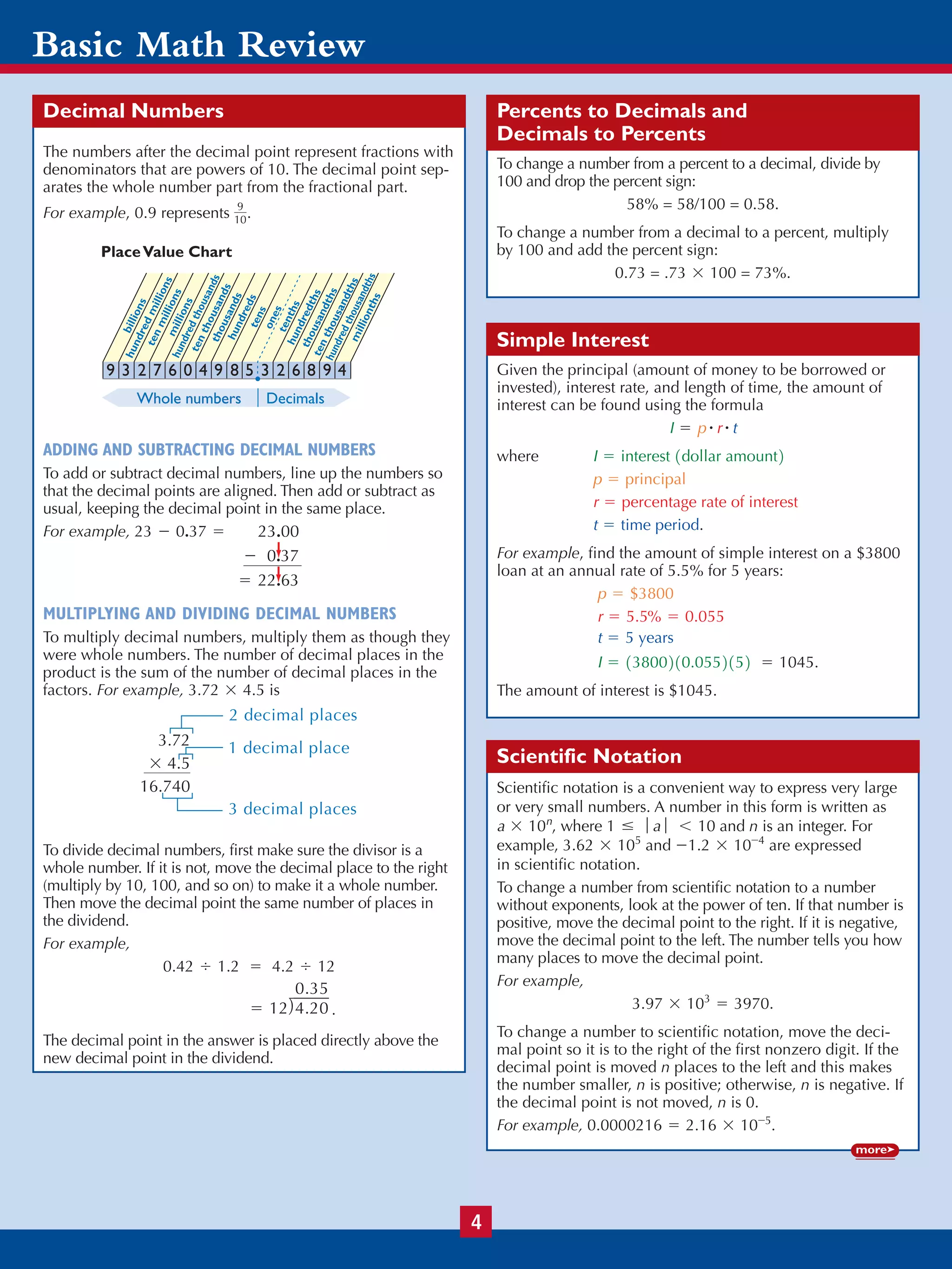
Percents to Decimals and
Decimals to Percents
To change a number from a percent to a decimal, divide by
100 and drop the percent sign:
58% = 58/100 = 0.58.
To change a number from a decimal to a percent, multiply
by 100 and add the percent sign:
0.73 = .73 100 = 73%.
Simple Interest
Given the principal (amount of money to be borrowed or
invested), interest rate, and length of time, the amount of
interest can be found using the formula
where
.
For example, find the amount of simple interest on a $3800
loan at an annual rate of 5.5% for 5 years:
.
The amount of interest is $1045.
Scientific Notation
Scientific notation is a convenient way to express very large
or very small numbers. A number in this form is written as
, where and n is an integer. For
example, and are expressed
in scientific notation.
To change a number from scientific notation to a number
without exponents, look at the power of ten. If that number is
positive, move the decimal point to the right. If it is negative,
move the decimal point to the left. The number tells you how
many places to move the decimal point.
For example,
.
To change a number to scientific notation, move the deci-
mal point so it is to the right of the first nonzero digit. If the
decimal point is moved n places to the left and this makes
the number smaller, n is positive; otherwise, n is negative. If
the decimal point is not moved, n is 0.
For example, .0.0000216 = 2.16 * 10-5
3.97 * 103
= 3970
-1.2 * 10-4
3.62 * 105
1 … ƒ a ƒ 6 10a * 10n
I = 13800210.0552152 = 1045
t = 5 years
r = 5.5% = 0.055
p = $3800
t = time period
r = percentage rate of interest
p = principal
I = interest 1dollar amount2
I = p # r # t
*
Decimal Numbers
The numbers after the decimal point represent fractions with
denominators that are powers of 10. The decimal point sep-
arates the whole number part from the fractional part.
For example, 0.9 represents .
ADDING AND SUBTRACTING DECIMAL NUMBERS
To add or subtract decimal numbers, line up the numbers so
that the decimal points are aligned. Then add or subtract as
usual, keeping the decimal point in the same place.
For example,
MULTIPLYING AND DIVIDING DECIMAL NUMBERS
To multiply decimal numbers, multiply them as though they
were whole numbers. The number of decimal places in the
product is the sum of the number of decimal places in the
factors. For example, is
To divide decimal numbers, first make sure the divisor is a
whole number. If it is not, move the decimal place to the right
(multiply by 10, 100, and so on) to make it a whole number.
Then move the decimal point the same number of places in
the dividend.
For example,
.
The decimal point in the answer is placed directly above the
new decimal point in the dividend.
ϭ 12ͤ4.20
0.35
0.42 , 1.2 = 4.2 , 12
2 decimal places
3 decimal places
1 decimal place3.72
ϫ 4.5
16.740
3.72 * 4.5
23.00
Ϫ 0.37
ϭ 22.63
23 - 0.37 =
9
billions
hundredmillions
tenmillionsmillions
hundredthousands
tenthousands
thousands
hundredstens
onestenthshundredths
thousandths
tenthousandths
hundredthousandths
millionths
3 2 7 6 0 4 9 8 5 3 2 6 8 9 4
PlaceValue Chart
Whole numbersWhole numbers Decimals
9
10
more➤
Measurements
U.S. Measurement Units
in. = inch oz = ounce
ft = foot c = cup
min = minute mi = mile
sec = second hr = hour
gal = gallon lb = pound
yd = yard qt = quart
pt = pint T = ton
Metric Units
mm = millimeter
cm = centimeter
km = kilometer
m = meter
mL = milliliter
cL = centiliter
L = liter
kL = kiloliter
mg = milligram
cg = centigram
g = gram
kg = kilogram
U.S. AND METRIC CONVERSIONS
U.S.
12 in. = 1 ft 3 ft = 1 yd
1760 yd = 1 mi 5280 ft = 1 mi
2 c = 1 pt 1 c = 8 oz
4 qt = 1 gal 2 pt = 1 qt
2000 lb = 1 T 16 oz = 1 lb
Metric
1000 mm = 1 m 100 cm = 1 m
1000 m = 1 km 100 cL = 1 L
1000 mL = 1 L 100 cg = 1 g
1000 mg = 1 g 1000 g = 1 kg
0.001 m = 1 mm 0.01 m = 1 cm
0.001 g = 1 mg 0.01 g = 1 cg
0.001 L = 1 mL 0.01 L = 1 cL
Geometry
The perimeter of a geometric figure is the distance around it
or the sum of the lengths of its sides.
The perimeter of a rectangle is 2 times the length plus 2
times the width:
The perimeter of a square is 4 times the length of a side:
Area is always expressed in square units, since it is two-
dimensional.
The formula for area of a rectangle is
.
The formula for area of a square is
or .
The area of a triangle is one-half the product of the height
and base:
The sum of all three angles in any triangle always equals
180 degrees.
A right triangle is a triangle with a (right) angle. The
hypotenuse of a right triangle is the side opposite the right
angle.
hypotenuse
90°
90°
x° + y° + z° = 180°
x
y
z
A =
1
2
b # h
h
b
A = s2
A = s # s
A = L # W
P = 4s
s
s
P = 2L + 2W
L
W
Scientific Notation (continued)
MULTIPLYING AND DIVIDING IN SCIENTIFIC NOTATION
To multiply or divide numbers in scientific notation, we can
change the order and grouping, so that we multiply or divide
first the decimal parts and then the powers of 10. For example,
Statistics
There are several ways to study a list of data.
Mean, or average, is the sum of all the data values divided by
the number of values.
Median is the number that separates the list of data into two
equal parts. To find the median, list the data in order from
smallest to largest. If the number of data is odd, the median is
the middle number. If the number of data is even, the median
is the average of the two middle numbers.
Mode is the number in the list that occurs the most fre-
quently. There can be more than one mode.
For example, consider the following list of test scores:
{87, 56, 69, 87, 93, 82}
To find the mean, first add:
.
Then divide by 6:
.
The mean score is 79.
To find the median, first list the data in order:
56, 69, 82, 87, 87, 93.
Since there is an even number of data, we take the average
of 82 and 87:
.
The median score is 84.5.
The mode is 87, since this number appears twice and each
of the other numbers appears only once.
Distance Formula
Given the rate at which you are traveling and the length of
time you will be traveling, the distance can be found by
using the formula
where
t = time
r = rate
d = distance
d = r # t
82 + 87
2
=
169
2
= 84.5
474
6
= 79
87 + 56 + 69 + 87 + 93 + 82 = 474
= 9.25 * 105
.
= 13.7 * 2.52 # 110-3
* 108
2
13.7 * 10-3
2 # 12.5 * 108
2
more➤
Geometry (continued)
PYTHAGOREAN THEOREM
In any right triangle, if a and b are the lengths of the legs
and c is the length of the hypotenuse, then
CIRCLES
Area:
Circumference:
where d is the diameter, r is the radius, or half the diameter,
and is approximately 3.14 or .
A circle has an angle of 360 degrees.
A straight line has an angle of 180 degrees.
AlgebraicTerms
Variable: A variable is a letter that represents a number
because the number is unknown or because it can change.
For example, the number of days until your vacation
changes every day, so it could be represented by a
variable, x.
Constant: A constant is a term that does not change. For
example, the number of days in the week, 7, does not
change, so it is a constant.
Expression: An algebraic expression consists of constants,
variables, numerals and at least one operation. For example,
is an expression.
Equation: An equation is basically a mathematical sentence
indicating that two expressions are equal. For example,
is an equation.
Solution: A number that makes an equation true is a
solution to that equation. For example, in using the above
equation, , we know that the statement is true
if .x = 11
x + 7 = 18
x + 7 = 18
x + 7
d
r
22
7p
C = p # d = 2 # p # r
A = p # r2
c
a
b
a2
+ b2
= c2
.
NEWCOLORs_basic_math_rev 3/31/08 3:52 PM Page 2
Basic Math Review
4 5 6
Percents to Decimals and
Decimals to Percents
To change a number from a percent to a decimal, divide by
100 and drop the percent sign:
58% = 58/100 = 0.58.
To change a number from a decimal to a percent, multiply
by 100 and add the percent sign:
0.73 = .73 100 = 73%.
Simple Interest
Given the principal (amount of money to be borrowed or
invested), interest rate, and length of time, the amount of
interest can be found using the formula
where
.
For example, find the amount of simple interest on a $3800
loan at an annual rate of 5.5% for 5 years:
.
The amount of interest is $1045.
Scientific Notation
Scientific notation is a convenient way to express very large
or very small numbers. A number in this form is written as
, where and n is an integer. For
example, and are expressed
in scientific notation.
To change a number from scientific notation to a number
without exponents, look at the power of ten. If that number is
positive, move the decimal point to the right. If it is negative,
move the decimal point to the left. The number tells you how
many places to move the decimal point.
For example,
.
To change a number to scientific notation, move the deci-
mal point so it is to the right of the first nonzero digit. If the
decimal point is moved n places to the left and this makes
the number smaller, n is positive; otherwise, n is negative. If
the decimal point is not moved, n is 0.
For example, .0.0000216 = 2.16 * 10-5
3.97 * 103
= 3970
-1.2 * 10-4
3.62 * 105
1 … ƒ a ƒ 6 10a * 10n
I = 13800210.0552152 = 1045
t = 5 years
r = 5.5% = 0.055
p = $3800
t = time period
r = percentage rate of interest
p = principal
I = interest 1dollar amount2
I = p # r # t
*
Decimal Numbers
The numbers after the decimal point represent fractions with
denominators that are powers of 10. The decimal point sep-
arates the whole number part from the fractional part.
For example, 0.9 represents .
ADDING AND SUBTRACTING DECIMAL NUMBERS
To add or subtract decimal numbers, line up the numbers so
that the decimal points are aligned. Then add or subtract as
usual, keeping the decimal point in the same place.
For example,
MULTIPLYING AND DIVIDING DECIMAL NUMBERS
To multiply decimal numbers, multiply them as though they
were whole numbers. The number of decimal places in the
product is the sum of the number of decimal places in the
factors. For example, is
To divide decimal numbers, first make sure the divisor is a
whole number. If it is not, move the decimal place to the right
(multiply by 10, 100, and so on) to make it a whole number.
Then move the decimal point the same number of places in
the dividend.
For example,
.
The decimal point in the answer is placed directly above the
new decimal point in the dividend.
ϭ 12ͤ4.20
0.35
0.42 , 1.2 = 4.2 , 12
2 decimal places
3 decimal places
1 decimal place3.72
ϫ 4.5
16.740
3.72 * 4.5
23.00
Ϫ 0.37
ϭ 22.63
23 - 0.37 =
9
billions
hundredmillions
tenmillionsmillions
hundredthousands
tenthousands
thousands
hundredstens
onestenthshundredths
thousandths
tenthousandths
hundredthousandths
millionths
3 2 7 6 0 4 9 8 5 3 2 6 8 9 4
PlaceValue Chart
Whole numbersWhole numbers Decimals
9
10
more➤
Measurements
U.S. Measurement Units
in. = inch oz = ounce
ft = foot c = cup
min = minute mi = mile
sec = second hr = hour
gal = gallon lb = pound
yd = yard qt = quart
pt = pint T = ton
Metric Units
mm = millimeter
cm = centimeter
km = kilometer
m = meter
mL = milliliter
cL = centiliter
L = liter
kL = kiloliter
mg = milligram
cg = centigram
g = gram
kg = kilogram
U.S. AND METRIC CONVERSIONS
U.S.
12 in. = 1 ft 3 ft = 1 yd
1760 yd = 1 mi 5280 ft = 1 mi
2 c = 1 pt 1 c = 8 oz
4 qt = 1 gal 2 pt = 1 qt
2000 lb = 1 T 16 oz = 1 lb
Metric
1000 mm = 1 m 100 cm = 1 m
1000 m = 1 km 100 cL = 1 L
1000 mL = 1 L 100 cg = 1 g
1000 mg = 1 g 1000 g = 1 kg
0.001 m = 1 mm 0.01 m = 1 cm
0.001 g = 1 mg 0.01 g = 1 cg
0.001 L = 1 mL 0.01 L = 1 cL
Geometry
The perimeter of a geometric figure is the distance around it
or the sum of the lengths of its sides.
The perimeter of a rectangle is 2 times the length plus 2
times the width:
The perimeter of a square is 4 times the length of a side:
Area is always expressed in square units, since it is two-
dimensional.
The formula for area of a rectangle is
.
The formula for area of a square is
or .
The area of a triangle is one-half the product of the height
and base:
The sum of all three angles in any triangle always equals
180 degrees.
A right triangle is a triangle with a (right) angle. The
hypotenuse of a right triangle is the side opposite the right
angle.
hypotenuse
90°
90°
x° + y° + z° = 180°
x
y
z
A =
1
2
b # h
h
b
A = s2
A = s # s
A = L # W
P = 4s
s
s
P = 2L + 2W
L
W
Scientific Notation (continued)
MULTIPLYING AND DIVIDING IN SCIENTIFIC NOTATION
To multiply or divide numbers in scientific notation, we can
change the order and grouping, so that we multiply or divide
first the decimal parts and then the powers of 10. For example,
Statistics
There are several ways to study a list of data.
Mean, or average, is the sum of all the data values divided by
the number of values.
Median is the number that separates the list of data into two
equal parts. To find the median, list the data in order from
smallest to largest. If the number of data is odd, the median is
the middle number. If the number of data is even, the median
is the average of the two middle numbers.
Mode is the number in the list that occurs the most fre-
quently. There can be more than one mode.
For example, consider the following list of test scores:
{87, 56, 69, 87, 93, 82}
To find the mean, first add:
.
Then divide by 6:
.
The mean score is 79.
To find the median, first list the data in order:
56, 69, 82, 87, 87, 93.
Since there is an even number of data, we take the average
of 82 and 87:
.
The median score is 84.5.
The mode is 87, since this number appears twice and each
of the other numbers appears only once.
Distance Formula
Given the rate at which you are traveling and the length of
time you will be traveling, the distance can be found by
using the formula
where
t = time
r = rate
d = distance
d = r # t
82 + 87
2
=
169
2
= 84.5
474
6
= 79
87 + 56 + 69 + 87 + 93 + 82 = 474
= 9.25 * 105
.
= 13.7 * 2.52 # 110-3
* 108
2
13.7 * 10-3
2 # 12.5 * 108
2
more➤
Geometry (continued)
PYTHAGOREAN THEOREM
In any right triangle, if a and b are the lengths of the legs
and c is the length of the hypotenuse, then
CIRCLES
Area:
Circumference:
where d is the diameter, r is the radius, or half the diameter,
and is approximately 3.14 or .
A circle has an angle of 360 degrees.
A straight line has an angle of 180 degrees.
AlgebraicTerms
Variable: A variable is a letter that represents a number
because the number is unknown or because it can change.
For example, the number of days until your vacation
changes every day, so it could be represented by a
variable, x.
Constant: A constant is a term that does not change. For
example, the number of days in the week, 7, does not
change, so it is a constant.
Expression: An algebraic expression consists of constants,
variables, numerals and at least one operation. For example,
is an expression.
Equation: An equation is basically a mathematical sentence
indicating that two expressions are equal. For example,
is an equation.
Solution: A number that makes an equation true is a
solution to that equation. For example, in using the above
equation, , we know that the statement is true
if .x = 11
x + 7 = 18
x + 7 = 18
x + 7
d
r
22
7p
C = p # d = 2 # p # r
A = p # r2
c
a
b
a2
+ b2
= c2
.
NEWCOLORs_basic_math_rev 3/31/08 3:52 PM Page 2
Basic Math Review
4 5 6
Percents to Decimals and
Decimals to Percents
To change a number from a percent to a decimal, divide by
100 and drop the percent sign:
58% = 58/100 = 0.58.
To change a number from a decimal to a percent, multiply
by 100 and add the percent sign:
0.73 = .73 100 = 73%.
Simple Interest
Given the principal (amount of money to be borrowed or
invested), interest rate, and length of time, the amount of
interest can be found using the formula
where
.
For example, find the amount of simple interest on a $3800
loan at an annual rate of 5.5% for 5 years:
.
The amount of interest is $1045.
Scientific Notation
Scientific notation is a convenient way to express very large
or very small numbers. A number in this form is written as
, where and n is an integer. For
example, and are expressed
in scientific notation.
To change a number from scientific notation to a number
without exponents, look at the power of ten. If that number is
positive, move the decimal point to the right. If it is negative,
move the decimal point to the left. The number tells you how
many places to move the decimal point.
For example,
.
To change a number to scientific notation, move the deci-
mal point so it is to the right of the first nonzero digit. If the
decimal point is moved n places to the left and this makes
the number smaller, n is positive; otherwise, n is negative. If
the decimal point is not moved, n is 0.
For example, .0.0000216 = 2.16 * 10-5
3.97 * 103
= 3970
-1.2 * 10-4
3.62 * 105
1 … ƒ a ƒ 6 10a * 10n
I = 13800210.0552152 = 1045
t = 5 years
r = 5.5% = 0.055
p = $3800
t = time period
r = percentage rate of interest
p = principal
I = interest 1dollar amount2
I = p # r # t
*
Decimal Numbers
The numbers after the decimal point represent fractions with
denominators that are powers of 10. The decimal point sep-
arates the whole number part from the fractional part.
For example, 0.9 represents .
ADDING AND SUBTRACTING DECIMAL NUMBERS
To add or subtract decimal numbers, line up the numbers so
that the decimal points are aligned. Then add or subtract as
usual, keeping the decimal point in the same place.
For example,
MULTIPLYING AND DIVIDING DECIMAL NUMBERS
To multiply decimal numbers, multiply them as though they
were whole numbers. The number of decimal places in the
product is the sum of the number of decimal places in the
factors. For example, is
To divide decimal numbers, first make sure the divisor is a
whole number. If it is not, move the decimal place to the right
(multiply by 10, 100, and so on) to make it a whole number.
Then move the decimal point the same number of places in
the dividend.
For example,
.
The decimal point in the answer is placed directly above the
new decimal point in the dividend.
ϭ 12ͤ4.20
0.35
0.42 , 1.2 = 4.2 , 12
2 decimal places
3 decimal places
1 decimal place3.72
ϫ 4.5
16.740
3.72 * 4.5
23.00
Ϫ 0.37
ϭ 22.63
23 - 0.37 =
9
billions
hundredmillions
tenmillionsmillions
hundredthousands
tenthousands
thousands
hundredstens
onestenthshundredths
thousandths
tenthousandths
hundredthousandths
millionths
3 2 7 6 0 4 9 8 5 3 2 6 8 9 4
PlaceValue Chart
Whole numbersWhole numbers Decimals
9
10
more➤
Measurements
U.S. Measurement Units
in. = inch oz = ounce
ft = foot c = cup
min = minute mi = mile
sec = second hr = hour
gal = gallon lb = pound
yd = yard qt = quart
pt = pint T = ton
Metric Units
mm = millimeter
cm = centimeter
km = kilometer
m = meter
mL = milliliter
cL = centiliter
L = liter
kL = kiloliter
mg = milligram
cg = centigram
g = gram
kg = kilogram
U.S. AND METRIC CONVERSIONS
U.S.
12 in. = 1 ft 3 ft = 1 yd
1760 yd = 1 mi 5280 ft = 1 mi
2 c = 1 pt 1 c = 8 oz
4 qt = 1 gal 2 pt = 1 qt
2000 lb = 1 T 16 oz = 1 lb
Metric
1000 mm = 1 m 100 cm = 1 m
1000 m = 1 km 100 cL = 1 L
1000 mL = 1 L 100 cg = 1 g
1000 mg = 1 g 1000 g = 1 kg
0.001 m = 1 mm 0.01 m = 1 cm
0.001 g = 1 mg 0.01 g = 1 cg
0.001 L = 1 mL 0.01 L = 1 cL
Geometry
The perimeter of a geometric figure is the distance around it
or the sum of the lengths of its sides.
The perimeter of a rectangle is 2 times the length plus 2
times the width:
The perimeter of a square is 4 times the length of a side:
Area is always expressed in square units, since it is two-
dimensional.
The formula for area of a rectangle is
.
The formula for area of a square is
or .
The area of a triangle is one-half the product of the height
and base:
The sum of all three angles in any triangle always equals
180 degrees.
A right triangle is a triangle with a (right) angle. The
hypotenuse of a right triangle is the side opposite the right
angle.
hypotenuse
90°
90°
x° + y° + z° = 180°
x
y
z
A =
1
2
b # h
h
b
A = s2
A = s # s
A = L # W
P = 4s
s
s
P = 2L + 2W
L
W
Scientific Notation (continued)
MULTIPLYING AND DIVIDING IN SCIENTIFIC NOTATION
To multiply or divide numbers in scientific notation, we can
change the order and grouping, so that we multiply or divide
first the decimal parts and then the powers of 10. For example,
Statistics
There are several ways to study a list of data.
Mean, or average, is the sum of all the data values divided by
the number of values.
Median is the number that separates the list of data into two
equal parts. To find the median, list the data in order from
smallest to largest. If the number of data is odd, the median is
the middle number. If the number of data is even, the median
is the average of the two middle numbers.
Mode is the number in the list that occurs the most fre-
quently. There can be more than one mode.
For example, consider the following list of test scores:
{87, 56, 69, 87, 93, 82}
To find the mean, first add:
.
Then divide by 6:
.
The mean score is 79.
To find the median, first list the data in order:
56, 69, 82, 87, 87, 93.
Since there is an even number of data, we take the average
of 82 and 87:
.
The median score is 84.5.
The mode is 87, since this number appears twice and each
of the other numbers appears only once.
Distance Formula
Given the rate at which you are traveling and the length of
time you will be traveling, the distance can be found by
using the formula
where
t = time
r = rate
d = distance
d = r # t
82 + 87
2
=
169
2
= 84.5
474
6
= 79
87 + 56 + 69 + 87 + 93 + 82 = 474
= 9.25 * 105
.
= 13.7 * 2.52 # 110-3
* 108
2
13.7 * 10-3
2 # 12.5 * 108
2
more➤
Geometry (continued)
PYTHAGOREAN THEOREM
In any right triangle, if a and b are the lengths of the legs
and c is the length of the hypotenuse, then
CIRCLES
Area:
Circumference:
where d is the diameter, r is the radius, or half the diameter,
and is approximately 3.14 or .
A circle has an angle of 360 degrees.
A straight line has an angle of 180 degrees.
AlgebraicTerms
Variable: A variable is a letter that represents a number
because the number is unknown or because it can change.
For example, the number of days until your vacation
changes every day, so it could be represented by a
variable, x.
Constant: A constant is a term that does not change. For
example, the number of days in the week, 7, does not
change, so it is a constant.
Expression: An algebraic expression consists of constants,
variables, numerals and at least one operation. For example,
is an expression.
Equation: An equation is basically a mathematical sentence
indicating that two expressions are equal. For example,
is an equation.
Solution: A number that makes an equation true is a
solution to that equation. For example, in using the above
equation, , we know that the statement is true
if .x = 11
x + 7 = 18
x + 7 = 18
x + 7
d
r
22
7p
C = p # d = 2 # p # r
A = p # r2
c
a
b
a2
+ b2
= c2
.
NEWCOLORs_basic_math_rev 3/31/08 3:52 PM Page 2

Basic math review card

  • 1.
    1 2 3 BasicMath Review Numbers NATURAL NUMBERS {1, 2, 3, 4, 5, …} WHOLE NUMBERS {0, 1, 2, 3, 4, …} INTEGERS {…, Ϫ3, Ϫ2, Ϫ1, 0, 1, 2, …} RATIONAL NUMBERS All numbers that can be written in the form , where a and b are integers and . IRRATIONAL NUMBERS Real numbers that cannot be written as the quotient of two integers but can be represented on the number line. REAL NUMBERS Include all numbers that can be represented on the number line, that is, all rational and irrational numbers. PRIME NUMBERS A prime number is a number greater than 1 that has only itself and 1 as factors. Some examples: 2, 3, and 7 are prime numbers. COMPOSITE NUMBERS A composite number is a number that is not prime. For example, 8 is a composite number since .8 = 2 # 2 # 2 = 23 Rational Numbers Real Numbers 23, 22.4, 21 , 0, 0.6, 1, etc.24_ 5 25VN Irrational Numbers p 23, 22, 21, 0, 1, 2, 3, pIntegers 0, 1, 2, 3, pWhole Numbers Natural Numbers 1, 2, 3, p 3, 2, p, etc.VN b Z 0 a>b –5–5 –4–4 –3–3 Negative integersNegative integers Positive integers The Number Line Zero –2–2 –1–1 0 1 2 3 4 5 ISBN-13: ISBN-10: 978-0-321-39476-7 0-321-39476-3 9 7 8 0 3 2 1 3 9 4 7 6 7 9 0 0 0 0 Integers (continued) MULTIPLYING AND DIVIDING WITH NEGATIVES Some examples: Fractions LEAST COMMON MULTIPLE The LCM of a set of numbers is the smallest number that is a multiple of all the given numbers. For example, the LCM of 5 and 6 is 30, since 5 and 6 have no factors in common. GREATEST COMMON FACTOR The GCF of a set of numbers is the largest number that can be evenly divided into each of the given numbers. For example, the GCF of 24 and 27 is 3, since both 24 and 27 are divisible by 3, but they are not both divisible by any numbers larger than 3. FRACTIONS Fractions are another way to express division. The top num- ber of a fraction is called the numerator, and the bottom number is called the denominator. ADDING AND SUBTRACTING FRACTIONS Fractions must have the same denominator before they can be added or subtracted. , with . , with . If the fractions have different denominators, rewrite them as equivalent fractions with a common denominator. Then add or subtract the numerators, keeping the denominators the same. For example, . 2 3 + 1 4 = 8 12 + 3 12 = 11 12 d Z 0 a d - b d = a - b d d Z 0 a d + b d = a + b d or 36 2 ϭ Ϫ18 Ϫ2ͤ 36 18Ϫ Ϫ 1-242>1-82 = 3 1-721-62 = 42 -3 # 5 = -15 -a , b = - a b -a -b = a b -a # -b = ab -a # b = -ab Important Properties PROPERTIES OF ADDITION Identity Property of Zero: Inverse Property: Commutative Property: Associative Property: PROPERTIES OF MULTIPLICATION Property of Zero: Identity Property of One: , when . Inverse Property: , when . Commutative Property: Associative Property: PROPERTIES OF DIVISION Property of Zero: , when . Property of One: , when . Identity Property of One: AbsoluteValue The absolute value of a number is always ≥ 0. If , . If , . For example, and . In each case, the answer is positive. ƒ5ƒ = 5ƒ -5ƒ = 5 ƒ aƒ = aa 6 0 ƒaƒ = aa 7 0 a 1 = a # 1 a Z 0 a a = 1 a Z 0 0 a = 0 a # 1b # c2 = 1a # b2 # c a # b = b # a a Z 0a # 1 a = 1 a Z 0a # 1 = a a # 0 = 0 a + 1b + c2 = 1a + b2 + c a + b = b + a a + 1-a2 = 0 a + 0 = a Key Words and Symbols The following words and symbols are used for the operations listed. Addition Sum, total, increase, plus addend ϩ addend = sum Subtraction Difference, decrease, minus minuend Ϫ subtrahend = difference Multiplication Product, of, times factor ϫ factor = product Division Quotient, per, divided by dividend Ϭ divisor = quotient Order of Operations 1st : Parentheses Simplify any expressions inside parentheses. 2nd : Exponents Work out any exponents. 3rd : Multiplication and Division Solve all multiplication and division, working from left to right. 4th : Addition and Subtraction These are done last, from left to right. For example, . Integers ADDING AND SUBTRACTING WITH NEGATIVES Some examples: -19 + 4 = 4 - 19 = -15 -3 - 17 = 1-32 + 1-172 = -20 a - 1-b2 = a + b -a + b = b - a -a - b = 1-a2 + 1-b2 = 12 = 15 - 6 + 3 = 15 - 2 # 3 + 27 , 9 15 - 2 # 3 + 130 - 32 , 32 a Ϭ b ϭ a b ϭ a>b ϭ bͤa a * b, a # b, 1a21b2, ab more➤ Rates, Ratios, Proportions, and Percents RATES AND RATIOS A rate is a comparison of two quantities with different units. For example, a car that travels 110 miles in 2 hours is mov- ing at a rate of 110 miles/2 hours or 55 mph. A ratio is a comparison of two quantities with the same units. For example, a class with 23 students has a student–teacher ratio of 23:1 or . PROPORTIONS A proportion is a statement in which two ratios or rates are equal. An example of a proportion is the following statement: 30 dollars is to 5 hours as 60 dollars is to 10 hours. This is written . A typical proportion problem will have one unknown quantity, such as . We can solve this equation by cross multiplying as shown: . So, it takes 60 minutes to walk 3 miles. PERCENTS A percent is the number of parts out of 100. To write a per- cent as a fraction, divide by 100 and drop the percent sign. For example, . To write a fraction as a percent, first check to see if the denominator is 100. If it is not, write the fraction as an equivalent fraction with 100 in the denominator. Then the numerator becomes the percent. For example, . To find a percent of a quantity, multiply the percent by the quantity. For example, 30% of 5 is . 30 100 # 5 = 150 100 = 3 2 4 5 = 80 100 = 80% 57% = 57 100 x = 60 20 = 3 20x = 60 # 1 1 mile 20 min = x miles 60 min $30 5 hr = $60 10 hr 23 1 Fractions (continued) Equivalent fractions are found by multiplying the numerator and denominator of the fraction by the same number. In the previous example, and . MULTIPLYING AND DIVIDING FRACTIONS When multiplying and dividing fractions, a common denominator is not needed. To multiply, take the product of the numerators and the product of the denominators: To divide fractions, invert the second fraction and then multiply the numerators and denominators: Some examples: REDUCING FRACTIONS To reduce a fraction, divide both the numerator and denom- inator by common factors. In the last example, . MIXED NUMBERS A mixed number has two parts: a whole number part and a fractional part. An example of a mixed number is . This really represents , which can be written as . Similarly, an improper fraction can be written as a mixed number. For example, can be written as , since 20 divided by 3 equals 6 with a remainder of 2. 6 2 3 20 3 40 8 + 3 8 = 43 8 5 + 3 8 5 3 8 10 12 = 10 , 2 12 , 2 = 5 6 5 12 , 1 2 = 5 12 # 2 1 = 10 12 = 5 6 3 5 # 2 7 = 6 35 a b , c d = a b # d c = ad bc a b # c d = a # c b # d = ac bd 1 4 = 1 # 3 4 # 3 = 3 12 2 3 = 2 # 4 3 # 4 = 8 12 more➤ NEWCOLORs_basic_math_rev 3/31/08 3:52 PM Page 1 -
  • 2.
    1 2 3 BasicMath Review Numbers NATURAL NUMBERS {1, 2, 3, 4, 5, …} WHOLE NUMBERS {0, 1, 2, 3, 4, …} INTEGERS {…, Ϫ3, Ϫ2, Ϫ1, 0, 1, 2, …} RATIONAL NUMBERS All numbers that can be written in the form , where a and b are integers and . IRRATIONAL NUMBERS Real numbers that cannot be written as the quotient of two integers but can be represented on the number line. REAL NUMBERS Include all numbers that can be represented on the number line, that is, all rational and irrational numbers. PRIME NUMBERS A prime number is a number greater than 1 that has only itself and 1 as factors. Some examples: 2, 3, and 7 are prime numbers. COMPOSITE NUMBERS A composite number is a number that is not prime. For example, 8 is a composite number since .8 = 2 # 2 # 2 = 23 Rational Numbers Real Numbers 23, 22.4, 21 , 0, 0.6, 1, etc.24_ 5 25VN Irrational Numbers p 23, 22, 21, 0, 1, 2, 3, pIntegers 0, 1, 2, 3, pWhole Numbers Natural Numbers 1, 2, 3, p 3, 2, p, etc.VN b Z 0 a>b –5–5 –4–4 –3–3 Negative integersNegative integers Positive integers The Number Line Zero –2–2 –1–1 0 1 2 3 4 5 ISBN-13: ISBN-10: 978-0-321-39476-7 0-321-39476-3 9 7 8 0 3 2 1 3 9 4 7 6 7 9 0 0 0 0 Integers (continued) MULTIPLYING AND DIVIDING WITH NEGATIVES Some examples: Fractions LEAST COMMON MULTIPLE The LCM of a set of numbers is the smallest number that is a multiple of all the given numbers. For example, the LCM of 5 and 6 is 30, since 5 and 6 have no factors in common. GREATEST COMMON FACTOR The GCF of a set of numbers is the largest number that can be evenly divided into each of the given numbers. For example, the GCF of 24 and 27 is 3, since both 24 and 27 are divisible by 3, but they are not both divisible by any numbers larger than 3. FRACTIONS Fractions are another way to express division. The top num- ber of a fraction is called the numerator, and the bottom number is called the denominator. ADDING AND SUBTRACTING FRACTIONS Fractions must have the same denominator before they can be added or subtracted. , with . , with . If the fractions have different denominators, rewrite them as equivalent fractions with a common denominator. Then add or subtract the numerators, keeping the denominators the same. For example, . 2 3 + 1 4 = 8 12 + 3 12 = 11 12 d Z 0 a d - b d = a - b d d Z 0 a d + b d = a + b d or 36 2 ϭ Ϫ18 Ϫ2ͤ 36 18Ϫ Ϫ 1-242>1-82 = 3 1-721-62 = 42 -3 # 5 = -15 -a , b = - a b -a -b = a b -a # -b = ab -a # b = -ab Important Properties PROPERTIES OF ADDITION Identity Property of Zero: Inverse Property: Commutative Property: Associative Property: PROPERTIES OF MULTIPLICATION Property of Zero: Identity Property of One: , when . Inverse Property: , when . Commutative Property: Associative Property: PROPERTIES OF DIVISION Property of Zero: , when . Property of One: , when . Identity Property of One: AbsoluteValue The absolute value of a number is always ≥ 0. If , . If , . For example, and . In each case, the answer is positive. ƒ5ƒ = 5ƒ -5ƒ = 5 ƒ aƒ = aa 6 0 ƒaƒ = aa 7 0 a 1 = a # 1 a Z 0 a a = 1 a Z 0 0 a = 0 a # 1b # c2 = 1a # b2 # c a # b = b # a a Z 0a # 1 a = 1 a Z 0a # 1 = a a # 0 = 0 a + 1b + c2 = 1a + b2 + c a + b = b + a a + 1-a2 = 0 a + 0 = a Key Words and Symbols The following words and symbols are used for the operations listed. Addition Sum, total, increase, plus addend ϩ addend = sum Subtraction Difference, decrease, minus minuend Ϫ subtrahend = difference Multiplication Product, of, times factor ϫ factor = product Division Quotient, per, divided by dividend Ϭ divisor = quotient Order of Operations 1st : Parentheses Simplify any expressions inside parentheses. 2nd : Exponents Work out any exponents. 3rd : Multiplication and Division Solve all multiplication and division, working from left to right. 4th : Addition and Subtraction These are done last, from left to right. For example, . Integers ADDING AND SUBTRACTING WITH NEGATIVES Some examples: -19 + 4 = 4 - 19 = -15 -3 - 17 = 1-32 + 1-172 = -20 a - 1-b2 = a + b -a + b = b - a -a - b = 1-a2 + 1-b2 = 12 = 15 - 6 + 3 = 15 - 2 # 3 + 27 , 9 15 - 2 # 3 + 130 - 32 , 32 a Ϭ b ϭ a b ϭ a>b ϭ bͤa a * b, a # b, 1a21b2, ab more➤ Rates, Ratios, Proportions, and Percents RATES AND RATIOS A rate is a comparison of two quantities with different units. For example, a car that travels 110 miles in 2 hours is mov- ing at a rate of 110 miles/2 hours or 55 mph. A ratio is a comparison of two quantities with the same units. For example, a class with 23 students has a student–teacher ratio of 23:1 or . PROPORTIONS A proportion is a statement in which two ratios or rates are equal. An example of a proportion is the following statement: 30 dollars is to 5 hours as 60 dollars is to 10 hours. This is written . A typical proportion problem will have one unknown quantity, such as . We can solve this equation by cross multiplying as shown: . So, it takes 60 minutes to walk 3 miles. PERCENTS A percent is the number of parts out of 100. To write a per- cent as a fraction, divide by 100 and drop the percent sign. For example, . To write a fraction as a percent, first check to see if the denominator is 100. If it is not, write the fraction as an equivalent fraction with 100 in the denominator. Then the numerator becomes the percent. For example, . To find a percent of a quantity, multiply the percent by the quantity. For example, 30% of 5 is . 30 100 # 5 = 150 100 = 3 2 4 5 = 80 100 = 80% 57% = 57 100 x = 60 20 = 3 20x = 60 # 1 1 mile 20 min = x miles 60 min $30 5 hr = $60 10 hr 23 1 Fractions (continued) Equivalent fractions are found by multiplying the numerator and denominator of the fraction by the same number. In the previous example, and . MULTIPLYING AND DIVIDING FRACTIONS When multiplying and dividing fractions, a common denominator is not needed. To multiply, take the product of the numerators and the product of the denominators: To divide fractions, invert the second fraction and then multiply the numerators and denominators: Some examples: REDUCING FRACTIONS To reduce a fraction, divide both the numerator and denom- inator by common factors. In the last example, . MIXED NUMBERS A mixed number has two parts: a whole number part and a fractional part. An example of a mixed number is . This really represents , which can be written as . Similarly, an improper fraction can be written as a mixed number. For example, can be written as , since 20 divided by 3 equals 6 with a remainder of 2. 6 2 3 20 3 40 8 + 3 8 = 43 8 5 + 3 8 5 3 8 10 12 = 10 , 2 12 , 2 = 5 6 5 12 , 1 2 = 5 12 # 2 1 = 10 12 = 5 6 3 5 # 2 7 = 6 35 a b , c d = a b # d c = ad bc a b # c d = a # c b # d = ac bd 1 4 = 1 # 3 4 # 3 = 3 12 2 3 = 2 # 4 3 # 4 = 8 12 more➤ NEWCOLORs_basic_math_rev 3/31/08 3:52 PM Page 1 -
  • 3.
    1 2 3 BasicMath Review Numbers NATURAL NUMBERS {1, 2, 3, 4, 5, …} WHOLE NUMBERS {0, 1, 2, 3, 4, …} INTEGERS {…, Ϫ3, Ϫ2, Ϫ1, 0, 1, 2, …} RATIONAL NUMBERS All numbers that can be written in the form , where a and b are integers and . IRRATIONAL NUMBERS Real numbers that cannot be written as the quotient of two integers but can be represented on the number line. REAL NUMBERS Include all numbers that can be represented on the number line, that is, all rational and irrational numbers. PRIME NUMBERS A prime number is a number greater than 1 that has only itself and 1 as factors. Some examples: 2, 3, and 7 are prime numbers. COMPOSITE NUMBERS A composite number is a number that is not prime. For example, 8 is a composite number since .8 = 2 # 2 # 2 = 23 Rational Numbers Real Numbers 23, 22.4, 21 , 0, 0.6, 1, etc.24_ 5 25VN Irrational Numbers p 23, 22, 21, 0, 1, 2, 3, pIntegers 0, 1, 2, 3, pWhole Numbers Natural Numbers 1, 2, 3, p 3, 2, p, etc.VN b Z 0 a>b –5–5 –4–4 –3–3 Negative integersNegative integers Positive integers The Number Line Zero –2–2 –1–1 0 1 2 3 4 5 ISBN-13: ISBN-10: 978-0-321-39476-7 0-321-39476-3 9 7 8 0 3 2 1 3 9 4 7 6 7 9 0 0 0 0 Integers (continued) MULTIPLYING AND DIVIDING WITH NEGATIVES Some examples: Fractions LEAST COMMON MULTIPLE The LCM of a set of numbers is the smallest number that is a multiple of all the given numbers. For example, the LCM of 5 and 6 is 30, since 5 and 6 have no factors in common. GREATEST COMMON FACTOR The GCF of a set of numbers is the largest number that can be evenly divided into each of the given numbers. For example, the GCF of 24 and 27 is 3, since both 24 and 27 are divisible by 3, but they are not both divisible by any numbers larger than 3. FRACTIONS Fractions are another way to express division. The top num- ber of a fraction is called the numerator, and the bottom number is called the denominator. ADDING AND SUBTRACTING FRACTIONS Fractions must have the same denominator before they can be added or subtracted. , with . , with . If the fractions have different denominators, rewrite them as equivalent fractions with a common denominator. Then add or subtract the numerators, keeping the denominators the same. For example, . 2 3 + 1 4 = 8 12 + 3 12 = 11 12 d Z 0 a d - b d = a - b d d Z 0 a d + b d = a + b d or 36 2 ϭ Ϫ18 Ϫ2ͤ 36 18Ϫ Ϫ 1-242>1-82 = 3 1-721-62 = 42 -3 # 5 = -15 -a , b = - a b -a -b = a b -a # -b = ab -a # b = -ab Important Properties PROPERTIES OF ADDITION Identity Property of Zero: Inverse Property: Commutative Property: Associative Property: PROPERTIES OF MULTIPLICATION Property of Zero: Identity Property of One: , when . Inverse Property: , when . Commutative Property: Associative Property: PROPERTIES OF DIVISION Property of Zero: , when . Property of One: , when . Identity Property of One: AbsoluteValue The absolute value of a number is always ≥ 0. If , . If , . For example, and . In each case, the answer is positive. ƒ5ƒ = 5ƒ -5ƒ = 5 ƒ aƒ = aa 6 0 ƒaƒ = aa 7 0 a 1 = a # 1 a Z 0 a a = 1 a Z 0 0 a = 0 a # 1b # c2 = 1a # b2 # c a # b = b # a a Z 0a # 1 a = 1 a Z 0a # 1 = a a # 0 = 0 a + 1b + c2 = 1a + b2 + c a + b = b + a a + 1-a2 = 0 a + 0 = a Key Words and Symbols The following words and symbols are used for the operations listed. Addition Sum, total, increase, plus addend ϩ addend = sum Subtraction Difference, decrease, minus minuend Ϫ subtrahend = difference Multiplication Product, of, times factor ϫ factor = product Division Quotient, per, divided by dividend Ϭ divisor = quotient Order of Operations 1st : Parentheses Simplify any expressions inside parentheses. 2nd : Exponents Work out any exponents. 3rd : Multiplication and Division Solve all multiplication and division, working from left to right. 4th : Addition and Subtraction These are done last, from left to right. For example, . Integers ADDING AND SUBTRACTING WITH NEGATIVES Some examples: -19 + 4 = 4 - 19 = -15 -3 - 17 = 1-32 + 1-172 = -20 a - 1-b2 = a + b -a + b = b - a -a - b = 1-a2 + 1-b2 = 12 = 15 - 6 + 3 = 15 - 2 # 3 + 27 , 9 15 - 2 # 3 + 130 - 32 , 32 a Ϭ b ϭ a b ϭ a>b ϭ bͤa a * b, a # b, 1a21b2, ab more➤ Rates, Ratios, Proportions, and Percents RATES AND RATIOS A rate is a comparison of two quantities with different units. For example, a car that travels 110 miles in 2 hours is mov- ing at a rate of 110 miles/2 hours or 55 mph. A ratio is a comparison of two quantities with the same units. For example, a class with 23 students has a student–teacher ratio of 23:1 or . PROPORTIONS A proportion is a statement in which two ratios or rates are equal. An example of a proportion is the following statement: 30 dollars is to 5 hours as 60 dollars is to 10 hours. This is written . A typical proportion problem will have one unknown quantity, such as . We can solve this equation by cross multiplying as shown: . So, it takes 60 minutes to walk 3 miles. PERCENTS A percent is the number of parts out of 100. To write a per- cent as a fraction, divide by 100 and drop the percent sign. For example, . To write a fraction as a percent, first check to see if the denominator is 100. If it is not, write the fraction as an equivalent fraction with 100 in the denominator. Then the numerator becomes the percent. For example, . To find a percent of a quantity, multiply the percent by the quantity. For example, 30% of 5 is . 30 100 # 5 = 150 100 = 3 2 4 5 = 80 100 = 80% 57% = 57 100 x = 60 20 = 3 20x = 60 # 1 1 mile 20 min = x miles 60 min $30 5 hr = $60 10 hr 23 1 Fractions (continued) Equivalent fractions are found by multiplying the numerator and denominator of the fraction by the same number. In the previous example, and . MULTIPLYING AND DIVIDING FRACTIONS When multiplying and dividing fractions, a common denominator is not needed. To multiply, take the product of the numerators and the product of the denominators: To divide fractions, invert the second fraction and then multiply the numerators and denominators: Some examples: REDUCING FRACTIONS To reduce a fraction, divide both the numerator and denom- inator by common factors. In the last example, . MIXED NUMBERS A mixed number has two parts: a whole number part and a fractional part. An example of a mixed number is . This really represents , which can be written as . Similarly, an improper fraction can be written as a mixed number. For example, can be written as , since 20 divided by 3 equals 6 with a remainder of 2. 6 2 3 20 3 40 8 + 3 8 = 43 8 5 + 3 8 5 3 8 10 12 = 10 , 2 12 , 2 = 5 6 5 12 , 1 2 = 5 12 # 2 1 = 10 12 = 5 6 3 5 # 2 7 = 6 35 a b , c d = a b # d c = ad bc a b # c d = a # c b # d = ac bd 1 4 = 1 # 3 4 # 3 = 3 12 2 3 = 2 # 4 3 # 4 = 8 12 more➤ NEWCOLORs_basic_math_rev 3/31/08 3:52 PM Page 1 -
  • 4.
    Basic Math Review 45 6 Percents to Decimals and Decimals to Percents To change a number from a percent to a decimal, divide by 100 and drop the percent sign: 58% = 58/100 = 0.58. To change a number from a decimal to a percent, multiply by 100 and add the percent sign: 0.73 = .73 100 = 73%. Simple Interest Given the principal (amount of money to be borrowed or invested), interest rate, and length of time, the amount of interest can be found using the formula where . For example, find the amount of simple interest on a $3800 loan at an annual rate of 5.5% for 5 years: . The amount of interest is $1045. Scientific Notation Scientific notation is a convenient way to express very large or very small numbers. A number in this form is written as , where and n is an integer. For example, and are expressed in scientific notation. To change a number from scientific notation to a number without exponents, look at the power of ten. If that number is positive, move the decimal point to the right. If it is negative, move the decimal point to the left. The number tells you how many places to move the decimal point. For example, . To change a number to scientific notation, move the deci- mal point so it is to the right of the first nonzero digit. If the decimal point is moved n places to the left and this makes the number smaller, n is positive; otherwise, n is negative. If the decimal point is not moved, n is 0. For example, .0.0000216 = 2.16 * 10-5 3.97 * 103 = 3970 -1.2 * 10-4 3.62 * 105 1 … ƒ a ƒ 6 10a * 10n I = 13800210.0552152 = 1045 t = 5 years r = 5.5% = 0.055 p = $3800 t = time period r = percentage rate of interest p = principal I = interest 1dollar amount2 I = p # r # t * Decimal Numbers The numbers after the decimal point represent fractions with denominators that are powers of 10. The decimal point sep- arates the whole number part from the fractional part. For example, 0.9 represents . ADDING AND SUBTRACTING DECIMAL NUMBERS To add or subtract decimal numbers, line up the numbers so that the decimal points are aligned. Then add or subtract as usual, keeping the decimal point in the same place. For example, MULTIPLYING AND DIVIDING DECIMAL NUMBERS To multiply decimal numbers, multiply them as though they were whole numbers. The number of decimal places in the product is the sum of the number of decimal places in the factors. For example, is To divide decimal numbers, first make sure the divisor is a whole number. If it is not, move the decimal place to the right (multiply by 10, 100, and so on) to make it a whole number. Then move the decimal point the same number of places in the dividend. For example, . The decimal point in the answer is placed directly above the new decimal point in the dividend. ϭ 12ͤ4.20 0.35 0.42 , 1.2 = 4.2 , 12 2 decimal places 3 decimal places 1 decimal place3.72 ϫ 4.5 16.740 3.72 * 4.5 23.00 Ϫ 0.37 ϭ 22.63 23 - 0.37 = 9 billions hundredmillions tenmillionsmillions hundredthousands tenthousands thousands hundredstens onestenthshundredths thousandths tenthousandths hundredthousandths millionths 3 2 7 6 0 4 9 8 5 3 2 6 8 9 4 PlaceValue Chart Whole numbersWhole numbers Decimals 9 10 more➤ Measurements U.S. Measurement Units in. = inch oz = ounce ft = foot c = cup min = minute mi = mile sec = second hr = hour gal = gallon lb = pound yd = yard qt = quart pt = pint T = ton Metric Units mm = millimeter cm = centimeter km = kilometer m = meter mL = milliliter cL = centiliter L = liter kL = kiloliter mg = milligram cg = centigram g = gram kg = kilogram U.S. AND METRIC CONVERSIONS U.S. 12 in. = 1 ft 3 ft = 1 yd 1760 yd = 1 mi 5280 ft = 1 mi 2 c = 1 pt 1 c = 8 oz 4 qt = 1 gal 2 pt = 1 qt 2000 lb = 1 T 16 oz = 1 lb Metric 1000 mm = 1 m 100 cm = 1 m 1000 m = 1 km 100 cL = 1 L 1000 mL = 1 L 100 cg = 1 g 1000 mg = 1 g 1000 g = 1 kg 0.001 m = 1 mm 0.01 m = 1 cm 0.001 g = 1 mg 0.01 g = 1 cg 0.001 L = 1 mL 0.01 L = 1 cL Geometry The perimeter of a geometric figure is the distance around it or the sum of the lengths of its sides. The perimeter of a rectangle is 2 times the length plus 2 times the width: The perimeter of a square is 4 times the length of a side: Area is always expressed in square units, since it is two- dimensional. The formula for area of a rectangle is . The formula for area of a square is or . The area of a triangle is one-half the product of the height and base: The sum of all three angles in any triangle always equals 180 degrees. A right triangle is a triangle with a (right) angle. The hypotenuse of a right triangle is the side opposite the right angle. hypotenuse 90° 90° x° + y° + z° = 180° x y z A = 1 2 b # h h b A = s2 A = s # s A = L # W P = 4s s s P = 2L + 2W L W Scientific Notation (continued) MULTIPLYING AND DIVIDING IN SCIENTIFIC NOTATION To multiply or divide numbers in scientific notation, we can change the order and grouping, so that we multiply or divide first the decimal parts and then the powers of 10. For example, Statistics There are several ways to study a list of data. Mean, or average, is the sum of all the data values divided by the number of values. Median is the number that separates the list of data into two equal parts. To find the median, list the data in order from smallest to largest. If the number of data is odd, the median is the middle number. If the number of data is even, the median is the average of the two middle numbers. Mode is the number in the list that occurs the most fre- quently. There can be more than one mode. For example, consider the following list of test scores: {87, 56, 69, 87, 93, 82} To find the mean, first add: . Then divide by 6: . The mean score is 79. To find the median, first list the data in order: 56, 69, 82, 87, 87, 93. Since there is an even number of data, we take the average of 82 and 87: . The median score is 84.5. The mode is 87, since this number appears twice and each of the other numbers appears only once. Distance Formula Given the rate at which you are traveling and the length of time you will be traveling, the distance can be found by using the formula where t = time r = rate d = distance d = r # t 82 + 87 2 = 169 2 = 84.5 474 6 = 79 87 + 56 + 69 + 87 + 93 + 82 = 474 = 9.25 * 105 . = 13.7 * 2.52 # 110-3 * 108 2 13.7 * 10-3 2 # 12.5 * 108 2 more➤ Geometry (continued) PYTHAGOREAN THEOREM In any right triangle, if a and b are the lengths of the legs and c is the length of the hypotenuse, then CIRCLES Area: Circumference: where d is the diameter, r is the radius, or half the diameter, and is approximately 3.14 or . A circle has an angle of 360 degrees. A straight line has an angle of 180 degrees. AlgebraicTerms Variable: A variable is a letter that represents a number because the number is unknown or because it can change. For example, the number of days until your vacation changes every day, so it could be represented by a variable, x. Constant: A constant is a term that does not change. For example, the number of days in the week, 7, does not change, so it is a constant. Expression: An algebraic expression consists of constants, variables, numerals and at least one operation. For example, is an expression. Equation: An equation is basically a mathematical sentence indicating that two expressions are equal. For example, is an equation. Solution: A number that makes an equation true is a solution to that equation. For example, in using the above equation, , we know that the statement is true if .x = 11 x + 7 = 18 x + 7 = 18 x + 7 d r 22 7p C = p # d = 2 # p # r A = p # r2 c a b a2 + b2 = c2 . NEWCOLORs_basic_math_rev 3/31/08 3:52 PM Page 2
  • 5.
    Basic Math Review 45 6 Percents to Decimals and Decimals to Percents To change a number from a percent to a decimal, divide by 100 and drop the percent sign: 58% = 58/100 = 0.58. To change a number from a decimal to a percent, multiply by 100 and add the percent sign: 0.73 = .73 100 = 73%. Simple Interest Given the principal (amount of money to be borrowed or invested), interest rate, and length of time, the amount of interest can be found using the formula where . For example, find the amount of simple interest on a $3800 loan at an annual rate of 5.5% for 5 years: . The amount of interest is $1045. Scientific Notation Scientific notation is a convenient way to express very large or very small numbers. A number in this form is written as , where and n is an integer. For example, and are expressed in scientific notation. To change a number from scientific notation to a number without exponents, look at the power of ten. If that number is positive, move the decimal point to the right. If it is negative, move the decimal point to the left. The number tells you how many places to move the decimal point. For example, . To change a number to scientific notation, move the deci- mal point so it is to the right of the first nonzero digit. If the decimal point is moved n places to the left and this makes the number smaller, n is positive; otherwise, n is negative. If the decimal point is not moved, n is 0. For example, .0.0000216 = 2.16 * 10-5 3.97 * 103 = 3970 -1.2 * 10-4 3.62 * 105 1 … ƒ a ƒ 6 10a * 10n I = 13800210.0552152 = 1045 t = 5 years r = 5.5% = 0.055 p = $3800 t = time period r = percentage rate of interest p = principal I = interest 1dollar amount2 I = p # r # t * Decimal Numbers The numbers after the decimal point represent fractions with denominators that are powers of 10. The decimal point sep- arates the whole number part from the fractional part. For example, 0.9 represents . ADDING AND SUBTRACTING DECIMAL NUMBERS To add or subtract decimal numbers, line up the numbers so that the decimal points are aligned. Then add or subtract as usual, keeping the decimal point in the same place. For example, MULTIPLYING AND DIVIDING DECIMAL NUMBERS To multiply decimal numbers, multiply them as though they were whole numbers. The number of decimal places in the product is the sum of the number of decimal places in the factors. For example, is To divide decimal numbers, first make sure the divisor is a whole number. If it is not, move the decimal place to the right (multiply by 10, 100, and so on) to make it a whole number. Then move the decimal point the same number of places in the dividend. For example, . The decimal point in the answer is placed directly above the new decimal point in the dividend. ϭ 12ͤ4.20 0.35 0.42 , 1.2 = 4.2 , 12 2 decimal places 3 decimal places 1 decimal place3.72 ϫ 4.5 16.740 3.72 * 4.5 23.00 Ϫ 0.37 ϭ 22.63 23 - 0.37 = 9 billions hundredmillions tenmillionsmillions hundredthousands tenthousands thousands hundredstens onestenthshundredths thousandths tenthousandths hundredthousandths millionths 3 2 7 6 0 4 9 8 5 3 2 6 8 9 4 PlaceValue Chart Whole numbersWhole numbers Decimals 9 10 more➤ Measurements U.S. Measurement Units in. = inch oz = ounce ft = foot c = cup min = minute mi = mile sec = second hr = hour gal = gallon lb = pound yd = yard qt = quart pt = pint T = ton Metric Units mm = millimeter cm = centimeter km = kilometer m = meter mL = milliliter cL = centiliter L = liter kL = kiloliter mg = milligram cg = centigram g = gram kg = kilogram U.S. AND METRIC CONVERSIONS U.S. 12 in. = 1 ft 3 ft = 1 yd 1760 yd = 1 mi 5280 ft = 1 mi 2 c = 1 pt 1 c = 8 oz 4 qt = 1 gal 2 pt = 1 qt 2000 lb = 1 T 16 oz = 1 lb Metric 1000 mm = 1 m 100 cm = 1 m 1000 m = 1 km 100 cL = 1 L 1000 mL = 1 L 100 cg = 1 g 1000 mg = 1 g 1000 g = 1 kg 0.001 m = 1 mm 0.01 m = 1 cm 0.001 g = 1 mg 0.01 g = 1 cg 0.001 L = 1 mL 0.01 L = 1 cL Geometry The perimeter of a geometric figure is the distance around it or the sum of the lengths of its sides. The perimeter of a rectangle is 2 times the length plus 2 times the width: The perimeter of a square is 4 times the length of a side: Area is always expressed in square units, since it is two- dimensional. The formula for area of a rectangle is . The formula for area of a square is or . The area of a triangle is one-half the product of the height and base: The sum of all three angles in any triangle always equals 180 degrees. A right triangle is a triangle with a (right) angle. The hypotenuse of a right triangle is the side opposite the right angle. hypotenuse 90° 90° x° + y° + z° = 180° x y z A = 1 2 b # h h b A = s2 A = s # s A = L # W P = 4s s s P = 2L + 2W L W Scientific Notation (continued) MULTIPLYING AND DIVIDING IN SCIENTIFIC NOTATION To multiply or divide numbers in scientific notation, we can change the order and grouping, so that we multiply or divide first the decimal parts and then the powers of 10. For example, Statistics There are several ways to study a list of data. Mean, or average, is the sum of all the data values divided by the number of values. Median is the number that separates the list of data into two equal parts. To find the median, list the data in order from smallest to largest. If the number of data is odd, the median is the middle number. If the number of data is even, the median is the average of the two middle numbers. Mode is the number in the list that occurs the most fre- quently. There can be more than one mode. For example, consider the following list of test scores: {87, 56, 69, 87, 93, 82} To find the mean, first add: . Then divide by 6: . The mean score is 79. To find the median, first list the data in order: 56, 69, 82, 87, 87, 93. Since there is an even number of data, we take the average of 82 and 87: . The median score is 84.5. The mode is 87, since this number appears twice and each of the other numbers appears only once. Distance Formula Given the rate at which you are traveling and the length of time you will be traveling, the distance can be found by using the formula where t = time r = rate d = distance d = r # t 82 + 87 2 = 169 2 = 84.5 474 6 = 79 87 + 56 + 69 + 87 + 93 + 82 = 474 = 9.25 * 105 . = 13.7 * 2.52 # 110-3 * 108 2 13.7 * 10-3 2 # 12.5 * 108 2 more➤ Geometry (continued) PYTHAGOREAN THEOREM In any right triangle, if a and b are the lengths of the legs and c is the length of the hypotenuse, then CIRCLES Area: Circumference: where d is the diameter, r is the radius, or half the diameter, and is approximately 3.14 or . A circle has an angle of 360 degrees. A straight line has an angle of 180 degrees. AlgebraicTerms Variable: A variable is a letter that represents a number because the number is unknown or because it can change. For example, the number of days until your vacation changes every day, so it could be represented by a variable, x. Constant: A constant is a term that does not change. For example, the number of days in the week, 7, does not change, so it is a constant. Expression: An algebraic expression consists of constants, variables, numerals and at least one operation. For example, is an expression. Equation: An equation is basically a mathematical sentence indicating that two expressions are equal. For example, is an equation. Solution: A number that makes an equation true is a solution to that equation. For example, in using the above equation, , we know that the statement is true if .x = 11 x + 7 = 18 x + 7 = 18 x + 7 d r 22 7p C = p # d = 2 # p # r A = p # r2 c a b a2 + b2 = c2 . NEWCOLORs_basic_math_rev 3/31/08 3:52 PM Page 2
  • 6.
    Basic Math Review 45 6 Percents to Decimals and Decimals to Percents To change a number from a percent to a decimal, divide by 100 and drop the percent sign: 58% = 58/100 = 0.58. To change a number from a decimal to a percent, multiply by 100 and add the percent sign: 0.73 = .73 100 = 73%. Simple Interest Given the principal (amount of money to be borrowed or invested), interest rate, and length of time, the amount of interest can be found using the formula where . For example, find the amount of simple interest on a $3800 loan at an annual rate of 5.5% for 5 years: . The amount of interest is $1045. Scientific Notation Scientific notation is a convenient way to express very large or very small numbers. A number in this form is written as , where and n is an integer. For example, and are expressed in scientific notation. To change a number from scientific notation to a number without exponents, look at the power of ten. If that number is positive, move the decimal point to the right. If it is negative, move the decimal point to the left. The number tells you how many places to move the decimal point. For example, . To change a number to scientific notation, move the deci- mal point so it is to the right of the first nonzero digit. If the decimal point is moved n places to the left and this makes the number smaller, n is positive; otherwise, n is negative. If the decimal point is not moved, n is 0. For example, .0.0000216 = 2.16 * 10-5 3.97 * 103 = 3970 -1.2 * 10-4 3.62 * 105 1 … ƒ a ƒ 6 10a * 10n I = 13800210.0552152 = 1045 t = 5 years r = 5.5% = 0.055 p = $3800 t = time period r = percentage rate of interest p = principal I = interest 1dollar amount2 I = p # r # t * Decimal Numbers The numbers after the decimal point represent fractions with denominators that are powers of 10. The decimal point sep- arates the whole number part from the fractional part. For example, 0.9 represents . ADDING AND SUBTRACTING DECIMAL NUMBERS To add or subtract decimal numbers, line up the numbers so that the decimal points are aligned. Then add or subtract as usual, keeping the decimal point in the same place. For example, MULTIPLYING AND DIVIDING DECIMAL NUMBERS To multiply decimal numbers, multiply them as though they were whole numbers. The number of decimal places in the product is the sum of the number of decimal places in the factors. For example, is To divide decimal numbers, first make sure the divisor is a whole number. If it is not, move the decimal place to the right (multiply by 10, 100, and so on) to make it a whole number. Then move the decimal point the same number of places in the dividend. For example, . The decimal point in the answer is placed directly above the new decimal point in the dividend. ϭ 12ͤ4.20 0.35 0.42 , 1.2 = 4.2 , 12 2 decimal places 3 decimal places 1 decimal place3.72 ϫ 4.5 16.740 3.72 * 4.5 23.00 Ϫ 0.37 ϭ 22.63 23 - 0.37 = 9 billions hundredmillions tenmillionsmillions hundredthousands tenthousands thousands hundredstens onestenthshundredths thousandths tenthousandths hundredthousandths millionths 3 2 7 6 0 4 9 8 5 3 2 6 8 9 4 PlaceValue Chart Whole numbersWhole numbers Decimals 9 10 more➤ Measurements U.S. Measurement Units in. = inch oz = ounce ft = foot c = cup min = minute mi = mile sec = second hr = hour gal = gallon lb = pound yd = yard qt = quart pt = pint T = ton Metric Units mm = millimeter cm = centimeter km = kilometer m = meter mL = milliliter cL = centiliter L = liter kL = kiloliter mg = milligram cg = centigram g = gram kg = kilogram U.S. AND METRIC CONVERSIONS U.S. 12 in. = 1 ft 3 ft = 1 yd 1760 yd = 1 mi 5280 ft = 1 mi 2 c = 1 pt 1 c = 8 oz 4 qt = 1 gal 2 pt = 1 qt 2000 lb = 1 T 16 oz = 1 lb Metric 1000 mm = 1 m 100 cm = 1 m 1000 m = 1 km 100 cL = 1 L 1000 mL = 1 L 100 cg = 1 g 1000 mg = 1 g 1000 g = 1 kg 0.001 m = 1 mm 0.01 m = 1 cm 0.001 g = 1 mg 0.01 g = 1 cg 0.001 L = 1 mL 0.01 L = 1 cL Geometry The perimeter of a geometric figure is the distance around it or the sum of the lengths of its sides. The perimeter of a rectangle is 2 times the length plus 2 times the width: The perimeter of a square is 4 times the length of a side: Area is always expressed in square units, since it is two- dimensional. The formula for area of a rectangle is . The formula for area of a square is or . The area of a triangle is one-half the product of the height and base: The sum of all three angles in any triangle always equals 180 degrees. A right triangle is a triangle with a (right) angle. The hypotenuse of a right triangle is the side opposite the right angle. hypotenuse 90° 90° x° + y° + z° = 180° x y z A = 1 2 b # h h b A = s2 A = s # s A = L # W P = 4s s s P = 2L + 2W L W Scientific Notation (continued) MULTIPLYING AND DIVIDING IN SCIENTIFIC NOTATION To multiply or divide numbers in scientific notation, we can change the order and grouping, so that we multiply or divide first the decimal parts and then the powers of 10. For example, Statistics There are several ways to study a list of data. Mean, or average, is the sum of all the data values divided by the number of values. Median is the number that separates the list of data into two equal parts. To find the median, list the data in order from smallest to largest. If the number of data is odd, the median is the middle number. If the number of data is even, the median is the average of the two middle numbers. Mode is the number in the list that occurs the most fre- quently. There can be more than one mode. For example, consider the following list of test scores: {87, 56, 69, 87, 93, 82} To find the mean, first add: . Then divide by 6: . The mean score is 79. To find the median, first list the data in order: 56, 69, 82, 87, 87, 93. Since there is an even number of data, we take the average of 82 and 87: . The median score is 84.5. The mode is 87, since this number appears twice and each of the other numbers appears only once. Distance Formula Given the rate at which you are traveling and the length of time you will be traveling, the distance can be found by using the formula where t = time r = rate d = distance d = r # t 82 + 87 2 = 169 2 = 84.5 474 6 = 79 87 + 56 + 69 + 87 + 93 + 82 = 474 = 9.25 * 105 . = 13.7 * 2.52 # 110-3 * 108 2 13.7 * 10-3 2 # 12.5 * 108 2 more➤ Geometry (continued) PYTHAGOREAN THEOREM In any right triangle, if a and b are the lengths of the legs and c is the length of the hypotenuse, then CIRCLES Area: Circumference: where d is the diameter, r is the radius, or half the diameter, and is approximately 3.14 or . A circle has an angle of 360 degrees. A straight line has an angle of 180 degrees. AlgebraicTerms Variable: A variable is a letter that represents a number because the number is unknown or because it can change. For example, the number of days until your vacation changes every day, so it could be represented by a variable, x. Constant: A constant is a term that does not change. For example, the number of days in the week, 7, does not change, so it is a constant. Expression: An algebraic expression consists of constants, variables, numerals and at least one operation. For example, is an expression. Equation: An equation is basically a mathematical sentence indicating that two expressions are equal. For example, is an equation. Solution: A number that makes an equation true is a solution to that equation. For example, in using the above equation, , we know that the statement is true if .x = 11 x + 7 = 18 x + 7 = 18 x + 7 d r 22 7p C = p # d = 2 # p # r A = p # r2 c a b a2 + b2 = c2 . NEWCOLORs_basic_math_rev 3/31/08 3:52 PM Page 2